EP3148018A1 - Dispositif d'amplification à soa polarisée, permettant d'amplifier des signaux optiques dans un système de transmission wdm - Google Patents
Dispositif d'amplification à soa polarisée, permettant d'amplifier des signaux optiques dans un système de transmission wdm Download PDFInfo
- Publication number
- EP3148018A1 EP3148018A1 EP15306495.1A EP15306495A EP3148018A1 EP 3148018 A1 EP3148018 A1 EP 3148018A1 EP 15306495 A EP15306495 A EP 15306495A EP 3148018 A1 EP3148018 A1 EP 3148018A1
- Authority
- EP
- European Patent Office
- Prior art keywords
- optical signal
- optical
- polarized
- amplification device
- power
- Prior art date
- Legal status (The legal status is an assumption and is not a legal conclusion. Google has not performed a legal analysis and makes no representation as to the accuracy of the status listed.)
- Withdrawn
Links
Images
Classifications
-
- H—ELECTRICITY
- H01—ELECTRIC ELEMENTS
- H01S—DEVICES USING THE PROCESS OF LIGHT AMPLIFICATION BY STIMULATED EMISSION OF RADIATION [LASER] TO AMPLIFY OR GENERATE LIGHT; DEVICES USING STIMULATED EMISSION OF ELECTROMAGNETIC RADIATION IN WAVE RANGES OTHER THAN OPTICAL
- H01S5/00—Semiconductor lasers
- H01S5/50—Amplifier structures not provided for in groups H01S5/02 - H01S5/30
- H01S5/5036—Amplifier structures not provided for in groups H01S5/02 - H01S5/30 the arrangement being polarisation-selective
-
- H—ELECTRICITY
- H01—ELECTRIC ELEMENTS
- H01S—DEVICES USING THE PROCESS OF LIGHT AMPLIFICATION BY STIMULATED EMISSION OF RADIATION [LASER] TO AMPLIFY OR GENERATE LIGHT; DEVICES USING STIMULATED EMISSION OF ELECTROMAGNETIC RADIATION IN WAVE RANGES OTHER THAN OPTICAL
- H01S5/00—Semiconductor lasers
- H01S5/06—Arrangements for controlling the laser output parameters, e.g. by operating on the active medium
- H01S5/068—Stabilisation of laser output parameters
- H01S5/0683—Stabilisation of laser output parameters by monitoring the optical output parameters
-
- H—ELECTRICITY
- H01—ELECTRIC ELEMENTS
- H01S—DEVICES USING THE PROCESS OF LIGHT AMPLIFICATION BY STIMULATED EMISSION OF RADIATION [LASER] TO AMPLIFY OR GENERATE LIGHT; DEVICES USING STIMULATED EMISSION OF ELECTROMAGNETIC RADIATION IN WAVE RANGES OTHER THAN OPTICAL
- H01S5/00—Semiconductor lasers
- H01S5/40—Arrangement of two or more semiconductor lasers, not provided for in groups H01S5/02 - H01S5/30
- H01S5/4025—Array arrangements, e.g. constituted by discrete laser diodes or laser bar
- H01S5/4031—Edge-emitting structures
-
- H—ELECTRICITY
- H04—ELECTRIC COMMUNICATION TECHNIQUE
- H04B—TRANSMISSION
- H04B10/00—Transmission systems employing electromagnetic waves other than radio-waves, e.g. infrared, visible or ultraviolet light, or employing corpuscular radiation, e.g. quantum communication
- H04B10/29—Repeaters
- H04B10/291—Repeaters in which processing or amplification is carried out without conversion of the main signal from optical form
- H04B10/293—Signal power control
-
- H—ELECTRICITY
- H04—ELECTRIC COMMUNICATION TECHNIQUE
- H04B—TRANSMISSION
- H04B10/00—Transmission systems employing electromagnetic waves other than radio-waves, e.g. infrared, visible or ultraviolet light, or employing corpuscular radiation, e.g. quantum communication
- H04B10/29—Repeaters
- H04B10/291—Repeaters in which processing or amplification is carried out without conversion of the main signal from optical form
- H04B10/293—Signal power control
- H04B10/294—Signal power control in a multiwavelength system, e.g. gain equalisation
-
- H—ELECTRICITY
- H01—ELECTRIC ELEMENTS
- H01S—DEVICES USING THE PROCESS OF LIGHT AMPLIFICATION BY STIMULATED EMISSION OF RADIATION [LASER] TO AMPLIFY OR GENERATE LIGHT; DEVICES USING STIMULATED EMISSION OF ELECTROMAGNETIC RADIATION IN WAVE RANGES OTHER THAN OPTICAL
- H01S5/00—Semiconductor lasers
- H01S5/005—Optical components external to the laser cavity, specially adapted therefor, e.g. for homogenisation or merging of the beams or for manipulating laser pulses, e.g. pulse shaping
-
- H—ELECTRICITY
- H01—ELECTRIC ELEMENTS
- H01S—DEVICES USING THE PROCESS OF LIGHT AMPLIFICATION BY STIMULATED EMISSION OF RADIATION [LASER] TO AMPLIFY OR GENERATE LIGHT; DEVICES USING STIMULATED EMISSION OF ELECTROMAGNETIC RADIATION IN WAVE RANGES OTHER THAN OPTICAL
- H01S5/00—Semiconductor lasers
- H01S5/02—Structural details or components not essential to laser action
- H01S5/022—Mountings; Housings
- H01S5/023—Mount members, e.g. sub-mount members
- H01S5/02325—Mechanically integrated components on mount members or optical micro-benches
-
- H—ELECTRICITY
- H01—ELECTRIC ELEMENTS
- H01S—DEVICES USING THE PROCESS OF LIGHT AMPLIFICATION BY STIMULATED EMISSION OF RADIATION [LASER] TO AMPLIFY OR GENERATE LIGHT; DEVICES USING STIMULATED EMISSION OF ELECTROMAGNETIC RADIATION IN WAVE RANGES OTHER THAN OPTICAL
- H01S5/00—Semiconductor lasers
- H01S5/06—Arrangements for controlling the laser output parameters, e.g. by operating on the active medium
- H01S5/0617—Arrangements for controlling the laser output parameters, e.g. by operating on the active medium using memorised or pre-programmed laser characteristics
-
- H—ELECTRICITY
- H01—ELECTRIC ELEMENTS
- H01S—DEVICES USING THE PROCESS OF LIGHT AMPLIFICATION BY STIMULATED EMISSION OF RADIATION [LASER] TO AMPLIFY OR GENERATE LIGHT; DEVICES USING STIMULATED EMISSION OF ELECTROMAGNETIC RADIATION IN WAVE RANGES OTHER THAN OPTICAL
- H01S5/00—Semiconductor lasers
- H01S5/40—Arrangement of two or more semiconductor lasers, not provided for in groups H01S5/02 - H01S5/30
- H01S5/4012—Beam combining, e.g. by the use of fibres, gratings, polarisers, prisms
Definitions
- the present invention relates to Wavelength Division Multiplexing (or WDM) transmission systems, and more precisely to amplification devices arranged for amplifying optical signals in such WDM transmission systems.
- WDM Wavelength Division Multiplexing
- an object of this invention is to improve the situation, and notably to allow increasing the optical bandwidth in WDM transmission systems.
- an amplification device comprises:
- the amplification device may include additional characteristics considered separately or combined, and notably:
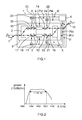
- an amplification device 1 intended for amplifying input optical signals in a Wavelength Division Multiplexing (or WDM) transmission system.
- an amplification device 1 comprises at least a splitting element 2, first 3 and second 4 polarized semiconductor optical amplifiers (or SOAs), a combination element 5, and a control means 6.
- the splitting element 2 is arranged (or configured) for splitting an input optical signal S in in first and second optical signals having respectively first and second polarization modes. As illustrated, this input optical signal S in is provided by a first optical fiber link 7 of a WDM transmission system, which is connected to an input of the amplification device 1.
- the splitting element 2 may comprise a birefringent material that is capable of physically splitting the input optical signal S in in first and second optical signals in order to deliver them respectively onto distant first and second outputs.
- the birefringent material may be a crystal quartz or a calcite crystal.
- the first polarization mode may be a transverse electric (or TE) mode and the second polarization mode may be a transverse magnetic (or TM) mode.
- TE transverse electric
- TM transverse magnetic
- the reverse situation may be envisaged (i.e. a first polarization mode that is a TM mode and a second polarization mode that is a TE mode) if the amplifier is designed and/or positioned to amplify TM mode.
- TM transverse magnetic
- the first polarized semiconductor optical amplifier (or SOA) 3 is arranged for amplifying the first optical signal (originating from a first output of the splitting element 2) as a function of a first driving current 11 provided by the control means 6.
- the second polarized semiconductor optical amplifier (or SOA) 4 is arranged for amplifying the second optical signal (originating from a second output of the splitting element 2) as a function of a second driving current 12 provided by the control means 6.
- polarized SOA a SOA arranged for optimally amplifying an optical signal having a predefined polarization mode.
- This type of SOA, optimized for a predefined polarization mode, may be designed to exhibit a very large gain bandwidth.
- the diagram of Figure 2 illustrates an example of evolution of the optical power outputted by a polarized SOA with a very large gain bandwidth as a function of the wavelength in nanometer (nm).
- the gain bandwidth is larger than 120 nm, which represents a threefold increase of optical gain bandwidth with respect to commonly used EDFAs.
- the first 3 and second 4 SOAs may be two sub-parts of an integrated component 8 that is secured to a small plate (or board) 9.
- the combination element 5 is arranged for combining the first and second amplified optical signals (originating respectively from the first 3 and second 4 SOAs) to produce an output optical signal S out . As illustrated, this output optical signal S out feeds a second optical fiber link 10 of the WDM transmission system, which is connected to an output of the amplification device 1.
- the combination element 5 may comprise a birefringent material that is capable of combining the first and second amplified optical signals it receives onto distant first and second inputs in order to deliver an output optical signal S out .
- the birefringent material may be a crystal quartz or a calcite crystal.
- splitting element 2 and the combination element 5 may be secured to the small plate (or board) 9 or to a subsidiary plate.
- the amplification device 1 preferably comprises further a first micro-lens 11 located just before the first polarized SOA 3, a second micro-lens 12 located just after the first polarized SOA 3, a third micro-lens 13 located just before the second polarized SOA 4, and a fourth micro-lens 14 located just after the second polarized SOA 4.
- These micro-lenses 11-14 allow improving light coupling between elements.
- the micro-lenses 11-14 may be secured to the small plate (or board) 9 or to a subsidiary plate.
- the control means 6 is arranged for producing the first 11 and second 12 driving currents as a function of information representative of powers of at least the first and second optical signals before the first 3 and second 4 polarized SOAs and of a targeted power of the output optical signal S out . So, it aims at controlling automatically the respective amplification levels of the first 3 and second 4 polarized SOAs so that the output optical signal S out be approximately equal to the targeted power (i.e. equal to the latter with a predefined tolerance).
- the control means 6 is preferably made of a combination of hardware and software modules, by means of a microcontroller or a central processing unit (or CPU), for instance.
- the first 3 and second 4 polarized SOAs are preferably arranged for amplifying optical signals having the first polarization mode (and preferably the TE mode).
- the amplification device 1 must further comprise first 15 and second 16 transformation elements to allow a combination of first and second optical signals with different polarization modes by the combination element 5, as illustrated in the non-limiting example of Figure 1 .
- the first transformation element 15 is arranged for tansforming the second polarization mode of the second optical signal (provided by the second output of the splitting element 2) in the first polarization mode. So, it is located before the second polarized SOA 4. It should be understood that this transformation consists in a rotation from the second polarization mode to the first polarization mode.
- the second transformation element 16 is arranged for tansforming the first polarization mode of the first optical signal (provided by the output of the first SOA 3) in the second polarization mode. So, it is located after the first polarized SOA 3. It should be understood that this transformation consists in a rotation from the first polarization mode to the second polarization mode.
- Such an embodiment allows the combination element 5 to combine the first optical signal (amplified and having the second polarization mode) with the second optical signal (amplified and having the first polarization mode) to produce the output optical signal S out .
- the first transformation element 15 and/or the second transformation element 16 comprise(s) a waveplate arranged for inducing the above mentioned polarization mode rotations. These waveplates may be used when the above mentioned free spaces are defined.
- the amplification device 1 may comprise first 17 and second 18 extracting elements and first 19 and second 20 photodiodes.
- the first extracting element 17 is arranged for taking a first predefined percentage of the power of the first optical signal before the first polarized SOA 3.
- the first photodiode 19 is arranged for producing a first information PI1 representative of the power taken from the first optical signal before the first polarized SOA 3 for the control means 6.
- the second extracting element 18 is arranged for taking a second predefined percentage of the power of the second optical signal before the second polarized SOA 4.
- the second photodiode 20 is arranged for producing a second information PI2 representative of the power taken from the second optical signal before the second polarized SOA 4 for the control means 6.
- the first and second predefined percentages may be equal to 1 %. But other values may be used.
- the first 17 and second 18 extracting elements may each comprise a tap coupler arranged for reflecting the first or second predefined power percentage of the first or second optical signal, and of transmitting the complementary power percentage of the first or second optical signal.
- the first or second predefined percentage is equal to 1%
- the complementary power percentage is equal to 99%.
- the first 17 and second 18 extracting elements may be beamsplitters, such as semi-reflective plates or partially reflective mirrors. These beamsplitters may be used when the above mentioned free spaces are defined.
- first 17 and second 18 extracting elements may be secured to the small plate (or board) 9.
- the first 19 and second 20 photodiodes may be secured to the same small plate 9 or to a subsidiary plate positioned below the first one.
- first 19 and second 20 photodiodes may exhibit a low bandwidth.
- control means 6 may be advantageously arranged for producing the first I1 and second I2 driving currents as a function also of other information representative of powers of the first and second optical signals after the first 3 and second 4 polarized SOAs.
- the amplification device 1 may comprise third 21 and fourth 22 extracting elements and third 23 and fourth 24 photodiodes.
- the third extracting element 21 is arranged for taking a third predefined percentage of the power of the first optical signal after the first polarized SOA 3.
- the third photodiode 23 is arranged for producing a third information PI3 representative of the power taken from the first optical signal after the first polarized SOA 3 for the control means 6.
- the fourth extracting element 22 is arranged for taking a fourth predefined percentage of the power of the second optical signal after the second polarized SOA 4.
- the fourth photodiode 24 is arranged for producing a fourth information representative of the power taken from the second optical signal after the second polarized SOA 4 for the control means 6.
- the third and fourth predefined percentages may be equal to 1 %. But other values may be used.
- the third 21 and fourth 22 extracting elements may each comprise a tap coupler arranged for reflecting the third or fourth predefined power percentage of the first or second amplified optical signal, and of transmitting the complementary power percentage of the first or second amplified optical signal.
- the complementary power percentage is equal to 99%.
- the third 21 and fourth 22 extracting elements may be beamsplitters, such as semi-reflective plates or partially reflective mirrors. These beamsplitters may be used when the above mentioned free spaces are defined.
- the third 21 and fourth 22 extracting elements may be secured to the small plate (or board) 9.
- the third 23 and fourth 24 photodiodes may be secured to the same small plate 9 or to a subsidiary plate positioned below the first one.
- the third 23 and fourth 24 photodiodes may exhibit a low bandwidth.
- the last embodiment allows the control means 6 to precisely balance output powers from the first 3 and second 4 SOAs according to the targeted power of the output optical signal S out of the amplification device 1. Once this targeted power is set in the control means 6 through the control plane or a manual setting at startup, each optical path should transmit half of this targeted power. So, the control means 6 adjusts the first I1 and second I2 driving currents accordingly on each SOA 3, 4. To this effect, the control means 6 may, for instance, determine the first I1 and second I2 driving currents from stored data establishing a correspondence between information representative of powers and driving currents.
- control means 6 After having received the power information PI1-PI4 of the two optical paths, the control means 6 finely tunes each driving current I1, I2 to reach the targeted power. To this effect the control means 6 may implement the following algorithm.
- control means 6 determines in stored data the first I1 and second I2 driving currents corresponding respectively to the last received first PI1 and second PI2 power information and to the targeted power. Then, the control means 6 transmits the determined first I1 and second I2 driving currents respectively to the first 3 and second 4 SOAs.
- control means 6 determines if the difference between half of the targeted power and the third power information PI3 is greater than the tolerance.
- control means 6 increases the determined first driving current I1 by a chosen value.
- control means 6 decreases the determined first driving current I1 by a chosen value.
- control means 6 maintains the last determined first driving current I1.
- control means 6 determines if the difference between half of the targeted power and the fourth power information PI4 is greater than the tolerance.
- control means 6 increases the determined second driving current I2 by a chosen value.
- control means 6 decreases the determined second driving current I2 by a chosen value.
- control means 6 maintains the last determined second driving current I2.
- the capacity of a WDM transmission system may be approximately tripled.
- the invention also allows to compensate lumped losses in optical networks by means of simple management rules.
Landscapes
- Physics & Mathematics (AREA)
- Electromagnetism (AREA)
- Condensed Matter Physics & Semiconductors (AREA)
- General Physics & Mathematics (AREA)
- Optics & Photonics (AREA)
- Engineering & Computer Science (AREA)
- Computer Networks & Wireless Communication (AREA)
- Signal Processing (AREA)
- Optical Communication System (AREA)
Priority Applications (1)
| Application Number | Priority Date | Filing Date | Title |
|---|---|---|---|
| EP15306495.1A EP3148018A1 (fr) | 2015-09-25 | 2015-09-25 | Dispositif d'amplification à soa polarisée, permettant d'amplifier des signaux optiques dans un système de transmission wdm |
Applications Claiming Priority (1)
| Application Number | Priority Date | Filing Date | Title |
|---|---|---|---|
| EP15306495.1A EP3148018A1 (fr) | 2015-09-25 | 2015-09-25 | Dispositif d'amplification à soa polarisée, permettant d'amplifier des signaux optiques dans un système de transmission wdm |
Publications (1)
| Publication Number | Publication Date |
|---|---|
| EP3148018A1 true EP3148018A1 (fr) | 2017-03-29 |
Family
ID=54252227
Family Applications (1)
| Application Number | Title | Priority Date | Filing Date |
|---|---|---|---|
| EP15306495.1A Withdrawn EP3148018A1 (fr) | 2015-09-25 | 2015-09-25 | Dispositif d'amplification à soa polarisée, permettant d'amplifier des signaux optiques dans un système de transmission wdm |
Country Status (1)
| Country | Link |
|---|---|
| EP (1) | EP3148018A1 (fr) |
Cited By (1)
| Publication number | Priority date | Publication date | Assignee | Title |
|---|---|---|---|---|
| CN113948972A (zh) * | 2021-09-26 | 2022-01-18 | 武汉联特科技股份有限公司 | 光器件、半导体光放大模块及其使用方法 |
Citations (3)
| Publication number | Priority date | Publication date | Assignee | Title |
|---|---|---|---|---|
| JPS56162554A (en) * | 1980-05-20 | 1981-12-14 | Nippon Telegr & Teleph Corp <Ntt> | Optical amplifying repeater |
| JP2002082321A (ja) * | 2000-09-08 | 2002-03-22 | Mitsubishi Electric Corp | 可変光フィルタ |
| US20130279910A1 (en) * | 2012-04-18 | 2013-10-24 | Infinera Corporation | Banded Semiconductor Optical Amplifier |
-
2015
- 2015-09-25 EP EP15306495.1A patent/EP3148018A1/fr not_active Withdrawn
Patent Citations (3)
| Publication number | Priority date | Publication date | Assignee | Title |
|---|---|---|---|---|
| JPS56162554A (en) * | 1980-05-20 | 1981-12-14 | Nippon Telegr & Teleph Corp <Ntt> | Optical amplifying repeater |
| JP2002082321A (ja) * | 2000-09-08 | 2002-03-22 | Mitsubishi Electric Corp | 可変光フィルタ |
| US20130279910A1 (en) * | 2012-04-18 | 2013-10-24 | Infinera Corporation | Banded Semiconductor Optical Amplifier |
Cited By (1)
| Publication number | Priority date | Publication date | Assignee | Title |
|---|---|---|---|---|
| CN113948972A (zh) * | 2021-09-26 | 2022-01-18 | 武汉联特科技股份有限公司 | 光器件、半导体光放大模块及其使用方法 |
Similar Documents
| Publication | Publication Date | Title |
|---|---|---|
| US8666252B2 (en) | Optical network system | |
| US9699531B2 (en) | Switchable optical amplifier and optical transmission apparatus | |
| US10419149B2 (en) | Amplification device with amplification stages with polarized SOAs and processing stage, for amplifying optical signals in a WDM transmission system | |
| JP3638777B2 (ja) | 利得等化のための方法並びに該方法の実施に使用する装置及びシステム | |
| JP6608747B2 (ja) | 波長多重光受信装置及びその駆動方法 | |
| EP3510709B1 (fr) | Systèmes de communication optique multiplexés par répartition spatiale et amplificateurs associés | |
| JP6627579B2 (ja) | 位相感応増幅器及び位相感応増幅のための方法 | |
| US9030730B2 (en) | Optical phase-sensitive amplifier for dual-polarization modulation formats | |
| US20190052056A1 (en) | Optical module and method for controlling optical module | |
| US20190280452A1 (en) | Optical amplification device, pump light supply method and circuit | |
| CN103329461B (zh) | 光学通信系统和方法 | |
| WO2018193587A1 (fr) | Appareil d'amplification optique et procédé d'amplification de signal optique | |
| US20180254832A1 (en) | Optical reception device, optical modulator and optical modulation method | |
| US8189258B2 (en) | Optical amplifier configuration | |
| KR100474701B1 (ko) | 이득 조절이 가능한 광대역 광섬유 증폭기 | |
| EP3148018A1 (fr) | Dispositif d'amplification à soa polarisée, permettant d'amplifier des signaux optiques dans un système de transmission wdm | |
| JP2019140471A (ja) | 光ノード装置 | |
| JP2012043934A (ja) | 増幅装置、通信システムおよび増幅方法 | |
| US8681420B2 (en) | Optical transmission system | |
| JP5967737B1 (ja) | 光通信システム及びマルチモード光ファイバ増幅装置 | |
| JP2002198601A (ja) | 光増幅器および光増幅方法 | |
| JP2023029247A (ja) | 半導体に基づく広帯域幅伝送用のシステム及び方法 | |
| JP2001308791A (ja) | 可変利得等化器 | |
| JP2018146614A (ja) | 光受信装置 | |
| JP2007074511A (ja) | 光増幅装置および光通信システム |
Legal Events
| Date | Code | Title | Description |
|---|---|---|---|
| PUAI | Public reference made under article 153(3) epc to a published international application that has entered the european phase |
Free format text: ORIGINAL CODE: 0009012 |
|
| STAA | Information on the status of an ep patent application or granted ep patent |
Free format text: STATUS: THE APPLICATION HAS BEEN PUBLISHED |
|
| AK | Designated contracting states |
Kind code of ref document: A1 Designated state(s): AL AT BE BG CH CY CZ DE DK EE ES FI FR GB GR HR HU IE IS IT LI LT LU LV MC MK MT NL NO PL PT RO RS SE SI SK SM TR |
|
| AX | Request for extension of the european patent |
Extension state: BA ME |
|
| STAA | Information on the status of an ep patent application or granted ep patent |
Free format text: STATUS: THE APPLICATION IS DEEMED TO BE WITHDRAWN |
|
| 18D | Application deemed to be withdrawn |
Effective date: 20170930 |