EP3148089B1 - Kommunikationsverfahren und kommunikationsvorrichtung - Google Patents
Kommunikationsverfahren und kommunikationsvorrichtung Download PDFInfo
- Publication number
- EP3148089B1 EP3148089B1 EP15796489.1A EP15796489A EP3148089B1 EP 3148089 B1 EP3148089 B1 EP 3148089B1 EP 15796489 A EP15796489 A EP 15796489A EP 3148089 B1 EP3148089 B1 EP 3148089B1
- Authority
- EP
- European Patent Office
- Prior art keywords
- cyclic
- block
- bits
- codeword
- permutation
- Prior art date
- Legal status (The legal status is an assumption and is not a legal conclusion. Google has not performed a legal analysis and makes no representation as to the accuracy of the status listed.)
- Active
Links
Images









Classifications
-
- H—ELECTRICITY
- H04—ELECTRIC COMMUNICATION TECHNIQUE
- H04L—TRANSMISSION OF DIGITAL INFORMATION, e.g. TELEGRAPHIC COMMUNICATION
- H04L1/00—Arrangements for detecting or preventing errors in the information received
- H04L1/004—Arrangements for detecting or preventing errors in the information received by using forward error control
- H04L1/0041—Arrangements at the transmitter end
-
- H—ELECTRICITY
- H03—ELECTRONIC CIRCUITRY
- H03M—CODING; DECODING; CODE CONVERSION IN GENERAL
- H03M13/00—Coding, decoding or code conversion, for error detection or error correction; Coding theory basic assumptions; Coding bounds; Error probability evaluation methods; Channel models; Simulation or testing of codes
- H03M13/03—Error detection or forward error correction by redundancy in data representation, i.e. code words containing more digits than the source words
- H03M13/05—Error detection or forward error correction by redundancy in data representation, i.e. code words containing more digits than the source words using block codes, i.e. a predetermined number of check bits joined to a predetermined number of information bits
- H03M13/11—Error detection or forward error correction by redundancy in data representation, i.e. code words containing more digits than the source words using block codes, i.e. a predetermined number of check bits joined to a predetermined number of information bits using multiple parity bits
- H03M13/1102—Codes on graphs and decoding on graphs, e.g. low-density parity check [LDPC] codes
- H03M13/1148—Structural properties of the code parity-check or generator matrix
- H03M13/116—Quasi-cyclic LDPC [QC-LDPC] codes, i.e. the parity-check matrix being composed of permutation or circulant sub-matrices
-
- H—ELECTRICITY
- H03—ELECTRONIC CIRCUITRY
- H03M—CODING; DECODING; CODE CONVERSION IN GENERAL
- H03M13/00—Coding, decoding or code conversion, for error detection or error correction; Coding theory basic assumptions; Coding bounds; Error probability evaluation methods; Channel models; Simulation or testing of codes
- H03M13/03—Error detection or forward error correction by redundancy in data representation, i.e. code words containing more digits than the source words
- H03M13/05—Error detection or forward error correction by redundancy in data representation, i.e. code words containing more digits than the source words using block codes, i.e. a predetermined number of check bits joined to a predetermined number of information bits
- H03M13/11—Error detection or forward error correction by redundancy in data representation, i.e. code words containing more digits than the source words using block codes, i.e. a predetermined number of check bits joined to a predetermined number of information bits using multiple parity bits
- H03M13/1102—Codes on graphs and decoding on graphs, e.g. low-density parity check [LDPC] codes
- H03M13/1148—Structural properties of the code parity-check or generator matrix
- H03M13/116—Quasi-cyclic LDPC [QC-LDPC] codes, i.e. the parity-check matrix being composed of permutation or circulant sub-matrices
- H03M13/1165—QC-LDPC codes as defined for the digital video broadcasting [DVB] specifications, e.g. DVB-Satellite [DVB-S2]
-
- H—ELECTRICITY
- H03—ELECTRONIC CIRCUITRY
- H03M—CODING; DECODING; CODE CONVERSION IN GENERAL
- H03M13/00—Coding, decoding or code conversion, for error detection or error correction; Coding theory basic assumptions; Coding bounds; Error probability evaluation methods; Channel models; Simulation or testing of codes
- H03M13/25—Error detection or forward error correction by signal space coding, i.e. adding redundancy in the signal constellation, e.g. Trellis Coded Modulation [TCM]
- H03M13/255—Error detection or forward error correction by signal space coding, i.e. adding redundancy in the signal constellation, e.g. Trellis Coded Modulation [TCM] with Low Density Parity Check [LDPC] codes
-
- H—ELECTRICITY
- H03—ELECTRONIC CIRCUITRY
- H03M—CODING; DECODING; CODE CONVERSION IN GENERAL
- H03M13/00—Coding, decoding or code conversion, for error detection or error correction; Coding theory basic assumptions; Coding bounds; Error probability evaluation methods; Channel models; Simulation or testing of codes
- H03M13/27—Coding, decoding or code conversion, for error detection or error correction; Coding theory basic assumptions; Coding bounds; Error probability evaluation methods; Channel models; Simulation or testing of codes using interleaving techniques
- H03M13/2778—Interleaver using block-wise interleaving, e.g. the interleaving matrix is sub-divided into sub-matrices and the permutation is performed in blocks of sub-matrices
-
- H—ELECTRICITY
- H04—ELECTRIC COMMUNICATION TECHNIQUE
- H04L—TRANSMISSION OF DIGITAL INFORMATION, e.g. TELEGRAPHIC COMMUNICATION
- H04L1/00—Arrangements for detecting or preventing errors in the information received
- H04L1/004—Arrangements for detecting or preventing errors in the information received by using forward error control
- H04L1/0056—Systems characterized by the type of code used
- H04L1/0057—Block codes
-
- H—ELECTRICITY
- H04—ELECTRIC COMMUNICATION TECHNIQUE
- H04L—TRANSMISSION OF DIGITAL INFORMATION, e.g. TELEGRAPHIC COMMUNICATION
- H04L1/00—Arrangements for detecting or preventing errors in the information received
- H04L1/004—Arrangements for detecting or preventing errors in the information received by using forward error control
- H04L1/0056—Systems characterized by the type of code used
- H04L1/0057—Block codes
- H04L1/0058—Block-coded modulation
-
- H—ELECTRICITY
- H04—ELECTRIC COMMUNICATION TECHNIQUE
- H04L—TRANSMISSION OF DIGITAL INFORMATION, e.g. TELEGRAPHIC COMMUNICATION
- H04L1/00—Arrangements for detecting or preventing errors in the information received
- H04L1/004—Arrangements for detecting or preventing errors in the information received by using forward error control
- H04L1/0056—Systems characterized by the type of code used
- H04L1/0071—Use of interleaving
-
- H—ELECTRICITY
- H04—ELECTRIC COMMUNICATION TECHNIQUE
- H04L—TRANSMISSION OF DIGITAL INFORMATION, e.g. TELEGRAPHIC COMMUNICATION
- H04L27/00—Modulated-carrier systems
- H04L27/32—Carrier systems characterised by combinations of two or more of the types covered by groups H04L27/02, H04L27/10, H04L27/18 or H04L27/26
- H04L27/34—Amplitude- and phase-modulated carrier systems, e.g. quadrature-amplitude modulated carrier systems
- H04L27/3405—Modifications of the signal space to increase the efficiency of transmission, e.g. reduction of the bit error rate, bandwidth, or average power
Definitions
- the present disclosure relates to a digital communication field. More specifically, the present disclosure relates to bit interleavers and bit de-interleavers in a bit-interleaved coding and modulation (BICM) system using quasi-cyclic low-density parity-check codes (QC LDPC codes) and quadrature amplitude modulation (QAM).
- BICM bit-interleaved coding and modulation
- QC LDPC codes quasi-cyclic low-density parity-check codes
- QAM quadrature amplitude modulation
- EP 2 560 310 relates to bit interleaving and de-interleaving of quasi-cyclic low-density parity-check codes and discloses an interleaving scheme that is aimed at allowing matching of the importance level of the cyclic blocks and the robustness of the constellation word bits to which they are mapped.
- EP 2 690 790 relates to communication systems that employ rotated multidimensional constellations in conjunction with quasi-cyclic low-density parity-check codes and provides a scheme of mapping the bit interleaver output to the constellation blocks such that each constellation block encodes only two bits of the same quasi-cyclic block. This scheme aims at allowing for a particularly efficient hardware implementation of the receiver with a plurality of parallel constellation demapper units.
- the constellation demapper units are grouped into several demapper banks such that each demapper bank only needs to access two memory banks, i.e., the memory banks holding information on the two bits encoded by the constellation block that is to be decoded by the respective demapper bank.
- This particular hardware implementation can be used irrespective of the number of dimensions of the constellations employed.
- NPL 1 DVB-S2 standard: ETSI EN 302 307, V1.2.1 (March, 2009 )
- the present invention is defined by the subject matter of claim 1.
- FIG. 1 is a block diagram illustrating one configuration example of a transmitter including general bit-interleaved coding and modulation (BICM).
- BICM general bit-interleaved coding and modulation
- Transmitter 100 illustrated in FIG. 1 includes input processing unit 110, BICM encoder 120, orthogonal frequency-division multiplexing (OFDM) modulator 130, up-converter 140, radio frequency (RF) amplifier 150, and antenna 160.
- OFDM orthogonal frequency-division multiplexing
- RF radio frequency
- Input processing unit 110 formats input-bit-streams into blocks of a determined length called baseband frames.
- BICM encoder 120 converts the baseband frames into data-streams including a plurality of complex values.
- OFDM modulator 130 uses, for example, OFDM modulation, and typically performs time interleaving and frequency interleaving for improving diversity.
- Up-converter 140 converts digital baseband signals into analog RF signals.
- RF amplifier 150 performs power amplification of the analog RF signals, and outputs the analog RF signals to antenna 160.
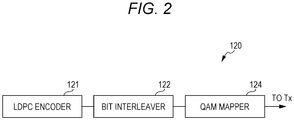
- FIG. 2 is a block diagram illustrating one configuration example of BICM encoder 120 of FIG. 1 .
- BICM encoder 120 illustrated in FIG. 2 includes low-density parity-check (LDPC) encoder 121, bit interleaver 122, and quadrature amplitude modulation (QAM) mapper 124.
- LDPC low-density parity-check
- QAM quadrature amplitude modulation
- LDPC encoder 121 encodes input blocks, that is, the baseband frames, and outputs LDPC codewords to bit interleaver 122.
- Bit interleaver 122 permutates bits of each LDPC codeword, and then QAM mapper 124 maps the bits of each LDPC codeword to complex cells.
- QAM mapper 124 maps the permutated bits of each LDPC codeword to the complex cells by using QAM.
- LDPC encoder 121 encodes the baseband frames by using a specific LDPC code.
- the present disclosure is particularly designed for LDPC block codes having staircase parity structure which is employed in the DVB-S2, DVB-T2, DVB-C2 standards, and for variations of Raptor-like LDPC codes. More details will be described below.
- the LDPC block code is a linear error-correcting code that is fully defined by its parity-check matrix (PCM).
- PCM parity-check matrix
- This PCM is a binary sparse matrix representing connection of the codeword bits (also referred to as bit nodes or variable nodes) to parity checks (also referred to as check nodes). Columns and rows of the PCM correspond to the variable nodes and check nodes, respectively. Connection of the variable nodes to the check nodes are represented by "1" entries in the PCM matrix.
- Quasi-cyclic low-density parity-check (QC LDPC) codes have structure especially suitable for hardware implementation. In fact, most if not all standards today use the QC LDPC codes.
- the PCM of such a QC LDPC code has special structure having cyclic matrices (or also referred to as cyclic).
- the cyclic matrix is a square matrix in which each row is a cyclic shift of a previous row by one matrix element, and may have one or more folded diagonals.
- a size of each cyclic matrix is Q ⁇ Q (Q rows and Q columns), and Q is referred to as a cyclic factor of the QC LDPC code.
- Q is referred to as a cyclic factor of the QC LDPC code.
- the PCM of a QC LDPC code is a matrix having Q ⁇ M rows and Q ⁇ N columns, and the codewords each include N blocks including Q bits.
- M is a number of blocks in a parity part.
- a Q-bit block is referred to as a quasi-cyclic block or simply a cyclic block throughout this document, and is abbreviated as QB.
- the PCM includes cyclic matrices having one or two folded diagonals.
- the QC LDPC code with the PCM illustrated in FIG. 3 belongs to a special family of QC LDPC codes referred to as repeat-accumulate quasi-cyclic low-density parity-check (RA QC LDPC) codes.
- the RA QC LDPC codes are known for ease of encoding, and are employed in a very large number of standards such as the second generation DVB standards (DVB-S2, DVB-T2, DVB-C2).
- Each LDPC code is fully defined by a table containing, for a first bit of each cyclic block in an information part, indices of each check node to which the first bit is connected. Note that the indices of each check node start with zero. These indices are referred to as "addresses of the parity bit accumulators" in the DVB-S2 standard.
- FIG. 4 illustrates the table for the LDPC code one example of which is illustrated in FIG. 3 .
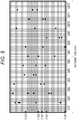
- FIG. 5 is a diagram illustrating the information part of the PCM for a first bit in each cyclic block of the information part for the RA QC LDPC code of FIG. 4 .
- the full PCM includes entries for all information bits and the staircase parity part, and is illustrated in FIG. 6 .
- Equation 1 For each bit other than the first bit of each cyclic block in the information part, the indices of each check node to which the bit is connected are calculated by Equation 1 described below.
- i q i 0 + q ⁇ M % Q ⁇ M
- q is a bit index (0, ..., Q - 1) within one cyclic block
- i q is a check node index for bit q
- i 0 is one of the check nodes to which the first bit of the cyclic block in the table of FIG. 4 is connected.
- M is a number of cyclic blocks in the parity part, and is 6 in the example of FIG. 6
- Q is a number of bits of one cyclic block and is 8 in the example of FIG. 6 .
- Equation 2 a permutation expressed by Equation 2 described below is applied to the rows of the PCM in FIG. 6 , and this application of the permutation results in the matrix illustrated in FIG. 7 .
- j i % M ⁇ Q + floor i / M where i and j are indices starting with zero.
- i is an index of the check nodes before permutation
- j is an index of the check nodes after permutation.
- M is a number of cyclic blocks in the parity part, and is 6 in the example of FIG. 6
- Q is a number of bits of one cyclic block, and is 8 in the example of FIG. 6 .
- % is a modulo operator
- floor(x) is a function that outputs a maximum integer equal to or less than x.
- Equation 3 a special permutation expressed by Equation 3 described below needs to be applied only to the parity bits.
- i and j are indices starting with zero, i is an index of the parity bits before permutation, and j is an index of the parity bits after permutation.
- M is a number of cyclic blocks in the parity part, and is 6 in the example of FIG. 7
- Q is a number of bits of one cyclic block, and is 8 in the example of FIG. 7 .
- % is a modulo operator
- floor(x) is a function that outputs a maximum integer equal to or less than x.
- parity permutation or parity interleaving the permutation by Equation 3 applied only to the parity bits is referred to as a parity permutation or parity interleaving throughout this document.
- the parity permutation or the parity interleaving will be regarded as part of the LDPC encoding process hereinafter.
- next-generation ATSC 3.0 standard for terrestrial reception of digital video service is currently under development, and will define 1/15, 2/15, ..., 13/15 as code rates, and 16200 code bits and 64800 code bits as code lengths.
- QAM mapper 124 Next, QAM mapper 124 will be described.
- QAM mapper 124 maps the bit of the codeword to one point of a plurality of points in a QAM constellation by independently modulating real components and imaginary components by using pulse-amplitude modulation (PAM). Each point in the QAM constellation corresponds to one combination of the bits.
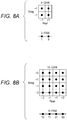
- FIG. 8A to FIG. 8C are diagrams illustrating three types of QAM constellations relevant to the present disclosure, a 4-QAM constellation, a 16-QAM constellation, and a 64-QAM constellation.
- the real components and the imaginary components use the same type of PAM.
- the real components and the imaginary components use 2-PAM, 4-PAM, 8-PAM in the 4-QAM constellation, the 16-QAM constellation, and the 64-QAM constellation, respectively.
- the present disclosure also assumes that the PAM mapping uses Gray encoding, as illustrated from FIG. 8A to FIG. 8C .
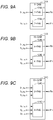
- FIG. 9A, FIG. 9B, FIG. 9C are blocks illustrating configurations of the QAM mappers corresponding to the constellations of FIG. 8A, FIG. 8B , FIG. 8C , respectively.
- 4-QAM mapper 124A of FIG. 9A includes two independent 2-PAM mappers 124A-1, 124A-2 each of which encodes one bit.
- 16-QAM mapper 124B of FIG. 9B includes two independent 4-PAM mappers 124B-1, 124B-2 each of which encodes two bits.
- 64-QAM mapper 124C of FIG. 9C includes two independent 8-PAM mappers 124C-1, 124C-2 each of which encodes three bits.
- FIG. 10 illustrates a schematic view for illustrating the different robustness levels in an 8-PAM symbol using Gray encoding.
- the different robustness levels result from a fact that a distance between a portion with a bit value of zero and a portion with a bit value of one is different for each of three bits b 1 , b 2 , b 3 .
- the reliability of a bit is proportional to an average distance between the portion with a bit value of zero and the portion with a bit value of one. In the example illustrated in FIG. 10 , bit b 1 has lowest reliability, bit b 2 has second lowest reliability, and bit b 3 has highest reliability.
- non-uniform constellations In order to increase a transmission rate of bits, that is, BICM capacity, non-uniform constellations have been introduced in the DVB-NGH standard, which is the first time. This increase is achieved by changing an interval between PAM constellation points, and so-called 1D-NU-PAMs are obtained. Next, a square non-uniform constellation is obtained from the 1D-NU-PAMs.
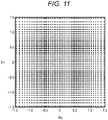
- FIG. 11 illustrates one example of a 4096-QAM constellation based on 1D-64 NU-PAM.
- a number of bits in the QAM symbol is represented by B. Since the QAM constellations are square, B is an even number. Further, since a square QAM symbol includes two PAM symbols of the same type, the bits encoded in the QAM symbol can be grouped into pairs having the same robustness levels. The bits encoded in the QAM symbol are referred to as a constellation word.
- bit interleaver 122 Next, bit interleaver 122 will be described.
- the bits of an LDPC codeword have different importance levels, and the bits of a constellation have different robustness levels.
- Direct that is, non-interleaved mapping of the LDPC codeword bits to the QAM constellation bits does not achieve optimal performance.
- the codeword bits need to be interleaved before the codeword bits are mapped to constellations.
- bit interleaver 122 is provided between LDPC encoder 121 and QAM mapper 124, as illustrated in FIG. 2 .
- Careful designing of bit interleaver 122 can achieve an optimal relationship between the bits of the LDPC codeword and the bits encoded by the constellation, and leads improved performance.
- evaluation criterion of the performance is a bit error rate (BER) or a frame error rate (FER) as a function of a signal-to-noise ratio (SNR).
- the different importance levels of the bits of an LDPC codeword result firstly from a fact that a number of parity checks (check nodes) is different in some of the bits.
- the different importance levels of the bits of the LDPC codeword results secondly from a fact that the variable nodes have different connectivity to the cycles in the Tanner graph representation of the LDPC code.
- the importance levels of the bits may be different even when the number of the parity checks (check nodes) connected to the codeword bits of the LDPC codeword is the same number in each of the bits.
- the Q ⁇ B/2 bits of the B/2 cyclic blocks are mapped to Q/2 spatial-multiplexing blocks.
- the B/2 cyclic blocks are referred to as a section.
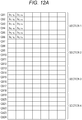
- FIG. 12A to FIG. 12C are diagrams for illustrating one example of BICM encoder 120 of FIG. 2 .
- FIG. 12A illustrates arrangement of 24 cyclic blocks with four sections.
- FIG. 12B is a diagram illustrating one example of structure of a pathway from bit interleaver 122 to QAM mapper 124 (including one pair of PAM mappers 124-1, 124-2) in BICM encoder 120 in FIG. 2 based on DVB-NGH.
- bit interleaver 122 is six cyclic blocks per section. Note that processing is performed by bit interleaver 122 and QAM mapper 124 in FIG. 12B (a pair of PAM mappers 124-1, 124-2 are included) for each section in FIG. 12A . Bit interleaver 122 permutates the fed bits, and then arranges the permutated bits to the real part and the imaginary part of the corresponding constellation words.
- the pair of PAM mappers 124-1, 124-2 map bits (b 1, Re , b 2, Re , ..., b 6, Re ) to a real component (Re) of complex symbol s1, and map bits (b 1, Im , b 2, Im , ..., b 6, Im ) to an imaginary component (Im) of complex symbol s1 by using the 64-PAM constellation.
- FIG. 12C is a diagram for illustrating bit permutation executed by bit interleaver 122 in FIG. 12B .
- bit interleaver 122 executes processing equivalent to writing all bits of one section of the codeword row-by-row in a matrix, and to reading the written bits column-by-column from the matrix. Note that this matrix is of B/2 rows and Q columns.
- FIG. 13A to FIG. 13C are diagrams for illustrating other examples of BICM encoder 120 of FIG. 2 .
- FIG. 13A to FIG. 13C are similar to FIG. 12A to FIG. 12C , respectively, except that FIG. 13A to FIG. 13C illustrate the arrangement based on ATSC 3.0.
- FIG. 13A illustrates arrangement of 24 cyclic blocks with two sections. Unlike the case of FIG. 12A , in the example of FIG. 13A , a number of cyclic blocks per section is bit number B of the QAM symbol, and is 12 in the example of FIG. 13A .
- FIG. 13B is a diagram illustrating one example of structure of a pathway from bit interleaver 122 to QAM mapper 124 of BICM encoder 120 in FIG. 2 based on ATSC 3.0.
- bit interleaver 122 is 12 cyclic blocks per section. Note that processing is performed by bit interleaver 122 and QAM mapper 124 in FIG. 13B for each section of FIG. 13A . Bit interleaver 122 permutates the fed bits.
- QAM mapper 124 maps bits (b 0 , b 1 , ..., b 11 ) to complex symbol s1 by using the 4096-QAM constellation.
- FIG. 13C is a diagram for illustrating bit permutation executed by bit interleaver 122 in FIG. 13B .
- bit interleaver 122 executes processing equivalent to writing all bits of one section of the codeword row-by-row in a matrix, and to reading the written bits column-by-column from the matrix. Note that this matrix is of B rows and Q columns.
- the different cyclic block of a determined LDPC code may have a different importance level because the importance level of a bit is dependent on the number of check nodes connected to the bit.
- improvement in transmission performance may be achieved by matching the importance level of the cyclic block with robustness of the bit of the constellation word to which this cyclic block is mapped.
- the bit of the cyclic block with the highest importance level is mapped to the bit of the constellation word with the strongest robustness.
- the bit of the cyclic block with the lowest importance level is mapped to the bit of the constellation word with the weakest robustness.
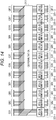
- FIG. 14 is a block diagram illustrating one configuration example of the bit interleaver according to an exemplary embodiment of the present disclosure.
- a cyclic block permutation (QB permutation) is executed for the codeword. This processing in the first stage is performed by cyclic block permutation unit 210.
- an intra-cyclic block permutation (intra-QB permutation) is executed for the cyclic blocks.
- This processing in the second stage is executed by intra-QB permutation units 220-1 to 220-12. Note that the second stage may not exist.
- a third stage after the first stage and the second stage are executed, the bits of each cyclic block of the codeword are mapped to the constellation word.
- This third stage can be implemented by dividing the codeword into a plurality of sections and performing mapping to the constellation word for each section (section permutation).
- the third stage is realized by disposing an interleaver (section interleaver) that has a function equivalent to bit interleaver 122 described with reference to FIG. 13A to FIG. 13C , in a subsequent stage of the intra-QB permutation unit.
- the inventors have found that improvement in communication performance for a determined LDPC code is achieved by optimizing the cyclic block permutation, that is, by selecting the cyclic block permutation that matches the constellation bits of different reliability with the cyclic blocks of different importance levels.
- a method used for finding the optimal cyclic block permutation disclosed in the present disclosure includes the following steps, and is applied to each of different constellations and different code rates.
- a very huge number (1e4, ..., 1e5) of cyclic block permutations are generated randomly under no constraint.
- Monte-Carlo simulations are executed for these cyclic block permutations by using blind demapping and iterative demapping in order to determine a threshold signal-to-noise ratio (SNR) at a determined target value of a block error rate (BLER).
- SNR signal-to-noise ratio
- BLER block error rate
- the inventors have found that optimization of the cyclic block permutation for the blind demapping does not result in optimal performance in the iterative demapping, and vice versa. It remains as a challenging task to find a cyclic block permutation that achieves good performance for both the blind demapping and the iterative demapping.
- An SNR range for various cyclic block permutations is determined from the preliminary step. Then, the threshold SNR is set in order to select only cyclic block permutations that achieve good performance for the blind demapping.
- the good performance means a low SNR.
- the threshold SNR should not be set too low. This is because the too low threshold SNR leads to exclusion of many cyclic block permutations that achieve very good performance for the iterative demapping.
- performance becomes poor. It is a question of experience to select the initial threshold SNR appropriately.
- a large number of cyclic block permutations are generated randomly under no constraint.
- a BLER curve regarding the blind demapping is determined for each cyclic block permutation by using Monte-Carlo simulations, for example. Only the cyclic block permutations with the SNR at the BELR target value being lower than a determined threshold SNR is kept. The BLER curve regarding the iterative demapping is determined for the kept cyclic block permutations, and the best cyclic block permutation is kept.
- a medium number of cyclic block permutations determined from the cyclic block permutation selected in the first selection step is generated randomly under a constraint. Then, a selection criterion in the first selection step is applied.
- the constrained cyclic block permutations are determined by application of a random permutation to the cyclic block of one section randomly selected. The application of such a constraint ensures that changes in performance are small and concentrated around the good-performance cyclic block permutation that has already selected in the first selection step. The good-performance cyclic block permutation can be found by this method more effectively than by using blind unconstrained search.
- a third selection step the medium number of cyclic block permutations determined from the cyclic block permutation selected in the second selection step is generated randomly under a constraint. Then, the selection criterion in the first selection step is applied.
- the constrained cyclic block permutations are determined by application of random permutations to the bits having the same robustness level.
- the inventors have carried out optimization of the cyclic block permutations for each of the code rates 6/15, 7/15, 8/15.
- the inventors have determined the optimal non-uniform constellation to be used together with the code rates 6/15, 7/15, 8/15.
- the following describes QB permutations and non-uniform constellations optimized for each of the code rates 6/15, 7/15, 8/15.
- Table 1 and Table 2 are tables illustrating the cyclic block permutations and non-uniform 64-PAM constellations that constitute non-uniform 4096-QAM constellations according to the present disclosure when the code rate is equal to 6/15, respectively.
- Table 3 and Table 4 are tables illustrating the cyclic block permutations and the non-uniform 64-PAM constellations that constitute the non-uniform 4096-QAM constellations according to the present disclosure when the code rate is equal to 7/15, respectively.
- [Table 3] j-th block of Group-wise Inter leaver output ⁇ (j)-th block of Group-wise Inter leaver input j-th block of Group-wise Inter leaver output ⁇ (j)-th block of Group-wise Inter leaver input j-th block of Group-wise Inter leaver output ⁇ (j)-th block of Group-wise Inter leaver input j-th block of Group-wise Inter leaver output ⁇ (j) -th block of Group-wi se Inter leaver input 0 59 45 101 90 138 135 24 1 122 46 4 91 51 136 117 2 161 47 5 92 89 137 154 3 93 48 87 93 88 138 157 4 37 49 106 94 167 139 164 5 112
- Table 5 and Table 6 are tables illustrating the cyclic block permutations and the non-uniform 64-PAM constellations that constitute the non-uniform 4096-QAM constellations according to the present disclosure when the code rate is equal to 8/15, respectively.
- [Table 5] j-th block of Group-wise Inter leaver output ⁇ (j)-th block of Group-wi se Inter leaver input j-th block of Group-wise Inter leaver output ⁇ (j)-th block of Group-wise Inter leaver input j-th block of Group-wise Inter leaver output ⁇ (j)-th block of Group-wi se Inter leaver input j-th block of Group-wise Inter leaver output ⁇ (j)-th block of Group-wise Inter leaver input 0 82 45 161 90 56 135 166 1 75 46 69 91 144 136 16 2 51 47 8 92 74 137 131 3 24 48 156 93 89 138 105 4 96 49 52 94 14 139 159 5 80 50 45
- cyclic block permutation unit 210 in FIG. 14 permutates the cyclic blocks within the codeword according to the code rate of the code used by LDPC encoder 121, based on the cyclic block permutations of Table 1, Table 3, and Table 5 according to the code rates 6/15, 7/15, and 8/15, respectively.
- address label x" of imaginary part p (x") is calculated by Equation 6 by using odd numbered bits b 1 , b 3 , b 5 , b 7 , b 9 , b 11 that are output from the above-described section interleaver.
- the above-described cyclic block permutations (for example, Table 1, Table 3, Table 5) and the non-uniform QAM constellations (for example, Table 2, Table 4, Table 6) are relevant to both the transmitter side and the receiver side in a digital communication system.
- Each of the above-described cyclic block permutations uniquely defines its inverse cyclic block permutation.
- One of the above-described cyclic block permutations is used for bit interleaving on the transmitter side, and its inverse cyclic block permutation is used for bit de-interleaving on the receiver side.
- mapping of constellation words that is, bits of the codeword to complex cells used for transmission is performed in the transmitter, and demapping of the received complex cells is performed in the receiver on the other side of a communication channel.
- Table 7-1 Table 7-2 illustrate definition of this LDPC code with the code rate of 6/15 and a code length of 64800 code bits. Note that actually, the definition of the LDPC code is completed by a last row of Table 7-1 followed by a first row of Table 7-2.
- Table 8-1 and Table 8-2 illustrate definition of this LDPC code with the code rate of 7/15 and the code length of 64800 code bits. Note that actually, the definition of the LDPC code is completed by the last row of Table 8-1 followed by the first row of Table 8-2.
- Table 9-1 and Table 9-2 illustrate definition of this LDPC code with the code rate of 8/15 and the code length of 64800 code bits. Note that actually, the definition of the LDPC code is completed by the last row of Table 9-1 followed by the first row of Table 9-2.
- the LDPC code with the code rates of 6/15, 7/15 is defined based on the following algorithm.
- M 1 1080
- M 2 37800
- LDPC encoder 121 calculates the parity bit as follows.
- the LDPC code with the code rate of 8/15 is defined by the following algorithm.
- a role of the parity interleaver is to convert the staircase structure of the parity part of the LDPC parity-check matrix into a quasi-cyclic structure similar to the information part of the matrix.
- Parity interleaved codeword bits c 0 , c 1 , ..., c N - 1 are sent to cyclic block permutation unit 210 of the bit interleaver.
- Parameters q (i, j, 0) indicate j-th entry of the i-th row in the index list of the definition based on each of Table 9-1 and Table 9-2, and satisfy a relationship of Equation 19.
- q i j l q i j 0 + R ⁇ I mod N ⁇ k for 0 ⁇ l ⁇ 360
- the present disclosure is not limited to the description provided in the above-described exemplary embodiment, and can be carried out in any form for achieving the object of the present disclosure and an object related or relevant to the object of the present disclosure.
- the present disclosure may be as follows.
- the present disclosure can be used for a BICM system that uses a QC LDPC code and QAM.
Landscapes
- Engineering & Computer Science (AREA)
- Physics & Mathematics (AREA)
- Mathematical Physics (AREA)
- Computer Networks & Wireless Communication (AREA)
- Signal Processing (AREA)
- Probability & Statistics with Applications (AREA)
- Theoretical Computer Science (AREA)
- Multimedia (AREA)
- Error Detection And Correction (AREA)
- Detection And Prevention Of Errors In Transmission (AREA)
Claims (1)
- Kommunikationsverfahren, umfassend:Ausführen einer zyklischen Blockpermutation für ein Codewort, das auf der Grundlage eines quasi-zyklischen Paritätsprüfcodes niedriger Dichte erzeugt wurde, der einen quasi-zyklischen Wiederholungs-Akkumulations-Paritätsprüfcode niedriger Dichte enthält, wobei das Codewort N zyklische Blöcke enthält, jeder der N zyklischen Blöcke Q Bits enthält, jedes aus N und Q eine positive ganze Zahl ist und die zyklische Blockpermutation eine Permutation der zyklischen Blöcke innerhalb des Codeworts ist; undgekennzeichnet durchZuordnen von jedem der Bits des Codeworts, für das die zyklische Blockpermutation ausgeführt wird, zu einem aus Konstellationspunkten einer uneinheitlichen 4096-QAM-Konstellation, wobei das Zuordnen eine Abschnittsverschachtelung beinhaltet, die jedes Konstellationswort aus Bits in B zyklischen Blöcken des Codeworts erzeugt, für das die zyklische Blockpermutation ausgeführt wird, wobei B eine Bitnummer des QAM-Symbols ist, wobei die B zyklischen Blöcke dadurch den jeweiligen Abschnitt bilden, wobei die Abschnittsverschachtelung durchgeführt wird, indem alle Bits eines Abschnitts des Codeworts, für das die zyklische Blockpermutation ausgeführt wird, zeilenweise in einer Matrix geschrieben und diese Bits spaltenweise aus der Matrix gelesen werden; undSenden des zugeordneten Codeworts,wobei die zyklische Blockpermutation und die ungleichmäßige Konstellation auf der Grundlage einer Code-Rate des quasi-zyklischen Paritätsprüfcodes niedriger Dichte, der für die Erzeugung des Codeworts verwendet wird, ausgewählt werden, wobei die ungleichmäßige Konstellation aus Pulsamplitudenmodulations-, PAM, Konstellationspunkten mit ungleichmäßigem Abstand dazwischen besteht,und in einem Fall, in dem die Coderate des quasi-zyklischen Paritätsprüfungscodes niedriger Dichte gleich 7/15 ist, die zyklische Blockpermutation gemäß Tabelle 1 definiert wird,
[Tabelle 1] wobei N gleich 180 ist und Q gleich 360 ist.j-ter Block der gruppenweisen Verschachteler-Ausgabe π(j)-ter Block der gruppenweisen Verschachteler-Eingabe j-ter Block der gruppenweisen Verschachteler-Ausgabe π(j)-ter Block der gruppenweisen Verschachteler-Eingabe j-ter Block der gruppenweisen Verschachteler-Eingabe π(j)-ter Block der gruppenweisen Verschachteler-Eingabe j-ter Block der gruppenweisen Verschachteler-Ausgabe π(j)-ter Block der gruppenweisen Verschachteler-Eingabe 0 59 45 101 90 138 135 24 1 122 46 4 91 51 136 117 2 161 47 5 92 89 137 154 3 93 48 87 93 88 138 157 4 37 49 106 94 167 139 164 5 112 50 79 95 80 140 143 6 111 51 104 96 142 141 12 7 62 52 168 97 108 142 56 8 42 53 163 98 69 143 152 9 102 54 170 99 7 144 20 10 119 55 57 100 103 145 85 11 72 56 83 101 115 146 84 12 60 57 44 102 99 147 77 13 144 58 54 103 135 148 158 14 34 59 110 104 36 149 107 15 120 60 30 105 11 150 32 16 46 61 50 106 166 151 153 17 31 62 82 107 169 152 147 18 129 63 10 108 8 153 132 19 172 64 148 109 165 154 124 20 149 65 98 110 68 155 52 21 94 66 41 111 173 156 121 22 65 67 22 112 140 157 58 23 9 68 96 113 95 158 118 24 0 69 49 114 179 159 137 25 76 70 90 115 2 160 114 26 13 71 100 116 125 161 97 27 61 72 29 117 105 162 19 28 3 73 39 118 1 163 155 29 70 74 175 119 116 164 67 30 40 75 38 120 150 165 25 31 78 76 109 121 174 166 17 32 127 77 91 122 15 167 126 33 35 78 74 123 75 168 23 34 145 79 159 124 64 169 43 35 28 80 139 125 176 170 27 36 48 81 177 126 81 171 21 37 162 82 71 127 55 172 136 38 92 83 47 128 130 173 131 39 73 84 146 129 151 174 26 40 6 85 63 130 156 175 14 41 134 86 86 131 53 176 18 42 66 87 45 132 171 177 128 43 160 88 123 133 16 178 141 44 133 89 33 134 113 179 178
Priority Applications (2)
| Application Number | Priority Date | Filing Date | Title |
|---|---|---|---|
| EP22187290.6A EP4113925B1 (de) | 2014-05-22 | 2015-05-19 | Kommunikationsverfahren und kommunikationsvorrichtung |
| EP20188709.8A EP3751810B1 (de) | 2014-05-22 | 2015-05-19 | Kommunikationsverfahren und kommunikationsvorrichtung |
Applications Claiming Priority (3)
| Application Number | Priority Date | Filing Date | Title |
|---|---|---|---|
| EP14169535.3A EP2947836A1 (de) | 2014-05-22 | 2014-05-22 | Zyklusblockpermutationen für 1d-4096-QAM mit quasizyklischen LDPC-Codes und Codierungsraten 6/15, 7/15 und 8/15 |
| JP2015090218A JP6423309B2 (ja) | 2014-05-22 | 2015-04-27 | 通信方法 |
| PCT/JP2015/002504 WO2015178011A1 (ja) | 2014-05-22 | 2015-05-19 | 通信方法および通信装置 |
Related Child Applications (3)
| Application Number | Title | Priority Date | Filing Date |
|---|---|---|---|
| EP20188709.8A Division-Into EP3751810B1 (de) | 2014-05-22 | 2015-05-19 | Kommunikationsverfahren und kommunikationsvorrichtung |
| EP20188709.8A Division EP3751810B1 (de) | 2014-05-22 | 2015-05-19 | Kommunikationsverfahren und kommunikationsvorrichtung |
| EP22187290.6A Division EP4113925B1 (de) | 2014-05-22 | 2015-05-19 | Kommunikationsverfahren und kommunikationsvorrichtung |
Publications (3)
| Publication Number | Publication Date |
|---|---|
| EP3148089A1 EP3148089A1 (de) | 2017-03-29 |
| EP3148089A4 EP3148089A4 (de) | 2017-06-07 |
| EP3148089B1 true EP3148089B1 (de) | 2020-12-09 |
Family
ID=50842060
Family Applications (3)
| Application Number | Title | Priority Date | Filing Date |
|---|---|---|---|
| EP14169535.3A Withdrawn EP2947836A1 (de) | 2014-05-22 | 2014-05-22 | Zyklusblockpermutationen für 1d-4096-QAM mit quasizyklischen LDPC-Codes und Codierungsraten 6/15, 7/15 und 8/15 |
| EP20188709.8A Active EP3751810B1 (de) | 2014-05-22 | 2015-05-19 | Kommunikationsverfahren und kommunikationsvorrichtung |
| EP15796489.1A Active EP3148089B1 (de) | 2014-05-22 | 2015-05-19 | Kommunikationsverfahren und kommunikationsvorrichtung |
Family Applications Before (2)
| Application Number | Title | Priority Date | Filing Date |
|---|---|---|---|
| EP14169535.3A Withdrawn EP2947836A1 (de) | 2014-05-22 | 2014-05-22 | Zyklusblockpermutationen für 1d-4096-QAM mit quasizyklischen LDPC-Codes und Codierungsraten 6/15, 7/15 und 8/15 |
| EP20188709.8A Active EP3751810B1 (de) | 2014-05-22 | 2015-05-19 | Kommunikationsverfahren und kommunikationsvorrichtung |
Country Status (7)
| Country | Link |
|---|---|
| US (3) | US10355816B2 (de) |
| EP (3) | EP2947836A1 (de) |
| JP (4) | JP6423309B2 (de) |
| KR (3) | KR101751662B1 (de) |
| CN (1) | CN106165301B (de) |
| CA (1) | CA2943174C (de) |
| MX (1) | MX358339B (de) |
Families Citing this family (11)
| Publication number | Priority date | Publication date | Assignee | Title |
|---|---|---|---|---|
| EP2525496A1 (de) | 2011-05-18 | 2012-11-21 | Panasonic Corporation | Bitverschachtelte Codierte Modulation (BICM) mit quasi-zyklischen LDPC Codes |
| WO2015178011A1 (ja) * | 2014-05-22 | 2015-11-26 | パナソニック株式会社 | 通信方法および通信装置 |
| EP2947836A1 (de) * | 2014-05-22 | 2015-11-25 | Panasonic Corporation | Zyklusblockpermutationen für 1d-4096-QAM mit quasizyklischen LDPC-Codes und Codierungsraten 6/15, 7/15 und 8/15 |
| WO2016117904A1 (ko) * | 2015-01-21 | 2016-07-28 | 엘지전자 주식회사 | 방송 신호 송신 장치, 방송 신호 수신 장치, 방송 신호 송신 방법, 및 방송 신호 수신 방법 |
| KR102240740B1 (ko) * | 2015-01-27 | 2021-04-16 | 한국전자통신연구원 | 길이가 16200이며, 부호율이 2/15인 ldpc 부호어 및 256-심볼 맵핑을 위한 비트 인터리버 및 이를 이용한 비트 인터리빙 방법 |
| KR102287621B1 (ko) * | 2015-02-16 | 2021-08-10 | 한국전자통신연구원 | 길이가 64800이며, 부호율이 3/15인 ldpc 부호어 및 256-심볼 맵핑을 위한 비트 인터리버 및 이를 이용한 비트 인터리빙 방법 |
| US9602232B2 (en) | 2015-05-19 | 2017-03-21 | Samsung Electronics Co., Ltd. | Transmitting apparatus and mapping method thereof |
| US11362871B2 (en) * | 2016-12-12 | 2022-06-14 | Sony Corporation | Communication device and method for communication with a counterpart communication device |
| EP3593475B1 (de) * | 2017-03-09 | 2023-05-10 | Sony Group Corporation | Codierungs- und modulationsvorrichtung unter verwendung von ungleichförmiger konstellation |
| WO2022230628A1 (ja) | 2021-04-26 | 2022-11-03 | キヤノン株式会社 | 光電変換素子、及びこれを有する光電変換モジュール、光電変換装置、移動体、建材 |
| US20250286565A1 (en) * | 2022-05-13 | 2025-09-11 | Universitat Politècnica De Catalunya | Quasi-cyclic ldpc codes based on generalised quadrangles |
Family Cites Families (10)
| Publication number | Priority date | Publication date | Assignee | Title |
|---|---|---|---|---|
| WO1987004810A1 (en) | 1986-01-29 | 1987-08-13 | Hughes Aircraft Company | Method for developing poly(methacrylic anhydride) resists |
| DE3640592A1 (de) * | 1986-11-27 | 1988-06-01 | Basf Ag | Feinteiliges, transparentes metallfreies phthalocyanin der x-modifikation und seine verwendung als pigment |
| JP2552043Y2 (ja) | 1991-01-17 | 1997-10-27 | 日信工業 株式会社 | 負圧ブースタ |
| EP2134051A1 (de) * | 2008-06-13 | 2009-12-16 | THOMSON Licensing | Adaptives QAM-Übertragungsschema zur Verbesserung der Leistung in einem AWGN-Kanal |
| EP2525495A1 (de) * | 2011-05-18 | 2012-11-21 | Panasonic Corporation | Bitverschachtelte codierte Modulation (BICM) mit quasi-zyklischen LDPC Codes |
| EP2552043A1 (de) * | 2011-07-25 | 2013-01-30 | Panasonic Corporation | Räumliches Multiplexing für bitverschachtelte Codierung und Modulierung mit quasizyklischen LDPC-Codes |
| EP2560311A1 (de) * | 2011-08-17 | 2013-02-20 | Panasonic Corporation | Zyklusblock-Permutationen zum räumlichen Multiplexing von quasi-zyklischen LDPC-Codes |
| EP2690790A1 (de) * | 2012-07-27 | 2014-01-29 | Panasonic Corporation | Bitverschachtelung für gedrehte Konstellationen mit quasizyklischen LDPC-Codes |
| US20160261288A1 (en) * | 2013-09-26 | 2016-09-08 | Sony Corporation | Data processing device and data processing method |
| EP2947836A1 (de) * | 2014-05-22 | 2015-11-25 | Panasonic Corporation | Zyklusblockpermutationen für 1d-4096-QAM mit quasizyklischen LDPC-Codes und Codierungsraten 6/15, 7/15 und 8/15 |
-
2014
- 2014-05-22 EP EP14169535.3A patent/EP2947836A1/de not_active Withdrawn
-
2015
- 2015-04-27 JP JP2015090218A patent/JP6423309B2/ja active Active
- 2015-05-19 KR KR1020167019915A patent/KR101751662B1/ko active Active
- 2015-05-19 MX MX2016012888A patent/MX358339B/es active IP Right Grant
- 2015-05-19 CA CA2943174A patent/CA2943174C/en active Active
- 2015-05-19 EP EP20188709.8A patent/EP3751810B1/de active Active
- 2015-05-19 EP EP15796489.1A patent/EP3148089B1/de active Active
- 2015-05-19 CN CN201580015534.4A patent/CN106165301B/zh active Active
- 2015-05-19 KR KR1020177016822A patent/KR102197545B1/ko active Active
- 2015-05-19 KR KR1020207037186A patent/KR102257962B1/ko active Active
-
2016
- 2016-09-20 US US15/271,203 patent/US10355816B2/en active Active
-
2018
- 2018-10-10 JP JP2018191591A patent/JP6609684B2/ja active Active
-
2019
- 2019-05-31 US US16/427,762 patent/US10979173B2/en active Active
- 2019-10-28 JP JP2019194876A patent/JP6820994B2/ja active Active
-
2021
- 2021-01-05 JP JP2021000313A patent/JP7273075B2/ja active Active
- 2021-03-08 US US17/194,661 patent/US11362761B2/en active Active
Non-Patent Citations (1)
| Title |
|---|
| None * |
Also Published As
| Publication number | Publication date |
|---|---|
| US10355816B2 (en) | 2019-07-16 |
| JP2019009826A (ja) | 2019-01-17 |
| US20210194625A1 (en) | 2021-06-24 |
| KR20210000332A (ko) | 2021-01-04 |
| CN106165301A (zh) | 2016-11-23 |
| KR20170075020A (ko) | 2017-06-30 |
| EP3148089A4 (de) | 2017-06-07 |
| EP2947836A1 (de) | 2015-11-25 |
| KR102257962B1 (ko) | 2021-05-27 |
| US20190288790A1 (en) | 2019-09-19 |
| EP3751810B1 (de) | 2022-09-21 |
| CA2943174C (en) | 2023-06-27 |
| MX358339B (es) | 2018-08-15 |
| JP2015222942A (ja) | 2015-12-10 |
| MX2016012888A (es) | 2016-12-07 |
| CN106165301B (zh) | 2020-01-10 |
| EP3148089A1 (de) | 2017-03-29 |
| JP6820994B2 (ja) | 2021-01-27 |
| EP3751810A1 (de) | 2020-12-16 |
| KR20160102264A (ko) | 2016-08-29 |
| JP6609684B2 (ja) | 2019-11-20 |
| US11362761B2 (en) | 2022-06-14 |
| KR101751662B1 (ko) | 2017-06-27 |
| JP7273075B2 (ja) | 2023-05-12 |
| JP6423309B2 (ja) | 2018-11-14 |
| JP2020031433A (ja) | 2020-02-27 |
| US10979173B2 (en) | 2021-04-13 |
| CA2943174A1 (en) | 2015-11-26 |
| US20170012736A1 (en) | 2017-01-12 |
| KR102197545B1 (ko) | 2020-12-31 |
| JP2021073759A (ja) | 2021-05-13 |
Similar Documents
| Publication | Publication Date | Title |
|---|---|---|
| US11362761B2 (en) | Communication method and communication device | |
| EP2560311A1 (de) | Zyklusblock-Permutationen zum räumlichen Multiplexing von quasi-zyklischen LDPC-Codes | |
| US12526071B2 (en) | Communication method and communication device | |
| EP2947837A1 (de) | Zyklusblock-Permutationen für 1D-4096-QAM mit quasizyklischen LDPC-Codes und Codierungsraten 9/15 und 13/15 |
Legal Events
| Date | Code | Title | Description |
|---|---|---|---|
| STAA | Information on the status of an ep patent application or granted ep patent |
Free format text: STATUS: THE INTERNATIONAL PUBLICATION HAS BEEN MADE |
|
| PUAI | Public reference made under article 153(3) epc to a published international application that has entered the european phase |
Free format text: ORIGINAL CODE: 0009012 |
|
| STAA | Information on the status of an ep patent application or granted ep patent |
Free format text: STATUS: REQUEST FOR EXAMINATION WAS MADE |
|
| 17P | Request for examination filed |
Effective date: 20160930 |
|
| AK | Designated contracting states |
Kind code of ref document: A1 Designated state(s): AL AT BE BG CH CY CZ DE DK EE ES FI FR GB GR HR HU IE IS IT LI LT LU LV MC MK MT NL NO PL PT RO RS SE SI SK SM TR |
|
| AX | Request for extension of the european patent |
Extension state: BA ME |
|
| REG | Reference to a national code |
Ref country code: DE Ref legal event code: R079 Ref document number: 602015063306 Country of ref document: DE Free format text: PREVIOUS MAIN CLASS: H03M0013190000 Ipc: H04L0027340000 |
|
| A4 | Supplementary search report drawn up and despatched |
Effective date: 20170511 |
|
| RIC1 | Information provided on ipc code assigned before grant |
Ipc: H04L 1/00 20060101ALI20170504BHEP Ipc: H04L 27/34 20060101AFI20170504BHEP Ipc: H03M 13/25 20060101ALI20170504BHEP Ipc: H03M 13/11 20060101ALI20170504BHEP |
|
| DAV | Request for validation of the european patent (deleted) | ||
| DAX | Request for extension of the european patent (deleted) | ||
| STAA | Information on the status of an ep patent application or granted ep patent |
Free format text: STATUS: EXAMINATION IS IN PROGRESS |
|
| 17Q | First examination report despatched |
Effective date: 20190416 |
|
| GRAP | Despatch of communication of intention to grant a patent |
Free format text: ORIGINAL CODE: EPIDOSNIGR1 |
|
| STAA | Information on the status of an ep patent application or granted ep patent |
Free format text: STATUS: GRANT OF PATENT IS INTENDED |
|
| INTG | Intention to grant announced |
Effective date: 20200109 |
|
| GRAJ | Information related to disapproval of communication of intention to grant by the applicant or resumption of examination proceedings by the epo deleted |
Free format text: ORIGINAL CODE: EPIDOSDIGR1 |
|
| STAA | Information on the status of an ep patent application or granted ep patent |
Free format text: STATUS: EXAMINATION IS IN PROGRESS |
|
| INTC | Intention to grant announced (deleted) | ||
| GRAP | Despatch of communication of intention to grant a patent |
Free format text: ORIGINAL CODE: EPIDOSNIGR1 |
|
| STAA | Information on the status of an ep patent application or granted ep patent |
Free format text: STATUS: GRANT OF PATENT IS INTENDED |
|
| INTG | Intention to grant announced |
Effective date: 20200623 |
|
| GRAS | Grant fee paid |
Free format text: ORIGINAL CODE: EPIDOSNIGR3 |
|
| GRAA | (expected) grant |
Free format text: ORIGINAL CODE: 0009210 |
|
| STAA | Information on the status of an ep patent application or granted ep patent |
Free format text: STATUS: THE PATENT HAS BEEN GRANTED |
|
| AK | Designated contracting states |
Kind code of ref document: B1 Designated state(s): AL AT BE BG CH CY CZ DE DK EE ES FI FR GB GR HR HU IE IS IT LI LT LU LV MC MK MT NL NO PL PT RO RS SE SI SK SM TR |
|
| REG | Reference to a national code |
Ref country code: GB Ref legal event code: FG4D |
|
| REG | Reference to a national code |
Ref country code: AT Ref legal event code: REF Ref document number: 1344504 Country of ref document: AT Kind code of ref document: T Effective date: 20201215 Ref country code: CH Ref legal event code: EP |
|
| REG | Reference to a national code |
Ref country code: DE Ref legal event code: R096 Ref document number: 602015063306 Country of ref document: DE |
|
| REG | Reference to a national code |
Ref country code: IE Ref legal event code: FG4D |
|
| PG25 | Lapsed in a contracting state [announced via postgrant information from national office to epo] |
Ref country code: GR Free format text: LAPSE BECAUSE OF FAILURE TO SUBMIT A TRANSLATION OF THE DESCRIPTION OR TO PAY THE FEE WITHIN THE PRESCRIBED TIME-LIMIT Effective date: 20210310 Ref country code: NO Free format text: LAPSE BECAUSE OF FAILURE TO SUBMIT A TRANSLATION OF THE DESCRIPTION OR TO PAY THE FEE WITHIN THE PRESCRIBED TIME-LIMIT Effective date: 20210309 Ref country code: RS Free format text: LAPSE BECAUSE OF FAILURE TO SUBMIT A TRANSLATION OF THE DESCRIPTION OR TO PAY THE FEE WITHIN THE PRESCRIBED TIME-LIMIT Effective date: 20201209 Ref country code: FI Free format text: LAPSE BECAUSE OF FAILURE TO SUBMIT A TRANSLATION OF THE DESCRIPTION OR TO PAY THE FEE WITHIN THE PRESCRIBED TIME-LIMIT Effective date: 20201209 |
|
| REG | Reference to a national code |
Ref country code: AT Ref legal event code: MK05 Ref document number: 1344504 Country of ref document: AT Kind code of ref document: T Effective date: 20201209 |
|
| PG25 | Lapsed in a contracting state [announced via postgrant information from national office to epo] |
Ref country code: LV Free format text: LAPSE BECAUSE OF FAILURE TO SUBMIT A TRANSLATION OF THE DESCRIPTION OR TO PAY THE FEE WITHIN THE PRESCRIBED TIME-LIMIT Effective date: 20201209 Ref country code: SE Free format text: LAPSE BECAUSE OF FAILURE TO SUBMIT A TRANSLATION OF THE DESCRIPTION OR TO PAY THE FEE WITHIN THE PRESCRIBED TIME-LIMIT Effective date: 20201209 Ref country code: BG Free format text: LAPSE BECAUSE OF FAILURE TO SUBMIT A TRANSLATION OF THE DESCRIPTION OR TO PAY THE FEE WITHIN THE PRESCRIBED TIME-LIMIT Effective date: 20210309 |
|
| REG | Reference to a national code |
Ref country code: NL Ref legal event code: MP Effective date: 20201209 |
|
| PG25 | Lapsed in a contracting state [announced via postgrant information from national office to epo] |
Ref country code: NL Free format text: LAPSE BECAUSE OF FAILURE TO SUBMIT A TRANSLATION OF THE DESCRIPTION OR TO PAY THE FEE WITHIN THE PRESCRIBED TIME-LIMIT Effective date: 20201209 Ref country code: HR Free format text: LAPSE BECAUSE OF FAILURE TO SUBMIT A TRANSLATION OF THE DESCRIPTION OR TO PAY THE FEE WITHIN THE PRESCRIBED TIME-LIMIT Effective date: 20201209 |
|
| REG | Reference to a national code |
Ref country code: LT Ref legal event code: MG9D |
|
| PG25 | Lapsed in a contracting state [announced via postgrant information from national office to epo] |
Ref country code: CZ Free format text: LAPSE BECAUSE OF FAILURE TO SUBMIT A TRANSLATION OF THE DESCRIPTION OR TO PAY THE FEE WITHIN THE PRESCRIBED TIME-LIMIT Effective date: 20201209 Ref country code: EE Free format text: LAPSE BECAUSE OF FAILURE TO SUBMIT A TRANSLATION OF THE DESCRIPTION OR TO PAY THE FEE WITHIN THE PRESCRIBED TIME-LIMIT Effective date: 20201209 Ref country code: SM Free format text: LAPSE BECAUSE OF FAILURE TO SUBMIT A TRANSLATION OF THE DESCRIPTION OR TO PAY THE FEE WITHIN THE PRESCRIBED TIME-LIMIT Effective date: 20201209 Ref country code: PT Free format text: LAPSE BECAUSE OF FAILURE TO SUBMIT A TRANSLATION OF THE DESCRIPTION OR TO PAY THE FEE WITHIN THE PRESCRIBED TIME-LIMIT Effective date: 20210409 Ref country code: RO Free format text: LAPSE BECAUSE OF FAILURE TO SUBMIT A TRANSLATION OF THE DESCRIPTION OR TO PAY THE FEE WITHIN THE PRESCRIBED TIME-LIMIT Effective date: 20201209 Ref country code: SK Free format text: LAPSE BECAUSE OF FAILURE TO SUBMIT A TRANSLATION OF THE DESCRIPTION OR TO PAY THE FEE WITHIN THE PRESCRIBED TIME-LIMIT Effective date: 20201209 Ref country code: LT Free format text: LAPSE BECAUSE OF FAILURE TO SUBMIT A TRANSLATION OF THE DESCRIPTION OR TO PAY THE FEE WITHIN THE PRESCRIBED TIME-LIMIT Effective date: 20201209 |
|
| PG25 | Lapsed in a contracting state [announced via postgrant information from national office to epo] |
Ref country code: AT Free format text: LAPSE BECAUSE OF FAILURE TO SUBMIT A TRANSLATION OF THE DESCRIPTION OR TO PAY THE FEE WITHIN THE PRESCRIBED TIME-LIMIT Effective date: 20201209 Ref country code: PL Free format text: LAPSE BECAUSE OF FAILURE TO SUBMIT A TRANSLATION OF THE DESCRIPTION OR TO PAY THE FEE WITHIN THE PRESCRIBED TIME-LIMIT Effective date: 20201209 |
|
| REG | Reference to a national code |
Ref country code: DE Ref legal event code: R097 Ref document number: 602015063306 Country of ref document: DE |
|
| PG25 | Lapsed in a contracting state [announced via postgrant information from national office to epo] |
Ref country code: IS Free format text: LAPSE BECAUSE OF FAILURE TO SUBMIT A TRANSLATION OF THE DESCRIPTION OR TO PAY THE FEE WITHIN THE PRESCRIBED TIME-LIMIT Effective date: 20210409 |
|
| PLBE | No opposition filed within time limit |
Free format text: ORIGINAL CODE: 0009261 |
|
| STAA | Information on the status of an ep patent application or granted ep patent |
Free format text: STATUS: NO OPPOSITION FILED WITHIN TIME LIMIT |
|
| PG25 | Lapsed in a contracting state [announced via postgrant information from national office to epo] |
Ref country code: IT Free format text: LAPSE BECAUSE OF FAILURE TO SUBMIT A TRANSLATION OF THE DESCRIPTION OR TO PAY THE FEE WITHIN THE PRESCRIBED TIME-LIMIT Effective date: 20201209 Ref country code: AL Free format text: LAPSE BECAUSE OF FAILURE TO SUBMIT A TRANSLATION OF THE DESCRIPTION OR TO PAY THE FEE WITHIN THE PRESCRIBED TIME-LIMIT Effective date: 20201209 |
|
| 26N | No opposition filed |
Effective date: 20210910 |
|
| PG25 | Lapsed in a contracting state [announced via postgrant information from national office to epo] |
Ref country code: ES Free format text: LAPSE BECAUSE OF FAILURE TO SUBMIT A TRANSLATION OF THE DESCRIPTION OR TO PAY THE FEE WITHIN THE PRESCRIBED TIME-LIMIT Effective date: 20201209 Ref country code: DK Free format text: LAPSE BECAUSE OF FAILURE TO SUBMIT A TRANSLATION OF THE DESCRIPTION OR TO PAY THE FEE WITHIN THE PRESCRIBED TIME-LIMIT Effective date: 20201209 Ref country code: SI Free format text: LAPSE BECAUSE OF FAILURE TO SUBMIT A TRANSLATION OF THE DESCRIPTION OR TO PAY THE FEE WITHIN THE PRESCRIBED TIME-LIMIT Effective date: 20201209 |
|
| REG | Reference to a national code |
Ref country code: CH Ref legal event code: PL |
|
| PG25 | Lapsed in a contracting state [announced via postgrant information from national office to epo] |
Ref country code: MC Free format text: LAPSE BECAUSE OF FAILURE TO SUBMIT A TRANSLATION OF THE DESCRIPTION OR TO PAY THE FEE WITHIN THE PRESCRIBED TIME-LIMIT Effective date: 20201209 Ref country code: LI Free format text: LAPSE BECAUSE OF NON-PAYMENT OF DUE FEES Effective date: 20210531 Ref country code: LU Free format text: LAPSE BECAUSE OF NON-PAYMENT OF DUE FEES Effective date: 20210519 Ref country code: CH Free format text: LAPSE BECAUSE OF NON-PAYMENT OF DUE FEES Effective date: 20210531 |
|
| REG | Reference to a national code |
Ref country code: BE Ref legal event code: MM Effective date: 20210531 |
|
| PG25 | Lapsed in a contracting state [announced via postgrant information from national office to epo] |
Ref country code: IE Free format text: LAPSE BECAUSE OF NON-PAYMENT OF DUE FEES Effective date: 20210519 |
|
| PG25 | Lapsed in a contracting state [announced via postgrant information from national office to epo] |
Ref country code: IS Free format text: LAPSE BECAUSE OF FAILURE TO SUBMIT A TRANSLATION OF THE DESCRIPTION OR TO PAY THE FEE WITHIN THE PRESCRIBED TIME-LIMIT Effective date: 20210409 |
|
| PG25 | Lapsed in a contracting state [announced via postgrant information from national office to epo] |
Ref country code: BE Free format text: LAPSE BECAUSE OF NON-PAYMENT OF DUE FEES Effective date: 20210531 |
|
| PG25 | Lapsed in a contracting state [announced via postgrant information from national office to epo] |
Ref country code: HU Free format text: LAPSE BECAUSE OF FAILURE TO SUBMIT A TRANSLATION OF THE DESCRIPTION OR TO PAY THE FEE WITHIN THE PRESCRIBED TIME-LIMIT; INVALID AB INITIO Effective date: 20150519 |
|
| PG25 | Lapsed in a contracting state [announced via postgrant information from national office to epo] |
Ref country code: CY Free format text: LAPSE BECAUSE OF FAILURE TO SUBMIT A TRANSLATION OF THE DESCRIPTION OR TO PAY THE FEE WITHIN THE PRESCRIBED TIME-LIMIT Effective date: 20201209 |
|
| PG25 | Lapsed in a contracting state [announced via postgrant information from national office to epo] |
Ref country code: MK Free format text: LAPSE BECAUSE OF FAILURE TO SUBMIT A TRANSLATION OF THE DESCRIPTION OR TO PAY THE FEE WITHIN THE PRESCRIBED TIME-LIMIT Effective date: 20201209 |
|
| PG25 | Lapsed in a contracting state [announced via postgrant information from national office to epo] |
Ref country code: MT Free format text: LAPSE BECAUSE OF FAILURE TO SUBMIT A TRANSLATION OF THE DESCRIPTION OR TO PAY THE FEE WITHIN THE PRESCRIBED TIME-LIMIT Effective date: 20201209 |
|
| PGFP | Annual fee paid to national office [announced via postgrant information from national office to epo] |
Ref country code: DE Payment date: 20250521 Year of fee payment: 11 |
|
| PGFP | Annual fee paid to national office [announced via postgrant information from national office to epo] |
Ref country code: GB Payment date: 20250521 Year of fee payment: 11 |
|
| PGFP | Annual fee paid to national office [announced via postgrant information from national office to epo] |
Ref country code: FR Payment date: 20250528 Year of fee payment: 11 |
|
| PG25 | Lapsed in a contracting state [announced via postgrant information from national office to epo] |
Ref country code: TR Free format text: LAPSE BECAUSE OF FAILURE TO SUBMIT A TRANSLATION OF THE DESCRIPTION OR TO PAY THE FEE WITHIN THE PRESCRIBED TIME-LIMIT Effective date: 20201209 |