EP3148231B1 - Appareil de communication et procédé de commande de reconnaissance d'un autre appareil de communication - Google Patents
Appareil de communication et procédé de commande de reconnaissance d'un autre appareil de communication Download PDFInfo
- Publication number
- EP3148231B1 EP3148231B1 EP16001819.8A EP16001819A EP3148231B1 EP 3148231 B1 EP3148231 B1 EP 3148231B1 EP 16001819 A EP16001819 A EP 16001819A EP 3148231 B1 EP3148231 B1 EP 3148231B1
- Authority
- EP
- European Patent Office
- Prior art keywords
- proxy
- communication
- nan
- processing
- communication apparatus
- Prior art date
- Legal status (The legal status is an assumption and is not a legal conclusion. Google has not performed a legal analysis and makes no representation as to the accuracy of the status listed.)
- Active
Links
Images






Classifications
-
- H—ELECTRICITY
- H04—ELECTRIC COMMUNICATION TECHNIQUE
- H04B—TRANSMISSION
- H04B7/00—Radio transmission systems, i.e. using radiation field
- H04B7/14—Relay systems
- H04B7/15—Active relay systems
- H04B7/155—Ground-based stations
-
- H—ELECTRICITY
- H04—ELECTRIC COMMUNICATION TECHNIQUE
- H04L—TRANSMISSION OF DIGITAL INFORMATION, e.g. TELEGRAPHIC COMMUNICATION
- H04L67/00—Network arrangements or protocols for supporting network services or applications
- H04L67/01—Protocols
- H04L67/10—Protocols in which an application is distributed across nodes in the network
- H04L67/104—Peer-to-peer [P2P] networks
- H04L67/1061—Peer-to-peer [P2P] networks using node-based peer discovery mechanisms
-
- H—ELECTRICITY
- H04—ELECTRIC COMMUNICATION TECHNIQUE
- H04L—TRANSMISSION OF DIGITAL INFORMATION, e.g. TELEGRAPHIC COMMUNICATION
- H04L67/00—Network arrangements or protocols for supporting network services or applications
- H04L67/50—Network services
- H04L67/56—Provisioning of proxy services
- H04L67/563—Data redirection of data network streams
-
- H—ELECTRICITY
- H04—ELECTRIC COMMUNICATION TECHNIQUE
- H04L—TRANSMISSION OF DIGITAL INFORMATION, e.g. TELEGRAPHIC COMMUNICATION
- H04L67/00—Network arrangements or protocols for supporting network services or applications
- H04L67/50—Network services
- H04L67/60—Scheduling or organising the servicing of application requests, e.g. requests for application data transmissions using the analysis and optimisation of the required network resources
- H04L67/62—Establishing a time schedule for servicing the requests
-
- H—ELECTRICITY
- H04—ELECTRIC COMMUNICATION TECHNIQUE
- H04W—WIRELESS COMMUNICATION NETWORKS
- H04W4/00—Services specially adapted for wireless communication networks; Facilities therefor
-
- H—ELECTRICITY
- H04—ELECTRIC COMMUNICATION TECHNIQUE
- H04W—WIRELESS COMMUNICATION NETWORKS
- H04W48/00—Access restriction; Network selection; Access point selection
- H04W48/16—Discovering, processing access restriction or access information
-
- H—ELECTRICITY
- H04—ELECTRIC COMMUNICATION TECHNIQUE
- H04W—WIRELESS COMMUNICATION NETWORKS
- H04W52/00—Power management, e.g. Transmission Power Control [TPC] or power classes
- H04W52/02—Power saving arrangements
- H04W52/0209—Power saving arrangements in terminal devices
- H04W52/0212—Power saving arrangements in terminal devices managed by the network, e.g. network or access point is leader and terminal is follower
- H04W52/0216—Power saving arrangements in terminal devices managed by the network, e.g. network or access point is leader and terminal is follower using a pre-established activity schedule, e.g. traffic indication frame
-
- H—ELECTRICITY
- H04—ELECTRIC COMMUNICATION TECHNIQUE
- H04W—WIRELESS COMMUNICATION NETWORKS
- H04W76/00—Connection management
- H04W76/20—Manipulation of established connections
-
- H—ELECTRICITY
- H04—ELECTRIC COMMUNICATION TECHNIQUE
- H04W—WIRELESS COMMUNICATION NETWORKS
- H04W8/00—Network data management
- H04W8/005—Discovery of network devices, e.g. terminals
-
- H—ELECTRICITY
- H04—ELECTRIC COMMUNICATION TECHNIQUE
- H04W—WIRELESS COMMUNICATION NETWORKS
- H04W84/00—Network topologies
- H04W84/18—Self-organising networks, e.g. ad-hoc networks or sensor networks
-
- H—ELECTRICITY
- H04—ELECTRIC COMMUNICATION TECHNIQUE
- H04W—WIRELESS COMMUNICATION NETWORKS
- H04W8/00—Network data management
-
- H—ELECTRICITY
- H04—ELECTRIC COMMUNICATION TECHNIQUE
- H04W—WIRELESS COMMUNICATION NETWORKS
- H04W84/00—Network topologies
- H04W84/02—Hierarchically pre-organised networks, e.g. paging networks, cellular networks, WLAN [Wireless Local Area Network] or WLL [Wireless Local Loop]
- H04W84/10—Small scale networks; Flat hierarchical networks
- H04W84/12—WLAN [Wireless Local Area Networks]
-
- H—ELECTRICITY
- H04—ELECTRIC COMMUNICATION TECHNIQUE
- H04W—WIRELESS COMMUNICATION NETWORKS
- H04W88/00—Devices specially adapted for wireless communication networks, e.g. terminals, base stations or access point devices
- H04W88/18—Service support devices; Network management devices
- H04W88/182—Network node acting on behalf of an other network entity, e.g. proxy
-
- Y—GENERAL TAGGING OF NEW TECHNOLOGICAL DEVELOPMENTS; GENERAL TAGGING OF CROSS-SECTIONAL TECHNOLOGIES SPANNING OVER SEVERAL SECTIONS OF THE IPC; TECHNICAL SUBJECTS COVERED BY FORMER USPC CROSS-REFERENCE ART COLLECTIONS [XRACs] AND DIGESTS
- Y02—TECHNOLOGIES OR APPLICATIONS FOR MITIGATION OR ADAPTATION AGAINST CLIMATE CHANGE
- Y02D—CLIMATE CHANGE MITIGATION TECHNOLOGIES IN INFORMATION AND COMMUNICATION TECHNOLOGIES [ICT], I.E. INFORMATION AND COMMUNICATION TECHNOLOGIES AIMING AT THE REDUCTION OF THEIR OWN ENERGY USE
- Y02D30/00—Reducing energy consumption in communication networks
- Y02D30/70—Reducing energy consumption in communication networks in wireless communication networks
Definitions
- the present invention relates to a technique of recognizing another communication apparatus in a communication apparatus.
- a wireless LAN represented by the IEEE802.11 standard series has been widely used.
- a base station called an access point (AP) often controls a network.
- a wireless network is formed by the AP and stations (STAs) which fall within the radio wave coverage of the AP and are in a wirelessly connected state.
- NAN Network Awareness Networking
- Wi-Fi Alliance a standard for detecting a communication apparatus and a service provided by it with low power consumption. This is intended to reduce the power consumption when a communication apparatus synchronizes with another communication apparatus in terms of a period during which information is exchanged with the other communication apparatus, and thus shortens the time during which a wireless RF (Radio Frequency) part is enabled. This synchronization period in NAN is called a DW (Discovery Window).
- a set of NAN devices which share a predetermined synchronization period is called a NAN cluster.
- terminals respectively having a master role or a non-master sync role transmit sync beacons as signals for ensuring the synchronization between the terminals during the DW period.
- the NAN device establishes synchronization with another terminal, and then transmits/receives a subscribe message as a signal for detecting a service, a publish message as a signal for sending a notification of provision of a service, and the like during the DW period. Furthermore, the NAN device can transmit/receive a follow-up message for exchanging additional information about a service during the DW period.
- the NAN device can enter a DOZE state as a state in which no wireless signal is received during the DW period, thereby reducing the power consumption.
- DW0 indicates a DW period which comes once every 16 DW periods.
- DWO indicates a DW period which starts when the lower 23 bits of a TSF (Time Synchronization Function) as a counter timer used by the NAN cluster for synchronization are OxO.
- the NAN devices respectively operating in a master role or a non-master sync role need to transmit sync beacons for every DW period, and can thus receive wireless signals during all the DW periods.
- a NAN device If a NAN device is in the DOZE state during a DW period, it cannot transmit/receive a subscribe message and publish message during that period. This poses a problem that a period until another apparatus detects a service provided by a NAN device which often enters the DOZE state during DW periods is prolonged.
- the present invention provides a technique for shortening a period until a communication apparatus detects another apparatus and a service provided by it.
- US 2014/0269555 A1 discloses a method for communicating data in a wireless communications network wherein a device decodes a message received from a station to determine service information identifying a service provided by the station, generates a second message to indicate the service provided by the station and service information of the device, and transmit the second message to a remote station.
- US 2014/0254569 A1 discloses a method for discovering a cluster of STA's forming a NAN, wherein a NAN beacon is generated at an access point that includes timing information for the NAN indicating a time interval when one or more messages can be transmitted within the NAN and wherein the NAN beacon is transmitted.
- the present invention in its first aspect provides a communication apparatus as specified in claims 1 to 13.
- the present invention in its second aspect provides a control method as specified in claim 14.
- each communication apparatus is a terminal having the wireless LAN communication function complying with the IEEE802.11 standard series.
- the present invention is not limited to this.
- each communication apparatus to be described below is a NAN device capable of discovering, by Wi-Fi Alliance Neighbor Awareness Networking (NAN), another communication apparatus and a service provided by it, the present invention is not limited to this. That is, in the following description, technical terms corresponding to a predetermined standard are used. However, each discussion to be described below is applicable to other standards of the same type.
- NAN discovery window
- the DW indicates the convergence time and channel of a plurality of devices for executing NAN.
- a set of terminals which share the schedule of DWs is called a NAN cluster. Note that the DW is set in every predetermined cycle.
- Each terminal belonging to the NAN cluster operates in one of master, non-master sync, and non-master non-sync roles.
- the terminal operating in the master role transmits a synchronization beacon (sync beacon) as a beacon for causing each terminal to identify the DW and synchronize with it.
- the terminal operating in the master role transmits a discovery beacon as a signal for causing a terminal, which does not belong to the NAN cluster, to recognize the NAN cluster.
- the discovery beacon is transmitted during a period other than the DW periods for, for example, every 100 TUs (Time Units) (1 TU corresponds to 1,024 ⁇ sec). Note that at least one terminal in each NAN cluster operates in the master role.
- the terminal operating in the non-master sync role transmits not a discovery beacon but a sync beacon.
- the terminal operating in the non-master non-sync role transmits neither a sync beacon nor a discovery beacon.
- the terminal joining the NAN cluster communicates service information during the DW period in synchronous with the DW period set in every predetermined cycle.
- the terminals communicate, with each other, a subscribe signal as a signal for detecting or requesting a service and a publish signal as a signal for sending a notification of provision of a service during the DW period. Furthermore, the respective terminals can exchange follow-up signals for exchanging additional information about a service during the DW period. Note that the publish, subscribe, and follow-up signals will be collectively referred to as service discovery frames (SDFs) hereinafter.
- SDFs service discovery frames
- the respective terminals can advertise or detect the service by exchanging the SDFs.
- Each terminal joining the same NAN cluster performs communication using channel 6 (2.437 GHz) in a frequency band of 2.4 GHz.
- a DW of 16 TUs is set every 512 TUs. That is, in the NAN cluster, a DW of 16 TUs is repeatedly set every 512 TUs.
- the respective terminals joining the NAN cluster synchronize the schedules of DWs by sync beacons transmitted/received during the DWs.
- Each terminal belonging to the NAN cluster communicates service information using the SDFs during each DW period.
- the NAN device can suppress the power consumption even during the DW period by entering the DOZE state as a state in which no wireless signal is transmitted/received.
- the NAN device cannot transmit/receive the subscribe and publish messages during the DW period when it is in the DOZE state. This may prolong the period until the NAN device discovers a service.
- some NAN devices can request another NAN device to perform service search and notification processes such as subscribe and publish processes.
- a NAN device which proxy-executes the service search and notification processes of another NAN device will be referred to as a proxy server hereinafter.
- a NAN device which requests another NAN device to serve as a proxy will be referred to as a proxy client hereinafter. If the proxy client requests the proxy server to proxy-transmit service information, the proxy server proxy-transmits the service information of the proxy client.
- the proxy server executes service search and notification processes instead of the proxy client, the proxy client can significantly reduce the power consumption by entering the DOZE state during a longer period.
- the proxy server may return a response. This increases the probability that the NAN device which is searching for the service can detect the service provided by the proxy client even if the proxy client is in the DOZE state.
- a NAN device searches for other nearby NAN devices each of which can operate as a proxy server, and selects, from the discovered devices, a device of which proxy processing is to be requested. The NAN device then requests the selected device to execute the proxy processing. This can suppress the power consumption of the NAN device.
- the proxy client requests proxy-execution of service search and notification processes but the proxy server which has received the request often enters the DOZE state
- the period during which the proxy server proxy-executes the service search and notification processes of the proxy client is unwantedly shortened.
- the time until another NAN device discovers a service provided by the proxy client may be prolonged.
- the proxy client is an apparatus on the service search side, the time until a search target service is discovered may be prolonged.
- the NAN device selects, as a proxy server for proxy-transmitting/receiving a predetermined wireless signal instead of itself, a proxy server which can shorten the time until a service is discovered. That is, the NAN device performs control to select, as a proxy server for proxy-transmitting/receiving a predetermined wireless signal instead of itself, a proxy server which does not often shift to the DOZE state.
- the wireless communication system according to this embodiment is formed by including NANs 101 to 104 as communication apparatuses (NAN devices) each complying with the NAN standard, and the NANs 101 to 104 join a NAN cluster 105.
- the NAN devices (NANs 101 to 104) joining the NAN cluster 105 creates a network using frequency channel 6 (6 ch).
- the NAN cluster 105 is a NAN cluster in which the length of each DW period is 16 TUs, and the time interval from the start timing of a DW period to that of the next DW period is 512 TUs.
- the DW periods have a cycle of 16 DW periods of DW0 to DW15.
- a DW period 16 DW periods after DWn (n is an integer of 0 to 15) is also DWn. Assume that all the NAN devices joining the NAN cluster 105 respectively receive wireless signals during DW0 without exception.
- the NAN 101 is a communication apparatus capable of executing each process to be described below. Based on the NAN standard, the NAN 101 can discover nearby communication apparatuses and services provided by them, and provide information of a service which can be provided by itself.
- the NAN 101 can operate as a proxy client which can search for proxy servers, select one of the proxy servers discovered by the search, and request proxy transmission/reception of a wireless signal.
- the proxy server is a NAN device which can proxy-execute service search and notification processes of another NAN device. Assume that the NAN 101 joins the NAN cluster 105 in the non-master non-sync role.
- the NAN 101 has a state in which it receives wireless signals during DW0, DW4, DW8, and DW12 and a state in which it receives wireless signals during all the DW periods.
- DW16 corresponds to next DW0.
- the NAN 101 serves as the subscriber of a proxy service provided by each of the NANs 102 to 104.
- the NAN 102 is a communication apparatus joining the NAN cluster 105 in the master role.
- the NAN 102 receives wireless signals during all the DW periods, and transmits sync beacons during all the DW periods.
- the NAN 102 transmits a discovery beacon in a cycle of 50 TUs (exclusive) to 200 TUs (exclusive).
- the NAN 102 serves as the publisher (proxy server) of a proxy service which the NAN 101 is searching for.
- the NAN 103 is a communication apparatus joining the NAN cluster 105 in the non-master sync role.
- the NAN 103 can transmit/receive wireless signals during all the DW periods, and transmits sync beacons during all the DW periods.
- the NAN 103 serves as a publisher (proxy server) which provides a proxy service which the NAN 104 is searching for.
- the NAN 104 is a communication apparatus joining the NAN cluster 105 in the master role.
- the NAN 104 can transmit/receive wireless signals during all the DW periods, and transmit sync beacons during all the DW periods.
- the NAN 104 transmits a discovery beacon in a cycle of 50 TUs (exclusive) to 200 TUs (exclusive).
- the NAN 104 serves as the publisher (proxy server) of the proxy service which the NAN 101 is searching for.
- Fig. 2 shows the hardware arrangement of the NAN 101 according to this embodiment.
- the NAN 101 includes, as an example of a hardware arrangement, a storage unit 201, a control unit 202, a function unit 203, an input unit 204, an output unit 205, a communication unit 206, and an antenna 207.
- the storage unit 201 is formed by one or both of a ROM and a RAM, and stores programs for executing various operations (to be described later), and various kinds of information such as communication parameters for wireless communication.
- a storage medium such as a flexible disk, hard disk, optical disk, magnetooptical disk, CD-ROM, CD-R, magnetic tape, nonvolatile memory card, or DVD may be used as the storage unit 201.
- a control unit 202 is formed by a CPU or MPU, and controls the overall NAN 101 by executing the programs stored in the storage unit 201. Note that the control unit 202 may control the overall NAN 101 in cooperation with an OS (Operating System) and the programs stored in the storage unit 201.
- OS Operating System
- the control unit 202 controls the function unit 203 to execute predetermined processing such as image capturing, printing, and projection.
- the function unit 203 is hardware used by the NAN 101 to execute predetermined processing. If, for example, the NAN 101 is a camera, the function unit 203 serves as an image capturing unit, and performs image capturing processing. If, for example, the NAN 101 is a printer, the function unit 203 serves as a printing unit, and performs print processing. If, for example, the NAN 101 is a projector, the function unit 203 serves as a projection unit, and performs projection processing. Data processed by the function unit 203 may be data stored in the storage unit 201 or data communicated with another STA via the communication unit 206 (to be described later).
- the input unit 204 accepts various operations from the user.
- the output unit 205 performs various kinds of output operations to the user.
- the output from the output unit 205 includes at least one of display on a screen, a voice output from a loudspeaker, a vibration output, and the like. Note that both of the input unit 204 and the output unit 205 may be implemented by one module like a touch panel.
- the communication unit 206 controls wireless communication complying with the IEEE802.11 standard series, and controls IP communication.
- the communication unit 206 controls the antenna 207 to transmit/receive a wireless signal for wireless communication.
- the NAN 101 communicates a content such as image data, document data, or video data with another communication apparatus via the communication unit 206.
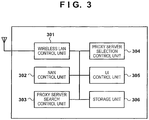
- Fig. 3 is a block diagram showing an example of the functional arrangement of the NAN 101.
- the NAN 101 includes, as a functional arrangement, for example, a wireless LAN control unit 301, a NAN control unit 302, a proxy server search control unit 303, a proxy server selection control unit 304, a UI control unit 305, and a storage unit 306.
- the wireless LAN control unit 301 is formed by including an antenna for transmitting/receiving a wireless signal to/from another wireless LAN apparatus, a circuit, and a program for controlling the antenna and circuit.
- the wireless LAN control unit 301 executes wireless LAN communication control in accordance with the IEEE802.11 standard series.
- the NAN control unit 302 is formed by including hardware and a program for performing control in accordance with the NAN standard.
- the NAN 101 has the state in which it receives wireless signals during DW0, DW4, DW8, and DW12 and the state in which it receives wireless signals during all the DW periods. These states will be described with reference to Figs. 4A and 4B.
- Figs. 4A and 4B are timing charts, respectively, schematically showing the wireless signal reception states of the NAN 101.
- Fig. 4A shows a state in which wireless signals can be transmitted/received during all the DW periods.
- the NAN 101 causes the wireless LAN control unit 301 to enable the wireless transmission/reception circuit during all the DW periods (that is, DW0 to DW15), thereby performing at least one of transmission and reception of wireless signals.
- Fig. 4B shows a state in which wireless signals can be transmitted/received during DWn (that is, during DW0, DW4, DW8, and DW12) where n is a multiple of 4.
- DWn that is, during DW0, DW4, DW8, and DW12
- n is a multiple of 4.
- the NAN 101 disables the wireless transmission/reception circuit to transmit/receive no wireless signal.
- the NAN 101 can reduce the power consumption.
- the proxy server search control unit 303 controls the NAN control unit 302 to control a search for a service provided by another NAN device.
- the proxy server selection control unit 304 controls selection of a proxy server of which proxy-execution of service notification processing is to be requested. Detailed processing of the proxy server search control unit 303 will be described later with reference to Fig. 5 . Detailed processing of the proxy server selection control unit 304 will be described later with reference to Fig. 7 .
- the UI control unit 305 is formed by including hardware related to a user interface such as a touch panel or button for accepting an operation for the NAN 101 by the user (not shown) of the NAN 101, and a program for controlling the hardware.
- the UI control unit 305 also has, for example, a function for presenting information to the user, such as a function of displaying an image or the like or a function of outputting a voice.
- the storage unit 306 is a storage device which can be formed by a ROM, a RAM, and the like and saves data and programs operated by the NAN 101.
- a NAN 101 selects, as a proxy server for executing proxy processing for the NAN 101, one of proxy servers existing nearby, which can receive signals during the DW periods at a high frequency.
- This increases the probability that the proxy server requested by the NAN 101 to execute the proxy processing can execute the proxy processing during the DW periods, thereby making it possible to shorten the time taken to perform service search/discovery processing.
- the NAN 101 selects the latter proxy server. The procedure of this processing will be described below.
- This processing is processing when the NAN 101 searches for proxy servers as target candidates to be requested to operate as proxy servers. This processing can be executed at various timings, for example, upon power-on of the NAN 101, in a predetermined cycle, or by an explicit instruction of the user.
- the proxy server search control unit 303 receives a proxy server publish message transmitted by a proxy server during DW0 as a DW period when all devices in a NAN cluster 105 are activated.
- the proxy server search control unit 303 confirms, using a list held in the NAN 101, whether the received proxy server publish message has been transmitted from a known proxy server (step S501).
- the NAN 101 may identify an apparatus operable as a proxy server based on information contained in a beacon signal. In this case, an apparatus operable as a proxy server transmits a beacon containing information indicating that it can operate as a proxy server. If the proxy server as the transmission source is not included in the list (NO in step S501), the proxy server search control unit 303 obtains DW information from the received proxy server publish message (step S502). The proxy server search control unit 303 adds the information of the proxy server as the transmission source and the DW information to the above-described list (step S503). On the other hand, if the information of the proxy server as the transmission source of the proxy server publish message is stored in the list (YES in step S501), the proxy server search control unit 303 performs no processing any more (step S504).
- Fig. 6 shows an example of the frame structure of the proxy server publish message.
- the proxy server publish message is a frame obtained by extending a NAN publish frame, and a frame added with information for sending a notification of provision of a proxy service.
- a service descriptor attribute of public action attribute information elements the same value as that of the NAN publish frame is set.
- a proxy service descriptor attribute (PSDA) as information for sending a notification of provision of a proxy service function is added as attribute information.
- PSDA proxy service descriptor attribute
- the NAN device Upon receiving the publish frame including the PSDA, the NAN device identifies that the NAN device as the transmission source operates as a proxy server.
- 14 as a value reserved in the NAN standard as an attribute ID is set.
- In a length, 2 is set.
- An awake DW bitmap is information for sending a notification, represented by bits, of DW periods during which the proxy server receives wireless signals, and stores a 2-byte bit map. If the "n"th bit of the awake DW bitmap is 1, this indicates that the transmission source apparatus of the proxy server publish frame receives a wireless signal during the period of DWn. If the "n"th bit of the awake DW bitmap is 0, this indicates that the transmission source apparatus of the proxy server publish frame receives no wireless signal during the period of DWn.
- the communication apparatus operating as a proxy client can know DWs during which the proxy server as the transmission source receives wireless signals.
- a proxy server selection control unit 304 of the NAN 101 processing of deciding a proxy server of which the NAN 101 is to request an operation as a proxy, which is executed by a proxy server selection control unit 304 of the NAN 101.
- This processing is executed when the NAN 101 decides to request the proxy server to proxy-execute service notification processing or service information collection processing in order to reduce the power consumption of itself. If, for example, the NAN 101 has detected no operation from the user for a given period or detects an explicit operation, by the user, of requesting the proxy processing of the proxy server, it performs the above-described request processing. Note that in other cases as well, the NAN 101 can decide to request the proxy processing of the proxy server. This processing can be executed in such case.
- the proxy server selection control unit 304 first receives a proxy server publish message from a proxy server during the period of DW0 (step S701).
- the NAN 101 may prompt a proxy server to transmit a proxy server publish message by spontaneously transmitting a subscribe message indicating that the NAN 101 is searching for proxy servers.
- the processing in step S701 may be skipped if a list of proxy servers existing nearby is generated by the processing shown in Fig. 5 .
- the processing shown in Fig. 5 may be skipped by executing this processing.
- the proxy server selection control unit 304 determines whether a plurality of proxy servers have been discovered (step S702). If only one proxy server has been found (NO in step S702), the proxy server selection control unit 304 requests the proxy server to execute the proxy processing (step S704). On the other hand, if a plurality of proxy servers have been discovered (YES in step S702), the proxy server selection control unit 304 requests a proxy server which receives wireless signals during a largest number of DW periods to execute the proxy processing (step S703). The number of DW periods during which each proxy server receives wireless signals is confirmed by the awake DW bitmap included in the received proxy server publish message.
- the NAN 101 can decide, as a proxy server of which execution of the proxy processing is to be requested, the transmission source apparatus of the proxy server publish message including the awake DW bitmap whose number of bits of "1" is largest.
- the proxy server publish message may be received during a DW period other than DW0.
- the NAN 101 may decide a proxy server of which the proxy processing is to be requested. Since it is possible to obtain the pieces of information of more proxy servers by receiving the proxy server publish messages during more DW periods, it is possible to increase the probability that the NAN 101 can select a more appropriate proxy server.
- the NAN 101 can shorten the period during which it transmits/receives a wireless signal, thereby reducing the power consumption.
- the NAN 101 may decide, in step S703, by another method, an apparatus of which the proxy processing is to be requested. For example, the NAN 101 may select, as a proxy server of which the proxy processing is to be requested, the transmission source apparatus of the proxy server publish message, whose RSSI indicating a reception strength is highest. By requesting the proxy processing of the proxy server having the highest RSSI, it is possible to increase the probability that the NAN 101 can request the proxy processing of a proxy server physically close to itself.
- the NAN 101 can communicate with the proxy server for performing the proxy processing of itself, it is possible to decrease the probability that a NAN device searching for the NAN 101 exists in a place where communication with the NAN 101 cannot be performed. As a result, it is possible to perform efficient service discovery and notification processes.
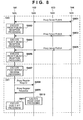
- a NAN 103 operating in the non-master sync role transmits a proxy server publish message to each nearby device (step S801).
- the NAN 101 may transmit a subscribe message for searching for an apparatus operable as a proxy server, and receive a proxy server publish message as a response.
- the NAN 101 executes the above-described processing related to the reception, and obtains information of DWs during which wireless communication is or is not performed (step S802).
- NANs 102 and 104 each operating in the master role sequentially transmit proxy server publish messages to each nearby device (steps S803 and S805).
- the NAN 101 receives the proxy server publish messages, executes the above-described processing related to the reception, and obtains, from the received proxy server publish messages, the pieces of information of DWs during which wireless communication is or is not performed (steps S804 and S806).
- the NAN 101 After the end of the period of DW0, the NAN 101 performs processing of deciding a target proxy server of which the proxy processing is to be requested (step S807).
- the NAN 102 operates in the master role, and remains in the state (awake) in which wireless signals can be received during all the DW periods.
- the NAN 103 operates in the non-master non-sync role, and is set in the state (awake) in which a wireless signal can be received during the period of DWn where n is a multiple of 4, that is, only the periods of DW0, DW4, DW8, and DW12.
- the NAN 101 selects, as a proxy server of which the proxy processing is to be requested, one of the plurality of nearby proxy servers (NANs 102 to 104), which is in the awake state during the largest number of DW periods. That is, in this case, since the NAN 102 is in the awake state during the largest number of DW periods, the NAN 101 selects the NAN 102 as a proxy server (a target of which an operation as a proxy is to be requested) for proxy-transmitting/receiving a signal instead of itself.
- the NAN 101 transmits a proxy register request to the NAN 102 as the selected proxy server during the subsequent period of DW1 (step S808).
- the proxy register request is a message for requesting proxy transmission of service information.
- the NAN 102 Upon receiving the proxy register request, the NAN 102 returns a proxy register response (step S809). After returning the proxy register response, the NAN 102 starts the proxy processing (step S810). If the NAN 102 receives a subscribe message from another apparatus, it proxy-transmits the service information of the NAN 101 contained in the proxy register request. On the other hand, after receiving the proxy register response, the NAN 101 controls to shift to the DOZE state in which no wireless signal is transmitted/received (step S811).
- the NAN 101 transmits the proxy register request during the DW period when the proxy server as the request target of the proxy processing is in the awake state. This is because if the proxy register request is transmitted during a DW period when the proxy server as the request target is not in the awake state, the proxy server as the request target cannot receive the proxy register request.
- the NAN 102 is in the awake state during all the DW periods. Therefore, the NAN 101 can transmit the proxy register request during the period of DW1 as a DW period immediately after the NAN 102 is selected as the request target of the proxy processing. To the contrary, for example, if the NAN 102 is in the awake state during only the period of DWn where n is a multiple of 2, the NAN 101 transmits the proxy register request during the period of DW2.
- the NAN 101 can request the proxy processing of some or all of the proxy servers. If the NAN 101 requests the proxy processing of the plurality of proxy servers each of which has the highest appearance frequency of the DW periods during which the proxy server is set in the awake state, more efficient service discovery/notification processing may be possible. On the other hand, by suppressing the number of proxy servers as the request targets of the proxy processing, the frequency at which the plurality of proxy servers execute the service discovery/notification processing of the same proxy client is decreased, thereby preventing wireless resources from being wasted.
- the NAN 101 selects, as a target of which the proxy processing is to be requested, one of the plurality of proxy servers, which is set in the awake state during the DW periods at the highest frequency.
- the present invention is not limited to this.
- the NAN 101 may select, as a target of which the proxy processing is to be requested, one of the plurality of proxy servers, which is set in the awake state during the DW periods at a frequency equal to or higher than a predetermined value. That is, the NAN 101 may set the above-described predetermined value to 1/2, and select, as the request target of the proxy processing, a proxy server which is set in the awake state once or more every two DW periods.
- the RSSIs may be used, as described above, or other values may be used.
- a NAN 101 obtains DW information via not a proxy server publish message but a sync beacon. This processing will be described by mainly focusing attention on the difference from the first embodiment.
- Fig. 9 is a flowchart illustrating an example of the procedure of proxy server search processing.
- sync beacon reception processing is added to the processing shown in Fig. 5 .
- steps S904 to S906 are the same as those in steps S503 to S505, respectively, and a description thereof will be omitted.
- a proxy server search control unit 303 Upon receiving a signal from a nearby proxy server, a proxy server search control unit 303 confirms whether the proxy server is included in a list held in the NAN 101 (step S901). If the proxy server as the transmission source of the signal is not included in the list (NO in step S901), the proxy server search control unit 303 determines whether a signal received before step S901 is a sync beacon (step S902).
- the proxy server search control unit 303 obtains a master preference value from the sync beacon (step S903).
- the master preference value is information which can be used to decide whether to operate in the master role in a cluster.
- the sync beacon is a predetermined signal complying with the NAN standard, and includes, for example, NAN attributes and extended NAN attributes.
- the extended NAN attributes include a PSDA, similarly to Fig. 6 . That is, the sync beacon includes an awake DW bitmap.
- the NAN device can know DW periods during which the proxy server as the transmission source of the sync beacon is in a state (awake state) in which wireless signals can be transmitted/received (step S904).
- the sync beacon includes a master indication attribute and cluster attribute which must be stored in the sync beacon.
- the same information elements as the master indication attribute and cluster attribute store NAN attributes.
- the sync beacon may include a plurality of information elements.
- the information elements storing the NAN attributes may be divided into a plurality of parts. Note that only attributes which must be stored in the sync beacon are shown in Fig. 10 . Other attributes which can be stored may be included.
- the NAN device can form a list of pieces of information of proxy servers existing nearby.
- the list includes information indicating the appearance frequency of DW periods during which each proxy server can transmit/receive wireless signals, and the master preference value of the proxy server.
- a proxy server selection control unit 304 of the NAN 101 selects a proxy server for proxy-transmitting/receiving signals instead of itself. This selection processing will be described with reference to Fig. 11 .
- the proxy server selection control unit 304 picks up, from the proxy server list obtained by the processing of Fig. 9 , a proxy server which is set in the awake state during the DW periods at the highest frequency (step S1101). If only one proxy server is picked up in step S1101 (NO in step S1102), the proxy server selection control unit 304 selects the proxy server as the request target of proxy processing (step S1104).
- the proxy server selection control unit 304 refers to the master preference values of the proxy servers. Then, the proxy server selection control unit 304 selects, as the request target of the proxy processing, a proxy server having the largest master preference value (step S1103).
- the master preference value is a parameter corresponding to the possibility of playing each of the master, non-master sync, and non-master non-sync roles in the NAN cluster.
- the master preference value is a value indicating the tendency of an apparatus having a larger master preference value to more likely play the master or non-master sync role.
- step S1103 the proxy server having the highest tendency to play the master or non-master sync role is selected as the request target of the proxy processing.
- the NAN 101 can request the proxy processing of the proxy server which tends to play the master or non-master sync role that needs to transmit/receive wireless signals during all the DWs. This allows the NAN 101 to improve the efficiency of service discovery/notification by requesting the proxy processing of the proxy server whose awake period becomes long at high probability.
- Fig. 12 shows an example of the procedure of the operation of a wireless communication system when the NAN 101 requests another communication apparatus to operate as a proxy, similarly to Fig. 8 .
- the proxy server publish messages (steps S801, S803, and S805) in Fig. 8 are changed to sync beacons (steps S1201, S1203, and S1205).
- Signal reception processes (steps S1202, S1204, and S1206) are also changed in accordance with the changes in transmitted signals.
- the NAN 101 obtains pieces of DW information from the sync beacons, and selects a proxy server for performing proxy transmission instead of itself (step S1207).
- Processes (steps S1208 to S1211) after the selection of the proxy server for performing proxy transmission are the same as those in steps S808 to S811.
- the device operating in the master or non-master sync role transmits a sync beacon.
- the NAN 101 may receive the proxy server publish message of Fig. 8 and the sync beacon at the same time.
- the NAN 101 can obtain, from the device operating in the non-master non-sync role, the DW information of the device by the proxy server publish message.
- the NAN 101 can obtain, from the remaining devices, pieces of DW information (and master preference values) by the proxy server publish messages and sync beacons.
- the sync beacons are transmitted to maintain the synchronization in the NAN cluster. Therefore, the device for transmitting the sync beacon is set in the awake state during the DW periods at a high frequency. That is, the DW period during which the DW information can be obtained from the device comes at a high frequency. To the contrary, the device which transmits no sync beacon can transmit a proxy server publish message during a DW period when the device is set in the awake state. Therefore, if a frequency at which the device is set in the awake state is low, the DW period during which the DW information can be obtained from the device comes at a low frequency. By obtaining the pieces of DW information from the sync beacons, the probability that the NAN device can decide, at the early stage, a proxy server of which the proxy processing is to be requested is increased.
- the NAN 101 selects a proxy server as the request target of the proxy processing based on not only the frequencies at which the devices are set in the awake state during the DW periods but also the master preference values included in the sync beacons.
- the proxy server which has a large master preference value and tends to play a role of transmitting a sync beacon, such as the master role, can also transmit/receive signals during the DW periods at high probability. Therefore, in this embodiment, the NAN device selects, as a proxy server for executing the proxy processing instead of itself, a proxy server having a large master preference value. This can increase the probability that the NAN device selects, as a proxy server for executing the proxy processing of itself, a proxy server which is set in the awake state during the DW periods at a high frequency.
- the NAN 101 selects, as a proxy server for executing the proxy processing of itself, a proxy server having the largest master preference value.
- the NAN 101 may select, as a proxy server for executing the proxy processing of itself, a proxy server having a master preference value equal to or larger than a predetermined value. If a plurality of proxy servers each have the largest master preference value, all or some (for example, one) of the plurality of proxy servers may be selected. If some of the proxy servers are selected, this selection may be made based on, for example, RSSIs or the like, similarly to the first embodiment.
- a NAN 101 obtains DW information via not a proxy server publish message but a discovery beacon.
- the frame structure of the discovery beacon is the same as the structure of the sync beacon shown in Fig. 10 .
- the sync beacon is defined to be transmitted during a DW period.
- the discovery beacon is intended to send a notification of the existence of a NAN cluster to a device which does not join the NAN cluster, and is thus transmitted during a period other than DW periods.
- the discovery beacon may be transmitted during a DW period.
- Fig. 13 shows proxy server search processing according to this embodiment.
- the processing shown in Fig. 13 is the same as that shown in Fig. 9 except that processing (step S1302) of determining whether a received signal is a discovery beacon is included.
- Step S901 of Fig. 9 corresponds to step S1301 of Fig. 13 .
- Steps S902 to S906 of Fig. 9 correspond to steps S1303 to S1307 of Fig. 13 .
- Fig. 14 shows proxy server selection processing according to this embodiment.
- steps S1401 and S1402 are the same as those in steps S1101 and S1102 of Fig. 11 .
- processing when proxy servers each of which is set in the awake state during the DW periods at a high frequency are included in a list is different from that shown in Fig. 11 .
- a proxy server having the largest master preference value is specified (step S1403). If only one such proxy server exists (NO in step S1404), the NAN 101 requests proxy processing for itself of the one proxy server (step S1407).
- the NAN 101 calculates master ranks (step S1405).
- the NAN 101 selects, as a proxy server of which the proxy processing of itself is to be requested, a proxy server having the highest master rank (step S1406).
- the master rank is calculated using a master preference value, random factor, and NAN address, and is unique to each NAN device included in the NAN cluster at this time.
- the NAN 101 can select one proxy server.
- the NAN 101 requests the one proxy server to execute the proxy processing for the NAN 101 itself (step S1407). With this processing, one proxy server is selected to execute the proxy processing, and thus the power consumption is expected to become low.
- a NAN 103 operates not in the mater role but in the non-master sync role, and thus transmits no discovery beacon.
- NANs 102 and 104 each operate in the master role, and thus transmit discovery beacons (steps S1501 and S1503).
- the NAN 101 receives the discovery beacons (steps S1502 and S1504). After that, the NAN 101 obtains pieces of DW information by the discovery beacons, and selects a proxy server for performing proxy transmission for itself based on the pieces of DW information (step S1505).
- Proxy transmission request processing (steps S1506 to S1509) after the selection of the request target of proxy transmission is the same as that in steps S808 to S811 or steps S1208 to S1211. Note that the proxy transmission request processing in this case need not always be performed during the DW periods.
- the NAN 101 can obtain DW information by the proxy server publish message from the device operating in the non-master non-sync role.
- the NAN 101 can obtain pieces of DW information by both the proxy server publish message and the sync beacon from the device operating in the non-master sync role.
- the NAN 101 can obtain DW information by the discovery beacon from the device operating in the master role.
- the discovery beacon is received before joining the NAN cluster.
- the device having the master role is expected to be set in the awake state during the DW periods at a high frequency, as described above. The probability that the NAN 101 can efficiently and more quickly discover a device which is set in the awake state during the DW periods at a high frequency is increased.
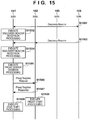
- the first embodiment has described processing in which the NAN 101 passively stands by for a proxy server publish message transmitted from each proxy server. To the contrary, in this embodiment, a NAN 101 actively inquires about the pieces of information of proxy servers.
- the NAN 101 transmits a proxy server probe request (step S1601).
- NANs 102 to 104 respectively return proxy server probe responses (steps S1602, S1604, and S1606).
- Each proxy server probe response as a response message can have the same structure as that of the proxy server publish message shown in Fig. 6 .
- the NAN 101 may receive a proxy server publish message as a response signal to a subscribe message.
- the NAN 101 receives the proxy server probe responses (steps S1603, S1605, and S1607), obtains pieces of DW information, and selects, based on the pieces of DW information, a proxy server for performing proxy transmission (step S1608).
- Proxy transmission request processing (steps S1609 to S1612) after the selection of the request target of proxy transmission is the same as that in steps S808 to S811, steps S1208 to S1211, or steps S1506 to S1509.
- each proxy server stores DW information in the frame of one of the proxy server publish message, sync beacon, and discovery beacon, and transmits it.
- the NAN 101 selects a proxy server for executing the proxy processing for itself.
- a NAN 101 instead of obtaining pieces of DW information stored in received signals, a NAN 101 counts the number of operations of receiving signals from proxy servers during a period from DW0 to DW15. Based on the count, the NAN 101 determines a frequency at which each proxy server is set in the awake state during the DW periods. This processing can be executed instead of the processes of Figs. 5 , 9 , and 13 .
- each of NANs 102 to 104 serves as a proxy server, it transmits a proxy server publish message and a sync beacon during the DW period.
- Each of the NANs 102 and 104 operates in the master role, and thus additionally transmits a discovery beacon.
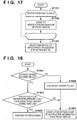
- the NAN 101 counts the reception frequency of the proxy server publish messages or sync beacons from the proxy servers during a period from DW0 to DW15 (for example, one cycle) (steps S1701 and S1702). Note that even if the NAN 101 receives discovery beacons during the DW period, a frequency at which each proxy server is set in the awake state during the DW periods is determined, similarly to a case in which the proxy server publish messages or sync beacons are received.
- Fig. 18 shows the detailed processing procedure of the processing in step S1702.
- the NAN 101 determines whether a proxy server as the transmission source of received notification information (including one of the proxy server publish message, sync beacon, and discovery beacon) is included in a list (step S1801).
- the list includes the information of a proxy server as the transmission source of notification information when the NAN 101 receives the notification information. If the information of the proxy server as the transmission source of the notification information is included in the list (YES in step S1801), the NAN 101 determines whether other notification information has been received from the proxy server during the DW period when the notification information is received (step S1802).
- step S1802. it is important that the NAN 102 is set in the awake state during the DW period and it is not important that the two signals are received. Therefore, even if the NAN 101 receives a plurality of signals during the same DW period (YES in step S1802), it counts up the reception count by one, and performs no processing at the time of reception of the second and subsequent signals (step S1805).
- the NAN 101 receives notification information during the same DW period for the first time (NO in step S1802), it counts up the signal reception count as the number of times the proxy server is set in the awake state during the DW periods (step S1803). If the NAN 101 determines in step S1801 that the proxy server as the transmission source of the notification information is not included in the list (NO in step S1801), it newly registers the proxy server in the list (step S1804). The NAN 101 counts up the signal reception count as the number of times the proxy server is set in the awake state during the DW periods (step S1803). By counting up the signal reception count, the NAN 101 can specify a frequency at which each proxy server is set in the awake state during the DW periods. Based on the specified frequency, the NAN 101 selects a proxy server of which the proxy processing for itself is to be requested, similarly to the above-described embodiments (step S1703) .
- the NAN device can determine a frequency at which each nearby proxy server is set in the awake state during the DW period, and request proxy processing of a proxy server having a high frequency.
- the probability that the proxy server of which the NAN 101 has requested the proxy processing can execute the proxy processing during the DW period becomes high, thereby making it possible to shorten the time taken to perform service search/discovery processing.
- the NAN 101 obtains information of DW periods during which each nearby proxy server transmits/receives wireless signals, and selects, based on the information, a proxy server of which the proxy processing is to be requested.
- the present invention is not limited to this.
- the NAN 101 may select a proxy server of which the proxy processing is to be requested. Since the master role needs to be in the awake state during all the DW periods, the probability that a proxy server which tends to play the master role can execute the proxy processing during all the DW periods is increased. When, therefore, the NAN 101 requests the proxy processing of such proxy server, the probability that the proxy server can execute the proxy processing during the DW periods is increased.
- each proxy server may notify the proxy client of a DOZE state period or an awake state period which is not limited to the DW periods, and the proxy client may select a proxy server which is in the awake state for a long time. After requesting the proxy processing of the proxy server, the proxy client may periodically search for other proxy servers in the NAN cluster, and reselect a proxy server.
- the NAN device may not request the proxy processing. For example, if there is no proxy server which is in the awake state during all the DW periods, the NAN 101 need not request the proxy processing of any proxy server in step S703 of Fig. 7 . In this case, the NAN 101 can execute service search/discovery processing by sending a notification of a service or discovering a service as usual without requesting the proxy processing.
- Embodiment(s) of the present invention can also be realized by a computer of a system or apparatus that reads out and executes computer executable instructions (e.g., one or more programs) recorded on a storage medium (which may also be referred to more fully as a 'non-transitory computer-readable storage medium') to perform the functions of one or more of the above-described embodiment(s) and/or that includes one or more circuits (e.g., application specific integrated circuit (ASIC)) for performing the functions of one or more of the above-described embodiment(s), and by a method performed by the computer of the system or apparatus by, for example, reading out and executing the computer executable instructions from the storage medium to perform the functions of one or more of the above-described embodiment(s) and/or controlling the one or more circuits to perform the functions of one or more of the above-described embodiment(s).
- computer executable instructions e.g., one or more programs
- a storage medium which may also be referred to more fully as
- the computer may comprise one or more processors (e.g., central processing unit (CPU), micro processing unit (MPU)) and may include a network of separate computers or separate processors to read out and execute the computer executable instructions.
- the computer executable instructions may be provided to the computer, for example, from a network or the storage medium.
- the storage medium may include, for example, one or more of a hard disk, a random-access memory (RAM), a read only memory (ROM), a storage of distributed computing systems, an optical disk (such as a compact disc (CD), digital versatile disc (DVD), or Blu-ray Disc (BD)TM), a flash memory device, a memory card, and the like.
Landscapes
- Engineering & Computer Science (AREA)
- Computer Networks & Wireless Communication (AREA)
- Signal Processing (AREA)
- Databases & Information Systems (AREA)
- Computer Security & Cryptography (AREA)
- Mobile Radio Communication Systems (AREA)
Claims (14)
- Appareil de communication (101) configuré pour communiquer avec d'autres appareils de communication (102-104) dans un réseau, où l'appareil de communication et les autres appareils de communication sont configurés pour communiquer entre eux pendant une période de synchronisation, DWO, de longueur prédéterminée qui se produit à un intervalle de temps prédéterminé, l'appareil de communication comprenant :un moyen de recherche (303) configuré pour rechercher des appareils de communication parmi les autres appareils de communication, dont chacun peut exécuter, en tant que mandataire de l'appareil de communication, au moins l'un d'un traitement d'émission et d'un traitement de réception d'un signal de communication sans fil ;un moyen d'obtention (303) configuré pour obtenir des informations indiquant une fréquence d'apparition de périodes pendant lesquelles chaque appareil de communication parmi les appareils de communication détectés par la recherche effectuée par le moyen de recherche peut émettre et/ou recevoir le signal de communication sans fil ; etun moyen de sélection (304) configuré pour sélectionner, parmi les appareils de communication détectés par la recherche effectuée par le moyen de recherche, un appareil de communication destiné à exécuter le traitement en tant que mandataire de l'appareil de communication sur la base des informations obtenues.
- Appareil selon la revendication 1, dans lequel
le moyen de sélection est conçu pour sélectionner l'appareil de communication destiné à exécuter le traitement en tant que mandataire de l'appareil de communication au sein d'un ensemble d'appareils de communication parmi les appareils de communication détectés par la recherche effectuée par le moyen de recherche, pour chacun desquels les informations obtenues indiquent une fréquence d'apparition la plus élevée, et d'un ensemble d'appareils de communication parmi les appareils de communication détectés par la recherche effectuée par le moyen de recherche, pour chacun desquels les informations obtenues indiquent une fréquence d'apparition non inférieure à une valeur prédéterminée. - Appareil selon la revendication 1 ou 2, dans lequel
le moyen d'obtention est conçu pour obtenir les informations indiquant la fréquence d'apparition à partir d'informations contenues dans un signal prédéterminé reçu en provenance de chacun des autres appareils de communication. - Appareil selon la revendication 1 ou 2, dans lequel
le moyen d'obtention est conçu pour obtenir les informations indiquant la fréquence d'apparition sur la base du nombre de fois où un signal prédéterminé est reçu en provenance de chacun des autres appareils de communication pendant lesdites périodes. - Appareil selon la revendication 2, dans lequel,
s'il existe l'un de l'ensemble de la pluralité d'appareils de communication dont chacun présente la fréquence d'apparition la plus élevée et de l'ensemble de la pluralité d'appareils de communication dont chacun présente la fréquence d'apparition non inférieure à la valeur prédéterminée, le moyen de sélection est conçu pour sélectionner, sur la base d'intensités de réception de signaux provenant de la pluralité d'appareils de communication de l'ensemble respectif, un appareil de communication destiné à exécuter le traitement en tant que mandataire de l'appareil de communication. - Appareil selon la revendication 5, dans lequel le moyen de sélection est conçu pour sélectionner, sur la base d'intensités de réception de signaux en provenance de la pluralité d'appareils de communication de l'ensemble respectif, un appareil de communication destiné à exécuter le traitement en tant que mandataire de l'appareil de communication, qui est physiquement proche de l'appareil de communication.
- Appareil selon l'une quelconque des revendications 1 à 5, dans lequel
le moyen d'obtention est en outre conçu pour obtenir, en provenance de chacun des appareils de communication détectés par la recherche effectuée par le moyen de recherche, une valeur indiquant une possibilité que cet appareil de communication serve d'appareil de communication destiné à émettre des balises pendant lesdites périodes, et
le moyen de sélection est conçu pour sélectionner, sur la base des informations indiquant les fréquences d'apparition et les valeurs, un appareil de communication destiné à exécuter le traitement en tant que mandataire de l'appareil de communication. - Appareil selon la revendication 7, dans lequel
à mesure que la valeur augmente, il est plus probable que l'appareil de communication serve d'appareil de communication destiné à émettre les balises pendant lesdites périodes, et
le moyen de sélection est conçu pour sélectionner un appareil de communication destiné à exécuter le traitement en tant que mandataire de l'appareil de communication au sein d'un ensemble d'appareils de communication parmi les appareils de communication détectés par la recherche effectuée par le moyen de recherche, dont chacun présente la valeur la plus élevée, et d'un ensemble d'appareils de communication parmi les appareils de communication détectés par la recherche effectuée par le moyen de recherche, dont chacun présente la valeur non inférieure à une valeur prédéterminée. - Appareil selon la revendication 1, dans lequel
le moyen d'obtention est conçu pour obtenir une durée pendant laquelle chacun des appareils de communication parmi les appareils de communication détectés par la recherche effectuée par le moyen de recherche est dans au moins un état dans lequel cet appareil de communication peut émettre et/ou recevoir un signal de communication sans fil et un état dans lequel cet appareil de communication ne peut pas émettre et/ou recevoir de signal de communication sans fil, et
le moyen de sélection est conçu pour sélectionner, sur la base des longueurs de temps, un appareil de communication destiné à exécuter le traitement en tant que mandataire de l'appareil de communication. - Appareil selon l'une quelconque des revendications 1 à 9, dans lequel
les périodes sont des périodes d'une fenêtre de découverte du système de réseau Wi-Fi Alliance Neighbor Awareness Networking. - Appareil selon la revendication 10, dans lequel
le moyen de recherche (303) est conçu pour rechercher des appareils de communication parmi les autres appareils de communication qui peuvent émettre par mandataire des informations de service pendant des fenêtres de découverte du système de réseau Neighbor Awareness Networking ; et
les informations obtenues par le moyen d'obtention sont une fréquence à laquelle l'appareil de communication détecté par le moyen de recherche est réglé dans un état dans lequel il n'effectue aucune communication sans fil pendant les fenêtres de découverte. - Appareil selon la revendication 11, dans lequel,
si le moyen de recherche détecte une pluralité d'appareils de communication, le moyen de sélection est conçu pour sélectionner l'un de la pluralité d'autres appareils de communication, qui est réglé dans l'état dans lequel il n'effectue aucune communication sans fil pendant les fenêtres de découverte à une faible fréquence, pour émettre par mandataire les informations de service de l'appareil de communication. - Appareil selon la revendication 11 ou 12, dans lequel
le moyen d'obtention est conçu pour obtenir ladite fréquence, à laquelle l'état dans lequel aucune communication sans fil n'est effectuée pendant les fenêtres de découverte est réglé, à partir d'informations contenues dans une balise et une trame de découverte de service. - Procédé de commande permettant de commander un appareil de communication configuré pour communiquer avec d'autres appareils de communication dans un réseau, où l'appareil de communication et les autres appareils de communication sont configurés pour communiquer entre eux pendant une période de synchronisation, DWO, de longueur prédéterminée qui se produit à un intervalle de temps prédéterminé, le procédé comprenant :la recherche (S701, S1101, S1401) d'appareils de communication parmi les autres appareils de communication, dont chacun peut exécuter, en tant que mandataire de l'appareil de communication, au moins l'un d'un traitement émission et d'un traitement réception d'un signal de communication sans fil ;l'obtention (S502, S903, S904, S1304, S1304, S1305, S1802) d'informations indiquant une fréquence d'apparition de périodes pendant lesquelles chaque appareil de communication parmi les appareils de communication détectés par la recherche effectuée lors de la recherche peut émettre et/ou recevoir le signal de communication sans fil ; etla sélection (S702-S704, S1102-S1104, S1402 - S1404, S1402 - S1407) , parmi les appareils de communication détectés par la recherche effectuée lors de la recherche, d'un appareil de communication destiné à exécuter le traitement en tant que mandataire de l'appareil de communication sur la base des informations obtenues.
Applications Claiming Priority (1)
| Application Number | Priority Date | Filing Date | Title |
|---|---|---|---|
| JP2015187447A JP6579884B2 (ja) | 2015-09-24 | 2015-09-24 | 通信装置、制御方法、及びプログラム |
Publications (2)
| Publication Number | Publication Date |
|---|---|
| EP3148231A1 EP3148231A1 (fr) | 2017-03-29 |
| EP3148231B1 true EP3148231B1 (fr) | 2020-04-22 |
Family
ID=56920448
Family Applications (1)
| Application Number | Title | Priority Date | Filing Date |
|---|---|---|---|
| EP16001819.8A Active EP3148231B1 (fr) | 2015-09-24 | 2016-08-18 | Appareil de communication et procédé de commande de reconnaissance d'un autre appareil de communication |
Country Status (5)
| Country | Link |
|---|---|
| US (1) | US10205506B2 (fr) |
| EP (1) | EP3148231B1 (fr) |
| JP (1) | JP6579884B2 (fr) |
| KR (1) | KR102059461B1 (fr) |
| CN (1) | CN106559919B (fr) |
Families Citing this family (13)
| Publication number | Priority date | Publication date | Assignee | Title |
|---|---|---|---|---|
| WO2015002468A1 (fr) * | 2013-07-02 | 2015-01-08 | Samsung Electronics Co., Ltd. | Appareil et procédé d'allocation de ressources à des communications de dispositif à dispositif dans un réseau sans fil |
| JP6294704B2 (ja) | 2014-02-26 | 2018-03-14 | キヤノン株式会社 | 通信装置、制御方法、及びプログラム |
| WO2016190721A1 (fr) * | 2015-05-28 | 2016-12-01 | 엘지전자 주식회사 | Procédé et appareil permettant de fournir un service de mandataire par l'intermédiaire d'un serveur mandataire nan dans un système de communications sans fil |
| JP2018046450A (ja) * | 2016-09-15 | 2018-03-22 | キヤノン株式会社 | 通信装置、通信方法、及びプログラム |
| EP3306896B1 (fr) * | 2016-10-07 | 2025-10-22 | Nokia Technologies Oy | Accès à des services fournis par un système de stockage de données distribuées |
| JP7093159B2 (ja) * | 2017-01-10 | 2022-06-29 | キヤノン株式会社 | 通信装置、通信装置の制御方法、およびプログラム |
| JP6801543B2 (ja) * | 2017-03-22 | 2020-12-16 | 富士通株式会社 | 情報処理装置、情報処理システム及び情報処理方法 |
| JP2019047289A (ja) | 2017-08-31 | 2019-03-22 | キヤノン株式会社 | 通信装置、その制御方法、およびプログラム |
| US11184452B2 (en) * | 2017-10-13 | 2021-11-23 | Yokogawa Electric Corporation | System and method for selecting proxy computer |
| JP7016710B2 (ja) * | 2018-01-30 | 2022-02-07 | キヤノン株式会社 | 通信装置、制御方法及びプログラム |
| MX2020009779A (es) * | 2018-03-30 | 2020-10-12 | V2Com S A | Sistema y metodo para gestion de recursos y asignacion de recursos en una red auto-optimizante de nodos de procesamiento heterogeneos. |
| CN113170314B (zh) * | 2018-11-07 | 2024-05-28 | 索尼集团公司 | 通信控制装置、通信装置及通信控制方法 |
| JP7797255B2 (ja) * | 2022-03-11 | 2026-01-13 | キヤノン株式会社 | 通信装置、通信装置の制御方法、およびプログラム |
Family Cites Families (18)
| Publication number | Priority date | Publication date | Assignee | Title |
|---|---|---|---|---|
| US20060094456A1 (en) | 2004-10-29 | 2006-05-04 | Rittle Loren J | Device and method for service discovery in adhoc networks using beacon signalling |
| JP4525780B2 (ja) * | 2008-03-24 | 2010-08-18 | ソニー株式会社 | 受信装置、送信装置、通信システム、および中継サーバのバッファ設定検出方法 |
| WO2010014912A2 (fr) * | 2008-07-31 | 2010-02-04 | Tekelec | Procédés, systèmes et supports lisibles par ordinateur pour fournir un service de sédation dans un réseau de télécommunications |
| JP2010062846A (ja) | 2008-09-03 | 2010-03-18 | Ntt Docomo Inc | 無線通信制御方法、無線通信基地局、無線通信端末および無線通信システム |
| JP5353683B2 (ja) | 2009-12-24 | 2013-11-27 | 日本電気株式会社 | 無線通信システム、無線通信機器および情報通知方法 |
| EP2940893B1 (fr) * | 2012-12-27 | 2021-05-19 | Panasonic Intellectual Property Corporation of America | Procédé de communication d'informations |
| US9800389B2 (en) * | 2013-03-08 | 2017-10-24 | Qualcomm Incorporated | Systems and methods for discovering and synchronizing within a neighbor aware network |
| US9578626B2 (en) * | 2013-03-15 | 2017-02-21 | Qualcomm Incorporated | Systems and methods for sharing context information in a neighbor aware network |
| US9516595B2 (en) * | 2013-03-27 | 2016-12-06 | Qualcomm Incorporated | Systems and methods for synchronization within a neighborhood aware network |
| US9204244B2 (en) | 2013-04-08 | 2015-12-01 | Nokia Technologies Oy | Method, apparatus, and computer program product for synchronization packet transmitter selection in a wireless network |
| US9872227B2 (en) * | 2013-04-23 | 2018-01-16 | Qualcomm Incorporated | Systems and methods for identification in a neighborhood aware network |
| JP5952245B2 (ja) * | 2013-09-18 | 2016-07-13 | Necプラットフォームズ株式会社 | 通信装置、通信システム、通信装置の制御方法および通信装置の制御プログラム |
| JP6294704B2 (ja) | 2014-02-26 | 2018-03-14 | キヤノン株式会社 | 通信装置、制御方法、及びプログラム |
| JP6274907B2 (ja) | 2014-02-26 | 2018-02-07 | キヤノン株式会社 | 通信装置、制御方法、及びプログラム |
| JP6360327B2 (ja) | 2014-02-26 | 2018-07-18 | キヤノン株式会社 | 通信装置、制御方法、及びプログラム |
| CN104518968B (zh) * | 2014-12-04 | 2018-07-03 | 华为技术有限公司 | 一种报文处理的方法和透明代理服务器 |
| JP6614782B2 (ja) | 2015-03-18 | 2019-12-04 | キヤノン株式会社 | 通信装置、制御方法、及びプログラム |
| JP6579883B2 (ja) | 2015-09-24 | 2019-09-25 | キヤノン株式会社 | 通信装置、制御方法、及びプログラム |
-
2015
- 2015-09-24 JP JP2015187447A patent/JP6579884B2/ja active Active
-
2016
- 2016-08-18 EP EP16001819.8A patent/EP3148231B1/fr active Active
- 2016-09-14 US US15/265,299 patent/US10205506B2/en active Active
- 2016-09-20 KR KR1020160119741A patent/KR102059461B1/ko active Active
- 2016-09-22 CN CN201610844552.XA patent/CN106559919B/zh active Active
Non-Patent Citations (1)
| Title |
|---|
| None * |
Also Published As
| Publication number | Publication date |
|---|---|
| JP6579884B2 (ja) | 2019-09-25 |
| JP2017063313A (ja) | 2017-03-30 |
| US10205506B2 (en) | 2019-02-12 |
| KR20170036621A (ko) | 2017-04-03 |
| KR102059461B1 (ko) | 2019-12-26 |
| EP3148231A1 (fr) | 2017-03-29 |
| US20170093479A1 (en) | 2017-03-30 |
| CN106559919B (zh) | 2020-07-28 |
| CN106559919A (zh) | 2017-04-05 |
Similar Documents
| Publication | Publication Date | Title |
|---|---|---|
| EP3148231B1 (fr) | Appareil de communication et procédé de commande de reconnaissance d'un autre appareil de communication | |
| EP3493567B1 (fr) | Appareil de communication, procédé de contrôle et support de stockage lisible sur ordinateur | |
| EP3148260B1 (fr) | Économies d'énergie de dispositifs mobiles proxy dans neighbor aware network nan | |
| US11140539B2 (en) | Wireless communication apparatus, wireless communication method, program, and storage medium | |
| JP2019201427A (ja) | 通信装置、探索方法、及びプログラム | |
| KR102114076B1 (ko) | 통신 장치, 통신 장치를 제어하는 방법, 및 프로그램 | |
| EP3349488B1 (fr) | Appareil de communication, son procédé de commande et programme | |
| US10548102B2 (en) | Communication apparatus, control method therefor, and non-transitory computer-readable storage medium for a neighbor awareness network | |
| JP6646458B2 (ja) | 通信装置、制御方法、及びプログラム | |
| JP2019075657A (ja) | 通信装置、通信方法、及びプログラム |
Legal Events
| Date | Code | Title | Description |
|---|---|---|---|
| PUAI | Public reference made under article 153(3) epc to a published international application that has entered the european phase |
Free format text: ORIGINAL CODE: 0009012 |
|
| STAA | Information on the status of an ep patent application or granted ep patent |
Free format text: STATUS: THE APPLICATION HAS BEEN PUBLISHED |
|
| AK | Designated contracting states |
Kind code of ref document: A1 Designated state(s): AL AT BE BG CH CY CZ DE DK EE ES FI FR GB GR HR HU IE IS IT LI LT LU LV MC MK MT NL NO PL PT RO RS SE SI SK SM TR |
|
| AX | Request for extension of the european patent |
Extension state: BA ME |
|
| STAA | Information on the status of an ep patent application or granted ep patent |
Free format text: STATUS: REQUEST FOR EXAMINATION WAS MADE |
|
| 17P | Request for examination filed |
Effective date: 20170929 |
|
| RBV | Designated contracting states (corrected) |
Designated state(s): AL AT BE BG CH CY CZ DE DK EE ES FI FR GB GR HR HU IE IS IT LI LT LU LV MC MK MT NL NO PL PT RO RS SE SI SK SM TR |
|
| REG | Reference to a national code |
Ref country code: DE Ref legal event code: R079 Ref document number: 602016034337 Country of ref document: DE Free format text: PREVIOUS MAIN CLASS: H04W0008000000 Ipc: H04W0004000000 |
|
| RIC1 | Information provided on ipc code assigned before grant |
Ipc: H04W 48/16 20090101ALI20190507BHEP Ipc: H04W 52/02 20090101ALI20190507BHEP Ipc: H04W 4/00 20180101AFI20190507BHEP Ipc: H04W 8/00 20090101ALI20190507BHEP Ipc: H04W 88/18 20090101ALI20190507BHEP Ipc: H04W 84/12 20090101ALI20190507BHEP |
|
| GRAP | Despatch of communication of intention to grant a patent |
Free format text: ORIGINAL CODE: EPIDOSNIGR1 |
|
| STAA | Information on the status of an ep patent application or granted ep patent |
Free format text: STATUS: GRANT OF PATENT IS INTENDED |
|
| INTG | Intention to grant announced |
Effective date: 20190621 |
|
| GRAS | Grant fee paid |
Free format text: ORIGINAL CODE: EPIDOSNIGR3 |
|
| GRAJ | Information related to disapproval of communication of intention to grant by the applicant or resumption of examination proceedings by the epo deleted |
Free format text: ORIGINAL CODE: EPIDOSDIGR1 |
|
| GRAL | Information related to payment of fee for publishing/printing deleted |
Free format text: ORIGINAL CODE: EPIDOSDIGR3 |
|
| STAA | Information on the status of an ep patent application or granted ep patent |
Free format text: STATUS: REQUEST FOR EXAMINATION WAS MADE |
|
| GRAP | Despatch of communication of intention to grant a patent |
Free format text: ORIGINAL CODE: EPIDOSNIGR1 |
|
| STAA | Information on the status of an ep patent application or granted ep patent |
Free format text: STATUS: GRANT OF PATENT IS INTENDED |
|
| INTC | Intention to grant announced (deleted) | ||
| RAP1 | Party data changed (applicant data changed or rights of an application transferred) |
Owner name: CANON KABUSHIKI KAISHA |
|
| INTG | Intention to grant announced |
Effective date: 20191121 |
|
| GRAA | (expected) grant |
Free format text: ORIGINAL CODE: 0009210 |
|
| STAA | Information on the status of an ep patent application or granted ep patent |
Free format text: STATUS: THE PATENT HAS BEEN GRANTED |
|
| AK | Designated contracting states |
Kind code of ref document: B1 Designated state(s): AL AT BE BG CH CY CZ DE DK EE ES FI FR GB GR HR HU IE IS IT LI LT LU LV MC MK MT NL NO PL PT RO RS SE SI SK SM TR |
|
| REG | Reference to a national code |
Ref country code: CH Ref legal event code: EP |
|
| REG | Reference to a national code |
Ref country code: IE Ref legal event code: FG4D |
|
| REG | Reference to a national code |
Ref country code: DE Ref legal event code: R096 Ref document number: 602016034337 Country of ref document: DE |
|
| REG | Reference to a national code |
Ref country code: AT Ref legal event code: REF Ref document number: 1261745 Country of ref document: AT Kind code of ref document: T Effective date: 20200515 |
|
| REG | Reference to a national code |
Ref country code: LT Ref legal event code: MG4D |
|
| REG | Reference to a national code |
Ref country code: NL Ref legal event code: MP Effective date: 20200422 |
|
| PG25 | Lapsed in a contracting state [announced via postgrant information from national office to epo] |
Ref country code: NO Free format text: LAPSE BECAUSE OF FAILURE TO SUBMIT A TRANSLATION OF THE DESCRIPTION OR TO PAY THE FEE WITHIN THE PRESCRIBED TIME-LIMIT Effective date: 20200722 Ref country code: FI Free format text: LAPSE BECAUSE OF FAILURE TO SUBMIT A TRANSLATION OF THE DESCRIPTION OR TO PAY THE FEE WITHIN THE PRESCRIBED TIME-LIMIT Effective date: 20200422 Ref country code: GR Free format text: LAPSE BECAUSE OF FAILURE TO SUBMIT A TRANSLATION OF THE DESCRIPTION OR TO PAY THE FEE WITHIN THE PRESCRIBED TIME-LIMIT Effective date: 20200723 Ref country code: SE Free format text: LAPSE BECAUSE OF FAILURE TO SUBMIT A TRANSLATION OF THE DESCRIPTION OR TO PAY THE FEE WITHIN THE PRESCRIBED TIME-LIMIT Effective date: 20200422 Ref country code: IS Free format text: LAPSE BECAUSE OF FAILURE TO SUBMIT A TRANSLATION OF THE DESCRIPTION OR TO PAY THE FEE WITHIN THE PRESCRIBED TIME-LIMIT Effective date: 20200822 Ref country code: NL Free format text: LAPSE BECAUSE OF FAILURE TO SUBMIT A TRANSLATION OF THE DESCRIPTION OR TO PAY THE FEE WITHIN THE PRESCRIBED TIME-LIMIT Effective date: 20200422 Ref country code: LT Free format text: LAPSE BECAUSE OF FAILURE TO SUBMIT A TRANSLATION OF THE DESCRIPTION OR TO PAY THE FEE WITHIN THE PRESCRIBED TIME-LIMIT Effective date: 20200422 Ref country code: PT Free format text: LAPSE BECAUSE OF FAILURE TO SUBMIT A TRANSLATION OF THE DESCRIPTION OR TO PAY THE FEE WITHIN THE PRESCRIBED TIME-LIMIT Effective date: 20200824 |
|
| REG | Reference to a national code |
Ref country code: AT Ref legal event code: MK05 Ref document number: 1261745 Country of ref document: AT Kind code of ref document: T Effective date: 20200422 |
|
| PG25 | Lapsed in a contracting state [announced via postgrant information from national office to epo] |
Ref country code: BG Free format text: LAPSE BECAUSE OF FAILURE TO SUBMIT A TRANSLATION OF THE DESCRIPTION OR TO PAY THE FEE WITHIN THE PRESCRIBED TIME-LIMIT Effective date: 20200722 Ref country code: LV Free format text: LAPSE BECAUSE OF FAILURE TO SUBMIT A TRANSLATION OF THE DESCRIPTION OR TO PAY THE FEE WITHIN THE PRESCRIBED TIME-LIMIT Effective date: 20200422 Ref country code: RS Free format text: LAPSE BECAUSE OF FAILURE TO SUBMIT A TRANSLATION OF THE DESCRIPTION OR TO PAY THE FEE WITHIN THE PRESCRIBED TIME-LIMIT Effective date: 20200422 Ref country code: HR Free format text: LAPSE BECAUSE OF FAILURE TO SUBMIT A TRANSLATION OF THE DESCRIPTION OR TO PAY THE FEE WITHIN THE PRESCRIBED TIME-LIMIT Effective date: 20200422 |
|
| PG25 | Lapsed in a contracting state [announced via postgrant information from national office to epo] |
Ref country code: AL Free format text: LAPSE BECAUSE OF FAILURE TO SUBMIT A TRANSLATION OF THE DESCRIPTION OR TO PAY THE FEE WITHIN THE PRESCRIBED TIME-LIMIT Effective date: 20200422 |
|
| REG | Reference to a national code |
Ref country code: DE Ref legal event code: R097 Ref document number: 602016034337 Country of ref document: DE |
|
| PG25 | Lapsed in a contracting state [announced via postgrant information from national office to epo] |
Ref country code: DK Free format text: LAPSE BECAUSE OF FAILURE TO SUBMIT A TRANSLATION OF THE DESCRIPTION OR TO PAY THE FEE WITHIN THE PRESCRIBED TIME-LIMIT Effective date: 20200422 Ref country code: SM Free format text: LAPSE BECAUSE OF FAILURE TO SUBMIT A TRANSLATION OF THE DESCRIPTION OR TO PAY THE FEE WITHIN THE PRESCRIBED TIME-LIMIT Effective date: 20200422 Ref country code: AT Free format text: LAPSE BECAUSE OF FAILURE TO SUBMIT A TRANSLATION OF THE DESCRIPTION OR TO PAY THE FEE WITHIN THE PRESCRIBED TIME-LIMIT Effective date: 20200422 Ref country code: EE Free format text: LAPSE BECAUSE OF FAILURE TO SUBMIT A TRANSLATION OF THE DESCRIPTION OR TO PAY THE FEE WITHIN THE PRESCRIBED TIME-LIMIT Effective date: 20200422 Ref country code: CZ Free format text: LAPSE BECAUSE OF FAILURE TO SUBMIT A TRANSLATION OF THE DESCRIPTION OR TO PAY THE FEE WITHIN THE PRESCRIBED TIME-LIMIT Effective date: 20200422 Ref country code: IT Free format text: LAPSE BECAUSE OF FAILURE TO SUBMIT A TRANSLATION OF THE DESCRIPTION OR TO PAY THE FEE WITHIN THE PRESCRIBED TIME-LIMIT Effective date: 20200422 Ref country code: ES Free format text: LAPSE BECAUSE OF FAILURE TO SUBMIT A TRANSLATION OF THE DESCRIPTION OR TO PAY THE FEE WITHIN THE PRESCRIBED TIME-LIMIT Effective date: 20200422 Ref country code: RO Free format text: LAPSE BECAUSE OF FAILURE TO SUBMIT A TRANSLATION OF THE DESCRIPTION OR TO PAY THE FEE WITHIN THE PRESCRIBED TIME-LIMIT Effective date: 20200422 |
|
| PG25 | Lapsed in a contracting state [announced via postgrant information from national office to epo] |
Ref country code: PL Free format text: LAPSE BECAUSE OF FAILURE TO SUBMIT A TRANSLATION OF THE DESCRIPTION OR TO PAY THE FEE WITHIN THE PRESCRIBED TIME-LIMIT Effective date: 20200422 Ref country code: SK Free format text: LAPSE BECAUSE OF FAILURE TO SUBMIT A TRANSLATION OF THE DESCRIPTION OR TO PAY THE FEE WITHIN THE PRESCRIBED TIME-LIMIT Effective date: 20200422 |
|
| PLBE | No opposition filed within time limit |
Free format text: ORIGINAL CODE: 0009261 |
|
| STAA | Information on the status of an ep patent application or granted ep patent |
Free format text: STATUS: NO OPPOSITION FILED WITHIN TIME LIMIT |
|
| 26N | No opposition filed |
Effective date: 20210125 |
|
| PG25 | Lapsed in a contracting state [announced via postgrant information from national office to epo] |
Ref country code: MC Free format text: LAPSE BECAUSE OF FAILURE TO SUBMIT A TRANSLATION OF THE DESCRIPTION OR TO PAY THE FEE WITHIN THE PRESCRIBED TIME-LIMIT Effective date: 20200422 |
|
| REG | Reference to a national code |
Ref country code: CH Ref legal event code: PL |
|
| PG25 | Lapsed in a contracting state [announced via postgrant information from national office to epo] |
Ref country code: CH Free format text: LAPSE BECAUSE OF NON-PAYMENT OF DUE FEES Effective date: 20200831 Ref country code: LI Free format text: LAPSE BECAUSE OF NON-PAYMENT OF DUE FEES Effective date: 20200831 Ref country code: LU Free format text: LAPSE BECAUSE OF NON-PAYMENT OF DUE FEES Effective date: 20200818 |
|
| REG | Reference to a national code |
Ref country code: BE Ref legal event code: MM Effective date: 20200831 |
|
| PG25 | Lapsed in a contracting state [announced via postgrant information from national office to epo] |
Ref country code: SI Free format text: LAPSE BECAUSE OF FAILURE TO SUBMIT A TRANSLATION OF THE DESCRIPTION OR TO PAY THE FEE WITHIN THE PRESCRIBED TIME-LIMIT Effective date: 20200422 |
|
| PG25 | Lapsed in a contracting state [announced via postgrant information from national office to epo] |
Ref country code: IE Free format text: LAPSE BECAUSE OF NON-PAYMENT OF DUE FEES Effective date: 20200818 Ref country code: BE Free format text: LAPSE BECAUSE OF NON-PAYMENT OF DUE FEES Effective date: 20200831 |
|
| PG25 | Lapsed in a contracting state [announced via postgrant information from national office to epo] |
Ref country code: TR Free format text: LAPSE BECAUSE OF FAILURE TO SUBMIT A TRANSLATION OF THE DESCRIPTION OR TO PAY THE FEE WITHIN THE PRESCRIBED TIME-LIMIT Effective date: 20200422 Ref country code: MT Free format text: LAPSE BECAUSE OF FAILURE TO SUBMIT A TRANSLATION OF THE DESCRIPTION OR TO PAY THE FEE WITHIN THE PRESCRIBED TIME-LIMIT Effective date: 20200422 Ref country code: CY Free format text: LAPSE BECAUSE OF FAILURE TO SUBMIT A TRANSLATION OF THE DESCRIPTION OR TO PAY THE FEE WITHIN THE PRESCRIBED TIME-LIMIT Effective date: 20200422 |
|
| PG25 | Lapsed in a contracting state [announced via postgrant information from national office to epo] |
Ref country code: MK Free format text: LAPSE BECAUSE OF FAILURE TO SUBMIT A TRANSLATION OF THE DESCRIPTION OR TO PAY THE FEE WITHIN THE PRESCRIBED TIME-LIMIT Effective date: 20200422 |
|
| PGFP | Annual fee paid to national office [announced via postgrant information from national office to epo] |
Ref country code: DE Payment date: 20250724 Year of fee payment: 10 |
|
| PGFP | Annual fee paid to national office [announced via postgrant information from national office to epo] |
Ref country code: GB Payment date: 20250724 Year of fee payment: 10 |
|
| PGFP | Annual fee paid to national office [announced via postgrant information from national office to epo] |
Ref country code: FR Payment date: 20250725 Year of fee payment: 10 |