EP3148309B1 - Graine à revêtement d'polyhalite et préparations de granulé d'engrais - Google Patents
Graine à revêtement d'polyhalite et préparations de granulé d'engrais Download PDFInfo
- Publication number
- EP3148309B1 EP3148309B1 EP15727442.4A EP15727442A EP3148309B1 EP 3148309 B1 EP3148309 B1 EP 3148309B1 EP 15727442 A EP15727442 A EP 15727442A EP 3148309 B1 EP3148309 B1 EP 3148309B1
- Authority
- EP
- European Patent Office
- Prior art keywords
- polyhalite
- pellets
- powder
- binder
- fertiliser
- Prior art date
- Legal status (The legal status is an assumption and is not a legal conclusion. Google has not performed a legal analysis and makes no representation as to the accuracy of the status listed.)
- Active
Links
Images
Classifications
-
- C—CHEMISTRY; METALLURGY
- C09—DYES; PAINTS; POLISHES; NATURAL RESINS; ADHESIVES; COMPOSITIONS NOT OTHERWISE PROVIDED FOR; APPLICATIONS OF MATERIALS NOT OTHERWISE PROVIDED FOR
- C09D—COATING COMPOSITIONS, e.g. PAINTS, VARNISHES OR LACQUERS; FILLING PASTES; CHEMICAL PAINT OR INK REMOVERS; INKS; CORRECTING FLUIDS; WOODSTAINS; PASTES OR SOLIDS FOR COLOURING OR PRINTING; USE OF MATERIALS THEREFOR
- C09D5/00—Coating compositions, e.g. paints, varnishes or lacquers, characterised by their physical nature or the effects produced; Filling pastes
-
- C—CHEMISTRY; METALLURGY
- C05—FERTILISERS; MANUFACTURE THEREOF
- C05G—MIXTURES OF FERTILISERS COVERED INDIVIDUALLY BY DIFFERENT SUBCLASSES OF CLASS C05; MIXTURES OF ONE OR MORE FERTILISERS WITH MATERIALS NOT HAVING A SPECIFIC FERTILISING ACTIVITY, e.g. PESTICIDES, SOIL-CONDITIONERS, WETTING AGENTS; FERTILISERS CHARACTERISED BY THEIR FORM
- C05G1/00—Mixtures of fertilisers belonging individually to different subclasses of C05
-
- A—HUMAN NECESSITIES
- A01—AGRICULTURE; FORESTRY; ANIMAL HUSBANDRY; HUNTING; TRAPPING; FISHING
- A01C—PLANTING; SOWING; FERTILISING
- A01C1/00—Apparatus, or methods of use thereof, for testing or treating seed, roots, or the like, prior to sowing or planting
-
- A—HUMAN NECESSITIES
- A01—AGRICULTURE; FORESTRY; ANIMAL HUSBANDRY; HUNTING; TRAPPING; FISHING
- A01C—PLANTING; SOWING; FERTILISING
- A01C1/00—Apparatus, or methods of use thereof, for testing or treating seed, roots, or the like, prior to sowing or planting
- A01C1/06—Coating or dressing seed
-
- B—PERFORMING OPERATIONS; TRANSPORTING
- B01—PHYSICAL OR CHEMICAL PROCESSES OR APPARATUS IN GENERAL
- B01J—CHEMICAL OR PHYSICAL PROCESSES, e.g. CATALYSIS OR COLLOID CHEMISTRY; THEIR RELEVANT APPARATUS
- B01J2/00—Processes or devices for granulating materials, e.g. fertilisers in general; Rendering particulate materials free flowing in general, e.g. making them hydrophobic
- B01J2/006—Coating of the granules without description of the process or the device by which the granules are obtained
-
- B—PERFORMING OPERATIONS; TRANSPORTING
- B01—PHYSICAL OR CHEMICAL PROCESSES OR APPARATUS IN GENERAL
- B01J—CHEMICAL OR PHYSICAL PROCESSES, e.g. CATALYSIS OR COLLOID CHEMISTRY; THEIR RELEVANT APPARATUS
- B01J2/00—Processes or devices for granulating materials, e.g. fertilisers in general; Rendering particulate materials free flowing in general, e.g. making them hydrophobic
- B01J2/14—Processes or devices for granulating materials, e.g. fertilisers in general; Rendering particulate materials free flowing in general, e.g. making them hydrophobic in rotating dishes or pans
-
- C—CHEMISTRY; METALLURGY
- C05—FERTILISERS; MANUFACTURE THEREOF
- C05D—INORGANIC FERTILISERS NOT COVERED BY SUBCLASSES C05B, C05C; FERTILISERS PRODUCING CARBON DIOXIDE
- C05D1/00—Fertilisers containing potassium
-
- C—CHEMISTRY; METALLURGY
- C05—FERTILISERS; MANUFACTURE THEREOF
- C05D—INORGANIC FERTILISERS NOT COVERED BY SUBCLASSES C05B, C05C; FERTILISERS PRODUCING CARBON DIOXIDE
- C05D3/00—Calcareous fertilisers
-
- C—CHEMISTRY; METALLURGY
- C05—FERTILISERS; MANUFACTURE THEREOF
- C05D—INORGANIC FERTILISERS NOT COVERED BY SUBCLASSES C05B, C05C; FERTILISERS PRODUCING CARBON DIOXIDE
- C05D5/00—Fertilisers containing magnesium
-
- C—CHEMISTRY; METALLURGY
- C05—FERTILISERS; MANUFACTURE THEREOF
- C05D—INORGANIC FERTILISERS NOT COVERED BY SUBCLASSES C05B, C05C; FERTILISERS PRODUCING CARBON DIOXIDE
- C05D9/00—Other inorganic fertilisers
-
- C—CHEMISTRY; METALLURGY
- C05—FERTILISERS; MANUFACTURE THEREOF
- C05G—MIXTURES OF FERTILISERS COVERED INDIVIDUALLY BY DIFFERENT SUBCLASSES OF CLASS C05; MIXTURES OF ONE OR MORE FERTILISERS WITH MATERIALS NOT HAVING A SPECIFIC FERTILISING ACTIVITY, e.g. PESTICIDES, SOIL-CONDITIONERS, WETTING AGENTS; FERTILISERS CHARACTERISED BY THEIR FORM
- C05G3/00—Mixtures of one or more fertilisers with additives not having a specially fertilising activity
-
- C—CHEMISTRY; METALLURGY
- C05—FERTILISERS; MANUFACTURE THEREOF
- C05G—MIXTURES OF FERTILISERS COVERED INDIVIDUALLY BY DIFFERENT SUBCLASSES OF CLASS C05; MIXTURES OF ONE OR MORE FERTILISERS WITH MATERIALS NOT HAVING A SPECIFIC FERTILISING ACTIVITY, e.g. PESTICIDES, SOIL-CONDITIONERS, WETTING AGENTS; FERTILISERS CHARACTERISED BY THEIR FORM
- C05G5/00—Fertilisers characterised by their form
- C05G5/10—Solid or semi-solid fertilisers, e.g. powders
- C05G5/12—Granules or flakes
-
- C—CHEMISTRY; METALLURGY
- C05—FERTILISERS; MANUFACTURE THEREOF
- C05G—MIXTURES OF FERTILISERS COVERED INDIVIDUALLY BY DIFFERENT SUBCLASSES OF CLASS C05; MIXTURES OF ONE OR MORE FERTILISERS WITH MATERIALS NOT HAVING A SPECIFIC FERTILISING ACTIVITY, e.g. PESTICIDES, SOIL-CONDITIONERS, WETTING AGENTS; FERTILISERS CHARACTERISED BY THEIR FORM
- C05G5/00—Fertilisers characterised by their form
- C05G5/30—Layered or coated, e.g. dust-preventing coatings
-
- C—CHEMISTRY; METALLURGY
- C09—DYES; PAINTS; POLISHES; NATURAL RESINS; ADHESIVES; COMPOSITIONS NOT OTHERWISE PROVIDED FOR; APPLICATIONS OF MATERIALS NOT OTHERWISE PROVIDED FOR
- C09D—COATING COMPOSITIONS, e.g. PAINTS, VARNISHES OR LACQUERS; FILLING PASTES; CHEMICAL PAINT OR INK REMOVERS; INKS; CORRECTING FLUIDS; WOODSTAINS; PASTES OR SOLIDS FOR COLOURING OR PRINTING; USE OF MATERIALS THEREFOR
- C09D7/00—Features of coating compositions, not provided for in group C09D5/00; Processes for incorporating ingredients in coating compositions
- C09D7/40—Additives
- C09D7/60—Additives non-macromolecular
- C09D7/61—Additives non-macromolecular inorganic
-
- B—PERFORMING OPERATIONS; TRANSPORTING
- B29—WORKING OF PLASTICS; WORKING OF SUBSTANCES IN A PLASTIC STATE IN GENERAL
- B29B—PREPARATION OR PRETREATMENT OF THE MATERIAL TO BE SHAPED; MAKING GRANULES OR PREFORMS; RECOVERY OF PLASTICS OR OTHER CONSTITUENTS OF WASTE MATERIAL CONTAINING PLASTICS
- B29B9/00—Making granules
- B29B9/08—Making granules by agglomerating smaller particles
Definitions
- This invention relates to fertiliser products in the form of pellets.
- Polyhalite is an evaporite mineral. It is a complex hydrated sulphate of potassium, calcium and magnesium of general formula K 2 Ca 2 Mg(SO 4 ) 4 ⁇ 2H 2 O. Deposits of polyhalite occur in, amongst other countries, Austria, China, Germany, India, Iran, Turkey, Ukraine, the UK and the USA.
- Polyhalite has the capacity to be valuable as a source of agricultural fertiliser.
- it has been proposed to decompose natural polyhalite to extract specific nutrients. See, for example, WO 2013/074328 , US 1,946,068 and US 4,246,019 .
- intact polyhalite is also usable as a fertiliser, being able to supply sulphur, potassium, calcium and magnesium to the soil.
- Mineral polyhalite can be spread in raw, crushed form. That minimises processing costs, but it has a number of disadvantages. Once applied to the soil the raw mineral takes some time to break down, delaying the bioavailability of its constituents. If applied in chipped form, the polyhalite tends to be of irregular shape and size, meaning that there can be issues in applying it uniformly, and that it can be difficult to apply with some types of agricultural spreading machinery. Untreated powdered polyhalite might in some circumstances be capable of being uniformly spread. However, since polyhalite powder can be strongly hygroscopic, its mechanical properties can vary quickly and radically over time once exposed to air; and again it can be difficult to spread evenly with some types of machinery.
- WO 2014/026048 describes a synthetic gypsum fertiliser product and a method for making it. This method centres on a pelletisation process in which synthetic gypsum is combined with a binder composition and pelletised to a desired size.
- DE 10 2006 034 621 discloses a method for the granulation of kieserite, and mineral fertilisers containing kieserite.
- DE 36 18 058 discloses a method for granulating water-soluble fertiliser containing the naturally occurring magnesium sulphate mineral kieserite.
- US 2001/042494 describes a granular substrate composition that is suitable for use as a carrier for active chemical agents, and also includes a method for forming the granular substrate involving mixing and pelletising stages.
- SU 1456395 describes a process of granulating a mixture of raw phosphate material, containing polyhalite, with phosphoric acid.
- a fertiliser product in the form of pellets comprising: at least 80% by mass of an evaporite mineral powder having a mean grain size in the range from 50 to 400 ⁇ m; and 1-3% by mass of a binder, wherein the binder is corn starch; the pellets having a mean compression strength greater than 2kgf; wherein the evaporate mineral is polyhalite.
- the pellets may comprise at least 90% by mass of the evaporite mineral powder.
- the corn starch may be in pre-gelled form.
- the pellets have a mean compression strength greater than 5kgf.
- the mean diameter of the pellets may be in the range from 2 to 5mm.
- the pellets may be substantially spherical.
- the mean grain size of the powder may be in the range from 100 to 250 ⁇ m.
- the pellets may comprise a stabiliser that chemically and/or mechanically stabilises and/or preserves the pellets.
- the pellets may comprise a component that accelerates the breakdown of the evaporite mineral on exposure to soil.
- the pellets may comprise a component that retards the breakdown of the evaporite mineral on exposure to soil.
- the pellets comprise one or more of a herbicide, a fungicide, an insecticide, a rodenticide, a hormone, a plant stimulant and a mycorrhizal fungus or spore.
- the pellets may comprise seeds.
- the evaporite mineral may be a blend of two or more evaporite components.
- Such a blend comprises 80% or more polyhalite by weight.
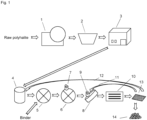
- Figure 1 shows a generalised overview of a pelletising process.
- pellets according to claim 1 can be formed.
- polyhalite is a complex hydrated sulphate of potassium, calcium and magnesium of general formula K 2 Ca 2 Mg(SO 4 ) 4 ⁇ 2H 2 O.
- Polyhalite has a Moh's hardness of around 2.5 to 3.5.
- polyhalite may be broken into blocks or chips of suitable size for transport and processing.
- the as-mined rock may be fed to crushers such as jaw crushers and/or cone crushers in order to yield a chipped material of generally uniform size. It has been found that chips of largest dimension no greater than around 20mm and/or of average dimension between 5 and 10mm are convenient for transportation from a mine.
- the polyhalite is stored in a substantially airtight container, such as a closed bag formed of impermeable sheet, so that its ability to absorb moisture from the atmosphere is restricted.
- a substantially airtight container such as a closed bag formed of impermeable sheet
- the raw or chipped polyhalite is processed to form a polyhalite powder. This may suitably be done by milling, for example
- a ball mill e.g. a continuous "Hardinge” ball mill
- an attritor mill the feedstock is agitated together with freely moving grinding elements such as steel balls. Air-swept suction may be applied in order to draw the milled material out of the mill. This allows the milling to be performed as a continuous process if desired, with chipped feedstock being added to the mill and powder being swept out of the mill by gas flow whilst the grinding elements continue to be agitated.
- the average grain size of the powder is dependent on various process parameters including the dwell time of the feedstock in the mill.
- the mill may be arranged to produce polyhalite powder grain size in the range from 50 to 400 ⁇ m, more preferably from 100 to 250 ⁇ m.
- at least 50% or more preferably at least 70% of the mass of the polyhalite powder is composed of grains having a grain size, or a largest or average diameter, in the range from 50 to 400 ⁇ m, more preferably from 100 to 250 ⁇ m.
- the grain size may be as measured by means of a Malvern Mastersizer 2000 or as measured by means of a sieve shaker.
- polyhalite Compared to some other evaporite minerals polyhalite is generally viewed as being relatively stable in the presence of moisture. However, it has been found that recently powdered polyhalite is strongly hygroscopic to an extent that can greatly hinder its subsequent processing unless the level of moisture content is carefully managed. In particular, it has been found that the success of the pelletising process described herein is strongly dependent on the water content of the polyhalite during the mixing. For that reason, it has been found helpful to arrange that the delay between rendering the polyhalite from grains of an average size greater than 1 mm to grains of an average size below 1mm is not more than 24 hours, more preferably not more than 12 hours, and still more preferably not more than 6 hours.
- the powdered polyhalite can be stored in ambient conditions without the need for additional drying before subsequent processing. If atmospheric conditions are particularly dry then the delay may be extended, and vice versa.
- the chipped polyhalite is milled into powder only shortly before it is to be processed further. It is preferred to cover the powdered polyhalite with an impermeable sheet or other closure so as to inhibit its take-up of water whilst being stored.
- the powdered polyhalite When the powdered polyhalite is incorporated into a fertiliser, it may be expected that using a smaller grain size of powder can increase the rate at which components of the polyhalite fertiliser become available in the soil due to their greater overall surface area. That may be advantageous in certain uses.
- the increased surface area per unit mass of finer polyhalite powders also gives them a tendency to absorb atmospheric water more rapidly which makes the pelletising process more difficult to control. Balancing these factors, it has been found that powder of a grain size in the range from 170 to 230 ⁇ m provides good results.
- a binder is added to the polyhalite powder.
- the binder helps the polyhalite powder to adhere to itself and increases the strength of the eventual pellets. That is important because the pellets should preferably be capable of resisting mechanical breakdown when spread through conventional agricultural spreaders.
- the binder also renders the polyhalite powder more plastic, which aids in the subsequent processing steps.
- Any suitable binder may be used, but it has been found that pre-gelled corn starch is particularly suitable. This is believed to be due, at least in part, to it not greatly increasing the ability of the mixed product to absorb water. It is preferred that the binder is no more hydroscopic than pre-gelled corn starch.
- binders not forming part of the invention include pre-gelled starch from other natural or artificial sources, lignosulphates, cement, sodium silicate, potassium silicate, polyvinyl acetate, sugars and milled grain.
- the binder is preferably in powder form when added to the polyhalite powder.
- the binder may be at least partially hydrated.
- the optimal amount of binder may be determined by balancing the strength of the final product with the workability of the intermediate materials. If too little binder is added then the resulting pellets may have insufficient strength. If excess binder is added then the polyhalite/binder mixture can become too sticky to be easily processed.
- any suitable mixer may be used to combine the polyhalite and the binder.
- the polyhalite and the binder it has been found advantageous for the polyhalite and the binder to be combined in a first mixing step that is of relatively low shear, and subsequently in a second mixing step that is of relatively high shear.
- the first mixing step it may be that no liquid, specifically no water, is added.
- liquid, for example including water may be added in the second mixing step.
- the first and second mixing steps may be performed in a single mixing chamber of a mixer.
- the mixer may be being operated in a relatively low shear manner during the first mixing step (e.g. by arranging that its blade(s) are driven with relatively low speed and/or power) and in a relatively high shear manner during the second mixing step (e.g. by arranging that its blade(s) are driven with relatively high speed and/or power).
- different mixers may be used for the first and second mixing steps.
- the first mixing step may be performed in a ribbon blender.
- a ribbon blender is a mixer in which the feedstock is blended in a horizontal trough in which a helical blade rotates so as to agitate the components.
- a U trough mixer or ribbon blender of the type made by Winkworth Machinery Ltd may be used.
- the polyhalite and the binder may be combined in such a mixer in batches or in a continuous stream, depending on the capabilities of the mixer.
- the polyhalite powder and the binder are preferably mixed for sufficient time to produce a homogeneous mixture.
- a batch of 600kg of milled polyhalite powder and 9kg of pre-gelled standard grade corn starch as supplied by Ingredion Inc. may be fed to a Winkworth ribbon blender having a working volume of 10001.
- the agitator of the blender may then be run at 50 rpm for 30 minutes, during which time no liquid is added to the mixture.
- the resulting product is a dry blend polyhalite-based powder of good homogeneity.
- the blended polyhalite powder and binder are passed to a second mixer for conditioning.
- the second mixer preferably performs mixing with higher shear than the first mixer.
- the second mixer could, for example, be a pin mixer.
- a pin mixer a mixing chamber is swept by a rotor which carries a plurality of radially extending pins.
- the pin mixer may have a 29,4 kw (40 hp) motor and a working cavity of length around 1.5m and diameter 30cm. It may be operated at, for instance, 800rpm.
- the material is preferably subject to intense mixing.
- Water - or other liquid preferably comprising free water - is preferably added.
- the water or other liquid may be added during the second step by spraying directly into the mixing chamber whilst the polyhalite/binder mixture is being agitated.
- a suitable quantity of water may be added to the polyhalite/binder mixture prior to the agitation involved in the second mixing step. If water is added then it may be found that the intense mixing of the second mixing step generates sufficient heat to liberate water vapour or steam.
- the addition of water at this stage encourages the plasticised polyhalite-containing powder to aggregate into a grit. Material may be retained in the mixer for around 30 to 45s.
- the duration of the second mixing step should be sufficient to adequately blend the polyhalite and binder to a state in which it exists as a free-flowing granular material, for example as non-adherent grains, of which preferably 90% or more by mass has a grain size in the range from 1.0mm to dust.
- approximately 600kg of mixed polyhalite powder and binder may be progressively fed to a 29,4 kw (40 hp) pin mixer having a working volume of around 1000l.
- the rotor of the mixer may then be run at 800 rpm.
- the pin mixer runs in a continuous process that outputs around 400kg per hour with around 2 to 3kg of material being worked in the chamber at any time. Over one hour 20l of water may be progressively sprayed into the mixing chamber.
- the product or discharge from the second mixing step is a sand-like material, predominantly having a grain size below 1.1mm in diameter.
- the discharge may be at a temperature of 50 to 60°C.
- a pan pelletiser comprises a pan having a base and a rim upstanding from the base.
- the pan can be rotated about an axis transverse to the base.
- the pan is tilted so that material in the pan nestles in a lowermost region of the base, where it is restrained by the side wall.
- the material tumbles against itself and particles of the material can adhere to one other. Larger particles typically migrate to the top of the pile of material, and can drop over the rim of the pan into a collecting receptacle. Meanwhile further feedstock can be added to the pan.
- the pelletising can therefore be carried out as a continuous process.
- the material that leaves the pan can be screened to separate in-size product from undersize and oversize product. Undersize product can be returned to the pelletiser. Oversize product can either (i) be roughly milled and added directly to the pelletiser or (ii) combined with incoming polyhalite chippings that are to be milled to a powder. Preferably the material is dried before being screened and/or re-milled. This can help to avoid the pellets being damaged in the screening process, and to avoid returning excessive moisture to the through flow.
- a typical pan pelletiser permits adjustment of the tilt angle of the pan base relative to horizontal. Altering the tilt angle permits the dwell time of the pellets in the pelletiser, and hence the final pellet size, to be controlled. It has been found that an average pellet size in the range from 2 to 4mm, and more specifically a size distribution in which at least 50% and more preferably 75% by number of the resulting pellets are in that range, produces good results.
- the state of the feedstock to the pelletiser, in cooperation with the operating state of the pelletiser, may be such that the mean retention time of material in the pelletiser is in the range from 30 to 200 seconds, more preferably from 30 to 60 seconds, most preferably around 45 seconds.
- pan base angle in the range from 70 to 45°, more preferably from 63 to 53° and most preferably around 58° may be found effective.
- the pan may be operated with a linear rim speed in the range from 2.0 to 2.5ms -1 , more preferably in the range from 2.1 to 2.2 ms -1 .
- the pan pelletiser may have a diameter of around 1.5m or 1.8m and a depth of around 22cm.
- the pan pelletiser may, for example be a model P45 or P60 pan pelletiser as supplied by Mars Mineral.
- the pelletiser During the operation of the pelletiser additional water is added to the material being processed.
- the water may be added by spraying into the pan, preferably in the region of the lower part of the pan bed, where the material that is being agglomerated tends to settle.
- the amount of water added may be between 1% and 3%, more preferably around 2%, by weight of the solid feedstock.
- the spray rate of the water can be set accordingly. For example, if the steady-state feed rate of polyhalite-containing granules is 6 to 8kg per minute then the spray rate of the water may be around 0.12 to 0.16 litres per minute.
- any pellets that are out of the desired size range can be reground (if oversize) or returned to the pan pelletiser (if undersize). It has been found that by using the steps described above, an in-specification yield of 85-90% by weight of the output from the pelletiser. By contrast, typical in-specification yields of limestone pelletising processes might be around 10%, the remaining 90% having to be recirculated.
- the output of the pelletiser is wet, substantially spherical pellets. These are conveniently dried before packaging. To achieve this the pellets that have been output from the pelletiser can be passed to a drier. It has been found that a retention time of around 3 minutes in a drier capable of heating the pellets to a temperature of around 150°C is sufficient to adequately dry the pellets. Moisture can be extracted from the dryer using a reverse jet air filter. The operating temperature and retention time in the dryer can be selected to provide pellets of the desired strength for subsequent handling.
- pellets can be cooled and packaged, for example in 600kg bags or 25kg sacks, or shipped loose for use or further processing elsewhere
- FIG. 1 shows a generalised overview of the process described above.
- As-mined raw polyhalite is primary crushed in a jaw crusher 1 and secondary crushed in a cone crusher 2.
- the chipped polyhalite may be stored, e.g. in a warehouse 3, until shortly before it is to be processed by the subsequent steps.
- the steps illustrated at 4 to 6 follow quickly one after the other, reducing the scope for the polyhalite powder to absorb ambient moisture.
- the chipped polyhalite can be withdrawn from the store 3 and passed to an attritor mill or continuous ball mill 4 where it is rendered to a powder.
- the polyhalite powder is combined with a binder in a low-shear mixer 5, and then the blended powder and binder are mixed in a high-shear mixer 6, with the addition of water as illustrated at 7.
- the output of the high-shear mixer is a granulate product.
- the granulate product is applied to a pan pelletiser 8, to which additional water is added as illustrated at 9.
- the pan pelletiser causes the granules to aggregate into substantially spherical pellets, which gradually exit the pelletiser.
- the exiting pellets are dried in a drier 10 and then sized by a set of screens 13. Undersize pellets are returned to the pelletiser as indicated at 11. Oversize pellets are returned to the attritor mill as indicated at 12.
- the final product at 14 consists of pellets of substantially spherical form and within the size limits defined by the screens 10. Those pellets can then be packaged and supplied for agricultural use. Finally they can be spread on a field or other agricultural or horticultural substrate to act as a fertiliser.
- Conveyor belts, auger conveyors or other handling apparatus can be used to move the components between processing stations.
- additives may be included in the pellets.
- Such additives may be one or more of the following, in any combination:
- Such a component may be added at various stages in the process, for example it could be combined with the polyhalite powder prior to or during the first mixing stage as described above, or with the binder prior to the first mixing stage as described above, or with the polyhalite/binder mix between the first and second mixing steps as described above, or during the second mixing step as described above, or it could be added to the pan pelletiser, or it could be sprayed or otherwise coated on to the pellets before or after drying.
- the seed could be coated with a biocompatible adhesive, such as a starch or PVA, and then contacted with a powder of polyhalite, for example by tumbling, to cause the powder to adhere to the exterior of the seed.
- the evaporite mineral polyhalite powder could be mixed with a binder then contacted with the seed.
- the seed could be contacted with the evaporite mineral polyhalite powder so that the powder dusts the exterior of the seed.
- the polyhalite content of the resulting pellets is greater than 80% and preferably greater than 90%. In the case of pellets that contain seeds this may optionally be varied such that the polyhalite content of the pellets excluding the weight of the seeds is greater than 80%, preferably greater than 90%.
- the pellets are preferably substantially spherical, and of substantially uniform volume and mass.
- the pellets may have a mean Wadell sphericity of greater than 0.85, 0.90 or 0.95.
- the pellets are preferably substantially free from voids, for example having not more than 1%, 2% or 5% by volume of air.
- the process as described above may be used for pelletising minerals other than polyhalite, and in particular for pelletising feedstocks composed principally of one or more evaporite minerals, especially other chloride minerals.
- evaporite minerals especially other chloride minerals.
- These may include any one or more of Anyhdrite, Carnalite, Gypsum, Halite, Kainite, Kieserite, Langbeinite and/or Sylvite.
- the process is especially suitable for pelletising feedstocks composed principally of minerals that are substantially hygroscopic in recently powdered form and/or that have a Moh's hardness in the range from 2 to 4.
- the resulting pellets may be used for purposes other than fertilisation.
Landscapes
- Chemical & Material Sciences (AREA)
- Organic Chemistry (AREA)
- Life Sciences & Earth Sciences (AREA)
- Chemical Kinetics & Catalysis (AREA)
- Pest Control & Pesticides (AREA)
- Inorganic Chemistry (AREA)
- Soil Sciences (AREA)
- Environmental Sciences (AREA)
- Engineering & Computer Science (AREA)
- Materials Engineering (AREA)
- Wood Science & Technology (AREA)
- Pretreatment Of Seeds And Plants (AREA)
- Fertilizers (AREA)
- Agricultural Chemicals And Associated Chemicals (AREA)
- Glanulating (AREA)
- Fodder In General (AREA)
Claims (11)
- Un produit fertilisant sous la forme de granulés (14) comprenant :au moins 80 % en masse d'une poudre minérale évaporite ayant une taille de grain moyenne comprise entre 50 et 400 um ; et1 à 3 % en masse d'un liant, dans lequel le liant est de l'amidon de maïs ;les granulés ayant une résistance à la compression supérieure à 2 kgf ;dans lequel le minéral évaporite est du polyhalite.
- Un produit fertilisant selon la revendication 1, dans lequel les granulés comprennent au moins 90 % en masse de la poudre minérale évaporée.
- Un produit fertilisant selon l'une quelconque des revendications précédentes, dans lequel les granulés ont une résistance à la compression supérieure à 5 kgf.
- Un produit fertilisant selon l'une quelconque des revendications précédentes, dans lequel le diamètre moyen des granulés est compris entre 2 et 5 mm.
- Un produit fertilisant selon l'une quelconque des revendications précédentes, dans lequel les granulés sont sensiblement sphériques.
- Un produit fertilisant selon l'une quelconque des revendications précédentes, dans lequel la taille moyenne en grammes de la poudre est comprise entre 100 et 250 um.
- Un produit fertilisant selon l'une quelconque des revendications précédentes, dans lequel les granulés comprennent un stabilisant qui stabilise chimiquement et/ou mécaniquement et/ou conserve les granulés.
- Un produit fertilisant selon l'une quelconque des revendications précédentes, dans lequel les granulés comprennent un composant qui accélère la décomposition du minéral évaporé lors de l'exposition au sol.
- Un produit fertilisant selon l'une quelconque des revendications précédentes, dans lequel les granulés comprennent un composant qui retarde la décomposition du minéral évaporé lors de l'exposition au sol.
- Un produit fertilisant selon l'une quelconque des revendications précédentes, dans lequel les granulés comprennent un ou plusieurs d'un herbicide, d'un fongicide, d'un insecticide, d'un rodenticide, d'une hormone, d'un stimulant végétal et d'un champignon ou spore mycorhizien.
- Un produit fertilisant selon l'une quelconque des revendications précédentes, dans lequel les granulés comprennent des graines.
Priority Applications (1)
| Application Number | Priority Date | Filing Date | Title |
|---|---|---|---|
| EP24189899.8A EP4428115A3 (fr) | 2014-06-02 | 2015-06-01 | Engrais |
Applications Claiming Priority (2)
| Application Number | Priority Date | Filing Date | Title |
|---|---|---|---|
| GB1409799.2A GB2522490B (en) | 2014-06-02 | 2014-06-02 | Fertiliser product |
| PCT/GB2015/051592 WO2015185907A1 (fr) | 2014-06-02 | 2015-06-01 | Graine à revêtement d'évaporite et préparations de granulé d'engrais |
Related Child Applications (2)
| Application Number | Title | Priority Date | Filing Date |
|---|---|---|---|
| EP24189899.8A Division EP4428115A3 (fr) | 2014-06-02 | 2015-06-01 | Engrais |
| EP24189899.8A Division-Into EP4428115A3 (fr) | 2014-06-02 | 2015-06-01 | Engrais |
Publications (2)
| Publication Number | Publication Date |
|---|---|
| EP3148309A1 EP3148309A1 (fr) | 2017-04-05 |
| EP3148309B1 true EP3148309B1 (fr) | 2024-08-28 |
Family
ID=51214612
Family Applications (3)
| Application Number | Title | Priority Date | Filing Date |
|---|---|---|---|
| EP15727441.6A Active EP3148308B1 (fr) | 2014-06-02 | 2015-06-01 | Préparation de graines enrobées de polyhalite |
| EP15727442.4A Active EP3148309B1 (fr) | 2014-06-02 | 2015-06-01 | Graine à revêtement d'polyhalite et préparations de granulé d'engrais |
| EP24189899.8A Pending EP4428115A3 (fr) | 2014-06-02 | 2015-06-01 | Engrais |
Family Applications Before (1)
| Application Number | Title | Priority Date | Filing Date |
|---|---|---|---|
| EP15727441.6A Active EP3148308B1 (fr) | 2014-06-02 | 2015-06-01 | Préparation de graines enrobées de polyhalite |
Family Applications After (1)
| Application Number | Title | Priority Date | Filing Date |
|---|---|---|---|
| EP24189899.8A Pending EP4428115A3 (fr) | 2014-06-02 | 2015-06-01 | Engrais |
Country Status (12)
| Country | Link |
|---|---|
| US (2) | US9949424B2 (fr) |
| EP (3) | EP3148308B1 (fr) |
| CN (2) | CN106536033B (fr) |
| AP (2) | AP2016009631A0 (fr) |
| BR (2) | BR112016028299B1 (fr) |
| ES (1) | ES2991855T3 (fr) |
| GB (3) | GB2522490B (fr) |
| HU (1) | HUE069281T2 (fr) |
| MX (2) | MX379325B (fr) |
| PL (1) | PL3148309T3 (fr) |
| PT (1) | PT3148309T (fr) |
| WO (2) | WO2015185906A1 (fr) |
Families Citing this family (26)
| Publication number | Priority date | Publication date | Assignee | Title |
|---|---|---|---|---|
| GB2522492B (en) | 2014-06-02 | 2020-07-15 | York Potash Ltd | Dry powder processing |
| GB2530757B (en) | 2014-09-30 | 2019-04-24 | York Potash Ltd | Pelletising process |
| US10703682B2 (en) | 2015-05-19 | 2020-07-07 | Sulvaris Inc. | Fertilizer pellets with micronized sulphur |
| CN107922286B (zh) * | 2016-03-22 | 2022-05-24 | 死海工程有限公司 | 球形肥料及其生产方法 |
| US10947453B2 (en) * | 2016-07-12 | 2021-03-16 | Genus Industries, Llc | Method and apparatus for preparing coir |
| CN109843834A (zh) | 2016-10-22 | 2019-06-04 | 死海工程有限公司 | 用于肥料制粒的粘结剂 |
| UA125464C2 (uk) | 2016-12-17 | 2022-03-16 | Дед Сі Воркс Лтд. | Спосіб отримання сульфату калію з карналіту та сульфату натрію |
| CN110198779B (zh) * | 2017-02-10 | 2022-06-28 | 艾斯尔欧洲合作社公司 | 杂卤石制粒方法 |
| GB2560026A (en) | 2017-02-27 | 2018-08-29 | Sirius Minerals Plc | Forming evaporite mineral products |
| GB2560027B (en) * | 2017-02-27 | 2022-09-07 | York Potash Ltd | Forming evaporite mineral products |
| GB2560025A (en) | 2017-02-27 | 2018-08-29 | Sirius Minerals Plc | Forming evaporite mineral products |
| US11324160B1 (en) * | 2017-06-14 | 2022-05-10 | Central Garden & Pet Company | Composite coating for seed |
| US11447431B1 (en) | 2017-06-14 | 2022-09-20 | Central Garden & Pet Company | Composite coating for seed |
| WO2019016804A1 (fr) * | 2017-07-17 | 2019-01-24 | Cleveland Potash Limited | Mélange granulé de polyhalite et de potasse et un processus de production de celui-ci |
| DE102017125467A1 (de) * | 2017-10-30 | 2019-05-02 | K+S Aktiengesellschaft | Verfahren zur Herstellung Kalium, Magnesium und Sulfat enthaltender Granulate |
| IL276686B2 (en) | 2018-02-27 | 2024-08-01 | Dead Sea Works Ltd | Potash dust granulation process |
| EP3581550A1 (fr) * | 2018-06-13 | 2019-12-18 | Pursell Agri-Tech, LLC | Procédé de revêtement d'engrais |
| GB2577865B (en) * | 2018-09-27 | 2023-08-16 | Anglo American Woodsmith Ltd | Binder compositions |
| GB2615675B (en) * | 2018-09-27 | 2023-12-13 | Anglo American Woodsmith Ltd | Pellet re-processing |
| GB2577866B (en) * | 2018-09-27 | 2023-08-16 | Anglo American Woodsmith Ltd | Pellet re-processing |
| EP3883693A4 (fr) | 2018-11-23 | 2022-08-24 | ICL Europe Cooperatief U.A. | Polyhalite compactée et procédé pour la produire |
| GB2588601B (en) * | 2019-10-25 | 2023-11-01 | Anglo American Woodsmith Ltd | Composite fertiliser systems |
| CN115551821A (zh) * | 2020-05-24 | 2022-12-30 | 艾斯尔欧洲合作社公司 | 杂卤石和熔融尿素的肥料颗粒以及用于其生产的制粒工艺 |
| GB2602962B (en) * | 2020-12-23 | 2025-02-19 | Anglo American Woodsmith Ltd | Manufacturing a composite fertiliser pellet |
| EP4448450A4 (fr) * | 2021-12-16 | 2025-12-17 | ICL Europe Cooperatief UA | Composition de polyhalite et procédé pour la récupération assistée de pétrole |
| EP4556453A4 (fr) * | 2022-07-12 | 2026-05-20 | Fertisac S L | Procédé de granulation humide de polysulfates |
Citations (1)
| Publication number | Priority date | Publication date | Assignee | Title |
|---|---|---|---|---|
| SU1456395A1 (ru) * | 1986-11-05 | 1989-02-07 | Джамбулский технологический институт легкой и пищевой промышленности | Способ получени сложного удобрени |
Family Cites Families (39)
| Publication number | Priority date | Publication date | Assignee | Title |
|---|---|---|---|---|
| US1946068A (en) | 1930-08-01 | 1934-02-06 | Friedrich Hans | Method of treating polyhalite |
| GB983920A (en) | 1962-12-18 | 1965-02-17 | Saat & Erntetechnik Gmbh | Improvements in or relating to the coating of seeds |
| GB1465979A (en) * | 1973-03-02 | 1977-03-02 | Fruitgrowers Chemical Co Ltd | Coated seeds |
| JPS5269711A (en) * | 1975-12-05 | 1977-06-10 | Yoshiaki Nakamura | Special paddy for nursery |
| JPS54130311A (en) | 1978-03-22 | 1979-10-09 | Sumitomo Chemical Co | Preparation of coated seed |
| US4246019A (en) | 1979-02-21 | 1981-01-20 | Sokolov Igor D | Method of producing a complex mineral fertilizer |
| US4251952A (en) * | 1979-08-06 | 1981-02-24 | Sandoz Ltd. | Plant seed coating |
| SU925869A1 (ru) * | 1980-06-16 | 1982-05-07 | Институт Минералогии,Геохимии И Кристаллохимии Редких Элементов | Способ получени трихлорида инди |
| JPS6170906A (ja) | 1984-09-17 | 1986-04-11 | 小野田化学工業株式会社 | 種籾用コ−テイング粉剤 |
| US5435821A (en) | 1985-12-12 | 1995-07-25 | Exxon Research & Engineering Co. | Controlled release vegetation enhancement agents coated with sulfonated polymers, method of production and prcesses of use |
| DE3618058C1 (de) * | 1986-05-28 | 1987-02-19 | Kali & Salz Ag | Verfahren zum Granulieren von wasserloeslichen Duengemitteln mit hohem Kieseritanteil |
| FR2612812A1 (fr) * | 1987-03-25 | 1988-09-30 | Tillie Etienne | Procede de fabrication, produits et emplois du gypse residuaire sous la forme bouletee |
| US5174804A (en) * | 1989-09-29 | 1992-12-29 | Vigoro Industries, Inc. | Fertilizer/pesticide composition and method of treating plants |
| JPH0458805A (ja) | 1990-06-29 | 1992-02-25 | Color Chem Kogyo Kk | 鳥忌避効果を有するコーティング種子 |
| US5188654A (en) * | 1991-03-28 | 1993-02-23 | Exxon Research And Engineering Company | Coatings with ionically and covalently crosslinked neutralized carboxylated polymers |
| US5623781A (en) * | 1991-11-21 | 1997-04-29 | Incotec B.V. | Pills or pellets containing seeds and inert carrier material and method for their preparation |
| US7357946B2 (en) * | 1994-04-15 | 2008-04-15 | Adamoli Jr James R | Uses for cellulose-containing aggregates |
| US6156699A (en) * | 1997-11-13 | 2000-12-05 | Rhone-Poulenc Ag Company Inc. | Process for the production of coated, singulated seed |
| US6613138B2 (en) * | 1997-12-22 | 2003-09-02 | The National Lime And Stone Co. | Manufactured granular substrate and method for producing the same |
| US5994265A (en) | 1998-03-18 | 1999-11-30 | Barclay; Stu | Seed coating composition of gypsum with molybdenum |
| US6805821B2 (en) | 1998-04-17 | 2004-10-19 | Airborne Industrial Minerals Inc. | Wet granulation method for generating granules |
| CN1086271C (zh) * | 1998-09-02 | 2002-06-19 | 李墨林 | 抗旱型复合种衣剂 |
| NZ515927A (en) | 1999-05-05 | 2004-05-28 | Agronomic Growth Ind Ltd | Method for granulating compost powder in an absence of a nucleating material, seeding material or other initiator |
| AU767895B2 (en) * | 1999-12-22 | 2003-11-27 | Kemira Growhow Oy | Seed coating for improving the efficiency of plant nutrients and coated seed |
| FI114080B (fi) * | 2001-06-21 | 2004-08-13 | Kemira Agro Oy | Pinnoitettu siemen ja menetelmä siemenen pinnoittamiseksi |
| AU2002952712A0 (en) * | 2002-11-18 | 2002-11-28 | Malcolm William Clark | Fertiliser |
| CN1281133C (zh) | 2003-01-29 | 2006-10-25 | 布仁巴雅尔 | 一种大豆壮苗种衣剂 |
| US20060010946A1 (en) * | 2004-07-15 | 2006-01-19 | Midwestern Bio-Ag Products & Services, Inc. | Pelleted organic calcium phosphate compositions |
| DE102006034621B4 (de) | 2006-07-06 | 2008-11-27 | K+S Aktiengesellschaft | Verfahren zur Granulierung von Kieserit und Kieserit enthaltenden mineralischen Düngemitteln |
| FR2919303B1 (fr) * | 2007-07-24 | 2012-11-30 | Jean Pierre Esterez | Procede de preparation d'esters d'acides gras a partir de flocon de graines oleagineuses. |
| BRPI1007544B1 (pt) * | 2009-01-30 | 2018-12-04 | Sumitomo Chemical Co | semente revestida |
| CN101503322B (zh) * | 2009-03-10 | 2012-03-07 | 施可丰化工股份有限公司 | 缓慢释放型氮磷钾复合肥料及其生产方法 |
| CA2663119A1 (fr) * | 2009-04-16 | 2010-10-16 | Sulphur Solutions Inc. | Pastilles dispersibles d'engrais soufre |
| CN103391710B (zh) * | 2011-02-28 | 2015-04-29 | 罗地亚管理公司 | 种子包衣、包衣组合物及其使用方法 |
| CN102228052B (zh) | 2011-04-11 | 2013-10-02 | 贵州省生物技术研究所 | 一种马铃薯微型薯种衣剂及制备方法 |
| CA2855492A1 (fr) | 2011-11-14 | 2013-05-23 | Intercontinental Potash Corp. (Usa) | Procedes de traitement d'un minerai de polyhalite, procedes de production de sulfate de potassium, et systemes associes |
| CA3032172C (fr) * | 2012-08-08 | 2020-08-11 | Sul4R-Plus, Llc | Produit d'engrais de gypse synthetique et procede de fabrication |
| CN103058777B (zh) * | 2013-01-25 | 2014-04-16 | 北京林业大学 | 一种治沙飞播用种子包衣剂、包衣种子及其制备方法 |
| EP3013772B1 (fr) * | 2013-06-28 | 2019-03-13 | K+S Aktiengesellschaft | Procédé pour la fabrication de granulats contenant du chlorure de potassium et du sulfate de magnésium hydraté |
-
2014
- 2014-06-02 GB GB1409799.2A patent/GB2522490B/en active Active
- 2014-06-06 GB GBGB1410115.8A patent/GB201410115D0/en not_active Ceased
-
2015
- 2015-06-01 AP AP2016009631A patent/AP2016009631A0/en unknown
- 2015-06-01 US US15/316,120 patent/US9949424B2/en active Active
- 2015-06-01 EP EP15727441.6A patent/EP3148308B1/fr active Active
- 2015-06-01 AP AP2016009645A patent/AP2016009645A0/en unknown
- 2015-06-01 EP EP15727442.4A patent/EP3148309B1/fr active Active
- 2015-06-01 BR BR112016028299-0A patent/BR112016028299B1/pt active IP Right Grant
- 2015-06-01 US US15/316,041 patent/US10349574B2/en active Active
- 2015-06-01 EP EP24189899.8A patent/EP4428115A3/fr active Pending
- 2015-06-01 MX MX2016015910A patent/MX379325B/es unknown
- 2015-06-01 CN CN201580038957.8A patent/CN106536033B/zh active Active
- 2015-06-01 BR BR112016028283A patent/BR112016028283A2/pt not_active Application Discontinuation
- 2015-06-01 GB GB1509443.6A patent/GB2525511B/en active Active
- 2015-06-01 ES ES15727442T patent/ES2991855T3/es active Active
- 2015-06-01 MX MX2016015909A patent/MX381428B/es unknown
- 2015-06-01 PL PL15727442.4T patent/PL3148309T3/pl unknown
- 2015-06-01 PT PT157274424T patent/PT3148309T/pt unknown
- 2015-06-01 HU HUE15727442A patent/HUE069281T2/hu unknown
- 2015-06-01 WO PCT/GB2015/051591 patent/WO2015185906A1/fr not_active Ceased
- 2015-06-01 CN CN201580040551.3A patent/CN106572631A/zh active Pending
- 2015-06-01 WO PCT/GB2015/051592 patent/WO2015185907A1/fr not_active Ceased
Patent Citations (1)
| Publication number | Priority date | Publication date | Assignee | Title |
|---|---|---|---|---|
| SU1456395A1 (ru) * | 1986-11-05 | 1989-02-07 | Джамбулский технологический институт легкой и пищевой промышленности | Способ получени сложного удобрени |
Also Published As
Similar Documents
| Publication | Publication Date | Title |
|---|---|---|
| US10556842B2 (en) | Dry powder processing | |
| US10349574B2 (en) | Fertiliser product | |
| EP3148685B1 (fr) | Bouletage d'un minéral d'polyhalite | |
| US20240286969A1 (en) | Composite fertiliser systems | |
| EP3201160B1 (fr) | Procédé d'agglomération à l'aide d'amidon | |
| GB2577865A (en) | Binder compositions | |
| EP4048648B1 (fr) | Systèmes d'engrais composites | |
| US20200010380A1 (en) | Forming evaporite mineral products and their use as fertiliser | |
| CN114555542A (zh) | 杂卤石复合肥料颗粒 | |
| GB2577866A (en) | Pellet re-processing | |
| GB2616186A (en) | Composite fertiliser systems | |
| GB2615675A (en) | Pellet re-processing | |
| BR112022007602B1 (pt) | Produto fertilizante | |
| BR112022001652B1 (pt) | Pélete de fertilizante, produto de fertilizante, e, produto de fertilizante peletizado |
Legal Events
| Date | Code | Title | Description |
|---|---|---|---|
| STAA | Information on the status of an ep patent application or granted ep patent |
Free format text: STATUS: THE INTERNATIONAL PUBLICATION HAS BEEN MADE |
|
| PUAI | Public reference made under article 153(3) epc to a published international application that has entered the european phase |
Free format text: ORIGINAL CODE: 0009012 |
|
| STAA | Information on the status of an ep patent application or granted ep patent |
Free format text: STATUS: REQUEST FOR EXAMINATION WAS MADE |
|
| 17P | Request for examination filed |
Effective date: 20161222 |
|
| AK | Designated contracting states |
Kind code of ref document: A1 Designated state(s): AL AT BE BG CH CY CZ DE DK EE ES FI FR GB GR HR HU IE IS IT LI LT LU LV MC MK MT NL NO PL PT RO RS SE SI SK SM TR |
|
| AX | Request for extension of the european patent |
Extension state: BA ME |
|
| DAV | Request for validation of the european patent (deleted) | ||
| DAX | Request for extension of the european patent (deleted) | ||
| RAP1 | Party data changed (applicant data changed or rights of an application transferred) |
Owner name: YORK POTASH LTD |
|
| STAA | Information on the status of an ep patent application or granted ep patent |
Free format text: STATUS: EXAMINATION IS IN PROGRESS |
|
| 17Q | First examination report despatched |
Effective date: 20190604 |
|
| P01 | Opt-out of the competence of the unified patent court (upc) registered |
Effective date: 20230526 |
|
| GRAP | Despatch of communication of intention to grant a patent |
Free format text: ORIGINAL CODE: EPIDOSNIGR1 |
|
| STAA | Information on the status of an ep patent application or granted ep patent |
Free format text: STATUS: GRANT OF PATENT IS INTENDED |
|
| RIC1 | Information provided on ipc code assigned before grant |
Ipc: C05G 5/30 20200101ALI20240229BHEP Ipc: C05G 5/12 20200101ALI20240229BHEP Ipc: C05D 9/00 20060101ALI20240229BHEP Ipc: B01J 2/00 20060101ALI20240229BHEP Ipc: B01J 2/14 20060101ALI20240229BHEP Ipc: C05G 1/00 20060101ALI20240229BHEP Ipc: C05D 5/00 20060101ALI20240229BHEP Ipc: C05D 3/00 20060101ALI20240229BHEP Ipc: C05D 1/00 20060101ALI20240229BHEP Ipc: B29B 9/08 20060101ALI20240229BHEP Ipc: C05G 3/00 20060101ALI20240229BHEP Ipc: A01C 1/06 20060101AFI20240229BHEP |
|
| INTG | Intention to grant announced |
Effective date: 20240321 |
|
| GRAS | Grant fee paid |
Free format text: ORIGINAL CODE: EPIDOSNIGR3 |
|
| GRAA | (expected) grant |
Free format text: ORIGINAL CODE: 0009210 |
|
| STAA | Information on the status of an ep patent application or granted ep patent |
Free format text: STATUS: THE PATENT HAS BEEN GRANTED |
|
| AK | Designated contracting states |
Kind code of ref document: B1 Designated state(s): AL AT BE BG CH CY CZ DE DK EE ES FI FR GR HR HU IE IS IT LI LT LU LV MC MK MT NL NO PL PT RO RS SE SI SK SM TR |
|
| RAP3 | Party data changed (applicant data changed or rights of an application transferred) |
Owner name: ANGLO AMERICAN WOODSMITH LIMITED |
|
| RBV | Designated contracting states (corrected) |
Designated state(s): AL AT BE BG CH CY CZ DE DK EE ES FI FR GR HR HU IE IS IT LI LT LU LV MC MK MT NL NO PL PT RO RS SE SI SK SM TR |
|
| REG | Reference to a national code |
Ref country code: CH Ref legal event code: EP |
|
| REG | Reference to a national code |
Ref country code: DE Ref legal event code: R096 Ref document number: 602015089665 Country of ref document: DE |
|
| REG | Reference to a national code |
Ref country code: IE Ref legal event code: FG4D |
|
| REG | Reference to a national code |
Ref country code: PT Ref legal event code: SC4A Ref document number: 3148309 Country of ref document: PT Date of ref document: 20241021 Kind code of ref document: T Free format text: AVAILABILITY OF NATIONAL TRANSLATION Effective date: 20241014 |
|
| REG | Reference to a national code |
Ref country code: NL Ref legal event code: FP |
|
| REG | Reference to a national code |
Ref country code: ES Ref legal event code: FG2A Ref document number: 2991855 Country of ref document: ES Kind code of ref document: T3 Effective date: 20241205 |
|
| REG | Reference to a national code |
Ref country code: LT Ref legal event code: MG9D |
|
| PG25 | Lapsed in a contracting state [announced via postgrant information from national office to epo] |
Ref country code: GR Free format text: LAPSE BECAUSE OF FAILURE TO SUBMIT A TRANSLATION OF THE DESCRIPTION OR TO PAY THE FEE WITHIN THE PRESCRIBED TIME-LIMIT Effective date: 20241129 Ref country code: FI Free format text: LAPSE BECAUSE OF FAILURE TO SUBMIT A TRANSLATION OF THE DESCRIPTION OR TO PAY THE FEE WITHIN THE PRESCRIBED TIME-LIMIT Effective date: 20240828 |
|
| PG25 | Lapsed in a contracting state [announced via postgrant information from national office to epo] |
Ref country code: LV Free format text: LAPSE BECAUSE OF FAILURE TO SUBMIT A TRANSLATION OF THE DESCRIPTION OR TO PAY THE FEE WITHIN THE PRESCRIBED TIME-LIMIT Effective date: 20240828 |
|
| PG25 | Lapsed in a contracting state [announced via postgrant information from national office to epo] |
Ref country code: IS Free format text: LAPSE BECAUSE OF FAILURE TO SUBMIT A TRANSLATION OF THE DESCRIPTION OR TO PAY THE FEE WITHIN THE PRESCRIBED TIME-LIMIT Effective date: 20241228 |
|
| PG25 | Lapsed in a contracting state [announced via postgrant information from national office to epo] |
Ref country code: HR Free format text: LAPSE BECAUSE OF FAILURE TO SUBMIT A TRANSLATION OF THE DESCRIPTION OR TO PAY THE FEE WITHIN THE PRESCRIBED TIME-LIMIT Effective date: 20240828 |
|
| PG25 | Lapsed in a contracting state [announced via postgrant information from national office to epo] |
Ref country code: RS Free format text: LAPSE BECAUSE OF FAILURE TO SUBMIT A TRANSLATION OF THE DESCRIPTION OR TO PAY THE FEE WITHIN THE PRESCRIBED TIME-LIMIT Effective date: 20241128 |
|
| PG25 | Lapsed in a contracting state [announced via postgrant information from national office to epo] |
Ref country code: RS Free format text: LAPSE BECAUSE OF FAILURE TO SUBMIT A TRANSLATION OF THE DESCRIPTION OR TO PAY THE FEE WITHIN THE PRESCRIBED TIME-LIMIT Effective date: 20241128 Ref country code: LV Free format text: LAPSE BECAUSE OF FAILURE TO SUBMIT A TRANSLATION OF THE DESCRIPTION OR TO PAY THE FEE WITHIN THE PRESCRIBED TIME-LIMIT Effective date: 20240828 Ref country code: IS Free format text: LAPSE BECAUSE OF FAILURE TO SUBMIT A TRANSLATION OF THE DESCRIPTION OR TO PAY THE FEE WITHIN THE PRESCRIBED TIME-LIMIT Effective date: 20241228 Ref country code: HR Free format text: LAPSE BECAUSE OF FAILURE TO SUBMIT A TRANSLATION OF THE DESCRIPTION OR TO PAY THE FEE WITHIN THE PRESCRIBED TIME-LIMIT Effective date: 20240828 Ref country code: GR Free format text: LAPSE BECAUSE OF FAILURE TO SUBMIT A TRANSLATION OF THE DESCRIPTION OR TO PAY THE FEE WITHIN THE PRESCRIBED TIME-LIMIT Effective date: 20241129 Ref country code: FI Free format text: LAPSE BECAUSE OF FAILURE TO SUBMIT A TRANSLATION OF THE DESCRIPTION OR TO PAY THE FEE WITHIN THE PRESCRIBED TIME-LIMIT Effective date: 20240828 |
|
| REG | Reference to a national code |
Ref country code: HU Ref legal event code: AG4A Ref document number: E069281 Country of ref document: HU |
|
| PG25 | Lapsed in a contracting state [announced via postgrant information from national office to epo] |
Ref country code: DK Free format text: LAPSE BECAUSE OF FAILURE TO SUBMIT A TRANSLATION OF THE DESCRIPTION OR TO PAY THE FEE WITHIN THE PRESCRIBED TIME-LIMIT Effective date: 20240828 Ref country code: RO Free format text: LAPSE BECAUSE OF FAILURE TO SUBMIT A TRANSLATION OF THE DESCRIPTION OR TO PAY THE FEE WITHIN THE PRESCRIBED TIME-LIMIT Effective date: 20240828 Ref country code: SM Free format text: LAPSE BECAUSE OF FAILURE TO SUBMIT A TRANSLATION OF THE DESCRIPTION OR TO PAY THE FEE WITHIN THE PRESCRIBED TIME-LIMIT Effective date: 20240828 |
|
| PG25 | Lapsed in a contracting state [announced via postgrant information from national office to epo] |
Ref country code: EE Free format text: LAPSE BECAUSE OF FAILURE TO SUBMIT A TRANSLATION OF THE DESCRIPTION OR TO PAY THE FEE WITHIN THE PRESCRIBED TIME-LIMIT Effective date: 20240828 |
|
| PG25 | Lapsed in a contracting state [announced via postgrant information from national office to epo] |
Ref country code: CZ Free format text: LAPSE BECAUSE OF FAILURE TO SUBMIT A TRANSLATION OF THE DESCRIPTION OR TO PAY THE FEE WITHIN THE PRESCRIBED TIME-LIMIT Effective date: 20240828 |
|
| PG25 | Lapsed in a contracting state [announced via postgrant information from national office to epo] |
Ref country code: SK Free format text: LAPSE BECAUSE OF FAILURE TO SUBMIT A TRANSLATION OF THE DESCRIPTION OR TO PAY THE FEE WITHIN THE PRESCRIBED TIME-LIMIT Effective date: 20240828 |
|
| REG | Reference to a national code |
Ref country code: DE Ref legal event code: R097 Ref document number: 602015089665 Country of ref document: DE |
|
| PLBE | No opposition filed within time limit |
Free format text: ORIGINAL CODE: 0009261 |
|
| STAA | Information on the status of an ep patent application or granted ep patent |
Free format text: STATUS: NO OPPOSITION FILED WITHIN TIME LIMIT |
|
| PGFP | Annual fee paid to national office [announced via postgrant information from national office to epo] |
Ref country code: PL Payment date: 20250527 Year of fee payment: 11 Ref country code: DE Payment date: 20250626 Year of fee payment: 11 |
|
| PGFP | Annual fee paid to national office [announced via postgrant information from national office to epo] |
Ref country code: NO Payment date: 20250624 Year of fee payment: 11 |
|
| PGFP | Annual fee paid to national office [announced via postgrant information from national office to epo] |
Ref country code: NL Payment date: 20250624 Year of fee payment: 11 Ref country code: BE Payment date: 20250624 Year of fee payment: 11 |
|
| PGFP | Annual fee paid to national office [announced via postgrant information from national office to epo] |
Ref country code: PT Payment date: 20250521 Year of fee payment: 11 |
|
| PGFP | Annual fee paid to national office [announced via postgrant information from national office to epo] |
Ref country code: HU Payment date: 20250526 Year of fee payment: 11 Ref country code: FR Payment date: 20250623 Year of fee payment: 11 |
|
| PGFP | Annual fee paid to national office [announced via postgrant information from national office to epo] |
Ref country code: BG Payment date: 20250625 Year of fee payment: 11 |
|
| PGFP | Annual fee paid to national office [announced via postgrant information from national office to epo] |
Ref country code: AT Payment date: 20250623 Year of fee payment: 11 |
|
| PGFP | Annual fee paid to national office [announced via postgrant information from national office to epo] |
Ref country code: TR Payment date: 20250522 Year of fee payment: 11 |
|
| PGFP | Annual fee paid to national office [announced via postgrant information from national office to epo] |
Ref country code: IE Payment date: 20250623 Year of fee payment: 11 |
|
| 26N | No opposition filed |
Effective date: 20250530 |
|
| PG25 | Lapsed in a contracting state [announced via postgrant information from national office to epo] |
Ref country code: SE Free format text: LAPSE BECAUSE OF FAILURE TO SUBMIT A TRANSLATION OF THE DESCRIPTION OR TO PAY THE FEE WITHIN THE PRESCRIBED TIME-LIMIT Effective date: 20240828 |
|
| PGFP | Annual fee paid to national office [announced via postgrant information from national office to epo] |
Ref country code: ES Payment date: 20250912 Year of fee payment: 11 |
|
| PGFP | Annual fee paid to national office [announced via postgrant information from national office to epo] |
Ref country code: IT Payment date: 20250619 Year of fee payment: 11 |
|
| REG | Reference to a national code |
Ref country code: CH Ref legal event code: H13 Free format text: ST27 STATUS EVENT CODE: U-0-0-H10-H13 (AS PROVIDED BY THE NATIONAL OFFICE) Effective date: 20260127 |
|
| PG25 | Lapsed in a contracting state [announced via postgrant information from national office to epo] |
Ref country code: MC Free format text: LAPSE BECAUSE OF FAILURE TO SUBMIT A TRANSLATION OF THE DESCRIPTION OR TO PAY THE FEE WITHIN THE PRESCRIBED TIME-LIMIT Effective date: 20240828 |
|
| PG25 | Lapsed in a contracting state [announced via postgrant information from national office to epo] |
Ref country code: LU Free format text: LAPSE BECAUSE OF NON-PAYMENT OF DUE FEES Effective date: 20250601 |
|
| REG | Reference to a national code |
Ref country code: AT Ref legal event code: UEP Ref document number: 1716899 Country of ref document: AT Kind code of ref document: T Effective date: 20240828 |
|
| PG25 | Lapsed in a contracting state [announced via postgrant information from national office to epo] |
Ref country code: CH Free format text: LAPSE BECAUSE OF NON-PAYMENT OF DUE FEES Effective date: 20250630 |