EP3148683B1 - Method for transforming waste and system for performing said method - Google Patents
Method for transforming waste and system for performing said method Download PDFInfo
- Publication number
- EP3148683B1 EP3148683B1 EP15734449.0A EP15734449A EP3148683B1 EP 3148683 B1 EP3148683 B1 EP 3148683B1 EP 15734449 A EP15734449 A EP 15734449A EP 3148683 B1 EP3148683 B1 EP 3148683B1
- Authority
- EP
- European Patent Office
- Prior art keywords
- waste
- organic
- products
- reaction chamber
- treated
- Prior art date
- Legal status (The legal status is an assumption and is not a legal conclusion. Google has not performed a legal analysis and makes no representation as to the accuracy of the status listed.)
- Active
Links
Images
Classifications
-
- B—PERFORMING OPERATIONS; TRANSPORTING
- B09—DISPOSAL OF SOLID WASTE; RECLAMATION OF CONTAMINATED SOIL
- B09B—DISPOSAL OF SOLID WASTE NOT OTHERWISE PROVIDED FOR
- B09B3/00—Destroying solid waste or transforming solid waste into something useful or harmless
- B09B3/40—Destroying solid waste or transforming solid waste into something useful or harmless involving thermal treatment, e.g. evaporation
-
- B—PERFORMING OPERATIONS; TRANSPORTING
- B09—DISPOSAL OF SOLID WASTE; RECLAMATION OF CONTAMINATED SOIL
- B09B—DISPOSAL OF SOLID WASTE NOT OTHERWISE PROVIDED FOR
- B09B3/00—Destroying solid waste or transforming solid waste into something useful or harmless
- B09B3/50—Destroying solid waste or transforming solid waste into something useful or harmless involving radiation, e.g. electro-magnetic waves
-
- C—CHEMISTRY; METALLURGY
- C02—TREATMENT OF WATER, WASTE WATER, SEWAGE, OR SLUDGE
- C02F—TREATMENT OF WATER, WASTE WATER, SEWAGE, OR SLUDGE
- C02F11/00—Treatment of sludge; Devices therefor
- C02F11/06—Treatment of sludge; Devices therefor by oxidation
-
- C—CHEMISTRY; METALLURGY
- C02—TREATMENT OF WATER, WASTE WATER, SEWAGE, OR SLUDGE
- C02F—TREATMENT OF WATER, WASTE WATER, SEWAGE, OR SLUDGE
- C02F11/00—Treatment of sludge; Devices therefor
- C02F11/12—Treatment of sludge; Devices therefor by de-watering, drying or thickening
- C02F11/13—Treatment of sludge; Devices therefor by de-watering, drying or thickening by heating
-
- F—MECHANICAL ENGINEERING; LIGHTING; HEATING; WEAPONS; BLASTING
- F26—DRYING
- F26B—DRYING SOLID MATERIALS OR OBJECTS BY REMOVING LIQUID THEREFROM
- F26B5/00—Drying solid materials or objects by processes not involving the application of heat
- F26B5/04—Drying solid materials or objects by processes not involving the application of heat by evaporation or sublimation of moisture under reduced pressure, e.g. in a vacuum
- F26B5/048—Drying solid materials or objects by processes not involving the application of heat by evaporation or sublimation of moisture under reduced pressure, e.g. in a vacuum in combination with heat developed by electro-magnetic means, e.g. microwave energy
-
- Y—GENERAL TAGGING OF NEW TECHNOLOGICAL DEVELOPMENTS; GENERAL TAGGING OF CROSS-SECTIONAL TECHNOLOGIES SPANNING OVER SEVERAL SECTIONS OF THE IPC; TECHNICAL SUBJECTS COVERED BY FORMER USPC CROSS-REFERENCE ART COLLECTIONS [XRACs] AND DIGESTS
- Y02—TECHNOLOGIES OR APPLICATIONS FOR MITIGATION OR ADAPTATION AGAINST CLIMATE CHANGE
- Y02W—CLIMATE CHANGE MITIGATION TECHNOLOGIES RELATED TO WASTEWATER TREATMENT OR WASTE MANAGEMENT
- Y02W10/00—Technologies for wastewater treatment
- Y02W10/40—Valorisation of by-products of wastewater, sewage or sludge processing
Definitions
- the present invention refers to a method for concentrating and/or stabilizing and/or converting waste and/or products having an organic/inorganic matrix in a product that is directly reusable, for example a fertilizer or a biomass.
- the present invention also refers to a system for implementing said method.
- waste for example sludges from treatment plants, having an organic and/or inorganic matrix, the organic fraction of waste originating from cafeterias, restaurants or supermarkets, waste from agri-food production or farming, constitutes a social/environmental problem of deep concern to the public. Companies that invest considerable capital for waste disposal are particularly sensitive to this problem.
- waste having an organic matrix can be concentrated, stabilized and converted into a reusable material, generally as a biomass or fertilizing substrate, e.g. as an amendment.
- US2010/132210 A1 discloses a method for drying organic matter such as kitchen and food wastes, comprising: dehydrating a sample in a mixing chamber under vacuum, for example at a reduced pressure between 100 and 2 mb, while heating it with microwaves to e.g. 80°C; and condensing the released vapour.
- the Applicant has developed a method, which by permitting evaporation at a low temperature (about 65°C) of the water contained in the waste and/or products having an organic/inorganic matrix under high vacuum conditions and treating the latter with a source of microwaves, makes it possible to obtain an end product that is directly reusable and characterized by a markedly reduced volume compared to the initial volume of the material treated, in a short time, with little energy being required and without releasing pollutants in the environment.
- the present invention also discloses a plant system for performing this method and comprising a low-cost heat source in terms of energy consumption; a reaction chamber that receives the organic/inorganic matrix waste and/or products to be treated and that comprises a jacket for heating the reaction chamber by means of the heat source, a source of microwaves and a system for mixing and/or shredding the material to be treated; a vacuum system connected to the reaction chamber and enabling high vacuum conditions to be realized inside the reaction chamber; and a vapour condenser.
- the method of the present invention advantageously affords a reduction in the volume of the treated mass of waste of up to 90% of the initial volume. At the same time, the method of the present invention enables the abatement of bad odours generally associated with waste disposal.
- the product obtained at the end of the method of the present invention is readily reusable.
- organic material it is possible to obtain a product capable of improving soil, in terms of quality, and the crop yield, in terms of quantity, and thus utilizable as a fertilizer.
- the product obtained at the end of the method can be used as a biomass for directly supplying combustion systems.
- the product obtained at the end of the method of the present invention is odourless, stable and has a relative moisture content that can be calibrated according to requirements for use.
- the method of present invention for concentrating, stabilizing and converting waste and/or products having an organic/inorganic matrix and a degree of dryness of up to 50% comprises:
- waste is understood as scrap materials of organic and inorganic origin.
- the waste that can be treated using the method of the present invention comprises the organic fraction of urban and extra-urban solid waste, waste from agri-food production or farming, waste from meat or fish processing, anaerobic biodigestates, animal fats and correlated products, organic and inorganic sludges originating from treatment plants, industrial sludges or in general matrices that contain a significant water content.
- the waste is preferably shredded waste.
- the term concentration of waste and/or of products having an organic/inorganic matrix is understood as the reduction in volume thereof, which preferably takes place by means of low-temperature dehydration of such waste and/or products.
- the waste and/or products having an organic matrix are dehydrated by evaporating the water contained therein at a temperature ranging from 60 to 70°C, preferably at about 65°C.
- low-temperature evaporation of the water can be achieved because the reaction chamber operates under high vacuum conditions.
- the conversion of waste and/or products having an organic/inorganic matrix is understood as the entire set of physical, chemical and biological conversions to which the treated waste and/or product having an organic matrix is subjected based on the treatment and/or the possible addition of process additives and/ structurants.
- these conversions consist of: the reduction of the fermentability of the organic matter (that is, the reduction of the fermentation ability of the spontaneous organic matter), the increase in the lower calorific value of the concentrated treated matter, the reduction of the bacterial count and/or pathogens, the breaking down of the macromolecules and/or organic chains into molecules of smaller size owing for example to chemical treatment (additives/structurants), physical treatment (temperature of 60-70°C) or mechanical treatment (shredding and/or structurants).
- stabilization of waste and/or products having an organic/inorganic matrix is essentially understood as the process of microbial abatement in such waste and/or products.
- Step (i) is performed in a reaction chamber kept under high vacuum conditions.
- the vacuum is realized using a pump, preferably a liquid ring pump, or a compression system, a Venturi system or a direct connection to a possible pre-existing vacuum line.
- the reaction chamber is heated (that is, brought to a temperature of 60-70°C) by means of a working fluid, preferably utilizing an external low-cost heat source in terms of energy consumption.
- the external heat source can consist of a heat generator for generating heat ex novo or the heat source comprises an enthalpy tail, that is, the heat source comprises recovered heat, for example from waste heat constituted by cooling water at about 60-90°C, preferably at about 90°C, remaining vapour, hot water from cooling motors, condensate return from the vapour lines, for example waste vapour, diathermic oil or fumes from combustion processes/endothermic engines/cogeneration systems.
- the heat source comprises recovered heat, for example from waste heat constituted by cooling water at about 60-90°C, preferably at about 90°C, remaining vapour, hot water from cooling motors, condensate return from the vapour lines, for example waste vapour, diathermic oil or fumes from combustion processes/endothermic engines/cogeneration systems.
- the heat source is circulated inside a jacket that completely or partly encloses the reaction chamber.
- temperature conditions are realized, varying from 60 to 70°C, and are sufficient to enable evaporation of the water contained in the mass of material to be treated.
- the boiling point is lowered to about 60-65°C and therefore less "noble" heat sources can also be utilized, which without the vacuum could not be used as an energy source.
- the energy consumption levels would be limited in any case because the heat source temperatures required under these operating conditions are lower (60-70°C, not 100°C) and, in addition, the greater heat delta would increase and speed up the transfer of heat.
- reaction chamber is under vacuum conditions and therefore does not communicate with the atmosphere, there are no malodorous emissions during treatment of waste and/or products having an organic matrix.
- the reduction of the operating temperatures also minimizes corrosion phenomena affecting the plant, thereby making it possible to increase the mean life of the plant and to reduce maintenance.
- step (i) of the method of the present invention it is possible to add additives and/or structuring agents to the organic/inorganic matrix waste and/or products inside the reaction chamber.
- the additives and/or structuring agents are preferably added before step (i) is begun, that is, suitable amounts of an additive and/or re-structuring agent are added to the mass of organic/inorganic matrix waste and/or products to be treated. Therefore, the mass to be treated also containing additives and/or structuring agents is directed into the reaction chamber.
- the additives and/or structuring agents can possibly be added directly into the reaction chamber containing the material to be treated.
- the chamber is then brought to a temperature ranging between 60 and 70°C, preferably about 65°C, utilizing the heat yielded by the heat source. Once the desired temperature has been reached, the high vacuum conditions are created inside the reaction chamber.
- the purpose of the additives and/or structuring agents is to facilitate the achievement of a stable, odourless product by reducing the bacterial count and pathogens, and thus create a product with characteristics suitable for reuse.
- the selection and amount of additives/structuring agents are both strictly correlated with the materials that have to be treated and/or the end product that one wishes to obtain.
- the added additive is based on natural substances and is selected each time based on the organic matrix entering the reaction chamber and according to the desired post-treatment product.
- the thickening agent is preferably selected from among: wood, sand, ashes and structurants in general.
- step (i) the material to be treated is mixed, preferably by means of a mixer unit equipped with a thermostat, more preferably a jacketed horizontal mixer.
- Mixing is performed preferably at a variable speed depending on the type of material to be treated. For example, for organic waste it varies between 10 and 500 revolutions per minute, preferably between 10 and 100 revolutions per minute and more preferably between 10 and 60 revolutions per minute.
- the mixer preferably comprises means for shredding the material to be treated, for example motorized blades that are preferably positioned on the cladding of the reaction chamber, and this means enables the material to be treated to be mixed and shredded at the same time.
- the material to be treated can possibly reach the reaction chamber for treatment already shredded, or it may not need to be shredded as in the case of some sludges for example.
- the material to be treated is brought to the temperature of the reaction chamber, that is, to about 60-70°C, preferably to about 65°C.
- heating takes place owing to a heat source that heats the reaction chamber preferably passing through a jacket that encloses the chamber.
- This heating process enables evaporation of the water contained in the organic matrix waste and/or products to be treated.
- the heating process is also facilitated by the microwave treatment of the mass.
- the microwave treatment possibly together with the additives, also enables the reduction of microorganisms present in the material to be treated and as a result it reduces the emission of bad odours.
- Operation of the microwave system is preferably of a discontinuous type.
- the microwaves utilized are preferably of 2-4 Kw, preferably of about 3 Kw.
- Step (i) represents the essential step of the treatment method.
- a finished product is recovered and it can be re-utilized immediately without further processing.
- the type of re-utilization highly depends on the initial material that undergoes treatment. For example, in the case of organic waste, the finished product can be directly used as a fertilizer.
- step (i) the organic/inorganic matrix products are dehydrated, stabilized and converted, and the volume thereof is reduced by about 50-90% compared to the original volume. Therefore, even in the case in which it cannot be reused directly, one obtains a quantity of waste for disposal that is reduced by 50-90% compared to the original volume. This leads to an enormous advantage, economically speaking, for firms as they have to dispose of a markedly smaller volume of waste, in the possible case of a finished product that cannot be re-utilized directly.
- step (i) The duration of the method of the present invention and particularly the duration of step (i) depends on the dimensions of the plant and the heat source utilized. In any case, step (i) lasts for a maximum of 2-3 hours.
- step (i) the water contained in the material undergoing treatment evaporates.
- the vapour originating from the reaction chamber is not discharged into the atmosphere. It is directed into a condenser, possibly after filtration and where it is condensed and returned in liquid form.
- the treatment of vapours involves lower costs so that from this point of view, the method of the present invention is very advantageous. Moreover, the method of the present invention does not comprise emission of vapour into the atmosphere and therefore the impact on the environment is lower.
- the liquids (virtually water) obtained from the condensation step can be reused, for example recycled, or they can be re-utilized following treatment.
- the condensation liquid is substantially free of suspended solids and salts (in that it originates from an evaporation step), any post-treatment proves to be very easily managed using well-established techniques of the prior art.
- the liquid obtained can be re-utilized for example in in-house processes of the production site, such as washing surfaces, washing vehicles, replenishing tower and/or cooling water, subject to possible treatment, including for example passage through an active carbon column and/or membrane filtration or cavitation.
- the condensation process can possibly be carried out using evaporative cooling tower water and/or water from a chilling circuit, that is, the cooling water circuits (tower and/or chilling circuit water) that can be connected to the plant system of the present invention, thereby simplifying installation and reducing investment and management costs.
- the method of the present invention is also advantageous because it can be monitored in real time and the treatment parameters thereof can be modified based on the course of the treatment so as to optimize and make the yield as efficient as possible.
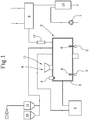
- a plant for realizing the method disclosed hereinabove comprising:
- Step (i) of the method takes place inside the reaction chamber (2).
- the organic/inorganic matrix waste and/or products to be treated are directed into the reaction chamber (2) through a hopper (9).
- Additives (10) and/or structuring agents (11) can be added to the waste and/or products according to the nature of the material to be treated.
- the heat source (1) is preferably external to the reaction chamber (2) and it can comprise a heat generator for generating heat ex novo.
- the heat source comprises an enthalpy tail, that is, the heat source comprises recovered heat.
- the recovered heat is preferably waste heat comprising cooling water at about 90°C, remaining vapour, hot water from cooling motors, condensate return from the vapour lines, for example waste vapour, diathermic oil or fumes from combustion processes/endothermic engines/cogeneration systems.
- the heat source (1) is circulated inside the jacket (3) that completely or partly encloses the reaction chamber, and in this manner the temperature of the reaction chamber (2) is brought to 60-70°C, preferably to about 65°C, with the heat yielded by the heat source.
- the temperature is also maintained owing to the microwave system (4), which also has the aim of abating the microbial count of the waste to be treated, that is, the aim of stabilizing it.
- the microwave system (4) which also has the aim of abating the microbial count of the waste to be treated, that is, the aim of stabilizing it.
- the vacuum system (7) consists of a pump, preferably a liquid ring pump, a compression system, a Venturi system or a direct connection to a possible pre-existing vacuum line.
- the material being treated in the reaction chamber is mixed by means of a mixing system comprising a series of mixers (5) equipped with blades (6), preferably motorized, so that the waste can be mixed and shredded at the same time.
- step (i) Owing to the combination of high vacuum conditions, microwaves and a temperature of about 60-70°C, during step (i) the water present within the material being treated evaporates, the microwaves and the temperature stabilize the material, reducing the microbial count thereof and the temperature, possibly also the additives and/or structuring agents, converts it.
- a finished product is collected that is dehydrated, stabilized, converted and that can be reused.
- vapour that is generated in the reaction chamber under vacuum conditions during step (i) of the method of the present invention is directed, possibly through a filter (12), into the condenser (8), which provides for converting the vapour into a liquid, which is, in turn, collected in a tank (13) ready to be treated or recycled, for example in the plant itself.
- the degree of dryness is understood as the percentage of total solids contained in the sludge, the solids being of organic or inorganic origin.
- the technology proved to be capable of effectively treating matrices with a low content of dry matter and matrices with varying degrees of dryness of up to 50%, as explained previously hereinabove.
- production output (litres of evaporated water/unit of time) proved to be constant during the step of removal of the "free" water (approximately up to a degree of dryness of 50%) and during the step of removal of the water in a bound form (degree of dryness approximately exceeding 50%).
- the matrix takes on a semi-plastic consistency, resulting in considerable problems with mixing and the heat exchange.
- the mixing system offered interesting results also in terms of (electric) energy consumption levels: with the exception of the processing time of the so-called "plastic” step, during which the mixing system absorbs all of the installed power for the purpose of maintaining the performance levels, the consumption of electricity was almost negligible with respect to the installed electric power.
- the quality of the water originating from condensation of the vapour represents another salient element.
- the content of residual pollutants was decidedly limited, particularly with reference to the nitrogen components, which constitute a problem for any treatment system.
- the low content of residual pollutants undoubtedly enables the recirculation thereof to the treatment plant that gave rise to the sludge, and where they will be treated prior to release in the environment.
Landscapes
- Engineering & Computer Science (AREA)
- Environmental & Geological Engineering (AREA)
- Life Sciences & Earth Sciences (AREA)
- Mechanical Engineering (AREA)
- Hydrology & Water Resources (AREA)
- Water Supply & Treatment (AREA)
- Chemical & Material Sciences (AREA)
- Organic Chemistry (AREA)
- Health & Medical Sciences (AREA)
- General Health & Medical Sciences (AREA)
- Toxicology (AREA)
- Physics & Mathematics (AREA)
- Thermal Sciences (AREA)
- Molecular Biology (AREA)
- General Engineering & Computer Science (AREA)
- Processing Of Solid Wastes (AREA)
- Treatment Of Sludge (AREA)
Applications Claiming Priority (2)
| Application Number | Priority Date | Filing Date | Title |
|---|---|---|---|
| ITMI20140999 | 2014-05-29 | ||
| PCT/IB2015/054017 WO2015181769A1 (en) | 2014-05-29 | 2015-05-28 | Method for transforming waste and system for performing said method |
Publications (2)
| Publication Number | Publication Date |
|---|---|
| EP3148683A1 EP3148683A1 (en) | 2017-04-05 |
| EP3148683B1 true EP3148683B1 (en) | 2020-03-18 |
Family
ID=51220726
Family Applications (1)
| Application Number | Title | Priority Date | Filing Date |
|---|---|---|---|
| EP15734449.0A Active EP3148683B1 (en) | 2014-05-29 | 2015-05-28 | Method for transforming waste and system for performing said method |
Country Status (4)
| Country | Link |
|---|---|
| EP (1) | EP3148683B1 (da) |
| DK (1) | DK3148683T3 (da) |
| ES (1) | ES2798122T3 (da) |
| WO (1) | WO2015181769A1 (da) |
Families Citing this family (5)
| Publication number | Priority date | Publication date | Assignee | Title |
|---|---|---|---|---|
| CN106403506A (zh) * | 2016-08-30 | 2017-02-15 | 贺州市恒达板业有限公司 | 一种速生木材的干燥工艺 |
| CN108246778B (zh) * | 2018-03-05 | 2023-08-29 | 上海恒霞环保设备有限公司 | 一种湿垃圾源头减量资源化处置系统 |
| CN109647865A (zh) * | 2019-01-11 | 2019-04-19 | 南开大学 | 一种有机废弃物无氧低温热解装置及应用 |
| CN110606647A (zh) * | 2019-09-30 | 2019-12-24 | 江门绿润环保科技有限公司 | 废物减量方法及干化装置 |
| IT202100007934A1 (it) * | 2021-03-31 | 2022-10-01 | Themis S P A | Sistema di separazione molecolare e trattamento di effluenti gassosi per macchinario per trattamento di reflui organici ed inorganici |
Family Cites Families (5)
| Publication number | Priority date | Publication date | Assignee | Title |
|---|---|---|---|---|
| US4882851A (en) * | 1987-04-13 | 1989-11-28 | The Fitzpatrick Co. | Apparatus and method for batch drying using a microwave vacuum system |
| US4856203A (en) * | 1988-01-15 | 1989-08-15 | The Fitzpatrick Company | Microwave vacuum dryer |
| US7001629B1 (en) * | 1993-05-11 | 2006-02-21 | Archimex | Method and plant for solvent-free microwave extraction of natural products |
| SE518999C2 (sv) * | 1999-03-01 | 2002-12-17 | Milproc Miljoeprocesser Ab | Förfarande för att hygienisera och torka organiskt material |
| DE202007001123U1 (de) * | 2007-01-25 | 2007-06-06 | KRÜGER, Günter | Anlage zum Trocknen von organischen Massen |
-
2015
- 2015-05-28 WO PCT/IB2015/054017 patent/WO2015181769A1/en not_active Ceased
- 2015-05-28 DK DK15734449.0T patent/DK3148683T3/da active
- 2015-05-28 EP EP15734449.0A patent/EP3148683B1/en active Active
- 2015-05-28 ES ES15734449T patent/ES2798122T3/es active Active
Non-Patent Citations (1)
| Title |
|---|
| None * |
Also Published As
| Publication number | Publication date |
|---|---|
| WO2015181769A1 (en) | 2015-12-03 |
| EP3148683A1 (en) | 2017-04-05 |
| ES2798122T3 (es) | 2020-12-09 |
| DK3148683T3 (da) | 2020-06-08 |
Similar Documents
| Publication | Publication Date | Title |
|---|---|---|
| EP3148683B1 (en) | Method for transforming waste and system for performing said method | |
| US5785852A (en) | Pretreatment of high solid microbial sludges | |
| KR102244259B1 (ko) | 음식물류 폐기물의 에너지화 처리장치 및 처리방법 | |
| RU2586332C1 (ru) | Экологически чистый и высокоэффективный способ получения твердого топлива с использованием органических отходов с высоким содержанием воды и комбинированная теплоэлектрическая система с использованием данного способа | |
| JP5288730B2 (ja) | 有機性廃棄物の処理方法及び処理装置 | |
| KR100954350B1 (ko) | 슬러지를 이용한 고형연료 제조장치 및 제조방법 | |
| US20110239620A1 (en) | Method for processing organic waste and a device for carrying out said method | |
| RU2007121675A (ru) | Способ превращения твердых биоотходов в возобновляемое топливо | |
| KR20230049970A (ko) | 음폐수 처리 시스템 | |
| JP4937059B2 (ja) | 下水汚泥の処理方法および下水汚泥の処理設備 | |
| KR100991483B1 (ko) | 마이크로웨이브 건조장치와 열전매체유를 이용한 바이오매스의 건조방법 | |
| Rulkens et al. | Recovery of energy from sludge–comparison of the various options | |
| KR20110005621A (ko) | 음식물쓰레기 처리장치 | |
| CN102021061B (zh) | 有机污泥制备燃料的方法 | |
| JP2016532553A (ja) | 廃棄物処理システム | |
| JP2002263617A (ja) | 廃棄物処理装置 | |
| KR100308819B1 (ko) | 유기성폐기물의 처리방법 | |
| WO2014086278A1 (zh) | 一种回收富水生物质中能量的热回收方法和系统 | |
| JP2012055808A (ja) | 余剰汚泥の利用方法 | |
| KR100561484B1 (ko) | 폐열 및 폐가스를 이용한 오폐수 및 상하수도 슬러지케이크 건조장치 | |
| US20160362649A1 (en) | Dual-mode system and method for processing organic material | |
| JPS63120792A (ja) | 汚泥と廃油の同時処理により燃料を製造する方法 | |
| JP2004358455A (ja) | 廃棄物処理方法、廃棄物処理装置、廃棄物処理システム、乾燥装置および乾燥方法 | |
| JP2017177008A (ja) | 乾式メタン発酵方法および乾式メタン発酵装置 | |
| Jyani et al. | Innovative Approaches to Sludge Treatment and Dewatering |
Legal Events
| Date | Code | Title | Description |
|---|---|---|---|
| STAA | Information on the status of an ep patent application or granted ep patent |
Free format text: STATUS: THE INTERNATIONAL PUBLICATION HAS BEEN MADE |
|
| PUAI | Public reference made under article 153(3) epc to a published international application that has entered the european phase |
Free format text: ORIGINAL CODE: 0009012 |
|
| STAA | Information on the status of an ep patent application or granted ep patent |
Free format text: STATUS: REQUEST FOR EXAMINATION WAS MADE |
|
| 17P | Request for examination filed |
Effective date: 20161124 |
|
| AK | Designated contracting states |
Kind code of ref document: A1 Designated state(s): AL AT BE BG CH CY CZ DE DK EE ES FI FR GB GR HR HU IE IS IT LI LT LU LV MC MK MT NL NO PL PT RO RS SE SI SK SM TR |
|
| AX | Request for extension of the european patent |
Extension state: BA ME |
|
| DAV | Request for validation of the european patent (deleted) | ||
| DAX | Request for extension of the european patent (deleted) | ||
| STAA | Information on the status of an ep patent application or granted ep patent |
Free format text: STATUS: EXAMINATION IS IN PROGRESS |
|
| 17Q | First examination report despatched |
Effective date: 20180509 |
|
| RAP1 | Party data changed (applicant data changed or rights of an application transferred) |
Owner name: THEMIS S.R.L. |
|
| GRAP | Despatch of communication of intention to grant a patent |
Free format text: ORIGINAL CODE: EPIDOSNIGR1 |
|
| STAA | Information on the status of an ep patent application or granted ep patent |
Free format text: STATUS: GRANT OF PATENT IS INTENDED |
|
| INTG | Intention to grant announced |
Effective date: 20191028 |
|
| GRAS | Grant fee paid |
Free format text: ORIGINAL CODE: EPIDOSNIGR3 |
|
| GRAA | (expected) grant |
Free format text: ORIGINAL CODE: 0009210 |
|
| STAA | Information on the status of an ep patent application or granted ep patent |
Free format text: STATUS: THE PATENT HAS BEEN GRANTED |
|
| AK | Designated contracting states |
Kind code of ref document: B1 Designated state(s): AL AT BE BG CH CY CZ DE DK EE ES FI FR GB GR HR HU IE IS IT LI LT LU LV MC MK MT NL NO PL PT RO RS SE SI SK SM TR |
|
| REG | Reference to a national code |
Ref country code: GB Ref legal event code: FG4D |
|
| REG | Reference to a national code |
Ref country code: DE Ref legal event code: R096 Ref document number: 602015048996 Country of ref document: DE |
|
| REG | Reference to a national code |
Ref country code: AT Ref legal event code: REF Ref document number: 1245268 Country of ref document: AT Kind code of ref document: T Effective date: 20200415 Ref country code: IE Ref legal event code: FG4D |
|
| REG | Reference to a national code |
Ref country code: DK Ref legal event code: T3 Effective date: 20200604 |
|
| REG | Reference to a national code |
Ref country code: CH Ref legal event code: NV Representative=s name: BUGNION S.A., CH |
|
| REG | Reference to a national code |
Ref country code: FI Ref legal event code: FGE |
|
| REG | Reference to a national code |
Ref country code: DE Ref legal event code: R081 Ref document number: 602015048996 Country of ref document: DE Owner name: THEMIS S.P.A., IT Free format text: FORMER OWNER: THEMIS S.R.L., MILANO, IT |
|
| REG | Reference to a national code |
Ref country code: SE Ref legal event code: TRGR |
|
| REG | Reference to a national code |
Ref country code: NL Ref legal event code: FP |
|
| RAP2 | Party data changed (patent owner data changed or rights of a patent transferred) |
Owner name: THEMIS S.P.A. |
|
| PG25 | Lapsed in a contracting state [announced via postgrant information from national office to epo] |
Ref country code: RS Free format text: LAPSE BECAUSE OF FAILURE TO SUBMIT A TRANSLATION OF THE DESCRIPTION OR TO PAY THE FEE WITHIN THE PRESCRIBED TIME-LIMIT Effective date: 20200318 |
|
| REG | Reference to a national code |
Ref country code: NO Ref legal event code: T2 Effective date: 20200318 |
|
| PG25 | Lapsed in a contracting state [announced via postgrant information from national office to epo] |
Ref country code: BG Free format text: LAPSE BECAUSE OF FAILURE TO SUBMIT A TRANSLATION OF THE DESCRIPTION OR TO PAY THE FEE WITHIN THE PRESCRIBED TIME-LIMIT Effective date: 20200618 Ref country code: LV Free format text: LAPSE BECAUSE OF FAILURE TO SUBMIT A TRANSLATION OF THE DESCRIPTION OR TO PAY THE FEE WITHIN THE PRESCRIBED TIME-LIMIT Effective date: 20200318 Ref country code: HR Free format text: LAPSE BECAUSE OF FAILURE TO SUBMIT A TRANSLATION OF THE DESCRIPTION OR TO PAY THE FEE WITHIN THE PRESCRIBED TIME-LIMIT Effective date: 20200318 Ref country code: GR Free format text: LAPSE BECAUSE OF FAILURE TO SUBMIT A TRANSLATION OF THE DESCRIPTION OR TO PAY THE FEE WITHIN THE PRESCRIBED TIME-LIMIT Effective date: 20200619 |
|
| REG | Reference to a national code |
Ref country code: LT Ref legal event code: MG4D |
|
| PG25 | Lapsed in a contracting state [announced via postgrant information from national office to epo] |
Ref country code: SM Free format text: LAPSE BECAUSE OF FAILURE TO SUBMIT A TRANSLATION OF THE DESCRIPTION OR TO PAY THE FEE WITHIN THE PRESCRIBED TIME-LIMIT Effective date: 20200318 Ref country code: SK Free format text: LAPSE BECAUSE OF FAILURE TO SUBMIT A TRANSLATION OF THE DESCRIPTION OR TO PAY THE FEE WITHIN THE PRESCRIBED TIME-LIMIT Effective date: 20200318 Ref country code: RO Free format text: LAPSE BECAUSE OF FAILURE TO SUBMIT A TRANSLATION OF THE DESCRIPTION OR TO PAY THE FEE WITHIN THE PRESCRIBED TIME-LIMIT Effective date: 20200318 Ref country code: LT Free format text: LAPSE BECAUSE OF FAILURE TO SUBMIT A TRANSLATION OF THE DESCRIPTION OR TO PAY THE FEE WITHIN THE PRESCRIBED TIME-LIMIT Effective date: 20200318 Ref country code: CZ Free format text: LAPSE BECAUSE OF FAILURE TO SUBMIT A TRANSLATION OF THE DESCRIPTION OR TO PAY THE FEE WITHIN THE PRESCRIBED TIME-LIMIT Effective date: 20200318 Ref country code: PT Free format text: LAPSE BECAUSE OF FAILURE TO SUBMIT A TRANSLATION OF THE DESCRIPTION OR TO PAY THE FEE WITHIN THE PRESCRIBED TIME-LIMIT Effective date: 20200812 Ref country code: EE Free format text: LAPSE BECAUSE OF FAILURE TO SUBMIT A TRANSLATION OF THE DESCRIPTION OR TO PAY THE FEE WITHIN THE PRESCRIBED TIME-LIMIT Effective date: 20200318 |
|
| REG | Reference to a national code |
Ref country code: ES Ref legal event code: FG2A Ref document number: 2798122 Country of ref document: ES Kind code of ref document: T3 Effective date: 20201209 |
|
| REG | Reference to a national code |
Ref country code: DE Ref legal event code: R097 Ref document number: 602015048996 Country of ref document: DE |
|
| PLBE | No opposition filed within time limit |
Free format text: ORIGINAL CODE: 0009261 |
|
| STAA | Information on the status of an ep patent application or granted ep patent |
Free format text: STATUS: NO OPPOSITION FILED WITHIN TIME LIMIT |
|
| 26N | No opposition filed |
Effective date: 20201221 |
|
| PG25 | Lapsed in a contracting state [announced via postgrant information from national office to epo] |
Ref country code: PL Free format text: LAPSE BECAUSE OF FAILURE TO SUBMIT A TRANSLATION OF THE DESCRIPTION OR TO PAY THE FEE WITHIN THE PRESCRIBED TIME-LIMIT Effective date: 20200318 |
|
| PG25 | Lapsed in a contracting state [announced via postgrant information from national office to epo] |
Ref country code: AL Free format text: LAPSE BECAUSE OF FAILURE TO SUBMIT A TRANSLATION OF THE DESCRIPTION OR TO PAY THE FEE WITHIN THE PRESCRIBED TIME-LIMIT Effective date: 20200318 Ref country code: SI Free format text: LAPSE BECAUSE OF FAILURE TO SUBMIT A TRANSLATION OF THE DESCRIPTION OR TO PAY THE FEE WITHIN THE PRESCRIBED TIME-LIMIT Effective date: 20200318 |
|
| REG | Reference to a national code |
Ref country code: DE Ref legal event code: R079 Ref document number: 602015048996 Country of ref document: DE Free format text: PREVIOUS MAIN CLASS: B01F0013060000 Ipc: B01F0033700000 |
|
| REG | Reference to a national code |
Ref country code: AT Ref legal event code: UEP Ref document number: 1245268 Country of ref document: AT Kind code of ref document: T Effective date: 20200318 |
|
| PG25 | Lapsed in a contracting state [announced via postgrant information from national office to epo] |
Ref country code: TR Free format text: LAPSE BECAUSE OF FAILURE TO SUBMIT A TRANSLATION OF THE DESCRIPTION OR TO PAY THE FEE WITHIN THE PRESCRIBED TIME-LIMIT Effective date: 20200318 Ref country code: MT Free format text: LAPSE BECAUSE OF FAILURE TO SUBMIT A TRANSLATION OF THE DESCRIPTION OR TO PAY THE FEE WITHIN THE PRESCRIBED TIME-LIMIT Effective date: 20200318 Ref country code: CY Free format text: LAPSE BECAUSE OF FAILURE TO SUBMIT A TRANSLATION OF THE DESCRIPTION OR TO PAY THE FEE WITHIN THE PRESCRIBED TIME-LIMIT Effective date: 20200318 |
|
| PG25 | Lapsed in a contracting state [announced via postgrant information from national office to epo] |
Ref country code: MK Free format text: LAPSE BECAUSE OF FAILURE TO SUBMIT A TRANSLATION OF THE DESCRIPTION OR TO PAY THE FEE WITHIN THE PRESCRIBED TIME-LIMIT Effective date: 20200318 |
|
| PGFP | Annual fee paid to national office [announced via postgrant information from national office to epo] |
Ref country code: NL Payment date: 20250528 Year of fee payment: 11 |
|
| PGFP | Annual fee paid to national office [announced via postgrant information from national office to epo] |
Ref country code: MC Payment date: 20250530 Year of fee payment: 11 |
|
| PGFP | Annual fee paid to national office [announced via postgrant information from national office to epo] |
Ref country code: FI Payment date: 20250530 Year of fee payment: 11 |
|
| PGFP | Annual fee paid to national office [announced via postgrant information from national office to epo] |
Ref country code: DE Payment date: 20250528 Year of fee payment: 11 |
|
| PGFP | Annual fee paid to national office [announced via postgrant information from national office to epo] |
Ref country code: GB Payment date: 20250527 Year of fee payment: 11 Ref country code: ES Payment date: 20250612 Year of fee payment: 11 Ref country code: DK Payment date: 20250526 Year of fee payment: 11 |
|
| PGFP | Annual fee paid to national office [announced via postgrant information from national office to epo] |
Ref country code: IS Payment date: 20250527 Year of fee payment: 11 Ref country code: NO Payment date: 20250602 Year of fee payment: 11 |
|
| PGFP | Annual fee paid to national office [announced via postgrant information from national office to epo] |
Ref country code: LU Payment date: 20250530 Year of fee payment: 11 Ref country code: BE Payment date: 20250528 Year of fee payment: 11 Ref country code: IT Payment date: 20250528 Year of fee payment: 11 Ref country code: AL Payment date: 20250527 Year of fee payment: 11 |
|
| PGFP | Annual fee paid to national office [announced via postgrant information from national office to epo] |
Ref country code: FR Payment date: 20250527 Year of fee payment: 11 |
|
| PGFP | Annual fee paid to national office [announced via postgrant information from national office to epo] |
Ref country code: CH Payment date: 20250601 Year of fee payment: 11 |
|
| PGFP | Annual fee paid to national office [announced via postgrant information from national office to epo] |
Ref country code: AT Payment date: 20250603 Year of fee payment: 11 |
|
| PGFP | Annual fee paid to national office [announced via postgrant information from national office to epo] |
Ref country code: IE Payment date: 20250530 Year of fee payment: 11 |
|
| PGFP | Annual fee paid to national office [announced via postgrant information from national office to epo] |
Ref country code: SE Payment date: 20250530 Year of fee payment: 11 |