EP3149073B1 - Polyethylenfolien und herstellung solcher folien - Google Patents
Polyethylenfolien und herstellung solcher folien Download PDFInfo
- Publication number
- EP3149073B1 EP3149073B1 EP15800069.5A EP15800069A EP3149073B1 EP 3149073 B1 EP3149073 B1 EP 3149073B1 EP 15800069 A EP15800069 A EP 15800069A EP 3149073 B1 EP3149073 B1 EP 3149073B1
- Authority
- EP
- European Patent Office
- Prior art keywords
- film
- range
- diene
- die
- psi
- Prior art date
- Legal status (The legal status is an assumption and is not a legal conclusion. Google has not performed a legal analysis and makes no representation as to the accuracy of the status listed.)
- Active
Links
Images


Classifications
-
- C—CHEMISTRY; METALLURGY
- C08—ORGANIC MACROMOLECULAR COMPOUNDS; THEIR PREPARATION OR CHEMICAL WORKING-UP; COMPOSITIONS BASED THEREON
- C08F—MACROMOLECULAR COMPOUNDS OBTAINED BY REACTIONS ONLY INVOLVING CARBON-TO-CARBON UNSATURATED BONDS
- C08F210/00—Copolymers of unsaturated aliphatic hydrocarbons having only one carbon-to-carbon double bond
- C08F210/16—Copolymers of ethene with alpha-alkenes, e.g. EP rubbers
- C08F210/18—Copolymers of ethene with alpha-alkenes, e.g. EP rubbers with non-conjugated dienes, e.g. EPT rubbers
-
- C—CHEMISTRY; METALLURGY
- C08—ORGANIC MACROMOLECULAR COMPOUNDS; THEIR PREPARATION OR CHEMICAL WORKING-UP; COMPOSITIONS BASED THEREON
- C08J—WORKING-UP; GENERAL PROCESSES OF COMPOUNDING; AFTER-TREATMENT NOT COVERED BY SUBCLASSES C08B, C08C, C08F, C08G or C08H
- C08J5/00—Manufacture of articles or shaped materials containing macromolecular substances
- C08J5/18—Manufacture of films or sheets
-
- B—PERFORMING OPERATIONS; TRANSPORTING
- B29—WORKING OF PLASTICS; WORKING OF SUBSTANCES IN A PLASTIC STATE IN GENERAL
- B29C—SHAPING OR JOINING OF PLASTICS; SHAPING OF MATERIAL IN A PLASTIC STATE, NOT OTHERWISE PROVIDED FOR; AFTER-TREATMENT OF THE SHAPED PRODUCTS, e.g. REPAIRING
- B29C48/00—Extrusion moulding, i.e. expressing the moulding material through a die or nozzle which imparts the desired form; Apparatus therefor
- B29C48/022—Extrusion moulding, i.e. expressing the moulding material through a die or nozzle which imparts the desired form; Apparatus therefor characterised by the choice of material
-
- B—PERFORMING OPERATIONS; TRANSPORTING
- B29—WORKING OF PLASTICS; WORKING OF SUBSTANCES IN A PLASTIC STATE IN GENERAL
- B29C—SHAPING OR JOINING OF PLASTICS; SHAPING OF MATERIAL IN A PLASTIC STATE, NOT OTHERWISE PROVIDED FOR; AFTER-TREATMENT OF THE SHAPED PRODUCTS, e.g. REPAIRING
- B29C48/00—Extrusion moulding, i.e. expressing the moulding material through a die or nozzle which imparts the desired form; Apparatus therefor
- B29C48/03—Extrusion moulding, i.e. expressing the moulding material through a die or nozzle which imparts the desired form; Apparatus therefor characterised by the shape of the extruded material at extrusion
- B29C48/09—Articles with cross-sections having partially or fully enclosed cavities, e.g. pipes or channels
- B29C48/10—Articles with cross-sections having partially or fully enclosed cavities, e.g. pipes or channels flexible, e.g. blown foils
-
- B—PERFORMING OPERATIONS; TRANSPORTING
- B29—WORKING OF PLASTICS; WORKING OF SUBSTANCES IN A PLASTIC STATE IN GENERAL
- B29C—SHAPING OR JOINING OF PLASTICS; SHAPING OF MATERIAL IN A PLASTIC STATE, NOT OTHERWISE PROVIDED FOR; AFTER-TREATMENT OF THE SHAPED PRODUCTS, e.g. REPAIRING
- B29C48/00—Extrusion moulding, i.e. expressing the moulding material through a die or nozzle which imparts the desired form; Apparatus therefor
- B29C48/25—Component parts, details or accessories; Auxiliary operations
- B29C48/88—Thermal treatment of the stream of extruded material, e.g. cooling
- B29C48/885—External treatment, e.g. by using air rings for cooling tubular films
-
- B—PERFORMING OPERATIONS; TRANSPORTING
- B29—WORKING OF PLASTICS; WORKING OF SUBSTANCES IN A PLASTIC STATE IN GENERAL
- B29C—SHAPING OR JOINING OF PLASTICS; SHAPING OF MATERIAL IN A PLASTIC STATE, NOT OTHERWISE PROVIDED FOR; AFTER-TREATMENT OF THE SHAPED PRODUCTS, e.g. REPAIRING
- B29C48/00—Extrusion moulding, i.e. expressing the moulding material through a die or nozzle which imparts the desired form; Apparatus therefor
- B29C48/25—Component parts, details or accessories; Auxiliary operations
- B29C48/88—Thermal treatment of the stream of extruded material, e.g. cooling
- B29C48/911—Cooling
- B29C48/9115—Cooling of hollow articles
- B29C48/912—Cooling of hollow articles of tubular films
-
- C—CHEMISTRY; METALLURGY
- C08—ORGANIC MACROMOLECULAR COMPOUNDS; THEIR PREPARATION OR CHEMICAL WORKING-UP; COMPOSITIONS BASED THEREON
- C08L—COMPOSITIONS OF MACROMOLECULAR COMPOUNDS
- C08L23/00—Compositions of homopolymers or copolymers of unsaturated aliphatic hydrocarbons having only one carbon-to-carbon double bond; Compositions of derivatives of such polymers
- C08L23/02—Compositions of homopolymers or copolymers of unsaturated aliphatic hydrocarbons having only one carbon-to-carbon double bond; Compositions of derivatives of such polymers not modified by chemical after-treatment
- C08L23/04—Homopolymers or copolymers of ethene
- C08L23/06—Polyethylene
-
- C—CHEMISTRY; METALLURGY
- C08—ORGANIC MACROMOLECULAR COMPOUNDS; THEIR PREPARATION OR CHEMICAL WORKING-UP; COMPOSITIONS BASED THEREON
- C08L—COMPOSITIONS OF MACROMOLECULAR COMPOUNDS
- C08L23/00—Compositions of homopolymers or copolymers of unsaturated aliphatic hydrocarbons having only one carbon-to-carbon double bond; Compositions of derivatives of such polymers
- C08L23/02—Compositions of homopolymers or copolymers of unsaturated aliphatic hydrocarbons having only one carbon-to-carbon double bond; Compositions of derivatives of such polymers not modified by chemical after-treatment
- C08L23/04—Homopolymers or copolymers of ethene
- C08L23/08—Copolymers of ethene
- C08L23/0807—Copolymers of ethene with unsaturated hydrocarbons only containing four or more carbon atoms
- C08L23/0815—Copolymers of ethene with unsaturated hydrocarbons only containing four or more carbon atoms with aliphatic 1-olefins containing one carbon-to-carbon double bond
-
- B—PERFORMING OPERATIONS; TRANSPORTING
- B29—WORKING OF PLASTICS; WORKING OF SUBSTANCES IN A PLASTIC STATE IN GENERAL
- B29K—INDEXING SCHEME ASSOCIATED WITH SUBCLASSES B29B, B29C OR B29D, RELATING TO MOULDING MATERIALS OR TO MATERIALS FOR MOULDS, REINFORCEMENTS, FILLERS OR PREFORMED PARTS, e.g. INSERTS
- B29K2009/00—Use of rubber derived from conjugated dienes, as moulding material
-
- B—PERFORMING OPERATIONS; TRANSPORTING
- B29—WORKING OF PLASTICS; WORKING OF SUBSTANCES IN A PLASTIC STATE IN GENERAL
- B29K—INDEXING SCHEME ASSOCIATED WITH SUBCLASSES B29B, B29C OR B29D, RELATING TO MOULDING MATERIALS OR TO MATERIALS FOR MOULDS, REINFORCEMENTS, FILLERS OR PREFORMED PARTS, e.g. INSERTS
- B29K2023/00—Use of polyalkenes or derivatives thereof as moulding material
- B29K2023/04—Polymers of ethylene
- B29K2023/06—PE, i.e. polyethylene
-
- B—PERFORMING OPERATIONS; TRANSPORTING
- B29—WORKING OF PLASTICS; WORKING OF SUBSTANCES IN A PLASTIC STATE IN GENERAL
- B29K—INDEXING SCHEME ASSOCIATED WITH SUBCLASSES B29B, B29C OR B29D, RELATING TO MOULDING MATERIALS OR TO MATERIALS FOR MOULDS, REINFORCEMENTS, FILLERS OR PREFORMED PARTS, e.g. INSERTS
- B29K2409/00—Use of rubber derived from conjugated dienes, as filler
-
- C—CHEMISTRY; METALLURGY
- C08—ORGANIC MACROMOLECULAR COMPOUNDS; THEIR PREPARATION OR CHEMICAL WORKING-UP; COMPOSITIONS BASED THEREON
- C08F—MACROMOLECULAR COMPOUNDS OBTAINED BY REACTIONS ONLY INVOLVING CARBON-TO-CARBON UNSATURATED BONDS
- C08F4/00—Polymerisation catalysts
- C08F4/42—Metals; Metal hydrides; Metallo-organic compounds; Use thereof as catalyst precursors
- C08F4/44—Metals; Metal hydrides; Metallo-organic compounds; Use thereof as catalyst precursors selected from light metals, zinc, cadmium, mercury, copper, silver, gold, boron, gallium, indium, thallium, rare earths or actinides
- C08F4/60—Metals; Metal hydrides; Metallo-organic compounds; Use thereof as catalyst precursors selected from light metals, zinc, cadmium, mercury, copper, silver, gold, boron, gallium, indium, thallium, rare earths or actinides together with refractory metals, iron group metals, platinum group metals, manganese, rhenium technetium or compounds thereof
- C08F4/62—Refractory metals or compounds thereof
- C08F4/64—Titanium, zirconium, hafnium or compounds thereof
- C08F4/659—Component covered by group C08F4/64 containing a transition metal-carbon bond
- C08F4/65908—Component covered by group C08F4/64 containing a transition metal-carbon bond in combination with an ionising compound other than alumoxane, e.g. (C6F5)4B-X+
-
- C—CHEMISTRY; METALLURGY
- C08—ORGANIC MACROMOLECULAR COMPOUNDS; THEIR PREPARATION OR CHEMICAL WORKING-UP; COMPOSITIONS BASED THEREON
- C08F—MACROMOLECULAR COMPOUNDS OBTAINED BY REACTIONS ONLY INVOLVING CARBON-TO-CARBON UNSATURATED BONDS
- C08F4/00—Polymerisation catalysts
- C08F4/42—Metals; Metal hydrides; Metallo-organic compounds; Use thereof as catalyst precursors
- C08F4/44—Metals; Metal hydrides; Metallo-organic compounds; Use thereof as catalyst precursors selected from light metals, zinc, cadmium, mercury, copper, silver, gold, boron, gallium, indium, thallium, rare earths or actinides
- C08F4/60—Metals; Metal hydrides; Metallo-organic compounds; Use thereof as catalyst precursors selected from light metals, zinc, cadmium, mercury, copper, silver, gold, boron, gallium, indium, thallium, rare earths or actinides together with refractory metals, iron group metals, platinum group metals, manganese, rhenium technetium or compounds thereof
- C08F4/62—Refractory metals or compounds thereof
- C08F4/64—Titanium, zirconium, hafnium or compounds thereof
- C08F4/659—Component covered by group C08F4/64 containing a transition metal-carbon bond
- C08F4/6592—Component covered by group C08F4/64 containing a transition metal-carbon bond containing at least one cyclopentadienyl ring, condensed or not, e.g. an indenyl or a fluorenyl ring
- C08F4/65922—Component covered by group C08F4/64 containing a transition metal-carbon bond containing at least one cyclopentadienyl ring, condensed or not, e.g. an indenyl or a fluorenyl ring containing at least two cyclopentadienyl rings, fused or not
- C08F4/65927—Component covered by group C08F4/64 containing a transition metal-carbon bond containing at least one cyclopentadienyl ring, condensed or not, e.g. an indenyl or a fluorenyl ring containing at least two cyclopentadienyl rings, fused or not two cyclopentadienyl rings being mutually bridged
-
- C—CHEMISTRY; METALLURGY
- C08—ORGANIC MACROMOLECULAR COMPOUNDS; THEIR PREPARATION OR CHEMICAL WORKING-UP; COMPOSITIONS BASED THEREON
- C08J—WORKING-UP; GENERAL PROCESSES OF COMPOUNDING; AFTER-TREATMENT NOT COVERED BY SUBCLASSES C08B, C08C, C08F, C08G or C08H
- C08J2323/00—Characterised by the use of homopolymers or copolymers of unsaturated aliphatic hydrocarbons having only one carbon-to-carbon double bond; Derivatives of such polymers
- C08J2323/02—Characterised by the use of homopolymers or copolymers of unsaturated aliphatic hydrocarbons having only one carbon-to-carbon double bond; Derivatives of such polymers not modified by chemical after treatment
- C08J2323/04—Homopolymers or copolymers of ethene
- C08J2323/06—Polyethene
-
- C—CHEMISTRY; METALLURGY
- C08—ORGANIC MACROMOLECULAR COMPOUNDS; THEIR PREPARATION OR CHEMICAL WORKING-UP; COMPOSITIONS BASED THEREON
- C08J—WORKING-UP; GENERAL PROCESSES OF COMPOUNDING; AFTER-TREATMENT NOT COVERED BY SUBCLASSES C08B, C08C, C08F, C08G or C08H
- C08J2447/00—Characterised by the use of homopolymers or copolymers of compounds having one or more unsaturated aliphatic radicals, at least one having two or more carbon-to-carbon double bonds; Derivatives of such polymers
-
- C—CHEMISTRY; METALLURGY
- C08—ORGANIC MACROMOLECULAR COMPOUNDS; THEIR PREPARATION OR CHEMICAL WORKING-UP; COMPOSITIONS BASED THEREON
- C08L—COMPOSITIONS OF MACROMOLECULAR COMPOUNDS
- C08L2203/00—Applications
- C08L2203/16—Applications used for films
-
- C—CHEMISTRY; METALLURGY
- C08—ORGANIC MACROMOLECULAR COMPOUNDS; THEIR PREPARATION OR CHEMICAL WORKING-UP; COMPOSITIONS BASED THEREON
- C08L—COMPOSITIONS OF MACROMOLECULAR COMPOUNDS
- C08L2205/00—Polymer mixtures characterised by other features
- C08L2205/02—Polymer mixtures characterised by other features containing two or more polymers of the same C08L -group
- C08L2205/025—Polymer mixtures characterised by other features containing two or more polymers of the same C08L -group containing two or more polymers of the same hierarchy C08L, and differing only in parameters such as density, comonomer content, molecular weight, structure
Definitions
- the present invention relates to polyethylene films and the process used to form such films, and in particular, an improved blown film process and the films that result therefrom.
- the blown film technique is an important means by which polyethylene films are manufactured.
- a major use of such films is in making bags, where the films can be formed as continuous cylinders then crimped to close one end.
- the process to blow polyethylenes into such films is complex, requiring a balance between processability (flowability and melt strength) on the one hand and mechanical properties (e.g., Tensile Strength, Modulus) on the other. Improvements in both the materials used to make such films, and the process itself, can synergistically make blown films a more attractive commercial process.
- the inventors here have found desirable materials and methods of forming blown films.
- WO 2013/043796 A2 discloses a branched modifier and a composition comprising more than 25 wt% (based on the weight of the composition) of one or more linear ethylene polymers having a g' vis of 0.97 or more and an Mw of 20,000 g/mol or more and at least 0.1 wt% of a branched modifier where the modifier has a g' vis of less than 0.97.
- the present invention provides a method of forming a finished film as recited in the attached claims.
- a polyethylene blown film having a MD Tensile Strength of the finished film is within a range from 6000 psi (41 MPa) or 8000 psi (55 MPa) to 16,000 psi (110 MPa) comprising (or consisting essentially of, or consisting of) a linear low density polyethylene having a density within the range from 0.850 g/cm 3 to 0.930 g/cm 3 and within the range from 0.10 wt% to 10 wt% of a diene-terpolymer modifier; wherein the diene terpolymer modifier comprises within a range from 0.01 wt% to 10.0 wt% diene derived units, and 1.0 wt% to 20 wt% of C 4 to C 10 ⁇ -olefin derived units based on the weight of the diene terpolymer, wherein the diene-terpolymer modifier has: a g' vis of less than 0.90; an M w within
- the inventors have surprisingly found that the addition of a minor amount of a diene-terpolymer modifier ("DTP") with a polyethylene, especially LLDPE, in combination with a film process with a means for cooling the forming film that provides some distance from the die from which the film emanates, yields significant enhancement of a number of the finished film's properties and the rate at which it can be produced.
- a cooling device such as an air ring, for example, is elevated (moved a distance from the die) allowing for more effective cooling of the forming film.
- the molten polymer is stretched in both the TD and MD directions after it reaches the cooling device (e.g., elevated air ring). Then the film is subjected to effective cooling from, for example, both a trip-lip air ring and internal bubble cooling, common in blown film processes. It is evidenced that this new process and DTP addition provide a balanced MD-TD orientation; hence, the film exhibits enhanced physical properties. Desirably, the combination of DTP and separation between the cooling and the die also creates a desired crystal size and morphology, which result in the enhanced stiffness and excellent optical property.
- the invention can be described in any embodiment as a method of forming a finished film comprising extruding a molten polyethylene comprising a diene terpolymer modifier through a die opening to form a film, wherein the diene-terpolymer modifier is a terpolymer comprising ethylene-derived units, C 3 to C 10 ⁇ -olefin derived units, and diene-derived units; causing the film to progress in a direction away from the die opening, preferably in the molten state, partially molten, or softened due to some partial cooling; cooling the molten polyethylene in the form of a film at a distance from the die opening using a cooling device , the distance adjusted to effect the properties of the film (e.g., to allow relaxation of the molten polyethylene prior to solidification and/or crystallization upon cooling), wherein the distance is at least 8 cm as measured from the top or outer edge of the die to the base of the cooling device; and isolating a finished film therefrom
- melt By “extruding” what is meant is that the polymer and/or polymer blend if formed into a melt such as by heating and/or sheer forces and is forced to blend with other polymers and/or components (e.g., the polyethylene and the modifier) and is then forced out of a die in a desirable form or shape to effect the form or shape of the emanating polymer melt, such as in a film, most preferably a tubular film.
- a single or twin-screw extruder, or other melt-blending device as is known in the art and that can be fitted with a suitable die.
- the “cooling device” such as a cooling ring that blows air on the forming film, is located at least 8 cm from the die (or other distance as described herein) measured from the top or outer edge of the die to the base of the cooling device.
- causing the film to progress is that the film forming from the die opening from hardening polyethylene is pulled or pushed mechanically or by some other means such as by air pressure (negative or positive) away from the die to create a continuous finished film.
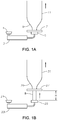
- a polyethylene melt is extruded through a die such as an annular slit die, usually vertically, to form a thin walled tube. Cooling preferably in the form of air is introduced via a ring in the center of the die to blow up the tube like a balloon. Cooling could also be effectuated by other means, and the air may be nitrogen/oxygen or other gases or mixtures of gases or liquids. Mounted on top of the die, a high-speed air ring blows onto the hot film to cool it. In the present invention, the cooling occurs at some distance "H" (see Figure 1B ) from the die, which is at least 8 cm as defined above.
- the tube of film can then continue upwards (see arrows in Figures 1A and 1B ), continually cooling, until it may pass through nip rolls where the tube is flattened to create what is known as a "lay-flat" tube of film.
- This lay-flat or collapsed tube can then be taken back down the extrusion "tower” via more rollers.
- the air inside the bubble is also exchanged. This is known as IBC (Internal Bubble Cooling).
- lay-flat film is then either kept as such or the edges of the lay-flat are slit off to produce two flat film sheets and wound up onto reels.
- Articles such as bags can be made from such lay-flat films.
- the tube of film is made into bags by sealing across the width of film and cutting or perforating to make each bag. This is done either in line with the blown film process or at a later stage.
- the expansion ratio between die and blown tube of film would be 1.5 to 4 times the die diameter.
- the drawdown between the melt wall thickness and the cooled film thickness occurs in both radial and longitudinal directions and is easily controlled by changing the volume of air inside the bubble and by altering the haul off speed. This gives blown film a better balance of properties than traditional cast or extruded film which is drawn down along the extrusion direction only.
- a typical prior art blown film process is described with reference to Figure 1A , where the ingredients used to form the film are added in any desirable form, preferably as granules, in hopper 1, which feeds the material to the extruder 3, where the materials are melt blended at a desirable temperature through shear forces and/or heating.
- the molten material is then fed, with or without filtering, to a die 5 which is also heated to a desired temperature and then forced from the die in the direction of the arrow in Figure 1A .
- the cooling of the forming film takes place via 7, preferably a device that blows air that is at least 10 or 20°C cooler than the surrounding air.
- the air preferably blows against the outside of the film, most preferably around the entire circumference formed by the film.
- the film 9 starts to expand where it eventually cools and crystallizes to form finished film 11.
- the forming film B desirably spends from 0.5 or 1 or 5 seconds to 10 or 20 seconds in the zone described by the distance H in Figure 1B .
- the cooling air is at a temperature within the range from 5 or 10°C to 15 or 20 or 25, or 30°C; and preferably the surrounding temperature in the area of the forming film 29 is within a range from 20 or 30°C to 50 or 60°C.
- the film then expands and cools in the region 29 as it is cooled by, for example, cooler air blowing from 27, where a finished film 31 is eventually isolated by various means such as by rollers, nips, etc.
- the “distance” is the_distance from the die measured from the top or outer edge of the die to the base of the cooling device.
- the optimal distance is one that allows for adequate relaxation of the molten polyethylene before it crystalizes into the finished film.
- the distance is at least 8 cm from the die; or within a range of from 8 cm to 50 cm, or 60 cm, or 80 cm, or 3 meters.
- the distance can be described as the ratio of H/D and is within a range from 0.05, or 0.1 or 0.5 or 1 to 2 or 3 or 4 or 5, or 10, or 15, or 20, where the H is the distance from die exit to the "cooling", for example, a cooling ring, and D is the diameter of a die (H and D are the same units).
- the "cooling” is preferably provided by air blown around the film. Air may also be blown inside the film if the finished film is a tube, and most preferably there is air blown inside the film-tube. Such air will emanate from the center of the die, near or at the die opening, and will maintain the temperature in the vicinity "H" described above.
- the die used in the formation of the films herein is designed such that the die opening, through which the molten polyethylene emanates, is in the form of a ring and the molten polyethylene emanating therefrom is in the form of a continuous tube.
- the "Maximum Die Rate” is a normalized extrusion rate by die size which is commonly used in blow film industry.
- the Maximum Die Rate at which the film is formed is at least 232.2 g/mm-hr (131b/in-hr); and preferably the Maximum Rate of extrusion is within a range from 350 lb/hr (159 kg/hr) to 500 lb/hr (227 kg/hr). Note that for the "Maximum Die Rate" in the English unit, the die dimension is the die circumference, while in metric unit, the die dimension is the die diameter.
- the inventive method in any embodiment includes the extrusion of a molten composition which is a polyethylene blend comprising at least one polyethylene and at least one DTP.
- a molten composition which is a polyethylene blend comprising at least one polyethylene and at least one DTP.
- the "polyethylene” that is useful in making films is preferably any type of homo- or co-polymer derived from ethylene and C 3 to C 10 ⁇ -olefins.
- the polyethylene is a linear low density polyethylene having a density within the range from 0.850 or 0.900 or 0.905 g/cm 3 to 0.915 or 0.925 or 0.930 g/cm 3 .
- linear low density polyethylene preferably has a melt index (ASTM D 1238 190°C, 2.16 kg) within the range from 0.20 or 0.40 or 0.60 or 0.80 g/10 min to 1.20 or 1.40 or 1.60 or 2.00 or 4.00, or 8.0, or 10.0 g/10 min.
- the polyethylene comprises within the range from 0.10 or 0.50 wt% to 2.0 or 3.0 or 6.0 or 10 wt% of a diene-terpolymer (DTP) modifier.
- the diene-terpolymer modifier is a terpolymer comprising ethylene-derived units, C 3 to C 10 ⁇ -olefin derived units, and diene-derived units; wherein the diene is preferably an alpha-omega linear diene.
- the diene terpolymer comprises within a range from 0.01 wt% to 10.0 wt% diene derived units, and 1.0 wt% to 20 wt% of C 4 to C 10 ⁇ -olefin derived units based on the weight of the diene terpolymer, wherein the diene terpolymer has a g' vis of less than 0.90; an M w within a range of from 70,000 g/mol to 300,000 g/mol; an M w /M n within the range of from 3.5 to 12; and an M z /M n of greater than 7.0.
- the DTP modifier can be described by a number of features and properties. It primarily is comprised of ethylene-derived units, but will also comprise within the range from 1.0 or 2.0 or 5.0 wt% to 12 or 16 or 20 wt% of a C 4 to C 10 ⁇ -olefin derived units based on the weight of the DTP modifier, most preferably 1-butene, 1-hexene or 1-octene.
- the DTP modifier also comprises within the range from 0.01 or 0.05 or 1.0 wt% to 5.0 or 8.0 or 10.0 wt% diene derived units, preferably alpha-omega dienes, based on the weight of the DTP modifier.
- the remainder of the DTP is comprised of ethylene-derived units.
- the dienes may preferably be selected from the group consisting of 1,4-pentadiene, 1,5-hexadiene, 1,6-heptadiene, 1,7-octadiene, 1,8-nonadiene, 1,9-decadiene, 1,10-undecadiene, 1,11-dodecadiene, 1,12-tridecadiene, and 1,13-tetradecadiene, tetrahydroindene, norbornadiene also known as bicyclo-(2.2.1)-hepta-2,5-diene, dicyclopentadiene, 5-vinyl-2-norbornene, 1,4-cyclohexadiene, 1,5-cyclooctadiene, 1,7-cyclododecadiene derived units, and combinations thereof.
- the diene is selected from 5-vinyl-2-norbornene, 1,4-pentadiene, 1,5-hexadiene, 1,6-heptadiene, 1,7-octadiene, 1,8-nonadiene, 1,9-decadiene, 1,10-undecadiene, 1,11-dodecadiene, 1,12-tridecadiene, and 1,13-tetradecadiene derived units; and most preferably selected from 1,7-octadiene and 1,9-decadiene derived units.
- the DTP modifier preferably has a density within the range of from 0.890 or 0.905 or 0.910 or 0.915 g/cm 3 to 0.920 or 0.925 g/cm 3 .
- the properties of the DTP modifier can of course vary depending on the exact process used to make it, but preferably the DTP modifier has the following measurable features.
- Certain GPC (Light Scattering (LS) or Differential Refractive Index (DRI)) measurable features include the following:
- the weight average molecular weight (Mw) is preferably within a range of from 70,000 or 80,000 or 100,000 g/mol to 140,000 or 160,000 or 180,000 or 200,000 or 300,000 g/mol.
- the number average molecular weight (Mn) is preferably within a range of from 15,000 or 20,000 or 30,000 g/mol to 35,000 or 40,000 or 50,000 or 80,000 g/mol.
- the z-average molecular weight (Mz) is preferably greater than 400,000 or 500,000 or 800,000 g/mol, and more preferably within a range of from 300,000 or 400,000 or 500,000 or 800,000 g/mol to 1,000,000 or 1,200,000 or 1,500,000 or 2,000,000 g/mol.
- the DTP modifier has a molecular weight distribution (Mw/Mn) within the range of from 3.0 or 3.2 to 6.0 or 7.0 or 8.0 or 10.0 or 12.0; and an Mz/Mn value of greater than 14 or 16 or 18 or 20, or within a range of from 14 or 16 or 18 to 24 or 28 or 30 or 36.
- DRI differential refractive index
- LS light scattering
- the DTP modifier preferably has a melting point temperature (T m ) within the range of from 90 or 95 or 100 or 110 °C to 115 or 125 or 130 °C.
- the DTP modifier also preferably has a crystallization temperature (T c ) within the range of from 75 or 80 or 85 or 90°C to 110 or 115 or 120 or 125°C.
- the DTP modifier also preferably has a heat of fusion (H f ) within the range of from 70 or 75 or 80 J/g to 90 or 95 or 100 or 110 or 120 or 130 or 140 J/g.
- the DTP modifier preferably has a melt index (190 °C/2.16 kg, "I 2 ") of 15 g/10 min or less, 10 g/10 min or less, 5 g/10 min or less or 2 g/10 min or less, or more preferably within the range of from 0.10 or 0.20 or 0.30 or 0.80 or 1.0 g/10 min to 4 or 5 or 6 or 8 g/10 min.
- I 2 melt index
- the DTP modifier has a wide ranging high load melt index (I 21 ), but preferably has a high load melt index (190°C/21.6 kg, "I 21 ") within the range of from 0.10 or 0.20 or 0.30 or 0.80 or 1.0 g/10 min to 4 or 5 or 6 or 8 or 20 or 40 or 60 or 80 or 100 or 140 or 180 or 200 g/10 min.
- the DTP modifier has a melt index ratio (I 21 /I 2 ) within a range of from 20 or 25 or 30 to 70 or 75 or 80 or 85 or 90.
- the DTP modifier preferably has a Complex Viscosity at 0.1 rad/sec and a temperature of 190°C within the range of from 20,000, or 50,000, or 100,000, or 150,000, Pa•s to 300,000, or 350,000, or 400,000, or 450,000 Pa•s.
- the DTP modifier preferably has a Complex Viscosity at 100 rad/sec and a temperature of 190 °C within the range of from 500 or 700 Pa•s to 5,000 or 8,000 or 10,000 or 15,000 Pa•s.
- the DTP modifier preferably has a Phase Angle at the Complex Modulus of 10,000 Pa within the range of from 10 or 15 or 20 or 25° to 45 or 50 or 55 or 60° when the complex shear rheology is measured at a temperature of 190°C.
- the DTP modifier preferably has a Phase Angle at the Complex Modulus of 100,000 Pa within the range of from 10 or 15° to 25 or 35 or 45° when the complex shear rheology is measured at a temperature of 190°C.
- the DTP modifier has a level of branching indicated by the measured value of the branching index "g' vis ".
- the value for g' vis is preferably less than 0.90 or 0.80 or 0.75 or 0.60, or within a range of from 0.30 or 0.40 or 0.60 to 0.70 or 0.90.
- a polyethylene is "linear" when the polyethylene has no long chain branches, typically having a g' vis of 0.97 or above, preferably 0.98 or above.
- Linear polyethylenes preferably include ethylene polymers having a g' vis of 0.95 or 0.97 or more, and as further described herein. Thus, a lower value for g' vis indicates more branching.
- the methods for measuring g' vis are described in US 9,340,664 ; US 9,321,911 ; US 2013/0216812 ; and US 9,580,533 .
- the % crystallinity ( ⁇ ) or inter-lamellar spacing ( ⁇ ) of the forming film could be measured as described below, and this could be used to aid in adjusting the distance of the cooling and the amount of "relaxation” or crystallization of the forming film.
- the distance could be adjusted to keep % crystallinity ( ⁇ ) of the film in the vicinity of "H” below 50% or 40% or 30% or 20% or 10%, or between 1 or 5 or 10% to 15 or 20 or 30% crystallinity.
- the MD Tensile Strength of the finished film is greater than 41 or 55 or 62 MPa (6000 or 8000 or 9000 psi), or within a range from 41 MPa (6000 psi) or 55 MPa (8000 psi) to 110 MPa (16,000 psi).
- the finished films preferably have a MD Elongation of greater than 480 or 490 or 500 or 550%, or within a range from 480% to 680%.
- the Haze (ASTM D1003) of the finished film is preferably less than 6 or 4%.
- the 1% Average Secant Flexural Modulus (“Flex Mod”) of the inventive film is within a range from 25,000 (172), or 28,000 psi (193 MPa) to 35,000 (241), or 40,000 psi (276 MPa) in either the MD or TD; and in any embodiment the Dart Impact is within a range from 15.7, or 16.5 g/ ⁇ m (400, or 420 g/mil) to 19.7, or 21.7, or 23.6, or 25.6, or 27.6, or 31.5 or 35.4, or 39.4 g/ ⁇ m (500, or 550, or 600, or 650, or 700, or 800, or 900, or 1000 g/mil). Desirably, the finished film has a thickness within the range from 10 or 15 ⁇ m to 50 or 75 or 100 or 150 ⁇ m.
- the finished films have many desirable end uses such as bags and packaging material.
- the finished films are most preferably "blown films” as is commonly referred to in the art, being cylindrical across its axis, and continuous perpendicular to this axis.
- the finished films are typically collected and formed into rolls and can be manipulated further by sealing one end and/or cut to form individual articles such as bags.
- the improved properties of the films also exist in the unfinished polymer melt that forms the film. Such improvements allow faster line speeds thus debottlenecking of blown film processes.
- the maximum rate of production measured for instance as the Maximum Die Rate, at which the film can be produced is controlled in part by the "bubble stability" of the forming film. When the line speed/extrusion rate is over the maximum rate, the bubble formed by the film being blown by air becomes unstable.
- the bubble stability is related two main factors:
- the Maximum Die Rate is used to normalize the extrusion rate.
- the Maximum Die Rate even using the DTP is about 232.2 to 241.1 g/mm-hr (13 to 13.5 lb/in-hr).
- these same blends can be formed at a Maximum Die Rate of at least 321.4, or 357.2, or 392.9 g/mm-hr (18, or 20, or 22 lbs/in-hr).
- the inventive process results in an inventive polyethylene blown film having a MD Tensile Strength within a range from 41 MPa (6000 psi) or 55 MPa (8000 psi) to 110 MPa (16,000 psi) comprising (or consisting essentially of) a linear low density polyethylene having a density within the range from 0.850 g/cm 3 to 0.930 g/cm 3 and within the range from 0.10 wt% to 10 wt% of a diene-terpolymer modifier; wherein the diene terpolymer modifier comprises ethylene-derived units and within a range from 0.01 wt% to 10.0 wt% diene derived units, and 1.0 wt% to 20 wt% of C 4 to C 10 ⁇ -olefin derived units based on the weight of the diene terpolymer, wherein the diene terpolymer has: a) a g' vis of less than 0.90;
- SEC-DRI-LS-VIS a viscometer
- Three Polymer Laboratories PLgel 10mm Mixed-B columns are used.
- the nominal flow rate is 0.5 cm 3 /min and the nominal injection volume is 300 ⁇ L.
- the various transfer lines, columns and differential refractometer (the DRI detector) are contained in an oven maintained at 135°C.
- Solvent for the SEC experiment is prepared by dissolving 6 grams of butylated hydroxy toluene as an antioxidant in 4 liters of reagent grade 1,2,4-trichlorobenzene (TCB). The TCB mixture is then filtered through a 0.7 ⁇ m glass pre-filter and subsequently through a 0.1 ⁇ m Teflon filter. The TCB is then degassed with an online degasser before entering the SEC.
- TCB 1,2,4-trichlorobenzene
- Each set of polymer films was analyzed using Small- and Wide-Angle X-ray Scattering (SAXS/WAXS) techniques.
- the film was placed in a sample holder at room temperature and the SAXS and WAXS data were collected simultaneously.
- the SAXS data were collected using a 2D CCD camera which was placed 1.127 m from the sample.
- the WAXS data were collected using an image plate with a hole in the center (allowing for the scattered X-rays at smaller angles to pass through) and this was placed 0.071m from the sample.
- the 2D X-ray patterns showed that all materials had an inherent degree of molecular orientation: both in the small scale crystal (obtained from WAXS) and in the larger range order which describes how these crystals connect via amorphous non-crystalline chains (obtained from SAXS).
- the molecular orientation is observed by an anisotropic pattern: the scattering rings are not uniform in intensity; indicative of more molecules being oriented in one specific direction, in our case, this direction is the machine direction (MD).
- MD machine direction
- the quantification of this orientation is done by calculating at which angle the greatest intensity lies and to what extent. These angles are then used to compute the Hermans Orientation Function (f H ).
- the f H can be computed for both SAXS and WAXS data, f H from SAXS data describes the ordering in the crystal stacks, or lamellae, connected by amorphous polymer chains. f H from WAXS describes the order of the individual crystallites within the lamellae.
- a f H value of zero indicates anisotropy (no order), a value of one (1) indicates perfect parallel alignment to MD, and a value of -0.5 indicates perfect perpendicular alignment to MD.
- positive fractional values of a f H are obtained, indicating preferential alignment to MD, but not perfect alignment.
- the extent of crystallinity (or "relaxation"), or amount of polymer chain that crystallized, can also be calculated from the WAXS data.
- the 2D images are collapsed to an Intensity versus Angle profile and the two sharp peaks observed for PE are fitted to a Guassian function and the areas are calculated. The ratio of these peak areas to the total area under the scattering profile yields the extent of crystallinity.
- FWHM full width at half maximum of these crystalline peaks
- ⁇ (beta) the crystallite size
- ⁇ (tau) the scattering angle
- the inter-crystalline (or lamellae) spacing can also be calculated from SAXS from the peak maximum once the 2D SAXS data are collapsed to a 1D intensity versus Angle profile.
- ASC Average Secant Flexural Modulus
- Dart F50 or Dart Drop Impact or Dart Impact (DI) reported in grams (g) and/or grams per mil (g/ ⁇ m), is measured as specified by ASTM D-1709, method B, using a dart with a phenolic composite head.
- DI Dart Drop Impact or Dart Impact
- DTP Diene-terpolymer modifiers
- examples: DTP (1,7), DTP2, DTP3, and DTP (1,9) were made in a continuous stirred-tank reactor operated in a solution process.
- the reactor was a 1.0-liter stainless steel autoclave reactor and was equipped with a stirrer, a water cooling/steam heating element with a temperature controller and a pressure controller.
- Solvents and monomers e.g., ethylene, hexene and/or octene
- the purified solvents and monomers were then chilled to below 4°C by passing through a chiller before being fed into the reactor through a manifold.
- Ethylene was delivered as a gas solubilized in the chilled solvent/monomer mixture. Solvent and monomers were mixed in the manifold and fed into the reactor through a single port. All liquid flow rates were controlled and measured using Brooksfield mass flow controllers. 1,7-octadiene and 1,9-decediene were purified and then diluted with isohexane and fed into the reactor using a metering pump.
- Rh-dimethylsilylbis(indenyl)zirconium dimethyl was pre-activated with N,N-dimethyl anilinium tetrakis (heptafluoro-2-naphthyl) borate at a molar ratio of about 1:1 in toluene.
- the pre-activated catalyst solution was kept in an inert atmosphere and was fed into the reactor using ISCO syringe pump through a separated line. Catalyst and monomer contacts took place in the reactor.
- TNOA tri-n-octyl aluminum
- the reactor was first prepared by continuously N 2 purging at a maximum allowed temperature, then pumping isohexane and scavenger solution through the reactor system for at least one hour. Monomers and catalyst solutions were then fed into the reactor for polymerization. Once the activity was established and the system reached equilibrium, the reactor was lined out by continuing operation of the system under the established condition for a time period of at least four times of mean residence time prior to sample collection.
- the liquid phase comprising mainly polymer and solvent, was collected for polymer recovery.
- the collected samples were first air-dried in a hood to evaporate most of the solvent, and then dried in a vacuum oven at a temperature of about 90°C for about 12 hours.
- the vacuum oven dried samples were weighed to obtain yields. All the reactions were carried out at a pressure of about 2.4 MPag (350 psig).
- the polymerization process condition and some characterization data are listed in Table 1. For each polymerization run, the catalyst feed rate and scavenger fed rate were adjusted to achieve a desired conversion listed in Table 1. Table 1.
- ExceedTM Polyethylene 1018 is an mLLDPE (metallocene ethylene/hexene copolymer) available from ExxonMobil Chemical Company (Houston, Texas), having an MI of 1.0 dg/min and a density of 0.918 g/cm 3 .
- Polyethylene LD071.LRTM (also referred to as LDPE or LD071) is an LDPE available from ExxonMobil Chemical Company (Houston, Texas) having an MI of 0.70 dg/min and a density of 0.924 g/cm 3 .
- EnableTM 2005 polyethylene (also referred as Enable 2005 or "EN2005”) is a metallocene ethylene-hexene copolymer having a melt index of 0.5 dg/min (ASTM D 1238, 2.16kg, 190°C) and density of 0.920 g/cm 3 .
- the various DTPs were used as modifier to mLLDPE to improve the film blowing process and film properties.
- the chosen DTP was ground in a Wiley mill mixer and homogenized with an antioxidant package in a 2.54 cm (1 inch) Haake twin screw extruder.
- An antioxidant package was included that consisted of 15 wt% Irganox 1076TM, 61 wt% Weston 399TM and 24 wt% of FX592DATM.
- a blend composition was compounded with 1 wt% of DTP (by weight of the combined ingredients) produced in the examples described with ExceedTM 1018.
- the blends were prepared in a CoperionTM ZSK 57 mm twin screw extruder.
- 5 wt% LDPE and 10 wt% EnableTM 2005 blends with Exceed 1018 were also prepared in the Coperion ZSK57mm twin screw extruder for comparison.
- the blown films were produced on a blown film line (Line I) having a 160 mm mono-layer die setting with a 90 mm grooved feed extruder.
- the adjustable air ring had a triple air lips and there is IBC (internal bubble cooling). It had 25.4 ⁇ m (1 mil) film, 2.5 blow-up ratio (BUR), 1524 ⁇ m (60 mil) die gap and 355 mm (14 inch) air ring height "H".
- the blown film conditions and equipment setting are detailed in Table 2, where the air ring air temperature was 12°C, the surrounding temperature was 25-30°C. Table 2.
- Blown films of blends of LLDPE (ExceedTM 1018) and DTP(1,9) as well as a blend of LLDPE (Exceed 1018) and LD071 were prepared as comparative examples for blown film process.
- the comparative examples were achieved in a blown film line with a traditional fixed cooling ring against the die (blown film Line II) so that "H" is zero, which has a 2.5" extruder of L/D of 30:1.
- Line II was equipped with a 6" mono-layer die and dual lip air ring. The die was able to rotate to provide a more uniform melt distribution.
- the bubble passed through a bubble cage to be stabilized. Then bubble to be flattened into a sheet after passing a collapsing frame.
- the maximum rate is controlled in part by the "bubble stability" of the forming film.
- bubble stability When the line speed/extrusion rate is over the maximum rate, the bubble formed by the film being blown by air becomes unstable.
- the bubble stability is related two main factors:
- the Maximum Die Rate is used to normalize the extrusion rate.
- the Maximum Die Rate for 1 wt% DTP or 5 wt% LD was about 232.2 to 241.1 g/mm-hr (13 to 13.5 lb/in-hr).
- these same blends can be formed at a Maximum Die Rate of at least 321.4, or 357.2, or 392.9 g/mm-hr (18, or 20, or 22 lbs/in-hr).
- each symbol, whether filled or open, represents the same composition.
- the filled black symbols represent the use of a traditional, prior art cooling device positioned against the die, wherein the open symbols represent the inventive process of having the cooling device a distance from the die of 14 inches (see Table 2).
- Figure 2 illustrates the film MD-Elmendorf tear as a function of film microstructure parameters: Herman's orientation function (lamellar) percent crystallinity and inter lamellar spacing; while Figure 3 elucidate the film stiffness measure by 1% MD secant as a function of the above mentioned three parameters.
- the open diamond refers to "1% DTP (1,7), as it does in Figure 2 , and "+" inside box or alone is meant to be 10% Enable 2005 at 321.4 to 357.2 g/mm-hr (18-20 lb/in-hr), as it is in Figure 2 .
- the crystallinity data and inter lamellar spacing data (y-axis) are in Figures 4 and 5 as bar graphs for illustrative purposes.
- a blown film line to form a finished film by extruding a molten polyethylene comprising a diene terpolymer modifier through a die opening to form a film
- the diene-terpolymer modifier is a terpolymer comprising ethylene-derived units, C 3 to C 10 ⁇ -olefin derived units, and diene-derived units; causing the film to progress in a direction away from the die opening; cooling the molten polyethylene in the form of a film at a distance from the die opening, the distance adjusted to allow relaxation of the molten polyethylene prior to solidification and/or crystallization upon cooling; and isolating a finished film therefrom.
- the polyethylene may be characterized by any one or combination of features described herein.
- phrases "consisting essentially of" in a film means that no other additives (additional polymers and/or antioxidants, antistatic agents, antislip agents, fillers) are present in the composition being referred to other than those named, or, if present, are present to a level no greater than 0.5, or 1.0, or 2.0, or 4.0 wt% by weight of the composition; and in a process, “consisting essentially of” means that no other major process step is present or effects the claimed film properties such that the value would be outside the claim scope.
Landscapes
- Chemical & Material Sciences (AREA)
- Engineering & Computer Science (AREA)
- Mechanical Engineering (AREA)
- Polymers & Plastics (AREA)
- Chemical Kinetics & Catalysis (AREA)
- Medicinal Chemistry (AREA)
- Health & Medical Sciences (AREA)
- Organic Chemistry (AREA)
- Physics & Mathematics (AREA)
- Thermal Sciences (AREA)
- Manufacturing & Machinery (AREA)
- Materials Engineering (AREA)
- Manufacture Of Macromolecular Shaped Articles (AREA)
- Compositions Of Macromolecular Compounds (AREA)
Claims (15)
- Verfahren zur Bildung einer fertigen Folie, bei dem geschmolzenes Polyethylen, welches Dien-Terpolymermodifizierungsmittel umfasst, durch eine Düsenöffnung extrudiert wird, um Folie zu bilden, wobei das Dien-Terpolymermodifizierungsmittel Terpolymer ist, das von Ethylen abgeleitete Einheiten, von C3- bis C40-α-Olefin abgeleitete Einheiten und von Dien abgeleitete Einheiten umfasst, bewirkt wird, dass die Folie in einer Richtung vorankommt, die von der Düsenöffnung weg führt,
die Folie unter Verwendung einer Kühlvorrichtung in einer Distanz zu der Düsenöffnung gekühlt wird, wobei die Distanz angepasst wird, um die Eigenschaften der Folie zu beeinflussen, wobei die Distanz mindestens 8 cm beträgt, gemessen von dem oberen oder äußeren Rand der Düse zu der Basis der Kühlvorrichtung, und
eine fertige Folie davon isoliert wird, wobei die resultierende fertige Folie die folgende Beziehung erfüllt:

- Verfahren nach Anspruch 1, bei dem die resultierende fertige Folie die folgende Beziehung erfüllt:




- Verfahren nach Anspruch 1 oder 2, bei dem das Polyethylen lineares Polyethylen mit niedriger Dichte ist, das eine Dichte innerhalb des Bereichs von 0, 850 g/cm3 bis 0, 930 g/cm3 aufweist.
- Verfahren nach einem der Ansprüche 1 bis 3, bei dem das Dien-Terpolymermodifizierungsmittel im Bereich von 0,10 Gew.% bis 10 Gew.% eines Dien-Terpolymermodifizierungsmittels vorhanden ist.
- Verfahren nach Anspruch 4, bei dem das Dien lineares alpha-omega-Dien ist.
- Verfahren nach Anspruch 5, bei dem das Dien-Terpolymer im Bereich von 0,01 Gew.% bis 10,0 Gew.% von Dien abgeleitete Einheiten und 1,0 bis 20 Gew.% von C4- bis C10-α-Olefin abgeleitete Einheiten umfasst, bezogen auf das Gewicht des Dien-Terpolymers, wobei das Dien-Terpolymer folgendes aufweist:a) einen g'vis von weniger als 0,90,b) ein Mw innerhalb eines Bereichs von 70 000 g/Mol bis 300 000 g/Mol,c) ein Mw/Mn innerhalb des Bereichs von 3,0 bis 12 undd) ein Mz/Mn größer als 14,0.
- Verfahren nach einem der Ansprüche 1 bis 6, bei dem die Distanz innerhalb eines Bereichs von 8 cm bis 50 cm, oder 60 cm, oder 80 cm, oder 3 Metern liegt.
- Verfahren nach einem der Ansprüche 1 bis 7, bei dem das Kühlen durch Luft bereitgestellt wird, die auf mindestens einen Abschnitt der Folie geblasen wird, wobei die Temperatur der Luft mindestens 10°C unter der Umgebungstemperatur liegt.
- Verfahren nach einem der Ansprüche 1 bis 8, bei dem die Folie mit einer maximalen Düsenrate von mindestens 232,2 g/mm-h (13 lb/in-h) gebildet wird.
- Verfahren nach einem der Ansprüche 1 bis 9, bei dem die Extrusion mit einer maximalen Rate innerhalb eines Bereichs von 159 kg/h (350 lb/h) bis 227 kg/h (500 lb/h) stattfindet.
- Verfahren nach Anspruch 4, bei dem die Zugfestigkeit der fertigen Folie in MD innerhalb eines Bereichs von 41 MPa (6000 psi) bis 110 MPa (16 000 psi) liegt.
- Verfahren nach Anspruch 4, bei dem die Dehnung der fertigen Folie in MD innerhalb eines Bereichs von 480 % bis 680 % liegt.
- Verfahren nach Anspruch 4, bei dem die Trübung (ASTM D1003) der fertigen Folie kleiner als 6 oder 4 % ist.
- Verfahren nach einem der Ansprüche 1 bis 13, bei dem die Düsenöffnung in Form eines Rings vorliegt, und wobei das daraus hervortretende geschmolzene Polyethylen in Form eines kontinuierlichen Schlauchs vorliegt.
- Verfahren nach einem der Ansprüche 1 bis 14, bei dem die fertige Folie eine Dicke innerhalb des Bereichs von 10 oder 15 µm bis 100 µm aufweist.
Applications Claiming Priority (3)
| Application Number | Priority Date | Filing Date | Title |
|---|---|---|---|
| US201462004278P | 2014-05-29 | 2014-05-29 | |
| EP14175210 | 2014-07-01 | ||
| PCT/US2015/030844 WO2015183578A1 (en) | 2014-05-29 | 2015-05-14 | Polyethylene films and production of such films |
Publications (3)
| Publication Number | Publication Date |
|---|---|
| EP3149073A1 EP3149073A1 (de) | 2017-04-05 |
| EP3149073A4 EP3149073A4 (de) | 2017-06-28 |
| EP3149073B1 true EP3149073B1 (de) | 2020-12-02 |
Family
ID=51205178
Family Applications (1)
| Application Number | Title | Priority Date | Filing Date |
|---|---|---|---|
| EP15800069.5A Active EP3149073B1 (de) | 2014-05-29 | 2015-05-14 | Polyethylenfolien und herstellung solcher folien |
Country Status (4)
| Country | Link |
|---|---|
| US (2) | US10077344B2 (de) |
| EP (1) | EP3149073B1 (de) |
| CN (1) | CN106414568B (de) |
| WO (1) | WO2015183578A1 (de) |
Families Citing this family (5)
| Publication number | Priority date | Publication date | Assignee | Title |
|---|---|---|---|---|
| US20160272798A1 (en) * | 2011-09-23 | 2016-09-22 | Exxonmobil Chemical Patents Inc. | Modified Polyethylene Compositions with Enhanced Melt Strength |
| EP3589474B1 (de) * | 2017-03-03 | 2021-10-27 | CSP Technologies, Inc. | Verfahren zum auftrag und anheften eines heissschmelz- polymers mit einschlüssen auf substraten |
| WO2018182943A1 (en) * | 2017-03-29 | 2018-10-04 | Exxonmobil Chemical Patents Inc. | Polyethylene compositions |
| CN110920016B (zh) * | 2019-11-30 | 2021-05-28 | 重庆瑞霆塑胶有限公司 | 风冷系统 |
| CN117276805A (zh) * | 2021-08-30 | 2023-12-22 | 重庆恩捷纽米科技股份有限公司 | 一种高延伸率聚烯烃微多孔膜及电池 |
Family Cites Families (40)
| Publication number | Priority date | Publication date | Assignee | Title |
|---|---|---|---|---|
| US3568252A (en) | 1967-03-15 | 1971-03-09 | Mitsubishi Petrochemical Co | Annular cooling device for manufacture of tubular film |
| US3891790A (en) | 1974-03-04 | 1975-06-24 | Electronized Chem Corp | Splicing and repairing insulated electrical wire |
| US4565847A (en) | 1984-01-04 | 1986-01-21 | Mobil Oil Corporation | Blends of LLDPE, PP and EPDM or EPR for films of improved stiffness, tear and impact strength |
| CA1272536A (en) | 1985-05-28 | 1990-08-07 | Tsutomu Suda | Propylene polymer composition |
| US4784885A (en) | 1986-08-29 | 1988-11-15 | R. J. Reynolds Tobacco Company | Peelable film laminate |
| EP0544098B1 (de) | 1991-11-27 | 1998-08-12 | Mitsubishi Chemical Corporation | Verpackungsfolie auf Basis von Polyolefin |
| JP3510900B2 (ja) | 1992-07-22 | 2004-03-29 | 昭和電工株式会社 | インフレーションフィルムの成形方法及びその装置 |
| JPH06136197A (ja) | 1992-09-08 | 1994-05-17 | Mitsui Petrochem Ind Ltd | エチレン系共重合体組成物 |
| JPH06136194A (ja) | 1992-09-08 | 1994-05-17 | Mitsui Petrochem Ind Ltd | エチレン系共重合体組成物 |
| JP2002179855A (ja) | 1992-09-08 | 2002-06-26 | Mitsui Chemicals Inc | エチレン系共重合体組成物 |
| JPH06143412A (ja) | 1992-11-13 | 1994-05-24 | Nippon Unicar Co Ltd | ポリカプロラクトンチューブラーフィルムの製造方法 |
| JP3365684B2 (ja) | 1994-05-18 | 2003-01-14 | 三井化学株式会社 | エチレン系共重合体組成物 |
| US6300451B1 (en) | 1994-10-24 | 2001-10-09 | Exxon Chemical Patents Inc. | Long-chain branched polymers and their production |
| US5670595A (en) | 1995-08-28 | 1997-09-23 | Exxon Chemical Patents Inc. | Diene modified polymers |
| US6114457A (en) | 1997-02-07 | 2000-09-05 | Exxon Chemical Patents Inc. | High melt strength polyethylene compositions |
| DE69808243T2 (de) | 1997-02-07 | 2003-05-08 | Exxonmobil Chemical Patents Inc., Baytown | Thermoplastische,elastomere zusammensetzungen aus verzweigten olefincopolymeren |
| US6355757B2 (en) | 1997-02-14 | 2002-03-12 | Exxonmobil Chemical Patents, Inc. | Processing olefin copolymers |
| US6111019A (en) | 1997-03-31 | 2000-08-29 | Exxon Chemical Patents, Inc. | LLDPE blends with an ethylene-norbornene copolymer for resins of improved toughness and processibility for film production |
| US6509431B1 (en) | 2000-01-18 | 2003-01-21 | Exxonmobil Oil Corporation | Terpolymers |
| US6734265B1 (en) | 2000-10-06 | 2004-05-11 | Univation Technologies, Llc. | Linear low density polyethylenes with high melt strength and high melt index ratio |
| US7750080B2 (en) | 2001-04-23 | 2010-07-06 | Exxonmobil Chemical Patents Inc. | Blends of EPDM and metallocene plastomers for wire and cable applications |
| US6870010B1 (en) | 2003-12-01 | 2005-03-22 | Univation Technologies, Llc | Low haze high strength polyethylene compositions |
| US7235609B2 (en) | 2004-01-14 | 2007-06-26 | Amitkumar Dharia | Thermoplastic olefin compositions and articles |
| WO2007067307A1 (en) | 2005-12-06 | 2007-06-14 | Exxonmobil Chemical Patents Inc. | Ethylene elastomer compositions |
| US7687580B2 (en) | 2005-12-08 | 2010-03-30 | Exxonmobil Research And Engineering Company | Synthesis and use of well-defined, highly-branched saturated hydrocarbon polymers |
| WO2007130277A1 (en) | 2006-05-05 | 2007-11-15 | Exxonmobil Chemical Patents Inc. | Linear low density polymer blends and articles made therefrom |
| US20080033112A1 (en) * | 2006-08-04 | 2008-02-07 | Squire Kevin R | Polymer compositions comprising cyclic olefin copolymers and polyolefin modifiers |
| US7744806B2 (en) | 2007-01-29 | 2010-06-29 | Cryovac, Inc. | Process for making shrink film comprising rapidly-quenched semi-crystalline polyamide |
| CA2629990C (en) | 2007-04-17 | 2011-07-19 | Kdesign Gmbh | A method of and device for cooling blown film during the production of blown film |
| US8709315B2 (en) * | 2009-08-18 | 2014-04-29 | Exxonmobil Chemical Patents Inc. | Process for making thermoplastic polymer pellets |
| JP2011218646A (ja) | 2010-04-08 | 2011-11-04 | Sumitomo Chemical Co Ltd | プロピレン樹脂製フィルムの製造方法 |
| JP5357825B2 (ja) | 2010-04-28 | 2013-12-04 | 三井化学株式会社 | エチレン系共重合体、および組成物 |
| US9340664B2 (en) | 2011-09-23 | 2016-05-17 | Exxonmobil Chemical Patents Inc. | Modified polyethylene compositions for blown film |
| US20130216812A1 (en) | 2011-09-23 | 2013-08-22 | Exxonmobil Chemical Patents Inc. | Modified Polyethylene Compositions with Enhanced Melt Strength |
| US9580533B2 (en) * | 2011-09-23 | 2017-02-28 | Exxonmobil Chemical Patents Inc. | Modified polyethylene compositions |
| US9321911B2 (en) | 2011-09-23 | 2016-04-26 | Exxonmobil Chemical Patents Inc. | Modified polyethylene compositions for cast film |
| CN102863685B (zh) | 2012-09-26 | 2014-06-18 | 北京印刷学院 | 一种番茄保鲜包装材料 |
| CN103739061B (zh) | 2013-12-31 | 2015-03-25 | 江门市新会区龙泉污水处理有限公司 | 潜水推流器导杆 |
| WO2015183577A1 (en) * | 2014-05-29 | 2015-12-03 | Exxonmobil Chemical Patents Inc. | Cyclic-diene additives in polyethylene films and enhanced film orientation balance in production thereof |
| US10125247B2 (en) | 2014-05-29 | 2018-11-13 | Exxonmobil Chemical Patents Inc. | Polyethylene compositions |
-
2015
- 2015-05-14 EP EP15800069.5A patent/EP3149073B1/de active Active
- 2015-05-14 US US15/303,784 patent/US10077344B2/en active Active
- 2015-05-14 CN CN201580028010.9A patent/CN106414568B/zh active Active
- 2015-05-14 WO PCT/US2015/030844 patent/WO2015183578A1/en not_active Ceased
-
2018
- 2018-08-03 US US16/054,827 patent/US10563027B2/en active Active
Non-Patent Citations (1)
| Title |
|---|
| None * |
Also Published As
| Publication number | Publication date |
|---|---|
| US20190135996A1 (en) | 2019-05-09 |
| CN106414568A (zh) | 2017-02-15 |
| WO2015183578A1 (en) | 2015-12-03 |
| US10077344B2 (en) | 2018-09-18 |
| EP3149073A1 (de) | 2017-04-05 |
| EP3149073A4 (de) | 2017-06-28 |
| US10563027B2 (en) | 2020-02-18 |
| US20170029584A1 (en) | 2017-02-02 |
| CN106414568B (zh) | 2019-08-06 |
Similar Documents
| Publication | Publication Date | Title |
|---|---|---|
| US10563027B2 (en) | Polyethylene films and production of such films | |
| US10562219B2 (en) | Cyclic-diene additives in polyethylene films and enhanced film orientation balance in production thereof | |
| US10611867B2 (en) | Broad orthogonal distribution metallocene polyethylenes for films | |
| EP2256160B1 (de) | Polymerzusammensetzung und Verfahren zur Herstellung von hochmolecularem Polyethylen hoher Dichte und Folie daraus | |
| EP2895550B1 (de) | Ethylenbasierte polymere und daraus gefertigte artikel | |
| EP2864101B1 (de) | Polyethylengemischzusammensetzung für blasfolien und daraus hergestellte folien | |
| EP2718365B1 (de) | Verbesserte harzzusammensetzungen für die extrusionsbeschichtung | |
| EA027509B1 (ru) | Металлоцен-катализированный полиэтилен | |
| JP2019526686A (ja) | 多峰性ポリエチレンパイプ | |
| CN104582929B (zh) | 适合用于吹塑膜的聚乙烯共混物组合物和由其制备的膜 | |
| US20090035546A1 (en) | Polyethylene films | |
| EP3548525A1 (de) | Metallocenpolyethylene mit breiter orthogonaler verteilung für filme | |
| US10125247B2 (en) | Polyethylene compositions | |
| US9783667B2 (en) | Polymeric blend composition | |
| EP2997053B1 (de) | Ethylenbasierte polymere und daraus gefertigte artikel | |
| EP2504388B1 (de) | Zusammensetzungen, filme und herstellungsverfahren | |
| EP1995037B1 (de) | Verfahren zur herstellung von formteilen durch das aufblasverfahren | |
| EP3601433B1 (de) | Polyethylenzusammensetzungen | |
| US20060047077A1 (en) | Polyethylene blends | |
| KR101769641B1 (ko) | 취입 필름 압출 방법에 적당한 폴리에틸렌 조성물의 버블 안정성 개선 방법 | |
| JP2004537628A (ja) | 延伸高密度ポリエチレンフィルム、その調製に適した組成物および方法 |
Legal Events
| Date | Code | Title | Description |
|---|---|---|---|
| STAA | Information on the status of an ep patent application or granted ep patent |
Free format text: STATUS: THE INTERNATIONAL PUBLICATION HAS BEEN MADE |
|
| PUAI | Public reference made under article 153(3) epc to a published international application that has entered the european phase |
Free format text: ORIGINAL CODE: 0009012 |
|
| STAA | Information on the status of an ep patent application or granted ep patent |
Free format text: STATUS: REQUEST FOR EXAMINATION WAS MADE |
|
| 17P | Request for examination filed |
Effective date: 20161220 |
|
| AK | Designated contracting states |
Kind code of ref document: A1 Designated state(s): AL AT BE BG CH CY CZ DE DK EE ES FI FR GB GR HR HU IE IS IT LI LT LU LV MC MK MT NL NO PL PT RO RS SE SI SK SM TR |
|
| AX | Request for extension of the european patent |
Extension state: BA ME |
|
| A4 | Supplementary search report drawn up and despatched |
Effective date: 20170529 |
|
| RIC1 | Information provided on ipc code assigned before grant |
Ipc: C08F 210/18 20060101ALI20170522BHEP Ipc: B29C 47/88 20060101AFI20170522BHEP |
|
| DAV | Request for validation of the european patent (deleted) | ||
| DAX | Request for extension of the european patent (deleted) | ||
| STAA | Information on the status of an ep patent application or granted ep patent |
Free format text: STATUS: EXAMINATION IS IN PROGRESS |
|
| 17Q | First examination report despatched |
Effective date: 20180704 |
|
| GRAP | Despatch of communication of intention to grant a patent |
Free format text: ORIGINAL CODE: EPIDOSNIGR1 |
|
| STAA | Information on the status of an ep patent application or granted ep patent |
Free format text: STATUS: GRANT OF PATENT IS INTENDED |
|
| RIC1 | Information provided on ipc code assigned before grant |
Ipc: B29C 48/00 20190101ALI20191122BHEP Ipc: B29K 409/00 20060101ALN20191122BHEP Ipc: C08L 23/08 20060101ALI20191122BHEP Ipc: C08F 4/659 20060101ALI20191122BHEP Ipc: C08F 210/00 20060101AFI20191122BHEP Ipc: C08F 210/18 20060101ALI20191122BHEP Ipc: B29K 9/00 20060101ALN20191122BHEP Ipc: B29C 48/10 20190101ALI20191122BHEP Ipc: C08F 4/6592 20060101ALI20191122BHEP Ipc: B29C 48/88 20190101ALI20191122BHEP |
|
| INTG | Intention to grant announced |
Effective date: 20191220 |
|
| GRAJ | Information related to disapproval of communication of intention to grant by the applicant or resumption of examination proceedings by the epo deleted |
Free format text: ORIGINAL CODE: EPIDOSDIGR1 |
|
| STAA | Information on the status of an ep patent application or granted ep patent |
Free format text: STATUS: EXAMINATION IS IN PROGRESS |
|
| INTC | Intention to grant announced (deleted) | ||
| RIC1 | Information provided on ipc code assigned before grant |
Ipc: B29C 48/00 20190101ALI20200408BHEP Ipc: C08F 210/18 20060101ALI20200408BHEP Ipc: B29C 48/10 20190101ALI20200408BHEP Ipc: C08F 4/659 20060101ALI20200408BHEP Ipc: C08L 23/08 20060101ALI20200408BHEP Ipc: C08F 210/00 20060101AFI20200408BHEP Ipc: B29K 9/00 20060101ALN20200408BHEP Ipc: B29C 48/88 20190101ALI20200408BHEP Ipc: C08F 4/6592 20060101ALI20200408BHEP Ipc: B29K 409/00 20060101ALN20200408BHEP |
|
| REG | Reference to a national code |
Ref country code: DE Ref legal event code: R079 Ref document number: 602015062980 Country of ref document: DE Free format text: PREVIOUS MAIN CLASS: C08J0005180000 Ipc: C08F0210000000 |
|
| GRAR | Information related to intention to grant a patent recorded |
Free format text: ORIGINAL CODE: EPIDOSNIGR71 |
|
| GRAS | Grant fee paid |
Free format text: ORIGINAL CODE: EPIDOSNIGR3 |
|
| RIC1 | Information provided on ipc code assigned before grant |
Ipc: C08F 4/6592 20060101ALI20200917BHEP Ipc: C08L 23/08 20060101ALI20200917BHEP Ipc: C08F 4/659 20060101ALI20200917BHEP Ipc: B29C 48/88 20190101ALI20200917BHEP Ipc: B29K 409/00 20060101ALN20200917BHEP Ipc: C08F 210/00 20060101AFI20200917BHEP Ipc: C08F 210/18 20060101ALI20200917BHEP Ipc: B29K 9/00 20060101ALN20200917BHEP Ipc: B29C 48/00 20190101ALI20200917BHEP Ipc: B29C 48/10 20190101ALI20200917BHEP |
|
| STAA | Information on the status of an ep patent application or granted ep patent |
Free format text: STATUS: GRANT OF PATENT IS INTENDED |
|
| GRAA | (expected) grant |
Free format text: ORIGINAL CODE: 0009210 |
|
| STAA | Information on the status of an ep patent application or granted ep patent |
Free format text: STATUS: THE PATENT HAS BEEN GRANTED |
|
| INTG | Intention to grant announced |
Effective date: 20201021 |
|
| AK | Designated contracting states |
Kind code of ref document: B1 Designated state(s): AL AT BE BG CH CY CZ DE DK EE ES FI FR GB GR HR HU IE IS IT LI LT LU LV MC MK MT NL NO PL PT RO RS SE SI SK SM TR |
|
| REG | Reference to a national code |
Ref country code: GB Ref legal event code: FG4D |
|
| REG | Reference to a national code |
Ref country code: AT Ref legal event code: REF Ref document number: 1340856 Country of ref document: AT Kind code of ref document: T Effective date: 20201215 Ref country code: CH Ref legal event code: EP |
|
| REG | Reference to a national code |
Ref country code: IE Ref legal event code: FG4D |
|
| REG | Reference to a national code |
Ref country code: DE Ref legal event code: R096 Ref document number: 602015062980 Country of ref document: DE |
|
| PG25 | Lapsed in a contracting state [announced via postgrant information from national office to epo] |
Ref country code: GR Free format text: LAPSE BECAUSE OF FAILURE TO SUBMIT A TRANSLATION OF THE DESCRIPTION OR TO PAY THE FEE WITHIN THE PRESCRIBED TIME-LIMIT Effective date: 20210303 Ref country code: NO Free format text: LAPSE BECAUSE OF FAILURE TO SUBMIT A TRANSLATION OF THE DESCRIPTION OR TO PAY THE FEE WITHIN THE PRESCRIBED TIME-LIMIT Effective date: 20210302 Ref country code: FI Free format text: LAPSE BECAUSE OF FAILURE TO SUBMIT A TRANSLATION OF THE DESCRIPTION OR TO PAY THE FEE WITHIN THE PRESCRIBED TIME-LIMIT Effective date: 20201202 Ref country code: RS Free format text: LAPSE BECAUSE OF FAILURE TO SUBMIT A TRANSLATION OF THE DESCRIPTION OR TO PAY THE FEE WITHIN THE PRESCRIBED TIME-LIMIT Effective date: 20201202 |
|
| REG | Reference to a national code |
Ref country code: NL Ref legal event code: MP Effective date: 20201202 |
|
| REG | Reference to a national code |
Ref country code: AT Ref legal event code: MK05 Ref document number: 1340856 Country of ref document: AT Kind code of ref document: T Effective date: 20201202 |
|
| PG25 | Lapsed in a contracting state [announced via postgrant information from national office to epo] |
Ref country code: SE Free format text: LAPSE BECAUSE OF FAILURE TO SUBMIT A TRANSLATION OF THE DESCRIPTION OR TO PAY THE FEE WITHIN THE PRESCRIBED TIME-LIMIT Effective date: 20201202 Ref country code: LV Free format text: LAPSE BECAUSE OF FAILURE TO SUBMIT A TRANSLATION OF THE DESCRIPTION OR TO PAY THE FEE WITHIN THE PRESCRIBED TIME-LIMIT Effective date: 20201202 Ref country code: PL Free format text: LAPSE BECAUSE OF FAILURE TO SUBMIT A TRANSLATION OF THE DESCRIPTION OR TO PAY THE FEE WITHIN THE PRESCRIBED TIME-LIMIT Effective date: 20201202 Ref country code: BG Free format text: LAPSE BECAUSE OF FAILURE TO SUBMIT A TRANSLATION OF THE DESCRIPTION OR TO PAY THE FEE WITHIN THE PRESCRIBED TIME-LIMIT Effective date: 20210302 |
|
| PG25 | Lapsed in a contracting state [announced via postgrant information from national office to epo] |
Ref country code: NL Free format text: LAPSE BECAUSE OF FAILURE TO SUBMIT A TRANSLATION OF THE DESCRIPTION OR TO PAY THE FEE WITHIN THE PRESCRIBED TIME-LIMIT Effective date: 20201202 Ref country code: HR Free format text: LAPSE BECAUSE OF FAILURE TO SUBMIT A TRANSLATION OF THE DESCRIPTION OR TO PAY THE FEE WITHIN THE PRESCRIBED TIME-LIMIT Effective date: 20201202 |
|
| REG | Reference to a national code |
Ref country code: LT Ref legal event code: MG9D |
|
| PG25 | Lapsed in a contracting state [announced via postgrant information from national office to epo] |
Ref country code: EE Free format text: LAPSE BECAUSE OF FAILURE TO SUBMIT A TRANSLATION OF THE DESCRIPTION OR TO PAY THE FEE WITHIN THE PRESCRIBED TIME-LIMIT Effective date: 20201202 Ref country code: CZ Free format text: LAPSE BECAUSE OF FAILURE TO SUBMIT A TRANSLATION OF THE DESCRIPTION OR TO PAY THE FEE WITHIN THE PRESCRIBED TIME-LIMIT Effective date: 20201202 Ref country code: SM Free format text: LAPSE BECAUSE OF FAILURE TO SUBMIT A TRANSLATION OF THE DESCRIPTION OR TO PAY THE FEE WITHIN THE PRESCRIBED TIME-LIMIT Effective date: 20201202 Ref country code: RO Free format text: LAPSE BECAUSE OF FAILURE TO SUBMIT A TRANSLATION OF THE DESCRIPTION OR TO PAY THE FEE WITHIN THE PRESCRIBED TIME-LIMIT Effective date: 20201202 Ref country code: PT Free format text: LAPSE BECAUSE OF FAILURE TO SUBMIT A TRANSLATION OF THE DESCRIPTION OR TO PAY THE FEE WITHIN THE PRESCRIBED TIME-LIMIT Effective date: 20210405 Ref country code: SK Free format text: LAPSE BECAUSE OF FAILURE TO SUBMIT A TRANSLATION OF THE DESCRIPTION OR TO PAY THE FEE WITHIN THE PRESCRIBED TIME-LIMIT Effective date: 20201202 Ref country code: LT Free format text: LAPSE BECAUSE OF FAILURE TO SUBMIT A TRANSLATION OF THE DESCRIPTION OR TO PAY THE FEE WITHIN THE PRESCRIBED TIME-LIMIT Effective date: 20201202 |
|
| PG25 | Lapsed in a contracting state [announced via postgrant information from national office to epo] |
Ref country code: AT Free format text: LAPSE BECAUSE OF FAILURE TO SUBMIT A TRANSLATION OF THE DESCRIPTION OR TO PAY THE FEE WITHIN THE PRESCRIBED TIME-LIMIT Effective date: 20201202 |
|
| REG | Reference to a national code |
Ref country code: DE Ref legal event code: R097 Ref document number: 602015062980 Country of ref document: DE |
|
| PG25 | Lapsed in a contracting state [announced via postgrant information from national office to epo] |
Ref country code: IS Free format text: LAPSE BECAUSE OF FAILURE TO SUBMIT A TRANSLATION OF THE DESCRIPTION OR TO PAY THE FEE WITHIN THE PRESCRIBED TIME-LIMIT Effective date: 20210402 |
|
| PLBE | No opposition filed within time limit |
Free format text: ORIGINAL CODE: 0009261 |
|
| STAA | Information on the status of an ep patent application or granted ep patent |
Free format text: STATUS: NO OPPOSITION FILED WITHIN TIME LIMIT |
|
| PG25 | Lapsed in a contracting state [announced via postgrant information from national office to epo] |
Ref country code: IT Free format text: LAPSE BECAUSE OF FAILURE TO SUBMIT A TRANSLATION OF THE DESCRIPTION OR TO PAY THE FEE WITHIN THE PRESCRIBED TIME-LIMIT Effective date: 20201202 Ref country code: AL Free format text: LAPSE BECAUSE OF FAILURE TO SUBMIT A TRANSLATION OF THE DESCRIPTION OR TO PAY THE FEE WITHIN THE PRESCRIBED TIME-LIMIT Effective date: 20201202 |
|
| 26N | No opposition filed |
Effective date: 20210903 |
|
| PG25 | Lapsed in a contracting state [announced via postgrant information from national office to epo] |
Ref country code: SI Free format text: LAPSE BECAUSE OF FAILURE TO SUBMIT A TRANSLATION OF THE DESCRIPTION OR TO PAY THE FEE WITHIN THE PRESCRIBED TIME-LIMIT Effective date: 20201202 Ref country code: ES Free format text: LAPSE BECAUSE OF FAILURE TO SUBMIT A TRANSLATION OF THE DESCRIPTION OR TO PAY THE FEE WITHIN THE PRESCRIBED TIME-LIMIT Effective date: 20201202 Ref country code: DK Free format text: LAPSE BECAUSE OF FAILURE TO SUBMIT A TRANSLATION OF THE DESCRIPTION OR TO PAY THE FEE WITHIN THE PRESCRIBED TIME-LIMIT Effective date: 20201202 |
|
| REG | Reference to a national code |
Ref country code: CH Ref legal event code: PL |
|
| PG25 | Lapsed in a contracting state [announced via postgrant information from national office to epo] |
Ref country code: CH Free format text: LAPSE BECAUSE OF NON-PAYMENT OF DUE FEES Effective date: 20210531 Ref country code: LU Free format text: LAPSE BECAUSE OF NON-PAYMENT OF DUE FEES Effective date: 20210514 Ref country code: LI Free format text: LAPSE BECAUSE OF NON-PAYMENT OF DUE FEES Effective date: 20210531 Ref country code: MC Free format text: LAPSE BECAUSE OF FAILURE TO SUBMIT A TRANSLATION OF THE DESCRIPTION OR TO PAY THE FEE WITHIN THE PRESCRIBED TIME-LIMIT Effective date: 20201202 |
|
| REG | Reference to a national code |
Ref country code: BE Ref legal event code: MM Effective date: 20210531 |
|
| PG25 | Lapsed in a contracting state [announced via postgrant information from national office to epo] |
Ref country code: IE Free format text: LAPSE BECAUSE OF NON-PAYMENT OF DUE FEES Effective date: 20210514 |
|
| PG25 | Lapsed in a contracting state [announced via postgrant information from national office to epo] |
Ref country code: IS Free format text: LAPSE BECAUSE OF FAILURE TO SUBMIT A TRANSLATION OF THE DESCRIPTION OR TO PAY THE FEE WITHIN THE PRESCRIBED TIME-LIMIT Effective date: 20210402 |
|
| PG25 | Lapsed in a contracting state [announced via postgrant information from national office to epo] |
Ref country code: BE Free format text: LAPSE BECAUSE OF NON-PAYMENT OF DUE FEES Effective date: 20210531 |
|
| PG25 | Lapsed in a contracting state [announced via postgrant information from national office to epo] |
Ref country code: HU Free format text: LAPSE BECAUSE OF FAILURE TO SUBMIT A TRANSLATION OF THE DESCRIPTION OR TO PAY THE FEE WITHIN THE PRESCRIBED TIME-LIMIT; INVALID AB INITIO Effective date: 20150514 |
|
| P01 | Opt-out of the competence of the unified patent court (upc) registered |
Effective date: 20230518 |
|
| PG25 | Lapsed in a contracting state [announced via postgrant information from national office to epo] |
Ref country code: CY Free format text: LAPSE BECAUSE OF FAILURE TO SUBMIT A TRANSLATION OF THE DESCRIPTION OR TO PAY THE FEE WITHIN THE PRESCRIBED TIME-LIMIT Effective date: 20201202 |
|
| PG25 | Lapsed in a contracting state [announced via postgrant information from national office to epo] |
Ref country code: MK Free format text: LAPSE BECAUSE OF FAILURE TO SUBMIT A TRANSLATION OF THE DESCRIPTION OR TO PAY THE FEE WITHIN THE PRESCRIBED TIME-LIMIT Effective date: 20201202 |
|
| PG25 | Lapsed in a contracting state [announced via postgrant information from national office to epo] |
Ref country code: TR Free format text: LAPSE BECAUSE OF FAILURE TO SUBMIT A TRANSLATION OF THE DESCRIPTION OR TO PAY THE FEE WITHIN THE PRESCRIBED TIME-LIMIT Effective date: 20201202 |
|
| PG25 | Lapsed in a contracting state [announced via postgrant information from national office to epo] |
Ref country code: MT Free format text: LAPSE BECAUSE OF FAILURE TO SUBMIT A TRANSLATION OF THE DESCRIPTION OR TO PAY THE FEE WITHIN THE PRESCRIBED TIME-LIMIT Effective date: 20201202 |
|
| PGFP | Annual fee paid to national office [announced via postgrant information from national office to epo] |
Ref country code: DE Payment date: 20250528 Year of fee payment: 11 |
|
| PGFP | Annual fee paid to national office [announced via postgrant information from national office to epo] |
Ref country code: GB Payment date: 20250520 Year of fee payment: 11 |
|
| PGFP | Annual fee paid to national office [announced via postgrant information from national office to epo] |
Ref country code: FR Payment date: 20250526 Year of fee payment: 11 |