EP3149198B1 - Verfahren zur reduzierung dichteabhängiger gc-vorzerrung bei der amplifikation - Google Patents
Verfahren zur reduzierung dichteabhängiger gc-vorzerrung bei der amplifikation Download PDFInfo
- Publication number
- EP3149198B1 EP3149198B1 EP15728090.0A EP15728090A EP3149198B1 EP 3149198 B1 EP3149198 B1 EP 3149198B1 EP 15728090 A EP15728090 A EP 15728090A EP 3149198 B1 EP3149198 B1 EP 3149198B1
- Authority
- EP
- European Patent Office
- Prior art keywords
- solution
- amplification
- nucleic acid
- citrate
- formamide
- Prior art date
- Legal status (The legal status is an assumption and is not a legal conclusion. Google has not performed a legal analysis and makes no representation as to the accuracy of the status listed.)
- Active
Links
Images









Classifications
-
- C—CHEMISTRY; METALLURGY
- C12—BIOCHEMISTRY; BEER; SPIRITS; WINE; VINEGAR; MICROBIOLOGY; ENZYMOLOGY; MUTATION OR GENETIC ENGINEERING
- C12Q—MEASURING OR TESTING PROCESSES INVOLVING ENZYMES, NUCLEIC ACIDS OR MICROORGANISMS; COMPOSITIONS OR TEST PAPERS THEREFOR; PROCESSES OF PREPARING SUCH COMPOSITIONS; CONDITION-RESPONSIVE CONTROL IN MICROBIOLOGICAL OR ENZYMOLOGICAL PROCESSES
- C12Q1/00—Measuring or testing processes involving enzymes, nucleic acids or microorganisms; Compositions therefor; Processes of preparing such compositions
- C12Q1/68—Measuring or testing processes involving enzymes, nucleic acids or microorganisms; Compositions therefor; Processes of preparing such compositions involving nucleic acids
- C12Q1/6844—Nucleic acid amplification reactions
- C12Q1/6846—Common amplification features
-
- C—CHEMISTRY; METALLURGY
- C12—BIOCHEMISTRY; BEER; SPIRITS; WINE; VINEGAR; MICROBIOLOGY; ENZYMOLOGY; MUTATION OR GENETIC ENGINEERING
- C12Q—MEASURING OR TESTING PROCESSES INVOLVING ENZYMES, NUCLEIC ACIDS OR MICROORGANISMS; COMPOSITIONS OR TEST PAPERS THEREFOR; PROCESSES OF PREPARING SUCH COMPOSITIONS; CONDITION-RESPONSIVE CONTROL IN MICROBIOLOGICAL OR ENZYMOLOGICAL PROCESSES
- C12Q1/00—Measuring or testing processes involving enzymes, nucleic acids or microorganisms; Compositions therefor; Processes of preparing such compositions
- C12Q1/68—Measuring or testing processes involving enzymes, nucleic acids or microorganisms; Compositions therefor; Processes of preparing such compositions involving nucleic acids
- C12Q1/6806—Preparing nucleic acids for analysis, e.g. for polymerase chain reaction [PCR] assay
Definitions
- the invention relates to methods of amplification of polynucleotide sequences and in particular relates to methods for amplification of polynucleotide sequences to minimize sequence specific biases.
- the methods according to the present invention are suited to solid phase amplification, for example, utilizing flow cells.
- PCR typically utilizes a number of components: a target nucleic acid molecule, a molar excess of a forward and reverse primer which bind to the target nucleic acid molecule, deoxyribonucleoside triphosphates (dATP, dTTP, dCTP and dGTP) and a polymerase enzyme.
- a target nucleic acid molecule a molar excess of a forward and reverse primer which bind to the target nucleic acid molecule
- deoxyribonucleoside triphosphates dATP, dTTP, dCTP and dGTP
- polymerase enzyme a polymerase enzyme
- the PCR reaction is a DNA synthesis reaction that depends on the extension of the forward and reverse primers annealed to opposite strands of a dsDNA template that has been denatured (melted apart) at high temperature (90 °C to 100 °C). Using repeated melting, annealing and extension steps usually carried out at differing temperatures, copies of the original template DNA are generated.
- Amplification of template sequences by PCR typically draws on knowledge of the template sequence to be amplified such that primers can be specifically annealed to the template.
- the use of multiple different primer pairs to simultaneously amplify different regions of the sample is known as multiplex PCR, and suffers from numerous limitations, including high levels of primer dimerization, and the loss of sample representation due to the different amplification efficiencies of the different regions.
- one or more of the primers may be immobilized on a solid support.
- Such universal amplification reactions are described more fully in U.S. Patent App. Pub. No. 2005/0100900 .
- Isothermal amplification methods for nucleic acid amplification are described in U.S. Patent App. Pub. No. 2008/0009420 .
- the methods involved may rely on the attachment of universal adapter regions, which allows amplification of all nucleic acid templates from a single pair of primers.
- the universal amplification reaction can still suffer from limitations in amplification efficiency related to the sequences of the templates.
- One manifestation of this limitation is that the mass or size of different nucleic acid clusters varies in a sequence dependent manner.
- the AT rich clusters can gain more mass or become larger than the GC rich clusters.
- analysis of different clusters may lead to bias.
- the GC rich clusters may appear smaller or dimmer such that the clusters are detected less efficiently. This results in lower representation of sequence data for GC rich clusters than the brighter (more intense) and larger AT rich clusters. This can result in lower representation and less accurate sequence determination for the GC rich templates, an effect which may be termed GC bias.
- sequence specific bias during amplification gives rise to difficulties determining the sequence of certain regions of the genome, for example GC rich regions such as CpG islands in promoter regions.
- the resulting lack of sequence representation in the data from clusters of different GC composition translates into data analysis problems such as increases in the number of gaps in the analyzed sequence; a yield of shorter contigs, giving rise to a lower quality de novo assembly; identifying SNPs less accurately in GC rich regions due to low coverage of these regions; and a need for increased coverage to sequence a genome, thereby increasing the cost of sequencing genomes.
- the problem of bias may be more acute when the density of clusters on the solid support is high.
- the amplification primers on the solid support are all extended, and hence adjacent clusters can not expand over the top of each other due to the lack of available amplification primers.
- the over-amplification of AT rich sequences causes rapid consumption of the primers on the surface, and hence reduces the ability of the GC rich sequences to amplify.
- WO2011/106368 discloses methods for amplifying nucleic acids. The methods can be used to minimise sequence specific bias caused by the preferential amplification of certain nucleic acid sequences. Methods are described which can lower the efficiency of AT rich templates relative to GC rich templates, thereby minimising GC bias during amplification reactions with multiple templates of different sequence. The methods are suited to solid phase amplification, for example, utilising flow cells.
- WO2012/106072 discloses methods of nucleic acid amplification.
- An exemplary method includes the steps of (a) providing a surface comprising a plurality of patches of primers, (b) providing a plurality of different nucleic acid molecules, (c) contacting the plurality of different nucleic acid molecules with the surface under conditions wherein the nucleic acid molecules bind to primers at only a subset of the patches, (d) amplifying the nucleic acid molecules under conditions to saturate the subset of patches with copies of the nucleic acid molecules, and repeating steps (c) and (d), thereby increasing the number of patches that are saturated with copies of the nucleic acid molecules.
- WO2007/107710 is directed to a method for isothermal amplification of a plurality of different target nucleic acids, wherein the different target nucleic acids are amplified using universal primers and colonies produced thereby can be distinguished from each other.
- the method therefore, generates distinct colonies of amplified nucleic acid sequences that can be analyzed by various means to yield information particular to each distinct colony.
- WO2014/043143 discloses methods for nucleic acid amplification, comprising forming a reaction mixture, and subjecting the reaction mixture to conditions suitable for nucleic acid amplification.
- the methods and compositions presented herein are aimed at reducing density-dependent GC bias in isothermal acid amplification reactions.
- the present invention relates to a method and kit for reducing density-dependent GC bias and/or nucleic acid damage in bridge amplification of a double stranded nucleic acid template on a surface and also to a system for bridge amplification as claimed hereafter.
- Preferred embodiments of the invention are set forth in the dependent claims.
- One aspect of the invention provides a method for reducing density-dependent GC bias and/or nucleic acid damage in bridge amplification of a double stranded nucleic acid template on a surface comprising:
- At least one of the first and second solutions comprises at least one additive, optionally wherein
- a cluster of identical nucleic acid strands is generated.
- the additive may comprise a mixture of different dNTPs and/or rNTPs.
- the second solution comprises water.
- the second solution comprises less than about 100mM of salt.
- the second solution is substantially free from any salt.
- the second solution comprises a pre-mix solution.
- the solution comprising the polymerase comprises less than about 100mM of any salt.
- the solution comprising the polymerase is substantially free from any salt.
- Another aspect of the invention provides a system for bridge amplification comprising apparatus having at least one inlet, and at least one outlet; and means for reducing density-dependent GC bias and/or nucleic acid damage in a bridge amplification of a double stranded nucleic acid template on a surface wherein the apparatus is programmed to coordinate the steps of the method.
- the apparatus may comprise means for immobilizing primers on a surface.
- the apparatus comprises a flow cell and solutions are applied through the inlet and removed through the outlet by a process of solution exchange.
- the system comprises detection means for detecting a fluorescent signal.
- kits for reducing density-dependent GC bias and/or nucleic acid damage in a bridge amplification of a double stranded nucleic acid template on a surface comprising; a first denaturing solution for producing single stranded nucleic acid template strands comprising formamide and at least one of a group comprising i) a single type of dNTP, ii) a single type of rNTP; iii) a mixure of dNTPs, and iv) a mixture of rNTPs; optionally at least one additive; and a polymerase.
- the at least one additive comprises: a chelating agent, EDTA, a citrate, a citrate salt, monosodium citrate, disodium citrate, trisodium citrate, potassium citrate, betaine and/or DMSO.
- the kit may comprise primers and/or instructions for performing the method.
- a method for reducing density-dependent GC bias in an isothermal bridge amplification of a double stranded DNA (dsDNA) template on a flow cell surface comprising: a) denaturing the dsDNA template with a first solution comprising a first additive to produce single stranded DNA (ssDNA) template strands; b) replacing the first solution with a second solution which may comprise a second additive, whereby the ssDNA template strands anneal to oligonucleotide primers bound to the flow cell surface; and c) replacing the second solution with a third solution comprising a DNA polymerase, whereby the oligonucleotide primers bound to the flow cell surface are fully extended; wherein density-dependent GC bias in the isothermal amplification of the dsDNA template is reduced.
- the first solution comprises formamide.
- the first solution further comprises EDTA.
- the first solution comprises formamide together with a high concentration of betaine.
- the additive is a mixture of different dNTPs or is a single type of dNTP.
- the additive is trisodium citrate.
- the additive is a mixture of different dNTPs.
- the second solution further comprises a pre-mix solution, particularly wherein the pre-mix solution comprises one or more salts and one or more buffers, more particularly wherein the pre-mix solution comprises DMSO and/or Betaine.
- the second solution comprises water.
- the DNA polymerase is a Bst DNA polymerase.
- a third solution further comprises a mixture of different dNTPs.
- a third solution comprises one or more salts and one or more buffers, particularly wherein the pre-mix solution comprises DMSO and/or Betaine.
- a third solution does not comprise ammonium sulfate.
- steps (a) to (c) are performed two or more times, particularly wherein steps (a) to (c) are performed about 35 times, and more particularly wherein steps (a) to (c) are performed at about 60 °C.
- the temperature at which steps (a) to (c) are performed may be adjusted according to the optimum temperature for the type of DNA polymerase used.
- a method for evaluating the effect of cluster amplification reagents and/or additives on DNA damage during isothermal bridge amplification of ssDNA template strands on a flow cell surface comprising: a) seeding the flow cell surface with the ssDNA template strands, whereby the ssDNA template strands anneal to oligonucleotide primers bound to the flow cell surface; b) extending the oligonucleotide primers using a DNA polymerase; c) denaturing the dsDNA template strands, whereby ssDNA molecules covalently bound to the oligonucleotide primers bound to the flow cell surface are produced; d) performing a mock isothermal amplification method on the ssDNA molecules covalently bound to the oligonucleotide primers bound to the flow cell surface, comprising cycling cluster amplification reagents and/or additives; e) performing an isothermal amplification method on the s
- the mock isothermal amplification method comprises: i) adding a first solution comprising a first additive to the ssDNA molecules covalently bound to the oligonucleotide primers bound to the flow cell surface; ii) replacing the first solution with a second solution comprising a second additive; and iii) replacing the second solution with a third solution that does not comprise a DNA polymerase.
- step (d) may be replaced with an alternative step (d) of pumping amplification reagents and/or additives substantially continuously to the ssDNA molecules covalently bound to the oligonucleotide primers bound to the flow cell surface.
- the first solution, second solution and/or third solutions used in step (d) do not comprise additives.
- the isothermal amplification method comprises: i) adding a first solution comprising a first additive to the ssDNA molecules covalently bound to the oligonucleotide primers bound to the flow cell surface; ii) replacing the first solution with a second solution comprising a second additive; and iii) replacing the second solution with a third solution comprising a DNA polymerase.
- the first solution, second solution and/or third solutions used in the isothermal amplification step (e) do not comprise additives.
- the first solution comprises formamide.
- the first additive may comprise one or more of the following: a chelating agent, EDTA, a mixture of dNTPs, a single type of dNTP, a mixture of rNTPs, a single type of rNTP, a a citrate, a citrate salt, sodium citrate, disodium citrate, trisodium citrate, potassium citrate, betaine, DMSO.
- the first additive comprises EDTA.
- the first additive is a mixture of different dNTPs or the first additive is a single type of dNTP.
- the first additive is trisodium citrate.
- the second additive is a mixture of different dNTPs.
- the second solution comprises a pre-mix solution, particularly wherein the pre-mix solution comprises one or more salts and one or more buffers, more particularly wherein the pre-mix solution comprises DMSO and/or Betaine.
- the second solution comprises water.
- the second additive may comprise one or more of the following: a chelating agent, EDTA, a mixture of dNTPs, a single type of dNTP, a citrate, a citrate salt, monosodium citrate, disodium citrate, trisodium citrate, potassium citrate, betaine, DMSO.
- the DNA polymerase is a Bst DNA polymerase.
- the third solution further comprises a mixture of different dNTPs.
- the third solution comprises one or more salts and one or more buffers, particularly wherein the pre-mix solution comprises DMSO and/or Betaine.
- the third solution does not comprise ammonium sulphate or other salt.
- steps (a) to (d) are performed two or more times, particularly wherein steps (a) to (d) are performed about 26 times, more particularly wherein steps (a) to (d) are performed about 35 times or lower, and even more particularly wherein steps (a) to (d) are performed at about 60 °C.
- the temperature at which steps (a) to (d) are performed may be adjusted according to the optimum temperature for the type of DNA polymerase used in the amplification process.
- a method for reducing DNA damage in an isothermal bridge amplification of a dsDNA template on a flow cell surface comprising: a) denaturing the dsDNA template with a first solution comprising formamide to produce single stranded DNA (ssDNA) template strands; b) replacing the first solution with a second solution comprising dNTPs, whereby the ssDNA template strands anneal to oligonucleotide primers bound to the flow cell surface; and c) replacing the second solution with a third solution comprising a DNA polymerase, whereby the oligonucleotide primers bound to the flow cell surface are fully extended; wherein DNA damage in the isothermal amplification of the dsDNA template is reduced.
- normalize or “reduce sequence specific bias” when used in reference to the amplification of nucleic acid templates, means to alter the ratio of molecules of different type obtained during an amplification process such that the number of molecules of a particular type in the population is made more equal to the number of molecules of another type in the population.
- to normalize the amplification can mean lowering any sequence specific biases which would otherwise result in certain members of the population increasing in number more than other members of the population.
- the normalization process can be used to produce relative ratios of the fragments in the population that are the same after the amplification as they were in the population before amplification.
- a population comprising 1 million molecules of different sequence will contain, after amplification, on average the same number of copies of each of the 1 million fragments without any specific biases for certain sequences. It will be understood that this is a statistical measure and that the absence of bias can be within an acceptable variance such as within 0.5, 1, 2, 3, 4, 5, 10, 15, 20, 25, 30, 35, 40, 45 or 50% variance in the number of copies for each fragment.
- the normalization of the amplification results in an array of clusters with a similar number of molecules in each cluster, and thus similar sizes and signal intensities.
- nucleic acids have nucleotide sequences that are not the same.
- two nucleic acids can differ due to one sequence being longer than the other and conversely one sequence being shorter than the other.
- Two nucleic acids can differ in the content and order of nucleotides in the sequence of one nucleic acid compared to the other nucleic acid, independent of any differences in sequence length between the two nucleic acids.
- the term can be used to describe nucleic acids whether they are referred to as copies, amplicons, templates, targets, primers, oligonucleotides, polynucleotides, or the like.
- nucleic acid templates containing a high level of A and T bases typically amplify more efficiently than nucleic acid templates with a high level of G and C bases.
- Nucleic acid templates with sequences containing a high level of A or T bases compared to the level of G or C bases are referred to throughout as AT rich templates or templates with high AT content. Accordingly, AT rich templates can have relatively high levels of A bases, T bases or both A and T bases.
- nucleic acid templates with sequences containing a high level of G or C bases compared to the level of A or T bases are referred to throughout as GC rich templates or templates with high GC content. Accordingly, GC rich templates can have relatively high levels of G bases, C bases or both G and C bases.
- GC rich and high GC content are used interchangeably.
- AT rich and high AT content are used interchangeably.
- the phrases GC rich and AT rich, as used herein, refer to a nucleic acid sequence having a relatively high number of G and/or C bases or A and/or T bases, respectively, in its sequence, or in a part or region of its sequence, relative to the sequence content contained within a control.
- the control can be similar nucleic acid sequences, genes, or the genomes from which the nucleic acid sequences originate.
- nucleic acid sequences having greater than about 52% GC or AT content are considered GC rich or AT rich sequences.
- the GC content or AT content is greater than 55, 60, 65, 70, 75, 80, 85, 90, 95 or 99%.
- Nucleic acid sequences containing discrete regions of high GC to AT content may also be considered GC rich or AT rich, respectively.
- the methods provided herein normalize the efficiencies or levels of amplification of templates with different sequence, for example, with high AT and/or GC content.
- an amplification cycle refers to one or more steps of an amplification process that are sufficient to produce one or more copies of a nucleic acid template.
- an amplification cycle includes providing one or more nucleic acid templates, denaturing the nucleic acid templates to produce single stranded nucleic acid templates, annealing one or more primers to the single stranded nucleic acid templates, and extending the primers to produce copies of the single stranded nucleic acid templates.
- such cycles can be repeated one or more times under conditions favoring AT rich or GC rich templates.
- a cycle of amplification can include a unit of one or more steps that is repeated in a round of amplification.
- the phrase "favoring AT rich templates” means that the efficiency of amplification of AT rich templates is not reduced or inhibited relative to non-AT rich templates.
- AT rich templates amplify at a higher efficiency than GC rich templates.
- conditions favoring AT rich templates include standard amplification conditions.
- standard amplification conditions means amplifying a nucleic acid sequence under conditions including all standard reagents and conditions necessary to carry out amplification. Standard amplification conditions are known and described in, for example, Saiki et al., Science, 230:1350 (1985 ).
- voring GC rich templates means that the efficiency of amplification of GC rich templates is increased relative to AT rich templates and/or the efficiency of amplification of AT rich templates is reduced relative to GC rich templates.
- the nucleotides used in the amplification process may be ribo- or deoxyribonucleotides.
- the nucleotides used in the amplification may be nucleotide 5' polyphosphates, for example 5'triphosphates.
- the nucleotides used in the amplification reaction may be the four nucleotide triphosphates typically found in native DNA: dATP, dGTP, dCTP and dTTP.
- a control includes control values or control levels, which can be values or levels prior to, or in the absence of, a stimulus.
- a control or control value includes the level of efficiency of amplification of nucleic acid sequences under standard amplification conditions or can comprise a known value, level or standard.
- a higher or lower value e.g., temperature or concentration
- compared to a control refers to a value that is higher or lower than a known or arbitrarily set value.
- an outside thermal reservoir for example, heat baths and the like
- substantially isothermal as used herein is intended to mean that the system is maintained at essentially the same temperature.
- the term is also intended to capture minor deviations in temperature which might occur as the system equilibrates, for example when components which are of lower or higher temperature are added to the system.
- the term includes minor deviations from the temperature initially chosen to perform the method and those in the range of deviation of commercial thermostats.
- the temperature deviation will be no more than about +/-2 °C, more particularly no more than about +/-1 °C, yet more particularly no more than about +/-0.5 °C, no more than about +/-0.25°C, no more than about +/-0.1 °C. or no more than about +/-0.01 °C.
- amplifying is intended to mean the process of increasing the numbers of a template polynucleotide sequence by producing one or more copies. Accordingly it will be clear that the amplification process can be either exponential or linear. In exponential amplification the number of copies made of the template polynucleotide sequence increases at an exponential rate. For example, in an ideal PCR reaction with 30 cycles, 2 copies of template DNA will yield 2 30 or 1,073,741,824 copies. In linear amplification the number of copies made of the template polynucleotide sequences increases at a linear rate. For example, in an ideal 4-hour linear amplification reaction whose copying rate is 2000 copies per minute, one molecule of template DNA will yield 480,000 copies.
- the term "copy" when used in reference to a first nucleic acid molecule is intended to mean a second nucleic acid molecule having the same sequence as the first nucleic acid or the complementary sequence of the nucleic acid.
- the nucleic acids can be single stranded or double stranded.
- a single stranded copy can have the same sequence of a single stranded template
- a single stranded copy can have the complementary sequence of a single stranded template
- a double stranded copy can include the same sequence and the complementary sequence (i.e. two strands) of a single stranded template
- a double stranded copy can include the same sequences as a double stranded template.
- the term "copy” when used in reference to a nucleic acid sequence means the same sequence or the complementary sequence.
- polynucleotide can refer to deoxyribonucleic acid (DNA), ribonucleic acid (RNA) or analogues of either DNA or RNA made, for example, from nucleotide analogues.
- RNA ribonucleic acid
- polynucleotide oligonucleotide or nucleic acid
- polynucleotide are applicable to single stranded (such as sense or antisense) and double stranded molecules.
- polynucleotide oligonucleotide or “nucleic acid” as used herein also encompass cDNA, that is complementary or copy DNA produced from an RNA template, for example by the action of reverse transcriptase.
- Single stranded polynucleotide molecules useful in a method or composition of the invention may have originated in single-stranded form, as DNA or RNA or may have originated in double-stranded DNA (dsDNA) form (e.g. genomic DNA fragments, PCR and amplification products and the like).
- dsDNA double-stranded DNA
- a single stranded polynucleotide may be the sense or antisense strand of a polynucleotide duplex.
- immobilized or bound as used herein is intended to encompass direct or indirect, covalent or non-covalent attachment, unless indicated otherwise, either explicitly or by context.
- covalent attachment may be preferred, but generally all that is required is that the molecules (e.g. nucleic acids) remain immobilized or attached to a support under conditions in which it is intended to use the support, for example in applications requiring nucleic acid amplification and/or sequencing.
- Amplification primers for solid phase amplification are immobilized herein by covalent attachment to a solid support at or near the 5' end of the primer, leaving the template-specific portion of the primer free to anneal to its cognate template and the 3' hydroxyl group free to function in primer extension.
- the chosen attachment chemistry will depend on the nature of the solid support, and any functionalization or derivitization applied to it.
- the primer itself may include a moiety, which may be a non-nucleotide chemical modification to facilitate attachment.
- the primer may include a sulphur containing nucleophile such as phosphothioate or thiophosphate at the 5' end.
- this nucleophile may bind to a bromoacetamide group present in the hydrogel.
- the means of attaching the primers to the solid support is via 5' phosphothioate attachment to a hydrogel comprised of polymerised acrylamide and N-(5-bromoacetamidylpentyl) acrylamide (BRAPA).
- BRAPA N-(5-bromoacetamidylpentyl) acrylamide
- Single stranded template polynucleotide molecules may be attached to a solid support via hybridization to immobilized primers, or alternatively the single stranded polynucleotide molecules may also be directly attached to the solid support at or near the 5' end.
- the chosen attachment chemistry will depend on the nature of the solid support, and any functionalization or derivitization applied to it.
- the single stranded polynucleotide molecule itself may include a moiety, which may be a non-nucleotide chemical modification to facilitate attachment.
- a single stranded polynucleotide molecule may include a sulphur containing nucleophile such as phosphorothioate or thiophosphate at the 5' end.
- this nucleophile can also bind to the bromoacetamide groups present in the hydrogel.
- the means of attaching the single stranded polynucleotide molecule to the solid support is via 5' phosphorothioate attachment to a hydrogel comprised of polymerised acrylamide and N-(5-bromoacetamidylpentyl) acrylamide (BRAPA).
- BRAPA N-(5-bromoacetamidylpentyl) acrylamide
- solid support refers to any surface, inert substrate or matrix to which nucleic acids can be attached such as, for example, beads, including latex or dextran beads, a surface, such as a polystyrene or polypropylene surface, polyacrylamide gel, gold surfaces, glass surfaces and silicon wafers.
- the solid support may be a glass surface.
- the solid support may be a planar surface, although the invention also works on beads which are moved between containers of different buffers, or beads arrayed on a planar surface.
- the solid support can be a flow cell, resin, gel, bead, well, column, chip, membrane, matrix, plate or filter.
- the solid support may comprise an inert substrate or matrix which has been "functionalized", for example by the application of a layer or coating of an intermediate material comprising reactive groups which permit covalent attachment to molecules such as polynucleotides.
- Such supports may include polyacrylamide hydrogels supported on an inert substrate such as glass.
- the molecules e.g. polynucleotides
- the molecules may be directly covalently attached to the intermediate material (e.g. the hydrogel) but the intermediate material may itself be non-covalently attached to the substrate or matrix (e.g. the glass substrate).
- Such an arrangement is described more fully in co-pending application WO 05/065814 .
- Primer oligonucleotides or primers are polynucleotide sequences that are capable of annealing specifically to one or more single stranded polynucleotide template to be amplified under conditions encountered in the primer annealing step of each cycle of an amplification reaction.
- amplification reactions can use at least two amplification primers, often denoted “forward” and “reverse” primers. In certain cases the forward and reverse primers may be identical.
- the forward primer oligonucleotides can include a "template-specific portion", being a sequence of nucleotides capable of annealing to a primer-binding sequence in at least one strand of the molecule to be amplified.
- Reverse primer oligonucleotides can include a template specific portion capable of annealing to the complement of the strand to which the forward primer anneals during the annealing step.
- primer oligonucleotides are single stranded polynucleotide structures. They may also contain a mixture of natural and non-natural bases and also natural and non-natural backbone linkages, provided that any non-natural modifications do not preclude function as a primer - that being defined as the ability to anneal to a template polynucleotide strand during conditions of the amplification reaction and to act as an initiation point for synthesis of a new polynucleotide strand complementary to the template strand.
- Primers may additionally comprise non-nucleotide chemical modifications, again provided that such modifications do not permanently prevent primer function.
- Chemical modifications may, for example, facilitate covalent attachment of the primer to a solid support.
- Certain chemical modifications may themselves improve the function of the molecule as a primer, or may provide some other useful functionality, such as providing a site for cleavage to enable the primer (or an extended polynucleotide strand derived therefrom) to be cleaved from a solid support.
- the present disclosure may encompass solid-phase amplification methods, in which only one amplification primer is immobilized on a solid support (the other primer usually being present in free solution), the solid support may be provided with both the forward and reverse primers immobilized.
- the solid support may be provided with both the forward and reverse primers immobilized.
- references herein to forward and reverse primers are to be interpreted accordingly as encompassing a plurality of such primers unless the context indicates otherwise.
- Solid-phase amplification refers to any nucleic acid amplification reaction carried out on or in association with a solid support such that all or a portion of the amplified products are immobilized on the solid support.
- the term encompasses solid phase amplification reactions analogous to standard solution phase PCR except that one or both of the forward and reverse amplification primers is/are immobilized on the solid support.
- Primer oligonucleotides and single stranded polynucleotide molecules that have been immobilized on a solid support at a desired density can be used to generate extension products by carrying out an appropriate number of cycles of amplification on the covalently bound single stranded polynucleotide molecules so that each colony, or cluster comprises multiple copies of the original immobilized single stranded polynucleotide molecule (and its complementary sequence).
- One cycle of amplification can include steps of hybridization, extension and denaturation. Such steps are generally comparable with the steps of hybridization, extension and denaturation of PCR.
- suitable conditions can be applied to a single stranded polynucleotide molecule and a plurality of immobilized primer oligonucleotides such that sequence Z at the 3' end of the single stranded polynucleotide molecule hybridizes to a primer oligonucleotide sequence X to form a complex wherein, the primer oligonucleotide hybridizes to the single stranded template to create a "bridge" structure.
- Suitable conditions such as neutralizing and/or hybridizing buffers are well known in the art (See Sambrook et al., Molecular Cloning, A Laboratory Manual, 3rd Ed, Cold Spring Harbor Laboratory Press, NY ; Current Protocols, eds Ausubel et al.).
- the neutralizing and/or hybridizing buffer may then be removed.
- One suitable hybridization buffer is referred to as "amplification pre-mix", and contains 2 M Betaine, 20 mM Tris, 10 mM Ammonium Sulfate, 2 mM Magnesium sulfate, 0.1% Triton, 1.3% DMSO, pH 8.8.
- an extension reaction can be performed for a complex formed between immobilized primer and single stranded polynucleotide template.
- the primer oligonucleotide of the complex can be extended by sequential addition of nucleotides to generate an extension product complementary to the single stranded polynucleotide molecule.
- Examples of enzymes with polymerase activity which can be used in the present invention are DNA polymerase (Klenow fragment, T4 DNA polymerase, Bst polymerase), heat-stable DNA polymerases from a variety of thermostable bacteria (such as Taq, VENT, Pfu, Tfl, Phusion DNA polymerases) as well as their genetically modified derivatives (TaqGold, VENTexo, Pfu exo).
- a combination of RNA polymerase and reverse transcriptase can also be used to generate the extension products.
- a useful polymerase enzyme can have strand displacement activity.
- the polymerase enzyme can be active at a pH of about 7 to about 9, particularly pH 7.9 to pH 8.8.
- the nucleoside triphosphate molecules used can be deoxyribonucleotide triphosphates, for example dATP, dTTP, dCTP, dGTP, or they can be ribonucleoside triphosphates for example ATP, UTP, CTP, GTP.
- the nucleoside triphosphate molecules may be naturally or non-naturally occurring.
- An amplification reaction may also contain additives such as DMSO and or Betaine, for example, to normalise the melting temperatures of the different sequences in the template strands.
- a suitable solution for initial cycles of extension is referred to as "amplification mix” and contains 2 M betaine, 20 mM Tris, 10 mM Ammonium Sulfate, 2 mM Magnesium sulfate, 0.1% Triton, 1.3% DMSO, pH 8.8 plus 200 ⁇ M dNTPs and 80 units/mL of Bst polymerase.
- the denaturation can be carried out using heat or by using a denaturing buffer.
- Suitable denaturing buffers are well known in the art (See Sambrook et al., Molecular Cloning, A Laboratory Manual, 3rd Ed, Cold Spring Harbor Laboratory Press, NY ; Current Protocols, eds. Ausubel et al.).
- alterations in pH and low ionic strength solutions can denature nucleic acids at substantially isothermal temperatures.
- Formamide and urea can be used for denaturation. In a particular the concentration of formamide is 50% or more, and may be used neat. Such conditions result in denaturation of double stranded nucleic acid molecules to single stranded nucleic acid molecules.
- the strands may be separated by treatment with a solution of very low salt (for example less than 0.1 mM cationic conditions) and high pH (>12) or by using a chaotropic salt (e.g. guanidinium hydrochloride).
- a strong base may be used.
- a strong base is a basic chemical compound that is able to deprotonate very weak acids in an acid base reaction. The strength of a base is indicated by its pK b value. Compounds with a pK b value of less than about 1 are called strong bases and are well known to a skilled practitioner.
- the strong base is Sodium Hydroxide (NaOH) solution used at a concentration of from 0.05 M to 0.25 M. More particularly NaOH is used at a concentration of 0.1 M.
- extension buffer without polymerase enzyme with or without dNTPs could be applied to a solid support upon which amplification is being carried out and it can be applied before being removed and replaced with complete extension buffer (extension buffer that includes all necessary components for extension to proceed).
- nucleic acid colony or "cluster” comprising multiple immobilized copies of a particular single stranded polynucleotide sequence and its complementary sequence.
- Initial immobilization of a single stranded polynucleotide molecule under conditions exemplified herein can result in the single stranded polynucleotide molecule only hybridizing with primer oligonucleotides located at a distance within the total length of the single stranded polynucleotide molecule.
- the boundary of the nucleic acid colony or cluster formed can be limited to a relatively local area, namely the area in which the initial single stranded polynucleotide molecule was immobilized. If conditions are used wherein the templates and the complementary copies thereof remain immobilized throughout the whole amplification process, then the templates do not become intermingled other than by becoming large enough to overlap on the surface. In particular examples, there is no non-immobilized nucleic acid during any part of the amplification process, and thus the templates cannot diffuse and initiate further clusters elsewhere on the surface.
- Hybridization, extension and denaturation steps of an amplification method set forth herein may all be carried out at the same, substantially isothermal temperature.
- the temperature is from 37 °C to about 75 °C, depending on the choice of enzyme, more preferably from 50 °C to 70 °C, yet more preferably from 60 °C to 65 °C for Bst polymerase.
- the substantially isothermal temperature may be around the melting temperature of the oligonucleotide primer(s). Methods of calculating appropriate melting temperatures are known in the art. For example the annealing temperature may be about 5 °C below the melting temperature (Tm) of the oligonucleotide primers. In another particular example the substantially isothermal temperature may be determined empirically. The temperature can be that at which the oligonucleotide displays greatest specificity for the primer binding site whilst reducing non-specific binding.
- nucleic acids in the collection can have a region of common sequence despite the presence of at least one other region in each of the nucleic acids that differs between the nucleic acids in the collection.
- all templates within a 5' and 3' modified library can contain regions of common sequence Y and Z at (or proximal to) their 5' and 3' ends, particularly wherein the common sequence at the 5' end of each individual template in the library is not identical and not fully complementary to the common sequence at the 3' end of said template.
- library refers to a collection or plurality of template molecules which can share common sequences at their 5' ends and common sequences at their 3' ends.
- Use of the term “5' and 3' modified library” to refer to a collection or plurality of template molecules should not be taken to imply that the templates making up the library are derived from a particular source.
- a “5' and 3' modified library” can include individual templates within the library that have the same nucleotide sequence or that have different nucleotide sequences.
- the templates can, but need not be related in terms of sequence and/or source.
- the present disclosure includes use of so-called “mono-template” libraries, which comprise multiple copies of a single type of template molecule, each having common sequences at their 5' ends and their 3' ends, as well as “complex” libraries wherein many, if not all, of the individual template molecules comprise different target sequences, although all share common sequences at their 5' ends and 3' ends.
- complex template libraries may be prepared from a complex mixture of target polynucleotides such as (but not limited to) random genomic DNA fragments, cDNA libraries etc.
- the methods of the disclosure may also be used to amplify "complex" libraries formed by mixing together several individual "mono-template” libraries, each of which has been prepared separately starting from a single type of target molecule (i.e., a mono-template).
- a mono-template i.e., a mono-template
- more than 50%, or more than 60%, or more than 70%, or more than 80%, or more than 90%, or more than 95% of the individual polynucleotide templates in a complex library may comprise different target sequences, although all templates in a given library can share a common sequence at their 5' ends and a common sequence at their 3' ends.
- Additives described herein are related at least for their ability to normalize amplification of nucleic acid templates of different sequences.
- the methods optionally include the use of different concentrations of nucleotides and/or nucleotide analogs as described herein.
- the additives may be, for example, ethylene glycol, polyethylene glycol, 1,2-propanediol, dimethyl sulfoxide (DMSO), glycerol, formamide, 7-deaza-GTP, acetamide, tetramethyl ammonium chloride (TMACI), salt or Betaine.
- Betaine carboxymethyl trimethyl ammonium ((CH 3 ) 3 N + CH 2 COO - )
- a combination of Betaine and DMSO or a combination of Betaine, DMSO and 7-deaza-dGTP is used.
- concentrations of Betaine may be above 2 Molar (M), for example, between 2 and 5 M, between 2.5 and 4 M or between 2.75 and 3.75 M.
- the present invention provides methods of reducing density-dependent GC bias in isothermal bridge amplification used for cluster generation.
- the method of the invention uses the addition of an additive to a first solution in an isothermal bridge amplification protocol.
- the first solution in the bridge amplification protocol is a formamide solution used to denature dsDNA.
- the first solution further comprises EDTA.
- the additive is a mixture of dNTPs.
- the additive is a single dNTP (i.e., dATP, dCTP, dGTP, or dTTP). Also disclosed is wherein the additive is 10 mM trisodium citrate, 1 mM trisodium citrate, or less than 1 mM trisodium citrate.
- the method of the invention uses the addition of an additive to a second solution in an isothermal bridge amplification protocol.
- the second solution in the bridge amplification protocol is a pre-mix solution.
- the additive is a mixture of dNTPs.
- the second solution in the bridge amplification protocol is water.
- water may be used alone or with the addition of dNTPs, trisodium citrate and/or other additive. Replacing the pre-mix solution, which contains salts and buffers, with water enhances amplification of GC-rich templates.
- An isothermal bridge amplification protocol for cluster generation on a flow cell typically includes repeated cycles of denaturation, annealing, and extension.
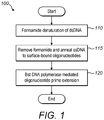
- FIG. 1 illustrates a flow diagram of an example of an isothermal bridge amplification protocol 100 for cluster amplification on a flow cell surface.
- bridge amplification protocol 100 is performed at about 60 °C and is repeated any number of times (e.g., typically 35 times) to generate a clonal population of identical DNA strands for each seeded DNA template.
- the bridge amplification protocol may be repeated for one to fifty, one to twenty-five, one to fifteen, or one to ten cycles of amplification.
- Bridge amplification protocol 100 includes, but is not limited to, the following steps.
- a first solution e.g., formamide (e.g., about 28 ⁇ L)
- formamide e.g., about 28 ⁇ L
- the formamide denatures the double-stranded cluster DNA on the flow cell to ssDNA.
- the formamide is removed by pumping a second solution, e.g., a solution of cluster pre-mix (e.g., about 28 ⁇ L), through each lane of the flow cell.
- a second solution e.g., a solution of cluster pre-mix (e.g., about 28 ⁇ L)
- the pre-mix solution is a standard pre-mix solution comprising 20 mM Tris-HCI pH 8.8 @ 25 °C, 10 mM ammonium sulfate, 2 mM Mg sulfate, 0.1% Triton X-100, 1.3% DMSO, and 2 M Betaine.
- a third solution e.g., a solution of Bst mix (e.g., about 36 ⁇ L)
- the Bst mix contains dNTPs and Bst DNA polymerase.
- a standard Bst mix solution is 20 mM Tris-HCI pH 8.8 @ 25 °C, 10 mM ammonium sulfate, 2 mM Mg sulfate, 0.1% Triton X-100, 1.3% DMSO, 2 M Betaine, 200 ⁇ M of each nucleotide, and 79 or 80 U/mL Bst polymerase.
- the Bst mix is an ammonium sulfate-free (NH 4 -free) Bst mix of 20 mM Tris-HCI pH 8.8 @ 25 °C, 2 mM Mg sulfate, 0.1% Triton X-100, 1.3% DMSO, 2 M Betaine, 200 ⁇ M of each nucleotide, and 79 or 80 U/mL Bst polymerase.
- NH 4 -free Bst mix of 20 mM Tris-HCI pH 8.8 @ 25 °C, 2 mM Mg sulfate, 0.1% Triton X-100, 1.3% DMSO, 2 M Betaine, 200 ⁇ M of each nucleotide, and 79 or 80 U/mL Bst polymerase.
- NH 4 -free Bst mix 20 mM Tris-HCI pH 8.8 @ 25 °C, 2 mM Mg sulfate, 0.1% Triton X-100, 1.3%
- Bridge amplification protocol 100 may be repeated any number of times. From a seeding site, a DNA molecule generates a cluster that is increased in size at every amplification cycle. However, for any particular insert length (DNA template length), cluster size and intensity may be affected by the GC composition of the insert. For example, DNA templates that contain a high proportion of A and T (or T and U for RNA) nucleotides tend to produce larger brighter clusters compared to templates that have a higher proportion of G and C nucleotides.
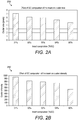
- Figures 2A and 2B show a plot 200 of cluster size and a plot 250 of cluster intensity, respectively, of clusters generated from monotemplates with different GC composition.
- a monotemplate may be defined as a single sequencing-ready template sequence (e.g., P5 primer, sequencing primer, template insert, and P7 primer) with a certain insert size.
- monotemplates CT151 (31% GC), CT161 (50% GC), CT159 (55% GC), CT152 (64% GC), and CT180 (80% GC) with an insert of 400bp in size were seeded in different lanes of the same flow cell. After a first extension, clusters were generated using 35 cycles of isothermal amplification. The flow cell was then stained with SYBR® Green and two representative tiles for each lane were imaged using a microscope. Cluster size and intensities were determined using image analysis software Firecrest.
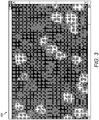
- Figure 3 shows a screenshot 300 of a cluster image showing GC-rich clusters and AT-rich clusters.
- four monotemplates were seeded at relatively low density. Clusters were generated by over-amplifying each molecule in order to generate larger clusters. After linearization, 3' end blocking with ddNTPs, and hybridization of the sequencing primer, a first bridge amplification cycle was performed. A 3-color overlay image was then produced. Of the four monotemplates seeded, three were AT-rich (clusters from the third AT rich monotemplate are not shown) and one was GC rich (80% GC). The clusters are labelled in the grayscale image as AT rich "G” and "B", and GC rich "R".
- a decrease in cluster amplification efficiency of GC-rich clusters may be due to DNA damage caused by cluster amplification reagents.
- cluster amplification reagents e.g., either broken phosphate-sugar backbone or damaged bases that stall primer extension
- it may not act as template in subsequent amplification cycles and consequently, less efficient cluster amplification (i.e. smaller dimmer clusters) may be observed.
- Modification of cluster amplification reagents by the addition of additives and/or the elimination of some components of the standard amplification reagent solutions may be used to ameliorate the DNA damage effects. This may be achieved by reduction of DNA damage by formamide by using an additive in the formamide solution, pre-mix solution, or both. Further, lowering the salt concentration may boost GC rich cluster growth through a mechanism that does not involve DNA damage.
- Figure 4 illustrates a flow diagram of an example of a DNA damage assay 400 for evaluating the effect of cluster amplification reagents and/or the addition of additives on cluster generation during isothermal bridge amplification.
- Figure 5 shows pictorially the steps of DNA damage assay 400 of Figure 4 .
- Method 400 includes, but is not limited to, the following steps.
- template DNA molecules are seeded onto the flow cell and hybridized to surface-bound oligonucleotide primers. This step is also shown pictorially in Figure 5 .
- the template DNA molecules are copied (first extension) using DNA polymerase (e.g., Taq DNA polymerase or Phusion DNA polymerase) and the seeded template strand is then removed by flowing 0.1 M NaOH through the flow cell (NaOH will also denature the DNA polymerase). Single stranded DNA molecules remain covalently bound to the flow cell surface.
- DNA polymerase e.g., Taq DNA polymerase or Phusion DNA polymerase
- the mock isothermal amplification comprises cycling the reagents that are used in cluster amplification (e.g., formamide, pre-mix, and amplification mix with the omission of Bst DNA polymerase to avoid DNA amplification during treatment).
- the mock isothermal amplification comprises flowing formamide through a lane on the flow cell, removing the formamide by flowing pre-mix through the lane of the flow cell, and flowing a pre-mix containing dNTPs onto the flow cell lane.
- control lane which serves as negative control (no DNA damage).
- a wash buffer (0.3X SSC containing 0.1% Tween-20) is continuously flowed through the lane; the wash buffer is non-DNA damaging. This step is also shown pictorially in Figure 5 .
- a step 425 all lanes are rinsed with wash buffer and then subjected to isothermal amplification. Only non-damaged molecules can act as a template during this isothermal amplification step and therefore lead to cluster formation. Damaged DNA molecules or snapped molecules will not be amplified. This step is also shown pictorially in Figure 5 .
- clusters are visualized by staining with a DNA binding dye (e.g., SYBR® Green) and imaged (e.g., three tiles for each lane) using a microscope and a camera.
- Image analysis software e.g., Firecrest software
- a CT180 monotemplate may be used in DNA damage assay 400 to evaluate potential DNA damage caused by isothermal amplification reagents.
- the CT180 monotemplate comprises 80% GC (i.e., it is GC rich) and has an insert size of 400 bp.
- Figure 6 shows a bar graph 600 of the percent of non-damaged DNA molecules in samples treated with formamide, pre-mix, and/or pre-mix plus dNTPs and evaluated using DNA damage assay 400 of Figure 4 .
- monotemplate CT180 was seeded at 1 pM. After first strand extension with Taq DNA polymerase and template denaturation with NaOH, single DNA molecules were treated with 26 cycles of mock isothermal amplification (step 420 of DNA damage assay 400 of Figure 4 ) using a first solution of 28 ⁇ L of formamide, a second solution of 28 ⁇ L of pre-mix without or with the addition of dNTPs, and a third solution of 36 ⁇ L of pre-mix with the addition of dNTPs.
- Each bar on the graph represents a lane on the flow cell.
- the control lane (first graph bar) was treated with wash buffer for the entire duration of the treatment (26 cycles).
- Cluster numbers for each treated lane (graph bars 2 and 3) on the flow cell are divided by the cluster number from the control lane and are expressed as a percentage of the control (reference) lane.
- Lane 2 which was treated with 26 cycles of mock isothermal amplification using the standard conditions (formamide/pre-mix/premix with dNTPs) shows a significant decrease in the number of clusters demonstrating that the isothermal amplification reagents cause DNA damage (a primer-density assay experiment showed that there was no significant loss of surface or oligonucleotides from the surface, data not shown).
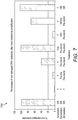
- Figure 7 shows a bar graph 700 of the percent of non-damaged DNA molecules in samples treated with formamide ⁇ dNTPs, pre-mix ⁇ dNTPs, or water ⁇ dNTPs and evaluated using DNA damage assay 400 of Figure 4 .
- monotemplate CT180 was seeded at 1 pM. After first strand extension with Taq DNA polymerase and template denaturation with NaOH, single DNA molecules were treated with 26 cycles of mock isothermal amplification (step 420 of DNA damage assay 400 of Figure 4 ) using three solutions. The first solution was either 28 ⁇ L of wash buffer (WB), formamide (F), or formamide plus dNTPs (F/nt).
- the second solution was either 28 ⁇ L of wash buffer (WB), formamide (F), pre-mix, pre-mix plus dNTPs (pre-mix/nt), water (H 2 O), or water plus dNTPs (H 2 O/nt).
- the third solution was 36 ⁇ L of wash buffer (WB) or pre-mix/nt.
- dNTPs were used at a final concentration of 200 ⁇ M each. Each bar on the graph represents a lane of the flow cell.
- the data show the protective effect of dNTPs when present in the pre-mix solution (comparing lanes 3 and 4), in formamide (comparing lanes 4 and 5), and in water (comparing lanes 6 and 7).
- Lane 8 also shows that the wash buffer is also protecting the DNA molecules from damage caused by formamide (compare lanes 2 and 8).
- Figure 8 shows a dose response curve 800 of the effect of dNTP concentration in formamide on cluster number during isothermal mock amplification.
- CT180 was seeded at 0.6 pM.
- First strand extension was performed using Taq DNA polymerase followed by NaOH denaturation.
- Single molecules were subsequently treated with 26 cycles of mock isothermal amplification according to DNA damage assay 400 of Figure 4 using 28 ⁇ L of a first solution of formamide with different dNTP concentrations, 28 ⁇ L of a second solution of water with the same concentrations of dNTPs, and 36 ⁇ L of a third solution of pre-mix with the same concentrations of dNTPs.
- clonal populations of molecules were generated with 26 cycles of isothermal amplification using 28 ⁇ L of formamide followed by 64 ⁇ L of Bst mix in each cycle (no pre-mix was used). The results show a dose response of DNA damage abrogation with higher concentrations of dNTPs being more effective at preventing DNA damage.
- Figure 9 shows a bar graph 900 of the effectiveness of each dNTP to prevent DNA damage when used as a formamide additive.
- CT180 was seeded at 0.6 pM.
- First strand extension was performed using Taq DNA polymerase followed by NaOH denaturation.
- Single molecules were subsequently treated with either wash buffer (WB), formamide (F), or formamide plus dATP, dCTP, dGTP, dTTP, or a dNTP mix for 80 minutes at 60 °C (a time period that is similar to the duration of 26 cycles of isothermal amplification).
- cluster amplification was performed using 26 isothermal cycles of 28 ⁇ L formamide followed by 64 ⁇ L of Bst mix for each cycle.
- the final concentration of the individual nucleotides was 800 ⁇ M.
- the concentration of each nucleotide in the dNTP mix was 200 ⁇ M.
- the data show that all four nucleotides are equally effective at protecting DNA from damage.
- the results also show that dNTPs prevent DNA damage caused by formamide when this chemical is pumped constantly (instead of being cycled together with water and pre-mix).
- FIG. 10 shows panels of clusters generated by isothermal amplification using formamide with and without added dNTPs.
- CT180 a GC-rich template
- CT3164 an AT-rich template
- Lanes 1 through 4 on the flow cell were seeded with 0.6 pM of CT180; lanes 5 through 8 on the flow cell were seeded with 0.6 pM of CT3164.
- cluster amplification was performed using 26 isothermal amplification cycles of 120 ⁇ L of formamide (a relatively large volume compared to the standard 28 ⁇ L of formamide), followed by 28 ⁇ L of water, and 36 ⁇ L of standard Bst mix. Clusters were visualized by staining with SYBR® Green and imaged. A representative tile from each lane is shown in Figure 9 . The data show that while both the CT180 and CT3164 templates fail to be amplified in an isothermal amplification process using a relatively large volume of formamide, cluster amplification is rescued by the addition of dNTPs into the formamide solution.
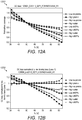
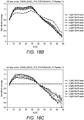
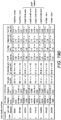
- Figure 11 shows a data table 1100 of sequencing metrics for a sequencing run evaluating the "dNTPs" method and the "water” method.
- the dNTPs method includes the addition of dNTPs to both a first solution of formamide and a second solution of water.
- the water method replaces a second solution of pre-mix with water.
- CT4008 standard BCG library, GC rich genome; average insert size of 300 bp was seeded at either low density (1.5 pM) or high density (7.5 pM).
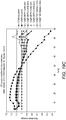
- Figures 12A and 12B show curves 1200 of GC bias and curves 1250 of GC bias normalized to low density lane 1, respectively, of the sequencing run described with reference to Figure 11 .
- Figure 13A shows a summary schematic diagram 1300 of bridge amplification solutions according to the methods of the invention
- Figure 13B shows a summary schematic diagram 1350 of bridge amplification solutions according to a standard method.
- trisodium citrate is used in a final concentration of 1mM in formamide.
- Solid phase amplification can be performed efficiently in a flow cell since it is a feature of the present disclosure that the primers, template and amplified (extension) products may all remain immobilized to the solid support during the amplification. Accordingly, an apparatus is disclosed that can allow immobilized nucleic acids to be isothermally amplified.
- An apparatus may also include a source of reactants and detecting means for detecting a signal that may be generated once one or more reactants have been applied to the immobilized nucleic acid molecules.
- An apparatus may also be provided with a surface comprising immobilized nucleic acid molecules in the form of colonies.
- An apparatus comprising one or more of the following:
- solutions applied to a flow cell through an inlet can be removed via an outlet by a process of solution exchange.
- a means for detecting a signal has sufficient resolution to enable it to distinguish between and among signals generated from different colonies.
- Instruments that are useful for detecting a fluorescent signal are described, for example, in WO 2007/123744 , US 2010/0111768 and U.S. Pat. No. 7,329,860 .
- Apparatuses of the present invention are preferably provided in automated form so that once they are activated, individual process steps can be repeated automatically.
Landscapes
- Chemical & Material Sciences (AREA)
- Organic Chemistry (AREA)
- Life Sciences & Earth Sciences (AREA)
- Health & Medical Sciences (AREA)
- Zoology (AREA)
- Wood Science & Technology (AREA)
- Engineering & Computer Science (AREA)
- Proteomics, Peptides & Aminoacids (AREA)
- Analytical Chemistry (AREA)
- Molecular Biology (AREA)
- Immunology (AREA)
- Microbiology (AREA)
- Biotechnology (AREA)
- Biochemistry (AREA)
- Bioinformatics & Cheminformatics (AREA)
- General Engineering & Computer Science (AREA)
- General Health & Medical Sciences (AREA)
- Genetics & Genomics (AREA)
- Chemical Kinetics & Catalysis (AREA)
- Biophysics (AREA)
- Physics & Mathematics (AREA)
- Measuring Or Testing Involving Enzymes Or Micro-Organisms (AREA)
- General Chemical & Material Sciences (AREA)
Claims (15)
- Ein Verfahren zum Reduzieren von dichteabhängiger GC-Verzerrung (GC-Bias) und/oder Nukleinsäureschädigung bei der Brückenamplifikation einer doppelsträngigen Nukleinsäurevorlage auf einer Oberfläche, beinhaltend:a) Denaturieren der Nukleinsäurevorlage mit einer ersten Lösung, die Formamid und eine einzelne Art von dNTP und/oder eine einzelne Art von rNTP oder eine Mischung von unterschiedlichen dNTPs und/oder rNTPs beinhaltet, um einzelsträngige Nukleinsäurevorlagestränge zu produzieren;b) optionales Ersetzen der ersten Lösung durch eine zweite Lösung;c) Annealing der einzelsträngigen Nukleinsäurevorlagestränge an Oligonukleotidprimer, die an die Oberfläche gebunden sind; undd) Ersetzen der ersten oder zweiten Lösung durch eine Lösung, die eine Polymerase beinhaltet, wodurch die an die Oberfläche gebundenen Oligonukleotidprimer vollständig verlängert werden;wobei die dichteabhängige GC-Verzerrung und/oder die Nukleinsäureschädigung bei der Amplifikation der doppelsträngigen Nukleinsäurevorlage reduziert werden.
- Verfahren gemäß Anspruch 1, wobei mindestens eine der ersten und zweiten Lösung mindestens einen Zusatzstoff beinhaltet, wobei optionali) der Zusatzstoff einen Chelatbildner beinhaltet;ii) der Zusatzstoff mindestens ein Citrat beinhaltet, wobei der Zusatzstoff optional mindestens ein Citrat beinhaltet, das aus Folgendem ausgewählt ist: Mononatriumcitrat, Dinatriumcitrat, Trinatriumcitrat, Kaliumcitrat;iii) der Zusatzstoff EDTA beinhaltet;iv) der Zusatzstoff Betain beinhaltet;v) der Zusatzstoff DMSO beinhaltet.
- Verfahren gemäß Anspruch 1 oder 2, wobei eine Gruppierung von im Wesentlichen identischen Nukleinsäuresträngen erzeugt wird.
- Verfahren gemäß einem der Ansprüche 1 bis 3, wobei die zweite Lösung Wasser und/oder eine Vormischungslösung beinhaltet.
- Verfahren gemäß einem der Ansprüche 1 bis 4, wobei die zweite Lösung weniger als etwa 100 mM Salz beinhaltet, wobei die zweite Lösung optional im Wesentlichen frei von Salz ist.
- Verfahren gemäß einem der Ansprüche 1 bis 5, wobei die die Polymerase beinhaltende Lösung ferner eine Mischung von unterschiedlichen dNTPs und/oder rNTPs beinhaltet.
- Verfahren gemäß einem der Ansprüche 1 bis 6, wobei die die Polymerase beinhaltende Lösung weniger als etwa 100 mM Salz beinhaltet.
- Verfahren gemäß Anspruch 7, wobei die die Polymerase beinhaltende Lösung im Wesentlichen frei von jedwedem Salz ist.
- Ein System zur Brückenamplifikation, beinhaltend eine Vorrichtung mit mindestens einem Einlass und mindestens einem Auslass; und ein Mittel zum Reduzieren von dichteabhängiger GC-Verzerrung und/oder Nukleinsäureschädigung bei einer Brückenamplifikation einer doppelsträngigen Nukleinsäurevorlage auf einer Oberfläche, wobei die Vorrichtung programmiert ist, um die Schritte des Verfahrens gemäß einem der Ansprüche 1 bis 8 zu koordinieren.
- System gemäß Anspruch 9, wobei die Vorrichtung ein Mittel zum Immobilisieren von Primern auf einer Oberfläche beinhaltet.
- System gemäß einem der Ansprüche 9 oder 10, wobei die Vorrichtung eine Durchflusszelle beinhaltet und Lösungen durch einen Prozess des Lösungsaustausches durch den Einlass eingebracht und durch den Auslass entfernt werden.
- System gemäß Anspruch 11, wobei das System ein Detektionsmittel zum Detektieren eines fluoreszierenden Signals beinhaltet.
- Ein Kit zum Reduzieren von dichteabhängiger GC-Verzerrung und/oder Nukleinsäureschädigung bei einer Brückenamplifikation einer doppelsträngigen Nukleinsäurevorlage auf einer Oberfläche, beinhaltend:eine erste Denaturierungslösung zum Produzieren einzelsträngiger Nukleinsäurevorlagestränge, die Formamid und mindestens eines von einer Gruppe beinhaltet, die Folgendes beinhaltet: i) eine einzelne Art von dNTP, ii) eine einzelne Art von rNTP; iii) eine Mischung von dNTPs und iv) eine Mischung von rNTPs; optional mindestens einen Zusatzstoff;und eine Polymerase.
- Kit gemäß Anspruch 13, wobei der mindestens eine Zusatzstoff Folgendes beinhaltet:
einen Chelatbildner, EDTA, ein Citrat, ein Citratsalz, Mononatriumcitrat, Dinatriumcitrat, Trinatriumcitrat, Kaliumcitrat, Betain und/oder DMSO. - Kit gemäß Anspruch 14, ferner beinhaltend Anweisungen zum Durchführen des Verfahrens gemäß einem der Ansprüche 1 bis 8.
Applications Claiming Priority (2)
| Application Number | Priority Date | Filing Date | Title |
|---|---|---|---|
| GBGB1409777.8A GB201409777D0 (en) | 2014-06-02 | 2014-06-02 | Methods of reducing density-dependent GC bias in isothermal amplification |
| PCT/GB2015/051605 WO2015185916A1 (en) | 2014-06-02 | 2015-06-02 | Methods of reducing density-dependent gc bias in amplification |
Publications (2)
| Publication Number | Publication Date |
|---|---|
| EP3149198A1 EP3149198A1 (de) | 2017-04-05 |
| EP3149198B1 true EP3149198B1 (de) | 2018-10-24 |
Family
ID=51214593
Family Applications (1)
| Application Number | Title | Priority Date | Filing Date |
|---|---|---|---|
| EP15728090.0A Active EP3149198B1 (de) | 2014-06-02 | 2015-06-02 | Verfahren zur reduzierung dichteabhängiger gc-vorzerrung bei der amplifikation |
Country Status (7)
| Country | Link |
|---|---|
| US (2) | US10392655B2 (de) |
| EP (1) | EP3149198B1 (de) |
| AU (1) | AU2015270298B2 (de) |
| CA (1) | CA2950833C (de) |
| ES (1) | ES2705423T3 (de) |
| GB (1) | GB201409777D0 (de) |
| WO (1) | WO2015185916A1 (de) |
Families Citing this family (6)
| Publication number | Priority date | Publication date | Assignee | Title |
|---|---|---|---|---|
| CN113005184A (zh) * | 2020-12-20 | 2021-06-22 | 杭州百迈生物股份有限公司 | 一种增强实时荧光pcr信号的试剂和方法 |
| US20220364077A1 (en) | 2021-04-07 | 2022-11-17 | Cibus Biotechnologies, Inc. | Methods and systems for nucleic acid extraction |
| CN115261496B (zh) * | 2021-04-30 | 2025-03-25 | 上海市生物医药技术研究院 | 一种检测沙门氏菌属的方法及其应用和引物 |
| WO2023023638A1 (en) * | 2021-08-20 | 2023-02-23 | Singular Genomics Systems, Inc. | Chemical and thermal assisted nucleic acid amplification methods |
| WO2025264831A1 (en) * | 2024-06-18 | 2025-12-26 | Illumina, Inc. | Methods for increasing sequencing quality of gc-rich regions |
| WO2026006314A1 (en) * | 2024-06-28 | 2026-01-02 | Illumina, Inc. | Tagging target regions prior to nucleotide sequencing |
Family Cites Families (12)
| Publication number | Priority date | Publication date | Assignee | Title |
|---|---|---|---|---|
| EP1591541B1 (de) | 1997-04-01 | 2012-02-15 | Illumina Cambridge Limited | Verfahren zur Vervielfältigung von Nukleinsäuren |
| US6787305B1 (en) | 1998-03-13 | 2004-09-07 | Invitrogen Corporation | Compositions and methods for enhanced synthesis of nucleic acid molecules |
| WO2003048393A1 (en) | 2001-12-04 | 2003-06-12 | Bio3 Research Srl | Mixture of two partially denaturating agents for the preparation of pcr buffer solutions |
| US20110059865A1 (en) | 2004-01-07 | 2011-03-10 | Mark Edward Brennan Smith | Modified Molecular Arrays |
| US7329860B2 (en) | 2005-11-23 | 2008-02-12 | Illumina, Inc. | Confocal imaging methods and apparatus |
| EP2021503A1 (de) | 2006-03-17 | 2009-02-11 | Solexa Ltd. | Isothermische methoden zur entstehung von arrays von einzelnen molekülen |
| WO2007123744A2 (en) | 2006-03-31 | 2007-11-01 | Solexa, Inc. | Systems and devices for sequence by synthesis analysis |
| EP2032686B1 (de) | 2006-06-23 | 2022-01-12 | Illumina, Inc. | Vorrichtung und verfahren zur erzeugung von dna-cluster-anordnungen |
| US7754429B2 (en) * | 2006-10-06 | 2010-07-13 | Illumina Cambridge Limited | Method for pair-wise sequencing a plurity of target polynucleotides |
| EP2539464B1 (de) | 2010-02-23 | 2016-11-16 | Illumina, Inc. | Verfahren zur minimierung sequenzabhängiger amplifikationsunterschiede |
| US20130344540A1 (en) * | 2011-02-03 | 2013-12-26 | Mark T. Reed | Methods for minimizing sequence specific bias |
| WO2014043143A1 (en) * | 2012-09-11 | 2014-03-20 | Life Technologies Corporation | Nucleic acid amplification |
-
2014
- 2014-06-02 GB GBGB1409777.8A patent/GB201409777D0/en not_active Ceased
-
2015
- 2015-06-02 AU AU2015270298A patent/AU2015270298B2/en active Active
- 2015-06-02 WO PCT/GB2015/051605 patent/WO2015185916A1/en not_active Ceased
- 2015-06-02 CA CA2950833A patent/CA2950833C/en active Active
- 2015-06-02 ES ES15728090T patent/ES2705423T3/es active Active
- 2015-06-02 US US15/315,342 patent/US10392655B2/en active Active
- 2015-06-02 EP EP15728090.0A patent/EP3149198B1/de active Active
-
2019
- 2019-07-15 US US16/511,304 patent/US10858696B2/en active Active
Non-Patent Citations (1)
| Title |
|---|
| None * |
Also Published As
| Publication number | Publication date |
|---|---|
| EP3149198A1 (de) | 2017-04-05 |
| US10392655B2 (en) | 2019-08-27 |
| US10858696B2 (en) | 2020-12-08 |
| ES2705423T3 (es) | 2019-03-25 |
| WO2015185916A1 (en) | 2015-12-10 |
| AU2015270298A1 (en) | 2016-12-22 |
| AU2015270298B2 (en) | 2021-08-19 |
| CA2950833C (en) | 2022-08-23 |
| US20200010882A1 (en) | 2020-01-09 |
| US20180187251A1 (en) | 2018-07-05 |
| GB201409777D0 (en) | 2014-07-16 |
| CA2950833A1 (en) | 2015-12-10 |
Similar Documents
| Publication | Publication Date | Title |
|---|---|---|
| US10858696B2 (en) | Methods of reducing density-dependent GC bias in amplification | |
| EP3615690B1 (de) | Zusammensetzungen und verfahren zur verbesserung der probenidentifikation in indizierten nukleinsäurebibliotheken | |
| US10428363B2 (en) | Amplification methods to minimise sequence specific bias | |
| CA3059840C (en) | Compositions and methods for improving sample identification in indexed nucleic acid libraries | |
| CN107760772B (zh) | 用于核酸配对末端测序的方法、组合物、系统、仪器和试剂盒 | |
| AU2018260633A1 (en) | Compositions and methods for improving sample identification in indexed nucleic acid libraries | |
| EP2021503A1 (de) | Isothermische methoden zur entstehung von arrays von einzelnen molekülen | |
| JP7723021B2 (ja) | フローセルにおける核酸ライブラリ播種効率を較正する方法 | |
| WO2023122499A1 (en) | Periodate compositions and methods for chemical cleavage of surface-bound polynucleotides | |
| HK40049316B (en) | Compositions and methods for improving sample identification in indexed nucleic acid libraries | |
| HK40049316A (en) | Compositions and methods for improving sample identification in indexed nucleic acid libraries | |
| HK40015459A (en) | Compositions and methods for improving sample identification in indexed nucleic acid libraries | |
| HK40015459B (en) | Compositions and methods for improving sample identification in indexed nucleic acid libraries |
Legal Events
| Date | Code | Title | Description |
|---|---|---|---|
| STAA | Information on the status of an ep patent application or granted ep patent |
Free format text: STATUS: THE INTERNATIONAL PUBLICATION HAS BEEN MADE |
|
| PUAI | Public reference made under article 153(3) epc to a published international application that has entered the european phase |
Free format text: ORIGINAL CODE: 0009012 |
|
| STAA | Information on the status of an ep patent application or granted ep patent |
Free format text: STATUS: REQUEST FOR EXAMINATION WAS MADE |
|
| 17P | Request for examination filed |
Effective date: 20161220 |
|
| AK | Designated contracting states |
Kind code of ref document: A1 Designated state(s): AL AT BE BG CH CY CZ DE DK EE ES FI FR GB GR HR HU IE IS IT LI LT LU LV MC MK MT NL NO PL PT RO RS SE SI SK SM TR |
|
| AX | Request for extension of the european patent |
Extension state: BA ME |
|
| DAV | Request for validation of the european patent (deleted) | ||
| DAX | Request for extension of the european patent (deleted) | ||
| STAA | Information on the status of an ep patent application or granted ep patent |
Free format text: STATUS: EXAMINATION IS IN PROGRESS |
|
| 17Q | First examination report despatched |
Effective date: 20170906 |
|
| GRAP | Despatch of communication of intention to grant a patent |
Free format text: ORIGINAL CODE: EPIDOSNIGR1 |
|
| STAA | Information on the status of an ep patent application or granted ep patent |
Free format text: STATUS: GRANT OF PATENT IS INTENDED |
|
| INTG | Intention to grant announced |
Effective date: 20180321 |
|
| GRAS | Grant fee paid |
Free format text: ORIGINAL CODE: EPIDOSNIGR3 |
|
| GRAJ | Information related to disapproval of communication of intention to grant by the applicant or resumption of examination proceedings by the epo deleted |
Free format text: ORIGINAL CODE: EPIDOSDIGR1 |
|
| GRAL | Information related to payment of fee for publishing/printing deleted |
Free format text: ORIGINAL CODE: EPIDOSDIGR3 |
|
| RAP1 | Party data changed (applicant data changed or rights of an application transferred) |
Owner name: ILLUMINA CAMBRIDGE LIMITED |
|
| STAA | Information on the status of an ep patent application or granted ep patent |
Free format text: STATUS: EXAMINATION IS IN PROGRESS |
|
| GRAR | Information related to intention to grant a patent recorded |
Free format text: ORIGINAL CODE: EPIDOSNIGR71 |
|
| STAA | Information on the status of an ep patent application or granted ep patent |
Free format text: STATUS: GRANT OF PATENT IS INTENDED |
|
| GRAA | (expected) grant |
Free format text: ORIGINAL CODE: 0009210 |
|
| STAA | Information on the status of an ep patent application or granted ep patent |
Free format text: STATUS: THE PATENT HAS BEEN GRANTED |
|
| INTC | Intention to grant announced (deleted) | ||
| INTG | Intention to grant announced |
Effective date: 20180912 |
|
| AK | Designated contracting states |
Kind code of ref document: B1 Designated state(s): AL AT BE BG CH CY CZ DE DK EE ES FI FR GB GR HR HU IE IS IT LI LT LU LV MC MK MT NL NO PL PT RO RS SE SI SK SM TR |
|
| REG | Reference to a national code |
Ref country code: CH Ref legal event code: EP |
|
| REG | Reference to a national code |
Ref country code: IE Ref legal event code: FG4D |
|
| REG | Reference to a national code |
Ref country code: AT Ref legal event code: REF Ref document number: 1056722 Country of ref document: AT Kind code of ref document: T Effective date: 20181115 |
|
| REG | Reference to a national code |
Ref country code: DE Ref legal event code: R096 Ref document number: 602015018685 Country of ref document: DE |
|
| REG | Reference to a national code |
Ref country code: CH Ref legal event code: NV Representative=s name: MURGITROYD AND COMPANY, CH |
|
| REG | Reference to a national code |
Ref country code: NL Ref legal event code: MP Effective date: 20181024 |
|
| REG | Reference to a national code |
Ref country code: LT Ref legal event code: MG4D |
|
| REG | Reference to a national code |
Ref country code: AT Ref legal event code: MK05 Ref document number: 1056722 Country of ref document: AT Kind code of ref document: T Effective date: 20181024 |
|
| REG | Reference to a national code |
Ref country code: ES Ref legal event code: FG2A Ref document number: 2705423 Country of ref document: ES Kind code of ref document: T3 Effective date: 20190325 |
|
| PG25 | Lapsed in a contracting state [announced via postgrant information from national office to epo] |
Ref country code: NL Free format text: LAPSE BECAUSE OF FAILURE TO SUBMIT A TRANSLATION OF THE DESCRIPTION OR TO PAY THE FEE WITHIN THE PRESCRIBED TIME-LIMIT Effective date: 20181024 |
|
| PG25 | Lapsed in a contracting state [announced via postgrant information from national office to epo] |
Ref country code: FI Free format text: LAPSE BECAUSE OF FAILURE TO SUBMIT A TRANSLATION OF THE DESCRIPTION OR TO PAY THE FEE WITHIN THE PRESCRIBED TIME-LIMIT Effective date: 20181024 Ref country code: LV Free format text: LAPSE BECAUSE OF FAILURE TO SUBMIT A TRANSLATION OF THE DESCRIPTION OR TO PAY THE FEE WITHIN THE PRESCRIBED TIME-LIMIT Effective date: 20181024 Ref country code: HR Free format text: LAPSE BECAUSE OF FAILURE TO SUBMIT A TRANSLATION OF THE DESCRIPTION OR TO PAY THE FEE WITHIN THE PRESCRIBED TIME-LIMIT Effective date: 20181024 Ref country code: AT Free format text: LAPSE BECAUSE OF FAILURE TO SUBMIT A TRANSLATION OF THE DESCRIPTION OR TO PAY THE FEE WITHIN THE PRESCRIBED TIME-LIMIT Effective date: 20181024 Ref country code: LT Free format text: LAPSE BECAUSE OF FAILURE TO SUBMIT A TRANSLATION OF THE DESCRIPTION OR TO PAY THE FEE WITHIN THE PRESCRIBED TIME-LIMIT Effective date: 20181024 Ref country code: BG Free format text: LAPSE BECAUSE OF FAILURE TO SUBMIT A TRANSLATION OF THE DESCRIPTION OR TO PAY THE FEE WITHIN THE PRESCRIBED TIME-LIMIT Effective date: 20190124 Ref country code: PL Free format text: LAPSE BECAUSE OF FAILURE TO SUBMIT A TRANSLATION OF THE DESCRIPTION OR TO PAY THE FEE WITHIN THE PRESCRIBED TIME-LIMIT Effective date: 20181024 Ref country code: NO Free format text: LAPSE BECAUSE OF FAILURE TO SUBMIT A TRANSLATION OF THE DESCRIPTION OR TO PAY THE FEE WITHIN THE PRESCRIBED TIME-LIMIT Effective date: 20190124 Ref country code: IS Free format text: LAPSE BECAUSE OF FAILURE TO SUBMIT A TRANSLATION OF THE DESCRIPTION OR TO PAY THE FEE WITHIN THE PRESCRIBED TIME-LIMIT Effective date: 20190224 |
|
| PG25 | Lapsed in a contracting state [announced via postgrant information from national office to epo] |
Ref country code: GR Free format text: LAPSE BECAUSE OF FAILURE TO SUBMIT A TRANSLATION OF THE DESCRIPTION OR TO PAY THE FEE WITHIN THE PRESCRIBED TIME-LIMIT Effective date: 20190125 Ref country code: PT Free format text: LAPSE BECAUSE OF FAILURE TO SUBMIT A TRANSLATION OF THE DESCRIPTION OR TO PAY THE FEE WITHIN THE PRESCRIBED TIME-LIMIT Effective date: 20190224 Ref country code: RS Free format text: LAPSE BECAUSE OF FAILURE TO SUBMIT A TRANSLATION OF THE DESCRIPTION OR TO PAY THE FEE WITHIN THE PRESCRIBED TIME-LIMIT Effective date: 20181024 Ref country code: SE Free format text: LAPSE BECAUSE OF FAILURE TO SUBMIT A TRANSLATION OF THE DESCRIPTION OR TO PAY THE FEE WITHIN THE PRESCRIBED TIME-LIMIT Effective date: 20181024 Ref country code: AL Free format text: LAPSE BECAUSE OF FAILURE TO SUBMIT A TRANSLATION OF THE DESCRIPTION OR TO PAY THE FEE WITHIN THE PRESCRIBED TIME-LIMIT Effective date: 20181024 |
|
| REG | Reference to a national code |
Ref country code: DE Ref legal event code: R097 Ref document number: 602015018685 Country of ref document: DE |
|
| PG25 | Lapsed in a contracting state [announced via postgrant information from national office to epo] |
Ref country code: IT Free format text: LAPSE BECAUSE OF FAILURE TO SUBMIT A TRANSLATION OF THE DESCRIPTION OR TO PAY THE FEE WITHIN THE PRESCRIBED TIME-LIMIT Effective date: 20181024 Ref country code: CZ Free format text: LAPSE BECAUSE OF FAILURE TO SUBMIT A TRANSLATION OF THE DESCRIPTION OR TO PAY THE FEE WITHIN THE PRESCRIBED TIME-LIMIT Effective date: 20181024 Ref country code: DK Free format text: LAPSE BECAUSE OF FAILURE TO SUBMIT A TRANSLATION OF THE DESCRIPTION OR TO PAY THE FEE WITHIN THE PRESCRIBED TIME-LIMIT Effective date: 20181024 |
|
| PG25 | Lapsed in a contracting state [announced via postgrant information from national office to epo] |
Ref country code: SM Free format text: LAPSE BECAUSE OF FAILURE TO SUBMIT A TRANSLATION OF THE DESCRIPTION OR TO PAY THE FEE WITHIN THE PRESCRIBED TIME-LIMIT Effective date: 20181024 Ref country code: EE Free format text: LAPSE BECAUSE OF FAILURE TO SUBMIT A TRANSLATION OF THE DESCRIPTION OR TO PAY THE FEE WITHIN THE PRESCRIBED TIME-LIMIT Effective date: 20181024 Ref country code: SK Free format text: LAPSE BECAUSE OF FAILURE TO SUBMIT A TRANSLATION OF THE DESCRIPTION OR TO PAY THE FEE WITHIN THE PRESCRIBED TIME-LIMIT Effective date: 20181024 Ref country code: RO Free format text: LAPSE BECAUSE OF FAILURE TO SUBMIT A TRANSLATION OF THE DESCRIPTION OR TO PAY THE FEE WITHIN THE PRESCRIBED TIME-LIMIT Effective date: 20181024 |
|
| PLBE | No opposition filed within time limit |
Free format text: ORIGINAL CODE: 0009261 |
|
| STAA | Information on the status of an ep patent application or granted ep patent |
Free format text: STATUS: NO OPPOSITION FILED WITHIN TIME LIMIT |
|
| 26N | No opposition filed |
Effective date: 20190725 |
|
| PG25 | Lapsed in a contracting state [announced via postgrant information from national office to epo] |
Ref country code: SI Free format text: LAPSE BECAUSE OF FAILURE TO SUBMIT A TRANSLATION OF THE DESCRIPTION OR TO PAY THE FEE WITHIN THE PRESCRIBED TIME-LIMIT Effective date: 20181024 |
|
| PG25 | Lapsed in a contracting state [announced via postgrant information from national office to epo] |
Ref country code: MC Free format text: LAPSE BECAUSE OF FAILURE TO SUBMIT A TRANSLATION OF THE DESCRIPTION OR TO PAY THE FEE WITHIN THE PRESCRIBED TIME-LIMIT Effective date: 20181024 |
|
| REG | Reference to a national code |
Ref country code: BE Ref legal event code: MM Effective date: 20190630 |
|
| PG25 | Lapsed in a contracting state [announced via postgrant information from national office to epo] |
Ref country code: TR Free format text: LAPSE BECAUSE OF FAILURE TO SUBMIT A TRANSLATION OF THE DESCRIPTION OR TO PAY THE FEE WITHIN THE PRESCRIBED TIME-LIMIT Effective date: 20181024 |
|
| PG25 | Lapsed in a contracting state [announced via postgrant information from national office to epo] |
Ref country code: IE Free format text: LAPSE BECAUSE OF NON-PAYMENT OF DUE FEES Effective date: 20190602 |
|
| PG25 | Lapsed in a contracting state [announced via postgrant information from national office to epo] |
Ref country code: LU Free format text: LAPSE BECAUSE OF NON-PAYMENT OF DUE FEES Effective date: 20190602 Ref country code: BE Free format text: LAPSE BECAUSE OF NON-PAYMENT OF DUE FEES Effective date: 20190630 |
|
| PG25 | Lapsed in a contracting state [announced via postgrant information from national office to epo] |
Ref country code: CY Free format text: LAPSE BECAUSE OF FAILURE TO SUBMIT A TRANSLATION OF THE DESCRIPTION OR TO PAY THE FEE WITHIN THE PRESCRIBED TIME-LIMIT Effective date: 20181024 |
|
| PG25 | Lapsed in a contracting state [announced via postgrant information from national office to epo] |
Ref country code: HU Free format text: LAPSE BECAUSE OF FAILURE TO SUBMIT A TRANSLATION OF THE DESCRIPTION OR TO PAY THE FEE WITHIN THE PRESCRIBED TIME-LIMIT; INVALID AB INITIO Effective date: 20150602 Ref country code: MT Free format text: LAPSE BECAUSE OF FAILURE TO SUBMIT A TRANSLATION OF THE DESCRIPTION OR TO PAY THE FEE WITHIN THE PRESCRIBED TIME-LIMIT Effective date: 20181024 |
|
| PG25 | Lapsed in a contracting state [announced via postgrant information from national office to epo] |
Ref country code: MK Free format text: LAPSE BECAUSE OF FAILURE TO SUBMIT A TRANSLATION OF THE DESCRIPTION OR TO PAY THE FEE WITHIN THE PRESCRIBED TIME-LIMIT Effective date: 20181024 |
|
| REG | Reference to a national code |
Ref country code: FR Ref legal event code: PLFP Year of fee payment: 9 |
|
| P01 | Opt-out of the competence of the unified patent court (upc) registered |
Effective date: 20230511 |
|
| PGFP | Annual fee paid to national office [announced via postgrant information from national office to epo] |
Ref country code: DE Payment date: 20250618 Year of fee payment: 11 |
|
| PGFP | Annual fee paid to national office [announced via postgrant information from national office to epo] |
Ref country code: GB Payment date: 20250620 Year of fee payment: 11 |
|
| PGFP | Annual fee paid to national office [announced via postgrant information from national office to epo] |
Ref country code: FR Payment date: 20250627 Year of fee payment: 11 |
|
| PGFP | Annual fee paid to national office [announced via postgrant information from national office to epo] |
Ref country code: ES Payment date: 20250718 Year of fee payment: 11 |
|
| PGFP | Annual fee paid to national office [announced via postgrant information from national office to epo] |
Ref country code: CH Payment date: 20250701 Year of fee payment: 11 |