EP3150672B1 - Wärmeleitende und silikonzusammensetzung und halbleiterbauelement - Google Patents
Wärmeleitende und silikonzusammensetzung und halbleiterbauelement Download PDFInfo
- Publication number
- EP3150672B1 EP3150672B1 EP16190314.1A EP16190314A EP3150672B1 EP 3150672 B1 EP3150672 B1 EP 3150672B1 EP 16190314 A EP16190314 A EP 16190314A EP 3150672 B1 EP3150672 B1 EP 3150672B1
- Authority
- EP
- European Patent Office
- Prior art keywords
- group
- thermal conductive
- silicone composition
- component
- conductive silicone
- Prior art date
- Legal status (The legal status is an assumption and is not a legal conclusion. Google has not performed a legal analysis and makes no representation as to the accuracy of the status listed.)
- Active
Links
Images
Classifications
-
- C—CHEMISTRY; METALLURGY
- C08—ORGANIC MACROMOLECULAR COMPOUNDS; THEIR PREPARATION OR CHEMICAL WORKING-UP; COMPOSITIONS BASED THEREON
- C08F—MACROMOLECULAR COMPOUNDS OBTAINED BY REACTIONS ONLY INVOLVING CARBON-TO-CARBON UNSATURATED BONDS
- C08F290/00—Macromolecular compounds obtained by polymerising monomers on to polymers modified by introduction of aliphatic unsaturated end or side groups
- C08F290/02—Macromolecular compounds obtained by polymerising monomers on to polymers modified by introduction of aliphatic unsaturated end or side groups on to polymers modified by introduction of unsaturated end groups
- C08F290/06—Polymers provided for in subclass C08G
- C08F290/068—Polysiloxanes
-
- C—CHEMISTRY; METALLURGY
- C08—ORGANIC MACROMOLECULAR COMPOUNDS; THEIR PREPARATION OR CHEMICAL WORKING-UP; COMPOSITIONS BASED THEREON
- C08K—Use of inorganic or non-macromolecular organic substances as compounding ingredients
- C08K3/00—Use of inorganic substances as compounding ingredients
- C08K3/02—Elements
- C08K3/08—Metals
-
- C—CHEMISTRY; METALLURGY
- C08—ORGANIC MACROMOLECULAR COMPOUNDS; THEIR PREPARATION OR CHEMICAL WORKING-UP; COMPOSITIONS BASED THEREON
- C08K—Use of inorganic or non-macromolecular organic substances as compounding ingredients
- C08K5/00—Use of organic ingredients
- C08K5/04—Oxygen-containing compounds
- C08K5/14—Peroxides
-
- C—CHEMISTRY; METALLURGY
- C08—ORGANIC MACROMOLECULAR COMPOUNDS; THEIR PREPARATION OR CHEMICAL WORKING-UP; COMPOSITIONS BASED THEREON
- C08K—Use of inorganic or non-macromolecular organic substances as compounding ingredients
- C08K5/00—Use of organic ingredients
- C08K5/54—Silicon-containing compounds
- C08K5/541—Silicon-containing compounds containing oxygen
- C08K5/5425—Silicon-containing compounds containing oxygen containing at least one C=C bond
-
- C—CHEMISTRY; METALLURGY
- C08—ORGANIC MACROMOLECULAR COMPOUNDS; THEIR PREPARATION OR CHEMICAL WORKING-UP; COMPOSITIONS BASED THEREON
- C08K—Use of inorganic or non-macromolecular organic substances as compounding ingredients
- C08K5/00—Use of organic ingredients
- C08K5/54—Silicon-containing compounds
- C08K5/544—Silicon-containing compounds containing nitrogen
- C08K5/5465—Silicon-containing compounds containing nitrogen containing at least one C=N bond
-
- C—CHEMISTRY; METALLURGY
- C08—ORGANIC MACROMOLECULAR COMPOUNDS; THEIR PREPARATION OR CHEMICAL WORKING-UP; COMPOSITIONS BASED THEREON
- C08L—COMPOSITIONS OF MACROMOLECULAR COMPOUNDS
- C08L83/00—Compositions of macromolecular compounds obtained by reactions forming in the main chain of the macromolecule a linkage containing silicon with or without sulfur, nitrogen, oxygen or carbon only; Compositions of derivatives of such polymers
-
- C—CHEMISTRY; METALLURGY
- C08—ORGANIC MACROMOLECULAR COMPOUNDS; THEIR PREPARATION OR CHEMICAL WORKING-UP; COMPOSITIONS BASED THEREON
- C08L—COMPOSITIONS OF MACROMOLECULAR COMPOUNDS
- C08L83/00—Compositions of macromolecular compounds obtained by reactions forming in the main chain of the macromolecule a linkage containing silicon with or without sulfur, nitrogen, oxygen or carbon only; Compositions of derivatives of such polymers
- C08L83/04—Polysiloxanes
-
- C—CHEMISTRY; METALLURGY
- C09—DYES; PAINTS; POLISHES; NATURAL RESINS; ADHESIVES; COMPOSITIONS NOT OTHERWISE PROVIDED FOR; APPLICATIONS OF MATERIALS NOT OTHERWISE PROVIDED FOR
- C09K—MATERIALS FOR MISCELLANEOUS APPLICATIONS, NOT PROVIDED FOR ELSEWHERE
- C09K5/00—Heat-transfer, heat-exchange or heat-storage materials, e.g. refrigerants; Materials for the production of heat or cold by chemical reactions other than by combustion
- C09K5/08—Materials not undergoing a change of physical state when used
- C09K5/14—Solid materials, e.g. powdery or granular
-
- H—ELECTRICITY
- H10—SEMICONDUCTOR DEVICES; ELECTRIC SOLID-STATE DEVICES NOT OTHERWISE PROVIDED FOR
- H10W—GENERIC PACKAGES, INTERCONNECTIONS, CONNECTORS OR OTHER CONSTRUCTIONAL DETAILS OF DEVICES COVERED BY CLASS H10
- H10W40/00—Arrangements for thermal protection or thermal control
- H10W40/01—Manufacture or treatment
- H10W40/03—Manufacture or treatment of arrangements for cooling
- H10W40/037—Assembling together parts thereof
-
- H—ELECTRICITY
- H10—SEMICONDUCTOR DEVICES; ELECTRIC SOLID-STATE DEVICES NOT OTHERWISE PROVIDED FOR
- H10W—GENERIC PACKAGES, INTERCONNECTIONS, CONNECTORS OR OTHER CONSTRUCTIONAL DETAILS OF DEVICES COVERED BY CLASS H10
- H10W40/00—Arrangements for thermal protection or thermal control
- H10W40/20—Arrangements for cooling
- H10W40/22—Arrangements for cooling characterised by their shape, e.g. having conical or cylindrical projections
-
- H—ELECTRICITY
- H10—SEMICONDUCTOR DEVICES; ELECTRIC SOLID-STATE DEVICES NOT OTHERWISE PROVIDED FOR
- H10W—GENERIC PACKAGES, INTERCONNECTIONS, CONNECTORS OR OTHER CONSTRUCTIONAL DETAILS OF DEVICES COVERED BY CLASS H10
- H10W40/00—Arrangements for thermal protection or thermal control
- H10W40/20—Arrangements for cooling
- H10W40/25—Arrangements for cooling characterised by their materials
- H10W40/251—Organics
-
- C—CHEMISTRY; METALLURGY
- C08—ORGANIC MACROMOLECULAR COMPOUNDS; THEIR PREPARATION OR CHEMICAL WORKING-UP; COMPOSITIONS BASED THEREON
- C08G—MACROMOLECULAR COMPOUNDS OBTAINED OTHERWISE THAN BY REACTIONS ONLY INVOLVING UNSATURATED CARBON-TO-CARBON BONDS
- C08G77/00—Macromolecular compounds obtained by reactions forming a linkage containing silicon with or without sulfur, nitrogen, oxygen or carbon in the main chain of the macromolecule
- C08G77/04—Polysiloxanes
- C08G77/12—Polysiloxanes containing silicon bound to hydrogen
-
- C—CHEMISTRY; METALLURGY
- C08—ORGANIC MACROMOLECULAR COMPOUNDS; THEIR PREPARATION OR CHEMICAL WORKING-UP; COMPOSITIONS BASED THEREON
- C08G—MACROMOLECULAR COMPOUNDS OBTAINED OTHERWISE THAN BY REACTIONS ONLY INVOLVING UNSATURATED CARBON-TO-CARBON BONDS
- C08G77/00—Macromolecular compounds obtained by reactions forming a linkage containing silicon with or without sulfur, nitrogen, oxygen or carbon in the main chain of the macromolecule
- C08G77/04—Polysiloxanes
- C08G77/20—Polysiloxanes containing silicon bound to unsaturated aliphatic groups
-
- C—CHEMISTRY; METALLURGY
- C08—ORGANIC MACROMOLECULAR COMPOUNDS; THEIR PREPARATION OR CHEMICAL WORKING-UP; COMPOSITIONS BASED THEREON
- C08K—Use of inorganic or non-macromolecular organic substances as compounding ingredients
- C08K3/00—Use of inorganic substances as compounding ingredients
- C08K3/02—Elements
- C08K3/08—Metals
- C08K2003/0806—Silver
-
- C—CHEMISTRY; METALLURGY
- C08—ORGANIC MACROMOLECULAR COMPOUNDS; THEIR PREPARATION OR CHEMICAL WORKING-UP; COMPOSITIONS BASED THEREON
- C08K—Use of inorganic or non-macromolecular organic substances as compounding ingredients
- C08K2201/00—Specific properties of additives
- C08K2201/001—Conductive additives
-
- C—CHEMISTRY; METALLURGY
- C08—ORGANIC MACROMOLECULAR COMPOUNDS; THEIR PREPARATION OR CHEMICAL WORKING-UP; COMPOSITIONS BASED THEREON
- C08K—Use of inorganic or non-macromolecular organic substances as compounding ingredients
- C08K2201/00—Specific properties of additives
- C08K2201/002—Physical properties
- C08K2201/006—Additives being defined by their surface area
-
- C—CHEMISTRY; METALLURGY
- C08—ORGANIC MACROMOLECULAR COMPOUNDS; THEIR PREPARATION OR CHEMICAL WORKING-UP; COMPOSITIONS BASED THEREON
- C08K—Use of inorganic or non-macromolecular organic substances as compounding ingredients
- C08K2201/00—Specific properties of additives
- C08K2201/016—Additives defined by their aspect ratio
-
- C—CHEMISTRY; METALLURGY
- C08—ORGANIC MACROMOLECULAR COMPOUNDS; THEIR PREPARATION OR CHEMICAL WORKING-UP; COMPOSITIONS BASED THEREON
- C08L—COMPOSITIONS OF MACROMOLECULAR COMPOUNDS
- C08L2203/00—Applications
- C08L2203/20—Applications use in electrical or conductive gadgets
-
- C—CHEMISTRY; METALLURGY
- C08—ORGANIC MACROMOLECULAR COMPOUNDS; THEIR PREPARATION OR CHEMICAL WORKING-UP; COMPOSITIONS BASED THEREON
- C08L—COMPOSITIONS OF MACROMOLECULAR COMPOUNDS
- C08L2205/00—Polymer mixtures characterised by other features
- C08L2205/02—Polymer mixtures characterised by other features containing two or more polymers of the same C08L -group
- C08L2205/025—Polymer mixtures characterised by other features containing two or more polymers of the same C08L -group containing two or more polymers of the same hierarchy C08L, and differing only in parameters such as density, comonomer content, molecular weight, structure
-
- C—CHEMISTRY; METALLURGY
- C08—ORGANIC MACROMOLECULAR COMPOUNDS; THEIR PREPARATION OR CHEMICAL WORKING-UP; COMPOSITIONS BASED THEREON
- C08L—COMPOSITIONS OF MACROMOLECULAR COMPOUNDS
- C08L2205/00—Polymer mixtures characterised by other features
- C08L2205/03—Polymer mixtures characterised by other features containing three or more polymers in a blend
-
- C—CHEMISTRY; METALLURGY
- C08—ORGANIC MACROMOLECULAR COMPOUNDS; THEIR PREPARATION OR CHEMICAL WORKING-UP; COMPOSITIONS BASED THEREON
- C08L—COMPOSITIONS OF MACROMOLECULAR COMPOUNDS
- C08L2666/00—Composition of polymers characterized by a further compound in the blend, being organic macromolecular compounds, natural resins, waxes or and bituminous materials, non-macromolecular organic substances, inorganic substances or characterized by their function in the composition
- C08L2666/54—Inorganic substances
-
- H—ELECTRICITY
- H10—SEMICONDUCTOR DEVICES; ELECTRIC SOLID-STATE DEVICES NOT OTHERWISE PROVIDED FOR
- H10W—GENERIC PACKAGES, INTERCONNECTIONS, CONNECTORS OR OTHER CONSTRUCTIONAL DETAILS OF DEVICES COVERED BY CLASS H10
- H10W72/00—Interconnections or connectors in packages
- H10W72/071—Connecting or disconnecting
- H10W72/073—Connecting or disconnecting of die-attach connectors
- H10W72/07331—Connecting techniques
- H10W72/07332—Compression bonding, e.g. thermocompression bonding
-
- H—ELECTRICITY
- H10—SEMICONDUCTOR DEVICES; ELECTRIC SOLID-STATE DEVICES NOT OTHERWISE PROVIDED FOR
- H10W—GENERIC PACKAGES, INTERCONNECTIONS, CONNECTORS OR OTHER CONSTRUCTIONAL DETAILS OF DEVICES COVERED BY CLASS H10
- H10W72/00—Interconnections or connectors in packages
- H10W72/071—Connecting or disconnecting
- H10W72/073—Connecting or disconnecting of die-attach connectors
- H10W72/07351—Connecting or disconnecting of die-attach connectors characterised by changes in properties of the die-attach connectors during connecting
- H10W72/07354—Connecting or disconnecting of die-attach connectors characterised by changes in properties of the die-attach connectors during connecting changes in dispositions
-
- H—ELECTRICITY
- H10—SEMICONDUCTOR DEVICES; ELECTRIC SOLID-STATE DEVICES NOT OTHERWISE PROVIDED FOR
- H10W—GENERIC PACKAGES, INTERCONNECTIONS, CONNECTORS OR OTHER CONSTRUCTIONAL DETAILS OF DEVICES COVERED BY CLASS H10
- H10W72/00—Interconnections or connectors in packages
- H10W72/30—Die-attach connectors
- H10W72/321—Structures or relative sizes of die-attach connectors
- H10W72/325—Die-attach connectors having a filler embedded in a matrix
-
- H—ELECTRICITY
- H10—SEMICONDUCTOR DEVICES; ELECTRIC SOLID-STATE DEVICES NOT OTHERWISE PROVIDED FOR
- H10W—GENERIC PACKAGES, INTERCONNECTIONS, CONNECTORS OR OTHER CONSTRUCTIONAL DETAILS OF DEVICES COVERED BY CLASS H10
- H10W72/00—Interconnections or connectors in packages
- H10W72/30—Die-attach connectors
- H10W72/341—Dispositions of die-attach connectors, e.g. layouts
- H10W72/347—Dispositions of multiple die-attach connectors
-
- H—ELECTRICITY
- H10—SEMICONDUCTOR DEVICES; ELECTRIC SOLID-STATE DEVICES NOT OTHERWISE PROVIDED FOR
- H10W—GENERIC PACKAGES, INTERCONNECTIONS, CONNECTORS OR OTHER CONSTRUCTIONAL DETAILS OF DEVICES COVERED BY CLASS H10
- H10W72/00—Interconnections or connectors in packages
- H10W72/30—Die-attach connectors
- H10W72/351—Materials of die-attach connectors
- H10W72/352—Materials of die-attach connectors comprising metals or metalloids, e.g. solders
-
- H—ELECTRICITY
- H10—SEMICONDUCTOR DEVICES; ELECTRIC SOLID-STATE DEVICES NOT OTHERWISE PROVIDED FOR
- H10W—GENERIC PACKAGES, INTERCONNECTIONS, CONNECTORS OR OTHER CONSTRUCTIONAL DETAILS OF DEVICES COVERED BY CLASS H10
- H10W72/00—Interconnections or connectors in packages
- H10W72/30—Die-attach connectors
- H10W72/351—Materials of die-attach connectors
- H10W72/353—Materials of die-attach connectors not comprising solid metals or solid metalloids, e.g. ceramics
- H10W72/354—Materials of die-attach connectors not comprising solid metals or solid metalloids, e.g. ceramics comprising polymers
-
- H—ELECTRICITY
- H10—SEMICONDUCTOR DEVICES; ELECTRIC SOLID-STATE DEVICES NOT OTHERWISE PROVIDED FOR
- H10W—GENERIC PACKAGES, INTERCONNECTIONS, CONNECTORS OR OTHER CONSTRUCTIONAL DETAILS OF DEVICES COVERED BY CLASS H10
- H10W72/00—Interconnections or connectors in packages
- H10W72/851—Dispositions of multiple connectors or interconnections
- H10W72/874—On different surfaces
- H10W72/877—Bump connectors and die-attach connectors
-
- H—ELECTRICITY
- H10—SEMICONDUCTOR DEVICES; ELECTRIC SOLID-STATE DEVICES NOT OTHERWISE PROVIDED FOR
- H10W—GENERIC PACKAGES, INTERCONNECTIONS, CONNECTORS OR OTHER CONSTRUCTIONAL DETAILS OF DEVICES COVERED BY CLASS H10
- H10W74/00—Encapsulations, e.g. protective coatings
- H10W74/10—Encapsulations, e.g. protective coatings characterised by their shape or disposition
- H10W74/15—Encapsulations, e.g. protective coatings characterised by their shape or disposition on active surfaces of flip-chip devices, e.g. underfills
-
- H—ELECTRICITY
- H10—SEMICONDUCTOR DEVICES; ELECTRIC SOLID-STATE DEVICES NOT OTHERWISE PROVIDED FOR
- H10W—GENERIC PACKAGES, INTERCONNECTIONS, CONNECTORS OR OTHER CONSTRUCTIONAL DETAILS OF DEVICES COVERED BY CLASS H10
- H10W90/00—Package configurations
- H10W90/701—Package configurations characterised by the relative positions of pads or connectors relative to package parts
- H10W90/721—Package configurations characterised by the relative positions of pads or connectors relative to package parts of bump connectors
- H10W90/724—Package configurations characterised by the relative positions of pads or connectors relative to package parts of bump connectors between a chip and a stacked insulating package substrate, interposer or RDL
-
- H—ELECTRICITY
- H10—SEMICONDUCTOR DEVICES; ELECTRIC SOLID-STATE DEVICES NOT OTHERWISE PROVIDED FOR
- H10W—GENERIC PACKAGES, INTERCONNECTIONS, CONNECTORS OR OTHER CONSTRUCTIONAL DETAILS OF DEVICES COVERED BY CLASS H10
- H10W90/00—Package configurations
- H10W90/701—Package configurations characterised by the relative positions of pads or connectors relative to package parts
- H10W90/731—Package configurations characterised by the relative positions of pads or connectors relative to package parts of die-attach connectors
- H10W90/734—Package configurations characterised by the relative positions of pads or connectors relative to package parts of die-attach connectors between a chip and a stacked insulating package substrate, interposer or RDL
-
- H—ELECTRICITY
- H10—SEMICONDUCTOR DEVICES; ELECTRIC SOLID-STATE DEVICES NOT OTHERWISE PROVIDED FOR
- H10W—GENERIC PACKAGES, INTERCONNECTIONS, CONNECTORS OR OTHER CONSTRUCTIONAL DETAILS OF DEVICES COVERED BY CLASS H10
- H10W90/00—Package configurations
- H10W90/701—Package configurations characterised by the relative positions of pads or connectors relative to package parts
- H10W90/731—Package configurations characterised by the relative positions of pads or connectors relative to package parts of die-attach connectors
- H10W90/736—Package configurations characterised by the relative positions of pads or connectors relative to package parts of die-attach connectors between a chip and a stacked lead frame, conducting package substrate or heat sink
Definitions
- the present invention relates to a silicone composition superior in thermal conductivity; and a semiconductor device.
- JP-A-Hei-2-153995 discloses a silicone grease composition obtained by combining a particular organopolysiloxane and a spherical hexagonal aluminum nitride powder with a given particle diameter.
- JP-A-Hei-3-14873 discloses a thermal conductive organosiloxane composition obtained by combining an aluminum nitride powder with a smaller particle diameter and an aluminum nitride powder with a larger particle diameter.
- JP-A-Hei-10-110179 discloses a thermal conductive silicone grease obtained by combining an aluminum nitride powder and a zinc oxide powder.
- JP-A-2000-63872 discloses a thermal conductive grease composition employing an aluminum nitride powder surface-treated by an organosilane.
- the thermal conductivity of an aluminum nitride is 70 to 270 W/mK.
- a material having a thermal conductivity higher than this range there can be listed diamond which has a thermal conductivity of 900 to 2,000 W/mK.
- JP-A-2002-30217 discloses a thermal conductive silicone composition obtained by combining a silicone resin with a diamond, a zinc oxide and a dispersant.
- JP-A-2000-63873 Patent document 6
- JP-A-2008-222776 Patent document 7
- a thermal conductive grease composition obtained by mixing a base oil such as a silicone oil and a metallic aluminum powder.
- JP-B No.3130193 Patent document 8
- JP-B No.3677671 Patent document 9
- a silver powder with a high thermal conductivity is used as a filler.
- thermal conductive materials or thermal conductive greases has been able to sufficiently cope with the amount of heat generated in a recent integrated circuit element such as a CPU.
- thermo conductive silicone composition capable of exhibiting a favorable heat dissipation effect.
- the inventors of the present invention diligently conducted a series of studies to achieve the above objective, and completed the invention as follows. That is, the inventors found that the thermal conductivity of a silicone composition could be dramatically improved by mixing a silver powder with a particular tap density, specific surface area and aspect ratio into a particular organopolysiloxane. That is, the present invention is to provide the following thermal conducive silicone composition, device using the same, and the method of producing the device.
- the thermal conductive silicone composition of the present invention has a superior thermal conductivity, and is thus suitable for use in a semiconductor device.
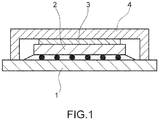
- FIG. 1 is a vertical cross-sectional view of an example of a semiconductor device of the present invention.
- thermal conductive silicone composition of the present invention is described in detail hereunder.
- An organopolysiloxane as a component (A) is represented by the following average composition formula (1), and exhibits a kinetic viscosity of 10 to 100,000 mm 2 /s at 25°C.
- R 1 represents a hydrogen atom or at least one group selected from a hydroxy group and a saturated or unsaturated monovalent hydrocarbon group having 1 to 18 carbon atoms; and a satisfies 1.8 ⁇ a ⁇ 2.2.
- examples of the saturated or unsaturated monovalent hydrocarbon group having 1 to 18 carbon atoms include an alkyl group such as a methyl group, an ethyl group, a propyl group, a hexyl group, an octyl group, a decyl group, a dodecyl group, a tetradecyl group, a hexadecyl group and an octadecyl group; a cycloalkyl group such as a cyclopentyl group and a cyclohexyl group; an alkenyl group such as a vinyl group and an allyl group; an aryl group such as a phenyl group and a tolyl group; an aralkyl group such as a 2-phenylethyl group and a 2-methyl-2-phenylethyl group; and a halogenated hydrocarbon group such as a 3,3,3
- the silicone composition containing such organopolysiloxane will easily exhibit oil-bleed.
- the silicone composition will exhibit a high viscosity, which results in a poor handling property thereof. Therefore, it is required that such kinetic viscosity at 25°C be 10 to 100,000 mm 2 /s, particularly preferably 30 to 10,000 mm 2 /s.
- the kinetic viscosity of the organopolysiloxane is a value measured by an Ostwald viscometer at 25°C.
- the entire or a part of the component (A) includes a component (C) which is an organopolysiloxane containing at least two silicon-bonded alkenyl groups in one molecule; and/or a component (D) which is an organohydrogenpolysiloxane containing at least two silicon-bonded hydrogen atoms in one molecule.
- the component (C) which is the organopolysiloxane containing alkenyl groups bonded to a silicon atom(s), contains in one molecule an average of not less than 2 (normally 2 to 50), preferably 2 to 20, more preferably about 2 to 10 alkenyl groups bonded to a silicon atom(s).
- Examples of the alkenyl groups in the organopolysiloxane as the component (C) include a vinyl group, an allyl group, a butenyl group, a pentenyl group, a hexenyl group and a heptenyl group, among which a vinyl group is particularly preferred.
- the alkenyl groups in the component (C) may be bonded to the silicon atoms at molecular chain terminals; and/or the silicon atoms in non-terminal sections of the molecular chain.
- examples of organic groups other than alkenyl groups that can be bonded to silicon atoms include an alkyl group such as a methyl group, an ethyl group, a propyl group, a butyl group, a pentyl group, a hexyl group and a heptyl group; an aryl group such as a phenyl group, a tolyl group, a xylyl group and a naphthyl group; an aralkyl group such as a benzyl group and a phenethyl group; and a halogenated alkyl group such as a chloromethyl group, a 3-chloropropyl group and a 3,3,3-trifluoropropyl group, among which a methyl group and a phenyl group are particularly preferred.
- an alkyl group such as a methyl group, an ethyl group, a propyl group, a butyl group, a
- the molecular structure of such component (C) examples include a linear structure, a partially-branched linear structure, an annular structure, a branched structure and a three-dimensional net-like structure.
- the molecular structure of the component (C) is that of a linear diorganopolysiloxane whose main chain is basically made of repeating diorganosiloxane units (D units) and whose molecular chain terminals are both blocked by a triorganosiloxy group; or that of a mixture of such linear diorganopolysiloxane and a branched or three-dimensional net-like organopolysiloxane.
- the organohydrogenpolysiloxane as the component (D) contains at least 2 (normally 2 to 300), preferably about 2 to 100 hydrogen atoms bonded to a silicon atom(s) (i.e. SiH groups) in one molecule.
- the organohydrogenpolysiloxane as the component (D) may be a resinous substance having any one of a linear structure, a branched structure, an annular structure and a three-dimensional net-like structure.
- the hydrogen atoms in the component (D) may be bonded to the silicon atom(s) at molecular chain terminals; and/or the silicon atom(s) in non-terminal sections of the molecular chain.
- examples of organic groups other than hydrogen atoms that can be bonded to silicon atoms include an alkyl group such as a methyl group, an ethyl group, a propyl group, a butyl group, a pentyl group, a hexyl group and a heptyl group; an aryl group such as a phenyl group, a tolyl group, a xylyl group and a naphthyl group; an aralkyl group such as a benzyl group and a phenethyl group; and a halogenated alkyl group such as a chloromethyl group, a 3-chloropropyl group and a 3,3,3-trifluoropropyl group, among which a methyl group and a phenyl group are particularly preferred.
- an alkyl group such as a methyl group, an ethyl group, a propyl group, a butyl group, a pen
- an organopolysiloxane (K) having a hydrolyzable group may also be added together with the organopolysiloxane of the component (A) that is represented by the average composition formula (1). It is preferred that the additive amount of such hydrolyzable organopolysiloxane be 0 to 20 % by mass, more preferably 0 to 10 % by mass, with respect to the component (A).
- R 4 represents an alkyl group having 1 to 6 carbon atoms; each R 5 independently represents a saturated or unsaturated, substituted or unsubstituted monovalent hydrocarbon group having 1 to 18 carbon atoms; and c represents 5 to 120.
- the organopolysiloxane represented by the above formula (3) assists in highly filling the silicone composition with a powder(s). Moreover, this organopolysiloxane can also be used to hydrophobize the surface of the powder.
- R 4 represents an alkyl group having 1 to 6 carbon atoms.
- alkyl group having 1 to 6 carbon atoms include a methyl group, an ethyl group and a propyl group, among which a methyl group and an ethyl group are preferred.
- Each R 5 independently represents a saturated or unsaturated, substituted or unsubstituted monovalent hydrocarbon group having 1 to 18, preferably 1 to 10 carbon atoms.
- Examples of such monovalent hydrocarbon group include an alkyl group such as a methyl group, an ethyl group, a propyl group, a hexyl group, an octyl group, a decyl group, a dodecyl group, a tetradecyl group, a hexadecyl group and an octadecyl group; a cycloalkyl group such as a cyclopentyl group and a cyclohexyl group; an alkenyl group such as a vinyl group and an allyl group; an aryl group such as a phenyl group and a tolyl group; an aralkyl group such as a 2-phenylethyl group and a 2-methyl-2-phenylethyl group; and a group obtained by substituting a part of or all the hydrogen atoms in any one of the above groups with, for example, a cyano group or hal
- a component (B) is a silver powder having a tap density of not lower than 3.0 g/cm 3 and a specific surface area of not larger than 2.0 m 2 /g.
- this tap density be 3.0 g/cm 3 to 10.0 g/cm 3 , preferably 4.5 g/cm 3 to 10.0 g/cm 3 , more preferably 6.0 g/cm 3 to 10.0 g/cm 3 .
- this specific surface area be 0.08 m 2 /g to 2.0 m 2 /g, preferably 0.08 m 2 /g to 1.0 m 2 /g, more preferably 0.08 m 2 /g to 0.5 m 2 /g.
- the tap density described in this specification was measured as follows. That is, the silver powder was taken by an amount of 100 g, followed by quietly dropping the same into a 100 ml graduated cylinder with the aid of a funnel, and then placing such graduated cylinder on a tap density measuring device so as to drop the graduated cylinder 600 times at a drop distance of 20 mm and a rate of 60 times/min.
- the tap density was a value calculated based on the volume of the compacted silver powder.
- the specific surface area was obtained as follows. That is, the silver powder was taken by an amount of about 2 g as a sample, followed by degassing the same at 60 ⁇ 5°C for 10 min, and then measuring a total surface area thereof using an automatic specific surface area measuring device (BET method). Later, the amount of the sample was measured, and the specific surface area was calculated through the following formula (4).
- Specific surface area m 2 / g Total surface area m 2 / Sample amount g
- the aspect ratio of the silver powder as the component (B) is 2.0 to 150.0, preferably 3.0 to 100.0, more preferably 3.0 to 50.0.
- An aspect ratio refers to a ratio between the major axis and minor axis of a particle (major axis / minor axis).
- a method for measuring such ratio may, for example, include a step of taking an electron micrograph of particles; and a step of measuring the major and minor axes of the particles based on the electron micrograph such that the aspect ratio can then be calculated.
- the size of a particle can be measured based on an electron micrograph taken from the top view. Particularly, measured as a major axis is the larger diameter of the particle in the electron micrograph taken from the top view.
- a minor axis as opposed to such major axis is defined as the thickness of the particle.
- the thickness of the particle cannot be measured based on the electron micrograph taken from the top view.
- the thickness of the particle is measured as follows. That is, when taking an electron micrograph, a sample stage on which the particles rest is installed in a way such that the sample stage is slanted, followed by taking an electron micrograph thereof from the top view, and then calculating the thicknesses of the particles by correcting the calculation with the inclined angle of the sample stage.
- the major and minor axes of 100 arbitrary particles were measured, followed by calculating the ratios between the major and minor axes (major axis / minor axis), and then obtaining an average value thereof.
- a particle diameter of the silver powder as the component (B). Particularly, it is preferred that an average particle diameter thereof be 0.2 to 50 ⁇ m, more preferably 1.0 to 30 ⁇ m.
- Such average particle diameter was obtained as follows. That is, the silver powder was taken by an amount of 1 to 2 scoops with a micro spatula. The silver powder of such amount was then put into a 100 ml beaker, followed by pouring an isopropyl alcohol of about 60 ml thereinto, and then dispersing the silver powder for 1 min using an ultrasonic homogenizer. Later, a laser diffraction particle size analyzer was used to measure a mean volume diameter [MV] of the silver powder on volume basis. The measurement was carried out for a measurement period of 30 sec.
- a production method of the silver powder used in the present invention There are no restrictions on a production method of the silver powder used in the present invention. There may be employed, for example, an electrolytic method, a crushing method, a heat treatment method, an atomizing method and a reduction method.
- the silver powder may be either used as it is after being produced by the above method(s); or crushed before use, without departing from the aforementioned numerical ranges.
- a device for crushing the silver powder there are no particular restrictions on a device for crushing the silver powder. Examples of such device include known devices such as a stamp mill, a ball mill, a vibration mill, a hammer mill, a rolling roll and a mortar.
- a stamp mill, a ball mill, a vibration mill and a hammer mill are preferred.
- the component (B) is added in an amount of 300 to 11,000 parts by mass with respect to 100 parts by mass of the component (A). If the component (B) is in an amount of smaller than 300 parts by mass with respect to 100 parts by mass of the component (A), the thermal conductivity of the composition obtained will be impaired. Further, if the component (B) is in an amount of larger than 11,000 parts by mass with respect to 100 parts by mass of the component (A), the fluidity of the composition will be impaired, which will lead to a poor handling property. It is preferred that the component (B) be in an amount of 300 to 5,000 parts by mass, more preferably 500 to 5,000 parts by mass, with respect to 100 parts by mass of the component (A).
- the thermal conductive silicone composition of the present invention may also contain an inorganic compound powder and/or an organic compound material without impairing the effects of the invention.
- inorganic compound powder those with a high thermal conductivity are preferred.
- the organic compound material those with a high thermal conductivity are also preferred.
- the surfaces of these inorganic compound powders and organic compound materials may be hydrophobized by, for example, organosilane, organosilazane, organopolysiloxane or an organic fluorine compound.
- the filling rate in a composition obtained will not increase, when an average particle diameter of the inorganic compound powders and the organic compound materials is either smaller than 0.5 ⁇ m or larger than 100 ⁇ m.
- a range of 0.5 to 100 ⁇ m is preferred, and a range of 1 to 50 ⁇ m is particularly preferred.
- the filling rate therein will not increase, when the fiber length of the carbon fiber is either smaller than 10 ⁇ m or larger than 500 ⁇ m. Therefore, a range of 10 to 500 ⁇ m is preferred, and a range of 30 to 300 ⁇ m is particularly preferred.
- the inorganic compound powder(s) and the organic compound material(s) are added in an amount of larger than 3,000 parts by mass with respect to 100 parts by mass of the component (A), a poor fluidity will be resulted, which will then lead to a poor handling property. Therefore, it is preferred that the inorganic compound powder(s) and the organic compound material(s) are added in an amount of 0 to 3,000 parts by mass, particularly preferably 0 to 2,000 parts by mass with respect to 100 parts by mass of the component (A).
- composition of the present invention can be turned into a curable composition by adding a curing catalyst thereto. If the composition of the invention is cured through a hydrosilylation reaction, there are added the components (C) and (D) as the component (A); and a platinum-based catalyst. It is preferred that the component (D) be added in an amount at which the silicon atom-bonded hydrogen atoms in the component (D) will be in an amount of 0.1 to 10 mol, more preferably 0.1 to 5 mol, particularly preferably 0.1 to 3.0 mol, with respect to 1 mol of the alkenyl groups in the component (C).
- a platinum-based catalyst is a catalyst for promoting the curing of the composition of the present invention.
- platinum-based catalyst include a chloroplatinic acid, an alcohol solution of a chloroplatinic acid, an olefin complex of platinum, an alkenylsiloxane complex of platinum and a carbonyl complex of platinum.
- the platinum-based catalyst is contained in an amount required to cure the composition i.e. a so-called catalytic amount. Specifically, it is preferred that the platinum-based catalyst be contained in an amount at which the platinum metal in this component will be in an amount of 0 to 500 ppm by mass, particularly preferably 0 to 200 ppm by mass, with respect to the component (A).
- a curing reaction inhibiting agent such as an acetylene-based compound (e.g. 2-methyl-3-butyn-2-ol, 2-phenyl-3-butyn-2-ol and 1-ethynyl-1-cyclohexanol); an enyne compound (e.g. 3-methyl-3-pentene-1-yne and 3,5-dimethyl-3-hexene-1-yne); a hydrazine-based compound; a phosphine-based compound; and a mercaptan-based compound.
- this curing reaction inhibiting agent be contained in an amount of 0.0001 to 1.0 parts by mass with respect to 100 parts by mass of the component (A).
- the composition of the invention if the composition of the invention is cured through a condensation reaction, it is preferred that the composition contain as a curing agent a silane or siloxane oligomer having at least three silicon atom-bonded hydrolyzable groups in one molecule; and contain as a curing catalyst a catalyst for condensation reaction.
- silicon atom-bonded hydrolyzable groups include an alkoxy group, an alkoxyalkoxy group, an acyloxy group, a ketoxime group, an alkenoxy group, an amino group, an aminoxy group and an amide group.
- the silicon atoms in such silane may also be bonded to, for example, a linear alkyl group similar to that described above, a branched alkyl group, an annular alkyl group, an alkenyl group, an aryl group, an aralkyl group and/or a halogenated alkyl group.
- silane or siloxane oligomer include tetraethoxysilane, methyltriethoxysilane, vinyltriethoxysilane, methyltris (methylethyl ketoxime) silane, vinyltriacetoxysilane, ethyl orthosilicate and vinyltri (isopropenoxy) silane.
- silane or siloxane oligomer is contained in an amount required to cure the composition of the invention. Specifically, it is preferred that the silane or siloxane oligomer be contained in an amount of 0.01 to 20 parts by mass, particularly preferably 0.1 to 10 parts by mass, with respect to 100 parts by mass of the component (A).
- the abovementioned catalyst for condensation reaction is an optional component, and is thus not essential when using as a curing agent a silane having a hydrolyzable group(s) such as an aminoxy group, an amino group and a ketoxime group.
- Such catalyst for condensation reaction examples include an organic titanic acid ester such as tetrabutyl titanate and tetraisopropyl titanate; an organic titanium chelate compound such as diisopropoxy bis (acetylacetate) titanium and diisopropoxy bis (ethylacetoacetate) titanium; an organic aluminum compound such as aluminum tris (acetylacetonate) and aluminum tris (ethylacetoacetate); an organic zirconium compound such as zirconium tetra (acetylacetonate) and zirconium tetra butyrate; an organic tin compound such as dibutyltin dioctoate, dibutyltin dilaurate and butyltin-2-ethylhexoate; a metallic salt of an organic carboxylic acid such as tin naphthenate, tin oleate, tin butyrate, cobalt naphthenate and zinc stearate; an amine compound such
- the catalyst for condensation reaction is contained in an arbitrary amount. If added, it is preferred that such catalyst for condensation reaction be contained in an amount of 0.01 to 20 parts by mass, particularly preferably 0.1 to 10 parts by mass, with respect to 100 parts by mass of the component (A).
- an organic peroxide be used as a curing catalyst.
- organic peroxide include benzoyl peroxide, di (p-methylbenzoyl) peroxide, di (o-methylbenzoyl) peroxide, dicumyl peroxide, 2,5-dimethyl-2,5-bis (t-butylperoxy) hexane, di-t-butyl peroxide, t-butyl peroxybenzoate and 1,1-di (t-butylperoxy) cyclohexane.
- Such organic peroxide is contained in an amount required to cure the composition of the invention. Specifically, it is preferred that this organic peroxide be contained in an amount of 0.1 to 5 parts by mass with respect to 100 parts by mass of the component (A).
- an organosilane represented by the following general formula (2) may be added to the composition of the invention as a component (E).
- R 2 represents at least one group selected from the group consisting of: a saturated or unsaturated monovalent hydrocarbon group that may have a substituted group; an epoxy group; an acrylic group; and a methacrylic group.
- R 3 represents a monovalent hydrocarbon group, and b satisfies 1 ⁇ b ⁇ 3.
- R 2 in the above general formula (2) examples include an alkyl group such as a methyl group, an ethyl group, a propyl group, a hexyl group, an octyl group, a nonyl group, a decyl group, a dodecyl group and a tetradecyl group; a cycloalkylalkenyl group; an acrylic group; an epoxy group; a cycloalkyl group such as a cyclopentyl group and a cyclohexyl group; an alkenyl group such as a vinyl group and an allyl group; an aryl group such as a phenyl group and a tolyl group; an aralkyl group such as a 2-phenylethyl group and a 2-methyl-2-phenylethyl group; and a halogenated hydrocarbon group such as a 3.3.3-trifluoropropyl group, a 2-(perfluoro
- Examples of the substituted group in the monovalent hydrocarbon group include an acryloyloxy group and a methacryloyloxy group.
- b represents 1 to 3.
- R 3 represents at least one alkyl group having 1 to 6 carbon atoms, such as a methyl group, an ethyl group, a propyl group, a butyl group, a pentyl group and a hexyl group, among which a methyl group and an ethyl group are particularly preferred.
- organosilane be added in an amount of 0.1 to 20 parts by mass, more preferably 0.1 to 10 parts by mass, with respect to 100 parts by mass of the component (A).
- the silicone composition of the invention may be produced in accordance with a known method for producing a silicone composition.
- the silicone composition may be produced by mixing the components (A) and (B) and, if necessary, other components as well for 30 min to 4 hours, using, for example, a mixer by INOUE MFG., INC., such as TRI-MIX®, Twin Mix® and Planetary Mixer®; a mixer by MIZUHO INDUSTRIAL CO., LTD., such as Ultramixer®; and a mixer by PRIMIX Corporation, such as HIVIS DISPER MIX®. If necessary, these components may also be heated at a temperature of 50 to 150°C while being mixed together.
- the thermal conductive silicone composition of the present invention when measured at 25°C, exhibit an absolute viscosity of 10 to 600 Pa ⁇ s, more preferably 50 to 500 Pa ⁇ s, or even more preferably 50 to 400 Pa ⁇ s.
- an absolute viscosity When the absolute viscosity is within the above ranges, there can be obtained a favorable grease and achieved a superior workability.
- Such absolute viscosity can be achieved by adjusting the added amount of each component in accordance with the added amounts described earlier.
- the absolute viscosity is a result measured by PC-1TL (10 rpm) (by Malcom Co., Ltd.).
- the thermal conductive silicone composition thus obtained is then heated to a temperature of not lower than 80°C with a pressure of 0.01 MPa being applied thereto, thereby curing the thermal conductive silicone composition of the invention.
- a cured product thus obtained.
- This cured product may be in the form of a gel, a rubber with a low hardness or a rubber with a high hardness.
- the semiconductor device of the present invention has the thermal conductive silicone composition of the invention interposed between the surface of a heat-generating electronic part and a heat dissipator. It is preferred that the thermal conductive silicone composition of the invention interposed have a thickness of 10 to 200 ⁇ m.
- FIG.1 shows a typical structure of the semiconductor device of the invention.
- the semiconductor device of the present invention is not limited to that having such a kind of structure.
- a numerical symbol “3" in FIG.1 represents the thermal conductive silicone of the invention.
- a numerical symbol “1” represents a substrate;
- a numerical symbol “2” represents a heat-generating electronic part (CPU); and
- a numerical symbol "4" represents a heat dissipator (lid).
- the semiconductor device of the present invention be manufactured in a way such that the thermal conductive silicone composition of the invention interposed between the heat-generating electronic part and the heat dissipator is heated to a temperature of not lower than 80°C under a pressure of not smaller than 0.01 MPa.
- the pressure applied be not smaller than 0.01 MPa, more preferably 0.05 to 100 MPa, and particularly preferably 0.1 to 100 MPa.
- the temperature for heating has to be 80°C or higher. It is preferred that such temperature be 90 to 300°C, more preferably 100 to 300°C, or even more preferably 120 to 300°C.
- the absolute viscosity of the composition was measured by a Malcom viscometer (Type PC-1TL) at 25°C.
- compositions prepared in working examples 1 to 13; and comparative examples 1 to 8 were poured into a mold of a thickness of 6 mm, and then heated to 170°C under a pressure of 0.1 MPa. The thermal conductivity of such composition was later measured by TPS-2500 S (by KYOTO ELECTRONICS MANUFACTURING CO., LTD.) at 25°C.
- TPS-2500 S by KYOTO ELECTRONICS MANUFACTURING CO., LTD.
- each of them was poured into a mold of a thickness of 6 mm, and then left for seven days at 23 ⁇ 2°C / 50 ⁇ 5% RH, followed by measuring the thermal conductivity thereof at 25°C through TPS-2500 S (by KYOTO ELECTRONICS MANUFACTURING CO., LTD.).
- F-1 A-1 solution of platinum-divinyltetramethyldisiloxane complex, containing 1 wt% of platinum atoms
- G-1 1-ethynyl-1-cyclohexanol
- compositions in working examples 1 to 15 and comparative examples 1 to 8 were obtained by combining and mixing the components shown in Tables 1 to 3 through the following manner.
- the components (A), (K) and (E) were put into a 5L planetary mixer (by INOUE MFG., INC.), followed by adding the component (B) thereto, and then performing mixing at 25°C for 1.5 hours. Next, the component (F), (G), (H), (I) or (J) was further added thereto, followed by further performing mixing in a homogenous manner.
Landscapes
- Chemical & Material Sciences (AREA)
- Chemical Kinetics & Catalysis (AREA)
- Organic Chemistry (AREA)
- Medicinal Chemistry (AREA)
- Polymers & Plastics (AREA)
- Health & Medical Sciences (AREA)
- Engineering & Computer Science (AREA)
- Materials Engineering (AREA)
- Physics & Mathematics (AREA)
- Thermal Sciences (AREA)
- Combustion & Propulsion (AREA)
- Compositions Of Macromolecular Compounds (AREA)
- Cooling Or The Like Of Semiconductors Or Solid State Devices (AREA)
Claims (6)
- Wärmeleitende Silikonzusammensetzung umfassend(A) ein Organopolysiloxan, welches eine kinetische Viskosität von 10 bis 100.000 mm2/s bei 25 °C aufweist und durch die folgende mittlere Zusammensetzungsformel (1)
R1 aSiO(4-a)/2 (1)
dargestellt ist,
wobei R1 für ein Wasserstoffatom oder zumindest eine Gruppe steht, ausgewählt aus einer Hydroxygruppe und einer gesättigten oder ungesättigten einwertigen Kohlenwasserstoffgruppe mit 1 bis 18 Kohlenstoffatomen, und a 1,8 ≤ a 2.2 entspricht; und(B) ein Silberpulver mit einer Klopfdichte von nicht weniger als 3,0 g/cm3 und einem spezifischen Oberflächenbereich von nicht mehr als 2,0 m2/g, wobei das Silberpulver bezogen auf 100 Massenteile der Komponente (A) in einer Menge von 300 bis 11.000 Massenteilen vorliegt, und ein Aspektverhältnis des Silberpulvers 2,0 bis 150,0 beträgt. - Wärmeleitende Silikonzusammensetzung nach Anspruch 1, wobei die gesamte Komponente (A) oder ein Teil davon umfasst:(C) ein Organopolysiloxan, das in einem Molekül zumindest zwei Silikon-gebundene Alkenylgruppen enthält; und/oder(D) ein Organowasserstoffpolysiloxan, das in einem Molekül zumindest zwei Silikon-gebundene Wasserstoffatome enthält.
- Wärmeleitende Silikonzusammensetzung nach einem der Ansprüche 1 oder 2, ferner umfassend einen Härtungskatalysator.
- Wärmeleitende Silikonzusammensetzung nach einem der Ansprüche 1 bis 3, ferner umfassend:(E) ein Organosilan, das bezogen auf 100 Massenteile der Komponente (A) in einer Menge von 0 bis 10 Massenteilen vorliegt und durch die folgende allgemeine Formel (2)
R2 bSi(OR3)4-b (2)
dargestellt ist,
wobei R2 für zumindest eine Gruppe steht, die aus der Gruppe ausgewählt ist, die aus einer gesättigten oder ungesättigten einwertigen Kohlenwasserstoffgruppe, die eine substituierte Gruppe aufweisen kann; einer Epoxygruppe; einer Acrylgruppe; und einer Methacrylgruppe besteht, R3 für eine einwertige Kohlenwasserstoffgruppe steht, und b 1 ≤ b ≤ 3 entspricht. - Halbleitervorrichtung umfassend:einen wärmeerzeugenden elektronischen Teil; undeinen Wärmeableiter, wobeidie wärmeleitende Silikonzusammensetzung nach einem der Ansprüche 1 bis 4 zwischen dem wärmeerzeugenden elektronischen Teil und dem Wärmeableiter angeordnet ist.
- Verfahren zur Herstellung einer Halbleitervorrichtung, umfassend:
einen Schritt des Erwärmens der wärmeleitenden Silikonzusammensetzung nach einem der Ansprüche 1 bis 4 auf eine Temperatur von nicht weniger als 80 °C unter einem Druck von nicht weniger als 0,01 MPa, wobei die wärmeleitende Silikonzusammensetzung zwischen einem wärmeerzeugenden elektronischen Teil und einem Wärmeableiter angeordnet wird.
Applications Claiming Priority (1)
| Application Number | Priority Date | Filing Date | Title |
|---|---|---|---|
| JP2015196862 | 2015-10-02 |
Publications (2)
| Publication Number | Publication Date |
|---|---|
| EP3150672A1 EP3150672A1 (de) | 2017-04-05 |
| EP3150672B1 true EP3150672B1 (de) | 2018-05-09 |
Family
ID=57003384
Family Applications (1)
| Application Number | Title | Priority Date | Filing Date |
|---|---|---|---|
| EP16190314.1A Active EP3150672B1 (de) | 2015-10-02 | 2016-09-23 | Wärmeleitende und silikonzusammensetzung und halbleiterbauelement |
Country Status (6)
| Country | Link |
|---|---|
| US (1) | US9783723B2 (de) |
| EP (1) | EP3150672B1 (de) |
| JP (1) | JP6645395B2 (de) |
| KR (1) | KR102537150B1 (de) |
| CN (1) | CN106905704B (de) |
| TW (1) | TWI710602B (de) |
Cited By (1)
| Publication number | Priority date | Publication date | Assignee | Title |
|---|---|---|---|---|
| EP3865542A4 (de) * | 2018-10-12 | 2022-07-13 | Shin-Etsu Chemical Co., Ltd. | Additionshärtende silikonzusammensetzung und verfahren zur herstellung davon |
Families Citing this family (16)
| Publication number | Priority date | Publication date | Assignee | Title |
|---|---|---|---|---|
| KR101866299B1 (ko) | 2011-01-26 | 2018-06-12 | 다우 실리콘즈 코포레이션 | 고온 안정성 열 전도성 재료 |
| KR102318181B1 (ko) | 2017-02-08 | 2021-10-27 | 엘켐 실리콘즈 유에스에이 코포레이션 | 열 관리가 개선된 이차 배터리 팩 |
| WO2019155846A1 (ja) * | 2018-02-09 | 2019-08-15 | 信越化学工業株式会社 | 熱伝導性シリコーン組成物、硬化物、半導体装置、及び半導体装置の製造方法 |
| JP7512020B2 (ja) * | 2018-07-31 | 2024-07-08 | 積水化学工業株式会社 | Fpgaアレイ |
| US12107031B2 (en) | 2018-12-21 | 2024-10-01 | Shin-Etsu Chemical Co., Ltd. | Thermal conductive silicone composition and semiconductor device |
| JP6965869B2 (ja) * | 2018-12-25 | 2021-11-10 | 信越化学工業株式会社 | 熱伝導性シリコーン組成物及び半導体装置 |
| JP6965870B2 (ja) * | 2018-12-25 | 2021-11-10 | 信越化学工業株式会社 | 熱伝導性シリコーン組成物及び半導体装置 |
| WO2020137332A1 (ja) * | 2018-12-25 | 2020-07-02 | 信越化学工業株式会社 | 熱伝導性シリコーン組成物及び半導体装置 |
| CN111919292B (zh) * | 2019-03-07 | 2024-05-17 | 富士高分子工业株式会社 | 导热性片材及其制造方法 |
| JP7076400B2 (ja) | 2019-05-27 | 2022-05-27 | 信越化学工業株式会社 | 熱伝導性シリコーン組成物、半導体装置及びその製造方法 |
| JP7271411B2 (ja) * | 2019-12-20 | 2023-05-11 | 信越化学工業株式会社 | 熱伝導性シリコーン組成物、半導体装置及びその製造方法 |
| JP7237884B2 (ja) * | 2020-04-17 | 2023-03-13 | 信越化学工業株式会社 | 熱伝導性シリコーン組成物 |
| KR20240021236A (ko) | 2021-06-16 | 2024-02-16 | 모멘티브 파포만스 마테리아루즈 쟈판 고도가이샤 | 열전도성 폴리실록산 조성물 |
| WO2022264715A1 (ja) | 2021-06-16 | 2022-12-22 | モメンティブ・パフォーマンス・マテリアルズ・ジャパン合同会社 | 熱伝導性ポリシロキサン組成物 |
| WO2023276846A1 (ja) * | 2021-07-02 | 2023-01-05 | 信越化学工業株式会社 | 熱伝導性シリコーン組成物、半導体装置及びその製造方法 |
| WO2024004625A1 (ja) * | 2022-06-28 | 2024-01-04 | 信越化学工業株式会社 | 熱伝導性シリコーン組成物、半導体装置及びその製造方法 |
Family Cites Families (23)
| Publication number | Priority date | Publication date | Assignee | Title |
|---|---|---|---|---|
| JPH0639591B2 (ja) | 1988-12-05 | 1994-05-25 | 信越化学工業株式会社 | シリコーングリース組成物 |
| US5011870A (en) | 1989-02-08 | 1991-04-30 | Dow Corning Corporation | Thermally conductive organosiloxane compositions |
| EP0647682B1 (de) | 1993-10-06 | 1997-12-03 | Dow Corning Toray Silicone Company, Limited | Mit Silber gefüllte, elektrisch leitfähige Organosiloxan-Zusammensetzungen |
| JP3130193B2 (ja) | 1993-10-06 | 2001-01-31 | 東レ・ダウコーニング・シリコーン株式会社 | シリコーンゴム用銀粉末、その製造方法、およびシリコーンゴム組成物 |
| JP3142800B2 (ja) | 1996-08-09 | 2001-03-07 | 信越化学工業株式会社 | 熱伝導性シリコーン組成物、熱伝導性材料及び熱伝導性シリコーングリース |
| US6017587A (en) * | 1998-07-09 | 2000-01-25 | Dow Corning Corporation | Electrically conductive silicone compositions |
| US6136758A (en) | 1998-08-17 | 2000-10-24 | Shin-Etsu Chemical Co., Ltd. | Aluminum nitride powder and thermally conductive grease composition using the same |
| JP2930298B1 (ja) | 1998-08-18 | 1999-08-03 | 信越化学工業株式会社 | 熱伝導性グリース組成物 |
| JP3948642B2 (ja) | 1998-08-21 | 2007-07-25 | 信越化学工業株式会社 | 熱伝導性グリース組成物及びそれを使用した半導体装置 |
| JP3677671B2 (ja) | 1999-04-30 | 2005-08-03 | 東レ・ダウコーニング株式会社 | シリコーンゴム用銀粉末の製造方法 |
| JP2002030217A (ja) | 2000-07-17 | 2002-01-31 | Fujitsu Ltd | 熱伝導性シリコーン組成物 |
| JP3846575B2 (ja) * | 2002-06-27 | 2006-11-15 | 信越化学工業株式会社 | 導電性シリコーンゴム組成物 |
| JP3894312B2 (ja) * | 2002-10-31 | 2007-03-22 | 信越化学工業株式会社 | 導電性シリコーンゴム組成物及び導電性ゴム部材 |
| JP4219793B2 (ja) * | 2003-11-25 | 2009-02-04 | 信越化学工業株式会社 | 放熱用シリコーングリース組成物 |
| US7850870B2 (en) * | 2004-10-28 | 2010-12-14 | Dow Corning Corporation | Conductive curable compositions |
| JP4993611B2 (ja) * | 2006-01-26 | 2012-08-08 | モメンティブ・パフォーマンス・マテリアルズ・ジャパン合同会社 | 放熱材及びそれを用いた半導体装置 |
| TWI419931B (zh) * | 2006-06-16 | 2013-12-21 | 信越化學工業股份有限公司 | 導熱聚矽氧潤滑脂組成物 |
| JP2008222776A (ja) | 2007-03-09 | 2008-09-25 | Shin Etsu Chem Co Ltd | 熱伝導性シリコーングリース組成物 |
| JP5469802B2 (ja) * | 2007-09-27 | 2014-04-16 | Dowaエレクトロニクス株式会社 | 導電性ペースト用フレーク状銀粉及びその製造方法、並びに導電性ペースト |
| JP5132613B2 (ja) * | 2009-03-16 | 2013-01-30 | 京セラ株式会社 | リチウム電池 |
| CN102212269B (zh) * | 2011-05-10 | 2012-12-19 | 合肥博发新材料科技有限公司 | 一种高导热绝缘灌封复合材料及其制备方法 |
| JP5648619B2 (ja) * | 2011-10-26 | 2015-01-07 | 信越化学工業株式会社 | 熱伝導性シリコーン組成物 |
| US9441086B2 (en) * | 2012-12-20 | 2016-09-13 | Dow Corning Corporation | Curable silicone compositions, electrically conductive silicone adhesives, methods of making and using same, and electrical devices containing same |
-
2016
- 2016-09-23 EP EP16190314.1A patent/EP3150672B1/de active Active
- 2016-09-29 CN CN201610865473.7A patent/CN106905704B/zh active Active
- 2016-09-30 KR KR1020160126081A patent/KR102537150B1/ko active Active
- 2016-09-30 TW TW105131982A patent/TWI710602B/zh active
- 2016-09-30 US US15/281,490 patent/US9783723B2/en active Active
- 2016-10-03 JP JP2016195909A patent/JP6645395B2/ja active Active
Non-Patent Citations (1)
| Title |
|---|
| None * |
Cited By (1)
| Publication number | Priority date | Publication date | Assignee | Title |
|---|---|---|---|---|
| EP3865542A4 (de) * | 2018-10-12 | 2022-07-13 | Shin-Etsu Chemical Co., Ltd. | Additionshärtende silikonzusammensetzung und verfahren zur herstellung davon |
Also Published As
| Publication number | Publication date |
|---|---|
| US9783723B2 (en) | 2017-10-10 |
| TWI710602B (zh) | 2020-11-21 |
| KR102537150B1 (ko) | 2023-05-26 |
| JP6645395B2 (ja) | 2020-02-14 |
| CN106905704A (zh) | 2017-06-30 |
| US20170096591A1 (en) | 2017-04-06 |
| KR20170040107A (ko) | 2017-04-12 |
| JP2017066406A (ja) | 2017-04-06 |
| CN106905704B (zh) | 2021-01-12 |
| TW201730276A (zh) | 2017-09-01 |
| EP3150672A1 (de) | 2017-04-05 |
Similar Documents
| Publication | Publication Date | Title |
|---|---|---|
| EP3150672B1 (de) | Wärmeleitende und silikonzusammensetzung und halbleiterbauelement | |
| KR102742202B1 (ko) | 열전도성 실리콘 조성물 및 반도체 장치 | |
| EP3533836A1 (de) | Wärmeleitende silikonzusammensetzung, halbleiterbauelement und verfahren zur herstellung eines halbleiterbauelements | |
| JP6610491B2 (ja) | 熱伝導性シリコーン組成物及び半導体装置 | |
| EP3901998B1 (de) | Wärmeleitende silikonzusammensetzung und halbleiterbauelement | |
| JP2021191823A (ja) | 熱伝導性シリコーン組成物、半導体装置、及び半導体装置の製造方法 | |
| JP6939914B2 (ja) | 熱伝導性シリコーン組成物、硬化物、半導体装置、及び半導体装置の製造方法 |
Legal Events
| Date | Code | Title | Description |
|---|---|---|---|
| PUAI | Public reference made under article 153(3) epc to a published international application that has entered the european phase |
Free format text: ORIGINAL CODE: 0009012 |
|
| AK | Designated contracting states |
Kind code of ref document: A1 Designated state(s): AL AT BE BG CH CY CZ DE DK EE ES FI FR GB GR HR HU IE IS IT LI LT LU LV MC MK MT NL NO PL PT RO RS SE SI SK SM TR |
|
| AX | Request for extension of the european patent |
Extension state: BA ME |
|
| 17P | Request for examination filed |
Effective date: 20171005 |
|
| RBV | Designated contracting states (corrected) |
Designated state(s): AL AT BE BG CH CY CZ DE DK EE ES FI FR GB GR HR HU IE IS IT LI LT LU LV MC MK MT NL NO PL PT RO RS SE SI SK SM TR |
|
| GRAP | Despatch of communication of intention to grant a patent |
Free format text: ORIGINAL CODE: EPIDOSNIGR1 |
|
| RIC1 | Information provided on ipc code assigned before grant |
Ipc: C08L 83/04 20060101AFI20171108BHEP Ipc: C08K 3/08 20060101ALI20171108BHEP |
|
| INTG | Intention to grant announced |
Effective date: 20171208 |
|
| RIN1 | Information on inventor provided before grant (corrected) |
Inventor name: AKIBA, SHOTA Inventor name: TSUJI, KENICHI Inventor name: YAMADA, KUNIHIRO |
|
| GRAS | Grant fee paid |
Free format text: ORIGINAL CODE: EPIDOSNIGR3 |
|
| GRAA | (expected) grant |
Free format text: ORIGINAL CODE: 0009210 |
|
| AK | Designated contracting states |
Kind code of ref document: B1 Designated state(s): AL AT BE BG CH CY CZ DE DK EE ES FI FR GB GR HR HU IE IS IT LI LT LU LV MC MK MT NL NO PL PT RO RS SE SI SK SM TR |
|
| REG | Reference to a national code |
Ref country code: GB Ref legal event code: FG4D |
|
| REG | Reference to a national code |
Ref country code: CH Ref legal event code: EP Ref country code: AT Ref legal event code: REF Ref document number: 997551 Country of ref document: AT Kind code of ref document: T Effective date: 20180515 |
|
| REG | Reference to a national code |
Ref country code: IE Ref legal event code: FG4D |
|
| REG | Reference to a national code |
Ref country code: DE Ref legal event code: R096 Ref document number: 602016002954 Country of ref document: DE |
|
| REG | Reference to a national code |
Ref country code: NL Ref legal event code: MP Effective date: 20180509 |
|
| REG | Reference to a national code |
Ref country code: LT Ref legal event code: MG4D |
|
| PG25 | Lapsed in a contracting state [announced via postgrant information from national office to epo] |
Ref country code: ES Free format text: LAPSE BECAUSE OF FAILURE TO SUBMIT A TRANSLATION OF THE DESCRIPTION OR TO PAY THE FEE WITHIN THE PRESCRIBED TIME-LIMIT Effective date: 20180509 Ref country code: NO Free format text: LAPSE BECAUSE OF FAILURE TO SUBMIT A TRANSLATION OF THE DESCRIPTION OR TO PAY THE FEE WITHIN THE PRESCRIBED TIME-LIMIT Effective date: 20180809 Ref country code: SE Free format text: LAPSE BECAUSE OF FAILURE TO SUBMIT A TRANSLATION OF THE DESCRIPTION OR TO PAY THE FEE WITHIN THE PRESCRIBED TIME-LIMIT Effective date: 20180509 Ref country code: FI Free format text: LAPSE BECAUSE OF FAILURE TO SUBMIT A TRANSLATION OF THE DESCRIPTION OR TO PAY THE FEE WITHIN THE PRESCRIBED TIME-LIMIT Effective date: 20180509 Ref country code: BG Free format text: LAPSE BECAUSE OF FAILURE TO SUBMIT A TRANSLATION OF THE DESCRIPTION OR TO PAY THE FEE WITHIN THE PRESCRIBED TIME-LIMIT Effective date: 20180809 Ref country code: LT Free format text: LAPSE BECAUSE OF FAILURE TO SUBMIT A TRANSLATION OF THE DESCRIPTION OR TO PAY THE FEE WITHIN THE PRESCRIBED TIME-LIMIT Effective date: 20180509 |
|
| PG25 | Lapsed in a contracting state [announced via postgrant information from national office to epo] |
Ref country code: NL Free format text: LAPSE BECAUSE OF FAILURE TO SUBMIT A TRANSLATION OF THE DESCRIPTION OR TO PAY THE FEE WITHIN THE PRESCRIBED TIME-LIMIT Effective date: 20180509 Ref country code: RS Free format text: LAPSE BECAUSE OF FAILURE TO SUBMIT A TRANSLATION OF THE DESCRIPTION OR TO PAY THE FEE WITHIN THE PRESCRIBED TIME-LIMIT Effective date: 20180509 Ref country code: HR Free format text: LAPSE BECAUSE OF FAILURE TO SUBMIT A TRANSLATION OF THE DESCRIPTION OR TO PAY THE FEE WITHIN THE PRESCRIBED TIME-LIMIT Effective date: 20180509 Ref country code: GR Free format text: LAPSE BECAUSE OF FAILURE TO SUBMIT A TRANSLATION OF THE DESCRIPTION OR TO PAY THE FEE WITHIN THE PRESCRIBED TIME-LIMIT Effective date: 20180810 Ref country code: LV Free format text: LAPSE BECAUSE OF FAILURE TO SUBMIT A TRANSLATION OF THE DESCRIPTION OR TO PAY THE FEE WITHIN THE PRESCRIBED TIME-LIMIT Effective date: 20180509 |
|
| REG | Reference to a national code |
Ref country code: AT Ref legal event code: MK05 Ref document number: 997551 Country of ref document: AT Kind code of ref document: T Effective date: 20180509 |
|
| PG25 | Lapsed in a contracting state [announced via postgrant information from national office to epo] |
Ref country code: CZ Free format text: LAPSE BECAUSE OF FAILURE TO SUBMIT A TRANSLATION OF THE DESCRIPTION OR TO PAY THE FEE WITHIN THE PRESCRIBED TIME-LIMIT Effective date: 20180509 Ref country code: RO Free format text: LAPSE BECAUSE OF FAILURE TO SUBMIT A TRANSLATION OF THE DESCRIPTION OR TO PAY THE FEE WITHIN THE PRESCRIBED TIME-LIMIT Effective date: 20180509 Ref country code: AT Free format text: LAPSE BECAUSE OF FAILURE TO SUBMIT A TRANSLATION OF THE DESCRIPTION OR TO PAY THE FEE WITHIN THE PRESCRIBED TIME-LIMIT Effective date: 20180509 Ref country code: DK Free format text: LAPSE BECAUSE OF FAILURE TO SUBMIT A TRANSLATION OF THE DESCRIPTION OR TO PAY THE FEE WITHIN THE PRESCRIBED TIME-LIMIT Effective date: 20180509 Ref country code: EE Free format text: LAPSE BECAUSE OF FAILURE TO SUBMIT A TRANSLATION OF THE DESCRIPTION OR TO PAY THE FEE WITHIN THE PRESCRIBED TIME-LIMIT Effective date: 20180509 Ref country code: SK Free format text: LAPSE BECAUSE OF FAILURE TO SUBMIT A TRANSLATION OF THE DESCRIPTION OR TO PAY THE FEE WITHIN THE PRESCRIBED TIME-LIMIT Effective date: 20180509 Ref country code: PL Free format text: LAPSE BECAUSE OF FAILURE TO SUBMIT A TRANSLATION OF THE DESCRIPTION OR TO PAY THE FEE WITHIN THE PRESCRIBED TIME-LIMIT Effective date: 20180509 |
|
| REG | Reference to a national code |
Ref country code: DE Ref legal event code: R097 Ref document number: 602016002954 Country of ref document: DE |
|
| PG25 | Lapsed in a contracting state [announced via postgrant information from national office to epo] |
Ref country code: IT Free format text: LAPSE BECAUSE OF FAILURE TO SUBMIT A TRANSLATION OF THE DESCRIPTION OR TO PAY THE FEE WITHIN THE PRESCRIBED TIME-LIMIT Effective date: 20180509 Ref country code: SM Free format text: LAPSE BECAUSE OF FAILURE TO SUBMIT A TRANSLATION OF THE DESCRIPTION OR TO PAY THE FEE WITHIN THE PRESCRIBED TIME-LIMIT Effective date: 20180509 |
|
| PLBE | No opposition filed within time limit |
Free format text: ORIGINAL CODE: 0009261 |
|
| STAA | Information on the status of an ep patent application or granted ep patent |
Free format text: STATUS: NO OPPOSITION FILED WITHIN TIME LIMIT |
|
| 26N | No opposition filed |
Effective date: 20190212 |
|
| PG25 | Lapsed in a contracting state [announced via postgrant information from national office to epo] |
Ref country code: MC Free format text: LAPSE BECAUSE OF FAILURE TO SUBMIT A TRANSLATION OF THE DESCRIPTION OR TO PAY THE FEE WITHIN THE PRESCRIBED TIME-LIMIT Effective date: 20180509 |
|
| PG25 | Lapsed in a contracting state [announced via postgrant information from national office to epo] |
Ref country code: SI Free format text: LAPSE BECAUSE OF FAILURE TO SUBMIT A TRANSLATION OF THE DESCRIPTION OR TO PAY THE FEE WITHIN THE PRESCRIBED TIME-LIMIT Effective date: 20180509 |
|
| REG | Reference to a national code |
Ref country code: BE Ref legal event code: MM Effective date: 20180930 |
|
| REG | Reference to a national code |
Ref country code: IE Ref legal event code: MM4A |
|
| PG25 | Lapsed in a contracting state [announced via postgrant information from national office to epo] |
Ref country code: LU Free format text: LAPSE BECAUSE OF NON-PAYMENT OF DUE FEES Effective date: 20180923 |
|
| PG25 | Lapsed in a contracting state [announced via postgrant information from national office to epo] |
Ref country code: IE Free format text: LAPSE BECAUSE OF NON-PAYMENT OF DUE FEES Effective date: 20180923 |
|
| PG25 | Lapsed in a contracting state [announced via postgrant information from national office to epo] |
Ref country code: FR Free format text: LAPSE BECAUSE OF NON-PAYMENT OF DUE FEES Effective date: 20180930 Ref country code: BE Free format text: LAPSE BECAUSE OF NON-PAYMENT OF DUE FEES Effective date: 20180930 |
|
| PG25 | Lapsed in a contracting state [announced via postgrant information from national office to epo] |
Ref country code: AL Free format text: LAPSE BECAUSE OF FAILURE TO SUBMIT A TRANSLATION OF THE DESCRIPTION OR TO PAY THE FEE WITHIN THE PRESCRIBED TIME-LIMIT Effective date: 20180509 |
|
| PG25 | Lapsed in a contracting state [announced via postgrant information from national office to epo] |
Ref country code: MT Free format text: LAPSE BECAUSE OF NON-PAYMENT OF DUE FEES Effective date: 20180923 |
|
| PG25 | Lapsed in a contracting state [announced via postgrant information from national office to epo] |
Ref country code: TR Free format text: LAPSE BECAUSE OF FAILURE TO SUBMIT A TRANSLATION OF THE DESCRIPTION OR TO PAY THE FEE WITHIN THE PRESCRIBED TIME-LIMIT Effective date: 20180509 |
|
| PG25 | Lapsed in a contracting state [announced via postgrant information from national office to epo] |
Ref country code: PT Free format text: LAPSE BECAUSE OF FAILURE TO SUBMIT A TRANSLATION OF THE DESCRIPTION OR TO PAY THE FEE WITHIN THE PRESCRIBED TIME-LIMIT Effective date: 20180509 |
|
| REG | Reference to a national code |
Ref country code: CH Ref legal event code: PL |
|
| PG25 | Lapsed in a contracting state [announced via postgrant information from national office to epo] |
Ref country code: CY Free format text: LAPSE BECAUSE OF FAILURE TO SUBMIT A TRANSLATION OF THE DESCRIPTION OR TO PAY THE FEE WITHIN THE PRESCRIBED TIME-LIMIT Effective date: 20180509 Ref country code: HU Free format text: LAPSE BECAUSE OF FAILURE TO SUBMIT A TRANSLATION OF THE DESCRIPTION OR TO PAY THE FEE WITHIN THE PRESCRIBED TIME-LIMIT; INVALID AB INITIO Effective date: 20160923 Ref country code: MK Free format text: LAPSE BECAUSE OF NON-PAYMENT OF DUE FEES Effective date: 20180509 |
|
| PG25 | Lapsed in a contracting state [announced via postgrant information from national office to epo] |
Ref country code: LI Free format text: LAPSE BECAUSE OF NON-PAYMENT OF DUE FEES Effective date: 20190930 Ref country code: CH Free format text: LAPSE BECAUSE OF NON-PAYMENT OF DUE FEES Effective date: 20190930 Ref country code: IS Free format text: LAPSE BECAUSE OF FAILURE TO SUBMIT A TRANSLATION OF THE DESCRIPTION OR TO PAY THE FEE WITHIN THE PRESCRIBED TIME-LIMIT Effective date: 20180909 |
|
| GBPC | Gb: european patent ceased through non-payment of renewal fee |
Effective date: 20200923 |
|
| PG25 | Lapsed in a contracting state [announced via postgrant information from national office to epo] |
Ref country code: GB Free format text: LAPSE BECAUSE OF NON-PAYMENT OF DUE FEES Effective date: 20200923 |
|
| REG | Reference to a national code |
Ref country code: DE Ref legal event code: R082 Ref document number: 602016002954 Country of ref document: DE Representative=s name: ZACCO LEGAL RECHTSANWALTSGESELLSCHAFT MBH, DE Ref country code: DE Ref legal event code: R082 Ref document number: 602016002954 Country of ref document: DE |
|
| REG | Reference to a national code |
Ref country code: DE Ref legal event code: R082 Ref document number: 602016002954 Country of ref document: DE |
|
| PGFP | Annual fee paid to national office [announced via postgrant information from national office to epo] |
Ref country code: DE Payment date: 20250919 Year of fee payment: 10 |