EP3150718A1 - Procédé permettant la détection sensible d'adn cible à l'aide d'une nucléase spécifique de cible - Google Patents
Procédé permettant la détection sensible d'adn cible à l'aide d'une nucléase spécifique de cible Download PDFInfo
- Publication number
- EP3150718A1 EP3150718A1 EP15800090.1A EP15800090A EP3150718A1 EP 3150718 A1 EP3150718 A1 EP 3150718A1 EP 15800090 A EP15800090 A EP 15800090A EP 3150718 A1 EP3150718 A1 EP 3150718A1
- Authority
- EP
- European Patent Office
- Prior art keywords
- dna
- genotype
- virus
- sample
- pathogenic bacterium
- Prior art date
- Legal status (The legal status is an assumption and is not a legal conclusion. Google has not performed a legal analysis and makes no representation as to the accuracy of the status listed.)
- Withdrawn
Links
Images




Classifications
-
- C—CHEMISTRY; METALLURGY
- C12—BIOCHEMISTRY; BEER; SPIRITS; WINE; VINEGAR; MICROBIOLOGY; ENZYMOLOGY; MUTATION OR GENETIC ENGINEERING
- C12Q—MEASURING OR TESTING PROCESSES INVOLVING ENZYMES, NUCLEIC ACIDS OR MICROORGANISMS; COMPOSITIONS OR TEST PAPERS THEREFOR; PROCESSES OF PREPARING SUCH COMPOSITIONS; CONDITION-RESPONSIVE CONTROL IN MICROBIOLOGICAL OR ENZYMOLOGICAL PROCESSES
- C12Q1/00—Measuring or testing processes involving enzymes, nucleic acids or microorganisms; Compositions therefor; Processes of preparing such compositions
- C12Q1/68—Measuring or testing processes involving enzymes, nucleic acids or microorganisms; Compositions therefor; Processes of preparing such compositions involving nucleic acids
- C12Q1/6844—Nucleic acid amplification reactions
-
- C—CHEMISTRY; METALLURGY
- C12—BIOCHEMISTRY; BEER; SPIRITS; WINE; VINEGAR; MICROBIOLOGY; ENZYMOLOGY; MUTATION OR GENETIC ENGINEERING
- C12Q—MEASURING OR TESTING PROCESSES INVOLVING ENZYMES, NUCLEIC ACIDS OR MICROORGANISMS; COMPOSITIONS OR TEST PAPERS THEREFOR; PROCESSES OF PREPARING SUCH COMPOSITIONS; CONDITION-RESPONSIVE CONTROL IN MICROBIOLOGICAL OR ENZYMOLOGICAL PROCESSES
- C12Q1/00—Measuring or testing processes involving enzymes, nucleic acids or microorganisms; Compositions therefor; Processes of preparing such compositions
- C12Q1/68—Measuring or testing processes involving enzymes, nucleic acids or microorganisms; Compositions therefor; Processes of preparing such compositions involving nucleic acids
-
- C—CHEMISTRY; METALLURGY
- C12—BIOCHEMISTRY; BEER; SPIRITS; WINE; VINEGAR; MICROBIOLOGY; ENZYMOLOGY; MUTATION OR GENETIC ENGINEERING
- C12Q—MEASURING OR TESTING PROCESSES INVOLVING ENZYMES, NUCLEIC ACIDS OR MICROORGANISMS; COMPOSITIONS OR TEST PAPERS THEREFOR; PROCESSES OF PREPARING SUCH COMPOSITIONS; CONDITION-RESPONSIVE CONTROL IN MICROBIOLOGICAL OR ENZYMOLOGICAL PROCESSES
- C12Q1/00—Measuring or testing processes involving enzymes, nucleic acids or microorganisms; Compositions therefor; Processes of preparing such compositions
- C12Q1/68—Measuring or testing processes involving enzymes, nucleic acids or microorganisms; Compositions therefor; Processes of preparing such compositions involving nucleic acids
- C12Q1/6806—Preparing nucleic acids for analysis, e.g. for polymerase chain reaction [PCR] assay
-
- C—CHEMISTRY; METALLURGY
- C12—BIOCHEMISTRY; BEER; SPIRITS; WINE; VINEGAR; MICROBIOLOGY; ENZYMOLOGY; MUTATION OR GENETIC ENGINEERING
- C12Q—MEASURING OR TESTING PROCESSES INVOLVING ENZYMES, NUCLEIC ACIDS OR MICROORGANISMS; COMPOSITIONS OR TEST PAPERS THEREFOR; PROCESSES OF PREPARING SUCH COMPOSITIONS; CONDITION-RESPONSIVE CONTROL IN MICROBIOLOGICAL OR ENZYMOLOGICAL PROCESSES
- C12Q1/00—Measuring or testing processes involving enzymes, nucleic acids or microorganisms; Compositions therefor; Processes of preparing such compositions
- C12Q1/68—Measuring or testing processes involving enzymes, nucleic acids or microorganisms; Compositions therefor; Processes of preparing such compositions involving nucleic acids
- C12Q1/6844—Nucleic acid amplification reactions
- C12Q1/6848—Nucleic acid amplification reactions characterised by the means for preventing contamination or increasing the specificity or sensitivity of an amplification reaction
-
- C—CHEMISTRY; METALLURGY
- C12—BIOCHEMISTRY; BEER; SPIRITS; WINE; VINEGAR; MICROBIOLOGY; ENZYMOLOGY; MUTATION OR GENETIC ENGINEERING
- C12Q—MEASURING OR TESTING PROCESSES INVOLVING ENZYMES, NUCLEIC ACIDS OR MICROORGANISMS; COMPOSITIONS OR TEST PAPERS THEREFOR; PROCESSES OF PREPARING SUCH COMPOSITIONS; CONDITION-RESPONSIVE CONTROL IN MICROBIOLOGICAL OR ENZYMOLOGICAL PROCESSES
- C12Q1/00—Measuring or testing processes involving enzymes, nucleic acids or microorganisms; Compositions therefor; Processes of preparing such compositions
- C12Q1/68—Measuring or testing processes involving enzymes, nucleic acids or microorganisms; Compositions therefor; Processes of preparing such compositions involving nucleic acids
- C12Q1/6844—Nucleic acid amplification reactions
- C12Q1/6858—Allele-specific amplification
-
- G—PHYSICS
- G01—MEASURING; TESTING
- G01N—INVESTIGATING OR ANALYSING MATERIALS BY DETERMINING THEIR CHEMICAL OR PHYSICAL PROPERTIES
- G01N33/00—Investigating or analysing materials by specific methods not covered by groups G01N1/00 - G01N31/00
- G01N33/48—Biological material, e.g. blood, urine; Haemocytometers
- G01N33/50—Chemical analysis of biological material, e.g. blood, urine; Testing involving biospecific ligand binding methods; Immunological testing
- G01N33/53—Immunoassay; Biospecific binding assay; Materials therefor
-
- G—PHYSICS
- G01—MEASURING; TESTING
- G01N—INVESTIGATING OR ANALYSING MATERIALS BY DETERMINING THEIR CHEMICAL OR PHYSICAL PROPERTIES
- G01N33/00—Investigating or analysing materials by specific methods not covered by groups G01N1/00 - G01N31/00
- G01N33/48—Biological material, e.g. blood, urine; Haemocytometers
- G01N33/50—Chemical analysis of biological material, e.g. blood, urine; Testing involving biospecific ligand binding methods; Immunological testing
- G01N33/53—Immunoassay; Biospecific binding assay; Materials therefor
- G01N33/575—Immunoassay; Biospecific binding assay; Materials therefor for cancer
-
- C—CHEMISTRY; METALLURGY
- C12—BIOCHEMISTRY; BEER; SPIRITS; WINE; VINEGAR; MICROBIOLOGY; ENZYMOLOGY; MUTATION OR GENETIC ENGINEERING
- C12Q—MEASURING OR TESTING PROCESSES INVOLVING ENZYMES, NUCLEIC ACIDS OR MICROORGANISMS; COMPOSITIONS OR TEST PAPERS THEREFOR; PROCESSES OF PREPARING SUCH COMPOSITIONS; CONDITION-RESPONSIVE CONTROL IN MICROBIOLOGICAL OR ENZYMOLOGICAL PROCESSES
- C12Q2521/00—Reaction characterised by the enzymatic activity
- C12Q2521/30—Phosphoric diester hydrolysing, i.e. nuclease
- C12Q2521/301—Endonuclease
-
- G—PHYSICS
- G01—MEASURING; TESTING
- G01N—INVESTIGATING OR ANALYSING MATERIALS BY DETERMINING THEIR CHEMICAL OR PHYSICAL PROPERTIES
- G01N2800/00—Detection or diagnosis of diseases
- G01N2800/24—Immunology or allergic disorders
- G01N2800/245—Transplantation related diseases, e.g. graft versus host disease
-
- G—PHYSICS
- G01—MEASURING; TESTING
- G01N—INVESTIGATING OR ANALYSING MATERIALS BY DETERMINING THEIR CHEMICAL OR PHYSICAL PROPERTIES
- G01N2800/00—Detection or diagnosis of diseases
- G01N2800/52—Predicting or monitoring the response to treatment, e.g. for selection of therapy based on assay results in personalised medicine; Prognosis
Definitions
- the present invention relates to a method for analyzing a genotype using a target-specific nuclease, and specifically, the present invention relates to a method for diagnosing cancer or a method for analyzing a genotype by removing wild type DNA or particular genotype DNA using a target-specific nuclease or a variant thereof to amplify or concentrate a small amount of DNA, which has a difference in variation such as a mutation, or in genotype, and to a method for separating desired DNA using a target-specific nuclease or a variant thereof.
- Blood plasma DNA has DNA fragments that are derived from many cells in the body. Although all human cells have the same genetic information, the human cells may become heterogeneous when external cells are applied (cell therapy or organ transplantation, etc.) or when mutations occur in internal cells.
- Examples of such situations include: 1) cancer (cancer is caused by various mutations), 2) pregnancy (fetal DNA is not the same as the mother's DNA), 3) cell and organ transplantation (donor DNA is not the same as recipient DNA), etc.
- cancer cancer is caused by various mutations
- pregnancy fetal DNA is not the same as the mother's DNA
- 3) cell and organ transplantation donor DNA is not the same as recipient DNA
- fragments of slightly different sequences for the same gene may be present in blood plasma DNA, even at a very low ratio. Therefore, the technique to sensitively observe the difference through a molecular diagnostic method is important.
- a small amount of desired DNA having a difference in variation such as a mutation, or in genotype can be concentrated by removing undesired DNA by cleaving the undesired DNA while masking the desired DNA from cleavage using a guide RNA specific to the desired DNA and an inactivated Cas9 protein complex, or by primarily removing the undesired DNA by cleaving the undesired DNA using a target-specific nuclease.
- a small amount of desired DNA can be concentrated by isolating and purifying the desired DNA using a guide RNA specific to the desired DNA and an inactivated Cas9 protein complex.
- the desired DNA can be isolated in a non-covalent bonding, using the inactivated Cas protein and the guide RNA targeting cell-derived DNA.
- the present invention was completed by confirming that the concentrated desired DNA can be used in various fields such as diagnosis of cancer, prediction of the prognosis for cancer, diagnosis of pregnancy, and cell/organ transplantation, by molecular detection or separation and purification.
- An object of the present invention is to provide a method for analyzing a genotype comprising: (i) removing particular genotype DNA in an isolated sample, in which two or more genotypes of DNA are mixed, by cleaving the particular genotype DNA using a nuclease specific to the particular genotype DNA; and (ii) analyzing other DNA present in the sample in which the particular genotype DNA has been removed.
- Another object of the present invention is to provide a method for analyzing a genotype comprising: (i) removing other genotype DNA by cleaving the other genotype DNA while masking particular genotype DNA in an isolated sample, in which two or more genotypes of DNA are mixed, for protection from cleavage by RGEN capable of recognizing the other genotype DNA, using a guide RNA specific to the particular genotype DNA and inactivated Cas nuclease protein; and (ii) analyzing the particular genotype DNA in the sample in which the other genotype DNA has been removed.
- Another object of the present invention is to provide a method for analyzing a genotype of DNA in an isolated sample comprising: (i) removing DNA of a non-pathogenic bacterium or virus from the sample by cleaving the DNA of the non-pathogenic bacterium or virus by treating a nuclease specific to the DNA of the non-pathogenic bacterium or virus in the sample having DNA of bacteria or viruses.; and (ii) analyzing DNA of a pathogenic bacterium or virus in the sample in which the DNA of the non-pathogenic bacterium or virus has been removed.
- Another object of the present invention is to provide a method for analyzing a genotype of DNA in a isolated sample comprising: (i) removing DNA of a non-pathogenic bacterium or virus in the sample by cleaving the DNA of the non-pathogenic bacterium or virus while masking DNA of a pathogenic bacterium or virus for protection from cleavage by RGEN specific to the non-pathogenic bacterium or virus, using a guide RNA specific to the DNA of the pathogenic bacterium or virus and an inactivated Cas nuclease protein (dCas); and (ii) analyzing the DNA of the pathogenic bacterium or virus in the sample in which the DNA of the non-pathogenic bacterium or virus has been removed.
- Another object of the present invention is to provide a method for separating desired DNA from an isolated sample containing two or more genotypes of DNA using an inactivated nuclease specific to the desired DNA.
- Another object of the present invention is to provide a method for separating desired DNA from an isolated sample containing genomic DNA using an inactivated nuclease specific to the desired DNA.
- Another object of the present invention is to provide a method for analyzing a genotype comprising: (i) separating particular genotype DNA in an isolated sample, in which two or more genotypes of DNA are mixed using an inactivated nuclease specific to the particular genotype DNA; and (ii) analyzing the separated particular genotype DNA.
- the present invention which is based on a concept contrary to the existing methods for diagnosis or analysis of a genotype, provides a method for diagnosing cancer or analyzing a genotype by concentrating desired DNA, by (i) cleaving undesired DNA, for example, normal DNA, using a target-specific nuclease such as ZFN, TALEN, and RGEN before amplifying the desired DNA in a sample, or (ii) separating desired DNA, using an inactivated Cas9:gRNA complex.
- a target-specific nuclease such as ZFN, TALEN, and RGEN
- the present invention provides a method for analyzing other genotype DNA by removing particular genotype DNA in an isolated sample in which two or more genotypes of DNA are mixed.
- the method for analyzing a genotype may be performed comprising: (i) removing particular genotype DNA in an isolated sample, in which two or more genotypes of DNA are mixed, by cleaving the particular genotype DNA using a nuclease specific to the particular genotype DNA; and (ii) analyzing desired other genotype DNA.
- the other genotype DNA can be detected by amplification by PCR or other methods known in the art.
- genotype DNA can be analyzed using PCR, sequencing (e.g., deep sequencing, Sanger sequencing, and NGS), and RFLP using a target-specific nuclease (e.g., RGEN RFLP).
- sequencing e.g., deep sequencing, Sanger sequencing, and NGS
- RFLP e.g., RGEN RFLP
- the above-described "remove” includes the concept that particular genotype DNA cannot be amplified by PCR, etc. because the particular genotype DNA has been cleaved, and includes the concept of complete or partial removal in a sample.
- the method may provide a method for analyzing a genotype of DNA that may be performed comprising (a) removing particular genotype DNA in an isolated sample, in which two or more genotypes are mixed, by cleaving the particular genotype DNA using a nuclease specific to the particular genotype DNA; (b) amplifying other genotype DNA present in a sample in which the particular genotype DNA has been removed; and (c) analyzing the amplified other genotype DNA.
- the method for analyzing a genotype may be a method for analyzing a genotype for providing information for diagnosing cancer.
- the method for diagnosing cancer may be a method for providing information for diagnosing cancer, comprising: step (a), in which particular genotype DNA is wild type DNA, of removing the wild type DNA in an isolated sample by cleaving the wild type DNA using a nuclease specific to the wild type DNA; step (b), in which other genotype DNA is DNA having a cancer-specific mutation, of amplifying the DNA having the cancer-specific mutation in the sample in which the wild type DNA has been removed; and step (c) of analyzing the sequence.
- the present inventors completed the present invention by confirming that when the new method is used, which is contrary to the paradigm of existing diagnostic methods or existing methods for analyzing a genotype, which comprises 1) removing normal DNA in a sample by cleaving the normal DNA with a nuclease specific to the normal DNA, and 2) amplifying only a small amount of cancer-derived DNA and performing RFLP or sequence analysis, it was possible to make a diagnosis without false positives/false negatives.
- the concept of cleaving and removing normal DNA rather than mutant DNA before amplification by PCR is a concept originally developed by the present inventors.
- target-specific nuclease is a nuclease capable of recognizing and cleaving a specific site of DNA in a target genome.
- the nuclease may comprise a nuclease in which a cleavage domain and a domain that recognizes a specific target sequence in the genome are fused, for example, a meganuclease; a fusion protein in which a cleavage domain and a transcription activator-like effector (TAL) domain, which is a transcription activator-like effector nuclease (TALEN) derived from a plant pathogenic gene, capable of recognizing a specific target sequence in the genome, are fused; a zinc finger nuclease; or an RNA-guided engineered nuclease (RGEN), but is not limited thereto.
- the method using RGEN can achieve simple yet more favorable results.
- the nuclease may be a zinc finger nuclease (ZFN).
- ZFN comprises a zinc finger protein engineered to bind to a selected gene and to a target site in a cleavage domain or a cleavage half-domain.
- the zinc finger binding domain can be engineered to bind to a selected sequence.
- Beerli et al. (2002) Nature Biotechnol. 20: 135-141 ; Pabo et al. (2001) Ann. Rev. Biochem. 70: 313-340 ; Isalan et al., (2001) Nature Biotechnol. 19: 656-660 ; Segal et al. (2001) Curr. Opin.
- the engineered zinc finger binding domain can have novel binding specificities.
- the method of operation includes rational design and selection of various types, but is not limited thereto.
- the rational design includes the use of databases containing, for example, triple (or quadruple) nucleotide sequences and individual zinc finger amino acid sequences, wherein each triple or quadruple nucleotide sequence is combined with one or more sequences of a zinc finger that binds to a particular triple or quadruple sequence.
- zinc finger domains and/or multi-finger zinc finger proteins may be linked by a linker comprising any appropriate linker sequence, for example, a linker 5 or more amino acids in length. Examples of linker sequences 6or more amino acids in length are disclosed in U.S. Patent Nos. 6,479,626 , 6,903,185 ,and 7,153,949 .
- the proteins described herein may comprise any combination of appropriate linkers between each zinc finger of the protein.
- a nuclease such as ZFN and/or a meganuclease comprises a cleavage domain or a cleavage half-domain.
- the cleavage domain may be heterologous to the DNA binding domain, such as, for example, a cleavage domain from a nuclease which includes different type of zinc finger DNA binding domain, a cleavage domain from a nuclease which includes different type of meganuclease DNA binding domain.
- the heterologous cleavage domain may be obtained from any endonuclease or exonuclease.
- An exemplary endonuclease, from which the cleavage domain may be derived may comprise a restriction endonucleaseor a meganuclease, but is not limited thereto.
- a cleavage half-domain may be derived from, as indicated above, any nuclease or a portion thereof that requires dimerization for cleavage activity.
- a fusion protein comprises a cleavage half-domain
- generally two fusion proteins are required for cleavage.
- a single protein comprising two cleavage half-domains may be used.
- the two cleavage half-domains may be derived from the same endonuclease (or functional fragments thereof), or each cleavage half-domain may be derived from a different endonuclease (or functional fragments thereof).
- the target site of the two fusion proteins is preferred to be positioned such that the cleavage half domain can form functional cleavage domains by, for example, dimerization, with the cleavage half domains being positioned spatially orientated to each other by the binding of the two fusion proteins and their respective target sites.
- the neighboring edges of the target site of 5 to 8 nucleotides or 15 to 18 nucleotides are separated.
- any integer number of nucleotides or nucleotide pairs may be interposed between the two target sites (e.g., 2 to 50 nucleotide pairs or more).
- the cleavage site lies between the target sites.
- Restriction endonucleases are present in many species and can sequence-specifically bind to DNA (at a target site) to cleave DNA directly at or around the binding site.
- Some restriction enzymes e.g ., Type IIS
- cleave DNA at sites distant from a recognition site, and have separable binding and cleavable domains.
- Type II enzyme FokI catalyzes the double strand cleavage at 9 nucleotides from a recognition site on one strand and at 13 nucleotides from a recognition site on the other strand.
- the fusion protein comprises a cleavage domain (or a cleavage half-domain) of at least 1 Type IIS restriction enzyme and one or more zinc finger binding domains (which may or may not be engineered).
- TALEN means a nuclease capable of recognizing and cleaving a target region of DNA.
- TALEN refers to a fusion protein comprising a TALE domain and a nucleotide cleavage domain.
- the terms "TAL effector nuclease” and “TALEN” are interchangeable.
- the TAL effector is a protein secreted by the Type III secretion system of Xanthomonas bacteria, when a variety of plant species are infected by the Xanthomonas bacteria.
- the protein may bind to a promoter sequence in a host plant to activate the expression of a plant gene that aids in bacterial infection.
- TALE may be a new platform for tools in genome engineering.
- TALEN genome-editing activity
- a TALE domain of the present invention refers to a protein that binds to a nucleotide in a sequence-specific manner via one or more TALE-repeat modules.
- the TALE domain comprises at least one TALE-repeat module, preferably 1 to 30 TALE-repeat modules, but is not limited thereto.
- the terms "TAL effector domain” and "TALE domain” are interchangeable.
- the TALE domain may comprise half of a TALE-repeat module.
- RGEN means a nuclease composed of a nuclease specific to target DNA and a Cas protein.
- Cas protein means a major protein component of the CRISPR/Cas system and forms a complex with a CRISPR RNA (crRNA) and a trans-activating crRNA (tracrRNA) to form an activated endonuclease or a nickase.
- crRNA CRISPR RNA
- tracrRNA trans-activating crRNA
- the Cas protein may be, but is not limited to, a Cas9 protein. Further, the Cas9 protein may be derived from Streptococcus pyogenes, but is not limited thereto.
- a Cas protein or genetic information may be obtained from known databases such as GenBank of National Center for Biotechnology Information (NCBI), but is not limited thereto.
- a Cas protein may be linked to a protein transduction domain.
- the protein transduction domain may be a poly-arginine or an HIV-derived TAT protein, but is not limited thereto.
- a Cas protein may be linked to a tag which is advantageous for separation and/or purification depending on the object.
- the tag that may be linked comprise a His tag, a Flag tag, an S tag, a glutathione S-transferase (GST) tag, a maltose binding protein (MBP) tag, a chitin binding protein (CBP) tag, an Avi tag, a calmodulin tag, a polyglutamate tag, an E tag, an HA tag, an myc tag, an SBP tag, softag 1, softag 3, a strep tag, a TC tag, an Xpress tag, a biotin carboxyl carrier protein (BCCP) tag, or a green fluorescent protein (GFP) tag, etc. depending on the object, but are not limited thereto.
- BCCP biotin carboxyl carrier protein
- GFP green fluorescent protein
- guide RNA refers to RNA specific to target DNA, which may be combined with a Cas protein to lead the Cas protein to target DNA.
- target DNA may be used interchangeably with desired DNA.
- a guide RNA may be composed of two RNAs, i.e., a CRISPR RNA (crRNA) and a trans-activating crRNA (tracrRNA).
- the guide RNA may be a single-chain RNA (sgRNA) prepared by fusion of major parts of a crRNA and a tracrRNA.
- a guide RNA may be a dualRNA comprising a crRNA and a tracrRNA.
- a crRNA may bind to target DNA.
- RGEN may be composed of a Cas protein and a dualRNA, or may be composed of a Cas protein and an sgRNA.
- a guide RNA may comprise one or more additional nucleotides at the 5' end of a crRNA of a sgRNA or a dualRNA.
- a guide RNA may be delivered into a cell in the form of either an RNA or a DNA encoding the RNA.
- the method for diagnosing cancer may be an early diagnosis of cancer.
- the method for diagnosing cancer may be a method for predicting the prognosis of cancer.
- the DNA having a mutation may be derived from a cancer cell.
- An isolated sample in which two or more genotypes of DNA are mixed may be a blood sample isolated from a subject suspected of having cancer.
- the method for analyzing a genotype may be used for providing information for predicting the prognosis of a subject that has received cell or organ transplantation wherein: step (i), in which particular genotype DNA is the DNA of a subject that has received cell or organ transplantation, is to remove the DNA of the subject that has received cell or organ transplantation in a sample, in which two or more genotypes of DNA are mixed, isolated from the subject that has received cell or organ transplantation, by cleaving the DNA of the subject using a nuclease specific to the DNA of the subject; and step (ii), in which other genotype DNA is the DNA of a transplanted cell or organ, comprises analyzing the DNA of the transplanted cell or organ in the sample in which the DNA of the subject has been removed.
- the method for analyzing a genotype may be used for collecting information regarding a crime scene wherein: step (i), in which particular genotype DNA is the DNA of a victim, is to remove the DNA of the victim in a DNA sample, in which two or more genotypes of DNA are mixed, derived from the crime scene by cleaving the DNA of the victim using a nuclease specific to the DNA of the victim; and step (ii), in which other genotype DNA is the DNA of an assailant, comprises analyzing the DNA of the assailant in the sample in which the DNA of the victim has been removed; or the method may comprise: step (i), in which particular genotype DNA is the DNA of an assailant, of removing the DNA of the assailant in a DNA sample, in which two or more genotypes of DNA are mixed, derived from the crime scene, by cleaving the DNA of the assailant using a nuclease specific to the DNA of the assailant; and step (ii),
- the present invention provides a method for analyzing a genotype using a guide RNA specific to particular genotype DNA and an inactivated nuclease protein (dCas).
- dCas inactivated nuclease protein
- the method for analyzing a genotype may comprise: (i) removing other genotype DNA by cleaving the other genotype DNA while masking particular genotype DNA in an isolated sample, in which two or more genotypes of DNA are mixed, for protection from cleavage by RGEN capable of recognizing the other genotype DNA using a guide RNA (gRNA) specific to the particular genotype DNA and an inactivated Cas nuclease protein; and (ii) analyzing the particular genotype present in the sample in which the other genotype DNA has been removed.
- gRNA guide RNA
- the method provides a method for analyzing a genotype that may be performed comprising: (a) removing other genotype DNA by cleaving the other genotype DNA while masking the particular genotype DNA in an isolated sample, in which two or more genotypes of DNA are mixed, for protection from cleavage by RGEN capable of recognizing the other genotype DNA using a guide RNA specific to the particular genotype DNA and an inactivated Cas nuclease protein; (b) amplifying the particular genotype DNA in the sample in which the other genotype DNA has been removed; and (c) analyzing the amplified particular genotype DNA.
- the method for analyzing a genotype may be a method for analyzing a genotype for providing information for diagnosing cancer.
- the method for diagnosing cancer may be a method for providing information for diagnosing cancer, comprising: step (a), in which other genotype DNA is wild type DNA, and particular DNA is DNA having a cancer-specific mutation, of removing the wild type DNA in an isolated sample by cleaving the wild type DNA while masking the particular genotype DNA for protection from cleavage by RGEN specific to the wild type DNA, using an inactivated RGEN (a dCas9:gRNA complex) composed of a guide RNA capable of specifically binding to the particular DNA having the mutation and an inactivated Cas nuclease protein (dCas); step (b) of amplifying the DNA having the cancer-specific mutation in the sample in which the wild type DNA has been removed; and step (c) of analyzing the amplified DNA having the mutation.
- step (a) in which other genotype DNA is wild type DNA, and particular DNA is DNA having a cancer-specific mutation
- the method for diagnosing cancer may be an early diagnosis of cancer.
- the method for diagnosing cancer may be a method for predicting the prognosis of cancer.
- the DNA having a mutation may be derived from cancer.
- the isolated sample in which two or more genotypes of DNA are mixed may be derived from a subject suspected of having cancer. Specifically, it may be an isolated blood sample containing a cfDNA or cfDNA sample.
- the term "inactivated RGEN” means RGEN comprising a Cas nuclease protein in which all or part of the function of the nuclease is inactivated.
- the inactivated Cas protein is also named as dCas.
- the Cas protein may be a Cas9 protein.
- the preparation of the inactivated Cas9 nuclease protein comprises, but is not limited to, any method by which the activity of the nuclease is inactivated, for example, by introducing D10A andH840A variations into the Cas9 nuclease protein.
- D10A Cas9 and H840A Cas9 nucleases proteins that is, Cas9 nuclease proteins, which are each prepared by introducing a variation at only one of the active sites present in the Cas9 nuclease protein, can function as a nickase when binding to a guide RNA.
- Such nickase is included in the category of RGEN because it may cause a double strand breakage (DBS) by cleaving both DNA strands on both sides when using two nickases.
- DBS double strand breakage
- D10A/H840A Cas9 proteins that is, dCas9 proteins, which are each prepared by introducing mutations at the two active sites of the Cas9 nuclease, can function as DNA binding complexes, which do not cleave DNA when binding with a guide DNA.
- the method for analyzing a genotype can be used for providing information for predicting the prognosis of a subject that has received cell or organ transplantation wherein: step (i), in which particular genotype DNA is the DNA of a subject that has received cell or organ transplantation, is to remove the DNA of the subject in a sample, in which two or more genotypes of DNA are mixed, isolated from the subject that has received cell or organ transplantation, by cleaving the DNA of the subject using a nuclease specific to the DNA of the subject; and step (ii), in which other genotype DNA is the DNA of a transplanted cell or organ, comprises analyzing the DNA of the transplanted cell or organ in the sample in which the DNA of the subject has been removed.
- the method for analyzing a genotype can be used for collecting information regarding a crime scene wherein: step (i), in which particular genotype DNA is the DNA of a victim, is to remove the DNA of the victim in a DNA sample, in which two or more genotypes of DNA are mixed, derived from the crime scene by cleaving the DNA of the victim using a nuclease specific to the DNA of the victim; and step (ii), in which other genotype DNA is the DNA of an assailant, comprises analyzing the DNA of the assailant in the sample in which the DNA of the victim has been removed; or the method may comprise: step (i), in which particular genotype DNA is the DNA of an assailant, of removing the DNA of the assailant in a DNA sample, in which two or more genotypes of DNA are mixed, derived from the crime scene, by cleaving the DNA of the assailant using a nuclease specific to the DNA of the assailant; and step (ii),
- the present invention provides a method for analyzing a genotype of DNA in an isolated sample comprising: (i) removing the DNA of a non-pathogenic bacterium or virus in the sample by cleaving the DNA of the non-pathogenic bacterium or virus by treating the DNA of the non-pathogenic bacterium or virus with a nuclease specific to the DNA of the non-pathogenic bacterium or virus, in the sample having DNA of bacteria or viruses; and (ii) analyzing the DNA of a pathogenic bacterium or virus in the sample in which the DNA of the non-pathogenic bacterium or virus has been removed.
- the present invention provides a method for analyzing a genotype of DNA in an isolated sample that may be performed comprising: (a) removing the DNA of a non-pathogenic bacterium or virus in the sample by cleaving the DNA of the non-pathogenic bacterium or virus by treating the DNA of the non-pathogenic bacterium or virus with a nuclease specific to the DNA of the non-pathogenic bacterium or virus, in the sample having DNA of bacteria or viruses; (b) amplifying the DNA of a pathogenic bacterium or virus in the sample in which the DNA of the non-pathogenic bacterium or virus has been removed; and (c) analyzing the amplified DNA of the pathogenic bacterium or virus.
- the nuclease may be selected from the group consisting of a zinc finger nuclease (ZFN), a transcription activator-like effector nuclease (TALEN), and an RNA-guided engineered nuclease (RGEN), but is not limited thereto.
- ZFN zinc finger nuclease
- TALEN transcription activator-like effector nuclease
- RGEN RNA-guided engineered nuclease
- the present invention provides a method for analyzing a genotype of DNA in an isolated sample comprising: (i) removing the DNA of a non-pathogenic bacterium or virus in the sample by cleaving the DNA of the non-pathogenic bacterium or virus while masking the DNA of a pathogenic bacterium or virus for protection from cleavage by RGEN specific to the DNA of the non-pathogenic bacterium or virus using a guide RNA specific to the pathogenic bacterium or virus and inactivated RGEN (a dCas9:gRNA complex) composed of an inactivated Cas9 nuclease protein; and (ii) analyzing the DNA of the pathogenic bacterium or virus in the sample in which the DNA of the non-pathogenic bacterium or virus has been removed.
- the method provides a method for analyzing a genotype of DNA in an isolated sample that may be performed comprising: (a) removing the DNA of a non-pathogenic bacterium or virus in the sample by cleaving the DNA of the non-pathogenic bacterium or virus while masking the DNA of a pathogenic bacterium or virus for protection from cleavage by RGEN specific to the DNA of the non-pathogenic bacterium or virus using a guide RNA specific to the DNA of the pathogenic bacterium or virus and inactivated RGEN (a dCas9:gRNA complex) composed of an inactivated Cas9 nuclease protein; (b) amplifying the DNA of the pathogenic bacterium or virus in the sample in which the DNA of the non-pathogenic bacterium or virus has been removed; and (c) analyzing the amplified DNA of the pathogenic bacterium or virus.
- the present invention provides a method for separating desired DNA, comprising separating the desired DNA in an isolated sample containing two or more types of DNA, using an inactivated nuclease specific to the desired DNA.
- the method for separating the desired DNA may be performed comprising: forming a dCas-gRNA-desired DNA complex from a guide RNA (gRNA) capable of specifically binding to the desired DNA, an inactivated Cas protein (dCas), and the desired DNA; and separating the complex from the sample.
- gRNA guide RNA
- dCas inactivated Cas protein
- the desired DNA can be detected by amplification by PCR or by known methods.
- the method for separating may be applied to cell-free DNA in vitro and may be performed without forming a cross-link covalent bond between the DNA, the gRNA, and the dCas protein.
- the method for separating may further comprise separating the desired DNA from the complex.
- the inactivated Casprotein may comprise an affinity tag for separation, for example, the affinity tag may be a His tag, a Flag tag, an S tag, a glutathione S-transferase (GST) tag, a maltose binding protein (MBP) tag, a chitin binding protein (CBP) tag, an Avi tag, a calmodulin tag, a polyglutamate tag, an E tag, an HA tag, an myc tag, an SBP tag, softag 1, softag 3, a strep tag, a TC tag, an Xpress tag, a biotin carboxyl carrier protein (BCCP) tag, or a green fluorescent protein (GFP) tag, but is not limited thereto.
- the affinity tag may be a His tag, a Flag tag, an S tag, a glutathione S-transferase (GST) tag, a maltose binding protein (MBP) tag, a chitin binding protein (CBP) tag,
- the inactivated Cas protein may lack the DNA cleavage activity of Cas proteins, and specifically, the inactivated Cas protein may be a variant of a Cas9 protein having a D10A, H840A, or a D10A/H840A mutation, but is not limited thereto.
- the Cas9 protein may be derived from Streptococcus pyogenes.
- the method may be for separating desired DNA using an affinity column or a magnetic bead binding to the tag.
- an affinity tag for the separation may be a His tag
- the desired DNA may be separated using a metal affinity column or a magnetic bead that binds to the His tag
- the magnetic bead may be, for example, a Ni-NTA magnetic bead, but is not limited thereto.
- the separation of desired DNA from the complex may be performed using an RNase and a protease.
- particular genotype DNA can be separated in an isolated sample in which two or more genotypes of DNA are mixed, and two or more types of desired DNA can be separated.
- the desired DNA can be separated using a guide RNA specific to each type of the desired DNA.
- the guide RNA may be a single-chain guide RNA (sgRNA), or may be a dualRNA comprising a crRNA and a tracrRNA. Further, the guide RNA may be in a form of separated RNA, or may be in an encoded form in a plasmid.
- sgRNA single-chain guide RNA
- tracrRNA dualRNA comprising a crRNA and a tracrRNA.
- the guide RNA may be in a form of separated RNA, or may be in an encoded form in a plasmid.
- the present invention provides a method for separating desired DNA comprising: separating the desired DNA in an isolated sample containing genomic DNA using an inactivated nuclease specific to the desired DNA.
- the method may be performed comprising: forming a dCas-gRNA-desired DNA complex from a guide RNA (gRNA) capable of specifically binding to the desired DNA, an inactivated Cas protein (dCas), and the desired DNA; and separating the complex from the sample.
- gRNA guide RNA
- dCas inactivated Cas protein
- the present invention provides a method for analyzing a genotype comprising: (i) removing particular genotype DNA in an isolated sample, in which two or more genotypes of DNA are mixed, by cleaving the particular genotype DNA using a nuclease specific to the particular genotype DNA; and (ii) analyzing the separated particular genotype DNA.
- the method may be performed comprising: (a) separating particular genotype DNA in an isolated sample, in which two or more genotypes of DNA are mixed, by cleaving the particular genotype DNA using a nuclease specific to the particular genotype DNA; (b) amplifying the separated particular genotype DNA; and (c) analyzing the amplified particular genotype DNA.
- the method for analyzing a genotype may be a method for analyzing a genotype for providing information for diagnosing cancer.
- the method for diagnosing cancer may be a method for providing information for diagnosing cancer by analyzing the particular genotype DNA, in which the particular genotype DNA is DNA having a cancer-specific mutation.
- the present inventors completed the present invention by confirming that after purifying particular genotype DNA using an inactivated nuclease specific to the particular genotype, it was possible to make a diagnosis without false positives/false negatives when only a small amount of cancer-derived DNA was purified, and RFLP or sequence analysis were performed.
- the nuclease may be, for example, a zinc finger nuclease (ZFN), a transcription activator-like effector nuclease (TALEN), or an RNA-guided engineered nuclease (RGEN), but is not limited thereto.
- ZFN zinc finger nuclease
- TALEN transcription activator-like effector nuclease
- RGEN RNA-guided engineered nuclease
- the method for diagnosing cancer may be an early diagnosis of cancer, or may be a method for predicting the prognosis of cancer.
- the method may comprise, specifically: (i) forming a dCas-gRNA-particular genotype DNA complex by treating the sample with a guide RNA (gRNA) capable of specifically binding to the particular genotype DNA and an inactivated Cas protein (dCas); and (ii) analyzing the particular genotype DNA separated from the complex.
- gRNA guide RNA
- dCas inactivated Cas protein
- the inactivated Cas protein may comprise an affinity tag for separation, examples of which are described above.
- the inactivated Cas protein may lack the cleavage activity of Cas proteins, as described above.
- the method may be for separating particular genotype DNA using an affinity column or a magnetic bead binding to the tag.
- the separation of particular genotype DNA from the complex may be performed using an RNase and a protease.
- Example 1 Confirmation of concentration of target DNA using a target-specific nuclease
- RNA-guided engineered nuclease RGEN
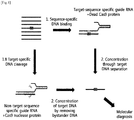
- FIG. 1 A schematic diagram thereof is shown in FIG. 1 .
- the genomic DNA of the cell was separated, and the normal DNA was excised using each RGEN corresponding to sequences similar to the target to be observed for the presence of a mutation.
- the sequence was read by a sequencing machine, and the ratio of the normal DNA to the mutant DNA was observed. As a result, an increase in the mutation rate of up to 1.4 to 30 times was observed compared to a case without cleaving with the RGEN (Table. 1).
- the mutant genomic DNA mixture was mixed with an amount of the normal genomic DNA, increased incrementally by powers of 10 (i.e., 10, 100, 1000, etc.), a genomic DNA mixture containing the mutants at a ratio of 0.0054% to 54% was obtained, which was then cleaved with the RGEN, which cleaves only normal sequences of the FANCF gene.
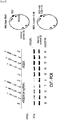
- the mutation rate was increased up to 520 times (2.8%/0.0054%) after cleavage, and this increasing effect was confirmed ( FIG. 3 ).
- Target base sequences and the sequences of sgRNA used in the above experiment are summarized in Table 2.
- Table 2 Target name Target base sequence RNAbase sequence (5'-> 3') VEGF-A_Off3 VEGFA_Off5 VEGFA_Off27 VEGFA_Off16 VEGFA_Off15 VEGFA_Off56 VEGFA_Off72 FANCF
- oncogenes have mutations, unlike normal DNA, which are wild type. Fragments having mutations of such oncogenes are difficult to observe because the fragments are mixed at a ratio of less than 1%, generally less than 0.01% to 0.1%, in a sample, and thus it is difficult to make an early diagnosis of cancer.
- FIG. 4 a method for determining whether or not it is possible to perform a mutation diagnosis of such oncogenes by applying the new paradigm of the present invention was shown in FIG. 4 as a schematic diagram.
- the restriction fragment length polymorphism (RFLP) and sequence analysis were performed using a control group (before concentration), in which normal DNA was not cleaved, and a test group (after concentration), in which only mutant oncogene fragments having mutations were amplified after cleaving the normal DNA with RGEN.
- RFLP restriction fragment length polymorphism
- the mutant oncogene which was a target DNA fragment, could be easily detected.
- the present inventors attempted to prepare RGEN for RFLP for detecting oncogene mutations.
- RGEN specific to normal DNA and mutation-specific RGEN specific to a mutation at the 12 th amino acid position which is a mutant hotspot of the K-RAS oncogene that mutates at a high frequency in a variety of cancers, were developed ( FIG. 5 ).
- FIG. 6 shows the result of confirming through experiments whether the two methods of Example 1 can be applied to the blood plasma DNA of cancer patients having the K-RAS G123 mutation. As shown in FIG. 6 , it was confirmed that the K-RAS G12S mutation was accurately detected without false negatives, etc.
- Example 5 Development of high sensitivity observation technique for a very small amount of a ctDNA mutation using RGEN
- circulating tumor DNA which is a cancer-specific marker
- ctDNA circulating tumor DNA
- RGEN RNA guided endonuclease
- a plasmid containing a mutant gene (KRAS c.35G>A, c.35G>T) of the KRAS gene, which has a high frequency of occurrence in colon cancer, and a plasmid containing a normal gene (KRAS c.35G) were each prepared and mixed at various ratios, and while the mutant gene was diluted to a smaller ratio (up to 1/1000 level) compared to the normal gene, CUT-PCR (PCR after treating with the RGEN specific to the normal gene) was performed.
- the normal KRAS gene was cleaved, and the ratio of the amplified normal KRAS gene to an internal control was calculated. Further, after the cancer-causing mutant gene with a high frequency of occurrence was diluted to a ratio of 1/1000 to the normal gene, and at the concentration thereof, an increased ratio of the mutant gene through CUT-PCR was calculated.
- the target base sequences of the RGEN specific to the normal gene and the base sequences of the sgRNA are shown in Table 3 below. [Table 3] Tag name Target base sequence RNA base sequence (5' -> 3') KRAS wildtype
- the experiment for detecting ctDNA which contains a cancer-specific gene variation, was also performed in cell-free DNA (cfDNA) obtained from human blood plasma. Since ctDNA is contained in the blood plasma in a very small amount, the mutant gene was amplified by repeating a CUT-PCR process (Treatment of the RGEN specific to the normal gene (Table 5) and PCR amplification). As a result, KRAS variations (c.35G>A (up to 192 times) and c.35G>T (up to 79 times)) with a higher frequency of occurrence were detected in samples obtained from colon cancer patients, compared to samples obtained from normal individuals ( FIG. 10 ).
- Example 6 Concentration of target DNA using a dCAS9:gRNA complex
- inactivated RGEN (a dCas9:gRNA complex) composed of a guide RNA and an inactivated Cas9 nuclease protein was used.
- the dCas9 protein has a histidine tag (a His tag) for purification, and by using a Ni-NTA magnetic bead that selectively binds to the His tag, only the dCas9 protein can be selectively purified.
- only desired target DNA can be selectively purified by using the property of a dCas9-protein-sgRNA complex, which does not have a nuclease activity capable of specifically binding to the base sequence of DNA ( FIG. 11 ).
- Example 6-1 Elective separation of plasmid fragments
- plasmid pUC19
- restriction enzymes Spel, Xmal, and Xhol
- sgRNAs were prepared for each of the plasmid DNA fragments cleaved in the above procedure (4134bp_sg#1, 4134bp_sg#2, 2570bp_sg#1, 2570bp_sg#2, 1263bp_sg#1, and 1263bp_sg#2), and the purification process was performed using each sgRNA corresponding to each target DNA or a combination thereof (4134bp sg#1+2, 2570bp_sg#1+2, and 1263bp_sg#1+2).
- Each sgRNA base sequence is shown in Table 6 below.
- sgRNA Target base sequence PAM base sequence 4134bp_sg#1 GAGAACCAGACCACCCAGAA (Sequence number 31) GGG 4134bp_sg#2 GGCAGCCCCGCCATCAAGAA(Sequence number 32) GGG 2570bp_sg#1 GTAAGATGCTTTTCTGTGAC(Sequence number 33) TGG 2570bp_sg#2 GATCCTTTGATCTTTTCTAC(Sequence number 34) GGG 1270bp_sg#1 GCCTGCAAAAAAGAAGAGAA(Sequence number 35) AGG 1270bp_sg#2 TGACATCAATTATTATACAT(Sequence number 36) CGG * The sgRNA sequence is identical to the target base sequence, except that T is U.
- the solution was then mixed with 50 ⁇ L of Ni-NTA magnetic beads capable of specifically binding to the histidine tag, and after washing twice with 200 ⁇ L of a wash buffer, a dCas9-sgRNA-target DNA complex was purified using 200 ⁇ L of an elution buffer (Bioneer, K-7200).
- RNase A Amresco, E866
- Protease K Booneer, 1304G
- gDNA genomic DNA
- RGEN dCas9:gRNA complex
- gDNAs of HeLa cells and SW480 cells were extracted and cleaved into fragments 400 bp in size, and experiments for purifying the target exon were performed.
- exons of the TP53 gene of cancer cells were targeted, and three sgRNAs were used for each target exon.
- the sequences of each sgRNA are shown in Table 7 below.
- the target DNA was purified under the same conditions as in Example 6-1.
- the present inventors attempted to confirm whether or not it was possible to classify sequences with a high equivalence, which are difficult to diagnose by classifying according to existing molecular diagnosis methods. For example, since a pathogenic bacterium/virus and a non-pathogenic bacterium/virus have very similar sequences, the method for confirming whether or not it was possible to make a diagnosis by classifying pathogenic and non-pathogenic bacteria by applying the new paradigm of the present invention is illustrated in FIG. 17 as a schematic diagram.
- the new method for analyzing a genotype of the present invention specifically, in which RGEN, unlike existing methods for analyzing a genotype, removes normal DNA in a sample by cleaving the normal DNA, and then only target DNA is amplified, or only the target DNA is captured and amplified, can accurately analyze without false positives/negatives, unlike existing PCR methods, etc.
Landscapes
- Chemical & Material Sciences (AREA)
- Life Sciences & Earth Sciences (AREA)
- Health & Medical Sciences (AREA)
- Engineering & Computer Science (AREA)
- Organic Chemistry (AREA)
- Zoology (AREA)
- Wood Science & Technology (AREA)
- Proteomics, Peptides & Aminoacids (AREA)
- Immunology (AREA)
- Molecular Biology (AREA)
- Analytical Chemistry (AREA)
- Biochemistry (AREA)
- Biotechnology (AREA)
- General Health & Medical Sciences (AREA)
- Physics & Mathematics (AREA)
- Microbiology (AREA)
- Genetics & Genomics (AREA)
- General Engineering & Computer Science (AREA)
- Bioinformatics & Cheminformatics (AREA)
- Biophysics (AREA)
- Chemical Kinetics & Catalysis (AREA)
- Biomedical Technology (AREA)
- Hematology (AREA)
- Urology & Nephrology (AREA)
- Pathology (AREA)
- Medicinal Chemistry (AREA)
- Cell Biology (AREA)
- General Physics & Mathematics (AREA)
- Food Science & Technology (AREA)
- Measuring Or Testing Involving Enzymes Or Micro-Organisms (AREA)
- Crystallography & Structural Chemistry (AREA)
- Plant Pathology (AREA)
- Hospice & Palliative Care (AREA)
- Oncology (AREA)
- Enzymes And Modification Thereof (AREA)
Applications Claiming Priority (2)
| Application Number | Priority Date | Filing Date | Title |
|---|---|---|---|
| KR20140064526 | 2014-05-28 | ||
| PCT/KR2015/005383 WO2015183025A1 (fr) | 2014-05-28 | 2015-05-28 | Procédé permettant la détection sensible d'adn cible à l'aide d'une nucléase spécifique de cible |
Publications (2)
| Publication Number | Publication Date |
|---|---|
| EP3150718A1 true EP3150718A1 (fr) | 2017-04-05 |
| EP3150718A4 EP3150718A4 (fr) | 2018-03-28 |
Family
ID=54699286
Family Applications (1)
| Application Number | Title | Priority Date | Filing Date |
|---|---|---|---|
| EP15800090.1A Withdrawn EP3150718A4 (fr) | 2014-05-28 | 2015-05-28 | Procédé permettant la détection sensible d'adn cible à l'aide d'une nucléase spécifique de cible |
Country Status (6)
| Country | Link |
|---|---|
| US (1) | US20170191123A1 (fr) |
| EP (1) | EP3150718A4 (fr) |
| JP (1) | JP2017516500A (fr) |
| KR (2) | KR101815695B1 (fr) |
| CN (1) | CN106687601A (fr) |
| WO (2) | WO2015183025A1 (fr) |
Cited By (12)
| Publication number | Priority date | Publication date | Assignee | Title |
|---|---|---|---|---|
| WO2018231963A1 (fr) * | 2017-06-13 | 2018-12-20 | Genetics Research, Llc, D/B/A Zs Genetics, Inc. | Protection sélective d'acides nucléiques |
| US10370700B2 (en) | 2017-06-13 | 2019-08-06 | Genetics Research, Llc | Detection of targeted sequence regions |
| US10527608B2 (en) | 2017-06-13 | 2020-01-07 | Genetics Research, Llc | Methods for rare event detection |
| CN111065747A (zh) * | 2018-02-06 | 2020-04-24 | 株式会社金希科 | 突变细胞游离基因分离试剂盒及利用其的突变细胞游离基因分离方法 |
| EP3638809A4 (fr) * | 2017-06-13 | 2021-03-10 | Genetics Research, LLC, D/B/A ZS Genetics, Inc. | Enrichissement négatif-positif pour la détection d'acides nucléiques |
| US10947599B2 (en) | 2017-06-13 | 2021-03-16 | Genetics Research, Llc | Tumor mutation burden |
| EP3638781A4 (fr) * | 2017-06-13 | 2021-03-17 | Genetics Research, LLC, D/B/A ZS Genetics, Inc. | Enrichissement d'une cible dans du plasma/sérum |
| EP3638812A4 (fr) * | 2017-06-13 | 2021-04-28 | Genetics Research, LLC, D/B/A ZS Genetics, Inc. | Détection d'acides nucléiques rares |
| EP3234200B1 (fr) | 2014-12-20 | 2021-07-07 | Arc Bio, LLC | Procédé d'appauvrissement ciblé d'acides nucléiques utilisant les protéines du système cas/crispr |
| US11142788B2 (en) | 2017-06-13 | 2021-10-12 | Genetics Research, Llc | Isolation of target nucleic acids |
| US11708606B2 (en) | 2014-02-04 | 2023-07-25 | Jumpcode Genomics, Inc. | Genome fractioning |
| US11884963B2 (en) | 2014-02-13 | 2024-01-30 | Takara Bio Usa, Inc. | Methods of depleting a target molecule from an initial collection of nucleic acids, and compositions and kits for practicing the same |
Families Citing this family (94)
| Publication number | Priority date | Publication date | Assignee | Title |
|---|---|---|---|---|
| US10323236B2 (en) | 2011-07-22 | 2019-06-18 | President And Fellows Of Harvard College | Evaluation and improvement of nuclease cleavage specificity |
| US9163284B2 (en) | 2013-08-09 | 2015-10-20 | President And Fellows Of Harvard College | Methods for identifying a target site of a Cas9 nuclease |
| US9359599B2 (en) | 2013-08-22 | 2016-06-07 | President And Fellows Of Harvard College | Engineered transcription activator-like effector (TALE) domains and uses thereof |
| US9322037B2 (en) | 2013-09-06 | 2016-04-26 | President And Fellows Of Harvard College | Cas9-FokI fusion proteins and uses thereof |
| US9526784B2 (en) | 2013-09-06 | 2016-12-27 | President And Fellows Of Harvard College | Delivery system for functional nucleases |
| US9228207B2 (en) | 2013-09-06 | 2016-01-05 | President And Fellows Of Harvard College | Switchable gRNAs comprising aptamers |
| US20150165054A1 (en) | 2013-12-12 | 2015-06-18 | President And Fellows Of Harvard College | Methods for correcting caspase-9 point mutations |
| EP3690044B1 (fr) | 2014-02-11 | 2024-01-10 | The Regents of the University of Colorado, a body corporate | Ingénierie génomique multiplexe validée ayant recours au système crispr |
| US10077453B2 (en) | 2014-07-30 | 2018-09-18 | President And Fellows Of Harvard College | CAS9 proteins including ligand-dependent inteins |
| WO2016135559A2 (fr) | 2015-02-23 | 2016-09-01 | Crispr Therapeutics Ag | Matériaux et procédés pour le traitement de maladies génétiques humaines, y compris d'hémoglobinopathies |
| BR112017017812A2 (en) | 2015-02-23 | 2018-04-10 | Crispr Therapeutics Ag | Materials and methods for treatment of hemoglobinopathies |
| IL310721B2 (en) | 2015-10-23 | 2025-11-01 | Harvard College | Nucleobase editors and uses thereof |
| US12043843B2 (en) | 2015-11-04 | 2024-07-23 | Vertex Pharmaceuticals Incorporated | Materials and methods for treatment of hemoglobinopathies |
| CN116640847A (zh) * | 2016-02-02 | 2023-08-25 | 夸登特健康公司 | 癌症进化检测和诊断 |
| AU2017252023B2 (en) * | 2016-04-18 | 2024-05-02 | Vertex Pharmaceuticals Incorporated | Materials and methods for treatment of hemoglobinopathies |
| WO2017191503A1 (fr) * | 2016-05-05 | 2017-11-09 | Crispr Therapeutics Ag | Substances et méthodes pour le traitement d'hémoglobinopathies |
| WO2017217768A1 (fr) * | 2016-06-15 | 2017-12-21 | 주식회사 툴젠 | Procédé de criblage de ciseaux génétiques ciblés à l'aide d'un système à cibles multiples d'activité sur cible et hors cible et son utilisation |
| US11293021B1 (en) | 2016-06-23 | 2022-04-05 | Inscripta, Inc. | Automated cell processing methods, modules, instruments, and systems |
| AU2017280353B2 (en) | 2016-06-24 | 2021-11-11 | Inscripta, Inc. | Methods for generating barcoded combinatorial libraries |
| CN110214183A (zh) | 2016-08-03 | 2019-09-06 | 哈佛大学的校长及成员们 | 腺苷核碱基编辑器及其用途 |
| US11078481B1 (en) | 2016-08-03 | 2021-08-03 | KSQ Therapeutics, Inc. | Methods for screening for cancer targets |
| WO2018031683A1 (fr) | 2016-08-09 | 2018-02-15 | President And Fellows Of Harvard College | Protéines de fusion cas9-recombinase programmables et utilisations associées |
| US11542509B2 (en) | 2016-08-24 | 2023-01-03 | President And Fellows Of Harvard College | Incorporation of unnatural amino acids into proteins using base editing |
| US11078483B1 (en) | 2016-09-02 | 2021-08-03 | KSQ Therapeutics, Inc. | Methods for measuring and improving CRISPR reagent function |
| KR101964746B1 (ko) * | 2016-09-07 | 2019-04-03 | 울산대학교 산학협력단 | dCas9 단백질 및 표적 핵산 서열에 결합하는 gRNA를 이용한 핵산 검출의 민감도 및 특이도 향상용 조성물 및 방법 |
| WO2018048194A1 (fr) * | 2016-09-07 | 2018-03-15 | 울산대학교 산학협력단 | Composition et procédé pour améliorer la sensibilité et la spécificité de la détection d'acides nucléiques à l'aide d'une protéine dcas9 et de la liaison d'arng à une séquence d'acide nucléique cible |
| KR102622411B1 (ko) | 2016-10-14 | 2024-01-10 | 프레지던트 앤드 펠로우즈 오브 하바드 칼리지 | 핵염기 에디터의 aav 전달 |
| WO2018119359A1 (fr) | 2016-12-23 | 2018-06-28 | President And Fellows Of Harvard College | Édition du gène récepteur ccr5 pour protéger contre l'infection par le vih |
| US12390514B2 (en) | 2017-03-09 | 2025-08-19 | President And Fellows Of Harvard College | Cancer vaccine |
| EP3592853A1 (fr) | 2017-03-09 | 2020-01-15 | President and Fellows of Harvard College | Suppression de la douleur par édition de gène |
| US11542496B2 (en) | 2017-03-10 | 2023-01-03 | President And Fellows Of Harvard College | Cytosine to guanine base editor |
| KR20240116572A (ko) | 2017-03-23 | 2024-07-29 | 프레지던트 앤드 펠로우즈 오브 하바드 칼리지 | 핵산 프로그램가능한 dna 결합 단백질을 포함하는 핵염기 편집제 |
| US11560566B2 (en) | 2017-05-12 | 2023-01-24 | President And Fellows Of Harvard College | Aptazyme-embedded guide RNAs for use with CRISPR-Cas9 in genome editing and transcriptional activation |
| US10011849B1 (en) | 2017-06-23 | 2018-07-03 | Inscripta, Inc. | Nucleic acid-guided nucleases |
| US9982279B1 (en) | 2017-06-23 | 2018-05-29 | Inscripta, Inc. | Nucleic acid-guided nucleases |
| JP2020530979A (ja) | 2017-06-30 | 2020-11-05 | インスクリプタ, インコーポレイテッド | 自動細胞処理方法、モジュール、機器及びシステム |
| CN111801345A (zh) | 2017-07-28 | 2020-10-20 | 哈佛大学的校长及成员们 | 使用噬菌体辅助连续进化(pace)的进化碱基编辑器的方法和组合物 |
| US10738327B2 (en) | 2017-08-28 | 2020-08-11 | Inscripta, Inc. | Electroporation cuvettes for automation |
| EP3676376B1 (fr) | 2017-08-30 | 2025-01-15 | President and Fellows of Harvard College | Éditeurs de bases à haut rendement comprenant une gam |
| EP3688161A1 (fr) | 2017-09-29 | 2020-08-05 | Intellia Therapeutics, Inc. | Compositions et méthodes pour l'édition du gène ttr et le traitement de l'amyloïdose attr |
| JP6985508B2 (ja) | 2017-09-30 | 2021-12-22 | インスクリプタ, インコーポレイテッド | フロースルーエレクトロポレーション機器編成 |
| KR20250107288A (ko) | 2017-10-16 | 2025-07-11 | 더 브로드 인스티튜트, 인코퍼레이티드 | 아데노신 염기 편집제의 용도 |
| AU2018378479B2 (en) | 2017-12-05 | 2025-03-13 | Vertex Pharmaceuticals Incorporated | CRISPR-Cas9 modified CD34+ human hematopoietic stem and progenitor cells and uses thereof |
| US12406749B2 (en) | 2017-12-15 | 2025-09-02 | The Broad Institute, Inc. | Systems and methods for predicting repair outcomes in genetic engineering |
| US11268077B2 (en) | 2018-02-05 | 2022-03-08 | Vertex Pharmaceuticals Incorporated | Materials and methods for treatment of hemoglobinopathies |
| US11566236B2 (en) | 2018-02-05 | 2023-01-31 | Vertex Pharmaceuticals Incorporated | Materials and methods for treatment of hemoglobinopathies |
| WO2019156475A1 (fr) * | 2018-02-06 | 2019-08-15 | 주식회사 진씨커 | Kit d'isolement d'adn acellulaire mutant et procédé d'isolement d'adn acellulaire mutant l'utilisant |
| CN108445212B (zh) * | 2018-03-21 | 2019-03-26 | 杭州观梓健康科技有限公司 | 一种用于检测艰难梭菌的胶体金试纸条和试剂盒 |
| US10443031B1 (en) | 2018-03-29 | 2019-10-15 | Inscripta, Inc. | Methods for controlling the growth of prokaryotic and eukaryotic cells |
| WO2019200004A1 (fr) | 2018-04-13 | 2019-10-17 | Inscripta, Inc. | Instruments de traitement cellulaire automatisés comprenant des cartouches de réactif |
| WO2019209926A1 (fr) | 2018-04-24 | 2019-10-31 | Inscripta, Inc. | Instrumentation automatisée pour la production de bibliothèques de peptides |
| US10557216B2 (en) | 2018-04-24 | 2020-02-11 | Inscripta, Inc. | Automated instrumentation for production of T-cell receptor peptide libraries |
| US10858761B2 (en) | 2018-04-24 | 2020-12-08 | Inscripta, Inc. | Nucleic acid-guided editing of exogenous polynucleotides in heterologous cells |
| CN112534063A (zh) | 2018-05-22 | 2021-03-19 | 安序源有限公司 | 用于核酸测序的方法、系统和组合物 |
| US12157760B2 (en) | 2018-05-23 | 2024-12-03 | The Broad Institute, Inc. | Base editors and uses thereof |
| CA3108767A1 (fr) | 2018-06-30 | 2020-01-02 | Inscripta, Inc. | Instruments, modules et procedes pour une detection amelioree de sequences editees dans des cellules vivantes |
| US12522807B2 (en) | 2018-07-09 | 2026-01-13 | The Broad Institute, Inc. | RNA programmable epigenetic RNA modifiers and uses thereof |
| CN109295181B (zh) * | 2018-08-08 | 2019-10-15 | 西安市中心血站 | 一种用于检测细菌的杂交干扰实时pcr方法 |
| US10532324B1 (en) | 2018-08-14 | 2020-01-14 | Inscripta, Inc. | Instruments, modules, and methods for improved detection of edited sequences in live cells |
| US10752874B2 (en) | 2018-08-14 | 2020-08-25 | Inscripta, Inc. | Instruments, modules, and methods for improved detection of edited sequences in live cells |
| US11142740B2 (en) | 2018-08-14 | 2021-10-12 | Inscripta, Inc. | Detection of nuclease edited sequences in automated modules and instruments |
| WO2020081149A2 (fr) | 2018-08-30 | 2020-04-23 | Inscripta, Inc. | Détection améliorée de séquences à édition par nucléase dans des modules automatisés et des instruments |
| KR102200109B1 (ko) * | 2018-09-12 | 2021-01-08 | 한국과학기술정보연구원 | 표적 서열 증폭용 올리고 뉴클레오타이드 및 이를 이용한 표적 서열의 증폭 방법 |
| WO2020086475A1 (fr) | 2018-10-22 | 2020-04-30 | Inscripta, Inc. | Enzymes modifiées |
| US11214781B2 (en) | 2018-10-22 | 2022-01-04 | Inscripta, Inc. | Engineered enzyme |
| WO2020092453A1 (fr) | 2018-10-29 | 2020-05-07 | The Broad Institute, Inc. | Éditeurs de nucléobases comprenant geocas9 et utilisations associées |
| US12351837B2 (en) | 2019-01-23 | 2025-07-08 | The Broad Institute, Inc. | Supernegatively charged proteins and uses thereof |
| WO2020191233A1 (fr) | 2019-03-19 | 2020-09-24 | The Broad Institute, Inc. | Procédés et compositions pour l'édition de séquences nucléotidiques |
| AU2020247900A1 (en) | 2019-03-25 | 2021-11-04 | Inscripta, Inc. | Simultaneous multiplex genome editing in yeast |
| US11001831B2 (en) | 2019-03-25 | 2021-05-11 | Inscripta, Inc. | Simultaneous multiplex genome editing in yeast |
| US12473543B2 (en) | 2019-04-17 | 2025-11-18 | The Broad Institute, Inc. | Adenine base editors with reduced off-target effects |
| AU2020288623A1 (en) | 2019-06-06 | 2022-01-06 | Inscripta, Inc. | Curing for recursive nucleic acid-guided cell editing |
| US10907125B2 (en) | 2019-06-20 | 2021-02-02 | Inscripta, Inc. | Flow through electroporation modules and instrumentation |
| WO2020257395A1 (fr) | 2019-06-21 | 2020-12-24 | Inscripta, Inc. | Mutations de conception rationnelle à l'échelle du génome conduisant à une production améliorée de lysine dans e. coli |
| US10927385B2 (en) | 2019-06-25 | 2021-02-23 | Inscripta, Inc. | Increased nucleic-acid guided cell editing in yeast |
| US12435330B2 (en) | 2019-10-10 | 2025-10-07 | The Broad Institute, Inc. | Methods and compositions for prime editing RNA |
| US11203762B2 (en) | 2019-11-19 | 2021-12-21 | Inscripta, Inc. | Methods for increasing observed editing in bacteria |
| WO2021101835A1 (fr) * | 2019-11-19 | 2021-05-27 | Xiao Bing Wang | Méthode d'identification de fusions de gènes par amplification d'adnc circulaire |
| CA3157131A1 (fr) | 2019-12-10 | 2021-06-17 | Inscripta, Inc. | Nouvelles nucleases mad |
| US10704033B1 (en) | 2019-12-13 | 2020-07-07 | Inscripta, Inc. | Nucleic acid-guided nucleases |
| AU2020407048A1 (en) | 2019-12-18 | 2022-06-09 | Inscripta, Inc. | Cascade/dCas3 complementation assays for in vivo detection of nucleic acid-guided nuclease edited cells |
| US10689669B1 (en) | 2020-01-11 | 2020-06-23 | Inscripta, Inc. | Automated multi-module cell processing methods, instruments, and systems |
| US11225674B2 (en) | 2020-01-27 | 2022-01-18 | Inscripta, Inc. | Electroporation modules and instrumentation |
| US20210332388A1 (en) | 2020-04-24 | 2021-10-28 | Inscripta, Inc. | Compositions, methods, modules and instruments for automated nucleic acid-guided nuclease editing in mammalian cells |
| IL297761A (en) | 2020-05-08 | 2022-12-01 | Broad Inst Inc | Methods and compositions for simultaneously editing two helices of a designated double-helix nucleotide sequence |
| US11787841B2 (en) | 2020-05-19 | 2023-10-17 | Inscripta, Inc. | Rationally-designed mutations to the thrA gene for enhanced lysine production in E. coli |
| US11299731B1 (en) | 2020-09-15 | 2022-04-12 | Inscripta, Inc. | CRISPR editing to embed nucleic acid landing pads into genomes of live cells |
| US11512297B2 (en) | 2020-11-09 | 2022-11-29 | Inscripta, Inc. | Affinity tag for recombination protein recruitment |
| AU2021415461A1 (en) | 2021-01-04 | 2023-08-17 | Inscripta, Inc. | Mad nucleases |
| EP4274890A4 (fr) | 2021-01-07 | 2024-11-27 | Inscripta, Inc. | Nucléases mad |
| KR102604416B1 (ko) * | 2021-02-03 | 2023-11-20 | 연세대학교 산학협력단 | 가이드 rna를 이용한 유전자 분석 방법 |
| US11884924B2 (en) | 2021-02-16 | 2024-01-30 | Inscripta, Inc. | Dual strand nucleic acid-guided nickase editing |
| KR102616916B1 (ko) * | 2021-05-11 | 2023-12-21 | 주식회사 애이마 | 발암성 돌연변이 유전자 검출용 가이드 rna 내지 이의 용도 |
| CN118318049A (zh) | 2021-09-28 | 2024-07-09 | 安序源有限公司 | 用于处理核酸样品的方法以及核酸样品的组合物 |
Family Cites Families (6)
| Publication number | Priority date | Publication date | Assignee | Title |
|---|---|---|---|---|
| WO2009120808A2 (fr) * | 2008-03-26 | 2009-10-01 | Sequenom, Inc. | Détection de séquence polymorphique amplifiée par endonucléase de restriction |
| US9637739B2 (en) * | 2012-03-20 | 2017-05-02 | Vilnius University | RNA-directed DNA cleavage by the Cas9-crRNA complex |
| AU2013335451C1 (en) * | 2012-10-23 | 2024-07-04 | Toolgen Incorporated | Composition for cleaving a target DNA comprising a guide RNA specific for the target DNA and Cas protein-encoding nucleic acid or Cas protein, and use thereof |
| RU2662932C2 (ru) * | 2013-03-14 | 2018-07-31 | Карибо Биосайенсиз, Инк. | Композиции и способы с участием нуклеиновых кислот, нацеленных на нуклеиновые кислоты |
| CN103224947B (zh) * | 2013-04-28 | 2015-06-10 | 陕西师范大学 | 一种基因打靶系统 |
| CN103757053B (zh) * | 2014-01-28 | 2016-05-25 | 中国医学科学院医学生物学研究所 | 一种特异性的dna病毒基因组定点改造及筛选方法 |
-
2015
- 2015-05-28 WO PCT/KR2015/005383 patent/WO2015183025A1/fr not_active Ceased
- 2015-05-28 US US15/314,288 patent/US20170191123A1/en not_active Abandoned
- 2015-05-28 CN CN201580040520.8A patent/CN106687601A/zh active Pending
- 2015-05-28 JP JP2017515647A patent/JP2017516500A/ja active Pending
- 2015-05-28 WO PCT/KR2015/005384 patent/WO2015183026A1/fr not_active Ceased
- 2015-05-28 KR KR1020150075192A patent/KR101815695B1/ko active Active
- 2015-05-28 KR KR1020150075203A patent/KR101886381B1/ko active Active
- 2015-05-28 EP EP15800090.1A patent/EP3150718A4/fr not_active Withdrawn
Cited By (19)
| Publication number | Priority date | Publication date | Assignee | Title |
|---|---|---|---|---|
| US11761039B2 (en) | 2014-02-04 | 2023-09-19 | Jumpcode Genomics, Inc. | Genome fractioning |
| US11708606B2 (en) | 2014-02-04 | 2023-07-25 | Jumpcode Genomics, Inc. | Genome fractioning |
| US12497647B2 (en) | 2014-02-13 | 2025-12-16 | Takara Bio Usa, Inc. | Methods of depleting a target molecule from an initial collection of nucleic acids, and compositions and kits for practicing the same |
| US11884963B2 (en) | 2014-02-13 | 2024-01-30 | Takara Bio Usa, Inc. | Methods of depleting a target molecule from an initial collection of nucleic acids, and compositions and kits for practicing the same |
| EP3234200B1 (fr) | 2014-12-20 | 2021-07-07 | Arc Bio, LLC | Procédé d'appauvrissement ciblé d'acides nucléiques utilisant les protéines du système cas/crispr |
| US11421263B2 (en) | 2017-06-13 | 2022-08-23 | Genetics Research, Llc | Detection of targeted sequence regions |
| WO2018231963A1 (fr) * | 2017-06-13 | 2018-12-20 | Genetics Research, Llc, D/B/A Zs Genetics, Inc. | Protection sélective d'acides nucléiques |
| EP3638781A4 (fr) * | 2017-06-13 | 2021-03-17 | Genetics Research, LLC, D/B/A ZS Genetics, Inc. | Enrichissement d'une cible dans du plasma/sérum |
| US10370700B2 (en) | 2017-06-13 | 2019-08-06 | Genetics Research, Llc | Detection of targeted sequence regions |
| EP3638812A4 (fr) * | 2017-06-13 | 2021-04-28 | Genetics Research, LLC, D/B/A ZS Genetics, Inc. | Détection d'acides nucléiques rares |
| US10947599B2 (en) | 2017-06-13 | 2021-03-16 | Genetics Research, Llc | Tumor mutation burden |
| US11142788B2 (en) | 2017-06-13 | 2021-10-12 | Genetics Research, Llc | Isolation of target nucleic acids |
| EP3638808A4 (fr) * | 2017-06-13 | 2021-03-17 | Genetics Research, LLC, D/B/A ZS Genetics, Inc. | Détection de régions de séquence ciblées |
| US10527608B2 (en) | 2017-06-13 | 2020-01-07 | Genetics Research, Llc | Methods for rare event detection |
| EP3638809A4 (fr) * | 2017-06-13 | 2021-03-10 | Genetics Research, LLC, D/B/A ZS Genetics, Inc. | Enrichissement négatif-positif pour la détection d'acides nucléiques |
| CN111065747A (zh) * | 2018-02-06 | 2020-04-24 | 株式会社金希科 | 突变细胞游离基因分离试剂盒及利用其的突变细胞游离基因分离方法 |
| CN111065747B (zh) * | 2018-02-06 | 2023-10-31 | 株式会社金希科 | 突变细胞游离基因分离试剂盒及利用其的突变细胞游离基因分离方法 |
| US11613776B2 (en) | 2018-02-06 | 2023-03-28 | Genecker Co., Ltd. | Mutant cell-free DNA isolation kit and mutant cell-free DNA isolation method using the same |
| EP3653730A4 (fr) * | 2018-02-06 | 2021-04-07 | Genecker Co., Ltd | Kit d'isolement d'adn acellulaire mutant et procédé d'isolement d'adn acellulaire mutant l'utilisant |
Also Published As
| Publication number | Publication date |
|---|---|
| KR101815695B1 (ko) | 2018-01-08 |
| WO2015183025A1 (fr) | 2015-12-03 |
| CN106687601A (zh) | 2017-05-17 |
| WO2015183026A1 (fr) | 2015-12-03 |
| KR20150138075A (ko) | 2015-12-09 |
| EP3150718A4 (fr) | 2018-03-28 |
| US20170191123A1 (en) | 2017-07-06 |
| JP2017516500A (ja) | 2017-06-22 |
| KR20150138074A (ko) | 2015-12-09 |
| KR101886381B1 (ko) | 2018-08-10 |
Similar Documents
| Publication | Publication Date | Title |
|---|---|---|
| EP3150718A1 (fr) | Procédé permettant la détection sensible d'adn cible à l'aide d'une nucléase spécifique de cible | |
| JP7256748B2 (ja) | エラーが訂正された核酸配列決定への適用を伴う標的化核酸配列濃縮のための方法 | |
| AU767983B2 (en) | Methods for detecting nucleic acids indicative of cancer | |
| AU2015101418A6 (en) | Compositions and methods of nucleic acid-targeting nucleic acids | |
| JPS61500646A (ja) | ファクタ−8および関連生産物の製造 | |
| EP3653730B1 (fr) | Procédé et kit d'isolement d'adn acellulaire mutant | |
| CN108699101A (zh) | 用于基因组dna片段的靶向纯化的制备型电泳方法 | |
| US6528256B1 (en) | Methods for identification and isolation of specific nucleotide sequences in cDNA and genomic DNA | |
| Fisher et al. | Previous hydatidiform mole identified as the causative pregnancy of choriocarcinoma following birth of normal twins | |
| WO2024138180A2 (fr) | Flux de travail ciblés et intégrés de séquençage de génome somatique entier et de méthylation d'adn | |
| EP3283646B1 (fr) | Procédé d'analyse des sites hypersensibles aux nucléases | |
| EP4339285A1 (fr) | Arn guide pour la détection d'un gène mutant oncogène et son utilisation | |
| Talotta | Molecular clustering and fragmentomics on circulating tumor DNA improve outcome prediction in diffuse large B cell lymphoma | |
| JP2026510027A (ja) | ハイブリッドssDNA-およびdsDNA-NGSライブラリー調製方法 | |
| WO2024163478A1 (fr) | Surveillance non invasive d'altérations génomiques induites par des thérapies d'édition génique | |
| WO2025038399A1 (fr) | Procédés d'enrichissement méthylé pour séquençage génétique et épigénétique à molécule unique | |
| WO2025160433A1 (fr) | Procédés d'analyse de lectures de séquençage | |
| CN114149990A (zh) | 编辑造血干/祖细胞中bcl11a基因的方法 | |
| HK1243142B (en) | Method for analysing nuclease hypersensitive sites |
Legal Events
| Date | Code | Title | Description |
|---|---|---|---|
| PUAI | Public reference made under article 153(3) epc to a published international application that has entered the european phase |
Free format text: ORIGINAL CODE: 0009012 |
|
| 17P | Request for examination filed |
Effective date: 20161222 |
|
| AK | Designated contracting states |
Kind code of ref document: A1 Designated state(s): AL AT BE BG CH CY CZ DE DK EE ES FI FR GB GR HR HU IE IS IT LI LT LU LV MC MK MT NL NO PL PT RO RS SE SI SK SM TR |
|
| AX | Request for extension of the european patent |
Extension state: BA ME |
|
| DAV | Request for validation of the european patent (deleted) | ||
| DAX | Request for extension of the european patent (deleted) | ||
| RIC1 | Information provided on ipc code assigned before grant |
Ipc: C12Q 1/68 20060101AFI20171120BHEP Ipc: G01N 33/574 20060101ALI20171120BHEP Ipc: G01N 33/53 20060101ALI20171120BHEP |
|
| A4 | Supplementary search report drawn up and despatched |
Effective date: 20180227 |
|
| RIC1 | Information provided on ipc code assigned before grant |
Ipc: G01N 33/574 20060101ALI20180221BHEP Ipc: C12Q 1/68 20180101AFI20180221BHEP Ipc: G01N 33/53 20060101ALI20180221BHEP |
|
| 17Q | First examination report despatched |
Effective date: 20190118 |
|
| STAA | Information on the status of an ep patent application or granted ep patent |
Free format text: STATUS: THE APPLICATION IS DEEMED TO BE WITHDRAWN |
|
| 18D | Application deemed to be withdrawn |
Effective date: 20200228 |