EP3152117B1 - Facettierter behälter - Google Patents
Facettierter behälter Download PDFInfo
- Publication number
- EP3152117B1 EP3152117B1 EP15729315.0A EP15729315A EP3152117B1 EP 3152117 B1 EP3152117 B1 EP 3152117B1 EP 15729315 A EP15729315 A EP 15729315A EP 3152117 B1 EP3152117 B1 EP 3152117B1
- Authority
- EP
- European Patent Office
- Prior art keywords
- container
- facets
- peripheral wall
- longitudinal axis
- exterior surface
- Prior art date
- Legal status (The legal status is an assumption and is not a legal conclusion. Google has not performed a legal analysis and makes no representation as to the accuracy of the status listed.)
- Active
Links
Images





Classifications
-
- B—PERFORMING OPERATIONS; TRANSPORTING
- B65—CONVEYING; PACKING; STORING; HANDLING THIN OR FILAMENTARY MATERIAL
- B65D—CONTAINERS FOR STORAGE OR TRANSPORT OF ARTICLES OR MATERIALS, e.g. BAGS, BARRELS, BOTTLES, BOXES, CANS, CARTONS, CRATES, DRUMS, JARS, TANKS, HOPPERS, FORWARDING CONTAINERS; ACCESSORIES, CLOSURES, OR FITTINGS THEREFOR; PACKAGING ELEMENTS; PACKAGES
- B65D1/00—Rigid or semi-rigid containers having bodies formed in one piece, e.g. by casting metallic material, by moulding plastics, by blowing vitreous material, by throwing ceramic material, by moulding pulped fibrous material or by deep-drawing operations performed on sheet material
- B65D1/02—Bottles or similar containers with necks or like restricted apertures, designed for pouring contents
- B65D1/0223—Bottles or similar containers with necks or like restricted apertures, designed for pouring contents characterised by shape
-
- B—PERFORMING OPERATIONS; TRANSPORTING
- B65—CONVEYING; PACKING; STORING; HANDLING THIN OR FILAMENTARY MATERIAL
- B65D—CONTAINERS FOR STORAGE OR TRANSPORT OF ARTICLES OR MATERIALS, e.g. BAGS, BARRELS, BOTTLES, BOXES, CANS, CARTONS, CRATES, DRUMS, JARS, TANKS, HOPPERS, FORWARDING CONTAINERS; ACCESSORIES, CLOSURES, OR FITTINGS THEREFOR; PACKAGING ELEMENTS; PACKAGES
- B65D23/00—Details of bottles or jars not otherwise provided for
- B65D23/12—Means for the attachment of smaller articles
- B65D23/14—Means for the attachment of smaller articles of tags, labels, cards, coupons, decorations or the like
-
- B—PERFORMING OPERATIONS; TRANSPORTING
- B65—CONVEYING; PACKING; STORING; HANDLING THIN OR FILAMENTARY MATERIAL
- B65D—CONTAINERS FOR STORAGE OR TRANSPORT OF ARTICLES OR MATERIALS, e.g. BAGS, BARRELS, BOTTLES, BOXES, CANS, CARTONS, CRATES, DRUMS, JARS, TANKS, HOPPERS, FORWARDING CONTAINERS; ACCESSORIES, CLOSURES, OR FITTINGS THEREFOR; PACKAGING ELEMENTS; PACKAGES
- B65D2501/00—Containers having bodies formed in one piece
- B65D2501/0009—Bottles or similar containers with necks or like restricted apertures designed for pouring contents
- B65D2501/0018—Ribs
-
- B—PERFORMING OPERATIONS; TRANSPORTING
- B65—CONVEYING; PACKING; STORING; HANDLING THIN OR FILAMENTARY MATERIAL
- B65D—CONTAINERS FOR STORAGE OR TRANSPORT OF ARTICLES OR MATERIALS, e.g. BAGS, BARRELS, BOTTLES, BOXES, CANS, CARTONS, CRATES, DRUMS, JARS, TANKS, HOPPERS, FORWARDING CONTAINERS; ACCESSORIES, CLOSURES, OR FITTINGS THEREFOR; PACKAGING ELEMENTS; PACKAGES
- B65D2501/00—Containers having bodies formed in one piece
- B65D2501/0009—Bottles or similar containers with necks or like restricted apertures designed for pouring contents
- B65D2501/0081—Bottles of non-circular cross-section
Definitions
- Container for a product for a product.
- Blow molded containers are commonly used for packaging consumer goods such as liquid fabric softeners, liquid detergent, powdered detergent, water, soda, beer, wine, tea, fruit juice, surface cleaning compositions, milk, particulate laundry scent additives, and the like.
- Marketers of such products must compete with others participants in the market to attract consumers to their brands.
- One way by which marketers attempt to differentiate their product from the products of others is to use a container shape that is proprietary or unique to their brand.
- Blow molding can be used produce containers having a variety of shapes.
- shelves are stocked full of a wide variety of containers for products.
- consumers encounter a category of goods within a single zone of shelving.
- multiple brands typically compete to attract consumers' attention.
- Marketers desire to attract attention to their brands before the consumer is close enough to the product to read the label on the container, thereby potentially influencing the purchasing decision made by the consumer.
- US2006/065566 A1 relates to blow molded plastic containers, according to the preamble of claim 1, comprising a faceted region comprising a plurality of facets arranged edge to edge.
- a container comprising: an open end circumscribing a longitudinal axis; and a peripheral wall extending from the open end about the longitudinal axis to a closed end; wherein the peripheral wall and the closed end comprise a thermoplastic substrate; wherein the peripheral wall comprises a faceted region comprising a plurality of facets arranged edge to edge with at least one adjacent facet, at least a portion of the faceted region being located nearer to the closed end than to the open end; wherein the peripheral wall has a peripheral wall exterior surface oriented away from the longitudinal axis, the peripheral wall exterior surface having a peripheral wall exterior surface area; wherein each of the plurality of facets has a facet exterior surface area oriented away from the longitudinal axis and each of the facets has an exterior surface area that is between about 0.0001% and about 4% of the peripheral wall exterior surface area; wherein at local positions along the longitudinal axis the container has a local maximum internal dimension orthogonal to the longitudinal axis, a local major axis coincident with the local maximum internal
- a container 10 having a neck 20 is shown in Fig. 1 .
- the container 10 can be formed by injection stretch blow molding.
- the container 10 can be formed by injection molding, injection stretch blow molding, extrusion blow molding, or similar process.
- the container 10 can be a thermoformed container 10.
- the container 10 has a closed end 30.
- the closed end 30 can have a closed end periphery 40.
- the closed end periphery 40 can define the extent of the closed end away from the longitudinal axis L.
- the closed end 30 can be shaped to have a structure that can be stably rested on a flat surface such as a table.
- the closed end 30 can be shaped as shown in Fig. 1 .
- the closed end 30 can be provided with a plurality of feet upon which the closed end 30 can rest on a flat surface such as a table.
- a peripheral wall 50 can extend from the closed end periphery 40 about a longitudinal axis L of the container 10 to the open end 60.
- the longitudinal axis L is an axis of the container 10 that passes through the open end 60 and the closed end 30 about which the peripheral wall 50 extends.
- the peripheral wall 50 extends from the open end 60 to the closed end 30.
- the peripheral wall 50 can be asymmetric about the longitudinal axis L.
- the open end 60 is about the longitudinal axis L. If the open end is generally circularly shaped, the open end 60 circumscribes the longitudinal axis L.
- the peripheral wall 50 and closed end 30 have a peripheral wall exterior surface 170 oriented away from the longitudinal axis L and an opposing interior surface 180.
- the interior surface 180 of the peripheral wall 50 is oriented towards the longitudinal axis L.
- the interior surface 180 of the closed end 30 is oriented towards the open end 60.
- the peripheral wall exterior surface 170 can have a peripheral wall exterior surface area 172, which is the total area of the peripheral wall exterior surface's 170 faces and curved surfaces above and below the neck.
- the closed end 30 and peripheral wall 50 can comprise a thermoplastic material.
- the thermoplastic material can be a petroleum based thermoplastic material or a plant based thermoplastic material.
- the closed end 30 and peripheral wall 50 can be any polymeric material that can be blow molded.
- the container 10 can comprise a material selected from the group consisting of high density polyethylene, low density polyethylene, polypropylene, biaxially oriented polypropylene polyethylene, polyethylene terphthalate,polyethylene terephthalate glycol, processable polylactic acid, polyvinyl chloride, thermoplastic startch, cellulose bioplastic, aliphatic polyesters, and polylactic acid.
- the peripheral wall 50 defines a variable open cross-section 70 of the container 10 in a plane orthogonal to the longitudinal axis L as function of distance from the closed end 30.
- a variable cross-section 70 of the container 10 at a particular height or location along the longitudinal axis L is stippled and labeled as 70 in Fig. 1 .
- the cross-section orthogonal to the longitudinal axis L can have different shapes and or sizes.
- the variable open cross-section 70 defines an area within the container 10 within which the contents of the container 10 are held.
- the container 10 can be a bulbous shaped container 10 having a relatively narrow closed end 30 and a peripheral wall 50 that broadens in relationship to the height of the container 10, the height being taken along the longitudinal axis L moving away from the closed end 30.
- the area of the open cross-section 70 can have an initial value that gradually increases with height as measured from the closed end 30 along the longitudinal axis L.
- the area of the open cross-section 70 can have a maximum at a particular height, above which the area of the open cross-section 70 decreases with increasing height as measured from the closed end 30 along the longitudinal axis L.
- the maximum can be a global maximum or local maximum.
- the container 10 can have a neck 20 having a neck open cross-section 80 orthogonal to the longitudinal axis L.
- the neck 20 can be a narrowed region of the container 10 that can be generally located proximal the open end 60 of the container 10.
- the neck open cross-section 80 is marked in Fig. 1 and stippled.
- the neck 20 can be sized and dimensioned to be able to be gripped by an adult female hand.
- the peripheral wall 50 comprises a faceted region 90.
- the faceted region 90 comprises plurality of facets 100.
- the facets 100 forming the faceted region 90 are arranged edge to edge with one or more adjacent facets 100.
- the faceted region 90 can comprise more than about 5 facets 100.
- the faceted region 90 can comprise more than about 10 facets 100.
- the faceted region 90 can comprise more than about 20 facets 100.
- the faceted region 90 can comprise more than about 40 facets 100.
- the faceted region 90 can comprise more than about 80 facets 100.
- the faceted region 90 can comprise more than about 150 facets 100.
- the faceted region 90 can comprise more than about 300 facets 100.
- the faceted region can comprise between about 5 and about 15 facets.
- the faceted region can comprise between about 5 and about 25 facets.
- the faceted region can comprise between about 5 and about 50 facets.
- the faceted region can comprise between about 5 and about 100 facets.
- the faceted region can comprise between about 20 and about 40 facets.
- a facet 100 can be a small plane surface.
- a facet 100 can have a facet exterior surface area 102 oriented away from the longitudinal axis that is less than about 4 cm 2 .
- a facet 100 can have a facet exterior surface area 102 oriented away from the longitudinal axis that is less than about 2.5 cm 2 .
- a facet 100 can have a facet exterior surface area 102 oriented away from the longitudinal axis between about 0.1 cm 2 and about 4 cm 2 .
- a facet 100 can have a facet exterior surface area 102 oriented away from the longitudinal axis between about 0.1 cm 2 and about 2.5 cm 2 .
- Each of the plurality of facets 100 has a facet exterior surface area oriented away from the longitudinal axis L and each of the plurality of facets 100 can have a facet exterior surface area 102 oriented away from the longitudinal axis L that is less than about 2% of the peripheral wall exterior surface area 172.
- the facet exterior surface area 102 oriented away from the longitudinal axis L is between about 0.0001% and about 4% of the peripheral wall exterior surface area 172.
- the facet exterior surface area 102 oriented away from the longitudinal axis L can be between about 0.0001% and about 2% of the peripheral wall exterior surface area 172.
- Each of the plurality of facets 100 can have a facet exterior surface area 102 oriented away from the longitudinal axis L and each of the plurality of facets 100 can have a face exterior surface area 102 oriented away from the longitudinal axis L that is less than about 1% of the peripheral wall exterior surface area 172.
- the facet exterior surface area 102 oriented away from the longitudinal axis L can be between about 0.0001% and about 1% of the peripheral wall exterior surface area 172.
- Each of the plurality of facets 100 can have a facet exterior surface area 102 oriented away from the longitudinal axis L and each of the plurality of facets 100 can have an exterior surface area 102 oriented away from the longitudinal axis L that is less than about 0.5% of the peripheral wall exterior surface area 172.
- the facet exterior surface area 102 oriented away from the longitudinal axis L can be between about 0.0001% and about 0.5% of the peripheral wall exterior surface area 172.
- the facets 100 can be small plane surfaces of individual panels. When a plurality of facets 100 are arranged to form a faceted region 90 on a container 10, individual facets 100 can present surfaces that reflect incident light in different directions. That is, the orthogonal directions away from the surfaces of individual facets 100 are divergent. The differences in intensity of light reflected to an observer's eyes are perceived to give the container 10 luster or make the container 10 look sparkly. Without being bound by theory, it is thought that containers having a faceted region 90 may shimmer as compared containers having the same general container shape that do not have faceted region 90. The shimmer, which can be perceived by consumers as flashes of light draw a consumer's eyes to the container 10 having a faceted region 90.
- a container 10 formed of a thermoplastic material having a faceted region 90 can appear to be a glass container.
- a lightweight container 10 can have the appearance of a more substantial glass container.
- At least a portion of the faceted region 90 can be located nearer to the closed end 30 than the open end 60. Without being bound by theory, it is thought that such an arrangement can provide for enhanced luster when the position of the longitudinal axis L is changes front to back relative to an observer's eye and when container 10 is rotated about the longitudinal axis L.
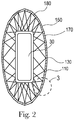
- Figure 2 is an approximate sectional view of the container 10 shown in Fig. 1 to illustrate one configuration of the structure of a section of the container 10.
- a variety of cross-sections orthogonal to the longitudinal axis are contemplated herein.
- around the peripheral wall 50 at least a portion of the peripheral wall 50 about the longitudinal axis L in a plane orthogonal to the longitudinal axis L below the neck 20 can be defined by a plurality of substantially straight line segments 110.
- the line segments 110 can be arranged end to end, as shown in Fig. 2 .
- the peripheral wall 50 about the longitudinal axis L in a plane orthogonal to the longitudinal axis L below the neck 20 can be entirely defined by a plurality of substantially straight line segments 110.
- Each line segment 100 can have length 120, as shown in Fig. 3 which is a cut-out view of a portion of the peripheral wall shown in Fig. 2 as marked in Fig. 2 .
- the length of the transition segment 130 between adjacent line segments 100 can have a length less than about 10% of the length of an adjacent line segment 100.
- the length of the transition segment 130 between adjacent line segments 100 can have a length between about 0.0001% and about 10% of the length of an adjacent line segment 100. Without being bound by theory, it is thought that shorter transition segments 130 can provide for more visual definition of the facets 100.
- the container 10 has a local maximum internal dimension 210 orthogonal to the longitudinal axis L, a local major axis 201 coincident with the local maximum internal dimension 210, a local minor axis orthogonal to the local major axis 201 and the longitudinal axis L, a local minor internal dimension 220 coincident with the local minor axis 201.
- the container 10 has a local aspect ratio defined as a ratio of the local maximum internal dimension 210 to the local minor internal dimension 220.
- the neck 20 can be considered to be a location at which the local aspect ratio is between about 1 and about 1.1.
- the local aspect ratio can be thought of as descriptive of the shape of the various cross sections of the container 10 taken orthogonal to the longitudinal axis L of the container 10. If the local aspect ratio of a section of the container 10 taken orthogonal to the longitudinal axis L is 1, that section of the container 10 can be circular, recognizing that the aspect ratio as defined herein of non-circular cross sections could be 1 if the local maximum internal dimension 210 and the local minor internal dimension 220 are the same, for example as might occur for a square cross section.
- a container 10 that when resting on the closed end 30 has a broad front dimension, taken to be from left to right of the observer, and a slimmer front to back dimension, which is taken to be front to back into a shelf on which the container 10 is observed.
- Such an arrangement can provide more space for branding and labeling of the container.
- the cross section of the container 10 orthogonal to the longitudinal axis L can become more circular to provide a circular open end 60 that can be conveniently fitted with a closure.
- the container 10 can have a local aspect ratio between about 1.3 and about 5 mid-way along the longitudinal axis L, for example as shown in Fig. 12 .
- a local aspect ratio can provide for a container 10 that has a broad dimension that can be suitable as a primary label face 501 of the container 10.
- the primary label face 501 of the container can contain the brand name of the product contained within the container 10 in a large enough font so as to be readable by an observer at a distance between about 0.1 m and about 2 m under typical lighting conditions that occur in a retail environment.
- the primary label face 501 of the container 10 can be generally in line with a local major axis 201 of the container 10, recognizing that the primary label face 501 may be a curved surface.
- the container 10 can have a local aspect ratio between about 1.4 and about 5 mid-way along the longitudinal axis L.
- the container 10 can have a local aspect ratio between about 1.5 and 5 mid-way along the longitudinal axis L.
- the container 10 can have a local aspect ratio between about 1.7 and about 5 mid-way along the longitudinal axis L.
- the container 10 can have a local aspect ratio between about 2 and about 5 mid-way along the longitudinal axis L.
- containers 10 having a faceted region 90 can be practical for attracting the attention of consumers from a distance between about 2 m and about 10 m.
- the faceted region 90 has a plurality of facets 100, each of which reflect in divergent direction, labeling on the container 10 can be difficult for an observer to read at a close distance, such as within about 2 m of the container 10.
- a container 10 having a local aspect ratio between about 1.3 and about 5 mid-way along the longitudinal axis L can provide for a less rounded portion of the container 10 that can be labeled with brand identifying information.
- a faceted region 90 provided on such a container can balance the desire to provide for a container 10 having a luster when viewed from a distance yet be legibly labeled on a primary label face 501 of the container 10.
- the container 10 can have a local aspect ratio between about 1.3 and about 5. Along between about 20% and about 95% of the longitudinal axis L the container 10 can have a local aspect ratio between about 1.5 and about 5. Along between about 40% and about 95% of the longitudinal axis L the container 10 can have a local aspect ratio greater between about 1.3 and about 5. Along between about 40% and about 95% of the longitudinal axis L the container 10 can have a local aspect ratio between about 1.5 and about 5. Along between about 20% and about 85% of the longitudinal axis L the container 10 can have a local aspect ratio between about 1.3 and about 5. Along between about 20% and about 85% of the longitudinal axis L the container 10 can have a local aspect ratio between about 1.5 and about 5.
- the container 10 can have a local aspect ratio greater between about 1.3 and about 5.
- the container 10 can have a local aspect ratio between about 1.5 and about 5.
- the neck 20 can be nearer to the open end 60 than to the closed end 30. By having the neck 20 located as such, a greater portion of the container 10 can be provided with a faceted region. Further, since the neck 20 can form a portion of the container 10 designed to be gripped, the center of mass of the container 10 plus the contents therein will tend to be lower than the neck 20. A lower center of gravity may be practical for providing a container from which it is easy to pour contents, is stable in the user's hand, and is stable when resting on a flat surface.
- the neck 20 can have a neck open cross-section 80 between about 5 cm 2 and about 80 cm 2 .
- a neck 20 dimensioned as such can provide for a convenient location at which to grip the container 10.
- the neck 20 can have a neck open cross-section 80 between about 5 cm 2 and about 60 cm 2 .
- the neck 20 can have a neck open cross-section 80 between about 5 cm 2 and about 40 cm 2 .
- the neck 20 can have a neck open cross-section 80 between about 5 cm 2 and about 40 cm 2 .
- the neck 20 can have a neck open cross-section 80 between about 5 cm 2 and about 40 cm 2 .
- the neck 20 can have a neck open cross-section 80 between about 5 cm 2 and about 20 cm 2 or even less than about 20 cm 2 .
- the neck 20 can have a neck open cross-section 80 between about 5 cm 2 and about 10 cm 2 . Having a smaller neck 20 can be practical for containers 10 that designed for used by persons having small hands.
- the container 10 can have a total volume defined by the closed end 30, the peripheral wall 50, and the open end 60.
- the total volume can be more than about 300 mL.
- the total volume can be more than about 500 mL.
- the total volume can be more than about 1000 mL.
- the total volume can be more than about 1500 mL.
- the total volume can be more than about 2000 mL.
- the total volume can be between about 300 mL and about 2000 mL.
- the container 10 can have a partial volume above the neck 20.
- the partial volume is defined by the neck open cross-section 80 at the neck, the peripheral wall 50 above the neck 20, and the open end 60.
- the partial volume can be thought of as the volume of the part of the container 10 above the neck 20.
- the partial volume above the neck 20 can be less than about 20% of the total volume of the container 10.
- the partial volume above the neck 20 can be less than about 10% of the total volume of the container 10.
- the partial volume above the neck 20 can be between about 1% and about 50% of the total volume of the container 10.
- the partial volume above the neck 20 can be between about 1% and about 20% of the total volume of the container 10.
- the partial volume above the neck 20 can be between about 1% and about 10% of the total volume of the container 10.
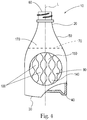
- the faceted region 90 can comprise more than about 30% of the peripheral wall exterior surface 170 of the peripheral wall 50. As shown in Fig. 4 , faceted region 90 can be on a face 140 of the container 10. A faceted region 90 comprising more than about 30% of the peripheral wall exterior surface 170 of the peripheral wall 50 can be large enough so that the shimmer emanating there from can be noticeable by a consumer from a distance of about 1 meter under lighting conditions typically found in stores.
- the peripheral wall exterior surface 170 of the peripheral wall 50 is the surface of the peripheral wall 50 oriented away from the longitudinal axis L.
- the faceted region 90 can comprise more than about 50% of the peripheral wall exterior surface 170 of the peripheral wall 50.
- the faceted region 90 can comprise more than about 60% of the peripheral wall exterior surface 170 of the peripheral wall 50.
- the faceted region 90 can comprise more than about 90% of the peripheral wall exterior surface 170 of the peripheral wall 50.
- the faceted region 90 can comprise about 100% of the peripheral wall exterior surface 170 of the peripheral wall 50.
- the faceted region 90 can comprise between about 30% and about 100% of the peripheral wall exterior surface 170.
- the faceted region 90 can comprise between about 40% and about 100% of the peripheral wall exterior surface 170 of the peripheral wall 50.
- the faceted region 90 can comprise between about 50% and about 100% of the peripheral wall exterior surface 170 of the peripheral wall 50.
- the faceted region 90 can comprise between about 60% and about 100% of the peripheral wall exterior surface 170 of the peripheral wall 50.
- the peripheral wall exterior surface 170 can have a surface area 172.
- the faceted region 90 can comprise more than about 30% of the peripheral wall exterior surface area 172.
- the faceted region 90 can comprise more than about 50% of the peripheral wall exterior surface area 172.
- the faceted region 90 can comprise more than about 70% of the peripheral wall exterior surface area 172.
- the faceted region 90 can comprise more than about 80% of the surface area of the peripheral wall exterior surface area 172.
- the peripheral wall exterior surface 170 can have a surface area 172.
- the faceted region 90 can comprise between about 30% and 100% of the peripheral wall exterior surface area 172.
- the faceted region 90 can comprise between about 50% and about 100% of the peripheral wall exterior surface area 172.
- the faceted region 90 can comprise between about 70% and about 100% of the peripheral wall exterior surface area 172.
- the faceted region 90 can comprise between about 80% and about 100% of the surface area of the peripheral wall exterior surface area 172. The larger the faceted region 90, the more noticeable the faceted region 90 can be since the technical effect of flashes of reflection from the faceted region 90 is apparent from a wider viewing angle.
- the faceted region 90 can extend around the peripheral wall 50, as shown in Figs. 1 and 2 .
- the faceted region 90 By arranging the faceted region 90 as such, as the consumer rotates the container 10 around the longitudinal axis L to view all parts of peripheral wall 50, the movement of the facets 100 relative to her eyes will create flashes of reflection that provide the impression of a sparkly luster from a glass container to the consumer.
- the area of the faceted region 90 can be greater than about 60 cm 2 .
- the visibility of the faceted region 90 is thought to increase with increasing size of the faceted region 90.
- the faceted region 90 can be a discrete portion of peripheral wall 50 that is provided with facets 100.
- a portion of the peripheral wall 50 can comprise a faceted region 90 and the remainder of the peripheral wall 50 can be free from or substantially free from facets 100.
- a portion of the peripheral wall 50 can comprise a faceted region 90 and the remainder of the peripheral wall 50 can be smooth and or provided with ribs and or other surface contours that are decorative and or structural.
- the area of the faceted region 90 can be between about 60 cm 2 and about 2000 cm 2 .
- the facets 100 can have a facet exterior surface 150 oriented away from the longitudinal axis L.
- the facet exterior surface 150 of each of the facets 100 can have an opposing facet interior surface that is oriented towards the longitudinal axis L.
- the facet exterior surfaces 150 of the plurality of facets 100 can be positioned convexly relative to the longitudinal axis L.
- a plurality of facets 100 can be positioned convexly relative to the longitudinal axis L.
- the plurality of facets 100 can be arranged to extend in a direction from towards the closed end 30 towards the open end 60 of the container. This arrangement can be thought of as being generally up and down the container 10 when the container 10 is resting on the closed end 30.
- the container 10 can generate flashes of reflectance when the longitudinal axis L of the container 10 is tipped relative to the observer. This can give the visual impression of a heavy faceted glass or crystal container yet have the weight of light plastic container.
- the facet exterior surfaces 150 of the plurality of facets 100 can be positioned convexly relative to the longitudinal axis L in a direction about the longitudinal axis L. That is, the plurality of facets 100 can be positioned to at least partially wrap around, or even entirely wrap around, the longitudinal axis L of the container 10 at a particular height of the container along the longitudinal axis L.
- the container 10 can have the impression of a sparkly luster when the container 10 is rotated about the longitudinal axis L or when the consumer walks past the container 10 and is progressively exposed to different portions of the peripheral wall 50 as she walks to, in front of, and past the container presented on a shelf in a store.
- the convex arrangement of the plurality of facets 100 relative to the longitudinal axis can be up and down the container 10, around the container 10, or both up and down and around the container 10, for example in a helical or spiral arrangement.
- the facet exterior surfaces 150 of the facets 100 are divergent from one another. That is, the normal direction away from the facet exterior surface 150 of each of the facets 100 forming the faceted region can be unique for each facet 100. The normal direction away from the facet exterior surface 150 of each facet 100 can be divergent from the normal direction away from the facet exterior surface 150 each adjacent facet 100. Such an arrangement can provide for flashes of reflection with changes in the viewing angle of the faceted region 90.
- the facets 100 can have a variety of different shapes. All of the facets 100 on the container 10 can have a substantially similar shape. As the shape of the container 10 can be a function of location along the longitudinal axis L, the facets 100 can be scaled to fit such shape. Optionally, the shape of the facets 100 can be transformed such that the shape of each of the facets 100 is common with each of the other facets 100 when the surface of the peripheral wall 50 is transformed to have a common dimensional scale throughout the peripheral wall 50. Such an arrangement is illustrated in Fig. 1 . As shown in Fig. 1 , the number of facets 100 around the peripheral wall 50 is the same at all locations along the longitudinal axis L below the neck 20.
- the size of the facets at a particular height on the container 10 can be a function of the perimeter of the container 10 which can be in turn a function of the location along the longitudinal axis L.
- the size of the facets 100 can decrease with decreasing perimeter.
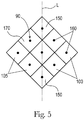
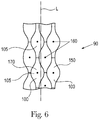
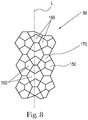
- the facets 100 can have a substantially rhomboidal shape, as shown in Fig. 5 . As shown in Figs. 5 and 6 , each of the facets 100 can have a centroid 160.
- centroid 160 of adjacent facets 100 can be aligned with one another on the peripheral wall exterior surface 170 of the container 10 at positions along the longitudinal axis L, as shown in Figs. 1 and 4 .
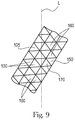
- the centroids 160 of adjacent facets 100 can be aligned with one another on the peripheral wall exterior surface 170 of the container 10 at positions about the longitudinal axis L, as shown in Figs. 1 , 5 , 7 , 8 , and 9 .
- the facets 100 can have a shape selected from the group consisting of substantially polygonal, substantially triangular, substantially quadrilateral, substantially rhomboidal, substantially hexagonal, and combinations thereof.
- a faceted region 90 can comprise facets 100 having a plurality of shapes, by way of non-limiting example, as shown in Fig. 8 .
- Each of the adjacent facets 100 can have a facet area 105 that is within about 20% of one another.
- the facet area 105 is the area of the facet exterior surface 150 of the facet 100.
- Each of the adjacent facets 100 can have substantially the same shape.
- the facet area 105 of each facet 100 forming the plurality of facets 100 can be less than about 10% of the surface area of the peripheral wall exterior surface 170 of the container 10.
- the facet area 105 of each facet 100 forming the plurality of facets 100 can be between about 0.001 % and about 10% of the surface area of the peripheral wall exterior surface 170 of the container 10.
- the facet area 105 of each facet 100 forming the plurality of facets 100 can be less than about 5% of the surface area of the peripheral wall exterior surface 170 of the container 10.
- the facet area 105 of each facet 100 forming the plurality of facets 100 can be between about 0.001 % and about 5% of the surface area of the peripheral wall exterior surface 170 of the container 10.
- the facet area 105 of each facet 100 forming the plurality of facets 100 can be less than about 3% of the surface area of the peripheral wall exterior surface 170 of the container 10.
- the facet area 105 of each facet 100 forming the plurality of facets 100 can be between about 0.001 % and about 3% of the surface area of the peripheral wall exterior surface 170 of the container 10.
- the facet area 105 of each facet 100 forming the plurality of facets 100 can be less than about 2% of the surface area of the peripheral wall exterior surface 170 of the container 10.
- the facet area 105 of each facet 100 forming the plurality of facets 100 can be between about 0.001 % and about 2% of the surface area of the peripheral wall exterior surface 170 of the container 10.
- the facet area 105 of each facet 100 forming the plurality of facets 100 can be less than about 1% of the surface area of the peripheral wall exterior surface 170 of the container 10.
- the facet area 105 of each facet 100 forming the plurality of facets 100 can be between about 0.001 % and about 1% of the surface area of the peripheral wall exterior surface 170 of the container 10.
- the facets 100 are substantially flat.
- the facets 100 can be flat. The flatter the facets 100 the more reflective the facets 100. Substantially flat surfaces are thought to provide for enhanced luster to the faceted region 100.
- Individual facets 100 have a radius of curvature of the principal curvatures at the centroid of the facet 100 greater than about 60 mm.
- Individual facets 100 can have a radius of curvature of the principal curvatures at the centroid of the facet 100 greater than about 70 mm.
- Individual facets 100 can have a radius of curvature of the principal curvatures at the centroid of the facet 100 greater than about 90 mm. Individual facets 100 can have a radius of curvature of the principal curvatures at the centroid of the facet 100 greater than about 130 mm. Without being bound by theory, such facets 100 are thought to be flat enough so as to be sufficiently reflective to provide for the desired luster.
- the facets 100 forming the faceted region 100 can have a Gaussian curvature between about -0.04 and about 0.04.
- the facets 100 forming the faceted region 100 can have a Gaussian curvature between about -0.01 and about 0.01.
- the Gaussian curvature of a facet 100 is the product of the principal curvatures of the facet 100.
- the peripheral wall 50 in the faceted region 90 can comprise an outer skin layer 190.
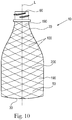
- the outer skin layer 190 can be a sleeve 200 disposed about the peripheral wall 50 of the container, as shown in Fig. 10 .
- the outer skin layer 190 can be provided, by way of non-limiting example, to the container after the container 10 is blow molded or during blow molding of the container 10.
- the sleeve 200 can be a shrink sleeve that is heat shrunk around the finished container 10.
- the sleeve 200 can be stretch sleeve into which a pre-form or parison is blown to stretch the stretch sleeve to form the finished container 10.
- the outer skin layer 190 can be a bounded label 210, as shown in Fig. 11 .
- a bounded label 190 is a label forming part of the container 10 that only partially extends about the longitudinal axis L.
- the bounded label 190 can be selected from the group consisting of a heat transfer label, an in-mold label, and an adhesive label.
- the outer skin layer 190 can be selected from the group consisting of an in-mold label, an adhesive label, a heat transfer label, a stretch sleeve label, wet glue label, and a shrink sleeve label.
- the outer skin layer 190 can be selected from the group consisting of a biaxially oriented polystyrene, polyethylene terephthalate, and glycol modified polyethylene terephthalate.
- the outer skin layer 190 can be printed.
- the outer skin layer 190 can be reverse printed.
- the outer skin layer 190 can be a metallic ink printed outer skin layer 190.
- the printing can be a metallic ink or pearlescent ink.
- a metallic foil can be included in a laminate comprising the outer skin layer 190.
- a metallic ink comprises small particles of metal, such as aluminum, bronze, copper, zinc, or other metallic element.
- the labels can be printed by digital printing, flexographic printing, gravure printing, or other suitable printing technology.
- An outer skin layer 190 that is a metallic ink printed outer skin layer 190 can provide for a reflective surface that that generates more intense perceived flashes of reflectance.
- a polyethylene terphthalate, polyethylene terephthalate glycol, or oriented polystyrene label may be used. This method of printing puts the reflective surface on the outside of the package. This can be enhanced by using metallic ink (ink mixed with small particles of aluminum, bronze, copper, zinc, or other elements), pearlescent ink, and metallic foils.
- the container 10 can further comprise a plug seal closure 62 operatively engaged with the open end 60, as shown in Fig. 13 .
- the container 10 and plug seal closure can provide for an enclosed package 64 that does not leak the contents of the package 64 under stresses that are anticipated to occur during the manufacture, storage, distribution, sale, and use of the package and/or contents of the package 64.
- the plug seal closure 62 can be a closure that is threaded onto the open end 60 of the container 10 for fit into or over the open end 60 of the container.
- the open end 60 of the container 10 can be calibrated. For instance the open end 60 of the container 10 can have dimensional tolerance between about 0% and about 2% of the diameter of the open end 60.
Landscapes
- Engineering & Computer Science (AREA)
- Mechanical Engineering (AREA)
- Ceramic Engineering (AREA)
- Containers Having Bodies Formed In One Piece (AREA)
- Packaging Of Annular Or Rod-Shaped Articles, Wearing Apparel, Cassettes, Or The Like (AREA)
- Details Of Rigid Or Semi-Rigid Containers (AREA)
Claims (14)
- Behälter (10), umfassend:ein offenes Ende (60), das eine Längsachse (L) umschreibt; undeine Umfangswand (50), die von dem offenen Ende um die Längsachse zu einem geschlossenen Ende (30) verläuft;wobei die Umfangswand und das geschlossene Ende ein thermoplastisches Substrat umfassen;wobei die Umfangswand einen facettierten Bereich (90) umfasst, der eine Vielzahl von Facetten (100) umfasst, die von Rand zu Rand mit mindestens einer angrenzenden Facette angeordnet sind, wobei wenigstens ein Teil des facettierten Bereichs näher an dem geschlossenen Ende angeordnet ist als das offene Ende;wobei die Umfangswand eine Umfangswand-Außenoberfläche (170) aufweist, die die von der Längsachse abgewandt ausgerichtet ist, wobei die Umfangswand-Außenoberfläche einen Umfangswand-Außenoberflächenbereich (172) aufweist;wobei jede der Vielzahl von Facetten einen Facetten-Außenoberflächenbereich (102) aufweist, der von der Längsachse abgewandt ausgerichtet ist, und jede der Facetten einen Außenoberflächenbereich aufweist, der weniger zwischen 0,0001 % und 4 % des Umfangswand-Außenoberflächenbereichs beträgt;wobei an lokalen Positionen entlang der Längsachse der Behälter eine lokale maximale Innenabmessung (210) rechtwinklig zu der Längsachse, eine lokale Hauptachse (201), die gleich der lokalen maximalen Innenabmessung ist, eine lokal Nebenachse (201), die senkrecht zu der lokalen Hauptachse und der Längsachse ist, eine lokale Nebeninnenabmessung (220), die gleich der lokalen Nebenachse ist, und ein lokales Aspektverhältnis, das als ein Verhältnis der lokalen maximalen Innenabmessung zu der lokalen Nebeninnenabmessung definiert ist, aufweist;wobei der Behälter ein lokales Aspektverhältnis zwischen 1,3 und 5 mittig entlang der Längsachse aufweist; dadurch gekennzeichnet, dass einzelne Facetten einen Krümmungsradius der Hauptkrümmungen an einem Schwerpunkt der Facetten von mehr als 60 mm aufweisen.
- Behälter nach Anspruch 1, wobei entlang mehr als 20 % der Längsachse der Behälter ein lokales Aspektverhältnis zwischen 1,3 und 5 aufweist.
- Behälter nach einem der vorstehenden Ansprüche, wobei die Umfangswand in dem facettierten Bereich eine Außenhautschicht (190) umfasst.
- Behälter nach Anspruch 3, wobei die Hautschicht ein Etikett ist, das ausgewählt ist aus der Gruppe bestehend aus einem Shrink-Sleeve-Etikett, einem Stretch-Sleeve-Etikett, einem In-Mold-Etikett, einem Wärmeübertragungsetikett und einem Klebeetikett.
- Behälter nach Anspruch 3 oder Anspruch 4, wobei die Hautschicht ein mit metallischer Tinte bedrucktes Shrink-Sleeve-Etikett oder ein mit metallischer Tinte bedrucktes Stretch-Sleeve-Etikett ist.
- Behälter nach einem der vorstehenden Ansprüche, wobei die Umfangswand einen Umfangswand-Außenoberflächenbereich (172) aufweist, wobei der facettierte Bereich zwischen 30 % und 100 % des Umfangswand-Außenoberflächenbereichs umfasst.
- Behälter nach einem der vorstehenden Ansprüche, wobei der facettierte Bereich zwischen 30 % und 100 % des Umfangswand-Außenoberflächenbereichs umfasst.
- Behälter nach einem der vorstehenden Ansprüche, wobei jede der angrenzenden Facetten eine Facettenfläche (105) innerhalb von 20 % voneinander aufweist.
- Behälter nach einem der vorstehenden Ansprüche, wobei der facettierte Bereich um die Umfangswand verläuft.
- Behälter nach einem der vorstehenden Ansprüche, wobei jede der Facetten eine Facetten-Außenoberfläche (150) aufweist, die von der Längsachse abgewandt ausgerichtet ist und die Facetten-Außenoberflächen der Vielzahl von Facetten konvex bezogen auf die Längsachse angeordnet sind.
- Behälter nach Anspruch 10, wobei die Außenoberflächen der Vielzahl von Facetten konvex bezogen auf die Längsachse angeordnet sind.
- Behälter nach Anspruch 10 oder Anspruch 11, wobei die Außenoberflächen der Vielzahl von Facetten konvex bezogen auf die Längsachse um die Längsachse angeordnet sind.
- Behälter nach einem der vorstehenden Ansprüche, wobei die Facetten eine Form aufweisen, die ausgewählt ist aus der Gruppe bestehend aus vieleckig, dreieckig, vierseitig, rautenförmig, sechseckig und Kombinationen davon.
- Behälter nach einem der vorstehenden Ansprüche, wobei jede dieser Facetten einen Schwerpunkt (160) aufweist, wobei die Schwerpunkte angrenzender Facetten miteinander an der Außenoberfläche des Behälters an Positionen um die Längsachse L ausgerichtet sind.
Applications Claiming Priority (2)
| Application Number | Priority Date | Filing Date | Title |
|---|---|---|---|
| US14/298,172 US20150353222A1 (en) | 2014-06-06 | 2014-06-06 | Faceted container |
| PCT/US2015/033870 WO2015187761A1 (en) | 2014-06-06 | 2015-06-03 | Faceted container |
Publications (3)
| Publication Number | Publication Date |
|---|---|
| EP3152117A1 EP3152117A1 (de) | 2017-04-12 |
| EP3152117B1 true EP3152117B1 (de) | 2018-05-16 |
| EP3152117B9 EP3152117B9 (de) | 2018-10-31 |
Family
ID=53398232
Family Applications (1)
| Application Number | Title | Priority Date | Filing Date |
|---|---|---|---|
| EP15729315.0A Active EP3152117B9 (de) | 2014-06-06 | 2015-06-03 | Facettierter behälter |
Country Status (6)
| Country | Link |
|---|---|
| US (1) | US20150353222A1 (de) |
| EP (1) | EP3152117B9 (de) |
| JP (1) | JP2017518231A (de) |
| CA (1) | CA2948647C (de) |
| MX (1) | MX380463B (de) |
| WO (1) | WO2015187761A1 (de) |
Families Citing this family (8)
| Publication number | Priority date | Publication date | Assignee | Title |
|---|---|---|---|---|
| USD865526S1 (en) | 2015-12-04 | 2019-11-05 | The Procter & Gamble Company | Bottle |
| JP6656751B2 (ja) * | 2015-12-24 | 2020-03-04 | 株式会社吉野工業所 | ラベル付きカップ容器 |
| US12030707B2 (en) | 2016-09-06 | 2024-07-09 | Toyo Seikan Co., Ltd. | Synthetic resin bottle |
| JP2018083650A (ja) * | 2016-11-24 | 2018-05-31 | 東洋製罐株式会社 | 合成樹脂製ボトル |
| USD931107S1 (en) | 2017-09-08 | 2021-09-21 | The Procter & Gamble Company | Bottle |
| CN114055759A (zh) * | 2020-08-10 | 2022-02-18 | 内蒙古蒙牛乳业(集团)股份有限公司 | 塑料瓶及其制备方法 |
| JP1688406S (de) * | 2020-08-14 | 2021-06-28 | ||
| USD1015047S1 (en) * | 2022-05-20 | 2024-02-20 | Huatao Zheng | Glass jug |
Citations (14)
| Publication number | Priority date | Publication date | Assignee | Title |
|---|---|---|---|---|
| US3760968A (en) | 1971-07-02 | 1973-09-25 | Owens Illinois Inc | Composite container article |
| DE2706055A1 (de) | 1976-02-20 | 1977-08-25 | Owens Illinois Inc | Verfahren und vorrichtung zum blasformen von kunststoffgegenstaenden |
| GB2103277A (en) | 1981-07-06 | 1983-02-16 | Robert Howard Burrage | Adjustable tie strap |
| US4708255A (en) | 1985-12-12 | 1987-11-24 | Tri-Tech Systems International Inc. | Closure cap with a linerless seal and a method for forming such closure and seal |
| USD411740S (en) | 1997-06-02 | 1999-06-29 | Cheil Jedang Corporation | Light beverage container |
| GB2345480A (en) | 1999-01-11 | 2000-07-12 | Reckitt & Colman South Africa | Containers |
| US20030010744A1 (en) | 2001-07-16 | 2003-01-16 | Ma Ki Hyung | Plastic massage bottle |
| US20070252382A1 (en) | 2006-03-20 | 2007-11-01 | Baum Robert E | Laminated multi-ply in-mold label |
| USD603713S1 (en) | 2007-10-26 | 2009-11-10 | Isklar AS | Bottle |
| USD603714S1 (en) | 2007-10-26 | 2009-11-10 | Isklar AS | Bottle |
| US20100252477A1 (en) | 2007-11-13 | 2010-10-07 | Du Pont-Mitsui Polychemicals Co., Ltd. | Composite container |
| DE102012200831A1 (de) | 2012-01-20 | 2013-07-25 | Bandfix Ag | Rundumetikett zur Etikettierung eines Gebindes wie einer Getränkeverpackung |
| US8511472B2 (en) | 2010-08-16 | 2013-08-20 | Kraft Foods Group Brands Llc | Containers having perforated shrink wrap sleeves |
| JP2014084142A (ja) | 2012-10-23 | 2014-05-12 | Kirin Brewery Co Ltd | プラスチックボトル及び飲料製品 |
Family Cites Families (6)
| Publication number | Priority date | Publication date | Assignee | Title |
|---|---|---|---|---|
| FR1367512A (fr) * | 1962-05-08 | 1964-07-24 | Karl Heinz Schroder Fa | Bouteille à une voie en matière plastique |
| GB9308650D0 (en) * | 1993-04-27 | 1993-06-09 | Unilever Plc | Plastic containers |
| US20060065566A1 (en) * | 2004-09-30 | 2006-03-30 | Steih Richard J | Container having label protection feature |
| USD599213S1 (en) * | 2008-05-02 | 2009-09-01 | Plastipak Packaging, Inc. | Plastic container |
| JP5579376B2 (ja) * | 2008-08-01 | 2014-08-27 | 大日本印刷株式会社 | プラスチックボトル |
| JP5861919B2 (ja) * | 2011-11-30 | 2016-02-16 | 株式会社吉野工業所 | 二重壁構造を有する合成樹脂製ボトル |
-
2014
- 2014-06-06 US US14/298,172 patent/US20150353222A1/en not_active Abandoned
-
2015
- 2015-06-03 CA CA2948647A patent/CA2948647C/en active Active
- 2015-06-03 MX MX2016016073A patent/MX380463B/es unknown
- 2015-06-03 WO PCT/US2015/033870 patent/WO2015187761A1/en not_active Ceased
- 2015-06-03 JP JP2016570298A patent/JP2017518231A/ja active Pending
- 2015-06-03 EP EP15729315.0A patent/EP3152117B9/de active Active
Patent Citations (14)
| Publication number | Priority date | Publication date | Assignee | Title |
|---|---|---|---|---|
| US3760968A (en) | 1971-07-02 | 1973-09-25 | Owens Illinois Inc | Composite container article |
| DE2706055A1 (de) | 1976-02-20 | 1977-08-25 | Owens Illinois Inc | Verfahren und vorrichtung zum blasformen von kunststoffgegenstaenden |
| GB2103277A (en) | 1981-07-06 | 1983-02-16 | Robert Howard Burrage | Adjustable tie strap |
| US4708255A (en) | 1985-12-12 | 1987-11-24 | Tri-Tech Systems International Inc. | Closure cap with a linerless seal and a method for forming such closure and seal |
| USD411740S (en) | 1997-06-02 | 1999-06-29 | Cheil Jedang Corporation | Light beverage container |
| GB2345480A (en) | 1999-01-11 | 2000-07-12 | Reckitt & Colman South Africa | Containers |
| US20030010744A1 (en) | 2001-07-16 | 2003-01-16 | Ma Ki Hyung | Plastic massage bottle |
| US20070252382A1 (en) | 2006-03-20 | 2007-11-01 | Baum Robert E | Laminated multi-ply in-mold label |
| USD603713S1 (en) | 2007-10-26 | 2009-11-10 | Isklar AS | Bottle |
| USD603714S1 (en) | 2007-10-26 | 2009-11-10 | Isklar AS | Bottle |
| US20100252477A1 (en) | 2007-11-13 | 2010-10-07 | Du Pont-Mitsui Polychemicals Co., Ltd. | Composite container |
| US8511472B2 (en) | 2010-08-16 | 2013-08-20 | Kraft Foods Group Brands Llc | Containers having perforated shrink wrap sleeves |
| DE102012200831A1 (de) | 2012-01-20 | 2013-07-25 | Bandfix Ag | Rundumetikett zur Etikettierung eines Gebindes wie einer Getränkeverpackung |
| JP2014084142A (ja) | 2012-10-23 | 2014-05-12 | Kirin Brewery Co Ltd | プラスチックボトル及び飲料製品 |
Non-Patent Citations (3)
| Title |
|---|
| "Eau de Toilette Spray Hugo Red von Hugo Boss", PARFUMDREAMS, May 2013 (2013-05-01), XP055568965, Retrieved from the Internet <URL:http://web.archive.org/web/20140605001605/ http://www.parfumdreams.de/Hug o-Boss/Hugo-Herrenduefte/Hugo-Red/Eau-de-Toilette-Spray/index 41172.aspx> |
| "ISKLAR", PACKAGING DESIGN ARCHIVE, 2010, XP055568953, Retrieved from the Internet <URL:http://web.archive.org/web/20120904174403/ http://www.packagingdesignarchive.org/archive/pack _details/1711-isklar> |
| "Thompson Brand Partners refreshes Harrogate Spring Water", DESIGNWEEK, 28 May 2014 (2014-05-28), XP055568945, Retrieved from the Internet <URL:https://web.archive.org/web/20140528172802/ http://www.designweek.co.ukjne ws/thompson-brand-partners-refreshes-harrogate-spring-water/3038391.article> |
Also Published As
| Publication number | Publication date |
|---|---|
| CA2948647C (en) | 2019-02-26 |
| WO2015187761A1 (en) | 2015-12-10 |
| EP3152117B9 (de) | 2018-10-31 |
| US20150353222A1 (en) | 2015-12-10 |
| CA2948647A1 (en) | 2015-12-10 |
| MX2016016073A (es) | 2017-07-28 |
| EP3152117A1 (de) | 2017-04-12 |
| JP2017518231A (ja) | 2017-07-06 |
| MX380463B (es) | 2025-03-12 |
| WO2015187761A9 (en) | 2016-01-28 |
Similar Documents
| Publication | Publication Date | Title |
|---|---|---|
| EP3152117B9 (de) | Facettierter behälter | |
| EP3152120B1 (de) | Facettierter behälter | |
| JP6263674B2 (ja) | 液状調味料容器及び容器詰液状調味料 | |
| AU762583B2 (en) | Enhanced three-dimensional container display | |
| EP3152118B2 (de) | Facettierter behälter | |
| EP2199224A2 (de) | Behälter mit erweiterter Anzeige | |
| MX2008015781A (es) | Recipiente o surtidor con funda decorativa. | |
| WO2014160420A2 (en) | Beverage container with compartment application | |
| EP3419907B1 (de) | Behälter mit einem abnehmbaren einsatz | |
| JP6809044B2 (ja) | プラスチックボトル、及び充填体 | |
| JP6866641B2 (ja) | プラスチックボトル、及び充填体 | |
| JP3181448U (ja) | ボトル | |
| JP6288223B2 (ja) | プラスチックボトル、及び充填体 | |
| US20020020686A1 (en) | Double walled see through cap | |
| WO2017010252A1 (ja) | 液状調味料容器及び容器詰液状調味料 | |
| JP2018108829A (ja) | プラスチックボトル、及び充填体 | |
| JP2018030630A (ja) | プラスチックボトル、及び充填体 | |
| JP2017019530A (ja) | 液状調味料容器及び容器詰液状調味料 | |
| JP2001122277A (ja) | 缶における販促品収納カップ | |
| JP2013082494A (ja) | ボトル用ネッカー |
Legal Events
| Date | Code | Title | Description |
|---|---|---|---|
| STAA | Information on the status of an ep patent application or granted ep patent |
Free format text: STATUS: THE INTERNATIONAL PUBLICATION HAS BEEN MADE |
|
| PUAI | Public reference made under article 153(3) epc to a published international application that has entered the european phase |
Free format text: ORIGINAL CODE: 0009012 |
|
| STAA | Information on the status of an ep patent application or granted ep patent |
Free format text: STATUS: REQUEST FOR EXAMINATION WAS MADE |
|
| 17P | Request for examination filed |
Effective date: 20161114 |
|
| AK | Designated contracting states |
Kind code of ref document: A1 Designated state(s): AL AT BE BG CH CY CZ DE DK EE ES FI FR GB GR HR HU IE IS IT LI LT LU LV MC MK MT NL NO PL PT RO RS SE SI SK SM TR |
|
| AX | Request for extension of the european patent |
Extension state: BA ME |
|
| DAV | Request for validation of the european patent (deleted) | ||
| DAX | Request for extension of the european patent (deleted) | ||
| GRAP | Despatch of communication of intention to grant a patent |
Free format text: ORIGINAL CODE: EPIDOSNIGR1 |
|
| STAA | Information on the status of an ep patent application or granted ep patent |
Free format text: STATUS: GRANT OF PATENT IS INTENDED |
|
| INTG | Intention to grant announced |
Effective date: 20171214 |
|
| GRAS | Grant fee paid |
Free format text: ORIGINAL CODE: EPIDOSNIGR3 |
|
| GRAA | (expected) grant |
Free format text: ORIGINAL CODE: 0009210 |
|
| STAA | Information on the status of an ep patent application or granted ep patent |
Free format text: STATUS: THE PATENT HAS BEEN GRANTED |
|
| REG | Reference to a national code |
Ref country code: FR Ref legal event code: PLFP Year of fee payment: 4 |
|
| AK | Designated contracting states |
Kind code of ref document: B1 Designated state(s): AL AT BE BG CH CY CZ DE DK EE ES FI FR GB GR HR HU IE IS IT LI LT LU LV MC MK MT NL NO PL PT RO RS SE SI SK SM TR |
|
| REG | Reference to a national code |
Ref country code: GB Ref legal event code: FG4D |
|
| REG | Reference to a national code |
Ref country code: CH Ref legal event code: EP |
|
| REG | Reference to a national code |
Ref country code: IE Ref legal event code: FG4D |
|
| REG | Reference to a national code |
Ref country code: AT Ref legal event code: REF Ref document number: 999323 Country of ref document: AT Kind code of ref document: T Effective date: 20180615 |
|
| REG | Reference to a national code |
Ref country code: DE Ref legal event code: R096 Ref document number: 602015011210 Country of ref document: DE |
|
| REG | Reference to a national code |
Ref country code: NL Ref legal event code: MP Effective date: 20180516 |
|
| REG | Reference to a national code |
Ref country code: LT Ref legal event code: MG4D |
|
| REG | Reference to a national code |
Ref country code: CH Ref legal event code: PK Free format text: BERICHTIGUNG B9 |
|
| PG25 | Lapsed in a contracting state [announced via postgrant information from national office to epo] |
Ref country code: BG Free format text: LAPSE BECAUSE OF FAILURE TO SUBMIT A TRANSLATION OF THE DESCRIPTION OR TO PAY THE FEE WITHIN THE PRESCRIBED TIME-LIMIT Effective date: 20180816 Ref country code: FI Free format text: LAPSE BECAUSE OF FAILURE TO SUBMIT A TRANSLATION OF THE DESCRIPTION OR TO PAY THE FEE WITHIN THE PRESCRIBED TIME-LIMIT Effective date: 20180516 Ref country code: LT Free format text: LAPSE BECAUSE OF FAILURE TO SUBMIT A TRANSLATION OF THE DESCRIPTION OR TO PAY THE FEE WITHIN THE PRESCRIBED TIME-LIMIT Effective date: 20180516 Ref country code: NO Free format text: LAPSE BECAUSE OF FAILURE TO SUBMIT A TRANSLATION OF THE DESCRIPTION OR TO PAY THE FEE WITHIN THE PRESCRIBED TIME-LIMIT Effective date: 20180816 Ref country code: SE Free format text: LAPSE BECAUSE OF FAILURE TO SUBMIT A TRANSLATION OF THE DESCRIPTION OR TO PAY THE FEE WITHIN THE PRESCRIBED TIME-LIMIT Effective date: 20180516 Ref country code: ES Free format text: LAPSE BECAUSE OF FAILURE TO SUBMIT A TRANSLATION OF THE DESCRIPTION OR TO PAY THE FEE WITHIN THE PRESCRIBED TIME-LIMIT Effective date: 20180516 |
|
| PG25 | Lapsed in a contracting state [announced via postgrant information from national office to epo] |
Ref country code: HR Free format text: LAPSE BECAUSE OF FAILURE TO SUBMIT A TRANSLATION OF THE DESCRIPTION OR TO PAY THE FEE WITHIN THE PRESCRIBED TIME-LIMIT Effective date: 20180516 Ref country code: LV Free format text: LAPSE BECAUSE OF FAILURE TO SUBMIT A TRANSLATION OF THE DESCRIPTION OR TO PAY THE FEE WITHIN THE PRESCRIBED TIME-LIMIT Effective date: 20180516 Ref country code: RS Free format text: LAPSE BECAUSE OF FAILURE TO SUBMIT A TRANSLATION OF THE DESCRIPTION OR TO PAY THE FEE WITHIN THE PRESCRIBED TIME-LIMIT Effective date: 20180516 Ref country code: NL Free format text: LAPSE BECAUSE OF FAILURE TO SUBMIT A TRANSLATION OF THE DESCRIPTION OR TO PAY THE FEE WITHIN THE PRESCRIBED TIME-LIMIT Effective date: 20180516 Ref country code: GR Free format text: LAPSE BECAUSE OF FAILURE TO SUBMIT A TRANSLATION OF THE DESCRIPTION OR TO PAY THE FEE WITHIN THE PRESCRIBED TIME-LIMIT Effective date: 20180817 |
|
| REG | Reference to a national code |
Ref country code: AT Ref legal event code: MK05 Ref document number: 999323 Country of ref document: AT Kind code of ref document: T Effective date: 20180516 |
|
| PG25 | Lapsed in a contracting state [announced via postgrant information from national office to epo] |
Ref country code: EE Free format text: LAPSE BECAUSE OF FAILURE TO SUBMIT A TRANSLATION OF THE DESCRIPTION OR TO PAY THE FEE WITHIN THE PRESCRIBED TIME-LIMIT Effective date: 20180516 Ref country code: PL Free format text: LAPSE BECAUSE OF FAILURE TO SUBMIT A TRANSLATION OF THE DESCRIPTION OR TO PAY THE FEE WITHIN THE PRESCRIBED TIME-LIMIT Effective date: 20180516 Ref country code: AT Free format text: LAPSE BECAUSE OF FAILURE TO SUBMIT A TRANSLATION OF THE DESCRIPTION OR TO PAY THE FEE WITHIN THE PRESCRIBED TIME-LIMIT Effective date: 20180516 Ref country code: DK Free format text: LAPSE BECAUSE OF FAILURE TO SUBMIT A TRANSLATION OF THE DESCRIPTION OR TO PAY THE FEE WITHIN THE PRESCRIBED TIME-LIMIT Effective date: 20180516 Ref country code: SK Free format text: LAPSE BECAUSE OF FAILURE TO SUBMIT A TRANSLATION OF THE DESCRIPTION OR TO PAY THE FEE WITHIN THE PRESCRIBED TIME-LIMIT Effective date: 20180516 Ref country code: RO Free format text: LAPSE BECAUSE OF FAILURE TO SUBMIT A TRANSLATION OF THE DESCRIPTION OR TO PAY THE FEE WITHIN THE PRESCRIBED TIME-LIMIT Effective date: 20180516 Ref country code: CZ Free format text: LAPSE BECAUSE OF FAILURE TO SUBMIT A TRANSLATION OF THE DESCRIPTION OR TO PAY THE FEE WITHIN THE PRESCRIBED TIME-LIMIT Effective date: 20180516 |
|
| REG | Reference to a national code |
Ref country code: CH Ref legal event code: PL |
|
| REG | Reference to a national code |
Ref country code: DE Ref legal event code: R026 Ref document number: 602015011210 Country of ref document: DE |
|
| PLBI | Opposition filed |
Free format text: ORIGINAL CODE: 0009260 |
|
| PG25 | Lapsed in a contracting state [announced via postgrant information from national office to epo] |
Ref country code: SM Free format text: LAPSE BECAUSE OF FAILURE TO SUBMIT A TRANSLATION OF THE DESCRIPTION OR TO PAY THE FEE WITHIN THE PRESCRIBED TIME-LIMIT Effective date: 20180516 Ref country code: IT Free format text: LAPSE BECAUSE OF FAILURE TO SUBMIT A TRANSLATION OF THE DESCRIPTION OR TO PAY THE FEE WITHIN THE PRESCRIBED TIME-LIMIT Effective date: 20180516 |
|
| PLAX | Notice of opposition and request to file observation + time limit sent |
Free format text: ORIGINAL CODE: EPIDOSNOBS2 |
|
| REG | Reference to a national code |
Ref country code: BE Ref legal event code: MM Effective date: 20180630 |
|
| REG | Reference to a national code |
Ref country code: IE Ref legal event code: MM4A |
|
| 26 | Opposition filed |
Opponent name: HENKEL AG & CO. KGAA Effective date: 20190218 |
|
| PG25 | Lapsed in a contracting state [announced via postgrant information from national office to epo] |
Ref country code: MC Free format text: LAPSE BECAUSE OF FAILURE TO SUBMIT A TRANSLATION OF THE DESCRIPTION OR TO PAY THE FEE WITHIN THE PRESCRIBED TIME-LIMIT Effective date: 20180516 Ref country code: LU Free format text: LAPSE BECAUSE OF NON-PAYMENT OF DUE FEES Effective date: 20180603 |
|
| PG25 | Lapsed in a contracting state [announced via postgrant information from national office to epo] |
Ref country code: IE Free format text: LAPSE BECAUSE OF NON-PAYMENT OF DUE FEES Effective date: 20180603 Ref country code: LI Free format text: LAPSE BECAUSE OF NON-PAYMENT OF DUE FEES Effective date: 20180630 Ref country code: CH Free format text: LAPSE BECAUSE OF NON-PAYMENT OF DUE FEES Effective date: 20180630 |
|
| PG25 | Lapsed in a contracting state [announced via postgrant information from national office to epo] |
Ref country code: SI Free format text: LAPSE BECAUSE OF FAILURE TO SUBMIT A TRANSLATION OF THE DESCRIPTION OR TO PAY THE FEE WITHIN THE PRESCRIBED TIME-LIMIT Effective date: 20180516 Ref country code: BE Free format text: LAPSE BECAUSE OF NON-PAYMENT OF DUE FEES Effective date: 20180630 |
|
| PLBB | Reply of patent proprietor to notice(s) of opposition received |
Free format text: ORIGINAL CODE: EPIDOSNOBS3 |
|
| PG25 | Lapsed in a contracting state [announced via postgrant information from national office to epo] |
Ref country code: AL Free format text: LAPSE BECAUSE OF FAILURE TO SUBMIT A TRANSLATION OF THE DESCRIPTION OR TO PAY THE FEE WITHIN THE PRESCRIBED TIME-LIMIT Effective date: 20180516 |
|
| PG25 | Lapsed in a contracting state [announced via postgrant information from national office to epo] |
Ref country code: MT Free format text: LAPSE BECAUSE OF NON-PAYMENT OF DUE FEES Effective date: 20180603 |
|
| PG25 | Lapsed in a contracting state [announced via postgrant information from national office to epo] |
Ref country code: TR Free format text: LAPSE BECAUSE OF FAILURE TO SUBMIT A TRANSLATION OF THE DESCRIPTION OR TO PAY THE FEE WITHIN THE PRESCRIBED TIME-LIMIT Effective date: 20180516 |
|
| PG25 | Lapsed in a contracting state [announced via postgrant information from national office to epo] |
Ref country code: PT Free format text: LAPSE BECAUSE OF FAILURE TO SUBMIT A TRANSLATION OF THE DESCRIPTION OR TO PAY THE FEE WITHIN THE PRESCRIBED TIME-LIMIT Effective date: 20180516 |
|
| PG25 | Lapsed in a contracting state [announced via postgrant information from national office to epo] |
Ref country code: MK Free format text: LAPSE BECAUSE OF NON-PAYMENT OF DUE FEES Effective date: 20180516 Ref country code: CY Free format text: LAPSE BECAUSE OF FAILURE TO SUBMIT A TRANSLATION OF THE DESCRIPTION OR TO PAY THE FEE WITHIN THE PRESCRIBED TIME-LIMIT Effective date: 20180516 Ref country code: HU Free format text: LAPSE BECAUSE OF FAILURE TO SUBMIT A TRANSLATION OF THE DESCRIPTION OR TO PAY THE FEE WITHIN THE PRESCRIBED TIME-LIMIT; INVALID AB INITIO Effective date: 20150603 |
|
| PG25 | Lapsed in a contracting state [announced via postgrant information from national office to epo] |
Ref country code: IS Free format text: LAPSE BECAUSE OF FAILURE TO SUBMIT A TRANSLATION OF THE DESCRIPTION OR TO PAY THE FEE WITHIN THE PRESCRIBED TIME-LIMIT Effective date: 20180916 |
|
| REG | Reference to a national code |
Ref country code: DE Ref legal event code: R100 Ref document number: 602015011210 Country of ref document: DE |
|
| PLCK | Communication despatched that opposition was rejected |
Free format text: ORIGINAL CODE: EPIDOSNREJ1 |
|
| PLBN | Opposition rejected |
Free format text: ORIGINAL CODE: 0009273 |
|
| STAA | Information on the status of an ep patent application or granted ep patent |
Free format text: STATUS: OPPOSITION REJECTED |
|
| 27O | Opposition rejected |
Effective date: 20210312 |
|
| P01 | Opt-out of the competence of the unified patent court (upc) registered |
Effective date: 20231103 |
|
| PGFP | Annual fee paid to national office [announced via postgrant information from national office to epo] |
Ref country code: DE Payment date: 20250429 Year of fee payment: 11 |
|
| PGFP | Annual fee paid to national office [announced via postgrant information from national office to epo] |
Ref country code: GB Payment date: 20250501 Year of fee payment: 11 |
|
| PGFP | Annual fee paid to national office [announced via postgrant information from national office to epo] |
Ref country code: FR Payment date: 20250508 Year of fee payment: 11 |