EP3152185B1 - Verfahren und verwendung eines salzes zur trennung von epimeren durch ionenmobilitätsspektrometrie - Google Patents
Verfahren und verwendung eines salzes zur trennung von epimeren durch ionenmobilitätsspektrometrie Download PDFInfo
- Publication number
- EP3152185B1 EP3152185B1 EP15725061.4A EP15725061A EP3152185B1 EP 3152185 B1 EP3152185 B1 EP 3152185B1 EP 15725061 A EP15725061 A EP 15725061A EP 3152185 B1 EP3152185 B1 EP 3152185B1
- Authority
- EP
- European Patent Office
- Prior art keywords
- sample
- ion mobility
- salt
- vitamin
- analytes
- Prior art date
- Legal status (The legal status is an assumption and is not a legal conclusion. Google has not performed a legal analysis and makes no representation as to the accuracy of the status listed.)
- Active
Links
Images








Classifications
-
- G—PHYSICS
- G01—MEASURING; TESTING
- G01N—INVESTIGATING OR ANALYSING MATERIALS BY DETERMINING THEIR CHEMICAL OR PHYSICAL PROPERTIES
- G01N27/00—Investigating or analysing materials by the use of electric, electrochemical, or magnetic means
- G01N27/62—Investigating or analysing materials by the use of electric, electrochemical, or magnetic means by investigating the ionisation of gases, e.g. aerosols; by investigating electric discharges, e.g. emission of cathode
- G01N27/622—Ion mobility spectrometry
- G01N27/624—Differential mobility spectrometry [DMS]; Field asymmetric-waveform ion mobility spectrometry [FAIMS]
-
- G—PHYSICS
- G01—MEASURING; TESTING
- G01N—INVESTIGATING OR ANALYSING MATERIALS BY DETERMINING THEIR CHEMICAL OR PHYSICAL PROPERTIES
- G01N27/00—Investigating or analysing materials by the use of electric, electrochemical, or magnetic means
- G01N27/62—Investigating or analysing materials by the use of electric, electrochemical, or magnetic means by investigating the ionisation of gases, e.g. aerosols; by investigating electric discharges, e.g. emission of cathode
- G01N27/622—Ion mobility spectrometry
- G01N27/623—Ion mobility spectrometry combined with mass spectrometry
-
- G—PHYSICS
- G01—MEASURING; TESTING
- G01N—INVESTIGATING OR ANALYSING MATERIALS BY DETERMINING THEIR CHEMICAL OR PHYSICAL PROPERTIES
- G01N33/00—Investigating or analysing materials by specific methods not covered by groups G01N1/00 - G01N31/00
- G01N33/48—Biological material, e.g. blood, urine; Haemocytometers
- G01N33/483—Physical analysis of biological material
- G01N33/487—Physical analysis of biological material of liquid biological material
-
- G—PHYSICS
- G01—MEASURING; TESTING
- G01N—INVESTIGATING OR ANALYSING MATERIALS BY DETERMINING THEIR CHEMICAL OR PHYSICAL PROPERTIES
- G01N33/00—Investigating or analysing materials by specific methods not covered by groups G01N1/00 - G01N31/00
- G01N33/48—Biological material, e.g. blood, urine; Haemocytometers
- G01N33/50—Chemical analysis of biological material, e.g. blood, urine; Testing involving biospecific ligand binding methods; Immunological testing
- G01N33/82—Chemical analysis of biological material, e.g. blood, urine; Testing involving biospecific ligand binding methods; Immunological testing involving vitamins or their receptors
-
- H—ELECTRICITY
- H01—ELECTRIC ELEMENTS
- H01J—ELECTRIC DISCHARGE TUBES OR DISCHARGE LAMPS
- H01J49/00—Particle spectrometers or separator tubes
- H01J49/0027—Methods for using particle spectrometers
- H01J49/0031—Step by step routines describing the use of the apparatus
Definitions
- Ion mobility spectrometry has gained attention as approach to analyze gaseous samples for example in ambient atmosphere and drug particles in contact with the skin surface. This technique distinguishes ion species on the basis of the difference in the drift velocity of ions through gas under an applied electric field.
- the saccharide compounds form stable complexes with the cation or anion derived from the salt (depending on whether a positive or negative ionization mode is used), wherein for each sample to be separated the addition of a different salt is reported to be necessary for a resolution of the peaks corresponding to the different isomer.
- a different salt is reported to be necessary for a resolution of the peaks corresponding to the different isomer.
- no baseline resolution of the isomers was obtained which makes a quantification of the amount of the different compounds difficult or even impossible.
- a separation or even quantification of epimers of lipophilic or even water insoluble compounds, such as steroids, has, however, not been reported.
- Ferreira Rubén et al, Methods 57 (2012) 56-63 investigated G-quadruplexe of DNA in the gas phase, and the use of ion mobility spectrometry by adding electrospray-compatible organic co-solvents (methanol, ethanol, isopropanol or acetonitrile) to aqueous ammonium acetate which increases the stability and rate of formation of dimeric G-quadruplexes, and causes structural transitions to parallel structures.
- WO2011121342 discusses a method wherein C3-epi-25-hydroxy vitamin D3 is separated from 25-hydroxy vitamin D3 by ion mobility. The document lacks the addition of a salt during ionization in order to improve separation in the IMS.
- steroids e.g. steroid hormone levels of an individual.
- progesterone and/or estrogen levels of women receiving hormone replacement therapy androgen levels of men treated for prostate cancer
- hormone levels of children with pituitary disorders or progesterone levels of pregnant women.
- athletes and racehorses are often tested for anabolic steroids.
- simultaneous and accurate measurements or circulating steroids and their metabolites such as their epimers are desired.
- Vitamin D is an essential nutrition with important physiological roles in the positive regulation of calcium homeostasis. Vitamin D can be generated de novo on the skin by exposure to sunlight or it can be absorbed from the diet. Insufficiency or deficiency of vitamin D is a risk factor for metabolic bone diseases such as rickets, osteoporosis, and osteomalacia. Vitamin D exists naturally in two forms, namely vitamin D2 and vitamin D3. The major source of vitamin D in humans is the photoconversion of 7-dihydrocholesterol to pre-vitamin D3 in the epidermis which isomerizes to vitamin D3.
- Vitamin D3 undergoes 25-hydroxylation by 25-hydroxlyase enzymes in the liver to produce 25-hydroxy vitamin D3.
- This vitamin D3 is generally believed to be the most abundant form circulating in the body.
- 25-hydroxy vitamin D3 can be converted into the most biological active form, 1,25-dihydroxy vitamin D3, a reaction predominantly occurring in the kidney.
- folate vitamers are important cofactors in 1-carbon metabolism, participating in methylation reactions and DNA synthesis. A suboptimal folate status may modulate chronic diseases such as cardiovascular disease, cancer, and/or cognitive impairment. There is great interest in exploring associations between folate vitamers and health effects. However, the analysis of folates in serum is complex because of numerous folate derivatives that exist in different oxidation states and 1-carbon substitutions. Folates are also sensitive to oxidative degradation. Serum 5-methyltetrahydrofolate (5-methylTHF)3, the main circulating folate form, can readily undergo mild reversible oxidation to 5-methyldihydrofolate.
- 5-methyltetrahydrofolate 5-methylTHF
- hmTHF Severe or prolonged oxidation can convert 5-methylTHF or 5-methyldihydrofolate to 4a-hydroxy-5-methylTHF, an intermediate product also called hmTHF.
- hmTHF undergoes structural rearrangement to form a pyra-zino-s-triazine derivative.
- This stable oxidation product of 5-methylTHF is also known as MeFox
- MeFox the methyl folinate oxidation pro MeFox and 5-formyltetrahydrofolate (5-formylTHF) are isobaric compounds and as such form the same mass to charge (m/z) parent to product ion pairs during ionization, making coelution and misidentification during liquid chromatography tandem MS (LC-MS/MS) analysis likely (see Fazil an Pfeiffer, Journal of Nutrition, 2 ⁇ 13, 109-119 ). Similar as the methods proposed for vitamin D measurements, also the methods proposed in view of folate vitamers are not suitable for routine applications in clinical settings.
- the measurement of the level of other steroids and their metabolites such as cortisone or metabolites thereof, such as e.g. the amount of corticosterone, 11-deoxycortisol and 21-deoxycortisol, remains a challenge for the endocrinological community due to the high similarity of the structures and masses of the different metabolites.
- the present invention relates to a method of quantifying the amount of at least two analytes A1 and A2 comprised in a sample according to claim 1.
- the method steps specifically may be performed in the given order. However, two or more of the method steps may fully or partially be combined to form a combined method step. Further, two or more of the method steps may fully or partially be performed simultaneously. Further, one or more or even all of the method steps may be performed repeatedly or continuously.
- the present invention relates to the use of at least one salt (S) as modifier in a process for quantifying the amount of at least two analytes A1 and A2 comprised in a sample by ion mobility spectrometry, wherein A1 is a pharmaceutically active compound C or derivative thereof and A2 is an epimer of C, and wherein A1 has an octanol-water partitioning coefficient (log P) value of greater than 0.
- S octanol-water partitioning coefficient
- the analyte A1 is the analyte A1
- A1 is a pharmaceutically active compound C or a derivative thereof.
- the term "derivative thereof” is not particularly restricted and preferably relates to ester, amide, prodrug or metabolite of C.
- A1 is a pharmaceutically active compound C or ester, amide, prodrug or metabolite. More preferably, A1 is a pharmaceutically active compound C or a metabolite thereof, most preferably, A1 is the pharmaceutically active compound C.
- compound C is selected from the group consisting of vitamins, hormones, cardiac glycosides, amphetamines, antibiotics, barbiturates, benzodiazepines, cannabinoids, opiates, alkaloids, immunosupressants, steroids, anesthetics, analgesics, antiarrhythmics, psychedelic drugs or drugs of abuse, dissociative, stimulants, anticonvulsants, and tricyclic antidepressants.
- compound C is selected from the group consisting of vitamins (such as Vitamin D or folate), hormones (such as a steroid hormones), antibiotics (such as glycopeptide antibiotics), and psychedelic drugs or drugs of abuse (such as amphetamines).
- vitamins such as Vitamin D or folate
- hormones such as a steroid hormones
- antibiotics such as glycopeptide antibiotics
- psychedelic drugs or drugs of abuse such as amphetamines
- compound C is a steroid or steroid analogue.
- steroid as used within the meaning of the present invention is well known in the art and relates to any type of organic compound that contains a characteristic arrangement of four cycloalkane rings that are joined to each other.
- the core of steroids is composed of seventeen carbon atoms bonded together that take the form of four fused rings: three cyclohexane rings (designated as rings A, B and C in structure (Ia) below) and one cyclopentane ring (the D ring).
- the steroids vary by the functional groups attached to this four-ring core and by the oxidation state of the rings. This includes sterols, steroid hormones and derivatives of the aforementioned compounds.
- steroid analogue refers to compounds derived from steroids, in particular to seco-steroids.
- seco-steroids refers to compounds containing the A as well as the C and D ring, in which, however, carbon 9 and 10 according to the atom numbering shown in the structure (Ib) above are not linked with each other.
- These seco-steroids preferably contain a core structure as shown below or stereoisomeric form thereof:
- steroid and steroid analogues includes all human, mammalian, other vertebrate, insect and plant steroids and steroid analogues, as well as synthetic steroids and steroid analogues.
- the steroid and steroid analogues have a log P value of greater than 0, preferably greater than 2, more preferably greater than 3, more preferably a log P value in the range of from 0 to 12, more preferably in the range of from 2 to 11.5, more preferably in the range of from 3 to 11, wherein the log P value is measured by the distribution behavior of the steroid or the steroid analogue, respectively, in a biphasic system such as in the octanol/water partition test.
- This test involves the measurement of the equilibrium concentration of a dissolved substance in a two-phase system of an octanol and water as well as a chromatographic method and is described in OECD test guideline 107.
- log P values can be mathematically predicted by software programs or can be retrieved from databases available to the public (e.g. ACD/Labs Software, ACD/logP www.acdlabs.com, for the prediction of octanol-water partitioning coefficients (log P) from a structure or the Chemspider Database, www.chemspider.com, of the Royal Society of Chemistry to retrieve log P values from a database).
- ACD/Labs Software ACD/logP www.acdlabs.com, for the prediction of octanol-water partitioning coefficients (log P) from a structure or the Chemspider Database, www.chemspider.com, of the Royal Society of Chemistry to retrieve log P values from a database.
- the present invention relates to a method of quantifying the amount of at least two analytes A1 and A2, as described above, wherein C is a steroid or analogue thereof, preferably having a log P value of greater than 3.0, more preferably a log P value greater than 4.0, more preferably a log P value greater than 4.5 and A2 is an epimer of C.
- the present invention relates to the use of at least one salt (S) as modifier in a process for quantifying the amount of at least two analytes A1 and A2 comprised in a sample by ion mobility spectrometry, wherein A1 is a steroid or an analogue thereof having a log P value of greater than 3.0, more preferably a log P value greater than 4.0, more preferably a log P value greater than 4.5 and A2 is an epimer of C.
- S salt
- C is a steroid hormone (including seco-steroid hormones).
- Major classes of mammalian steroid hormones include progestagens (progestational hormones), glucocorticoids (anti-stressing hormones), mineralcorticoids (Na+ uptake regulators), androgens (male sex hormones), and estrogens (female sex hormones).
- Preferred steroids are steroids and steroid anaologues selected from the group consisting of pregnenolone, estrogen (e.g.
- aldosterone 17 beta-estradiol
- aldosterone testosterone, androstenedione
- progesterone cortisol, deoxycortisol, corticosterone, dehydroepiandosterone, calcitriol, ecdysone and vitamin D
- C is a seco-steroid or a mixture of a seco-steroid and a steroid, preferably a vitamin D.
- a vitamin D includes any compound being or comprising an analogue of vitamin D.
- Vitamin D compounds are preferably agonists of the vitamin D receptor.
- a vitamin D includes vitamin D1 (which is a mixture of the steroid lumisterol and the seco-steroid ergocalciferol), vitamin D2 (ergocalciferol), vitamin D3 (cholecalciferol or 25-hydroxy vitamin D3), vitamin D5 (22-Dihydroergocalciferol), vitamin D6 (Sitocalciferol), previtamin D3, lumisterol, tachysterol and isomers and/or derivatives (including metabolites) of any one of the aforementioned compounds.
- C is a seco-steroid being selected from the group consisting of a vitamin D2, a vitamin D3, a vitamin D4, a vitamin D5, previtamin D3, lumisterol, tachysterol and isomers and/or derivatives (including metabolites) of any one of the aforementioned compounds, more preferably, C is a seco-steroid selected from the group consisting of a vitamin D2, a vitamin D3, a vitamin D4, a vitamin D5, previtamin D3, lumisterol and tachysterol, more preferably, C is a seco-steroid selected from the group consisting of a vitamin D3, previtamin D3, lumisterol and tachysterol.
- C is vitamin D3.
- the term "a vitamin D3" includes vitamin D3 and metabolites thereof. More preferably, C is vitamin D3, i.e. 25-hydroxy vitamin D3.
- the present invention relates to a method of quantifying the amount of at least two analytes A1 and A2, as described above, wherein A1 is a pharmaceutically active compound C or a derivative thereof with C being a seco-steroid selected from the group consisting of a vitamin D3, previtamin D3, lumisterol and tachysterol, preferably C is 25-hydroxy vitamin D3, and wherein A2 is an epimer of C Preferably A1 is C.
- A1 is a pharmaceutically active compound C or a derivative thereof with C being a seco-steroid selected from the group consisting of a vitamin D3, previtamin D3, lumisterol and tachysterol, preferably C is 25-hydroxy vitamin D3, and wherein A2 is an epimer of C
- A1 is C.
- the present invention relates to the use of at least one salt (S) as modifier in a process for quantifying the amount of at least two analytes A1 and A2 comprised in a sample by ion mobility spectrometry, wherein A1 is a pharmaceutically active compound C or a derivative thereof with C being a seco-steroid selected from the group consisting of a vitamin D3, previtamin D3, lumisterol and tachysterol, preferably C is 25-hydroxy vitamin D3, and A2 is an epimer of C.
- A1 is C.
- C is cholesterol or a derivative thereof, such as pregnenolone, 17-alpha-hydroxypregnenolone, dehydroepiandrosterone, andros-tenediol, progesterone, 17-alpha-hydroxyprogesterone, androstenedione, testosterone, dihydrotestosterone, deoxycorticosterone, 11-deoxycortisol, estrone, estradiol, 21-deoxycortisol, cortisol, corticosterone, estriol or the like.
- C is cholesterol.
- A1 is cholesterol or a metabolite thereof.
- C is cholesterol and A1 is a metabolite of C, preferably corticosterone.
- the present invention also relates to a method of quantifying the amount of at least two analytes A1 and A2, as described above, wherein A1 is C or a metabolite thereof, wherein C is cholesterol, and wherein A2 is an epimer of C, preferably a metabolite of C, and wherein A1 is preferably a metabolite of cholesterol, more preferably corticosterone.
- C is folate or a derivative thereof, such as 5-methyltetrahydrofolate (5-methylTHF), 5-methyldihydrofolate, 5-methylTHF, 4a-hydroxy-5-methylTHF, MeFox or 5-formyltetrahydrofolate (5-formylTHF).
- A1 is a metabolite of C with C being folate and A1 being 5-formyltetrahydrofolate, and wherein A2 is preferably a metabolite of C.
- the present invention also relates to a method of quantifying the amount of at least two analytes A1 and A2, as described above, wherein A1 is a metabolite of C, wherein C is a folate and wherein A1 is preferably 5-formyltetrahydrofolate, and wherein A2 is preferably a metabolite of C.
- C is a glycopeptide, preferably vancomycin B, CDP-1, CDPM, CDPm a derivative of one of the aforementioned, wherein CDP-1 is a mixture of CDPM and CDPm.
- CDPM and CDPm are known degradationproducts of vancomycin B.
- A1 is C with C being vancomycin B, and wherein A2 is preferably a metabolite of C.
- the present invention also relates to a method of quantifying the amount of at least two analytes A1 and A2, as described above, wherein C is a glycopeptide, preferably vancomycin B, CDP-1, CDPM or CDPm, more preferably wherein A1 is C with C being vancomycin B, and wherein A2 is preferably a metabolite of C.
- C is a glycopeptide, preferably vancomycin B, CDP-1, CDPM or CDPm, more preferably wherein A1 is C with C being vancomycin B, and wherein A2 is preferably a metabolite of C.
- C is a psychedelic drug or a drug of abuse.
- C is selected from the group consisting of opiates, stimulants, halocinogenes, benzodiazepines, barbiturates and canabinoides.
- C is an amphetamine.
- A1 is C with C being d-amphetamine-d6. In this case, preferably A2 is being l-amphetamine-d6.
- A1 is C with C being d-amphetamine ((R)-1-phenylpropan-2-amine) and A2 is being l-amphetamine ((S)-1-phenylpropan-2-amine).
- the present invention also relates to a method of quantifying the amount of at least two analytes A1 and A2, as described above, wherein A1 is C with C being d-Amphetamine, and wherein A2 is an epimer of C.
- the analyte A2 is the analyte A2
- A2 is an epimer of C. More preferably, A1 is the active compound C and thus A2 is an epimer of A1.
- the term "epimer” as used herein refers to a compound having the identical chemical formula but a different optical configuration at one particular position, i.e. diastereomers that differ in the configuration of only one stereogenic centre.
- A2 is preferably an epimer of a vitamin D2, a vitamin D3, a vitamin D4, a vitamin D5, previtamin D3, lumisterol or tachysterol, preferably of vitamin D3, i.e. 25-hydroxy vitamin D3.
- A1 is 25-hydroxy vitamin D3 and A2 is 3-epi-25-hydroxy vitamin D3.
- the present invention relates to a method of quantifying the amount of at least two analytes A1 and A2, as described above, wherein A1 is 25-hydroxy vitamin D3 and A2 is 3-epi-25-hydroxy vitamin D3. Further, the present invention relates to the use of at least one salt (S) as modifier in a process for quantifying the amount of at least two analytes A1 and A2 comprised in a sample by ion mobility spectrometry, as described above, wherein A1 is 25-hydroxy vitamin D3 and A2 is 3-epi-25-hydroxy vitamin D3.
- S salt
- analytes A1 and A2 further analytes present in the sample may be quantified, such as, for example, additionally 25-hydroxyvitamin D2 and the metabolite 24R,25-dihydroxyvitamin D3.
- A2 is an epimer of C.
- Al is C with C being d-amphetamine
- A2 is preferably (S)-1-phenylpropan-2-amine.
- A1 is C with C being d-amphetamine-d6,
- A2 is preferably l-amphetamine-d6.
- A2 is a metabolite of C.
- metabolite refers to the intermediate or the end products of metabolism.
- A2 is preferably a metabolite of cholesterol.
- A1 is selected from the group consisting of corticosterin, 11-deoxycortisol and 21-deoxycortisol and A2 is selected from the group consisting of corticosterin, 11-deoxycortisol and 21-deoxycortisol, with the proviso that A1 and A2 differ from each other.
- A1 and A2 further analytes present in the sample may be quantified.
- A2 is preferably a metabolite of C.
- A1 is 5-formyltetrahydrofolate
- A2 is preferably Mefox.
- CDPM vancomycin B
- CDPm CDP-1
- step (a) according to the invention, at least one salt (S) is added to the sample comprising the at least two analytes A1 and A2.
- sample as used hereinunder and above is not particularly restricted but relates to all possible probes comprising the at least two analytes such as a mixture of the two analytes in a suitable solvent.
- This includes samples from a body fluid, samples of separate cells or samples from a tissue or an organ as well as samples from foodstuff such as milk or cheese or the like, which e.g. needs to be analysed for their vitamin D content.
- the sample according to the invention is a sample of or derived from a body fluid, a sample of or derived from separated cells or a sample from a tissue or an organ.
- Samples of body fluids can be obtained by well known techniques and include samples of blood, plasma, serum, urine, lymphatic fluid, sputum, ascites, or any other bodily secretion.
- Tissue or organ samples may be obtained from any tissue or organ by, e.g., biopsy.
- Separated cells may be obtained from the body fluids or the tissues or organs by separating techniques such as centrifugation or cell sorting.
- the samples may be frozen, fresh, fixed (including formaline-fixed), centrifuged and/or embedded (e.g. paraffin-embedded).
- the cells can, of course, be subjected to a variety of well known post-collection, preparative and storage techniques (e.g. nucleic acid and/or protein extraction, fixation, storage, freezing, ultrafiltration, concentration, evaporation and/or centrifugation or other well known techniques known to those skilled in the art) prior to quantifying the amounts of the at least two analytes contained in the sample.
- preparative and storage techniques e.g. nucleic acid and/or protein extraction, fixation, storage, freezing, ultrafiltration, concentration, evaporation and/or centrifugation or other well known techniques known to those skilled in the art
- biopsies may also be subjected to post-collection, preparative and storage techniques, e.g. fixation or other techniques known to those skilled in the art.
- the present invention also relates to a method of quantifying the amount of at least analytes Al and A2 comprised in a sample, as mentioned above, wherein the sample is a sample of a body fluid, a sample of separated cells or a sample from tissue or an organ or a sample derived from any of the aforementioned samples.
- the present invention relates to a method as outlined above wherein the sample is a sample of blood, plasma, serum, urine, lymphatic fluid, sputum, ascites or any other bodily secretion or sample derived from any of the aforementioned samples.
- the sample is a sample of blood, plasma or serum or a sample derived from blood, plasma or serum.
- the sample is a sample derived from a raw sample, the raw sample being a sample from a body fluid, a sample of separate cells, a sample from a tissue or an organ, or a sample from foodstuff, preferably, the raw sample is a sample of blood, plasma, serum, urine, lymphatic fluid, sputum, ascites or any other bodily secretion or sample derived therefrom. Most preferably, the raw sample is a sample of blood, plasma or serum.
- the term "derived from a raw sample” is denoted to mean that the raw sample is subjected to at least one purification step before performing step (a) to give the sample to be analyzed for its analyte content.
- the method described above comprises at least one additional separation step before performing step (a).
- the sample in (a) is a raw sample.
- this raw sample is further subjected to at least one purification step either during step (a) or after step (a) but before performing step (b).
- matrix constituents within the meaning of the present invention refers to all components in the sample other than the analytes of interest (see Anal Bioanal Chem (2012) 403:2155-2172 ),
- the present invention relates to a method of quantifying the amount of at least two analytes A1 and A2 comprised in a sample according to claim 1. wherein the method further comprises removing at least part of the matrix constituents before, during or after performing step (a), provided that the removal of at least part of the matrix constituents is carried out before performing step (b), preferably, wherein the sample in (a) is derived from a raw sample, and wherein the method further comprises removing at least part of the matrix constituents before performing step (a) to give the sample according to (a).
- Endogenous biological components such as phospholipids, carbohydrates, and endogenous metabolites (e.g. bilirubin), residual formulation components from intraperitoneal (ip), intravenous (iv), or oral dosing (po) experiments; for example, polyethylene glycol (PEG), solutol, polysorbate (Tween 80), etc. and plasma proteins.
- endogenous biological components such as phospholipids, carbohydrates, and endogenous metabolites (e.g. bilirubin), residual formulation components from intraperitoneal (ip), intravenous (iv), or oral dosing (po) experiments
- PEG polyethylene glycol
- solutol solutol
- polysorbate Teween 80
- the removal may be performed by any method known to those skilled in the art.
- the removal of at least part of the matrix constituents is carried out by at least one of the following methods: centrifugation, filtration, dialysis, protein precipitation (PPT), magnetic particle (bead) separation, by liquid-liquid extraction (LLE), solid phase extraction or by using at least one chromatographic separation step.
- the at least one purification step is performed during or after step (a)
- a purification method is chosen which ensures that at least a portion of the salt (S) is comprised or remains in the sample to be ionized in step (b).
- the mobile phase used in this at least one chromatographic separation step preferably comprises the salt (S).
- Protein precipitation may e.g. be carried out by combining a precipitating agent with the raw sample or a sample derived therefrom thereby forming a mixture, preferably subsequent centrifugation of the mixture wherein a sediment and an aqueous solution is obtained, and removal of the sediment from the solution to give, optionally after additional purification steps, the sample employed in step (a) or (b), preferably (a).
- a precipitating agent e.g. be carried out by combining a precipitating agent with the raw sample or a sample derived therefrom thereby forming a mixture, preferably subsequent centrifugation of the mixture wherein a sediment and an aqueous solution is obtained, and removal of the sediment from the solution to give, optionally after additional purification steps, the sample employed in step (a) or (b), preferably (a).
- liquid/liquid extraction refers to a process of extraction by adding an aliphatic solvent to the raw sample or the sample derived therefrom.
- the aliphatic solvent and the raw sample or sample derived therefrom are mixed and separated to form, optionally after additional purification steps, the sample employed in step (a) or (b), preferably (a).
- an aliphatic solvent is comprised of organic molecules having preferably one to twelve carbons, such as hexane, diethylether, chloroform toluene or mixtures of two or more thereof. Suitable solvents are e.g. described Chemie Ingenieurtechnik Volume 57, Issue 8, Article first published online: February, 2 2004, http://onlinelibrary.wiley.com/doi/10.1002/cite.330570805/pdf
- the raw sample or a sample derived therefrom is loaded on a preparatory chromatographic media.
- the sample comprising the analytes A1 and A2 is then eluted from the preparatory chromatographic media by means of a suitable solvent to form, optionally after additional purification steps, the sample employed in step (a) or (b), preferably (a).
- the preparatory chromatographic media is chosen depending on the raw sample and analytes A1 and A2.
- A1 is a vitamin D
- a polymeric medium is preferred, in particular, a medium based on silica modified by lipophilic surface like RP18, RP8 and the like.
- This chromatographic media is preferably contained in a suitable container such as a column, cartridge or a multi-well extraction device.
- a magnetic particle (bead) separation either at least a part of the matrix constituents from the raw sample or a sample derived therefrom are removed by binding to the particles (as described e.g. in Vogeser, M. et al, Clinical Biochemistry 2013, (46) 652-655 , EP 2,003,445 or WO 2014/040754 ) or the magnetic particle (bead) separation is used to enrich the analyte(s) of interest from the raw sample or a sample derived therefrom on the particles, separating and eluating the analyte(s) from the particles (as described in US 2009/0090855 or EP 2,068,143 ).
- step (a) two or more of the above mentioned steps may be performed after each other in order to provide the sample employed in step (a).
- the order of steps is in principle not critical and is chosen depending on the raw sample.
- Protein precipitation is preferably the first step.
- the at least one purification step is performed before step (a).
- the method described above comprises at least one solid phase extraction and/or at least one chromatographic separation step, preferably performed before performing step (a), wherein the chromatographic separation step is selected from the group consisting of column chromatography, LC, HPLC, ion exchange chromatography, size-exclusion chromatography or gas chromatography.
- the chromatographic separation step is selected from the group consisting of column chromatography, LC, HPLC, ion exchange chromatography, size-exclusion chromatography or gas chromatography.
- Suitable conditions and columns for column chromatography, LC, HPLC, ion exchange chromatography, size-exclusion chromatography or gas chromatography are known to those skilled in the art.
- the method described above comprises at least one chromatographic separation step before performing step (a), wherein the chromatographic separation step is selected from the group consisting of LC, HPLC and gas chromatography, preferably of LC or HPLC, more preferably HPLC.
- the chromatographic separation step is selected from the group consisting of LC, HPLC and gas chromatography, preferably of LC or HPLC, more preferably HPLC.
- HPLC is carried out, preferably a C4 and/or C18 reversed phase column is employed.
- the at least one separation step may fully or partially be performed before, during or after performing method step (a).
- the method step generally should be performed such that the at least one salt (S) added in method step (a) at least partially remains within the sample.
- the at least one separation step generally may be performed at least partially before performing method step (a).
- the separation step performed before step (a) is performed in an apparatus or a combination of apparatuses having at least one chromatographic device such as an LC and more preferably an HPLC device and/or a GC device, such as at least one chromatographic device in line with the at least one ion mobility separator.
- the apparatus may be designed such that an output flow of the chromatographic device directly or after passing one or more additional devices enters the ion mobility separator. Additionally or alternatively, an output of the at least one chromatographic device may fully or partially be transferred manually into the ion mobility separator. In between, one or more additional sample preparation steps may be performed, in particular, the addition of the at least one salt which may be performed manually or may be performed in an automated or semi-automated fashion.
- a purification of the sample such as a removal of matrix constituents, may be carried out after addition of the salt in (a) and before performing step (b).
- step (a) at least one salt (S) is added to the sample.
- the adding of the salt (S) may be performed manually, in an automated fashion or in a semi-automated fashion.
- the salt (S) added in step (a) is preferably the salt of a monovalent or divalent cation or of a monovalent or divalent anion depending on whether the method is carried out in a positive or negative ionization mode. More preferably, the salt (S) added in step (a) is the salt of a monovalent cation or of a monovalent anion.
- the salt is the salt of a monovalent cation.
- the term "salt of a monovalent cation” refers to salts comprising a cation with the positive charge +1.
- the term “salt of a divalent cation” refers to salts comprising a cation with the positive charge +2.
- the salt is a salt of a monovalent cation of an alkaline metal, of a transition metal or of an organic compound.
- the present invention also relates to a method described above, wherein the salt is a salt of a monovalent cation being selected from the group consisting of alkaline metal cations, transition metal cations and cations of an organic compound.
- cation of an organic compound in particular refers to cations of amines, pyridine, pyrrolidin, imidazole or morpholin.
- the cation may e.g. be pyridinium, pyrrolidinium, imidazolium morpholinium or (R1)(R2)(R3)(R4)N + , wherein R1 to R4 may, independently of each other, e.g. be selected from the group consisting of H, alkyl, substituted alkyl, substituted aryl and aryl, such as methyl or H.
- the salt comprises a cation selected from the group consisting of Li + , Na + , K + , Rb + , Cs + , Ag + , Cu + , Ni + , Mn + , pyridinium and mixtures of two or more thereof.
- the salt (S) comprises a cation selected from the group consisting of Li + , Na + , K + , Rb + , Cs + and Ag + .
- the salt (S) preferably comprises a cation selected from the group consisting of Li + , Na + , K + , Cs + and Ag + , more preferably selected from the group consisting of Na + , K + , and Ag + , more preferably the salt (S) comprises the cation K + .
- the salt (S) preferably comprises a cation selected from the group consisting of Li + , Na + , K + , Rb + , Cs + and Ag + , more preferably selected from the group consisting of Na + , Ag + and Li + , more preferably selected from the group consisting of Ag + and Li +, more preferably the salt (S) comprises the cation Ag + .
- the salt (S) preferably comprises a cation selected from the group consisting of Li + , Na + , K + , Rb + , Cs + and Ag + , more preferably selected from the group consisting of Na + and Ag + , more preferably the salt (S) comprises the cation Na + .
- a counter current gas flow of the mass spectrometer is enabled (e.g. ABSciex Selex: enabled resolution enhancement).
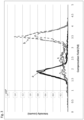
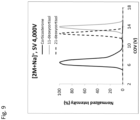
- two molecules C may form with the salt (S) an adduct 2*[C]+[Cation] + , e.g. [2M+Na] + (e.g. Example 3 and Figure 9 ).
- the salt (S) preferably comprises a cation selected from the group consisting of Li + , Na + , K + , Cs + and Ag + , more preferably selected from the group consisting of K + , Na + and Ag + , more preferably the salt (S) comprises the cation K + .
- the salt (S) preferably comprises a cation selected from the group consisting of Li + , Na + and K + , more preferably selected from the group consisting of Na + and Li + , more preferably the salt (S) comprises the cation Li + .
- the salt preferably comprises one or more anions selected from the group consisting of fluoride, chloride, bromide, iodide, nitrate, acetate, chlorate, citrate, cyanate, formate, phosphate, oxalate, sulfate, tartrate, carbonate and mixtures of two or more thereof.
- the salt is selected from the group consisting of lithium fluoride, lithium formate, sodium formate, sodium chloride, sodium acetate, potassium chloride, potassium formate, rubidium acetate, rubidium formate, cesium chloride, cesium formate, silver chloride and silver nitrate.
- the salt (S) the salt is preferably selected from the group consisting of lithium fluoride, lithium formate, sodium formate, sodium chloride, sodium acetate, potassium chloride, potassium formate, cesium chloride, cesium formate, silver chloride and silver nitrate, more preferably selected from the group consisting of lithium formate, sodium acetate, potassium chloride, cesium formate, and silver nitrate, more preferably selected from the group consisting of sodium acetate, potassium chloride, and silver nitrate, more preferably the salt (S) is potassium chloride.
- the salt (S) is preferably selected from the group consisting of lithium fluoride, lithium formate, sodium formate, sodium chloride, sodium acetate, potassium chloride, potassium formate, rubidium acetate, rubidium formate, cesium chloride, cesium formate, silver chloride and silver nitrate, more preferably selected from the group consisting of lithium fluoride, lithium formate, sodium formate, sodium chloride, sodium acetate, silver chloride and silver nitrate, more preferably selected from silver chloride, lithium acetate and sodium acetate, more preferably selected from silver chloride and lithium acetate, more preferably the salt (S) is silver chloride.
- the salt (S) is preferably selected from the group consisting of lithium fluoride, lithium formate, sodium formate, sodium chloride, sodium acetate, potassium chloride, potassium formate, rubidium acetate, rubidium formate, cesium chloride, cesium formate, silver chloride and silver nitrate, more preferably selected from the group consisting of sodium formate, sodium chloride, sodium acetate, silver chloride and silver nitrate, more preferably the salt (S) is selected from sodium formate, sodium chloride and sodium acetate.
- the salt (S) is preferably selected from the group consisting of lithium fluoride, lithium formate, sodium formate, sodium chloride, sodium acetate, potassium chloride, potassium formate, cesium chloride, cesium formate, silver chloride and silver nitrate, more preferably the salt (S) is selected from the group consisting of sodium formate, sodium chloride, sodium acetate, potassium chloride, potassium formate, silver chloride and silver nitrate, more preferably the salt (S) is selected from the group consisting of potassium chloride and potassium formate.
- the salt (S) is a salt of a monovalent anion.
- the term "salt of a monovalent anion” refers to salts comprising an anion with the negative charge -1.
- the salt is a salt of a monovalent anion, preferably of a halogen or of an organic compound.
- fluorine, chlorine, bromine, iodine, acetate, formate or trifluoroacetate are mentioned.
- the sample according to (a) comprises after addition of the total amount of the salt (S) the added salt (S) in a concentration in the range of from 25 micromol/L to 2 mmol/L, preferably in a concentration in the range of from 40 micromol/L to 1.5 mmol/L, more preferably in a concentration in the range of from 50 micromol/L to 1.0 mmol/L.
- one or more additional salts such as further monovalent or divalent or trivalent salts may be added.
- salts of monovalent ions are added to the sample in step (a).
- further additives may be added to the sample in step (a).
- additives such as diluents, bases, acids, or buffers should be mentioned.
- step (a) at least one diluent, preferably at least one organic solvent, in particular a solvent selected from the group consisting of acetonitrile, methanol, ethanol, propanol and butanol, and mixtures of two or more thereof is added in step (a).
- the sample according to (a) may already comprise such a diluent, preferably such a solvent.
- the sample obtained in (a) comprises methanol.
- the sample according to (a) is additionally acidified by addition of at least one acid.
- at least one acid any acid known to those skilled in the art and being known to be suitable in ion mobility spectrometry may be added.
- at least formic acid is added to the sample according to (a).
- the sample obtained in (a) has a pH in the range of from 1 to 8, more preferably in the range of from 2 to 5, more preferably in the range of from 2 to 4.
- the amount of acid is preferably in the range of from 1 to 8, more preferably in the range of from 2 to 6, more preferably in the range of from 2 to 5 and most preferably in the range of from 2 to 4, based on the total amount of the sample according to (a).
- ammonium acetate formic acid, acetic acid, propionic acid or TFA (tri-fluor-acetic acid), or the corresponding volitaile salts thereof, may be mentioned.
- the sample according to (a) is additionally alkalinized by addition of at least one alkalinizing agent.
- at least one alkalinizing agent any alkalinizing agent known to those skilled in the art and being known to be suitable in ion mobility spectrometry may be added.
- at least ammonium hydroxide is added to the sample according to (a).
- the sample obtained in (a) has a pH in the range of from 4 to 10, more preferably in the range of from 6 to 9, more preferably in the range of from 7 to 8.
- the sample according to (a) comprises at least one alkalinizing agent, in particular ammonium hydroxide, ammonium carbonate, ammonium hydrogen carbonate or ammonium acetat
- the amount of alkalinizing agent is preferably in the range of from 4 to 10, more preferably in the range of from 5 to 9, more preferably in the range of from 6 to 8 and most preferably in the range of from 7 to 8, based on the total amount of the sample according to (a).
- ammonium hydroxide ammonium carbonate, ammonium hydrogen carbonate or ammonium acetate may be mentioned.
- step (b) at least a portion of the sample according to (a) is ionized thereby forming an analyte flow comprising the analytes A1 and A2 in ionized form.
- cations of the analytes A1 and A2 are formed. It is contemplated that in the ionization process (step (b)) the analytes form stable complexes with ions derived from the salt.
- the ionization in step (b) is carried out by using one or more ionizers.
- the at least one ionizer or, in case a plurality of ionizers is used, at least one of the ionizers may be used for at least partially ionizing the sample in (b), thereby generating the analyte flow, fully or partially before, during or after entering the ion mobility separator.
- the at least one ionizer may be a separate device and/or may fully or partially be integrated into the at least one ion mobility separator.
- step (b) and step (c) may fully or partly be combined.
- one or more ionizers may be used in conjunction with the at least one optional mass spectrometer, as a separate device and/or fully or partially integrated into the mass spectrometer.
- the at least one ionizer may be based on generally known ionization techniques and/or may be commercially available.
- one or more of the following devices may be used as the at least one ionizer and/or may be used within the at least one ionizer: an electrospray ionizer; a chemical ionizer such as an atmospheric pressure chemical ionizer (APCI); a photo ionizer, such as one or more of an atmospheric pressure photo ionizer (APPI), an atmospheric pressure laser ionizer (APLI) or matrix-assisted laser desorption/ionization (MALDI).
- APCI atmospheric pressure chemical ionizer
- APCI atmospheric pressure chemical ionizer
- APPI atmospheric pressure photo ionizer
- APLI atmospheric pressure laser ionizer
- MALDI matrix-assisted laser desorption/ionization
- step (c) the separation of the at least two ionized analytes A1 and A2 takes place by using at least one ion mobility separator, such as at least one ion mobility spectrometer.
- the analyte flow such as a gas flow of a carrier gas and the at least two analytes, at least partially passes through the ion mobility separator.
- an ion mobility separator generally refers to a device adapted for performing a separation of particles, preferably particles in a gas flow or aerosol flow, according to the mobility of the particles.
- the mobility generally refers to the ratio of the drift velocity and the electric field.
- An ion mobility spectrometer generally refers to a measurement apparatus using an ion mobility separator for separating the particles according to their mobility, thereby dividing the particles into at least two mobility classes of particles having the same or similar mobility, and monitoring the number of particles within at least one of the mobility classes.
- DTIMS drift-time ion mobility spectrometry
- AIMS aspiration ion mobility spectrometry
- DMA differential mobility analyzer
- TWIMS travelling-wave ion mobility spectrometry
- OMS overtone mobility spectrometry
- FIMS field-asymmetric waveform ion mobility spectrometry
- DTIMS generally refers to a drifting technique in which ions are directed towards a drift tube by a combination of gas flow and electric field.
- the ions are pulsed into the drift tube by an ion shutter or gate.
- the ions On entering the drift tube, the ions are subjected to a uniform weak electric field, which accelerates the ions towards a detector situated at the end of the drift tube.
- An ion passing through a buffer gas, such as a buffer gas within the drift tube experiences a number of collisions, which impede its progress towards the detector. Larger ions with greater collision cross sections experience more collisions than smaller ions and therefore take longer to traverse the drift tube. Consequently, ions of different shapes and sizes are separated in the drift tube. Since, in most cases, a narrow pulse of ions is typically periodically introduced into the drift region, a duty cycle is typically required which lowers the overall sensitivity and dynamic range of the instrument.
- AIMS generally refers to a method in which charged particles are moved by an air stream, or generally a gas stream, into an electrical field which generally is substantially perpendicular to the original direction of movement of the charged particles. Accordingly, the path of the charged particles starts to deviate according to the mass and charge of the charged particles. Clusters with low mobility are driven farther than those with high ion mobility. As a result, a dynamic ion mobility distribution is formed inside the spectrometer. The shape of the distribution of the charged particles is changed when the nature of the sample and/or the sample gas is changed, which in turn changes the differential ion mobilities.
- Differential mobility analysis or differential mobility analyzers generally are based on an assembly of two concentrically cylindrical electrodes with an air gap between the walls of the electrodes. Air and aerosol flows enter from one end, pass through the annulus and exit the other end. An electric field is applied between the inner and outer electrodes. Particles having a specific mobility exit with the monodisperse air flow through a small slit located at the bottom of the inner electrode. Multi-channel DMAs have also been developed.
- DMA generally is considered as a distinct technique over FAIMS (also referred to as DMS), since DMA is generally used for classifying and measuring nanometer-sized aerosol particles between 1 nm to 1 ⁇ m in diameter, but generally has a poor resolution with aerosols or with particles having a size of less than 100 nm.
- TWIMS is generally based on the use of a sequence of ring-shaped electrodes supported on printed circuit boards that deliver both RF and DC voltages.
- Adjacent rings having opposite phases of Radio Frequency (RF) voltage applied thereto, are used for radially confine in the ions within the device while allowing them to pass unhindered along the axis.
- a direct current (DC) voltage can be applied to a pair of adjacent rings, to produce a potential barrier that the ions cannot cross.
- the DC potential is stepped to an adjacent set of rings the ion barrier moves forward, causing any ions in front of it to be propelled forwards. Stepping the ion barrier sequentially along the rings of the device to the other creates a travelling wave that drives the ions through the device.
- ions with similar mass to charge (m/z) values, but different charge states can be separated.
- OMS which was recently developed, generally uses multiple segmented drift regions with modulated linear drift fields to produce conditions that allow only ions with defined mobilities to pass through the instrument. Therefore, the instrument acts as a mobility-filter for continuous ion sources. By changing the frequency of the applied drift fields, it is possible to tune this instrument to transmit ions having different mobilities.
- a scan over a wide range of drift field frequencies for a single ion species shows a peak corresponding to the expected resonance time of the ions in one drift region segment and a series of peaks at higher frequencies that are overtones of the resonant frequency.
- OMS generally suffers from low sensitivity in a similar fashion to traditional drift IMS.
- FAIMS or DMS generally refers to a technique in which an analyte streamis passed through a slit of two parallel electrodes (drift tube), wherein an electric field is applied across these electrodes.
- an asymmetric electric waveform comprised of a short duration, high-voltage (e.g., 10,000 V/cm up to 70,000 V/cm depending on the device used; ABSciex Selexion may use app. 30,000 V/cm) component and a longer duration, low-voltage (e.g., 200 V/cm or 1 ⁇ 4 to 1/3 of the magnitude of the high-voltage assuming high-field duty cycle is approx. 25- 33%) component, is applied to the parallel electrodes.
- high-voltage e.g. 10,000 V/cm up to 70,000 V/cm depending on the device used; ABSciex Selexion may use app. 30,000 V/cm
- low-voltage e.g. 200 V/cm or 1 ⁇ 4 to 1/3 of the magnitude of the high-
- the separation generally takes place on the basis of the fact that the mobility of ions typically is dependent on the strength of the electric field.
- ions are separated on the basis of the difference in the mobility at high field relative to their mobility at low field.
- the FAIMS or DMS device comprises one or more outlet openings, such as an outlet opening being in straight line with an inlet opening through which the analyte flow enters the FAIMS or DMS device.
- the ion In order for an ion to exit the FAIMS or DMS device, typically, the ion has to be in a "balanced" condition.
- the voltage required to create a "balanced" drift for a given ion is generally referred to as the Compensation Voltage (CV or CoV).
- CV or CoV Compensation Voltage
- FAIMS typically offers a high sensitivity separation even at ambient atmospheric pressure and is therefore generally compatible with atmospheric pressure electrospray ionization sources.
- ion mobility separators on the basis of FAIMS. It shall be noted, however, that, in addition or alternatively, one or more other ion mobility separation techniques may be used, even though specifically the advantage of atmospheric pressure setups and the use of electrospray ionization sources generally renders FAIMS the preferred technique for the purposes of the present invention.
- the ion mobility separator is preferably combined with one or more devices for monitoring an output of the ion mobility separation and the quantification of the analytes.
- step (d) preferably comprises using at least one mass spectrometer for analyzing an output flow of the ion mobility separator.
- a mass spectrometer generally refers to an apparatus adapted for producing spectra of the masses of particles, such as atoms or molecules, comprising a sample of material.
- Mass spectrometers generally are based on ionizing the particles, such as chemical compounds, in order to generate charged particles, such as charged molecules or molecular fragments, and measuring their mass-to-charge ratios.
- a sample such as the output flow of a HPLC seperation and/or particles contained therein, is ionized, such as by spraying the sample through a charged capillary in the presence of an ionic modifier.
- This treatment may cause some of the sample's particles, such as some of the sample's molecules, to ionize by forming adducts with the ionic modifier. These ions are then separated according to their mass-to-charge ratio, typically by accelerating them and subjecting them to an electric or magnetic field. Within the electric or magnetic field, ions of the same mass-to-charge ratio will typically undergo the same amount of deflection and will not be separated.
- mass spectrometers typically further comprise one or more means for detecting the groups of ions having the same mass-to-charge ratio.
- Faraday cups and/or electron multipliers may be used. The results of the separation and detection of ions by mass-to-charge ratio are generally referred to as mass spectra.
- the at least one mass spectrometer generally may be any type of mass spectrometer known to the skilled person and/or as commercially available.
- the at least one mass spectrometer may be selected from the group consisting of a tandem mass spectrometer, an ion trap mass spectrometer, a time-of-flight mass spectrometer, a Fourier transformation mass spectrometer, an orbitrap mass spectrometer, a MALDI mass spectrometer, a quadrupole mass spectrometer.
- These types of mass spectrometers are generally known to the skilled person and are commercially available in a wide variety by a plurality of vendors.
- the method according to the present invention may comprise using an apparatus having a combination of at least one ion mobility separator and at least one mass spectrometer.
- the ion mobility separator and the mass spectrometer may be in line, such that the output flow of the ion mobility separator fully or partially, directly or after passing one or more additional devices, may enter the mass spectrometer.
- the ion mobility separator and the mass spectrometer may be separate devices, which may be linked by a line. Additionally or alternatively, the ion mobility separator and the mass spectrometer may fully or partially be combined, such as by combining the ion mobility separator and the mass spectrometer into a common housing.
- the quantification of analytes A1 and A2 in the sample is preferably carried out by comparing the analytical signal, with the signals of a calibration signal and/or curve. Therefore, it is preferred to at least once establish a calibration curve which represents the relationship between the analytical signal obtained from the particular analytical method used in (d), e.g., peak area or peak height in MS spectra or in mass chromatograms, and the quantity of the respective analyte.
- a series of calibration standards e.g., the isolated analyte in different concentrations
- This type of calibration is generally known to the skilled person in the field of analytics or diagnostics.
- a raw sample 112 is provided, such as a chemical raw sample derived from a chemical production process or a biological raw sample, such as a sample of a body fluid like blood, interstitial fluid, saliva, urine, plasma, tear fluid or combinations thereof.
- the raw sample 112 may be subjected to one or more sample preparation processes, such as by using one or more sample preparation devices 114.
- the one or more sample preparation devices 114 may comprise one or more chromatographic devices 116, such as one or more LC and/or GC devices.
- a column chromatographic device and/or a HPLC chromatographic device may be used.
- a sample 118 is generated as an output of the one or more sample preparation devices 114 and/or as an output of the one or more sample preparation processes.
- one or more salts 120 are added to the sample 118.
- the step of addition of salt 120 is denoted by reference number 122 in Figure 1 , corresponding to step (a) of the method according to the present invention.
- the addition of salt 120 may fully or partially take place in a manual fashion and/or may take place fully or partially in an automated fashion, such as by using one or more dispensing or dosing devices for adding the salts to the sample 118.
- the salt addition preferably takes place in a controlled fashion.
- the sample 118 with the salt 120 added is, manually or automatically, fully or partially, transferred to an ion mobility separator 124.
- the transfer may take place by using a carrier gas, such as by diluting the sample 118 in the carrier gas and/or by spraying the sample 118 into the carrier gas, preferably by using a nebulizer, an atomizer or a sprayer.
- the ion mobility separator 124 in the exemplary embodiment depicted in Figure 1 , comprises an ionizer 126 which, in the embodiment shown, may e.g. be an electrospray ionizer (ESI).
- ESI electrospray ionizer
- the electrospray ionizer may both fulfill the purpose of fully or partially ionizing the sample 118 and/or particles contained therein and the purpose of spraying the sample 118, in a fully or partially ionized fashion, into a differential mobility spectrometer DMS, such as a field-asymmetric waveform ion mobility spectrometry (FAIMS) device 128.
- DMS differential mobility spectrometer
- FIMS field-asymmetric waveform ion mobility spectrometry
- Figure 2(A) shows a schematic cross-sectional view of the FAIMS device 128, and Figure 2(B) shows an exemplary embodiment of the strength of an electric field E (denoted by reference number 130 and directed in a downward fashion in Figure 2(A)) as a function of time t.
- E an electric field
- a sample enters a chamber through a slit of two parallel electrodes (drift tube) 132 through an entry opening 134 and passes the electric field from the left to the right in Figure 2(A).
- the electric field E as applied to the parallel electrodes 134 has an asymmetrical electrical waveform.
- short high-voltage periods 134 and longer low-voltage periods 136 are arranged in an alternating fashion, with the electric field in the high-voltage periods 134 being directed in an opposite direction as compared to the electric field in the low-voltage periods 136.
- an asymmetric electric waveform comprised of a short duration, (e.g., 10,000 V/cm up to 70,000 V/cm depending on the device used) may be used in the high-voltage periods 134 and a longer duration, low-voltage period 136 (e.g., 200 V/cm or 1 ⁇ 4 to 1/3 of the magnitude of the high-voltage assuming high-field duty cycle is approx. 25- 33%) may be used.
- a short duration e.g., 10,000 V/cm up to 70,000 V/cm depending on the device used
- a longer duration, low-voltage period 136 e.g. 200 V/cm or 1 ⁇ 4 to 1/3 of the magnitude of the high-voltage assuming high-field duty cycle is approx. 25- 33%) may be used.
- the absolute value of the electric field strength in the high-voltage periods may be at least 1.2 times the absolute value of the electric field strength in the low-voltage periods, more preferably at least 1.5 times the absolute value of the electric field strength in the low-voltage periods and more preferably at least 2.0 times the absolute value of the electric field strength in the low-voltage periods.
- the absolute value of the electric field strength in the high-voltage periods may be 1.5 to 100 times the absolute value of the electric field strength in the low voltage periods.
- the waveform as depicted in Figure 2(B) generally may be a periodic asymmetric signal, such as an asymmetric rectangular signal.
- the duration t 1 of the high-voltage periods 134 preferably is shorter than the duration t 2 of the low-voltage periods 136, such as by a factor of 1.5 to 100.
- the duration t 1 may be 2 ⁇ s
- the duration t 2 may be 4 ⁇ s.
- Other waveforms are possible.
- the periodic signals may have a frequency of 10 Hz to 1 kHz, such as 50 Hz to 500 Hz, e.g. 150 to 200 Hz.
- Other waveforms, other frequencies, other electric fields and other durations of the high-voltage and low-voltage periods are feasible.
- the separation within the drift tube 132 generally takes place on the basis of the fact that the mobility of ions typically is dependent on the strength ⁇ of the electric field.
- ions are separated on the basis of the difference in the mobility at high field relative to their mobility at low field.
- the mobility of the ions generally is dependent on the strength of the electric field. Some ions generally will have a mobility which increases with electric field; other ions have a mobility which decreases with field.
- the drift tube 132 comprises one or more outlet openings 138, such as an outlet opening 138 being in straight line with the inlet opening 134.
- the ion In order for an ion to exit the drift tube 132 through the outlet opening 138, typically, the ion has to be in a "balanced” condition.
- the voltage required to create a "balanced" drift for a given ion is generally referred to as the Compensation Voltage (CV or CoV).
- CV or CoV Compensation Voltage
- Figure 2(A) a drift path 140 of an unbalanced ion, which will not reach the outlet opening 138, and a drift path 142 of a balanced ion, which will reach the outlet opening 138 and will leave the drift tube 132 through the outlet opening 158, are shown.
- the mobility of the balanced ions may be chosen and, by varying one or more of these parameters, a scan through various classes of mobilities may be performed.
- the FAIMS device 128 may either be used for particle classification, thereby selecting a specific class of particles from the analyte flow, or may be used for scanning and taking spectra of the particle mobilities contained within the analyte flow.
- the ion mobility separator 124 may generally be combined with one or more devices 144 for monitoring an output of the ion mobility separator 124.
- the combination of the device 144 and the ion mobility separator 124 may generally be referred to as an ion mobility spectrometer 146, wherein, in some cases, the ionizer 126 is also referred to as a part of the ion mobility spectrometer 146.
- the ion mobility spectrometer 146 may be a FAIMS spectrometer.
- the device 144 for monitoring the output or output flow 148 of the ion mobility separator 124 may be a simple counting device or may, as depicted in Figure 1 , contain one or more further separating devices.
- device 144 may be or may comprise one or more mass spectrometers 150.
- a tandem mass spectrometer may be used.
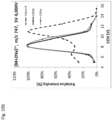
- a solution of stock solution of 1 mg 25-Hydroxy-Vitamin D3 (25-Hydroxycholecalciferol) (Sigma Aldrich) and a stock solution of 1 mg of 3-epi-25-Hydroxyvitamin D3 (Isosciences LLC) in 1 mL solvent (Methanol : Water 8:2 with 0.1 % formic acid) was prepared.
- the stock solutions were diluted and optionally mixed to give solutions comprising the amount of 25-Hydroxy-Vitamin D3 and/or 3-epi-25-Hydroxyvitamin D3 as indicated in Table 1. These solutions were containing an amount of sodium salt in the range of app. 25 ⁇ M to 100 ⁇ M (see examples 1.1 - 1.6).
- the FAIMS chip used for the analysis had 100 micron electrode gap, 700 micron device thickness and 97mm trench length. A chip region temperature estimate of 125 °C was used. The carrier gas used was nitrogen. The FAIMS was scanned over -5 to +5 Td in 0.05 Td steps.
- UltraFAIMS is a chip-based FAIMS platform designed to interface with a Mass Spectrometer to provide additional in-source separation of ions.
- the core of the ultraFAIMS platform is a microchip-sized FAIMS spectrometer that allows the selective transmission of ions based on differences in the way their mobility varies in a changing electric field.
- the UltraFAIMS chip has a small footprint of approx. 2 mm thickness and 17 mm in diameter and can be floated to 6 kV, which means it can be interfaced with most mass spectrometers.
- the UltraFAIMS apparatus was combined with an Agilent Jetstream electrospray ionization source and an Agilent 6230 TOF mass spectrometer.
- the FAIMS device was used as a tunable filter, allowing certain ions to be transmitted to the mass spectrometer while blocking others.
- Table 1 Example Concentration of 25-Hydroxy-Vitamin D3 [micromol/L] Concentration 3-epi-25-Hydroxy-Vitamin D3 [micromol/L] Sodium salt app. 25-100 ⁇ M Water [Vol %] (based on the total volume of the sample) Methanol [Vol %] (based on the total volume of the sample) Formic acid [Vol %] (based on the total volume of the sample) Townsend [Td] See Fig.
- the working solutions also contained 100 uM sodium acetate.
- the metabolites were analyzed by direct infusion separately at a flow rate of 10 uL/min.
- the ABSciex Qtrap 6500 and Selexion DMS cell were operated under the following conditions: spray voltage 5,000 V, source gas 1 with 10 psi, source gas 2 with 0 psi, curtain gas with 25 psi, temperature 0 °C, declustering potential 62 V, entrance potential 10 V, collision exit cell potential 21 V, DMS temperature low, modifier none, separation voltage 4,500 V, and resolution enhancement low.
- the compensation voltage (COV) was ramped between -10 to 30 V in 0.5 V increments while performing Q3 full scans from m/z 200 to 600 (sum 3 spectra).
- example 2.2 the working solutions were analyzed in an automated fashion using an Agilent Infinity 2900 HPLC system for flow injection analysis.
- a volume of 5 ⁇ L was injected online where it was mixed with mobile phase and flushed through a 150 x 2.1 mm C18 column.
- the mobile phase was 300 ⁇ L/min of 10% 1 mM salt solution (see table) in water and 90% methanol; therefore, the effective working salt concentration was 100 ⁇ M before ion mobility analysis.
- the samples had virtually no retention on the column and were detected in 0.5 min peak widths upon injection into the mass spectrometer.
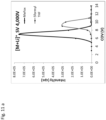
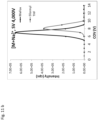
- the ABSciex Qtrap 6500 and Selexion DMS cell were operated under the following conditions: spray voltage 5,500 V, source gas 1 with 8 psi, source gas 2 with 15 psi, curtain gas with 10 psi, temperature 300 °C, declustering potential 130 V, entrance potential 10 V, collision exit cell potential 21 V, DMS temperature low, modifier none, separation voltage 3,800 or 4,000 V, and resolution enhancement low.
- the compensation voltage (COV) was stepped between 2 to 18 V in 2 V increments while performing Q3 SIM multiple ion scans.
- Total ion chromatograms (TIC) were generated for each unique COV value and the relative peak area was plotted as a function of COV value to generate COV curves.
- the working solutions were analyzed either in an automated fashion using an Agilent Infinity 2900 HPLC system for flow injection analysis or by direct infusion with a syringe pump.
- a volume of 20 uL was directly injected into the ion mobility mass spectrometer by a 150 uL/min flow rate of water:methanol (70:30).
- the respective salt solution was prepared at 1 mM and pumped at 10 uL/min into the sample flow via a T-Piece fitting; therefore, the effective working salt concentration was 63 uM before ion mobility analysis.
- ABSciex Qtrap 6500 and Selexion DMS cell were operated under the following conditions for the steroid separation: spray voltage 5,500 V, source gas 1 with 8 psi, source gas 2 with 15 psi, curtain gas with 10 psi, temperature 300 °C, declustering potential 130 V, entrance potential 10 V, collision exit cell potential 21 V, DMS temperature low, modifier none, separation voltage 4,000 V, and resolution enhancement medium.
- the conditions were as follows: spray voltage 4,500 V, source gas 1 with 8 psi, source gas 2 with 5 psi, curtain gas with 10 psi, temperature 100 °C, declustering potential 20 V, entrance potential 10 V, collision exit cell potential 21 V, DMS temperature low, modifier none, separation voltage 3,800 or 4,000 V, and resolution enhancement off.
- the compensation voltage (COV) was scanned while performing Q3 SIM multiple ion scans.
- Total ion chromatograms (TIC) were generated for each unique COV value and the relative peak area was plotted as a function of COV value to generate COV curves.
- CDP1 contains CDP Major (CDPM) and CDP minor (CDPm)
- CDPM CDP Major
- CDP minor CDP minor
- the solutions were analyzed using an Agilent Infinity 2900 HPLC system for fast, low resolution separation to separate the CDPM and CDPm metabolites.
- the mobile phases were water (A) and methanol (B) and a 4 minute fast gradient program was used (10-65 % B) at 500 uL/min for the separation on a Zorbax C8 HPLC column.
- the respective salt solution was prepared at 1 mM and pumped at 10 uL/min into the sample flow via a T-Piece fitting; therefore, the effective working salt concentration was 20 uM before ion mobility analysis.
- ABSciex Qtrap 6500 and Selexion DMS cell were operated under the following conditions: spray voltage 4,500 V, source gas 1 with 17 psi, source gas 2 with 20 psi, curtain gas with 20 psi, temperature 300 °C, declustering potential 135 V, entrance potential 10 V, collision exit cell potential 22 V, DMS temperature low, modifier none, separation voltage 4,000 V, and resolution enhancement low.
- the compensation voltage (COV) was scanned while performing Q3 SIM multiple ion scans. Average signal intensity across the chromatographic peak were plotted as a function of COV value to construct the curves..
- Stock solutions of 4a-hydroxy-5-methylTHF (MeFox) and 5-methyltetrahydrofolate (5formyl-THF) were prepared at 100 ug/mL in water with 0.1% sodium ascorbate.
- Working solutions were prepared by diluting to 1 ug/mL in water.
- the working solutions were analyzed using an Agilent Infinity 2900 HPLC system for fast, low resolution separation to remove impurities before ion mobility mass spectrometry analysis.
- the isocratic mobile phase was 89.5% water, 10% methanol and 0.5% acetic acid.
- the respective salt solution was prepared at 1 mM and pumped at 10 uL/min into the sample flow via a T-Piece fitting; therefore, the effective working salt concentration was 63 uM before ion mobility analysis.
- ABSciex Qtrap 6500 and Selexion DMS cell were operated under the following conditions: spray voltage 5,500 V, source gas 1 with 40 psi, source gas 2 with 50 psi, curtain gas with 35 psi, temperature 450°C, declustering potential 130 V, entrance potential 10 V, collision exit cell potential 21 V, DMS temperature low, modifier none, separation voltage 4,000 V, and resolution enhancement low.
- the compensation voltage (COV) was scanned while performing Q3 SIM multiple ion scans. Average signal intensity across the chromatographic peak were plotted for each COV value to construct the curves.
- the working samples were analyzed individually by direct infusion using a flow rate of 5 ⁇ L/min.
- the hardware used was an Owlstone UltraFAIMS T1 connected to a Thermo LTQ XL mass spectrometer.
- the heated transfer capillary temperature was adjusted between 50-400°C and the gas flows were adjusted between 0-20 PSI in order to optimize peak shape and selectivity for the desired separation.
- DF dispersion field
- CF compensation field
- MS system acquired ion intensity in single ion monitoring (SIM) mode of the desired ionic species.
- SIM single ion monitoring
Landscapes
- Health & Medical Sciences (AREA)
- Life Sciences & Earth Sciences (AREA)
- Engineering & Computer Science (AREA)
- Chemical & Material Sciences (AREA)
- Physics & Mathematics (AREA)
- Biomedical Technology (AREA)
- Immunology (AREA)
- Analytical Chemistry (AREA)
- Molecular Biology (AREA)
- Biochemistry (AREA)
- General Health & Medical Sciences (AREA)
- General Physics & Mathematics (AREA)
- Pathology (AREA)
- Hematology (AREA)
- Urology & Nephrology (AREA)
- Spectroscopy & Molecular Physics (AREA)
- Food Science & Technology (AREA)
- Medicinal Chemistry (AREA)
- Electrochemistry (AREA)
- Chemical Kinetics & Catalysis (AREA)
- Biophysics (AREA)
- Biotechnology (AREA)
- Cell Biology (AREA)
- Microbiology (AREA)
- Other Investigation Or Analysis Of Materials By Electrical Means (AREA)
- Investigating Or Analysing Biological Materials (AREA)
Claims (14)
- Verfahren zum Quantifizieren der Menge von mindestens zwei Analyten A1 und A2, die in einer Probe enthalten sind, umfassend:(a) Zugeben mindestens eines Salzes (S) zu mindestens einem Teil (P1) der Probe, die die mindestens zwei Analyten A1 und A2 umfasst,(b) Ionisieren mindestens eines Teils der Probe gemäß (a), wodurch ein Analytenstrom gebildet wird, der die Analyten A1 und A2 in ionisierter Form umfasst,(c) Trennen der ionisierten Analyten A1 und A2 voneinander unter Verwendung mindestens eines Ionenmobilitätsseparators (124), wobei der Analytenstrom gemäß (b) den Ionenmobilitätsseparator (124) mindestens teilweise durchläuft, und(d) Quantifizieren der Menge der abgetrennten ionisierten Analyten, die gemäß (c) erhalten wurden, wobei A1 eine pharmazeutisch wirksame Verbindung C oder ein Derivat davon ist und A2 ein Epimer von C ist, undwobei A1 einen Octanol-Wasser-Verteilungskoeffizient-(log P)-Wert größer als 0 hat.
- Verfahren nach dem vorstehenden Anspruch, wobei der log P-Wert von A1 größer als 2, stärker bevorzugt größer als 3 ist oder im Bereich von 0 bis 12, stärker bevorzugt im Bereich von 2 bis 11,5, stärker bevorzugt im Bereich von 3 bis 11 liegt.
- Verfahren nach einem der vorstehenden Ansprüche, wobei A1 ein Vitamin D ist, vorzugsweise wobei A1 25-Hydroxy-Vitamin D3 ist, und wobei A2 3-Epi-25-Hydroxy-Vitamin D3 ist.
- Verfahren nach einem der vorstehenden Ansprüche, wobei die Probe aus einer Rohprobe stammt, die die Analyten A1und A2 und Matrixbestandteile umfasst, und wobei das Verfahren ferner das Entfernen mindestens eines Teils der Matrixbestandteile, bevor Schritt (a) ausgeführt wird, unter Erhalt der Probe gemäß (a) umfasst.
- Verfahren nach einem der vorstehenden Ansprüche, wobei das Salz (S) ein Salz von einem einwertigen Kation ist, das aus der Gruppe ausgewählt ist, die aus Li+, Na+, K+, Rb+, Cs+, Ag+, Cu+, Ni+, Mn+, Pyridinium und Gemischen aus zwei oder mehr davon besteht.
- Verfahren nach einem der vorstehenden Ansprüche, wobei die Probe gemäß (a) das zugegebene Salz (S) in einer Konzentration im Bereich von 25 Mikromol/l bis 2 mmol/l, vorzugsweise in einer Konzentration im Bereich von 40 Mikromol/l bis 1,5 mmol/l, stärker bevorzugt in einer Konzentration im Bereich von 50 Mikromol/l bis 1,0 mmol/l umfasst.
- Verfahren nach einem der vorstehenden Ansprüche, wobei in (a) mindestens ein weiteres Additiv zugegeben wird, vorzugsweise ein Additiv, das aus der Gruppe ausgewählt ist, die aus Acetonitril, Methanol, Ethanol, Propanol und Butanol besteht.
- Verfahren nach einem der vorstehenden Ansprüche, wobei in (a) zusätzlich mindestens eine Säure, vorzugsweise Ameisensäure, zugegeben wird.
- Verfahren nach einem der vorstehenden Ansprüche, wobei Schritt (b) das Verwenden mindestens eines Ionisierungsmittels (126) umfasst, wobei das Ionisierungsmittel (126) für mindestens teilweises Ionisieren der Probe verwendet wird und dadurch der Analytenstrom erzeugt wird, bevor oder während er den Ionenmobilitätsseparator (124) erreicht.
- Verfahren nach einem der vorstehenden Ansprüche, wobei der Ionenmobilitätsseparator (124) ein Ionenmobilitätsseparator mit asymmetrischem Wechselfeld (Field-Asymmetric Waveform Ion Mobility Separator) ist.
- Verfahren nach einem der vorstehenden Ansprüche, wobei der Ionenmobilitätsseparator (124) mindestens ein Ionenmobilitätsspektrometer (146) umfasst, oder wobei der Ionenmobilitätsseparator (124) Teil mindestens eines Ionenmobilitätsspektrometers ist, wobei das Ionenmobilitätsspektrometer (146) mindestens ein Ionenmobilitätsspektrometer mit asymmetrischem Wechselfeld (Field-Asymmetric Waveform Ion Mobility Spectrometer) ist.
- Verfahren nach einem der vorstehenden Ansprüche, wobei Schritt (c) ferner das Verwenden mindestens eines Massenspektrometers (150) zum Analysieren eines Austragsstroms des Ionenmobilitätsseparators (124) umfasst.
- Verfahren nach dem vorstehenden Anspruch, wobei das Massenspektrometer (150) eines oder mehrere der folgenden umfasst: ein Tandem-Massenspektrometer, ein Ion-Trap-Massenspektrometer, ein Flugzeit-Massenspektrometer, ein Fourier-Transformations-Massenspektrometer, ein Orbitrap-Massenspektrometer, ein Quadrupol-Massenspektrometer.
- Verwendung mindestens eines Salzes (S) als Modifikator in einem Prozess zum Quantifizieren der Menge von mindestens zwei Analyten A1 und A2, die in einer Probe enthalten sind, durch Ionenmobilitätsspektrometrie, wobei A1 eine pharmazeutisch wirksame Verbindung C oder ein Derivat davon ist und A2 ein Epimer von C ist, und wobei A1 einen Octanol-Wasser-Verteilungskoeffizient-(log P)-Wert größer als 0, vorzugsweise größer als 2, stärker bevorzugt größer als 3 oder im Bereich von 0 bis 12, stärker bevorzugt im Bereich von 2 bis 11,5, stärker bevorzugt im Bereich von 3 bis 11 hat.
Applications Claiming Priority (2)
| Application Number | Priority Date | Filing Date | Title |
|---|---|---|---|
| EP14171145 | 2014-06-04 | ||
| PCT/EP2015/062108 WO2015185487A1 (en) | 2014-06-04 | 2015-06-01 | Method and device for separating metabolites or stereoisomers by ion mobility spectrometry |
Publications (2)
| Publication Number | Publication Date |
|---|---|
| EP3152185A1 EP3152185A1 (de) | 2017-04-12 |
| EP3152185B1 true EP3152185B1 (de) | 2023-10-04 |
Family
ID=50884277
Family Applications (1)
| Application Number | Title | Priority Date | Filing Date |
|---|---|---|---|
| EP15725061.4A Active EP3152185B1 (de) | 2014-06-04 | 2015-06-01 | Verfahren und verwendung eines salzes zur trennung von epimeren durch ionenmobilitätsspektrometrie |
Country Status (3)
| Country | Link |
|---|---|
| US (1) | US11099154B2 (de) |
| EP (1) | EP3152185B1 (de) |
| WO (1) | WO2015185487A1 (de) |
Families Citing this family (6)
| Publication number | Priority date | Publication date | Assignee | Title |
|---|---|---|---|---|
| US11237154B2 (en) * | 2015-05-29 | 2022-02-01 | Waters Technologies Corporation | Metabolic pathway and metabolite identification |
| WO2017178988A1 (en) | 2016-04-15 | 2017-10-19 | Dh Technologies Development Pte. Ltd. | Methods for detection of sample enantiomers using differential mobility spectrometry |
| JP2023521376A (ja) | 2020-04-13 | 2023-05-24 | ディーエイチ テクノロジーズ デベロップメント プライベート リミテッド | 微分移動度分光計に沿った温度勾配を制御するためのシステムおよび方法 |
| EP4244611A1 (de) * | 2020-11-11 | 2023-09-20 | DH Technologies Development Pte. Ltd. | Verfahren zum nachweis von isomeren steroiden mittels differentialmobilitätsspektrometrie |
| CN113504328A (zh) * | 2021-07-28 | 2021-10-15 | 苏州市药品检验检测研究中心 | 一种化妆品中糖皮质激素和性激素的高通量检测方法 |
| GB2638659A (en) * | 2024-01-12 | 2025-09-03 | Simed Global Ltd | An analyte detection method |
Citations (1)
| Publication number | Priority date | Publication date | Assignee | Title |
|---|---|---|---|---|
| WO2013061146A1 (en) * | 2011-10-26 | 2013-05-02 | Dh Technologies Development Pte. Ltd. | Quantification of an analyte in serum and other biological matrices |
Family Cites Families (11)
| Publication number | Priority date | Publication date | Assignee | Title |
|---|---|---|---|---|
| WO2005101017A1 (en) * | 2004-04-07 | 2005-10-27 | Genentech, Inc. | Mass spectrometry of antibody conjugates |
| US8563322B2 (en) * | 2006-04-20 | 2013-10-22 | Axel Mie | Method for separation of molecules |
| US7815803B2 (en) | 2007-06-14 | 2010-10-19 | Roche Diagnostics Operations, Inc. | Preparation of samples for LC-MS/MS using magnetic particles |
| EP2068143A1 (de) | 2007-12-07 | 2009-06-10 | Roche Diagnostics GmbH | Manipulation magnetischer Mikropartikel in einem Hochdruck-Flüssigkeitssystem und Extraktionsprozess |
| GB201005315D0 (en) * | 2010-03-29 | 2010-05-12 | Micromass Ltd | Seperation and quantitation of the C3-epimer of 250HD3 in serum using UPLC/MS/MS |
| US20140166875A1 (en) * | 2010-09-02 | 2014-06-19 | Wayne State University | Systems and methods for high throughput solvent assisted ionization inlet for mass spectrometry |
| WO2013080044A2 (en) * | 2011-11-17 | 2013-06-06 | Owlstone Limited | Sensor apparatus and method for use with gas ionization systems |
| CN107674071B (zh) * | 2012-05-11 | 2021-12-31 | 同步制药公司 | 作为隐花色素调节剂的含有咔唑的磺酰胺类 |
| US12157766B2 (en) * | 2012-08-05 | 2024-12-03 | Absci Corporation | Cytoplasmic expression system |
| DE102012018234A1 (de) | 2012-09-17 | 2014-03-20 | Magnamedics Gmbh | Abtrennung von Proteinen |
| US10245273B2 (en) * | 2013-12-26 | 2019-04-02 | Clarus Therapeutics, Inc. | Oral pharmaceutical products and methods of use combining testosterone esters with hypolipidemic agents |
-
2015
- 2015-06-01 EP EP15725061.4A patent/EP3152185B1/de active Active
- 2015-06-01 WO PCT/EP2015/062108 patent/WO2015185487A1/en not_active Ceased
-
2016
- 2016-12-01 US US15/366,695 patent/US11099154B2/en active Active
Patent Citations (1)
| Publication number | Priority date | Publication date | Assignee | Title |
|---|---|---|---|---|
| WO2013061146A1 (en) * | 2011-10-26 | 2013-05-02 | Dh Technologies Development Pte. Ltd. | Quantification of an analyte in serum and other biological matrices |
Also Published As
| Publication number | Publication date |
|---|---|
| US11099154B2 (en) | 2021-08-24 |
| WO2015185487A1 (en) | 2015-12-10 |
| EP3152185A1 (de) | 2017-04-12 |
| US20170082578A1 (en) | 2017-03-23 |
Similar Documents
| Publication | Publication Date | Title |
|---|---|---|
| US11099154B2 (en) | Method and device for separating metabolites or stereoisomers | |
| US9063159B2 (en) | LC-MS separation and detection of vitamin D metabolites | |
| JP6580103B2 (ja) | コエンザイムq10を検出するための方法及びキット | |
| AU2011320345B2 (en) | LC-MS configuration for purification and detection of analytes having a broad range of hydrophobicities | |
| JP2021119346A (ja) | マイクロサンプリングデバイスにより抽出された被分析物の質量分析による定量のための方法 | |
| US11346845B2 (en) | C peptide detection by mass spectrometry | |
| US20210088486A1 (en) | Methods and systems for detection of vitamin d metabolites | |
| Stefansson et al. | Regulation of multimer formation in electrospray mass spectrometry | |
| EP3296740A1 (de) | Verfahren zum nachweis von reversem trijodthyronin durch massenspektrometrie | |
| JP2013513802A (ja) | 非誘導体化非代謝化ビタミンdの質量分析法による決定 | |
| Korfmacher | Mass spectrometry for drug discovery and drug development | |
| CN105527368A (zh) | 一种高效液相色谱串联二级质谱技术检测尿液中8-羟基脱氧鸟苷和8-羟基鸟苷的方法 | |
| EP2588867B1 (de) | Detektion und quantifizierung von vitamin d-metaboliten unter verwendung eines alkylamins um stabile addukte für die massenspektrometrische analyse zu bilden | |
| US7358092B2 (en) | Method for the determination of 25-hydroxycholecalciferol in feed | |
| Solak | Structural characterization and quantitative analysis by interfacing liquid chromatography and/or ion mobility separation with multi-dimensional mass spectrometry | |
| Levy | Anabolic Steroids: Cationization, Dimerization, and Ion Mobility Separation | |
| HK40018869A (en) | Methods and kits for detection of coenzyme q10 | |
| Dong et al. | Simultaneous determination of seven glucocorticoids in cosmetics by liquid chromatography tandem mass spectrometry | |
| Wu | Development, Implementation and Applications of CaptiveSpray Differential Ion Mobility Spectrometry (DMS) Mass Spectrometry for Mixture Analysis | |
| HK40037875A (en) | Methods for detecting reverse triiodothyronine by mass spectrometry | |
| Chouinard | Ion mobility-mass spectrometry for improved metabolomics separations: Experimental and theoretical approaches |
Legal Events
| Date | Code | Title | Description |
|---|---|---|---|
| STAA | Information on the status of an ep patent application or granted ep patent |
Free format text: STATUS: THE INTERNATIONAL PUBLICATION HAS BEEN MADE |
|
| PUAI | Public reference made under article 153(3) epc to a published international application that has entered the european phase |
Free format text: ORIGINAL CODE: 0009012 |
|
| STAA | Information on the status of an ep patent application or granted ep patent |
Free format text: STATUS: REQUEST FOR EXAMINATION WAS MADE |
|
| 17P | Request for examination filed |
Effective date: 20161219 |
|
| AK | Designated contracting states |
Kind code of ref document: A1 Designated state(s): AL AT BE BG CH CY CZ DE DK EE ES FI FR GB GR HR HU IE IS IT LI LT LU LV MC MK MT NL NO PL PT RO RS SE SI SK SM TR |
|
| AX | Request for extension of the european patent |
Extension state: BA ME |
|
| DAV | Request for validation of the european patent (deleted) | ||
| DAX | Request for extension of the european patent (deleted) | ||
| STAA | Information on the status of an ep patent application or granted ep patent |
Free format text: STATUS: EXAMINATION IS IN PROGRESS |
|
| 17Q | First examination report despatched |
Effective date: 20201106 |
|
| REG | Reference to a national code |
Ref country code: DE Ref legal event code: R079 Free format text: PREVIOUS MAIN CLASS: C07B0063000000 Ipc: G01N0027623000 Ref country code: DE Ref legal event code: R079 Ref document number: 602015085931 Country of ref document: DE Free format text: PREVIOUS MAIN CLASS: C07B0063000000 Ipc: G01N0027623000 |
|
| RIC1 | Information provided on ipc code assigned before grant |
Ipc: G01N 33/487 20060101ALI20221006BHEP Ipc: G01N 33/82 20060101ALI20221006BHEP Ipc: G01N 27/623 20210101AFI20221006BHEP |
|
| GRAP | Despatch of communication of intention to grant a patent |
Free format text: ORIGINAL CODE: EPIDOSNIGR1 |
|
| STAA | Information on the status of an ep patent application or granted ep patent |
Free format text: STATUS: GRANT OF PATENT IS INTENDED |
|
| INTG | Intention to grant announced |
Effective date: 20221115 |
|
| GRAJ | Information related to disapproval of communication of intention to grant by the applicant or resumption of examination proceedings by the epo deleted |
Free format text: ORIGINAL CODE: EPIDOSDIGR1 |
|
| STAA | Information on the status of an ep patent application or granted ep patent |
Free format text: STATUS: EXAMINATION IS IN PROGRESS |
|
| GRAP | Despatch of communication of intention to grant a patent |
Free format text: ORIGINAL CODE: EPIDOSNIGR1 |
|
| STAA | Information on the status of an ep patent application or granted ep patent |
Free format text: STATUS: GRANT OF PATENT IS INTENDED |
|
| INTC | Intention to grant announced (deleted) | ||
| INTG | Intention to grant announced |
Effective date: 20230425 |
|
| GRAS | Grant fee paid |
Free format text: ORIGINAL CODE: EPIDOSNIGR3 |
|
| GRAA | (expected) grant |
Free format text: ORIGINAL CODE: 0009210 |
|
| STAA | Information on the status of an ep patent application or granted ep patent |
Free format text: STATUS: THE PATENT HAS BEEN GRANTED |
|
| AK | Designated contracting states |
Kind code of ref document: B1 Designated state(s): AL AT BE BG CH CY CZ DE DK EE ES FI FR GB GR HR HU IE IS IT LI LT LU LV MC MK MT NL NO PL PT RO RS SE SI SK SM TR |
|
| REG | Reference to a national code |
Ref country code: GB Ref legal event code: FG4D |
|
| REG | Reference to a national code |
Ref country code: CH Ref legal event code: EP |
|
| REG | Reference to a national code |
Ref country code: DE Ref legal event code: R096 Ref document number: 602015085931 Country of ref document: DE |
|
| REG | Reference to a national code |
Ref country code: IE Ref legal event code: FG4D |
|
| REG | Reference to a national code |
Ref country code: LT Ref legal event code: MG9D |
|
| REG | Reference to a national code |
Ref country code: NL Ref legal event code: MP Effective date: 20231004 |
|
| REG | Reference to a national code |
Ref country code: AT Ref legal event code: MK05 Ref document number: 1618219 Country of ref document: AT Kind code of ref document: T Effective date: 20231004 |
|
| PG25 | Lapsed in a contracting state [announced via postgrant information from national office to epo] |
Ref country code: NL Free format text: LAPSE BECAUSE OF FAILURE TO SUBMIT A TRANSLATION OF THE DESCRIPTION OR TO PAY THE FEE WITHIN THE PRESCRIBED TIME-LIMIT Effective date: 20231004 |
|
| PG25 | Lapsed in a contracting state [announced via postgrant information from national office to epo] |
Ref country code: GR Free format text: LAPSE BECAUSE OF FAILURE TO SUBMIT A TRANSLATION OF THE DESCRIPTION OR TO PAY THE FEE WITHIN THE PRESCRIBED TIME-LIMIT Effective date: 20240105 |
|
| PG25 | Lapsed in a contracting state [announced via postgrant information from national office to epo] |
Ref country code: IS Free format text: LAPSE BECAUSE OF FAILURE TO SUBMIT A TRANSLATION OF THE DESCRIPTION OR TO PAY THE FEE WITHIN THE PRESCRIBED TIME-LIMIT Effective date: 20240204 |
|
| PG25 | Lapsed in a contracting state [announced via postgrant information from national office to epo] |
Ref country code: LT Free format text: LAPSE BECAUSE OF FAILURE TO SUBMIT A TRANSLATION OF THE DESCRIPTION OR TO PAY THE FEE WITHIN THE PRESCRIBED TIME-LIMIT Effective date: 20231004 |
|
| PG25 | Lapsed in a contracting state [announced via postgrant information from national office to epo] |
Ref country code: AT Free format text: LAPSE BECAUSE OF FAILURE TO SUBMIT A TRANSLATION OF THE DESCRIPTION OR TO PAY THE FEE WITHIN THE PRESCRIBED TIME-LIMIT Effective date: 20231004 |
|
| PG25 | Lapsed in a contracting state [announced via postgrant information from national office to epo] |
Ref country code: ES Free format text: LAPSE BECAUSE OF FAILURE TO SUBMIT A TRANSLATION OF THE DESCRIPTION OR TO PAY THE FEE WITHIN THE PRESCRIBED TIME-LIMIT Effective date: 20231004 |
|
| PG25 | Lapsed in a contracting state [announced via postgrant information from national office to epo] |
Ref country code: LT Free format text: LAPSE BECAUSE OF FAILURE TO SUBMIT A TRANSLATION OF THE DESCRIPTION OR TO PAY THE FEE WITHIN THE PRESCRIBED TIME-LIMIT Effective date: 20231004 Ref country code: IS Free format text: LAPSE BECAUSE OF FAILURE TO SUBMIT A TRANSLATION OF THE DESCRIPTION OR TO PAY THE FEE WITHIN THE PRESCRIBED TIME-LIMIT Effective date: 20240204 Ref country code: GR Free format text: LAPSE BECAUSE OF FAILURE TO SUBMIT A TRANSLATION OF THE DESCRIPTION OR TO PAY THE FEE WITHIN THE PRESCRIBED TIME-LIMIT Effective date: 20240105 Ref country code: ES Free format text: LAPSE BECAUSE OF FAILURE TO SUBMIT A TRANSLATION OF THE DESCRIPTION OR TO PAY THE FEE WITHIN THE PRESCRIBED TIME-LIMIT Effective date: 20231004 Ref country code: BG Free format text: LAPSE BECAUSE OF FAILURE TO SUBMIT A TRANSLATION OF THE DESCRIPTION OR TO PAY THE FEE WITHIN THE PRESCRIBED TIME-LIMIT Effective date: 20240104 Ref country code: AT Free format text: LAPSE BECAUSE OF FAILURE TO SUBMIT A TRANSLATION OF THE DESCRIPTION OR TO PAY THE FEE WITHIN THE PRESCRIBED TIME-LIMIT Effective date: 20231004 Ref country code: PT Free format text: LAPSE BECAUSE OF FAILURE TO SUBMIT A TRANSLATION OF THE DESCRIPTION OR TO PAY THE FEE WITHIN THE PRESCRIBED TIME-LIMIT Effective date: 20240205 |
|
| PG25 | Lapsed in a contracting state [announced via postgrant information from national office to epo] |
Ref country code: SE Free format text: LAPSE BECAUSE OF FAILURE TO SUBMIT A TRANSLATION OF THE DESCRIPTION OR TO PAY THE FEE WITHIN THE PRESCRIBED TIME-LIMIT Effective date: 20231004 Ref country code: RS Free format text: LAPSE BECAUSE OF FAILURE TO SUBMIT A TRANSLATION OF THE DESCRIPTION OR TO PAY THE FEE WITHIN THE PRESCRIBED TIME-LIMIT Effective date: 20231004 Ref country code: PL Free format text: LAPSE BECAUSE OF FAILURE TO SUBMIT A TRANSLATION OF THE DESCRIPTION OR TO PAY THE FEE WITHIN THE PRESCRIBED TIME-LIMIT Effective date: 20231004 Ref country code: NO Free format text: LAPSE BECAUSE OF FAILURE TO SUBMIT A TRANSLATION OF THE DESCRIPTION OR TO PAY THE FEE WITHIN THE PRESCRIBED TIME-LIMIT Effective date: 20240104 Ref country code: LV Free format text: LAPSE BECAUSE OF FAILURE TO SUBMIT A TRANSLATION OF THE DESCRIPTION OR TO PAY THE FEE WITHIN THE PRESCRIBED TIME-LIMIT Effective date: 20231004 Ref country code: HR Free format text: LAPSE BECAUSE OF FAILURE TO SUBMIT A TRANSLATION OF THE DESCRIPTION OR TO PAY THE FEE WITHIN THE PRESCRIBED TIME-LIMIT Effective date: 20231004 |
|
| REG | Reference to a national code |
Ref country code: DE Ref legal event code: R097 Ref document number: 602015085931 Country of ref document: DE |
|
| PGFP | Annual fee paid to national office [announced via postgrant information from national office to epo] |
Ref country code: GB Payment date: 20240521 Year of fee payment: 10 |
|
| PG25 | Lapsed in a contracting state [announced via postgrant information from national office to epo] |
Ref country code: DK Free format text: LAPSE BECAUSE OF FAILURE TO SUBMIT A TRANSLATION OF THE DESCRIPTION OR TO PAY THE FEE WITHIN THE PRESCRIBED TIME-LIMIT Effective date: 20231004 |
|
| PG25 | Lapsed in a contracting state [announced via postgrant information from national office to epo] |
Ref country code: CZ Free format text: LAPSE BECAUSE OF FAILURE TO SUBMIT A TRANSLATION OF THE DESCRIPTION OR TO PAY THE FEE WITHIN THE PRESCRIBED TIME-LIMIT Effective date: 20231004 |
|
| PG25 | Lapsed in a contracting state [announced via postgrant information from national office to epo] |
Ref country code: SK Free format text: LAPSE BECAUSE OF FAILURE TO SUBMIT A TRANSLATION OF THE DESCRIPTION OR TO PAY THE FEE WITHIN THE PRESCRIBED TIME-LIMIT Effective date: 20231004 |
|
| PG25 | Lapsed in a contracting state [announced via postgrant information from national office to epo] |
Ref country code: SM Free format text: LAPSE BECAUSE OF FAILURE TO SUBMIT A TRANSLATION OF THE DESCRIPTION OR TO PAY THE FEE WITHIN THE PRESCRIBED TIME-LIMIT Effective date: 20231004 Ref country code: SK Free format text: LAPSE BECAUSE OF FAILURE TO SUBMIT A TRANSLATION OF THE DESCRIPTION OR TO PAY THE FEE WITHIN THE PRESCRIBED TIME-LIMIT Effective date: 20231004 Ref country code: RO Free format text: LAPSE BECAUSE OF FAILURE TO SUBMIT A TRANSLATION OF THE DESCRIPTION OR TO PAY THE FEE WITHIN THE PRESCRIBED TIME-LIMIT Effective date: 20231004 Ref country code: IT Free format text: LAPSE BECAUSE OF FAILURE TO SUBMIT A TRANSLATION OF THE DESCRIPTION OR TO PAY THE FEE WITHIN THE PRESCRIBED TIME-LIMIT Effective date: 20231004 Ref country code: EE Free format text: LAPSE BECAUSE OF FAILURE TO SUBMIT A TRANSLATION OF THE DESCRIPTION OR TO PAY THE FEE WITHIN THE PRESCRIBED TIME-LIMIT Effective date: 20231004 Ref country code: DK Free format text: LAPSE BECAUSE OF FAILURE TO SUBMIT A TRANSLATION OF THE DESCRIPTION OR TO PAY THE FEE WITHIN THE PRESCRIBED TIME-LIMIT Effective date: 20231004 Ref country code: CZ Free format text: LAPSE BECAUSE OF FAILURE TO SUBMIT A TRANSLATION OF THE DESCRIPTION OR TO PAY THE FEE WITHIN THE PRESCRIBED TIME-LIMIT Effective date: 20231004 |
|
| PGFP | Annual fee paid to national office [announced via postgrant information from national office to epo] |
Ref country code: FR Payment date: 20240522 Year of fee payment: 10 |
|
| PLBE | No opposition filed within time limit |
Free format text: ORIGINAL CODE: 0009261 |
|
| STAA | Information on the status of an ep patent application or granted ep patent |
Free format text: STATUS: NO OPPOSITION FILED WITHIN TIME LIMIT |
|
| 26N | No opposition filed |
Effective date: 20240705 |
|
| PG25 | Lapsed in a contracting state [announced via postgrant information from national office to epo] |
Ref country code: SI Free format text: LAPSE BECAUSE OF FAILURE TO SUBMIT A TRANSLATION OF THE DESCRIPTION OR TO PAY THE FEE WITHIN THE PRESCRIBED TIME-LIMIT Effective date: 20231004 |
|
| PG25 | Lapsed in a contracting state [announced via postgrant information from national office to epo] |
Ref country code: SI Free format text: LAPSE BECAUSE OF FAILURE TO SUBMIT A TRANSLATION OF THE DESCRIPTION OR TO PAY THE FEE WITHIN THE PRESCRIBED TIME-LIMIT Effective date: 20231004 |
|
| PG25 | Lapsed in a contracting state [announced via postgrant information from national office to epo] |
Ref country code: MC Free format text: LAPSE BECAUSE OF FAILURE TO SUBMIT A TRANSLATION OF THE DESCRIPTION OR TO PAY THE FEE WITHIN THE PRESCRIBED TIME-LIMIT Effective date: 20231004 |
|
| REG | Reference to a national code |
Ref country code: CH Ref legal event code: PL |
|
| PG25 | Lapsed in a contracting state [announced via postgrant information from national office to epo] |
Ref country code: LU Free format text: LAPSE BECAUSE OF NON-PAYMENT OF DUE FEES Effective date: 20240601 |
|
| PG25 | Lapsed in a contracting state [announced via postgrant information from national office to epo] |
Ref country code: IE Free format text: LAPSE BECAUSE OF NON-PAYMENT OF DUE FEES Effective date: 20240601 |
|
| PG25 | Lapsed in a contracting state [announced via postgrant information from national office to epo] |
Ref country code: BE Free format text: LAPSE BECAUSE OF NON-PAYMENT OF DUE FEES Effective date: 20240630 Ref country code: CH Free format text: LAPSE BECAUSE OF NON-PAYMENT OF DUE FEES Effective date: 20240630 |
|
| REG | Reference to a national code |
Ref country code: BE Ref legal event code: MM Effective date: 20240630 |
|
| PG25 | Lapsed in a contracting state [announced via postgrant information from national office to epo] |
Ref country code: CY Free format text: LAPSE BECAUSE OF FAILURE TO SUBMIT A TRANSLATION OF THE DESCRIPTION OR TO PAY THE FEE WITHIN THE PRESCRIBED TIME-LIMIT; INVALID AB INITIO Effective date: 20150601 |
|
| PG25 | Lapsed in a contracting state [announced via postgrant information from national office to epo] |
Ref country code: FI Free format text: LAPSE BECAUSE OF FAILURE TO SUBMIT A TRANSLATION OF THE DESCRIPTION OR TO PAY THE FEE WITHIN THE PRESCRIBED TIME-LIMIT Effective date: 20231004 |
|
| REG | Reference to a national code |
Ref country code: DE Ref legal event code: R119 Ref document number: 602015085931 Country of ref document: DE |
|
| GBPC | Gb: european patent ceased through non-payment of renewal fee |
Effective date: 20250601 |
|
| PG25 | Lapsed in a contracting state [announced via postgrant information from national office to epo] |
Ref country code: HU Free format text: LAPSE BECAUSE OF FAILURE TO SUBMIT A TRANSLATION OF THE DESCRIPTION OR TO PAY THE FEE WITHIN THE PRESCRIBED TIME-LIMIT; INVALID AB INITIO Effective date: 20150601 |
|
| PG25 | Lapsed in a contracting state [announced via postgrant information from national office to epo] |
Ref country code: GB Free format text: LAPSE BECAUSE OF NON-PAYMENT OF DUE FEES Effective date: 20250601 |
|
| PG25 | Lapsed in a contracting state [announced via postgrant information from national office to epo] |
Ref country code: DE Free format text: LAPSE BECAUSE OF NON-PAYMENT OF DUE FEES Effective date: 20260101 |
|
| PG25 | Lapsed in a contracting state [announced via postgrant information from national office to epo] |
Ref country code: FR Free format text: LAPSE BECAUSE OF NON-PAYMENT OF DUE FEES Effective date: 20250630 |