EP3155121B1 - Predicting the ability of atlantic salmon to utilise dietary pigment based on the determination of polymorphisms - Google Patents
Predicting the ability of atlantic salmon to utilise dietary pigment based on the determination of polymorphisms Download PDFInfo
- Publication number
- EP3155121B1 EP3155121B1 EP15729908.2A EP15729908A EP3155121B1 EP 3155121 B1 EP3155121 B1 EP 3155121B1 EP 15729908 A EP15729908 A EP 15729908A EP 3155121 B1 EP3155121 B1 EP 3155121B1
- Authority
- EP
- European Patent Office
- Prior art keywords
- salmon
- snp
- dna
- pigment
- allele
- Prior art date
- Legal status (The legal status is an assumption and is not a legal conclusion. Google has not performed a legal analysis and makes no representation as to the accuracy of the status listed.)
- Active
Links
Images

Classifications
-
- C—CHEMISTRY; METALLURGY
- C12—BIOCHEMISTRY; BEER; SPIRITS; WINE; VINEGAR; MICROBIOLOGY; ENZYMOLOGY; MUTATION OR GENETIC ENGINEERING
- C12Q—MEASURING OR TESTING PROCESSES INVOLVING ENZYMES, NUCLEIC ACIDS OR MICROORGANISMS; COMPOSITIONS OR TEST PAPERS THEREFOR; PROCESSES OF PREPARING SUCH COMPOSITIONS; CONDITION-RESPONSIVE CONTROL IN MICROBIOLOGICAL OR ENZYMOLOGICAL PROCESSES
- C12Q1/00—Measuring or testing processes involving enzymes, nucleic acids or microorganisms; Compositions therefor; Processes of preparing such compositions
- C12Q1/68—Measuring or testing processes involving enzymes, nucleic acids or microorganisms; Compositions therefor; Processes of preparing such compositions involving nucleic acids
- C12Q1/6813—Hybridisation assays
- C12Q1/6827—Hybridisation assays for detection of mutation or polymorphism
-
- C—CHEMISTRY; METALLURGY
- C12—BIOCHEMISTRY; BEER; SPIRITS; WINE; VINEGAR; MICROBIOLOGY; ENZYMOLOGY; MUTATION OR GENETIC ENGINEERING
- C12Q—MEASURING OR TESTING PROCESSES INVOLVING ENZYMES, NUCLEIC ACIDS OR MICROORGANISMS; COMPOSITIONS OR TEST PAPERS THEREFOR; PROCESSES OF PREPARING SUCH COMPOSITIONS; CONDITION-RESPONSIVE CONTROL IN MICROBIOLOGICAL OR ENZYMOLOGICAL PROCESSES
- C12Q2600/00—Oligonucleotides characterized by their use
- C12Q2600/124—Animal traits, i.e. production traits, including athletic performance or the like
-
- C—CHEMISTRY; METALLURGY
- C12—BIOCHEMISTRY; BEER; SPIRITS; WINE; VINEGAR; MICROBIOLOGY; ENZYMOLOGY; MUTATION OR GENETIC ENGINEERING
- C12Q—MEASURING OR TESTING PROCESSES INVOLVING ENZYMES, NUCLEIC ACIDS OR MICROORGANISMS; COMPOSITIONS OR TEST PAPERS THEREFOR; PROCESSES OF PREPARING SUCH COMPOSITIONS; CONDITION-RESPONSIVE CONTROL IN MICROBIOLOGICAL OR ENZYMOLOGICAL PROCESSES
- C12Q2600/00—Oligonucleotides characterized by their use
- C12Q2600/156—Polymorphic or mutational markers
Definitions
- the present invention relates to methods for predicting the ability of a salmon to utilise dietary pigment, more specifically the invention relates to predicting the ability of a salmon to utilise dietary pigment by the analysis of DNA polymorphisms.
- the red colour of the salmon fillet is caused by dietary carotenoids, in particular astaxhanthin, and (to a lesser extent) canthaxanthin.
- the pigments responsible for the red colour in wild salmonid fish originate from their natural feeding on small crustaceans. The pigments are catabolised in the liver, forming metabolites that are excreted from the body. However, a fraction of the ingested pigment is deposited in muscle tissue rather than being catabolised.
- the pigments causing the red colour of salmon tissue is not a natural part of the diets fed to farmed salmon, so the carotenoids, most importantly astaxhanthin, is therefore added to the commercial feed so that the salmon can obtain the red colour wanted by consumers.
- the addition of pigments to a salmon's diet adds a significant cost to the production of the salmon; the cost of providing the pigment for the life of an average fish (weighing about 5.5 kg at slaughter) is estimated to represent 2-3 % of the total production cost per kg of fish. Reducing the amount of pigment required, whilst still being able to rear salmon with the desired fillet colour, would have a significant impact on the profits of salmon farming.
- the salmon producers are interested in rearing salmon that are inherently efficient at retaining the dietary pigments.
- the salmon producers are also interested in rearing salmon that are inherently (i.e.
- One approach towards increasing the redness of the salmon fillets and/or reducing amount of pigment added to the feed is to select salmon as broodstock on the basis of their fillet colour, thereby enabling the development of a population of salmon that present the desired fillet colour even when the diet contains relatively small doses of astaxanthin.
- the redness of the salmon fillet is determined by many factors, such as the amount of astaxanthin in the feed and the age/body size of the fish.
- genetic disposition is a major determinant of the fillet colour, typically responsible for around 40 % of the total variation found in muscle pigment content or red colour intensity.
- the skilled person can measure pigment concentration in the muscle of the salmon by high-pressure liquid-chromatography (HPLC).
- HPLC high-pressure liquid-chromatography
- the fillet colour can be evaluated (1) by visual (ie by eye) comparison against the Roche SalmoFan®, (2) by automated inspection of digital photographs, or (3) by using automated systems for objective estimation of pigment concentration based on spectroscopy.
- Experimental measurements obtained using any of the three last-mentioned methods may be translated to units of pigment content (mg pigment per kg fillet) by correlating, in a sample of at least 50 animals, the measurements in question with HPLC-obtained pigment-content.
- producers generally aim for an average pigment concentration of above 7 mg per kg fillet, corresponding to Roche SalmoFan® measurements at around 26.
- the drawback of the above-mentioned methods for estimating the intensity of the red colour in salmon fillets is that they all require that the salmon first be slaughtered and the fillet prepared. This not only reduces the number of salmon that can be used to form the population of the broodstock, but also means that it is the siblings of the salmon that have been analysed that are used as broodstock. The accuracy of selection is reduced when selection is performed on the basis of phenotypes that are not recorded on the selection candidates, meaning that the population of salmon created from the broodstock may not possess the desired fillet colour that was presented by the tested animals.
- the inventors of the present application have, following extensive experimentation, identified that one can predict a salmon's ability to utilise dietary pigment by analysis of one or more DNA polymorphism. Predicting such an ability on the basis of DNA polymorphisms means that analysis can be carried out on a small tissue sample of the salmon and that one does not need to sacrifice the salmon being analysed. Consequently, one can develop a population of salmon directly from broodstock that have been analysed by the new DNA based method (ie marker-assisted selection).
- a method of predicting the ability of a salmon to utilise dietary pigment comprising determining the alleles present at one or more DNA polymorphism in the salmon and predicting the ability of the salmon to utilise dietary pigment based on the determination of the alleles.
- the utilisation of pigment by salmon is the process of depositing and retaining the dietary pigment in the muscle tissue rather than catabolising and excreting it.
- the relative level of utilisation of pigment of a test salmon may be confirmed by analysis of the colour of the fillet (for example, by using any of the methods described above) and/or the amount of pigment in a fillet (optionally expressed as mg of pigment per kg of fillet), and comparing that level to that derived from a population of salmon that are fed on a diet that includes the same or substantially the same amount of pigment as that of the test salmon.
- Salmon that have a greater than normal ability to utilise dietary pigment are ideal broodstock as they will be able to maximise on the use of pigment in their diet in order to present the desired intense red colour for their fillets. Salmon with a lesser than normal ability to utilise dietary pigment would not ideally be selected as broodstock.
- the method of the present invention may predict a salmon that has a greater or a lesser than normal ability to utilise dietary pigment based on the determination of the alleles present at one or more DNA polymorphism in the salmon.
- a salmon that has a greater (or lesser) than normal ability to utilise dietary pigment is most likely to have a muscle pigment content (and hence, a red colour intensity) which is higher (or lower, respectively) than the average muscle pigment content of the population that the salmon belongs to.
- the population of salmon may be defined as a contemporary group of salmon, having been raised on the same feed and in the same environments (eg. in the same tanks and in the same net pens) throughout their lives.
- the population may be raised on commercially available, astaxhantin-containing, feed intended for farmed Atlantic salmon.
- Atlantic salmon are usually or always farmed in large sea cages or water tanks, containing thousands of individuals (cohorts) of the same genetic origin and the same age, being fed the same feed ad libitum. Therefore, an individual animal should, and can easily be, compared with a random sample of its cohorts (for example, the random sample comprising at least 50 individuals), in order to determine whether its fillet colour is higher or lower than normal.
- a random sample of its cohorts for example, the random sample comprising at least 50 individuals
- an individual that has been selected (using the methods described here) to have a higher than normal ability to utilise pigment is expected to have a concentration of pigment which is higher than the mean pigment concentration within a random sample of its cohorts.
- the presence or absence of the appropriate alleles of the DNA polymorphisms of the present invention can define whether the salmon has a greater or lesser than normal ability to utilise dietary pigment.
- the method of predicting a salmon with a greater or lesser ability than normal to utilise dietary pigment, based on the determination of the alleles present at a DNA polymorphism only applies if the DNA polymorphism in question is variable within the salmon population in question (ie if more than one allele of the DNA polymorphism is present within the population).
- the DNA polymorphisms of the present invention can be present in either of two forms, i.e. the polymorphisms each have two alleles.
- One allele can be characterised as being associated with a salmon that has a greater than normal ability to utilise dietary pigment. Salmon that are homozygous for this allele would be expected to present fillets with a higher red colour intensity than normal (assuming the diet of that population includes pigment). Consequently, this allele is referred to hereinafter as the "red allele”.
- the other allele can be characterised as being associated with salmon having less than normal abilities to utilise dietary pigment.
- Salmon that are homozygous for the other allele would be expected to present fillets with a lower red colour intensity than normal (assuming the diet of that population includes pigment). Consequently, this allele is referred to hereinafter as the "pale allele".
- a normal ability to utilise dietary pigment is defined as the mean ability (to utilise pigment) of the Atlantic salmon population in question. It is customary (part of the Art) and reasonable to assume that the ability to utilise dietary pigment correlates strongly with the pigment (e.g. astaxhantin) levels found in the muscle of individuals that have ingested pigment through the feed.
- estimates of pigment levels in muscle can be used as measures of the ability to utilise dietary pigment, and a normal ability to utilise dietary pigment translates to a normal pigment content in muscle.
- the normal pigment level would be defined as the mean pigment level in a number of (for example, at least 50) random animals from the population.
- the step of determining the alleles in the method of the first aspect of the present invention therefore includes the step of analysing the form of DNA polymorphism provided in each set of chromosomes, i.e. determining whether each copy of the DNA polymorphism present is a red allele or is a pale allele.
- a salmon subjected to the method of the present invention is determined to have two copies of the red allele for the DNA polymorphism (i.e. the salmon is homozygous for the red allele), the salmon is predicted to have a greater than normal ability to utilise pigment.
- the salmon When a salmon subjected to the method of the present invention is determined to have one copy of the red allele for the nucleotide polymorphism and one copy of the pale allele for that nucleotide polymorphism (i.e. is heterozygous), the salmon would be predicted according to the present invention to have a greater than normal ability to utilise pigment, if the red allele is less frequent in the population than the pale allele (possibly only a slightly greater ability). Consequently, assuming such salmon are provided with pigment enriched diets, those fish would be expected to achieve a more intense red coloured fillet than a population of normal fish fed on the same diet.
- red allele is slightly more frequent in the population than the pale allele
- a heterozygous animal would be predicted to have a lesser than normal ability to utilise pigment (possibly only slightly lower), and so would be expected to have a lower red colour intensity when compared to the average of the normal population of fish fed on the same diet.
- DNA polymorphisms that are associated with the ability for salmon to utilise dietary pigments are to be found in chromosomes 2, 14 and 26. Consequently, the one or more DNA polymorphism of the present invention may be provided in chromosome 2, 14 and/or 26 and that can predict the ability of a salmon to utilise dietary pigment (as described above).
- the DNA polymorphisms of the present invention can be any of thirteen DNA polymorphisms found by the inventors to have this predictive ability and that are described below.
- the DNA polymorphism may be any one or any combination of:-
- each of the DNA polymorphisms provided above are contemplated individually as part of the present invention. Methods of the present invention may therefore employ any one of the above DNA polymorphisms. Methods of the present invention may therefore employ any combination of the above DNA polymorphisms.
- the DNA polymorphism of the present invention may be any one or any combination of SNPS 1, 2, 3, 4, 5, 6, 7, 8 and 9.
- the DNA polymorphism of the present invention may be any one or any combination of SNP 1, 6 and 8.
- the DNA polymorphism of the present invention may be any one or any combination of SNP 2, 6 and 8.
- the DNA polymorphism of the present invention may be any one or any combination of SNP 1, 5 and 8.
- the DNA polymorphism of the present invention may be any one or any combination of SNP 2, 5 and 8.
- the DNA polymorphism of the present invention may therefore be any one or any combination of SNPS 1, 2, 3, 4, 5, 7, 9 and 10.
- the DNA polymorphisms of the present invention may be either or both of SNPs 1 and 2.
- the DNA polymorphism of the present invention may therefore be any one or any combination of SNP Nos. 6, 11, 12, and 13.
- the DNA polymorphism of the present invention may be rs159407967, ie SNP 8 (located on chromosome 14).
- SNPS 1, 2, 3, 4, 5, 7, 9, and 10 are located within a narrow region (covering 5.7 million base pairs of a genome that is approximately 3.0 billion base pairs long; i.e. 0.018 % of the genome) on chromosome 26 (Tables 3 and 4), .It is therefore highly reasonable to assume that these seven DNA polymorphisms co-segregate with one and the same causative mutation. In other words, these seven DNA polymorphisms function as (DNA) markers of one and the same QTL. Therefore, these seven DNA polymorphisms comprise one unit, and in practice one could use only one of these DNA polymorphisms in a method of predicting a salmon's ability to utilise dietary pigment. Consequently, each of the DNA polymorphisms provided above are contemplated individually as part of the present invention.
- SNPs 6, 12, 13, and 14 are located within one and the same narrow region on chromosome 2. It is therefore likely that these SNPs co-segregate with one and the same causative mutation. Therefore, these four DNA polymorphisms comprise one unit, and in practice one could use only one of these DNA polymorphisms in a method of predicting a salmon's ability to utilise dietary pigment. Consequently, each of the DNA polymorphisms provided above are contemplated individually as part of the present invention.
- loci For most polymorphic loci (in any species), there will be a number of other loci having identical or highly similar genotype patterns. To illustrate, two loci have identical or nearly identical genotype patterns if all or most animals having genotype AA at locus 1 have genotype CC at locus 2, all or most animals having genotype AB at locus 1 have genotype CD at locus 2, and all or most animals having genotype BB at locus 1 have genotype DD at locus 2. In genetic terms, two such loci will be said to be in linkage disequilibrium (LD) with each other.
- LD linkage disequilibrium
- the DNA polymorphisms of the present invention as specified above may therefore be replaced by other DNA polymorphisms with which they are in LD.
- the present invention may therefore relate to a method where one or more of the polymorphisms (described above) are replaced by other loci with which they are in sufficiently strong LD.
- sufficiently strong LD is defined as follows: Two loci are in sufficiently strong LD with each other if the square of the correlation coefficient between the two loci (r 2 ; a common measure of LD) is greater than 0. 3. This number (0.3) is commonly regarded as the lower threshold for defining 'sufficiently strong LD' (see e.g. Uimari et al. 2005).
- the method may employ two or more of the polymorphisms of the present invention, for example three polymorphisms.
- the methods of the present invention may involve the step of determination on the basis of one DNA polymorphism from chromosome 26 (eg SNP 1 or 2), one DNA polymorphism from chromosome 2 (eg SNP 6 or 11), and the DNA polymorphism from chromosome 14 (SNP 8).
- the methods of the present invention may involve the step of determination on the basis of any one DNA polymorphism selected from the group consisting of SNPs 1, 2, 3, 4, 5, 7 9 and 10, and any one DNA polymorphism selected from the group consisting of SNPs 6, 12, 13 and 14, optionally additional with SNP 8.
- the salmon having the red allele at all two/three polymorphisms are expected to have the highest ability to utilise dietary pigment, and so the highest intensity red fillet colour. More precisely, the invention would be most effective if the polymorphisms used in the method comprised or consisted SNP1 (AGKD01307174.1_2657-AC ;chromosome 26) in combination with SNP 6 (rs159406379 ;chromosome 2) and SNP 8 (rs159407967; chromosome 14).
- SNP2 AGKD01018473.1_11330-CT
- SNP1 AGKD01307174.1_2657-AC
- SNP 11 AGKD01087062.1_2136-CT
- SNP 6 rs159406379
- the identity of that base which defines the red or pale allele for each polymorphism for use in the methods of the present invention is provided in Table 2.
- the identities of the red- and pale alleles provided in Table 2 are relative to the DNA sequences provided in Table 5 (note: a DNA strand can be read in two directions, for example, the DNA sequence ACAGT would become CATGT if read in the other (so-called reverse-complement) direction, and the middle base would be nominated as A or T, respectively, in these two cases).
- the methods of the present invention include the determination of the allele present at SNP1
- the allele is determined to be A at the variant position of SNP1 (defined by square bracket in Table 5), and provided that the DNA strand is read in the read direction used in Table 5, then the allele is determined to be a red allele.
- the allele is determined to be C at the variant position of SNP1 (provided that the DNA strand is read in the read direction used in Table 5), then the allele is determined to be the pale allele.
- the associated sequence listing provides a sequence for each allele for each of the above described polymorphisms.
- SEQ ID Nos 1 through 13 correspond to red alleles for SNPs 1 through 13, respectively.
- SEQ ID Nos 14 through 26 correspond to the pale alleles for SNPs 1 through 13, respectively.
- SEQ ID Nos 1 through 13 correspond to red alleles for SNPs 1 through 13, respectively.
- SEQ ID Nos 14 through 26 correspond to the pale alleles for SNPs 1 through 13, respectively.
- DNA polymorphisms described throughout this application are defined with reference to the first version of the whole genome sequence for Salmo salar published in GenBank under accession number AGKD00000000 (version AGKD00000000.1 GI: 354459050). More particularly, most DNA polymorphisms in the present application have been given names that reflect the contig (subsequence) of AGKD00000000.1 within which the DNA polymorphism in question reside, the position of the DNA polymorphism within the contig, and the alleles present at the DNA polymorphism. More specifically, the DNA polymorphisms have been given names following the scheme:-
- the DNA polymorphism may be AGKD01307174.1_2657- AC . This polymorphism is located at position 2657 within contig AGKD01307174.1 (which is part of reference sequence AGKD00000000.1), and the alleles that can be found are A and C.
- the DNA polymorphism may be rs159406379, being a single nucleotide polymorphism (SNP) found within the dbSNP database, hosted by the National Center for Biotechnology Information (NCBI; USA), i.e. (http://www.ncbi.nlm.nih.gov/projects/SNP/).
- the method may be applied to Atlantic salmon ( i.e. Salmo salar ).
- the step of determining which alleles are present in a salmon and at a specific DNA polymorphism may be practised on a sample taken from the salmon.
- the sample may be any sample in which analysis of nucleic acid material is possible, as would be readily understood by the person skilled in the art.
- the sample may be a muscle tissue sample, blood sample, liver sample and/or a fin clip.
- the method may involve sequence analysis of the salmon to be tested.
- the method may involve single base extension of DNA fragments terminating at the polymorphic site (e.g. iPLEX assays from Sequenom and Infinium assays from Illumina), allele-specific PCR (e.g. SNPtype assays from Fluidigm or KASPar assays from KBiosciences), or competitive hybridisation of probes complementary to the different alleles (e.g. the TaqMan assay from Applied Biosystems).
- a hybridisation probe that is specific for one or more of the aforementioned DNA nucleotide polymorphisms.
- a salmon that is predicted to have greater than normal ability to utilise dietary pigment according to the first aspect of the present invention is more likely than normal to produce offspring that have greater than normal ability to utilise dietary pigment (and so ability to provide fillets with the desired high intensity red colour). Consequently, in a further aspect of the present inventions, there is provided a method of selecting a salmon for use as broodstock, wherein the salmon is selected based on the prediction by the method as claimed in the first aspect of the present invention that the salmon will provide a greater than normal ability to utilise dietary pigment.
- a salmon predicted by the method of the first aspect of the present invention as not providing a greater than normal utilisation of dietary pigment would not be selected as broodstock.
- Also contemplated as forming part of the present invention is an isolated polynucleotide comprising one or more of the single nucleotide polymorphisms selected from the group provided in Table 5 located within a portion of the salmon genome.
- Dietary carotenoids such as astaxanthin and canthaxanthin, are Vitamin A precursors. Vitamin A precursors are mainly metabolised in the intestine or liver, where they are cleaved by oxygenases into retenoids or apo-carotenals. Excess carotenoids that have not been cleaved are incorporated into lipoproteins and secreted into the bloodstream, from where they are taken up by muscle cells and deposited, binding to actomyosin.
- Beta-Carotene 15,15'-Monooxygenase 1 (Bcmo1; coded by gene bcmo1 ), performing oxidative cleavage of beta-carotene.
- the two SNPs most strongly associated with fillet colour, AGKD01307174.1_2657-AC (SNP 1) and AGKD01018473.1_11330-CT (SNP 2) (both being part of this application), are both located within or near the 3'-untranslated region of a gene encoding a protein similar to Bcmo1.
- This gene, and its corresponding protein product, will be referred to, respectively, as bcmo1-like and Bcmo1-like from here on.
- Concentrations of both circulatory- and muscle-bound carotene, as well as flesh coloration, have been shown to be affected by genetic variation in regulatory elements of bcmo1 in mammalian and avian species (Ferruci et al. 2009, Lietz et al. 2012, Hendrickson et al. 2012, Le Bihan-Duval et al. 2011, Jlali et al. 2012).
- the applicants have determined experimentally that the protein product of the bcmo1-like gene located on chromosome 26 is capable of cleaving beta-carotene in vivo.
- This/these polymorphism(s) may be identical to AGKD01307174.1_2657-AC and/or AGKD01018473.1_11330-CT, or they may be other, yet undiscovered, polymorphisms within or in the vicinity of bcmo1-like or bcmo1
- bcmo1-like and/or bcmo1 are partly responsible for determining how good a salmon is at utilising dietary pigment
- one route towards increasing a salmon's ability to utilise dietary pigment would be to modify the concentrations or the activities of the protein products corresponding to these genes.
- antisense mRNA in order to inhibit the translation of the bcmo1-like and/or bcmo1 mRNA, given that antisense mRNA could be delivered to the relevant cells.
- a method of improving the ability of a salmon to utilise dietary pigment including the step of administering an agent that inhibits the expression of the genes bcmo1-like and/or bcmo1 and/or an agent that inhibits the activity of the proteins Bcmo1-like and/or Bcmo1 (the activity may be the enzymatic digestion by Bcmo1-like and Bcmo1).
- the agent may, for example, be anti-sense mRNA that inhibits the translation of bcmo1-like and/or bcmo1 mRNA.
- Fillet colour was analysed for salmon fillets taken from 6701 Atlantic salmon belonging to the AquaGen breeding population. This breeding population was formed in the early 1970s, on the basis of Atlantic salmon sampled from different Norwegian rivers.
- Fillet colour was analysed in three independent test rounds, taking place in 2007, 2010, and 2013, respectively. In all three rounds, fillet colour was measured on the flesh side of fresh salmon fillets. In 2007 and in 2013, fillet colour was measured using a QVision Analyser, a spectrophotometer which measures absorption/reflection at 400-1200 nm wavelengths. In 2010, fillet colour was measured using the Photofish method, a method which is based on image analysis of photographs taken under standardised conditions (i.e. inside a closed box with constant light). Irrespective of method, the fillet colour measurements were converted to units of mg astaxhantin per kg of fillet.
- tissue samples from skeletal muscle, liver, or heart were taken from a subset of the animals whose fillet colour had been measured. DNA was extracted from these tissues using a standard method (using the DNAeasy 96 kit from QIAGEN, following the protocol supplied by QIAGEN). These DNA samples were later used for genotyping. In each test round, the selection of animals for DNA-extraction and genotyping was based on sets of criteria that were unrelated to the animals' fillet colour measurements or to the expected performance of the animal with regard to fillet colour.
- Sample Set 1 displays the numbers of individuals, full-sib groups, fathers, and mothers pertaining to each sample set.
- Data sets 1, 2, and 3 are the data sets corresponding to sample sets 1, 2, and 3; the date sets encompassing genotype data and phenotype data.
- Sample/data sets Dat a set Year Genotypin g technol.
- N animals number of animals having been genotyped and phenotyped ('offspring');
- N FS groups number of full-sibling groups represented by genotyped and phenotyped animals;
- N fathers and N mothers number of fathers and mothers of the phenotyped and genotyped animals;
- N markers number of DNA polymorphisms genotyped.
- Sample Set 1 was genotyped using a customdesigned iSelect SNP-array from Illumina (San Diego, CA, USA), containing approximately 6,000 working SNP-assays developed in-house at CIGENE. Of these 6,000 SNPs, 5650 were polymorphic within sample set 1.
- Sample Set 2 was genotyped using another customdesigned iSelect SNP-array from Illumina, this array being a slightly modified form of the array used on Sample Set 1. Of the approximately 6,000 working SNPs on this array, 4423 were polymorphic within Sample Set 2. The number of SNPs common to the two sets was 4308.
- the SNP-arrays used for genotyping Sample Set 1 and Sample Set 2 contained SNPs that were mostly derived from the alignment of publicly available EST sequences or from sequencing of genome complexity reduction (GCI) libraries using 454 technology (Lien et al. 2011).
- the samples were genotyped following standard protocols for iSelect SNP-arrays, provided by Illumina. Bead-arrays were scanned on an iScan reader using a modified Infinium II scan settings protocol which records bead-level intensity data in .txt format.
- Sample Set 3 was genotyped using a custom Axiom array from Affymetrix (San Diego, CA, USA).
- the SNPs on this array were identified through whole genome sequencing of 29 Atlantic salmon from the AquaGen breeding nucleus in addition to three double haploid (androgenetically derived) Atlantic salmon.
- the SNP array contained 200,000 SNPs that were polymorphic within Sample Set 3. Genotyping was done according to the Axiom 2.0 Assay Manual Workflow User Guide (http://media.affymetrix.com/support/downloads/manuals/axiom_2_assay_manua l_workflow_prepguide.pdf).
- Genotype calling was done using the Affymetrix Power Tools programs (http://www.affymetrix.com/estore/partners_programs/programs/developer/tool s/powertools.affx), according to "best practices” recommendations from Affymetrix (http://media.affymetrix.com/support/downloads/manuals/axiom_best_practice_s upplement_user_guide.pdf).
- Sample Set 1 was, in addition to being genotyped with the above-mentioned Illumina iSelect SNP-array, also genotyped for a further set of 96 SNPs*. These 96 SNPs were identified by targeted-SNP detection on a genomic scaffold containing the candidate gene in question (this gene being bcmo1-like ). The genomic scaffold had been developed by de novo assembly of reads coming from the International Collaboration to Sequence the Atlantic Salmon Genome (ICSASG: Davidsson et al). The reads that were aligned to the reference sequence (in order to identify SNP and other polymorphisms) were obtained through sequencing 45 and 29 AquaGen-animals to 2x and 15x genome coverage, respectively, on Illumina HiSeq2000.
- the reads were aligned using bowtie2, and SNPs were detected using freebayes.
- the novel SNPs were genotyped in sample set 1, using the MassArray iPLEX platform from Sequenom (San Diego, USA), following the standard iPLEX protocol provided by Sequenom.
- DNA polymorphisms were shared by all three datasets, while others were shared by two datasets or by none. More specifically, 2,724 DNA polymorphisms were shared by all three datasets, while 1,771 DNA polymorphisms were shared by only two datasets.
- the overall p-value was derived from the sum of the individual likelihood ratio test (LRT) statistics, the sum of the LRT statistics being ⁇ 2 -distributed with degrees of freedom equal to the number of tests (ie 2 or 3).
- nucleotide BLAST Using nucleotide BLAST, the Atlantic salmon genome scaffolds (from build 2 of the Atlantic salmon genome sequence) harbouring these SNPs were identified. The chromosomes harbouring the SNPs were identified by two-point linkage analysis using Data Set 3. Later, when build 4 of the Atlantic salmon genome sequence became available, nucleotide BLAST against build 4 was performed in order to position the SNPs relative to this sequence (Table 3). Chromosome sequences (contiguous DNA sequences correspond to whole Atlantic salmon chromosomes), submitted to GenBank but not yet released by GenBank, were provided by Sigbj ⁇ rn Lien (one of the inventors and a partner in the ICSASG), and used in order to confirm the genome positions of the SNPs (Table 4).
- the chromosomes that the SNPs belong to are also evident from inspection of the GenBank records of the scaffolds that the SNPs map to (listed in Table 3).
- SNP1 AGKD01307174.1_2657-AC
- GenBank identifier AGKD04000059 According to the GenBank record, the additional identifier of this scaffold is tcf1000000010_0-0_ssa26_0_0, reflecting that the SNP is located on chromosome 26.
- the LRT statistics of the SNPs strongly associated with fillet colour can be found in Table 2. As can be seen from Table 3, eight of the thirteen SNPs reside within one and the same genome scaffold. It is reasonable to assume that these SNPs tag one and the same QTL, this QTL being located on chromosome 26 (Tables 3 and 4). The other two SNPs are located on chromosomes 2 and 14, respectively (Tables 3 and 4). The flanking sequences of the SNPs can be found in Table 5.
- Four of the SNPs are denoted by their dbSNP rs# identifiers (http://www.ncbi.nlm.nih.gov/projects/SNP/).
- Each chromosome sequence is an amalgam of scaffolds from Atlantic salmon genome build 4 (such as the scaffolds listed in Table 3), the scaffolds having been sorted and oriented using genetic linkage analysis and other appropriate techniques.
- the chromosome sequences have been submitted to GenBank by one of the inventors (Dr. Sigbj ⁇ rn Lien), and are due to be made public by GenBank in 2015.
- dbSNP identifiers of SNPs submitted to dbSNP by the authors SNP # SEQ ID Nos. (Red/Pale Allele) SNP dbSNP identifier 1 1/14 AGKD01307174.1_2657-AC ss1751859087 2 2/15 AGKD01018473.1_11330-CT ss1751859088 3 3/16 AGKD01018473.1_9476-AG ss1751859089 4 4/17 AGKD01114288.1_6700-CT ss1751859090 5 5/18 AGKD01407103.1_1854-AG ss1751859091 10 10/23 AGKD01407103.1_3519-GT ss1751859093 11 11/24 AGKD01087062.1_2136-CT ss1751859094 12 12/25 AGKD01459927.1_723-AG ss1751859095 13 13/26 AGK
- SNPs listed in Table 2 can be used in order to select broodstock whose offspring will have fillets with a red colour intensity which is higher than the mean of the population (from which the parents were derived). For example, one may genotype SNP AGKD01307174.1_2657-AC (SNP 1) in the broodstock candidates in order to select a male and a female which are both homozygous for the red allele (which is A in the case of AGKD01307174.1_2657-AC). All offspring resulting from the mating of these two salmon will be homozygous for the red allele.
- SNP AGKD01307174.1_2657-AC SNP AGKD01307174.1_2657-AC
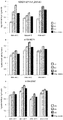
- Figure 2 displays the mean astaxanthin levels ( ⁇ standard error of the mean) of fish that would have resulted from such crossing schemes, in populations similar to the populations corresponding to Sample Sets 1 through 4.
- the offspring of two parents homozygous for the red allele have offspring that have a significantly more red fillet colour than offspring resulting from other crosses.
- Data Set 1 revealed that many of the SNPs most strongly associated with fillet colour were located on chromosome 26.
- One of these two genes were Beta-Carotene 15,15'-Monooxygenase 1 ( bcmo1 ), the other gene coded for a protein similar to bcmo1, so that the gene is termed bcmo1-like (the protein products of the two genes are referred to as Bcmo1 and Bcmo1-like).
- Bcmo1 has been shown to be capable of oxidatively cleaving beta-carotene.
- Atlantic salmon Bcmo1 and Bcmo1-like are also capable of cleaving beta-carotene. This was done following this procedure: The complete reading frame of both genes, stretching from (and including) the transcriptional start codons to the last amino acid of the protein, was PCR-amplified using cDNA as template. PCR fragments were purified and ligated into a His-Tagged expression vector (pBAD ThioFusion, Life sciences).
- AGKD01307174.1_2657-AC nor AGKD01018473.1_11330-CT give rise to an amino-acid shift, neither within bcmo1 nor within bcmo1-like.
- qPCR quantitative Real-Time PCR
- the applicants have shown that there is no significant difference in expression levels, at either of the two genes, between animals homozygous for the two different alleles at either AGKD01307174.1_2657-AC or AGKD01018473.1_11330-CT.
- AGKD01307174.1_2657-AC is located within a typical microRNA (miRNA) binding site.
- MicroRNAs are known to be involved in negative regulation of enzyme activity, acting through different mechanisms such as transcript degradation and translational suppression. It is therefore possible that AGKD01307174.1_2657-AC is a functional mutation which facilitates an increase in the red colour intensity by preventing the binding of a miRNA to bcmo1-like, thus reducing the oxidative cleavage of carotenoids facilitated by bcmo1-like.
- the full-length cDNA-sequence of the bcmo1-like gene has GenBank identifier HF543833.1.
- SNP1 lies within the 3' untranslated region of bcmo1-like, while SNP2 lies 2.38 kb downstream from the last exon of bcmo1-like.
- Sample Set 4 a sample set was collected, similar to Sample Sets 1-3.
- the sample set from 2014 will be referred to as Sample Set 4.
- Sample Set 4 consisted of Atlantic salmon from the breeding nucleus of AquaGen; more precisely, the grandparents of the individuals of Sample Set 4 were siblings of the grandparents of the individuals of Sample Set 3.
- the astaxhantin content of individuals of Sample Set 4 was recorded using Near-Infrared Spectroscopy (instrument: Foss XDS). The measurements were made at a mean body weight of 2636 gram.
- Sample Set 4 was genotyped using a custom Axiom array from Affymetrix, hereafter referred to as the 56k-chip.
- the 56k-chip contained 56,177 SNPs.
Landscapes
- Chemical & Material Sciences (AREA)
- Organic Chemistry (AREA)
- Life Sciences & Earth Sciences (AREA)
- Zoology (AREA)
- Wood Science & Technology (AREA)
- Proteomics, Peptides & Aminoacids (AREA)
- Health & Medical Sciences (AREA)
- Engineering & Computer Science (AREA)
- Microbiology (AREA)
- Immunology (AREA)
- Physics & Mathematics (AREA)
- Molecular Biology (AREA)
- Biotechnology (AREA)
- Biophysics (AREA)
- Analytical Chemistry (AREA)
- Biochemistry (AREA)
- Bioinformatics & Cheminformatics (AREA)
- General Engineering & Computer Science (AREA)
- General Health & Medical Sciences (AREA)
- Genetics & Genomics (AREA)
- Measuring Or Testing Involving Enzymes Or Micro-Organisms (AREA)
Applications Claiming Priority (2)
| Application Number | Priority Date | Filing Date | Title |
|---|---|---|---|
| GBGB1410328.7A GB201410328D0 (en) | 2014-06-10 | 2014-06-10 | Phenotype test |
| PCT/GB2015/051713 WO2015189617A1 (en) | 2014-06-10 | 2015-06-10 | Predicting the ability of atlantic salmon to utilise dietary pigment based on the determination of polymorphisms |
Publications (2)
| Publication Number | Publication Date |
|---|---|
| EP3155121A1 EP3155121A1 (en) | 2017-04-19 |
| EP3155121B1 true EP3155121B1 (en) | 2018-12-19 |
Family
ID=51267012
Family Applications (1)
| Application Number | Title | Priority Date | Filing Date |
|---|---|---|---|
| EP15729908.2A Active EP3155121B1 (en) | 2014-06-10 | 2015-06-10 | Predicting the ability of atlantic salmon to utilise dietary pigment based on the determination of polymorphisms |
Country Status (8)
| Country | Link |
|---|---|
| US (1) | US11046998B2 (es) |
| EP (1) | EP3155121B1 (es) |
| AU (1) | AU2015273214B2 (es) |
| CA (1) | CA2951500C (es) |
| CL (1) | CL2016003162A1 (es) |
| DK (1) | DK3155121T5 (es) |
| GB (1) | GB201410328D0 (es) |
| WO (1) | WO2015189617A1 (es) |
Families Citing this family (2)
| Publication number | Priority date | Publication date | Assignee | Title |
|---|---|---|---|---|
| GB201410328D0 (en) | 2014-06-10 | 2014-07-23 | Aqua Gen As | Phenotype test |
| GB201522230D0 (en) | 2015-12-16 | 2016-01-27 | Aquagen As | Characteristic test |
Family Cites Families (2)
| Publication number | Priority date | Publication date | Assignee | Title |
|---|---|---|---|---|
| US543833A (en) * | 1895-07-30 | Fruit | ||
| GB201410328D0 (en) | 2014-06-10 | 2014-07-23 | Aqua Gen As | Phenotype test |
-
2014
- 2014-06-10 GB GBGB1410328.7A patent/GB201410328D0/en not_active Ceased
-
2015
- 2015-06-10 DK DK15729908.2T patent/DK3155121T5/en active
- 2015-06-10 EP EP15729908.2A patent/EP3155121B1/en active Active
- 2015-06-10 CA CA2951500A patent/CA2951500C/en active Active
- 2015-06-10 US US15/317,302 patent/US11046998B2/en active Active
- 2015-06-10 WO PCT/GB2015/051713 patent/WO2015189617A1/en not_active Ceased
- 2015-06-10 AU AU2015273214A patent/AU2015273214B2/en active Active
-
2016
- 2016-12-07 CL CL2016003162A patent/CL2016003162A1/es unknown
Non-Patent Citations (1)
| Title |
|---|
| None * |
Also Published As
| Publication number | Publication date |
|---|---|
| CA2951500A1 (en) | 2015-12-17 |
| WO2015189617A1 (en) | 2015-12-17 |
| EP3155121A1 (en) | 2017-04-19 |
| DK3155121T3 (en) | 2019-02-11 |
| CA2951500C (en) | 2023-05-16 |
| US11046998B2 (en) | 2021-06-29 |
| AU2015273214B2 (en) | 2021-04-01 |
| DK3155121T5 (en) | 2019-02-18 |
| AU2015273214A1 (en) | 2016-12-22 |
| CL2016003162A1 (es) | 2018-03-23 |
| GB201410328D0 (en) | 2014-07-23 |
| US20170114399A1 (en) | 2017-04-27 |
Similar Documents
| Publication | Publication Date | Title |
|---|---|---|
| Ma et al. | A splice mutation in the PHKG1 gene causes high glycogen content and low meat quality in pig skeletal muscle | |
| Ayllon et al. | The vgll3 locus controls age at maturity in wild and domesticated Atlantic salmon (Salmo salar L.) males | |
| Salem et al. | RNA-Seq identifies SNP markers for growth traits in rainbow trout | |
| Liu et al. | A de novo transcriptome of the noble scallop, Chlamys nobilis, focusing on mining transcripts for carotenoid-based coloration | |
| Yoshida et al. | Multi-trait GWAS using imputed high-density genotypes from whole-genome sequencing identifies genes associated with body traits in Nile tilapia | |
| Gandolfi et al. | First WNK4-hypokalemia animal model identified by genome-wide association in Burmese cats | |
| Helgeland et al. | Genomic and functional gene studies suggest a key role of beta-carotene oxygenase 1 like (bco1l) gene in salmon flesh color | |
| Yan et al. | Genome-wide characterization of insertion and deletion variation in chicken using next generation sequencing | |
| Becker et al. | Microphthalmia in Texel sheep is associated with a missense mutation in the paired-like homeodomain 3 (PITX3) gene | |
| Eydivandi et al. | A selection signatures study among Middle Eastern and European sheep breeds | |
| Le Bihan-Duval et al. | Detection of a Cis eQTL controlling BMCO1 gene expression leads to the identification of a QTG for chicken breast meat color | |
| Xiong et al. | A mutation in PHKG1 causes high drip loss and low meat quality in Chinese Ningdu yellow chickens | |
| García-Fernández et al. | SNP-haplotypes: An accurate approach for parentage and relatedness inference in gilthead sea bream (Sparus aurata) | |
| CA3102740C (en) | Sexual maturation in rainbow trout | |
| Wang et al. | Refine localizations of functional variants affecting eggshell color of Lueyang black-boned chicken in the SLCO1B3 | |
| CA2951500C (en) | Predicting the ability of atlantic salmon to utilise dietary pigment based on the determination of polymorphisms | |
| Wu et al. | Research note: Detection of IGF2BP2 gene polymorphism associated with growth and reproduction traits of pigeon | |
| Liu et al. | Single nucleotide polymorphisms in the CDH18 gene affect growth traits in Hu sheep | |
| Qu et al. | Genome-wide association studies for mottled eggs in chickens using a high-density single-nucleotide polymorphism array | |
| Wang et al. | Molecular characterization of slc5a6a and its association with growth and body conformation in bighead carp (Hypophthalmichthys nobilis) | |
| EP3390655B1 (en) | Test for predicting the ability of a salmonid to utilise dietary pigment | |
| Duan et al. | Single nucleotide polymorphisms of the SIF gene and their association with growth traits in swimming crab (Portunus Trituberculatus) | |
| Harvey et al. | Linking genomic prediction for muscle fat content in Atlantic salmon to underlying changes in lipid metabolism regulation | |
| Cao et al. | Identifying candidate genes associated with high utilization of fishmeal-free low-protein diet via integrated GWAS and transcriptome analysis in yellow catfish Tachysurus fulvidraco | |
| Cilkiz | Genome-Wide Association Study of the Woody Breast Myopathy in Broiler Chickens |
Legal Events
| Date | Code | Title | Description |
|---|---|---|---|
| STAA | Information on the status of an ep patent application or granted ep patent |
Free format text: STATUS: THE INTERNATIONAL PUBLICATION HAS BEEN MADE |
|
| PUAI | Public reference made under article 153(3) epc to a published international application that has entered the european phase |
Free format text: ORIGINAL CODE: 0009012 |
|
| STAA | Information on the status of an ep patent application or granted ep patent |
Free format text: STATUS: REQUEST FOR EXAMINATION WAS MADE |
|
| 17P | Request for examination filed |
Effective date: 20160614 |
|
| AK | Designated contracting states |
Kind code of ref document: A1 Designated state(s): AL AT BE BG CH CY CZ DE DK EE ES FI FR GB GR HR HU IE IS IT LI LT LU LV MC MK MT NL NO PL PT RO RS SE SI SK SM TR |
|
| AX | Request for extension of the european patent |
Extension state: BA ME |
|
| RAP1 | Party data changed (applicant data changed or rights of an application transferred) |
Owner name: AQUAGEN AS |
|
| DAV | Request for validation of the european patent (deleted) | ||
| DAX | Request for extension of the european patent (deleted) | ||
| RAP1 | Party data changed (applicant data changed or rights of an application transferred) |
Owner name: AQUAGEN AS |
|
| RAP1 | Party data changed (applicant data changed or rights of an application transferred) |
Owner name: AQUAGEN AS |
|
| GRAP | Despatch of communication of intention to grant a patent |
Free format text: ORIGINAL CODE: EPIDOSNIGR1 |
|
| STAA | Information on the status of an ep patent application or granted ep patent |
Free format text: STATUS: GRANT OF PATENT IS INTENDED |
|
| INTG | Intention to grant announced |
Effective date: 20180615 |
|
| RIN1 | Information on inventor provided before grant (corrected) |
Inventor name: MOEN, THOMAS Inventor name: SODELAND, MARTE Inventor name: LIEN, SIGBJOERN |
|
| GRAS | Grant fee paid |
Free format text: ORIGINAL CODE: EPIDOSNIGR3 |
|
| GRAA | (expected) grant |
Free format text: ORIGINAL CODE: 0009210 |
|
| STAA | Information on the status of an ep patent application or granted ep patent |
Free format text: STATUS: THE PATENT HAS BEEN GRANTED |
|
| RAP1 | Party data changed (applicant data changed or rights of an application transferred) |
Owner name: AQUAGEN AS |
|
| AK | Designated contracting states |
Kind code of ref document: B1 Designated state(s): AL AT BE BG CH CY CZ DE DK EE ES FI FR GB GR HR HU IE IS IT LI LT LU LV MC MK MT NL NO PL PT RO RS SE SI SK SM TR |
|
| REG | Reference to a national code |
Ref country code: GB Ref legal event code: FG4D |
|
| REG | Reference to a national code |
Ref country code: CH Ref legal event code: EP |
|
| REG | Reference to a national code |
Ref country code: IE Ref legal event code: FG4D |
|
| REG | Reference to a national code |
Ref country code: DE Ref legal event code: R096 Ref document number: 602015021879 Country of ref document: DE |
|
| REG | Reference to a national code |
Ref country code: AT Ref legal event code: REF Ref document number: 1078751 Country of ref document: AT Kind code of ref document: T Effective date: 20190115 |
|
| REG | Reference to a national code |
Ref country code: DK Ref legal event code: T3 Effective date: 20190206 |
|
| REG | Reference to a national code |
Ref country code: DK Ref legal event code: T5 Effective date: 20190211 |
|
| REG | Reference to a national code |
Ref country code: NO Ref legal event code: T2 Effective date: 20181219 |
|
| REG | Reference to a national code |
Ref country code: NL Ref legal event code: MP Effective date: 20181219 |
|
| PG25 | Lapsed in a contracting state [announced via postgrant information from national office to epo] |
Ref country code: HR Free format text: LAPSE BECAUSE OF FAILURE TO SUBMIT A TRANSLATION OF THE DESCRIPTION OR TO PAY THE FEE WITHIN THE PRESCRIBED TIME-LIMIT Effective date: 20181219 Ref country code: LV Free format text: LAPSE BECAUSE OF FAILURE TO SUBMIT A TRANSLATION OF THE DESCRIPTION OR TO PAY THE FEE WITHIN THE PRESCRIBED TIME-LIMIT Effective date: 20181219 Ref country code: LT Free format text: LAPSE BECAUSE OF FAILURE TO SUBMIT A TRANSLATION OF THE DESCRIPTION OR TO PAY THE FEE WITHIN THE PRESCRIBED TIME-LIMIT Effective date: 20181219 Ref country code: FI Free format text: LAPSE BECAUSE OF FAILURE TO SUBMIT A TRANSLATION OF THE DESCRIPTION OR TO PAY THE FEE WITHIN THE PRESCRIBED TIME-LIMIT Effective date: 20181219 Ref country code: BG Free format text: LAPSE BECAUSE OF FAILURE TO SUBMIT A TRANSLATION OF THE DESCRIPTION OR TO PAY THE FEE WITHIN THE PRESCRIBED TIME-LIMIT Effective date: 20190319 |
|
| REG | Reference to a national code |
Ref country code: LT Ref legal event code: MG4D |
|
| REG | Reference to a national code |
Ref country code: AT Ref legal event code: MK05 Ref document number: 1078751 Country of ref document: AT Kind code of ref document: T Effective date: 20181219 |
|
| PG25 | Lapsed in a contracting state [announced via postgrant information from national office to epo] |
Ref country code: GR Free format text: LAPSE BECAUSE OF FAILURE TO SUBMIT A TRANSLATION OF THE DESCRIPTION OR TO PAY THE FEE WITHIN THE PRESCRIBED TIME-LIMIT Effective date: 20190320 Ref country code: AL Free format text: LAPSE BECAUSE OF FAILURE TO SUBMIT A TRANSLATION OF THE DESCRIPTION OR TO PAY THE FEE WITHIN THE PRESCRIBED TIME-LIMIT Effective date: 20181219 Ref country code: SE Free format text: LAPSE BECAUSE OF FAILURE TO SUBMIT A TRANSLATION OF THE DESCRIPTION OR TO PAY THE FEE WITHIN THE PRESCRIBED TIME-LIMIT Effective date: 20181219 Ref country code: RS Free format text: LAPSE BECAUSE OF FAILURE TO SUBMIT A TRANSLATION OF THE DESCRIPTION OR TO PAY THE FEE WITHIN THE PRESCRIBED TIME-LIMIT Effective date: 20181219 |
|
| PG25 | Lapsed in a contracting state [announced via postgrant information from national office to epo] |
Ref country code: NL Free format text: LAPSE BECAUSE OF FAILURE TO SUBMIT A TRANSLATION OF THE DESCRIPTION OR TO PAY THE FEE WITHIN THE PRESCRIBED TIME-LIMIT Effective date: 20181219 |
|
| PG25 | Lapsed in a contracting state [announced via postgrant information from national office to epo] |
Ref country code: PL Free format text: LAPSE BECAUSE OF FAILURE TO SUBMIT A TRANSLATION OF THE DESCRIPTION OR TO PAY THE FEE WITHIN THE PRESCRIBED TIME-LIMIT Effective date: 20181219 Ref country code: CZ Free format text: LAPSE BECAUSE OF FAILURE TO SUBMIT A TRANSLATION OF THE DESCRIPTION OR TO PAY THE FEE WITHIN THE PRESCRIBED TIME-LIMIT Effective date: 20181219 Ref country code: ES Free format text: LAPSE BECAUSE OF FAILURE TO SUBMIT A TRANSLATION OF THE DESCRIPTION OR TO PAY THE FEE WITHIN THE PRESCRIBED TIME-LIMIT Effective date: 20181219 Ref country code: PT Free format text: LAPSE BECAUSE OF FAILURE TO SUBMIT A TRANSLATION OF THE DESCRIPTION OR TO PAY THE FEE WITHIN THE PRESCRIBED TIME-LIMIT Effective date: 20190419 Ref country code: IT Free format text: LAPSE BECAUSE OF FAILURE TO SUBMIT A TRANSLATION OF THE DESCRIPTION OR TO PAY THE FEE WITHIN THE PRESCRIBED TIME-LIMIT Effective date: 20181219 |
|
| PG25 | Lapsed in a contracting state [announced via postgrant information from national office to epo] |
Ref country code: SM Free format text: LAPSE BECAUSE OF FAILURE TO SUBMIT A TRANSLATION OF THE DESCRIPTION OR TO PAY THE FEE WITHIN THE PRESCRIBED TIME-LIMIT Effective date: 20181219 Ref country code: EE Free format text: LAPSE BECAUSE OF FAILURE TO SUBMIT A TRANSLATION OF THE DESCRIPTION OR TO PAY THE FEE WITHIN THE PRESCRIBED TIME-LIMIT Effective date: 20181219 Ref country code: RO Free format text: LAPSE BECAUSE OF FAILURE TO SUBMIT A TRANSLATION OF THE DESCRIPTION OR TO PAY THE FEE WITHIN THE PRESCRIBED TIME-LIMIT Effective date: 20181219 Ref country code: SK Free format text: LAPSE BECAUSE OF FAILURE TO SUBMIT A TRANSLATION OF THE DESCRIPTION OR TO PAY THE FEE WITHIN THE PRESCRIBED TIME-LIMIT Effective date: 20181219 |
|
| REG | Reference to a national code |
Ref country code: DE Ref legal event code: R097 Ref document number: 602015021879 Country of ref document: DE |
|
| PLBE | No opposition filed within time limit |
Free format text: ORIGINAL CODE: 0009261 |
|
| STAA | Information on the status of an ep patent application or granted ep patent |
Free format text: STATUS: NO OPPOSITION FILED WITHIN TIME LIMIT |
|
| PG25 | Lapsed in a contracting state [announced via postgrant information from national office to epo] |
Ref country code: AT Free format text: LAPSE BECAUSE OF FAILURE TO SUBMIT A TRANSLATION OF THE DESCRIPTION OR TO PAY THE FEE WITHIN THE PRESCRIBED TIME-LIMIT Effective date: 20181219 |
|
| 26N | No opposition filed |
Effective date: 20190920 |
|
| REG | Reference to a national code |
Ref country code: DE Ref legal event code: R119 Ref document number: 602015021879 Country of ref document: DE |
|
| PG25 | Lapsed in a contracting state [announced via postgrant information from national office to epo] |
Ref country code: MC Free format text: LAPSE BECAUSE OF FAILURE TO SUBMIT A TRANSLATION OF THE DESCRIPTION OR TO PAY THE FEE WITHIN THE PRESCRIBED TIME-LIMIT Effective date: 20181219 |
|
| REG | Reference to a national code |
Ref country code: CH Ref legal event code: PL |
|
| PG25 | Lapsed in a contracting state [announced via postgrant information from national office to epo] |
Ref country code: SI Free format text: LAPSE BECAUSE OF FAILURE TO SUBMIT A TRANSLATION OF THE DESCRIPTION OR TO PAY THE FEE WITHIN THE PRESCRIBED TIME-LIMIT Effective date: 20181219 |
|
| REG | Reference to a national code |
Ref country code: BE Ref legal event code: MM Effective date: 20190630 |
|
| PG25 | Lapsed in a contracting state [announced via postgrant information from national office to epo] |
Ref country code: TR Free format text: LAPSE BECAUSE OF FAILURE TO SUBMIT A TRANSLATION OF THE DESCRIPTION OR TO PAY THE FEE WITHIN THE PRESCRIBED TIME-LIMIT Effective date: 20181219 |
|
| PG25 | Lapsed in a contracting state [announced via postgrant information from national office to epo] |
Ref country code: DE Free format text: LAPSE BECAUSE OF NON-PAYMENT OF DUE FEES Effective date: 20200101 |
|
| PG25 | Lapsed in a contracting state [announced via postgrant information from national office to epo] |
Ref country code: BE Free format text: LAPSE BECAUSE OF NON-PAYMENT OF DUE FEES Effective date: 20190630 Ref country code: LI Free format text: LAPSE BECAUSE OF NON-PAYMENT OF DUE FEES Effective date: 20190630 Ref country code: LU Free format text: LAPSE BECAUSE OF NON-PAYMENT OF DUE FEES Effective date: 20190610 Ref country code: CH Free format text: LAPSE BECAUSE OF NON-PAYMENT OF DUE FEES Effective date: 20190630 |
|
| PG25 | Lapsed in a contracting state [announced via postgrant information from national office to epo] |
Ref country code: FR Free format text: LAPSE BECAUSE OF NON-PAYMENT OF DUE FEES Effective date: 20190630 |
|
| PG25 | Lapsed in a contracting state [announced via postgrant information from national office to epo] |
Ref country code: CY Free format text: LAPSE BECAUSE OF FAILURE TO SUBMIT A TRANSLATION OF THE DESCRIPTION OR TO PAY THE FEE WITHIN THE PRESCRIBED TIME-LIMIT Effective date: 20181219 |
|
| PG25 | Lapsed in a contracting state [announced via postgrant information from national office to epo] |
Ref country code: HU Free format text: LAPSE BECAUSE OF FAILURE TO SUBMIT A TRANSLATION OF THE DESCRIPTION OR TO PAY THE FEE WITHIN THE PRESCRIBED TIME-LIMIT; INVALID AB INITIO Effective date: 20150610 Ref country code: MT Free format text: LAPSE BECAUSE OF FAILURE TO SUBMIT A TRANSLATION OF THE DESCRIPTION OR TO PAY THE FEE WITHIN THE PRESCRIBED TIME-LIMIT Effective date: 20181219 |
|
| PG25 | Lapsed in a contracting state [announced via postgrant information from national office to epo] |
Ref country code: MK Free format text: LAPSE BECAUSE OF FAILURE TO SUBMIT A TRANSLATION OF THE DESCRIPTION OR TO PAY THE FEE WITHIN THE PRESCRIBED TIME-LIMIT Effective date: 20181219 |
|
| P01 | Opt-out of the competence of the unified patent court (upc) registered |
Free format text: CASE NUMBER: UPC_APP_120428/2023 Effective date: 20230510 |
|
| PGFP | Annual fee paid to national office [announced via postgrant information from national office to epo] |
Ref country code: GB Payment date: 20250529 Year of fee payment: 11 Ref country code: DK Payment date: 20250618 Year of fee payment: 11 |
|
| PGFP | Annual fee paid to national office [announced via postgrant information from national office to epo] |
Ref country code: IS Payment date: 20250602 Year of fee payment: 11 Ref country code: NO Payment date: 20250620 Year of fee payment: 11 |
|
| PGFP | Annual fee paid to national office [announced via postgrant information from national office to epo] |
Ref country code: IE Payment date: 20250617 Year of fee payment: 11 |