EP3155172B1 - Verfahren für ausbauasphalt - Google Patents
Verfahren für ausbauasphalt Download PDFInfo
- Publication number
- EP3155172B1 EP3155172B1 EP16737690.4A EP16737690A EP3155172B1 EP 3155172 B1 EP3155172 B1 EP 3155172B1 EP 16737690 A EP16737690 A EP 16737690A EP 3155172 B1 EP3155172 B1 EP 3155172B1
- Authority
- EP
- European Patent Office
- Prior art keywords
- asphalt
- recycled asphalt
- flow dryer
- recycled
- rotary counter
- Prior art date
- Legal status (The legal status is an assumption and is not a legal conclusion. Google has not performed a legal analysis and makes no representation as to the accuracy of the status listed.)
- Active
Links
Images






Classifications
-
- E—FIXED CONSTRUCTIONS
- E01—CONSTRUCTION OF ROADS, RAILWAYS, OR BRIDGES
- E01C—CONSTRUCTION OF, OR SURFACES FOR, ROADS, SPORTS GROUNDS, OR THE LIKE; MACHINES OR AUXILIARY TOOLS FOR CONSTRUCTION OR REPAIR
- E01C19/00—Machines, tools or auxiliary devices for preparing or distributing paving materials, for working the placed materials, or for forming, consolidating, or finishing the paving
- E01C19/02—Machines, tools or auxiliary devices for preparing or distributing paving materials, for working the placed materials, or for forming, consolidating, or finishing the paving for preparing the materials
- E01C19/10—Apparatus or plants for premixing or precoating aggregate or fillers with non-hydraulic binders, e.g. with bitumen, with resins, i.e. producing mixtures or coating aggregates otherwise than by penetrating or surface dressing; Apparatus for premixing non-hydraulic mixtures prior to placing or for reconditioning salvaged non-hydraulic compositions
- E01C19/1004—Reconditioning or reprocessing bituminous mixtures, e.g. salvaged paving, fresh patching mixtures grown unserviceable; Recycling salvaged bituminous mixtures; Apparatus for the in-plant recycling thereof
-
- B—PERFORMING OPERATIONS; TRANSPORTING
- B01—PHYSICAL OR CHEMICAL PROCESSES OR APPARATUS IN GENERAL
- B01F—MIXING, e.g. DISSOLVING, EMULSIFYING OR DISPERSING
- B01F29/00—Mixers with rotating receptacles
- B01F29/40—Parts or components, e.g. receptacles, feeding or discharging means
- B01F29/401—Receptacles, e.g. provided with liners
- B01F29/40231—Surface characteristics, e.g. coated, rough
-
- B—PERFORMING OPERATIONS; TRANSPORTING
- B01—PHYSICAL OR CHEMICAL PROCESSES OR APPARATUS IN GENERAL
- B01F—MIXING, e.g. DISSOLVING, EMULSIFYING OR DISPERSING
- B01F29/00—Mixers with rotating receptacles
- B01F29/60—Mixers with rotating receptacles rotating about a horizontal or inclined axis, e.g. drum mixers
- B01F29/63—Mixers with rotating receptacles rotating about a horizontal or inclined axis, e.g. drum mixers with fixed bars, i.e. stationary, or fixed on the receptacle
-
- C—CHEMISTRY; METALLURGY
- C08—ORGANIC MACROMOLECULAR COMPOUNDS; THEIR PREPARATION OR CHEMICAL WORKING-UP; COMPOSITIONS BASED THEREON
- C08L—COMPOSITIONS OF MACROMOLECULAR COMPOUNDS
- C08L95/00—Compositions of bituminous materials, e.g. asphalt, tar, pitch
-
- E—FIXED CONSTRUCTIONS
- E01—CONSTRUCTION OF ROADS, RAILWAYS, OR BRIDGES
- E01C—CONSTRUCTION OF, OR SURFACES FOR, ROADS, SPORTS GROUNDS, OR THE LIKE; MACHINES OR AUXILIARY TOOLS FOR CONSTRUCTION OR REPAIR
- E01C19/00—Machines, tools or auxiliary devices for preparing or distributing paving materials, for working the placed materials, or for forming, consolidating, or finishing the paving
- E01C19/02—Machines, tools or auxiliary devices for preparing or distributing paving materials, for working the placed materials, or for forming, consolidating, or finishing the paving for preparing the materials
- E01C19/10—Apparatus or plants for premixing or precoating aggregate or fillers with non-hydraulic binders, e.g. with bitumen, with resins, i.e. producing mixtures or coating aggregates otherwise than by penetrating or surface dressing; Apparatus for premixing non-hydraulic mixtures prior to placing or for reconditioning salvaged non-hydraulic compositions
- E01C19/1013—Plant characterised by the mode of operation or the construction of the mixing apparatus; Mixing apparatus
- E01C19/1027—Mixing in a rotary receptacle
- E01C19/1036—Mixing in a rotary receptacle for in-plant recycling or for reprocessing, e.g. adapted to receive and reprocess an addition of salvaged material, adapted to reheat and remix cooled-down batches
-
- E—FIXED CONSTRUCTIONS
- E01—CONSTRUCTION OF ROADS, RAILWAYS, OR BRIDGES
- E01C—CONSTRUCTION OF, OR SURFACES FOR, ROADS, SPORTS GROUNDS, OR THE LIKE; MACHINES OR AUXILIARY TOOLS FOR CONSTRUCTION OR REPAIR
- E01C19/00—Machines, tools or auxiliary devices for preparing or distributing paving materials, for working the placed materials, or for forming, consolidating, or finishing the paving
- E01C19/02—Machines, tools or auxiliary devices for preparing or distributing paving materials, for working the placed materials, or for forming, consolidating, or finishing the paving for preparing the materials
- E01C19/10—Apparatus or plants for premixing or precoating aggregate or fillers with non-hydraulic binders, e.g. with bitumen, with resins, i.e. producing mixtures or coating aggregates otherwise than by penetrating or surface dressing; Apparatus for premixing non-hydraulic mixtures prior to placing or for reconditioning salvaged non-hydraulic compositions
- E01C19/1059—Controlling the operations; Devices solely for supplying or proportioning the ingredients
- E01C19/1063—Controlling the operations
-
- B—PERFORMING OPERATIONS; TRANSPORTING
- B01—PHYSICAL OR CHEMICAL PROCESSES OR APPARATUS IN GENERAL
- B01F—MIXING, e.g. DISSOLVING, EMULSIFYING OR DISPERSING
- B01F2101/00—Mixing characterised by the nature of the mixed materials or by the application field
- B01F2101/38—Mixing of asphalt, bitumen, tar or pitch or their ingredients
-
- B—PERFORMING OPERATIONS; TRANSPORTING
- B01—PHYSICAL OR CHEMICAL PROCESSES OR APPARATUS IN GENERAL
- B01F—MIXING, e.g. DISSOLVING, EMULSIFYING OR DISPERSING
- B01F29/00—Mixers with rotating receptacles
- B01F29/40—Parts or components, e.g. receptacles, feeding or discharging means
- B01F29/403—Disposition of the rotor axis
- B01F29/4033—Disposition of the rotor axis inclined
-
- E—FIXED CONSTRUCTIONS
- E01—CONSTRUCTION OF ROADS, RAILWAYS, OR BRIDGES
- E01C—CONSTRUCTION OF, OR SURFACES FOR, ROADS, SPORTS GROUNDS, OR THE LIKE; MACHINES OR AUXILIARY TOOLS FOR CONSTRUCTION OR REPAIR
- E01C19/00—Machines, tools or auxiliary devices for preparing or distributing paving materials, for working the placed materials, or for forming, consolidating, or finishing the paving
- E01C19/02—Machines, tools or auxiliary devices for preparing or distributing paving materials, for working the placed materials, or for forming, consolidating, or finishing the paving for preparing the materials
- E01C19/10—Apparatus or plants for premixing or precoating aggregate or fillers with non-hydraulic binders, e.g. with bitumen, with resins, i.e. producing mixtures or coating aggregates otherwise than by penetrating or surface dressing; Apparatus for premixing non-hydraulic mixtures prior to placing or for reconditioning salvaged non-hydraulic compositions
- E01C2019/1081—Details not otherwise provided for
- E01C2019/109—Mixing containers having a counter flow drum, i.e. the flow of material is opposite to the gas flow
-
- Y—GENERAL TAGGING OF NEW TECHNOLOGICAL DEVELOPMENTS; GENERAL TAGGING OF CROSS-SECTIONAL TECHNOLOGIES SPANNING OVER SEVERAL SECTIONS OF THE IPC; TECHNICAL SUBJECTS COVERED BY FORMER USPC CROSS-REFERENCE ART COLLECTIONS [XRACs] AND DIGESTS
- Y02—TECHNOLOGIES OR APPLICATIONS FOR MITIGATION OR ADAPTATION AGAINST CLIMATE CHANGE
- Y02A—TECHNOLOGIES FOR ADAPTATION TO CLIMATE CHANGE
- Y02A30/00—Adapting or protecting infrastructure or their operation
- Y02A30/30—Adapting or protecting infrastructure or their operation in transportation, e.g. on roads, waterways or railways
Definitions
- the application relates to a process of making recycling asphalt.
- a drum mixer is provided with a rotatable cylinder in which aggregates, reclaimed asphalt pavement and liquid asphalt are mixed to produce an asphaltic composition.
- the drum cylinder includes a first region, in which virgin aggregate is heated and dried by heat radiation and the stream of hot gases produced by a burner flame flowing in countercurrent flow to the aggregate itself to establish a highly beneficial heat transfer relationship.
- a second region doubles as combustion and mixing zones.
- the combustion zone is formed along the center of the mixing zone by an elongated combustion assembly disposed along the central axis thereof.
- the combustion assembly and chamber extend from the discharge end of the drum through the mixing zone to the heating and drying zone to segregate the hot gases from the asphalt, thereby preventing degradation of the final product.
- the hot gas stream is withdrawn from the drum cylinder at the upstream or inlet end thereof and delivered by ductwork to air pollution control equipment. Accordingly, while the liquid asphalt, recycle material and virgin aggregate are mixed in the mixing zone in an annular region between the drum cylinder and the combustion assembly, contact with the burner flame or with the hot gas stream is eliminated.
- a method of making hot mix asphalt using recycled asphalt in which tertiary air is mixed with products of combustion at an exit of a refractory-lined chamber to produce hot controlled temperature process air, the temperature of the tertiary air being increased while the temperature of the products of combustion is decreased to adjust a temperature of the hot controlled temperature process air.
- Particles of the recycled asphalt are heated by exposing the particles to the hot controlled temperature process air in the rotary counter-flow dryer and mixer and moisture is removed from the recycled asphalt with the hot controlled temperature process air.
- a method of making hot mix asphalt using recycled asphalt includes providing a hot air generator at a discharge end of a mixing chamber of a rotary counter-flow dryer, firing a burner into a refractory lined chamber of the hot air generator, producing products of combustion in the refractory lined chamber using fuel, primary air, and secondary air, surrounding the refractory-lined chamber with an annulus, introducing tertiary air into the annulus, mixing the tertiary air with the products of combustion at an exit of the refractory-lined chamber to produce hot controlled temperature process air, increasing the temperature of the tertiary air while decreasing the temperature of the product of combustion to adjust a temperature of the hot controlled temperature process air, heating particles of the recycled asphalt by exposing the particles to the hot controlled temperature process air in the rotary counter-flow dryer and mixer and removing moisture from the recycled asphalt with the hot controlled temperature process air, adding virgin aggregates into the rotary counter-flow dryer as a fraction of the recycled asphalt, mixing the recycled asphalt and the virgin aggregates with liquid asphalt
- the method of making hot mix asphalt with recycled asphalt includes heating the products of combustion to about 1477,6°K (2200°F) .
- the method of making hot mix asphalt with recycled asphalt includes maintaining the temperature of the hot process air within a range of approximately 588,7°K to 755,4°K (600°F to 900°F).
- the method of making hot mix asphalt with recycled asphalt includes mixing the tertiary air with a first volume and a first energy level of the products of combustion at an exit of the refractory-lined chamber to produce the hot controlled temperature process air at a second volume and a second energy level, the second volume substantially larger than the first volume and the first energy level substantially higher than the second energy level.
- the method of making hot mix asphalt with recycled asphalt includes adding the coarse particles before the rotary counter-flow dryer and adding the fine particles in the mixing zone of the rotary counter-flow dryer.
- the method of making hot mix asphalt with recycled asphalt includes exposing the coarse particles to heat for a longer duration than the fine particles.
- the method of making hot mix asphalt with recycled asphalt includes adding ground up shingles in the mixing zone of the rotary counter-flow dryer.
- the method of making hot mix asphalt with recycled asphalt includes adding a material such as liquid bitumen or foamed bitumen, mineral filler, fibrous filler, crumb rubber, anti-strip agents, glass, or alternative road building materials into the mixing chamber of the rotary counter-flow dryer.
- a material such as liquid bitumen or foamed bitumen, mineral filler, fibrous filler, crumb rubber, anti-strip agents, glass, or alternative road building materials into the mixing chamber of the rotary counter-flow dryer.
- the method of making hot mix asphalt with recycled asphalt includes maintaining a temperature of the rotating tube that radiates heat into the mixing chamber within a range of 588, 7°K to 755, 4°K (600°F to 900°F) .
- the method of making hot mix asphalt with recycled asphalt includes feeding the particles of the recycled asphalt to the rotary counter-flow dryer by spiral shaped flights.
- the method of making hot mix asphalt with recycled asphalt includes feeding the particles of the recycled asphalt to the rotary counter-flow dryer by spiral shaped flights.
- the method of making hot mix asphalt with recycled asphalt includes picking their recycled asphalt up in an adjustable bucket flights and cascading the recycled asphalt across a cross-sectional area of the rotary counter-flow dryer.
- the method of making hot mix asphalt with recycled asphalt includes subjecting the recycled asphalt to specially designed mixing paddles in a heating zone of the rotary counter-flow dryer.
- This unique process describes a heating system and equipment that is designed to heat and enhance up to 100% recycled asphalt to the operating temperatures needed with a reduction in emissions and odors.
- Gases at these temperatures are used to directly and gently heat and remove most of the moisture from a mixture of up to 100% recycled asphaltic materials while avoiding the formation of coke buildup in the combination rotary dryer-mixer.
- the higher energy level products created from the combustion of fossil fuels is converted into a gas stream of an equivalent lower energy level at a greater volume in this energy conversion process. Less heat is wasted or quenched in this process.
- the high temperature gases at a given volume are increased in volume as the temperature is reduced the addition of cooler air or gases. This method will ensure that almost all of the particles of asphaltic recycled materials are gently exposed to a full volume of hot air to increase the temperature as the moisture is removed while being cascaded through the rotary dryer.
- Controlling the temperature with hot air allows the temperature of the recycled asphaltic materials to be heated slowly with accuracy to slow the melting point of the bitumen until such time that is mixed with additional warm mix liquid asphalt and any additives as needed in a designated mixing zone of the rotary counter- flow dryer technology. In this manner melted bitumen is less likely to build up in the rotary dryer; it is less likely to be exposed to temperatures that will volatilize the hydrocarbons in the bitumen; it is less likely to cause the formation of hazardous emissions or blue smoke to the atmosphere.
- Using direct heat as opposed to indirect heating allows a more efficient use of energy resulting in lower emission levels of carbon dioxide.
- the screened or fractionated coarse portion of the mixture may require more heat exposure for a longer duration while the finer portion of a fractionated mixture may contain a higher percentage of bitumen, thus requiring less time to be heated, and stopping the buildup of melted bitumen in the drying portion of the rotary dryer.
- This provision will also allow the use of ground up shingles to be added to the asphaltic mixture at the same port.
- This unique system has the provision for the addition of liquid bitumen or warm mix liquid bitumen into the mixing zone toward the end of the process.
- Additional additive pipes can be installed to the rotating mixing zone for the addition of mineral fillers, fibrous fillers, crumb rubber, anti-strip agents, glass or alternate road building materials. Liquids and fillers can be added to the mixing zone while the rotating dryer is in operation.
- the mixing zone of the rotary dryer is designed to use the mechanical energy of the rotating rotary dryer and mixing devices to add the liquid and additive components of the final asphaltic mixture.
- the mixing zone of the rotary dryer is protected from direct heat with use of a large rotating tube that radiates heat into the mixing chamber.
- the tube metal temperature is controlled with the process air temperature, from the hot air generator, limiting the metal temperature to that of the process heating and drying air in the range of 588,7°K to 755,4°K (600°F to 900°F).
- the liquid warm mix bitumen, liquid additives, organic fillers, ground up shingles and the finer component of fractionated recycled asphaltic materials are not exposed to high temperature direct heat.
- a proper mixing temperature will keep the mixing zone operating in a temperature range in which the bitumen can be melted but not coked, will provide an atmosphere to enhance mechanical mixing and will not stick to the mechanical mixing components used to enhance mixing in this zone.
- Another unique component of the system is a large inertial mechanical particle separator placed at the feed end of the rotary dryer.
- the internal design of this collector is to collect both coarse and fine particles from the exhaust of the rotary dryer. As they are collected and separated, the internal design of the inertial separator directs these particles onto the surface of the underfeeding conveyor. The conveyor then directs and feeds the recycled asphaltic material and particles from the inertial separator into the rotary dryer.
- Finer particles may be directed using ductwork to a baghouse filter to remove the finer particles in the range of 75 microns and finer. Those particles can then be returned to mixing zone of the rotary dryer using the same in-feed wheel located on the rotary dryer that is used to feed the finer fractionated particles from the screening process into the rotary dryer into the mixing zone.
- the fully automatic control system design unique to this process is a multifunctional system control.
- the combustion burner control maintains the operating safety of the burner sequences while controlling the product exit temperature. This is accomplished by measuring and controlling not only the product temperature but using the exit gas temperature from the rotary dryer to influence the firing position of the burner based upon fluctuations in the exit gas temperature.
- This advanced temperature detection control parameter will adjust the burner firing position as the moisture level of the raw material feeding into the rotary dryer changes to maintain a constant product exit temperature.
- the control system also monitors the exit gas temperature from the dryer to set an operating safety set point limit and safety shut down sequences. Another partition of the control parameter is to control and maintain the process air temperature introduced into the hot rotating tube and rotary dryer by modulating the amount of tertiary air.
- the hot air generator is mounted to the discharge end of the rotary dryer mixing zone.
- a combustion burner fires directly into a refractory lined chamber producing hot products of combustion at approximately 1477,6°K (2200°F) using fuel, primary air and secondary air.
- the purpose of the chamber is to allow the complete burnout of the fuel to maintain more efficient combustion.
- the length of the chamber is designed accordingly.
- the refractory chamber is surrounded with an air annulus. Air is introduced into the annular area with a tertiary air fan. Tertiary air is mixed with the hot products of combustion at the exit of the chamber to create the desired control temperature for the air entering the hot rotating tube of the mixing zone of the rotary dryer.
- a control thermocouple located in the hot rotating tube monitors and signals the control to maintain set point temperature. The thermocouple also provides a high limit signal to protect the system from over temperature.
- Recycled asphaltic materials are fed or directed into the rotating counter flow dryer.
- the materials are introduced into spiral shaped flights to move the material into the rotary dryer.
- the material feeds into multiple rows of adjustable bucket flights that pick up the material and cascade the material across the cross sectional area of the rotary dryer.
- the adjustable feature of the flight allows the cascade effect to be adjusted to insure maximum particle distribution across the cross sectional area of the rotary dryer. Once the bucket flight is adjusted the particles will then be cascaded through the hot air stream for efficient heat transfer into the particles of recycled asphaltic materials The rate of particle heating can be controlled in this manner. As the particles absorb heat the particle temperature will increase.
- the particles will be subjected to specially designed mixing paddles in the heating zone of the rotary dryer.
- the mixing paddles keep the particles stirred and homogeneously mixed as they are prepared to advance into the mixing zone of the rotary dryer.
- the particles can now be mixed with the finer fractionated recycled asphaltic materials before they are sprayed with the needed warm mix liquid asphalt and additives needed to prepare final asphalt product.
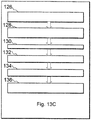
- FIG. 13A A method of making hot mix asphalt using recycled asphalt is shown in Figs. 13A , 13B , and 13C .
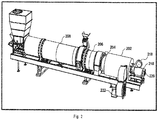
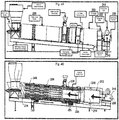
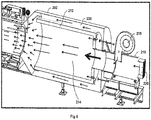
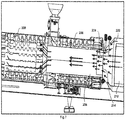
- the method of making hot mix asphalt will be explained with respect to Figs. 1 , 2 , 3 , 4A, 4B , 5-8 , 9A , 9B , 10 , 11 , 12A, 12B, and 12C .
- a hot air generator 202 is provided at a discharge end 204 of a mixing chamber 206 of a rotary counter-flow dryer 208.
- burner 210 is fired into a refractory-lined chamber 212 of the hot air generator 202.
- products of combustion 214 are produced in the refractory-lined chamber 212 using fuel 216, primary air 218, and secondary air 220.
- the products of combustion 214 are heated to about 1477,6°K (2200°F).
- the refractory-lined chamber 212 is surrounded with an annulus 230.
- tertiary air 222 is introduced into the annulus 230.
- the tertiary air 222 is mixed with the products of combustion 214 at an exit of the refractory-lined chamber 212 to produce hot controlled temperature process air 224.
- the tertiary air 222 with a first volume and a first energy level is mixed with the products of combustion 214 at an exit of the refractory-lined chamber 212 to produce the hot controlled temperature process air 224 at a second volume and a second energy level.
- the second volume maybe substantially larger than the first volume and the first energy level may be substantially higher than the second energy level.
- a seventh operation 114 the temperature of the tertiary air 222 is increased while the temperature of the products of combustion 214 is decreased to adjust a temperature of the hot controlled temperature process air 224.
- a thermocouple 244 shown in Fig. 12B may be used to measure the temperature of the hot controlled temperature process air 224.
- the recycled asphalt 228 is heated by exposing the particles to the hot controlled temperature process air 224 in the rotary counter-flow dryer.
- the fine dust particles 242 of the recycled asphalt 228 are added to the rotary counter-flow dryer 208 by spiral shaped flights 234.
- the fine dust particles 242 are picked up in adjustable bucket flights 248 and cascaded across a cross-sectional area of the rotary counter-flow dryer 208.
- virgin aggregates are added into the rotary counter-flow dryer 208 as a fraction of the recycled asphalt 228.
- ground up shingles are added in the rotary counter-flow dryer 208 before the mixer 206.
- the recycled asphalt 228 and the virgin aggregates are mixed with liquid asphalt in the mixing chamber 206 of the rotary counter-flow dryer 208.
- material such as liquid bitumen or foamed bitumen, mineral filler, fibrous filler, crumb rubber, anti-strip agents, glass, and alternative road building materials may be added into the mixing chamber 206 of the rotary counter-flow dryer 208.
- the recycled asphalt 228 is subjected to specially designed mixing paddles in a heating zone of the rotary counter-flow dryer 208.
- the temperature of the hot controlled temperature process air 224 is controlled to slow melting of bitumen in the recycled asphalt 228 until it is mixed with the liquid asphalt.
- indirect heat is added to a mixing chamber 206 of the rotary counter-flow dryer 208 by introducing the hot controlled temperature process air 224 into a rotating tube 236 that radiates heat into the mixing chamber 206.
- a temperature of the rotating tube 236 that radiates heat into the mixing chamber 206 is maintained within a range of about 588,7°K to 755,4°K (600°F to 900°F).
- a temperature of the hot controlled process air 224 is introduced into the rotating tube 236 and the rotary counter-flow dryer 208 and mixer 206 is maintained by modulating an amount of the tertiary air 222.
- the temperature of the hot controlled temperature process air 224 is maintained within a range of approximately 588,7°K to 755,4°K (600°F to 900°F).
- an exit gas temperature from the rotary counter-flow dryer 208 and mixer 206 is measured and the burner 210 is adjusted in response to a moisture level of the recycled asphalt 228 entering the rotary counter-flow dryer 208 and mixer 206.
- the burner 210 is adjusted in response to the exit gas tem perature.
- a temperature of the rotating tube 236 is limited to the temperature of the hot controlled process temperature.
- thermocouple 246 shown in Fig. 12B may be used to measure a temperature of the bitumen.
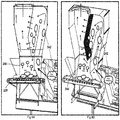
- coarse and fine dust particles 240, 242 shown in Figs. 9A and 9B are collected and separated from an exhaust of the rotary counter-flow dryer 208 in an inertial mechanical particle separator 238 and the coarse and the fine dust particles 240, 242 are added to the recycled asphalt 228.
- the coarse dust particles 240 are added before the rotary counter-flow dryer 208 and the fine dust particles 242 are added after the rotary counter-flow dryer 208.
- the coarse dust particles 240 may be exposed to heat for a longer duration than the fine dust particles 242.
Landscapes
- Chemical & Material Sciences (AREA)
- Engineering & Computer Science (AREA)
- Civil Engineering (AREA)
- Structural Engineering (AREA)
- Architecture (AREA)
- Chemical Kinetics & Catalysis (AREA)
- Materials Engineering (AREA)
- Health & Medical Sciences (AREA)
- Medicinal Chemistry (AREA)
- Polymers & Plastics (AREA)
- Organic Chemistry (AREA)
- Road Paving Machines (AREA)
Claims (13)
- Ein Verfahren zur Herstellung eines Heißmischasphalts unter Verwendung recycelten Asphalts (228), wobei das Verfahren umfasst:Einfeuern eines Brenners (210) in eine feuerfest ausgekleidete Kammer eines Heißluftgenerators (202);Erzeugen von Verbrennungsprodukten (214) in der feuerfest ausgekleideten Kammer unter Verwendung von Brennstoff (216), Primärluft (218), und Sekundärluft (220);Umgeben der feuerfest ausgekleideten Kammer (212) mit einem Ringraum (230);gekennzeichnet durch:Einbringen von Tertiärluft (222) in den Ringraum (230);Mischen der Tertiärluft (222) mit den Verbrennungsprodukten (214) an einem Ausgang der feuerfest ausgekleideten Kammer (212) zum Erzeugen einer heißen temperaturgesteuerten Prozessluft (224);Erhöhen der Temperatur der Tertiärluft (222) während eines Erniedrigens der Temperatur des Verbrennungsproduktes, um eine Temperatur der heißen temperaturgesteuerten Prozessluft (224) einzustellen;Erwärmen von Partikeln des recycelten Asphalts (228) durch Aussetzen der Partikel der heißen temperaturgesteuerten Prozessluft (224) in einem rotierenden Gegenstrom-Trockner (208) und Mischer und Entfernen von Feuchtigkeit von dem recycelten Asphalt (228) mit der heißen temperaturgesteuerten Prozessluft (224);Hinzugeben von neuen Zuschlagsstoffen in den rotierenden Gegenstrom-Trockner (208) als eine Fraktion des recycelten Asphalts (228);Mischen des recycelten Asphalts (228) und der neuen Zuschlagsstoffe mit flüssigem Asphalt in einer Mischkammer (206) des rotierenden Gegenstrom-Trockners (208);Steuern der Temperatur der heißen temperaturgesteuerten Prozessluft (224), um Bitumen in dem recycelten Asphalt (228) langsam zu schmelzen bis es mit dem flüssigen Asphalt gemischt ist;Hinzugeben von indirekter Luft zu der Mischkammer (206) des rotierenden Gegenstrom-Trockners (208) und Mischers durch Einbringen der heißen temperaturgesteuerten Prozessluft (224) in ein rotierendes Rohr (236), das Wärme in die Mischkammer (206) strahlt;Aufrechterhalten einer Temperatur der heißen temperaturgesteuerten Prozessluft (224), die in das rotierende Rohr (236) und den rotierenden Gegenstrom-Trockner (208) und Mischer eingebracht wurde durch Modulieren einer Menge der Tertiärluft (222);Messen einer Austrittsgastemperatur von dem rotierenden Gegenstrom-Trockner (208) und Mischer und Einstellen des Brenners (210) in Antwort auf einen Feuchtigkeitsgrad des recycelten Asphalts (228), der in den rotierenden Gegenstrom-Trockner (208) und Mischer eintritt;Einstellen des Brenners (210) in Antwort auf die Austrittsgastemperatur;Begrenzen einer Temperatur des rotierenden Rohrs (236) auf die Temperatur der heißen temperaturgesteuerten Prozessluft (224);Schmelzen des Bitumens in der Mischkammer (206) ohne den Bitumen wesentlich zu verkohlen; undSammeln und Trennen von groben und feinen Partikeln (240, 242) aus einem Auslass des rotierenden Gegenstrom-Trockners (208) in einem trägheitsmechanischen Partikelseparator und Hinzufügen der groben und der feinen Partikel (240, 242) zu dem recycelten Asphalt (228).
- Das Verfahren zur Herstellung von Heißmischasphalt mit recyceltem Asphalt (228) nach Anspruch 1, ferner aufweisend Erhitzen der Verbrennungsprodukte (214) auf etwa 1477,6°K (2200°F).
- Das Verfahren zur Herstellung von Heißmischasphalt mit recyceltem Asphalt (228) nach Anspruch 1, ferner aufweisend Aufrechterhalten der Temperatur der heißen Prozessluft in einem Bereich von etwa 588,7°K - 755,4°K (600°F - 900°F).
- Das Verfahren zur Herstellung von Heißmischasphalt mit recyceltem Asphalt (228) nach Anspruch 1, ferner umfassen Mischen der Tertiärluft (222) mit einem ersten Volumen und einem ersten Energiegrad der Verbrennungsprodukte (214) an einem Ausgang der feuerfest ausgekleideten Kammer (212) zum Erzeugen der heißen temperaturgesteuerten Prozessluft (224) bei einem zweiten Volumen und einem zweiten Energiegrad, wobei das zweite Volumen wesentlich größer als das erste Volumen ist und der erste Energiegrad wesentlich höher als der zweite Energiegrad ist.
- Das Verfahren zur Herstellung von Heißmischasphalt mit recyceltem Asphalt (228) nach Anspruch 1, ferner umfassend Hinzufügen der groben Partikel (240) vor dem rotierenden Gegenstrom-Trockner (208) und Hinzufügen der feinen Partikel (242) in die Mischzone des rotierenden Gegenstrom-Trockners (208).
- Das Verfahren zur Herstellung von Heißmischasphalt mit recyceltem Asphalt (228) nach Anspruch 5, ferner umfassend Aussetzen der großen Partikel (240) einer Wärme über einen längeren Zeitraum als die feinen Partikel (242).
- Das Verfahren zur Herstellung von Heißmischasphalt mit recyceltem Asphalt (228) nach Anspruch 1, ferner aufweisend Hinzufügen von obererdigen Schindeln in die Mischzone des rotierenden Gegenstrom-Trockners (208).
- Das Verfahren zur Herstellung von Heißmischasphalt mit recyceltem Asphalt (228) nach Anspruch 1, ferner umfassend Hinzufügen eines Materials in die Mischkammer (206) des rotierenden Gegenstrom-Trockners (208), wobei das Material ausgewählt ist aus der Gruppe bestehend aus:flüssigem Bitumen oder geschäumten Bitumen,mineralischem Füller,fibrösem Füller,Gummigranulat,Antiabtragswirkstoff,Glas, undalternativen Straßenbaumaterialien.
- Das Verfahren zur Herstellung von Heißmischasphalt mit recyceltem Asphalt (228) nach Anspruch 1, ferner umfassend Aufrechterhalten einer Temperatur des rotierenden Rohres (236), das Wärme in die Mischkammer (206) strahlt, innerhalb eines Bereichs von 588,7°K - 755,4°K (600°F - 900°F).
- Das Verfahren zur Herstellung von Heißmischasphalt mit recyceltem Asphalt (228) nach Anspruch 1, ferner umfassend Einspeisen der Partikel des recycelten Asphalts (228) in den rotierenden Gegenstrom-Trockner (208) durch spiralförmige Flüge.
- Das Verfahren zur Herstellung von Heißmischasphalt mit recyceltem Asphalt (228) nach Anspruch 10, ferner umfassend Einspeisen der Partikel des recycelten Asphalts (228) in den rotierenden Gegenstrom-Trockner (208) durch spiralförmige Flüge.
- Das Verfahren zur Herstellung von Heißmischasphalt mit recyceltem Asphalt (228) nach Anspruch 1, ferner umfassend Aufnehmen ihres recycelten Asphalts (228) in einstellbarer Eimer-Flügen und Kaskadieren des recycelten Asphalts (228) über eine Querschnittsfläche des rotierenden Gegenstrom-Trockners (208).
- Das Verfahren zur Herstellung von Heißmischasphalt mit recyceltem Asphalt (228) nach Anspruch 1, ferner umfassend Aussetzen des recycelten Asphalts (228) speziell geformten Mischpaddeln in einer Wärmezone des rotierenden Gegenstrom-Trockners (208).
Applications Claiming Priority (2)
| Application Number | Priority Date | Filing Date | Title |
|---|---|---|---|
| US201562103113P | 2015-01-14 | 2015-01-14 | |
| PCT/US2016/012940 WO2016115065A1 (en) | 2015-01-14 | 2016-01-12 | Recycled asphalt process |
Publications (3)
| Publication Number | Publication Date |
|---|---|
| EP3155172A1 EP3155172A1 (de) | 2017-04-19 |
| EP3155172A4 EP3155172A4 (de) | 2018-02-21 |
| EP3155172B1 true EP3155172B1 (de) | 2019-05-01 |
Family
ID=56367132
Family Applications (1)
| Application Number | Title | Priority Date | Filing Date |
|---|---|---|---|
| EP16737690.4A Active EP3155172B1 (de) | 2015-01-14 | 2016-01-12 | Verfahren für ausbauasphalt |
Country Status (4)
| Country | Link |
|---|---|
| US (1) | US9644329B2 (de) |
| EP (1) | EP3155172B1 (de) |
| AU (1) | AU2016206933B2 (de) |
| WO (1) | WO2016115065A1 (de) |
Families Citing this family (5)
| Publication number | Priority date | Publication date | Assignee | Title |
|---|---|---|---|---|
| BR202015013216Y1 (pt) * | 2015-06-05 | 2020-06-16 | Ciber Equipamentos Rodoviários Ltda | Aperfeiçoamento aplicado em chassi de usinas asfálticas móveis |
| US20170190618A1 (en) * | 2015-12-31 | 2017-07-06 | Honeywell International Inc. | Foamed asphalt compositions, recycled asphalt composition including the same, asphalt pavement including the same, and methods of forming asphalt pavement using the same |
| CN108486994A (zh) * | 2018-03-22 | 2018-09-04 | 吉林省嘉鹏集团有限公司 | 沥青路面再生料提温加热方法 |
| US12134864B2 (en) | 2021-03-25 | 2024-11-05 | e5 Engineers, LLC | Flight for asphalt rotary dryer |
| CN113912163B (zh) * | 2021-12-14 | 2022-05-17 | 山东绅联药业有限公司 | 一种医药制药废水处理设备 |
Family Cites Families (10)
| Publication number | Priority date | Publication date | Assignee | Title |
|---|---|---|---|---|
| US4332478A (en) | 1979-05-16 | 1982-06-01 | Barber-Greene Company | Method and apparatus for reducing smoke emissions in an asphalt drum mixer |
| US4787938B3 (en) * | 1986-06-30 | 1999-11-30 | Standard Havens | Countercurrent drum mixer asphalt plant |
| FR2631354A1 (fr) | 1988-05-13 | 1989-11-17 | Ermont Cm | Dispositif et procede de preparation de produits bitumineux |
| US5322367A (en) * | 1989-07-31 | 1994-06-21 | Cyclean, Inc. | Process control for recycled asphalt pavement drum plant |
| US5344229A (en) * | 1989-07-31 | 1994-09-06 | Cyclean, Inc. | Angle and velocity adjustment of a hot mix asphalt drum when output gas temperatures are uneven |
| US5320426A (en) | 1993-01-06 | 1994-06-14 | Astec Industries, Inc. | Asphalt drum mixer having temperature sensor enclosure |
| US5364182A (en) | 1993-11-16 | 1994-11-15 | Michael Hawkins | Counter-flow asphalt plant with multi-stage combustion zone overlapping the mixing zone |
| US5664881A (en) * | 1993-11-16 | 1997-09-09 | Maxam Equipment, Inc. | Counter-flow asphalt plant with multi-stage combustion zone overlapping the mixing zone |
| US6164809A (en) * | 1998-11-30 | 2000-12-26 | Hawkins; Michael R. | Counter-flow asphalt plant with independently rotatable dryer and mixer |
| US7758235B1 (en) | 2004-09-27 | 2010-07-20 | Collette Jerry R | Recycled asphalt pavement (RAP) preparation system |
-
2015
- 2015-05-21 US US14/718,183 patent/US9644329B2/en active Active
-
2016
- 2016-01-12 EP EP16737690.4A patent/EP3155172B1/de active Active
- 2016-01-12 AU AU2016206933A patent/AU2016206933B2/en active Active
- 2016-01-12 WO PCT/US2016/012940 patent/WO2016115065A1/en not_active Ceased
Non-Patent Citations (1)
| Title |
|---|
| None * |
Also Published As
| Publication number | Publication date |
|---|---|
| AU2016206933A1 (en) | 2017-06-29 |
| EP3155172A4 (de) | 2018-02-21 |
| AU2016206933B2 (en) | 2019-10-03 |
| EP3155172A1 (de) | 2017-04-19 |
| WO2016115065A1 (en) | 2016-07-21 |
| US20160201274A1 (en) | 2016-07-14 |
| US9644329B2 (en) | 2017-05-09 |
Similar Documents
| Publication | Publication Date | Title |
|---|---|---|
| EP3155172B1 (de) | Verfahren für ausbauasphalt | |
| US5352275A (en) | Method of producing hot mix asphalt | |
| EP1997099B1 (de) | Vorrichtung und verfahren für eine asphaltheissmischanlage mit einem hohen anteil an recycelten asphaltprodukten | |
| US4025057A (en) | Equipment for making asphalt paving compositions | |
| US5303999A (en) | Apparatus for control of recycled asphalt production | |
| US4189238A (en) | Recycled asphalt-aggregate process and apparatus | |
| US4096588A (en) | Recycled asphalt-aggregate process and apparatus | |
| US4143972A (en) | Combustion control system for bituminous drum mixers | |
| US7044630B1 (en) | Counter-flow asphalt plant method | |
| US4300837A (en) | Device for the preparation of coated bituminous products for road surfacing | |
| CA1280108C (en) | Method and apparatus for mixing asphalt compositions | |
| US4954995A (en) | Device and method for preparing bituminous products | |
| CA2585626A1 (en) | Pre-combustion mix drum | |
| USRE31904E (en) | Method and apparatus for recycling asphalt-aggregate compositions | |
| US5344229A (en) | Angle and velocity adjustment of a hot mix asphalt drum when output gas temperatures are uneven | |
| US5322367A (en) | Process control for recycled asphalt pavement drum plant | |
| US20150345085A1 (en) | Multiple-entry hot-mix asphalt manufacturing system and method | |
| USRE31905E (en) | Method and apparatus for recycling asphalt-aggregate compositions | |
| US4177080A (en) | Method and apparatus for recycling asphalt-aggregate compositions | |
| CA1118157A (en) | Method and apparatus for recycling asphalt- aggregate compositions | |
| US20140369155A1 (en) | System for utilizing recycled asphalt pavement and methods thereof | |
| US4142803A (en) | Recycled asphalt-aggregate process and apparatus | |
| US4215941A (en) | Method and apparatus for recycling asphalt-aggregate compositions | |
| CA1060278A (en) | Production of aggregate material coated with bituminous binder | |
| RU2509838C2 (ru) | Способ и устройство для производства асфальтовой смеси |
Legal Events
| Date | Code | Title | Description |
|---|---|---|---|
| STAA | Information on the status of an ep patent application or granted ep patent |
Free format text: STATUS: THE INTERNATIONAL PUBLICATION HAS BEEN MADE |
|
| PUAI | Public reference made under article 153(3) epc to a published international application that has entered the european phase |
Free format text: ORIGINAL CODE: 0009012 |
|
| STAA | Information on the status of an ep patent application or granted ep patent |
Free format text: STATUS: REQUEST FOR EXAMINATION WAS MADE |
|
| 17P | Request for examination filed |
Effective date: 20170116 |
|
| AK | Designated contracting states |
Kind code of ref document: A1 Designated state(s): AL AT BE BG CH CY CZ DE DK EE ES FI FR GB GR HR HU IE IS IT LI LT LU LV MC MK MT NL NO PL PT RO RS SE SI SK SM TR |
|
| AX | Request for extension of the european patent |
Extension state: BA ME |
|
| A4 | Supplementary search report drawn up and despatched |
Effective date: 20180123 |
|
| RIC1 | Information provided on ipc code assigned before grant |
Ipc: E01C 19/10 20060101AFI20180117BHEP |
|
| DAV | Request for validation of the european patent (deleted) | ||
| DAX | Request for extension of the european patent (deleted) | ||
| GRAP | Despatch of communication of intention to grant a patent |
Free format text: ORIGINAL CODE: EPIDOSNIGR1 |
|
| STAA | Information on the status of an ep patent application or granted ep patent |
Free format text: STATUS: GRANT OF PATENT IS INTENDED |
|
| INTG | Intention to grant announced |
Effective date: 20181127 |
|
| GRAS | Grant fee paid |
Free format text: ORIGINAL CODE: EPIDOSNIGR3 |
|
| GRAA | (expected) grant |
Free format text: ORIGINAL CODE: 0009210 |
|
| STAA | Information on the status of an ep patent application or granted ep patent |
Free format text: STATUS: THE PATENT HAS BEEN GRANTED |
|
| AK | Designated contracting states |
Kind code of ref document: B1 Designated state(s): AL AT BE BG CH CY CZ DE DK EE ES FI FR GB GR HR HU IE IS IT LI LT LU LV MC MK MT NL NO PL PT RO RS SE SI SK SM TR |
|
| REG | Reference to a national code |
Ref country code: GB Ref legal event code: FG4D |
|
| REG | Reference to a national code |
Ref country code: CH Ref legal event code: EP Ref country code: AT Ref legal event code: REF Ref document number: 1127037 Country of ref document: AT Kind code of ref document: T Effective date: 20190515 |
|
| REG | Reference to a national code |
Ref country code: DE Ref legal event code: R096 Ref document number: 602016013284 Country of ref document: DE |
|
| REG | Reference to a national code |
Ref country code: IE Ref legal event code: FG4D |
|
| REG | Reference to a national code |
Ref country code: CH Ref legal event code: NV Representative=s name: SERVOPATENT GMBH, CH |
|
| REG | Reference to a national code |
Ref country code: NL Ref legal event code: MP Effective date: 20190501 |
|
| REG | Reference to a national code |
Ref country code: LT Ref legal event code: MG4D |
|
| PG25 | Lapsed in a contracting state [announced via postgrant information from national office to epo] |
Ref country code: HR Free format text: LAPSE BECAUSE OF FAILURE TO SUBMIT A TRANSLATION OF THE DESCRIPTION OR TO PAY THE FEE WITHIN THE PRESCRIBED TIME-LIMIT Effective date: 20190501 Ref country code: LT Free format text: LAPSE BECAUSE OF FAILURE TO SUBMIT A TRANSLATION OF THE DESCRIPTION OR TO PAY THE FEE WITHIN THE PRESCRIBED TIME-LIMIT Effective date: 20190501 Ref country code: SE Free format text: LAPSE BECAUSE OF FAILURE TO SUBMIT A TRANSLATION OF THE DESCRIPTION OR TO PAY THE FEE WITHIN THE PRESCRIBED TIME-LIMIT Effective date: 20190501 Ref country code: NL Free format text: LAPSE BECAUSE OF FAILURE TO SUBMIT A TRANSLATION OF THE DESCRIPTION OR TO PAY THE FEE WITHIN THE PRESCRIBED TIME-LIMIT Effective date: 20190501 Ref country code: FI Free format text: LAPSE BECAUSE OF FAILURE TO SUBMIT A TRANSLATION OF THE DESCRIPTION OR TO PAY THE FEE WITHIN THE PRESCRIBED TIME-LIMIT Effective date: 20190501 Ref country code: AL Free format text: LAPSE BECAUSE OF FAILURE TO SUBMIT A TRANSLATION OF THE DESCRIPTION OR TO PAY THE FEE WITHIN THE PRESCRIBED TIME-LIMIT Effective date: 20190501 Ref country code: ES Free format text: LAPSE BECAUSE OF FAILURE TO SUBMIT A TRANSLATION OF THE DESCRIPTION OR TO PAY THE FEE WITHIN THE PRESCRIBED TIME-LIMIT Effective date: 20190501 Ref country code: PT Free format text: LAPSE BECAUSE OF FAILURE TO SUBMIT A TRANSLATION OF THE DESCRIPTION OR TO PAY THE FEE WITHIN THE PRESCRIBED TIME-LIMIT Effective date: 20190901 Ref country code: NO Free format text: LAPSE BECAUSE OF FAILURE TO SUBMIT A TRANSLATION OF THE DESCRIPTION OR TO PAY THE FEE WITHIN THE PRESCRIBED TIME-LIMIT Effective date: 20190801 |
|
| PG25 | Lapsed in a contracting state [announced via postgrant information from national office to epo] |
Ref country code: BG Free format text: LAPSE BECAUSE OF FAILURE TO SUBMIT A TRANSLATION OF THE DESCRIPTION OR TO PAY THE FEE WITHIN THE PRESCRIBED TIME-LIMIT Effective date: 20190801 Ref country code: GR Free format text: LAPSE BECAUSE OF FAILURE TO SUBMIT A TRANSLATION OF THE DESCRIPTION OR TO PAY THE FEE WITHIN THE PRESCRIBED TIME-LIMIT Effective date: 20190802 Ref country code: LV Free format text: LAPSE BECAUSE OF FAILURE TO SUBMIT A TRANSLATION OF THE DESCRIPTION OR TO PAY THE FEE WITHIN THE PRESCRIBED TIME-LIMIT Effective date: 20190501 Ref country code: RS Free format text: LAPSE BECAUSE OF FAILURE TO SUBMIT A TRANSLATION OF THE DESCRIPTION OR TO PAY THE FEE WITHIN THE PRESCRIBED TIME-LIMIT Effective date: 20190501 |
|
| REG | Reference to a national code |
Ref country code: AT Ref legal event code: MK05 Ref document number: 1127037 Country of ref document: AT Kind code of ref document: T Effective date: 20190501 |
|
| PG25 | Lapsed in a contracting state [announced via postgrant information from national office to epo] |
Ref country code: IS Free format text: LAPSE BECAUSE OF FAILURE TO SUBMIT A TRANSLATION OF THE DESCRIPTION OR TO PAY THE FEE WITHIN THE PRESCRIBED TIME-LIMIT Effective date: 20190901 |
|
| PG25 | Lapsed in a contracting state [announced via postgrant information from national office to epo] |
Ref country code: EE Free format text: LAPSE BECAUSE OF FAILURE TO SUBMIT A TRANSLATION OF THE DESCRIPTION OR TO PAY THE FEE WITHIN THE PRESCRIBED TIME-LIMIT Effective date: 20190501 Ref country code: DK Free format text: LAPSE BECAUSE OF FAILURE TO SUBMIT A TRANSLATION OF THE DESCRIPTION OR TO PAY THE FEE WITHIN THE PRESCRIBED TIME-LIMIT Effective date: 20190501 Ref country code: RO Free format text: LAPSE BECAUSE OF FAILURE TO SUBMIT A TRANSLATION OF THE DESCRIPTION OR TO PAY THE FEE WITHIN THE PRESCRIBED TIME-LIMIT Effective date: 20190501 Ref country code: AT Free format text: LAPSE BECAUSE OF FAILURE TO SUBMIT A TRANSLATION OF THE DESCRIPTION OR TO PAY THE FEE WITHIN THE PRESCRIBED TIME-LIMIT Effective date: 20190501 Ref country code: CZ Free format text: LAPSE BECAUSE OF FAILURE TO SUBMIT A TRANSLATION OF THE DESCRIPTION OR TO PAY THE FEE WITHIN THE PRESCRIBED TIME-LIMIT Effective date: 20190501 Ref country code: SK Free format text: LAPSE BECAUSE OF FAILURE TO SUBMIT A TRANSLATION OF THE DESCRIPTION OR TO PAY THE FEE WITHIN THE PRESCRIBED TIME-LIMIT Effective date: 20190501 |
|
| REG | Reference to a national code |
Ref country code: DE Ref legal event code: R097 Ref document number: 602016013284 Country of ref document: DE |
|
| PG25 | Lapsed in a contracting state [announced via postgrant information from national office to epo] |
Ref country code: SM Free format text: LAPSE BECAUSE OF FAILURE TO SUBMIT A TRANSLATION OF THE DESCRIPTION OR TO PAY THE FEE WITHIN THE PRESCRIBED TIME-LIMIT Effective date: 20190501 Ref country code: IT Free format text: LAPSE BECAUSE OF FAILURE TO SUBMIT A TRANSLATION OF THE DESCRIPTION OR TO PAY THE FEE WITHIN THE PRESCRIBED TIME-LIMIT Effective date: 20190501 |
|
| PLBE | No opposition filed within time limit |
Free format text: ORIGINAL CODE: 0009261 |
|
| STAA | Information on the status of an ep patent application or granted ep patent |
Free format text: STATUS: NO OPPOSITION FILED WITHIN TIME LIMIT |
|
| PG25 | Lapsed in a contracting state [announced via postgrant information from national office to epo] |
Ref country code: TR Free format text: LAPSE BECAUSE OF FAILURE TO SUBMIT A TRANSLATION OF THE DESCRIPTION OR TO PAY THE FEE WITHIN THE PRESCRIBED TIME-LIMIT Effective date: 20190501 |
|
| 26N | No opposition filed |
Effective date: 20200204 |
|
| PG25 | Lapsed in a contracting state [announced via postgrant information from national office to epo] |
Ref country code: PL Free format text: LAPSE BECAUSE OF FAILURE TO SUBMIT A TRANSLATION OF THE DESCRIPTION OR TO PAY THE FEE WITHIN THE PRESCRIBED TIME-LIMIT Effective date: 20190501 |
|
| PG25 | Lapsed in a contracting state [announced via postgrant information from national office to epo] |
Ref country code: SI Free format text: LAPSE BECAUSE OF FAILURE TO SUBMIT A TRANSLATION OF THE DESCRIPTION OR TO PAY THE FEE WITHIN THE PRESCRIBED TIME-LIMIT Effective date: 20190501 |
|
| REG | Reference to a national code |
Ref country code: CH Ref legal event code: PCAR Free format text: NEW ADDRESS: WANNERSTRASSE 9/1, 8045 ZUERICH (CH) |
|
| PG25 | Lapsed in a contracting state [announced via postgrant information from national office to epo] |
Ref country code: MC Free format text: LAPSE BECAUSE OF FAILURE TO SUBMIT A TRANSLATION OF THE DESCRIPTION OR TO PAY THE FEE WITHIN THE PRESCRIBED TIME-LIMIT Effective date: 20190501 |
|
| REG | Reference to a national code |
Ref country code: BE Ref legal event code: MM Effective date: 20200131 |
|
| PG25 | Lapsed in a contracting state [announced via postgrant information from national office to epo] |
Ref country code: LU Free format text: LAPSE BECAUSE OF NON-PAYMENT OF DUE FEES Effective date: 20200112 |
|
| PG25 | Lapsed in a contracting state [announced via postgrant information from national office to epo] |
Ref country code: BE Free format text: LAPSE BECAUSE OF NON-PAYMENT OF DUE FEES Effective date: 20200131 |
|
| PG25 | Lapsed in a contracting state [announced via postgrant information from national office to epo] |
Ref country code: IE Free format text: LAPSE BECAUSE OF NON-PAYMENT OF DUE FEES Effective date: 20200112 |
|
| PG25 | Lapsed in a contracting state [announced via postgrant information from national office to epo] |
Ref country code: MT Free format text: LAPSE BECAUSE OF FAILURE TO SUBMIT A TRANSLATION OF THE DESCRIPTION OR TO PAY THE FEE WITHIN THE PRESCRIBED TIME-LIMIT Effective date: 20190501 Ref country code: CY Free format text: LAPSE BECAUSE OF FAILURE TO SUBMIT A TRANSLATION OF THE DESCRIPTION OR TO PAY THE FEE WITHIN THE PRESCRIBED TIME-LIMIT Effective date: 20190501 |
|
| PG25 | Lapsed in a contracting state [announced via postgrant information from national office to epo] |
Ref country code: MK Free format text: LAPSE BECAUSE OF FAILURE TO SUBMIT A TRANSLATION OF THE DESCRIPTION OR TO PAY THE FEE WITHIN THE PRESCRIBED TIME-LIMIT Effective date: 20190501 |
|
| P01 | Opt-out of the competence of the unified patent court (upc) registered |
Effective date: 20230602 |
|
| REG | Reference to a national code |
Ref country code: CH Ref legal event code: U11 Free format text: ST27 STATUS EVENT CODE: U-0-0-U10-U11 (AS PROVIDED BY THE NATIONAL OFFICE) Effective date: 20260219 |
|
| PGFP | Annual fee paid to national office [announced via postgrant information from national office to epo] |
Ref country code: GB Payment date: 20260219 Year of fee payment: 11 |
|
| PGFP | Annual fee paid to national office [announced via postgrant information from national office to epo] |
Ref country code: DE Payment date: 20260126 Year of fee payment: 11 |
|
| PGFP | Annual fee paid to national office [announced via postgrant information from national office to epo] |
Ref country code: FR Payment date: 20260129 Year of fee payment: 11 |
|
| PGFP | Annual fee paid to national office [announced via postgrant information from national office to epo] |
Ref country code: CH Payment date: 20260219 Year of fee payment: 11 |