EP3156384B1 - Corps fritté et outil de coupe - Google Patents
Corps fritté et outil de coupe Download PDFInfo
- Publication number
- EP3156384B1 EP3156384B1 EP16802855.3A EP16802855A EP3156384B1 EP 3156384 B1 EP3156384 B1 EP 3156384B1 EP 16802855 A EP16802855 A EP 16802855A EP 3156384 B1 EP3156384 B1 EP 3156384B1
- Authority
- EP
- European Patent Office
- Prior art keywords
- sintered compact
- aluminum oxide
- fine
- volume
- region
- Prior art date
- Legal status (The legal status is an assumption and is not a legal conclusion. Google has not performed a legal analysis and makes no representation as to the accuracy of the status listed.)
- Active
Links
Images


Classifications
-
- C—CHEMISTRY; METALLURGY
- C04—CEMENTS; CONCRETE; ARTIFICIAL STONE; CERAMICS; REFRACTORIES
- C04B—LIME, MAGNESIA; SLAG; CEMENTS; COMPOSITIONS THEREOF, e.g. MORTARS, CONCRETE OR LIKE BUILDING MATERIALS; ARTIFICIAL STONE; CERAMICS; REFRACTORIES; TREATMENT OF NATURAL STONE
- C04B35/00—Shaped ceramic products characterised by their composition; Ceramics compositions; Processing powders of inorganic compounds preparatory to the manufacturing of ceramic products
- C04B35/515—Shaped ceramic products characterised by their composition; Ceramics compositions; Processing powders of inorganic compounds preparatory to the manufacturing of ceramic products based on non-oxide ceramics
- C04B35/58—Shaped ceramic products characterised by their composition; Ceramics compositions; Processing powders of inorganic compounds preparatory to the manufacturing of ceramic products based on non-oxide ceramics based on borides, nitrides, i.e. nitrides, oxynitrides, carbonitrides or oxycarbonitrides or silicides
- C04B35/583—Shaped ceramic products characterised by their composition; Ceramics compositions; Processing powders of inorganic compounds preparatory to the manufacturing of ceramic products based on non-oxide ceramics based on borides, nitrides, i.e. nitrides, oxynitrides, carbonitrides or oxycarbonitrides or silicides based on boron nitride
- C04B35/5831—Shaped ceramic products characterised by their composition; Ceramics compositions; Processing powders of inorganic compounds preparatory to the manufacturing of ceramic products based on non-oxide ceramics based on borides, nitrides, i.e. nitrides, oxynitrides, carbonitrides or oxycarbonitrides or silicides based on boron nitride based on cubic boron nitrides or Wurtzitic boron nitrides, including crystal structure transformation of powder
-
- B—PERFORMING OPERATIONS; TRANSPORTING
- B23—MACHINE TOOLS; METAL-WORKING NOT OTHERWISE PROVIDED FOR
- B23B—TURNING; BORING
- B23B27/00—Tools for turning or boring machines; Tools of a similar kind in general; Accessories therefor
- B23B27/14—Cutting tools of which the bits or tips or cutting inserts are of special material
- B23B27/148—Composition of the cutting inserts
-
- B—PERFORMING OPERATIONS; TRANSPORTING
- B23—MACHINE TOOLS; METAL-WORKING NOT OTHERWISE PROVIDED FOR
- B23C—MILLING
- B23C5/00—Milling-cutters
- B23C5/16—Milling-cutters characterised by physical features other than shape
- B23C5/20—Milling-cutters characterised by physical features other than shape with removable cutter bits or teeth or cutting inserts
-
- C—CHEMISTRY; METALLURGY
- C01—INORGANIC CHEMISTRY
- C01F—COMPOUNDS OF THE METALS BERYLLIUM, MAGNESIUM, ALUMINIUM, CALCIUM, STRONTIUM, BARIUM, RADIUM, THORIUM, OR OF THE RARE-EARTH METALS
- C01F7/00—Compounds of aluminium
- C01F7/02—Aluminium oxide; Aluminium hydroxide; Aluminates
- C01F7/34—Preparation of aluminium hydroxide by precipitation from solutions containing aluminium salts
-
- C—CHEMISTRY; METALLURGY
- C01—INORGANIC CHEMISTRY
- C01F—COMPOUNDS OF THE METALS BERYLLIUM, MAGNESIUM, ALUMINIUM, CALCIUM, STRONTIUM, BARIUM, RADIUM, THORIUM, OR OF THE RARE-EARTH METALS
- C01F7/00—Compounds of aluminium
- C01F7/02—Aluminium oxide; Aluminium hydroxide; Aluminates
- C01F7/34—Preparation of aluminium hydroxide by precipitation from solutions containing aluminium salts
- C01F7/36—Preparation of aluminium hydroxide by precipitation from solutions containing aluminium salts from organic aluminium salts
-
- C—CHEMISTRY; METALLURGY
- C01—INORGANIC CHEMISTRY
- C01G—COMPOUNDS CONTAINING METALS NOT COVERED BY SUBCLASSES C01D OR C01F
- C01G25/00—Compounds of zirconium
- C01G25/02—Oxides
-
- C—CHEMISTRY; METALLURGY
- C04—CEMENTS; CONCRETE; ARTIFICIAL STONE; CERAMICS; REFRACTORIES
- C04B—LIME, MAGNESIA; SLAG; CEMENTS; COMPOSITIONS THEREOF, e.g. MORTARS, CONCRETE OR LIKE BUILDING MATERIALS; ARTIFICIAL STONE; CERAMICS; REFRACTORIES; TREATMENT OF NATURAL STONE
- C04B35/00—Shaped ceramic products characterised by their composition; Ceramics compositions; Processing powders of inorganic compounds preparatory to the manufacturing of ceramic products
- C04B35/01—Shaped ceramic products characterised by their composition; Ceramics compositions; Processing powders of inorganic compounds preparatory to the manufacturing of ceramic products based on oxide ceramics
- C04B35/48—Shaped ceramic products characterised by their composition; Ceramics compositions; Processing powders of inorganic compounds preparatory to the manufacturing of ceramic products based on oxide ceramics based on zirconium or hafnium oxides, zirconates, zircon or hafnates
- C04B35/486—Fine ceramics
- C04B35/488—Composites
- C04B35/4885—Composites with aluminium oxide
-
- C—CHEMISTRY; METALLURGY
- C04—CEMENTS; CONCRETE; ARTIFICIAL STONE; CERAMICS; REFRACTORIES
- C04B—LIME, MAGNESIA; SLAG; CEMENTS; COMPOSITIONS THEREOF, e.g. MORTARS, CONCRETE OR LIKE BUILDING MATERIALS; ARTIFICIAL STONE; CERAMICS; REFRACTORIES; TREATMENT OF NATURAL STONE
- C04B35/00—Shaped ceramic products characterised by their composition; Ceramics compositions; Processing powders of inorganic compounds preparatory to the manufacturing of ceramic products
- C04B35/622—Forming processes; Processing powders of inorganic compounds preparatory to the manufacturing of ceramic products
- C04B35/626—Preparing or treating the powders individually or as batches ; preparing or treating macroscopic reinforcing agents for ceramic products, e.g. fibres; mechanical aspects section B
- C04B35/62605—Treating the starting powders individually or as mixtures
- C04B35/6261—Milling
-
- C—CHEMISTRY; METALLURGY
- C04—CEMENTS; CONCRETE; ARTIFICIAL STONE; CERAMICS; REFRACTORIES
- C04B—LIME, MAGNESIA; SLAG; CEMENTS; COMPOSITIONS THEREOF, e.g. MORTARS, CONCRETE OR LIKE BUILDING MATERIALS; ARTIFICIAL STONE; CERAMICS; REFRACTORIES; TREATMENT OF NATURAL STONE
- C04B35/00—Shaped ceramic products characterised by their composition; Ceramics compositions; Processing powders of inorganic compounds preparatory to the manufacturing of ceramic products
- C04B35/622—Forming processes; Processing powders of inorganic compounds preparatory to the manufacturing of ceramic products
- C04B35/626—Preparing or treating the powders individually or as batches ; preparing or treating macroscopic reinforcing agents for ceramic products, e.g. fibres; mechanical aspects section B
- C04B35/62605—Treating the starting powders individually or as mixtures
- C04B35/62625—Wet mixtures
- C04B35/6264—Mixing media, e.g. organic solvents
-
- C—CHEMISTRY; METALLURGY
- C04—CEMENTS; CONCRETE; ARTIFICIAL STONE; CERAMICS; REFRACTORIES
- C04B—LIME, MAGNESIA; SLAG; CEMENTS; COMPOSITIONS THEREOF, e.g. MORTARS, CONCRETE OR LIKE BUILDING MATERIALS; ARTIFICIAL STONE; CERAMICS; REFRACTORIES; TREATMENT OF NATURAL STONE
- C04B35/00—Shaped ceramic products characterised by their composition; Ceramics compositions; Processing powders of inorganic compounds preparatory to the manufacturing of ceramic products
- C04B35/622—Forming processes; Processing powders of inorganic compounds preparatory to the manufacturing of ceramic products
- C04B35/626—Preparing or treating the powders individually or as batches ; preparing or treating macroscopic reinforcing agents for ceramic products, e.g. fibres; mechanical aspects section B
- C04B35/63—Preparing or treating the powders individually or as batches ; preparing or treating macroscopic reinforcing agents for ceramic products, e.g. fibres; mechanical aspects section B using additives specially adapted for forming the products, e.g.. binder binders
- C04B35/6303—Inorganic additives
-
- C—CHEMISTRY; METALLURGY
- C04—CEMENTS; CONCRETE; ARTIFICIAL STONE; CERAMICS; REFRACTORIES
- C04B—LIME, MAGNESIA; SLAG; CEMENTS; COMPOSITIONS THEREOF, e.g. MORTARS, CONCRETE OR LIKE BUILDING MATERIALS; ARTIFICIAL STONE; CERAMICS; REFRACTORIES; TREATMENT OF NATURAL STONE
- C04B35/00—Shaped ceramic products characterised by their composition; Ceramics compositions; Processing powders of inorganic compounds preparatory to the manufacturing of ceramic products
- C04B35/622—Forming processes; Processing powders of inorganic compounds preparatory to the manufacturing of ceramic products
- C04B35/64—Burning or sintering processes
- C04B35/645—Pressure sintering
-
- B—PERFORMING OPERATIONS; TRANSPORTING
- B23—MACHINE TOOLS; METAL-WORKING NOT OTHERWISE PROVIDED FOR
- B23B—TURNING; BORING
- B23B2224/00—Materials of tools or workpieces composed of a compound including a metal
- B23B2224/04—Aluminium oxide
-
- B—PERFORMING OPERATIONS; TRANSPORTING
- B23—MACHINE TOOLS; METAL-WORKING NOT OTHERWISE PROVIDED FOR
- B23B—TURNING; BORING
- B23B2226/00—Materials of tools or workpieces not comprising a metal
- B23B2226/12—Boron nitride
- B23B2226/125—Boron nitride cubic [CBN]
-
- B—PERFORMING OPERATIONS; TRANSPORTING
- B23—MACHINE TOOLS; METAL-WORKING NOT OTHERWISE PROVIDED FOR
- B23B—TURNING; BORING
- B23B2228/00—Properties of materials of tools or workpieces, materials of tools or workpieces applied in a specific manner
- B23B2228/44—Materials having grain size less than 1 micrometre, e.g. nanocrystalline
-
- B—PERFORMING OPERATIONS; TRANSPORTING
- B23—MACHINE TOOLS; METAL-WORKING NOT OTHERWISE PROVIDED FOR
- B23C—MILLING
- B23C2224/00—Materials of tools or workpieces composed of a compound including a metal
- B23C2224/04—Aluminium oxide
-
- B—PERFORMING OPERATIONS; TRANSPORTING
- B23—MACHINE TOOLS; METAL-WORKING NOT OTHERWISE PROVIDED FOR
- B23C—MILLING
- B23C2226/00—Materials of tools or workpieces not comprising a metal
- B23C2226/12—Boron nitride
- B23C2226/125—Boron nitride cubic [CBN]
-
- B—PERFORMING OPERATIONS; TRANSPORTING
- B23—MACHINE TOOLS; METAL-WORKING NOT OTHERWISE PROVIDED FOR
- B23C—MILLING
- B23C2228/00—Properties of materials of tools or workpieces, materials of tools or workpieces applied in a specific manner
- B23C2228/49—Sintered
-
- C—CHEMISTRY; METALLURGY
- C01—INORGANIC CHEMISTRY
- C01P—INDEXING SCHEME RELATING TO STRUCTURAL AND PHYSICAL ASPECTS OF SOLID INORGANIC COMPOUNDS
- C01P2002/00—Crystal-structural characteristics
- C01P2002/50—Solid solutions
-
- C—CHEMISTRY; METALLURGY
- C01—INORGANIC CHEMISTRY
- C01P—INDEXING SCHEME RELATING TO STRUCTURAL AND PHYSICAL ASPECTS OF SOLID INORGANIC COMPOUNDS
- C01P2002/00—Crystal-structural characteristics
- C01P2002/50—Solid solutions
- C01P2002/52—Solid solutions containing elements as dopants
- C01P2002/54—Solid solutions containing elements as dopants one element only
-
- C—CHEMISTRY; METALLURGY
- C01—INORGANIC CHEMISTRY
- C01P—INDEXING SCHEME RELATING TO STRUCTURAL AND PHYSICAL ASPECTS OF SOLID INORGANIC COMPOUNDS
- C01P2004/00—Particle morphology
- C01P2004/60—Particles characterised by their size
- C01P2004/64—Nanometer sized, i.e. from 1-100 nanometer
-
- C—CHEMISTRY; METALLURGY
- C04—CEMENTS; CONCRETE; ARTIFICIAL STONE; CERAMICS; REFRACTORIES
- C04B—LIME, MAGNESIA; SLAG; CEMENTS; COMPOSITIONS THEREOF, e.g. MORTARS, CONCRETE OR LIKE BUILDING MATERIALS; ARTIFICIAL STONE; CERAMICS; REFRACTORIES; TREATMENT OF NATURAL STONE
- C04B2235/00—Aspects relating to ceramic starting mixtures or sintered ceramic products
- C04B2235/02—Composition of constituents of the starting material or of secondary phases of the final product
- C04B2235/30—Constituents and secondary phases not being of a fibrous nature
- C04B2235/32—Metal oxides, mixed metal oxides, or oxide-forming salts thereof, e.g. carbonates, nitrates, (oxy)hydroxides, chlorides
- C04B2235/3205—Alkaline earth oxides or oxide forming salts thereof, e.g. beryllium oxide
- C04B2235/3206—Magnesium oxides or oxide-forming salts thereof
-
- C—CHEMISTRY; METALLURGY
- C04—CEMENTS; CONCRETE; ARTIFICIAL STONE; CERAMICS; REFRACTORIES
- C04B—LIME, MAGNESIA; SLAG; CEMENTS; COMPOSITIONS THEREOF, e.g. MORTARS, CONCRETE OR LIKE BUILDING MATERIALS; ARTIFICIAL STONE; CERAMICS; REFRACTORIES; TREATMENT OF NATURAL STONE
- C04B2235/00—Aspects relating to ceramic starting mixtures or sintered ceramic products
- C04B2235/02—Composition of constituents of the starting material or of secondary phases of the final product
- C04B2235/30—Constituents and secondary phases not being of a fibrous nature
- C04B2235/32—Metal oxides, mixed metal oxides, or oxide-forming salts thereof, e.g. carbonates, nitrates, (oxy)hydroxides, chlorides
- C04B2235/3217—Aluminum oxide or oxide forming salts thereof, e.g. bauxite, alpha-alumina
-
- C—CHEMISTRY; METALLURGY
- C04—CEMENTS; CONCRETE; ARTIFICIAL STONE; CERAMICS; REFRACTORIES
- C04B—LIME, MAGNESIA; SLAG; CEMENTS; COMPOSITIONS THEREOF, e.g. MORTARS, CONCRETE OR LIKE BUILDING MATERIALS; ARTIFICIAL STONE; CERAMICS; REFRACTORIES; TREATMENT OF NATURAL STONE
- C04B2235/00—Aspects relating to ceramic starting mixtures or sintered ceramic products
- C04B2235/02—Composition of constituents of the starting material or of secondary phases of the final product
- C04B2235/30—Constituents and secondary phases not being of a fibrous nature
- C04B2235/32—Metal oxides, mixed metal oxides, or oxide-forming salts thereof, e.g. carbonates, nitrates, (oxy)hydroxides, chlorides
- C04B2235/3224—Rare earth oxide or oxide forming salts thereof, e.g. scandium oxide
- C04B2235/3225—Yttrium oxide or oxide-forming salts thereof
-
- C—CHEMISTRY; METALLURGY
- C04—CEMENTS; CONCRETE; ARTIFICIAL STONE; CERAMICS; REFRACTORIES
- C04B—LIME, MAGNESIA; SLAG; CEMENTS; COMPOSITIONS THEREOF, e.g. MORTARS, CONCRETE OR LIKE BUILDING MATERIALS; ARTIFICIAL STONE; CERAMICS; REFRACTORIES; TREATMENT OF NATURAL STONE
- C04B2235/00—Aspects relating to ceramic starting mixtures or sintered ceramic products
- C04B2235/02—Composition of constituents of the starting material or of secondary phases of the final product
- C04B2235/30—Constituents and secondary phases not being of a fibrous nature
- C04B2235/32—Metal oxides, mixed metal oxides, or oxide-forming salts thereof, e.g. carbonates, nitrates, (oxy)hydroxides, chlorides
- C04B2235/3224—Rare earth oxide or oxide forming salts thereof, e.g. scandium oxide
- C04B2235/3229—Cerium oxides or oxide-forming salts thereof
-
- C—CHEMISTRY; METALLURGY
- C04—CEMENTS; CONCRETE; ARTIFICIAL STONE; CERAMICS; REFRACTORIES
- C04B—LIME, MAGNESIA; SLAG; CEMENTS; COMPOSITIONS THEREOF, e.g. MORTARS, CONCRETE OR LIKE BUILDING MATERIALS; ARTIFICIAL STONE; CERAMICS; REFRACTORIES; TREATMENT OF NATURAL STONE
- C04B2235/00—Aspects relating to ceramic starting mixtures or sintered ceramic products
- C04B2235/02—Composition of constituents of the starting material or of secondary phases of the final product
- C04B2235/30—Constituents and secondary phases not being of a fibrous nature
- C04B2235/32—Metal oxides, mixed metal oxides, or oxide-forming salts thereof, e.g. carbonates, nitrates, (oxy)hydroxides, chlorides
- C04B2235/3231—Refractory metal oxides, their mixed metal oxides, or oxide-forming salts thereof
- C04B2235/3244—Zirconium oxides, zirconates, hafnium oxides, hafnates, or oxide-forming salts thereof
-
- C—CHEMISTRY; METALLURGY
- C04—CEMENTS; CONCRETE; ARTIFICIAL STONE; CERAMICS; REFRACTORIES
- C04B—LIME, MAGNESIA; SLAG; CEMENTS; COMPOSITIONS THEREOF, e.g. MORTARS, CONCRETE OR LIKE BUILDING MATERIALS; ARTIFICIAL STONE; CERAMICS; REFRACTORIES; TREATMENT OF NATURAL STONE
- C04B2235/00—Aspects relating to ceramic starting mixtures or sintered ceramic products
- C04B2235/02—Composition of constituents of the starting material or of secondary phases of the final product
- C04B2235/30—Constituents and secondary phases not being of a fibrous nature
- C04B2235/38—Non-oxide ceramic constituents or additives
- C04B2235/3817—Carbides
- C04B2235/3839—Refractory metal carbides
-
- C—CHEMISTRY; METALLURGY
- C04—CEMENTS; CONCRETE; ARTIFICIAL STONE; CERAMICS; REFRACTORIES
- C04B—LIME, MAGNESIA; SLAG; CEMENTS; COMPOSITIONS THEREOF, e.g. MORTARS, CONCRETE OR LIKE BUILDING MATERIALS; ARTIFICIAL STONE; CERAMICS; REFRACTORIES; TREATMENT OF NATURAL STONE
- C04B2235/00—Aspects relating to ceramic starting mixtures or sintered ceramic products
- C04B2235/02—Composition of constituents of the starting material or of secondary phases of the final product
- C04B2235/30—Constituents and secondary phases not being of a fibrous nature
- C04B2235/38—Non-oxide ceramic constituents or additives
- C04B2235/3817—Carbides
- C04B2235/3839—Refractory metal carbides
- C04B2235/3843—Titanium carbides
-
- C—CHEMISTRY; METALLURGY
- C04—CEMENTS; CONCRETE; ARTIFICIAL STONE; CERAMICS; REFRACTORIES
- C04B—LIME, MAGNESIA; SLAG; CEMENTS; COMPOSITIONS THEREOF, e.g. MORTARS, CONCRETE OR LIKE BUILDING MATERIALS; ARTIFICIAL STONE; CERAMICS; REFRACTORIES; TREATMENT OF NATURAL STONE
- C04B2235/00—Aspects relating to ceramic starting mixtures or sintered ceramic products
- C04B2235/02—Composition of constituents of the starting material or of secondary phases of the final product
- C04B2235/30—Constituents and secondary phases not being of a fibrous nature
- C04B2235/38—Non-oxide ceramic constituents or additives
- C04B2235/3852—Nitrides, e.g. oxynitrides, carbonitrides, oxycarbonitrides, lithium nitride, magnesium nitride
-
- C—CHEMISTRY; METALLURGY
- C04—CEMENTS; CONCRETE; ARTIFICIAL STONE; CERAMICS; REFRACTORIES
- C04B—LIME, MAGNESIA; SLAG; CEMENTS; COMPOSITIONS THEREOF, e.g. MORTARS, CONCRETE OR LIKE BUILDING MATERIALS; ARTIFICIAL STONE; CERAMICS; REFRACTORIES; TREATMENT OF NATURAL STONE
- C04B2235/00—Aspects relating to ceramic starting mixtures or sintered ceramic products
- C04B2235/02—Composition of constituents of the starting material or of secondary phases of the final product
- C04B2235/30—Constituents and secondary phases not being of a fibrous nature
- C04B2235/38—Non-oxide ceramic constituents or additives
- C04B2235/3852—Nitrides, e.g. oxynitrides, carbonitrides, oxycarbonitrides, lithium nitride, magnesium nitride
- C04B2235/386—Boron nitrides
-
- C—CHEMISTRY; METALLURGY
- C04—CEMENTS; CONCRETE; ARTIFICIAL STONE; CERAMICS; REFRACTORIES
- C04B—LIME, MAGNESIA; SLAG; CEMENTS; COMPOSITIONS THEREOF, e.g. MORTARS, CONCRETE OR LIKE BUILDING MATERIALS; ARTIFICIAL STONE; CERAMICS; REFRACTORIES; TREATMENT OF NATURAL STONE
- C04B2235/00—Aspects relating to ceramic starting mixtures or sintered ceramic products
- C04B2235/02—Composition of constituents of the starting material or of secondary phases of the final product
- C04B2235/30—Constituents and secondary phases not being of a fibrous nature
- C04B2235/38—Non-oxide ceramic constituents or additives
- C04B2235/3852—Nitrides, e.g. oxynitrides, carbonitrides, oxycarbonitrides, lithium nitride, magnesium nitride
- C04B2235/3865—Aluminium nitrides
-
- C—CHEMISTRY; METALLURGY
- C04—CEMENTS; CONCRETE; ARTIFICIAL STONE; CERAMICS; REFRACTORIES
- C04B—LIME, MAGNESIA; SLAG; CEMENTS; COMPOSITIONS THEREOF, e.g. MORTARS, CONCRETE OR LIKE BUILDING MATERIALS; ARTIFICIAL STONE; CERAMICS; REFRACTORIES; TREATMENT OF NATURAL STONE
- C04B2235/00—Aspects relating to ceramic starting mixtures or sintered ceramic products
- C04B2235/02—Composition of constituents of the starting material or of secondary phases of the final product
- C04B2235/30—Constituents and secondary phases not being of a fibrous nature
- C04B2235/38—Non-oxide ceramic constituents or additives
- C04B2235/3852—Nitrides, e.g. oxynitrides, carbonitrides, oxycarbonitrides, lithium nitride, magnesium nitride
- C04B2235/3873—Silicon nitrides, e.g. silicon carbonitride, silicon oxynitride
-
- C—CHEMISTRY; METALLURGY
- C04—CEMENTS; CONCRETE; ARTIFICIAL STONE; CERAMICS; REFRACTORIES
- C04B—LIME, MAGNESIA; SLAG; CEMENTS; COMPOSITIONS THEREOF, e.g. MORTARS, CONCRETE OR LIKE BUILDING MATERIALS; ARTIFICIAL STONE; CERAMICS; REFRACTORIES; TREATMENT OF NATURAL STONE
- C04B2235/00—Aspects relating to ceramic starting mixtures or sintered ceramic products
- C04B2235/02—Composition of constituents of the starting material or of secondary phases of the final product
- C04B2235/30—Constituents and secondary phases not being of a fibrous nature
- C04B2235/38—Non-oxide ceramic constituents or additives
- C04B2235/3852—Nitrides, e.g. oxynitrides, carbonitrides, oxycarbonitrides, lithium nitride, magnesium nitride
- C04B2235/3886—Refractory metal nitrides, e.g. vanadium nitride, tungsten nitride
-
- C—CHEMISTRY; METALLURGY
- C04—CEMENTS; CONCRETE; ARTIFICIAL STONE; CERAMICS; REFRACTORIES
- C04B—LIME, MAGNESIA; SLAG; CEMENTS; COMPOSITIONS THEREOF, e.g. MORTARS, CONCRETE OR LIKE BUILDING MATERIALS; ARTIFICIAL STONE; CERAMICS; REFRACTORIES; TREATMENT OF NATURAL STONE
- C04B2235/00—Aspects relating to ceramic starting mixtures or sintered ceramic products
- C04B2235/02—Composition of constituents of the starting material or of secondary phases of the final product
- C04B2235/30—Constituents and secondary phases not being of a fibrous nature
- C04B2235/40—Metallic constituents or additives not added as binding phase
- C04B2235/402—Aluminium
-
- C—CHEMISTRY; METALLURGY
- C04—CEMENTS; CONCRETE; ARTIFICIAL STONE; CERAMICS; REFRACTORIES
- C04B—LIME, MAGNESIA; SLAG; CEMENTS; COMPOSITIONS THEREOF, e.g. MORTARS, CONCRETE OR LIKE BUILDING MATERIALS; ARTIFICIAL STONE; CERAMICS; REFRACTORIES; TREATMENT OF NATURAL STONE
- C04B2235/00—Aspects relating to ceramic starting mixtures or sintered ceramic products
- C04B2235/02—Composition of constituents of the starting material or of secondary phases of the final product
- C04B2235/50—Constituents or additives of the starting mixture chosen for their shape or used because of their shape or their physical appearance
- C04B2235/54—Particle size related information
- C04B2235/5418—Particle size related information expressed by the size of the particles or aggregates thereof
- C04B2235/5436—Particle size related information expressed by the size of the particles or aggregates thereof micrometer sized, i.e. from 1 to 100 micron
-
- C—CHEMISTRY; METALLURGY
- C04—CEMENTS; CONCRETE; ARTIFICIAL STONE; CERAMICS; REFRACTORIES
- C04B—LIME, MAGNESIA; SLAG; CEMENTS; COMPOSITIONS THEREOF, e.g. MORTARS, CONCRETE OR LIKE BUILDING MATERIALS; ARTIFICIAL STONE; CERAMICS; REFRACTORIES; TREATMENT OF NATURAL STONE
- C04B2235/00—Aspects relating to ceramic starting mixtures or sintered ceramic products
- C04B2235/02—Composition of constituents of the starting material or of secondary phases of the final product
- C04B2235/50—Constituents or additives of the starting mixture chosen for their shape or used because of their shape or their physical appearance
- C04B2235/54—Particle size related information
- C04B2235/5418—Particle size related information expressed by the size of the particles or aggregates thereof
- C04B2235/5445—Particle size related information expressed by the size of the particles or aggregates thereof submicron sized, i.e. from 0,1 to 1 micron
-
- C—CHEMISTRY; METALLURGY
- C04—CEMENTS; CONCRETE; ARTIFICIAL STONE; CERAMICS; REFRACTORIES
- C04B—LIME, MAGNESIA; SLAG; CEMENTS; COMPOSITIONS THEREOF, e.g. MORTARS, CONCRETE OR LIKE BUILDING MATERIALS; ARTIFICIAL STONE; CERAMICS; REFRACTORIES; TREATMENT OF NATURAL STONE
- C04B2235/00—Aspects relating to ceramic starting mixtures or sintered ceramic products
- C04B2235/02—Composition of constituents of the starting material or of secondary phases of the final product
- C04B2235/50—Constituents or additives of the starting mixture chosen for their shape or used because of their shape or their physical appearance
- C04B2235/54—Particle size related information
- C04B2235/5418—Particle size related information expressed by the size of the particles or aggregates thereof
- C04B2235/5454—Particle size related information expressed by the size of the particles or aggregates thereof nanometer sized, i.e. below 100 nm
-
- C—CHEMISTRY; METALLURGY
- C04—CEMENTS; CONCRETE; ARTIFICIAL STONE; CERAMICS; REFRACTORIES
- C04B—LIME, MAGNESIA; SLAG; CEMENTS; COMPOSITIONS THEREOF, e.g. MORTARS, CONCRETE OR LIKE BUILDING MATERIALS; ARTIFICIAL STONE; CERAMICS; REFRACTORIES; TREATMENT OF NATURAL STONE
- C04B2235/00—Aspects relating to ceramic starting mixtures or sintered ceramic products
- C04B2235/65—Aspects relating to heat treatments of ceramic bodies such as green ceramics or pre-sintered ceramics, e.g. burning, sintering or melting processes
- C04B2235/656—Aspects relating to heat treatments of ceramic bodies such as green ceramics or pre-sintered ceramics, e.g. burning, sintering or melting processes characterised by specific heating conditions during heat treatment
-
- C—CHEMISTRY; METALLURGY
- C04—CEMENTS; CONCRETE; ARTIFICIAL STONE; CERAMICS; REFRACTORIES
- C04B—LIME, MAGNESIA; SLAG; CEMENTS; COMPOSITIONS THEREOF, e.g. MORTARS, CONCRETE OR LIKE BUILDING MATERIALS; ARTIFICIAL STONE; CERAMICS; REFRACTORIES; TREATMENT OF NATURAL STONE
- C04B2235/00—Aspects relating to ceramic starting mixtures or sintered ceramic products
- C04B2235/65—Aspects relating to heat treatments of ceramic bodies such as green ceramics or pre-sintered ceramics, e.g. burning, sintering or melting processes
- C04B2235/656—Aspects relating to heat treatments of ceramic bodies such as green ceramics or pre-sintered ceramics, e.g. burning, sintering or melting processes characterised by specific heating conditions during heat treatment
- C04B2235/6567—Treatment time
Definitions
- the present invention relates to a sintered compact and a cutting tool including the sintered compact.
- cBN cubic boron nitride
- a sintered compact obtained by sintering cubic boron nitride together with a binding material such as ZrO 2 or Al 2 O 3 has been used for tools such as a cutting tool ( WO 2008/087940 (Patent Document 1), WO 2011/059020 (Patent Document 2), WO 2012/029440 (Patent Document 3), and WO 2012/057184 (Patent Document 4)).
- a cutting tool or the like employing a sintered compact including cBN and a binding material such as Al 2 O 3 or ZrO 2 may be chipped depending on a condition of use (for example, a cutting condition).
- a condition of use for example, a cutting condition.
- ZrO 2 provides a high toughness to a sintered compact.
- the toughness of the sintered compact can be excellent by increasing the concentration of ZrO 2 in the sintered compact, so that it is considered that chipping resistance of the cutting tool or the like might be improved.
- Patent Document 2 it has been reported that when the concentration of ZrO 2 in a sintered compact is increased, wear resistance of the sintered compact is decreased (for example, Patent Document 2) In other words, it is considered that increasing the concentration of ZrO 2 in the sintered compact to improve the chipping resistance of the cutting tool or the like leads to decreased wear resistance of the sintered compact.
- Patent Document 2 it has not been considered realistic to improve the chipping resistance of the cutting tool or the like by providing the sintered compact with not less than a certain concentration of ZrO 2 .
- a cutting tool or the like is required to achieve high wear resistance, it has been considered impossible to employ the means for increasing the toughness of the sintered compact by increasing the concentration of ZrO 2 in the sintered compact.
- the present invention has been made in view of such a circumstance, and has an object to provide a sintered compact having both excellent chipping resistance and excellent wear resistance.
- a sintered compact according to one embodiment of the present invention includes a first material, a second material, and a third material.
- the first material is cubic boron nitride.
- the second material is a compound including zirconium.
- the third material is an aluminum oxide, and the aluminum oxide includes a fine-particle aluminum oxide.
- the sintered compact according to one embodiment of the present invention has a first region in which not less than 5 volume % and not more than 50 volume % of the fine-particle aluminum oxide is dispersed in the second material.
- an average value of continuous distances occupied by the fine-particle aluminum oxide is not more than 0.08 ⁇ m and a standard deviation of the continuous distances occupied by the fine-particle aluminum oxide is not more than 0.1 ⁇ m.
- the present embodiment of the present invention more in detail.
- a cutting tool or the like employing a sintered compact including cBN and a binding material such as Al 2 O 3 or ZrO 2 may be chipped depending on a condition of use (for example, a cutting condition).
- a condition of use for example, a cutting condition.
- ZrO 2 provides a high toughness to a sintered compact.
- the toughness of the sintered compact can be excellent by increasing the concentration of ZrO 2 in the sintered compact, so that it is considered that chipping resistance of the cutting tool or the like might be improved.
- Patent Document 2 it has been reported that when the concentration of ZrO 2 in a sintered compact is increased, wear resistance of the sintered compact is decreased (for example, Patent Document 2). In other words, it is considered that increasing the concentration of ZrO 2 in the sintered compact to improve the chipping resistance of the cutting tool or the like leads to decreased wear resistance of the sintered compact. Hence, conventionally, it has not been considered realistic to improve the chipping resistance of the cutting tool or the like by providing the sintered compact with not less than a certain concentration of ZrO 2 . Particularly, when a cutting tool or the like is required to achieve high wear resistance, it has been considered impossible to employ the means for increasing the toughness of the sintered compact by increasing the concentration of ZrO 2 in the sintered compact.
- the present inventors diligently reviewed configurations of sintered compacts to satisfy the demand of improving both chipping resistance and wear resistance in a cutting tool or the like.
- a fine-particle aluminum oxide is dispersed in a compound including zirconium in at least a portion of the sintered compact.
- This fact greatly disproves such a common technical knowledge in this technical field that it has not been considered realistic to improve the chipping resistance of the cutting tool or the like by providing the sintered compact with not less than a certain concentration of ZrO 2 (a type of compound including zirconium).
- a sintered compact (corresponding to the "sintered compact of the present embodiment") obtained through the diligent review by the present inventors has a first material, a second material, and a third material.
- the first material is cubic boron nitride.
- the second material is a compound including zirconium.
- the third material is an aluminum oxide and the aluminum oxide includes a fine-particle aluminum oxide.
- the sintered compact of the present embodiment has a first region in which not less than 5 volume % and not more than 50 volume % of the fine-particle aluminum oxide is dispersed in the second material.
- an average value of continuous distances occupied by the fine-particle aluminum oxide is not more than 0.08 ⁇ m, and a standard deviation of the continuous distances occupied by the fine-particle aluminum oxide is not more than 0.1 ⁇ m.
- the sintered compact of the present embodiment may have only the first material, the second material, and the third material but may have any other component(s) as long as the sintered compact has the first material, the second material, and the third material.
- the any other component(s) include a fourth material, a fifth material, and the like as described below; however, the component(s) are not limited to the fourth material and the fifth material
- the sintered compact of the present embodiment may further have an inevitable impurity as long as a desired effect is exhibited.
- the first material included in the sintered compact of the present embodiment is cubic boron nitride.
- the shapes of particles of the cubic boron nitride of the present embodiment are preferably such that an average particle size thereof is not less than 0.1 ⁇ m and not more than 10 ⁇ m. If the average particle size of the cBN particles (particles composed of cubic boron nitride) is less than 0.1 ⁇ m, the cubic boron nitride is likely to be aggregated during mixing with other powder, with the result that sintering tends to be insufficient. On the other hand, if the average particle size of the cBN particles is more than 10 ⁇ m, strength of the sintered compact tends to be decreased. More preferably, the shapes of the particles of the cubic boron nitride of the present embodiment are preferably such that the average particle size thereof is not less than 0.1 ⁇ m and not more than 5 ⁇ m.
- the cubic boron nitride of the present embodiment is preferably included in the sintered compact. If the content volume of the cubic boron nitride in the sintered compact is less than 20 volume %, hardness of the sintered compact is likely to be decreased, with the result that wear resistance of the sintered compact tends to be decreased. On the other hand, if the content volume of the cubic boron nitride in the sintered compact is more than 80 volume %, chipping resistance or wear resistance tends to be decreased in the sintered compact.
- the wear resistance and chipping resistance can be more improved in the sintered compact. More preferably, the content volume of the cubic boron nitride in the sintered compact is not less than 30 volume % and not more than 60 volume %. Accordingly, in the sintered compact, wear resistance and chipping resistance can be further improved.
- each of the components in the composition of the sintered compact of the present embodiment can be confirmed in the following manner. That is, by performing a CP (Cross Section Polisher) process to the sintered compact using an ion beam, a smooth cross sectional surface (hereinafter, also referred to as "CP processed surface") of the sintered compact is formed. Then, a scanning electron microscope (SEM) is employed to capture a photograph of a structure of the sintered compact at the CP processed surface, and the obtained reflection electron image is observed. In this way, each of the components in the composition of the sintered compact of the present embodiment can be confirmed. Alternatively, each of the components in the composition of the sintered compact of the present embodiment can be also confirmed by employing energy dispersive X-ray spectrometry (EDX) or Auger electron spectroscopy.
- EDX energy dispersive X-ray spectrometry
- Auger electron spectroscopy Auger electron spectroscopy.
- the average particle size of the cBN particles can be determined as follows. That is, a photograph of the structure of the sintered compact at the CP processed surface is captured using a scanning electron microscope (SEM). The obtained reflection electron image is subjected to a binarization process using image analysis software (trademark: "WinROOF ver.7.4.1” provided by Mitani Corporation, for example) to calculate equivalent circle diameters of the cBN particles. The calculated equivalent circle diameters of the cBN particles are employed for the average particle size of the cBN particles.
- SEM scanning electron microscope
- the content volume of the cubic boron nitride in the sintered compact can be determined as follows. That is, a photograph of the structure of the sintered compact at the CP processed surface is captured using a scanning electron microscope (SEM). In the obtained reflection electron image, the cubic boron nitride is shown as a black region, a compound (described below) including zirconium is shown as a light gray region, and an aluminum oxide (described below) is shown as a dark gray region.
- SEM scanning electron microscope
- the second material included in the sintered compact of the present embodiment is a compound including zirconium (hereinafter, also referred to as "Zr compound").
- Zr compound examples include ZrO 2 , ZrO, or ZrB 2 .
- the ZrO 2 of the present embodiment includes cubic ZrO 2 and tetragonal ZrO 2 , and also includes conventionally known partially stabilized ZrO 2 .
- the conventionally known partially stabilized ZrO 2 refers to ZrO 2 having a crystal structure stabilized by ZrO 2 and an oxide other than zirconia forming a solid solution to reduce oxygen vacancy in the crystal structure of zirconia, i.e., refers to ZrO 2 having a crystal structure (such as a cubic or tetragonal crystal structure) stable or metastable at room temperature
- the "oxide other than zirconia” include a calcium oxide, a magnesium oxide, and a rare earth oxide such as an yttrium oxide.
- the conventionally known partially stabilized ZrO 2 can include one or two or more of such oxides other than zirconia. It should be noted that the amount of solid solution of the oxide(s) except zirconia is preferably about 1 to 4 mol% relative to ZrO 2 .
- the shapes of the particles of the Zr compound of the present embodiment are preferably such that the average particle size thereof is not less than 1 nm and not more than 500 nm. If the average particle size of the particles of the Zr compound is less than 1 nm, the Zr compound is likely to be aggregated during mixing with other powder, with the result that sintering tends to be insufficient. On the other hand, if the average particle size of the particles of the Zr compound is more than 500 nm, the strength of the sintered compact tends to be decreased.
- the shapes of the particles of the Zr compound of the present embodiment are preferably such that the average particle size thereof is not more than 100 nm. Accordingly, in the sintered compact of the present embodiment, crack resistance can be more improved, thus more improving chipping resistance. More preferably, the shapes of the particles of the Zr compound of the present embodiment are such that the average particle size thereof is not less than 10 nm and not more than 100 nm.
- the average particle size of the particles of the Zr compound can be determined by calculating equivalent circle diameters of the particles of the Zr compound in accordance with the method for determining the average particle size of the cBN particles.
- the content volume of the Zr compound in the sintered compact can be determined in accordance with the method for determining the content volume of the cubic boron nitride in the sintered compact.
- the third material included in the sintered compact of the present embodiment is an aluminum oxide.
- the aluminum oxide of the present embodiment include Al 2 O 3 .
- Examples of Al 2 O 3 of the present embodiment include ⁇ -Al 2 O 3 and ⁇ -Al 2 O 3 .
- the aluminum oxide of the present embodiment includes fine-particle aluminum oxide.
- fine-particle aluminum oxide refers to particles of an aluminum oxide (preferably Al 2 O 3 , and more preferably ⁇ -Al 2 O 3 ) having an average particle size of not more than 80 nm, preferably, refers to particles of an aluminum oxide (more preferably Al 2 O 3 , and further preferably ⁇ -Al 2 O 3 ) having an average particle size of not less than 1 nm and not more than 80 nm.
- the fine-particle aluminum oxide will be further described in the below-described section ⁇ First Region>.
- the aluminum oxide of the present embodiment may further include particles of an aluminum oxide having an average particle size of not less than 100 nm (hereinafter, also referred to as "large-particle aluminum oxide").
- the large-particle aluminum oxide can solely function as a binder phase in the sintered compact.
- not less than 5 volume % and not more than 50 volume % of the large-particle aluminum oxide is preferably included in the sintered compact. If the content volume of the large-particle aluminum oxide in the sintered compact is less than 5 volume %, wear resistance tends to be decreased.
- the content volume of the large-particle aluminum oxide in the sintered compact is more than 50 volume %, chipping resistance tends to be decreased More preferably, the content volume of the large-particle aluminum oxide in the sintered compact is not less than 7 volume % and not more than 20 volume %. It should be noted that the content volume of the large-particle aluminum oxide in the sintered compact can be determined in accordance with the method for determining the content volume of the cubic boron nitride in the sintered compact. Moreover, the average particle size of the large-particle aluminum oxide is more preferably not more than I ⁇ m.
- the average particle size of the particles of the aluminum oxide (which include the fine-particle aluminum oxide and the large-particle aluminum oxide) can be determined by calculating equivalent circle diameters of the particles of the aluminum oxide in accordance with the method for determining the average particle size of the cBN particles,
- the sintered compact of the present embodiment has the first region (which is considered to function as a binder phase in the sintered compact) in which not less than 5 volume % and not more than 50 volume % of the fine-particle aluminum oxide is dispersed in the second material.
- the average value of the continuous distances occupied by the fine-particle aluminum oxide is not more than 0.08 ⁇ m, and the standard deviation of the continuous distances occupied by the fine-particle aluminum oxide is not more than 0.1 ⁇ m. Since the sintered compact of the present embodiment has such a first region, excellent chipping resistance and excellent wear resistance can be achieved in the sintered compact of the present embodiment. Particularly, a very excellent chipping resistance can be achieved. It is considered that this is due to the following reason: toughness and strength of the sintered compact are greatly improved because the fine-particle aluminum provides high toughness and high strength to the structure of the sintered compact.
- the average value of the continuous distances occupied by the fine-particle aluminum oxide is not less than 0.01 ⁇ m and not more than 0.05 ⁇ m, and the standard deviation of the continuous distances occupied by the fine-particle aluminum oxide is not less than 0.01 ⁇ m and not more than 0.05 ⁇ m.
- the sintered compact of the present embodiment has such a first region, more excellent chipping resistance and more excellent wear resistance can be achieved in the sintered compact.
- the "average value of the continuous distances occupied by the fine-particle aluminum oxide on the arbitrary straight lines in the first region" is preferably not less than 0.001 ⁇ m.
- the content volume of the first region in the sintered compact is included in the sintered compact. If the content volume of the first region in the sintered compact is less than 5 volume %, toughness tends to be decreased in the sintered compact. On the other hand, if the content volume of the first region in the sintered compact is more than 80 volume %, wear resistance tends to be decreased. More preferably, the content volume of the first region in the sintered compact is not less than 10 volume % and not more than 50 volume %. It should be noted that the content volume of the first region in the sintered compact can be determined in accordance with a method for determining the content volume of the cubic boron nitride in the sintered compact.
- the average value of the continuous distances occupied by the fine-particle aluminum oxide on the arbitrary straight lines in the first region and the standard deviation of the continuous distances can be determined as follows. That is, first, the sintered compact is mirror-polished and a scanning electron microscope (SEM) is used to capture a photograph of the structure of the sintered compact at the first region with a magnification of x80000. In the obtained reflection electron image, contrast of lightness and darkness corresponding to the composition is observed, and a compound is estimated based on an overlapped state of various elements using energy dispersive X-ray spectrometry (EDX) provided in the scanning electron microscope (SEM). In the obtained reflection electron image, the cubic boron nitride is shown as the black region, the Zr compound is shown as the light gray region, and the aluminum oxide is shown as the dark gray region.
- EDX energy dispersive X-ray spectrometry
- the number of the straight lines is preferably determined such that the total of contact points between the straight lines and the fine-particle aluminum oxide or Zr compound becomes not less than 50.
- the straight lines are preferably drawn such that there are three or more contact points between each of the straight lines and the fine-particle aluminum oxide or Zr compound. Then, continuous distances (lengths) occupied by the fine-particle aluminum oxide in the drawn straight lines are measured, and the average value and standard deviation thereof are determined.
- fine-particle aluminum oxide is dispersed in the second material means that the fine-particle aluminum oxide is dispersed in a crystal grain boundary or crystal grain of the Zr compound (for example, the above-described partially stabilized ZrO 2 or the like).
- the location of the fine-particle aluminum oxide can be confirmed as follows. That is, first, an ion beam is employed to perform a CP process to the sintered compact, thereby forming a CP processed surface. Next, a scanning electron microscope (SEM) is used to observe the CP processed surface. In this way, the location of the fine-particle aluminum oxide can be confirmed.
- SEM scanning electron microscope
- the average particle size of the fine-particle aluminum oxide is smaller, the strength of the sintered compact can be increased.
- the average particle size of the fine-particle aluminum oxide is preferably not more than 50 nm, and is more preferably not more than 30 nm. It should be noted that when the average particle size of the fine-particle aluminum oxide becomes too small, toughness of the aluminum oxide is likely to be decreased. Accordingly, the average particle size of the fine-particle aluminum oxide is preferably not less than 5 nm.
- the content volume of the fine-particle aluminum oxide in the first region is not less than 5 volume % and not more than 50 volume %. If the content volume of the fine-particle aluminum oxide in the first region is less than 5 volume %, it becomes difficult to achieve both excellent chipping resistance and excellent wear resistance in the sintered compact. On the other hand, if the content volume of the fine-particle aluminum oxide in the first region is more than 50 volume %, toughness of the sintered compact is significantly decreased, with the result that chipping resistance of the sintered compact is decreased significantly.
- the content volume of the fine-particle aluminum oxide in the first region is not less than 15 volume % and not more than 40 volume %. It should be noted that the content volume of the fine-particle aluminum oxide in the first region can be determined in accordance with the method for determining the content volume of the cubic boron nitride in the sintered compact.
- the sintered compact of the present embodiment can further have the fourth material in addition to the above-described first to third materials.
- the fourth material is preferably at least one selected from a group consisting of magnesium oxide, cerium oxide, yttrium oxide, and hafnium oxide. When such a fourth material is included in the sintered compact, sinterability is improved, thereby further improving strength of the sintered compact.
- the shapes of the particles of the fourth material are preferably such that the average particle size thereof is not less than 0.05 ⁇ m and not more than 5 ⁇ m. If the average particle size of the particles of the fourth material is less than 0.05 ⁇ m, the fourth material is likely to be aggregated during mixing with other powder, with the result that sintering tends to be insufficient. On the other hand, if the average particle size of the particles of the fourth material is more than 5 ⁇ m, the strength of the sintered compact tends to be decreased.
- Not less than 5 volume % and not more than 50 volume % of the fourth material of the present embodiment is preferably included in the sintered compact. If the content volume of the fourth material in the sintered compact is less than 5 volume %, the strength of the sintered compact tends to be insufficiently improved. On the other hand, if the content volume of the fourth material in the sintered compact is more than 50 volume %, it becomes difficult to secure the content volume of the cubic boron nitride in the sintered compact, with the result that the hardness of the sintered compact tends to be decreased. More preferably, not less than 10 volume % and not more than 30 volume % of the fourth material of the present embodiment is included in the sintered compact.
- the average particle size of the particles of the fourth material can be determined by calculating equivalent circle diameters of the particles of the fourth material in accordance with the method for determining the average particle size of the cBN particles.
- the content volume of the fourth material in the sintered compact can be determined in accordance with the method for determining the content volume of the cubic boron nitride in the sintered compact.
- the sintered compact of the present embodiment can further have the fifth material in addition to the above-described first to third materials.
- the fifth material may be included in the sintered compact of the present embodiment together with the fourth material.
- the fifth material of the present embodiment is preferably at least one compound composed of (i) at least one element selected from a group consisting of a group 4 element, a group 5 element, a group 6 element in a periodic table, Al, and Si, and (ii) at least one element selected from a group consisting of carbon, nitrogen, and boron.
- a fifth material is included in the sintered compact, sinterability is improved, thereby further improving strength of the sintered compact.
- the compound includes TiC, TiN, TiB 2 , TiCrN, ZrC, ZrN, ZrB 2 , AlCrN, AIN, AlB 2 , SiC, Si 3 N 4 , HfC, HfN, VC, VN, NbC, TaC, CrC, CrN, Cr 2 N, MoC, WC, or the like.
- One of these compounds may be included in the sintered compact of the present embodiment, or a combination of two or more of these compounds may be included in the sintered compact of the present embodiment.
- the shapes of the particles of the fifth material are preferably such that the average particle size thereof is not less than 0.05 ⁇ m and not more than 5 ⁇ m. If the average particle size of the particles of the fifth material is less than 0.05 ⁇ m, the fifth material is likely to be aggregated during mixing with other powder, with the result that sintering tends to be insufficient. On the other hand, if the average particle size of the particles of the fifth material is more than 5 ⁇ m, the strength of the sintered compact tends to be decreased.
- Not less than 5 volume % and not more than 50 volume % of the fifth material of the present embodiment is preferably included in the sintered compact. If the content volume of the fifth material in the sintered compact is less than 5 volume %, the strength of the sintered compact tends to be insufficiently improved. On the other hand, when the content volume of the fifth material in the sintered compact is more than 50 volume %, it becomes difficult to secure the content volume of the cubic boron nitride in the sintered compact, with the result that the hardness of the sintered compact tends to be decreased. More preferably, not less than 10 volume % and not more than 30 volume % of the fifth material of the present embodiment is included in the sintered compact
- the average particle size of the particles of the fifth material can be determined by calculating equivalent circle diameters of the particles of the fifth material in accordance with the method for determining the average particle size of the cBN particles.
- the content volume of the fifth material in the sintered compact can be determined in accordance with the method for determining the content volume of the cubic boron nitride in the sintered compact.
- the sintered compact of the present embodiment can be produced as follows. That is, raw materials of the sintered compact are prepared first. Next, the prepared raw materials of the sintered compact are mixed and are then sintered. In this way, the sintered compact of the present embodiment can be produced. Hereinafter, each step will be described
- first region material a material (hereinafter, referred to as "first region material") to form the first region and cubic boron nitride are prepared.
- the first region material is produced in accordance with a method described below.
- a material different from the first region material and the cubic boron nitride for example, the large-particle aluminum oxide, the fourth material, the fifth material, or the like may be further prepared.
- the first region material can be obtained using a below-described neutralization co-precipitation method or sol-gel method.
- the neutralization co-precipitation method is a method including the following steps A and B. Such a method is described in a paper ( J. Jpn. Soc. Powder Power Metallurgy, Vol. 60, No. 10, P428-435) published in 2013 , for example.
- step A a mixed solution is prepared using zirconium salt (salt to serve as the second material), yttrium salt (salt to serve as a material that may be included in the second material), aluminum salt (salt to serve as the third material), and a predetermined solvent.
- the oxide mixed in ZrO 2 in the solid state should not be limited to Y 2 O 3 , and may be calcium oxide, magnesium oxide, or a rare earth oxide other than Y 2 O 3 .
- step B the mixed solution obtained in step A is neutralized by adding alkali thereto, thereby co-precipitating zirconium, yttrium, and aluminum.
- the obtained precipitate is dried, is then heated at 650°C to 750°C for 7 to 12 hours, and is then calcinated at 850°C to 950°C for 0.5 to 3 hours. In this way, Y 2 O 3 -stabilized ZrO 2 -Al 2 O 3 solid solution powder (the first region material) is obtained.
- examples of the zirconium salt in step A include: zirconium oxychloride (ZrOCl 2 ), zirconium oxynitrate (ZrO(NO 3 ) 2 ), and the like.
- examples of the yttrium salt include yttrium chloride (YCl 3 ), yttrium nitrate (Y(NO 3 ) 3 ), and the like.
- examples of the aluminum salt include aluminum chloride (AlCl 3 ) and the like.
- examples of the predetermined solvent for the mixed solution include water, nitric acid, hydrochloric acid, and the like.
- the sol-gel method is a method including the following step X.
- Such a method is, for example, described in a paper ( J. Jpn. Soc. Powder Power Metallurgy, Vol. 58, No. 12, P727-732) published in 2011 .
- step X the sol-gel method is used to prepare amorphous solid solution powder of ZrO 2 (99.7 to 98.3 mol% of ZrO 2 - 0.3 to 1.7 mol% of Y 2 O 3 ) -10 to 50 mol% of Al 2 O 3 ) (the third material)) obtained by adding 0.3 to 1.7 mol% of Y 2 O 3 (oxide that may be included in the second material) to ZrO 2 (the second material).
- the obtained powder is calcinated at a crystallization temperature or higher. In this way, crystalline ZrO 2 solid solution powder (the first region material) is obtained.
- the first region material of the present embodiment can be obtained also by a method described hereinafter. That is, a grinder such as a bead mill or a ball mill is used to mix partially stabilized ZrO 2 with Al 2 O 3 in a solvent such as ethanol, thereby obtaining a slurry. Next, granulation is performed using this slurry. In this way, the first region material can be obtained Granulation means is not particularly limited, and preferable examples thereof include melt granulation, spray granulation, or the like.
- the bead mill or the ball mill is used to mix the obtained first region material, cubic boron nitride, and, as required, another material (such as the large-particle aluminum oxide, the fourth material, or the fifth material). Then, the obtained mixture is sintered.
- sintering is preferably performed at a temperature of not less than 1300°C and not more than 1700°C under a pressure of not less than 10 MPa and not more than 7 GPa for not less than 10 minutes and not more than 60 minutes. More preferably, sintering is performed at a pressure of not less than 4 GPa and not more than 7 GPa.
- the sintering method is not particularly limited, spark plasma sintering (SPS), hot press, ultra-high pressure press or the like can be used.
- the particles of the aluminum oxide in the first region material have such characteristics that their particle sizes are changed depending on sintering conditions. Moreover, even under the same sintering condition, the particle sizes of the particles (particles of the aluminum oxide in the first region material) differ between (i) a case where only the first region material is sintered and (ii) a case where the first region material and the cubic boron nitride are mixed and sintered.
- the latter i.e., the particle sizes of the particles in the sintered compact including the cubic boron nitride
- the particle sizes of the particles in the sintered compact including the cubic boron nitride are finer particle sizes (crystal grain sizes), which are about 1/10 of the particle sizes of the former (i.e., the particle sizes of the particles including only the first region material) even though the same sintering condition (temperature, pressure, and the like) is employed.
- the particle sizes (crystal grain sizes) of the particles become not more than 0.1 ⁇ m when the first region material and the cubic boron nitride are mixed and sintered.
- the fine-particle aluminum oxide is obtained, thereby obtaining the sintered compact having the first region.
- the present inventors confirmed the following matters: (i) the particle sizes of the particles of the aluminum oxide in the first region material become smaller when the first region material and the cubic boron nitride are mixed and are sintered at a low temperature under a high pressure; and (ii) the particle sizes of the particles of the aluminum oxide in the first region material becomes relatively large when the first region material and the cubic boron nitride are mixed and are sintered at a high temperature under a low pressure (see Examples described below). It is preferable to set the sintering condition in consideration of these.
- the present inventors confirmed that as the Zr compound, the obtained sintered compact includes not only cubic ZrO 2 or tetragonal ZrO 2 but also ZrO, ZrB 2 , or ZrO, and ZrB 2 .
- the present inventors considered that a certain chemical reaction occurs by mixing and sintering the first region material and the cubic boron nitride to generate ZrO and ZrB 2 .
- the sintered compact of the present embodiment exhibits excellent chipping resistance and excellent wear resistance. Accordingly, it is suitable to use the sintered compact of the present embodiment for a cutting tool or the like. That is, a cutting tool of the present embodiment includes the sintered compact of the present embodiment.
- Examples of the cutting tool of the present embodiment include a drill, an end mill, an indexable cutting insert for drill, an indexable cutting insert for end mill, an indexable cutting insert for milling, an indexable cutting insert for turning, a metal saw, a gear cutting tool, a reamer, a tap, a cutting bite, and the like.
- the cutting tool of the present embodiment may be entirely constituted of the sintered compact of the present embodiment, or may be partially (for example, edge portion) constituted of the sintered compact of the present embodiment. Moreover, a coating film may be formed on a surface of the cutting tool of the present embodiment.
- the sintered compact of the present embodiment is not used only for the cutting tool, and may be used for a friction stir tool or the like, for example.
- a sintered compact No. 1 was produced as follows,
- the following materials were prepared: 55 volume % of the first material (cBN particles having an average particle size of 2 ⁇ m); 25 volume % of the first region material (particles having an average particle size of 0.1 ⁇ m); 15 volume % of the third material (particles of ⁇ -Al 2 O 3 having an average particle size of 0.5 ⁇ m); and 5 volume % of metallic Al (particles having an average particle size of 2.0 ⁇ m) serving as a sintering auxiliary agent.
- the first region material was produced as described below.
- zirconium oxychloride ZrOCl 2 ⁇ 8H 2 O
- aluminum chloride AlCl 3
- yttrium chloride YCl 3
- aqueous ammonia solution is added to the obtained mixed aqueous solution to simultaneously neutralize and co-precipitate Zr, and Y and Al.
- the obtained precipitate is filtered, is washed with water, and is dried. Accordingly, amorphous hydrated zirconia (75 mol% (98.5 mol% of ZrO 2 - 1.5 mol% of Y 2 O 3 ) - 25 mol% of Al 2 O 3 ) solid solution powder is obtained.
- the obtained amorphous hydrated zirconia solid solution powder is calcinated (heated) for 9 hours in air at 700°C, and is calcinated at 900°C for 1 hour to obtain crystalline ZrO 2 (in which Al 2 O 3 and Y 2 O 3 are mixed in the solid state) powder (the first region material).
- the prepared raw materials of sintered compact No. 1 were mixed using a ball mill.
- the obtained mixture was filled in a capsule made of Nb and the capsule was set in a container of an ultra-high pressure generator.
- Sintering was performed under a sintering pressure of 7 GPa at a sintering temperature of 1450°C for 15 minutes. In this way, sintered compact No. 1 was obtained.
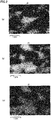
- the obtained sintered compact No. 1 was subjected to a CP process using an ion beam. Accordingly, a CP processed surface was formed in sintered compact No. 1. Then, a scanning electron microscope (SEM) was employed to capture a photograph of the structure of the sintered compact of the CP processed surface. In doing so, an acceleration voltage was set at 10 kV and a photograph of a field of view with a magnification of x30000 was captured. The obtained photograph (reflection electron image) is shown in Fig. 1 .
- EDX energy dispersive X-ray spectrometry
- SEM scanning electron microscope
- the region having been captured in the photograph was captured in a photograph at an acceleration voltage of 2 kV with a magnification of x80000.
- the following analysis was performed onto a region (first region) that had not less than 5 volume % and not more than 50 volume % of Al 2 O 3 particles (fine-particle aluminum oxide) each having a radius of not less than 0.1 ⁇ m and having an average particle size of not more than 80 nm.
- image analysis software (trademark "WinROOF ver.7.4.1” provided by Mitani Corporation) was used to perform a binarization process to distinguish between ZrO 2 and Al 2 O 3 ( Fig. 3 ).
- Fig. 3 image analysis software
- ZrO 2 is shown as a light gray region and Al 2 O 3 is shown as a dark gray region. Then, (not less than two) arbitrary straight lines were drawn in the first region, continuous distances occupied by the Al 2 O 3 particles on the straight lines were determined, and the average value and standard deviation thereof were calculated. Moreover, continuous distances occupied by ZrO 2 on the straight lines were determined and the average value and standard deviation thereof were calculated. The result of calculation is shown in Table 1.
- Sintered compact No. 1 thus obtained was used to manufacture a cutting tool with a shape of TCGW110208, a negative land angle of 15°, and a negative land width of 0.12 mm. Under the following cutting condition, a high-speed cutting test was performed to the obtained cutting tool using a machining center.
- NV5000 ⁇ 1A/40 product number as provided by DMG MORI Co., Ltd.
- sintered compact No. 5 was produced in accordance with the method for producing sintered compact No. 1.
- the sintered compact structure of sintered compact No. 5 obtained was evaluated, and a high-speed cutting test was performed to sintered compact No. 5 obtained. A result thereof is shown in Table 2.
- the sol-gel method is, for example, described in a paper ( J. Jpn. Soc. Powder Power Metallurgy, Vol. 58, No. 12, P727-732) published in 2011 .
- Zr-i-(OC 3 H 7 ) 4 , Al(OC 3 H 7 ) 3 , and Y(OC 3 H 7 ) 3 are treated for 2 hours in 2-propanol, and then NH 4 OH is added thereto. In doing so, these three compounds are mixed such that 1.5 mol % of Y 2 O 3 and 25 mol % of Al 2 O 3 are included relative to ZrO 2 .
- reflux is performed at 78°C for 24 hours, thereby obtaining a hydrolysis product.
- this hydrolysis product is centrifuged and is then washed with hot water. The hydrolysis product thus washed with the hot water is dried at 120°C in vacuum. In this way, amorphous solid solution powder is obtained.
- the obtained amorphous solid solution powder is calcinated (heated) for 9 hours at 700°C in the air, and is further calcinated at 900°C in air for I hour.
- crystalline ZrO 2 in which Al 2 O 3 and Y 2 O 3 are mixed in the solid state
- the first region material is obtained.
- sintered compacts No. 9 to No. 13 were produced in accordance with the method for producing sintered compact No. 1.
- the sintered compact structures of sintered compacts No. 9 to No. 13 obtained were evaluated, and a high-speed cutting test was performed to sintered compacts No. 9 to No. 13 obtained. Results thereof are shown in Table 3 [Table 3] Sintered Compact No. Sintering Condition Blending Amounts of Raw Materials (Volume %) Sintered Compact Structure ' High-Speed Cutting Test First Region Press. (GPa) Temp.
- sintered compacts No. 14 to No. 25 were produced in accordance with the method for producing sintered compact No. 1.
- the sintered compact structures of sintered compacts No. 14 to No. 25 obtained were evaluated. Results thereof are shown in Table 5.
- Sintered compacts No. 14 to No. 25 thus obtained were used to manufacture cutting tools each with a shape of TCGW110208, a negative land angle of 15°, and a negative land width of 0.12 mm. Under the following cutting condition, a high-speed rotation cutting test was performed to each of the obtained cutting tools using a machining center.
- NV5000 ⁇ 1A/40 product number as provided by DMG MORI Co., Ltd.
- Sintered compact No. 4 had a larger maximum flank wear amount ( ⁇ m) and a shorter chipping life (km) after cutting for 4.0 km than those of sintered compacts No. 1 to No. 3. Based on this fact, it was found that both excellent chipping resistance and excellent wear resistance can be achieved in the cutting tool as long as the average value of the continuous distances occupied by the fine-particle aluminum oxide is not more than 0.08 ⁇ m and the standard deviation of the continuous distances occupied by the fine-particle aluminum oxide is not more than 0.1 ⁇ m on the arbitrary straight lines in the first region.
- sintered compact No 1 had a longer chipping life (km) than those of sintered compacts No. 2 and No. 3. Based on this fact, it was found that the chipping resistance can be more excellent in the cutting tool as long as the average value of the continuous distances occupied by the fine-particle aluminum oxide is not less than 0.01 ⁇ m and not more than 0 05 ⁇ m and the standard deviation of the continuous distances occupied by the fine-particle aluminum oxide is not less than 0.01 ⁇ m and not more than 0.05 ⁇ m on the arbitrary straight lines in the first region.
- sintered compacts No. 5 and No. 6 had longer chipping lives (km) than those of sintered compacts No. 7 and No. 8. Also based on this result, it was found that the chipping resistance can be more excellent in the cutting tool as long as the average value of the continuous distances occupied by the fine-particle aluminum oxide is not less than 0.01 ⁇ m and not more than 0.05 ⁇ m and the standard deviation of the continuous distances occupied by the fine-particle aluminum oxide is not less than 0.01 ⁇ m and not more than 0.05 ⁇ m on the arbitrary straight lines in the first region.
- each of sintered compacts No. 11 and No. 12 had a longer chipping life (km) than those of sintered compacts No. 9, No. 10, and No. 13. Based on this fact, it was found that the chipping resistance of the cutting tool becomes more excellent as long as the content volume of the cubic boron nitride in the sintered compact is not less than 30 volume % and not more than 60 volume %.
Landscapes
- Chemical & Material Sciences (AREA)
- Engineering & Computer Science (AREA)
- Organic Chemistry (AREA)
- Ceramic Engineering (AREA)
- Manufacturing & Machinery (AREA)
- Inorganic Chemistry (AREA)
- Materials Engineering (AREA)
- Structural Engineering (AREA)
- Life Sciences & Earth Sciences (AREA)
- Geology (AREA)
- Crystallography & Structural Chemistry (AREA)
- Mechanical Engineering (AREA)
- Composite Materials (AREA)
- Cutting Tools, Boring Holders, And Turrets (AREA)
- Ceramic Products (AREA)
- Drilling Tools (AREA)
Claims (8)
- Comprimé fritté comprenant un premier matériau, un second matériau, et un troisième matériau,
le premier matériau étant du nitrure de bore cubique, le second matériau étant un composé comprenant du zirconium,
le troisième matériau étant un oxyde d'aluminium, l'oxyde d'aluminium comprenant un oxyde d'aluminium en fines particules,
le comprimé fritté ayant une première région dans laquelle pas moins de 5 % en volume et pas plus de 50 % en volume de l'oxyde d'aluminium en fines particules sont dispersés dans le second matériau,
l'oxyde d'aluminium en fines particules ayant une taille moyenne de particule non supérieure à 80 nm,
des lignes droites arbitraires tracées dans une image électronique par réflexion dans la première région, une valeur moyenne des distances continues occupées par l'oxyde d'aluminium en fines particules n'étant pas supérieure à 0,08 µm et un écart-type des distances continues occupées par l'oxyde d'aluminium en fines particules n'étant pas supérieur à 0,1 µm,
la valeur moyenne des distances continues occupées par l'oxyde d'aluminium en fines particules et l'écart-type des distances continues occupées par l'oxyde d'aluminium en fines particules étant déterminés par :le polissage miroir du comprimé fritté ;l'utilisation d'un microscope électronique à balayage pour capturer une photographie de la structure du comprimé fritté au niveau de la première région sous un grossissement de x80 000 ;l'observation du contraste de lumière et d'obscurité correspondant à une composition dans l'image électronique par réflexion obtenue ;l'évaluation du composé sur la base d'un état de chevauchement de divers éléments en utilisant la spectrométrie par rayons X par dispersion d'énergie fournie dans le microscope électronique à balayage dans l'image électronique par réflexion obtenue ;le tracé de dix lignes droites ou plus arbitraires dans la première région dans l'image électronique par réflexion ; etla mesure des distances continues occupées par l'oxyde d'aluminium en fines particules dans les lignes droites tracées. - Comprimé fritté selon la revendication 1, dans lequel sur les lignes droites arbitraires dans la première région, la valeur moyenne des distances continues occupées par l'oxyde d'aluminium en fines particules n'est pas inférieure à 0,01 µm et pas supérieure à 0,05 µm et l'écart-type des distances continues occupées par l'oxyde d'aluminium en fines particules n'est pas inférieur 0,01 µm et pas supérieur à 0,05 µm.
- Comprimé fritté selon la revendication 1 ou la revendication 2, dans lequel dans la première région, pas moins de 15 % en volume et pas plus de 40 % en volume de l'oxyde d'aluminium en fines particules ne sont dispersés dans le second matériau.
- Comprimé fritté selon l'une quelconque de la revendication 1 à la revendication 3, dans lequel pas moins de 20 % en volume et pas plus de 80 % en volume du premier matériau sont inclus dans le comprimé fritté.
- Comprimé fritté selon l'une quelconque de la revendication 1 à la revendication 4, dans lequel pas moins de 30 % en volume et pas plus de 60 % en volume du premier matériau sont inclus dans le comprimé fritté.
- Comprimé fritté selon l'une quelconque de la revendication 1 à la revendication 5, comprenant en outre un quatrième matériau, dans lequel le quatrième matériau est au moins l'un sélectionné dans un groupe constitué de l'oxyde de magnésium, de l'oxyde de cérium, de l'oxyde d'yttrium, et de l'oxyde d'hafnium.
- Comprimé fritté selon l'une quelconque de la revendication 1 à la revendication 6, comprenant en outre un cinquième matériau, dans lequel le cinquième matériau est au moins un composé constitué de (i) au moins un élément sélectionné dans un groupe constitué d'un élément du groupe 4, d'un élément du groupe 5, d'un élément du groupe 6 dans un tableau périodique, Al, et Si, et (ii) au moins d'un élément sélectionné dans le groupe constitué du carbone, de l'azote, et du bore.
- Outil de coupe comprenant le comprimé fritté énoncé selon l'une quelconque de la revendication 1 à la revendication 7.
Applications Claiming Priority (2)
| Application Number | Priority Date | Filing Date | Title |
|---|---|---|---|
| JP2015110671 | 2015-05-29 | ||
| PCT/JP2016/055376 WO2016194416A1 (fr) | 2015-05-29 | 2016-02-24 | Corps fritté et outil de coupe |
Publications (3)
| Publication Number | Publication Date |
|---|---|
| EP3156384A1 EP3156384A1 (fr) | 2017-04-19 |
| EP3156384A4 EP3156384A4 (fr) | 2017-08-09 |
| EP3156384B1 true EP3156384B1 (fr) | 2018-10-03 |
Family
ID=57441144
Family Applications (1)
| Application Number | Title | Priority Date | Filing Date |
|---|---|---|---|
| EP16802855.3A Active EP3156384B1 (fr) | 2015-05-29 | 2016-02-24 | Corps fritté et outil de coupe |
Country Status (8)
| Country | Link |
|---|---|
| US (1) | US9988314B2 (fr) |
| EP (1) | EP3156384B1 (fr) |
| JP (1) | JP6652560B2 (fr) |
| KR (1) | KR20180015602A (fr) |
| CN (1) | CN106795061B (fr) |
| CA (1) | CA2955292A1 (fr) |
| MX (1) | MX2017000970A (fr) |
| WO (1) | WO2016194416A1 (fr) |
Families Citing this family (14)
| Publication number | Priority date | Publication date | Assignee | Title |
|---|---|---|---|---|
| KR101937061B1 (ko) * | 2015-04-20 | 2019-01-09 | 스미토모덴키고교가부시키가이샤 | 소결체 및 그것을 포함하는 절삭 공구 |
| EP3153485B1 (fr) * | 2015-05-29 | 2021-01-06 | Sumitomo Electric Hardmetal Corp. | Corps fritté et outil de coupe |
| MX2017000970A (es) | 2015-05-29 | 2017-05-01 | Sumitomo Electric Hardmetal Corp | Cuerpo sinterizado y herramienta de corte. |
| US10532951B2 (en) * | 2016-05-27 | 2020-01-14 | Sumitomo Electric Industries, Ltd. | Sintered material and cutting tool including same |
| CN109906212B (zh) * | 2016-10-17 | 2022-07-19 | 住友电气工业株式会社 | 烧结体以及包含该烧结体的切削工具 |
| GB201704133D0 (en) * | 2017-03-15 | 2017-04-26 | Element Six (Uk) Ltd | Sintered polycrystalline cubic boron nitride material |
| KR20200014749A (ko) * | 2017-05-26 | 2020-02-11 | 스미토모덴키고교가부시키가이샤 | 소결체 및 그 제조 방법 |
| EP3808714A4 (fr) * | 2018-06-18 | 2022-03-30 | Sumitomo Electric Industries, Ltd. | Corps fritté et zircone partiellement stabilisée dopée à l'alumine |
| US12410103B2 (en) * | 2019-07-18 | 2025-09-09 | Sumitomo Electric Industries, Ltd. | Cubic boron nitride sintered material and cutting tool |
| GB201913252D0 (en) * | 2019-09-13 | 2019-10-30 | Element Six Uk Ltd | Sintered polycrystalline cubic boron nitride material |
| GB202001174D0 (en) * | 2020-01-28 | 2020-03-11 | Element Six Uk Ltd | Polycrystalline cubic boron nitride material |
| CN113321504A (zh) * | 2021-07-06 | 2021-08-31 | 中国有色桂林矿产地质研究院有限公司 | 一种氧化锆增韧氧化铝陶瓷材料及其制备方法和应用 |
| CN118510737B (zh) * | 2022-03-08 | 2026-04-17 | 住友电工硬质合金株式会社 | 立方晶氮化硼烧结体 |
| CN120700322B (zh) * | 2025-07-18 | 2026-03-06 | 重庆文理学院 | 一种基于高熵合金粘接相的硬质合金材料的制备方法 |
Family Cites Families (18)
| Publication number | Priority date | Publication date | Assignee | Title |
|---|---|---|---|---|
| JPS6465073A (en) * | 1987-09-04 | 1989-03-10 | Ishikawajima Harima Heavy Ind | Ceramic material for constructing sliding part working at high temperature |
| CN101583451B (zh) * | 2007-01-15 | 2011-06-29 | 住友电工硬质合金株式会社 | cBN烧结体和由cBN烧结体制成的工具 |
| WO2008096400A1 (fr) * | 2007-02-02 | 2008-08-14 | Sumitomo Electric Hardmetal Corp. | Fritte de diamant |
| US8236411B2 (en) * | 2008-03-26 | 2012-08-07 | Kyocera Corporation | Cutting tool |
| EP2332678B1 (fr) * | 2008-09-26 | 2019-06-12 | Kyocera Corporation | Cermet fritté et outil de coupe |
| TWI405742B (zh) * | 2009-02-19 | 2013-08-21 | Corning Inc | 用於燒結大型耐火性物體的方法 |
| EP2500332B1 (fr) * | 2009-11-11 | 2016-01-27 | Tungaloy Corporation | Compact fritté de nitrure de bore cubique, compact fritté de nitrure de bore cubique revêtu, procédé de production d'un compact fritté de nitrure de bore cubique, et procédé de production d'un compact fritté de nitrure de bore cubique revêtu |
| CN102712542A (zh) | 2009-12-28 | 2012-10-03 | 松下电器产业株式会社 | 氧化锆-氧化铝复合陶瓷材料的制造方法、氧化锆-氧化铝复合造粒粉、氧化锆珠 |
| WO2012029440A1 (fr) * | 2010-09-01 | 2012-03-08 | 住友電工ハードメタル株式会社 | Outil à corps fritté en nitrure de bore cubique |
| CA2794396C (fr) | 2010-10-27 | 2017-08-29 | Sumitomo Electric Hardmetal Corp. | Corps fritte en nitrure de bore cubique et outil a corps fritte en nitrure de bore cubique |
| WO2012057183A1 (fr) | 2010-10-27 | 2012-05-03 | 住友電工ハードメタル株式会社 | Corps fritté en nitrure de bore cubique (cbn) et outil à corps fritté en nitrure de bore cubique (cbn) |
| TW201226209A (en) * | 2010-12-28 | 2012-07-01 | Ultrapack Energy Co Ltd | Heat dissipation substrate and manufacturing method thereof |
| WO2012153645A1 (fr) | 2011-05-12 | 2012-11-15 | 学校法人同志社 | PROCÉDÉ DE FABRICATION D'UNE CÉRAMIQUE EN SOLUTION SOLIDE À BASE DE ZrO2-Al2O3,À RÉSISTANCE ÉLEVÉE, À TÉNACITÉ ÉLEVÉE |
| CA2836778C (fr) | 2011-06-21 | 2020-11-17 | Diamond Innovations, Inc. | Compacts composites formes de ceramiques et nitrure de bore cubique de faible volume et procede de fabrication |
| JP6052735B2 (ja) | 2013-03-28 | 2016-12-27 | 学校法人同志社 | 高強度強靱性ZrO2−Al2O3系固溶体セラミックスの作製法 |
| KR101937061B1 (ko) | 2015-04-20 | 2019-01-09 | 스미토모덴키고교가부시키가이샤 | 소결체 및 그것을 포함하는 절삭 공구 |
| EP3153485B1 (fr) * | 2015-05-29 | 2021-01-06 | Sumitomo Electric Hardmetal Corp. | Corps fritté et outil de coupe |
| MX2017000970A (es) | 2015-05-29 | 2017-05-01 | Sumitomo Electric Hardmetal Corp | Cuerpo sinterizado y herramienta de corte. |
-
2016
- 2016-02-24 MX MX2017000970A patent/MX2017000970A/es unknown
- 2016-02-24 JP JP2017521711A patent/JP6652560B2/ja active Active
- 2016-02-24 CA CA2955292A patent/CA2955292A1/fr not_active Abandoned
- 2016-02-24 WO PCT/JP2016/055376 patent/WO2016194416A1/fr not_active Ceased
- 2016-02-24 EP EP16802855.3A patent/EP3156384B1/fr active Active
- 2016-02-24 KR KR1020177002843A patent/KR20180015602A/ko not_active Withdrawn
- 2016-02-24 CN CN201680002181.9A patent/CN106795061B/zh active Active
- 2016-02-24 US US15/327,214 patent/US9988314B2/en active Active
Non-Patent Citations (1)
| Title |
|---|
| None * |
Also Published As
| Publication number | Publication date |
|---|---|
| EP3156384A4 (fr) | 2017-08-09 |
| CA2955292A1 (fr) | 2016-12-08 |
| US20170197886A1 (en) | 2017-07-13 |
| CN106795061B (zh) | 2020-01-21 |
| WO2016194416A1 (fr) | 2016-12-08 |
| WO2016194416A9 (fr) | 2017-02-02 |
| KR20180015602A (ko) | 2018-02-13 |
| CN106795061A (zh) | 2017-05-31 |
| MX2017000970A (es) | 2017-05-01 |
| JPWO2016194416A1 (ja) | 2018-04-19 |
| US9988314B2 (en) | 2018-06-05 |
| JP6652560B2 (ja) | 2020-02-26 |
| EP3156384A1 (fr) | 2017-04-19 |
Similar Documents
| Publication | Publication Date | Title |
|---|---|---|
| EP3156384A1 (fr) | Corps fritté et outil de coupe | |
| EP3153485B1 (fr) | Corps fritté et outil de coupe | |
| EP3162780B1 (fr) | Corps fritté et outil de coupe comprenant ce corps fritté | |
| US12070802B2 (en) | Sintered material and cutting tool including same | |
| JP7452589B2 (ja) | 焼結体 | |
| WO2019244414A1 (fr) | Corps fritté et outil de coupe le comprenant |
Legal Events
| Date | Code | Title | Description |
|---|---|---|---|
| STAA | Information on the status of an ep patent application or granted ep patent |
Free format text: STATUS: THE INTERNATIONAL PUBLICATION HAS BEEN MADE |
|
| PUAI | Public reference made under article 153(3) epc to a published international application that has entered the european phase |
Free format text: ORIGINAL CODE: 0009012 |
|
| STAA | Information on the status of an ep patent application or granted ep patent |
Free format text: STATUS: REQUEST FOR EXAMINATION WAS MADE |
|
| 17P | Request for examination filed |
Effective date: 20170113 |
|
| AK | Designated contracting states |
Kind code of ref document: A1 Designated state(s): AL AT BE BG CH CY CZ DE DK EE ES FI FR GB GR HR HU IE IS IT LI LT LU LV MC MK MT NL NO PL PT RO RS SE SI SK SM TR |
|
| AX | Request for extension of the european patent |
Extension state: BA ME |
|
| A4 | Supplementary search report drawn up and despatched |
Effective date: 20170707 |
|
| RIC1 | Information provided on ipc code assigned before grant |
Ipc: C04B 35/645 20060101ALI20170704BHEP Ipc: C04B 35/583 20060101AFI20170704BHEP Ipc: B23B 27/14 20060101ALI20170704BHEP Ipc: C04B 35/5831 20060101ALI20170704BHEP Ipc: C04B 35/626 20060101ALI20170704BHEP |
|
| GRAP | Despatch of communication of intention to grant a patent |
Free format text: ORIGINAL CODE: EPIDOSNIGR1 |
|
| STAA | Information on the status of an ep patent application or granted ep patent |
Free format text: STATUS: GRANT OF PATENT IS INTENDED |
|
| DAV | Request for validation of the european patent (deleted) | ||
| DAX | Request for extension of the european patent (deleted) | ||
| INTG | Intention to grant announced |
Effective date: 20180430 |
|
| RIN1 | Information on inventor provided before grant (corrected) |
Inventor name: KUKINO, SATORU Inventor name: DANDA, MAYU Inventor name: OKAMURA, KATSUMI |
|
| GRAS | Grant fee paid |
Free format text: ORIGINAL CODE: EPIDOSNIGR3 |
|
| GRAA | (expected) grant |
Free format text: ORIGINAL CODE: 0009210 |
|
| STAA | Information on the status of an ep patent application or granted ep patent |
Free format text: STATUS: THE PATENT HAS BEEN GRANTED |
|
| REG | Reference to a national code |
Ref country code: DE Ref legal event code: R082 Ref document number: 602016006261 Country of ref document: DE Representative=s name: GRUENECKER PATENT- UND RECHTSANWAELTE PARTG MB, DE |
|
| AK | Designated contracting states |
Kind code of ref document: B1 Designated state(s): AL AT BE BG CH CY CZ DE DK EE ES FI FR GB GR HR HU IE IS IT LI LT LU LV MC MK MT NL NO PL PT RO RS SE SI SK SM TR |
|
| REG | Reference to a national code |
Ref country code: GB Ref legal event code: FG4D |
|
| REG | Reference to a national code |
Ref country code: CH Ref legal event code: EP Ref country code: AT Ref legal event code: REF Ref document number: 1048413 Country of ref document: AT Kind code of ref document: T Effective date: 20181015 |
|
| REG | Reference to a national code |
Ref country code: IE Ref legal event code: FG4D Ref country code: DE Ref legal event code: R096 Ref document number: 602016006261 Country of ref document: DE |
|
| REG | Reference to a national code |
Ref country code: SE Ref legal event code: TRGR |
|
| REG | Reference to a national code |
Ref country code: NL Ref legal event code: MP Effective date: 20181003 |
|
| REG | Reference to a national code |
Ref country code: LT Ref legal event code: MG4D |
|
| REG | Reference to a national code |
Ref country code: AT Ref legal event code: MK05 Ref document number: 1048413 Country of ref document: AT Kind code of ref document: T Effective date: 20181003 |
|
| PG25 | Lapsed in a contracting state [announced via postgrant information from national office to epo] |
Ref country code: NL Free format text: LAPSE BECAUSE OF FAILURE TO SUBMIT A TRANSLATION OF THE DESCRIPTION OR TO PAY THE FEE WITHIN THE PRESCRIBED TIME-LIMIT Effective date: 20181003 |
|
| PG25 | Lapsed in a contracting state [announced via postgrant information from national office to epo] |
Ref country code: FI Free format text: LAPSE BECAUSE OF FAILURE TO SUBMIT A TRANSLATION OF THE DESCRIPTION OR TO PAY THE FEE WITHIN THE PRESCRIBED TIME-LIMIT Effective date: 20181003 Ref country code: LT Free format text: LAPSE BECAUSE OF FAILURE TO SUBMIT A TRANSLATION OF THE DESCRIPTION OR TO PAY THE FEE WITHIN THE PRESCRIBED TIME-LIMIT Effective date: 20181003 Ref country code: PL Free format text: LAPSE BECAUSE OF FAILURE TO SUBMIT A TRANSLATION OF THE DESCRIPTION OR TO PAY THE FEE WITHIN THE PRESCRIBED TIME-LIMIT Effective date: 20181003 Ref country code: BG Free format text: LAPSE BECAUSE OF FAILURE TO SUBMIT A TRANSLATION OF THE DESCRIPTION OR TO PAY THE FEE WITHIN THE PRESCRIBED TIME-LIMIT Effective date: 20190103 Ref country code: AT Free format text: LAPSE BECAUSE OF FAILURE TO SUBMIT A TRANSLATION OF THE DESCRIPTION OR TO PAY THE FEE WITHIN THE PRESCRIBED TIME-LIMIT Effective date: 20181003 Ref country code: CZ Free format text: LAPSE BECAUSE OF FAILURE TO SUBMIT A TRANSLATION OF THE DESCRIPTION OR TO PAY THE FEE WITHIN THE PRESCRIBED TIME-LIMIT Effective date: 20181003 Ref country code: IS Free format text: LAPSE BECAUSE OF FAILURE TO SUBMIT A TRANSLATION OF THE DESCRIPTION OR TO PAY THE FEE WITHIN THE PRESCRIBED TIME-LIMIT Effective date: 20190203 Ref country code: NO Free format text: LAPSE BECAUSE OF FAILURE TO SUBMIT A TRANSLATION OF THE DESCRIPTION OR TO PAY THE FEE WITHIN THE PRESCRIBED TIME-LIMIT Effective date: 20190103 Ref country code: ES Free format text: LAPSE BECAUSE OF FAILURE TO SUBMIT A TRANSLATION OF THE DESCRIPTION OR TO PAY THE FEE WITHIN THE PRESCRIBED TIME-LIMIT Effective date: 20181003 Ref country code: HR Free format text: LAPSE BECAUSE OF FAILURE TO SUBMIT A TRANSLATION OF THE DESCRIPTION OR TO PAY THE FEE WITHIN THE PRESCRIBED TIME-LIMIT Effective date: 20181003 Ref country code: LV Free format text: LAPSE BECAUSE OF FAILURE TO SUBMIT A TRANSLATION OF THE DESCRIPTION OR TO PAY THE FEE WITHIN THE PRESCRIBED TIME-LIMIT Effective date: 20181003 |
|
| PGFP | Annual fee paid to national office [announced via postgrant information from national office to epo] |
Ref country code: ES Payment date: 20190321 Year of fee payment: 10 |
|
| PG25 | Lapsed in a contracting state [announced via postgrant information from national office to epo] |
Ref country code: AL Free format text: LAPSE BECAUSE OF FAILURE TO SUBMIT A TRANSLATION OF THE DESCRIPTION OR TO PAY THE FEE WITHIN THE PRESCRIBED TIME-LIMIT Effective date: 20181003 Ref country code: RS Free format text: LAPSE BECAUSE OF FAILURE TO SUBMIT A TRANSLATION OF THE DESCRIPTION OR TO PAY THE FEE WITHIN THE PRESCRIBED TIME-LIMIT Effective date: 20181003 Ref country code: GR Free format text: LAPSE BECAUSE OF FAILURE TO SUBMIT A TRANSLATION OF THE DESCRIPTION OR TO PAY THE FEE WITHIN THE PRESCRIBED TIME-LIMIT Effective date: 20190104 Ref country code: PT Free format text: LAPSE BECAUSE OF FAILURE TO SUBMIT A TRANSLATION OF THE DESCRIPTION OR TO PAY THE FEE WITHIN THE PRESCRIBED TIME-LIMIT Effective date: 20190203 |
|
| REG | Reference to a national code |
Ref country code: DE Ref legal event code: R097 Ref document number: 602016006261 Country of ref document: DE |
|
| PG25 | Lapsed in a contracting state [announced via postgrant information from national office to epo] |
Ref country code: DK Free format text: LAPSE BECAUSE OF FAILURE TO SUBMIT A TRANSLATION OF THE DESCRIPTION OR TO PAY THE FEE WITHIN THE PRESCRIBED TIME-LIMIT Effective date: 20181003 |
|
| PLBE | No opposition filed within time limit |
Free format text: ORIGINAL CODE: 0009261 |
|
| STAA | Information on the status of an ep patent application or granted ep patent |
Free format text: STATUS: NO OPPOSITION FILED WITHIN TIME LIMIT |
|
| PG25 | Lapsed in a contracting state [announced via postgrant information from national office to epo] |
Ref country code: EE Free format text: LAPSE BECAUSE OF FAILURE TO SUBMIT A TRANSLATION OF THE DESCRIPTION OR TO PAY THE FEE WITHIN THE PRESCRIBED TIME-LIMIT Effective date: 20181003 Ref country code: RO Free format text: LAPSE BECAUSE OF FAILURE TO SUBMIT A TRANSLATION OF THE DESCRIPTION OR TO PAY THE FEE WITHIN THE PRESCRIBED TIME-LIMIT Effective date: 20181003 Ref country code: SK Free format text: LAPSE BECAUSE OF FAILURE TO SUBMIT A TRANSLATION OF THE DESCRIPTION OR TO PAY THE FEE WITHIN THE PRESCRIBED TIME-LIMIT Effective date: 20181003 Ref country code: SM Free format text: LAPSE BECAUSE OF FAILURE TO SUBMIT A TRANSLATION OF THE DESCRIPTION OR TO PAY THE FEE WITHIN THE PRESCRIBED TIME-LIMIT Effective date: 20181003 |
|
| 26N | No opposition filed |
Effective date: 20190704 |
|
| REG | Reference to a national code |
Ref country code: CH Ref legal event code: PL |
|
| PG25 | Lapsed in a contracting state [announced via postgrant information from national office to epo] |
Ref country code: LU Free format text: LAPSE BECAUSE OF NON-PAYMENT OF DUE FEES Effective date: 20190224 Ref country code: MC Free format text: LAPSE BECAUSE OF FAILURE TO SUBMIT A TRANSLATION OF THE DESCRIPTION OR TO PAY THE FEE WITHIN THE PRESCRIBED TIME-LIMIT Effective date: 20181003 Ref country code: SI Free format text: LAPSE BECAUSE OF FAILURE TO SUBMIT A TRANSLATION OF THE DESCRIPTION OR TO PAY THE FEE WITHIN THE PRESCRIBED TIME-LIMIT Effective date: 20181003 |
|
| REG | Reference to a national code |
Ref country code: BE Ref legal event code: MM Effective date: 20190228 |
|
| PG25 | Lapsed in a contracting state [announced via postgrant information from national office to epo] |
Ref country code: LI Free format text: LAPSE BECAUSE OF NON-PAYMENT OF DUE FEES Effective date: 20190228 Ref country code: CH Free format text: LAPSE BECAUSE OF NON-PAYMENT OF DUE FEES Effective date: 20190228 |
|
| PG25 | Lapsed in a contracting state [announced via postgrant information from national office to epo] |
Ref country code: BE Free format text: LAPSE BECAUSE OF NON-PAYMENT OF DUE FEES Effective date: 20190228 |
|
| PG25 | Lapsed in a contracting state [announced via postgrant information from national office to epo] |
Ref country code: TR Free format text: LAPSE BECAUSE OF FAILURE TO SUBMIT A TRANSLATION OF THE DESCRIPTION OR TO PAY THE FEE WITHIN THE PRESCRIBED TIME-LIMIT Effective date: 20181003 |
|
| PG25 | Lapsed in a contracting state [announced via postgrant information from national office to epo] |
Ref country code: MT Free format text: LAPSE BECAUSE OF NON-PAYMENT OF DUE FEES Effective date: 20190224 |
|
| GBPC | Gb: european patent ceased through non-payment of renewal fee |
Effective date: 20200224 |
|
| PG25 | Lapsed in a contracting state [announced via postgrant information from national office to epo] |
Ref country code: GB Free format text: LAPSE BECAUSE OF NON-PAYMENT OF DUE FEES Effective date: 20200224 Ref country code: FR Free format text: LAPSE BECAUSE OF NON-PAYMENT OF DUE FEES Effective date: 20200229 |
|
| PG25 | Lapsed in a contracting state [announced via postgrant information from national office to epo] |
Ref country code: CY Free format text: LAPSE BECAUSE OF FAILURE TO SUBMIT A TRANSLATION OF THE DESCRIPTION OR TO PAY THE FEE WITHIN THE PRESCRIBED TIME-LIMIT Effective date: 20181003 |
|
| PG25 | Lapsed in a contracting state [announced via postgrant information from national office to epo] |
Ref country code: HU Free format text: LAPSE BECAUSE OF FAILURE TO SUBMIT A TRANSLATION OF THE DESCRIPTION OR TO PAY THE FEE WITHIN THE PRESCRIBED TIME-LIMIT; INVALID AB INITIO Effective date: 20160224 |
|
| PG25 | Lapsed in a contracting state [announced via postgrant information from national office to epo] |
Ref country code: IT Free format text: LAPSE BECAUSE OF NON-PAYMENT OF DUE FEES Effective date: 20200224 |
|
| PG25 | Lapsed in a contracting state [announced via postgrant information from national office to epo] |
Ref country code: MK Free format text: LAPSE BECAUSE OF FAILURE TO SUBMIT A TRANSLATION OF THE DESCRIPTION OR TO PAY THE FEE WITHIN THE PRESCRIBED TIME-LIMIT Effective date: 20181003 |
|
| P01 | Opt-out of the competence of the unified patent court (upc) registered |
Effective date: 20230515 |
|
| PGFP | Annual fee paid to national office [announced via postgrant information from national office to epo] |
Ref country code: SE Payment date: 20260105 Year of fee payment: 11 |
|
| PGFP | Annual fee paid to national office [announced via postgrant information from national office to epo] |
Ref country code: DE Payment date: 20260102 Year of fee payment: 11 Ref country code: IE Payment date: 20260102 Year of fee payment: 11 |