EP3157079A1 - Électrode au lithium et batterie au lithium la comprenant - Google Patents
Électrode au lithium et batterie au lithium la comprenant Download PDFInfo
- Publication number
- EP3157079A1 EP3157079A1 EP15806444.4A EP15806444A EP3157079A1 EP 3157079 A1 EP3157079 A1 EP 3157079A1 EP 15806444 A EP15806444 A EP 15806444A EP 3157079 A1 EP3157079 A1 EP 3157079A1
- Authority
- EP
- European Patent Office
- Prior art keywords
- group
- substituted
- unsubstituted
- lithium
- electrode
- Prior art date
- Legal status (The legal status is an assumption and is not a legal conclusion. Google has not performed a legal analysis and makes no representation as to the accuracy of the status listed.)
- Granted
Links
Images


Classifications
-
- H—ELECTRICITY
- H01—ELECTRIC ELEMENTS
- H01M—PROCESSES OR MEANS, e.g. BATTERIES, FOR THE DIRECT CONVERSION OF CHEMICAL ENERGY INTO ELECTRICAL ENERGY
- H01M4/00—Electrodes
- H01M4/02—Electrodes composed of, or comprising, active material
- H01M4/62—Selection of inactive substances as ingredients for active masses, e.g. binders, fillers
- H01M4/628—Inhibitors, e.g. gassing inhibitors, corrosion inhibitors
-
- H—ELECTRICITY
- H01—ELECTRIC ELEMENTS
- H01M—PROCESSES OR MEANS, e.g. BATTERIES, FOR THE DIRECT CONVERSION OF CHEMICAL ENERGY INTO ELECTRICAL ENERGY
- H01M10/00—Secondary cells; Manufacture thereof
- H01M10/05—Accumulators with non-aqueous electrolyte
- H01M10/052—Li-accumulators
-
- H—ELECTRICITY
- H01—ELECTRIC ELEMENTS
- H01M—PROCESSES OR MEANS, e.g. BATTERIES, FOR THE DIRECT CONVERSION OF CHEMICAL ENERGY INTO ELECTRICAL ENERGY
- H01M10/00—Secondary cells; Manufacture thereof
- H01M10/05—Accumulators with non-aqueous electrolyte
- H01M10/052—Li-accumulators
- H01M10/0525—Rocking-chair batteries, i.e. batteries with lithium insertion or intercalation in both electrodes; Lithium-ion batteries
-
- H—ELECTRICITY
- H01—ELECTRIC ELEMENTS
- H01M—PROCESSES OR MEANS, e.g. BATTERIES, FOR THE DIRECT CONVERSION OF CHEMICAL ENERGY INTO ELECTRICAL ENERGY
- H01M4/00—Electrodes
- H01M4/02—Electrodes composed of, or comprising, active material
- H01M4/13—Electrodes for accumulators with non-aqueous electrolyte, e.g. for lithium-accumulators; Processes of manufacture thereof
- H01M4/133—Electrodes based on carbonaceous material, e.g. graphite-intercalation compounds or CFx
-
- H—ELECTRICITY
- H01—ELECTRIC ELEMENTS
- H01M—PROCESSES OR MEANS, e.g. BATTERIES, FOR THE DIRECT CONVERSION OF CHEMICAL ENERGY INTO ELECTRICAL ENERGY
- H01M4/00—Electrodes
- H01M4/02—Electrodes composed of, or comprising, active material
- H01M4/13—Electrodes for accumulators with non-aqueous electrolyte, e.g. for lithium-accumulators; Processes of manufacture thereof
- H01M4/134—Electrodes based on metals, Si or alloys
-
- H—ELECTRICITY
- H01—ELECTRIC ELEMENTS
- H01M—PROCESSES OR MEANS, e.g. BATTERIES, FOR THE DIRECT CONVERSION OF CHEMICAL ENERGY INTO ELECTRICAL ENERGY
- H01M4/00—Electrodes
- H01M4/02—Electrodes composed of, or comprising, active material
- H01M4/36—Selection of substances as active materials, active masses, active liquids
- H01M4/362—Composites
- H01M4/366—Composites as layered products
-
- H—ELECTRICITY
- H01—ELECTRIC ELEMENTS
- H01M—PROCESSES OR MEANS, e.g. BATTERIES, FOR THE DIRECT CONVERSION OF CHEMICAL ENERGY INTO ELECTRICAL ENERGY
- H01M4/00—Electrodes
- H01M4/02—Electrodes composed of, or comprising, active material
- H01M4/36—Selection of substances as active materials, active masses, active liquids
- H01M4/38—Selection of substances as active materials, active masses, active liquids of elements or alloys
- H01M4/381—Alkaline or alkaline earth metals elements
- H01M4/382—Lithium
-
- H—ELECTRICITY
- H01—ELECTRIC ELEMENTS
- H01M—PROCESSES OR MEANS, e.g. BATTERIES, FOR THE DIRECT CONVERSION OF CHEMICAL ENERGY INTO ELECTRICAL ENERGY
- H01M4/00—Electrodes
- H01M4/02—Electrodes composed of, or comprising, active material
- H01M4/36—Selection of substances as active materials, active masses, active liquids
- H01M4/38—Selection of substances as active materials, active masses, active liquids of elements or alloys
- H01M4/40—Alloys based on alkali metals
- H01M4/405—Alloys based on lithium
-
- H—ELECTRICITY
- H01—ELECTRIC ELEMENTS
- H01M—PROCESSES OR MEANS, e.g. BATTERIES, FOR THE DIRECT CONVERSION OF CHEMICAL ENERGY INTO ELECTRICAL ENERGY
- H01M4/00—Electrodes
- H01M4/02—Electrodes composed of, or comprising, active material
- H01M4/36—Selection of substances as active materials, active masses, active liquids
- H01M4/58—Selection of substances as active materials, active masses, active liquids of inorganic compounds other than oxides or hydroxides, e.g. sulfides, selenides, tellurides, halogenides or LiCoFy; of polyanionic structures, e.g. phosphates, silicates or borates
- H01M4/583—Carbonaceous material, e.g. graphite-intercalation compounds or CFx
- H01M4/587—Carbonaceous material, e.g. graphite-intercalation compounds or CFx for inserting or intercalating light metals
-
- H—ELECTRICITY
- H01—ELECTRIC ELEMENTS
- H01M—PROCESSES OR MEANS, e.g. BATTERIES, FOR THE DIRECT CONVERSION OF CHEMICAL ENERGY INTO ELECTRICAL ENERGY
- H01M4/00—Electrodes
- H01M4/02—Electrodes composed of, or comprising, active material
- H01M4/62—Selection of inactive substances as ingredients for active masses, e.g. binders, fillers
-
- H—ELECTRICITY
- H01—ELECTRIC ELEMENTS
- H01M—PROCESSES OR MEANS, e.g. BATTERIES, FOR THE DIRECT CONVERSION OF CHEMICAL ENERGY INTO ELECTRICAL ENERGY
- H01M4/00—Electrodes
- H01M4/02—Electrodes composed of, or comprising, active material
- H01M2004/026—Electrodes composed of, or comprising, active material characterised by the polarity
- H01M2004/027—Negative electrodes
-
- Y—GENERAL TAGGING OF NEW TECHNOLOGICAL DEVELOPMENTS; GENERAL TAGGING OF CROSS-SECTIONAL TECHNOLOGIES SPANNING OVER SEVERAL SECTIONS OF THE IPC; TECHNICAL SUBJECTS COVERED BY FORMER USPC CROSS-REFERENCE ART COLLECTIONS [XRACs] AND DIGESTS
- Y02—TECHNOLOGIES OR APPLICATIONS FOR MITIGATION OR ADAPTATION AGAINST CLIMATE CHANGE
- Y02E—REDUCTION OF GREENHOUSE GAS [GHG] EMISSIONS, RELATED TO ENERGY GENERATION, TRANSMISSION OR DISTRIBUTION
- Y02E60/00—Enabling technologies; Technologies with a potential or indirect contribution to GHG emissions mitigation
- Y02E60/10—Energy storage using batteries
Definitions
- the present application relates to a lithium electrode and a lithium battery including the same.
- a chemical battery is composed of a positive electrode (anode: a battery negative electrode), a negative electrode (cathode: a battery positive electrode), a separation membrane (separator) for separating the negative electrode and the positive electrode, and an electrolyte for eliminating polarization generated during the electrochemical reaction by helping transfer of charges, and a battery using lithium as a negative electrode is usually referred to as a lithium battery.
- lithium is a highly reactive metal
- a lithium electrode including the lithium has a problem of stability in that it is difficult to deal with the electrode itself in the process.
- lithium dendrites are formed in the charge and discharge process, and the dendrites may generate a short circuit of the battery, and the like.
- the present application has been made in an effort to provide a lithium electrode and a lithium battery including the same.
- the present application provides a lithium electrode including: an electrode layer including lithium; and a protective layer which is provided on at least one surface of the electrode layer and includes a lithium ion conductive polymer including at least one functional group selected from -SO 3 Li -COOLi, and -OLi.
- the present application provides a lithium battery including the lithium electrode.
- a lithium electrode according to an exemplary embodiment of the present application has an effect in that the stability is improved.
- the lithium electrode according to an exemplary embodiment of the present application has an effect in that the lithium ion conductivity is improved.
- a lithium battery according to an exemplary embodiment of the present application has an effect in that the durability is improved.
- the lithium battery according to an exemplary embodiment of the present application has an effect in that lithium dendrites are suppressed from being grown to prevent a short circuit.
- the lithium battery according to an exemplary embodiment of the present application has an effect in that the lifetime and stability of the battery are improved.
- the present application provides a lithium electrode including: an electrode layer including lithium; and a protective layer which is provided on at least one surface of the electrode layer and includes a lithium ion conductive polymer including at least one functional group selected from -SO 3 Li, -COOLi, and -OLi.
- a lithium electrode according to an exemplary embodiment of the present application has an effect in that the stability of the electrode itself is improved due to a protective layer. Accordingly, there are effects in that the electrode is easily dealt with in the process, and even when the lithium electrode is included in a battery, lithium dendrites are suppressed from being grown to prevent a short circuit. Furthermore, the lifetime and stability of the battery may be improved.
- FIG. 2 illustrates a lithium electrode in the related art, and a lithium electrode according to an exemplary embodiment of the present application, which includes a protective layer.
- lithium dendrites are generated generally during the charge and discharge process of the battery, and when a protective layer is applied, it is possible to enhance the charge and discharge efficiency by physically blocking lithium dendrites from being grown.
- X in the following FIG. 2 schematically illustrates that lithium dendrites fail to be physically grown due to the protective layer.
- the lithium ion conductive polymer may include a repeating unit represented by the following Chemical Formula D.
- R is a hydrocarbon group which is unsubstituted or substituted with at least one selected from a group consisting of fluorine, oxygen, nitrogen, and sulfur, X is -SO 3 Li, -COOLi, or -OLi, and y is 2 to 100,000.
- the "hydrocarbon group” means a group having a carbon skeleton, and carbon (C) in the carbon skeleton may be replaced with at least one selected from a group consisting of oxygen (O), nitrogen (N), and sulfur (S), and hydrogen (H) may be replaced with halogen, particularly fluorine (F).
- a terminal group of the lithium ion conductive polymer including the repeating unit represented by Chemical Formula D may be selected from hydrogen, a halogen group, a hydroxy group, and an amine group.
- the repeating unit represented by Chemical Formula D may have a weight average molecular weight of 500 to 1,000,000, specifically 100,000 to 1,000,000.
- Chemical Formula D may be represented by the following Chemical Formula E.
- Chemical Formula E may be represented by the following Chemical Formula E-1, Chemical Formula E-2, Chemical Formula E-3, or Chemical Formula 4.
- the lithium ion conductive polymer may include a copolymer including a repeating unit of the following Chemical Formula A and a repeating unit of the following Chemical Formula B.
- m and n mean the number of repeating units, 1 ⁇ m 1 ⁇ 500, and 1 ⁇ n ⁇ 500, X 1 , X 2 , and X 3 are the same as or different from each other, and are each independently represented by any one of the following Chemical Formulae 1 to 3,
- L 1 is a direct bond, or any one of -CZ 2 Z 3 -, -CO-, -O-, -S-, -SO 2 -, -SiZ 2 Z 3 -, and a substituted or unsubstituted divalent fluorene group
- Z 2 and Z 3 are the same as or different from each other, and are each independently any one of hydrogen, an alkyl group, a trifluoromethyl group (-CF 3 ), and a phenyl group
- S 1 to S 5 are the same as or different from each other, and are each independently hydrogen; deuterium; a halogen group; a cyano group; a nitrile group; a nitro group; a hydroxy group; a substituted or unsubstituted alkyl group; a substituted or unsubstituted cycloalkyl group; a substituted or unsubstituted alkoxy group; a substituted or unsubstitute
- examples of the halogen group include fluorine, chlorine, bromine or iodine.
- the alkyl group may be straight-chained or branch-chained, and the number of carbon atoms thereof is not particularly limited, but it is preferred that the number is 1 to 60, specifically 1 to 40, and more specifically 1 to 20.
- Specific examples thereof include a methyl group, an ethyl group, a propyl group, an isopropyl group, a butyl group, a t-butyl group, a pentyl group, a hexyl group, a heptyl group, and the like, but are not limited thereto.
- the alkenyl group may be straight-chained or branch-chained, and the number of carbon atoms thereof is not particularly limited, but it is preferred that the number is 2 to 60, specifically 2 to 40, and more specifically 2 to 20.
- the alkoxy group may be straight-chained or branch-chained, and the number of carbon atoms thereof is not particularly limited, but it is preferred that the number is 1 to 60, specifically 1 to 40, and more specifically 1 to 20.
- the cycloalkyl group is not particularly limited, but it is preferred that the number of carbon atoms thereof is 3 to 60, specifically 3 to 40, and more specifically 5 to 20, and particularly, a cyclopentyl group and a cyclohexyl group are preferred.
- the heterocycloalkyl group includes one or more of S, O, and N and is not particularly limited, but it is preferred that the number of carbon atoms thereof is 2 to 60, specifically 2 to 40, and more specifically 3 to 20, and particularly, a cyclopentyl group and a cyclohexyl group are preferred.
- the number of carbon atoms of the amine group is not particularly limited, but it is preferred that the number is 1 to 60, specifically 1 to 40, and more specifically 1 to 20.
- Specific examples of the amine group include a methylamine group, a dimethylamine group, an ethylamine group, a diethylamine group, a phenylamine group, a naphthylamine group, a biphenylamine group, an anthracenylamine group, a 9-methyl-anthracenylamine group, a diphenylamine group, a phenylnaphthylamine group, a ditolylamine group, a phenyltolylamine group, a triphenylamine group, and the like, but are not limited thereto.
- the aryl group may be monocyclic or polycyclic, and the number of carbon atoms thereof is not particularly limited, but it is preferred that the number is 6 to 60, specifically 6 to 40, and more specifically 6 to 20.
- Specific examples of the aryl group include a monocyclic aromatic group, such as a phenyl group, a biphenyl group, a triphenyl group, a terphenyl group, and a stilbene group, and a polycyclic aromatic group, such as a naphthyl group, a binaphthyl group, an anthracenyl group, a phenanthrenyl group, a pyrenyl group, a perylenyl group, a tetracenyl group, a chrysenyl group, a fluorenyl group, an acenaphthacenyl group, a triphenylene group, and a fluoranthene group, and the like, but are not
- the heteroaryl group includes one or more of S, O, and N as a heteroatom, and the number of carbon atoms thereof is not particularly limited, and it is preferred that the number is 2 to 60, specifically 2 to 40, and more specifically 3 to 20.
- heteroaryl examples include pyridyl, pyrrolyl, pyrimidyl, pyridazinyl, furanyl, thienyl, imidazolyl, pyrazolyl, oxazolyl, isoxazolyl, thiazolyl, isothiazolyl, triazolyl, furazanyl, oxadiazolyl, thiadiazolyl, dithiazolyl, tetrazolyl, pyranyl, thiopyranyl, diazinyl, oxazinyl, thiazinyl, dioxynyl, triazinyl, tetrazinyl, quinolyl, isoquinolyl, quinazolinyl, isoquinazolinyl, acridinyl, phenanthridinyl, imidazopyridinyl, diazanaphthalenyl, triazaindene, indolyl, be
- the fluorenyl group may be substituted with another substituent, and substituents may combine with each other to form a ring. Examples thereof include and the like.
- substituted or unsubstituted means being unsubstituted or substituted with one or more substituents selected from a group consisting of deuterium; a halogen group; a nitrile group; a nitro group; a hydroxy group; a cyano group; straight-chained or branch-chained C 1 to C 60 alkyl; straight-chained or branch-chained C 2 to C 60 alkenyl; straight-chained or branch-chained C 2 to C 60 alkynyl; C 3 to C 60 monocyclic or polycyclic cycloalkyl; C 2 to C 60 monocyclic or polycyclic heterocycloalkyl; C 6 to C 60 monocyclic or polycyclic aryl; and C 2 to C 60 monocyclic or polycyclic heteroaryl, or being unsubstituted or substituted with a substituent having a structure in which two or more selected from a group consisting of the substituent
- m and n may be 2 ⁇ m ⁇ 500 and 2 ⁇ n ⁇ 500.
- the copolymer may be a block copolymer.
- the ratio of m and n may be 1 : 9 to 7 : 3. That is, when m + n is 1, n may have a ratio of 0.3 to 0.9.
- the ratio of m and n may be 2 : 8 to 6 : 4. That is, when m + n is 1, n may have a ratio of 0.4 to 0.8.
- Chemical Formula 1 may be represented by the following Chemical Formula 1-1.
- Chemical Formula 4 may be represented by the following Chemical Formula 4-1.
- T 1 , T 2 , d, e, and L 2 are the same as those defined in Chemical Formula 4.
- X 1 , X 2 , and X 3 are the same as or different from each other, and may be each independently any one selected from the following structural formulae.
- R and R' are the same as or different from each other, and are each independently -NO 2 or -CF 3 .
- Chemical Formulae A and B at least one of X 1 , X 2 , and X 3 may be represented by the following Chemical Formula 11.
- S 6 to S 8 are the same as or different from each other, and are each independently hydrogen; deuterium; a halogen group; a cyano group; a nitrile group; a nitro group; a hydroxy group; a substituted or unsubstituted alkyl group; a substituted or unsubstituted cycloalkyl group; a substituted or unsubstituted alkoxy group; a substituted or unsubstituted alkenyl group; a substituted or unsubstituted silyl group; a substituted or unsubstituted boron group; a substituted or unsubstituted amine group; a substituted or unsubstituted aryl group; or a substituted or unsubstituted heteroaryl group, s and t are the same as or different from each other, and are each independently an integer of 0 or more and 4 or less, and r is an integer of 0 or more and 8
- the copolymer may improve the durability while having heat resistance and strong physical properties by a rigid aromatic skeleton, and may exhibit an effect in that lithium ions are easily transferred due to the increase in hydrodynamic volume during the entanglement of polymer chains.
- Chemical Formulae A and B at least one of X 1 and X 2 may be represented by Chemical Formula 11.
- At least one of X 1 , X 2 , and X 3 may be or
- Y 1 may be any one selected from the following structural formulae.
- Q is -SO 3 Li, -COOLi, or -OLi
- Q' is hydrogen, -SO 3 Li, -COOLi, or -OLi.
- the copolymer may further include a repeating unit of the following Chemical Formula C.
- Z is a trivalent organic group.
- the repeating unit of Chemical Formula C serves to link or cross-link polymer chains as a brancher.
- a branch may be formed on the chain, or the chains may be cross-linked to each other to form a network-type structure.
- Z is a trivalent organic group, and may be each bonded to additional repeating units in three directions to elongate the polymer chain.
- the number, molecular weight, and the like of an ion transfer functional group may be adjusted and mechanical properties may be strengthened by using a brancher which is the repeating unit of Chemical Formula C.
- k when the number of repeating units in the repeating unit of Chemical Formula C is denoted as k, k may be an integer of 1 to 300.
- the repeating unit of Chemical Formula C may be a polymer repeating unit constituting a main chain.
- Z may be linked to at least one selected from X 1 , X 2 , X 3 , and Y 1 to form one repeating unit.
- the one repeating unit formed as described above may constitute the main chain. In this case, the number of repeating units is the same as that of the above-described k.
- the resulting bonds each have a linking group of oxygen (-O-).
- the oxygen linking group is a linking group remaining in the chain, from which the compound is left by condensation polymerization.
- the oxygen linking group may be a case where HF evades and only oxygen (-O-) remains in the chain.
- Z is represented by the following Chemical Formula C-1 or C-2.
- Z 1 may be represented by any one of the following Chemical Formulae 7 to 9.
- L 3 to L 6 are the same as or different from each other, and are each independently a direct bond, or -O-, -CO-, or -SO 2 -
- E 1 to E 7 are the same as or different from each other, and are each independently hydrogen; deuterium; a halogen group; a cyano group; a nitrile group; a nitro group; a hydroxy group; a substituted or unsubstituted alkyl group; a substituted or unsubstituted cycloalkyl group; a substituted or unsubstituted alkoxy group; a substituted or unsubstituted alkenyl group; a substituted or unsubstituted silyl group; a substituted or unsubstituted boron group; a substituted or unsubstituted amine group; a substituted or unsubstituted aryl group; or a substituted or unsubstituted heteroaryl
- Z may be any one selected from the following structural formulae.
- the repeating unit of Chemical Formula A may be represented by the following structural formula.
- n is the same as that as described above.
- the repeating unit of Chemical Formula B may be represented by the following structural formulae.
- n is the same as that as described above.
- the copolymer may have a weight average molecular weight of 100,000 or more and 1,000,000 or less.
- the weight average molecular weight of the copolymer is within the range, an appropriate solubility of the copolymer may be maintained while having mechanical properties as a protective layer.
- the protective layer includes inorganic particles dispersed in the lithium ion conductive polymer.
- FIG. 3 illustrates a lithium electrode according to an exemplary embodiment of the present application, which includes a protective layer further including inorganic particles.
- the inorganic particles serve to be able to more effectively suppress lithium dendrites from being formed on the surface of the lithium electrode or the formed lithium dendrites from being grown.
- the inorganic particles may be lithium ion conductive or lithium ion non-conductive.
- examples of the lithium ion non-conductive inorganic particle include a metal oxide such as Al 2 O 3 , SnO 2 , CeO 2 , MgO, NiO, CaO, ZnO, ZrO 2 , Y 2 O 3 , TiO 2 , and SiC, but are not limited thereto.
- examples of the lithium ion conductive inorganic particle include a lithium hybrid-based compound such as LiBH 4 , Li 3 N, Li 2 NH, Li 2 BNH 6 , Li 1.8 N 0.4 Cl 0.6 , Li 3 P-LiCl, Li 4 SiO 4 , Li 3 PS 4 , and Li 3 SiS 4 ; a thio-LISICON-based compound such as Li 10 GeP 2 S 12 and Li 3.25 Ge 0.25 P 0.75 S 4 ; a NASICON-based compound such as Li 1.3 Al 0.3 Ge 1.7 (PO 4 ) 3 , Li 1.3 Al 0.3 Ti 1.7 (PO 4 ) 3 , and LiTi 0.5 Zr 1.5 (PO 4 ) 3 ; a LISICON-based compound such as Li 14 Zn(GeO 4 ) 4 ; a Perovskite-based compound such as Li 0.35 La 0.55 TiO 3 , Li 0.5 La 0.5 TiO 3 , and Li 7 La
- the inorganic particle may be a compound of one or more selected from a group consisting of Al 2 O 3 , SnO 2 , CeO 2 , MgO, NiO, CaO, ZnO, ZrO 2 , Y 2 O 3 , TiO 2 , SiC, LiBH 4 , Li 3 N, Li 2 NH, Li 2 BNH 6 , Li 1.8 N 0.4 Cl 0.6 , Li 3 P-LiCl, Li 4 SiO 4 , Li 3 PS 4 , Li 3 SiS 4 , Li 10 GeP 2 S 12 , Li 3.25 Ge 0.25 P 0.75 S 4 , Li 1.3 Al 0.3 Ge 1.7 (PO 4 ) 3 , Li 1.3 Al 0.3 Ti 1.7 (PO 4 ) 3 , LiTi 0.5 Zr 1.5 (PO 4 ) 3 , Li 14 Zn(GeO 4 ) 4 , Li 0.35 La 0.55 TiO 3 , Li 0.5 La 0.5 TiO 3 , and
- the particle diameter of the inorganic particle is not particularly limited. However, in order to exhibit the dispersibility of the above-described lithium ion conductive polymer and effects of suppressing lithium dendrites from being formed and blocking lithium dendrites from being grown, it is preferred that the inorganic particle has a particle diameter of 1 nm to 10 ⁇ m.
- the content of the inorganic particles is not particularly limited because the content may be adjusted in a range where the above-described effects may be sufficiently exhibited depending on the kind of inorganic particle.
- the inorganic particles may be included in an amount of 10 to 90 parts by weight based on 100 parts by weight of the lithium ion conductive polymer. That is, in order to sufficiently exhibit the effects resulting from including the inorganic particles, it is preferred that the inorganic particles are included in an amount of 10 parts by weight or more based on 100 parts by weight of the lithium ion conductive polymer.
- the inorganic particles are included in an excessive amount, the lithium ion conductivity may deteriorate, and it may be difficult to secure the performance of a battery including the lithium electrode. Accordingly, it is preferred that the inorganic particles are included in an amount of 90 parts by weight or less based on 100 parts by weight of the lithium ion conductive polymer.
- the protective layer may be provided on at least one surface of the electrode layer.
- the protective layer may be provided on one surface of the electrode layer.
- the protective layer may be provided on both surfaces of the electrode layer.
- the protective layer may be provided in a form which surrounds all the directions of the electrode layer.
- the protective layer may have a thickness of 0.01 to 50 ⁇ m, specifically 0.1 to 50 ⁇ m.
- the lithium included in the electrode layer may serve as an active material.
- the lithium included in the electrode layer may be included in a form of a lithium metal; a lithium metal alloy; or a composite of lithium and at least one selected from a group consisting of carbons such as coke, activated carbon, graphite, graphitized carbon, carbon nanotubes, or graphene.
- the lithium metal alloy may be an alloy of lithium and one or more selected from a group consisting of Al, Mg, Si, Sn, B, and Fe.
- the mass ratio of a metal other than lithium in the lithium metal alloy may be 0.1% to 50% compared to lithium.
- the electrode layer may further include at least one of a binder, a solvent, a conductive material, and a dispersant.
- the lithium electrode may be prepared by preparing a slurry by mixing and stirring an active material including lithium, a binder, a solvent, a conductive material, and a dispersant, which are prepared by general methods,, coating the slurry on a current collector of a metal material, and then compressing and drying the coated current collector.
- the current collector may use a foil by a combination of copper, nickel, and the like with alloys thereof, and the like.
- the negative electrode current collector may also increase the adhesive strength of a negative electrode active material by forming fine convex and concave irregularities on the surface thereof, and various forms such as a film, a sheet, a foil, a net, a porous body, a foaming body, and a nonwoven body can be employed.
- the binder is a component which aids in a bonding of a negative electrode active material to a conductive material and a bonding to a negative electrode current collector, and examples thereof include polyvinylidene fluoride (PVDF), polyvinyl alcohol, carboxymethyl cellulose (CMC), starch, hydroxypropyl cellulose, regenerated cellulose, polyvinylpyrrolidone, tetrafluoroethylene, polyethylene, polypropylene, an ethylene-propylene-diene polymer (EPDM), a sulfonated-EPDM, a styrene-butadiene rubber, a fluorine rubber, various copolymers thereof, and the like.
- PVDF polyvinylidene fluoride
- CMC carboxymethyl cellulose
- EPDM ethylene-propylene-diene polymer
- sulfonated-EPDM a styrene-butadiene rubber
- fluorine rubber various copolymers thereof,
- the conductive material is a component which further improves conductivity of an electrode active material
- the conductive material is not particularly limited as long as the conductive material has conductivity without causing a chemical change to the corresponding battery, and for example, it is possible to use graphite such as natural graphite or artificial graphite; carbon black such as carbon black, acetylene black, Ketjen black, channel black, furnace black, lamp black, and thermal black; conductive fibers such as carbon fiber or metal fiber; metal powder such as carbon fluoride powder, aluminum powder, and nickel powder; conductive whiskers such as zinc oxide and potassium titanate; conductive metal oxides such as titanium oxide; conductive materials such as polyphenylene derivatives, and the like.
- graphite such as natural graphite or artificial graphite
- carbon black such as carbon black, acetylene black, Ketjen black, channel black, furnace black, lamp black, and thermal black
- conductive fibers such as carbon fiber or metal fiber
- metal powder such as carbon fluoride powder, aluminum powder
- the present application provides a lithium battery including the lithium electrode.
- the lithium electrode is a negative electrode of a lithium battery.
- a battery which uses lithium as a negative electrode, is referred to as a lithium battery.
- the lithium battery may be a primary battery, or a secondary battery.
- the lithium battery is a lithium secondary battery.
- a lithium secondary battery includes a lithium secondary battery, a lithium polymer battery, a lithium sulfur battery, a lithium air battery, and the like.
- the lithium battery includes a positive electrode, a negative electrode, and a separation membrane located between the positive electrode and the negative electrode, and the negative electrode may be the lithium electrode.
- a surface of the electrode layer on which the protective layer is provided may be in a direction at the positive electrode side.
- the lithium battery includes a positive electrode and a negative electrode, the negative electrode is the lithium electrode, and a surface of the electrode layer on which the protective layer is provided may be in a direction at the positive electrode side. That is, the lithium battery does not include a separation membrane, and the protective layer of the lithium electrode may serve as a separation membrane.
- the lithium electrode according to an exemplary embodiment of the present application is used as a negative electrode of a lithium battery, it is possible to prevent a short circuit of a battery from being generated by suppressing lithium dendrites of the negative electrode from being grown during charge and discharge, and to improve the lifetime and stability of the battery.
- the positive electrode may be prepared in a form in which a positive electrode active material is applied on a positive electrode current collector by a general method.
- the positive electrode current collector may be a foil by aluminum, nickel, and the like, and a combination of alloys of one or more thereof, and the like.
- the separation membrane is not particularly limited, and may be in a form of a porous membrane.
- the separation membrane may be a separation membrane formed by using polyethylene, polypropylene, other polyolefin-based membranes, or a multi-layered membrane thereof.
- the separation membrane may be a separation membrane in which a ceramic coating is applied to the aforementioned separation membrane.
- the lithium battery according to an exemplary embodiment of the present application may be prepared by a typical method known in the art, and may be prepared by injecting an electrolytic solution into a cylindrical outer shape, a square outer shape, or a pouch-type outer shape, which is assembled by including the negative electrode, the positive electrode, and the separation membrane. Further, the separation membrane may not be included.
- a Dean-Stark apparatus was connected to a 500 mL round flask, and then 17.238 g (79.00 mmol) of 4,4'-difluorobenzophenone, 1.053 g (2.37 mmol) of [3,5-bis(4-fluorobenzoyl)phenyl](4-fluorophenyl)methanone, 24.502 g (69.92 mmol) of 9,9-bis(4-hydroxyphenyl)fluorene, 19.327 g (139.84 mmol) of potassium carbonate, 200 mL of N-methyl-2-pyrrolidone, and 120 mL of benzene were added thereto.
- reaction mixture was stirred under nitrogen at a temperature of 140°C in an oil bath for 4 hours to completely remove an azotrope adsorbed onto the molecular sieves of the Dean-Stark apparatus by pressurized nitrogen while benzene was backflowed, and then the reaction temperature was warmed to 182°C, 100 mL of N-methyl-2-pyrrolidone was additionally added, and the resulting mixture was subjected to condensation polymerization for 12 hours. After the reaction was terminated, the temperature of the reactant was lowered to 60°C, and then about 200 mL of N-methyl-2-pyrrolidone in the reactant was removed while increasing the temperature of the reactant to 120°C simultaneously with applying vacuum thereto.
- the temperature of the reactant was lowered to room temperature, the reactant was diluted by adding 300 mL of methyl tetrahydrofuran (THF) thereto, then the diluted reactant was poured into 3 L of methanol to separate the copolymer from the solvent, and then a copolymer (cake form) obtained by filtration was dried at 80°C in a vacuum oven for 12 hours or more to prepare 34.8 g of a white branched hydrophobic block, which has a weight average molecular weight of 5,000 g/mol and of which the terminal group was characterized with fluorine elements.
- THF methyl tetrahydrofuran
- reaction mixture was stirred under nitrogen at a temperature of 140°C in an oil bath for 4 hours to completely remove an azotrope adsorbed onto the molecular sieves of the Dean-Stark apparatus with pressurized nitrogen while benzene was backflowed, and then the reaction temperature was warmed to 182°C, 100 mL of dimethyl sulfoxide was additionally added, and the resulting mixture was subjected to condensation polymerization for 12 hours.
- the reactant was diluted by adding 200 mL of dimethyl sulfoxide to the reactant, then the diluted reactant was poured into 3 L of methanol to separate the copolymer from the solvent, and then a copolymer (cake form) obtained by filtration was dried at 80°C in a vacuum oven for 12 hours or more to prepare a polyarylene ether copolymer containing lithium sulfonate, in which a branched hydrophobic block and a branched hydrophilic block were alternately linked to each other by chemical bonds.
- the copolymer had a weight average molecular weight of about 800,000.
- a lithium metal having a thickness of 40 ⁇ m was composed of a positive electrode and a negative electrode symmetric cell, and polyethylene (PE) and TD2 (an ether-based electrolytic solution) were used as a separation membrane and an electrolytic solution, respectively, thereby preparing a cell.
- PE polyethylene
- TD2 an ether-based electrolytic solution
- a cell was prepared in the same manner as in the Comparative Example, except that a solution, in which the lithium ion conductive polymer prepared in the Preparation Example was dispersed, was coated on one surface of the lithium metal used as the negative electrode by a doctor blade, and then the coated lithium metal was dried at normal temperature to form a protective layer.
- the protective layer had a coating thickness of 10 ⁇ m.
- a cell was prepared in the same manner as in the Comparative Example, except that a solution, in which the lithium ion conductive polymer prepared in the Preparation Example and Al 2 O 3 having a particle diameter of about 500 nm were dispersed at a mass ratio of 10 : 1, was coated on one surface of the lithium metal used as the negative electrode by a doctor blade, and then the coated metal electrode was dried at normal temperature to form a protective layer.
- the protective layer had a coating thickness of 10 ⁇ m.
- FIG. 2 illustrates a lithium electrode in the related art, and a lithium electrode according to an exemplary embodiment of the present application, which includes a protective layer.
- Comparative Example 1 may be explained as an example in which the lithium electrode at the left side in FIG. 2 was used as a negative electrode, and Example 1 may be explained as an example in which the lithium electrode at the right side in FIG. 2 was used.
- FIG. 3 illustrates a lithium electrode according to an exemplary embodiment of the present application, which includes a protective layer further including inorganic particles.
- Example 2 may be explained as an example in which the lithium electrode in FIG. 3 was used as a negative electrode.
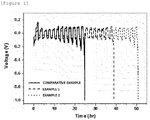
- FIG. 1 is a graph obtained by measuring the performances of the cells prepared according to Comparative Example 1, Example 1, and Example 2 of the present application.
- Example 1 in which a lithium ion conductive polymer was coated exhibited higher efficiency by about 4.5% than the Comparative Example, and Example 2 exhibited higher efficiency by about 6.3% than the Comparative Example.
- a lithium battery including the lithium electrode according to an exemplary embodiment of the present application may high charge and discharge efficiency due to a protective layer including a lithium ion conductive polymer, and a case where inorganic particles are further included in the polymer may exhibit higher charge and discharge efficiency.
Landscapes
- Chemical & Material Sciences (AREA)
- Chemical Kinetics & Catalysis (AREA)
- Electrochemistry (AREA)
- General Chemical & Material Sciences (AREA)
- Engineering & Computer Science (AREA)
- Materials Engineering (AREA)
- Manufacturing & Machinery (AREA)
- Inorganic Chemistry (AREA)
- Composite Materials (AREA)
- Battery Electrode And Active Subsutance (AREA)
- Secondary Cells (AREA)
Applications Claiming Priority (3)
| Application Number | Priority Date | Filing Date | Title |
|---|---|---|---|
| KR20140072249 | 2014-06-13 | ||
| KR20140147909 | 2014-10-29 | ||
| PCT/KR2015/006021 WO2015190897A1 (fr) | 2014-06-13 | 2015-06-15 | Électrode au lithium et batterie au lithium la comprenant |
Publications (3)
| Publication Number | Publication Date |
|---|---|
| EP3157079A1 true EP3157079A1 (fr) | 2017-04-19 |
| EP3157079A4 EP3157079A4 (fr) | 2018-01-10 |
| EP3157079B1 EP3157079B1 (fr) | 2018-10-17 |
Family
ID=54833896
Family Applications (1)
| Application Number | Title | Priority Date | Filing Date |
|---|---|---|---|
| EP15806444.4A Active EP3157079B1 (fr) | 2014-06-13 | 2015-06-15 | Électrode au lithium et batterie au lithium la comprenant |
Country Status (4)
| Country | Link |
|---|---|
| US (1) | US10439225B2 (fr) |
| EP (1) | EP3157079B1 (fr) |
| CN (1) | CN106663785B (fr) |
| WO (1) | WO2015190897A1 (fr) |
Cited By (1)
| Publication number | Priority date | Publication date | Assignee | Title |
|---|---|---|---|---|
| EP3396736A1 (fr) * | 2017-04-28 | 2018-10-31 | Samsung Electronics Co., Ltd. | Électrode négative pour batterie au lithium métallique, procédé de préparation d'électrode négative et batterie au lithium métallique la comprenant |
Families Citing this family (12)
| Publication number | Priority date | Publication date | Assignee | Title |
|---|---|---|---|---|
| KR101930479B1 (ko) * | 2016-04-26 | 2018-12-19 | 주식회사 엘지화학 | 고분자 보호층을 포함하는 나트륨 전극 및 이를 포함하는 나트륨 이차전지 |
| WO2018041374A1 (fr) | 2016-09-05 | 2018-03-08 | Toyota Motor Europe | Procédé de synthèse de liti2(ps4)3 |
| US11063289B2 (en) | 2016-09-05 | 2021-07-13 | Toyota Motor Europe | Increasing ionic conductivity of lithium titanium thiophosphate by sintering |
| WO2018077434A1 (fr) * | 2016-10-28 | 2018-05-03 | Toyota Motor Europe | Augmentation de la conductivité ionique de liti2(ps4)3 par dopage zr |
| KR102044692B1 (ko) | 2016-11-24 | 2019-11-14 | 주식회사 엘지화학 | 전극 보호층을 포함하는 이차전지용 전극 |
| KR102256487B1 (ko) * | 2017-07-06 | 2021-05-27 | 주식회사 엘지에너지솔루션 | 이차전지용 고분자 전해질 및 이를 포함하는 리튬 이차전지 |
| EP3567667B1 (fr) | 2017-09-07 | 2024-01-24 | LG Energy Solution, Ltd. | Batterie secondaire flexible |
| DE102018205299A1 (de) | 2018-04-09 | 2019-10-10 | Karlsruher Institut für Technologie | Verfahren zur Herstellung eines Schichtaufbaus für einen Lithium-Ionen-Festkörperakkumulator |
| CN110931711B (zh) * | 2018-09-19 | 2021-03-09 | 国家能源投资集团有限责任公司 | 锂金属负极及其制备方法和锂金属电池 |
| KR20200075250A (ko) * | 2018-12-18 | 2020-06-26 | 현대자동차주식회사 | 알칼리 토금속이 도핑된 황화물계 고체전해질 및 이의 제조방법 |
| KR102582050B1 (ko) | 2019-07-16 | 2023-09-21 | 주식회사 엘지에너지솔루션 | 리튬 금속 음극 및 이를 포함하는 리튬 금속 전지 |
| WO2022019622A1 (fr) | 2020-07-23 | 2022-01-27 | 주식회사 엘지에너지솔루션 | Anode pour batterie secondaire au lithium, son procédé de fabrication et batterie secondaire au lithium la comprenant |
Family Cites Families (26)
| Publication number | Priority date | Publication date | Assignee | Title |
|---|---|---|---|---|
| KR100368753B1 (ko) | 1997-06-27 | 2003-04-08 | 주식회사 엘지화학 | 리튬전지용음극및그의제조방법 |
| US6528212B1 (en) | 1999-09-13 | 2003-03-04 | Sanyo Electric Co., Ltd. | Lithium battery |
| US6562511B2 (en) | 1999-12-09 | 2003-05-13 | Ntk Powerdex, Inc. | Battery separator for Li-Ion and/or Li-Ion polymer battery |
| DE60144235D1 (de) | 2000-08-12 | 2011-04-28 | Lg Chemical Ltd | Zusammengesetzter film mit mehreren komponenten und verfahren zu seiner herstellung |
| KR100373204B1 (ko) | 2000-08-12 | 2003-02-25 | 주식회사 엘지화학 | 고분자 전해질용 다성분계 복합 분리막 및 그의 제조방법 |
| KR100449765B1 (ko) | 2002-10-12 | 2004-09-22 | 삼성에스디아이 주식회사 | 리튬전지용 리튬메탈 애노드 |
| KR100508945B1 (ko) | 2003-04-17 | 2005-08-17 | 삼성에스디아이 주식회사 | 리튬 전지용 음극, 그의 제조 방법 및 그를 포함하는 리튬전지 |
| PT1678728E (pt) * | 2003-10-14 | 2009-11-24 | Gen3 Partners Inc | Eléctrodo para dispositivos de armazenamento de energia e super-condensador electroquímico com base nesse eléctrodo |
| KR100542213B1 (ko) | 2003-10-31 | 2006-01-10 | 삼성에스디아이 주식회사 | 리튬 금속 전지용 음극 및 이를 포함하는 리튬 금속 전지 |
| KR100609693B1 (ko) * | 2004-04-24 | 2006-08-08 | 한국전자통신연구원 | 리튬 단이온 전도 무기 첨가제를 포함하는 리튬이차전지용 복합 고분자 전해질 및 그 제조 방법 |
| KR100613260B1 (ko) | 2004-09-20 | 2006-09-25 | 재단법인 포항산업과학연구원 | 리튬 이차 전지용 음극 활물질, 이의 제조 방법 및 이를포함하는 리튬 이차 전지 |
| KR20070016431A (ko) * | 2005-08-03 | 2007-02-08 | 삼성에스디아이 주식회사 | 리튬 이차 전지용 활물질, 그의 제조방법 및 이를 갖는리튬 이차 전지 |
| JP5298558B2 (ja) * | 2007-08-30 | 2013-09-25 | ソニー株式会社 | 二次電池用負極およびその製造方法、二次電池およびその製造方法、ならびに電子機器 |
| US8367251B2 (en) | 2007-08-30 | 2013-02-05 | Sony Corporation | Anode with lithium containing ionic polymer coat, method of manufacturing same, secondary battery, and method of manufacturing same |
| US20090148773A1 (en) | 2007-12-06 | 2009-06-11 | Ener1, Inc. | Lithium-ion secondary battery cell, electrode for the battery cell, and method of making the same |
| CN100505383C (zh) | 2007-12-21 | 2009-06-24 | 成都中科来方能源科技有限公司 | 锂离子电池用微孔聚合物隔膜及其制备方法 |
| JP5682153B2 (ja) | 2010-02-01 | 2015-03-11 | ダイキン工業株式会社 | 含フッ素共重合体の製造方法、ポリマー電解質、リチウム電池用電極及びリチウム電池 |
| CN104016891B (zh) * | 2010-04-16 | 2016-08-17 | 3M创新有限公司 | 质子传导材料 |
| KR20120122674A (ko) | 2011-04-29 | 2012-11-07 | 삼성전자주식회사 | 리튬 이차 전지용 음극, 그 제조방법 및 이를 채용한 리튬 이차 전지 |
| WO2013046403A1 (fr) | 2011-09-29 | 2013-04-04 | トヨタ自動車株式会社 | Pile métal-air |
| KR20130056668A (ko) | 2011-11-22 | 2013-05-30 | 삼성전자주식회사 | 복합 음극 활물질, 이의 제조방법 및 이를 포함하는 리튬 이차 전지 |
| JP2013114882A (ja) * | 2011-11-29 | 2013-06-10 | Nissan Motor Co Ltd | リチウムイオン二次電池 |
| KR101442198B1 (ko) | 2012-02-27 | 2014-09-22 | 서강대학교산학협력단 | 다공성 탄소 구조체, 이의 제조 방법, 상기 다공성 탄소 구조체를 포함하는 탄소 음극 활물질, 이를 이용한 리튬 이온 배터리, 및 이의 제조 방법 |
| KR101417268B1 (ko) | 2012-05-02 | 2014-07-08 | 현대자동차주식회사 | 리튬금속배터리용 리튬전극 및 그 제조방법 |
| KR101503571B1 (ko) | 2012-08-03 | 2015-03-18 | (주)오렌지파워 | 음극재, 음극 조립체, 이차 전지 및 이들의 제조 방법 |
| KR101672095B1 (ko) * | 2013-10-18 | 2016-11-02 | 주식회사 엘지화학 | 분리막 및 그를 포함하는 리튬-황 전지 |
-
2015
- 2015-06-15 EP EP15806444.4A patent/EP3157079B1/fr active Active
- 2015-06-15 US US15/318,301 patent/US10439225B2/en active Active
- 2015-06-15 WO PCT/KR2015/006021 patent/WO2015190897A1/fr not_active Ceased
- 2015-06-15 CN CN201580031600.7A patent/CN106663785B/zh active Active
Cited By (2)
| Publication number | Priority date | Publication date | Assignee | Title |
|---|---|---|---|---|
| EP3396736A1 (fr) * | 2017-04-28 | 2018-10-31 | Samsung Electronics Co., Ltd. | Électrode négative pour batterie au lithium métallique, procédé de préparation d'électrode négative et batterie au lithium métallique la comprenant |
| US10971753B2 (en) | 2017-04-28 | 2021-04-06 | Samsung Electronics Co., Ltd. | Negative electrode for lithium metal battery, method of preparing negative electrode, and lithium metal battery including the same |
Also Published As
| Publication number | Publication date |
|---|---|
| EP3157079A4 (fr) | 2018-01-10 |
| EP3157079B1 (fr) | 2018-10-17 |
| CN106663785A (zh) | 2017-05-10 |
| CN106663785B (zh) | 2019-09-10 |
| US20170117551A1 (en) | 2017-04-27 |
| US10439225B2 (en) | 2019-10-08 |
| WO2015190897A1 (fr) | 2015-12-17 |
Similar Documents
| Publication | Publication Date | Title |
|---|---|---|
| EP3157079B1 (fr) | Électrode au lithium et batterie au lithium la comprenant | |
| KR101771320B1 (ko) | 리튬 전극 및 이를 포함하는 리튬 전지 | |
| EP3157078B1 (fr) | Électrode au lithium et batterie secondaire au lithium comprenant celle-ci | |
| JP6191763B2 (ja) | 分離膜、リチウム−硫黄電池、電池モジュール、分離膜の製造方法、リチウム−硫黄電池の製造方法 | |
| TWI686415B (zh) | 含有噻嗯之聚合物作為電荷儲存裝置之用途 | |
| CN102473885A (zh) | 包含至少一个含碳半金属氧化物相的多孔膜材料及其作为电化学电池的隔膜材料的用途 | |
| CN107001633B (zh) | 聚合物、该聚合物的制备方法以及包含该聚合物的电解质膜 | |
| CN111916738A (zh) | 全固态电池用粘合剂溶液、包含其的全固态电池用电极浆料及使用其制造全固态电池的方法 | |
| JP2015521208A5 (fr) | ||
| CN108701832A (zh) | 高分子化合物、中间组成物、负极电极、蓄电装置、负极电极用浆料、高分子化合物的制造方法以及负极电极的制造方法 | |
| CN113871699A (zh) | 一种固态电解质及包括该固态电解质的锂离子电池 | |
| KR102830358B1 (ko) | 공유결합성 유기 골격 구조체를 포함하는 고체전해질 및 이를 포함하는 전고체 전지 | |
| US10538625B2 (en) | Polymer compound, intermediate composition, negative electrode, electrical storage device, slurry for negative electrode, method for producing polymer compound, and method for producing negative electrode | |
| KR101746927B1 (ko) | 리튬 전극 및 이를 포함하는 리튬 전지 | |
| CN105932293B (zh) | 一种粘合剂,其制备方法及含有该粘合剂的二次电池 | |
| JP2015167094A (ja) | 有機硫黄化合物、その製造方法、二次電池用正極活物質、二次電池 | |
| US20190315924A1 (en) | Polymer compound, intermediate composition, negative electrode, electricity storage device, and method for producing polymer compound | |
| KR102572516B1 (ko) | 이차전지용 활물질 복합체 제조방법, 및 이에 따라 제조된 이차전지용 활물질 복합체 | |
| JP2012234779A (ja) | リチウム二次電池負極用結着剤及び負極材料 | |
| CN120129966A (zh) | 电极材料、正极材料、负极材料、正极、负极及电池 | |
| CN120153492A (zh) | 正极材料、正极和电池 | |
| KR20240034544A (ko) | 실롤 아세틸렌 코폴리머를 포함하는 리튬 이차전지용 음극활물질 | |
| JP2013168336A (ja) | 立体規則性ポリ(2−置換ピリジン)及びそれを用いたリチウム二次電池負極用結着剤 |
Legal Events
| Date | Code | Title | Description |
|---|---|---|---|
| STAA | Information on the status of an ep patent application or granted ep patent |
Free format text: STATUS: THE INTERNATIONAL PUBLICATION HAS BEEN MADE |
|
| PUAI | Public reference made under article 153(3) epc to a published international application that has entered the european phase |
Free format text: ORIGINAL CODE: 0009012 |
|
| STAA | Information on the status of an ep patent application or granted ep patent |
Free format text: STATUS: REQUEST FOR EXAMINATION WAS MADE |
|
| 17P | Request for examination filed |
Effective date: 20161209 |
|
| AK | Designated contracting states |
Kind code of ref document: A1 Designated state(s): AL AT BE BG CH CY CZ DE DK EE ES FI FR GB GR HR HU IE IS IT LI LT LU LV MC MK MT NL NO PL PT RO RS SE SI SK SM TR |
|
| AX | Request for extension of the european patent |
Extension state: BA ME |
|
| DAV | Request for validation of the european patent (deleted) | ||
| DAX | Request for extension of the european patent (deleted) | ||
| A4 | Supplementary search report drawn up and despatched |
Effective date: 20171211 |
|
| RIC1 | Information provided on ipc code assigned before grant |
Ipc: H01M 4/134 20100101AFI20171205BHEP Ipc: H01M 10/052 20100101ALI20171205BHEP Ipc: H01M 10/0525 20100101ALI20171205BHEP Ipc: H01M 4/40 20060101ALI20171205BHEP Ipc: H01M 4/02 20060101ALI20171205BHEP Ipc: H01M 4/38 20060101ALI20171205BHEP Ipc: H01M 4/62 20060101ALI20171205BHEP Ipc: H01M 4/587 20100101ALI20171205BHEP Ipc: H01M 4/133 20100101ALI20171205BHEP |
|
| STAA | Information on the status of an ep patent application or granted ep patent |
Free format text: STATUS: EXAMINATION IS IN PROGRESS |
|
| 17Q | First examination report despatched |
Effective date: 20180130 |
|
| INTG | Intention to grant announced |
Effective date: 20180611 |
|
| GRAP | Despatch of communication of intention to grant a patent |
Free format text: ORIGINAL CODE: EPIDOSNIGR1 |
|
| STAA | Information on the status of an ep patent application or granted ep patent |
Free format text: STATUS: GRANT OF PATENT IS INTENDED |
|
| GRAS | Grant fee paid |
Free format text: ORIGINAL CODE: EPIDOSNIGR3 |
|
| GRAA | (expected) grant |
Free format text: ORIGINAL CODE: 0009210 |
|
| STAA | Information on the status of an ep patent application or granted ep patent |
Free format text: STATUS: THE PATENT HAS BEEN GRANTED |
|
| AK | Designated contracting states |
Kind code of ref document: B1 Designated state(s): AL AT BE BG CH CY CZ DE DK EE ES FI FR GB GR HR HU IE IS IT LI LT LU LV MC MK MT NL NO PL PT RO RS SE SI SK SM TR |
|
| REG | Reference to a national code |
Ref country code: GB Ref legal event code: FG4D |
|
| REG | Reference to a national code |
Ref country code: CH Ref legal event code: EP |
|
| REG | Reference to a national code |
Ref country code: IE Ref legal event code: FG4D |
|
| REG | Reference to a national code |
Ref country code: DE Ref legal event code: R096 Ref document number: 602015018446 Country of ref document: DE Ref country code: AT Ref legal event code: REF Ref document number: 1055032 Country of ref document: AT Kind code of ref document: T Effective date: 20181115 |
|
| REG | Reference to a national code |
Ref country code: NL Ref legal event code: MP Effective date: 20181017 |
|
| REG | Reference to a national code |
Ref country code: LT Ref legal event code: MG4D |
|
| REG | Reference to a national code |
Ref country code: AT Ref legal event code: MK05 Ref document number: 1055032 Country of ref document: AT Kind code of ref document: T Effective date: 20181017 |
|
| PG25 | Lapsed in a contracting state [announced via postgrant information from national office to epo] |
Ref country code: NL Free format text: LAPSE BECAUSE OF FAILURE TO SUBMIT A TRANSLATION OF THE DESCRIPTION OR TO PAY THE FEE WITHIN THE PRESCRIBED TIME-LIMIT Effective date: 20181017 |
|
| PG25 | Lapsed in a contracting state [announced via postgrant information from national office to epo] |
Ref country code: NO Free format text: LAPSE BECAUSE OF FAILURE TO SUBMIT A TRANSLATION OF THE DESCRIPTION OR TO PAY THE FEE WITHIN THE PRESCRIBED TIME-LIMIT Effective date: 20190117 Ref country code: PL Free format text: LAPSE BECAUSE OF FAILURE TO SUBMIT A TRANSLATION OF THE DESCRIPTION OR TO PAY THE FEE WITHIN THE PRESCRIBED TIME-LIMIT Effective date: 20181017 Ref country code: BG Free format text: LAPSE BECAUSE OF FAILURE TO SUBMIT A TRANSLATION OF THE DESCRIPTION OR TO PAY THE FEE WITHIN THE PRESCRIBED TIME-LIMIT Effective date: 20190117 Ref country code: FI Free format text: LAPSE BECAUSE OF FAILURE TO SUBMIT A TRANSLATION OF THE DESCRIPTION OR TO PAY THE FEE WITHIN THE PRESCRIBED TIME-LIMIT Effective date: 20181017 Ref country code: LT Free format text: LAPSE BECAUSE OF FAILURE TO SUBMIT A TRANSLATION OF THE DESCRIPTION OR TO PAY THE FEE WITHIN THE PRESCRIBED TIME-LIMIT Effective date: 20181017 Ref country code: LV Free format text: LAPSE BECAUSE OF FAILURE TO SUBMIT A TRANSLATION OF THE DESCRIPTION OR TO PAY THE FEE WITHIN THE PRESCRIBED TIME-LIMIT Effective date: 20181017 Ref country code: HR Free format text: LAPSE BECAUSE OF FAILURE TO SUBMIT A TRANSLATION OF THE DESCRIPTION OR TO PAY THE FEE WITHIN THE PRESCRIBED TIME-LIMIT Effective date: 20181017 Ref country code: ES Free format text: LAPSE BECAUSE OF FAILURE TO SUBMIT A TRANSLATION OF THE DESCRIPTION OR TO PAY THE FEE WITHIN THE PRESCRIBED TIME-LIMIT Effective date: 20181017 Ref country code: IS Free format text: LAPSE BECAUSE OF FAILURE TO SUBMIT A TRANSLATION OF THE DESCRIPTION OR TO PAY THE FEE WITHIN THE PRESCRIBED TIME-LIMIT Effective date: 20190217 Ref country code: AT Free format text: LAPSE BECAUSE OF FAILURE TO SUBMIT A TRANSLATION OF THE DESCRIPTION OR TO PAY THE FEE WITHIN THE PRESCRIBED TIME-LIMIT Effective date: 20181017 |
|
| PG25 | Lapsed in a contracting state [announced via postgrant information from national office to epo] |
Ref country code: GR Free format text: LAPSE BECAUSE OF FAILURE TO SUBMIT A TRANSLATION OF THE DESCRIPTION OR TO PAY THE FEE WITHIN THE PRESCRIBED TIME-LIMIT Effective date: 20190118 Ref country code: RS Free format text: LAPSE BECAUSE OF FAILURE TO SUBMIT A TRANSLATION OF THE DESCRIPTION OR TO PAY THE FEE WITHIN THE PRESCRIBED TIME-LIMIT Effective date: 20181017 Ref country code: PT Free format text: LAPSE BECAUSE OF FAILURE TO SUBMIT A TRANSLATION OF THE DESCRIPTION OR TO PAY THE FEE WITHIN THE PRESCRIBED TIME-LIMIT Effective date: 20190217 Ref country code: SE Free format text: LAPSE BECAUSE OF FAILURE TO SUBMIT A TRANSLATION OF THE DESCRIPTION OR TO PAY THE FEE WITHIN THE PRESCRIBED TIME-LIMIT Effective date: 20181017 Ref country code: AL Free format text: LAPSE BECAUSE OF FAILURE TO SUBMIT A TRANSLATION OF THE DESCRIPTION OR TO PAY THE FEE WITHIN THE PRESCRIBED TIME-LIMIT Effective date: 20181017 |
|
| REG | Reference to a national code |
Ref country code: DE Ref legal event code: R097 Ref document number: 602015018446 Country of ref document: DE |
|
| PG25 | Lapsed in a contracting state [announced via postgrant information from national office to epo] |
Ref country code: DK Free format text: LAPSE BECAUSE OF FAILURE TO SUBMIT A TRANSLATION OF THE DESCRIPTION OR TO PAY THE FEE WITHIN THE PRESCRIBED TIME-LIMIT Effective date: 20181017 Ref country code: IT Free format text: LAPSE BECAUSE OF FAILURE TO SUBMIT A TRANSLATION OF THE DESCRIPTION OR TO PAY THE FEE WITHIN THE PRESCRIBED TIME-LIMIT Effective date: 20181017 Ref country code: CZ Free format text: LAPSE BECAUSE OF FAILURE TO SUBMIT A TRANSLATION OF THE DESCRIPTION OR TO PAY THE FEE WITHIN THE PRESCRIBED TIME-LIMIT Effective date: 20181017 |
|
| PLBE | No opposition filed within time limit |
Free format text: ORIGINAL CODE: 0009261 |
|
| STAA | Information on the status of an ep patent application or granted ep patent |
Free format text: STATUS: NO OPPOSITION FILED WITHIN TIME LIMIT |
|
| PG25 | Lapsed in a contracting state [announced via postgrant information from national office to epo] |
Ref country code: SK Free format text: LAPSE BECAUSE OF FAILURE TO SUBMIT A TRANSLATION OF THE DESCRIPTION OR TO PAY THE FEE WITHIN THE PRESCRIBED TIME-LIMIT Effective date: 20181017 Ref country code: SM Free format text: LAPSE BECAUSE OF FAILURE TO SUBMIT A TRANSLATION OF THE DESCRIPTION OR TO PAY THE FEE WITHIN THE PRESCRIBED TIME-LIMIT Effective date: 20181017 Ref country code: RO Free format text: LAPSE BECAUSE OF FAILURE TO SUBMIT A TRANSLATION OF THE DESCRIPTION OR TO PAY THE FEE WITHIN THE PRESCRIBED TIME-LIMIT Effective date: 20181017 Ref country code: EE Free format text: LAPSE BECAUSE OF FAILURE TO SUBMIT A TRANSLATION OF THE DESCRIPTION OR TO PAY THE FEE WITHIN THE PRESCRIBED TIME-LIMIT Effective date: 20181017 |
|
| 26N | No opposition filed |
Effective date: 20190718 |
|
| PG25 | Lapsed in a contracting state [announced via postgrant information from national office to epo] |
Ref country code: SI Free format text: LAPSE BECAUSE OF FAILURE TO SUBMIT A TRANSLATION OF THE DESCRIPTION OR TO PAY THE FEE WITHIN THE PRESCRIBED TIME-LIMIT Effective date: 20181017 |
|
| PG25 | Lapsed in a contracting state [announced via postgrant information from national office to epo] |
Ref country code: MC Free format text: LAPSE BECAUSE OF FAILURE TO SUBMIT A TRANSLATION OF THE DESCRIPTION OR TO PAY THE FEE WITHIN THE PRESCRIBED TIME-LIMIT Effective date: 20181017 |
|
| REG | Reference to a national code |
Ref country code: CH Ref legal event code: PL |
|
| REG | Reference to a national code |
Ref country code: BE Ref legal event code: MM Effective date: 20190630 |
|
| PG25 | Lapsed in a contracting state [announced via postgrant information from national office to epo] |
Ref country code: TR Free format text: LAPSE BECAUSE OF FAILURE TO SUBMIT A TRANSLATION OF THE DESCRIPTION OR TO PAY THE FEE WITHIN THE PRESCRIBED TIME-LIMIT Effective date: 20181017 |
|
| PG25 | Lapsed in a contracting state [announced via postgrant information from national office to epo] |
Ref country code: IE Free format text: LAPSE BECAUSE OF NON-PAYMENT OF DUE FEES Effective date: 20190615 |
|
| PG25 | Lapsed in a contracting state [announced via postgrant information from national office to epo] |
Ref country code: BE Free format text: LAPSE BECAUSE OF NON-PAYMENT OF DUE FEES Effective date: 20190630 Ref country code: LU Free format text: LAPSE BECAUSE OF NON-PAYMENT OF DUE FEES Effective date: 20190615 Ref country code: LI Free format text: LAPSE BECAUSE OF NON-PAYMENT OF DUE FEES Effective date: 20190630 Ref country code: CH Free format text: LAPSE BECAUSE OF NON-PAYMENT OF DUE FEES Effective date: 20190630 |
|
| PG25 | Lapsed in a contracting state [announced via postgrant information from national office to epo] |
Ref country code: CY Free format text: LAPSE BECAUSE OF FAILURE TO SUBMIT A TRANSLATION OF THE DESCRIPTION OR TO PAY THE FEE WITHIN THE PRESCRIBED TIME-LIMIT Effective date: 20181017 |
|
| PG25 | Lapsed in a contracting state [announced via postgrant information from national office to epo] |
Ref country code: HU Free format text: LAPSE BECAUSE OF FAILURE TO SUBMIT A TRANSLATION OF THE DESCRIPTION OR TO PAY THE FEE WITHIN THE PRESCRIBED TIME-LIMIT; INVALID AB INITIO Effective date: 20150615 Ref country code: MT Free format text: LAPSE BECAUSE OF FAILURE TO SUBMIT A TRANSLATION OF THE DESCRIPTION OR TO PAY THE FEE WITHIN THE PRESCRIBED TIME-LIMIT Effective date: 20181017 |
|
| PG25 | Lapsed in a contracting state [announced via postgrant information from national office to epo] |
Ref country code: MK Free format text: LAPSE BECAUSE OF FAILURE TO SUBMIT A TRANSLATION OF THE DESCRIPTION OR TO PAY THE FEE WITHIN THE PRESCRIBED TIME-LIMIT Effective date: 20181017 |
|
| P01 | Opt-out of the competence of the unified patent court (upc) registered |
Effective date: 20230408 |
|
| REG | Reference to a national code |
Ref country code: DE Ref legal event code: R081 Ref document number: 602015018446 Country of ref document: DE Owner name: LG ENERGY SOLUTION, LTD., KR Free format text: FORMER OWNER: LG CHEM, LTD., SEOUL, KR |
|
| REG | Reference to a national code |
Ref country code: GB Ref legal event code: 732E Free format text: REGISTERED BETWEEN 20230824 AND 20230831 |
|
| PGFP | Annual fee paid to national office [announced via postgrant information from national office to epo] |
Ref country code: DE Payment date: 20250520 Year of fee payment: 11 |
|
| PGFP | Annual fee paid to national office [announced via postgrant information from national office to epo] |
Ref country code: GB Payment date: 20250520 Year of fee payment: 11 |
|
| PGFP | Annual fee paid to national office [announced via postgrant information from national office to epo] |
Ref country code: FR Payment date: 20250521 Year of fee payment: 11 |