EP3159164B1 - Stratifié et son procédé de production - Google Patents
Stratifié et son procédé de production Download PDFInfo
- Publication number
- EP3159164B1 EP3159164B1 EP15809450.8A EP15809450A EP3159164B1 EP 3159164 B1 EP3159164 B1 EP 3159164B1 EP 15809450 A EP15809450 A EP 15809450A EP 3159164 B1 EP3159164 B1 EP 3159164B1
- Authority
- EP
- European Patent Office
- Prior art keywords
- water
- layer
- polylactic acid
- fibrous structure
- acid resin
- Prior art date
- Legal status (The legal status is an assumption and is not a legal conclusion. Google has not performed a legal analysis and makes no representation as to the accuracy of the status listed.)
- Active
Links
- 0 *C(C1)C2*1=CCC2 Chemical compound *C(C1)C2*1=CCC2 0.000 description 3
- XDTMQSROBMDMFD-UHFFFAOYSA-N C1CCCCC1 Chemical compound C1CCCCC1 XDTMQSROBMDMFD-UHFFFAOYSA-N 0.000 description 1
- DDEXELFSUURHPN-UHFFFAOYSA-N CC1(CCS)C#CCC1 Chemical compound CC1(CCS)C#CCC1 DDEXELFSUURHPN-UHFFFAOYSA-N 0.000 description 1
Images

Classifications
-
- B—PERFORMING OPERATIONS; TRANSPORTING
- B32—LAYERED PRODUCTS
- B32B—LAYERED PRODUCTS, i.e. PRODUCTS BUILT-UP OF STRATA OF FLAT OR NON-FLAT, e.g. CELLULAR OR HONEYCOMB, FORM
- B32B27/00—Layered products comprising a layer of synthetic resin
- B32B27/12—Layered products comprising a layer of synthetic resin next to a fibrous or filamentary layer
-
- B—PERFORMING OPERATIONS; TRANSPORTING
- B32—LAYERED PRODUCTS
- B32B—LAYERED PRODUCTS, i.e. PRODUCTS BUILT-UP OF STRATA OF FLAT OR NON-FLAT, e.g. CELLULAR OR HONEYCOMB, FORM
- B32B27/00—Layered products comprising a layer of synthetic resin
- B32B27/36—Layered products comprising a layer of synthetic resin comprising polyesters
-
- A—HUMAN NECESSITIES
- A61—MEDICAL OR VETERINARY SCIENCE; HYGIENE
- A61L—METHODS OR APPARATUS FOR STERILISING MATERIALS OR OBJECTS IN GENERAL; DISINFECTION, STERILISATION OR DEODORISATION OF AIR; CHEMICAL ASPECTS OF BANDAGES, DRESSINGS, ABSORBENT PADS OR SURGICAL ARTICLES; MATERIALS FOR BANDAGES, DRESSINGS, ABSORBENT PADS OR SURGICAL ARTICLES
- A61L15/00—Chemical aspects of, or use of materials for, bandages, dressings or absorbent pads
- A61L15/16—Bandages, dressings or absorbent pads for physiological fluids such as urine or blood, e.g. sanitary towels, tampons
- A61L15/22—Bandages, dressings or absorbent pads for physiological fluids such as urine or blood, e.g. sanitary towels, tampons containing macromolecular materials
- A61L15/225—Mixtures of macromolecular compounds
-
- A—HUMAN NECESSITIES
- A61—MEDICAL OR VETERINARY SCIENCE; HYGIENE
- A61L—METHODS OR APPARATUS FOR STERILISING MATERIALS OR OBJECTS IN GENERAL; DISINFECTION, STERILISATION OR DEODORISATION OF AIR; CHEMICAL ASPECTS OF BANDAGES, DRESSINGS, ABSORBENT PADS OR SURGICAL ARTICLES; MATERIALS FOR BANDAGES, DRESSINGS, ABSORBENT PADS OR SURGICAL ARTICLES
- A61L15/00—Chemical aspects of, or use of materials for, bandages, dressings or absorbent pads
- A61L15/16—Bandages, dressings or absorbent pads for physiological fluids such as urine or blood, e.g. sanitary towels, tampons
- A61L15/22—Bandages, dressings or absorbent pads for physiological fluids such as urine or blood, e.g. sanitary towels, tampons containing macromolecular materials
- A61L15/24—Macromolecular compounds obtained by reactions only involving carbon-to-carbon unsaturated bonds; Derivatives thereof
-
- A—HUMAN NECESSITIES
- A61—MEDICAL OR VETERINARY SCIENCE; HYGIENE
- A61L—METHODS OR APPARATUS FOR STERILISING MATERIALS OR OBJECTS IN GENERAL; DISINFECTION, STERILISATION OR DEODORISATION OF AIR; CHEMICAL ASPECTS OF BANDAGES, DRESSINGS, ABSORBENT PADS OR SURGICAL ARTICLES; MATERIALS FOR BANDAGES, DRESSINGS, ABSORBENT PADS OR SURGICAL ARTICLES
- A61L15/00—Chemical aspects of, or use of materials for, bandages, dressings or absorbent pads
- A61L15/16—Bandages, dressings or absorbent pads for physiological fluids such as urine or blood, e.g. sanitary towels, tampons
- A61L15/22—Bandages, dressings or absorbent pads for physiological fluids such as urine or blood, e.g. sanitary towels, tampons containing macromolecular materials
- A61L15/26—Macromolecular compounds obtained otherwise than by reactions only involving carbon-to-carbon unsaturated bonds; Derivatives thereof
-
- A—HUMAN NECESSITIES
- A61—MEDICAL OR VETERINARY SCIENCE; HYGIENE
- A61L—METHODS OR APPARATUS FOR STERILISING MATERIALS OR OBJECTS IN GENERAL; DISINFECTION, STERILISATION OR DEODORISATION OF AIR; CHEMICAL ASPECTS OF BANDAGES, DRESSINGS, ABSORBENT PADS OR SURGICAL ARTICLES; MATERIALS FOR BANDAGES, DRESSINGS, ABSORBENT PADS OR SURGICAL ARTICLES
- A61L15/00—Chemical aspects of, or use of materials for, bandages, dressings or absorbent pads
- A61L15/16—Bandages, dressings or absorbent pads for physiological fluids such as urine or blood, e.g. sanitary towels, tampons
- A61L15/22—Bandages, dressings or absorbent pads for physiological fluids such as urine or blood, e.g. sanitary towels, tampons containing macromolecular materials
- A61L15/28—Polysaccharides or their derivatives
-
- A—HUMAN NECESSITIES
- A61—MEDICAL OR VETERINARY SCIENCE; HYGIENE
- A61L—METHODS OR APPARATUS FOR STERILISING MATERIALS OR OBJECTS IN GENERAL; DISINFECTION, STERILISATION OR DEODORISATION OF AIR; CHEMICAL ASPECTS OF BANDAGES, DRESSINGS, ABSORBENT PADS OR SURGICAL ARTICLES; MATERIALS FOR BANDAGES, DRESSINGS, ABSORBENT PADS OR SURGICAL ARTICLES
- A61L31/00—Materials for other surgical articles, e.g. stents, stent-grafts, shunts, surgical drapes, guide wires, materials for adhesion prevention, occluding devices, surgical gloves, tissue fixation devices
- A61L31/04—Macromolecular materials
- A61L31/041—Mixtures of macromolecular compounds
-
- A—HUMAN NECESSITIES
- A61—MEDICAL OR VETERINARY SCIENCE; HYGIENE
- A61L—METHODS OR APPARATUS FOR STERILISING MATERIALS OR OBJECTS IN GENERAL; DISINFECTION, STERILISATION OR DEODORISATION OF AIR; CHEMICAL ASPECTS OF BANDAGES, DRESSINGS, ABSORBENT PADS OR SURGICAL ARTICLES; MATERIALS FOR BANDAGES, DRESSINGS, ABSORBENT PADS OR SURGICAL ARTICLES
- A61L31/00—Materials for other surgical articles, e.g. stents, stent-grafts, shunts, surgical drapes, guide wires, materials for adhesion prevention, occluding devices, surgical gloves, tissue fixation devices
- A61L31/04—Macromolecular materials
- A61L31/042—Polysaccharides
-
- A—HUMAN NECESSITIES
- A61—MEDICAL OR VETERINARY SCIENCE; HYGIENE
- A61L—METHODS OR APPARATUS FOR STERILISING MATERIALS OR OBJECTS IN GENERAL; DISINFECTION, STERILISATION OR DEODORISATION OF AIR; CHEMICAL ASPECTS OF BANDAGES, DRESSINGS, ABSORBENT PADS OR SURGICAL ARTICLES; MATERIALS FOR BANDAGES, DRESSINGS, ABSORBENT PADS OR SURGICAL ARTICLES
- A61L31/00—Materials for other surgical articles, e.g. stents, stent-grafts, shunts, surgical drapes, guide wires, materials for adhesion prevention, occluding devices, surgical gloves, tissue fixation devices
- A61L31/04—Macromolecular materials
- A61L31/048—Macromolecular materials obtained by reactions only involving carbon-to-carbon unsaturated bonds
-
- A—HUMAN NECESSITIES
- A61—MEDICAL OR VETERINARY SCIENCE; HYGIENE
- A61L—METHODS OR APPARATUS FOR STERILISING MATERIALS OR OBJECTS IN GENERAL; DISINFECTION, STERILISATION OR DEODORISATION OF AIR; CHEMICAL ASPECTS OF BANDAGES, DRESSINGS, ABSORBENT PADS OR SURGICAL ARTICLES; MATERIALS FOR BANDAGES, DRESSINGS, ABSORBENT PADS OR SURGICAL ARTICLES
- A61L31/00—Materials for other surgical articles, e.g. stents, stent-grafts, shunts, surgical drapes, guide wires, materials for adhesion prevention, occluding devices, surgical gloves, tissue fixation devices
- A61L31/04—Macromolecular materials
- A61L31/06—Macromolecular materials obtained otherwise than by reactions only involving carbon-to-carbon unsaturated bonds
-
- B—PERFORMING OPERATIONS; TRANSPORTING
- B32—LAYERED PRODUCTS
- B32B—LAYERED PRODUCTS, i.e. PRODUCTS BUILT-UP OF STRATA OF FLAT OR NON-FLAT, e.g. CELLULAR OR HONEYCOMB, FORM
- B32B15/00—Layered products comprising a layer of metal
- B32B15/14—Layered products comprising a layer of metal next to a fibrous or filamentary layer
-
- B—PERFORMING OPERATIONS; TRANSPORTING
- B32—LAYERED PRODUCTS
- B32B—LAYERED PRODUCTS, i.e. PRODUCTS BUILT-UP OF STRATA OF FLAT OR NON-FLAT, e.g. CELLULAR OR HONEYCOMB, FORM
- B32B27/00—Layered products comprising a layer of synthetic resin
- B32B27/06—Layered products comprising a layer of synthetic resin as the main or only constituent of a layer, which is next to another layer of the same or of a different material
- B32B27/08—Layered products comprising a layer of synthetic resin as the main or only constituent of a layer, which is next to another layer of the same or of a different material of synthetic resin
-
- B—PERFORMING OPERATIONS; TRANSPORTING
- B32—LAYERED PRODUCTS
- B32B—LAYERED PRODUCTS, i.e. PRODUCTS BUILT-UP OF STRATA OF FLAT OR NON-FLAT, e.g. CELLULAR OR HONEYCOMB, FORM
- B32B27/00—Layered products comprising a layer of synthetic resin
- B32B27/30—Layered products comprising a layer of synthetic resin comprising vinyl (co)polymers; comprising acrylic (co)polymers
- B32B27/306—Layered products comprising a layer of synthetic resin comprising vinyl (co)polymers; comprising acrylic (co)polymers comprising vinyl acetate or vinyl alcohol (co)polymers
-
- B—PERFORMING OPERATIONS; TRANSPORTING
- B32—LAYERED PRODUCTS
- B32B—LAYERED PRODUCTS, i.e. PRODUCTS BUILT-UP OF STRATA OF FLAT OR NON-FLAT, e.g. CELLULAR OR HONEYCOMB, FORM
- B32B29/00—Layered products comprising a layer of paper or cardboard
- B32B29/02—Layered products comprising a layer of paper or cardboard next to a fibrous or filamentary layer
-
- B—PERFORMING OPERATIONS; TRANSPORTING
- B32—LAYERED PRODUCTS
- B32B—LAYERED PRODUCTS, i.e. PRODUCTS BUILT-UP OF STRATA OF FLAT OR NON-FLAT, e.g. CELLULAR OR HONEYCOMB, FORM
- B32B37/00—Methods or apparatus for laminating, e.g. by curing or by ultrasonic bonding
- B32B37/10—Methods or apparatus for laminating, e.g. by curing or by ultrasonic bonding characterised by the pressing technique, e.g. using action of vacuum or fluid pressure
-
- B—PERFORMING OPERATIONS; TRANSPORTING
- B32—LAYERED PRODUCTS
- B32B—LAYERED PRODUCTS, i.e. PRODUCTS BUILT-UP OF STRATA OF FLAT OR NON-FLAT, e.g. CELLULAR OR HONEYCOMB, FORM
- B32B37/00—Methods or apparatus for laminating, e.g. by curing or by ultrasonic bonding
- B32B37/14—Methods or apparatus for laminating, e.g. by curing or by ultrasonic bonding characterised by the properties of the layers
- B32B37/16—Methods or apparatus for laminating, e.g. by curing or by ultrasonic bonding characterised by the properties of the layers with all layers existing as coherent layers before laminating
- B32B37/18—Methods or apparatus for laminating, e.g. by curing or by ultrasonic bonding characterised by the properties of the layers with all layers existing as coherent layers before laminating involving the assembly of discrete sheets or panels only
- B32B37/182—Methods or apparatus for laminating, e.g. by curing or by ultrasonic bonding characterised by the properties of the layers with all layers existing as coherent layers before laminating involving the assembly of discrete sheets or panels only one or more of the layers being plastic
-
- B—PERFORMING OPERATIONS; TRANSPORTING
- B32—LAYERED PRODUCTS
- B32B—LAYERED PRODUCTS, i.e. PRODUCTS BUILT-UP OF STRATA OF FLAT OR NON-FLAT, e.g. CELLULAR OR HONEYCOMB, FORM
- B32B38/00—Ancillary operations in connection with laminating processes
- B32B38/10—Removing layers, or parts of layers, mechanically or chemically
-
- B—PERFORMING OPERATIONS; TRANSPORTING
- B32—LAYERED PRODUCTS
- B32B—LAYERED PRODUCTS, i.e. PRODUCTS BUILT-UP OF STRATA OF FLAT OR NON-FLAT, e.g. CELLULAR OR HONEYCOMB, FORM
- B32B5/00—Layered products characterised by the non- homogeneity or physical structure, i.e. comprising a fibrous, filamentary, particulate or foam layer; Layered products characterised by having a layer differing constitutionally or physically in different parts
- B32B5/02—Layered products characterised by the non- homogeneity or physical structure, i.e. comprising a fibrous, filamentary, particulate or foam layer; Layered products characterised by having a layer differing constitutionally or physically in different parts characterised by structural features of a fibrous or filamentary layer
- B32B5/022—Non-woven fabric
-
- B—PERFORMING OPERATIONS; TRANSPORTING
- B32—LAYERED PRODUCTS
- B32B—LAYERED PRODUCTS, i.e. PRODUCTS BUILT-UP OF STRATA OF FLAT OR NON-FLAT, e.g. CELLULAR OR HONEYCOMB, FORM
- B32B5/00—Layered products characterised by the non- homogeneity or physical structure, i.e. comprising a fibrous, filamentary, particulate or foam layer; Layered products characterised by having a layer differing constitutionally or physically in different parts
- B32B5/22—Layered products characterised by the non- homogeneity or physical structure, i.e. comprising a fibrous, filamentary, particulate or foam layer; Layered products characterised by having a layer differing constitutionally or physically in different parts characterised by the presence of two or more layers which are next to each other and are fibrous, filamentary, formed of particles or foamed
- B32B5/24—Layered products characterised by the non- homogeneity or physical structure, i.e. comprising a fibrous, filamentary, particulate or foam layer; Layered products characterised by having a layer differing constitutionally or physically in different parts characterised by the presence of two or more layers which are next to each other and are fibrous, filamentary, formed of particles or foamed one layer being a fibrous or filamentary layer
- B32B5/26—Layered products characterised by the non- homogeneity or physical structure, i.e. comprising a fibrous, filamentary, particulate or foam layer; Layered products characterised by having a layer differing constitutionally or physically in different parts characterised by the presence of two or more layers which are next to each other and are fibrous, filamentary, formed of particles or foamed one layer being a fibrous or filamentary layer another layer next to it also being fibrous or filamentary
-
- B—PERFORMING OPERATIONS; TRANSPORTING
- B32—LAYERED PRODUCTS
- B32B—LAYERED PRODUCTS, i.e. PRODUCTS BUILT-UP OF STRATA OF FLAT OR NON-FLAT, e.g. CELLULAR OR HONEYCOMB, FORM
- B32B7/00—Layered products characterised by the relation between layers; Layered products characterised by the relative orientation of features between layers, or by the relative values of a measurable parameter between layers, i.e. products comprising layers having different physical, chemical or physicochemical properties; Layered products characterised by the interconnection of layers
- B32B7/04—Interconnection of layers
-
- B—PERFORMING OPERATIONS; TRANSPORTING
- B32—LAYERED PRODUCTS
- B32B—LAYERED PRODUCTS, i.e. PRODUCTS BUILT-UP OF STRATA OF FLAT OR NON-FLAT, e.g. CELLULAR OR HONEYCOMB, FORM
- B32B7/00—Layered products characterised by the relation between layers; Layered products characterised by the relative orientation of features between layers, or by the relative values of a measurable parameter between layers, i.e. products comprising layers having different physical, chemical or physicochemical properties; Layered products characterised by the interconnection of layers
- B32B7/04—Interconnection of layers
- B32B7/12—Interconnection of layers using interposed adhesives or interposed materials with bonding properties
-
- B—PERFORMING OPERATIONS; TRANSPORTING
- B32—LAYERED PRODUCTS
- B32B—LAYERED PRODUCTS, i.e. PRODUCTS BUILT-UP OF STRATA OF FLAT OR NON-FLAT, e.g. CELLULAR OR HONEYCOMB, FORM
- B32B9/00—Layered products comprising a layer of a particular substance not covered by groups B32B11/00 - B32B29/00
- B32B9/04—Layered products comprising a layer of a particular substance not covered by groups B32B11/00 - B32B29/00 comprising such particular substance as the main or only constituent of a layer, which is next to another layer of the same or of a different material
- B32B9/045—Layered products comprising a layer of a particular substance not covered by groups B32B11/00 - B32B29/00 comprising such particular substance as the main or only constituent of a layer, which is next to another layer of the same or of a different material of synthetic resin
-
- B—PERFORMING OPERATIONS; TRANSPORTING
- B32—LAYERED PRODUCTS
- B32B—LAYERED PRODUCTS, i.e. PRODUCTS BUILT-UP OF STRATA OF FLAT OR NON-FLAT, e.g. CELLULAR OR HONEYCOMB, FORM
- B32B9/00—Layered products comprising a layer of a particular substance not covered by groups B32B11/00 - B32B29/00
- B32B9/04—Layered products comprising a layer of a particular substance not covered by groups B32B11/00 - B32B29/00 comprising such particular substance as the main or only constituent of a layer, which is next to another layer of the same or of a different material
- B32B9/047—Layered products comprising a layer of a particular substance not covered by groups B32B11/00 - B32B29/00 comprising such particular substance as the main or only constituent of a layer, which is next to another layer of the same or of a different material made of fibres or filaments
-
- B—PERFORMING OPERATIONS; TRANSPORTING
- B32—LAYERED PRODUCTS
- B32B—LAYERED PRODUCTS, i.e. PRODUCTS BUILT-UP OF STRATA OF FLAT OR NON-FLAT, e.g. CELLULAR OR HONEYCOMB, FORM
- B32B2262/00—Composition or structural features of fibres which form a fibrous or filamentary layer or are present as additives
-
- B—PERFORMING OPERATIONS; TRANSPORTING
- B32—LAYERED PRODUCTS
- B32B—LAYERED PRODUCTS, i.e. PRODUCTS BUILT-UP OF STRATA OF FLAT OR NON-FLAT, e.g. CELLULAR OR HONEYCOMB, FORM
- B32B2262/00—Composition or structural features of fibres which form a fibrous or filamentary layer or are present as additives
- B32B2262/02—Synthetic macromolecular fibres
-
- B—PERFORMING OPERATIONS; TRANSPORTING
- B32—LAYERED PRODUCTS
- B32B—LAYERED PRODUCTS, i.e. PRODUCTS BUILT-UP OF STRATA OF FLAT OR NON-FLAT, e.g. CELLULAR OR HONEYCOMB, FORM
- B32B2262/00—Composition or structural features of fibres which form a fibrous or filamentary layer or are present as additives
- B32B2262/02—Synthetic macromolecular fibres
- B32B2262/0223—Vinyl resin fibres
-
- B—PERFORMING OPERATIONS; TRANSPORTING
- B32—LAYERED PRODUCTS
- B32B—LAYERED PRODUCTS, i.e. PRODUCTS BUILT-UP OF STRATA OF FLAT OR NON-FLAT, e.g. CELLULAR OR HONEYCOMB, FORM
- B32B2262/00—Composition or structural features of fibres which form a fibrous or filamentary layer or are present as additives
- B32B2262/04—Cellulosic plastic fibres, e.g. rayon
-
- B—PERFORMING OPERATIONS; TRANSPORTING
- B32—LAYERED PRODUCTS
- B32B—LAYERED PRODUCTS, i.e. PRODUCTS BUILT-UP OF STRATA OF FLAT OR NON-FLAT, e.g. CELLULAR OR HONEYCOMB, FORM
- B32B2270/00—Resin or rubber layer containing a blend of at least two different polymers
-
- B—PERFORMING OPERATIONS; TRANSPORTING
- B32—LAYERED PRODUCTS
- B32B—LAYERED PRODUCTS, i.e. PRODUCTS BUILT-UP OF STRATA OF FLAT OR NON-FLAT, e.g. CELLULAR OR HONEYCOMB, FORM
- B32B2307/00—Properties of the layers or laminate
- B32B2307/40—Properties of the layers or laminate having particular optical properties
- B32B2307/412—Transparent
-
- B—PERFORMING OPERATIONS; TRANSPORTING
- B32—LAYERED PRODUCTS
- B32B—LAYERED PRODUCTS, i.e. PRODUCTS BUILT-UP OF STRATA OF FLAT OR NON-FLAT, e.g. CELLULAR OR HONEYCOMB, FORM
- B32B2307/00—Properties of the layers or laminate
- B32B2307/70—Other properties
- B32B2307/716—Degradable
- B32B2307/7163—Biodegradable
-
- B—PERFORMING OPERATIONS; TRANSPORTING
- B32—LAYERED PRODUCTS
- B32B—LAYERED PRODUCTS, i.e. PRODUCTS BUILT-UP OF STRATA OF FLAT OR NON-FLAT, e.g. CELLULAR OR HONEYCOMB, FORM
- B32B2307/00—Properties of the layers or laminate
- B32B2307/70—Other properties
- B32B2307/716—Degradable
- B32B2307/7166—Water-soluble, water-dispersible
-
- B—PERFORMING OPERATIONS; TRANSPORTING
- B32—LAYERED PRODUCTS
- B32B—LAYERED PRODUCTS, i.e. PRODUCTS BUILT-UP OF STRATA OF FLAT OR NON-FLAT, e.g. CELLULAR OR HONEYCOMB, FORM
- B32B2307/00—Properties of the layers or laminate
- B32B2307/70—Other properties
- B32B2307/726—Permeability to liquids, absorption
-
- B—PERFORMING OPERATIONS; TRANSPORTING
- B32—LAYERED PRODUCTS
- B32B—LAYERED PRODUCTS, i.e. PRODUCTS BUILT-UP OF STRATA OF FLAT OR NON-FLAT, e.g. CELLULAR OR HONEYCOMB, FORM
- B32B2307/00—Properties of the layers or laminate
- B32B2307/70—Other properties
- B32B2307/748—Releasability
-
- B—PERFORMING OPERATIONS; TRANSPORTING
- B32—LAYERED PRODUCTS
- B32B—LAYERED PRODUCTS, i.e. PRODUCTS BUILT-UP OF STRATA OF FLAT OR NON-FLAT, e.g. CELLULAR OR HONEYCOMB, FORM
- B32B2405/00—Adhesive articles, e.g. adhesive tapes
-
- B—PERFORMING OPERATIONS; TRANSPORTING
- B32—LAYERED PRODUCTS
- B32B—LAYERED PRODUCTS, i.e. PRODUCTS BUILT-UP OF STRATA OF FLAT OR NON-FLAT, e.g. CELLULAR OR HONEYCOMB, FORM
- B32B2437/00—Clothing
-
- B—PERFORMING OPERATIONS; TRANSPORTING
- B32—LAYERED PRODUCTS
- B32B—LAYERED PRODUCTS, i.e. PRODUCTS BUILT-UP OF STRATA OF FLAT OR NON-FLAT, e.g. CELLULAR OR HONEYCOMB, FORM
- B32B2535/00—Medical equipment, e.g. bandage, prostheses or catheter
-
- B—PERFORMING OPERATIONS; TRANSPORTING
- B32—LAYERED PRODUCTS
- B32B—LAYERED PRODUCTS, i.e. PRODUCTS BUILT-UP OF STRATA OF FLAT OR NON-FLAT, e.g. CELLULAR OR HONEYCOMB, FORM
- B32B2555/00—Personal care
- B32B2555/02—Diapers or napkins
-
- B—PERFORMING OPERATIONS; TRANSPORTING
- B32—LAYERED PRODUCTS
- B32B—LAYERED PRODUCTS, i.e. PRODUCTS BUILT-UP OF STRATA OF FLAT OR NON-FLAT, e.g. CELLULAR OR HONEYCOMB, FORM
- B32B2556/00—Patches, e.g. medical patches, repair patches
Definitions
- the present invention relates to a laminate having a fibrous structure containing a water-soluble resin and a polylactic acid resin-containing layer which is optimum to use for medical applications such as wound-dressing membranes or adhesion-preventing membranes, and a production method therefor.
- adhesion can be treated only by adhesion separation surgery which separates the adhesion part by conducting surgical operation again, and therefore, in a surgical operation, prevention of adhesions is extremely important.
- Patent documents 1 and 2 In recent years, in order to solve such problems, adhesion-preventing materials using gelatin or collagen which can expect bioabsorbability are reported (for example, Patent documents 1 and 2). In a case where gelatin or collagen is used, however, there is a problem where it is difficult to remove telopeptide part having an antigenicity, and further, because there is a risk of an animal-derived infectious disease such as prion contamination, it is considered that it is better to avoid use to an organism. Moreover, it is considered that there are many cases where a crosslinking agent added in order to obtain strength and control degradability is not preferred for use in an organism.
- an adhesion-preventing material using a polysaccharide such as trehalose which is low in risk of infectious disease is also reported (for example, Patent document 3).
- a material using a polysaccharide it is poor in strength, and there is a problem that suture is difficult because of lack of strength. Further, even if suture is possible, it is difficult to maintain a sutured state for a certain period of time.
- a dry laminating method for manufacturing a polylactic acid resin-containing layer (C) and a fibrous structure (B) separately and laminating the polylactic acid resin-containing layer (C) and the fibrous structure (B) using an adhesive for example, Patent document 5
- an organic solvent is used, special waste liquid facility and exhaust equipment are required from the viewpoint of environmental load, and use of a protection device such as a gas mask is required in order to prevent health damage to an operator, and the like, and thus, many considerations are required in production activities.
- an organic solvent which is low in contribution to performance of a final product, is used, at the production stage the solvent is evaporated and disposed outside the product, and the affection to the cost thereof is not low at all.
- a production method which does not provide an adhesive layer with respect to a production method of a laminate there is a method of needle punching for physically fixing a fibrous structure (B) and a polylactic acid resin-containing layer (C) by stacking the fibrous structure (B) and the polylactic acid resin-containing layer (C) which are manufactured separately from each other, and pressing a needle to a plurality of places from a surface of the fibrous structure (B) or the polylactic acid resin-containing layer (C) to entangle the fibrous structure (B) and the polylactic acid resin-containing layer (C) to each other (for example, Patent document 9).
- US5630972 A discloses non-woven webs formed from multiple layer microfibers, and non-woven webs formed from microfibers of blended compositions, preferably whereby a film or a non-woven web of hydrolytically degradable polymers is combined with a film or non-woven web of water soluble polymers.
- the thickness of the hydrolytically degradable polymer layer is in the range 0.1 to 250 microns, i.e. 100 to 250.000 nm.
- Preferred resins for the hydrolytically degradable polymer is PLA and for the water soluble polymer PVOH or a blend of PLA and PVOH; it is possible to have a sandwich comprising several water soluble polymer layers between two outermost hydrolytically degradable polymer layers.
- an object of the present invention is to provide a laminate laminated with a fibrous structure (B) containing a water-soluble resin, at least one layer (D) containing a water-soluble resin (E) and a polylactic acid resin-containing layer (C) which is optimum to use for medical applications such as wound-dressing membranes or adhesion-preventing membranes, which is excellent in biocompatibility and easy in handling ability, and which is excellent in economic efficiency.
- a laminate according to the present invention has the following constitution.
- the laminate according to the present invention is a laminate laminated with at least one polylactic acid resin-containing layer (C) on at least one surface of a fibrous structure (B) containing a water-soluble resin (A), since it is flexible and excellent in handling ability and the fibrous structure (B) containing a water-soluble resin (A) of a thick layer can be easily removed from the polylactic acid resin-containing layer (C) of a thin layer by means of an aqueous solution when it is applied to an adherend, it is excellent in followability, adherence and coatability relative to the adherend having a curved surface, and further, if a biodegradable component is selected, it exhibits excellent compatibility to organs such as skin and internal organs, and it is optimal for use in materials for external use on the skin, such as wound-dressing materials, adhesion-preventing materials, and skin care products.
- the adhesive property between the polylactic acid resin-containing layer (C) and the fibrous structure (B) containing the water-soluble resin (A) can be improved, the laminate can be more stabilized relatively to a stress from outside, and the handling ability as a laminate can be improved.
- materials for forming the laminate are a polylactic acid resin and a water-soluble resin, the laminate can be inexpensively served to a mass production, and it is excellent in economic efficiency.
- the polylactic acid resin-containing layer (C) after being removed with the fibrous structure (B) containing a water-soluble resin (A) by means of water or an aqueous solution is transparent, a surface stuck with it is not conspicuous, and therefore, it can be applied not only to surgery operation but also to sticking to a skin, and also to use as a plaster.
- the polylactic acid resin-containing layer (C) as a base material, and the laminate can be used also as a drug delivery system.
- the method for producing a laminate when the above-described fibrous structure (B) containing a water-soluble resin (A) and the polylactic acid resin-containing layer (C) are laminated, water or an aqueous solution is applied to a joining surface of the fibrous structure (B) and the polylactic acid resin-containing layer (C) (here, as a method for applying water or the aqueous solution, for example, there are methods such as spraying, coating and dropping, and it is preferred to apply it by spraying.), thereby laminating the fibrous structure (B) containing a water-soluble resin (A) and the polylactic acid resin-containing layer (C), and therefore, as compared with conventional production methods, it is extremely simple, and excellent in working efficiency, and further, it is a production method small in environmental load.
- the lamination of the fibrous structure (B) containing a water-soluble resin (A) and the polylactic acid resin-containing layer (C) becomes easy.
- the thickness of the layer (D) containing a water-soluble resin (E) is in a range of 0.01 ⁇ m - 15 ⁇ m, as compared with conventional production methods, the appearance quality (unevenness in lamination, etc.) can be improved, the yield is enhanced and the cost competitiveness is excellent, and therefore, such a condition is preferred.
- the thickness of the layer (D) containing a water-soluble resin (E) is less than 0.01 ⁇ m, there is a possibility that the appearance quality (unevenness in lamination, etc.) is poor, and in case of more than 15 ⁇ m, there is a possibility that the cost competitiveness is poor.
- the lamination method in the method for producing a laminate according to the present invention by laminating the fibrous structure (B) containing a water-soluble resin (A) and the polylactic acid resin-containing layer (C) at a condition being fixed onto respective separate flat plates, or by laminating the fibrous structure (B) containing a water-soluble resin (A) and the polylactic acid resin-containing layer (C) by being nipped between two or more rollers, a laminate further excellent in appearance quality and cost competitiveness can be obtained, and therefore, such a method is preferred.
- the shape of the liquid drops after the aqueous solution is sprayed from a sprayer until it reaches the surfaces of the fibrous structure (B) containing a water-soluble resin (A) and/or the polylactic acid resin-containing layer (C) and/or the layer (D) containing a water-soluble resin (E), can be stabilized, and a laminate excellent in appearance quality can be obtained, and therefore, such a condition is preferred.
- Such a method for producing a laminate according to the present invention is optimal, in particular, for production of medical products such as wound-dressing materials or adhesion-preventing materials and materials for external use on the skin such as skin care products, and further, also suitable for production of hygiene products and the like such as surgical gowns, antibacterial mats, poultices, stupes, artificial skins, diapers, sanitary items, gauze, first-aid adhesive tapes, cleaning supplies and masks.
- a "film” is used as a term meaning a structural material having a two-dimensional extension, for example, as one including a sheet, a plate, a discontinuous membrane, etc.
- the weight average molecular weight of the polylactic acid resin used in the present invention is preferably 30,000 or more, more preferably 50,000 or more, further preferably in a range of 80,000 to 400,000, and more preferably in a range of 100,000 to 500,000.
- the weight average molecular weight referred to in present invention means a molecular weight determined with a chloroform solvent by gel permeation chromatography (GPC), and calculated by conversion method with polymethyl methacrylate (PMMA).
- GPC gel permeation chromatography
- PMMA polymethyl methacrylate
- the polylactic acid resin used in the present invention may be mixed with a homo-polylactic acid resin having a crystallinity and an amorphous homo-polylactic acid resin for the purpose of improving the solubility into a solvent at the time of preparing a coating liquid for a coating layer.
- the rate of the amorphous homo-polylactic acid resin may be decided within a range which does not damage the effects according to the present invention.
- at least one of the polylactic acid resins being used preferably includes a polylactic acid resin having an optical purity of 95% or more.
- the main component of the polylactic acid resin used in the present invention is poly-L-lactic acid (L body) and/or poly-D-lactic acid (D body).
- the main component means that the content of the components originating from lactic acid is in a range of 70 mol% or more and 100 mol% or less relative to 100 mol% of all monomer components forming the polylactic acid resin, and a homo-polylactic acid resin substantially composed of only poly-L-lactic acid and/or poly-D-lactic acid is preferably used.
- the amount of poly-D-lactic acid of the polylactic acid resin used in the present invention is preferably in a range of 4 mol% to 50 mol%, and more preferably in a range of 6 mol% to 13 mol%. If the amount of poly-D-lactic acid is less than 4 mol%, the solubility into an organic solvent reduces and there is a possibility that it becomes difficult to make a coating material, and if more than 50 mol%, there is a possibility that it is hardly metabolized although there is an individual variation.
- the polylactic acid resin used in the present invention may be a copolymerized polylactic acid resin copolymerized with another monomer component having an ester forming function other than L-lactic acid and D-lactic acid.
- a monomer component capable of being copolymerized a hydroxycarboxylic acid such as glycolic acid, 3-hydroxybutyric acid, 4-hydroxybutyric acid, 4-hydroxyvaleric acid, and 6-hydroxy-caproic acid, and in addition, compounds containing a plurality of hydroxyl groups in a molecule such as ethylene glycol, propylene glycol, butane diol, neopentyl glycol, polyethylene glycol, glycerin, or pentaerythritol, or derivatives thereof, and compounds containing a plurality of carboxylic groups in a molecule such as succinic acid, adipic acid, sebacic acid, fumaric acid, terephthalic acid, isophthalic acid, 2,6-naphthalene dicar
- copolymerized components it is preferred to select a component having a biodegradability depending upon uses. It is preferred that these copolymerized components are contained at 40 mol% or less relative to 100 mol% of all monomer components forming the polylactic acid resin.
- the concentration of carboxylic end groups in the polylactic acid resin in the present invention is preferably 30 equivalents/10 3 kg or less, more preferably 20 equivalents/10 3 kg or less, and further preferably 10 equivalents/10 3 kg or less. If the concentration of carboxylic end groups in the polylactic acid resin is 30 equivalents/10 3 kg or less, because the concentration of carboxylic end groups, which also cause autocatalysis for hydrolysis, is sufficiently low, a practically good durability can be provided, and such a condition is preferred.
- the lower limit of the concentration of carboxylic end groups in the polylactic acid resin is not particularly restricted, and there is no problem even if it is as close to 0 equivalent as possible.
- the method for controlling the concentration of carboxylic end groups in the polylactic acid resin at a condition of 30 equivalents/10 3 kg or less for example, a method for controlling it by the catalyst or thermal history at the time of synthesis of the polylactic acid resin, a method for reducing the thermal history by lowering the processing temperature or shortening the heating time for forming it in a layered shape, a method for closing the ends of the carboxylic groups using a reaction type compound, etc., can be exemplified.
- reaction type compound for example, condensation reaction type compounds such as aliphatic alcohols and amide compounds or additional reaction type compounds such as carbodiimide compounds, epoxy compounds and oxazoline compounds can be exemplified, and additional reaction type compounds are preferred from the viewpoint that excessive by-products are hardly generated at the time of reaction, and in particular, carbodiimide compounds are preferred from the viewpoint of reaction efficiency.
- an impact resistance improving agent may be contained in a range of 2 mass% to 20 mass% relative to 100 mass% of the whole of the polylactic acid resin-containing layer (C). Preferably, it is in a range of 2.5 mass% to 15 mass%. As the content of the impact resistance improving agent increases, the improvement effect of the impact resistance increases, but, there is a possibility that a great improvement of mechanical properties cannot be achieved even if it is contained at a content over 20 mass%.
- aliphatic polyesters or aliphatic aromatic polyesters other than the polylactic acid resin are preferred from the viewpoint that they have a good dispersibility in the polylactic acid resin and a higher effect can be obtained by a small amount thereof.
- the aliphatic polyesters or aliphatic aromatic polyesters other than the polylactic acid resin are not particularly limited, and concretely, a polyglycolic acid, a poly(3-hydroxybutyric acid), a poly(4-hydroxybutyric acid), a poly(4-hydroxyvaleric acid), a poly(3-hydroxyhexanoic acid) or a polycaprolactone, a polyethylene adipate, a polyethylene succinate, a polybutylene succinate, a polybutylene succinate adipate, etc., can be exemplified.
- a polybutylene succinate-based resin which is an aliphatic polyester other than the polylactic acid resin, is preferably used. More preferably, a polybutylene succinate or a polybutylene succinate adipate, which is great in effect for improving mechanical properties and excellent in compatibility with the polylactic acid resin, is used.
- the weight average molecular weight of the polybutylene succinate-based resin used in the present invention is preferably in a range of 100,000 to 300,000.
- the polybutylene succinate-based resin is prepared by polycondensation of 1,4-butane diol and succinic acid.
- the polylactic acid resin in the present invention can be prepared, for example, by the following method.
- a lactic acid component of L-lactic acid or D-lactic acid and the aforementioned hydroxycarboxylic acid other than the lactic acid component can be used together.
- cyclic ester intermediates of the hydroxycarboxylic acid for example, such as lactide or glycolide, can also be used as the raw material.
- dicarboxylic acids or glycols can also be used.
- the polylactic acid resin can be prepared by a method for directly dehydration condensing the above-described raw material or a method for ring-opening polymerizing the above-described cyclic ester intermediate.
- a polymer having a high molecular weight can be prepared by polymerization by a method for serving the lactic acid or the lactic acid and the hydroxycarboxylic acid to azeotropic dehydration condensation preferably under the presence of an organic solvent, in particular, a phenylether-based solvent, preferably, by removing water from the solvent distillated by the azeotrope and returning the solvent controlled at a substantially dehydrated condition to the reaction system.
- a polymer having a high molecular weight can be prepared also by ring-opening polymerizing a cyclic ester intermediate such as lactide under a pressure-reduced condition, using a catalyst such as octyl tin.
- a polymer small in amount of lactide can be obtained by employing a method for adjusting the condition for removing the moisture component and the low-molecular compounds in the organic solvent at the time of heat reflux, a method for suppressing a depolymerization by deactivating the catalyst after the polymerization, a method for heat treating the prepared polymer, etc.
- the thickness of the polylactic acid resin-containing layer (C) in the present invention is controlled in a range of 10 nm to 500 nm from the viewpoint of the followability in shape to an adherend, and it is preferably in a range of 10 nm to 200 nm. If less than 10 nm, there is a possibility that it becomes difficult to maintain the shape, and if more than 500 nm, there is a possibility that wrinkles are generated when stuck to an adherend.
- additives may be contained in a range of 30 mass% or less relative to 100 mass% of the whole of the polylactic acid resin-containing layer (C) as long as the content is within a range which does not damage the effects according to the present invention.
- an antioxidant a weather resistance agent, a thermal stabilizer, a lubricant, a nucleating agent, a ultraviolet absorber, a colorant, etc.
- the lower limit of the content of the additive is not particularly restricted, and there is no problem even if it is 0 mass% relative to 100 mass% of the whole of the polylactic acid resin-containing layer (C).
- inorganic or organic particles may be contained in a range of 20 mass% or less relative to 100 mass% of the whole of the polylactic acid resin-containing layer (C) as long as the content is within a range which does not damage the transparency.
- inorganic or organic particles may be contained in a range of 20 mass% or less relative to 100 mass% of the whole of the polylactic acid resin-containing layer (C) as long as the content is within a range which does not damage the transparency.
- calcium carbonate, titanium oxide, silicon oxide, calcium fluoride, lithium fluoride, alumina, barium sulfate, zirconia, calcium phosphate, cross-linked polystyrene-based particles or metal nanoparticles, etc. can be used.
- the lower limit of the content of the inorganic or organic particles is not particularly restricted, and there is no problem even if it is 0 mass% relative to 100 mass% of the whole of the polylactic acid resin-containing layer (C).
- a bioabsorbable material layer comprising gelatin, collagen, hyaluronic acid, chitosan, synthetic polypeptide, etc. may be further formed on at least one surface of the polylactic acid resin-containing layer (C) within a range which does not damage the effects according to the present invention.
- the water-soluble resin (A) and water-soluble resin (E) are polymers which are soluble in an aqueous solution such as water, hot water, saline or glucose solution.
- a polyvinyl alcohol or a copolymer thereof polysaccharides such as a dextran, an agarose, a pullulan, a chitosan, a mannan, a carrageenan, an alginate, a starch group (oxidized starch, etherified starch, dextrin, etc.), an amylose, an amylopectin, a pectin, a lentinan, a hyaluronic acid, a hylan, a cellulose derivative (methyl cellulose, ethyl cellulose, carboxymethyl cellulose, carboxyethyl cellulose, hydoxyethyl cellulose, hydoxypropyl cellulose, etc.) etc., polypeptides such as a gelatin
- polymers modifying these various polymers with a functional group such as a carboxylic group, an amino group, a methylol group, etc. can also be preferably used.
- a polyvinyl alcohol and a pullulan are preferred from the viewpoint of production cost, availability and hygiene.
- Polyvinyl alcohol is a saponificate of polyvinyl acetate, and the degree of saponification thereof is preferably in a range of 80 to 99.9 mol%, and more preferably in a range of 85 mol% o 98 mol%.
- the degree of saponification of polyvinyl alcohol is more than 99.9 mol%, there is a possibility that the solubility of the obtained layer (D) containing a water-soluble resin (E) into water is reduced, but it can be used to the water-soluble resin (A) or the water-soluble resin (E) depending upon the purpose such as adjustment of the time of dissolution of the fibrous structure (B).
- the polyvinyl alcohol in the present invention includes a polyvinyl alcohol copolymer.
- the units of vinyl alcohol thereof are preferably in a range of 80 mol% to 98 mol%, and more preferably in a range of 85 mol% to 98 mol%.
- the degree of saponification means a rate (mol%) of the mol number of the vinyl alcohol units relative to the total mol number of the structural units capable of being converted into vinyl alcohol units by saponification (typically, vinyl ester units) and the vinyl alcohol units contained in the polyvinyl alcohol or the copolymer thereof.
- the degree of saponification can be determined based on JIS K6726:1994.
- a pullulan which is produced by cultivating an yeast such as genus oreobacidium in a culture medium containing starch decomposition products, can be advantageously used.
- a pullulan sold by Hayashibara Co., Ltd. (trade name: "pullulan PI-20" and “pullulan PF-20”) can be suitably used.
- another pullulan product can also be used as long as the purpose of the present invention does not deviate.
- a maltotriose made as a derivative by modification or the like such as esterification at an arbitrary substitution degree, may be employed as a repeated unit.
- the weight average molecular weight of a pullulan used in the present invention is preferred to be usually 5,000 dalton or more, preferably 10,000 dalton or more and 1,000,000 dalton or less, more preferably 50,000 dalton or more and 500,000 dalton or less.
- the layer (D) containing a water-soluble resin (E) can be controlled at a desired collapse speed.
- the weight average molecular weight is less than 5,000 dalton, there is a possibility that it becomes difficult to form a sheet-like membrane, and if more than 1,000,000 dalton, there is a possibility that the dissolution speed into an aqueous solvent becomes too small.
- the average degree of polymerization of a water-soluble polymer forming the water-soluble resin (A) or water-soluble resin (E) is preferably in a range of 100 to 5,000, more preferably in a range of 200 to 2,500, and further preferably in a range of 400 to 1,800.
- the average degree of polymerization means a number average degree of polymerization. If the average degree of polymerization is in this range, since a uniform coating layer is easily formed, the mechanical strength as the coating layer is high and it is excellent in re-solubility in an aqueous solution, such a condition is preferred.
- the average degree of polymerization of polyvinyl alcohol mentioned in the present specification means an average degree of polymerization determined based on JIS K6726:1994.
- two kinds or more of water-soluble polymers having different average degrees of polymerization may be mixed and used.
- a coating layer good also in adherence with the base material film and the polylactic acid resin can be obtained, and therefore, such a condition is preferred.
- water-soluble polymers of a water-soluble polymer having a low average degree of polymerization of 100 to 800 and a water-soluble polymer having a high average degree of polymerization of 1,000 to 2,500 are preferred to mix and use two kinds or more of water-soluble polymers of a water-soluble polymer having a low average degree of polymerization of 100 to 800 and a water-soluble polymer having a high average degree of polymerization of 1,000 to 2,500.
- the water-soluble polymer having a low degree of polymerization preferably has an average degree of polymerization of 300 to 700.
- the water-soluble polymer having a high degree of polymerization preferably has an average degree of polymerization of 1,300 to 1,700.
- additives may be contained in a range of 30 mass% or less relative to 100 mass% of the whole of the water-soluble resin (A) or water-soluble resin (E) as long as the content is within a range which does not damage the effects according to the present invention.
- the lower limit is not particularly restricted, and there is no problem even if it is 0 mass%.
- an antioxidant, a weather resistance agent, a thermal stabilizer, a lubricant, a nucleating agent, a ultraviolet absorber, a colorant, etc. can be used.
- inorganic or organic particles may be contained in a range of 20 mass% or less as long as the content is within a range which does not damage the effects according to the present invention.
- the lower limit is not particularly restricted, and there is no problem even if it is 0 mass%.
- calcium carbonate, titanium oxide, silicon oxide, calcium fluoride, lithium fluoride, alumina, barium sulfate, zirconia, calcium phosphate, cross-linked polystyrene-based particles or metal nanoparticles, etc. can be used.
- a layer (D) containing a water-soluble resin (E) is provided between the fibrous structure (B) containing a water-soluble resin (A) and the polylactic acid resin-containing layer (C).
- the thickness of the layer (D) containing a water-soluble resin (E) is in a range of 0.01 ⁇ m to 15 ⁇ m, more preferably in a range of 1 ⁇ m to 15 ⁇ m, from the viewpoints of the adhesive property to the fibrous structure (B) containing a water-soluble resin (A), the handling ability as a laminate, and the shape followability to an adherend. If it is thinner than 0.01 ⁇ m, there is a possibility that handling as a laminate becomes difficult because the adhesion with the fibrous structure (B) becomes weak, and if more than 15 ⁇ m, there is a possibility that wrinkles are generated when stuck to an adherend. or that it takes a time for being re-dissolved in water, it becomes hard to be separated from the biodegradable resin, and the adherence to an adherend is lowered.
- the fibrous structure (B) in the present invention includes, of course, one having a fabric form, and may be one formed from fibers having another form such as a strip-like one, a string-like one or a yarn-like one.
- a fabric a woven fabric, a knitted fabric and a nonwoven fabric are preferred, and it may be a composite material. From the viewpoint of productivity, a nonwoven fabric is preferred.
- a fleece is formed using a dry method, a wet method, a melt blow method, a spun bond method, etc., and connection between fibers can be achieved using a chemical bond method, a thermal bond method, a needle punch method, a water complex method, etc.
- the average fiber diameter of the fibers used for the fibrous structure (B) in the present invention is preferably in a range of 0.001 ⁇ m to 100 ⁇ m from the viewpoints of dissolvability into water and fiber strength.
- the average fiber diameter is preferably in a range of 0.001 ⁇ m to 100 ⁇ m from the viewpoints of dissolvability into water and fiber strength.
- the formation of the fiber used for the fibrous structure (B) in the present invention is not particularly restricted, it may be formed from one kind of polymer, and there is no problem that it is formed from two or more kinds of polymers.
- the areal weight of the fibrous structure (B) in the present invention is in a range of 1 g/m 2 to 1,000 g/m 2 .
- the formation stability and the dimensional stability of the fibrous structure (B) are excellent and occurrence of unevenness in processing and breakage due to elongation at the time of being laminated with the polylactic acid resin-containing layer (C) can be suppressed, and therefore, such a condition is preferred.
- the handling at the time when the fibrous structure (B) is made in a form of a roll becomes easy, and further, the cushion property of the fibrous structure (B) is appropriately suppressed, and at the time of being laminated with the polylactic acid resin-containing layer (C), the pressing pressure can be appropriately maintained at the surface of the fibrous structure (B), thereby performing an efficient lamination processing, and therefore, such a condition is preferred.
- the thickness of the fibrous structure (B) in the present invention is in a range of 0.1 ⁇ m to 5,000 ⁇ m.
- the formation stability and the dimensional stability of the fibrous structure (B) are excellent and occurrence of unevenness in processing and breakage due to elongation at the time of being laminated with the polylactic acid resin-containing layer (C) can be suppressed, and therefore, such a condition is preferred.
- the cushion property of the fibrous structure (B) is appropriately suppressed, and at the time of being laminated with the polylactic acid resin-containing layer (C), the pressing pressure can be appropriately maintained at the surface of the fibrous structure (B), thereby performing an efficient lamination processing, and therefore, such a condition is preferred.
- the fibrous structure (B) in the present invention contains a water-soluble resin. This is because by containing a water-soluble resin, as described later, the fibrous structure (B) can be easily dissolved with an aqueous solution such as water after being stuck to an adherend.
- the water-soluble resin (A) is as being aforementioned.
- the time required from a timing at that water (about 0.04 ml) is applied to one surface of the fibrous structure (B) until a timing at that the water reaches another surface of the fibrous structure (B) is a range of 10 seconds to 5 minutes.
- the water reaches another surface means a condition where the fibers of another surface of the fibrous structure (B) are dissolved so that the form of the fibers cannot be maintained. If 10 seconds or more, since the handling under presence of moisture, blood, etc. can be facilitated, such a condition is preferred.
- the time is preferably 30 seconds or more, particularly preferably 1 minute or more.
- the time is preferably 3 minutes or less, and particularly preferably 2 minutes or less.
- a structure for the purpose of improving the formation stability and the dimensional stability of the fibrous structure (B), a structure may be employed wherein a reinforcing layer is provided to a surface of the fibrous structure (B) opposite to the joining surface between the fibrous structure (B) and the polylactic acid resin-containing layer (C).
- a reinforcing layer can be employed a woven fabric, a knitted fabric, a nonwoven fabric (including a paper), a plastic film, a metal thin film, etc.
- a treatment such as pressing may be performed to the fibrous structure (B) in the present invention.
- the press treatment may be performed at any time between processes from a process for obtaining a nonwoven fabric to a process after joining with the polylactic acid resin-containing layer (C).
- a heat pressing is preferably employed.
- a base material in the item of a method for producing a laminate described later will be explained.
- a base material used in the present invention is used as a base material used for forming the layer (D) containing a water-soluble resin (E) and the polylactic acid resin-containing layer (C), or as a base material used for forming a single layer of the polylactic acid resin-containing layer (C).
- the base material used in the present invention is preferably a film comprising a polymer material.
- a polyolefin such as polyethylene and polypropylene
- a polyester such as polyethylene terephthalate, polybutylene terephthalate and polyethylene-2,6-naphthalate
- a polyamide such as nylon 6 and nylon 12
- polyvinyl chloride ethylenevinyl acetate copolymer or a saponificate thereof
- polystyrene polycarbonate, polysulfone, polyphenylene oxide, polyphenylene sulfide, aromatic polyamide, polyimide, polyamideimide, cellulose, cellulose acetate, polyvinylidene chloride, polyacrylonitrile, polyvinyl alcohol, and copolymers thereof.
- a polyester such as polyethylene terephthalate, or a polyolefin such as polypropylene, is preferred. Because the wetting tension at surface is high, a polyester such as polyethylene terephthalate is particularly preferred.
- a surface treatment such as a corona discharge treatment, a flame treatment, a plasma treatment or a ultraviolet irradiation treatment, to the base material film before forming the layer (D) containing a water-soluble resin (E) or the polylactic acid resin-containing layer (C) as a coating layer.
- the base material film may be any of a non-oriented film, a uniaxially oriented film and a biaxially oriented film, a biaxially oriented film is preferred from the viewpoint of dimensional stability and mechanical properties.
- additives may be contained in the base material film.
- an antioxidant a weather resistance agent, a thermal stabilizer, a lubricant, a nucleating agent, a ultraviolet absorber, a colorant, etc.
- inorganic or organic particles may be contained at a content which does not remarkably damage the surface smoothness.
- talc, kaolinite, calcium carbonate, titanium oxide, silicon oxide, calcium fluoride, lithium fluoride, alumina, barium sulfate, zirconia, mica, calcium phosphate, cross-linked polystyrene-based particles, etc. can be contained.
- the average particle diameter of the above-described particles is preferably in a range of 0.001 ⁇ m to 10 ⁇ m, and more preferably in a range of 0.003 ⁇ m to 5 ⁇ m.
- the average particle diameter means a particle diameter determined by taking a photograph at a magnification of 10,000 times to 100,000 times using a transmission-type electron microscope or the like and calculating in a manner of number average.
- these base material films are preferably transparent.
- the total light transmittance of a base material film is preferably 40% or more, further preferably 60% or more, and there is no problem even if the upper limit is close to 100% as much as possible.
- the haze of a base material film is preferably 20% or less, and more preferably 15% or less. If the haze is more than 20%, there is a possibility that inspection by an optical inspection machine with respect to impurities contained in the laminated layer (D) containing a water-soluble resin (E) and polylactic acid resin-containing layer (C) becomes difficult.
- the lower limit of the haze is not particularly restricted, and there is no problem even if it is as close to 0% as possible.
- the thickness of the base material film is not particularly restricted, it is preferably in a range of 2 ⁇ m to 1,000 ⁇ m, and more preferably in a range of 10 ⁇ m to 500 ⁇ m from the viewpoint of economy.
- the method for producing a laminate in the present invention is not particularly restricted, for example, the following method can be employed.
- the method for making a single layer of a polylactic acid resin-containing layer (C) is not particularly restricted, for example, the following methods can be considered.
- a layer (D) containing a water-soluble resin (E) and a polylactic acid resin-containing layer (C) are laminated in this order.
- the lamination method is not particularly restricted, a gravure coating, a direct lip coating, a slot coating, a comma coating, an ink jet, a silk screen printing, etc. can be exemplified.
- the base material is not particularly restricted, a glass plate, a metal plate, a plastic film, etc. can be exemplified, and from the viewpoint of economy, it is desired to use a plastic film as the base material film, and in particular, a plastic film having a surface smoothness is desired.
- any method of off-line coating for coating after the film formation process of the biaxially oriented film and in-line coating for coating in the film formation process of the biaxially oriented film may be used.
- thermosetting means that a film is crystallized by heat treating the oriented film at a condition keeping the film at a temperature higher than the stretching temperature and lower than the melting point of the film. Therefore, a coating applied to a non-oriented film, a film after uniaxial stretching in the longitudinal direction or the transverse direction, or a film after biaxial stretching is preferred. A coating applied to a film immediately after uniaxial stretching is more preferred, and it is further preferred to further stretch the film in one or more axial directions and thermoset it.
- a heated roll contacting method, a heat medium (air, oil, etc.) contacting method, an infrared heating method, a microwave heating method, etc. can be utilized.
- a method for gravure coating, reverse coating, spray coating, kiss coating, comma coating, die coating, knife coating, air knife coating or metering bar coating a solution prepared by dispersing a component of a coating layer in various kinds of solvents is preferred.
- the base material film is more preferably applied before coating with a adherence promoting treatment of, for example, a corona discharge treatment in air, in nitrogen gas, or under an atmospheric condition of nitrogen/carbon dioxide mixed gas or another gas, a plasma treatment under a pressure reduced condition, a flame treatment, a ultraviolet treatment, etc.
- an anchoring treatment may be applied using an anchoring treatment agent such as a urethane resin, an epoxy resin or a polyethylene imine.
- the drying of the coating layer of the layer (D) containing a water-soluble resin (E) is performed within a range of 60°C to 180°C in case of off-line coating, and within a range of 80°C to 250°C in case of in-line coating.
- the time for drying is preferably in a range of 1 second to 60 seconds, more preferably in a range of 3 seconds to 30 seconds.
- the drying of the coating layer of the polylactic acid resin is performed within a range of 60°C to 110°C in case of off-line coating, and within a range of 80°C to 180°C in case of in-line coating.
- the time for drying is preferably in a range of 1 second to 60 seconds, more preferably in a range of 3 seconds to 30 seconds.
- the layer (D) containing a water-soluble resin (E) or the laminated layer of the layer (D) containing a water-soluble resin (E) and the polylactic acid resin-containing layer (C) is obtained.
- the obtained single layer or laminated layer is set such that the polylactic acid resin-containing layer (C) and the supporting material come into contact with each other.
- the supporting material is not particularly restricted, a glass plate, a metal plate, a plastic film, etc. can be exemplified, and from the viewpoint of economy, it is preferred to use a plastic film as the supporting material, in particular, a plastic film having a surface release property.
- an aqueous solution is applied to the layer (D) containing a water-soluble resin (E) or the fibrous structure (B) containing a water-soluble resin (A) to dissolve a part of the surface layer. Further, the layer (D) containing a water-soluble resin (E) may be completely removed by this process.
- aqueous solution is not particularly restricted, a purified water, an alcohol aqueous solution, a mineral dispersion, a chemical dispersion, etc. can be exemplified, and from the viewpoint of economy, a purified water is desired.
- the lamination method of the single layer or the laminated layer and the fibrous structure (B) is not particularly restricted, there are a method for spraying water or an aqueous solution to the surface of the layer (D) containing a water-soluble resin (E) in the laminated layer of the layer (D) containing a water-soluble resin (E) and the polylactic acid resin-containing layer (C) or to the surface of the fibrous structure (B) to dissolve it, and bringing the dissolved surface into contact with a surface side of one of the respective layers containing a water-soluble resin to weld the respective surfaces; a method for spraying water or an aqueous solution to the surface of the single layer of the polylactic acid resin-containing layer (C) after forming the single layer of the polylactic acid resin-containing layer (C), thereafter, bringing it into contact with the fibrous structure (B), and dissolving the surface of the fibrous structure (B) contacted to the polylactic acid resin-containing layer (C) to bond them; and the like.
- the above-described spraying method of water or aqueous solution is not particularly restricted, it may be able to uniformly and broadly disperse a liquid at a fine form using a sprayer such as a spray or a shower, and for example, an accumulator spray method, a nozzle spray method (two-fluid nozzle, three fluid nozzle or four -fluid nozzle), an ink jet method, etc., can be used.
- the lamination method in the present invention the following two kinds of methods are preferred.
- a coating material containing a water-soluble resin (A) or a water-soluble resin (E) can be used when the laminated layer of the layer (D) containing a water-soluble resin (E) and the polylactic acid resin-containing layer (C) is laminated with the fibrous structure (B) containing a water-soluble resin (A).
- a solution uniformly dissolved with components is preferred.
- water or a mixed solution of water and a lower alcohol is preferably used. It is more preferred to use a mixed solution of water and a lower alcohol.
- the concentration of solid components of the coating material containing a water-soluble resin (A) or a water-soluble resin (E) is preferably 1.0 mass% or more and 15 mass% or less, from the viewpoint of productivity such as viscosity, drying efficiency and coatability of the coating material. If a high-concentration coating material more than 15 mass% is used, the viscosity of the solution becomes too high, and there is a possibility that it becomes difficult to control the thickness of the layer (D) containing a water-soluble resin (E).
- a method for adding a low-boiling point solvent having a high volatility and a compatibility with water to the solvent of the coating material a method for performing the drying of the coating layer at a temperature of water boiling point or higher, or the like, is employed.
- another water-soluble organic compound as a third component may be contained in the mixed solvent as long as its content is within a range at which the stability of the coating material containing a water-soluble resin (A) or a water-soluble resin (E) can be maintained.
- the water-soluble organic compound for example, alcohols such as methanol, ethanol, n-propanol and isopropanol, glycols such as ethylene glycol and propylene glycol, glycol derivatives such as methyl cellosolve, ethyl cellosolve and n-butyl cellosolve, polyhydric alcohols such as glycerin and wax groups, ethers such as dioxane, esters such as ethyl acetate, ketones such as methyl ethyl ketone, etc. can be raised.
- the pH of the dispersion is preferably in a range of 2 to 11 from the point of stability of the solution.
- the coating material containing a polylactic acid resin a solution uniformly dissolved with components is preferred.
- its solvent is not particularly restricted, it is preferred to use at least a sole solvent or a solution mixed with two or more kinds selected from the group consisting of butyl alcohol, chloroform, cyclohexane, acetonitrile, dichloromethane, dichloroethane, ethyl acetate, ethyl ether, dipropyl ether and toluene. From the viewpoint of productivity and handling ability, ethyl acetate is particularly preferred.
- the solid-component concentration of the coating material containing a polylactic acid resin is not particularly restricted, it is preferably 1.0 mass% or more and 10 mass% or less, from the viewpoint of the productivity such as viscosity, drying efficiency and coatability of the coating material.
- another organic compound as a third component may be contained in the solution as long as its content is within a range at which the stability of the coating material containing a polylactic acid resin can be maintained.
- the methods for preparing the coating material containing a water-soluble resin (A) or a water-soluble resin (E) and for preparing the coating material containing a polylactic acid resin are not particularly restricted, in case where various kinds of additives such as cross-linking agent and particles are added within a range at which the effects according to the present invention are not damaged, it is preferred that the resin and the additives are dispersed uniformly in the coating material.
- a method for enhancing the solubility of the resin by raising the temperature of the solvent using a heater or the like, or a method for employing a mechanically forcible dispersion treatment using a device such as homo mixer, a jet agitor, a ball mill, a bead mill, a kneader, a sand mill or a three-roll mechanism.
- a device such as homo mixer, a jet agitor, a ball mill, a bead mill, a kneader, a sand mill or a three-roll mechanism.
- a laminate is to be stuck to a target part through a thin cylindrical vessel such as a trocar.
- the laminate according to the present invention is good in passing property through the trocar and extensibility of the laminate after passing through the trocar, the laminate can particularly suitably used to an operation using an endoscope.
- Good in extensibility means that the laminate once pressed into a trocar can be easily extended to an original form by a forceps or the like after being passed through the trocar.
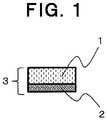
- a laminate not according to the present invention has a structure, for example, as shown in Fig. 1 . Namely, it is a laminate 3 having at least one polylactic acid resin-containing layer (C) 2 with a predetermined thickness on at least one surface of a fibrous structure (B) 1 containing a water-soluble resin (A).
- a using method shown in Fig. 2 is exemplified as an example. Namely, it is a method for using the laminate for pressing the laminate 3 according to the present invention into a cylindrical vessel 5 using a pressing jig 4 from one opening of the vessel 5, sending the laminate 3 out of the other opening, after sticking the laminate 3 to a surface of an adherend 6, applying a liquid onto the laminate 3 to dissolve the fibrous structure (B) 1 (shown in Fig. 1 ), thereby removing the fibrous structure (B), and leaving the polylactic acid resin-containing layer (C) 2 (shown in Fig. 1 ) on the surface of the adherend 6.
- the laminate according to the present invention can be suitably used for medical applications such as wound-dressing membranes or adhesion-preventing membranes capable of being used in an organism or even under an environment adhered with moisture.
- the areal weight was determined based on the method described in JIS L 1096 8.3.2 (1999).
- a dial thickness gauge (supplied by OZAKI MFG.CO.,LTD., product name: "Peacock H", amount of scale: 0.01 mm, measurement force: 1.8N or less) was used, and an average value of 10 measurement points of each sample was determined to be a total thickness of the laminate.
- a dial thickness gauge higher in accuracy supplied by Teclock Corporation, type: SM-1201L, amount of scale: 0.001 mm, measurement force: 1.5N or less
- a perpendicular section in the thickness direction was prepared by a microtome, and the section was observed using a scanning electron microscope (SEM, supplied by Keyence Corporation, VE-7800) and appropriately adjusting the magnification in a range of 2,500 times to 100,000 times so that each observed layer was put within 10% to 90% of the angle of visibility.
- SEM scanning electron microscope
- a thickness of each layer became 0.1 ⁇ m or less and it was difficult to observe by the above-described method, it was similarly observed using a high-resolution transmission electron microscope (supplied by JEOL Ltd., JEM-2100) and adjusting the magnification in a range of 500,000 times to 1,000,000 times.
- the thickness was determined by storing the observed image and appropriately enlarging the image (for example, by printing it at an A3 size or the like).
- the thickness of a fibrous structure (B) was determined as a thickness calculated by subtracting the thicknesses of a layer (D) containing water-soluble resin (E) and a polylactic acid resin-containing layer (C) from the total thickness of the laminate.
- the thickness of a fibrous structure (B) in case having a reinforcing layer was determined as a thickness calculated by subtracting the thicknesses of a layer (D) containing water-soluble resin (E), a polylactic acid resin-containing layer (C) and the reinforcing layer from the total thickness of the laminate.
- the thickness of a fibrous structure (B) in case having a reinforcing layer means a thickness of only the fibrous structure (B) which does not include the thickness of the reinforcing layer.
- the height from a surface of a test piece to a tip of a burette was adjusted so as to become 10 mm.
- the timing when one drop of water was dropped from the burette to one surface of the test piece of a fibrous structure (B) was referred to as a starting time
- the timing when the water permeated to another surface thereof and dissolved it was referred to as a finishing time
- a time required from the starting time until the finishing time was determined.
- the dissolution referred here means that the shape of the fibers cannot be maintained and collapses, and it is determined by observing from various directions.
- a case where the time required until the finishing of dissolution was 10 seconds or more and less than 5 minutes was determined to be Rank A
- a case of 5 minutes or more was determined to be Rank B
- a case of less than 10 seconds was determined to be Rank C.
- Two sheets of Si rubbers (supplied by Kyowa Industrial Co., Ltd., hardness: 20 degrees, 3 cm x 1 cm) were prepared, and purified water was sprayed onto the surfaces of the two sheets of Si rubbers so as to uniformly adhere thereto at an amount of 5 mg per each sheet under an environment of a temperature of 23 ⁇ 5°C and a relative humidity of 65 ⁇ 20%.
- test piece of 5 cm x 5 cm was nipped by two sheets of wet Si rubbers for 1 second at a force of 5N, and was held in the air so that the longer sides of the Si rubbers were perpendicular to the ground, and when one Si rubber was fixed and the other Si rubber was exfoliated in the horizontal direction relative to the ground at a speed of 1.5 m/min., it was checked whether the test piece fell without being stuck to the Si rubber or not.
- test piece of 9 cm x 12 cm and a trocar used in a general laparoscopic surgery were used, and flexibility was evaluated at the following condition. Further, as the trocar and a sending-out rod, the following (i) and (ii) were used. In the sending out, the test piece was placed so that the polylactic acid resin-containing layer (C) side thereof was brought into contact with the hole part of the trocar, it was pressed into the trocar, it was evaluated whether the test piece could pass through the trocar, and further, after passing, whether the test piece could be extended to an original formation when extending it by hand. Further, supposing use during operation, a test wetting the inside of the trocar was also carried out. Where, with respect to a test piece which did not pass through the trocar, the extensibility could not be evaluated.
- the polylactic acid resin-containing layer (C) side of a test piece (size: 10 cm x 10 cm) was stuck to a PET (polyethylene terephthalate) film (supplied by Toray Industries, Inc., "Lumirror” (registered trade mark) #100T60, size; 5 cm x 5 cm) wetted by being sprayed with 100g of purified water, and that state was maintained for 5 seconds.
- PET polyethylene terephthalate
- Adherence-1 (Examples 1 to 12, Comparative Examples 1 to 8):
- the polylactic acid resin-containing layer (C) side of a test piece (size: 3 cm x 3 cm) was stuck to a central portion of a PET film (supplied by Toray Industries, Inc., "Lumirror” (registered trade mark) #100T60, size; 5 cm x 5 cm) wetted by being sprayed with 100g of purified water, and it was adhered by pressing it with a dried Si rubber (supplied by Kyowa Industrial Co., Ltd., hardness: 20 degrees, 3 cm x 1 cm) for 10 seconds.
- a PET film supplied by Toray Industries, Inc., "Lumirror” (registered trade mark) #100T60, size; 5 cm x 5 cm
- a dried Si rubber supplied by Kyowa Industrial Co., Ltd., hardness: 20 degrees, 3 cm x 1 cm
- test piece together with the PET film was transferred into a vessel having a bottom surface of 12 cm x 5 cm, and 12g of purified water was charged thereinto softly from a part above the test piece to dissolve and remove the fibrous structure (B).
- test piece together with the PET film was taken out from the solution, and it was left for one hour or more in a constant temperature and humidity vessel (supplied by Espec Corporation, LHU-113) controlled to an environment of a temperature of 25°C and a relative humidity of 90% at a condition of being placed vertically, thereby removing excessive moisture from the test piece.
- a constant temperature and humidity vessel supplied by Espec Corporation, LHU-113 controlled to an environment of a temperature of 25°C and a relative humidity of 90% at a condition of being placed vertically, thereby removing excessive moisture from the test piece.
- test piece together with the PET film was taken out from the constant temperature and humidity vessel, it was checked whether the test piece and the PET film could be shifted in position from each other by hand, a case where they were not shifted was determined to be Rank A, a case where they were shifted was determined to be Rank B, and a case where it could not be checked whether the test piece was shifted or elongated because of being swelled was determined to be Rank C.
- a laminate was evaluated by observation.
- the evaluation indexes are as follows.
- Adherence-2 (Examples 13 to 16, Reference Examples 17 to 21):
- a single layer of a polylactic acid resin-containing layer (C) or a laminated layer of a layer (D) containing a water-soluble resin (E) and a polylactic acid resin-containing layer (C), and a fibrous structure (B), were separated from each other, and it was served to a sensory evaluation.
- the evaluation indexes are as follows.
- the evaluation indexes are as follows.
- the evaluation indexes are as follows.
- Biaxially oriented polyester film supplied by Toray Industries, Inc., "Lumirror” (registered trade mark) type: T60, thickness: 100 ⁇ m).
- Poly-L-lactic acid resin with an amount of poly-D-lactic acid at 1.4 mol%, having a melting point of 150°C, and having a weight average molecular weight calculated by conversion with PMMA of 220,000 (supplied by Nature Works Corporation, 4032D).
- Pullulan having a number average molecular weight of about 200,000 daltons and a viscosity in a range of 100 to 180 mm 2 /sec. (aqueous solution with a temperature of 30°C and a solid component concentration of 10 mass%) (sold by Hayashibara Co., Ltd., Pullulan Pl-20).
- Polyvinyl alcohol having a degree of saponification of 96.5 mol% and a viscosity of 27.5 mPa • s (4 mass% aqueous solution, 20°C) (supplied by Japan Vam & Poval Co., Ltd., JM-17).
- Gelatin powder supplied by Nitta Gelatin Inc., for medical applications.
- Pig-derived collagen powder supplied by Nippon Meat Pressure, Inc., SOFD type.
- a nonwoven fabric having an areal weight of 50 g/m 2 and a thickness of 300 ⁇ m was prepared by melt-blow system.
- a nonwoven fabric having an areal weight of 1 g/m 2 and a thickness of 10 ⁇ m was prepared by melt-blow system.
- a nonwoven fabric having an areal weight of 30 g/m 2 and a thickness of 300 ⁇ m was prepared by melt-blow system.
- a nonwoven fabric having an areal weight of 200 g/m 2 and a thickness of 1,000 ⁇ m was prepared by melt-blow system.
- a nonwoven fabric having an areal weight of 1,000 g/m 2 and a thickness of 5,000 ⁇ m was prepared by melt-blow system.
- Collagen-1 as a water-soluble resin (A)
- a nonwoven fabric having an areal weight of 10 g/m 2 and a thickness of 80 ⁇ m was prepared by wet-spinning system.
- a nonwoven fabric having an areal weight of 300 g/m 2 and a thickness of 1,700 ⁇ m was prepared by melt-blow system.
- PET-1 (same base material film as aforementioned):
- Biaxially oriented polyester film supplied by Toray Industries, Inc., "Lumirror” (registered trade mark) type: T60, thickness: 100 ⁇ m).
- Poly-L-lactic acid resin with an amount of poly-D-lactic acid at 12 mol%, having a melting point of 150°C, and having a weight average molecular weight calculated by conversion with PMMA of 220,000 (supplied by Nature Works Corporation, 4060D).
- Polyvinyl alcohol having a degree of saponification of 88 mol% and a viscosity of 5 mPa ⁇ s (4 mass% aqueous solution, 20°C) supplied by Nippon Synthetic Chemical Industry Co., Ltd., "GOHSENOL” (registered trade mark) EG-05P).
- a nonwoven fabric having an areal weight of 30 g/m 2 and a thickness of 300 ⁇ m was prepared by melt-blow system. It was sampled at a size of 100 mm x 100 mm.
- PVA-2 was dissolved into water to prepare a water-soluble resin emulsion solution with a solid component concentration of 1 mass%.
- two rubber rollers (11, 12), each formed using an aluminum as its roller core material and a nitrile rubber (NBR, hardness: 30 degrees) as its surface material and each having a diameter of 5 cm, a width of 30 cm and a weight of 1 kg, were set at their axes, rotatably in the directions capable of being contacted with each other (rotational directions 13).
- the upper roller 11 was set such that its shaft can move in the vertical direction so that only its self-weight applies to the lower roller 12.
- Pullulan-1 as a water-soluble resin was dissolved in water to prepare an water-soluble resin emulsion solution, it was applied to one surface of a base material film PET-1 by applicator method so that the layer thickness after drying became 3 ⁇ m, and it was dried in a hot air-drying type drier at 90°C for 20 seconds to form a layer (D) containing a water-soluble resin (E) on the base material film.
- a solution dissolved with PLA-1 to ethyl acetate was applied onto the layer (D) containing a water-soluble resin (E) using a metering bar so that the layer thickness after drying became 150 nm, it was dried in a hot air-drying type drier at 80°C for 20 seconds to provide the polylactic acid resin-containing layer (C) thereon, and thus a laminated layer was formed.
- the laminated layer comprising the water-soluble resin (E) and the polylactic acid resin was exfoliated from the base material film, and after purified water was applied to the layer (D) containing the water-soluble resin (E) by a sprayer so as to achieve 5 g/m 2 , it was quickly laminated to Structure-1.
- the evaluation results of the obtained structure and the laminate laminated with the laminated layer are shown in Table 2.
- a laminate laminated with the fibrous structure (B) and the polylactic acid resin-containing layer (C) was formed similarly to Example 1 other than a condition where the thickness of the polylactic acid resin-containing layer (C) was controlled at 50 nm.
- a laminate laminated with the fibrous structure (B) and the polylactic acid resin-containing layer (C) was formed similarly to Example 1 other than a condition where the thickness of the polylactic acid resin-containing layer (C) was controlled at 10 nm and the layer thickness after drying of the layer (D) containing the water-soluble resin (E) was controlled at 1 ⁇ m.
- a laminate laminated with the fibrous structure (B) and the polylactic acid resin-containing layer (C) was formed similarly to Example 1 other than a condition where the thickness of the polylactic acid resin-containing layer (C) was controlled at 500 nm and the layer thickness after drying of the layer (D) containing the water-soluble resin (E) was controlled at 1 ⁇ m.
- a laminate laminated with the fibrous structure (B) and the polylactic acid resin-containing layer (C) was formed similarly to Example 1 other than a condition where the layer (D) containing the water-soluble resin (E) was applied so that its layer thickness became 0.01 ⁇ m.
- a laminate laminated with the fibrous structure (B) and the polylactic acid resin-containing layer (C) was formed similarly to Example 1 other than a condition where the layer (D) containing the water-soluble resin (E) was applied so that its layer thickness became 15 ⁇ m.
- a laminate laminated with the fibrous structure (B) and the polylactic acid resin-containing layer (C) was formed similarly to Example 1 other than a condition where not Structure-1 but Structure-2 was employed as the fibrous structure (B).
- a laminate laminated with the fibrous structure (B) and the polylactic acid resin-containing layer (C) was formed similarly to Example 1 other than a condition where not Structure-1 but Structure-3 was employed as the fibrous structure (B), PVA-1 was used for the layer (D) containing the water-soluble resin (E) and the layer thickness after drying of the layer (D) was controlled at 3 ⁇ m.
- a laminate laminated with the fibrous structure (B) and the polylactic acid resin-containing layer (C) was formed similarly to Example 1 other than a condition where not Structure-1 but Structure-4 was employed as the fibrous structure (B).
- a laminate laminated with the fibrous structure (B) and the polylactic acid resin-containing layer (C) was formed similarly to Example 1 other than a condition where not Structure-1 but Structure-5 was employed as the fibrous structure (B).
- a laminate laminated with the fibrous structure (B) and the polylactic acid resin-containing layer (C) was formed similarly to Example 1 other than a condition where not Structure-1 but Structure-8 was employed as the fibrous structure (B).
- a polylactic acid resin-containing layer (C) was formed at a thickness of 500 nm and a layer (D) containing a water-soluble resin (E) was formed so that its thickness after drying became 1 ⁇ m, respectively, and the obtained laminated layer was washed by water, thereby removing a layer containing the water-soluble resin. Further, a laminate laminated with the fibrous structure (B) and the polylactic acid resin-containing layer (C) was formed similarly to Example 1 other than a condition where positions applied with purified water were set at 4 corners of Structure-1.
- a laminate laminated with the fibrous structure (B) and the polylactic acid resin-containing layer (C) was formed similarly to Example 1 other than a condition where the thickness of the polylactic acid resin-containing layer (C) was controlled at 1,000 nm.
- Example 1 Similarly to Example 1, a layer (D) containing a water-soluble resin (E) was formed and a laminated layer was formed. Thereafter, although, in order to use PLA-2 for a polylactic acid resin-containing layer (C), it was tried to dissolve PLA-2 into heated ethyl acetate (60°C to 90°C), coating could not be carried out because PLA-2 did not dissolve into the ethyl acetate.
- Example 1 Similarly to Example 1 other than a condition where a Gelatin-1 layer was formed instead of a polylactic acid resin-containing layer (C) and its thickness was controlled at 1,000 nm, a laminate laminated with the fibrous structure (B) and the gelatin layer was formed.
- a laminate laminated with the fibrous structure (B) and the polylactic acid resin-containing layer (C) was formed similarly to Example 1 other than a condition where the thickness of the polylactic acid resin-containing layer (C) was controlled at 1,000 nm and the thickness of the layer (D) containing the water-soluble resin (E) was controlled at 30 ⁇ m.
- a laminate laminated with the fibrous structure (B) and the polylactic acid resin-containing layer (C) was formed similarly to Example 1 other than a condition where the thickness of the polylactic acid resin-containing layer (C) was controlled at 1,000 nm and not Structure-1 but Structure-6 was employed as the fibrous structure (B).
- a laminate laminated with the fibrous structure (B) and the polylactic acid resin-containing layer (C) was formed similarly to Example 1 other than a condition where the thickness of the polylactic acid resin-containing layer (C) was controlled at 1,000 nm, Collagen-1 was employed for a layer (D) containing a water-soluble resin (E), and not Structure-1 but Structure-7 was employed as the fibrous structure (B).
- Example 1 Similarly to Example 1 other than a condition where a pullulan layer was formed instead of a polylactic acid resin-containing layer (C) and its thickness was controlled at 300 nm, a laminate laminated with the fibrous structure (B) and the pullulan layer was formed.
- Example 1 Similarly to Example 1 other than a condition where the working was finished when the laminated layer comprising the water-soluble resin (E) and the polylactic acid resin was exfoliated from the base material film and the lamination working with the fibrous structure (B) was not carried out, a laminated layer of the polylactic acid resin-containing layer (C) was formed.
- Example 1 Example 2
- Example 3 Example 4
- Example 5 Polylactic acid resin-containing layer
- C Resin Unit PLA-1 PLA-1 PLA-1 PLA-1 PLA-1 Thickness nm 150 50 10 500 150 150
- Layer (D) containing water-soluble resin
- E Resin - Pullulan-1 Pullulan-1 Pullulan-1 Pullulan-1 Pullulan-1 Thickness ⁇ m 3 3 1 1 0.01 15 Fibrous structure.
- B containing water-soluble resin
- A Resin - Pullulan-1 Pullulan-1 Pullulan-1 Pullulan-1 Pullulan-1 Pullulan-1 Pullulan-1
- Example 1 to 11 and Example 12 not according to the invention the evaluations of dissolvability of fibrous structure (B), stickiness, trocar passing property, re-sticking property and adherence were good.
- Comparative Examples 1 to 8 there were poor points in any of the items. Points to be specially mentioned will be described.
- PVA-2 was dissolved in water to prepare an water-soluble resin emulsion solution, it was applied to one surface of a base material film PET-1 using a metering bar so that the layer thickness after drying became 3 ⁇ m, and it was dried in a hot air-drying type drier at 90°C for 20 seconds to form a layer (D) containing a water-soluble resin on the PET-1.
- a solution dissolved with PLA-3 to ethyl acetate was applied onto the layer (D) containing a water-soluble resin using a metering bar so that the layer thickness after drying became 500 nm, and it was dried in a hot air-drying type drier at 70°C for 20 seconds to provide the polylactic acid resin-containing layer (C) thereon.
- the planar structure laminated with the PET-1, the layer (D) containing a water-soluble resin and the polylactic acid resin-containing layer (C) was sampled at a size of 100 mm x 100 mm, it was dipped in purified water to dissolve the , and a single substance of the polylactic acid resin-containing layer (C) was obtained.
- the fibrous structure (B) and the polylactic acid resin-containing layer (C) were fixed to each surface of separated flat plates, and to the fibrous structure (B), purified water was sprayed using a sprayer so that the purified water was distributed over the whole of the surface of the base material having a size of 100 mm x 100 mm at 5 g/m 2 Thereafter, while maintaining the parallel state between the fibrous structure (B) and the polylactic acid resin-containing layer (C), they were quickly laminated so that the four positions of their four corners were approximately coincided.
- the evaluation result is as shown in Table 6.
- the fibrous structure (B) and a single substance of the polylactic acid resin-containing layer (C), which was prepared in a manner similar to that in Example 13, were fixed to each surface of separated PET-1.
- purified water was sprayed using a sprayer so that the purified water was distributed over the whole of the surface of the fibrous structure (B) having a size of 100 mm x 100 mm at 5 g/m 2 .
- the fibrous structure (B) and the polylactic acid resin-containing layer (C) were quickly laminated by passing them between two rollers so that the four positions of their four corners were approximately coincided ( Fig. 4 ).
- symbol 11 shows an upper roller
- symbol 12 shows a lower roller
- symbol 13 shows a rotational direction
- symbol 14 shows PET-1, respectively.
- the evaluation result is as shown in Table 6.
- Example 13 Using a flat structure prepared similarly to Example 13 other than a condition where the thickness after drying of the polylactic acid resin-containing layer (C) was controlled at 150 nm, a laminated layer comprising the polylactic acid resin-containing layer (C) and the layer (D) containing a water-soluble resin was physically exfoliated from PET-1. Next, the exfoliated laminated layer was sampled at a size of 100 mm x 100 mm, lamination was carried out similarly to Example 13 other than a condition where the polylactic acid resin-containing layer (C) of the laminated layer was fixed so as to come to Flat plate-1 side. The evaluation result is as shown in Table 6.
- the laminated layer prepared similarly to Example 15 was sampled at a size of 100 mm x 100 mm, lamination was carried out similarly to Example 14 other than a condition where the polylactic acid resin-containing layer (C) of the laminated layer was fixed so as to come to Flat plate-1 side.
- the evaluation result is as shown in Table 6.
- a single substance of the polylactic acid resin-containing layer (C) was prepared similarly to Example 13. Next, a solution controlled at a solid component concentration of 30 mass% by diluting a urethane-based adhesive (supplied by Mitsui Chemicals, Inc., main agent: "Takelac” (registered trade mark) A3216, curing agent: "Takenate” (registered trade mark) A3070) with ethyl acetate was applied onto one surface of the polylactic acid resin-containing layer (C) using a metering bar so that the layer thickness after drying became 3 ⁇ m, and it was dried in a hot air-drying type drier at 70°C for 20 seconds to provide an adhesive layer.
- a urethane-based adhesive supplied by Mitsui Chemicals, Inc., main agent: "Takelac” (registered trade mark) A3216, curing agent: "Takenate” (registered trade mark) A3070
- the fibrous structure (B) and the polylactic acid resin-containing layer (C) were quickly laminated at a state where the adhesive layer was positioned between the fibrous structure (B) and the polylactic acid resin-containing layer (C), by passing them between two rollers so that the four positions of their four corners were approximately coincided. Thereafter, it was aged at 40°C for 48 hours or more.
- the evaluation result is as shown in Table 7.
- PLA-3 was supplied to the melting extruder, it was discharged from a T-shaped die controlled at a die temperature of 210°C to be brought into close contact with the casting drum, thereafter, it was immediately laminated with the fibrous structure (B) placed on the surface of the polishing roller, and cooled, and then wound by a winder. As shown with the evaluation result in Table 7, in the obtained laminate, the fibers of the fibrous structure (B) were adhered to each other by heat, and the shape was deteriorated.
- a single substance of the polylactic acid resin-containing layer (C) was prepared similarly to Example 13. Next, after the fibrous structure (B) and the polylactic acid resin-containing layer (C) were stacked to each other, they were passed between a pair of a heating drum and a nip roller, which were rotated in the directions contacted with each other and heated at 180°C (corresponding to a melting point of the polylactic acid resin-containing layer (C) + about 10°C). As shown with the evaluation result in Table 7, the obtained polylactic acid resin-containing layer (C) was fused and it could not form a layer structure.
- a single substance of the polylactic acid resin-containing layer (C) was prepared similarly to Example 13.
- a silicone-based adhesive with a thickness of 50 ⁇ m which had been nipped by two mold release films, was exfoliated from the mold release films, it was nipped between the fibrous structure (B) and the polylactic acid resin-containing layer (C), and they were passed between two rollers similarly to Example 14 to laminate the fibrous structure (B) and the polylactic acid resin-containing layer (C).
- the fibrous structure (B) was easily delaminated from the adhesive.
- a single substance of the polylactic acid resin-containing layer (C) was prepared similarly to Reference Example 17.
- the respective single substances of the fibrous structure (B) and the polylactic acid resin-containing layer (C) were stacked to each other, a thorny needle, which had a plurality of thorns extending downwardly toward the tip of the metal needle, was once penetrated from a fibrous structure (B) side to a polylactic acid resin-containing layer (C) side so as to be pressed at a condition where a part of the fibers of the fibrous structure (B) were caught by the thorns, thereafter, the needle was pulled out gently, and from the opened holy, a part of the fibrous structure (B) was exposed to the surface of the polylactic acid resin-containing layer (C).
- Example 16 Lamination method A B A B Fibrous structure (B) containing water-soluble resin (A) Material Water-soluble resin PVA-2 Water-soluble resin PVA-2 Water-soluble resin PVA-2 Water-soluble resin PVA-2 Thickness ( ⁇ m) 300 300 300 300 Areal weight (g/m 2 ) 30 30 30 30 30 Layer (D) containing water-soluble resin (E) Material - - Water-soluble resin PVA-2 Water-soluble resin PVA-2 Thickness ( ⁇ m) - - 3.00 3.00 Polylactic acid resin-containing layer (C) Material PLA-3 PLA-3 PLA-3 PLA-3 Thickness (nm) 500 500 150 150 Evaluation result Appearance A A A A A Adherance A A A A A Environmental load (Used amount of organic solvent) A A A A A A Workability of lamination A A A A [Table 7] Reference Example
- the laminate according to the present invention is a laminate laminated with at least one polylactic acid resin-containing layer (C) on at least one surface of a fibrous structure (B) containing a water-soluble resin (A), it is flexible and excellent in followability, adherence and coatability relative to an adherend having a curved surface, further it exhibits excellent compatibility to organs such as skin and internal organs, and the fibrous structure (B) containing a water-soluble resin (A) can be easily removed from the polylactic acid resin-containing layer (C) by an aqueous solution, and therefore, it is optimal for use in materials for external use on the skin, such as wound-dressing materials, adhesion-preventing materials, and skin care products.
- the production method for the laminate according to the present invention is optimal for production of products attempting high functionality by lamination of a fibrous structure and a polylactic acid resin-containing layer, for example, medical products such as surgical gowns, stupes and artificial skins, and hygiene products such as diapers, gauze and first-aid adhesive tapes.
Landscapes
- Health & Medical Sciences (AREA)
- Chemical & Material Sciences (AREA)
- Epidemiology (AREA)
- Life Sciences & Earth Sciences (AREA)
- Animal Behavior & Ethology (AREA)
- General Health & Medical Sciences (AREA)
- Public Health (AREA)
- Veterinary Medicine (AREA)
- Engineering & Computer Science (AREA)
- Chemical Kinetics & Catalysis (AREA)
- Hematology (AREA)
- Materials Engineering (AREA)
- Surgery (AREA)
- Vascular Medicine (AREA)
- Heart & Thoracic Surgery (AREA)
- Ceramic Engineering (AREA)
- Textile Engineering (AREA)
- Mechanical Engineering (AREA)
- Fluid Mechanics (AREA)
- Physics & Mathematics (AREA)
- Laminated Bodies (AREA)
- Biological Depolymerization Polymers (AREA)
- Materials For Medical Uses (AREA)
- Medicinal Chemistry (AREA)
- Polymers & Plastics (AREA)
- Organic Chemistry (AREA)
Claims (7)
- Stratifié comportant au moins une couche contenant une résine de poly(acide lactique) (C) ayant une épaisseur de 10 nm à 500 nm sur au moins une surface d'une structure fibreuse (B) contenant une résine hydrosoluble (A), dans lequel au moins une couche (D) contenant une résine hydrosoluble (E) ayant une épaisseur de 0,01 µm à 15 µm est disposée entre ladite structure fibreuse (B) contenant une résine hydrosoluble (A) et ladite couche contenant une résine de poly(acide lactique) (C).
- Stratifié selon la revendication 1, où un temps nécessaire à partir d'un moment auquel de l'eau est appliquée sur une surface de ladite structure fibreuse (B) contenant une résine hydrosoluble (A) jusqu'à un moment auquel l'eau atteint une autre surface de ladite structure fibreuse (B) est une plage de 10 secondes à 5 minutes, dans lequel la quantité d'eau appliquée sur une surface de ladite structure fibreuse (B) est 0,04 ml, où « l'eau atteint une autre surface de ladite structure fibreuse (B) » désigne un état dans lequel les fibres d'une autre surface de la structure fibreuse (B) sont dissoutes de sorte que la forme des fibres ne puisse pas être maintenue, et où le temps est déterminé comme décrit dans la description.
- Stratifié selon la revendication 1 ou 2, dans lequel ladite résine hydrosoluble (A) contient un alcool polyvinylique et/ou un pullulane.
- Stratifié selon la revendication 1, dans lequel ladite résine hydrosoluble (E) contient un alcool polyvinylique et/ou un pullulane.
- Stratifié selon l'une quelconque des revendications 1 à 4, dans lequel un poids surfacique de ladite structure fibreuse (B) contenant une résine hydrosoluble (A) est dans une plage de 1 g/m2 à 1 000 g/m2.
- Stratifié selon l'une quelconque des revendications 1 à 5, dans lequel une épaisseur de ladite structure fibreuse (B) contenant une résine hydrosoluble (A) est dans une plage de 0,1 µm à 5 000 µm.
- Stratifié selon l'une quelconque des revendications 1 à 6, dans lequel ladite résine de poly(acide lactique) est une résine avec une quantité de poly(acide D-lactique) dans une plage de 4 % en moles à 50 % en moles.
Applications Claiming Priority (3)
| Application Number | Priority Date | Filing Date | Title |
|---|---|---|---|
| JP2014124935 | 2014-06-18 | ||
| JP2014128864 | 2014-06-24 | ||
| PCT/JP2015/067553 WO2015194616A1 (fr) | 2014-06-18 | 2015-06-18 | Stratifié et son procédé de production |
Publications (3)
| Publication Number | Publication Date |
|---|---|
| EP3159164A1 EP3159164A1 (fr) | 2017-04-26 |
| EP3159164A4 EP3159164A4 (fr) | 2018-01-24 |
| EP3159164B1 true EP3159164B1 (fr) | 2020-04-29 |
Family
ID=54935596
Family Applications (1)
| Application Number | Title | Priority Date | Filing Date |
|---|---|---|---|
| EP15809450.8A Active EP3159164B1 (fr) | 2014-06-18 | 2015-06-18 | Stratifié et son procédé de production |
Country Status (8)
| Country | Link |
|---|---|
| US (1) | US10786980B2 (fr) |
| EP (1) | EP3159164B1 (fr) |
| JP (1) | JP6119863B2 (fr) |
| KR (1) | KR101786825B1 (fr) |
| CN (1) | CN106457811A (fr) |
| CA (1) | CA2952604C (fr) |
| ES (1) | ES2790800T3 (fr) |
| WO (1) | WO2015194616A1 (fr) |
Families Citing this family (32)
| Publication number | Priority date | Publication date | Assignee | Title |
|---|---|---|---|---|
| GB0808376D0 (en) | 2008-05-08 | 2008-06-18 | Bristol Myers Squibb Co | Wound dressing |
| GB0817796D0 (en) | 2008-09-29 | 2008-11-05 | Convatec Inc | wound dressing |
| GB201020236D0 (en) | 2010-11-30 | 2011-01-12 | Convatec Technologies Inc | A composition for detecting biofilms on viable tissues |
| JP5833134B2 (ja) | 2010-12-08 | 2015-12-16 | コンバテック・テクノロジーズ・インコーポレイテッドConvatec Technologies Inc | 創傷部位から滲出液を除去するための方法およびシステム |
| JP6151186B2 (ja) | 2010-12-08 | 2017-06-21 | コンバテック・テクノロジーズ・インコーポレイテッドConvatec Technologies Inc | 創傷滲出液システム付属装置 |
| CN103347561B (zh) | 2010-12-08 | 2016-09-07 | 康沃特克科技公司 | 用于评估伤口分泌液的集成系统 |
| GB201115182D0 (en) | 2011-09-02 | 2011-10-19 | Trio Healthcare Ltd | Skin contact material |
| GB2497406A (en) | 2011-11-29 | 2013-06-12 | Webtec Converting Llc | Dressing with a perforated binder layer |
| WO2014096843A2 (fr) | 2012-12-20 | 2014-06-26 | Convatec Technologies Inc. | Traitement de fibres cellulosiques chimiquement modifiées |
| GB2543544A (en) | 2015-10-21 | 2017-04-26 | Brightwake Ltd | Wound dressing |
| WO2017149584A1 (fr) * | 2016-02-29 | 2017-09-08 | 川澄化学工業株式会社 | Matériau de prévention des adhérences |
| JP7077621B2 (ja) * | 2016-03-23 | 2022-05-31 | 東レ株式会社 | 積層体 |
| CA3019436A1 (fr) | 2016-03-30 | 2017-10-05 | Qualizyme Diagnostics Gmbh & Co Kg | Detection d'une infection microbienne dans les plaies |
| SG11201808488XA (en) | 2016-03-30 | 2018-10-30 | Convatec Technologies Inc | Detecting microbial infections in wounds |
| GB201608099D0 (en) | 2016-05-09 | 2016-06-22 | Convatec Technologies Inc | Negative pressure wound dressing |
| CN105926202A (zh) * | 2016-06-12 | 2016-09-07 | 中山伟立纺织品有限公司 | 一种织片的制作工艺 |
| JP2019525799A (ja) | 2016-07-08 | 2019-09-12 | コンバテック・テクノロジーズ・インコーポレイテッドConvatec Technologies Inc | 流体収集装置 |
| EP3871645B1 (fr) | 2016-07-08 | 2022-05-04 | ConvaTec Technologies Inc. | Système de pression flexible négative |
| ES2912094T3 (es) | 2016-07-08 | 2022-05-24 | Convatec Technologies Inc | Detección de flujo de fluidos |
| EP3520825B1 (fr) | 2016-09-30 | 2023-12-20 | Toray Industries, Inc. | Matériau pour la prévention des adhérences |
| KR102030496B1 (ko) * | 2017-09-27 | 2019-10-10 | (주)진우바이오 | 자동 도포기에 의한 히알루론산염 필름의 제조방법 및 이로부터 제조된 히알루론산염 필름 |
| CN107617122B (zh) * | 2017-08-10 | 2020-11-24 | 北京大清生物技术股份有限公司 | 一种复合的止血膜及其制备方法 |
| EP4360666A3 (fr) | 2017-11-16 | 2024-05-08 | ConvaTec Limited | Appareil de collecte de fluide |
| CN112423732A (zh) * | 2018-07-25 | 2021-02-26 | 凸版印刷株式会社 | 皮肤敷贴用薄膜及转印片材 |
| SG11202112292QA (en) | 2019-06-03 | 2021-12-30 | Convatec Ltd | Methods and devices to disrupt and contain pathogens |
| CN110556331B (zh) * | 2019-09-19 | 2023-03-14 | 苏州芯慧联半导体科技有限公司 | 一种复合材料及使用该材料的静电卡盘的制造方法 |
| US12552129B2 (en) * | 2019-09-30 | 2026-02-17 | Monosol, Llc | Nonwoven water-soluble composite structure |
| US11331221B2 (en) | 2019-12-27 | 2022-05-17 | Convatec Limited | Negative pressure wound dressing |
| US11771819B2 (en) | 2019-12-27 | 2023-10-03 | Convatec Limited | Low profile filter devices suitable for use in negative pressure wound therapy systems |
| JP7478234B2 (ja) * | 2020-06-12 | 2024-05-02 | 信越化学工業株式会社 | 仮接着方法、デバイスウエハ加工方法、仮接着用積層体及びデバイスウエハ加工用積層体 |
| JP2023082786A (ja) * | 2021-12-03 | 2023-06-15 | セイコーエプソン株式会社 | 緩衝材および緩衝材の製造方法 |
| JPWO2024024765A1 (fr) * | 2022-07-25 | 2024-02-01 |
Family Cites Families (30)
| Publication number | Priority date | Publication date | Assignee | Title |
|---|---|---|---|---|
| JPH0781204B2 (ja) * | 1987-04-21 | 1995-08-30 | 株式会社バイオマテリアルユニバ−ス | ポリ乳酸繊維 |
| US5472518A (en) * | 1994-12-30 | 1995-12-05 | Minnesota Mining And Manufacturing Company | Method of disposal for dispersible compositions and articles |
| JP3610780B2 (ja) * | 1998-06-30 | 2005-01-19 | トヨタ自動車株式会社 | ポリ乳酸ステレオコンプレックスポリマー成型物の製造方法 |
| JP4378442B2 (ja) | 2000-01-11 | 2009-12-09 | 独立行政法人物質・材料研究機構 | 癒着防止材料 |
| JP2001145650A (ja) | 1999-11-22 | 2001-05-29 | Nitto Denko Corp | カイロ用粘着シート、その収容袋及びその使捨てカイロ |
| ATE283715T1 (de) * | 1999-12-17 | 2004-12-15 | Genzyme Corp | Chirurgische prothese |
| JP3796165B2 (ja) | 2001-11-20 | 2006-07-12 | 株式会社クラレ | 癒着防止材 |
| JP2003251749A (ja) | 2002-03-04 | 2003-09-09 | Sekisui Film Kk | 水解性積層フィルム及びその製造方法 |
| US20030195611A1 (en) * | 2002-04-11 | 2003-10-16 | Greenhalgh Skott E. | Covering and method using electrospinning of very small fibers |
| EP2042555B1 (fr) * | 2002-06-20 | 2011-04-27 | Toray Industries, Inc. | Composition de polymère d'acide poly(lactide), leurs plastiques formés et film |
| JP4295482B2 (ja) | 2002-08-08 | 2009-07-15 | グンゼ株式会社 | 癒着防止材 |
| JP2005224981A (ja) | 2004-02-10 | 2005-08-25 | Bando Chem Ind Ltd | 積層支持体及び皮膚貼付薬シート |
| US20070172651A1 (en) * | 2004-03-16 | 2007-07-26 | Takanori Miyoshi | Ultrafine polyactic acid fibers and fiber structure, and process for their production |
| EP1731180B1 (fr) | 2004-03-31 | 2017-10-11 | Nipro Corporation | Kit antiadhésif, procédé pour produire celui-ci et procédé consistant à empêcher l'adhérence |
| US20070238384A1 (en) * | 2006-03-20 | 2007-10-11 | Ming Tang | Articles, operating room drapes and methods of making and using the same |
| TW200838902A (en) * | 2007-02-09 | 2008-10-01 | Teijin Ltd | Method for producing polylactic acid |
| JP5608323B2 (ja) | 2007-11-14 | 2014-10-15 | 日東電工株式会社 | フィルタ濾材とその製造方法ならびにフィルタユニット |
| JP5295943B2 (ja) * | 2008-12-26 | 2013-09-18 | 花王株式会社 | ナノファイバシート |
| MX347302B (es) * | 2009-12-17 | 2017-04-21 | 3M Innovative Properties Company * | Telas fibrosas no tejidas dimensionalmente estables y metodos para fabricar y utilizar las mismas. |
| US8821900B2 (en) | 2009-12-28 | 2014-09-02 | Kawasumi Laboratories, Inc. | Anti-adhesion material |
| US9125811B2 (en) * | 2010-06-29 | 2015-09-08 | Kao Corporation | Nanofiber laminate sheet |
| JP5651076B2 (ja) * | 2010-06-29 | 2015-01-07 | 花王株式会社 | ナノファイバ積層シート |
| KR101256550B1 (ko) * | 2010-12-30 | 2013-04-19 | 주식회사 삼양바이오팜 | 유착방지기능을 갖는 수술용 메쉬 복합체 및 이의 제조 방법 |
| US9949897B2 (en) * | 2012-04-11 | 2018-04-24 | L'oreal | Self-standing cosmetic sheet |
| CN104812367A (zh) * | 2012-10-12 | 2015-07-29 | 株式会社资生堂 | 美容方法 |
| JP5685238B2 (ja) | 2012-11-12 | 2015-03-18 | 花王株式会社 | 使い捨ておむつ及び伸縮性シートの製造方法 |
| ES2797484T3 (es) * | 2013-03-15 | 2020-12-02 | Toray Industries | Película laminada que utiliza resina basada en ácido poliláctico |
| CN105377965B (zh) * | 2013-06-04 | 2019-05-10 | 蒙诺苏尔有限公司 | 水溶性膜密封溶液、相关方法和相关物品 |
| CN111297700B (zh) * | 2014-03-18 | 2022-10-14 | 松下知识产权经营株式会社 | 皮肤贴附用片材制作方法、美容方法及皮肤贴附用片材 |
| WO2015152204A1 (fr) * | 2014-03-31 | 2015-10-08 | 東レ株式会社 | Feuille multicouche, feuille intégrée l'utilisant, et leur procédé de fabrication |
-
2015
- 2015-06-18 EP EP15809450.8A patent/EP3159164B1/fr active Active
- 2015-06-18 ES ES15809450T patent/ES2790800T3/es active Active
- 2015-06-18 WO PCT/JP2015/067553 patent/WO2015194616A1/fr not_active Ceased
- 2015-06-18 JP JP2015531371A patent/JP6119863B2/ja active Active
- 2015-06-18 KR KR1020167028139A patent/KR101786825B1/ko active Active
- 2015-06-18 CN CN201580032437.6A patent/CN106457811A/zh active Pending
- 2015-06-18 CA CA2952604A patent/CA2952604C/fr active Active
- 2015-06-18 US US15/311,314 patent/US10786980B2/en active Active
Non-Patent Citations (1)
| Title |
|---|
| None * |
Also Published As
| Publication number | Publication date |
|---|---|
| CN106457811A (zh) | 2017-02-22 |
| EP3159164A4 (fr) | 2018-01-24 |
| ES2790800T3 (es) | 2020-10-29 |
| JPWO2015194616A1 (ja) | 2017-04-20 |
| EP3159164A1 (fr) | 2017-04-26 |
| US10786980B2 (en) | 2020-09-29 |
| KR20170017869A (ko) | 2017-02-15 |
| CA2952604C (fr) | 2019-01-29 |
| JP6119863B2 (ja) | 2017-04-26 |
| CA2952604A1 (fr) | 2015-12-23 |
| US20170072669A1 (en) | 2017-03-16 |
| WO2015194616A1 (fr) | 2015-12-23 |
| KR101786825B1 (ko) | 2017-10-18 |
Similar Documents
| Publication | Publication Date | Title |
|---|---|---|
| EP3159164B1 (fr) | Stratifié et son procédé de production | |
| CA2902804C (fr) | Film stratifie utilisant de la resine a l'acide polylactique | |
| CN108778729B (zh) | 层叠体 | |
| US10531988B2 (en) | Laminated film and medical sheet | |
| US10456503B2 (en) | Polymer laminate | |
| JP2018171725A (ja) | 積層体及びこれを用いた癒着防止材 | |
| EP4563346A1 (fr) | Objet multicouche |
Legal Events
| Date | Code | Title | Description |
|---|---|---|---|
| STAA | Information on the status of an ep patent application or granted ep patent |
Free format text: STATUS: THE INTERNATIONAL PUBLICATION HAS BEEN MADE |
|
| PUAI | Public reference made under article 153(3) epc to a published international application that has entered the european phase |
Free format text: ORIGINAL CODE: 0009012 |
|
| STAA | Information on the status of an ep patent application or granted ep patent |
Free format text: STATUS: REQUEST FOR EXAMINATION WAS MADE |
|
| 17P | Request for examination filed |
Effective date: 20161201 |
|
| AK | Designated contracting states |
Kind code of ref document: A1 Designated state(s): AL AT BE BG CH CY CZ DE DK EE ES FI FR GB GR HR HU IE IS IT LI LT LU LV MC MK MT NL NO PL PT RO RS SE SI SK SM TR |
|
| AX | Request for extension of the european patent |
Extension state: BA ME |
|
| DAV | Request for validation of the european patent (deleted) | ||
| DAX | Request for extension of the european patent (deleted) | ||
| A4 | Supplementary search report drawn up and despatched |
Effective date: 20180103 |
|
| RIC1 | Information provided on ipc code assigned before grant |
Ipc: B32B 27/12 20060101ALI20171220BHEP Ipc: A61L 15/22 20060101ALI20171220BHEP Ipc: A61L 15/24 20060101ALI20171220BHEP Ipc: A61L 31/06 20060101ALI20171220BHEP Ipc: B32B 5/02 20060101ALI20171220BHEP Ipc: A61L 15/26 20060101ALI20171220BHEP Ipc: B32B 37/18 20060101ALI20171220BHEP Ipc: B32B 7/04 20060101ALI20171220BHEP Ipc: B32B 38/10 20060101ALI20171220BHEP Ipc: B32B 27/36 20060101AFI20171220BHEP Ipc: B32B 27/30 20060101ALI20171220BHEP Ipc: A61L 15/28 20060101ALI20171220BHEP Ipc: A61L 15/16 20060101ALI20171220BHEP Ipc: A61L 31/04 20060101ALI20171220BHEP Ipc: A61L 31/00 20060101ALI20171220BHEP |
|
| REG | Reference to a national code |
Ref country code: DE Ref legal event code: R079 Ref document number: 602015051780 Country of ref document: DE Free format text: PREVIOUS MAIN CLASS: B32B0027360000 Ipc: B32B0027080000 |
|
| GRAP | Despatch of communication of intention to grant a patent |
Free format text: ORIGINAL CODE: EPIDOSNIGR1 |
|
| STAA | Information on the status of an ep patent application or granted ep patent |
Free format text: STATUS: GRANT OF PATENT IS INTENDED |
|
| RIC1 | Information provided on ipc code assigned before grant |
Ipc: B32B 27/30 20060101ALI20191015BHEP Ipc: B32B 23/08 20060101ALI20191015BHEP Ipc: A61L 31/04 20060101ALI20191015BHEP Ipc: B32B 27/08 20060101AFI20191015BHEP Ipc: A61L 31/00 20060101ALI20191015BHEP Ipc: A61L 15/22 20060101ALI20191015BHEP Ipc: B32B 27/12 20060101ALI20191015BHEP Ipc: A61L 15/24 20060101ALI20191015BHEP Ipc: A61L 15/26 20060101ALI20191015BHEP Ipc: A61L 15/28 20060101ALI20191015BHEP Ipc: B32B 7/12 20060101ALI20191015BHEP Ipc: B32B 27/36 20060101ALI20191015BHEP Ipc: A61L 31/06 20060101ALI20191015BHEP Ipc: A61L 15/16 20060101ALI20191015BHEP |
|
| INTG | Intention to grant announced |
Effective date: 20191113 |
|
| RIN1 | Information on inventor provided before grant (corrected) |
Inventor name: HOCHI MOTONORI Inventor name: SATO TERUHISA Inventor name: YAKAKE YOSHIKAZU Inventor name: ARAKANE TORU Inventor name: SEKIDO YUKI |
|
| GRAS | Grant fee paid |
Free format text: ORIGINAL CODE: EPIDOSNIGR3 |
|
| GRAJ | Information related to disapproval of communication of intention to grant by the applicant or resumption of examination proceedings by the epo deleted |
Free format text: ORIGINAL CODE: EPIDOSDIGR1 |
|
| GRAL | Information related to payment of fee for publishing/printing deleted |
Free format text: ORIGINAL CODE: EPIDOSDIGR3 |
|
| STAA | Information on the status of an ep patent application or granted ep patent |
Free format text: STATUS: REQUEST FOR EXAMINATION WAS MADE |
|
| GRAR | Information related to intention to grant a patent recorded |
Free format text: ORIGINAL CODE: EPIDOSNIGR71 |
|
| STAA | Information on the status of an ep patent application or granted ep patent |
Free format text: STATUS: GRANT OF PATENT IS INTENDED |
|
| GRAA | (expected) grant |
Free format text: ORIGINAL CODE: 0009210 |
|
| STAA | Information on the status of an ep patent application or granted ep patent |
Free format text: STATUS: THE PATENT HAS BEEN GRANTED |
|
| INTC | Intention to grant announced (deleted) | ||
| AK | Designated contracting states |
Kind code of ref document: B1 Designated state(s): AL AT BE BG CH CY CZ DE DK EE ES FI FR GB GR HR HU IE IS IT LI LT LU LV MC MK MT NL NO PL PT RO RS SE SI SK SM TR |
|
| INTG | Intention to grant announced |
Effective date: 20200320 |
|
| REG | Reference to a national code |
Ref country code: GB Ref legal event code: FG4D |
|
| REG | Reference to a national code |
Ref country code: CH Ref legal event code: EP |
|
| REG | Reference to a national code |
Ref country code: AT Ref legal event code: REF Ref document number: 1262682 Country of ref document: AT Kind code of ref document: T Effective date: 20200515 |
|
| REG | Reference to a national code |
Ref country code: DE Ref legal event code: R096 Ref document number: 602015051780 Country of ref document: DE |
|
| REG | Reference to a national code |
Ref country code: IE Ref legal event code: FG4D |
|
| REG | Reference to a national code |
Ref country code: NL Ref legal event code: MP Effective date: 20200429 |
|
| REG | Reference to a national code |
Ref country code: LT Ref legal event code: MG4D |
|
| REG | Reference to a national code |
Ref country code: ES Ref legal event code: FG2A Ref document number: 2790800 Country of ref document: ES Kind code of ref document: T3 Effective date: 20201029 |
|
| PG25 | Lapsed in a contracting state [announced via postgrant information from national office to epo] |
Ref country code: FI Free format text: LAPSE BECAUSE OF FAILURE TO SUBMIT A TRANSLATION OF THE DESCRIPTION OR TO PAY THE FEE WITHIN THE PRESCRIBED TIME-LIMIT Effective date: 20200429 Ref country code: NO Free format text: LAPSE BECAUSE OF FAILURE TO SUBMIT A TRANSLATION OF THE DESCRIPTION OR TO PAY THE FEE WITHIN THE PRESCRIBED TIME-LIMIT Effective date: 20200729 Ref country code: IS Free format text: LAPSE BECAUSE OF FAILURE TO SUBMIT A TRANSLATION OF THE DESCRIPTION OR TO PAY THE FEE WITHIN THE PRESCRIBED TIME-LIMIT Effective date: 20200829 Ref country code: PT Free format text: LAPSE BECAUSE OF FAILURE TO SUBMIT A TRANSLATION OF THE DESCRIPTION OR TO PAY THE FEE WITHIN THE PRESCRIBED TIME-LIMIT Effective date: 20200831 Ref country code: LT Free format text: LAPSE BECAUSE OF FAILURE TO SUBMIT A TRANSLATION OF THE DESCRIPTION OR TO PAY THE FEE WITHIN THE PRESCRIBED TIME-LIMIT Effective date: 20200429 Ref country code: SE Free format text: LAPSE BECAUSE OF FAILURE TO SUBMIT A TRANSLATION OF THE DESCRIPTION OR TO PAY THE FEE WITHIN THE PRESCRIBED TIME-LIMIT Effective date: 20200429 Ref country code: GR Free format text: LAPSE BECAUSE OF FAILURE TO SUBMIT A TRANSLATION OF THE DESCRIPTION OR TO PAY THE FEE WITHIN THE PRESCRIBED TIME-LIMIT Effective date: 20200730 |
|
| REG | Reference to a national code |
Ref country code: AT Ref legal event code: MK05 Ref document number: 1262682 Country of ref document: AT Kind code of ref document: T Effective date: 20200429 |
|
| PG25 | Lapsed in a contracting state [announced via postgrant information from national office to epo] |
Ref country code: HR Free format text: LAPSE BECAUSE OF FAILURE TO SUBMIT A TRANSLATION OF THE DESCRIPTION OR TO PAY THE FEE WITHIN THE PRESCRIBED TIME-LIMIT Effective date: 20200429 Ref country code: LV Free format text: LAPSE BECAUSE OF FAILURE TO SUBMIT A TRANSLATION OF THE DESCRIPTION OR TO PAY THE FEE WITHIN THE PRESCRIBED TIME-LIMIT Effective date: 20200429 Ref country code: RS Free format text: LAPSE BECAUSE OF FAILURE TO SUBMIT A TRANSLATION OF THE DESCRIPTION OR TO PAY THE FEE WITHIN THE PRESCRIBED TIME-LIMIT Effective date: 20200429 Ref country code: BG Free format text: LAPSE BECAUSE OF FAILURE TO SUBMIT A TRANSLATION OF THE DESCRIPTION OR TO PAY THE FEE WITHIN THE PRESCRIBED TIME-LIMIT Effective date: 20200729 |
|
| PG25 | Lapsed in a contracting state [announced via postgrant information from national office to epo] |
Ref country code: NL Free format text: LAPSE BECAUSE OF FAILURE TO SUBMIT A TRANSLATION OF THE DESCRIPTION OR TO PAY THE FEE WITHIN THE PRESCRIBED TIME-LIMIT Effective date: 20200429 Ref country code: AL Free format text: LAPSE BECAUSE OF FAILURE TO SUBMIT A TRANSLATION OF THE DESCRIPTION OR TO PAY THE FEE WITHIN THE PRESCRIBED TIME-LIMIT Effective date: 20200429 |
|
| PG25 | Lapsed in a contracting state [announced via postgrant information from national office to epo] |
Ref country code: MC Free format text: LAPSE BECAUSE OF FAILURE TO SUBMIT A TRANSLATION OF THE DESCRIPTION OR TO PAY THE FEE WITHIN THE PRESCRIBED TIME-LIMIT Effective date: 20200429 Ref country code: RO Free format text: LAPSE BECAUSE OF FAILURE TO SUBMIT A TRANSLATION OF THE DESCRIPTION OR TO PAY THE FEE WITHIN THE PRESCRIBED TIME-LIMIT Effective date: 20200429 Ref country code: CZ Free format text: LAPSE BECAUSE OF FAILURE TO SUBMIT A TRANSLATION OF THE DESCRIPTION OR TO PAY THE FEE WITHIN THE PRESCRIBED TIME-LIMIT Effective date: 20200429 Ref country code: DK Free format text: LAPSE BECAUSE OF FAILURE TO SUBMIT A TRANSLATION OF THE DESCRIPTION OR TO PAY THE FEE WITHIN THE PRESCRIBED TIME-LIMIT Effective date: 20200429 Ref country code: SM Free format text: LAPSE BECAUSE OF FAILURE TO SUBMIT A TRANSLATION OF THE DESCRIPTION OR TO PAY THE FEE WITHIN THE PRESCRIBED TIME-LIMIT Effective date: 20200429 Ref country code: EE Free format text: LAPSE BECAUSE OF FAILURE TO SUBMIT A TRANSLATION OF THE DESCRIPTION OR TO PAY THE FEE WITHIN THE PRESCRIBED TIME-LIMIT Effective date: 20200429 Ref country code: AT Free format text: LAPSE BECAUSE OF FAILURE TO SUBMIT A TRANSLATION OF THE DESCRIPTION OR TO PAY THE FEE WITHIN THE PRESCRIBED TIME-LIMIT Effective date: 20200429 |
|
| REG | Reference to a national code |
Ref country code: CH Ref legal event code: PL |
|
| REG | Reference to a national code |
Ref country code: DE Ref legal event code: R097 Ref document number: 602015051780 Country of ref document: DE |
|
| PG25 | Lapsed in a contracting state [announced via postgrant information from national office to epo] |
Ref country code: PL Free format text: LAPSE BECAUSE OF FAILURE TO SUBMIT A TRANSLATION OF THE DESCRIPTION OR TO PAY THE FEE WITHIN THE PRESCRIBED TIME-LIMIT Effective date: 20200429 Ref country code: SK Free format text: LAPSE BECAUSE OF FAILURE TO SUBMIT A TRANSLATION OF THE DESCRIPTION OR TO PAY THE FEE WITHIN THE PRESCRIBED TIME-LIMIT Effective date: 20200429 |
|
| PLBE | No opposition filed within time limit |
Free format text: ORIGINAL CODE: 0009261 |
|
| STAA | Information on the status of an ep patent application or granted ep patent |
Free format text: STATUS: NO OPPOSITION FILED WITHIN TIME LIMIT |
|
| PG25 | Lapsed in a contracting state [announced via postgrant information from national office to epo] |
Ref country code: LU Free format text: LAPSE BECAUSE OF NON-PAYMENT OF DUE FEES Effective date: 20200618 |
|
| 26N | No opposition filed |
Effective date: 20210201 |
|
| REG | Reference to a national code |
Ref country code: BE Ref legal event code: MM Effective date: 20200630 |
|
| PG25 | Lapsed in a contracting state [announced via postgrant information from national office to epo] |
Ref country code: LI Free format text: LAPSE BECAUSE OF NON-PAYMENT OF DUE FEES Effective date: 20200630 Ref country code: IE Free format text: LAPSE BECAUSE OF NON-PAYMENT OF DUE FEES Effective date: 20200618 Ref country code: CH Free format text: LAPSE BECAUSE OF NON-PAYMENT OF DUE FEES Effective date: 20200630 |
|
| PG25 | Lapsed in a contracting state [announced via postgrant information from national office to epo] |
Ref country code: BE Free format text: LAPSE BECAUSE OF NON-PAYMENT OF DUE FEES Effective date: 20200630 Ref country code: SI Free format text: LAPSE BECAUSE OF FAILURE TO SUBMIT A TRANSLATION OF THE DESCRIPTION OR TO PAY THE FEE WITHIN THE PRESCRIBED TIME-LIMIT Effective date: 20200429 |
|
| PG25 | Lapsed in a contracting state [announced via postgrant information from national office to epo] |
Ref country code: TR Free format text: LAPSE BECAUSE OF FAILURE TO SUBMIT A TRANSLATION OF THE DESCRIPTION OR TO PAY THE FEE WITHIN THE PRESCRIBED TIME-LIMIT Effective date: 20200429 Ref country code: MT Free format text: LAPSE BECAUSE OF FAILURE TO SUBMIT A TRANSLATION OF THE DESCRIPTION OR TO PAY THE FEE WITHIN THE PRESCRIBED TIME-LIMIT Effective date: 20200429 Ref country code: CY Free format text: LAPSE BECAUSE OF FAILURE TO SUBMIT A TRANSLATION OF THE DESCRIPTION OR TO PAY THE FEE WITHIN THE PRESCRIBED TIME-LIMIT Effective date: 20200429 |
|
| PG25 | Lapsed in a contracting state [announced via postgrant information from national office to epo] |
Ref country code: MK Free format text: LAPSE BECAUSE OF FAILURE TO SUBMIT A TRANSLATION OF THE DESCRIPTION OR TO PAY THE FEE WITHIN THE PRESCRIBED TIME-LIMIT Effective date: 20200429 |
|
| P01 | Opt-out of the competence of the unified patent court (upc) registered |
Effective date: 20230515 |
|
| PGFP | Annual fee paid to national office [announced via postgrant information from national office to epo] |
Ref country code: DE Payment date: 20250429 Year of fee payment: 11 |
|
| PGFP | Annual fee paid to national office [announced via postgrant information from national office to epo] |
Ref country code: GB Payment date: 20250501 Year of fee payment: 11 |
|
| PGFP | Annual fee paid to national office [announced via postgrant information from national office to epo] |
Ref country code: IT Payment date: 20250522 Year of fee payment: 11 |
|
| PGFP | Annual fee paid to national office [announced via postgrant information from national office to epo] |
Ref country code: FR Payment date: 20250508 Year of fee payment: 11 |
|
| PGFP | Annual fee paid to national office [announced via postgrant information from national office to epo] |
Ref country code: ES Payment date: 20250701 Year of fee payment: 11 |