EP3159342A1 - Als mtor/pi3k-inhibitor verwendete pyridino[1,2-a]pyrimidon-analoga - Google Patents
Als mtor/pi3k-inhibitor verwendete pyridino[1,2-a]pyrimidon-analoga Download PDFInfo
- Publication number
- EP3159342A1 EP3159342A1 EP15810204.6A EP15810204A EP3159342A1 EP 3159342 A1 EP3159342 A1 EP 3159342A1 EP 15810204 A EP15810204 A EP 15810204A EP 3159342 A1 EP3159342 A1 EP 3159342A1
- Authority
- EP
- European Patent Office
- Prior art keywords
- group
- compound
- mmol
- pyrimidin
- pyrido
- Prior art date
- Legal status (The legal status is an assumption and is not a legal conclusion. Google has not performed a legal analysis and makes no representation as to the accuracy of the status listed.)
- Granted
Links
- 0 C*1*=CC=C1 Chemical compound C*1*=CC=C1 0.000 description 10
- AYOHZMAVWNJEJJ-UHFFFAOYSA-N CC(N=C(C=C1)N2C=C1c(cc1NS(c3ccc(C(F)(F)F)cc3)(=O)=O)cnc1OC)=CC2=O Chemical compound CC(N=C(C=C1)N2C=C1c(cc1NS(c3ccc(C(F)(F)F)cc3)(=O)=O)cnc1OC)=CC2=O AYOHZMAVWNJEJJ-UHFFFAOYSA-N 0.000 description 1
- UJPGRYLTXAGBKW-UHFFFAOYSA-N CC1(COC2=CN=C(C=CC(c(cn3)cc(NS(c4c(C)nc(C)[s]4)(=O)=O)c3OC)=C3)N3C2=O)COC1 Chemical compound CC1(COC2=CN=C(C=CC(c(cn3)cc(NS(c4c(C)nc(C)[s]4)(=O)=O)c3OC)=C3)N3C2=O)COC1 UJPGRYLTXAGBKW-UHFFFAOYSA-N 0.000 description 1
- RUHJLGWQEYLLGT-UHFFFAOYSA-N CCCCC(N)(N)N Chemical compound CCCCC(N)(N)N RUHJLGWQEYLLGT-UHFFFAOYSA-N 0.000 description 1
- BWURWRGQEZGXHG-CSKARUKUSA-N CCOC(/C(/[n]1nc(C)cc1)=C\N(C)C)=O Chemical compound CCOC(/C(/[n]1nc(C)cc1)=C\N(C)C)=O BWURWRGQEZGXHG-CSKARUKUSA-N 0.000 description 1
- PPCZCRHUBFHKQG-UHFFFAOYSA-N CCOC(C[n]1nc(C)cc1)=O Chemical compound CCOC(C[n]1nc(C)cc1)=O PPCZCRHUBFHKQG-UHFFFAOYSA-N 0.000 description 1
- KQJKJLRIDOLRJD-UHFFFAOYSA-N CNc(c(NS(c(c(F)c1)ccc1F)(=O)=O)c1)ncc1C(C=CC1=NC=C2OCCOC)=CN1C2=O Chemical compound CNc(c(NS(c(c(F)c1)ccc1F)(=O)=O)c1)ncc1C(C=CC1=NC=C2OCCOC)=CN1C2=O KQJKJLRIDOLRJD-UHFFFAOYSA-N 0.000 description 1
- WLIWHLYKGGPMOC-UHFFFAOYSA-N COCCCOc(c(NS(c(c(F)c1)ccc1F)(=O)=O)c1)ncc1C(C=CC1=NC=C2Cl)=CN1C2=O Chemical compound COCCCOc(c(NS(c(c(F)c1)ccc1F)(=O)=O)c1)ncc1C(C=CC1=NC=C2Cl)=CN1C2=O WLIWHLYKGGPMOC-UHFFFAOYSA-N 0.000 description 1
- AOLDWJNQPUFBQI-UHFFFAOYSA-N COCCOC1=CN=C(C=CC(c(cc2NS(c(c(F)c3)cc(Cl)c3F)(=O)=O)cnc2OC)=C2)N2C1=O Chemical compound COCCOC1=CN=C(C=CC(c(cc2NS(c(c(F)c3)cc(Cl)c3F)(=O)=O)cnc2OC)=C2)N2C1=O AOLDWJNQPUFBQI-UHFFFAOYSA-N 0.000 description 1
- VUDFZAYEKCCGOB-UHFFFAOYSA-N COc(c(NS(c(c(F)c1)ccc1F)(=O)=O)c1)ncc1C(C=CC1=NN2)=CN1C2=O Chemical compound COc(c(NS(c(c(F)c1)ccc1F)(=O)=O)c1)ncc1C(C=CC1=NN2)=CN1C2=O VUDFZAYEKCCGOB-UHFFFAOYSA-N 0.000 description 1
- WIBLKVKLYPGXPI-UHFFFAOYSA-N COc(c(NS(c(ccc(F)c1)c1F)(=O)=O)c1)ncc1C(C=CC1=NC=C2OCC(O)=O)=CN1C2=O Chemical compound COc(c(NS(c(ccc(F)c1)c1F)(=O)=O)c1)ncc1C(C=CC1=NC=C2OCC(O)=O)=CN1C2=O WIBLKVKLYPGXPI-UHFFFAOYSA-N 0.000 description 1
- RNQQMNGNTBCLLO-UHFFFAOYSA-N COc(c(NS(c(ccc(F)c1)c1F)(=O)=O)c1)nnc1C(C=CC1=NC=C2Cl)=CN1C2=O Chemical compound COc(c(NS(c(ccc(F)c1)c1F)(=O)=O)c1)nnc1C(C=CC1=NC=C2Cl)=CN1C2=O RNQQMNGNTBCLLO-UHFFFAOYSA-N 0.000 description 1
- WCDTYRPPANFBAZ-UHFFFAOYSA-N COc(c(NS(c(cccc1)c1Cl)(=O)=O)c1)ncc1C(N=CC1=NC=C2)=CN1C2=O Chemical compound COc(c(NS(c(cccc1)c1Cl)(=O)=O)c1)ncc1C(N=CC1=NC=C2)=CN1C2=O WCDTYRPPANFBAZ-UHFFFAOYSA-N 0.000 description 1
- CVFLVKKJVQLKJZ-UHFFFAOYSA-N COc(c(NS(c1cc(F)cc(F)c1)(=O)=O)c1)ncc1C(C=CC1=NC=C2Cl)=CN1C2=O Chemical compound COc(c(NS(c1cc(F)cc(F)c1)(=O)=O)c1)ncc1C(C=CC1=NC=C2Cl)=CN1C2=O CVFLVKKJVQLKJZ-UHFFFAOYSA-N 0.000 description 1
- CFZZEFCXXWKZFM-UHFFFAOYSA-N COc(c(NS(c1cc(F)ccc1)(=O)=O)c1)ncc1C(C=CC1=NC=C2Cl)=CN1C2=O Chemical compound COc(c(NS(c1cc(F)ccc1)(=O)=O)c1)ncc1C(C=CC1=NC=C2Cl)=CN1C2=O CFZZEFCXXWKZFM-UHFFFAOYSA-N 0.000 description 1
- MXGNZBYPHJWOMG-UHFFFAOYSA-N COc(c(NS(c1cnc(cccc2)c2c1)(=O)=O)c1)ncc1C(C=CC1=NC=C2)=CN1C2=O Chemical compound COc(c(NS(c1cnc(cccc2)c2c1)(=O)=O)c1)ncc1C(C=CC1=NC=C2)=CN1C2=O MXGNZBYPHJWOMG-UHFFFAOYSA-N 0.000 description 1
- IATJQUPESMYCEM-UHFFFAOYSA-N COc(ncc(C(C=CC1=NC=C2F)=CN1C2=O)c1)c1NS(c1ccc(C(F)(F)F)cc1)(=O)=O Chemical compound COc(ncc(C(C=CC1=NC=C2F)=CN1C2=O)c1)c1NS(c1ccc(C(F)(F)F)cc1)(=O)=O IATJQUPESMYCEM-UHFFFAOYSA-N 0.000 description 1
- BFICCNZORJYSAX-UHFFFAOYSA-N COc(ncc(C(C=CC1=NC=C2NS(C)(=O)=O)=CN1C2=O)c1)c1NS(c(ccc(F)c1)c1F)(=O)=O Chemical compound COc(ncc(C(C=CC1=NC=C2NS(C)(=O)=O)=CN1C2=O)c1)c1NS(c(ccc(F)c1)c1F)(=O)=O BFICCNZORJYSAX-UHFFFAOYSA-N 0.000 description 1
- RXJJFVBIXHDPFY-UHFFFAOYSA-N COc(ncc(C(C=CC1=NC=C2OCC3COC3)=CN1C2=O)c1)c1NS(c(c(Cl)ccc1)c1Cl)(=O)=O Chemical compound COc(ncc(C(C=CC1=NC=C2OCC3COC3)=CN1C2=O)c1)c1NS(c(c(Cl)ccc1)c1Cl)(=O)=O RXJJFVBIXHDPFY-UHFFFAOYSA-N 0.000 description 1
- KTHGRHVXLODQBD-UHFFFAOYSA-N COc(ncc(C(N=CC1=NC=C2)=CN1C2=O)c1)c1NS(c(cccc1)c1F)(=O)=O Chemical compound COc(ncc(C(N=CC1=NC=C2)=CN1C2=O)c1)c1NS(c(cccc1)c1F)(=O)=O KTHGRHVXLODQBD-UHFFFAOYSA-N 0.000 description 1
- MRMKGGUIROLXMB-UHFFFAOYSA-N Cc(cc1)cc(C)c1S(Nc1cc(C(C=CC2=NC=C3OCCOC)=CN2C3=O)cnc1OC)(=O)=O Chemical compound Cc(cc1)cc(C)c1S(Nc1cc(C(C=CC2=NC=C3OCCOC)=CN2C3=O)cnc1OC)(=O)=O MRMKGGUIROLXMB-UHFFFAOYSA-N 0.000 description 1
- LGJYNEWKZFEBGV-UHFFFAOYSA-N Cc(cc1)n[n]1C1=CN=C(C=CC(Br)=C2)N2C1=O Chemical compound Cc(cc1)n[n]1C1=CN=C(C=CC(Br)=C2)N2C1=O LGJYNEWKZFEBGV-UHFFFAOYSA-N 0.000 description 1
- KNVIXCBFUHYYDS-UHFFFAOYSA-N Cc(cc1)n[n]1C1=CN=C(C=CC(c(cc2NS(c3c(C)nc(C)[s]3)(=O)=O)cnc2OC)=C2)N2C1=O Chemical compound Cc(cc1)n[n]1C1=CN=C(C=CC(c(cc2NS(c3c(C)nc(C)[s]3)(=O)=O)cnc2OC)=C2)N2C1=O KNVIXCBFUHYYDS-UHFFFAOYSA-N 0.000 description 1
- BCSROQJYXGFOKG-UHFFFAOYSA-N Cc(cc1)ncc1S(Nc1cc(C(C=CC2=NC=C3)=CN2C3=O)cnc1OC)(=O)=O Chemical compound Cc(cc1)ncc1S(Nc1cc(C(C=CC2=NC=C3)=CN2C3=O)cnc1OC)(=O)=O BCSROQJYXGFOKG-UHFFFAOYSA-N 0.000 description 1
- OGENOYWVFPZJGQ-UHFFFAOYSA-N Cc(cc1Cl)ccc1S(Nc1cc(C(C=CC2=NC=C3OCCOC)=CN2C3=O)cnc1OC)(=O)=O Chemical compound Cc(cc1Cl)ccc1S(Nc1cc(C(C=CC2=NC=C3OCCOC)=CN2C3=O)cnc1OC)(=O)=O OGENOYWVFPZJGQ-UHFFFAOYSA-N 0.000 description 1
- AQSJHLYIZNTYRT-UHFFFAOYSA-N Cc(nc(C)[s]1)c1S(Nc1cc(C(C=CC2=NC=C3NCC4COC4)=CN2C3=O)cnc1OC)(=O)=O Chemical compound Cc(nc(C)[s]1)c1S(Nc1cc(C(C=CC2=NC=C3NCC4COC4)=CN2C3=O)cnc1OC)(=O)=O AQSJHLYIZNTYRT-UHFFFAOYSA-N 0.000 description 1
- HSSDDQWENFDXOW-UHFFFAOYSA-N Cc(nc(C)[s]1)c1S(Nc1cc(C(C=CC2=NC=C3OC)=CN2C3=O)cnc1OC)(=O)=O Chemical compound Cc(nc(C)[s]1)c1S(Nc1cc(C(C=CC2=NC=C3OC)=CN2C3=O)cnc1OC)(=O)=O HSSDDQWENFDXOW-UHFFFAOYSA-N 0.000 description 1
- GPNLRWKWGGLITH-UHFFFAOYSA-N Cc(nc(OC)[s]1)c1S(Nc1cc(C(C=CC2=NC=C3OCCOC)=CN2C3=O)cnc1OC)(=O)=O Chemical compound Cc(nc(OC)[s]1)c1S(Nc1cc(C(C=CC2=NC=C3OCCOC)=CN2C3=O)cnc1OC)(=O)=O GPNLRWKWGGLITH-UHFFFAOYSA-N 0.000 description 1
- DWXOKDAEBAZLLW-UHFFFAOYSA-N Cc1cc(F)ccc1S(Nc1cc(C(C(C)=CC2=NC=C3)=CN2C3=O)cnc1OC)(=O)=O Chemical compound Cc1cc(F)ccc1S(Nc1cc(C(C(C)=CC2=NC=C3)=CN2C3=O)cnc1OC)(=O)=O DWXOKDAEBAZLLW-UHFFFAOYSA-N 0.000 description 1
- XKVUYEYANWFIJX-UHFFFAOYSA-N Cc1n[nH]cc1 Chemical compound Cc1n[nH]cc1 XKVUYEYANWFIJX-UHFFFAOYSA-N 0.000 description 1
- NJLIEZWAMDLFEN-UHFFFAOYSA-N Cc1n[o]c(C)c1S(Nc1cc(C(C=CC2=NC=C3Cl)=CN2C3=O)cnc1OC)(=O)=O Chemical compound Cc1n[o]c(C)c1S(Nc1cc(C(C=CC2=NC=C3Cl)=CN2C3=O)cnc1OC)(=O)=O NJLIEZWAMDLFEN-UHFFFAOYSA-N 0.000 description 1
- BHCMXJKPZOPRNN-UHFFFAOYSA-N Ic1cnc[nH]1 Chemical compound Ic1cnc[nH]1 BHCMXJKPZOPRNN-UHFFFAOYSA-N 0.000 description 1
- URZGBDKEHYGOJX-UHFFFAOYSA-N Ic1cnc[s]1 Chemical compound Ic1cnc[s]1 URZGBDKEHYGOJX-UHFFFAOYSA-N 0.000 description 1
- VAQSRTGFMKWNIH-UHFFFAOYSA-N Ic1ncc[s]1 Chemical compound Ic1ncc[s]1 VAQSRTGFMKWNIH-UHFFFAOYSA-N 0.000 description 1
Images
Classifications
-
- C—CHEMISTRY; METALLURGY
- C07—ORGANIC CHEMISTRY
- C07D—HETEROCYCLIC COMPOUNDS
- C07D471/00—Heterocyclic compounds containing nitrogen atoms as the only ring hetero atoms in the condensed system, at least one ring being a six-membered ring with one nitrogen atom, not provided for by groups C07D451/00 - C07D463/00
- C07D471/02—Heterocyclic compounds containing nitrogen atoms as the only ring hetero atoms in the condensed system, at least one ring being a six-membered ring with one nitrogen atom, not provided for by groups C07D451/00 - C07D463/00 in which the condensed system contains two hetero rings
- C07D471/04—Ortho-condensed systems
-
- A—HUMAN NECESSITIES
- A61—MEDICAL OR VETERINARY SCIENCE; HYGIENE
- A61K—PREPARATIONS FOR MEDICAL, DENTAL OR TOILETRY PURPOSES
- A61K31/00—Medicinal preparations containing organic active ingredients
- A61K31/33—Heterocyclic compounds
- A61K31/395—Heterocyclic compounds having nitrogen as a ring hetero atom, e.g. guanethidine or rifamycins
- A61K31/495—Heterocyclic compounds having nitrogen as a ring hetero atom, e.g. guanethidine or rifamycins having six-membered rings with two or more nitrogen atoms as the only ring heteroatoms, e.g. piperazine or tetrazines
- A61K31/505—Pyrimidines; Hydrogenated pyrimidines, e.g. trimethoprim
- A61K31/519—Pyrimidines; Hydrogenated pyrimidines, e.g. trimethoprim ortho- or peri-condensed with heterocyclic rings
-
- A—HUMAN NECESSITIES
- A61—MEDICAL OR VETERINARY SCIENCE; HYGIENE
- A61P—SPECIFIC THERAPEUTIC ACTIVITY OF CHEMICAL COMPOUNDS OR MEDICINAL PREPARATIONS
- A61P35/00—Antineoplastic agents
-
- C—CHEMISTRY; METALLURGY
- C07—ORGANIC CHEMISTRY
- C07D—HETEROCYCLIC COMPOUNDS
- C07D487/00—Heterocyclic compounds containing nitrogen atoms as the only ring hetero atoms in the condensed system, not provided for by groups C07D451/00 - C07D477/00
- C07D487/02—Heterocyclic compounds containing nitrogen atoms as the only ring hetero atoms in the condensed system, not provided for by groups C07D451/00 - C07D477/00 in which the condensed system contains two hetero rings
- C07D487/04—Ortho-condensed systems
-
- C—CHEMISTRY; METALLURGY
- C07—ORGANIC CHEMISTRY
- C07D—HETEROCYCLIC COMPOUNDS
- C07D491/00—Heterocyclic compounds containing in the condensed ring system both one or more rings having oxygen atoms as the only ring hetero atoms and one or more rings having nitrogen atoms as the only ring hetero atoms, not provided for by groups C07D451/00 - C07D459/00, C07D463/00, C07D477/00 or C07D489/00
- C07D491/12—Heterocyclic compounds containing in the condensed ring system both one or more rings having oxygen atoms as the only ring hetero atoms and one or more rings having nitrogen atoms as the only ring hetero atoms, not provided for by groups C07D451/00 - C07D459/00, C07D463/00, C07D477/00 or C07D489/00 in which the condensed system contains three hetero rings
- C07D491/14—Ortho-condensed systems
- C07D491/147—Ortho-condensed systems the condensed system containing one ring with oxygen as ring hetero atom and two rings with nitrogen as ring hetero atom
Definitions
- the present invention relates to a class of pyridino[1,2-a]pyrimidinone analogs as mTOR/PI3K inhibitor, and particularly, the present invention relates to a compound of formula (I) or a pharmaceutically acceptable salt thereof.
- PI3K pathway is a site in human cancer cells where mutations most commonly occur and can lead to cell proliferation, activation, and signal amplification.
- PI3K and mTOR are the two most important kinases in the PI3K signaling pathway.
- PI3 kinase (phosphatidylinositol 3-kinase, PI3Ks) belongs to the family of lipid kinases and can phosphorylate the 3'-OH terminus of the inositol ring of phosphatidylinositol.
- Phosphatidylinositol-3-kinase (PI3K) is a lipid kinase composed of a regulatory subunit p85 or p101 and a catalysis subunit p110 and plays a key role in cell proliferation, survival and metabolism etc.
- PIP2 phosphatidylinositol 4,5-bisphosphate
- PIP3 phosphatidylinositol 3,4,5-triphosphate
- Tumor suppressor gene PTEN (phosphatase and tension homolog deleted on chromosome ten) dephosphorylates PIP3 to generate PIP2, thus achieving negative regulation of the PI3K/Akt signaling pathway, inhibiting cell proliferation and promoting apoptosis.
- PTEN phosphatase and tension homolog deleted on chromosome ten
- mTOR mimmalian rapamycin target protein
- mTOR is a serine/threonine protein kinase present in the cytoplasm, which belongs to the phosphatidylinositol 3-kinase related kinase family and plays an important role in the regulation of signal transduction of many pathways.
- mTOR has been identified as a downstream target of PI3K/Akt. It has currently been found that two different mTOR complexes, i.e. mTORC1 and mTORC2, are present in the cells.
- mTORC1 the main function of mTORC1 is to stimulate cell growth and proliferation, while mTORC2 regulates cell survival and cytoskeleton by activating AKT, PKC and other kinases.
- AKT AKT
- PKC PKC
- mTOR signaling pathway is related to the occurrence of cancer and the simultaneous inhibition of the activities of the two mTOR complexes in cancer cells have a more extensive and effective anti-cancer effect.
- a PI3K-mTOR dual inhibitor can simultaneously block multiple segments in the signal transduction and will more effectively prevent the kinase signal transduction, thereby overcoming or delaying the emergence of drug resistance.
- the object of the present invention is to provide a compound of formula (I), or a pharmaceutically acceptable salt thereof, wherein, the structure unit can be replaced with
- said E is selected from C 3-6 cycloalkyl or C 1-6 alkyl substituted by R 3 , the number of R 3 is 0, 1, 2 or 3, or E is selected from the group consisting of wherein, zero, one, two or three of G 1 ⁇ 5 are selected from N, and the others are selected from C(R 3 );
- said E is selected from the group consisting of methyl, ethyl, propyl, which is optionally substituted by 1, 2, or 3 R 3 .
- said E is selected from the group consisting of
- zero or one of X, Y, and Z is selected from N, and the others are selected from the group consisting of CH, C(CH 3 ), C(CF 3 ), CC1, and CF.
- a and T are independently selected from the group consisting of N, CH, C(CH 3 ), C(CF 3 ), CC1, and CF; or B is selected from the group consisting ofNH, N(CH 3 ) and N(CF 3 ).
- the ring formed between any two R 1 , R a and R a in the same D 2 , two D 2 , or R a and one D 2 is selected from the group consisting of cyclopropyl, cyclobutyl, cyclopentyl, cyclohexyl, oxetanyl, 1,3-dioxolanyl.
- said R 1-3 is selected from the group consisting of H, F, Cl, Br, I, CN, OH, NH 2 , methyl, ethyl, propyl, methoxy, ethoxy, methylamino, dimethylamino, halomethyl, haloethyl, halopropyl, aminomethyl, aminoethyl, aminopropyl, cyclopropyl,
- the above-mentioned compounds or pharmaceutically acceptable salts thereof are selected from the group consisting of: Compound 1 to Compound 284.
- C 1-10 is selected from the group consisting of C 1 , C 2 , C 3 , C 4 , C 5 , C 6 , C 7 , C 8 , C 9 and C 10 ;
- C 3-10 is selected from the group consisting of C 3 , C 4 , C 5 , C 6 , C 7 , C 8 , C 9 , and C 10 .
- C 1-10 alkyl or heteroalkyl, C 3-10 cyclohydrocarbyl or heterocyclohydrocarbyl, C 1-10 alkyl or heteroalkyl substituted by C 3-10 cyclohydrocarbyl or heterocyclohydrocarbyl include, but are not limited to:
- pharmaceutically acceptable refers to those compounds, materials, compositions, and/or dosage forms which are, within the scope of reliable medical judgment, suitable for access of human and animal tissues without excessive toxicity, irritation, allergic reaction or other problem or complication, and can match a reasonable benefit/risk ratio.
- pharmaceutically acceptable salt refers to salts of the compounds of the present invention which are prepared from the compounds having particular substituent moieties found in the present invention and relatively nontoxic acids or bases.
- base addition salts can be obtained by contacting a sufficient amount of base with the neutral form of such compounds in a neat solution or in a suitable inert solvent.
- the pharmaceutically acceptable base addition salts include sodium, potassium, calcium, ammonium, organic amino, or magnesium salt, or a similar salt.
- acid addition salts can be obtained by contacting a sufficient amount of acid with the neutral form of such compounds in a neat solution or in a suitable inert solvent.
- Examples of pharmaceutically acceptable acid addition salts include those derived from inorganic acids like hydrochloric, hydrobromic, nitric, carbonic, monohydrogencarbonic, phosphoric, monohydrogenphosphoric, dihydrogenphosphoric, sulfuric, monohydrogensulfuric, hydriodic, phosphorous acids and the like; as well as the salts derived from organic acids like acetic, propionic, isobutyric, maleic, malonic, benzoic, succinic, suberic, fumaric, lactic, mandelic, phthalic, benzenesulfonic, p-tolylsulfonic, citric, tartaric, methanesulfonic, and the like.
- salts of amino acids such as arginate and the like, and salts of organic acids like glucuronic acid and the like (see, Berge et al, "Pharmaceutical salts", Journal of Pharmaceutical Science 66: 1-19 (1977 )).
- Certain specific compounds of the present invention contain both basic and acidic functionalities that allow the compounds to be converted into either base or acid addition salts.
- the neutral forms of the compounds are preferably regenerated by contacting the salt with a base or acid and isolating the parent compound in the conventional manner.
- the parent form of the compound differs from the various salt forms thereof in certain physical properties, such as different solubility in polar solvents.
- “Pharmaceutically acceptable salts” used herein belong to derivatives of the disclosed compounds wherein the parent compound is modified by forming salts with an acid or base.
- pharmaceutically acceptable salts include, but are not limited to, inorganic or organic acid salts of basic residues such as amines; alkali or organic salts of acid radicals such as carboxylic acids; and the like.
- the pharmaceutically acceptable salts include the conventional non-toxic salts or the quaternary ammonium salts of the parent compound formed, for example, from non-toxic inorganic or organic acids.
- the conventional non-toxic salts include, but are not limited to, those derived from inorganic acids and organic acids, wherein the inorganic acids or organic acids are selected from the group consising of 2-acetoxybenzoic, 2-hydroethanesulfonic, acetic, ascorbic, benzenesulfonic, benzoic, monohydrogencarbonic, carbonic, citric, edetic, ethane disulfonic, ethane sulfonic, fumaric, glucoheptonic, gluconic, glutamic, glycolic, hydrobromic, hydrochloric, hydriodic, hydroxyl, hydroxylnaphthoic, isethionic, lactic, lactose, dodecyl sulphonic, maleic, malic, mandelic, methane sulfonic, nitric, oxalic, pamoic, pantothenic, phenylacetic, phosphoric, poly-galacturonic, prop
- the pharmaceutically acceptable salts of the present invention can be prepared with the parent compounds containing acid radical or base by the conventional chemical methods.
- the preparation of such salts is carried out by the reaction of free acid or base forms of these compounds with a stoichiometric amount of an appropriate acid or base in water or in an organic solvent or a mixture of the two solvents.
- non-aqueous medium such as ether, ethyl acetate, ethanol, isopropanol, or acetonitrile and the like is preferable.
- the compounds provided by the present invention have prodrug forms.
- Prodrugs of the compounds described herein readily undergo chemical changes under physiological conditions to provide the compounds of the present invention. Additionally, prodrugs can be converted to the compounds of the present invention by chemical or biochemical methods in an in vivo environment.
- Certain compounds of the present invention may be presented in non-solvated forms or solvated forms including hydrate form.
- the non-solvated form is equivalent to the solvated form, and both forms are within the scope of the present invention.
- Certain compounds of the present invention may exist in multiple crystalline or amorphous form.
- Certain compounds of the present invention may have an asymmetric carbon atom (optical center) or a double bond. Racemate, diastereomer, geometric isomer and individual isomer are included within the scope of the present invention.
- the compounds of the present invention may have specific geometric or stereoisomeric forms.
- the present invention contemplates all such compounds, including cis and trans isomers, (-) - and (+) - enantiomers, (R) - and (S) - enantiomers, diastereoisomers, (D)-isomers, (L)-isomers, and racemic mixtures and other mixtures, for example, enantiomers- or diastereoisomers-enriched mixtures, all of which belong to the scope of the present invention.
- the substituents such as alkyl, etc. may have additional asymmetric carbon atoms. All these isomers and mixtures thereof are included within the scope of the present invention.
- Optically active (R)- and (S)-isomers, or (D)- and (L)-isomers may be prepared using chiral synthesis, chiral reagents or other conventional techniques. If one kind of enantiomer of certain compound of the present invention is to be obtained, the pure desired enantiomer can be obtained by asymmetric synthesis or derivatization with a chiral auxiliary, followed by separation of the resulting diastereomeric mixture and cleavage of the auxiliary group.
- the compound when the molecule contains a basic functional group (such as amino) or acidic functional group (such as a carboxyl), the compound reacts with an appropriate optically active acid or base to form a salt of diastereomeric isomer, then the diastereomeric isomer is subjected to resolution through fractional crystallization or chromatography well known in the art and recovered to give pure enantiomer.
- the enantiomers and diastereomers are separated generally using chromatography which uses a chiral stationary phase, and optionally also a chemical derivative method (for example, carbamate generated from amine).
- the compounds of the present invention may also contain unnatural proportions of atomic isotopes at one or more of the atoms that constitute such compounds.
- the compounds may be labeled with radioactive isotopes, such as for example tritium ( 3 H), iodine-125 ( 125 I) or carbon-14 ( 14 C). All isotopic variations of the compounds of the present invention, whether radioactive or not, are encompassed within the scope of the present invention.
- pharmaceutically acceptable carrier refers to any agent or carrier medium which can deliver an effective amount of the active substances of the present invention, does not interfere with the biological activity of the active substances and have no toxic side effects on the host or patient.
- the representative carrier includes water, oil, vegetable and mineral, cream base, lotion base, ointment base and the like. These bases include suspensions, thickeners, penetration enhancers and the like. Their formulations are well known to the skilled in the cosmetic field or topical pharmaceutical field. Additional information about carriers can be referred to Remington: The Science and Practice of Pharmacy, 21st Ed, Lippincott, Williams & Wilkins (2005 ), the disclosure of which is incorporated herein by reference.
- excipient generally refers to a carrier, diluent and/or vehicle required for formulating the effective pharmaceutical compositions.
- an effective amount or “therapeutically effective amount” refers to a nontoxic but sufficient amount to achieve the desired effect of the drug or agent.
- an "effective amount" of an active substance in the composition refers to an amount required for achieving the desired effect when combining with another active substance in the composition.
- An effective amount varies from person to person and is determined depending on the age and general condition of recipients as well as the specific active substance. An appropriate effective amount in individual cases can be determined by the skilled in the art based on routine experiment.
- active ingredient refers to a chemical entity which can effectively treat the target disorder, disease or condition.
- substituted means that any one or more hydrogen atoms on a specific atom are substituted by substituent(s), including deuterium and hydrogen variants, as long as the valence state of the specific atom is normal and the substituted compound is stable.
- the ketone substitution will not occur on the aromatic group.
- optionally substituted means that one may be substituted, or may not be substituted, and unless otherwise specified, the kind and number of substituents may be arbitrary as long as it can be achieved chemically.
- any variable e.g., R
- its definition in each case is independent.
- the group may optionally be substituted with up to two R and the R in each case has an independent option.
- the combination of substituents and/or variants thereof is allowed only if such combination can result in a stable compound.
- one of the variables When one of the variables is selected from a single bond, it represents that two groups are connected directly. For example, when L in A-L-Z represents a single bond, the structure of A-L-Z is actually A-Z.
- substituent When a bond of a substituent can cross link to two atoms on a ring, such substituent may be bonded to any atom of the ring. When it is not specified through which atom an enlisted substituent is linked to a compound that is encompassed by the general chemical structure but is not specifically mentioned, such substituent may be bonded through any of its atoms.
- the combination of substituents and/or variants thereof is allowed only if such combination can result in a stable compound.
- the structural unit represents that any position on cyclohexyl or cyclohexadiene can be substituted.
- R', R", R"', R"" and R""' are each independently and preferably hydrogen, substituted or unsubstituted heteroalkyl, substituted or unsubstituted aryl (e.g., 1 to 3 halogens-substituted aryl), substituted or unsubstituted alkyl, alkoxy, thioalkoxy or aralkyl.
- each R is to be selected independently as for each of R', R", R"', R"", and R""' when more than one R', R", R"', R"", and R'"' exist.
- R', and R" When R', and R" are attached to the same nitrogen atom, they can form a 5-, 6- or 7-membered ring together with the nitrogen atom.
- -NR'R is meant to include, but not limited to 1-pyrrolidinyl and 4-morpholinyl.
- alkyl is meant to include a group formed by the linkage of carbon atom with a non-hydrogen group, such as haloalkyl (e.g., -CF 3 , -CH 2 CF 3 ) and acyl (e.g., -C(O)CH 3 , -C(O)CF 3 , -C(O)CH 2 OCH 3 , etc.).
- haloalkyl e.g., -CF 3 , -CH 2 CF 3
- acyl e.g., -C(O)CH 3 , -C(O)CF 3 , -C(O)CH 2 OCH 3 , etc.
- Two substituents of the adjacent atoms on an aryl or heteroaryl ring may optionally be substituted by a substituent of the formula -T-C(O)-(CRR')q-U-, wherein T and U are independently selected from the group consisting of -NR-, -O-, CRR'- and a single bond, and q is an integer of 0-3.
- two substituents of the adjacent atoms on an aryl or heteroaryl ring may optionally be substituted by a substituent of the formula -A(CH 2 ) r B-, wherein A and B are independently selected from the group consisting of -CRR'-, -O-, -NR-, -S-, -S(O)-, S(O) 2 -, -S(O) 2 NR'- and a single bond, and r is an integer of 1-4.
- one single bond of the new ring thus formed can be replaced with a double bond.
- two substituents of the adjacent atoms on an aryl or heteroaryl ring may optionally be substituted by a substituent of the formula -A(CH 2 ) r B-, wherein s and d are independently selected from an integer of 0-3, X is selected from the group consisting of -O-, -NR', -S-, -S(O)-, -S(O) 2 -, and -S(O) 2 NR'-.
- the substituents R, R', R"and R'" are each independently and preferably selected from the group consisting of hydrogen, and substituted or unsubstituted (C 1 -C 6 ) alkyl.
- halogen refers to fluorine, chlorine, bromine or iodine atom.
- haloalkyl is meant to include monohaloalkyl and polyhaloalkyl.
- halo(C 1 -C 4 )alkyl is intended to include, but not limited to, trifluoromethyl, 2,2,2-trifluoroethyl, 4-chlorobutyl, 3-bromopropyl and the like.
- haloalkyl examples include, but not limited to: trifluoromethyl, trichloromethyl, pentafluoroethyl and pentachloroethyl.
- Alkoxy represents the above-mentioned alkyl having a specified number of carbon atoms attached by an oxygen.
- C 1-6 alkoxy includes C 1 , C 2 , C 3 , C 4 , C 5 and C 6 alkoxy.
- alkoxy include, but not limited to: methoxy, ethoxy, n-propoxy, isopropoxy, n-butoxy, sec-butoxy, tert-butoxy, n-pentyloxy and S-pentoxy.
- Cycloalkyl includes saturated ring groups, such as cyclopropyl, cyclobutyl or cyclopentyl. 3-7 cycloalkyl include C 3 , C 4 , C 5 , C 6 and C 7 cycloalkyl.
- Alkenyl includes straight or branched chain hydrocarbon, wherein one or more carbon-carbon double bonds are present in any stable site on the chain, such as vinyl and propenyl.
- halo or halogen refers to fluoro, chloro, bromo and iodo.
- ring represents a substituted or unsubstituted cycloalkyl, heterocycloalkyl, cycloalkenyl, heterocycloalkenyl, cycloalkynyl, heterocycloalkynyl, aryl or heteroaryl.
- the so-called ring includes mono-ring, linked ring, spiro-ring, fused ring or bridged ring.
- the number of ring atoms is usually defined as member number of the ring, for example, "5-to 7- membered ring” means that 5 to 7 atoms are arranged along the ring.
- the ring optionally contains 1 to 3 hetero atoms.
- 5- to 7- membered ring includes for example, phenyl pyridine and piperidinyl; on the other hand, the term “5- to 7-membered heterocycloalkyl ring” includes pyridyl and piperidyl, but excluding phenyl.
- ring also includes a ring system containing at least one ring, each ring independently meeting the above definition.
- heterocycle means a stable mono-cycle, bi-cycle or tri-cycle containing a hetero atom or hetero atom group, which may be saturated, partially unsaturated or unsaturated (aromatic) and contains carbon atoms and 1, 2, 3 or 4 ring heteroatoms independently selected from N, O and S, wherein said heterocycle may be optionally fused to a benzene ring to form a bi-cycle.
- Nitrogen and sulfur heteroatoms may optionally be oxidized (i.e., NO and S(O)p).
- Nitrogen atom may be substituted or unsubstituted (i.e., N or NR, wherein R is H or other substituents already defined herein).
- the heterocyclic ring may be attached to the pendant group of any heteroatom or carbon atom to form a stable structure. If the resulting compound is stable, heterocycle described herein may be substituted on a carbon or nitrogen position.
- Nitrogen atom in the heterocycle is optionally quaternized. In a preferred embodiment, when the total number of S and O atoms in a heterocycle is more than 1, these heteroatoms are not adjacent to each other. In another preferred embodiment, the total number of S and O atoms in the heterocycle is no more than 1.
- aromatic heterocycle refers to a stable aryl ring of 5-, 6-, 7- membered monocycle or bi-cycle or 7-, 8-, 9- or 10- membered bicyclic heterocycle which contains carbon atoms and 1, 2, 3 or 4 ring heteroatoms independently selected from N, O and S.
- Nitrogen atom may be substituted or unsubstituted (i.e., N or NR, wherein R is H or other substituents already defined herein).
- Nitrogen and sulfur heteroatoms may optionally be oxidized (i.e., NO and S(O)p). It is worth noting that the total number of S and O atoms in the aromatic heterocycle is not more than one.
- Bridged ring is also included in the definition of heterocycle.
- Bridged ring is formed when one or more atoms (i.e., C, O, N or S) are linked to two non-adjacent carbon or nitrogen atoms.
- Preferred bridged ring includes, but not limited to: one carbon atom, two carbon atoms, one nitrogen atom, two nitrogen atoms and one carbon-nitrogen group. It is worth noting that a bridge always converts a monocycle into a tricycle. The substituent may also be present on the bridge of a bridged ring.
- heterocyclic compounds include, but are not limited to: acridinyl, azocinyl, benzimidazolyl, benzofuranyl, benzomercaptofuranyl, benzomercaptophenyl, benzoxazolyl, benzoxazolinyl, benzothiazolyl, benzotriazolyl, benzotetrazolyl, benzoisoxazolyl, benzoisothiazolyl, benzoimidazolinyl, carbazolyl, 4aH- carbazolyl, carbolinyl, chromanyl, chromene, cinnolinyl decahydroquinolinyl, 2H,6H-1,5,2-dithiazinyl, dihydro-furo[2,3-b]tetrahydrofuranyl, furanyl, furazanyl, imidazolidinyl, imidazolinyl, imidazolyl, 1H-indazolyl, ind
- hydrocarbyl or any specific concepts thereof (such as alkyl, alkenyl, alkynyl, phenyl, etc.), by itself or as part of another substituent, means a straight, branched chain or cyclic hydrocarbon radicals or combinations thereof, may be fully saturated, mono- or poly- unsaturated, can be mono-, di- or poly- substituted, may include a divalent or multivalent radical, and have a specified number of carbon atoms (for example, C 1 -C 10 indicates 1 to 10 carbons).
- hydrocarbyl includes, but is not limited to, aliphatic hydrocarbyl and aromatic hydrocarbyl, wherein the aliphatic hydrocarbyl includes linear and cyclic hydrocarbyl, specifically including but not limited to, an alkyl, alkenyl, and alkynyl, and the aromatic hydrocarbyl includes but is not limited to 6- to 12- membered aromatic hydrocarbyl such as phenyl, naphthyl and the like.
- alkyl means a straight or branched radical or a combination thereof which may be fully saturated, mono- or poly- unsaturated, and may include a divalent or multivalent radical.
- saturated hydrocarbon radical examples include, but are not limited to, methyl, ethyl, n-propyl, isopropyl, n-butyl, tert-butyl, isobutyl, sec-butyl, isobutyl, cyclohexyl, (cyclohexyl)methyl, cyclopropylmethyl, and homologs or isomers of radicals such as n-pentyl, n-hexyl, n-heptyl, n-octyl and the like.
- the unsaturated alkyl has one or more double or triple bonds, and examples of which include but are not limited to, ethenyl, 2-propenyl, butenyl, crotyl, 2-isopentenyl, 2-(butadienyl), 2,4-pentadienyl, 3-(1,4-pentadienyl), ethynyl, 1- and 3-propynyl, 3-butynyl, and higher homologs and isomers.
- heterohydrocarbyl or any specific concepts thereof (such as heteroalkyl, heteroalkenyl, heteroalkynyl, heteroaryl, etc.), by itself or as part of another substituent, means a straight, branched chain or cyclic hydrocarbon radicals or combinations thereof which have a certain number of carbon atoms and at least one hetero atom.
- heteroalkyl by itself or in combination with another term represents a stable straight chain, branched chain hydrocarbon radical or combinations thereof which have a certain number of carbon atoms and at least one hetero atom.
- a hetero atom is selected from B, O, N and S, wherein nitrogen and sulfur atoms are optionally oxidized and the nitrogen atom is optionally quaternized.
- Heteroatom B, O, N and S may be located at any interior position in the heterohydrocarbyl (including the position where the hydrocarbyl attaches to the rest part of the molecule).
- alkoxy refers to those alkyl groups connected to the remainder of the molecule via an oxygen atom, an amino or a sulfur atom, respectively.
- cyclohydrocarbyl "heterocyclohydrocarbyl” or any specific concepts thereof (such as aryl, heteroaryl, cycloalkyl, heterocycloalkyl, cycloalkenyl, heterocycloalkenyl, cycloalkynyl, heterocycloalkynyl, etc.), by itself or in combination with another term, represents cyclized “hydrocarbyl", and "heterohydrocarbyl”.
- heterohydrocarbyl or heterocyclohydrocarbyl e.g. heteroalkyl, heterocycloalkyl
- the heteroatom can occupy the position where the heterocycle attaches to the remainder part of the molecule.
- cycloalkyl examples include, but are not limited to, cyclopentyl, cyclohexyl, 1-cyclohexenyl, 3-cyclohexenyl, cycloheptyl and the like.
- heterocyclic group examples include 1-(1,2,5,6-tetrahydropyridyl), 1-piperidinyl, 2-piperidinyl, 3-piperidinyl, 4-morpholinyl, 3-morpholinyl, tetrahydrofuran-2-yl, tetrahydrofuranindol-3-yl, tetrahydro-thiophen-2-yl, tetrahydro-thiophen-3-yl, 1-piperazinyl and 2-piperazinyl.
- aryl means polyunsaturated aromatic hydrocarbon substituents, which may be mono-, di- or poly- substituted, and it may be a single ring or multiple rings (preferably 1-3 rings) wherein they are fused together or linked covalently.
- heteroaryl refers to an aryl (or ring) containing one to four hetero atoms.
- the hetero atom is selected from B, O, N and S, wherein nitrogen and sulfur atoms are optionally oxidized and the nitrogen atom is optionally quaternized.
- the heteroaryl may attach to the rest part of the molecule via the heteroatom.
- Non-limiting examples of aryl or heteroaryl include phenyl, 1-naphthyl, 2-naphthyl, 4-biphenyl, 1-pyrrolyl, 2-pyrrolyl, 3-pyrrolyl, 3-pyrazolyl, 2-imidazolyl, 4-imidazolyl, pyrazinyl, 2-oxazolyl, 4-oxazolyl, 2-phenyl-4-oxazolyl, 5-oxazolyl, 3-isoxazolyl, 4-isoxazolyl, 5-isoxazolyl, 2-thiazolyl, 4-thiazolyl, 5-thiazolyl, 2-furyl, 3-furyl, 2-thienyl, 3-thienyl, 2-pyridyl, 3-pyridyl, 4-pyridyl, 2-pyrimidyl, 4-pyrimidyl, 5-benzothiazolyl, purinyl, 2-benzimidazolyl, 5-indolyl, 1-isoquinolyl
- taryl includes the aryl and heteroaryl ring defined above.
- aralkyl is meant to include those radicals formed from an aryl attached to an alkyl (e.g. benzyl, phenethyl, pyridylmethyl, etc.), including those alkyls wherein the carbon atom (e.g., methylene) is replaced by, e.g., an oxygen atom, e.g., phenoxymethyl, 2-pyridyloxymethyl, 3-(1-naphthyloxy)propyl, and the like.
- leaving group refers to a functional group or atom that can be substituted by another functional group or atom through substitution reaction (such as nucleophilic substitution reaction).
- representative leaving groups include triflate; chlorine, bromine and iodine; sulfonate groups, such as mesylate, tosylate, brosylate, tosylate and the like; acyloxy, such as acetoxy, trifluoroacetoxy and the like.
- protecting group includes, but is not limited to, "amino protecting group", “hydroxy protecting group” or “mercapto-protecting group.”
- amino protecting group means a protecting group suitable for blocking side reaction on nitrogen of the amino.
- Representative amino protecting groups include, but are not limited to: formyl; acyl, such as alkanoyl (e.g.
- acetyl, trichloroacetyl or trifluoroacetyl alkoxycarbonyl, such as tert-butoxycarbonyl (Boc); arylmethoxycarbonyl such as benzyloxycarbonyl (Cbz) and 9-fluorenyl methoxycarbonyl (Fmoc); arylmethyl such as benzyl (Bn), trityl (Tr), 1,1-bis-(4'-methoxyphenyl)methyl; silyl such as trimethylsilyl (TMS) and tert-butyldimethylsilyl (TBS) and the like.
- alkoxycarbonyl such as tert-butoxycarbonyl (Boc); arylmethoxycarbonyl such as benzyloxycarbonyl (Cbz) and 9-fluorenyl methoxycarbonyl (Fmoc); arylmethyl such as benzyl (Bn), trity
- hydroxy protecting group refers to a protecting group suitable for blocking side reaction on hydroxyl.
- Representative hydroxy protecting groups include, but are not limited to: alkyl such as methyl, ethyl and t-butyl; acyl, e.g. alkanoyl (e.g. acetyl); arylmethyl such as benzyl (Bn), p-methoxybenzyl (PMB), 9-fluorenylmethyl (Fm), and diphenylmethyl (benzhydryl, DPM); silyl such as trimethylsilyl (TMS) and tert-butyl dimethyl silyl (TBS) and the like.
- alkyl such as methyl, ethyl and t-butyl
- acyl e.g. alkanoyl (e.g. acetyl)
- arylmethyl such as benzyl (Bn), p-methoxybenzyl (PMB), 9-fluoreny
- the compounds of the present invention may be prepared by a variety of synthetic methods well known to the skilled in the art, including the specific embodiments illustrated below, the embodiments formed in conjunction with other chemical synthesis methods, and the equivalents well known to the skilled in the art.
- the preferred embodiments include, but are not limited to the examples of the present invention.
- aq represents water
- HATU O-7-aza-benzotriazol-1-yl)-N,N,N',N'-tetramethyluronium hexafluorophosphate
- EDC represents N-(3-dimethylaminopropyl)-N'-ethylcarbodiimide hydrochloride
- m-CPBA 3-chloroperoxybenzoic acid
- eq represents equivalent, an equivalent amount
- CDI represents a carbonyl diimidazole
- DCM represents dichloromethane
- PE represents petroleum ether
- DIAD represents diisopropyl azodicarboxylate
- DMF represents N,N-dimethylformamide
- DMSO represents dimethylsulfoxide
- EtOAc represents ethyl acetate
- EtOH represents ethanol
- MeOH represents methanol
- CBz represents benzyloxycarbonyl which is an amine protecting group
- BOC represents t-butyl
- TsOH represents p-toluenesulfonic acid
- NFSI represents N-fluoro-N-(phenylsulfonyl)benzenesulfonamide
- NCS represents 1-chloro pyrrolidine-2,5-dione
- n-Bu 4 NF represents tetrabutylammonium fluoride
- iPrOH represents 2-propanol
- mp represents melting point.
- Reaction conditions a) triethyl orthoformate, 2,2-dimethyl-1,3-dioxane-4,6-dione, heating; EtOH, heating; b) diphenyl ether, reflux; c) R boric acid (borate), palladium reagent (tetrakistriphenylphosphine palladium, [1,1'-bis(diphenylphosphino)ferrocene]palladium chloride, etc.), potassium carbonate, dioxane, water, heating.
- Triethyl orthoformate 25.8 g, 0.174 mol
- 2,2-dimethyl-1,3-dioxane-4,6-dione (25.1 g, 0.174 mol) were placed in a three-necked round-bottomed flask and the reaction was carried out with stirring for 2 hours at 60 °C.
- 2-amino-5-bromopyridine (30 g, 0.174 mol) in ethanol (150 mL) was added dropwise.
- the reaction solution was stirred at 60 °C for 2 hours and then cooled to 25 °C and filtered.
- the filter cake was rinsed with ethanol (200 mL ⁇ 3) to give the title compound as a white solid (40 g, 70%).
- Triethyl orthoformate (9.9 g, 0.0689 mol) and 2,2-dimethyl-1,3-dioxane-4,6-dione (10.8 g, 0.073 mol) were placed in a three-necked round-bottomed flask, and the reaction was carried out with stirring for 2 hours at 60 °C.
- 5-bromo-2-aminopyrazine (12 g, 0.0689 mol) in ethanol (50 mL) was added dropwise. The reaction solution was stirred for at 60 °C for 2 hours.
- Trimethyl orthoformate (4.39 g, 0.03 mmol) and 2,2-dimethyl-1,3-dioxane-4,6-dione (4.03 g, 0.028 mmol) were placed in a three-neck round bottom flask equipped with a mechanical stirrer. The resulting suspension was stirred at 60 °C for 2 hours. To this mixture, 2-amino-5-bromopyrazine (5g, 0.027mmol) in ethanol (50 mL) was added dropwise. The reaction solution was stirred at 60 °C for 2 hours and then cooled to 25 °C and filtered.
- reaction solution was stirred at 90 °C for 1 hour under microwave reaction condition.
- the liquid mass spectrometry showed the reaction was completed.
- the reaction solution was filtered and the filtrate was dried through rotary evaporation to give the crude product which was separated using preparative high performance liquid chromatography to give the product as a white solid.
- Reaction conditions a) concentrated sulfuric acid, nitric acid; b) iron powder, ammonium chloride, heating; c) R boric acid (borate), palladium reagent (tetrakistriphenylphosphine palladium, [1,1'-bis(diphenylphosphino)ferrocene]palladium chloride, etc.), potassium carbonate, 1,4-dioxane, water, heating.
- Triethyl orthoformate (7.3g, 0.05 mol) and 2,2-dimethyl-1,3-dioxane-4,6-dione (7.5 g, 0.05 mol) were added to a three-necked round bottom flask equipped with a stirrer. The suspension was stirred at 70 °C for 1 hour. A solution of 5-bromopyridin-2-amine (8 g, 0.042 mol) in ethanol (100 mL) was added dropwise to this mixture. The reaction solution was stirred at 70 °C for 0.5 hours and cooled to 25 °C and filtered. The filter cake was rinsed with ethanol (100mL ⁇ 3) to give the title compound as a white solid (11.6 g, 80%).
- Reaction conditions a) triethyl orthoformate, 2, 2-dimethyl-1,3-dioxan-4,6-dione, heating; EtOH, heating; b) diphenyl ether, reflux; c) R boric acid (borate), palladium reagent (tetrakistriphenylphosphine palladium, [1,1'-bis(diphenylphosphino)ferrocene]palladium chloride, etc.), potassium carbonate, dioxane, water, heating.
- Triethyl orthoformate (1.75 g, 0.01 mol) and 2,2-dimethyl-1,3-dioxane-4,6-dione (1.61 g, 0.014 mol) were placed in a three-necked round-bottom flask equipped with a stirrer, and the reaction was carried out with stirring for 2 hours at 60 °C.
- a solution of 5-bromopyridin-2-amine (2g, 0.017mol) in ethanol (20 mL) was added dropwise to the above mixture. The reaction solution was stirred for at 60 °C for 2 hours.
- Reaction conditions a) sulfuric acid, ethanol, heating; b) 1-tert-butoxy-N,N,N',N'-tetraethyl diamine, heating; c) 5-bromopyridin-2-amine, acetic acid, heating; d) R boric acid (borate), palladium reagent (tetrakistriphenylphosphine palladium, [1,1'-bis(diphenylphosphino) ferrocene]palladium chloride, etc.), potassium carbonate, dioxane, water, heating.
- 1,1'-bis(diphenylphosphino)ferrocene palladium chloride (42.22 mg, 57.70 umol, 0.01 Eq) was added to the mixed solution of 5-bromo-2-(2-methoxyethoxy)-3-nitro-pyridine (1.60 g, 5.77 mmol, 1.00 Eq), 4,4,5,5-tetramethyl-2-(4,4,5,5-tetramethyl-1,3,2-dioxoboran-2-yl)-1,3,2-dioxoborane (1.76 g, 6.92 mmol, 1.20 Eq) and potassium acetate (1.70 g, 17.31 mmol, 3.00 Eq) in dioxane (20 mL).
- 1,1'-bis(diphenylphosphino)ferrocene palladium chloride (5.64 mg, 7.71 umol, 0.01 Eq) and water (1 mL) were added to the mixed solution of 7-bromo-3-chloro-pyrido[1,2-a] pyrimidin-4-one (200.00 mg, 770.74 umol, 1.00 Eq), 2-(2-methoxyethoxy)-5-(4,4,5,5-tetramethyl-1,3,2-dioxoboran-2-yl)pyridin-3-amine (453.43 mg, 770.74 umol, 1.00 Eq) and potassium carbonate (319.57 mg, 2.31 mmol, 3.00 Eq) in dioxane (5 mL).
- 2,4-difluorobenzene sulfochloride (91.96 mg, 432.57 umol, 1.50 Eq) was added to the mixed solution of 7-[5-amino-6-(2-methoxyethoxy)pyridin-3-yl]-3-chloro-pyrido[1,2-a] pyrimidin-4-one (125.00 mg, 288.38 umol, 1.00 Eq) in pyridine (3 mL). The mixture was reacted at 15 °C for 4 hours. After the reaction was complete, the reaction solution was concentrated. The residue was dissolved in dichloromethane and rinsed with water and brine. The organic phase was dried over anhydrous sodium sulfate and concentrated.
- the reaction solution was warmed to 80 °C and stirred for 16 hours.
- the reaction mixture was filtered.
- the filtrate was diluted with water, and the aqueous phase was extracted with ethyl acetate (15 mL ⁇ 3).
- 2-amino-5-bromopyridine (10.0 g, 57.8 mmol) was dissolved in dichloromethane (100 mL) and placed in a 250 mL round-bottomed flask. Malonyl chloride (9.78 g, 69.36 mmol) was added dropwise at 0 °C and then the reaction solution was warmed to 15 °C and stirred for 48 hours. The liquid mass spectrometry showed that the reaction was complete. The reaction mixture was filtered, and the filter cake was rinsed with dichloromethane (200 mL) to give the title compound as a yellow solid (13 g, 84%).
- Morpholine (2.00 g, 22.9 mmol), methyl bromoacetate (4.80 g, 31.4 mmol), potassium hydroxide (1.33 g,23.6 mmol), potassium carbonate (3.30 g,23.9 mmol) and dichloromethane (50 mL) were placed in a 100 mL round-bottomed flask and stirred at room temperature for 12 hours and then stirred at 40 °C for 6 hours. TLC showed the reaction was complete. The reaction solution was cooled to room temperature and rinsed with with saturated brine (10 mL ⁇ 3), dried over anhydrous sodium sulfate, filtered and concentrated.
- Methyl 2-morpholinoacetate (1.80 g, 11.3 mmol), 1-t-butoxy-N,N,N',N'-tetramethyl-methanediamine (2.36 g, 13.6 mmol) and toluene (50 mL) were placed in a 100 mL round-bottomed flask and stirred at 120 °C for 10 hours. TLC showed the reaction was complete. The reaction solution was concentrated to give the title compound (2.08 g, 86%) which was used in the next step without further purification.
- Table 1 The test results of in vitro cell activity compound % inhibition IC50 AKT p70s6k conc. p-AKT(nM) p-p70S6K(nM) 1 97.5 42.4 1 ⁇ M A B 2 94.2 50.8 1 ⁇ M C D 3 95.9 52.4 1 ⁇ M B B 4 95.6 50.8 1 ⁇ M A C 5 26.0 12.3 1 ⁇ M NT NT 6 53.0 25.3 1 ⁇ M B D 7 81.3 50.1 1 ⁇ M NT NT 8 84.6 60.5 1 ⁇ M NT NT 9 76.0 38.4 1 ⁇ M NT NT 10 81.9 27.8 1 ⁇ M NT NT 11 94.7 52.3 1 ⁇ M B C 12 95.4 91.5 1 ⁇ M B C 13 78.3 53.0 1 ⁇ M NT NT 14 81.4 47.3 1 ⁇ M NT NT 15 93.3 91.7 1 ⁇ M NT NT 16 91.6 75.1 1 ⁇ M A D 17 81.1 34.1 1 ⁇ M NT NT 18 8
- the objective was to evaluate the inhibitory effect of the subject samples on PI3K (p110 ⁇ ) kinase activity at molecular level.
- PI 3-Kinase HTRF Assay (384 wells) was purchased from Upstate (Millipore) company; PI3K (p110 ⁇ ) kinase was made in our lab.
- Each solution was prepared according to the instructions provided in the Kinase PI 3-Kinase HTRF Assay.
- the kinase reaction was cerried out in white 384-well plates (Proxiplate-384 plus).
- 0.5 ⁇ l of DMSO (the concentration was consistent with the highest concentration of DMSO for the test compounds) was added to each of the two control wells with and without enzyme, and then 0.5 ⁇ l of a series of different concentrations of the test compounds was added to each well to be tested.
- the kinase reaction liquid (10 ⁇ M substrate PIP2, 0.5 ng PI3K (p110 ⁇ )) was added to the control well containing enzyme and the test wells, while only working reaction liquid (10 ⁇ M substrate PIP2) was added to the control well without enzyme, and finally, 5 ⁇ M ATP working reaction liquid was added to activate the reaction.
- the stop solution was added to each well to terminate the kinase reaction.
- the detection liquid was added to each well and fully mixed. The plate was sealed with Parafilm and placed in the dark. After incubated overnight, the mixture was detected.
- Table 2 The setting conditions of the detector were shown in the following table. Table 2.
- the IC 50 value was calculated through the GraphPad software after plotting the relative inhibitory rate versus concentration. 2. Experimental procedures and methods of the mTOR kinase assay
- the objective was to evaluate the inhibitory effect of the subject samples on the mTOR kinase activity at molecular level.
- the mTOR Kinase Assay (384 wells) was purchased from PerkinElmer company; the mTOR kinase was made in our lab.
- the IC 50 value was calculated through the GraphPad software after plotting the relative inhibitory rate versus concentration.
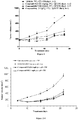
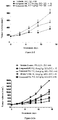
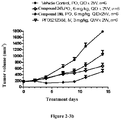
- the studies were conducted to examine if the drugs to be tested have in vivo efficacy in the ovarian cancer SK-OV-3 animal model and the prostate cancer PC-3M animal model.
- the descriptions relating to the animal feeding, feed ingredients, experiment observation, experiment criteria, experiment termination as well as data analysis were as follows.
Landscapes
- Chemical & Material Sciences (AREA)
- Organic Chemistry (AREA)
- Health & Medical Sciences (AREA)
- Life Sciences & Earth Sciences (AREA)
- Medicinal Chemistry (AREA)
- Pharmacology & Pharmacy (AREA)
- Animal Behavior & Ethology (AREA)
- General Health & Medical Sciences (AREA)
- Public Health (AREA)
- Veterinary Medicine (AREA)
- Epidemiology (AREA)
- Nuclear Medicine, Radiotherapy & Molecular Imaging (AREA)
- General Chemical & Material Sciences (AREA)
- Chemical Kinetics & Catalysis (AREA)
- Pharmaceuticals Containing Other Organic And Inorganic Compounds (AREA)
- Nitrogen Condensed Heterocyclic Rings (AREA)
Applications Claiming Priority (3)
| Application Number | Priority Date | Filing Date | Title |
|---|---|---|---|
| CN201410271554.5A CN105461712B (zh) | 2014-06-17 | 2014-06-17 | 作为mTOR/PI3K抑制剂的吡啶并[1,2-a]嘧啶酮类似物 |
| CN201510326169 | 2015-06-12 | ||
| PCT/CN2015/081519 WO2015192761A1 (zh) | 2014-06-17 | 2015-06-16 | 作为mTOR/PI3K抑制剂的吡啶并[1,2-a]嘧啶酮类似物 |
Publications (3)
| Publication Number | Publication Date |
|---|---|
| EP3159342A1 true EP3159342A1 (de) | 2017-04-26 |
| EP3159342A4 EP3159342A4 (de) | 2018-05-16 |
| EP3159342B1 EP3159342B1 (de) | 2020-08-05 |
Family
ID=54934873
Family Applications (1)
| Application Number | Title | Priority Date | Filing Date |
|---|---|---|---|
| EP15810204.6A Active EP3159342B1 (de) | 2014-06-17 | 2015-06-16 | Als mtor/pi3k-inhibitor verwendete pyridino[1,2-a]pyrimidon-analoga |
Country Status (8)
| Country | Link |
|---|---|
| US (1) | US9868737B2 (de) |
| EP (1) | EP3159342B1 (de) |
| JP (1) | JP6386177B2 (de) |
| BR (1) | BR112016029825B1 (de) |
| CA (1) | CA2952992C (de) |
| RU (1) | RU2658912C1 (de) |
| TW (1) | TWI600655B (de) |
| WO (1) | WO2015192761A1 (de) |
Cited By (3)
| Publication number | Priority date | Publication date | Assignee | Title |
|---|---|---|---|---|
| CN112469720A (zh) * | 2018-04-20 | 2021-03-09 | 艾科思莱德制药公司 | 用于抗肿瘤疗法中的双重atm和dna-pk抑制剂 |
| EP4144734A4 (de) * | 2020-04-30 | 2023-11-01 | Guangzhou Joyo Pharmatech Co., Ltd | Anwendung einer heterocyclischen verbindung |
| EP4279489A4 (de) * | 2021-01-18 | 2024-07-10 | Guangzhou Joyo Pharmatech Co., Ltd | Verwendung von pyrido[1,2-a pyrimidinon-analoga |
Families Citing this family (12)
| Publication number | Priority date | Publication date | Assignee | Title |
|---|---|---|---|---|
| WO2015192760A1 (zh) * | 2014-06-17 | 2015-12-23 | 南京明德新药研发股份有限公司 | 作为pi3k抑制剂的吡啶并[1,2-a]嘧啶酮类似物 |
| WO2017101829A1 (zh) * | 2015-12-16 | 2017-06-22 | 辰欣药业股份有限公司 | 吡啶并[1,2-a]嘧啶酮类似物的晶型及其制备方法和中间体 |
| PL3395817T3 (pl) * | 2015-12-16 | 2022-05-02 | Chia Tai Tianqing Pharmaceutical Group Co., Ltd. | Analog pirydo[1,2-a]pirymidonu, jego krystaliczna postać, jego związek pośredni i sposób jego wytwarzania |
| CA3121202A1 (en) | 2018-11-30 | 2020-06-04 | Nuvation Bio Inc. | Pyrrole and pyrazole compounds and methods of use thereof |
| ES3008232T3 (en) * | 2019-07-30 | 2025-03-21 | Xrad Therapeutics Inc | Dual atm and dna-pk inhibitors for use in anti-tumor therapy |
| CN112480116B (zh) * | 2019-09-11 | 2024-03-29 | 南京正大天晴制药有限公司 | Pkb抑制剂 |
| CN115151540A (zh) | 2019-12-02 | 2022-10-04 | 风暴治疗有限公司 | 作为mettl3抑制剂的多杂环化合物 |
| CN114788829B (zh) * | 2021-01-25 | 2023-06-20 | 广州嘉越医药科技有限公司 | 一种吡啶并[1,2-a]嘧啶酮类似物的应用 |
| CN115671289B (zh) * | 2021-07-27 | 2024-04-26 | 广州嘉越医药科技有限公司 | 药物组合及其应用 |
| TWI843217B (zh) * | 2021-09-30 | 2024-05-21 | 大陸商廣州嘉越醫藥科技有限公司 | 一種藥物組合及其應用 |
| WO2025136936A1 (en) * | 2023-12-19 | 2025-06-26 | Merck Sharp & Dohme Llc | Agonists of trem2 activity |
| GB202415232D0 (en) | 2024-10-16 | 2024-11-27 | Nacamed As | Composition |
Family Cites Families (14)
| Publication number | Priority date | Publication date | Assignee | Title |
|---|---|---|---|---|
| US7598377B2 (en) * | 2002-08-16 | 2009-10-06 | Astrazeneca Ab | Inhibition of phosphoinositide 3-kinase β |
| BRPI0415185A (pt) * | 2003-10-10 | 2006-11-28 | Pfizer Prod Inc | 2h-[1,2,4]triazol[4,3-a]pirazinas substituìdas como inibidores da gsk-3 |
| EP2038272B8 (de) * | 2006-06-30 | 2013-10-23 | Sunesis Pharmaceuticals, Inc. | Pyridinonyl-pdk1-hemmer |
| JO2985B1 (ar) * | 2006-12-20 | 2016-09-05 | Takeda Pharmaceuticals Co | مثبطات كينازmapk/erk |
| AU2008218806B2 (en) | 2007-02-20 | 2011-12-01 | Novartis Ag | Imidazoquinolines as dual lipid kinase and mTOR inhibitors |
| PE20090717A1 (es) | 2007-05-18 | 2009-07-18 | Smithkline Beecham Corp | Derivados de quinolina como inhibidores de la pi3 quinasa |
| EP2211615A4 (de) * | 2007-10-22 | 2010-10-13 | Glaxosmithkline Llc | Pyridosulfonamidderivate als pi3-kinase-hemmer |
| EP2138493A1 (de) * | 2008-06-26 | 2009-12-30 | Sanofi-Aventis | Substituierte Pyrimidon-Derivate |
| KR101763656B1 (ko) * | 2009-06-29 | 2017-08-01 | 인사이트 홀딩스 코포레이션 | Pi3k 저해물질로서의 피리미디논 |
| UA48943U (en) * | 2009-10-27 | 2010-04-12 | Институт Органической Химии Нан Украины | Process for the preparation of 1,6-8-aryl-dioxo-1,3,4,6,7,8-hexahydro-2h-pyrazino[1,2-c]pyrimidine-9-carboxylates |
| WO2013071698A1 (zh) | 2011-11-17 | 2013-05-23 | 山东轩竹医药科技有限公司 | 三环类PI3K和/或mTOR抑制剂 |
| CN103539777B (zh) * | 2012-07-13 | 2016-03-02 | 广东东阳光药业有限公司 | Pi3激酶调节剂及其使用方法和用途 |
| WO2014022128A1 (en) * | 2012-07-29 | 2014-02-06 | Calitor Sciences, Llc | Pi3 kinase modulators and methods of use |
| TWI574962B (zh) * | 2012-11-14 | 2017-03-21 | 加拓科學公司 | 作爲pi3激酶調節劑的芳雜環化合物及其使用方法和用途 |
-
2015
- 2015-06-16 WO PCT/CN2015/081519 patent/WO2015192761A1/zh not_active Ceased
- 2015-06-16 US US15/319,728 patent/US9868737B2/en active Active
- 2015-06-16 BR BR112016029825-0A patent/BR112016029825B1/pt active IP Right Grant
- 2015-06-16 EP EP15810204.6A patent/EP3159342B1/de active Active
- 2015-06-16 JP JP2017518398A patent/JP6386177B2/ja active Active
- 2015-06-16 CA CA2952992A patent/CA2952992C/en active Active
- 2015-06-16 RU RU2017100119A patent/RU2658912C1/ru active
- 2015-06-17 TW TW104119648A patent/TWI600655B/zh active
Cited By (7)
| Publication number | Priority date | Publication date | Assignee | Title |
|---|---|---|---|---|
| CN112469720A (zh) * | 2018-04-20 | 2021-03-09 | 艾科思莱德制药公司 | 用于抗肿瘤疗法中的双重atm和dna-pk抑制剂 |
| EP3784671A4 (de) * | 2018-04-20 | 2021-11-17 | XRad Therapeutics, Inc. | Duale atm- und dna-pk-inhibitoren zur verwendung in der antitumortherapie |
| CN112469720B (zh) * | 2018-04-20 | 2024-03-29 | 艾科思莱德制药公司 | 用于抗肿瘤疗法中的双重atm和dna-pk抑制剂 |
| EP4327877A3 (de) * | 2018-04-20 | 2024-04-24 | XRad Therapeutics, Inc. | Duale atm- und dna-pk-hemmer zur verwendung in der antitumortherapie |
| US12187742B2 (en) | 2018-04-20 | 2025-01-07 | Xrad Therapeutics, Inc. | Dual ATM and DNA-PK inhibitors for use in anti-tumor therapy |
| EP4144734A4 (de) * | 2020-04-30 | 2023-11-01 | Guangzhou Joyo Pharmatech Co., Ltd | Anwendung einer heterocyclischen verbindung |
| EP4279489A4 (de) * | 2021-01-18 | 2024-07-10 | Guangzhou Joyo Pharmatech Co., Ltd | Verwendung von pyrido[1,2-a pyrimidinon-analoga |
Also Published As
| Publication number | Publication date |
|---|---|
| US9868737B2 (en) | 2018-01-16 |
| TWI600655B (zh) | 2017-10-01 |
| EP3159342B1 (de) | 2020-08-05 |
| JP6386177B2 (ja) | 2018-09-05 |
| CA2952992A1 (en) | 2015-12-23 |
| BR112016029825B1 (pt) | 2020-10-27 |
| CA2952992C (en) | 2019-05-07 |
| TW201602107A (zh) | 2016-01-16 |
| RU2658912C1 (ru) | 2018-06-26 |
| JP2017518382A (ja) | 2017-07-06 |
| EP3159342A4 (de) | 2018-05-16 |
| BR112016029825A2 (pt) | 2017-08-22 |
| US20170129888A1 (en) | 2017-05-11 |
| WO2015192761A1 (zh) | 2015-12-23 |
Similar Documents
| Publication | Publication Date | Title |
|---|---|---|
| EP3159342B1 (de) | Als mtor/pi3k-inhibitor verwendete pyridino[1,2-a]pyrimidon-analoga | |
| JP6577613B2 (ja) | キナーゼ阻害剤としての縮合環式または三環式アリールピリミジン化合物 | |
| EP3269715B1 (de) | Substituiertes 2-wasserstoff-pyrazol-derivat als antikrebsmittel | |
| EP3159341B1 (de) | Pyridin[1,2-a]pyrimidonanalog als pi3k-hemmer | |
| CN105461712B (zh) | 作为mTOR/PI3K抑制剂的吡啶并[1,2-a]嘧啶酮类似物 | |
| CN111471059A (zh) | Pde9抑制剂及其用途 | |
| WO2025188662A1 (en) | Akt1 modulators | |
| HK1244803B (zh) | 作为抗癌药物的取代的2-氢-吡唑衍生物 |
Legal Events
| Date | Code | Title | Description |
|---|---|---|---|
| STAA | Information on the status of an ep patent application or granted ep patent |
Free format text: STATUS: THE INTERNATIONAL PUBLICATION HAS BEEN MADE |
|
| PUAI | Public reference made under article 153(3) epc to a published international application that has entered the european phase |
Free format text: ORIGINAL CODE: 0009012 |
|
| STAA | Information on the status of an ep patent application or granted ep patent |
Free format text: STATUS: REQUEST FOR EXAMINATION WAS MADE |
|
| 17P | Request for examination filed |
Effective date: 20170111 |
|
| AK | Designated contracting states |
Kind code of ref document: A1 Designated state(s): AL AT BE BG CH CY CZ DE DK EE ES FI FR GB GR HR HU IE IS IT LI LT LU LV MC MK MT NL NO PL PT RO RS SE SI SK SM TR |
|
| AX | Request for extension of the european patent |
Extension state: BA ME |
|
| DAV | Request for validation of the european patent (deleted) | ||
| DAX | Request for extension of the european patent (deleted) | ||
| RIC1 | Information provided on ipc code assigned before grant |
Ipc: C07D 471/04 20060101AFI20180112BHEP Ipc: C07D 487/04 20060101ALI20180112BHEP Ipc: A61P 35/00 20060101ALI20180112BHEP Ipc: A61K 31/519 20060101ALI20180112BHEP Ipc: C07D 491/147 20060101ALI20180112BHEP |
|
| A4 | Supplementary search report drawn up and despatched |
Effective date: 20180418 |
|
| RIC1 | Information provided on ipc code assigned before grant |
Ipc: A61P 35/00 20060101ALI20180412BHEP Ipc: C07D 471/04 20060101AFI20180412BHEP Ipc: A61K 31/519 20060101ALI20180412BHEP Ipc: C07D 487/04 20060101ALI20180412BHEP Ipc: C07D 491/147 20060101ALI20180412BHEP |
|
| RAP1 | Party data changed (applicant data changed or rights of an application transferred) |
Owner name: CISEN PHARMACEUTICAL CO., LTD. Owner name: SHANGHAI JIA TAN PHARMATECH CO. LTD. |
|
| GRAP | Despatch of communication of intention to grant a patent |
Free format text: ORIGINAL CODE: EPIDOSNIGR1 |
|
| STAA | Information on the status of an ep patent application or granted ep patent |
Free format text: STATUS: GRANT OF PATENT IS INTENDED |
|
| INTG | Intention to grant announced |
Effective date: 20200220 |
|
| GRAS | Grant fee paid |
Free format text: ORIGINAL CODE: EPIDOSNIGR3 |
|
| GRAA | (expected) grant |
Free format text: ORIGINAL CODE: 0009210 |
|
| STAA | Information on the status of an ep patent application or granted ep patent |
Free format text: STATUS: THE PATENT HAS BEEN GRANTED |
|
| AK | Designated contracting states |
Kind code of ref document: B1 Designated state(s): AL AT BE BG CH CY CZ DE DK EE ES FI FR GB GR HR HU IE IS IT LI LT LU LV MC MK MT NL NO PL PT RO RS SE SI SK SM TR |
|
| REG | Reference to a national code |
Ref country code: GB Ref legal event code: FG4D |
|
| REG | Reference to a national code |
Ref country code: CH Ref legal event code: EP |
|
| REG | Reference to a national code |
Ref country code: AT Ref legal event code: REF Ref document number: 1298570 Country of ref document: AT Kind code of ref document: T Effective date: 20200815 |
|
| REG | Reference to a national code |
Ref country code: DE Ref legal event code: R096 Ref document number: 602015057059 Country of ref document: DE |
|
| REG | Reference to a national code |
Ref country code: IE Ref legal event code: FG4D |
|
| REG | Reference to a national code |
Ref country code: LT Ref legal event code: MG4D |
|
| REG | Reference to a national code |
Ref country code: NL Ref legal event code: MP Effective date: 20200805 |
|
| REG | Reference to a national code |
Ref country code: AT Ref legal event code: MK05 Ref document number: 1298570 Country of ref document: AT Kind code of ref document: T Effective date: 20200805 |
|
| PG25 | Lapsed in a contracting state [announced via postgrant information from national office to epo] |
Ref country code: PT Free format text: LAPSE BECAUSE OF FAILURE TO SUBMIT A TRANSLATION OF THE DESCRIPTION OR TO PAY THE FEE WITHIN THE PRESCRIBED TIME-LIMIT Effective date: 20201207 Ref country code: NO Free format text: LAPSE BECAUSE OF FAILURE TO SUBMIT A TRANSLATION OF THE DESCRIPTION OR TO PAY THE FEE WITHIN THE PRESCRIBED TIME-LIMIT Effective date: 20201105 Ref country code: BG Free format text: LAPSE BECAUSE OF FAILURE TO SUBMIT A TRANSLATION OF THE DESCRIPTION OR TO PAY THE FEE WITHIN THE PRESCRIBED TIME-LIMIT Effective date: 20201105 Ref country code: ES Free format text: LAPSE BECAUSE OF FAILURE TO SUBMIT A TRANSLATION OF THE DESCRIPTION OR TO PAY THE FEE WITHIN THE PRESCRIBED TIME-LIMIT Effective date: 20200805 Ref country code: LT Free format text: LAPSE BECAUSE OF FAILURE TO SUBMIT A TRANSLATION OF THE DESCRIPTION OR TO PAY THE FEE WITHIN THE PRESCRIBED TIME-LIMIT Effective date: 20200805 Ref country code: HR Free format text: LAPSE BECAUSE OF FAILURE TO SUBMIT A TRANSLATION OF THE DESCRIPTION OR TO PAY THE FEE WITHIN THE PRESCRIBED TIME-LIMIT Effective date: 20200805 Ref country code: AT Free format text: LAPSE BECAUSE OF FAILURE TO SUBMIT A TRANSLATION OF THE DESCRIPTION OR TO PAY THE FEE WITHIN THE PRESCRIBED TIME-LIMIT Effective date: 20200805 Ref country code: SE Free format text: LAPSE BECAUSE OF FAILURE TO SUBMIT A TRANSLATION OF THE DESCRIPTION OR TO PAY THE FEE WITHIN THE PRESCRIBED TIME-LIMIT Effective date: 20200805 Ref country code: GR Free format text: LAPSE BECAUSE OF FAILURE TO SUBMIT A TRANSLATION OF THE DESCRIPTION OR TO PAY THE FEE WITHIN THE PRESCRIBED TIME-LIMIT Effective date: 20201106 Ref country code: FI Free format text: LAPSE BECAUSE OF FAILURE TO SUBMIT A TRANSLATION OF THE DESCRIPTION OR TO PAY THE FEE WITHIN THE PRESCRIBED TIME-LIMIT Effective date: 20200805 |
|
| PG25 | Lapsed in a contracting state [announced via postgrant information from national office to epo] |
Ref country code: RS Free format text: LAPSE BECAUSE OF FAILURE TO SUBMIT A TRANSLATION OF THE DESCRIPTION OR TO PAY THE FEE WITHIN THE PRESCRIBED TIME-LIMIT Effective date: 20200805 Ref country code: NL Free format text: LAPSE BECAUSE OF FAILURE TO SUBMIT A TRANSLATION OF THE DESCRIPTION OR TO PAY THE FEE WITHIN THE PRESCRIBED TIME-LIMIT Effective date: 20200805 Ref country code: LV Free format text: LAPSE BECAUSE OF FAILURE TO SUBMIT A TRANSLATION OF THE DESCRIPTION OR TO PAY THE FEE WITHIN THE PRESCRIBED TIME-LIMIT Effective date: 20200805 Ref country code: PL Free format text: LAPSE BECAUSE OF FAILURE TO SUBMIT A TRANSLATION OF THE DESCRIPTION OR TO PAY THE FEE WITHIN THE PRESCRIBED TIME-LIMIT Effective date: 20200805 Ref country code: IS Free format text: LAPSE BECAUSE OF FAILURE TO SUBMIT A TRANSLATION OF THE DESCRIPTION OR TO PAY THE FEE WITHIN THE PRESCRIBED TIME-LIMIT Effective date: 20201205 |
|
| PG25 | Lapsed in a contracting state [announced via postgrant information from national office to epo] |
Ref country code: EE Free format text: LAPSE BECAUSE OF FAILURE TO SUBMIT A TRANSLATION OF THE DESCRIPTION OR TO PAY THE FEE WITHIN THE PRESCRIBED TIME-LIMIT Effective date: 20200805 Ref country code: RO Free format text: LAPSE BECAUSE OF FAILURE TO SUBMIT A TRANSLATION OF THE DESCRIPTION OR TO PAY THE FEE WITHIN THE PRESCRIBED TIME-LIMIT Effective date: 20200805 Ref country code: SM Free format text: LAPSE BECAUSE OF FAILURE TO SUBMIT A TRANSLATION OF THE DESCRIPTION OR TO PAY THE FEE WITHIN THE PRESCRIBED TIME-LIMIT Effective date: 20200805 Ref country code: DK Free format text: LAPSE BECAUSE OF FAILURE TO SUBMIT A TRANSLATION OF THE DESCRIPTION OR TO PAY THE FEE WITHIN THE PRESCRIBED TIME-LIMIT Effective date: 20200805 Ref country code: CZ Free format text: LAPSE BECAUSE OF FAILURE TO SUBMIT A TRANSLATION OF THE DESCRIPTION OR TO PAY THE FEE WITHIN THE PRESCRIBED TIME-LIMIT Effective date: 20200805 |
|
| REG | Reference to a national code |
Ref country code: DE Ref legal event code: R097 Ref document number: 602015057059 Country of ref document: DE |
|
| PG25 | Lapsed in a contracting state [announced via postgrant information from national office to epo] |
Ref country code: AL Free format text: LAPSE BECAUSE OF FAILURE TO SUBMIT A TRANSLATION OF THE DESCRIPTION OR TO PAY THE FEE WITHIN THE PRESCRIBED TIME-LIMIT Effective date: 20200805 |
|
| PLBE | No opposition filed within time limit |
Free format text: ORIGINAL CODE: 0009261 |
|
| STAA | Information on the status of an ep patent application or granted ep patent |
Free format text: STATUS: NO OPPOSITION FILED WITHIN TIME LIMIT |
|
| PG25 | Lapsed in a contracting state [announced via postgrant information from national office to epo] |
Ref country code: SK Free format text: LAPSE BECAUSE OF FAILURE TO SUBMIT A TRANSLATION OF THE DESCRIPTION OR TO PAY THE FEE WITHIN THE PRESCRIBED TIME-LIMIT Effective date: 20200805 |
|
| 26N | No opposition filed |
Effective date: 20210507 |
|
| PG25 | Lapsed in a contracting state [announced via postgrant information from national office to epo] |
Ref country code: SI Free format text: LAPSE BECAUSE OF FAILURE TO SUBMIT A TRANSLATION OF THE DESCRIPTION OR TO PAY THE FEE WITHIN THE PRESCRIBED TIME-LIMIT Effective date: 20200805 |
|
| PG25 | Lapsed in a contracting state [announced via postgrant information from national office to epo] |
Ref country code: MC Free format text: LAPSE BECAUSE OF FAILURE TO SUBMIT A TRANSLATION OF THE DESCRIPTION OR TO PAY THE FEE WITHIN THE PRESCRIBED TIME-LIMIT Effective date: 20200805 |
|
| REG | Reference to a national code |
Ref country code: CH Ref legal event code: PL |
|
| REG | Reference to a national code |
Ref country code: BE Ref legal event code: MM Effective date: 20210630 |
|
| PG25 | Lapsed in a contracting state [announced via postgrant information from national office to epo] |
Ref country code: LU Free format text: LAPSE BECAUSE OF NON-PAYMENT OF DUE FEES Effective date: 20210616 |
|
| PG25 | Lapsed in a contracting state [announced via postgrant information from national office to epo] |
Ref country code: LI Free format text: LAPSE BECAUSE OF NON-PAYMENT OF DUE FEES Effective date: 20210630 Ref country code: IE Free format text: LAPSE BECAUSE OF NON-PAYMENT OF DUE FEES Effective date: 20210616 Ref country code: CH Free format text: LAPSE BECAUSE OF NON-PAYMENT OF DUE FEES Effective date: 20210630 |
|
| PG25 | Lapsed in a contracting state [announced via postgrant information from national office to epo] |
Ref country code: BE Free format text: LAPSE BECAUSE OF NON-PAYMENT OF DUE FEES Effective date: 20210630 |
|
| PG25 | Lapsed in a contracting state [announced via postgrant information from national office to epo] |
Ref country code: HU Free format text: LAPSE BECAUSE OF FAILURE TO SUBMIT A TRANSLATION OF THE DESCRIPTION OR TO PAY THE FEE WITHIN THE PRESCRIBED TIME-LIMIT; INVALID AB INITIO Effective date: 20150616 |
|
| P01 | Opt-out of the competence of the unified patent court (upc) registered |
Effective date: 20230517 |
|
| PG25 | Lapsed in a contracting state [announced via postgrant information from national office to epo] |
Ref country code: CY Free format text: LAPSE BECAUSE OF FAILURE TO SUBMIT A TRANSLATION OF THE DESCRIPTION OR TO PAY THE FEE WITHIN THE PRESCRIBED TIME-LIMIT Effective date: 20200805 |
|
| PG25 | Lapsed in a contracting state [announced via postgrant information from national office to epo] |
Ref country code: MK Free format text: LAPSE BECAUSE OF FAILURE TO SUBMIT A TRANSLATION OF THE DESCRIPTION OR TO PAY THE FEE WITHIN THE PRESCRIBED TIME-LIMIT Effective date: 20200805 |
|
| PG25 | Lapsed in a contracting state [announced via postgrant information from national office to epo] |
Ref country code: MT Free format text: LAPSE BECAUSE OF FAILURE TO SUBMIT A TRANSLATION OF THE DESCRIPTION OR TO PAY THE FEE WITHIN THE PRESCRIBED TIME-LIMIT Effective date: 20200805 |
|
| PGFP | Annual fee paid to national office [announced via postgrant information from national office to epo] |
Ref country code: DE Payment date: 20250617 Year of fee payment: 11 |
|
| PGFP | Annual fee paid to national office [announced via postgrant information from national office to epo] |
Ref country code: GB Payment date: 20250625 Year of fee payment: 11 |
|
| PGFP | Annual fee paid to national office [announced via postgrant information from national office to epo] |
Ref country code: FR Payment date: 20250630 Year of fee payment: 11 |
|
| PGFP | Annual fee paid to national office [announced via postgrant information from national office to epo] |
Ref country code: IT Payment date: 20250609 Year of fee payment: 11 |
|
| PG25 | Lapsed in a contracting state [announced via postgrant information from national office to epo] |
Ref country code: TR Free format text: LAPSE BECAUSE OF FAILURE TO SUBMIT A TRANSLATION OF THE DESCRIPTION OR TO PAY THE FEE WITHIN THE PRESCRIBED TIME-LIMIT Effective date: 20200805 |