EP3165457A2 - Verfahren und systeme zur applikation vom flammschutzmittel auf basis von bordmessung u.-entscheidungsverfahren - Google Patents
Verfahren und systeme zur applikation vom flammschutzmittel auf basis von bordmessung u.-entscheidungsverfahren Download PDFInfo
- Publication number
- EP3165457A2 EP3165457A2 EP16197280.7A EP16197280A EP3165457A2 EP 3165457 A2 EP3165457 A2 EP 3165457A2 EP 16197280 A EP16197280 A EP 16197280A EP 3165457 A2 EP3165457 A2 EP 3165457A2
- Authority
- EP
- European Patent Office
- Prior art keywords
- sensors
- fire
- terrain
- fire retardant
- aerial vehicle
- Prior art date
- Legal status (The legal status is an assumption and is not a legal conclusion. Google has not performed a legal analysis and makes no representation as to the accuracy of the status listed.)
- Withdrawn
Links
Images


Classifications
-
- G—PHYSICS
- G06—COMPUTING OR CALCULATING; COUNTING
- G06Q—INFORMATION AND COMMUNICATION TECHNOLOGY [ICT] SPECIALLY ADAPTED FOR ADMINISTRATIVE, COMMERCIAL, FINANCIAL, MANAGERIAL OR SUPERVISORY PURPOSES; SYSTEMS OR METHODS SPECIALLY ADAPTED FOR ADMINISTRATIVE, COMMERCIAL, FINANCIAL, MANAGERIAL OR SUPERVISORY PURPOSES, NOT OTHERWISE PROVIDED FOR
- G06Q10/00—Administration; Management
- G06Q10/06—Resources, workflows, human or project management; Enterprise or organisation planning; Enterprise or organisation modelling
- G06Q10/063—Operations research, analysis or management
- G06Q10/0631—Resource planning, allocation, distributing or scheduling for enterprises or organisations
- G06Q10/06315—Needs-based resource requirements planning or analysis
-
- A—HUMAN NECESSITIES
- A62—LIFE-SAVING; FIRE-FIGHTING
- A62C—FIRE-FIGHTING
- A62C31/00—Delivery of fire-extinguishing material
-
- A—HUMAN NECESSITIES
- A62—LIFE-SAVING; FIRE-FIGHTING
- A62C—FIRE-FIGHTING
- A62C3/00—Fire prevention, containment or extinguishing specially adapted for particular objects or places
- A62C3/02—Fire prevention, containment or extinguishing specially adapted for particular objects or places for area conflagrations, e.g. forest fires, subterranean fires
- A62C3/0228—Fire prevention, containment or extinguishing specially adapted for particular objects or places for area conflagrations, e.g. forest fires, subterranean fires with delivery of fire extinguishing material by air or aircraft
- A62C3/0242—Fire prevention, containment or extinguishing specially adapted for particular objects or places for area conflagrations, e.g. forest fires, subterranean fires with delivery of fire extinguishing material by air or aircraft by spraying extinguishants from the aircraft
-
- B—PERFORMING OPERATIONS; TRANSPORTING
- B64—AIRCRAFT; AVIATION; COSMONAUTICS
- B64D—EQUIPMENT FOR FITTING IN OR TO AIRCRAFT; FLIGHT SUITS; PARACHUTES; ARRANGEMENT OR MOUNTING OF POWER PLANTS OR PROPULSION TRANSMISSIONS IN AIRCRAFT
- B64D1/00—Dropping, ejecting, releasing or receiving articles, liquids, or the like, in flight
- B64D1/16—Dropping or releasing powdered, liquid, or gaseous matter, e.g. for fire-fighting
-
- G—PHYSICS
- G05—CONTROLLING; REGULATING
- G05D—SYSTEMS FOR CONTROLLING OR REGULATING NON-ELECTRIC VARIABLES
- G05D1/00—Control of position, course, altitude or attitude of land, water, air or space vehicles, e.g. using automatic pilots
- G05D1/08—Control of attitude, i.e. control of roll, pitch, or yaw
- G05D1/0808—Control of attitude, i.e. control of roll, pitch, or yaw specially adapted for aircraft
-
- G—PHYSICS
- G08—SIGNALLING
- G08B—SIGNALLING SYSTEMS, e.g. PERSONAL CALLING SYSTEMS; ORDER TELEGRAPHS; ALARM SYSTEMS
- G08B17/00—Fire alarms; Alarms responsive to explosion
- G08B17/005—Fire alarms; Alarms responsive to explosion for forest fires, e.g. detecting fires spread over a large or outdoors area
-
- B—PERFORMING OPERATIONS; TRANSPORTING
- B64—AIRCRAFT; AVIATION; COSMONAUTICS
- B64D—EQUIPMENT FOR FITTING IN OR TO AIRCRAFT; FLIGHT SUITS; PARACHUTES; ARRANGEMENT OR MOUNTING OF POWER PLANTS OR PROPULSION TRANSMISSIONS IN AIRCRAFT
- B64D45/00—Aircraft indicators or protectors not otherwise provided for
- B64D2045/009—Fire detection or protection; Erosion protection, e.g. from airborne particles
-
- B—PERFORMING OPERATIONS; TRANSPORTING
- B64—AIRCRAFT; AVIATION; COSMONAUTICS
- B64U—UNMANNED AERIAL VEHICLES [UAV]; EQUIPMENT THEREFOR
- B64U2101/00—UAVs specially adapted for particular uses or applications
- B64U2101/30—UAVs specially adapted for particular uses or applications for imaging, photography or videography
-
- B—PERFORMING OPERATIONS; TRANSPORTING
- B64—AIRCRAFT; AVIATION; COSMONAUTICS
- B64U—UNMANNED AERIAL VEHICLES [UAV]; EQUIPMENT THEREFOR
- B64U2101/00—UAVs specially adapted for particular uses or applications
- B64U2101/45—UAVs specially adapted for particular uses or applications for releasing liquids or powders in-flight, e.g. crop-dusting
- B64U2101/47—UAVs specially adapted for particular uses or applications for releasing liquids or powders in-flight, e.g. crop-dusting for fire fighting
-
- G—PHYSICS
- G06—COMPUTING OR CALCULATING; COUNTING
- G06Q—INFORMATION AND COMMUNICATION TECHNOLOGY [ICT] SPECIALLY ADAPTED FOR ADMINISTRATIVE, COMMERCIAL, FINANCIAL, MANAGERIAL OR SUPERVISORY PURPOSES; SYSTEMS OR METHODS SPECIALLY ADAPTED FOR ADMINISTRATIVE, COMMERCIAL, FINANCIAL, MANAGERIAL OR SUPERVISORY PURPOSES, NOT OTHERWISE PROVIDED FOR
- G06Q50/00—Information and communication technology [ICT] specially adapted for implementation of business processes of specific business sectors, e.g. utilities or tourism
- G06Q50/40—Business processes related to the transportation industry
Definitions
- the invention is directed to systems and methods for applying fire retardant using aerial vehicles. More particularly, the invention is directed to systems and methods for applying fire retardant using onboard sensing and decision making processes with application of the fire retardant using aerial vehicles.
- a system includes: a plurality of sensors provided on an aerial aircraft to sense terrain and fire characteristics; and a controller to determine optimal location of application of fire retardant based on the terrain and fire characteristics.
- a system comprises: a plurality of sensors encompassing multi-spectral sensing capabilities of external environmental conditions, provided on an aerial aircraft; and a controller to determine optimal location of application of fire retardant based on the external environmental conditions as sensed by the plurality of sensors.
- the invention is directed to systems and methods for applying fire retardant using aerial vehicles. More particularly, the invention is directed to systems and methods for applying fire retardant using onboard sensing and decision making processes with application of the fire retardant using aerial vehicles.
- the aerial vehicles can include, for example, helicopters and airplanes, including manned and unmanned aircraft.
- the systems and methods described herein are used in both manned aerial vehicles and unmanned aerial vehicles (UAVs) for use in suppressing wildfires.
- UAVs unmanned aerial vehicles
- the UAVs are capable of operating in environmental conditions that are hazardous and/or unacceptable for manned operations, specifically in low visibility and/or at night time.
- both manned aerial vehicles and UAVs are capable of identifying the optimum placement of fire retardant as it approaches a burn area, and applying the retardant at the optimum location in real time.
- the present invention provides several advantages which include by way of illustrative examples, amongst others:
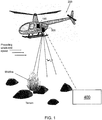
- FIG. 1 shows an aerial vehicle with onboard sensors in accordance with aspects of the invention.
- the aerial vehicle 200 can be, e.g., both manned aerial vehicles and unmanned aerial vehicles (UAVs) for use in suppressing wildfires.
- the aerial vehicle 200 can be, for example, an airplane, helicopter, or any type of unmanned aerial vehicle which can be used for fire suppression.
- the aerial vehicle 200 includes a plurality of sensors 300.
- the sensors 300 include, for example, infrared (IR) cameras or Electro Optical Sensors (EO) onboard the aerial vehicle 200 that can identify localized hot spots of the wildfires.
- the sensors 300 can further include sensors for identifying terrain sloping and terrain features such as, for example, RADAR, LIDAR, Acoustic Ranging and/or Radar Altimeters.
- RADAR Radar Altimeter
- LIDAR Laser Optical Sensors
- Acoustic Ranging and/or Radar Altimeters.
- a Radar Altimeter can measure altitude above the terrain beneath an aircraft by timing how long it takes a beam of radio waves to reflect from the ground and return to the aircraft. This type of altimeter provides the distance between the antenna and the ground directly below it, which can be translated into terrain mapping.
- Terrain features that can be identified include, for example, terrain slopes, natural fire barriers such as rivers or other bodies of water, ridge lines, etc. Sensors can determine prevailing winds and speed by comparing airspeed and heading of the aerial vehicle 200 and GPS track information. Other sensors are also contemplated by the present invention such as environmental sensors, including wind, temperature, and moisture content sensors, and it should be understood that the above noted sensors are only illustrative, exemplary sensors provided for a complete understanding of the invention.
- the information from the sensors 300 can be transmitted to a controller, e.g., system module 100, to determine or identify optimum locations for application of fire retardant to achieve maximum fire suppression results. For example, through the collection of this data, e.g., local hot spots, wind speed and terrain information, the system module 100 will assess the potential for fire advancement, including the rate and direction that the fire will be travelling. Based on the information collected from the sensors 200, the controller, e.g., system module 100, will identify where the retardant placement would have the greatest effect, and direct application of fire retardants in that area by transmitting this information to the onboard and/or off board guidance so that the aerial vehicle 200 can be provided with the general location of the wildfire and the location to release the fire retardant. This information can also be given to the ground based systems 400 in order to coordinate ground efforts to control the wildfire. Specifically, ground efforts can be concentrated on other areas of the wildfire for containment purposes.
- this data e.g., local hot spots, wind speed and terrain information
- the controller e.g
- the aerial vehicles 200 are capable of operating in environmental conditions that would be otherwise hazardous and/or unacceptable, specifically in low visibility and/or at night time. Also, with the use of onboard sensing, the aerial vehicles 200 are capable of identifying the optimum placement of fire retardant as it approaches a burn area, and to apply the retardant at the optimum location in real time.
- FIG. 2 shows an illustrative environment 10 for managing the processes in accordance with the invention.
- the environment 10 includes a server or other computing system 12 that can perform the processes described herein.
- the illustrative environment may be used in the aerial vehicle 200 for assisting in the suppression of fires using fire retardants, as shown illustratively in FIG. 1 ; although other aerial vehicle systems are also contemplated by the present invention.
- the computing system 12 includes a computing device 14 which can be resident on or communicate with a network infrastructure or other computing devices.
- the computing system 12 can communicate with both an aerial vehicle 200 and a plurality of sensors 300 on the aerial vehicle 200.
- the computing system 12 can be located on the aerial vehicle 200 or remote from the aerial vehicle 200.
- the computing system 12 can communicate with ground based systems 400 such as, for example, ground-based controllers used in fire suppression systems, e.g., central control systems.
- the computing device 14 includes a processor 20, memory 22A, an I/O interface 24, and a bus 26.
- the computing device includes random access memory (RAM), a read-only memory (ROM), and an operating system (O/S).
- the computing device 14 is in communication with an external I/O device/resource 28 and the storage system 22B.
- the I/O device 28 can comprise any device that enables an individual to interact with the computing device 14 (e.g., user interface) or any device that enables the computing device 14 to communicate with one or more other computing devices using any type of communications link or any device that enables the computing device 14 to interact with is environment.
- the I/O device 28 can be sensing devices 300.
- I/O device 28 can include aircraft specific state/status inputs influencing the plan for application of fire retardant, such as validity of air data measurements, weight (and by calculation, amount) of fire retardant in bucket, bucket state (released/open or closed), etc.
- the I/O device 28 can be off board I/O from locations other than the Ground System, 400. This could be I/O data delivered through a Radio Frequency data link from a firefighter on the ground in the drop zone commanding emergency delivery wave-off or retardant release.
- the processor 20 executes computer program code (e.g., program control 44), which can be stored in the memory 22A and/or storage system 22B. While executing the computer program code, the processor 20 can read and/or write data to/from memory 22A, storage system 22B, and/or I/O interface 24.
- the program code 44 executes the processes of the invention such as, for example, determining an optimal location for application of fire retardants in order to suppress wildfires. As discussed in more detail herein, by making such determination it is now possible to apply fire retardant in optimal locations using onboard sensing 300 and decision making processes (e.g., computing system 12) with aerial vehicles 200.
- the computing device 14 includes the system module 100, which can be implemented as one or more program code in the program code 44 stored in memory 22A as a separate or combined module. Additionally, the system module 100 may be implemented as separate dedicated processors or a single or several processors to provide the functionality of this tool. Moreover, it should be understood by those of ordinary skill in the art that the system module 100 is used as a general descriptive term for providing the features and/or functions of the present invention, and that the system module 100 may comprise many different components such as, for example, the components and/or infrastructure described and shown with reference to FIGS. 1 and 2 .
- the program code 44 and more specifically the system module 100 communicates with ground based systems 400 such as, for example, ground controllers used in fire suppression systems, e.g., central control systems, and the aerial vehicle 200 and more specifically the sensors and onboard navigation systems (also shown at reference numeral 300 of FIG. 1 ).
- the system module 100 is capable identifying the optimum location for application of fire retardant to achieve maximum fire suppression results, as well as provide the general location of the wildfire location and transmit this information to onboard or off board guidance such in combination with the onboard sensors 300 and the logic described herein, can identify key factors for the optimum release of onboard fire retardant.
- the aircraft can identify it's position, such as by use of GPS or INS devices.
- the present invention may be embodied as a system, method or computer program product.
- the present invention may take the form of a hardware embodiment, a software embodiment or a combination of software and hardware.
- the present invention may take the form of a computer program product embodied in any tangible storage having computer-usable program code embodied in the medium (non-transitory medium).
- the computer-usable or computer-readable medium may be medium that can contain or store information for use by or in connection with the instruction execution system, apparatus, or device.
- the computer-usable or computer-readable medium may be, for example, an electronic, magnetic, optical, electromagnetic, infrared, or semiconductor system, apparatus, or device.
- a computer readable storage medium, memory or device would include the following: an electrical connection having one or more wires, a portable computer diskette, a hard disk, a random access memory (RAM), a read-only memory (ROM),an erasable programmable read-only memory (EPROM or Flash memory), an optical fiber, a portable compact disc read-only memory (CD-ROM), an optical storage device, a magnetic storage device, or any suitable combination of the foregoing.
- a computer readable storage medium, memory or device, or computer-usable or computer-readable medium, as used herein is not to be construed as being transitory signals per se.
- FIG. 3 depicts an exemplary flow for a process in accordance with aspects of the present invention.
- the exemplary flow can be illustrative of a system, a method, and/or a computer program product and related functionality implemented on the computing system of FIG. 2 , in accordance with aspects of the present invention.
- the method, and/or computer program product implementing the flow of FIG. 3 can be downloaded to respective computing/processing devices, e.g., computing system of FIG. 2 as implemented with the aerial vehicle of FIG. 1 .
- the sensors can determine the fire characteristics. These characteristics can include, for example, speed of travel, local hotspot and location with respect to certain terrain.
- the sensors can determine the terrain. This can include any natural barriers such as ridge lines and bodies of water. The terrain can also include slopes, etc.
- the sensors can determine the prevailing winds and wind speeds. This can be useful for several purposes: to determine how the fire retardant, once released, will travel (taking into account the speed of the aircraft and the wind); and to predict how the fire will progress (direction and growth).
- a determination can be made as to the size of the fire.
- fire retardant may be applied directly onto a small fire; whereas, fire retardant is typically provided at perimeters of larger fires in order to allow the fires to burn themselves out.
- a decision to release the fire retardant directly on the fire can be provided at step S320.
- a decision to release the fire retardant about a perimeter or away from a natural fire retardant barrier can be provided at step S325.
- this information can be provided to the onboard or off board navigation systems so that the aerial vehicle can travel to the desired location and apply the fire retardant at the appropriate location and time.
- the information can also be provided to ground systems so that coordination can be achieved amongst aerial and ground efforts.
- the aerial vehicles equipped with sensors can identify the hot spots of a fire, and dynamically plan to apply retardant at the most optimum location.
- the optimum location to be determined in real time based on speed of fire migration, terrain, winds, etc.
Landscapes
- Business, Economics & Management (AREA)
- Engineering & Computer Science (AREA)
- Human Resources & Organizations (AREA)
- Physics & Mathematics (AREA)
- Emergency Management (AREA)
- General Physics & Mathematics (AREA)
- Economics (AREA)
- Strategic Management (AREA)
- Biodiversity & Conservation Biology (AREA)
- Life Sciences & Earth Sciences (AREA)
- Aviation & Aerospace Engineering (AREA)
- Entrepreneurship & Innovation (AREA)
- Health & Medical Sciences (AREA)
- Public Health (AREA)
- Game Theory and Decision Science (AREA)
- Quality & Reliability (AREA)
- Development Economics (AREA)
- Forests & Forestry (AREA)
- Ecology (AREA)
- Marketing (AREA)
- Operations Research (AREA)
- Educational Administration (AREA)
- Tourism & Hospitality (AREA)
- General Business, Economics & Management (AREA)
- Theoretical Computer Science (AREA)
- Radar, Positioning & Navigation (AREA)
- Remote Sensing (AREA)
- Automation & Control Theory (AREA)
- Fire-Extinguishing By Fire Departments, And Fire-Extinguishing Equipment And Control Thereof (AREA)
- Investigating Or Analysing Materials By Optical Means (AREA)
Applications Claiming Priority (2)
| Application Number | Priority Date | Filing Date | Title |
|---|---|---|---|
| US201562251366P | 2015-11-05 | 2015-11-05 | |
| US15/337,943 US20170128759A1 (en) | 2015-11-05 | 2016-10-28 | Methods and systems of applying fire retardant based on onboard sensing and decision making processes |
Publications (2)
| Publication Number | Publication Date |
|---|---|
| EP3165457A2 true EP3165457A2 (de) | 2017-05-10 |
| EP3165457A3 EP3165457A3 (de) | 2017-08-02 |
Family
ID=57460304
Family Applications (1)
| Application Number | Title | Priority Date | Filing Date |
|---|---|---|---|
| EP16197280.7A Withdrawn EP3165457A3 (de) | 2015-11-05 | 2016-11-04 | Verfahren und systeme zur applikation vom flammschutzmittel auf basis von bordmessung u.-entscheidungsverfahren |
Country Status (2)
| Country | Link |
|---|---|
| US (1) | US20170128759A1 (de) |
| EP (1) | EP3165457A3 (de) |
Families Citing this family (9)
| Publication number | Priority date | Publication date | Assignee | Title |
|---|---|---|---|---|
| EP3380905B1 (de) * | 2015-11-12 | 2021-02-17 | Boyle, Norman | Unbemanntes strassenrand-beschilderungsfahrzeugsystem |
| USD817253S1 (en) * | 2016-01-20 | 2018-05-08 | Hansung Ils Co., Ltd. | Helicopter |
| US10987804B2 (en) * | 2016-10-19 | 2021-04-27 | Fuji Xerox Co., Ltd. | Robot device and non-transitory computer readable medium |
| US10265844B2 (en) * | 2017-03-24 | 2019-04-23 | International Business Machines Corporation | Creating assembly plans based on triggering events |
| US11021250B2 (en) * | 2017-09-20 | 2021-06-01 | Kenneth Heck | Airborne fire extinguishing system with infrared imaging and method |
| US20190176987A1 (en) * | 2017-12-13 | 2019-06-13 | James E. Beecham | System and method for fire suppression via artificial intelligence |
| US10777051B1 (en) * | 2018-02-27 | 2020-09-15 | Allstate Insurance Company | Emergency incident detection, response, and mitigation using autonomous drones |
| AU2019100368B4 (en) | 2019-01-25 | 2019-11-28 | Norman BOYLE | A driverless impact attenuating traffic management vehicle |
| CN111544797A (zh) * | 2020-04-02 | 2020-08-18 | 峰飞国际有限公司 | 一种应用于无人机的高空抛投瞄准方法及系统、存储介质 |
Family Cites Families (11)
| Publication number | Priority date | Publication date | Assignee | Title |
|---|---|---|---|---|
| US5794889A (en) * | 1995-06-06 | 1998-08-18 | Raytheon Company | Fire retardant delivery system |
| FR2749177B1 (fr) * | 1996-06-03 | 1998-07-17 | Inst Francais Du Petrole | Methode et systeme pour la teledetection de l'inflammabilite des differentes parties d'une zone survolee par un aeronef |
| US6281970B1 (en) * | 1998-03-12 | 2001-08-28 | Synergistix Llc | Airborne IR fire surveillance system providing firespot geopositioning |
| US6125942A (en) * | 1998-03-13 | 2000-10-03 | Continuum Dynamics, Inc. | Aircraft-based fire-fighting bucket |
| DE102004006033B3 (de) * | 2004-02-06 | 2005-09-08 | Eads Deutschland Gmbh | Verfahren zur Erkennung und Bekämpfung von Wald-und Flächenbränden |
| US20090205845A1 (en) * | 2008-02-16 | 2009-08-20 | Fire Termination Equipment, Incorporated | System and method for extinguishing wildfires |
| US20100036549A1 (en) * | 2008-07-18 | 2010-02-11 | Honeywell International Inc. | Methods and systems for displaying a predicted distribution of fire retardant material from an aircraft |
| US8165731B2 (en) * | 2008-09-12 | 2012-04-24 | Lonestar Inventions, L.P. | System for aerial delivery of fire retardant |
| CN102693603B (zh) * | 2012-06-26 | 2014-06-04 | 山东神戎电子股份有限公司 | 一种基于双光谱的森林防火智能监控系统 |
| ES2732401T3 (es) * | 2012-07-24 | 2019-11-22 | Boeing Co | Sistema de prevención y detención de incendio no controlado |
| US9473918B2 (en) * | 2014-10-20 | 2016-10-18 | Rodney Goossen | Wildfire resource tracking apparatus and method of use thereof |
-
2016
- 2016-10-28 US US15/337,943 patent/US20170128759A1/en not_active Abandoned
- 2016-11-04 EP EP16197280.7A patent/EP3165457A3/de not_active Withdrawn
Non-Patent Citations (1)
| Title |
|---|
| None |
Also Published As
| Publication number | Publication date |
|---|---|
| EP3165457A3 (de) | 2017-08-02 |
| US20170128759A1 (en) | 2017-05-11 |
Similar Documents
| Publication | Publication Date | Title |
|---|---|---|
| EP3165457A2 (de) | Verfahren und systeme zur applikation vom flammschutzmittel auf basis von bordmessung u.-entscheidungsverfahren | |
| US11619953B2 (en) | Three dimensional aircraft autonomous navigation under constraints | |
| US10131429B2 (en) | Method and systems of autonomously picking up water in support of fire fighting missions | |
| CN104808682B (zh) | 小型旋翼无人机自主避障飞行控制方法 | |
| RU2712716C2 (ru) | Беспилотный летательный аппарат и способ безопасной посадки беспилотного летательного аппарата | |
| US20180229842A1 (en) | Systems and methods for execution of recovery actions on an unmanned aerial vehicle | |
| CA2870979C (en) | Systems and methods for providing landing exceedance warnings and avoidance | |
| US10255818B2 (en) | Systems and methods for weather detection and avoidance | |
| JP2021509096A (ja) | 自律型無人航空機及びその制御方法 | |
| US10502584B1 (en) | Mission monitor and controller for autonomous unmanned vehicles | |
| US20240248477A1 (en) | Multi-drone beyond visual line of sight (bvlos) operation | |
| KR20200003911A (ko) | 항공기에 대한 외부 오브젝트를 감지하고 회피하기 위한 시스템 및 방법 | |
| EP4152289B1 (de) | Computersystem und verfahren zur bereitstellung von unterstützung bei der evakuierung bei waldbränden | |
| CN105292494A (zh) | 无人机伞降方法和装置 | |
| CN115145302A (zh) | 一种飞行控制方法及装置、云平台、存储介质 | |
| CN103699132A (zh) | 一种用于辅助目视盘旋进近的装置及方法 | |
| RU2769017C2 (ru) | Способ управления движением летательных аппаратов | |
| CN106205223A (zh) | 一种针对障碍物的预警方法及系统 | |
| US20260057793A1 (en) | Method and system for avoiding mid-air collisions and traffic control | |
| US12112646B2 (en) | Apparatus, method and system relating to aircraft systems | |
| CN110632945A (zh) | 一种直升机着陆方法及系统 | |
| WO2017021955A1 (en) | Constraints driven autonomous aircraft navigation | |
| Singh et al. | Perception for safe autonomous helicopter flight and landing | |
| US12087171B2 (en) | Assurance module | |
| Neogi et al. | Some impacts of risk-centric certification requirements for UAS |
Legal Events
| Date | Code | Title | Description |
|---|---|---|---|
| PUAI | Public reference made under article 153(3) epc to a published international application that has entered the european phase |
Free format text: ORIGINAL CODE: 0009012 |
|
| AK | Designated contracting states |
Kind code of ref document: A2 Designated state(s): AL AT BE BG CH CY CZ DE DK EE ES FI FR GB GR HR HU IE IS IT LI LT LU LV MC MK MT NL NO PL PT RO RS SE SI SK SM TR |
|
| AX | Request for extension of the european patent |
Extension state: BA ME |
|
| PUAL | Search report despatched |
Free format text: ORIGINAL CODE: 0009013 |
|
| AK | Designated contracting states |
Kind code of ref document: A3 Designated state(s): AL AT BE BG CH CY CZ DE DK EE ES FI FR GB GR HR HU IE IS IT LI LT LU LV MC MK MT NL NO PL PT RO RS SE SI SK SM TR |
|
| AX | Request for extension of the european patent |
Extension state: BA ME |
|
| RIC1 | Information provided on ipc code assigned before grant |
Ipc: G05D 1/08 20060101ALI20170628BHEP Ipc: A62C 3/02 20060101ALI20170628BHEP Ipc: A62C 31/00 20060101ALI20170628BHEP Ipc: B64D 1/16 20060101AFI20170628BHEP Ipc: G06Q 10/06 20120101ALI20170628BHEP Ipc: G08B 17/00 20060101ALI20170628BHEP |
|
| 17P | Request for examination filed |
Effective date: 20171205 |
|
| RBV | Designated contracting states (corrected) |
Designated state(s): AL AT BE BG CH CY CZ DE DK EE ES FI FR GB GR HR HU IE IS IT LI LT LU LV MC MK MT NL NO PL PT RO RS SE SI SK SM TR |
|
| GRAP | Despatch of communication of intention to grant a patent |
Free format text: ORIGINAL CODE: EPIDOSNIGR1 |
|
| INTG | Intention to grant announced |
Effective date: 20180524 |
|
| STAA | Information on the status of an ep patent application or granted ep patent |
Free format text: STATUS: THE APPLICATION IS DEEMED TO BE WITHDRAWN |
|
| 18D | Application deemed to be withdrawn |
Effective date: 20181005 |