EP3166264A1 - Isis-basiertes routingberechnungsverfahren und -vorrichtung - Google Patents
Isis-basiertes routingberechnungsverfahren und -vorrichtung Download PDFInfo
- Publication number
- EP3166264A1 EP3166264A1 EP14888855.5A EP14888855A EP3166264A1 EP 3166264 A1 EP3166264 A1 EP 3166264A1 EP 14888855 A EP14888855 A EP 14888855A EP 3166264 A1 EP3166264 A1 EP 3166264A1
- Authority
- EP
- European Patent Office
- Prior art keywords
- neighbor
- tlv
- route
- interface
- sub
- Prior art date
- Legal status (The legal status is an assumption and is not a legal conclusion. Google has not performed a legal analysis and makes no representation as to the accuracy of the status listed.)
- Withdrawn
Links
Images


Classifications
-
- H—ELECTRICITY
- H04—ELECTRIC COMMUNICATION TECHNIQUE
- H04L—TRANSMISSION OF DIGITAL INFORMATION, e.g. TELEGRAPHIC COMMUNICATION
- H04L45/00—Routing or path finding of packets in data switching networks
- H04L45/42—Centralised routing
-
- H—ELECTRICITY
- H04—ELECTRIC COMMUNICATION TECHNIQUE
- H04L—TRANSMISSION OF DIGITAL INFORMATION, e.g. TELEGRAPHIC COMMUNICATION
- H04L45/00—Routing or path finding of packets in data switching networks
- H04L45/02—Topology update or discovery
- H04L45/023—Delayed use of routing table updates
-
- H—ELECTRICITY
- H04—ELECTRIC COMMUNICATION TECHNIQUE
- H04L—TRANSMISSION OF DIGITAL INFORMATION, e.g. TELEGRAPHIC COMMUNICATION
- H04L45/00—Routing or path finding of packets in data switching networks
- H04L45/02—Topology update or discovery
- H04L45/03—Topology update or discovery by updating link state protocols
-
- H—ELECTRICITY
- H04—ELECTRIC COMMUNICATION TECHNIQUE
- H04L—TRANSMISSION OF DIGITAL INFORMATION, e.g. TELEGRAPHIC COMMUNICATION
- H04L45/00—Routing or path finding of packets in data switching networks
- H04L45/26—Route discovery packet
-
- H—ELECTRICITY
- H04—ELECTRIC COMMUNICATION TECHNIQUE
- H04L—TRANSMISSION OF DIGITAL INFORMATION, e.g. TELEGRAPHIC COMMUNICATION
- H04L45/00—Routing or path finding of packets in data switching networks
- H04L45/74—Address processing for routing
- H04L45/741—Routing in networks with a plurality of addressing schemes, e.g. with both IPv4 and IPv6
-
- H—ELECTRICITY
- H04—ELECTRIC COMMUNICATION TECHNIQUE
- H04L—TRANSMISSION OF DIGITAL INFORMATION, e.g. TELEGRAPHIC COMMUNICATION
- H04L45/00—Routing or path finding of packets in data switching networks
- H04L45/12—Shortest path evaluation
-
- H—ELECTRICITY
- H04—ELECTRIC COMMUNICATION TECHNIQUE
- H04L—TRANSMISSION OF DIGITAL INFORMATION, e.g. TELEGRAPHIC COMMUNICATION
- H04L45/00—Routing or path finding of packets in data switching networks
- H04L45/32—Flooding
-
- H—ELECTRICITY
- H04—ELECTRIC COMMUNICATION TECHNIQUE
- H04L—TRANSMISSION OF DIGITAL INFORMATION, e.g. TELEGRAPHIC COMMUNICATION
- H04L63/00—Network architectures or network communication protocols for network security
- H04L63/14—Network architectures or network communication protocols for network security for detecting or protecting against malicious traffic
- H04L63/1441—Countermeasures against malicious traffic
- H04L63/1458—Denial of Service
-
- H—ELECTRICITY
- H04—ELECTRIC COMMUNICATION TECHNIQUE
- H04L—TRANSMISSION OF DIGITAL INFORMATION, e.g. TELEGRAPHIC COMMUNICATION
- H04L63/00—Network architectures or network communication protocols for network security
- H04L63/14—Network architectures or network communication protocols for network security for detecting or protecting against malicious traffic
- H04L63/1441—Countermeasures against malicious traffic
- H04L63/1466—Active attacks involving interception, injection, modification, spoofing of data unit addresses, e.g. hijacking, packet injection or TCP sequence number attacks
Definitions
- the present invention relates to the field of communications, and more particularly to an Intermediate System to Intermediate System (ISIS)-based route computation method and apparatus.
- ISIS Intermediate System to Intermediate System
- An ISIS is a dynamic link state-based Interior Gateway Protocol (IGP). After the ISIS protocol establishes a neighbor by means of hello packet interaction negotiation, each Intermediate System (IS) generates a Link State Protocol Data Unit (LSP) to describe link state information of the present IS and sends the link state information to a network, and LSPs sent by all IS devices on a network topology will also be stored to form a Link State DataBase (LSDB).
- LSP Link State Protocol Data Unit
- the ISIS is an optimal route reaching a destination address computed by using the LSDB via a Shortest Path First (SPF).
- SPF Shortest Path First
- each IS on the network needs to undertake functions of flooding, synchronization and saving of the LSP and route computation.
- a great number of computation resources are consumed, the network bandwidth is occupied, and network attacks such as LSP interception and modification of LSP flooding also exist, and abnormal route computation makes the network paralyzed or makes traffic sent to a destination specified by a hacker.
- Embodiments of the present invention provide an ISIS-based route computation method and apparatus, which are intended to at least solve the problem in the existing technology that a route computation mode for an ISIS occupies considerable computation resources and is easily attacked.
- an Intermediate System to Intermediate System ISIS-based route computation method which includes that: a route computation unit acquires a Link State Protocol Data Unit LSP packet from each IS of a network; and the route computation unit computes a route table of each IS according to the LSP packet, and sends the route table to each IS.
- the LSP packet includes: next-hop information included in each neighbor ITEM of a neighbor Type, Length, Value TLV22 of the IS and needed by a neighbor.
- the step that the route computation unit acquires an LSP packet from each IS of a network includes that: the route computation unit acquires the LSP packet from each IS, herein the LSP packet includes an IPv4 interface address sub-TLV and local interface information sub-TLV of the neighbor in each neighbor item of the neighbor TLV22 of the IS, the local interface information sub-TLV is arranged to describe egress interface information in the next-hop information reaching the neighbor, and the IPv4 interface address sub-TLV is arranged to describe gateway information in the next-hop information reaching the neighbor.
- the IPv4 interface address sub-TLV includes a local IPv4 interface address arranged to forward data on an interface where the neighbor is located.
- the local interface information sub-TLV includes a sub-TLV type and length, and an interface number of the interface where the neighbor is located.
- the LSP packet further includes an IPv4 neighbor address sub-TLV of the point-to-point neighbor.
- the IPv4 neighbor address sub-TLV of the neighbor includes an IPv4 interface address of the neighbor arranged to forward data on an interface where the neighbor is located.
- an ISIS-based route computation apparatus which is located in a route computation unit, and includes: an acquisition module, arranged to acquire a Link State Protocol Data Unit LSP packet from each IS of a network; and a computation module, arranged to compute a route table of each IS according to the LSP packet, and send the route table to each IS.
- the LSP packet includes: next-hop information included in each neighbor ITEM of a neighbor TLV22 of the IS and needed by the neighbor.
- the acquisition module is further arranged to acquire the LSP packet from each IS, herein the LSP packet includes an IPv4 interface address sub-TLV and local interface information sub-TLV of the neighbor in each neighbor item of the neighbor TLV22 of the IS, the local interface information sub-TLV is arranged to describe egress interface information in the next-hop information reaching the neighbor, and the IPv4 interface address sub-TLV is arranged to describe gateway information in the next-hop information reaching the neighbor.
- the LSP packet further includes an IPv4 neighbor address sub-TLV of the point-to-point neighbor.
- the route computation unit is located on a part of ISs in all of the ISs, or the route computation unit is located in a preset route computation device.
- the route computation unit acquires the LSP packet from each IS of the network; and the route computation unit computes the route table of each IS according to the LSP packet, and sends the route table to each IS. Therefore, the problem in the existing technology that the route computation mode for the ISIS occupies considerable computation resources and is easily attacked is solved, the computation resources occupied by the route computation mode for the ISIS are reduced, and the opportunities of attacking the ISIS are reduced since it is unnecessary to perform mutual flooding and synchronization among various ISs and to save LSPs of other ISs, thereby improving the stability and reliability of a system.
- FIG. 1 is a flowchart of an ISIS-based route computation method according to an embodiment of the present invention. As shown in FIG. 1 , the method includes the following steps.
- step S102 A route computation unit acquires an LSP packet from each IS of a network.
- step S104 The route computation unit computes a route table of each IS according to the LSP packet, and sends the route table to each IS.
- the route computation unit is added to the network, and the original route tables computed in all the ISs respectively are computed in the route computation unit in a unified manner. That is, the route computation unit acquires the LSP packet from each IS in the network, then computes the route table of each IS according to the LSP packet, and distributes the route table to each IS, thereby liberating resources for route computation operation in the ISs.
- Route computation is performed by the route computation unit in a unified mode, so the problem in the existing technology that the route computation mode for the ISIS occupies considerable computation resources and is easily attacked is solved, the computation resources occupied by the route computation manner for the ISIS are reduced, and the opportunities of attacking the ISIS are reduced since it is unnecessary to perform mutual flooding and synchronization among various ISs and to save LSPs of other ISs, thereby improving the stability and reliability of a system.
- next-hop information needed for reaching a neighbor thereof may be conveniently obtained.
- the route computation unit is used to compute the route table of each IS
- the next-hop information may be acquired from each IS.
- the next-hop information needed by the neighbor is included in each neighbor item of a neighbor TLV22 carried in the LSP packet sent to the route computation unit from each IS.
- a mode of carrying the next-hop information needed by the neighbor in the LSP packet may be: including an IPv4 interface address sub-TLV and local interface information sub-TLV of the neighbor in each neighbor item of the neighbor TLV22 of the IS in the LSP packet, herein the local interface information sub-TLV is arranged to describe egress interface information in the next-hop information reaching the neighbor, and the IPv4 interface address sub-TLV is arranged to describe gateway information in the next-hop information reaching the neighbor.
- the IPv4 interface address sub-TLV includes a local IPv4 interface address arranged to forward data on an interface where the neighbor is located, and deletes usage limitation of that sub-TLV only to a TE in a protocol.
- the local interface information sub-TLV is an newly added sub-TLV type in the present embodiment, includes an interface number of the interface where the neighbor is located, and further includes a sub-TLV type and length.
- the sub-TLV type of the local interface information sub-TLV may be 19.
- the LSP packet further contains an IPv4 neighbor address sub-TLV of the point-to-point neighbor.
- the IPv4 neighbor address sub-TLV includes an IPv4 interface address of the neighbor arranged to forward data on an interface where the neighbor is located, and deletes usage limitation of this sub-TLV only to the TE in the protocol.
- an ISIS-based route computation apparatus is also provided, which is located in a route computation unit.
- the apparatus is arranged to implement the above-mentioned embodiment and an alternative implementation mode. Those which have been described will not be elaborated.
- a term 'module' used hereinbelow the combination of software and/or hardware with predetermined functions may be implemented.
- the apparatus described by the embodiment below is better implemented by software, the implementation of hardware or the combination of software and hardware may be possible and conceived.
- FIG. 2 is a structure block diagram of an ISIS-based route computation apparatus according to an embodiment of the present invention. As shown in FIG. 2 , the apparatus includes an acquisition module 22 and a computation module 24. Each module will be described in detail hereinbelow.
- the acquisition module 22 is arranged to acquire an LSP packet from each IS of a network.
- the computation module 24 is connected to the acquisition module 22 and arranged to compute a route table of each IS according to the LSP packet, and send the route table to each IS.
- the LSP packet includes: next-hop information included in each neighbor ITEM of a neighbor TLV22 of the IS and needed by the neighbor.
- the acquisition module 22 may be arranged to acquire the LSP packet from each IS, herein the LSP packet includes an IPv4 interface address sub-TLV and local interface information sub-TLV of the neighbor in each neighbor item of the neighbor TLV22 of the IS, the local interface information sub-TLV is arranged to describe egress interface information in the next-hop information reaching the neighbor, and the IPv4 interface address sub-TLV is arranged to describe gateway information in the next-hop information reaching the neighbor.
- the LSP packet further includes an IPv4 neighbor address sub-TLV of the point-to-point neighbor.
- the route computation unit may be located on a part of ISs in all of the ISs, or the route computation unit may also be located in a preset route computation device. For example, one or more dedicated computers may be set as the route computation unit.
- the distributed route computation is completed by a route computation unit separately, the route computation unit may be located on an own device, other devices on a network, or a computer dedicated to route computation.
- the route computation unit obtains LSP database information from an IS on the network, and provides topological computation and route computation of the ISIS protocol for the IS.
- the IS on the network does not need to perform LSP flooding and synchronization, does not need to save and process LSPs of other ISs, does not need to perform topological computation and route computation, and only needs to acquire an own route table from the route computation unit to forward a data package.
- the IS does not need to synchronize an LSP database, thereby greatly relieving network burdens caused by database synchronization, and reducing occupation of user bandwidth.
- the IS does not need to synchronize the LSP database, does not need to save and process the LSPs of other ISs, and does not need to perform topological computation and Partial Route Computation (PRC), thereby greatly relieving the working burdens and resources of the IS.
- PRC Partial Route Computation
- the IS only specializes forwarding of the data package, thereby greatly improving the forwarding performance of the IS. Meanwhile, the data packet of the LSP does not need to synchronize the database on the network, thereby shielding potential network safety hazards such as LSP packet interception and modification.
- the system in the alternative embodiment below includes: an original IS and the route computation unit.
- the original IS does not perform LSP flooding and synchronization, does not perform route computation, sends an LSP generated by itself to the route computation unit, and does not save and process LSPs of other ISs.
- the route computation unit is a device dedicated to the route computation, may be located on an IS, or may be located on a dedicated route computer.
- the route computation unit obtains LSP database information from the IS on the network, provides topological computation and route computation of the ISIS protocol for each IS, and sends a route table to the corresponding IS.
- a neighbor information description format (RFC5305) of a neighbor TLV22 under a wide flux of a existing protocol is kept.
- Sub-TLVs namely an IPv4 interface address sub-TLV and an IPv4 neighbor address sub-TLV, of two neighbors TLV22 in the RFC5305 are introduced.
- the functional limitation thereof only to a TE is eliminated, and it may also be used in route computation.
- a new sub-TLV of the neighbor TLV22 is proposed, a type of an interface information sub-TLV is 19.
- a format is as described herein.
- the IS fills in the neighbor description information and sub-TLV of the neighbor TLV22 in accordance with descriptions herein, and fills in the recently proposed interface information sub-TLV.
- next-hop information is obtained from the sub-TLV of neighbor description information of the neighbor TLV22, that is, an egress interface of a next hop is acquired from the interface information sub-TLV, and gateway information of the next hop is acquired from the IPv4 interface address sub-TLV or the IPv4 neighbor address sub-TLV.
- a network device for running an ISIS route protocol and a network device for independently performing route computation in the alternative embodiment below support distributed route computation for the ISIS protocol, and are applied to various ISIS-supporting devices and devices for providing route computation for the ISIS.
- the devices may include a router, a switch, and a computer host.
- the alternative embodiment may provide a distributed route computation method and system with an independent ISIS route computation function, and a route computation unit (device) specially undertakes the route computation function for each IS.
- the IS on the network fills in neighbor information in accordance with a neighbor fill-in method for a TLV22 in an LSP in the embodiment of the present invention.
- Sub-TLVs namely an IPv4 interface address sub-TLV and an IPv4 neighbor address sub-TLV, of two TLV22 in the RFC5305 are introduced.
- the type of a new interface information sub-TLV in the embodiment of the present invention is 19, and the generated LSP is sent to the route computation unit.
- the route computation unit receives LSPs sent by all ISs, and performs route computation on each IS, namely topological computation and PRC.
- An SPF algorithm is still executed in the topological computation, next-hop information is acquired from the sub-TLV of the TLV22, and next-hop information from the present IS to other ISs is computed.
- the PRC is performed, that is, the next-hop reaching the other ISs is copied into next-hop information of IP accessibility information carried therein, to complete the route computation.
- a route table corresponding to each of the ISs is sent to this IS, and this IS may use the route table to forward a data package.
- the method for supporting distributed route computation via an ISIS protocol in the present alternative embodiment has the following advantages.
- a route computation unit is a device dedicated to the route computation, may be located on an IS, or may be located on a dedicated route computer.
- an LSP packet will be generated, so the generated LSP packet is sent to an independent computation unit. So, the route computation unit saves LSPs of all ISs on a network, the route computation unit performs route computation according to these LSPs and sends a route computation result to a router, and the router may forward a data packet according to these pieces of route information.
- a system running mode includes the following two modes.
- the system running mode describes, in detail, running modes under two scenarios where the route computation unit is located on the IS and is located on the dedicated route computer. Certainly, the method and system for distributed route computation described herein are not limited to setting in these scenarios, the core being that route computation is separated from the IS and completed by the route computation unit.
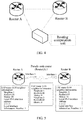
- FIG. 3 is a schematic diagram of a route computation unit located on an IS according to an embodiment 1 of the present invention.
- the route computation unit is located on an IS.
- the route computation unit On a network consisting of a router A and a router B, the route computation unit is located on the router A, that is, the router A undertakes the route computation unit.
- the router A After generating LSPs, the router A will send all of the LSPs generated by itself to the route computation unit located on a device thereof.
- the router B will send LSPs generated by itself to the route computation unit of the router A by means of a special channel, a flooding mode or other modes.
- the route computation unit located on the router A will perform route computation on each IS according to the LSPs generated by all IS routers A and routers B on the network. Then, a computation result route table of a corresponding IS is sent to the IS: a route table for computation of the router A is sent to the router A and a route table for computation of the router B is sent to the router B. Finally, the router A and the router B possess the respectively corresponding route tables, and forward data packet according to the route tables.
- FIG. 4 is a schematic diagram of a route computation unit located on a dedicated computer according to an embodiment 1 of the present invention.
- the running mode when the route computation unit is located on a dedicated computer On a network consisting of a router A and a router B, the route computation unit is located on a computer dedicated to route computation. After generating LSPs, the router A will send all of the LSPs generated by itself to the route computation unit located on the computer by means of a special channel or other modes. The router B will also send LSPs generated by itself to the route computation unit located on the computer by means of a special channel or other modes.
- the route computation unit located on a dedicated host will perform route computation on each IS according to the LSPs generated by all IS routers A and routers B on the network. Then, a computation result route table of a corresponding IS is sent to the IS: a route table for computation of the router A is sent to the router A and a route table for computation of the router B is sent to the router B. Finally, the router A and the router B possess the respectively corresponding route tables, and forward data packages according to the route tables.
- the route computation unit performs route computation according to the LSPs obtained from all ISs on the network, and needs to execute topological computation and PRC.
- the topological computation and the PRC are performed still according to the original method: as for the topological computation, an SPF algorithm is used to compute next-hop information from the present IS to each IS firstly, the next-hop information mainly including: egress interface information of a next hop and gateway information of a next hop.
- the next-hop information reaching the IS is copied to form own next-hop information.
- each IS self-executes the topological computation and the PRC originally, and computes a route table needed by itself.
- the topological computation is performed according to a neighbor TLV in the LSP.
- computation of the next-hop information in the topological computation refers to acquisition from the corresponding neighbor on a boot interface of each IS.
- the execution of route computation via the route computation unit described in the present alternative embodiment is not performed in the present IS. Therefore, the next-hop information needed by the neighbor may be carried in the LSP. So, next-hop information needed by the neighbor may be carried in LSP.
- the route computation unit may compute a next hop.
- a neighbor information format in a neighbor TLV22 of an original LSP includes: a 7-byte system Id and pseudo node number, 3-byte metric information, a 1-byte sub-TLV length, and a sub-TLV of 0 to 244 bytes.
- the neighbor information may include two important sub-TLVs, see RFC5305 for details: an IPv4 address sub-TLV and an IPv4 neighbor address sub-TLV which are used only in a TE function currently, and cannot be used in route computation.
- Table 1 Neighbor information format in neighbor TLV22 according to embodiment 1 of the present invention Neighbor system-id (6 bytes) and pseudo node number (1 byte) metric (3 bytes) Sub-TLV length (1 byte)
- the neighbor information format of the neighbor TLV22 of the LSP and the sub-TLV thereof under the condition of the wide flux are modified and expanded hereinbelow.
- FIG. 5 is a schematic diagram of an LSP generation situation of a broadcast link according to an embodiment 1 of the present invention.
- a neighbor of a broadcast network is established via an interface of which an interface number is 1 and an interface Ipv4 address is 1.1.1.1/24 on a router A and an interface of which an interface number is 1 and an interface Ipv4 address is 1.1.1.2/24 on a router B.
- a system-id of the router A is 1111.1111.1111
- a system-id of the router B is 2222.2222.2222
- the interface 1 of the router A is a DIS elected by the present broadcast network
- a pseudo node router A.1 will be created.
- a neighbor in an LSP generated by the router A is 1111.1111.1111.01 (router A.01), metric is 10 in default, two sub-TLVs namely an IPv4 interface address sub-TLV and an interface information sub-TLV are carried under this neighbor, a local Ipv4 interface address of the IPv4 interface address sub-TLV is 1.1.1.1, and a fill-in interface number of the interface information sub-TLV is 1.
- a neighbor in an LSP generated by the router B is 1111.1111.1111.01 (router A.01), metric is 10 in default, two sub-TLVs namely an IPv4 interface address sub-TLV and an interface information sub-TLV are carried under this neighbor, a local Ipv4 interface address of the IPv4 interface address sub-TLV is 1.1.1.2, and a fill-in interface number of the interface information sub-TLV is 1.
- the route computation unit After receiving the LSPs generated by the router A, the router B and the router A.01, the route computation unit will perform route computation, namely topological computation and PRC, on the router A and the router B.
- the route computation unit performs route computation on the router A. Firstly, an SPF algorithm is executed to perform the topological computation, it is finally discovered that next-hop information reaching the router B is an outbound interface 1 of the router A, a next-hop gateway is 1.1.1.2, the next-hop egress interface is acquired from an interface sub-TLV of which the neighbor is the router A.01 in the LSP of the router A, and the next-hop gateway is acquired from an interface of which the neighbor is the router A.01 and a local Ipv4 interface address is 1.1.1.2 in the LSP of the router B. So, IP accessibility information on the router B forms next-hop information of the IP accessibility information by copying the next-hop information reaching the router B, and the route computation is ended. Finally, the route computation unit will send route information of the router A to the router A, and the router A will perform route forwarding by using a route table thereof.
- the route computation unit performs route computation on the router B.
- the SPF algorithm is executed to perform the topological computation
- next-hop information reaching the router A is an egress interface 1 of the router B
- a next-hop gateway is 1.1.1.1
- the next-hop outbound interface is acquired from an interface sub-TLV of which the neighbor is the router A.01 in the LSP of the router B
- the next-hop gateway is acquired from an interface of which the neighbor is the router A.01 and a local Ipv4 interface address is 1.1.1.1 in the LSP of the router A.
- IP accessibility information on the router A forms next-hop information of the IP accessibility information by copying the next-hop information reaching the router A, and the route computation is ended.
- the route computation unit will send route information of the router B to the router B, and the router B will perform route forwarding by using a route table thereof.
- FIG. 6 is a schematic diagram of an LSP generation situation of a point-to-point link according to an embodiment 1 of the present invention.
- a neighbor of a broadcast network is established via an interface of which an interface number is 1 and an interface Ipv4 address is 1.1.1.1/24 on a router A and an interface of which an interface number is 1 and an interface Ipv4 address is 1.1.1.2/24 on a router B.
- a system-id of the router A is 1111.1111.1111
- a system-id of the router B is 2222.2222.2222.
- a neighbor in an LSP generated by the router A is 2222.2222.2222.00 (router A.01)
- metric is 10 in default
- three sub-TLVs namely an IPv4 interface address sub-TLV, an IPv4 neighbor address sub-TLV and an interface information sub-TLV are carried under this neighbor, a local Ipv4 interface address of the IPv4 interface address sub-TLV is 1.1.1.1
- a local Ipv4 interface address of the IPv4 neighbor address sub-TLV is 1.1.1.2
- a fill-in interface number of the interface information sub-TLV is 1.
- a neighbor in an LSP generated by the router B is 1111.1111.1111.01 (router A.01), metric is 10 in default, three sub-TLVs namely an IPv4 interface address sub-TLV, an IPv4 neighbor address sub-TLV and an interface information sub-TLV are carried under this neighbor, a local Ipv4 interface address of the IPv4 interface address sub-TLV is 1.1.1.1, a local Ipv4 interface address of the IPv4 neighbor address sub-TLV is 1.1.1.2, and a fill-in interface number of the interface information sub-TLV is 1.
- the route computation unit After receiving the LSPs generated by the router A and the router B, the route computation unit will perform route computation, namely topological computation and PRC, on the router A and the router B.
- the route computation unit performs route computation on the router A. Firstly, an SPF algorithm is executed to perform the topological computation, it is finally discovered that next-hop information reaching the router B is an egress interface 1 of the router A, a next-hop gateway is 1.1.1.2, the next-hop outbound interface is acquired from an interface sub-TLV of which the neighbor is the router B.00 in the LSP of the router A, and the next-hop gateway is acquired from an interface of which the neighbor is the router A.00 and a local Ipv4 interface address is 1.1.1.2 in the LSP of the router B.
- the gateway Ipv4 address is acquired, it must be confirmed that: a local Ipv4 interface address of the interface of which the neighbor is the router B.00 in the LSP of the router A is 1.1.1.1, and a neighbor Ipv4 interface address of the interface of which the neighbor is the router A.00 in the LSP of the router B is 1.1.1.1, these two Ipv4 addresses are equal, and it is actually confirmed that these two pieces of point-to-point neighbor description information are located on an identical point-to-point link. So, IP accessibility information on the router B forms next-hop information of the IP accessibility information by copying the next-hop information reaching the router B, and the route computation is ended. Finally, the route computation unit will send route information of the router A to the router A, and the router A will perform route forwarding by using a route table thereof
- the route computation unit performs route computation on the router B. Firstly, the SPF algorithm is executed to perform the topological computation, it is finally discovered that next-hop information reaching the router A is an outbound interface 1 of the router B, a next-hop gateway is 1.1.1.1, the next-hop egress interface is acquired as 1 from an interface sub-TLV of which the neighbor is the router A.00 in the LSP of the router B, and the next-hop gateway is acquired from an interface of which the neighbor is the router B.00 and a local Ipv4 interface address is 1.1.1.1 in the LSP of the router A.
- the gateway Ipv4 address is acquired, it must be confirmed that: a local Ipv4 interface address of the interface of which the neighbor is the router A.00 in the LSP of the router B is 1.1.1.2, and a neighbor Ipv4 interface address of the interface of which the neighbor is the router B.00 in the LSP of the router A is 1.1.1.2, these two Ipv4 addresses are equal, and it is actually confirmed that these two pieces of point-to-point neighbor description information are located on an identical point-to-point link. So, IP accessibility information on the router A forms next-hop information of the IP accessibility information by copying the next-hop information reaching the router A, and the route computation is ended. Finally, the route computation unit will send route information of the router B to the router B, and the router B will perform route forwarding by using a route table thereof.
- software is also provided.
- the software is arranged to execute the technical solutions described in the above-mentioned embodiments and the alternative embodiments.
- a storage medium is also provided.
- the above-mentioned software is stored in the storage medium.
- the storage medium includes, but is not limited to, an optical disk, a floppy disk, a hard disk, an erasable memory and the like.
- the ISIS-based route computation method and apparatus provided by the embodiments of the present invention have the following beneficial effects.
- the problem in the existing technology that the route computation manner for the ISIS occupies considerable computation resources and is easily attacked is solved, the computation resources occupied by the route computation manner for the ISIS are reduced, and the opportunities of attacking the ISIS are reduced since it is unnecessary to perform mutual flooding and synchronization among various ISs and to save LSPs of other ISs, thereby improving the stability and reliability of the system.
Landscapes
- Engineering & Computer Science (AREA)
- Computer Networks & Wireless Communication (AREA)
- Signal Processing (AREA)
- Data Exchanges In Wide-Area Networks (AREA)
Applications Claiming Priority (2)
| Application Number | Priority Date | Filing Date | Title |
|---|---|---|---|
| CN201410311110.XA CN105323163A (zh) | 2014-07-01 | 2014-07-01 | 基于isis的路由计算方法及装置 |
| PCT/CN2014/089074 WO2015154420A1 (zh) | 2014-07-01 | 2014-10-21 | 基于isis的路由计算方法及装置 |
Publications (2)
| Publication Number | Publication Date |
|---|---|
| EP3166264A1 true EP3166264A1 (de) | 2017-05-10 |
| EP3166264A4 EP3166264A4 (de) | 2017-08-09 |
Family
ID=54287188
Family Applications (1)
| Application Number | Title | Priority Date | Filing Date |
|---|---|---|---|
| EP14888855.5A Withdrawn EP3166264A4 (de) | 2014-07-01 | 2014-10-21 | Isis-basiertes routingberechnungsverfahren und -vorrichtung |
Country Status (4)
| Country | Link |
|---|---|
| US (1) | US20170195214A1 (de) |
| EP (1) | EP3166264A4 (de) |
| CN (1) | CN105323163A (de) |
| WO (1) | WO2015154420A1 (de) |
Cited By (1)
| Publication number | Priority date | Publication date | Assignee | Title |
|---|---|---|---|---|
| CN107733917A (zh) * | 2017-11-09 | 2018-02-23 | 上海海事大学 | 一种指定目标结点集合的k最大概率攻击路径的渐进式求解方法 |
Families Citing this family (7)
| Publication number | Priority date | Publication date | Assignee | Title |
|---|---|---|---|---|
| CN109309616B (zh) * | 2017-07-27 | 2022-03-01 | 中兴通讯股份有限公司 | 基于isis协议的通告方法及装置 |
| CN107196856A (zh) * | 2017-07-31 | 2017-09-22 | 杭州迪普科技股份有限公司 | 一种确定路由转发路径的方法和装置 |
| CN107911298B (zh) * | 2017-12-29 | 2020-03-06 | 杭州迪普科技股份有限公司 | 一种基于isis的路由重分布的方法及装置 |
| FR3081645A1 (fr) | 2018-06-28 | 2019-11-29 | Orange | Procede de communication mis en œuvre par un premier routeur d'un systeme autonome utilisant un protocole de routage interne |
| CN113746747B (zh) * | 2021-08-31 | 2023-05-30 | 烽火通信科技股份有限公司 | 一种lsp报文流量控制方法及系统 |
| CN115499361B (zh) * | 2022-07-29 | 2023-08-04 | 天翼云科技有限公司 | 路由数据的处理方法及装置、存储介质、处理器 |
| CN116192657B (zh) * | 2022-12-29 | 2024-10-18 | 中国联合网络通信集团有限公司 | 一种网络isis路由扩散模拟方法及装置 |
Family Cites Families (10)
| Publication number | Priority date | Publication date | Assignee | Title |
|---|---|---|---|---|
| US5467345A (en) * | 1994-05-31 | 1995-11-14 | Motorola, Inc. | Packet routing system and method therefor |
| US7460481B2 (en) * | 2004-12-01 | 2008-12-02 | Cisco Technology, Inc. | Inter-domain TE-LSP with IGP extensions |
| US7554996B2 (en) * | 2005-09-14 | 2009-06-30 | Cisco Technology, Inc. | Controlled distribution of inter-area routing information |
| US7751336B2 (en) * | 2006-06-08 | 2010-07-06 | Cisco Technology, Inc. | Technique for efficiently avoiding transient routing disturbances in link state routing protocols with link state packet fragmentation |
| CN101453405A (zh) * | 2007-11-30 | 2009-06-10 | 华为技术有限公司 | 建立路由的方法、系统和控制管理设备 |
| CN103188149B (zh) * | 2011-12-28 | 2016-05-25 | 中国移动通信集团广东有限公司 | 一种路由计算方法和路由器 |
| US8989049B2 (en) * | 2012-06-15 | 2015-03-24 | Cisco Technology, Inc. | System and method for virtual portchannel load balancing in a trill network |
| CN103888359B (zh) * | 2012-12-21 | 2017-04-12 | 杭州华三通信技术有限公司 | 路由计算方法及网络设备 |
| CN103236990B (zh) * | 2013-05-13 | 2016-10-05 | 杭州华三通信技术有限公司 | 一种路由信息同步的方法和设备 |
| CN103701696B (zh) * | 2013-12-31 | 2017-07-04 | 新华三技术有限公司 | 一种is‑is协议中支持转发地址的方法及其装置 |
-
2014
- 2014-07-01 CN CN201410311110.XA patent/CN105323163A/zh not_active Withdrawn
- 2014-10-21 WO PCT/CN2014/089074 patent/WO2015154420A1/zh not_active Ceased
- 2014-10-21 US US15/323,088 patent/US20170195214A1/en not_active Abandoned
- 2014-10-21 EP EP14888855.5A patent/EP3166264A4/de not_active Withdrawn
Cited By (2)
| Publication number | Priority date | Publication date | Assignee | Title |
|---|---|---|---|---|
| CN107733917A (zh) * | 2017-11-09 | 2018-02-23 | 上海海事大学 | 一种指定目标结点集合的k最大概率攻击路径的渐进式求解方法 |
| CN107733917B (zh) * | 2017-11-09 | 2020-07-24 | 上海海事大学 | 一种指定目标结点集合的k最大概率攻击路径的渐进式求解方法 |
Also Published As
| Publication number | Publication date |
|---|---|
| WO2015154420A1 (zh) | 2015-10-15 |
| CN105323163A (zh) | 2016-02-10 |
| EP3166264A4 (de) | 2017-08-09 |
| US20170195214A1 (en) | 2017-07-06 |
Similar Documents
| Publication | Publication Date | Title |
|---|---|---|
| EP3166264A1 (de) | Isis-basiertes routingberechnungsverfahren und -vorrichtung | |
| EP2963867B1 (de) | Verfahren, system und vorrichtung zur herstellung von pseudodraht | |
| CN103179038B (zh) | 一种使用as号的互联网路由方法及网络转发设备 | |
| EP3058776B1 (de) | Topologie-ermittlung basierend auf sctp/x2 snooping | |
| CN106878186B (zh) | 网络中路由更新的方法、网络设备和系统 | |
| US20210359930A1 (en) | Forwarding Path Determining Method, Apparatus, and System | |
| CN107968750A (zh) | 报文传输方法、装置及节点 | |
| CN103475581A (zh) | 一种网络标签分配方法、设备与系统 | |
| EP4072079A1 (de) | Verfahren und vorrichtung zur verhinderung von faserbrüchen für segmentroutingtunnel, eingangsknoten und speichermedium | |
| EP4152701A1 (de) | Routingverarbeitungsverfahren und zugehörige vorrichtung | |
| US12309055B2 (en) | Route determining method and apparatus and network device | |
| EP3157211B1 (de) | Überflutungsverfahren und vorrichtung auf isis-basis | |
| EP3166263B1 (de) | Leitweglenkungsberechnungsverfahren und -vorrichtung für trill isis | |
| KR20190039596A (ko) | Sfc 네트워크에서 토폴로지 정보를 동기화하기 위한 방법, 및 라우팅 네트워크 엘리먼트 | |
| CN106982162B (zh) | 用于转发业务流的方法、装置和系统 | |
| CN104168194A (zh) | 集群网络路径控制方法、设备和集群网络系统 | |
| WO2023016550A1 (zh) | 一种路由发送方法及设备 | |
| CN104065578B (zh) | 一种基于ason光网络的ip路由处理方法和装置 | |
| CN102006240B (zh) | 一种在mpls网络中转发报文的方法、装置及系统 | |
| CN117014356A (zh) | 路由通告消息的处理方法、装置、存储介质及电子装置 | |
| CN117640502A (zh) | 一种段标识sid通告方法、网络设备及存储介质 | |
| JP2008219185A (ja) | 経路情報生成広告方法、経路情報生成広告装置および経路情報生成広告プログラム | |
| CN101834795A (zh) | 传送多协议标签交换标签处理方法和装置 |
Legal Events
| Date | Code | Title | Description |
|---|---|---|---|
| PUAI | Public reference made under article 153(3) epc to a published international application that has entered the european phase |
Free format text: ORIGINAL CODE: 0009012 |
|
| 17P | Request for examination filed |
Effective date: 20170131 |
|
| AK | Designated contracting states |
Kind code of ref document: A1 Designated state(s): AL AT BE BG CH CY CZ DE DK EE ES FI FR GB GR HR HU IE IS IT LI LT LU LV MC MK MT NL NO PL PT RO RS SE SI SK SM TR |
|
| AX | Request for extension of the european patent |
Extension state: BA ME |
|
| A4 | Supplementary search report drawn up and despatched |
Effective date: 20170712 |
|
| RIC1 | Information provided on ipc code assigned before grant |
Ipc: H04L 12/721 20130101ALN20170706BHEP Ipc: H04L 12/717 20130101AFI20170706BHEP Ipc: H04L 29/06 20060101ALN20170706BHEP Ipc: H04L 12/751 20130101ALI20170706BHEP |
|
| DAX | Request for extension of the european patent (deleted) | ||
| 17Q | First examination report despatched |
Effective date: 20190412 |
|
| STAA | Information on the status of an ep patent application or granted ep patent |
Free format text: STATUS: THE APPLICATION HAS BEEN WITHDRAWN |
|
| 18W | Application withdrawn |
Effective date: 20190510 |