EP3167724A1 - Verfahren und vorrichtung zur herstellung von kaffee - Google Patents
Verfahren und vorrichtung zur herstellung von kaffee Download PDFInfo
- Publication number
- EP3167724A1 EP3167724A1 EP14897062.7A EP14897062A EP3167724A1 EP 3167724 A1 EP3167724 A1 EP 3167724A1 EP 14897062 A EP14897062 A EP 14897062A EP 3167724 A1 EP3167724 A1 EP 3167724A1
- Authority
- EP
- European Patent Office
- Prior art keywords
- coffee
- nitrogen
- charged
- cold
- brewed
- Prior art date
- Legal status (The legal status is an assumption and is not a legal conclusion. Google has not performed a legal analysis and makes no representation as to the accuracy of the status listed.)
- Granted
Links
Images

Classifications
-
- A—HUMAN NECESSITIES
- A23—FOODS OR FOODSTUFFS; TREATMENT THEREOF, NOT COVERED BY OTHER CLASSES
- A23F—COFFEE; TEA; THEIR SUBSTITUTES; MANUFACTURE, PREPARATION, OR INFUSION THEREOF
- A23F5/00—Coffee; Coffee substitutes; Preparations thereof
- A23F5/24—Extraction of coffee; Coffee extracts; Making instant coffee
- A23F5/26—Extraction of water soluble constituents
- A23F5/267—Extraction of water soluble constituents using additives, specific extraction media or specific coffee blends
-
- A—HUMAN NECESSITIES
- A23—FOODS OR FOODSTUFFS; TREATMENT THEREOF, NOT COVERED BY OTHER CLASSES
- A23F—COFFEE; TEA; THEIR SUBSTITUTES; MANUFACTURE, PREPARATION, OR INFUSION THEREOF
- A23F5/00—Coffee; Coffee substitutes; Preparations thereof
- A23F5/46—Coffee flavour; Coffee oil; Flavouring of coffee or coffee extract
-
- A—HUMAN NECESSITIES
- A47—FURNITURE; DOMESTIC ARTICLES OR APPLIANCES; COFFEE MILLS; SPICE MILLS; SUCTION CLEANERS IN GENERAL
- A47J—KITCHEN EQUIPMENT; COFFEE MILLS; SPICE MILLS; APPARATUS FOR MAKING BEVERAGES
- A47J31/00—Apparatus for making beverages
- A47J31/002—Apparatus for making beverages following a specific operational sequence, e.g. for improving the taste of the extraction product
-
- A—HUMAN NECESSITIES
- A47—FURNITURE; DOMESTIC ARTICLES OR APPLIANCES; COFFEE MILLS; SPICE MILLS; SUCTION CLEANERS IN GENERAL
- A47J—KITCHEN EQUIPMENT; COFFEE MILLS; SPICE MILLS; APPARATUS FOR MAKING BEVERAGES
- A47J31/00—Apparatus for making beverages
- A47J31/16—Inverting coffee-making apparatus in which water is boiled in the lower part and the apparatus is subsequently inverted to pass the water through the filter
-
- A—HUMAN NECESSITIES
- A47—FURNITURE; DOMESTIC ARTICLES OR APPLIANCES; COFFEE MILLS; SPICE MILLS; SUCTION CLEANERS IN GENERAL
- A47J—KITCHEN EQUIPMENT; COFFEE MILLS; SPICE MILLS; APPARATUS FOR MAKING BEVERAGES
- A47J31/00—Apparatus for making beverages
- A47J31/44—Parts or details or accessories of beverage-making apparatus
Definitions
- Example embodiments of the present invention relate to a method of making coffee and an apparatus of making coffee. More particularly, example embodiments of the present invention relate to a method of making coffee capable of keeping flavor at a relatively low temperature and an apparatus of making coffee realizing the method.
- Iced Americano which has been widely sold in coffee shops.
- the Iced Americano is made by diluting Espresso with water and ice, which is extracted from ground coffee using a relatively high pressure.
- the Iced Americano is made by adding cold water and ice to Espresso having a crema of minute foam and having velvety texture and a form layer, which may cause a temperature of Iced Americano lower to enhance bitter taste and to deteriorate texture dramatically by breaking the foam layer.
- Example embodiments of the present invention provide a method of making a coffee capable of keeping a rich density of form and a flavor.
- Example embodiments of the present invention provide an apparatus of making a coffee capable of keeping a rich density of form and a flavor.
- a method of making coffee After a cold-brewed coffee is extracted from coffee beans, nitrogen gas is charged into the cold-brewed coffee. The cold-brewed coffee into which nitrogen gas is dissolved, is cooled to form a nitrogen-charged coffee.
- the coffee beans are grinded to form a ground coffee. The ground coffee is steeped into water to form a mixture having the ground coffee and water. Then, after an extracted coffee is extracted from the mixture, the extracted coffee is diluted with water.
- a concentration (TDS) of the cold-brewed coffee is in a range from about 1.36% to about 1.58%.
- dispensing the nitrogen-charged coffee into a cup may be further performed.
- the nitrogen-charged coffee is discharged from a nozzle and then nitrogen gas is additionally discharged from the nozzle while discharging the nitrogen-charged coffee.
- a An apparatus of making coffee includes a keg storing a cold-brewed coffee, a nitrogen tank containing nitrogen gas, the nitrogen tank being connected with keg by a first line to be configured to provide nitrogen gas with the keg to form a nitrogen-charged coffee, a discharging unit being connected with the keg by a second line to be configured to discharge the nitrogen-charged coffee, and a first cooling unit covering the second line to be configured to cool the nitrogen-charged coffee.
- the apparatus may further include a third line connecting the nitrogen tank with the discharge unit, the discharging unit may be configured to selectively open/close the second line and the third line to selectively discharge the nitrogen-charged coffee or to discharge the nitrogen-charged coffee and nitrogen gas at the same time.
- the apparatus may further include a second cooling unit receiving the keg, the second cooling unit being configured to cool the cold-brewed coffee in the keg.
- nitrogen gas is bubbled in a cold-brewed coffee to form a nitrogen-charged coffee.
- a foam layer having a thickness may be formed on an upper surface of the nitrogen-charged coffee and the foam layer may be maintained for a period of time.
- the nitrogen-charged coffee may keep a smooth texture, a concentration and a flavor until the nitrogen-charged coffee is drunken up.
- first and second are used to describe various components, the components are not limited to these terms. These terms are used only to differentiate one component from another one. For example, without departing from the scope of the inventive concept, a first element could be termed a second element, and similarly has a second element could be termed a first element.
- FIG. 1 is a flow chart illustrating a method of making coffee in accordance with an example embodiment of the present invention.
- FIG. 1 a method of making coffee according to example embodiment of the present invention will be explained in detail.
- a cold-brewed coffee is extracted from coffee beans (step S110).
- the cold-brewed coffee is formed by brewing the coffee beans in water, for example, a purified water at a relatively low temperature.
- FIG. 2 is a flow chart illustrating a step of extracting a cold-brewed coffee in FIG. 1 .
- the coffee beans are grinded under a pressure to form a ground coffee (step S111).
- the ground coffee has powders each having an average grind size of about 800 ⁇ m to about 900 ⁇ m. More particular, the average grind size may be in a range of about 840 ⁇ m to about 860 ⁇ m. Preferably, the average diameter of the ground coffee is about 850 ⁇ m.
- the ground coffee When the ground coffee has the powders each having an average grind size less than 800 ⁇ m, the ground coffee may be too over-extracted. Thus, the cold-brewed coffee may taste stale or bitter.
- the ground coffee When the ground coffee has the powders each having an average diameter more than 900 ⁇ m, the ground coffee may be too under-extracted. Thus, the cold-brewed coffee may taste watery or plain.
- the ground coffee is steeped in water, for example, a purified water at a relatively low temperature (step S112).
- water for example, a purified water at a relatively low temperature
- a ratio of the ground coffee with respect to water may be in a range of about 180 g/L to about 195 g/L. Further, water may be controlled to have a temperature of about 10°C to about 15°C and a steeping time may be from about 12 hours to about 24 hours. The steeping time may be adjusted according to characteristics of the coffee beans, which may vary in accordance with each origin of the coffee beans, and a roasting degree of the coffee beans.
- a range of water hardness is between about 100 ppm and about 200 ppm.
- water has the water hardness of less than 100 ppm, the cold-brewed coffee may taste weak flavor, even though the cold-brewed coffee tastes mild and have an improved acidity.
- the cold-brewed coffee may taste sharply bitter, stale such that the cold-brewed coffee may not be smooth.
- the cold-brewed coffee may have balanced taste of sweetness, acidity and bitterness.
- the ground coffee may be too under-extracted while brewing the ground coffee such that the cold-brewed coffee may taste watery or plain.
- the ground coffee when the ratio of the ground coffee with respect to water is more than 195g/L or the steeping time is over 24 hours, the ground coffee may be over-extracted while brewing the ground coffee such that the cold-brewed coffee may taste stale or bitter.
- An extracted coffee is extracted from the mixture having the ground coffee and water (step S113).
- the mixture passes through a filtering sheet to remove the ground coffee having a relatively large size from the mixture to form the extracted coffee.
- the extracted coffee is diluted with water to form a cold-brewed coffee (step S114).
- the extracted coffee is attenuated with water to form the cold-brewed coffee having a concentration suitable for drinking.
- a concentration of TDS in the cold-brewed coffee against water is in a range of about 1.36 % to about 1.58 %.
- the TSD is an abbreviation of total dissolved solids, which means a weight of the TSD in the cold-brewed coffee.
- the concentration of the cold-brewed coffee When the concentration of the cold-brewed coffee is less than 1.36%, the cold-brewed coffee may taste watery or plain. Further, the cold-brewed coffee may not have a balanced taste. In contrast, when the concentration of the cold-brewed coffee is more than 1.58%, the cold-brewed coffee may taste excessively bitter or have a taste too strong to drink.
- a volume ratio between the extracted coffee and water may be in a range of about 1:0.8 to about 1:1.2.
- Water may include heavy water having a water hardness of about 100 ppm to about 200 ppm.
- the volume ratio is less than about 1:0.8, an amount of water is too little, whereas the concentration of the cold-brewed coffee is too high. Thus, the cold-brewed coffee may taste too bitter or have a bad balanced taste too strong to drink.
- the cold-brewed coffee may taste watery or may not have a balanced taste.
- Water is mixed to the extracted coffee to control an amount of the cold-brewed coffee easily.
- cost for making the cold-brewed coffee may decrease to improve a productivity of making the cold-brewed coffee.
- the volume ratio between the extracted coffee and water may be easily adjusted to control the concentration of the cold-brewed coffee. So, a standard of taste related to the cold-brewed coffee may be established conveniently.
- the extracted coffee may be utilized without diluting the extracted coffee with water.
- concentration of the extracted coffee TSD
- the concentration of the extracted coffee may be adjusted in a range of about 1.36 % to about 1.58 % to omit a step of diluting the extracted coffee with water.
- the cold-brewed coffee may be stored in a keg.
- the keg may be occupied with nitrogen gas.
- the cold-brewed coffee may be prevented from reacting with oxygen gas and from being oxidized.
- the cold-brewed coffee may be stored at a temperature of about 1°C to about 10°C.
- the cold-brewed coffee When the cold-brewed coffee is stored at a temperature of less than 1°C, the cold-brewed coffee may be frozen. Further, when the cold brewed coffee is stored at a temperature of more than 10°C, the cold-brewed coffee may be lukewarm to a mouth or may have a degraded refreshing taste.
- step S120 nitrogen gas is charged into the cold-brewed coffee.
- nitrogen gas is bubbled in the cold-brewed coffee stored in the keg to charge nitrogen gas into the cold-brewed coffee.
- nitrogen gas may be repeatedly provided into the cold-brewed coffee.
- nitrogen gas may charge into the cold-brewed coffee two times.
- a pressure of nitrogen gas is in a range of about 6.0 bar to about 6.5 bar in the keg.
- the pressure of nitrogen gas When the pressure of nitrogen gas is less than about 6.0 bar, the pressure of nitrogen gas is too low to charge nitrogen gas into the cold-brewed coffee sufficiently. Thus, the nitrogen charged coffee to be formed by charging nitrogen gas into the cold-brewed coffee, may not generate micro-sized foams. In the meantime, when the pressure of nitrogen gas is more than about 6.5 bar, the pressure of nitrogen gas is too high, which may cause a nitrogen-providing unit malfunctioned.
- the cold-brewed coffee in which nitrogen gas is dissolved is cooled to form a nitrogen-charged coffee.
- Nitrogen gas is provided in the keg to increase a pressure of nitrogen gas in the keg to supply the cold-brewed coffee into a discharging unit.
- the cold-brewed coffee in which nitrogen gas is dissolved may be cooled to have a predetermined temperature.
- the predetermined temperature is from about 1°C to about 10°C. More particularly, the temperature is in a range of about 3°C to about 6°C. More preferably, the temperature is about 4°C.
- the cold-brewed coffee in which nitrogen gas is dissolved When the temperature is less than 1°C, the cold-brewed coffee in which nitrogen gas is dissolved may be frozen. Meanwhile, when the temperature is more than 10°C, the cold-brewed coffee in which nitrogen gas is dissolved may be lukewarm in a mouth or may have a degraded refreshing taste. Thus, the cold-brewed coffee in which nitrogen gas is dissolved, may have a rich flavor, a good density of foam, a balanced taste, a good texture, etc.
- the nitrogen-charged coffee is discharged into a cup(step S140).
- the nitrogen-charged coffee is discharged from a nozzle into the cup.
- micro-sized foams may generated at a surface of the nitrogen-charged coffee due to nitrogen gas.
- the micro-sized foams may form a foam layer on the surface of the nitrogen-charged coffee.
- the foam layer may be maintained on the surface for a period of time to cover the nitrogen-charged coffee.
- the nitrogen-charged coffee may maintain a smooth and rich texture, a concentration of foam and a flavor until the nitrogen-charged coffee is drunken up.
- the nitrogen-charged coffee and nitrogen gas may be discharged simultaneously from the nozzle to fill the cup additionally.
- the nitrogen-charged coffee dispensed into the cup may have rich foam on a top thereof.
- the nitrogen-charged coffee has the foam layer thick.
- a volume of the nitrogen-charged coffee which firstly fills the cup is defined as a first volume.
- a volume of the nitrogen-charged coffee and nitrogen gas which are discharged simultaneously from the nozzle is defined as a second volume.
- a volume ratio of the first volume with respect to an overall volume of the nitrogen-charged coffee in the cup may be in a range of about 60% to about 80%.
- the second volume may be excessively high.
- the foam layer may be too thick, which may cause inconvenience that coffee-drinker's mouth is smeared with foam of the nitrogen-charged coffee.
- the volume ratio is more than about 80%, the first volume may be excessively high.
- the foam layer formed around a upper surface of the nitrogen-charged coffee may be too thin.
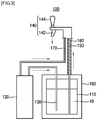
- FIG. 3 is a cross-sectional view illustrating an apparatus of making coffee in accordance with an example embodiment of the present invention.
- an apparatus 100 of making coffee in accordance with an example embodiment of the present invention includes a keg 110, a nitrogen tank 120, a first line 130, a discharging unit 140, a second line 150, a first cooling unit 160, a third line 170 and a second cooling unit 180.
- the keg 110 stores a coffee 10 therein.
- the keg 110 is filled with nitrogen gas.
- the cold-brewed coffee 10 may be prevented from being reacted with oxygen and being oxidized.
- the coffee 10 may include a cold-brewed coffee.
- the coffee 10 may include the cold-brewed coffee made by a method of making the cold-brewed coffee explained with FIG. 2
- the nitrogen tank 120 stores nitrogen gas therein.
- the nitrogen tank 120 is connected to the keg 110 by the first line 130.
- the first line 130 may extend such that a end portion of the first line 130 is dipped into the coffee 10 of the keg 110.
- Nitrogen gas is provided from the nitrogen tank 120 into the keg110 through the first line 130.
- nitrogen gas is bubbled in the coffee 10 to be dissolved in the coffee 10.
- a nitrogen-charged coffee may be formed in the keg 110.
- nitrogen gas may be repeatedly provided into the coffee 10. For example, nitrogen gas is provided into the coffee 10 two times.
- the nitrogen tank 120 may keep an internal pressure of nitrogen gas between about 6.0 bar to about 6.5 bar.
- the discharging unit 140 is configured to discharge the nitrogen-charged coffee.
- the discharging unit 140 may include a nozzle 142 and a lever 144.
- the lever 144 may selectively open/close the nozzle 142 to determine whether the nitrogen-charged coffee is discharged or not.
- the nozzle 142 may be a passway by which the nitrogen-charged coffee is discharged.
- the lever 144 may selectively open/close the second line 150 to determine whether the nitrogen-charged coffee is discharged or not.
- the discharging unit 140 is connected with the keg 110 by the second line 150.
- the second line 150 may extend such that a end portion of the second line 150 is dipped into a low portion of the keg 110.
- the nitrogen-charged coffee may flow to the discharging unit 140 by the second line 150.
- the first cooling unit 160 surrounds the second line 150.
- the first cooling unit 160 may circulate cooling water along the second line 150 to cool the nitrogen-charged coffee which flows through the second line 150.
- the nitrogen-charged coffee may be supplied into the discharging unit 140 with keeping a temperature of the nitrogen-charged coffee constant.
- the first cooling unit 160 may include a circulating line serving as a passway for cooling water, pump for circulating cooling water and a chiller for chilling cooling water to cool the nitrogen-charged coffee at a predetermined temperature.
- the predetermined temperature is from about 1°C to about 10°C. More particularly, the temperature is in a range of about 3°C to about 6°C. More preferably, the temperature is about 4°C.
- the nitrogen-charged coffee may be frozen to plug the second line 150. Meanwhile, when the first cooling unit 160 may cool the nitrogen-charged coffee having a temperature of more than 10°C, the nitrogen-charged coffee may be lukewarm in a mouth or may have a degraded refreshing taste. Thus, the nitrogen-charged coffee may have a rich flavor, a good density, a good acidity, a good texture, etc.
- the apparatus 100 further includes a third line 170.
- the third line 170 may connect the nitrogen tank 120 to the discharging unit 140.
- the third line 170 may connect the nitrogen tank 120 to the nozzle 142 of the discharging unit 140.
- the nozzle 142 may be a passway by which nitrogen gas is discharged.
- the lever 144 may selectively open/close the second line 150 and the third line 170 to determine whether the nitrogen-charged coffee is discharged and whether nitrogen gas is discharged.
- the discharging unit 140 may dispense only the nitrogen-charged coffee or dispense both the nitrogen-charged coffee and nitrogen coffee simultaneously through the nozzle 142, depending on an operation of the lever 144
- the second line 150 and the third line 170 is kept to be close.
- the third line 170 is kept to be close and the second line 150 changes to be open such that the nitrogen-charged coffee is discharged from the nozzle 142 through the second line 150.
- both the third line 170 and the second line 150 change to be open such that the nitrogen-charged coffee and nitrogen gas are simultaneously discharged from the nozzle 142 through the second line 150 and the third line 170, respectively.
- micro-sized foam may be formed on an upper surface of the nitrogen-charged coffee due to nitrogen gas which is dissolved in the nitrogen-charged coffee.
- the foam layer is formed on the upper surface of the nitrogen-charged coffee.
- micro-sized foam may be affluently formed on an upper surface of the nitrogen-charged coffee due to both nitrogen gas which is dissolved in the nitrogen-charged coffee and nitrogen gas additionally discharged from the nozzle 142.
- the foam layer becoming thicker is formed on the upper surface of the nitrogen-charged coffee.
- the foam layer may be excessively thick on the upper surface of the nitrogen-charged coffee.
- the foam layer may be maintained on the surface for a period of time to cover the nitrogen-charged coffee.
- the nitrogen-charged coffee may keep a smooth texture, a concentration and a flavor until the nitrogen-charged coffee is drunken up.
- first line 130, the second line 150 and the third line 170 may include valves, respectively.
- the first line 130, the second line 150 and the third line 170 may be selectively open/close depending on an operation of the valves.
- the second cooling unit 180 is configured to receive the keg 110.
- the second cooling unit 180 cools the nitrogen-charged coffee stored in the keg 110.
- the second cooling unit 180 may include a refrigerator.
- the second cooling unit 180 may chill the nitrogen-charged coffee having a temperature, as the first cooling unit 160 does.
- the second cooling unit 180 may chill the nitrogen-charged coffee having a temperature from about 1°C to about 10°C.
- the first cooling unit 160 may not be capable of cooling the nitrogen-charged coffee efficiently.
- the second cooling unit 180 may chill the nitrogen-charged coffee before providing nitrogen-charged coffee into the discharging unit 140 in order to assist the first cooling unit 160.
- the nitrogen-charged coffee may be discharged under a cooled status.
- the nitrogen-charged coffee may be prevented from being lukewarm in a mouth or degrading a refreshing taste.
- nitrogen gas is charged into a cold-brewed coffee so that a foam layer having a thickness may be formed on an upper surface of discharged the nitrogen-charged coffee.
- a foam layer having a thickness may be formed on an upper surface of discharged the nitrogen-charged coffee.
- an iced coffee may keep a smooth texture, a rich density of form and a flavor.
Landscapes
- Engineering & Computer Science (AREA)
- Food Science & Technology (AREA)
- Life Sciences & Earth Sciences (AREA)
- Chemical & Material Sciences (AREA)
- Polymers & Plastics (AREA)
- Tea And Coffee (AREA)
- Apparatus For Making Beverages (AREA)
Applications Claiming Priority (2)
| Application Number | Priority Date | Filing Date | Title |
|---|---|---|---|
| KR1020140086750A KR101671574B1 (ko) | 2014-07-10 | 2014-07-10 | 커피 제조 방법 및 장치 |
| PCT/KR2014/008356 WO2016006757A1 (ko) | 2014-07-10 | 2014-09-05 | 커피 제조 방법 및 장치 |
Publications (3)
| Publication Number | Publication Date |
|---|---|
| EP3167724A1 true EP3167724A1 (de) | 2017-05-17 |
| EP3167724A4 EP3167724A4 (de) | 2020-03-11 |
| EP3167724B1 EP3167724B1 (de) | 2020-08-12 |
Family
ID=52409949
Family Applications (1)
| Application Number | Title | Priority Date | Filing Date |
|---|---|---|---|
| EP14897062.7A Active EP3167724B1 (de) | 2014-07-10 | 2014-09-05 | Verfahren und vorrichtung zur herstellung von kaffee |
Country Status (6)
| Country | Link |
|---|---|
| US (2) | US9386782B2 (de) |
| EP (1) | EP3167724B1 (de) |
| KR (1) | KR101671574B1 (de) |
| CN (2) | CN105266589B (de) |
| SG (1) | SG11201700035RA (de) |
| WO (1) | WO2016006757A1 (de) |
Families Citing this family (42)
| Publication number | Priority date | Publication date | Assignee | Title |
|---|---|---|---|---|
| KR101671574B1 (ko) * | 2014-07-10 | 2016-11-01 | 주식회사 파리크라상 | 커피 제조 방법 및 장치 |
| CA2982166A1 (en) * | 2015-04-08 | 2016-10-13 | Bunn-O-Matic Corporation | Cold brew system, method and apparatus |
| DK3307118T3 (da) * | 2015-06-09 | 2019-07-15 | Plae 2 Tecj I Ab | Bryggesystem og fremgangsmåde til brygning af en drik |
| US10477883B2 (en) | 2015-08-25 | 2019-11-19 | Cornelius, Inc. | Gas injection assemblies for batch beverages having spargers |
| US10785996B2 (en) | 2015-08-25 | 2020-09-29 | Cornelius, Inc. | Apparatuses, systems, and methods for inline injection of gases into liquids |
| ITUB20154199A1 (it) * | 2015-10-07 | 2017-04-07 | Carpigiani Group Ali Spa | Macchina e metodo per la realizzazione di prodotti liquidi e semiliquidi del tipo caldo o freddo. |
| US9623383B1 (en) * | 2016-02-25 | 2017-04-18 | Ac Distributing, Inc. | System to prepare nitrogen infused beverages |
| US9955710B2 (en) | 2016-03-16 | 2018-05-01 | Cascade And Phoenix On Tap, Llc | Systems to nitrogen-infuse and dispense beverages |
| US10730023B2 (en) | 2016-03-16 | 2020-08-04 | Cuatro Connect Llc | Methods to nitrogen-infuse and dispense beverages |
| HUE068151T2 (hu) | 2016-06-10 | 2024-12-28 | Nestle Sa | Nitrogénnel átitatott oldható, hidegen fõzött instant kávé és eljárás annak elõállítására |
| US10688450B2 (en) | 2016-07-14 | 2020-06-23 | Espresso Amore | System and method for gas impregnation of a liquid |
| IT201600074471A1 (it) | 2016-07-15 | 2018-01-15 | Ali Group Srl Carpigiani | Macchina e metodo per la produzione di prodotti liquidi e semiliquidi del settore gelateria, pasticceria o ristorazione. |
| IT201600100869A1 (it) | 2016-10-07 | 2018-04-07 | Ali Group Srl Carpigiani | Metodo e sistema di pulizia di una macchina per la realizzazione di prodotti alimentari liquidi e/o semiliquidi del settore gelateria, pasticceria o ristorazione |
| KR101866092B1 (ko) * | 2016-11-29 | 2018-06-08 | 동서대학교산학협력단 | 커피 저온추출 방법 |
| CN106720818B (zh) * | 2017-01-13 | 2019-09-27 | 山东农业大学 | 一种泡沫咖啡酒精发酵饮料及其制备方法 |
| KR102027463B1 (ko) * | 2017-03-07 | 2019-10-04 | 주식회사 루왁코리아 | 거품층을 형성하는 액상 커피 제조 방법 및 이에 의한 액상 커피 |
| IT201700037089A1 (it) | 2017-04-04 | 2018-10-04 | Illycaffe Spa | Assieme di erogazione di una bevanda fredda |
| IT201700043975A1 (it) | 2017-04-21 | 2018-10-21 | Ali Group Srl Carpigiani | Macchina e metodo per la produzione di prodotti liquidi e semiliquidi del settore gelateria. |
| WO2018221954A1 (en) | 2017-06-02 | 2018-12-06 | Ewha University-Industry Collaboration Foundation | Delivery method of target material into extracellular vesicles using extracorporeal shockwave |
| KR200486416Y1 (ko) | 2017-06-23 | 2018-05-15 | 성기찬 | 탄산 및 질소 음료 제조용 장치 |
| US11445849B1 (en) * | 2017-07-18 | 2022-09-20 | Big Watt Inc. | System and method for highly uniform production of cold-brewed beverages having extended shelf-life |
| US10092132B1 (en) * | 2017-09-06 | 2018-10-09 | Ryan Brothers Coffee Of San Diego, Inc. | System and method for cold storage and hot or cold delivery of a brewed beverage |
| US11134805B1 (en) | 2017-10-13 | 2021-10-05 | Off The Beaten Path Coffee, Llc | Cold brewing system and method |
| KR20190090445A (ko) | 2018-01-25 | 2019-08-02 | 이지원 | 액체질소를 이용한 포장음료 제조방법 |
| JP7200480B2 (ja) * | 2018-02-06 | 2023-01-10 | 富士電機株式会社 | 飲料供給装置 |
| KR101957094B1 (ko) | 2018-02-13 | 2019-03-11 | 건국대학교 산학협력단 | 커피 캡슐 |
| US10925299B2 (en) | 2018-03-06 | 2021-02-23 | Kerflummox Holdings, LLC | C. bot prevention in infused coffee |
| US10368561B1 (en) * | 2018-03-06 | 2019-08-06 | Kerflummox Holdings, LLC | C. bot prevention in infused coffee |
| US10729274B2 (en) * | 2018-06-11 | 2020-08-04 | Todd Ewing | Cold brew compositions and methods |
| CN110870690B (zh) * | 2018-09-03 | 2023-01-06 | 广东美的生活电器制造有限公司 | 咖啡机及其控制方法 |
| US11040314B2 (en) | 2019-01-08 | 2021-06-22 | Marmon Foodservice Technologies, Inc. | Apparatuses, systems, and methods for injecting gasses into beverages |
| EP3747273A1 (de) * | 2019-06-05 | 2020-12-09 | Beyers' Koffie nv | Verfahren zum kaltbrühen von kaffee und damit hergestelltes getränk |
| KR102461502B1 (ko) | 2020-08-13 | 2022-11-02 | 한국과학기술연구원 | 치료제가 봉입된 우유 엑소좀을 포함하는 경구형 조성물 및 이의 제조 방법 |
| US11950606B2 (en) | 2020-10-16 | 2024-04-09 | Kerflummox Holdings, LLC | C. Bot prevention in coffee |
| US20230140751A1 (en) * | 2021-11-01 | 2023-05-04 | Spinn Holding B.V. | Connected brewing machine with shared brewing recipes |
| KR102466537B1 (ko) | 2022-06-28 | 2022-11-11 | 주식회사 베어컨테이너 | 콜드브루 커피 제조 방법 |
| KR102850552B1 (ko) | 2022-08-30 | 2025-08-26 | (주)만월회 | 친환경 커피 카스카라 원액 및 이의 제조방법 |
| USD1113343S1 (en) | 2023-09-20 | 2026-02-17 | The Cumulus Coffee Company | Pod |
| USD1111812S1 (en) | 2023-09-20 | 2026-02-10 | The Cumulus Coffee Company | Pod |
| USD1113444S1 (en) | 2024-05-14 | 2026-02-17 | The Cumulus Coffee Company | Pod |
| USD1113443S1 (en) | 2024-05-14 | 2026-02-17 | The Cumulus Coffee Company | Pod |
| CN222929586U (zh) * | 2024-06-24 | 2025-06-03 | 佛山市顺德区凯智塑料制品有限公司 | 一种加气装置及咖啡机 |
Family Cites Families (19)
| Publication number | Priority date | Publication date | Assignee | Title |
|---|---|---|---|---|
| US3997685A (en) * | 1971-06-30 | 1976-12-14 | The Procter & Gamble Company | Stable aroma, flavor and aroma and flavor products from aroma- and flavor-bearing substrates |
| JPS62111633A (ja) * | 1985-11-11 | 1987-05-22 | Ajinomoto General Foods Kk | 冷凍下にスプ−ンですくえるコ−ヒ−濃厚物の製造方法 |
| JPH0712281B2 (ja) * | 1989-06-27 | 1995-02-15 | ザ・コカ‐コーラ・カンパニー | コーヒー缶飲料の製造法 |
| US6981441B1 (en) * | 2002-04-05 | 2006-01-03 | Kenneth Dussinger | Fresh brewed ice beverage dispensing system |
| US7220440B2 (en) * | 2002-10-25 | 2007-05-22 | The Procter & Gamble Company | Method for reduction of acrylamide in roasted coffee beans, roasted coffee beans having reduced levels of acrylamide, and article of commerce |
| JP2004275112A (ja) * | 2003-03-17 | 2004-10-07 | Suntory Ltd | 容器入り飲料、その製造方法及び飲料の香味改善方法 |
| ES2336901T3 (es) * | 2003-10-27 | 2010-04-19 | Nestec S.A. | Bebida a base de cafe fermentado. |
| US8720321B2 (en) * | 2005-04-18 | 2014-05-13 | Bean Logik Llc | Apparatus for extracting cold-brewed coffee concentrate |
| JP4070800B1 (ja) * | 2007-04-13 | 2008-04-02 | キリンビバレッジ株式会社 | コーヒー飲料用水出しコーヒーの製造方法 |
| KR101560852B1 (ko) * | 2007-12-20 | 2015-10-15 | 네스텍 소시에테아노님 | 즉석 음료 제품 |
| US20090229472A1 (en) * | 2008-03-12 | 2009-09-17 | Ferrara Jr Daniel A | Brewing system and packaging |
| US8043645B2 (en) * | 2008-07-09 | 2011-10-25 | Starbucks Corporation | Method of making beverages with enhanced flavors and aromas |
| KR101119319B1 (ko) * | 2009-05-27 | 2012-03-15 | 남양유업 주식회사 | 산소 탈기수와 질소를 이용하여 이중으로 산소를 차단한 고품질 액상 조제커피의 제조방법 |
| US8586117B2 (en) * | 2009-10-28 | 2013-11-19 | Bkon Llc | Liquid infusion process and method of brewing a beverage |
| KR101004150B1 (ko) * | 2010-01-29 | 2010-12-28 | 정태원 | 거품커피 제조용 액상조성물, 이의 제조방법, 이를 포함한 거품커피, 이를 이용한 거품커피의 제조방법 |
| US20130101705A1 (en) * | 2010-04-21 | 2013-04-25 | Nestec S.A. | Coffee extract comprising a multivalent ion |
| US20120021108A1 (en) * | 2010-07-20 | 2012-01-26 | Procreate Brands LLC | Cold Brew System and Method for Making Cold Brew Coffee or Tea Extract |
| AU2012290313A1 (en) * | 2011-07-29 | 2013-05-02 | Bean Logik Llc | Cold-brewed instant coffee |
| KR101671574B1 (ko) * | 2014-07-10 | 2016-11-01 | 주식회사 파리크라상 | 커피 제조 방법 및 장치 |
-
2014
- 2014-07-10 KR KR1020140086750A patent/KR101671574B1/ko active Active
- 2014-09-05 SG SG11201700035RA patent/SG11201700035RA/en unknown
- 2014-09-05 EP EP14897062.7A patent/EP3167724B1/de active Active
- 2014-09-05 WO PCT/KR2014/008356 patent/WO2016006757A1/ko not_active Ceased
- 2014-09-19 US US14/491,973 patent/US9386782B2/en active Active
- 2014-10-15 CN CN201410545464.0A patent/CN105266589B/zh active Active
- 2014-10-15 CN CN201420596384.3U patent/CN204133216U/zh not_active Withdrawn - After Issue
-
2016
- 2016-05-19 US US15/158,753 patent/US9497978B2/en active Active
Also Published As
| Publication number | Publication date |
|---|---|
| KR20160006974A (ko) | 2016-01-20 |
| WO2016006757A1 (ko) | 2016-01-14 |
| CN105266589A (zh) | 2016-01-27 |
| CN204133216U (zh) | 2015-02-04 |
| US9386782B2 (en) | 2016-07-12 |
| CN105266589B (zh) | 2018-08-07 |
| US9497978B2 (en) | 2016-11-22 |
| SG11201700035RA (en) | 2017-02-27 |
| US20160262417A1 (en) | 2016-09-15 |
| KR101671574B1 (ko) | 2016-11-01 |
| EP3167724A4 (de) | 2020-03-11 |
| EP3167724B1 (de) | 2020-08-12 |
| US20160007626A1 (en) | 2016-01-14 |
Similar Documents
| Publication | Publication Date | Title |
|---|---|---|
| EP3167724B1 (de) | Verfahren und vorrichtung zur herstellung von kaffee | |
| TWI461171B (zh) | 自容器製備乳脂為主的飲料之方法及用於此製備方法之套件 | |
| US10667540B2 (en) | Self-foaming ready to drink beverages | |
| CN102984960B (zh) | 含谷类降解产物的发泡性饮料的发泡体 | |
| KR20190085060A (ko) | 아이스 차 또는 커피 음료의 제조 방법 | |
| EP2475262A1 (de) | Neues geschäumtes teegetränk und herstellungsverfahren | |
| JP5972778B2 (ja) | 炭酸コーヒー飲料 | |
| US11089796B2 (en) | Nitrogen infused high yield soluble coffee and methods thereof | |
| EP3110257B1 (de) | Kaffee zusamensetzung | |
| EP2236060A1 (de) | Verfahren zur Herstellung eines eisgekühlten Getränks und Verpackung mit einer Flüssigkeit | |
| JP2011135829A (ja) | コーヒー抽出液の製造方法 | |
| US20220312790A1 (en) | Composition, system, and method for making a whipped coffee concentrate | |
| HK1125277B (en) | Method for preparation of a creamy milk based beverage from a capsule and kit for such preparation | |
| KR20160085168A (ko) | 동결 커피 제조 방법 및 이를 이용하여 제조된 커피 | |
| JP2019054780A (ja) | コーヒー飲料の製造方法 |
Legal Events
| Date | Code | Title | Description |
|---|---|---|---|
| STAA | Information on the status of an ep patent application or granted ep patent |
Free format text: STATUS: THE INTERNATIONAL PUBLICATION HAS BEEN MADE |
|
| PUAI | Public reference made under article 153(3) epc to a published international application that has entered the european phase |
Free format text: ORIGINAL CODE: 0009012 |
|
| STAA | Information on the status of an ep patent application or granted ep patent |
Free format text: STATUS: REQUEST FOR EXAMINATION WAS MADE |
|
| 17P | Request for examination filed |
Effective date: 20170102 |
|
| AK | Designated contracting states |
Kind code of ref document: A1 Designated state(s): AL AT BE BG CH CY CZ DE DK EE ES FI FR GB GR HR HU IE IS IT LI LT LU LV MC MK MT NL NO PL PT RO RS SE SI SK SM TR |
|
| AX | Request for extension of the european patent |
Extension state: BA ME |
|
| DAX | Request for extension of the european patent (deleted) | ||
| A4 | Supplementary search report drawn up and despatched |
Effective date: 20171128 |
|
| RIC1 | Information provided on ipc code assigned before grant |
Ipc: A47J 31/00 20060101ALI20171122BHEP Ipc: A23F 5/46 20060101AFI20171122BHEP Ipc: A23F 5/26 20060101ALI20171122BHEP Ipc: A23F 5/24 20060101ALI20171122BHEP Ipc: A47J 31/16 20060101ALI20171122BHEP |
|
| DA4 | Supplementary search report drawn up and despatched (deleted) | ||
| R17P | Request for examination filed (corrected) |
Effective date: 20170102 |
|
| RA4 | Supplementary search report drawn up and despatched (corrected) |
Effective date: 20171128 |
|
| GRAP | Despatch of communication of intention to grant a patent |
Free format text: ORIGINAL CODE: EPIDOSNIGR1 |
|
| STAA | Information on the status of an ep patent application or granted ep patent |
Free format text: STATUS: GRANT OF PATENT IS INTENDED |
|
| INTG | Intention to grant announced |
Effective date: 20200506 |
|
| RAP1 | Party data changed (applicant data changed or rights of an application transferred) |
Owner name: PARIS CROISSANT CO., LTD. |
|
| GRAS | Grant fee paid |
Free format text: ORIGINAL CODE: EPIDOSNIGR3 |
|
| GRAA | (expected) grant |
Free format text: ORIGINAL CODE: 0009210 |
|
| STAA | Information on the status of an ep patent application or granted ep patent |
Free format text: STATUS: THE PATENT HAS BEEN GRANTED |
|
| AK | Designated contracting states |
Kind code of ref document: B1 Designated state(s): AL AT BE BG CH CY CZ DE DK EE ES FI FR GB GR HR HU IE IS IT LI LT LU LV MC MK MT NL NO PL PT RO RS SE SI SK SM TR |
|
| REG | Reference to a national code |
Ref country code: CH Ref legal event code: EP |
|
| REG | Reference to a national code |
Ref country code: IE Ref legal event code: FG4D |
|
| REG | Reference to a national code |
Ref country code: DE Ref legal event code: R096 Ref document number: 602014069017 Country of ref document: DE |
|
| REG | Reference to a national code |
Ref country code: AT Ref legal event code: REF Ref document number: 1300631 Country of ref document: AT Kind code of ref document: T Effective date: 20200915 |
|
| REG | Reference to a national code |
Ref country code: LT Ref legal event code: MG4D |
|
| REG | Reference to a national code |
Ref country code: NL Ref legal event code: MP Effective date: 20200812 |
|
| PG25 | Lapsed in a contracting state [announced via postgrant information from national office to epo] |
Ref country code: BG Free format text: LAPSE BECAUSE OF FAILURE TO SUBMIT A TRANSLATION OF THE DESCRIPTION OR TO PAY THE FEE WITHIN THE PRESCRIBED TIME-LIMIT Effective date: 20201112 Ref country code: HR Free format text: LAPSE BECAUSE OF FAILURE TO SUBMIT A TRANSLATION OF THE DESCRIPTION OR TO PAY THE FEE WITHIN THE PRESCRIBED TIME-LIMIT Effective date: 20200812 Ref country code: LT Free format text: LAPSE BECAUSE OF FAILURE TO SUBMIT A TRANSLATION OF THE DESCRIPTION OR TO PAY THE FEE WITHIN THE PRESCRIBED TIME-LIMIT Effective date: 20200812 Ref country code: FI Free format text: LAPSE BECAUSE OF FAILURE TO SUBMIT A TRANSLATION OF THE DESCRIPTION OR TO PAY THE FEE WITHIN THE PRESCRIBED TIME-LIMIT Effective date: 20200812 Ref country code: SE Free format text: LAPSE BECAUSE OF FAILURE TO SUBMIT A TRANSLATION OF THE DESCRIPTION OR TO PAY THE FEE WITHIN THE PRESCRIBED TIME-LIMIT Effective date: 20200812 Ref country code: GR Free format text: LAPSE BECAUSE OF FAILURE TO SUBMIT A TRANSLATION OF THE DESCRIPTION OR TO PAY THE FEE WITHIN THE PRESCRIBED TIME-LIMIT Effective date: 20201113 Ref country code: NO Free format text: LAPSE BECAUSE OF FAILURE TO SUBMIT A TRANSLATION OF THE DESCRIPTION OR TO PAY THE FEE WITHIN THE PRESCRIBED TIME-LIMIT Effective date: 20201112 |
|
| REG | Reference to a national code |
Ref country code: AT Ref legal event code: MK05 Ref document number: 1300631 Country of ref document: AT Kind code of ref document: T Effective date: 20200812 |
|
| PG25 | Lapsed in a contracting state [announced via postgrant information from national office to epo] |
Ref country code: RS Free format text: LAPSE BECAUSE OF FAILURE TO SUBMIT A TRANSLATION OF THE DESCRIPTION OR TO PAY THE FEE WITHIN THE PRESCRIBED TIME-LIMIT Effective date: 20200812 Ref country code: PL Free format text: LAPSE BECAUSE OF FAILURE TO SUBMIT A TRANSLATION OF THE DESCRIPTION OR TO PAY THE FEE WITHIN THE PRESCRIBED TIME-LIMIT Effective date: 20200812 Ref country code: NL Free format text: LAPSE BECAUSE OF FAILURE TO SUBMIT A TRANSLATION OF THE DESCRIPTION OR TO PAY THE FEE WITHIN THE PRESCRIBED TIME-LIMIT Effective date: 20200812 Ref country code: LV Free format text: LAPSE BECAUSE OF FAILURE TO SUBMIT A TRANSLATION OF THE DESCRIPTION OR TO PAY THE FEE WITHIN THE PRESCRIBED TIME-LIMIT Effective date: 20200812 Ref country code: IS Free format text: LAPSE BECAUSE OF FAILURE TO SUBMIT A TRANSLATION OF THE DESCRIPTION OR TO PAY THE FEE WITHIN THE PRESCRIBED TIME-LIMIT Effective date: 20201212 |
|
| REG | Reference to a national code |
Ref country code: DE Ref legal event code: R119 Ref document number: 602014069017 Country of ref document: DE |
|
| PG25 | Lapsed in a contracting state [announced via postgrant information from national office to epo] |
Ref country code: RO Free format text: LAPSE BECAUSE OF FAILURE TO SUBMIT A TRANSLATION OF THE DESCRIPTION OR TO PAY THE FEE WITHIN THE PRESCRIBED TIME-LIMIT Effective date: 20200812 Ref country code: SM Free format text: LAPSE BECAUSE OF FAILURE TO SUBMIT A TRANSLATION OF THE DESCRIPTION OR TO PAY THE FEE WITHIN THE PRESCRIBED TIME-LIMIT Effective date: 20200812 Ref country code: EE Free format text: LAPSE BECAUSE OF FAILURE TO SUBMIT A TRANSLATION OF THE DESCRIPTION OR TO PAY THE FEE WITHIN THE PRESCRIBED TIME-LIMIT Effective date: 20200812 Ref country code: DK Free format text: LAPSE BECAUSE OF FAILURE TO SUBMIT A TRANSLATION OF THE DESCRIPTION OR TO PAY THE FEE WITHIN THE PRESCRIBED TIME-LIMIT Effective date: 20200812 Ref country code: CZ Free format text: LAPSE BECAUSE OF FAILURE TO SUBMIT A TRANSLATION OF THE DESCRIPTION OR TO PAY THE FEE WITHIN THE PRESCRIBED TIME-LIMIT Effective date: 20200812 |
|
| REG | Reference to a national code |
Ref country code: CH Ref legal event code: PL |
|
| PG25 | Lapsed in a contracting state [announced via postgrant information from national office to epo] |
Ref country code: MC Free format text: LAPSE BECAUSE OF FAILURE TO SUBMIT A TRANSLATION OF THE DESCRIPTION OR TO PAY THE FEE WITHIN THE PRESCRIBED TIME-LIMIT Effective date: 20200812 Ref country code: AL Free format text: LAPSE BECAUSE OF FAILURE TO SUBMIT A TRANSLATION OF THE DESCRIPTION OR TO PAY THE FEE WITHIN THE PRESCRIBED TIME-LIMIT Effective date: 20200812 Ref country code: AT Free format text: LAPSE BECAUSE OF FAILURE TO SUBMIT A TRANSLATION OF THE DESCRIPTION OR TO PAY THE FEE WITHIN THE PRESCRIBED TIME-LIMIT Effective date: 20200812 Ref country code: ES Free format text: LAPSE BECAUSE OF FAILURE TO SUBMIT A TRANSLATION OF THE DESCRIPTION OR TO PAY THE FEE WITHIN THE PRESCRIBED TIME-LIMIT Effective date: 20200812 |
|
| PLBE | No opposition filed within time limit |
Free format text: ORIGINAL CODE: 0009261 |
|
| REG | Reference to a national code |
Ref country code: BE Ref legal event code: MM Effective date: 20200930 |
|
| STAA | Information on the status of an ep patent application or granted ep patent |
Free format text: STATUS: NO OPPOSITION FILED WITHIN TIME LIMIT |
|
| PG25 | Lapsed in a contracting state [announced via postgrant information from national office to epo] |
Ref country code: SK Free format text: LAPSE BECAUSE OF FAILURE TO SUBMIT A TRANSLATION OF THE DESCRIPTION OR TO PAY THE FEE WITHIN THE PRESCRIBED TIME-LIMIT Effective date: 20200812 Ref country code: LU Free format text: LAPSE BECAUSE OF NON-PAYMENT OF DUE FEES Effective date: 20200905 |
|
| 26N | No opposition filed |
Effective date: 20210514 |
|
| GBPC | Gb: european patent ceased through non-payment of renewal fee |
Effective date: 20201112 |
|
| PG25 | Lapsed in a contracting state [announced via postgrant information from national office to epo] |
Ref country code: IT Free format text: LAPSE BECAUSE OF FAILURE TO SUBMIT A TRANSLATION OF THE DESCRIPTION OR TO PAY THE FEE WITHIN THE PRESCRIBED TIME-LIMIT Effective date: 20200812 Ref country code: DE Free format text: LAPSE BECAUSE OF NON-PAYMENT OF DUE FEES Effective date: 20210401 |
|
| PG25 | Lapsed in a contracting state [announced via postgrant information from national office to epo] |
Ref country code: CH Free format text: LAPSE BECAUSE OF NON-PAYMENT OF DUE FEES Effective date: 20200930 Ref country code: BE Free format text: LAPSE BECAUSE OF NON-PAYMENT OF DUE FEES Effective date: 20200930 Ref country code: SI Free format text: LAPSE BECAUSE OF FAILURE TO SUBMIT A TRANSLATION OF THE DESCRIPTION OR TO PAY THE FEE WITHIN THE PRESCRIBED TIME-LIMIT Effective date: 20200812 Ref country code: LI Free format text: LAPSE BECAUSE OF NON-PAYMENT OF DUE FEES Effective date: 20200930 Ref country code: IE Free format text: LAPSE BECAUSE OF NON-PAYMENT OF DUE FEES Effective date: 20200905 |
|
| PG25 | Lapsed in a contracting state [announced via postgrant information from national office to epo] |
Ref country code: GB Free format text: LAPSE BECAUSE OF NON-PAYMENT OF DUE FEES Effective date: 20201112 |
|
| PG25 | Lapsed in a contracting state [announced via postgrant information from national office to epo] |
Ref country code: IS Free format text: LAPSE BECAUSE OF FAILURE TO SUBMIT A TRANSLATION OF THE DESCRIPTION OR TO PAY THE FEE WITHIN THE PRESCRIBED TIME-LIMIT Effective date: 20201212 Ref country code: TR Free format text: LAPSE BECAUSE OF FAILURE TO SUBMIT A TRANSLATION OF THE DESCRIPTION OR TO PAY THE FEE WITHIN THE PRESCRIBED TIME-LIMIT Effective date: 20200812 Ref country code: MT Free format text: LAPSE BECAUSE OF FAILURE TO SUBMIT A TRANSLATION OF THE DESCRIPTION OR TO PAY THE FEE WITHIN THE PRESCRIBED TIME-LIMIT Effective date: 20200812 Ref country code: CY Free format text: LAPSE BECAUSE OF FAILURE TO SUBMIT A TRANSLATION OF THE DESCRIPTION OR TO PAY THE FEE WITHIN THE PRESCRIBED TIME-LIMIT Effective date: 20200812 |
|
| PG25 | Lapsed in a contracting state [announced via postgrant information from national office to epo] |
Ref country code: MK Free format text: LAPSE BECAUSE OF FAILURE TO SUBMIT A TRANSLATION OF THE DESCRIPTION OR TO PAY THE FEE WITHIN THE PRESCRIBED TIME-LIMIT Effective date: 20200812 |
|
| PG25 | Lapsed in a contracting state [announced via postgrant information from national office to epo] |
Ref country code: PT Free format text: LAPSE BECAUSE OF FAILURE TO SUBMIT A TRANSLATION OF THE DESCRIPTION OR TO PAY THE FEE WITHIN THE PRESCRIBED TIME-LIMIT Effective date: 20200812 |
|
| PGFP | Annual fee paid to national office [announced via postgrant information from national office to epo] |
Ref country code: FR Payment date: 20250624 Year of fee payment: 12 |