EP3168317A1 - Acier inoxydable austénitique et son procédé de production - Google Patents
Acier inoxydable austénitique et son procédé de production Download PDFInfo
- Publication number
- EP3168317A1 EP3168317A1 EP15818354.1A EP15818354A EP3168317A1 EP 3168317 A1 EP3168317 A1 EP 3168317A1 EP 15818354 A EP15818354 A EP 15818354A EP 3168317 A1 EP3168317 A1 EP 3168317A1
- Authority
- EP
- European Patent Office
- Prior art keywords
- stainless steel
- austenitic stainless
- expressed
- weight
- oxygen
- Prior art date
- Legal status (The legal status is an assumption and is not a legal conclusion. Google has not performed a legal analysis and makes no representation as to the accuracy of the status listed.)
- Withdrawn
Links
Images

Classifications
-
- C—CHEMISTRY; METALLURGY
- C22—METALLURGY; FERROUS OR NON-FERROUS ALLOYS; TREATMENT OF ALLOYS OR NON-FERROUS METALS
- C22C—ALLOYS
- C22C38/00—Ferrous alloys, e.g. steel alloys
- C22C38/18—Ferrous alloys, e.g. steel alloys containing chromium
- C22C38/40—Ferrous alloys, e.g. steel alloys containing chromium with nickel
- C22C38/50—Ferrous alloys, e.g. steel alloys containing chromium with nickel with titanium or zirconium
-
- B—PERFORMING OPERATIONS; TRANSPORTING
- B22—CASTING; POWDER METALLURGY
- B22F—WORKING METALLIC POWDER; MANUFACTURE OF ARTICLES FROM METALLIC POWDER; MAKING METALLIC POWDER; APPARATUS OR DEVICES SPECIALLY ADAPTED FOR METALLIC POWDER
- B22F1/00—Metallic powder; Treatment of metallic powder, e.g. to facilitate working or to improve properties
-
- B—PERFORMING OPERATIONS; TRANSPORTING
- B22—CASTING; POWDER METALLURGY
- B22F—WORKING METALLIC POWDER; MANUFACTURE OF ARTICLES FROM METALLIC POWDER; MAKING METALLIC POWDER; APPARATUS OR DEVICES SPECIALLY ADAPTED FOR METALLIC POWDER
- B22F1/00—Metallic powder; Treatment of metallic powder, e.g. to facilitate working or to improve properties
- B22F1/05—Metallic powder characterised by the size or surface area of the particles
-
- B—PERFORMING OPERATIONS; TRANSPORTING
- B22—CASTING; POWDER METALLURGY
- B22F—WORKING METALLIC POWDER; MANUFACTURE OF ARTICLES FROM METALLIC POWDER; MAKING METALLIC POWDER; APPARATUS OR DEVICES SPECIALLY ADAPTED FOR METALLIC POWDER
- B22F3/00—Manufacture of workpieces or articles from metallic powder characterised by the manner of compacting or sintering; Apparatus specially adapted therefor ; Presses and furnaces
- B22F3/12—Both compacting and sintering
- B22F3/14—Both compacting and sintering simultaneously
- B22F3/15—Hot isostatic pressing
-
- B—PERFORMING OPERATIONS; TRANSPORTING
- B22—CASTING; POWDER METALLURGY
- B22F—WORKING METALLIC POWDER; MANUFACTURE OF ARTICLES FROM METALLIC POWDER; MAKING METALLIC POWDER; APPARATUS OR DEVICES SPECIALLY ADAPTED FOR METALLIC POWDER
- B22F3/00—Manufacture of workpieces or articles from metallic powder characterised by the manner of compacting or sintering; Apparatus specially adapted therefor ; Presses and furnaces
- B22F3/24—After-treatment of workpieces or articles
-
- C—CHEMISTRY; METALLURGY
- C22—METALLURGY; FERROUS OR NON-FERROUS ALLOYS; TREATMENT OF ALLOYS OR NON-FERROUS METALS
- C22C—ALLOYS
- C22C38/00—Ferrous alloys, e.g. steel alloys
-
- C—CHEMISTRY; METALLURGY
- C22—METALLURGY; FERROUS OR NON-FERROUS ALLOYS; TREATMENT OF ALLOYS OR NON-FERROUS METALS
- C22C—ALLOYS
- C22C38/00—Ferrous alloys, e.g. steel alloys
- C22C38/001—Ferrous alloys, e.g. steel alloys containing N
-
- C—CHEMISTRY; METALLURGY
- C22—METALLURGY; FERROUS OR NON-FERROUS ALLOYS; TREATMENT OF ALLOYS OR NON-FERROUS METALS
- C22C—ALLOYS
- C22C38/00—Ferrous alloys, e.g. steel alloys
- C22C38/002—Ferrous alloys, e.g. steel alloys containing In, Mg, or other elements not provided for in one single group C22C38/001 - C22C38/60
-
- C—CHEMISTRY; METALLURGY
- C22—METALLURGY; FERROUS OR NON-FERROUS ALLOYS; TREATMENT OF ALLOYS OR NON-FERROUS METALS
- C22C—ALLOYS
- C22C38/00—Ferrous alloys, e.g. steel alloys
- C22C38/02—Ferrous alloys, e.g. steel alloys containing silicon
-
- C—CHEMISTRY; METALLURGY
- C22—METALLURGY; FERROUS OR NON-FERROUS ALLOYS; TREATMENT OF ALLOYS OR NON-FERROUS METALS
- C22C—ALLOYS
- C22C38/00—Ferrous alloys, e.g. steel alloys
- C22C38/04—Ferrous alloys, e.g. steel alloys containing manganese
-
- C—CHEMISTRY; METALLURGY
- C22—METALLURGY; FERROUS OR NON-FERROUS ALLOYS; TREATMENT OF ALLOYS OR NON-FERROUS METALS
- C22C—ALLOYS
- C22C38/00—Ferrous alloys, e.g. steel alloys
- C22C38/18—Ferrous alloys, e.g. steel alloys containing chromium
- C22C38/40—Ferrous alloys, e.g. steel alloys containing chromium with nickel
- C22C38/48—Ferrous alloys, e.g. steel alloys containing chromium with nickel with niobium or tantalum
-
- G—PHYSICS
- G21—NUCLEAR PHYSICS; NUCLEAR ENGINEERING
- G21C—NUCLEAR REACTORS
- G21C7/00—Control of nuclear reaction
- G21C7/06—Control of nuclear reaction by application of neutron-absorbing material, i.e. material with absorption cross-section very much in excess of reflection cross-section
- G21C7/08—Control of nuclear reaction by application of neutron-absorbing material, i.e. material with absorption cross-section very much in excess of reflection cross-section by displacement of solid control elements, e.g. control rods
- G21C7/10—Construction of control elements
-
- G—PHYSICS
- G21—NUCLEAR PHYSICS; NUCLEAR ENGINEERING
- G21D—NUCLEAR POWER PLANT
- G21D1/00—Details of nuclear power plant
-
- B—PERFORMING OPERATIONS; TRANSPORTING
- B22—CASTING; POWDER METALLURGY
- B22F—WORKING METALLIC POWDER; MANUFACTURE OF ARTICLES FROM METALLIC POWDER; MAKING METALLIC POWDER; APPARATUS OR DEVICES SPECIALLY ADAPTED FOR METALLIC POWDER
- B22F3/00—Manufacture of workpieces or articles from metallic powder characterised by the manner of compacting or sintering; Apparatus specially adapted therefor ; Presses and furnaces
- B22F3/24—After-treatment of workpieces or articles
- B22F2003/247—Removing material: carving, cleaning, grinding, hobbing, honing, lapping, polishing, milling, shaving, skiving, turning the surface
-
- Y—GENERAL TAGGING OF NEW TECHNOLOGICAL DEVELOPMENTS; GENERAL TAGGING OF CROSS-SECTIONAL TECHNOLOGIES SPANNING OVER SEVERAL SECTIONS OF THE IPC; TECHNICAL SUBJECTS COVERED BY FORMER USPC CROSS-REFERENCE ART COLLECTIONS [XRACs] AND DIGESTS
- Y02—TECHNOLOGIES OR APPLICATIONS FOR MITIGATION OR ADAPTATION AGAINST CLIMATE CHANGE
- Y02E—REDUCTION OF GREENHOUSE GAS [GHG] EMISSIONS, RELATED TO ENERGY GENERATION, TRANSMISSION OR DISTRIBUTION
- Y02E30/00—Energy generation of nuclear origin
-
- Y—GENERAL TAGGING OF NEW TECHNOLOGICAL DEVELOPMENTS; GENERAL TAGGING OF CROSS-SECTIONAL TECHNOLOGIES SPANNING OVER SEVERAL SECTIONS OF THE IPC; TECHNICAL SUBJECTS COVERED BY FORMER USPC CROSS-REFERENCE ART COLLECTIONS [XRACs] AND DIGESTS
- Y02—TECHNOLOGIES OR APPLICATIONS FOR MITIGATION OR ADAPTATION AGAINST CLIMATE CHANGE
- Y02E—REDUCTION OF GREENHOUSE GAS [GHG] EMISSIONS, RELATED TO ENERGY GENERATION, TRANSMISSION OR DISTRIBUTION
- Y02E30/00—Energy generation of nuclear origin
- Y02E30/30—Nuclear fission reactors
Definitions
- the present invention relates to dispersion-strengthened austenitic stainless steel, and more particularly to highly irradiation-resistant austenitic stainless steel applicable to a reactor internal structure used under a neutron irradiation environment.
- Austenitic stainless steel has high corrosion resistance under a corrosive environment due to a Cr passive film formed on the surface thereof.
- Austenitic stainless steel is frequently used as a component of a structural material, and is often used also in a nuclear power plant.
- the following possibility has been pointed out. That is, under a high-temperature, high-pressure water environment such as in a reactor, stress corrosion cracking occurs, and furthermore, the stainless steel is irradiated with neutrons within the reactor and an irradiation defect is introduced. As a result, Cr deficiency occurs at a crystal grain boundary, leading to irradiation-induced stress corrosion cracking. Therefore, in order to lower the susceptibility to irradiation-induced stress corrosion cracking, development of a material having excellent resistance to irradiation and stress corrosion cracking is required.
- PTL 1 describes that corrosion resistance, strength, and resistance to irradiation are improved by using austenitic stainless steel having an average crystal grain diameter of 1 ⁇ m or less and containing at least one kind selected from Ti at 1.0% or less, Zr at 2.0% or less, and Nb at 1.0% or less.
- PTL 2 describes ferritic stainless steel in which toughness and workability as well as strength are improved by bulking powder having an ultrafine grain structure obtained by mechanical alloying or the like while maintaining the structure.
- a purpose of the austenitic stainless steel described in PTL 1 is to improve corrosion resistance, strength, and resistance to irradiation by making crystal grains finer, and to improve strength and resistance to stress corrosion cracking by forming oxides and carbides by Ti, Zr, or Nb. Meanwhile, an element additive amount relative to the amount of oxygen and carbon is not clear, and there may be a risk of a decrease in mechanical strength due to the formation of an intermetallic compound and residual oxygen and carbon.
- the ferritic stainless steel described in PTL 2 largely improves toughness by stabilizing oxygen, which adversely affects the mechanical properties of steel, by forming an oxide of the added element. Meanwhile, since the parent phase is a ferrite phase, there is a concern about corrosion resistance under the environment inside a reactor.
- Ferrite martensitic oxide dispersion-strengthened steel has been developed as a material having excellent resistance to irradiation, but still has a problem with corrosion resistance under the environment inside a reactor.
- An object of the present invention is to provide austenitic stainless steel having a high strength and high corrosion resistance while improving resistance to irradiation and reducing irradiation-induced stress corrosion cracking.
- Austenitic stainless steel of the present invention contains Cr: 16 to 26%, Ni: 8 to 22%, O: 0.02 to 0.4%, C: 0.08% or less, and N: 0.1% or less by weight, and further contains at least one kind of Zr: 0.2 to 2.8%, Ta: 0.4 to 5.0%, and Ti: 0.2 to 2.6%, the balance being Fe and unavoidable impurities, wherein Zr, Ta, and Ti are precipitated as precipitates of one or more kinds of oxide particles, carbide particles, nitride particles, and composite particles thereof.
- a method for producing austenitic stainless steel of the present invention includes: alloying, through mechanical alloying treatment, alloy powder containing Cr: 16 to 26%, Ni: 8 to 22%, O: 0.02 to 0.4%, C: 0.08% or less, and N: 0.1% or less by weight, and further containing at least one kind of Zr: 0.2 to 2.8%, Ta: 0.4 to 5.0%, and Ti: 0.2 to 2.6%, the balance being Fe and unavoidable impurities, or mixed powder satisfying the composition; encapsulating the powder in a container under vacuum; and solidifying and molding the powder at 800°C to 1200°C.
- austenitic stainless steel having a high strength and high corrosion resistance while improving resistance to irradiation and reducing irradiation-induced stress corrosion cracking, and a method for producing the austenitic stainless steel can be provided.
- the austenitic stainless steel of the present invention has the following basic composition.
- the austenitic stainless steel contains Cr: 16 to 26%, Ni: 8 to 22%, O: 0.02 to 0.4%, C: 0.08% or less, and N: 0.1% or less by weight, and further contains at least one kind of Zr: 0.2 to 2.8%, Ta: 0.4 to 5.0%, and Ti: 0.2 to 2.6%, the balance being Fe and unavoidable impurities.
- Zr, Ta, and Ti are precipitated as precipitates of one or more kinds of oxide particles, carbide particles, nitride particles, and composite particles thereof.
- Zr, Ta, and Ti are added in order to stabilize oxygen present in the steel and to be precipitated as oxide particles.
- Oxygen contained in the steel is known as a factor that may deteriorate the mechanical properties, particularly toughness, and also lower the intergranular corrosion resistance of the stainless steel. Therefore, Zr, Ta, and Ti having a high affinity for oxygen are added to stabilize oxygen and improve the mechanical properties. Furthermore, Zr, Ta, and Ti have a high affinity for carbon and nitrogen as well as oxygen, and stabilize these elements in the steel and form precipitates.
- carbon in the stainless steel becomes a factor that precipitates Cr carbides on a grain boundary, and lowers the Cr concentration near the grain boundary to cause stress corrosion cracking.
- oxygen, carbon, and nitrogen are stabilized by Zr, Ta, and Ti and do not remain in the parent phase.
- Zr, Ta, and Ti are added in enough amounts to stabilize all the oxygen, carbon, and nitrogen, the amounts being neither stoichiometrically excessive nor deficient.
- the addition in stoichiometrically excessive amounts is not desirable, because such addition may form intermetallic compounds, leading to deterioration of mechanical properties.
- the additive amounts of Zr, Ta, and Ti are determined within the following ranges in accordance with correlation formulas, where the amounts of oxygen, carbon, nitrogen contained in steel are expressed by X%, Y%, and Z% respectively.
- Zr 0.2 ⁇ 2.85 X + 7.60 Y + 6.52 Z ⁇ 2.8 Ta : 0.4 ⁇ 4.52 X + 15.0 Y + 12.9 Z ⁇ 5.0 Ti : 0.2 ⁇ 1.50 X + 3.99 Y + 3.42 Z ⁇ 2.6
- the additive amounts may be increased, as necessary, from the above amounts in order to stabilize oxygen, carbon, and nitrogen inevitably mixed during the production process.
- the amounts of oxygen, carbon, and nitrogen mixed during the production process are 0.1 wt% or less, 0.07 wt% or less, and 0.02 wt% or less respectively.
- the minimum value of the additive amount is 0 wt%, and the maximum value thereof is an enough amount to stabilize all the oxygen, carbon, and nitrogen, and is neither stoichiometrically excessive nor deficient.
- an oxygen amount ⁇ %, a carbon amount ⁇ %, and a nitrogen amount ⁇ % to be mixed during the production process are estimated and determined according to the following correlation formulas.
- Zr 2.85 ⁇ + 7.60 ⁇ + 6.52 ⁇ Ta : 4.52 ⁇ + 15.0 ⁇ + 12.9 ⁇ Ti : 1.50 ⁇ + 3.99 ⁇ + 3.42 ⁇
- predetermined amounts of Zr, Ta, and Ti are made into a solid solution state in addition to the above additive amounts.
- the elements serve as a trap site of irradiation defects, and have an effect of promoting recombination of the irradiation defects and suppressing the irradiation-induced segregation. Therefore, it is expected to suppress intergranular Cr deficiency due to irradiation-induced intergranular segregation, and to lower susceptibility to the irradiation-induced stress corrosion cracking. If these elements are excessively added, on the other hand, the elements form intermetallic compounds, which is not preferable.
- the additive amounts of Zr, Ta, and Ti are determined so as to satisfy the following relational formulas, where the amounts of oxygen, carbon, nitrogen are X%, Y%, and Z% by weight respectively, and the amounts of Zr, Ta, Ti are X%, Y%, and Z% by weight respectively.
- the precipitates that are precipitated as one or more kinds of the oxide particles, carbide particles, nitride particles, and composite particles thereof serve as a pinning site that suppresses the coarsening of crystal grain boundaries and the movement of dislocations and as a trap site of irradiation defects, and contribute to an improvement in mechanical strength and resistance to irradiation.
- the models of Orowan and Ansell as for precipitated particles, the finer the size and the higher the precipitation density, the better, in terms of mechanical strength.
- the parent phase structure in the austenitic stainless steel according to the present invention is an austenite single-phase structure in order to improve corrosion resistance.
- Cr contained in the austenitic stainless steel of the present invention is an element that improves the corrosion resistance of alloy and stabilizes an austenite structure, and the additive amount thereof is preferably 16% or more. If excessively added, Cr may form the ⁇ phase and deteriorate the material properties, and thus the additive amount of Cr in the present invention is 16 to 26%. To obtain a more stable austenite phase, the Cr content is preferably 18 to 20%.
- Ni contained in the austenitic stainless steel of the present invention contributes to the corrosion resistance, and the stability of the austenite phase.
- excessively added Ni is not preferable because such Ni may cause deterioration of the mechanical properties or precipitation of an embrittling phase. Therefore, the additive amount of Ni in the present invention is 8 to 22%.
- the Ni content is preferably 8 to 12%.
- the hall-petch equation empirically holds for the relationship between the crystal grain diameter and the mechanical strength.
- the finer the crystal grains the higher the tensile strength.
- the tensile strength becomes about 1.5 times as high as a normal material (average crystal grain diameter of several tens of micrometers).
- the miniaturization of the crystal grains can increase the total length of the crystal grain boundaries that are defect sink sites.
- the smaller the grain diameter the better, also in terms of resistance to irradiation.
- the miniaturization of the crystal grains is also known to improve corrosion resistance, and is preferable in terms of any of mechanical strength, resistance to irradiation, and corrosion resistance.
- the average crystal grain diameter is 5 ⁇ m or less, and preferably ultrafine grains of 1 ⁇ m or less are applied.
- the austenitic stainless steel of the present invention is produced as follows. Alloy powder or mixed powder satisfying the aforementioned composition is subjected to mechanical alloying in a ball mill or an attritor. The resultant powder is encapsulated in a vacuum container and solidified and molded by any of hot isostatic pressing, hot extrusion, and hot rolling.
- the solidifying and molding temperature is preferably 800°C or higher in order to achieve a satisfactory bond between the powder, and the solidification and molding are carried out at equal to or less than 1200°C, which is a solution heat treatment temperature. The higher the treatment temperature, the easier the coarsening of the crystal grains. Therefore, solidification and molding at too high a temperature are not preferable.
- Machining processes such as forging and rolling are optionally applied to the solidified and molded material.
- Alloy produced by solidifying and molding powder has a weak bond at a former powder boundary, leading to the deterioration of the mechanical strength. Therefore, by means of the above processes, the density is increased and the bond between the powder is strengthened, thereby improving the mechanical properties.
- the temperature at the time of implementing the processes is preferably from 800°C to 1200°C in a similar manner to the solidifying and molding process.
- the treatment temperature is 800°C to 1200°C in the same manner as the solidifying and molding temperature.
- Table 1 shows the chemical compositions of the materials produced in this example.
- Table 1 No. C P Ni Mn Cr Si O N Zr Ta Ti Fe 1 0.013 0.006 11.4 0.1 19.7 0.8 0.28 0.03 1.56 - Bal. 2 0.016 0.003 11.6 0.1 19.8 0.8 0.26 0.04 1.11 - Bal. 3 0.016 0.003 11.6 0.1 19.8 0.8 0.26 0.04 0.56 - Bal. 4 0.009 0.004 10.9 0.1 18.8 0.7 0.34 0.03 - 2.94 Bal. 5 0.016 0.003 11.6 0.1 19.8 0.8 0.26 0.04 - 1.90 Bal.
- Nos. 1 to 7 are materials that satisfy the basic composition of the austenitic stainless steel of the present invention.
- Zr is added to Nos. 1, 2, and 3 as a stabilizing element.
- Zr is added to No. 1 in an enough amount to satisfy the relationship of (Formula 1) and make a predetermined amount of solid solution.
- Zr is added to No. 2 in an enough amount to satisfy the relationship of (Formula 1).
- Zr is added to No. 3 in an amount necessary to stabilize 50% of each of oxygen, carbon, and nitrogen in the steel.
- Ta is added to Nos. 4, 5, and 6 as a stabilizing element.
- Ta is added to No. 4 in an enough amount to satisfy the relationship of (Formula 2) and make a predetermined amount of solid solution.
- Ta is added to No.
- Ta is added to No. 6 in an amount necessary to stabilize 50% of each of oxygen, carbon, and nitrogen in the steel.
- Ti is added to No. 7 as a stabilizing element, in an enough amount to satisfy the relationship of (Formula 3) and make a predetermined amount of solid solution.
- Nos. 1 to 7 were obtained by subjecting powder (SUS304L powder) serving as base steel and the additive element powder (Zr, Ta, Ti) to mechanical alloying by using a planetary ball mill.
- the powder subjected to mechanical alloying was encapsulated in a vacuum container, and vacuum deaeration was performed for three hours at 400°C and 10 -4 torr.
- the resultant powder was then solidified and molded through hot extrusion at 1100°C. Thereafter, hot forging was performed at 1100°C in order to further tighten the bond between the powder.
- the resultant material was subjected to a solution treatment for 30 minutes at 1100°C as a final thermal treatment.
- Nos. 8 and 9 are SUS304L serving as a comparative material.
- No. 8 was obtained as follows. SUS304L powder subjected to mechanical alloying was encapsulated in a vacuum container, and vacuum deaeration was performed for three hours at 400°C and 10 -4 torr. The resultant powder was then solidified and molded through hot extrusion at 1100°C. Thereafter, hot forging was performed at 1100°C in order to further tighten the bond between the powder. The resultant material was subjected to a solution treatment for 30 minutes at 1100°C as a final thermal treatment. No. 9 was obtained as follows.
- Table 2 shows the average crystal grain diameters, the grain sizes, and the number densities of the grains of the materials of the present invention and the comparative materials.
- FIG. 1 representatively shows structure photos of the material of the present invention No. 1 and the comparative material No. 9.
- the average crystal grain diameter of the comparative material No. 8 i.e., SUS304L subjected to mechanical alloying, on the other hand, was 20 ⁇ m and coarse precipitates were formed.
- the crystal grain diameter was further increased up to 35 ⁇ m on average. It is shown that in all of the materials of the present invention, the crystal grain diameter is smaller than those of the comparative materials, miniaturization of the crystal grains is achieved by mechanical alloying, and the fine precipitates of the additive elements that are precipitated at a higher density are effective for suppressing coarsening of the crystal grains. It is also shown through comparison between Nos. 1, 2 and No. 3 and between Nos. 4, 5 and No. 6 that, the higher the number density of grains, the finer the crystal grains, and that a larger amount of pinning grains can further suppress the coarsening of the crystal grains.
- the additive amounts of the stabilizing elements are preferably large enough to stabilize all the oxygen, carbon, and nitrogen contained in the steel and all the oxygen, carbon, and nitrogen to be mixed during the production.
- Table 3 shows the results of a Vickers hardness test carried out on the materials of the present invention and the comparative materials.
- the hardness of the comparative material No. 8 is 195 Hv, which is substantially equal to that of general stainless steel. It can be said that the coarse precipitates of 0.1 ⁇ m or more, which are coarsely precipitated, hardly contribute to the improvement of the mechanical strength. Meanwhile, it is found that the hardness of the materials of the present invention is significantly higher than that of the comparative materials, i.e., 313 Hv for No. 1 and 280 Hv for No. 4. In the results, the smaller the average crystal grain diameter, the higher the hardness.
- the additive amounts of the stabilizing elements are preferably large enough to stabilize all the oxygen, carbon, and nitrogen contained in the steel and all the oxygen, carbon, and nitrogen to be mixed during the production.
- Table 4 shows the results of an entire surface corrosion test carried out on the materials of the present invention (Nos. 1, 3, 4, and 6) and the comparative material (No. 9).
- the test results indicate relative values in the case where the corrosion weight increase of the comparative material No. 9 is set to 1.
- the test was carried out for 2000 hours as an immersion test under a light-water reactor environment (at 288°C, 8 MPa).
- the weight increases of the materials of the present invention were all substantially equal to or slightly better than that of the comparative material, and the same applies to the sample surface shape after the immersion test.
- the finer the crystal grains the smaller the weight increase.
- the results showed that the materials of the present invention had corrosion resistance similar to that of SUS316L. It can be said that the miniaturization of the crystal grain boundaries is preferable for improving the corrosion resistance.
- [Table 5] No. Presence/absence of crack 1 0/7 3 0/7 4 0/7 6 1/7 9 3/7
- the susceptibility to stress corrosion cracking was evaluated under a high-temperature, high-pressure water environment.
- the creviced bent beam (CBB) test was employed. In the test, an immersion test was carried out for 2000 hours at 288°C and a dissolved oxygen concentration of 8 ppm, and this test was carried out seven times on one sample. All of the samples used were subjected to 40% cold working. Table 5 shows the results of evaluating occurrence of a crack in the test pieces. A crack having a depth of 50 ⁇ m or more was defined as the crack.
- the test was carried on the materials of the present invention (Nos. 1, 3, 4, and 6) and the comparative material (No. 9). In the comparative material No. 9, cracks were formed on multiple test pieces, while no crack was observed on Nos.
- FIG. 2 shows results of an electron beam irradiation test carried out on the material of the present invention and the comparative material, the test being carried out for studying the dose dependence of void swelling.
- the irradiation was carried out at electron beam energy of 1.0 MeV and a sample temperature of 500°C.
- the void swelling increased with an increase in the irradiation dose through the irradiation, and reached about 10% in the experiment range.
- the void swelling occurred along with the irradiation but showed little change after around 1 dpa.
- the void swelling was about 1%.
- the material of the present invention is better than SUS316L, which is a comparative material, in terms of resistance to irradiation.
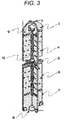
- FIG. 3 shows an example in which boron carbide is used as a neutron absorbing material.
- the control rod mainly includes a tie rod 10, a handle 9, a connector 7, a sheath 6, and a neutron absorbing rod 5, all of which include austenitic stainless steel. In the control rod which receives high neutron irradiation dose, irradiation-induced stress corrosion cracking is likely to occur.
- the dispersion-strengthened austenitic stainless steel of the present invention excellent in mechanical properties, corrosion resistance, resistance to irradiation, resistance to irradiation-induced stress corrosion cracking, and resistance to stress corrosion cracking is used. This can suppress the irradiation-induced stress corrosion cracking of the control rod, and thus a highly reliable control rod having a long service life can be obtained.
- the austenitic stainless steel of the present invention can be produced as members of various shapes, such as a rod, a sheet, and a tube. Therefore, the austenitic stainless steel can be applied not only to a control rod using boron carbide, but also to a control rod using hafnium for a neutron absorbing material.
- Irradiation-induced stress corrosion cracking is likely to occur in austenitic stainless steel that has conventionally been used in a reactor, upon irradiation with neutrons having energy of 0.1 MeV or higher at 0.5 ⁇ 10 21 n/ cm 2 or more. Therefore, the austenitic stainless steel is applicable not only to the control rod but also to other reactor inner structures and devices in which irradiation-induced stress corrosion cracking is likely to occur upon neutron irradiation.
- the austenitic stainless steel of the present invention can be used in a core shroud, a top guide, a core support plate, a baffle plate, a former plate, or a baffle former bolt, whereby the reactor and the nuclear power plant can be made highly reliable.
Landscapes
- Chemical & Material Sciences (AREA)
- Engineering & Computer Science (AREA)
- Mechanical Engineering (AREA)
- Materials Engineering (AREA)
- Metallurgy (AREA)
- Organic Chemistry (AREA)
- Physics & Mathematics (AREA)
- Manufacturing & Machinery (AREA)
- Plasma & Fusion (AREA)
- General Engineering & Computer Science (AREA)
- High Energy & Nuclear Physics (AREA)
- Chemical Kinetics & Catalysis (AREA)
- Powder Metallurgy (AREA)
Applications Claiming Priority (2)
| Application Number | Priority Date | Filing Date | Title |
|---|---|---|---|
| JP2014139282 | 2014-07-07 | ||
| PCT/JP2015/057971 WO2016006280A1 (fr) | 2014-07-07 | 2015-03-18 | Acier inoxydable austénitique et son procédé de production |
Publications (1)
| Publication Number | Publication Date |
|---|---|
| EP3168317A1 true EP3168317A1 (fr) | 2017-05-17 |
Family
ID=55063926
Family Applications (1)
| Application Number | Title | Priority Date | Filing Date |
|---|---|---|---|
| EP15818354.1A Withdrawn EP3168317A1 (fr) | 2014-07-07 | 2015-03-18 | Acier inoxydable austénitique et son procédé de production |
Country Status (4)
| Country | Link |
|---|---|
| US (1) | US20170167005A1 (fr) |
| EP (1) | EP3168317A1 (fr) |
| JP (1) | JPWO2016006280A1 (fr) |
| WO (1) | WO2016006280A1 (fr) |
Families Citing this family (8)
| Publication number | Priority date | Publication date | Assignee | Title |
|---|---|---|---|---|
| US11149324B2 (en) | 2015-03-26 | 2021-10-19 | Nippon Steel Stainless Steel Corporation | High strength austenitic stainless steel having excellent resistance to hydrogen embrittlement, method for manufacturing the same, and hydrogen equipment used for high-pressure hydrogen gas and liquid hydrogen environment |
| WO2017073422A1 (fr) * | 2015-10-30 | 2017-05-04 | 株式会社日立製作所 | Acier inoxydable austénitique à durcissement par phase dispersée, procédé pour la fabrication de l'acier inoxydable et produit fabriqué à partir de l'acier inoxydable |
| JP2020063906A (ja) * | 2017-01-12 | 2020-04-23 | 株式会社日立製作所 | 原子炉用制御棒及びその製造方法 |
| GB201803142D0 (en) * | 2018-02-27 | 2018-04-11 | Rolls Royce Plc | A method of manufacturing an austenitc iron alloy |
| CN112368411B (zh) * | 2018-10-30 | 2022-05-10 | 日铁不锈钢株式会社 | 奥氏体系不锈钢板 |
| DE112020000592T5 (de) * | 2019-01-30 | 2021-12-16 | Sumitomo Electric Industries, Ltd. | Sinterwerkstoff, Zahnrad und Verfahren zum Herstellen des Sinterwerkstoffs |
| FR3102996B1 (fr) | 2019-11-07 | 2022-05-13 | Commissariat Energie Atomique | Pièce comprenant un matériau en acier optimisé et son procédé de fabrication. |
| JP2022168571A (ja) * | 2021-04-26 | 2022-11-08 | 株式会社東芝 | 特性模擬材料及びその製造方法 |
Family Cites Families (4)
| Publication number | Priority date | Publication date | Assignee | Title |
|---|---|---|---|---|
| JPH0559494A (ja) * | 1991-09-03 | 1993-03-09 | Hitachi Ltd | 耐照射誘起偏析に優れたオーステナイトステンレス鋼 |
| JPH10204586A (ja) * | 1997-01-21 | 1998-08-04 | Hitachi Ltd | 耐応力腐食割れ性に優れたオーステナイト系ステンレス鋼及びその製造方法 |
| JP3689009B2 (ja) * | 2001-02-27 | 2005-08-31 | 株式会社日立製作所 | 高耐食性高強度オーステナイト系ステンレス鋼とその製法 |
| JP5978095B2 (ja) * | 2012-10-18 | 2016-08-24 | 日立Geニュークリア・エナジー株式会社 | 高耐食性オーステナイト系ステンレス鋼 |
-
2015
- 2015-03-18 EP EP15818354.1A patent/EP3168317A1/fr not_active Withdrawn
- 2015-03-18 US US15/324,047 patent/US20170167005A1/en not_active Abandoned
- 2015-03-18 JP JP2016532456A patent/JPWO2016006280A1/ja active Pending
- 2015-03-18 WO PCT/JP2015/057971 patent/WO2016006280A1/fr not_active Ceased
Also Published As
| Publication number | Publication date |
|---|---|
| JPWO2016006280A1 (ja) | 2017-04-27 |
| US20170167005A1 (en) | 2017-06-15 |
| WO2016006280A1 (fr) | 2016-01-14 |
Similar Documents
| Publication | Publication Date | Title |
|---|---|---|
| EP3168317A1 (fr) | Acier inoxydable austénitique et son procédé de production | |
| RU2724272C2 (ru) | Титановый композиционный материал и титановый материал для горячей обработки давлением | |
| US7361235B2 (en) | Method for producing dispersed oxide reinforced ferritic steel having coarse grain structure and being excellent in high temperature creep strength | |
| US11634805B2 (en) | Austenitic stainless steel and reactor internal structure | |
| CN108026620B (zh) | 弥散强化型奥氏体系不锈钢钢材、该不锈钢钢材的制造方法和由该不锈钢钢材形成的制造物 | |
| KR101604103B1 (ko) | 우수한 부식저항성을 갖는 핵연료 피복관용 지르코늄 합금 및 그 제조방법 | |
| KR102061839B1 (ko) | 중성자 흡수소재 및 그의 제조방법 | |
| JPH0372054A (ja) | 耐中性子照射脆化に優れたオーステナイト鋼及びその用途 | |
| EP2608911B1 (fr) | Alliages façonnables à base fer ayant une absorption neutronique thermique élevée. | |
| KR20160033076A (ko) | 분말 야금으로 강 부품을 제조하는 방법, 및 결과적인 강 부품 | |
| JP2014181383A (ja) | 高耐食性高強度ステンレス鋼および原子炉内構造物ならびに高耐食性高強度ステンレス鋼の製造方法 | |
| KR101626125B1 (ko) | 인장 및 크리프 강도가 우수한 저방사화 산화물분산강화 강 및 그 제조방법 | |
| EP0530725B1 (fr) | Acier austénitique inoxydable, résistant à la ségrégation causée par irradiation | |
| EP1528112B1 (fr) | Acier martensitique renforce au moyen d'oxyde disperse presentant une excellente resistance aux temperatures elevees et son procede de production | |
| JP3467740B2 (ja) | 酸化物分散強化型フェライト鋼の製造方法 | |
| JP7340186B2 (ja) | オーステナイト系ステンレス鋼 | |
| JPH08165545A (ja) | 中性子照射下で使用される構造部材 | |
| CN114574747A (zh) | 核反应堆用低活化抗辐照及耐腐蚀高熵合金及其制备方法 | |
| JPH024945A (ja) | 中性子照射下で高温高圧水にさらされるオーステナイト鋼及びその用途 | |
| McKamey et al. | Development of iron aluminides | |
| EP4029963A1 (fr) | Acier inoxydable austénitique à activation réduite contenant du tantale et procédé de fabrication associé | |
| EP3957762A1 (fr) | Acier austénitique à l'épreuve des radiations pour enceinte dans la cuve d'un réacteur à eau pressurisée | |
| KR101223155B1 (ko) | 고온 강도 및 크리프 저항성이 향상된 산화물 분산 강화 합금 |
Legal Events
| Date | Code | Title | Description |
|---|---|---|---|
| STAA | Information on the status of an ep patent application or granted ep patent |
Free format text: STATUS: THE INTERNATIONAL PUBLICATION HAS BEEN MADE |
|
| PUAI | Public reference made under article 153(3) epc to a published international application that has entered the european phase |
Free format text: ORIGINAL CODE: 0009012 |
|
| STAA | Information on the status of an ep patent application or granted ep patent |
Free format text: STATUS: REQUEST FOR EXAMINATION WAS MADE |
|
| 17P | Request for examination filed |
Effective date: 20170207 |
|
| AK | Designated contracting states |
Kind code of ref document: A1 Designated state(s): AL AT BE BG CH CY CZ DE DK EE ES FI FR GB GR HR HU IE IS IT LI LT LU LV MC MK MT NL NO PL PT RO RS SE SI SK SM TR |
|
| AX | Request for extension of the european patent |
Extension state: BA ME |
|
| DAV | Request for validation of the european patent (deleted) | ||
| DAX | Request for extension of the european patent (deleted) | ||
| STAA | Information on the status of an ep patent application or granted ep patent |
Free format text: STATUS: THE APPLICATION HAS BEEN WITHDRAWN |
|
| 18W | Application withdrawn |
Effective date: 20171026 |