EP3169093B1 - Dispositif de communication sans fil, procédé de communication sans fil et programme - Google Patents
Dispositif de communication sans fil, procédé de communication sans fil et programme Download PDFInfo
- Publication number
- EP3169093B1 EP3169093B1 EP15854030.2A EP15854030A EP3169093B1 EP 3169093 B1 EP3169093 B1 EP 3169093B1 EP 15854030 A EP15854030 A EP 15854030A EP 3169093 B1 EP3169093 B1 EP 3169093B1
- Authority
- EP
- European Patent Office
- Prior art keywords
- wireless communication
- communication mode
- interval
- searching
- registered
- Prior art date
- Legal status (The legal status is an assumption and is not a legal conclusion. Google has not performed a legal analysis and makes no representation as to the accuracy of the status listed.)
- Active
Links
- 238000004891 communication Methods 0.000 title claims description 387
- 238000000034 method Methods 0.000 title claims description 10
- 238000012545 processing Methods 0.000 claims description 135
- 230000008859 change Effects 0.000 claims description 3
- 230000006870 function Effects 0.000 description 16
- 238000010586 diagram Methods 0.000 description 8
- 230000004044 response Effects 0.000 description 8
- 238000005516 engineering process Methods 0.000 description 3
- 238000004364 calculation method Methods 0.000 description 2
- 230000000694 effects Effects 0.000 description 2
- 230000015654 memory Effects 0.000 description 2
- 230000003111 delayed effect Effects 0.000 description 1
- 238000001514 detection method Methods 0.000 description 1
- 239000004973 liquid crystal related substance Substances 0.000 description 1
- 238000012986 modification Methods 0.000 description 1
- 230000004048 modification Effects 0.000 description 1
- 238000000060 site-specific infrared dichroism spectroscopy Methods 0.000 description 1
- 230000003936 working memory Effects 0.000 description 1
Images


Classifications
-
- H—ELECTRICITY
- H04—ELECTRIC COMMUNICATION TECHNIQUE
- H04W—WIRELESS COMMUNICATION NETWORKS
- H04W76/00—Connection management
- H04W76/10—Connection setup
- H04W76/14—Direct-mode setup
-
- H—ELECTRICITY
- H04—ELECTRIC COMMUNICATION TECHNIQUE
- H04W—WIRELESS COMMUNICATION NETWORKS
- H04W36/00—Hand-off or reselection arrangements
- H04W36/34—Reselection control
- H04W36/36—Reselection control by user or terminal equipment
- H04W36/365—Reselection control by user or terminal equipment by manual user interaction
-
- H—ELECTRICITY
- H04—ELECTRIC COMMUNICATION TECHNIQUE
- H04W—WIRELESS COMMUNICATION NETWORKS
- H04W4/00—Services specially adapted for wireless communication networks; Facilities therefor
- H04W4/02—Services making use of location information
- H04W4/024—Guidance services
-
- H—ELECTRICITY
- H04—ELECTRIC COMMUNICATION TECHNIQUE
- H04W—WIRELESS COMMUNICATION NETWORKS
- H04W4/00—Services specially adapted for wireless communication networks; Facilities therefor
- H04W4/30—Services specially adapted for particular environments, situations or purposes
-
- H—ELECTRICITY
- H04—ELECTRIC COMMUNICATION TECHNIQUE
- H04W—WIRELESS COMMUNICATION NETWORKS
- H04W4/00—Services specially adapted for wireless communication networks; Facilities therefor
- H04W4/30—Services specially adapted for particular environments, situations or purposes
- H04W4/40—Services specially adapted for particular environments, situations or purposes for vehicles, e.g. vehicle-to-pedestrians [V2P]
- H04W4/48—Services specially adapted for particular environments, situations or purposes for vehicles, e.g. vehicle-to-pedestrians [V2P] for in-vehicle communication
-
- H—ELECTRICITY
- H04—ELECTRIC COMMUNICATION TECHNIQUE
- H04W—WIRELESS COMMUNICATION NETWORKS
- H04W8/00—Network data management
-
- H—ELECTRICITY
- H04—ELECTRIC COMMUNICATION TECHNIQUE
- H04W—WIRELESS COMMUNICATION NETWORKS
- H04W8/00—Network data management
- H04W8/005—Discovery of network devices, e.g. terminals
-
- H—ELECTRICITY
- H04—ELECTRIC COMMUNICATION TECHNIQUE
- H04W—WIRELESS COMMUNICATION NETWORKS
- H04W84/00—Network topologies
- H04W84/02—Hierarchically pre-organised networks, e.g. paging networks, cellular networks, WLAN [Wireless Local Area Network] or WLL [Wireless Local Loop]
- H04W84/10—Small scale networks; Flat hierarchical networks
-
- H—ELECTRICITY
- H04—ELECTRIC COMMUNICATION TECHNIQUE
- H04W—WIRELESS COMMUNICATION NETWORKS
- H04W84/00—Network topologies
- H04W84/02—Hierarchically pre-organised networks, e.g. paging networks, cellular networks, WLAN [Wireless Local Area Network] or WLL [Wireless Local Loop]
- H04W84/10—Small scale networks; Flat hierarchical networks
- H04W84/12—WLAN [Wireless Local Area Networks]
-
- H—ELECTRICITY
- H04—ELECTRIC COMMUNICATION TECHNIQUE
- H04W—WIRELESS COMMUNICATION NETWORKS
- H04W88/00—Devices specially adapted for wireless communication networks, e.g. terminals, base stations or access point devices
- H04W88/02—Terminal devices
- H04W88/06—Terminal devices adapted for operation in multiple networks or having at least two operational modes, e.g. multi-mode terminals
-
- H—ELECTRICITY
- H04—ELECTRIC COMMUNICATION TECHNIQUE
- H04W—WIRELESS COMMUNICATION NETWORKS
- H04W4/00—Services specially adapted for wireless communication networks; Facilities therefor
- H04W4/80—Services using short range communication, e.g. near-field communication [NFC], radio-frequency identification [RFID] or low energy communication
Definitions
- the present invention relates to wireless communication devices that perform communications in a plurality of wireless communication modes, and wireless communication methods and programs which are used to perform wireless communications by the wireless communication devices.
- communication devices which include wireless communication means as means for communicating with other nearby devices or Internet communication networks.
- on-board devices such as navigation devices which include the wireless communication means have been proposed in addition to information terminals such as personal computers, mobile phones, smartphones, and tablets.
- wireless communication mode There is not just one kind of wireless communication mode.
- wireless communication modes such as, e.g., a mode like Wi-Fi (registered trademark) in which communication is performed via an access point (base unit, base station, or station) and a mode like Bluetooth (registered trademark) in which communication is performed directly between devices without via an access point.
- Wireless communication devices have also been proposed which can perform communications in a plurality of kinds of wireless communication modes.
- Japanese Patent Application Publication No. 2003-199160 JP 2003-199160 A proposes a wireless communication device that can perform communications in two kinds of wireless communication modes, namely a wireless LAN according to IEEE 802.11b and Bluetooth.
- Patent Document 1 Japanese Patent Application Publication No. 2003-199160 ( JP 2003-199160 A ) (pp. 3-4, FIG. 1 )
- US 2013/010766 A1 relates to coexistence techniques for multi-radio devices, wherein a connection in one of two communication modes may be established by priority, wherein communications using a first radio access technology is allowed and it is determined whether communications of a second radio access technology may potentially interfere with connection setups of the first radio access technology.
- US2007/275746 A1 relates to wireless communications, specifically to wireless terminals capable of operating using multiple different communication protocols.
- US2008/2791437 A1 relates to a system for managing radio modules integrated within a wireless communication device.
- configuring wireless communication devices so that they can perform communications in a plurality of kinds of wireless communication modes as in Patent Document 1 causes a new problem, namely interference between or among wireless communications.
- configuring wireless communication devices so that they perform communications in a plurality of kinds of wireless communication modes via a single antenna causes the following problem.
- the wireless communication device While the wireless communication device is performing communication in one of the wireless communication modes (hereinafter referred to as the "first wireless communication mode"), the antenna is occupied by the communication in the first wireless communication mode. Accordingly, even if the wireless communication device attempts to perform communication in the other wireless communication mode (hereinafter referred to as the “second wireless communication mode”), no radio wave is output from the antenna and the wireless communication device fails to perform the communication.
- the first wireless communication mode is a wireless communication mode, such as Bluetooth (hereinafter referred to as "BT”), in which the wireless communication device repeatedly executes processing of searching for other registered devices at predetermined intervals in order to connect to these other registered devices.
- BT Bluetooth
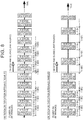
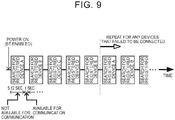
- FIG. 9 shows an example in which a wireless communication device is turned on (or a BT communication function is enabled) with five devices A to E being registered as target devices for BT communication.
- the wireless communication device first executes search processing of searching for the registered device A in order to connect to the registered device A.
- the wireless communication device executes the search processing of searching for the registered device for up to 5.12 seconds until it can connect to the intended device.
- the wireless communication device executes search processing of searching for the registered device B in order to connect to the registered device B.
- the wireless communication device similarly executes search processing of searching for the registered devices C to E at the above execution intervals.
- the wireless communication device similarly executes at the above execution intervals search processing of searching for any registered devices that failed to be connected.
- the wireless communication device continues to repeatedly execute the search processing. While the wireless communication device is repeatedly performing the search processing of searching for the registered devices, the antenna is occupied by BT communication for the duration of search processing, namely 5.12 seconds. Accordingly, even if the wireless communication device attempts to perform communication in the second wireless communication mode other than BT (e.g., Wi-Fi wireless LAN communication), it can perform the communication only when it is not executing the search processing, namely only during each execution interval of 1 second in the search processing, i.e., between the durations of 5.12 seconds. This causes problems with communication in the second wireless communication mode. For example, a connection fails to be established at a required timing, and even if a connection can be established, communication can be very slow or can be interrupted.
- the second wireless communication mode e.g., Wi-Fi wireless LAN communication
- the present invention was developed in order to solve the conventional problems and it is an object of the present invention to provide a wireless communication device, a wireless communication method, and a program in which even when communications in a plurality of kinds of wireless communication modes are performed via a single antenna, the communications in these wireless communication modes can coexist and the communications can be appropriately performed.
- a wireless communication device is a wireless communication device that performs, via a single antenna, communications in a first wireless communication mode in which the wireless communication device repeatedly executes processing of searching for other registered devices at a predetermined execution interval in order to connect to these other devices and in a second wireless communication mode according to a communication standard other than the first wireless communication mode.
- the execution interval in the first wireless communication mode is set to a reference interval.
- the wireless communication device includes: execution interval changing means for changing the execution interval in the first wireless communication mode to a value larger than the reference interval during at least a part of a period during which communication in the second wireless communication mode is being performed or communication in the second wireless communication mode is enabled.
- a wireless communication method is a wireless communication method of performing wireless communications by a wireless communication device that performs, via a single antenna, communications in a first wireless communication mode in which the wireless communication device repeatedly executes processing of searching for other registered devices at a predetermined execution interval in order to connect to these other devices and in a second wireless communication mode according to a communication standard other than the first wireless communication mode.
- the execution interval in the first wireless communication mode is set to a reference interval.
- the wireless communication method includes the step of: changing the execution interval in the first wireless communication mode to a value larger than the reference interval by execution interval changing means during at least a part of a period during which communication in the second wireless communication mode is being performed or communication in the second wireless communication mode is enabled.
- a program according to the present invention causes a wireless communication device, which performs, via a single antenna, communications in a first wireless communication mode in which the wireless communication device repeatedly executes processing of searching for other registered devices at a predetermined execution interval in order to connect to these other devices and in a second wireless communication mode according to a communication standard other than the first wireless communication mode, and in which the execution interval is set to a reference interval, to implement an execution interval changing function to change the execution interval in the first wireless communication mode to a value larger than the reference interval during at least a part of a period during which communication in the second wireless communication mode is being performed or communication in the second wireless communication mode is enabled.
- the execution intervals of searching for other devices in the first wireless communication mode are changed according to the communication status in the second wireless communication mode.
- the antenna can thus be prevented from being occupied by the first wireless communication mode. This eliminates problems with communication in the second wireless communication mode such as failure to establish a connection at a required timing, and very slow communication and interrupted communication even if a connection can be established. That is, even when communications in a plurality of kinds of wireless communication modes are performed via a single antenna, the communications in these wireless communication modes can coexist and the communications can be appropriately performed.
- FIG. 1 is a schematic configuration diagram of the wireless communication system 2 according to the present embodiment.
- the wireless communication system 2 basically includes the navigation device 1 that is an on-board device mounted on a vehicle 3, and a mobile information terminal (mobile phone, smartphone, tablet), a router, a portable audio device, etc. (hereinafter referred to as the "target devices 4") which are possessed by an occupant (user) of the vehicle 3.
- the navigation device 1 and the target devices 4 are connected so that the navigation device 1 can communicate with the target devices 4 in a plurality of wireless communication modes, and are configured so that the navigation device 1 can transmit and receive data to and from the target devices 4.
- any of the target devices 4 which is set as an access point, such as the router, is connected to an external server (e.g., a center that distributes map update information for updating map information, etc.) via a communication network 6 such as the Internet so that the target device 4 can communicate also with the external server.
- an external server e.g., a center that distributes map update information for updating map information, etc.
- the navigation device 1 communicates with the target devices 4 in two kinds of wireless communication modes, namely Wi-Fi (registered trademark) and Bluetooth (registered trademark).
- Wi-Fi is one of wireless LAN standards and is a wireless communication mode that allows devices to communicate with each other or connect to the Internet etc. via a device that is set as an access point (also called a base unit, a base station, or a station).
- Bluetooth (hereinafter referred to as "BT”) is a wireless communication mode that allows devices to directly communicate with each other without via a device that is set as an access point.
- Wi-Fi uses a wider bandwidth for communication (i.e., faster communication) than BT.
- BT provides higher security than Wi-Fi because paired devices directly communicate with each other and the communication range is short. Moreover, BT communication is less susceptible to interference from other radio waves. Accordingly, it is preferable to transmit and receive large data (e.g. map update information for updating map information etc.) via Wi-Fi and to transmit and receive other data via BT as much as possible.
- Wi-Fi and BT are used as wireless communication modes. However, other wireless standards may be used instead of Wi-Fi. Other short-range wireless communications that do not use an access point may be used instead of BT.
- the navigation device 1 is an on-board device that has a function to identify the current position such a GPS and that displays a map of the area around the vehicle, displays the current position of the vehicle 3, and searches for a route to a set destination and guides the user to the destination based on stored map information.
- a schematic configuration of the navigation device 1 will be described with reference to FIG. 3.
- FIG. 3 is a block diagram showing the navigation device 1 according to the present embodiment.
- the navigation device 1 has: a current position detection unit 11 that detects the current position of the vehicle 3 equipped with the navigation device 1; a data recording unit 12 having various types of data recorded thereon; a navigation control unit 13 that controls the overall operation of the navigation device 1 such as route search and map image display; an operation unit 14 that accepts user's operations; a liquid crystal display (LCD) 15 that displays a map around the vehicle and information on facilities to the user; a BT control unit 16 that particularly controls operation regarding BT wireless communication of the navigation device 1; a WiFi control unit 17 that particularly controls operation regarding Wi-Fi wireless communication of the navigation device 1; a connection management control unit 18 that particularly manages connections of BT and Wi-Fi wireless communications; a BT module 19 that performs BT wireless communication; and a WiFi module 20 that performs Wi-Fi wireless communication.
- a current position detection unit 11 that detects the current position of the vehicle 3 equipped with the navigation device 1
- a data recording unit 12 having various types of data recorded thereon
- a navigation control unit 13 that controls
- the data recording unit 12 stores, in addition to map information, identification information (e.g. BT address, MAC address, SSID, etc.) required for Wi-Fi and BT communications.
- identification information e.g. BT address, MAC address, SSID, etc.
- the navigation control unit 13, the BT control unit 16, the WiFi control unit 17, and the connection management control unit 18 are electronic control units that perform various kinds of control on the navigation device 1.
- Each of these control units includes: a CPU or MPU that serves as an arithmetic device and a control device; a RAM that is used as a working memory when the CPU or MPU performs various calculations and that stores calculation data etc.; a ROM having recorded thereon a wireless communication setting program (see FIG. 4 ) and a BT device search program (see FIG. 7 ) which are described below, etc., in addition to a control program; and an internal storage device such as a flash memory.
- the BT control unit 16, the WiFi control unit 17, and the connection management control unit 18 have various means serving as processing algorithms.
- execution interval changing means changes the BT execution intervals to a value larger than a reference interval during at least a part of a period during which Wi-Fi communication is being performed or Wi-Fi communication is enabled.
- the operation unit 14 is operated when the user inputs a point of departure as a start point and a destination as an end point etc., and has a plurality of operation switches (not shown) such as various keys and buttons. Based on switch signals that are output in response to depression etc. of the switches, the navigation control unit 13 controls the navigation device 1 to perform various associated operations. Particularly in the present embodiment, the operation unit 14 is also operated when the user obtains a list of Wi-Fi access points, starts Wi-FI or BT communication at a desired timing, enables or disables the Wi-Fi or BT communication function, etc.
- the operation unit 14 may have a touch panel provided on the front surface of the LCD 15.
- the operation unit 14 may have a microphone and a speech recognition device.
- the LCD 15 displays a map image including roads, traffic information, operation guidance, an operation menu, a list of Wi-Fi access points, key guidance, a planned route from a point of departure to a destination, guidance information on the planned route, news, a weather forecast, time, emails, TV programs, etc.
- a HUD or a HMD may be used instead of the LCD 15.
- the BT module 19 is a module for BT wireless communication.
- the navigation device 1 wirelessly communicates via BT module 19 with those target devices 4 which are located within a communication range by the BT.
- An antenna 21 that outputs radio waves in communication of the BT module 19 is the same as the antenna 21 that outputs radio waves in communication of the WiFi module 20 (i.e., Wi-Fi wireless communication and BT wireless communication are performed via the single antenna 21).
- the WiFi module 20 is a module for Wi-Fi wireless communication.
- the navigation device 1 wirelessly communicates via Wi-Fi module 20 with the target devices 4 by the WiFi.
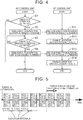
- FIG. 4 is a flowchart of the wireless communication setting program according to the present embodiment.
- the wireless communication setting program is a program that is executed after an ACC power is turned on, namely after a power source of the navigation device 1 is turned on, to perform setting regarding search processing of searching for each target device 4 registered in advance for BT connection.
- the program shown in the flowcharts of FIGS. 4 and 7 is stored in advance in the RAM, the ROM, etc. of the navigation device 1 and is executed by the control units 16 to 18.
- step (hereinafter abbreviated as S) 1 the WiFi control unit 17 determines if a condition for limiting the execution intervals of processing (hereinafter referred to as the "search processing") of searching via BT for the target devices 4 registered in advance in the navigation device 1 for BT connection (hereinafter referred to as the "registered devices”) is satisfied.
- search processing a condition for limiting the execution intervals of processing
- BT when the power supply of the navigation device 1 is turned on (or the BT communication function is enabled), BT repeatedly executes the processing of searching for the registered devices at predetermined execution intervals in order to connect to each registered device, as described above.
- a plurality of (e.g. up to 10) target devices 4 can be set as the registered devices.
- FIG. 5 shows an example in which the power supply of the navigation device 1 is turned on (the BT communication function is enabled) with five target devices 4 being registered as registered devices A to E.
- the navigation device 1 first executes search processing of searching for the registered device A in order to connect to the registered device A.
- the navigation device 1 executes the search processing of searching for the registered device for up to 5.12 seconds until it can connect to the intended device.
- the navigation device 1 executes search processing of searching for the registered device B in order to connect to the registered device B.
- the navigation device 1 similarly executes search processing of searching for the registered devices C to E at the above execution intervals.
- the navigation device 1 After executing the search processing for searching for all of the registered devices A to E, the navigation device 1 similarly executes at the above execution intervals search processing of searching for any registered devices that failed to be connected.
- the execution intervals of the search processing are initially set to one second, which is a reference interval. However, if it is determined in S1 that the condition for limiting the execution intervals of the search processing of searching for the registered devices is satisfied, the execution intervals of the search processing, especially for the second and subsequent rounds, are set to a value larger than the reference interval (specifically, 15 seconds) (S34 in FIG. 7 ).
- the condition for limiting the execution intervals of the search processing of searching for the registered devices is during at least a part of a period during which Wi-Fi communication is being performed or Wi-Fi communication is enabled.
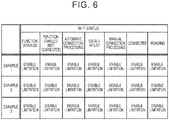
- FIG. 6 is a table showing a specific example of the condition for limiting the execution intervals of the search processing for searching for the registered devices, which is determined in S1.
- the condition for limiting the execution intervals of the search processing for searching for the registered devices will be described with respect to three patterns, namely Examples 1 to 3.
- the navigation device 1 sets one of Examples 1 to 3 as the condition.
- the navigation device 1 may be configured so that one of Examples 1 to 3 can be selected based on user's operation.
- the navigation device 1 basically limits the execution intervals of the search processing of searching for the registered devices while the Wi-Fi communication function is enabled. Specifically, if any of the following conditions (A) to (F) is satisfied, it is determined that the execution intervals of the search processing should be limited.
- the navigation device 1 limits the execution intervals of the search processing of searching for the registered devices only when Wi-Fi communication is being actually performed. Specifically, if the condition (E) is satisfied, it is determined that the execution intervals of the search processing should be limited.
- the navigation device 1 limits the execution intervals of the search processing of searching for the registered devices only when the navigation device 1 is preparing for a Wi-Fi connection and when a Wi-Fi connection is being established in the case where a Wi-Fi connection has been started based on user's operation. Specifically, if any of the conditions (C) to (E) is satisfied, it is determined that the execution intervals of the search processing should be limited.
- Example 1 is advantageous in that Wi-Fi communication is most easily performed, but is disadvantageous in that BT connections to the registered devices are delayed because, as long as the Wi-Fi communication function is enabled, the execution intervals of the search processing of searching for the registered devices are limited even if no Wi-Fi connection is being established.
- Example 2 is advantageous in that BT connections to the registered devices can be completed fastest. However, the execution intervals of the search processing of searching for the registered devices are limited only when Wi-Fi communication is being actually performed. For example, Example 2 is therefore disadvantageous in that it takes more time to start a Wi-Fi connection (i.e., it takes more time to prepare for a Wi-Fi connection) in the case where the user desires a Wi-Fi connection.
- Example 3 is a compromise between Examples 1 and 2, and is advantageous in that it takes less time to start a Wi-Fi connection in the case where a Wi-Fi connection is started based on user's intension.
- S1 If it is determined in S1 that the condition for limiting the execution intervals of the search processing of searching for the registered devices is satisfied (S1: YES), the program proceeds to S2. If it is determined in S1 that the condition for limiting the execution intervals of the search processing of searching for the registered devices is not satisfied (S1: NO), it is acknowledged that there is no need to change the execution intervals of the search processing from the reference interval, and the wireless communication setting program is terminated.
- the WiFi control unit 17 sends to the BT control unit 16 a command signal to limit the execution intervals of the search processing of searching for the registered device (execution interval limitation enable command).
- execution interval limitation enable command the BT control unit 16 enables the limitation on the execution intervals of the search processing of searching for the registered devices as described below.
- the execution intervals of the search processing are changed to a value (e.g., 15 seconds) larger than the reference interval.
- the WiFi control unit 17 determines in S3 if the condition for removing the limitation on the execution intervals of the search processing of searching for the registered devices is satisfied.
- the condition for removing the limitation on the execution intervals of the search processing of searching for the registered devices corresponds to the determination criterion in S1, namely corresponds to the condition for limiting the execution intervals of the search processing of searching for the registered devices. That is, the condition for removing the limitation on the execution intervals of the search processing of searching for the registered devices is that, the determination criterion in S1, namely the condition for limiting the execution intervals of the search processing of searching for the registered devices, is no longer satisfied.
- Example 1 shown in FIG. 6 is used as the condition for limiting the execution intervals of the search processing of searching for the registered devices, it is determined that the limitation on the execution intervals of the search processing of searching for the registered devices should be removed, if the condition other than the above conditions (A) to (F), namely the condition "(G) the Wi-Fi communication function of the navigation device 1 is disabled," is satisfied.
- Example 2 In the case where Example 2 is used as the condition for limiting the execution intervals of the search processing of searching for the registered devices, it is determined that the limitation on the execution intervals of the search processing of searching for the registered devices should be removed, if any of the above conditions (A) to (D), (F), and "(G) the Wi-Fi communication function of the navigation device 1 is disabled" is satisfied.
- Example 3 In the case where Example 3 is used as the condition for limiting the execution intervals of the search processing of searching for the registered devices, it is determined that the limitation on the execution intervals of the search processing of searching for the registered devices should be removed, if any of the above conditions (A), (B), (F), and "(G) the Wi-Fi communication function of the navigation device 1 is disabled" is satisfied.
- S3 If it is determined in S3 that the condition for removing the limitation on the execution intervals of the search processing via BT is satisfied (S3: YES), the program proceeds to S4. If it is determined in S3 that the condition for removing the limitation on the execution intervals of the search processing via BT is not satisfied (S3: NO), the program waits until the condition for removing the limitation on the execution intervals of the search processing via BT is satisfied.
- the WiFi control unit 17 sends to the BT control unit 16 a command signal to remove the limitation on the execution intervals of the search processing of searching for the registered devices (execution interval limitation disable command).
- execution interval limitation disable command the BT control unit 16 disables (removes) the limitation on the execution intervals of the search processing of searching for the registered devices as described below.
- the execution intervals of the search processing are changed back to the reference interval (e.g., 1 second).
- the wireless communication setting program that is executed by the BT control unit 16 will be described below.
- the BT control unit 16 receives the execution interval limitation enable command from the WiFi control unit 17.
- the execution interval limitation enable command is a command signal to limit the execution intervals of the search processing of searching for the registered devices as described above.
- the BT control unit 16 enables the limitation on the execution intervals of the search processing of searching for the registered devices in S12. For example, whether the limitation on the execution intervals of the search processing has been enabled or disabled is stored by a flag stored in a memory. If the limitation on the execution intervals of the search processing of searching for the registered devices has been enabled, the execution intervals of the search processing, especially for the second and subsequent rounds, are changed to a value particularly larger than the reference interval (S34). Specifically, the execution intervals are changed to 15 seconds.
- the BT control unit 16 receives the execution interval limitation disable command from the WiFi control unit 17.
- the execution interval limitation disable command is a command signal to remove the limitation on the execution intervals of the search processing of searching for the registered devices as described above.
- the BT control unit 16 disables (removes) the limitation on the execution intervals of the search processing of searching for the registered devices in S14. With the limitation on the execution intervals of the search processing of searching for the registered devices being disabled, the search processing is executed at the reference intervals even in the second and subsequent rounds, as described below (S33).
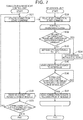
- FIG. 7 is a flowchart of the BT device search program according to the present embodiment.
- the BT device search program is a program that is executed after the ACC power is turned on, namely after the power source of the navigation device 1 is turned on, to search for the target devices 4 for BT connection.
- the connection management control unit 18 sends to the BT control unit 16 a command signal to start the search processing of searching for the registering device (BT connection start command).
- the program then proceeds to S22.
- the BT control unit 16 starts the search processing of searching for the registered device by using the BT module 19 as described below.
- the processing of S21 may be executed after the power supply of the navigation device 1 is turned on and the BT communication function is enabled (e.g., the BT communication function can be enabled and disabled by operation on the communication settings screen of the navigation device 1 or operation of a hard key provided on the housing of the navigation device 1).
- connection management control unit 18 receives information on the results of connection to the registration device from the BT control unit 16.
- the information on the connection results received in S22 is information on each of the registered devices registered as target devices for BT connection in the navigation device 1 about whether a BT connection has been completed or timeout has occurred due to failure to connect within 5.12 seconds.
- the connection management control unit 18 determines in S23 if a BT connection has been completed for all of the registered devices registered as target devices for BT connection in the navigation device 1.
- the BT device search program is terminated. If it is determined that a BT connection has not been completed for all of the registered devices registered as target devices for BT connection in the navigation device 1 (S23: NO), the program returns to S21, and the search processing of searching for the registered device continues to be executed.
- the BT device search program that is executed by the BT control unit 16 will be described below.
- the BT control unit 16 receives the BT connection start command from the connection management control unit 18.
- the BT connection start command is a command signal to start the search processing of searching for the registered device as described above.
- the BT control unit 16 performs the processing of S32 and the subsequent steps for all of the registered devices registered as target devices for BT connection in the navigation device 1, and then terminates the BT device search program.
- the registered devices that are registered as target devices for BT connection in the navigation device 1 include a mobile information terminal (mobile phone, smartphone, tablet), a portable audio device, etc. which are possessed by an occupant (user) of the vehicle 3, and are registered by performing a predetermined registration operation in advance in the navigation device 1.
- the BT control unit 16 determines if the search processing of searching for the registered device is in the second or subsequent round and the limitation on the execution intervals of the search processing of searching for the registered devices has been enabled.
- the search processing of searching for the registered device is similarly executed again for any registered devices that failed to be connected. That is, in the first round, the search processing is executed for all of the registered devices, and in the second and subsequent rounds, the search processing is executed only for any registered devices that have failed to be connected so far.
- the limitation on the execution intervals of the search processing of searching for the registered devices is enabled or disabled in the wireless communication setting program described above ( FIG. 4 ) (S12, S14).
- the program proceeds to S34. If it is determined that the search processing of searching for the registered device is in the first round or if it is determined that the search processing of searching for the registered device is in the second or subsequent round and the limitation on the execution intervals of the search processing of searching for the registered devices has not been enabled (S32: NO), the program proceeds to S33.
- the BT control unit 16 sets the execution intervals of the search processing for searching for the registered devices to the reference interval, namely one second.
- the BT control unit 16 sets the execution intervals of the search processing for searching for the registered devices to a value larger than the reference interval, namely 15 seconds.
- the search processing of searching for the registered device is executed at the execution intervals of 1 second both in the first round and in the second and subsequent rounds.
- the search processing of searching for the registered device is executed at the execution intervals of 1 second in the first round, but is executed at the execution intervals of 15 seconds in the second and subsequent rounds. This can prevent problems with Wi-Fi communication such as failure to establish a connection at a required timing or very slow communication and interrupted communication even if a connection can be established, while ensuring opportunities for BT connection.
- the BT control unit 16 then sends a request for connection to the intended registered device to the BT module 19.
- the BT module 19 executes the search processing in order to establish a BT connection to the intended registered device.
- the BT control unit 16 determines if a connection completion notification, which is a notification of completion of connection to the intended registered device, or a timeout notification, which is a notification of failure to connect to the intended registered device within the time limit (5.12 seconds), has been received from the BT module 19.
- the BT control unit 16 sends the determination result to the connection management control unit 18 (S37). If it is determined that neither the connection completion notification nor the timeout notification has been received from the BT module 19 (S36: NO), the BT control unit 16 waits until either the connection completion notification or the timeout notification is received.
- the BT control unit 16 After performing the processing of S32 to S37 for all of the registered devices registered as target devices for BT connection in the navigation device 1, the BT control unit 16 terminates the BT device research program.
- the navigation device 1 in the case where the navigation device 1 according to the present embodiment performs communications in the BT wireless communication mode in which the navigation device 1 repeatedly performs the processing of searching for the target devices 4 at predetermined intervals in order to connect to the registered target devices 4 and in the Wi-Fi wireless communication mode via the single antenna 21, the navigation device 1 changes the execution intervals of searching for the registered target devices 4 via BT to a value larger than the reference interval (S34) during at least a part of a period during which Wi-Fi communication is being performed or Wi-Fi communication is enabled. Since the execution intervals of searching for the registered target devices 4 via BT are changed according to the Wi-Fi communication status, the antenna 21 can be prevented from being occupied by BT.
- the WiFi control unit 17 performs S1 to S4 of the wireless communication setting program ( FIG. 4 )
- the connection management control unit 18 performs S21 to S23 of the BT device search program ( FIG. 7 )
- the BT control unit 16 performs S11 to S14 of the wireless communication setting program ( FIG. 4 ) and S31 to S37 of the BT device search program ( FIG. 7 ).
- the unit that performs each step may be switched as appropriate among the control units.
- the navigation control unit 13 may execute the steps.
- the execution intervals of searching for the registered devices are changed to 15 seconds that is longer than the reference interval, in the case where the search processing of searching for the registered device is in the second or subsequent round and the limitation on the execution intervals of the search processing of searching for the registered devices has been enabled.
- the execution intervals may be changed to a value other than 15 seconds (e.g., 10 seconds or 20 seconds) as long as the value is larger than the reference interval.
- the reference interval may be other than 1 second.
- Examples 1 to 3 in FIG. 6 are shown as the conditions for limiting the execution intervals of the search processing of searching for the registration devices. However, conditions other than the Examples 1 to 3 may be used. For example, the execution intervals of the search processing may be limited when any of the conditions (C) to (F) is satisfied.
- the navigation device 1 is shown as an example of the wireless communication device that performs communications in a plurality of wireless communication modes via a single antenna.
- the present invention is also applicable to a device other than the navigation device 1 which performs communications in a plurality of wireless communication modes via a single antenna. Examples of such a device include an on-board audio device, a personal computer, a smartphone, a tablet, etc.
- the wireless communication device may have the following configurations. In these cases, the wireless communication device has the following advantageous effects.
- the configuration is as follows.
- a wireless communication device (1) performs, via a single antenna, communications in a first wireless communication mode in which the wireless communication device repeatedly executes processing of searching for other registered devices (4) at a predetermined execution interval in order to connect to these other registered devices and in a second wireless communication mode according to a communication standard other than the first wireless communication mode.
- the execution interval in the first wireless communication mode is set to a reference interval.
- the wireless communication device includes: execution interval changing means (16 to 18) for changing the execution interval in the first wireless communication mode to a value larger than the reference interval during at least a part of a period during which communication in the second wireless communication mode is being performed or communication in the second wireless communication mode is enabled.
- the execution interval of the search processing of searching for those other devices in the first wireless communication mode is changed according to the communication status in the second wireless communication mode.
- the antenna can thus be prevented from being occupied by the first wireless communication mode.
- This eliminates problems with communication in the second wireless communication mode such as failure to establish a connection at a required timing or very slow communication and interrupted communication even if a connection can be established. That is, even when communications in a plurality of kinds of wireless communication modes are performed via a single antenna, the communications in these wireless communication modes can coexist and the communications can be appropriately performed.
- the configuration is as follows.
- the execution interval changing means (16 to 18) changes the execution interval to the value larger than the reference interval after a round of the processing for searching for those other devices (4) in the first wireless communication mode is performed at the reference interval for all of those other registered devices.
- the wireless communication device having the above configuration, even when the execution interval of searching for those other devices in the first wireless communication mode is changed to a longer interval, the first round of the search processing is executed at the reference interval. This can prevent an increase in time required to complete connections with those other devices in the first wireless communication mode.
- the configuration is as follows.
- the first wireless communication mode is a wireless communication mode in which direct communication is performed without via an access point
- the second wireless communication mode is a wireless communication mode in which communication is performed via the access point.
- the "access point” is also called a base unit, a base station, or a station.
- the wireless communication device having the above configuration, even when communications in a plurality of kinds of wireless communication modes according to totally different communication standards such as Wi-Fi and Bluetooth are performed via a single antenna, the communications in these wireless communication modes can coexist and the communications can be appropriately performed.
- the configuration is as follows.
- the execution interval changing means (16 to 18) changes the execution interval in the first wireless communication mode to the value larger than the reference interval while a connection to the access point is being established in the second wireless communication mode.
- the execution interval of the processing of searching for those other devices in the first wireless communication mode is changed to the value larger than the reference interval while communication is actually being performed in the second wireless communication mode. This eliminates problems with communication in the second wireless communication mode such as very slow communication and interrupted communication.
- the configuration is as follows.
- the execution interval changing means (16 to 18) changes the execution interval in the first wireless communication mode to the value larger than the reference interval while processing for starting a connection to the access point is being performed in the second wireless communication mode.
- the execution interval of searching for those other devices in the first wireless communication mode is changed to the value larger than the reference interval while preparation for a connection in the second wireless communication mode is being done. This eliminates problems with communication in the second wireless communication mode such as failure to establish a connection at a required timing and an increase in time required to actually establish a connection after connection processing is started.
- the configuration is as follows.
- the execution interval changing means (16 to 18) changes the execution interval in the first wireless communication mode to the value larger than the reference interval while the processing for starting a connection to the access point is being performed in the second wireless communication mode based on user's operation.
- the execution interval of searching for those other devices in the first wireless communication mode is changed to the value larger than the reference interval while preparation for a connection in the second wireless communication mode, which has been started especially based on user's operation, is being done.
- This eliminates problems with communication in the second wireless communication mode such as failure to establish a connection at a timing desired by the user and an increase in time required to actually establish a connection after an operation for establishing a connection is started by the user.
- the configuration is as follows.
- the execution interval changing means (16 to 18) changes the execution interval in the first wireless communication mode to the value larger than the reference interval while a list of access points for connection is being obtained in the second wireless communication mode based on user's operation.
- the execution interval of searching for those other devices in the first wireless communication mode is changed to the value larger than the reference interval while the processing of obtaining a list of access points, which has been started especially based on user's operation, is being performed.
- This eliminates problems with communication in the second wireless communication mode such as failure to establish a connection at a timing desired by the user and an increase in time required to actually establish a connection after an operation for establishing a connection is started by the user.
- the configuration is as follows.
- the execution interval changing means (16 to 18) changes the execution interval in the first wireless communication mode to the value larger than the reference interval while processing of changing the access point for connection is being performed in the second wireless communication mode.
- the execution interval of searching for those other devices in the first wireless communication mode is changed to the value larger than the reference interval while the access point in the second wireless communication mode is being changed. This eliminates problems with communication in the second wireless communication mode such as an increase in time required in changing the access point namely, time period during which communication in the second wireless communication mode is not available due to changing of the access point.
Landscapes
- Engineering & Computer Science (AREA)
- Computer Networks & Wireless Communication (AREA)
- Signal Processing (AREA)
- Databases & Information Systems (AREA)
- Human Computer Interaction (AREA)
- Mobile Radio Communication Systems (AREA)
- Telephone Function (AREA)
- Telephonic Communication Services (AREA)
- Navigation (AREA)
Claims (9)
- Dispositif de communication sans fil (1) comprenant :un premier module (19) adapté pour des communications dans un premier mode de communication sans fil via une seule antenne (21), dans lequel le dispositif de communication sans fil (1) exécute un traitement de recherche d'autres dispositifs enregistrés (4) afin de se connecter à ces autres dispositifs (4), dans lequel le dispositif de communication sans fil (1) exécute un traitement de recherche d'un dispositif enregistré des autres dispositifs enregistrés (4) pendant un premier intervalle et après un intervalle d'exécution le dispositif de communication sans fil (1) exécute un traitement de recherche d'un autre dispositif enregistré des autres dispositifs enregistrés (4) pour un second intervalle, etun second module (20) adapté pour des communications dans un second mode de communication sans fil via la même antenne (21) selon un standard de communication autre que le premier mode de communication sans fil, oùl'intervalle d'exécution dans le premier mode de communication sans fil est réglé sur un intervalle de référence, le dispositif de communication sans fil (1) comprenant en outre :un moyen de modification d'intervalle d'exécution adapté pour modifier l'intervalle d'exécution dans le premier mode de communication sans fil à une valeur supérieure à l'intervalle de référence pendant au moins une partie d'une période pendant laquelle une communication dans le second mode de communication sans fil est effectuée ou une communication dans le second mode de communication sans fil est autorisée, et aprèsun cycle du traitement de recherche de ces autres dispositifs (4) dans le premier mode de communication sans fil est exécuté avec l'intervalle d'exécution réglé sur l'intervalle de référence pour tous ces autres dispositifs enregistrés (4).
- Dispositif de communication sans fil (1) selon la revendication 1, dans lequel
le premier mode de communication sans fil est un mode de communication sans fil pour une communication directe sans passer par un point d'accès, et
le second mode de communication sans fil est un mode de communication sans fil pour une communication via le point d'accès. - Dispositif de communication sans fil (1) selon la revendication 2, dans lequel
le moyen de modification d'intervalle d'exécution est adapté pour modifier l'intervalle d'exécution dans le premier mode de communication sans fil à la valeur supérieure à l'intervalle de référence pendant qu'une connexion au point d'accès est établie dans le second mode de communication sans fil. - Dispositif de communication sans fil (1) selon la revendication 2 ou 3, dans lequel
le moyen de modification d'intervalle d'exécution est adapté pour modifier l'intervalle d'exécution dans le premier mode de communication sans fil à la valeur supérieure à l'intervalle de référence pendant que le traitement pour démarrer une connexion au point d'accès est effectué dans le second mode de communication sans fil. - Dispositif de communication sans fil (1) selon la revendication 4, dans lequel
le moyen de modification d'intervalle d'exécution est adapté pour modifier l'intervalle d'exécution dans le premier mode de communication sans fil à la valeur supérieure à l'intervalle de référence pendant que le traitement pour démarrer une connexion au point d'accès est effectué dans le second mode de communication sans fil sur la base d'une opération de l'utilisateur. - Dispositif de communication sans fil (1) selon la revendication 5, dans lequel
le moyen de modification d'intervalle d'exécution est adapté pour modifier l'intervalle d'exécution dans le premier mode de communication sans fil à la valeur supérieure à l'intervalle de référence tandis qu'une liste de points d'accès pour la connexion est obtenue dans le second mode de communication sans fil en fonction d'une opération de l'utilisateur. - Dispositif de communication sans fil (1) selon la revendication 2, dans lequel
le moyen de modification d'intervalle d'exécution est adapté pour modifier l'intervalle d'exécution dans le premier mode de communication sans fil à la valeur supérieure à l'intervalle de référence pendant que le traitement de modification du point d'accès pour la connexion est effectué dans le second mode de communication sans fil. - Procédé de communication sans fil pour effectuer des communications sans fil par un dispositif de communication sans fil (1) qui effectue, via une seule antenne (21), des communications dans un premier mode de communication sans fil dans lequel la communication sans fil (1) exécute un traitement de recherche d'autres dispositifs enregistrés (4) afin de se connecter à ces autres dispositifs (4), dans lequel le dispositif de communication sans fil (1) exécute un traitement de recherche d'un dispositif enregistré des autres dispositifs enregistrés (4) pendant un premier intervalle et après un intervalle d'exécution le dispositif de communication sans fil (1) exécute un traitement de recherche d'un autre dispositif enregistré des autres dispositifs enregistrés (4) pour un second intervalle, et des communications dans un second mode de communication sans fil selon un standard de communication autre que le premier mode de communication sans fil, dans lequel
l'intervalle d'exécution dans le premier mode de communication sans fil est réglé sur un intervalle de référence, le procédé de communication sans fil comprenant l'étape consistant à :modifier l'intervalle d'exécution dans le premier mode de communication sans fil à une valeur supérieure à l'intervalle de référence par des moyens de modification d'intervalle d'exécution pendant au moins une partie d'une période pendant laquelle une communication dans le second mode de communication sans fil est effectuée ou une communication dans le second mode de communication sans fil est autorisée, et aprèsun cycle du traitement de recherche de ces autres dispositifs (4) dans le premier mode de communication sans fil est effectué avec l'intervalle d'exécution réglé sur l'intervalle de référence pour tous ces autres dispositifs enregistrés (4). - Programme qui provoque un dispositif de communication sans fil (1), qui exécute, via une seule antenne (21), des communications dans un premier mode de communication sans fil dans lequel le dispositif de communication sans fil (1) exécute un traitement de recherche d'autres dispositifs enregistrés afin de se connecter à ces autres dispositifs (4), dans lequel le dispositif de communication sans fil (1) exécute un traitement de recherche d'un dispositif enregistré des autres dispositifs enregistrés (4) pendant un premier intervalle et après un intervalle d'exécution le dispositif de communication sans fil (1) exécute un traitement de recherche d'un autre dispositif enregistré des autres dispositifs enregistrés (4) pour un second intervalle, et
des communications dans un second mode de communication sans fil selon un standard de communication autre que le premier mode de communication sans fil, où
l'intervalle d'exécution dans le premier mode de communication sans fil est réglé sur un intervalle de référence, pour mettre en œuvre une fonction de modification d'intervalle d'exécution pour modifier l'intervalle d'exécution dans le premier mode de communication sans fil à une valeur supérieure à l'intervalle de référence pendant au moins une partie d'une période pendant laquelle une communication dans le second mode de communication sans fil est effectuée ou une communication dans le second mode de communication sans fil est autorisée, et après
un cycle du traitement de recherche de ces autres dispositifs (4) dans le premier mode de communication sans fil est exécuté avec l'intervalle d'exécution réglé sur l'intervalle de référence pour tous ces autres dispositifs enregistrés (4).
Applications Claiming Priority (2)
| Application Number | Priority Date | Filing Date | Title |
|---|---|---|---|
| JP2014220229A JP6480151B2 (ja) | 2014-10-29 | 2014-10-29 | 無線通信機器、無線通信方法及びプログラム |
| PCT/JP2015/075395 WO2016067757A1 (fr) | 2014-10-29 | 2015-09-08 | Dispositif de communication sans fil, procédé de communication sans fil et programme |
Publications (4)
| Publication Number | Publication Date |
|---|---|
| EP3169093A1 EP3169093A1 (fr) | 2017-05-17 |
| EP3169093A4 EP3169093A4 (fr) | 2017-07-12 |
| EP3169093B1 true EP3169093B1 (fr) | 2019-11-06 |
| EP3169093B8 EP3169093B8 (fr) | 2019-12-11 |
Family
ID=55857103
Family Applications (1)
| Application Number | Title | Priority Date | Filing Date |
|---|---|---|---|
| EP15854030.2A Active EP3169093B8 (fr) | 2014-10-29 | 2015-09-08 | Dispositif de communication sans fil, procédé de communication sans fil et programme |
Country Status (5)
| Country | Link |
|---|---|
| US (1) | US10244573B2 (fr) |
| EP (1) | EP3169093B8 (fr) |
| JP (1) | JP6480151B2 (fr) |
| CN (1) | CN106797550B (fr) |
| WO (1) | WO2016067757A1 (fr) |
Families Citing this family (3)
| Publication number | Priority date | Publication date | Assignee | Title |
|---|---|---|---|---|
| US12056963B2 (en) * | 2022-05-27 | 2024-08-06 | Calamp Corp. | Technologies for switching between communication modes in a telematics device |
| JP2024128354A (ja) * | 2023-03-10 | 2024-09-24 | キヤノン株式会社 | データ処理システム、情報処理装置、携帯通信装置、制御方法、及びプログラム |
| JP2024128353A (ja) * | 2023-03-10 | 2024-09-24 | キヤノン株式会社 | データ処理システム、情報処理装置、携帯通信装置、制御方法、及びプログラム |
Family Cites Families (24)
| Publication number | Priority date | Publication date | Assignee | Title |
|---|---|---|---|---|
| US6895255B1 (en) | 2000-10-20 | 2005-05-17 | Symbol Technologies, Inc. | Dual mode wireless data communications |
| JP2003199160A (ja) | 2001-12-27 | 2003-07-11 | Nec Mobiling Ltd | 無線通信装置 |
| WO2003105418A2 (fr) | 2002-06-07 | 2003-12-18 | Koninklijke Philips Electronics N.V. | Coexistence de technologies sans fil |
| JP2004363728A (ja) | 2003-06-02 | 2004-12-24 | Canon Inc | 無線情報通信端末 |
| JP3817531B2 (ja) | 2003-07-22 | 2006-09-06 | キヤノン株式会社 | 無線通信装置の制御部、無線通信装置、及び制御方法 |
| JP2005045368A (ja) * | 2003-07-23 | 2005-02-17 | Canon Inc | 無線通信装置および無線通信の制御方法 |
| US7697896B2 (en) | 2005-03-16 | 2010-04-13 | Sony Computer Entertainment Inc. | Communication apparatus preventing communication interference |
| JP4145896B2 (ja) * | 2005-03-16 | 2008-09-03 | 株式会社ソニー・コンピュータエンタテインメント | 通信端末装置 |
| US8160001B2 (en) | 2006-05-25 | 2012-04-17 | Altair Semiconductor Ltd. | Multi-function wireless terminal |
| WO2008102434A1 (fr) * | 2007-02-20 | 2008-08-28 | Panasonic Corporation | Terminal de communication et procédé de transfert de données d'image |
| US20080279137A1 (en) * | 2007-05-10 | 2008-11-13 | Nokia Corporation | Discontinuous inquiry for wireless communication |
| JP4916391B2 (ja) * | 2007-06-22 | 2012-04-11 | パナソニック株式会社 | 無線通信装置、無線通信方法及びプログラム |
| JP4816659B2 (ja) | 2008-02-28 | 2011-11-16 | ブラザー工業株式会社 | 無線通信装置 |
| US8055256B2 (en) * | 2008-05-30 | 2011-11-08 | Motorola Mobility, Inc. | Method and apparatus for selecting scanning rates in a multi-mode communication device |
| JP5295882B2 (ja) | 2009-06-24 | 2013-09-18 | 株式会社東芝 | 無線通信装置 |
| JP5359755B2 (ja) | 2009-10-05 | 2013-12-04 | 日本電気株式会社 | 無線通信システム、端末機器、無線lanアクセスポイント、及び無線通信方法 |
| US9185720B2 (en) * | 2010-08-04 | 2015-11-10 | Qualcomm Incorporated | Method and apparatus to facilitate support for multi-radio coexistence |
| US8908656B2 (en) * | 2011-01-10 | 2014-12-09 | Qualcomm Incorporated | Support for multi-radio coexistence during connection setup |
| JP2012186522A (ja) | 2011-03-03 | 2012-09-27 | Panasonic Corp | 無線通信装置 |
| WO2013150647A1 (fr) | 2012-04-06 | 2013-10-10 | 三菱電機株式会社 | Appareil de communication sans fil et procédé de communication sans fil |
| CN102857998B (zh) * | 2012-08-24 | 2015-04-08 | 电子科技大学 | 多模多待手持移动终端设备入网搜索时间间隔的自适应设置方法和装置 |
| US9814089B2 (en) * | 2014-10-24 | 2017-11-07 | Qualcomm Incorporated | System timing-aware co-existence on a shared communication medium |
| US9538459B1 (en) * | 2014-12-30 | 2017-01-03 | Google Inc. | Adaptive scanning based on user activity |
| US10098016B2 (en) * | 2015-01-22 | 2018-10-09 | Qualcomm Incorporated | Adaptive scanning with multi-radio device |
-
2014
- 2014-10-29 JP JP2014220229A patent/JP6480151B2/ja active Active
-
2015
- 2015-09-08 WO PCT/JP2015/075395 patent/WO2016067757A1/fr not_active Ceased
- 2015-09-08 EP EP15854030.2A patent/EP3169093B8/fr active Active
- 2015-09-08 US US15/515,023 patent/US10244573B2/en active Active
- 2015-09-08 CN CN201580052196.1A patent/CN106797550B/zh not_active Expired - Fee Related
Non-Patent Citations (1)
| Title |
|---|
| None * |
Also Published As
| Publication number | Publication date |
|---|---|
| US20170208642A1 (en) | 2017-07-20 |
| JP2016086396A (ja) | 2016-05-19 |
| EP3169093B8 (fr) | 2019-12-11 |
| JP6480151B2 (ja) | 2019-03-06 |
| US10244573B2 (en) | 2019-03-26 |
| EP3169093A1 (fr) | 2017-05-17 |
| EP3169093A4 (fr) | 2017-07-12 |
| WO2016067757A1 (fr) | 2016-05-06 |
| CN106797550B (zh) | 2020-04-28 |
| CN106797550A (zh) | 2017-05-31 |
Similar Documents
| Publication | Publication Date | Title |
|---|---|---|
| US9532163B2 (en) | Short range radio communication system and short range radio communication terminal | |
| US8660549B2 (en) | Avoiding battery depletion of a mobile device | |
| EP2672761B1 (fr) | Procédés et appareil à utiliser pour faciliter la communication de différents types de réseaux sans fil | |
| JP5801351B2 (ja) | 携帯電子機器連携システム、情報提供装置、携帯電子機器、及び携帯電子機器用プログラム | |
| KR102361852B1 (ko) | 통신 장치, 제어 방법, 및 매체 | |
| US9883456B2 (en) | Application specific internet access | |
| US9794734B2 (en) | Terminal switching method, access device, terminal, and system | |
| JP6132037B1 (ja) | 無線通信方法及びプログラム | |
| CN111052780A (zh) | Sim卡鉴权方法及终端 | |
| KR20220051416A (ko) | 핫스팟 접속 구축 방법 및 단말 장치 | |
| CN108040357A (zh) | 移动终端无线局域网扫描方法和装置、计算机设备 | |
| CA2862872C (fr) | Procedes et appareil destines a etre utilises pour faciliter la mise en reseau sans fil poste-a-poste (p2p) wi-fi | |
| US10244573B2 (en) | Wireless communication device, wireless communication method and program | |
| US20170150532A1 (en) | Wireless communication system, information terminal and communication device | |
| JP7303913B2 (ja) | 通信装置、制御方法、及びプログラム | |
| CN116708046B (zh) | 路由器关闭方法、系统及路由器 | |
| US20260052521A1 (en) | Information processing method and apparatus, communication device, and storage medium | |
| EP4593337A1 (fr) | Procédés et appareils de traitement d'informations, dispositif de communication et support de stockage | |
| EP4668879A1 (fr) | Procédé et appareil de mise à jour d'informations de configuration de srs, dispositif de communication et support de stockage | |
| JP6160439B2 (ja) | 携帯端末装置、及び通信制御方法 |
Legal Events
| Date | Code | Title | Description |
|---|---|---|---|
| STAA | Information on the status of an ep patent application or granted ep patent |
Free format text: STATUS: THE INTERNATIONAL PUBLICATION HAS BEEN MADE |
|
| PUAI | Public reference made under article 153(3) epc to a published international application that has entered the european phase |
Free format text: ORIGINAL CODE: 0009012 |
|
| STAA | Information on the status of an ep patent application or granted ep patent |
Free format text: STATUS: REQUEST FOR EXAMINATION WAS MADE |
|
| 17P | Request for examination filed |
Effective date: 20170209 |
|
| AK | Designated contracting states |
Kind code of ref document: A1 Designated state(s): AL AT BE BG CH CY CZ DE DK EE ES FI FR GB GR HR HU IE IS IT LI LT LU LV MC MK MT NL NO PL PT RO RS SE SI SK SM TR |
|
| AX | Request for extension of the european patent |
Extension state: BA ME |
|
| STAA | Information on the status of an ep patent application or granted ep patent |
Free format text: STATUS: EXAMINATION IS IN PROGRESS |
|
| A4 | Supplementary search report drawn up and despatched |
Effective date: 20170609 |
|
| RIC1 | Information provided on ipc code assigned before grant |
Ipc: H04W 8/00 20090101AFI20170602BHEP Ipc: H04W 76/02 20090101ALI20170602BHEP Ipc: H04W 84/10 20090101ALI20170602BHEP Ipc: H04W 84/12 20090101ALI20170602BHEP Ipc: H04W 4/04 20090101ALI20170602BHEP Ipc: H04W 88/06 20090101ALI20170602BHEP |
|
| 17Q | First examination report despatched |
Effective date: 20170703 |
|
| DAV | Request for validation of the european patent (deleted) | ||
| DAX | Request for extension of the european patent (deleted) | ||
| RIC1 | Information provided on ipc code assigned before grant |
Ipc: H04W 76/15 20180101AFI20190322BHEP Ipc: H04W 88/06 20090101ALN20190322BHEP |
|
| REG | Reference to a national code |
Ref country code: DE Ref legal event code: R079 Ref document number: 602015041386 Country of ref document: DE Free format text: PREVIOUS MAIN CLASS: H04W0008000000 Ipc: H04W0076150000 |
|
| RIC1 | Information provided on ipc code assigned before grant |
Ipc: H04W 88/06 20090101ALN20190329BHEP Ipc: H04W 76/15 20180101AFI20190329BHEP |
|
| GRAP | Despatch of communication of intention to grant a patent |
Free format text: ORIGINAL CODE: EPIDOSNIGR1 |
|
| STAA | Information on the status of an ep patent application or granted ep patent |
Free format text: STATUS: GRANT OF PATENT IS INTENDED |
|
| RIC1 | Information provided on ipc code assigned before grant |
Ipc: H04W 88/06 20090101ALN20190429BHEP Ipc: H04W 76/15 20180101AFI20190429BHEP |
|
| RIC1 | Information provided on ipc code assigned before grant |
Ipc: H04W 76/15 20180101AFI20190508BHEP Ipc: H04W 88/06 20090101ALN20190508BHEP |
|
| INTG | Intention to grant announced |
Effective date: 20190521 |
|
| GRAS | Grant fee paid |
Free format text: ORIGINAL CODE: EPIDOSNIGR3 |
|
| GRAA | (expected) grant |
Free format text: ORIGINAL CODE: 0009210 |
|
| STAA | Information on the status of an ep patent application or granted ep patent |
Free format text: STATUS: THE PATENT HAS BEEN GRANTED |
|
| GRAT | Correction requested after decision to grant or after decision to maintain patent in amended form |
Free format text: ORIGINAL CODE: EPIDOSNCDEC |
|
| AK | Designated contracting states |
Kind code of ref document: B1 Designated state(s): AL AT BE BG CH CY CZ DE DK EE ES FI FR GB GR HR HU IE IS IT LI LT LU LV MC MK MT NL NO PL PT RO RS SE SI SK SM TR |
|
| REG | Reference to a national code |
Ref country code: GB Ref legal event code: FG4D |
|
| REG | Reference to a national code |
Ref country code: CH Ref legal event code: EP Ref country code: CH Ref legal event code: PK Free format text: BERICHTIGUNG B8 Ref country code: AT Ref legal event code: REF Ref document number: 1200648 Country of ref document: AT Kind code of ref document: T Effective date: 20191115 |
|
| RAP2 | Party data changed (patent owner data changed or rights of a patent transferred) |
Owner name: AISIN AW CO., LTD. Owner name: TOYOTA JIDOSHA KABUSHIKI KAISHA |
|
| REG | Reference to a national code |
Ref country code: IE Ref legal event code: FG4D |
|
| REG | Reference to a national code |
Ref country code: DE Ref legal event code: R096 Ref document number: 602015041386 Country of ref document: DE |
|
| REG | Reference to a national code |
Ref country code: NL Ref legal event code: MP Effective date: 20191106 |
|
| REG | Reference to a national code |
Ref country code: LT Ref legal event code: MG4D |
|
| PG25 | Lapsed in a contracting state [announced via postgrant information from national office to epo] |
Ref country code: LT Free format text: LAPSE BECAUSE OF FAILURE TO SUBMIT A TRANSLATION OF THE DESCRIPTION OR TO PAY THE FEE WITHIN THE PRESCRIBED TIME-LIMIT Effective date: 20191106 Ref country code: PL Free format text: LAPSE BECAUSE OF FAILURE TO SUBMIT A TRANSLATION OF THE DESCRIPTION OR TO PAY THE FEE WITHIN THE PRESCRIBED TIME-LIMIT Effective date: 20191106 Ref country code: SE Free format text: LAPSE BECAUSE OF FAILURE TO SUBMIT A TRANSLATION OF THE DESCRIPTION OR TO PAY THE FEE WITHIN THE PRESCRIBED TIME-LIMIT Effective date: 20191106 Ref country code: NL Free format text: LAPSE BECAUSE OF FAILURE TO SUBMIT A TRANSLATION OF THE DESCRIPTION OR TO PAY THE FEE WITHIN THE PRESCRIBED TIME-LIMIT Effective date: 20191106 Ref country code: BG Free format text: LAPSE BECAUSE OF FAILURE TO SUBMIT A TRANSLATION OF THE DESCRIPTION OR TO PAY THE FEE WITHIN THE PRESCRIBED TIME-LIMIT Effective date: 20200206 Ref country code: LV Free format text: LAPSE BECAUSE OF FAILURE TO SUBMIT A TRANSLATION OF THE DESCRIPTION OR TO PAY THE FEE WITHIN THE PRESCRIBED TIME-LIMIT Effective date: 20191106 Ref country code: PT Free format text: LAPSE BECAUSE OF FAILURE TO SUBMIT A TRANSLATION OF THE DESCRIPTION OR TO PAY THE FEE WITHIN THE PRESCRIBED TIME-LIMIT Effective date: 20200306 Ref country code: NO Free format text: LAPSE BECAUSE OF FAILURE TO SUBMIT A TRANSLATION OF THE DESCRIPTION OR TO PAY THE FEE WITHIN THE PRESCRIBED TIME-LIMIT Effective date: 20200206 Ref country code: GR Free format text: LAPSE BECAUSE OF FAILURE TO SUBMIT A TRANSLATION OF THE DESCRIPTION OR TO PAY THE FEE WITHIN THE PRESCRIBED TIME-LIMIT Effective date: 20200207 Ref country code: FI Free format text: LAPSE BECAUSE OF FAILURE TO SUBMIT A TRANSLATION OF THE DESCRIPTION OR TO PAY THE FEE WITHIN THE PRESCRIBED TIME-LIMIT Effective date: 20191106 |
|
| PG25 | Lapsed in a contracting state [announced via postgrant information from national office to epo] |
Ref country code: RS Free format text: LAPSE BECAUSE OF FAILURE TO SUBMIT A TRANSLATION OF THE DESCRIPTION OR TO PAY THE FEE WITHIN THE PRESCRIBED TIME-LIMIT Effective date: 20191106 Ref country code: HR Free format text: LAPSE BECAUSE OF FAILURE TO SUBMIT A TRANSLATION OF THE DESCRIPTION OR TO PAY THE FEE WITHIN THE PRESCRIBED TIME-LIMIT Effective date: 20191106 Ref country code: IS Free format text: LAPSE BECAUSE OF FAILURE TO SUBMIT A TRANSLATION OF THE DESCRIPTION OR TO PAY THE FEE WITHIN THE PRESCRIBED TIME-LIMIT Effective date: 20200306 |
|
| PG25 | Lapsed in a contracting state [announced via postgrant information from national office to epo] |
Ref country code: AL Free format text: LAPSE BECAUSE OF FAILURE TO SUBMIT A TRANSLATION OF THE DESCRIPTION OR TO PAY THE FEE WITHIN THE PRESCRIBED TIME-LIMIT Effective date: 20191106 |
|
| PG25 | Lapsed in a contracting state [announced via postgrant information from national office to epo] |
Ref country code: CZ Free format text: LAPSE BECAUSE OF FAILURE TO SUBMIT A TRANSLATION OF THE DESCRIPTION OR TO PAY THE FEE WITHIN THE PRESCRIBED TIME-LIMIT Effective date: 20191106 Ref country code: DK Free format text: LAPSE BECAUSE OF FAILURE TO SUBMIT A TRANSLATION OF THE DESCRIPTION OR TO PAY THE FEE WITHIN THE PRESCRIBED TIME-LIMIT Effective date: 20191106 Ref country code: EE Free format text: LAPSE BECAUSE OF FAILURE TO SUBMIT A TRANSLATION OF THE DESCRIPTION OR TO PAY THE FEE WITHIN THE PRESCRIBED TIME-LIMIT Effective date: 20191106 Ref country code: RO Free format text: LAPSE BECAUSE OF FAILURE TO SUBMIT A TRANSLATION OF THE DESCRIPTION OR TO PAY THE FEE WITHIN THE PRESCRIBED TIME-LIMIT Effective date: 20191106 Ref country code: ES Free format text: LAPSE BECAUSE OF FAILURE TO SUBMIT A TRANSLATION OF THE DESCRIPTION OR TO PAY THE FEE WITHIN THE PRESCRIBED TIME-LIMIT Effective date: 20191106 |
|
| REG | Reference to a national code |
Ref country code: DE Ref legal event code: R097 Ref document number: 602015041386 Country of ref document: DE |
|
| REG | Reference to a national code |
Ref country code: AT Ref legal event code: MK05 Ref document number: 1200648 Country of ref document: AT Kind code of ref document: T Effective date: 20191106 |
|
| PG25 | Lapsed in a contracting state [announced via postgrant information from national office to epo] |
Ref country code: SK Free format text: LAPSE BECAUSE OF FAILURE TO SUBMIT A TRANSLATION OF THE DESCRIPTION OR TO PAY THE FEE WITHIN THE PRESCRIBED TIME-LIMIT Effective date: 20191106 Ref country code: SM Free format text: LAPSE BECAUSE OF FAILURE TO SUBMIT A TRANSLATION OF THE DESCRIPTION OR TO PAY THE FEE WITHIN THE PRESCRIBED TIME-LIMIT Effective date: 20191106 |
|
| PLBE | No opposition filed within time limit |
Free format text: ORIGINAL CODE: 0009261 |
|
| STAA | Information on the status of an ep patent application or granted ep patent |
Free format text: STATUS: NO OPPOSITION FILED WITHIN TIME LIMIT |
|
| 26N | No opposition filed |
Effective date: 20200807 |
|
| PG25 | Lapsed in a contracting state [announced via postgrant information from national office to epo] |
Ref country code: AT Free format text: LAPSE BECAUSE OF FAILURE TO SUBMIT A TRANSLATION OF THE DESCRIPTION OR TO PAY THE FEE WITHIN THE PRESCRIBED TIME-LIMIT Effective date: 20191106 Ref country code: SI Free format text: LAPSE BECAUSE OF FAILURE TO SUBMIT A TRANSLATION OF THE DESCRIPTION OR TO PAY THE FEE WITHIN THE PRESCRIBED TIME-LIMIT Effective date: 20191106 |
|
| PG25 | Lapsed in a contracting state [announced via postgrant information from national office to epo] |
Ref country code: IT Free format text: LAPSE BECAUSE OF FAILURE TO SUBMIT A TRANSLATION OF THE DESCRIPTION OR TO PAY THE FEE WITHIN THE PRESCRIBED TIME-LIMIT Effective date: 20191106 |
|
| REG | Reference to a national code |
Ref country code: DE Ref legal event code: R119 Ref document number: 602015041386 Country of ref document: DE |
|
| PG25 | Lapsed in a contracting state [announced via postgrant information from national office to epo] |
Ref country code: MC Free format text: LAPSE BECAUSE OF FAILURE TO SUBMIT A TRANSLATION OF THE DESCRIPTION OR TO PAY THE FEE WITHIN THE PRESCRIBED TIME-LIMIT Effective date: 20191106 |
|
| REG | Reference to a national code |
Ref country code: CH Ref legal event code: PL |
|
| GBPC | Gb: european patent ceased through non-payment of renewal fee |
Effective date: 20200908 |
|
| REG | Reference to a national code |
Ref country code: BE Ref legal event code: MM Effective date: 20200930 |
|
| PG25 | Lapsed in a contracting state [announced via postgrant information from national office to epo] |
Ref country code: LU Free format text: LAPSE BECAUSE OF NON-PAYMENT OF DUE FEES Effective date: 20200908 |
|
| PG25 | Lapsed in a contracting state [announced via postgrant information from national office to epo] |
Ref country code: DE Free format text: LAPSE BECAUSE OF NON-PAYMENT OF DUE FEES Effective date: 20210401 Ref country code: FR Free format text: LAPSE BECAUSE OF NON-PAYMENT OF DUE FEES Effective date: 20200930 |
|
| PG25 | Lapsed in a contracting state [announced via postgrant information from national office to epo] |
Ref country code: BE Free format text: LAPSE BECAUSE OF NON-PAYMENT OF DUE FEES Effective date: 20200930 Ref country code: CH Free format text: LAPSE BECAUSE OF NON-PAYMENT OF DUE FEES Effective date: 20200930 Ref country code: GB Free format text: LAPSE BECAUSE OF NON-PAYMENT OF DUE FEES Effective date: 20200908 Ref country code: IE Free format text: LAPSE BECAUSE OF NON-PAYMENT OF DUE FEES Effective date: 20200908 Ref country code: LI Free format text: LAPSE BECAUSE OF NON-PAYMENT OF DUE FEES Effective date: 20200930 |
|
| PG25 | Lapsed in a contracting state [announced via postgrant information from national office to epo] |
Ref country code: TR Free format text: LAPSE BECAUSE OF FAILURE TO SUBMIT A TRANSLATION OF THE DESCRIPTION OR TO PAY THE FEE WITHIN THE PRESCRIBED TIME-LIMIT Effective date: 20191106 Ref country code: MT Free format text: LAPSE BECAUSE OF FAILURE TO SUBMIT A TRANSLATION OF THE DESCRIPTION OR TO PAY THE FEE WITHIN THE PRESCRIBED TIME-LIMIT Effective date: 20191106 Ref country code: CY Free format text: LAPSE BECAUSE OF FAILURE TO SUBMIT A TRANSLATION OF THE DESCRIPTION OR TO PAY THE FEE WITHIN THE PRESCRIBED TIME-LIMIT Effective date: 20191106 |
|
| PG25 | Lapsed in a contracting state [announced via postgrant information from national office to epo] |
Ref country code: MK Free format text: LAPSE BECAUSE OF FAILURE TO SUBMIT A TRANSLATION OF THE DESCRIPTION OR TO PAY THE FEE WITHIN THE PRESCRIBED TIME-LIMIT Effective date: 20191106 |