EP3169135A1 - Funkkommunikationsvorrichtung und funkkommunikationsverfahren - Google Patents
Funkkommunikationsvorrichtung und funkkommunikationsverfahren Download PDFInfo
- Publication number
- EP3169135A1 EP3169135A1 EP15815556.4A EP15815556A EP3169135A1 EP 3169135 A1 EP3169135 A1 EP 3169135A1 EP 15815556 A EP15815556 A EP 15815556A EP 3169135 A1 EP3169135 A1 EP 3169135A1
- Authority
- EP
- European Patent Office
- Prior art keywords
- radio communication
- communication apparatus
- role
- change
- connection
- Prior art date
- Legal status (The legal status is an assumption and is not a legal conclusion. Google has not performed a legal analysis and makes no representation as to the accuracy of the status listed.)
- Granted
Links
Images




Classifications
-
- H—ELECTRICITY
- H04—ELECTRIC COMMUNICATION TECHNIQUE
- H04W—WIRELESS COMMUNICATION NETWORKS
- H04W84/00—Network topologies
- H04W84/18—Self-organising networks, e.g. ad-hoc networks or sensor networks
- H04W84/20—Leader-follower arrangements
-
- G—PHYSICS
- G06—COMPUTING OR CALCULATING; COUNTING
- G06Q—INFORMATION AND COMMUNICATION TECHNOLOGY [ICT] SPECIALLY ADAPTED FOR ADMINISTRATIVE, COMMERCIAL, FINANCIAL, MANAGERIAL OR SUPERVISORY PURPOSES; SYSTEMS OR METHODS SPECIALLY ADAPTED FOR ADMINISTRATIVE, COMMERCIAL, FINANCIAL, MANAGERIAL OR SUPERVISORY PURPOSES, NOT OTHERWISE PROVIDED FOR
- G06Q30/00—Commerce
- G06Q30/02—Marketing; Price estimation or determination; Fundraising
- G06Q30/0241—Advertisements
- G06Q30/0251—Targeted advertisements
- G06Q30/0267—Wireless devices
-
- G—PHYSICS
- G06—COMPUTING OR CALCULATING; COUNTING
- G06Q—INFORMATION AND COMMUNICATION TECHNOLOGY [ICT] SPECIALLY ADAPTED FOR ADMINISTRATIVE, COMMERCIAL, FINANCIAL, MANAGERIAL OR SUPERVISORY PURPOSES; SYSTEMS OR METHODS SPECIALLY ADAPTED FOR ADMINISTRATIVE, COMMERCIAL, FINANCIAL, MANAGERIAL OR SUPERVISORY PURPOSES, NOT OTHERWISE PROVIDED FOR
- G06Q30/00—Commerce
- G06Q30/02—Marketing; Price estimation or determination; Fundraising
- G06Q30/0241—Advertisements
- G06Q30/0251—Targeted advertisements
- G06Q30/0269—Targeted advertisements based on user profile or attribute
-
- H—ELECTRICITY
- H04—ELECTRIC COMMUNICATION TECHNIQUE
- H04L—TRANSMISSION OF DIGITAL INFORMATION, e.g. TELEGRAPHIC COMMUNICATION
- H04L63/00—Network architectures or network communication protocols for network security
- H04L63/06—Network architectures or network communication protocols for network security for supporting key management in a packet data network
- H04L63/061—Network architectures or network communication protocols for network security for supporting key management in a packet data network for key exchange, e.g. in peer-to-peer networks
-
- H—ELECTRICITY
- H04—ELECTRIC COMMUNICATION TECHNIQUE
- H04W—WIRELESS COMMUNICATION NETWORKS
- H04W4/00—Services specially adapted for wireless communication networks; Facilities therefor
- H04W4/18—Information format or content conversion, e.g. adaptation by the network of the transmitted or received information for the purpose of wireless delivery to users or terminals
-
- H—ELECTRICITY
- H04—ELECTRIC COMMUNICATION TECHNIQUE
- H04W—WIRELESS COMMUNICATION NETWORKS
- H04W76/00—Connection management
-
- H—ELECTRICITY
- H04—ELECTRIC COMMUNICATION TECHNIQUE
- H04W—WIRELESS COMMUNICATION NETWORKS
- H04W8/00—Network data management
- H04W8/22—Processing or transfer of terminal data, e.g. status or physical capabilities
- H04W8/24—Transfer of terminal data
- H04W8/245—Transfer of terminal data from a network towards a terminal
-
- H—ELECTRICITY
- H04—ELECTRIC COMMUNICATION TECHNIQUE
- H04J—MULTIPLEX COMMUNICATION
- H04J3/00—Time-division multiplex systems
- H04J3/02—Details
- H04J3/06—Synchronising arrangements
- H04J3/0635—Clock or time synchronisation in a network
- H04J3/0638—Clock or time synchronisation among nodes; Internode synchronisation
- H04J3/0641—Change of the master or reference, e.g. take-over or failure of the master
-
- H—ELECTRICITY
- H04—ELECTRIC COMMUNICATION TECHNIQUE
- H04L—TRANSMISSION OF DIGITAL INFORMATION, e.g. TELEGRAPHIC COMMUNICATION
- H04L63/00—Network architectures or network communication protocols for network security
- H04L63/10—Network architectures or network communication protocols for network security for controlling access to devices or network resources
- H04L63/101—Access control lists [ACL]
-
- H—ELECTRICITY
- H04—ELECTRIC COMMUNICATION TECHNIQUE
- H04W—WIRELESS COMMUNICATION NETWORKS
- H04W12/00—Security arrangements; Authentication; Protecting privacy or anonymity
- H04W12/08—Access security
-
- H—ELECTRICITY
- H04—ELECTRIC COMMUNICATION TECHNIQUE
- H04W—WIRELESS COMMUNICATION NETWORKS
- H04W12/00—Security arrangements; Authentication; Protecting privacy or anonymity
- H04W12/40—Security arrangements using identity modules
- H04W12/47—Security arrangements using identity modules using near field communication [NFC] or radio frequency identification [RFID] modules
-
- Y—GENERAL TAGGING OF NEW TECHNOLOGICAL DEVELOPMENTS; GENERAL TAGGING OF CROSS-SECTIONAL TECHNOLOGIES SPANNING OVER SEVERAL SECTIONS OF THE IPC; TECHNICAL SUBJECTS COVERED BY FORMER USPC CROSS-REFERENCE ART COLLECTIONS [XRACs] AND DIGESTS
- Y02—TECHNOLOGIES OR APPLICATIONS FOR MITIGATION OR ADAPTATION AGAINST CLIMATE CHANGE
- Y02D—CLIMATE CHANGE MITIGATION TECHNOLOGIES IN INFORMATION AND COMMUNICATION TECHNOLOGIES [ICT], I.E. INFORMATION AND COMMUNICATION TECHNOLOGIES AIMING AT THE REDUCTION OF THEIR OWN ENERGY USE
- Y02D30/00—Reducing energy consumption in communication networks
- Y02D30/70—Reducing energy consumption in communication networks in wireless communication networks
Definitions
- the present disclosure relates to a radio communication apparatus and radio communication method.
- Unexamined Japanese Patent Application Kokai Publication No. 2013-229805 discloses a technique for wireless gigabit (WiGig) communication, with which a radio communication apparatus, for which one of two roles, "station (STA)” and “personal basic service set central point (PCP),” is set, determines whether it is necessary to change its own role in making an attempt to connect to another radio communication apparatus, and when the change is necessary, switches the role of the other radio communication apparatus and its own role and makes connection to the other radio communication apparatus.
- WiGig wireless gigabit
- Patent Literature 1 Unexamined Japanese Patent Application Kokai Publication No. 2013-229805
- radio communication apparatuses operate based on one of two roles, a master taking the control of radio communication and a slave wirelessly communicating under the control of the master, while the connection is established.
- a radio communication apparatus having many functions such as a smart-phone can operate both as a master and as a slave. Therefore, for example, a radio communication apparatus operating as a master may be desired during communication to change to a slave consuming less power for reducing the battery drain in some situations.
- the connection to the other communication apparatus should once be terminated. Once the connection is terminated, it is not guaranteed that connection is made to the same radio communication apparatus again. Therefore, smooth reconnection after role switching is demanded.
- the present disclosure is made with the view of the above problem and an objective of the disclosure is to provide a radio communication apparatus and radio communication method allowing for smooth role switching.
- the radio communication apparatus is a radio communication apparatus performing radio communication based on either role, a master or a slave, comprising:
- the radio communication apparatus is a radio communication apparatus performing radio communication based on either role, a master or a slave, comprising:
- the radio communication apparatus is a radio communication apparatus performing radio communication based on either role, a master or a slave, comprising:
- the radio communication method is a radio communication method executed by a radio communication apparatus performing radio communication based on either role, a master or a slave, including:
- the radio communication method is a radio communication method executed by a radio communication apparatus performing radio communication based on either role, a master or a slave, including:
- the present disclosure can provide a radio communication apparatus and radio communication method allowing for smooth role switching.
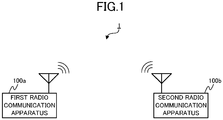
- FIG. 1 is a diagram presenting an exemplary configuration of a radio communication system 1 according to Embodiment 1 of the present disclosure.
- the radio communication system 1 comprises two radio communication apparatuses 100 (100a and 100b).
- the radio communication apparatuses 100 wirelessly communicate with each other based on the Bluetooth (registered trademark) low energy (BLE, hereafter).
- BLE is a standard (mode) designed with intent to pursue low power consumption in a short range radio communication standard called the Bluetooth (registered trademark).
- a radio communication apparatus 100 operates based on either role, a master or a slave, during radio communication with another radio communication apparatus 100.
- a radio communication apparatus 100 operating as a master uses services (for example, measurement data) provided from a radio communication apparatus 100 operating as a slave.
- a radio communication apparatus 100 operating as a slave provides services (for example, measurement data) to a radio communication apparatus 100 operating as a master.
- the radio communication apparatuses 100 are, for example, devices such as cell-phones, smart-phones, tablet-type personal computers, and note-type personal computers and terminals capable of radio communication based on the BLE as well.
- a radio communication apparatus 100 receives various data from a radio communication apparatus 100 functioning as a slave and displays various kinds of information on a display 107 described later and produces sound such as an alarm from a speaker 106 described later based on the received data.
- a radio communication apparatus 100 notifies a radio communication apparatus 100 functioning as a master of a summary of services its own apparatus retains and transmits an advertisement for awaiting a connection request from the master.
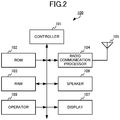
- FIG. 2 is a block diagram schematically showing an exemplary hardware configuration of the radio communication apparatuses 100 according to Embodiment 1.
- a radio communication apparatus 100 comprises a controller 101, a read only memory (ROM) 102, a random access memory (RAM) 103, a radio communication processor 104, an antenna 105, a speaker 106, a display 107, and an operator 108.
- the controller 101 comprises, for example, a central processing unit (CPU).
- the controller 101 executes software procedures according to programs stored in the ROM 102 (for example, programs for realizing the role switching procedures (a) and (b) shown in FIGS. 6 and 7 described later) to control various functions provided to the radio communication apparatus 100.
- programs stored in the ROM 102 for example, programs for realizing the role switching procedures (a) and (b) shown in FIGS. 6 and 7 described later
- the ROM 102 comprises a nonvolatile memory such as a flash memory and stores programs and data for the controller 101 to control various functions as described above.
- the RAM 103 comprises a volatile memory and is used as the work area for the controller 101 to temporarily store data for executing various procedures.
- the radio communication processor 104 comprises, for example, a radio frequency (RF) circuit, base band (BB) circuit, memory circuit, and the like.
- the radio communication processor 104 transmits and receives radio signals based on the BLE via the antenna 105.
- the memory circuit of the radio communication processor 104 is used as a region to store and update a white list (details are described later).
- the speaker 106 outputs sound such as an alarm based on sound data from the controller 101.
- the display 107 comprises, for example, a liquid crystal display (LCD), electroluminescence (EL) display, a driver, and the like.
- the display 107 displays images according to image signals output from the controller 101.
- the operator 108 is an interface used for receiving user operation contents and comprises, for example, an input apparatus such as a touch panel, buttons, and a keyboard.
- the operator 108 outputs received operation contents to the controller 101.
- FIG. 3 is a schematic block diagram showing an exemplary functional configuration of the controller 101 of the radio communication apparatuses 100.
- the controller 101 functions as a role change receiver 111, a role change confirmer 112, a disconnector 113, an advertisement transmitter 114, a scanner 115, a connection establisher 116, and a data communicator 117.
- the role change receiver 111, role change confirmer 112, disconnector 113, advertisement transmitter 114, scanner 115, connection establisher 116, and data communicator 117 may be a single CPU or may each be a CPU performing individual operation.
- the role change receiver 111 receives a change request for changing the current role to the other role between two roles, a master and a slave, while connection to another radio communication apparatus 100 is established.
- the role change receiver 111 receives a change request based on convenience of its own communication apparatus 100. Specifically, the role change receiver 111 determines that a role change request from a master to a slave is received when, for example, its own radio communication apparatus 100 currently operates as a master and is very low in the remaining battery level. As a result of such a role change, the radio communication apparatus 100 can operate as a slave that consumes less power than a master.
- the role change receiver 111 may receive a change request from another radio communication apparatus 100.
- the role change receiver 111 determines that a change request is received when, for example, a change request for changing the current role to the other role is received from another radio communication apparatus 100 to which connection is established.
- the role change confirmer 112 inquires of another radio communication apparatus 100 to which connection is established about the possibility of role change from the current role to the other role. Then, if the other radio communication apparatus 100 can change the role, the role change confirmer 112 transmits a request for switching the role (a role switching request).
- the role change confirmer 112 responds to the other radio communication apparatus 100 as to whether its own radio communication apparatus 100 can change the role. Then, when a role switching request is received from the other radio communication apparatus 100, the role change confirmer 112 transmits a response to the role switching request to the other radio communication apparatus 100.
- the role change confirmer 112 includes information regarding an advertising channel after disconnection (details will be described later) as a parameter in the response to the role switching request along with the possibility of role change.
- the radio communication apparatus 100 having received an inquiry about the possibility of role change has only to check the bit presenting the possibility of role change defined in the RFU and include information of the bit in the response to the inquiry.
- the role change confirmer 112 registers a radio communication apparatus 100 to which connection is currently established as the communication partner on the white list set in the link layer.
- reading the white list is not defined by the current host control interface (HCI) commands and therefore, has to be newly defined.
- HCI current host control interface
- information of addition of a device to the current white list may also be retained on the host side.
- the current while list is backed up on the host side and both radio communication apparatuses 100 switching their roles use the white list on which only the radio communication apparatus 100 of the role switching partner is set to advertise or scan, whereby it is possible to reconnect certainly to the role switching partner.
- information of the white list changed for the reconnection can be restored based on the information backed up on the host side.
- the disconnector 113 terminates the connection when the role change confirmer 112 determines to switch the role with another radio communication apparatus 100 to which connection is established.
- the advertisement transmitter 114 transmits an advertisement on one advertising channel set by the role change confirmer 112 when the role change confirmer 112 determines to switch the role from a master to a slave.
- one radio communication apparatus 100 transmits an advertisement and another radio communication apparatus 100 (scanner) scans to receive the advertisement before connection is established.
- An advertisement or advertising means a packet or transmitting/receiving a packet including identification information for notifying another radio communication apparatus of its own presence in search for another radio communication apparatus or in an attempt to make connection to another radio communication apparatus.
- a frequency band of 2400 MHz to 2483.5 MHz is divided into 40 channels of 2 MHz each in width.
- 40 channels three advertising channels having an intermediate frequency (RF center frequency) of 2402, 2426, or 2480 MHz (of which the advertising channel indices are 37, 38, and 39) are used for advertising.
- the other 37 data communication channels (of which the data channel indices are 0 to 36) are used for data communication after connection between a master and slave is established.
- the advertisement transmitter 114 when attempting to make reconnection to a radio communication apparatus 100 with which the role change from a slave to a master is determined, the advertisement transmitter 114 advertises using a given one advertising channel set in the response to the role switching request from the role change confirmer 112.
- which channel is used as an advertising channel among the channels 37, 38, and 39 is, for example, preset by the user.
- the advertisement transmitter 114 transmits an advertisement at intervals I1 (for example, 10 milliseconds) shorter than normal advertising intervals 10 (for example, 1 second) during a given time period T1 since the start of transmitting an advertisement as shown in FIG. 4A . Then, after the given time period T1 has elapsed, the advertisement transmitter 114 transmits an advertisement at the normal advertising intervals I0.
- the normal advertising intervals are intervals at which the radio communication apparatus 100 transmits an advertisement when no role switching is conducted.
- the scanner 115 scans for an advertisement on three advertising channels when the role change confirmer 122 determines to change the role from a slave to a master.
- Parameters defining the scanning of the scanner 115 include a scan window and a scan interval.
- the scan window is a time during which scanning is actually performed.
- the scan interval indicates the intervals between adjoining scan windows. When the scan window and scan interval are equal, successive scanning is performed.
- the BLE specification recommends scanning only one channel in each scan window and changing a scanning channel every scan window, and states that all three channels should definitely be scanned.
- the scanner 115 repeatedly scans the three advertising channels 37 to 39 in the order of 37, 38, 39, 37, 38, 39, ... at an equal frequency as shown in FIG. 4A .
- FIG. 4A is a chart showing chronological transitions of the scanning and advertising according to Embodiment 1.
- FIG. 4B is a chart showing chronological transitions of the scanning and advertising in the prior art.
- an advertisement is transmitted on the channel 38.
- FIG. 4B in the prior art advertising, an advertisement is transmitted at the normal advertising intervals 10 and the advertisement transmitted first since the start of scanning the channel 38 is scanned at a time tb.
- FIG. 4B in the prior art advertising, an advertisement is transmitted at the normal advertising intervals 10 and the advertisement transmitted first since the start of scanning the channel 38 is scanned at a time tb.
- an advertisement is transmitted first at the advertising intervals I1 shorter than the 10 and the advertisement transmitted first since the start of scanning the channel 38 is scanned at a time ta earlier than the time tb.
- an advertisement is transmitted more frequently for a given time period T1 since the start of advertising, whereby it is possible to quickly scan an advertisement while suppressing power consumption as much as possible.
- the scanner 115 functions as a receiver receiving an advertisement transmitted from another radio communication apparatus 100.
- the connection establisher 116 establishes connection in response to the connection request if the other radio communication apparatus 100 is registered on the white list.
- the connection establisher 116 transmits a connection request to the other radio communication apparatus 100 and establishes connection.
- connection establisher 116 After the connection establisher 116 establishes connection to the other radio communication apparatus 100, the data communicator 117 performs data communication with the other radio communication apparatus 100 on the 37 data communication channels based on the role determined by the role change confirmer 112.
- FIG. 5 An exemplary operation of the radio communication system 1 according to Embodiment 1 will be described hereafter with reference to the sequence chart in FIG. 5 .
- operations of the host and link layer of the radio communication apparatuses 100a and 100b are described using a case in which the first radio communication apparatus 100a operating as a slave and the second radio communication apparatus 100b operating as a master switch their roles while their connection is established.
- the second radio communication apparatus 100b transmits to the first radio communication apparatus 100a an inquiry about functions supported by the link layer of the first radio communication apparatus 100a (LL_FEATURE_REQ) in order to check whether the role switching with the first radio communication apparatus 100a is possible (Step S10).
- the first radio communication apparatus 100a having received the LL_FEATURE_REQ determines whether the role switching is supported with reference to FeatureSet presenting the link layer-supported functions. If the role switching is supported, the first radio communication apparatus 100a transmits a response indicating that the role switching is supported (LL_FEATURE_RSP) to the second radio communication apparatus 100b (Step S11).
- the host of the second radio communication apparatus 100b outputs a role switching order to the link layer (Step S12). Then, the link layer of the second radio communication apparatus 100b transmits a role switching request (ROLE_SWITCH_REQ) to the first radio communication apparatus 100a (Step S 13) and notifies the host of the completion (Step S 14).
- a role switching request ROLE_SWITCH_REQ
- the link layer of the first radio communication apparatus 100a notifies the host of reception of a role switching request (Step S 15). Then, the host orders the link layer to respond to the second radio communication apparatus 100b that the role switching is possible when the first radio communication apparatus 100a has a sufficient remaining battery level and the role change to a master is possible (Step S16). Then, the link layer transmits a response indicating that the role switching is possible (ROLE_SWITCH_RSP) to the second radio communication apparatus 100b along with information presenting an advertising channel used for advertising upon reconnection (Step S 17) and notifies the host of the completion (Step S18).
- ROLE_SWITCH_RSP a response indicating that the role switching is possible
- the host of the second radio communication apparatus 100b orders the link layer to read the white list (Step S 19). Then, the link layer reads data presenting the radio communication apparatuses 100 registered on the white list and notifies the host of the completion (Step S20).
- the host of the second radio communication apparatus 100b orders the link layer to clear the read data on the white list (Step S21). Then, the link layer clears the data and notifies the host of the completion (Step S22).
- the host of the second radio communication apparatus 100b orders the link layer to add data presenting the first radio communication apparatus 100a to the white list (Step S23). Then, the link layer adds data presenting the first radio communication apparatus 100a to the white list and notifies the host of the completion (Step S24).
- the first radio communication apparatus 100a performs the same processing as in the Steps S19 to S24 in Steps S25 to S30.
- the host of the second radio communication apparatus 100b orders the link layer to disconnect from the first radio communication apparatus 100a (Step S31). Then, the link layer transmits a disconnection request (TERMINATE_IND) to the first radio communication apparatus 100a (Step S32) and notifies the host of the completion (Step S33).
- TERMINATE_IND a disconnection request
- the link layer of the first radio communication apparatus 100a notifies the host of the completion of disconnection from the second radio communication apparatus 100b (Step S34).
- the host of the second radio communication apparatus 100b orders the link layer to set advertising data (Step S35). After completing the setting of advertising data, the link layer notifies the host of the completion (Step S36).
- the host of the second radio communication apparatus 100b orders the link layer to set advertising parameters (Step S37). After completing the setting of advertising parameters, the link layer notifies the host of the completion (Step S38).
- the host of the second radio communication apparatus 100b orders the link layer to start advertising (Step S39).
- the link layer notifies the host of the completion (Step S40) and transmits an advertisement at advertising intervals shorter than the normal advertising intervals (Step S41).
- the host of the first radio communication apparatus 100a orders the link layer to set scanning parameters (Step S42). After completing the setting of scanning parameters, the link layer notifies the host of the completion (Step S43).
- the host of the first radio communication apparatus 100a orders the link layer to start scanning (Step S44).
- the link layer notifies the host of the completion (Step S45) and scans three advertising channels in sequence at given time intervals.
- the link layer of the first radio communication apparatus 100a notifies the host of the reception of an advertisement (Step S46).
- the host orders the link layer to make connection to the second radio communication apparatus 100b (Step S47) and the link layer returns a command status to the host (Step S48).
- the link layer of the first radio communication apparatus 100a transmits a connection request (CONNECT_REQ) to the second radio communication apparatus 100b (Step S49) and completes establishment of connection to the second radio communication apparatus 100b (Step S50). From then on, the first radio communication apparatus 100a performs data communication as a master with the second radio communication apparatus 100b.
- the link layer of the second radio communication apparatus 100b completes establishment of connection to the first radio communication apparatus 100a (Step S51). From then on, the second radio communication apparatus 100b performs data communication as a slave with the first radio communication apparatus 100a.
- FIG. 6 is a flowchart showing an example of the role switching procedure (a) executed by the controller 101 of a radio communication apparatus 100 according to Embodiment 1.
- this role switching procedure (a) a case is described in which a second radio communication apparatus 100b operating as a master changes its role to a slave while connection to a first radio communication apparatus 100a operating as a slave is established.
- the role switching procedure (a) is executed by the controller 101 of the second radio communication apparatus 100b.
- the role switching procedure (a) shown in FIG. 6 starts when, for example, it is determined that the role change receiver 111 receives a role change request as the remaining battery level of its own apparatus becomes equal to or lower than a given value.
- the role change confirmer 112 transmits to the first radio communication apparatus 100a an inquiry about functions supported by the link layer of the first radio communication apparatus 100a (LL_FEATURE_REQ) (Step S101). Then, the role change confirmer 112 determines whether a response to the inquiry (LL_FEATURE_RSP) is received from the first radio communication apparatus 100a (Step S102). The role change confirmer 112 awaits until a response is received (Step S102; No).
- the role change confirmer 112 determines whether the first radio communication apparatus 100a supports the role switching based on the received response (Step S103).
- the role change confirmer 112 transmits a role switching request (ROLE_SWITCH_REQ) to the first radio communication apparatus 100a (Step S104). Then, the role change confirmer 112 determines whether a response to the role switching request (ROLE_SWITCH_RES) is received from the first radio communication apparatus 100a (Step S105). The role change confirmer 112 awaits until a response is received (Step S105; No).
- the role change confirmer 112 determines whether the first radio communication apparatus 100a can switch the role based on the received response (Step S106).
- the role change confirmer 112 executes an advertising parameter setting procedure to set advertising parameters (Step S107).
- the advertising parameters to set here the advertising intervals that are intervals between advertising operations are set to a value shorter than the normal advertising intervals.
- the response to the role switching request includes data presenting an advertising channel.
- the role change confirmer 112 registers the address of the first radio communication apparatus 100a on the white list.
- the disconnector 113 transmits a disconnection request (TERMINATE_IND) to the first radio communication apparatus 100a (Step S108). Then, the disconnector 113 disconnects from the first radio communication apparatus 100a.
- the advertisement transmitter 114 starts advertising using the parameters set in the Step S107 and the advertising channel notified in the response to the role switching request (ROLE_SWICTH_RSP).
- the connection establisher 116 determines whether a connection request (CONNECT_REQ) is received from the first radio communication apparatus 100a registered on the white list (Step S110).
- connection establisher 116 determines that a connection request is received from the first radio communication apparatus 100a (Step S110; Yes), the advertisement transmitter 114 stops advertising (Step S111).
- connection establisher 116 executes a procedure to establish connection to the first radio communication apparatus 100a using connection parameters included in the received connection request (Step S 112). Then, the connection establisher 116 ends the role switching procedure (a). After this procedure ends, the second radio communication apparatus 100b operates as a slave and performs data communication with the first radio communication apparatus 100a operating as a master.
- the advertisement transmitter 114 determines whether a given time period T1 has elapsed since the start of advertising (Step S113). If the given time period T1 has not elapsed (Step S113; No), the advertisement transmitter 114 returns the processing to the Step S110.
- the advertisement transmitter 114 changes the advertising intervals to the normal value and continues to advertise (Step S114).
- connection establisher 116 determines whether a connection request (CONNECT_REQ) is received from the first radio communication apparatus 100a registered on the white list (Step S115).
- Step S115 If a connection request is received from the first radio communication apparatus 100a (Step S115; Yes), the connection establisher 116 advances the processing to Step S111. On the other hand, if no connection request is received from the first radio communication apparatus 100a (Step S115; No), the advertisement transmitter 114 determines whether a given time period T2 (T2>T1) has elapsed since the start of advertising (Step S116). If the given time period T2 has not elapsed (Step S116; No), the advertisement transmitter 114 returns the processing to the Step S115.
- T2 T2>T1
- connection establisher 116 determines that reconnection to the first radio communication apparatus 100a is unsuccessful and ends the role switching procedure (a).
- the disconnector 113 disconnects from the first radio communication apparatus 100a (Step S117) and ends the role switching procedure (a).
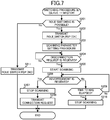
- the role switching procedure (b) executed by the controller 101 of a radio communication apparatus 100 according to Embodiment 1 and shown in FIG. 7 by way of example will be described hereafter.
- this role switching procedure (b) a case is described in which a first radio communication apparatus 100a operating as a slave changes its role to a master while connection to a second radio communication apparatus 100b operating as a master is established.
- the role switching procedure (b) is executed by the controller 101 of the first radio communication apparatus 100a.
- the role switching procedure (b) shown in FIG. 7 starts when, for example, the role change receiver 111 receives a role switching request (ROLE_SWITVH_REQ) from the second radio communication apparatus 100b.
- a role switching request ROLE_SWITVH_REQ
- the role change confirmer 112 determines whether its own apparatus can switch the role (Step S201).
- the role change confirmer 112 determines that its own apparatus can switch the role when, for example, the remaining battery level of its own apparatus is equal to or higher than a given value.
- the role change confirmer 112 transmits a response indicating that the role switching is possible (ROLE_SWITCH_RSP (OK)) to the second radio communication apparatus 100b (Step S202). Moreover, the role change confirmer 112 includes data presenting an advertising channel in the response.
- the role change confirmer 112 executes a scanning parameter setting procedure to set scanning parameters (Step S203). Moreover, the role change confirmer 112 registers the address of the second radio communication apparatus 100b on the white list.
- the disconnector 113 determines whether a disconnection request (TERMINATE_IND) is received from the second radio communication apparatus 100b (Step S204). The disconnector 113 awaits until a disconnection request is received (Step S204; No).
- Step S204 If a disconnection request is received from the second radio communication apparatus 100b (Step S204; Yes), the disconnector 113 disconnects from the second radio communication apparatus 100b. Then, the scanner 115 starts scanning using the parameters set in the Step S203 (Step S205).
- connection establisher 116 determines whether an advertisement is received from the second radio communication apparatus 100b registered on the white list (Step S206).
- connection establisher 116 determines that an advertisement is received from the second radio communication apparatus 100b (Step S206; Yes)
- the scanner 115 stops scanning (Step S207).
- connection establisher 116 transmits a connection request (CONNECT_REQ) to the second radio communication apparatus 100b and establishes connection to the second radio communication apparatus 100b (Step S208). Then, the role switching procedure (b) ends. After this procedure ends, the first radio communication apparatus 100a operates as a master and performs data communication with the second radio communication apparatus 100b operating as a slave.
- Step S206 determines whether a given time period T2 has elapsed since the start of scanning. If the given time period T2 has not elapsed (Step S209; No), the scanner 115 returns the processing to the Step S206.
- Step S209 If the given time period T2 has elapsed (Step S209; Yes), the scanner 115 stops scanning (Step S210). Then, the connection establisher 116 determines that reconnection to the second radio communication apparatus 100b is unsuccessful and ends the role switching procedure (b).
- the role change confirmer 112 transmits a response indicating that the role switching is impossible (ROLE_SWITCH_RSP (NO)) to the second radio communication apparatus 100b (Step S211). Then, the role change confirmer 112 ends the role switching procedure (b).
- the radio communication apparatus 100 presets an advertising channel while connection is established and a radio communication apparatus 100 transmitting an advertisement for reconnection transmits the advertisement on that advertising channel. In doing so, the advertisement is transmitted at shorter intervals than normally, whereby the reconnection can be quick.
- the connected radio communication apparatuses 100 synchronously disconnect from each other and then perform the advertising or scanning, whereby the reconnection can be smooth.
- a radio communication apparatus 100 operating as a slave after role switching receives only a connection request from the radio communication apparatus 100 registered on the white list.
- a radio communication apparatus 100 operating as a master after role switching receives only an advertisement from the radio communication apparatus 100 registered on the white list. Therefore, it is possible to prevent connection to a radio communication apparatus other than the role switching partner after the disconnection.
- a radio communication apparatus 100 operating as a slave after role switching transmits an advertisement at shorter intervals after the disconnection, whereby smooth reconnection is realized.
- the method of making smooth reconnection is not restricted thereto.
- Embodiment 2 as a scanning method by a radio communication apparatus 100 operating as a master after role switching, a case is described in which the first scan since the start of scanning is performed on an advertising channel preset together with the other radio communication apparatuses 100 for a longer time than the normal scan window and then the scan is performed on the three advertising channels in sequence using the normal scan window.
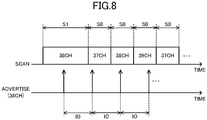
- FIG. 8 shows chronological transitions of the scanning and advertising according to Embodiment 2.
- an advertisement is transmitted on the channel 38 at the normal advertising intervals I0.
- the scanner 115 of the radio communication apparatus 100 scans on the channel 38 that is an advertising channel preset together with another radio communication apparatus 100 of the role switching partner.
- a scan window S1 at this point (for example, 10.24 seconds) is longer than a normal scan window S0 (for example, one second).
- the normal scan window is a scan window for when no role switching is performed.
- the scanner 115 scans the three advertising channels in sequence using the normal scan window S0.
- the first scan after the disconnection is a scan on a preset advertising channel for a longer time than the normal scan window, whereby quick scan for an advertisement is made possible.
- Embodiment 3 another scanning method by a radio communication apparatus 100 operating as a master after role switching will be described hereafter.
- FIG. 9 shows chronological transitions of the scanning and advertising according to Embodiment 3.
- an advertisement is transmitted on the channel 38 at the normal advertising intervals I0.
- the scanner 115 of the radio communication apparatus 100 scans the three advertising channels in sequence using a scan window S2 (for example, 25 milliseconds) shorter than the normal scan window S0.
- a scan window S2 for example, 25 milliseconds
- Embodiment 4 another scanning method by a radio communication apparatus 100 operating as a master after role switching will be described hereafter.
- FIG. 10 shows chronological transitions of the scanning and advertising according to Embodiment 4.
- the scanner 115 of the radio communication apparatus 100 scans the three advertising channels in the manner that the advertising channel 38 preset together with another radio communication apparatus 100 of the role switching partner is scanned at a higher frequency instead of scanning the three advertising channels at an equal frequency.
- the channel 38 is scanned in every other scan window.
- the scanning order is set so that the advertising channel preset together with another radio communication apparatus 100 of the role switching partner is scanned at a higher frequency, whereby it is possible to quickly scan for an advertisement transmitted from a radio communication apparatus 100 of the role switching partner.
- a radio communication apparatus makes connection using connection parameters included in a connection request (CONNECT_REQ) packet.
- CONNECT_REQ connection request
- the radio communication apparatus 100 may take over the connection parameters used in the connection before the role switching.
- connection parameters included in a connection request packet include AA, CRCInit, WinSize, WinOffset, Interval, Latency, Timeout, ChM, Hop, and SCA.
- AA is the access address of a data packet after connection.
- the value of AA can be taken over provided that the value is not a duplicate of AA of any other connection. Moreover, the value can be taken over when a setting of inhibiting any other connection from disconnection to reconnection is enabled.
- CRCInit is a value specifying the initial value of a shift register verifying the checksum of a packet. The value of CRCInit cannot be taken over upon reconnection because it is randomly created by the link layer.
- WinSize presents a period during which the first data packet can be transmitted.
- the value of Win Size can be taken over.
- WinOffset presents an offset time from transmission of a connection request to start of the next window size.
- the value of WinOffset can be taken over when the radio communication apparatus 100 is not busy with other operations after transmitting/receiving a connection request.
- Interval presents the intervals of hopping channels.
- the value of Interval can be taken over.
- Latency presents the number of times of a connection event being ignored by a radio communication apparatus 100 operating as a slave when there are no data to transmit to a radio communication apparatus 100 operating as a master. The value of Latency can be taken over.
- Timeout is a time in which connection is determined to be lost. The value of Timeout can be taken over.
- ChM is a value specifying which data channel is to use for a connection event.
- the value of ChM can be taken over.
- Hop is a value specifying the order of switching data channels. The value of Hop can be taken over.
- SCA is a value presenting the accuracy of the sleep clock of a radio communication apparatus 100 operating as a master.
- the value of SCA can be taken over when a radio communication apparatus 100 operating as a master and a radio communication apparatus 100 operating as a slave have the same clock accuracy.
- connection parameters used in the connection before role switching those that can be taken over are retained after disconnection, and the connection establisher 116 of a radio communication apparatus 100 operating as a master after the role switching transmits a connection request including connection parameters that cannot be taken over and excluding connection parameters that can be taken over in an attempt to reconnect to a radio communication apparatus 100 of the role switching partner.
- connection request including connection parameters that cannot be taken over and excluding connection parameters that can be taken over in an attempt to reconnect to a radio communication apparatus 100 of the role switching partner.
- information presenting an advertising channel in an attempt to make reconnection after disconnection is included in a response to a role switching request by way of example.
- the method of giving notice of an advertising channel upon reconnection is not restricted thereto. It is sufficient that an advertising channel upon reconnection is set by any method between the radio communication apparatuses 100 operating as a slave and a master before they are disconnected. For example, when a radio communication apparatus 100 operating as a master transmits a role switching request, information presenting an advertising channel upon reconnection may be included in the packet.
- a radio communication apparatus 100 operating as a master transmits a role switching request by way of example.
- a radio communication apparatus 100 operating as a slave may transmit a role switching request.
- the role switching partner is registered on the white list by way of example for assuring reconnection to the role switching partner.
- the advertisement transmitter 114 of a radio communication apparatus 100 operating as a slave after role switching may use, in advertising, a direct advertisement (ADV_DIRECT_IND) specifying a radio communication apparatus 100 of the role switching partner as the destination of an advertisement.
- ADV_DIRECT_IND a direct advertisement specifying a radio communication apparatus 100 of the role switching partner as the destination of an advertisement.
- the address of the partner has been obtained from information in the advertisement upon connection before role switching; therefore, directly advertising to that address can prevent connection to a radio communication apparatus other than the role switching partner.
- the method of transmitting an advertisement described in Embodiment 1 and the methods of scanning described in Embodiments 2 to 4 may be combined.
- the advertisement transmitter 114 of a radio communication apparatus 100 operating as a slave after role switching transmits an advertisement on the channel 38 at advertising intervals T1 until a given time period T1 elapses since the start of advertising and concurrently, the scanner 115 of a radio communication apparatus 100 operating as a master after role switching scans the channel 38 in a scan window S1 in the first scan.
- the radio communication system performing radio communication based on the BLE as an exemplary radio communication standard is described by way of example.
- the radio communication standard to which the present disclosure is applicable is not restricted to the BLE and the present disclosure is applicable to other standards of communication between devices operating as a master and a slave.
- the radio communication apparatus 100 can be realized by a conventional computer system, not by a dedicated apparatus.
- a computer may execute programs to realize the functions of the radio communication apparatus 100.
- the programs for realizing the functions of the radio communication apparatus 100 may be stored on a non-transitory computer-readable recording medium such as a universal serial bus (USB) memory, secure digital (SD) memory card, compact disc read only memory (CD-ROM), digital versatile disc (DVD), Blu-ray (registered trademark) disc (BD), and hard disk drive (HDD), or downloaded on a computer via a network.
- USB universal serial bus
- SD secure digital
- CD-ROM compact disc read only memory
- DVD digital versatile disc
- HDD hard disk drive
Landscapes
- Engineering & Computer Science (AREA)
- Computer Networks & Wireless Communication (AREA)
- Signal Processing (AREA)
- Business, Economics & Management (AREA)
- Strategic Management (AREA)
- Finance (AREA)
- Development Economics (AREA)
- Accounting & Taxation (AREA)
- Physics & Mathematics (AREA)
- General Physics & Mathematics (AREA)
- Theoretical Computer Science (AREA)
- Economics (AREA)
- Marketing (AREA)
- Entrepreneurship & Innovation (AREA)
- General Business, Economics & Management (AREA)
- Game Theory and Decision Science (AREA)
- Databases & Information Systems (AREA)
- Computer Hardware Design (AREA)
- Computer Security & Cryptography (AREA)
- Computing Systems (AREA)
- General Engineering & Computer Science (AREA)
- Mobile Radio Communication Systems (AREA)
Applications Claiming Priority (2)
| Application Number | Priority Date | Filing Date | Title |
|---|---|---|---|
| JP2014134138A JP6375726B2 (ja) | 2014-06-30 | 2014-06-30 | 無線通信装置及びプログラム |
| PCT/JP2015/066304 WO2016002430A1 (ja) | 2014-06-30 | 2015-06-05 | 無線通信装置及び無線通信方法 |
Publications (3)
| Publication Number | Publication Date |
|---|---|
| EP3169135A1 true EP3169135A1 (de) | 2017-05-17 |
| EP3169135A4 EP3169135A4 (de) | 2018-07-04 |
| EP3169135B1 EP3169135B1 (de) | 2020-07-22 |
Family
ID=55018980
Family Applications (1)
| Application Number | Title | Priority Date | Filing Date |
|---|---|---|---|
| EP15815556.4A Active EP3169135B1 (de) | 2014-06-30 | 2015-06-05 | Funkkommunikationsvorrichtung und funkkommunikationsverfahren |
Country Status (5)
| Country | Link |
|---|---|
| US (2) | US10475080B2 (de) |
| EP (1) | EP3169135B1 (de) |
| JP (2) | JP6375726B2 (de) |
| CN (1) | CN106471859B (de) |
| WO (1) | WO2016002430A1 (de) |
Families Citing this family (23)
| Publication number | Priority date | Publication date | Assignee | Title |
|---|---|---|---|---|
| US9924342B2 (en) | 2015-06-16 | 2018-03-20 | Google Llc | Establishing a connection over a low power communication type |
| JP6714400B2 (ja) * | 2016-03-16 | 2020-06-24 | シチズン時計株式会社 | 電子時計と電子機器間の通信制御システム、電子時計、電子機器、電子機器プログラム及び通信制御方法 |
| JP6475207B2 (ja) * | 2016-09-13 | 2019-02-27 | Necプラットフォームズ株式会社 | 無線通信装置、方法およびプログラム |
| JP2018056837A (ja) * | 2016-09-29 | 2018-04-05 | キヤノン株式会社 | 通信装置、その制御方法、プログラム |
| KR101826761B1 (ko) * | 2016-11-23 | 2018-02-07 | 서울대학교산학협력단 | 다중 홉 구조의 무선 통신 시스템에서 기기 수명 연장 방법 |
| JP6822180B2 (ja) * | 2017-02-02 | 2021-01-27 | セイコーエプソン株式会社 | 印刷装置、印刷装置の制御方法、及び、通信システム |
| US10904776B2 (en) * | 2017-05-11 | 2021-01-26 | Verizon Patent And Licensing Inc. | Smart IoT self-healing network |
| US20190007903A1 (en) * | 2017-06-28 | 2019-01-03 | Qualcomm Incorporated | Coordinated neighbor aware network (nan) role assignment |
| JP7006102B2 (ja) | 2017-10-02 | 2022-01-24 | カシオ計算機株式会社 | 無線通信装置、電子時計、無線通信方法、及びプログラム |
| JP7008514B2 (ja) * | 2018-01-22 | 2022-01-25 | キヤノン株式会社 | 通信装置、制御方法、及びプログラム |
| EP3879919B1 (de) * | 2018-11-09 | 2025-12-24 | Sony Interactive Entertainment Inc. | Kommunikationsvorrichtung, elektronische vorrichtung und drahtloses verbindungsverfahren |
| US11108431B2 (en) * | 2019-01-30 | 2021-08-31 | Mediatek Inc. | Wireless communication apparatus for performing beamforming under frequency hopping and associated wireless communication method |
| US10972966B2 (en) * | 2019-03-27 | 2021-04-06 | Kabushiki Kaisha Toshiba | Managed flooding for bluetooth mesh networks |
| CN113661777B (zh) * | 2019-06-20 | 2025-01-28 | 谷歌有限责任公司 | 真正无线耳塞式耳机的无缝角色切换 |
| CN112312367B (zh) * | 2019-08-01 | 2024-11-15 | 联发科技(新加坡)私人有限公司 | 蓝牙通信方法及通信设备 |
| US11405766B2 (en) | 2020-02-06 | 2022-08-02 | International Business Machines Corporation | Connecting computer processing systems and transmitting data |
| US11357020B2 (en) * | 2020-02-06 | 2022-06-07 | International Business Machines Corporation | Connecting computer processing systems and transmitting data |
| US11290575B2 (en) | 2020-02-06 | 2022-03-29 | International Business Machines Corporation | Connecting computer processing systems and transmitting data |
| JP7099568B1 (ja) | 2021-02-24 | 2022-07-12 | 株式会社デンソー | 電池管理システム |
| JP7609043B2 (ja) | 2021-02-24 | 2025-01-07 | 株式会社デンソー | 電池管理システム |
| CN115412952B (zh) * | 2021-05-27 | 2024-06-14 | 成都极米科技股份有限公司 | 一种无线感知控制方法、设备和计算机存储介质 |
| CN119769170A (zh) * | 2022-08-31 | 2025-04-04 | 索尼集团公司 | 通信系统、固定终端和移动终端 |
| JP7805991B2 (ja) * | 2023-05-31 | 2026-01-26 | 株式会社東芝 | 無線通信装置、無線通信システム及び無線通信方法 |
Family Cites Families (21)
| Publication number | Priority date | Publication date | Assignee | Title |
|---|---|---|---|---|
| JPH03124141A (ja) * | 1989-10-09 | 1991-05-27 | Nissan Motor Co Ltd | 車両用通信装置 |
| JP2001103570A (ja) * | 1999-09-30 | 2001-04-13 | Toshiba Corp | 通信システム、この通信システムに用いられる通信装置及び通信方法 |
| JP2002344455A (ja) * | 2001-05-14 | 2002-11-29 | Matsushita Electric Ind Co Ltd | 通信装置、通信方法および記録媒体 |
| JP3964671B2 (ja) * | 2001-12-28 | 2007-08-22 | 株式会社東芝 | 移動無線端末装置 |
| EP1324540B1 (de) * | 2001-12-28 | 2011-08-17 | Fujitsu Toshiba Mobile Communications Limited | Funkkommunikationsgerät |
| US7356360B2 (en) * | 2002-02-05 | 2008-04-08 | Honda Giken Kogyo Kabushiki Kaisha | Radio communication system |
| EP1549094A1 (de) * | 2003-12-02 | 2005-06-29 | Siemens Aktiengesellschaft | Dynamische Anpassung von Funkrufkanalfrequenz in einem Bluetooth Netzwerk |
| JP4266165B2 (ja) * | 2003-12-19 | 2009-05-20 | 株式会社東芝 | 通信装置および通信制御プログラム |
| KR100693603B1 (ko) | 2004-06-29 | 2007-03-14 | 주식회사 팬택 | 모바일 ip 서비스를 위한 인증 방법 |
| JP2006025130A (ja) * | 2004-07-07 | 2006-01-26 | Canon Inc | 通信デバイス及びその制御方法 |
| US8811335B2 (en) | 2007-04-20 | 2014-08-19 | Qualcomm Incorporated | Method and apparatus for dynamic adjustment of uplink transmission time |
| KR100903112B1 (ko) * | 2007-04-30 | 2009-06-16 | 한국전자통신연구원 | 애드 혹(ad-hoc) 네트워크에서 비컨 스케줄링 노드장치 및 스케줄링 방법, 및 데이터 전송 방법 |
| JP5564774B2 (ja) | 2008-09-24 | 2014-08-06 | ソニー株式会社 | 情報処理装置および方法、並びに、プログラム |
| US8467806B2 (en) * | 2009-06-05 | 2013-06-18 | Qualcomm Incorporated | Method and apparatus for supporting location services with a streamlined location service layer |
| EP3435717B1 (de) * | 2010-02-12 | 2021-07-07 | Fujitsu Limited | Funkkommunikationsvorrichtung, funkkommunikationssystem und funkkommunikationsverfahren |
| EP2451227B1 (de) * | 2010-09-09 | 2013-05-08 | Panasonic Corporation | Drahtlose kommunikationsvorrichtung, drahtloses kommunikationssystem und drahtloses kommunikationsverfahren |
| US20130003630A1 (en) | 2011-06-29 | 2013-01-03 | Texas Instruments Incorporated | Connection setup for low energy wireless networks based on scan window and scan interval estimation |
| JP2013229805A (ja) | 2012-04-26 | 2013-11-07 | Panasonic Corp | 無線通信装置、通信デバイス、無線通信方法、および無線通信制御プログラム |
| WO2013161248A1 (ja) * | 2012-04-25 | 2013-10-31 | パナソニック株式会社 | 無線通信装置、通信デバイス、無線通信方法、および無線通信制御プログラム |
| US9210520B2 (en) * | 2012-12-17 | 2015-12-08 | Starkey Laboratories, Inc. | Ear to ear communication using wireless low energy transport |
| US10126719B2 (en) * | 2013-06-17 | 2018-11-13 | Kt Corporation | Methods for changing an authority of control for a controller in environment having multiple controllers |
-
2014
- 2014-06-30 JP JP2014134138A patent/JP6375726B2/ja active Active
-
2015
- 2015-06-05 WO PCT/JP2015/066304 patent/WO2016002430A1/ja not_active Ceased
- 2015-06-05 US US15/321,696 patent/US10475080B2/en active Active
- 2015-06-05 EP EP15815556.4A patent/EP3169135B1/de active Active
- 2015-06-05 CN CN201580036171.2A patent/CN106471859B/zh active Active
-
2018
- 2018-07-23 JP JP2018137560A patent/JP6741047B2/ja active Active
- 2018-08-10 US US16/101,112 patent/US10575340B2/en active Active
Also Published As
| Publication number | Publication date |
|---|---|
| JP2016012852A (ja) | 2016-01-21 |
| JP6375726B2 (ja) | 2018-08-22 |
| US20180349959A1 (en) | 2018-12-06 |
| JP2018160945A (ja) | 2018-10-11 |
| WO2016002430A1 (ja) | 2016-01-07 |
| JP6741047B2 (ja) | 2020-08-19 |
| CN106471859B (zh) | 2020-03-27 |
| US10575340B2 (en) | 2020-02-25 |
| EP3169135A4 (de) | 2018-07-04 |
| US20170161786A1 (en) | 2017-06-08 |
| CN106471859A (zh) | 2017-03-01 |
| EP3169135B1 (de) | 2020-07-22 |
| US10475080B2 (en) | 2019-11-12 |
Similar Documents
| Publication | Publication Date | Title |
|---|---|---|
| US10575340B2 (en) | Radio communication apparatus and radio communication method | |
| JP5892151B2 (ja) | 無線通信装置、無線通信システム、無線通信方法、プログラム、及びペリフェラル | |
| US9723546B2 (en) | Wireless communication device, non-transitory computer-readable recording medium, master device, and slave device | |
| EP3328099A1 (de) | Informationsverarbeitungsvorrichtung, steuerungsverfahren dafür und computerprogramm | |
| JP6132037B1 (ja) | 無線通信方法及びプログラム | |
| KR20190024743A (ko) | 통신 장치, 제어 방법, 및 매체 | |
| CN110958684A (zh) | 一种网络注册方法及用户设备 | |
| JP6375657B2 (ja) | 無線通信装置、無線通信システム、及び無線通信方法 | |
| JP6288123B2 (ja) | 無線通信装置、無線通信方法、及びプログラム | |
| US9491787B2 (en) | Wireless communication apparatus, wireless communication method, non-transitory computer-readable recording medium, master, and slave | |
| JP6343988B2 (ja) | 無線通信装置、無線通信システム、無線通信方法、プログラム、スレーブ、及びマスター | |
| US11166332B2 (en) | Communication apparatus and control method thereof | |
| JP2019126100A (ja) | 無線通信装置、無線通信方法、及びプログラム | |
| JP2017130971A (ja) | 無線通信方法及びプログラム | |
| EP3169093A1 (de) | Drahtloskommunikationsvorrichtung, drahtloskommunikationsverfahren und programm | |
| CN107465995B (zh) | 一种通信模式的切换方法及智能密码设备 | |
| EP3461220A1 (de) | Vorrichtung für drahtlose kommunikation, elektronische uhr, verfahren für drahtlose kommunikation und aufzeichnungsmedium | |
| JP6528866B2 (ja) | 無線通信装置、無線通信方法、及びプログラム |
Legal Events
| Date | Code | Title | Description |
|---|---|---|---|
| STAA | Information on the status of an ep patent application or granted ep patent |
Free format text: STATUS: THE INTERNATIONAL PUBLICATION HAS BEEN MADE |
|
| PUAI | Public reference made under article 153(3) epc to a published international application that has entered the european phase |
Free format text: ORIGINAL CODE: 0009012 |
|
| STAA | Information on the status of an ep patent application or granted ep patent |
Free format text: STATUS: REQUEST FOR EXAMINATION WAS MADE |
|
| 17P | Request for examination filed |
Effective date: 20161214 |
|
| AK | Designated contracting states |
Kind code of ref document: A1 Designated state(s): AL AT BE BG CH CY CZ DE DK EE ES FI FR GB GR HR HU IE IS IT LI LT LU LV MC MK MT NL NO PL PT RO RS SE SI SK SM TR |
|
| AX | Request for extension of the european patent |
Extension state: BA ME |
|
| DAV | Request for validation of the european patent (deleted) | ||
| DAX | Request for extension of the european patent (deleted) | ||
| RIC1 | Information provided on ipc code assigned before grant |
Ipc: H04W 84/20 20090101AFI20180219BHEP Ipc: H04J 3/06 20060101ALN20180219BHEP |
|
| A4 | Supplementary search report drawn up and despatched |
Effective date: 20180604 |
|
| RIC1 | Information provided on ipc code assigned before grant |
Ipc: H04W 84/20 20090101AFI20180528BHEP Ipc: H04J 3/06 20060101ALN20180528BHEP |
|
| STAA | Information on the status of an ep patent application or granted ep patent |
Free format text: STATUS: EXAMINATION IS IN PROGRESS |
|
| 17Q | First examination report despatched |
Effective date: 20190415 |
|
| GRAP | Despatch of communication of intention to grant a patent |
Free format text: ORIGINAL CODE: EPIDOSNIGR1 |
|
| STAA | Information on the status of an ep patent application or granted ep patent |
Free format text: STATUS: GRANT OF PATENT IS INTENDED |
|
| RIC1 | Information provided on ipc code assigned before grant |
Ipc: H04W 84/20 20090101AFI20191203BHEP Ipc: H04J 3/06 20060101ALN20191203BHEP |
|
| RIC1 | Information provided on ipc code assigned before grant |
Ipc: H04W 84/20 20090101AFI20191210BHEP Ipc: H04J 3/06 20060101ALN20191210BHEP |
|
| INTG | Intention to grant announced |
Effective date: 20200103 |
|
| GRAS | Grant fee paid |
Free format text: ORIGINAL CODE: EPIDOSNIGR3 |
|
| GRAA | (expected) grant |
Free format text: ORIGINAL CODE: 0009210 |
|
| STAA | Information on the status of an ep patent application or granted ep patent |
Free format text: STATUS: THE PATENT HAS BEEN GRANTED |
|
| AK | Designated contracting states |
Kind code of ref document: B1 Designated state(s): AL AT BE BG CH CY CZ DE DK EE ES FI FR GB GR HR HU IE IS IT LI LT LU LV MC MK MT NL NO PL PT RO RS SE SI SK SM TR |
|
| REG | Reference to a national code |
Ref country code: GB Ref legal event code: FG4D |
|
| REG | Reference to a national code |
Ref country code: CH Ref legal event code: EP |
|
| REG | Reference to a national code |
Ref country code: DE Ref legal event code: R096 Ref document number: 602015056262 Country of ref document: DE |
|
| REG | Reference to a national code |
Ref country code: AT Ref legal event code: REF Ref document number: 1294668 Country of ref document: AT Kind code of ref document: T Effective date: 20200815 |
|
| REG | Reference to a national code |
Ref country code: IE Ref legal event code: FG4D |
|
| REG | Reference to a national code |
Ref country code: LT Ref legal event code: MG4D |
|
| REG | Reference to a national code |
Ref country code: AT Ref legal event code: MK05 Ref document number: 1294668 Country of ref document: AT Kind code of ref document: T Effective date: 20200722 |
|
| PG25 | Lapsed in a contracting state [announced via postgrant information from national office to epo] |
Ref country code: LT Free format text: LAPSE BECAUSE OF FAILURE TO SUBMIT A TRANSLATION OF THE DESCRIPTION OR TO PAY THE FEE WITHIN THE PRESCRIBED TIME-LIMIT Effective date: 20200722 Ref country code: FI Free format text: LAPSE BECAUSE OF FAILURE TO SUBMIT A TRANSLATION OF THE DESCRIPTION OR TO PAY THE FEE WITHIN THE PRESCRIBED TIME-LIMIT Effective date: 20200722 Ref country code: SE Free format text: LAPSE BECAUSE OF FAILURE TO SUBMIT A TRANSLATION OF THE DESCRIPTION OR TO PAY THE FEE WITHIN THE PRESCRIBED TIME-LIMIT Effective date: 20200722 Ref country code: HR Free format text: LAPSE BECAUSE OF FAILURE TO SUBMIT A TRANSLATION OF THE DESCRIPTION OR TO PAY THE FEE WITHIN THE PRESCRIBED TIME-LIMIT Effective date: 20200722 Ref country code: ES Free format text: LAPSE BECAUSE OF FAILURE TO SUBMIT A TRANSLATION OF THE DESCRIPTION OR TO PAY THE FEE WITHIN THE PRESCRIBED TIME-LIMIT Effective date: 20200722 Ref country code: GR Free format text: LAPSE BECAUSE OF FAILURE TO SUBMIT A TRANSLATION OF THE DESCRIPTION OR TO PAY THE FEE WITHIN THE PRESCRIBED TIME-LIMIT Effective date: 20201023 Ref country code: BG Free format text: LAPSE BECAUSE OF FAILURE TO SUBMIT A TRANSLATION OF THE DESCRIPTION OR TO PAY THE FEE WITHIN THE PRESCRIBED TIME-LIMIT Effective date: 20201022 Ref country code: PT Free format text: LAPSE BECAUSE OF FAILURE TO SUBMIT A TRANSLATION OF THE DESCRIPTION OR TO PAY THE FEE WITHIN THE PRESCRIBED TIME-LIMIT Effective date: 20201123 Ref country code: NO Free format text: LAPSE BECAUSE OF FAILURE TO SUBMIT A TRANSLATION OF THE DESCRIPTION OR TO PAY THE FEE WITHIN THE PRESCRIBED TIME-LIMIT Effective date: 20201022 Ref country code: AT Free format text: LAPSE BECAUSE OF FAILURE TO SUBMIT A TRANSLATION OF THE DESCRIPTION OR TO PAY THE FEE WITHIN THE PRESCRIBED TIME-LIMIT Effective date: 20200722 |
|
| PG25 | Lapsed in a contracting state [announced via postgrant information from national office to epo] |
Ref country code: PL Free format text: LAPSE BECAUSE OF FAILURE TO SUBMIT A TRANSLATION OF THE DESCRIPTION OR TO PAY THE FEE WITHIN THE PRESCRIBED TIME-LIMIT Effective date: 20200722 Ref country code: RS Free format text: LAPSE BECAUSE OF FAILURE TO SUBMIT A TRANSLATION OF THE DESCRIPTION OR TO PAY THE FEE WITHIN THE PRESCRIBED TIME-LIMIT Effective date: 20200722 Ref country code: LV Free format text: LAPSE BECAUSE OF FAILURE TO SUBMIT A TRANSLATION OF THE DESCRIPTION OR TO PAY THE FEE WITHIN THE PRESCRIBED TIME-LIMIT Effective date: 20200722 Ref country code: IS Free format text: LAPSE BECAUSE OF FAILURE TO SUBMIT A TRANSLATION OF THE DESCRIPTION OR TO PAY THE FEE WITHIN THE PRESCRIBED TIME-LIMIT Effective date: 20201122 |
|
| PG25 | Lapsed in a contracting state [announced via postgrant information from national office to epo] |
Ref country code: NL Free format text: LAPSE BECAUSE OF FAILURE TO SUBMIT A TRANSLATION OF THE DESCRIPTION OR TO PAY THE FEE WITHIN THE PRESCRIBED TIME-LIMIT Effective date: 20200722 |
|
| REG | Reference to a national code |
Ref country code: DE Ref legal event code: R097 Ref document number: 602015056262 Country of ref document: DE |
|
| PG25 | Lapsed in a contracting state [announced via postgrant information from national office to epo] |
Ref country code: CZ Free format text: LAPSE BECAUSE OF FAILURE TO SUBMIT A TRANSLATION OF THE DESCRIPTION OR TO PAY THE FEE WITHIN THE PRESCRIBED TIME-LIMIT Effective date: 20200722 Ref country code: DK Free format text: LAPSE BECAUSE OF FAILURE TO SUBMIT A TRANSLATION OF THE DESCRIPTION OR TO PAY THE FEE WITHIN THE PRESCRIBED TIME-LIMIT Effective date: 20200722 Ref country code: IT Free format text: LAPSE BECAUSE OF FAILURE TO SUBMIT A TRANSLATION OF THE DESCRIPTION OR TO PAY THE FEE WITHIN THE PRESCRIBED TIME-LIMIT Effective date: 20200722 Ref country code: SM Free format text: LAPSE BECAUSE OF FAILURE TO SUBMIT A TRANSLATION OF THE DESCRIPTION OR TO PAY THE FEE WITHIN THE PRESCRIBED TIME-LIMIT Effective date: 20200722 Ref country code: RO Free format text: LAPSE BECAUSE OF FAILURE TO SUBMIT A TRANSLATION OF THE DESCRIPTION OR TO PAY THE FEE WITHIN THE PRESCRIBED TIME-LIMIT Effective date: 20200722 Ref country code: EE Free format text: LAPSE BECAUSE OF FAILURE TO SUBMIT A TRANSLATION OF THE DESCRIPTION OR TO PAY THE FEE WITHIN THE PRESCRIBED TIME-LIMIT Effective date: 20200722 |
|
| PLBE | No opposition filed within time limit |
Free format text: ORIGINAL CODE: 0009261 |
|
| STAA | Information on the status of an ep patent application or granted ep patent |
Free format text: STATUS: NO OPPOSITION FILED WITHIN TIME LIMIT |
|
| PG25 | Lapsed in a contracting state [announced via postgrant information from national office to epo] |
Ref country code: AL Free format text: LAPSE BECAUSE OF FAILURE TO SUBMIT A TRANSLATION OF THE DESCRIPTION OR TO PAY THE FEE WITHIN THE PRESCRIBED TIME-LIMIT Effective date: 20200722 |
|
| 26N | No opposition filed |
Effective date: 20210423 |
|
| PG25 | Lapsed in a contracting state [announced via postgrant information from national office to epo] |
Ref country code: SK Free format text: LAPSE BECAUSE OF FAILURE TO SUBMIT A TRANSLATION OF THE DESCRIPTION OR TO PAY THE FEE WITHIN THE PRESCRIBED TIME-LIMIT Effective date: 20200722 |
|
| PG25 | Lapsed in a contracting state [announced via postgrant information from national office to epo] |
Ref country code: SI Free format text: LAPSE BECAUSE OF FAILURE TO SUBMIT A TRANSLATION OF THE DESCRIPTION OR TO PAY THE FEE WITHIN THE PRESCRIBED TIME-LIMIT Effective date: 20200722 |
|
| REG | Reference to a national code |
Ref country code: NL Ref legal event code: MP Effective date: 20200722 |
|
| PG25 | Lapsed in a contracting state [announced via postgrant information from national office to epo] |
Ref country code: MC Free format text: LAPSE BECAUSE OF FAILURE TO SUBMIT A TRANSLATION OF THE DESCRIPTION OR TO PAY THE FEE WITHIN THE PRESCRIBED TIME-LIMIT Effective date: 20200722 |
|
| REG | Reference to a national code |
Ref country code: CH Ref legal event code: PL |
|
| REG | Reference to a national code |
Ref country code: BE Ref legal event code: MM Effective date: 20210630 |
|
| PG25 | Lapsed in a contracting state [announced via postgrant information from national office to epo] |
Ref country code: LU Free format text: LAPSE BECAUSE OF NON-PAYMENT OF DUE FEES Effective date: 20210605 |
|
| PG25 | Lapsed in a contracting state [announced via postgrant information from national office to epo] |
Ref country code: LI Free format text: LAPSE BECAUSE OF NON-PAYMENT OF DUE FEES Effective date: 20210630 Ref country code: IE Free format text: LAPSE BECAUSE OF NON-PAYMENT OF DUE FEES Effective date: 20210605 Ref country code: CH Free format text: LAPSE BECAUSE OF NON-PAYMENT OF DUE FEES Effective date: 20210630 |
|
| PG25 | Lapsed in a contracting state [announced via postgrant information from national office to epo] |
Ref country code: BE Free format text: LAPSE BECAUSE OF NON-PAYMENT OF DUE FEES Effective date: 20210630 |
|
| PG25 | Lapsed in a contracting state [announced via postgrant information from national office to epo] |
Ref country code: HU Free format text: LAPSE BECAUSE OF FAILURE TO SUBMIT A TRANSLATION OF THE DESCRIPTION OR TO PAY THE FEE WITHIN THE PRESCRIBED TIME-LIMIT; INVALID AB INITIO Effective date: 20150605 |
|
| PG25 | Lapsed in a contracting state [announced via postgrant information from national office to epo] |
Ref country code: CY Free format text: LAPSE BECAUSE OF FAILURE TO SUBMIT A TRANSLATION OF THE DESCRIPTION OR TO PAY THE FEE WITHIN THE PRESCRIBED TIME-LIMIT Effective date: 20200722 |
|
| PG25 | Lapsed in a contracting state [announced via postgrant information from national office to epo] |
Ref country code: MK Free format text: LAPSE BECAUSE OF FAILURE TO SUBMIT A TRANSLATION OF THE DESCRIPTION OR TO PAY THE FEE WITHIN THE PRESCRIBED TIME-LIMIT Effective date: 20200722 |
|
| PG25 | Lapsed in a contracting state [announced via postgrant information from national office to epo] |
Ref country code: MT Free format text: LAPSE BECAUSE OF FAILURE TO SUBMIT A TRANSLATION OF THE DESCRIPTION OR TO PAY THE FEE WITHIN THE PRESCRIBED TIME-LIMIT Effective date: 20200722 |
|
| PG25 | Lapsed in a contracting state [announced via postgrant information from national office to epo] |
Ref country code: TR Free format text: LAPSE BECAUSE OF FAILURE TO SUBMIT A TRANSLATION OF THE DESCRIPTION OR TO PAY THE FEE WITHIN THE PRESCRIBED TIME-LIMIT Effective date: 20200722 |
|
| PGFP | Annual fee paid to national office [announced via postgrant information from national office to epo] |
Ref country code: GB Payment date: 20260507 Year of fee payment: 12 |
|
| PGFP | Annual fee paid to national office [announced via postgrant information from national office to epo] |
Ref country code: DE Payment date: 20260430 Year of fee payment: 12 |
|
| PGFP | Annual fee paid to national office [announced via postgrant information from national office to epo] |
Ref country code: FR Payment date: 20260511 Year of fee payment: 12 |