EP3170843B1 - Verfahren zur desintegration von zellstoff für celluloseacetatherstellung und verfahren zur herstellung von celluloseacetat - Google Patents
Verfahren zur desintegration von zellstoff für celluloseacetatherstellung und verfahren zur herstellung von celluloseacetat Download PDFInfo
- Publication number
- EP3170843B1 EP3170843B1 EP14897640.0A EP14897640A EP3170843B1 EP 3170843 B1 EP3170843 B1 EP 3170843B1 EP 14897640 A EP14897640 A EP 14897640A EP 3170843 B1 EP3170843 B1 EP 3170843B1
- Authority
- EP
- European Patent Office
- Prior art keywords
- pulp
- cellulose acetate
- disintegrating
- disintegration
- pieces
- Prior art date
- Legal status (The legal status is an assumption and is not a legal conclusion. Google has not performed a legal analysis and makes no representation as to the accuracy of the status listed.)
- Active
Links
Images


Classifications
-
- C—CHEMISTRY; METALLURGY
- C08—ORGANIC MACROMOLECULAR COMPOUNDS; THEIR PREPARATION OR CHEMICAL WORKING-UP; COMPOSITIONS BASED THEREON
- C08B—POLYSACCHARIDES; DERIVATIVES THEREOF
- C08B3/00—Preparation of cellulose esters of organic acids
- C08B3/06—Cellulose acetate, e.g. mono-acetate, di-acetate or tri-acetate
-
- B—PERFORMING OPERATIONS; TRANSPORTING
- B02—CRUSHING, PULVERISING, OR DISINTEGRATING; PREPARATORY TREATMENT OF GRAIN FOR MILLING
- B02C—CRUSHING, PULVERISING, OR DISINTEGRATING IN GENERAL; MILLING GRAIN
- B02C19/00—Other disintegrating devices or methods
- B02C19/06—Jet mills
-
- B—PERFORMING OPERATIONS; TRANSPORTING
- B02—CRUSHING, PULVERISING, OR DISINTEGRATING; PREPARATORY TREATMENT OF GRAIN FOR MILLING
- B02C—CRUSHING, PULVERISING, OR DISINTEGRATING IN GENERAL; MILLING GRAIN
- B02C19/00—Other disintegrating devices or methods
- B02C19/06—Jet mills
- B02C19/061—Jet mills of the cylindrical type
-
- B—PERFORMING OPERATIONS; TRANSPORTING
- B02—CRUSHING, PULVERISING, OR DISINTEGRATING; PREPARATORY TREATMENT OF GRAIN FOR MILLING
- B02C—CRUSHING, PULVERISING, OR DISINTEGRATING IN GENERAL; MILLING GRAIN
- B02C7/00—Crushing or disintegrating by disc mills
- B02C7/02—Crushing or disintegrating by disc mills with coaxial discs
- B02C7/06—Crushing or disintegrating by disc mills with coaxial discs with horizontal axis
Definitions
- the present invention relates to a method of disintegrating pulp for use as a raw material for producing cellulose acetate, and also relates to a method of producing cellulose acetate by using the disintegrated pulp as a raw material.
- pulp that is used as a raw material for producing the cellulose acetate is disintegrated.
- the term "disintegrate” herein means to crush the pulp into fine pieces.
- Pulp available for use in cellulose acetate production is, for example, wood pulp obtained from wood or linter pulp obtained from cotton linters. These available pulps are sheet-shaped. Such a pulp sheet is disintegrated to obtain a large number of pulp pieces, which are then subjected to a pretreatment in which acetic acid is added to the pulp pieces.
- Acetic acid that has been cooled down, acetic anhydride, and a sulfuric acid catalyst are added to the pretreated pulp pieces, and the resulting mixture is subjected to acetylation by using a kneader or the like while performing temperature control by an external jacket or the like.
- cellulose acetate (primary cellulose acetate) is obtained by the acetylation
- the obtained viscous cellulose acetate is charged into an ageing tank, and a neutralizer such as an aqueous solution of magnesium acetate is added thereto, such that the sulfuric acid is neutralized (fully or partly neutralized) by magnesium, and such that the acetic anhydride is quenched and hydrolyzed by water contained in the aqueous solution of magnesium acetate. Consequently, a cellulose acetate (secondary cellulose acetate) dope with a desirable degree of substitution is obtained.
- a neutralizer such as an aqueous solution of magnesium acetate
- a large amount of water is added to the dope, or the dope is extruded into a large amount of water, such that the cellulose acetate is sedimented in the water.
- the cellulose acetate sediment is then subjected to solid-liquid separation, washed, and dried. As a result, a cellulose acetate product is obtained.
- the reaction of the cellulose acetate is a solid-liquid reaction between the solid pulp and the liquid mixed acid. Therefore, in order to realize a uniform reaction, it is important for the pulp to be in a properly disintegrated state before undergoing the solid-liquid reaction.
- a method adopted for disintegrating the pulp may be a wet disintegration method or a dry disintegration method.
- a wet disintegration method a pulp sheet is disintegrated while adding water or steam thereto (see Patent Literatures 1 and 2, for example).
- activation by steam and high-shear stirring in a reactor are performed.
- the reactor needs to be additionally installed, and also, a great loss of acetic anhydride is caused by water that enters the system.
- wood pulp with an ⁇ -cellulose content of 92 to 93 % is utilized. The wood pulp is disaggregated in an aqueous solution of diluted acetic acid, and thereby slurry is formed.
- Patent Literature 2 adopts so-called slurry pretreatment.
- a large amount of water-containing acetic acid is produced as a byproduct.
- a large amount of energy is required for concentrating and recovering acetic acid, which is unfavorable from economical and environmental viewpoints. Therefore, adopting not a wet disintegration method but a dry disintegration method is practical for disintegrating the pulp for use as a raw material for producing cellulose acetate.
- Patent Literatures 3 and 4 discloses that pulp that has been roughly disintegrated by a disc refiner having pyramid teeth is more finely disintegrated by a disc refiner having linear teeth, and thereby favorable cellulose acetate is obtained.
- Patent Literature 4 discloses the use of a turbo mill that includes: a cylindrical outer casing with a liner attached to its inner wall; a plurality of discs that rotate about the center line of the outer casing at high speed; and a large number of blades mounted radially with respect to the center line such that each blade is positioned between adjoining discs.
- Patent Literature 4 an object to be disintegrated is fed into the outer casing, and the fed object is exposed to three kinds of impact shocks that are caused by: hitting by the blades; collision with the liner; and high-frequency pressure oscillation generated as a result of the action of the high-speed rotating discs, the blades, and the liner. Consequently, the fed object is disintegrated.
- Patent Literature 4 discloses that even when a hard low-grade pulp sheet having a high sheet density is used as a cellulose raw material, cellulose acetate with excellent transparency, filterability, and spinnability can be produced by disintegrating the pulp with a turbo mill. However, if the pulp is, for example, unevenly distributed within the turbo mill, it is considered that the pulp is disintegrated less unevenly. Certain applications require cellulose acetate with higher quality. Therefore, also in the case of using a turbo mill, it is required to further reduce the unreacted components.
- an object of the present invention is to reduce the unreacted components during the production of cellulose acetate by adopting a suitable pulp disintegration method, and thereby reduce the degree of filtration of the cellulose acetate.
- a method of disintegrating pulp for use in cellulose acetate production includes: a primary disintegration step of disintegrating a pulp sheet, to which water has not been added, into pulp pieces having an average area of not more than 45 cm 2 by a disc refiner or a hammer mill; and a secondary disintegration step of disintegrating the pulp pieces with an impact shock exerted by a jet mill.
- the jet mill includes: a cylindrical casing provided with an inlet and an outlet; and a rotor including a plurality of blades provided on its outer peripheral portion, the plurality of blades facing an inner peripheral surface of the casing.
- the pulp is disintegrated in the secondary disintegration by utilizing the impact shock exerted by the jet mill, degradation of the pulp due to heat can be suppressed.
- the pulp sheet is disintegrated in the primary disintegration into pulp pieces having an average area of not more than 45 cm 2 .
- problems such as uneven distribution of the pulp within the jet mill can be prevented satisfactorily, and thereby the pulp can be disintegrated evenly.
- the pulp can be disintegrated evenly while suppressing degradation of the pulp. This makes it possible to reduce unreacted components during the production of cellulose acetate using the pulp as a raw material, and thereby reduce the degree of filtration of the cellulose acetate.
- pulp can be disintegrated satisfactorily. Therefore, by using the disintegrated pulp as a raw material, high-quality cellulose acetate with reduced unreacted components can be obtained.
- primary disintegration is performed, and then secondary disintegration is performed.
- a disc refiner 10 which is a mechanical disintegrator, may be used to disintegrate a pulp sheet into pulp pieces having a predetermined average area.
- a hammer mill may be used instead of a disc refiner to disintegrate a pulp sheet into pulp pieces having a predetermined average area.
- a jet mill 20 is used to further disintegrate the pulp pieces. In this manner, powdery pulp for use as a raw material for producing cellulose acetate is prepared.
- FIG. 1 is a sectional view of a disc refiner 10 used in the primary disintegration for disintegrating pulp according to the present embodiment.
- the disc refiner 10 includes a casing 11.
- the casing 11 includes: a tubular introducing part 11a provided with an inlet 11c; and a disc housing 11b connected to the introducing part 11a and having a greater diameter than that of the introducing part 11a.
- the disc housing 11b accommodates a fixed disc 12 and a rotary disc 16, such that the fixed disc 12 and the rotary disc 16 face each other.
- the fixed disc 12 is fixed to the inner surface of the disc housing 11b.
- a through-hole 12a which is in communication with an internal passage of the introducing part 11a, is formed in the fixed disc 12 such that the fixed disc 12 is annular plate-shaped.
- the rotary disc 16 is fixed to a rotary base plate 15, which is spaced apart from the disc housing 11b and fixed to a rotary shaft 14.
- the disc housing 11b is provided with an outlet 11d, which is positioned outwardly from the fixed disc 12 and the rotary disc 16 in the radial direction.
- the rotary disc 16 is discoid, and has a recessed surface 16a, which is formed at a portion facing the through-hole 12a of the fixed disc 12.
- the recessed surface 16a is recessed in a direction away from the through-hole 12a, and is arc-shaped when seen in a sectional view.
- the rotary shaft 14 is rotatably supported by the casing 11 via a bearing 18, and is driven by a driving source (not shown) to rotate.
- a plurality of teeth 13 protrude from a surface of the fixed disc 12, and a plurality of teeth 17 protrude from a surface of the rotary disc 16. These surfaces face each other, and the teeth 13 and the teeth 17 face each other with a predetermined clearance L formed between them.
- the teeth 13 and 17 are pyramid teeth, each having a pyramid shape. It should be noted that the shape of the teeth 13 and 17 is not limited to a pyramid shape. Alternatively, the teeth 13 and 17 may be, for example, linear teeth extending radially in the radial direction. In the above-described configuration, only one of the two facing discs 12 and 16 is configured to rotate. However, the configuration of these discs is not thus limited. Alternatively, both the discs 12 and 16 may be configured to rotate in reverse directions to each other.
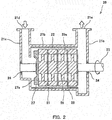
- FIG. 2 is a sectional view of a jet mill 20 used in the secondary disintegration for disintegrating pulp according to the present embodiment.
- the jet mill 20 includes a casing 21.
- the casing 21 includes: an introducing part 21a provided with an inlet 21d; a cylindrical rotor housing 21b connected to the introducing part 21a; and a leading-out part 21c, which is connected to the rotor housing 21b at the opposite side to the introducing part 21a and which is provided with an outlet 21e.
- a liner 22 is attached to the inner peripheral surface of the rotor housing 21b. A large number of grooves are formed in the liner 22.
- the grooves are spaced apart from one another in the circumferential direction, and extend in the direction of the rotational axis.
- the rotor housing 21b accommodates rotors 25 fixed to a rotary shaft 23.
- the rotary shaft 23 is rotatably supported by the casing 21 via a bearing 24, and is driven by a driving source (not shown) to rotate.
- Each rotor 25 includes a plurality of blades 25a provided on its outer peripheral portion.
- the plurality of blades 25a are arranged such that the blades 25a are spaced apart from each other in the circumferential direction of the rotor 25 and extend radially when seen from the rotational axis.
- Discoid partition plates 26 are provided such that each partition plate 26 is positioned between adjoining rotors 25.
- the blades 25a are closer to the liner 22 than the partition plates 26 are.
- a discoid distributor 27 fixed to the rotary shaft 23 is disposed on the introducing part 21a side of the rotor 25 that is the closest rotor to the introducing part 21a among the plurality of rotors 25.
- the distributor 27 is provided with vanes 27a, which radially extend when seen from the rotational axis and which protrude toward the introducing part 21a.
- the rotors 25 and the distributor 27 face the liner 22 in the radial direction. It should be noted that the distributor 27 and/or the liner 22 are not essential components, and may be eliminated.
- the pulp sheet, to which water has not been added, is disintegrated by the disc refiner 10 into pulp pieces having a predetermined average area (primary disintegration).
- the pulp sheet is continuously fed into the inlet 11c of the disc refiner 10.
- the pulp sheet is led to a gap between the teeth 13 of the fixed disc 12 and the teeth 17 of the rotary disc 16 owing to centrifugal force generated by the rotation of the rotary disc 16, and the teeth 13 and 17 exert shear force on the pulp sheet, thereby disintegrating the pulp sheet. Consequently, a large number of small pulp pieces are produced. Owing to the centrifugal force, the large number of pulp pieces are led outwardly in the radial direction from between the fixed disc 12 and the rotary disc 16, and discharged to the outside of the casing 11 through the outlet 11d.
- the disc refiner 10 is set such that the pulp sheet is disintegrated into pulp pieces having an average area of not more than 45 cm 2 .
- the average area of the pulp pieces to be produced can be set to a desirable value by adjusting, for example, the clearance L between the teeth 13 and the teeth 17 facing each other and the rotation speed of the rotary shaft 14.
- a disc refiner not a disc refiner but a hammer mill may be used instead.
- the pulp that has undergone the primary disintegration is further disintegrated by the jet mill 20 (secondary disintegration).
- the large number of pulp pieces having an average area of not more than 45 cm 2 are sequentially fed into the inlet 21d of the jet mill 20.
- the pulp pieces that have been led to the rotor housing 21b through the introducing part 21a are led outwardly in the radial direction owing to a swirl flow accelerated by the vanes 27a of the distributor 27, and circumferentially evenly distributed to a gap (a milling chamber) formed between the rotors 25 and the liner 22.
- the pulp pieces are exposed to impact shocks that are caused by: hitting by the blades 25a; collision with the liner 22; and high-frequency pressure oscillation generated as a result of the action of the high-speed rotating blades 25a, the partition plates 26, and the liner 22. Consequently, the pulp pieces are finely disintegrated. Then, the resulting fine powdery pulp that has been led from the rotor housing 21b to the leading-out part 21c is discharged to the outside of the casing 21 through the outlet 21e.
- the disintegrated raw material pulp obtained through the above-described primary disintegration and secondary disintegration is used to produce cellulose acetate.
- the cellulose acetate is produced through known production steps.
- a pretreatment is performed, in which acetic acid is added to the raw material pulp.
- the acetic acid to be added in the pretreatment may contain a sulfuric acid catalyst or may contain no sulfuric acid catalyst.
- acetic acid that has been cooled down, acetic anhydride, and a sulfuric acid catalyst (mixed acid) are added to the pretreated pulp, and the resulting mixture is subjected to acetylation by using a kneader while controlling the temperature of the mixture by an external jacket or the like.
- cellulose acetate (primary cellulose acetate) is obtained by the acetylation
- the obtained viscous cellulose acetate is charged into an ageing tank, and a neutralizer such as an aqueous solution of magnesium acetate is added thereto, such that the sulfuric acid is neutralized (fully or partly neutralized) by magnesium, and such that the acetic anhydride is quenched and hydrolyzed by water contained in the aqueous solution of magnesium acetate. Consequently, a cellulose acetate (secondary cellulose acetate) dope with a desirable degree of substitution is obtained.
- a neutralizer such as an aqueous solution of magnesium acetate
- a large amount of water is added to the dope, or the dope is extruded into a large amount of water, such that the cellulose acetate is sedimented in the water.
- the cellulose acetate sediment is then subjected to solid-liquid separation, washed, and dried. As a result, a cellulose acetate product is obtained.
- Examples are given for describing the present invention more specifically. Only Examples 1, 2 and 5 are in accordance with the present invention. Examples 3 and 4 are Reference Examples.
- Proportion of Undisintegrated Pulp means as follows. When the pulp that has undergone the disintegration is classified by air-jet sieving, there are pulp pieces that cannot pass through a 4-mesh sieve (opening size of 4.76 mm) (i.e., pulp pieces inferior in terms of, for example, acetylation reactivity during the cellulose acetate production). The proportion (% by weight) of such pulp pieces to the entire amount of the pulp is referred to as "Proportion of Undisintegrated Pulp".
- Example 1 to 5 and Comparative Examples 1 to 9 the disintegrated pulp was used as a raw material for producing cellulose acetate by a production method according to either SYNTHESIS EXAMPLE 1 or SYNTHESIS EXAMPLE 2.
- the cellulose acetate solution that had thus cooled down was, while being stirred by a mixer, fed into 10 % diluted acetic acid, which was three times as great in amount as the cellulose acetate solution.
- flaky sediment was obtained.
- the sediment was washed with a sufficient amount of running water, and dried in an oven at 100 °C for two hours. In this manner, cellulose acetate was obtained.
- Pulp containing 5 % of water was fed into a pretreatment machine, in which 100 parts of glacial acetic acid was evenly sprayed over 100 parts of the pulp, and the resulting pulp was mixed at 40 °C for 30 minutes.
- pretreatment activation was performed.
- a liquid mixture containing 250 parts of acetic anhydride, 375 parts of acetic acid, and 1 part of sulfuric acid and cooled down to 12 °C was prepared in a kneading acetylator in advance. Then, the pulp previously subjected to the aforementioned pretreatment activation was fed into the kneading acetylator, and stirred and mixed therein.
- the mixture generated heat as a result of a reaction between water entrained by the raw material pulp and the acetic anhydride and a reaction between cellulose and the acetic anhydride.
- the temperature was controlled by external cooling, such that the temperature increased to 77 °C from the initial temperature of about 16 °C by taking 60 minutes. Then, the temperature was kept at 77 °C for 12 minutes to cause an acetylation reaction. Next, 10 parts of a 20 % aqueous solution of magnesium acetate was added and mixed to fully neutralize the sulfuric acid in the system and to leave excess magnesium acetate. The fully neutralized reaction mixture was transferred into an autoclave, which was then sealed.
- the degree of filtration and fiber amount of each cellulose acetate were measured.
- Equation 1 The degree of filtration (Kw) was calculated by using Equation 1 shown below.
- PI is the amount of filtrate (ml) accumulated over a period of 20 minutes since the start of the filtration
- P2 the amount of filtrate (ml) accumulated over a period of 40 minutes from when 20 minutes elapsed since the start of the filtration to when 60 minutes elapsed since the start of the filtration.
- Kw 2 ⁇ P 2 / P 1 / P 1 + P 2 ⁇ 10 4
- the degree of filtration in terms of physical properties is the degree of clogging of the predetermined filter cloth. That is, the degree of filtration indicates the amount of insoluble components of the cellulose acetate in the acetone solution.
- Cellulose acetate with a high degree of filtration is considered to contain a large amount of insoluble components, such as unreacted fibers and gel. Therefore, if cellulose acetate with a high degree of filtration is used, the amount of clogging is large in a filtration process prior to film forming. Thus, the filterability of such cellulose acetate is considered to be poor.
- Dichloromethane/methanol (weight ratio 9:1) was added to 3 to 5 g of a dry cellulose acetate sample to obtain a mixture having a total amount of 150 g. The mixture was stirred by a stirrer for three hours or more. A membrane filter (Millipore JC 10 ⁇ m) was dried by a vacuum dryer at 50 °C for three hours, and then weighed. The aforementioned cellulose acetate solution was filtered by the resulting membrane filter, and the filtration residue was washed three times or more, in each of which the filtration residue was washed with 50 ml of dichloromethane/methanol (weight ratio 9:1).
- the membrane filter on which the resulting filtration residue was placed was dried by a vacuum dryer at 50 °C for three hours, then allowed to cool down in a desiccator, and thereafter weighed.
- the proportion (% by weight) of an increase in the weight to the weight of the cellulose acetate sample was calculated as a fiber amount.
- the fiber amount indicates the ratio of insoluble components in the cellulose acetate to dichloromethane/methanol (the weight ratio of the dichloromethane/methanol was 9:1). Part of the insoluble components is the raw material cellulose whose reaction has not been completed.
- the fiber amount of cellulose acetate shows a positive correlation with the degree of filtration of cellulose acetate obtained from the same kind of pulp. The fiber amount is used as a surrogate indicator of quality.
- the acetylation degree of each cellulose acetate was measured in accordance with an acetylation degree measuring method prescribed in ASTM: D-817-91 (testing methods for cellulose acetate, etc.).
- ASTM testing methods for cellulose acetate, etc.
- 1.9 g of dry cellulose acetate was precisely weighed and dissolved in 150 ml of a mixed solvent of acetone and dimethyl sulfoxide (volume ratio 4:1).
- 30 ml of a IN-sodium hydroxide aqueous solution was added thereto, and the resulting mixture was saponified at 25 °C for two hours.
- a phenolphthalein solution was added as an indicator, and the excess sodium hydroxide was titrated with 1N-sulfuric acid.
- Equation 2 A is the volume (ml) of IN-sulfuric acid required for the titration of the sample; B is the volume (ml) of 1N-sulfuric acid required for the titration of a blank test; F is the concentration factor of 1N-sulfuric acid; and W is the weight of the sample.
- Acetylation degree % 6.005 ⁇ B ⁇ A ⁇ F / W
- Equation 4 V is the absolute viscosity of the standard solution (mPa ⁇ s); D1 is the density of the solution (1.235 g/cm); D2 is the density of the standard solution (g/cm 3 ); and T is the flow time of the standard solution in seconds (s).
- Viscometer coefficient V ⁇ D 1 / D 2 ⁇ T [Table 1] Examples Comparative Examples 1 2 3 4 5 1 2 3 4 5 6 7 8 9 Pulp Pieces Tree Type Coniferous Broad-leaved Broad-leaved Coniferous Digestion Method Sulfite Purity [%] (a-cellulose content) 95.8 95.3 95.3 95.8 92.3 Sheet Density [g/cm3] 0.50 0.46 0.46 0.50 0.87 Weighted Average Fiber Length [mm] 2.6 0.6 0.6 2.6 2.9 Average Area [cm2] 0.25 16 40 0.25 0.25 52 100 200 Disintegrator Primary Disintegration Disc Refiner (Pyramid teeth) - (Manually done) Disc Refiner (Pyramid teeth) Disc Refiner (Pyramid teeth) - (Manually done) Secondary Disintegration Turbo Mill T600 Not Done Disc Refiner (Linear teeth) Not Done Disc Refiner (Linear teeth) Turbo Mill T600
- the weighted average fiber length of the pulp sheet was 2.6 mm, which was long; however, the degree of filtration and the fiber amount were sufficiently reduced. The reason for this is considered that even in the case of using a pulp sheet with a long fiber length, such as one having a weighted average fiber length of 2.0 mm or more, the jet mill made it possible to prevent scorching of the pulp during the secondary disintegration. It should be noted that the weighted average fiber length of the pulp sheet is preferably not more than 10 mm from the viewpoint of disintegrability.
- FIG. 3 is a chart showing a relationship between the average area of pulp pieces and the degree of filtration in each of Examples 1 to 4 and each of Comparative Examples 5 to 9. It is understood from Table 1 and FIG. 3 that, in Examples 1 to 4, the value of the degree of filtration (as well as the value of the fiber amount) was sufficiently reduced compared to Comparative Examples 5 to 9. That is, in Examples 1 to 4, high-quality cellulose acetate with favorable filterability and reduced unreacted components was obtained. The reason for this is considered that, in Examples 1 to 4, since the average area of the pulp pieces fed into the jet mill was not more than 45 cm 2 , problems such as uneven distribution of the pulp within the jet mill were prevented satisfactorily, and thereby the pulp was disintegrated evenly. It is understood from Table 1 that, also in Example 5, the degree of filtration was reduced satisfactorily although a broad-leaved tree was used as a raw material.
- the upper limit value of the average area of the pulp pieces fed into the jet mill after undergoing the primary disintegration is preferably 40 cm 2 , more preferably 16 cm 2 , and even more preferably 5 cm 2 .
- the reason for this is that, as shown in Table 1, when the average area of the pulp pieces is reduced, the degree of filtration is reduced sufficiently. The disintegrability is not particularly affected so long as the average area of the pulp pieces fed into the jet mill after undergoing the primary disintegration is reduced.
- the lower limit value of the average area of the pulp pieces at the time is preferably 0.01 cm 2 , more preferably 0.1 cm 2 , and even more preferably 2 cm 2 . The reason for this is as follows.
- the method of disintegrating pulp for use in cellulose acetate production and the method of producing cellulose acetate according to the present invention provide an excellent advantage of being able to obtain high-quality cellulose acetate with reduced unreacted components, and are beneficial when widely applied to cellulose acetate production in which the aforementioned advantage can be exerted meaningfully.
Landscapes
- Chemical & Material Sciences (AREA)
- Engineering & Computer Science (AREA)
- Food Science & Technology (AREA)
- Health & Medical Sciences (AREA)
- Biochemistry (AREA)
- Materials Engineering (AREA)
- Life Sciences & Earth Sciences (AREA)
- Chemical Kinetics & Catalysis (AREA)
- Medicinal Chemistry (AREA)
- Polymers & Plastics (AREA)
- Organic Chemistry (AREA)
- Polysaccharides And Polysaccharide Derivatives (AREA)
- Paper (AREA)
Claims (3)
- Verfahren zum Desintegrieren von Zellstoff zur Verwendung bei der Celluloseacetatherstellung, wobei das Verfahren umfasst:einen primären Desintegrationsschritt des Desintegrierens eines Zellstoffbogens, dem kein Wasser hinzugefügt worden ist, zu Zellstoffstücken mit einer durchschnittlichen Fläche von nicht mehr als 45 cm2 durch einen Scheibenrefiner oder eine Hammermühle; undeinen sekundären Desintegrationsschritt des Desintegrierens der Zellstoffstücke mit einem durch eine Strahlmühle ausgeübten Auftreffstoß, wobeidie Strahlmühle einschließt:ein zylindrisches Gehäuse, das mit einem Einlass und einem Auslass versehen ist; undeinen Rotor, der eine Mehrzahl von Flügeln einschließt, die auf seinem äußeren peripheren Bereich bereitgestellt sind, wobei die Mehrzahl von Flügeln einer inneren peripheren Oberfläche des Gehäuses gegenüberliegt.
- Verfahren zum Desintegrieren von Zellstoff zur Verwendung bei der Celluloseacetatherstellung gemäß Anspruch 1, wobei
eine gewichtete mittlere Faserlänge des Zellstoffbogens nicht weniger als 2,0 mm beträgt. - Verfahren zum Herstellen von Celluloseacetat, umfassend
einen Vorbehandlungsschritt des Durchführens einer Vorbehandlung durch Zugeben von Essigsäure zu Zellstoff, welcher durch das Verfahren zum Desintegrieren von Zellstoff gemäß Anspruch 1 oder 2 desintegriert worden ist; und
einen Acetylierungsschritt des Zugebens von Essigsäure, Essigsäureanhydrid und einem Schwefelsäurekatalysator zu dem Zellstoff, welcher dem Vorbehandlungsschritt unterzogen worden ist, und des Unterwerfens einer resultierenden Mischung einer Acetylierung, während eine Temperatur der Mischung geregelt wird.
Applications Claiming Priority (1)
| Application Number | Priority Date | Filing Date | Title |
|---|---|---|---|
| PCT/JP2014/003720 WO2016009461A1 (ja) | 2014-07-14 | 2014-07-14 | 酢酸セルロース製造用のパルプの解砕方法及び酢酸セルロースの製造方法 |
Publications (3)
| Publication Number | Publication Date |
|---|---|
| EP3170843A1 EP3170843A1 (de) | 2017-05-24 |
| EP3170843A4 EP3170843A4 (de) | 2017-09-13 |
| EP3170843B1 true EP3170843B1 (de) | 2019-01-16 |
Family
ID=54602102
Family Applications (1)
| Application Number | Title | Priority Date | Filing Date |
|---|---|---|---|
| EP14897640.0A Active EP3170843B1 (de) | 2014-07-14 | 2014-07-14 | Verfahren zur desintegration von zellstoff für celluloseacetatherstellung und verfahren zur herstellung von celluloseacetat |
Country Status (6)
| Country | Link |
|---|---|
| US (1) | US10954314B2 (de) |
| EP (1) | EP3170843B1 (de) |
| JP (1) | JP5816395B1 (de) |
| CN (1) | CN106536568B (de) |
| MX (1) | MX2017000600A (de) |
| WO (1) | WO2016009461A1 (de) |
Families Citing this family (10)
| Publication number | Priority date | Publication date | Assignee | Title |
|---|---|---|---|---|
| JP7143055B2 (ja) | 2016-08-22 | 2022-09-28 | 株式会社ダイセル | セルロースアセテート及びその製造方法 |
| CN107552202B (zh) * | 2017-09-22 | 2023-12-29 | 百珍堂生物科技(上海)有限公司 | 一种高效骨粉制备系统及使用方法 |
| WO2019150521A1 (ja) * | 2018-02-01 | 2019-08-08 | 株式会社Isaac | ジェットミル装置 |
| JP7162292B2 (ja) * | 2018-06-12 | 2022-10-28 | 国立大学法人北海道大学 | セルロースアセテート、セルロースアセテート繊維、セルロースアセテート組成物、セルロースアセテートの製造方法、及びセルロースアセテート組成物の製造方法 |
| ES2907600T3 (es) * | 2019-06-20 | 2022-04-25 | Cellwood Machinery Ab | Aparato y método para dispersión o refinado de material orgánico, tal como fibra de celulosa y residuos orgánicos |
| JP7470066B2 (ja) * | 2021-01-28 | 2024-04-17 | 北越コーポレーション株式会社 | 古紙原料を解繊するための乾式解繊機および古紙パルプの製造方法 |
| CN113184452A (zh) * | 2021-02-25 | 2021-07-30 | 淄博圣泉纸业有限公司 | 一种卷筒木浆切割及浆料输送设备 |
| JP7741531B2 (ja) * | 2021-03-09 | 2025-09-18 | アシザワ・ファインテック株式会社 | 分散粉砕装置 |
| US11801514B1 (en) | 2023-02-10 | 2023-10-31 | CR Nano, Inc. | Mechanochemical production of tunable planar materials |
| WO2024167502A1 (en) * | 2023-02-10 | 2024-08-15 | CR Nano, Inc. | Mechanochemical production of tunable planar materials |
Family Cites Families (16)
| Publication number | Priority date | Publication date | Assignee | Title |
|---|---|---|---|---|
| US2105498A (en) * | 1936-06-27 | 1938-01-18 | Rainier Pulp & Paper Company | Acetylation of wood pulp |
| US2646429A (en) * | 1951-06-08 | 1953-07-21 | Eastman Kodak Co | Manufacture of cellulose acetate with sulfoacetic pretreatment |
| BE785656A (fr) | 1971-06-30 | 1973-01-02 | Celanese Corp | Procede d'hydrolyse de la cellulose esterifiee a temperature elevee |
| US3753749A (en) * | 1971-08-12 | 1973-08-21 | Cement Marketing Co | Concrete compositions |
| GB8816864D0 (en) * | 1988-07-15 | 1988-08-17 | Courtaulds Plc | Treating cellulosic sheet material |
| JP2633042B2 (ja) * | 1989-12-26 | 1997-07-23 | ダイセル化学工業株式会社 | パルプシートの解砕方法 |
| JP2823944B2 (ja) * | 1990-07-05 | 1998-11-11 | ダイセル化学工業株式会社 | 酢酸セルロースの製造方法 |
| JP2999293B2 (ja) * | 1991-07-02 | 2000-01-17 | ダイセル化学工業株式会社 | 酢酸セルロースの製造方法 |
| DE69327286T2 (de) * | 1992-09-24 | 2000-05-11 | Daicel Chemical Industries, Ltd. | Verfahren zur Herstellung eines Fettsäureesters von Cellulose |
| JP2001029817A (ja) * | 1999-07-26 | 2001-02-06 | Daicel Chem Ind Ltd | パルプ原料の解砕法 |
| US20040041042A1 (en) * | 2002-08-29 | 2004-03-04 | Samuels Michael R. | Grinding of liquid crystalline polymers |
| JP2009011967A (ja) | 2007-07-06 | 2009-01-22 | Daicel Chem Ind Ltd | パルプ原料の解砕法及び解砕装置 |
| JP5283472B2 (ja) * | 2008-10-14 | 2013-09-04 | 株式会社アーステクニカ | ジェットミル |
| BRPI0922382B1 (pt) | 2008-12-16 | 2019-06-18 | Carlsberg A/S | Material de polímero à base de celulose, recipiente para armazenamento de líquidos, material para armazenamento de alimentos e método para preparar o referido material |
| JP2011190322A (ja) | 2010-03-12 | 2011-09-29 | Mitsubishi Paper Mills Ltd | セルロース含有熱可塑性樹脂の製造方法、セルロース含有熱可塑性樹脂およびその成形体 |
| US8920520B2 (en) * | 2012-03-01 | 2014-12-30 | Celanese Acetate Llc | Methods of preparing polysaccharide sheets for esterification |
-
2014
- 2014-07-14 EP EP14897640.0A patent/EP3170843B1/de active Active
- 2014-07-14 WO PCT/JP2014/003720 patent/WO2016009461A1/ja not_active Ceased
- 2014-07-14 US US15/323,928 patent/US10954314B2/en active Active
- 2014-07-14 CN CN201480080628.5A patent/CN106536568B/zh active Active
- 2014-07-14 JP JP2015531374A patent/JP5816395B1/ja active Active
- 2014-07-14 MX MX2017000600A patent/MX2017000600A/es unknown
Non-Patent Citations (1)
| Title |
|---|
| None * |
Also Published As
| Publication number | Publication date |
|---|---|
| EP3170843A4 (de) | 2017-09-13 |
| MX2017000600A (es) | 2017-09-01 |
| US20170145118A1 (en) | 2017-05-25 |
| CN106536568B (zh) | 2019-08-16 |
| EP3170843A1 (de) | 2017-05-24 |
| JPWO2016009461A1 (ja) | 2017-04-27 |
| WO2016009461A1 (ja) | 2016-01-21 |
| JP5816395B1 (ja) | 2015-11-18 |
| CN106536568A (zh) | 2017-03-22 |
| US10954314B2 (en) | 2021-03-23 |
Similar Documents
| Publication | Publication Date | Title |
|---|---|---|
| EP3170843B1 (de) | Verfahren zur desintegration von zellstoff für celluloseacetatherstellung und verfahren zur herstellung von celluloseacetat | |
| US20210301033A1 (en) | Method and system for the production of a spinning dope composition | |
| JP2018058941A (ja) | セルロースアセテートおよびセルロースアセテートの製造方法 | |
| JP6898173B2 (ja) | セルロースアセテートの製造方法、製造装置及びセルロースアセテート | |
| US10927189B2 (en) | Cellulose acetate and producing method therefor | |
| CN109206526B (zh) | 水溶性纤维素醚及其生产方法 | |
| JP7323887B2 (ja) | セルロースアセテートフィルム | |
| CN108623697B (zh) | 羟丙基甲基纤维素的生产方法 | |
| CN111868094B (zh) | 乙酸纤维素、乙酸纤维素纤维、乙酸纤维素组合物、乙酸纤维素的制造方法、及乙酸纤维素组合物的制造方法 | |
| Glegg et al. | Acetylation of cellulose I and II studied by limiting viscosity and X‐ray diffraction | |
| WO2019176465A1 (ja) | セルロースナノファイバー分散液の製造方法 | |
| EP4071201A1 (de) | Masterbatch und harzzusammensetzung | |
| JP2022147444A (ja) | セロオリゴ糖含有組成物の製造方法及びセロオリゴ糖含有組成物 | |
| WO2021112182A1 (ja) | 樹脂組成物の製造方法 | |
| JPH0465401A (ja) | 酢酸セルロースの製造方法 | |
| JP2021091853A (ja) | マスターバッチ及び樹脂組成物 | |
| WO2020013312A1 (ja) | セルロースアセテート及びセルロースアセテートの製造方法 | |
| US11008406B2 (en) | Method for preparing cellulose dope | |
| EA045531B1 (ru) | Предварительная обработка целлюлозы |
Legal Events
| Date | Code | Title | Description |
|---|---|---|---|
| STAA | Information on the status of an ep patent application or granted ep patent |
Free format text: STATUS: THE INTERNATIONAL PUBLICATION HAS BEEN MADE |
|
| PUAI | Public reference made under article 153(3) epc to a published international application that has entered the european phase |
Free format text: ORIGINAL CODE: 0009012 |
|
| STAA | Information on the status of an ep patent application or granted ep patent |
Free format text: STATUS: REQUEST FOR EXAMINATION WAS MADE |
|
| 17P | Request for examination filed |
Effective date: 20170209 |
|
| AK | Designated contracting states |
Kind code of ref document: A1 Designated state(s): AL AT BE BG CH CY CZ DE DK EE ES FI FR GB GR HR HU IE IS IT LI LT LU LV MC MK MT NL NO PL PT RO RS SE SI SK SM TR |
|
| AX | Request for extension of the european patent |
Extension state: BA ME |
|
| A4 | Supplementary search report drawn up and despatched |
Effective date: 20170811 |
|
| RIC1 | Information provided on ipc code assigned before grant |
Ipc: C08B 3/06 20060101AFI20170807BHEP Ipc: B02C 19/06 20060101ALI20170807BHEP |
|
| DAX | Request for extension of the european patent (deleted) | ||
| STAA | Information on the status of an ep patent application or granted ep patent |
Free format text: STATUS: EXAMINATION IS IN PROGRESS |
|
| 17Q | First examination report despatched |
Effective date: 20180607 |
|
| GRAP | Despatch of communication of intention to grant a patent |
Free format text: ORIGINAL CODE: EPIDOSNIGR1 |
|
| STAA | Information on the status of an ep patent application or granted ep patent |
Free format text: STATUS: GRANT OF PATENT IS INTENDED |
|
| INTG | Intention to grant announced |
Effective date: 20180817 |
|
| GRAS | Grant fee paid |
Free format text: ORIGINAL CODE: EPIDOSNIGR3 |
|
| GRAA | (expected) grant |
Free format text: ORIGINAL CODE: 0009210 |
|
| STAA | Information on the status of an ep patent application or granted ep patent |
Free format text: STATUS: THE PATENT HAS BEEN GRANTED |
|
| AK | Designated contracting states |
Kind code of ref document: B1 Designated state(s): AL AT BE BG CH CY CZ DE DK EE ES FI FR GB GR HR HU IE IS IT LI LT LU LV MC MK MT NL NO PL PT RO RS SE SI SK SM TR |
|
| REG | Reference to a national code |
Ref country code: GB Ref legal event code: FG4D |
|
| REG | Reference to a national code |
Ref country code: CH Ref legal event code: EP |
|
| REG | Reference to a national code |
Ref country code: IE Ref legal event code: FG4D |
|
| REG | Reference to a national code |
Ref country code: DE Ref legal event code: R096 Ref document number: 602014040213 Country of ref document: DE |
|
| REG | Reference to a national code |
Ref country code: AT Ref legal event code: REF Ref document number: 1089642 Country of ref document: AT Kind code of ref document: T Effective date: 20190215 |
|
| REG | Reference to a national code |
Ref country code: NL Ref legal event code: MP Effective date: 20190116 |
|
| REG | Reference to a national code |
Ref country code: LT Ref legal event code: MG4D |
|
| PG25 | Lapsed in a contracting state [announced via postgrant information from national office to epo] |
Ref country code: NL Free format text: LAPSE BECAUSE OF FAILURE TO SUBMIT A TRANSLATION OF THE DESCRIPTION OR TO PAY THE FEE WITHIN THE PRESCRIBED TIME-LIMIT Effective date: 20190116 |
|
| REG | Reference to a national code |
Ref country code: AT Ref legal event code: MK05 Ref document number: 1089642 Country of ref document: AT Kind code of ref document: T Effective date: 20190116 |
|
| PG25 | Lapsed in a contracting state [announced via postgrant information from national office to epo] |
Ref country code: ES Free format text: LAPSE BECAUSE OF FAILURE TO SUBMIT A TRANSLATION OF THE DESCRIPTION OR TO PAY THE FEE WITHIN THE PRESCRIBED TIME-LIMIT Effective date: 20190116 Ref country code: SE Free format text: LAPSE BECAUSE OF FAILURE TO SUBMIT A TRANSLATION OF THE DESCRIPTION OR TO PAY THE FEE WITHIN THE PRESCRIBED TIME-LIMIT Effective date: 20190116 Ref country code: PT Free format text: LAPSE BECAUSE OF FAILURE TO SUBMIT A TRANSLATION OF THE DESCRIPTION OR TO PAY THE FEE WITHIN THE PRESCRIBED TIME-LIMIT Effective date: 20190516 Ref country code: FI Free format text: LAPSE BECAUSE OF FAILURE TO SUBMIT A TRANSLATION OF THE DESCRIPTION OR TO PAY THE FEE WITHIN THE PRESCRIBED TIME-LIMIT Effective date: 20190116 Ref country code: NO Free format text: LAPSE BECAUSE OF FAILURE TO SUBMIT A TRANSLATION OF THE DESCRIPTION OR TO PAY THE FEE WITHIN THE PRESCRIBED TIME-LIMIT Effective date: 20190416 Ref country code: PL Free format text: LAPSE BECAUSE OF FAILURE TO SUBMIT A TRANSLATION OF THE DESCRIPTION OR TO PAY THE FEE WITHIN THE PRESCRIBED TIME-LIMIT Effective date: 20190116 Ref country code: LT Free format text: LAPSE BECAUSE OF FAILURE TO SUBMIT A TRANSLATION OF THE DESCRIPTION OR TO PAY THE FEE WITHIN THE PRESCRIBED TIME-LIMIT Effective date: 20190116 |
|
| PG25 | Lapsed in a contracting state [announced via postgrant information from national office to epo] |
Ref country code: IS Free format text: LAPSE BECAUSE OF FAILURE TO SUBMIT A TRANSLATION OF THE DESCRIPTION OR TO PAY THE FEE WITHIN THE PRESCRIBED TIME-LIMIT Effective date: 20190516 Ref country code: BG Free format text: LAPSE BECAUSE OF FAILURE TO SUBMIT A TRANSLATION OF THE DESCRIPTION OR TO PAY THE FEE WITHIN THE PRESCRIBED TIME-LIMIT Effective date: 20190416 Ref country code: GR Free format text: LAPSE BECAUSE OF FAILURE TO SUBMIT A TRANSLATION OF THE DESCRIPTION OR TO PAY THE FEE WITHIN THE PRESCRIBED TIME-LIMIT Effective date: 20190417 Ref country code: HR Free format text: LAPSE BECAUSE OF FAILURE TO SUBMIT A TRANSLATION OF THE DESCRIPTION OR TO PAY THE FEE WITHIN THE PRESCRIBED TIME-LIMIT Effective date: 20190116 Ref country code: LV Free format text: LAPSE BECAUSE OF FAILURE TO SUBMIT A TRANSLATION OF THE DESCRIPTION OR TO PAY THE FEE WITHIN THE PRESCRIBED TIME-LIMIT Effective date: 20190116 Ref country code: RS Free format text: LAPSE BECAUSE OF FAILURE TO SUBMIT A TRANSLATION OF THE DESCRIPTION OR TO PAY THE FEE WITHIN THE PRESCRIBED TIME-LIMIT Effective date: 20190116 |
|
| REG | Reference to a national code |
Ref country code: DE Ref legal event code: R097 Ref document number: 602014040213 Country of ref document: DE |
|
| PG25 | Lapsed in a contracting state [announced via postgrant information from national office to epo] |
Ref country code: CZ Free format text: LAPSE BECAUSE OF FAILURE TO SUBMIT A TRANSLATION OF THE DESCRIPTION OR TO PAY THE FEE WITHIN THE PRESCRIBED TIME-LIMIT Effective date: 20190116 Ref country code: IT Free format text: LAPSE BECAUSE OF FAILURE TO SUBMIT A TRANSLATION OF THE DESCRIPTION OR TO PAY THE FEE WITHIN THE PRESCRIBED TIME-LIMIT Effective date: 20190116 Ref country code: RO Free format text: LAPSE BECAUSE OF FAILURE TO SUBMIT A TRANSLATION OF THE DESCRIPTION OR TO PAY THE FEE WITHIN THE PRESCRIBED TIME-LIMIT Effective date: 20190116 Ref country code: DK Free format text: LAPSE BECAUSE OF FAILURE TO SUBMIT A TRANSLATION OF THE DESCRIPTION OR TO PAY THE FEE WITHIN THE PRESCRIBED TIME-LIMIT Effective date: 20190116 Ref country code: AT Free format text: LAPSE BECAUSE OF FAILURE TO SUBMIT A TRANSLATION OF THE DESCRIPTION OR TO PAY THE FEE WITHIN THE PRESCRIBED TIME-LIMIT Effective date: 20190116 Ref country code: EE Free format text: LAPSE BECAUSE OF FAILURE TO SUBMIT A TRANSLATION OF THE DESCRIPTION OR TO PAY THE FEE WITHIN THE PRESCRIBED TIME-LIMIT Effective date: 20190116 Ref country code: SK Free format text: LAPSE BECAUSE OF FAILURE TO SUBMIT A TRANSLATION OF THE DESCRIPTION OR TO PAY THE FEE WITHIN THE PRESCRIBED TIME-LIMIT Effective date: 20190116 Ref country code: AL Free format text: LAPSE BECAUSE OF FAILURE TO SUBMIT A TRANSLATION OF THE DESCRIPTION OR TO PAY THE FEE WITHIN THE PRESCRIBED TIME-LIMIT Effective date: 20190116 |
|
| PLBE | No opposition filed within time limit |
Free format text: ORIGINAL CODE: 0009261 |
|
| STAA | Information on the status of an ep patent application or granted ep patent |
Free format text: STATUS: NO OPPOSITION FILED WITHIN TIME LIMIT |
|
| PG25 | Lapsed in a contracting state [announced via postgrant information from national office to epo] |
Ref country code: SM Free format text: LAPSE BECAUSE OF FAILURE TO SUBMIT A TRANSLATION OF THE DESCRIPTION OR TO PAY THE FEE WITHIN THE PRESCRIBED TIME-LIMIT Effective date: 20190116 |
|
| 26N | No opposition filed |
Effective date: 20191017 |
|
| PG25 | Lapsed in a contracting state [announced via postgrant information from national office to epo] |
Ref country code: SI Free format text: LAPSE BECAUSE OF FAILURE TO SUBMIT A TRANSLATION OF THE DESCRIPTION OR TO PAY THE FEE WITHIN THE PRESCRIBED TIME-LIMIT Effective date: 20190116 Ref country code: MC Free format text: LAPSE BECAUSE OF FAILURE TO SUBMIT A TRANSLATION OF THE DESCRIPTION OR TO PAY THE FEE WITHIN THE PRESCRIBED TIME-LIMIT Effective date: 20190116 |
|
| REG | Reference to a national code |
Ref country code: CH Ref legal event code: PL |
|
| GBPC | Gb: european patent ceased through non-payment of renewal fee |
Effective date: 20190714 |
|
| PG25 | Lapsed in a contracting state [announced via postgrant information from national office to epo] |
Ref country code: TR Free format text: LAPSE BECAUSE OF FAILURE TO SUBMIT A TRANSLATION OF THE DESCRIPTION OR TO PAY THE FEE WITHIN THE PRESCRIBED TIME-LIMIT Effective date: 20190116 |
|
| REG | Reference to a national code |
Ref country code: BE Ref legal event code: MM Effective date: 20190731 |
|
| PG25 | Lapsed in a contracting state [announced via postgrant information from national office to epo] |
Ref country code: GB Free format text: LAPSE BECAUSE OF NON-PAYMENT OF DUE FEES Effective date: 20190714 |
|
| PG25 | Lapsed in a contracting state [announced via postgrant information from national office to epo] |
Ref country code: LU Free format text: LAPSE BECAUSE OF NON-PAYMENT OF DUE FEES Effective date: 20190714 Ref country code: BE Free format text: LAPSE BECAUSE OF NON-PAYMENT OF DUE FEES Effective date: 20190731 Ref country code: CH Free format text: LAPSE BECAUSE OF NON-PAYMENT OF DUE FEES Effective date: 20190731 Ref country code: LI Free format text: LAPSE BECAUSE OF NON-PAYMENT OF DUE FEES Effective date: 20190731 |
|
| PG25 | Lapsed in a contracting state [announced via postgrant information from national office to epo] |
Ref country code: IE Free format text: LAPSE BECAUSE OF NON-PAYMENT OF DUE FEES Effective date: 20190714 |
|
| PG25 | Lapsed in a contracting state [announced via postgrant information from national office to epo] |
Ref country code: CY Free format text: LAPSE BECAUSE OF FAILURE TO SUBMIT A TRANSLATION OF THE DESCRIPTION OR TO PAY THE FEE WITHIN THE PRESCRIBED TIME-LIMIT Effective date: 20190116 |
|
| PG25 | Lapsed in a contracting state [announced via postgrant information from national office to epo] |
Ref country code: MT Free format text: LAPSE BECAUSE OF FAILURE TO SUBMIT A TRANSLATION OF THE DESCRIPTION OR TO PAY THE FEE WITHIN THE PRESCRIBED TIME-LIMIT Effective date: 20190116 Ref country code: HU Free format text: LAPSE BECAUSE OF FAILURE TO SUBMIT A TRANSLATION OF THE DESCRIPTION OR TO PAY THE FEE WITHIN THE PRESCRIBED TIME-LIMIT; INVALID AB INITIO Effective date: 20140714 |
|
| PG25 | Lapsed in a contracting state [announced via postgrant information from national office to epo] |
Ref country code: MK Free format text: LAPSE BECAUSE OF FAILURE TO SUBMIT A TRANSLATION OF THE DESCRIPTION OR TO PAY THE FEE WITHIN THE PRESCRIBED TIME-LIMIT Effective date: 20190116 |
|
| PGFP | Annual fee paid to national office [announced via postgrant information from national office to epo] |
Ref country code: DE Payment date: 20250722 Year of fee payment: 12 |
|
| PGFP | Annual fee paid to national office [announced via postgrant information from national office to epo] |
Ref country code: FR Payment date: 20250725 Year of fee payment: 12 |