EP3170995A1 - Kombikraftwerk und zugehöriges verfahren zum betrieb - Google Patents
Kombikraftwerk und zugehöriges verfahren zum betrieb Download PDFInfo
- Publication number
- EP3170995A1 EP3170995A1 EP15195839.4A EP15195839A EP3170995A1 EP 3170995 A1 EP3170995 A1 EP 3170995A1 EP 15195839 A EP15195839 A EP 15195839A EP 3170995 A1 EP3170995 A1 EP 3170995A1
- Authority
- EP
- European Patent Office
- Prior art keywords
- gas turbine
- turbine engine
- exhaust fluid
- power plant
- combined cycle
- Prior art date
- Legal status (The legal status is an assumption and is not a legal conclusion. Google has not performed a legal analysis and makes no representation as to the accuracy of the status listed.)
- Withdrawn
Links
- 238000000034 method Methods 0.000 title claims abstract description 9
- 239000012530 fluid Substances 0.000 claims abstract description 105
- 230000004044 response Effects 0.000 claims abstract description 9
- 239000000446 fuel Substances 0.000 claims description 11
- 238000011144 upstream manufacturing Methods 0.000 claims description 8
- 230000008859 change Effects 0.000 claims description 2
- 238000012544 monitoring process Methods 0.000 claims 1
- 239000007789 gas Substances 0.000 description 109
- 239000003570 air Substances 0.000 description 9
- 238000002485 combustion reaction Methods 0.000 description 7
- 239000012080 ambient air Substances 0.000 description 6
- 230000003134 recirculating effect Effects 0.000 description 5
- 230000008901 benefit Effects 0.000 description 4
- 230000000694 effects Effects 0.000 description 4
- 238000010304 firing Methods 0.000 description 4
- 239000000203 mixture Substances 0.000 description 4
- 230000001052 transient effect Effects 0.000 description 4
- QVGXLLKOCUKJST-UHFFFAOYSA-N atomic oxygen Chemical compound [O] QVGXLLKOCUKJST-UHFFFAOYSA-N 0.000 description 3
- 238000013461 design Methods 0.000 description 3
- 239000001301 oxygen Substances 0.000 description 3
- 229910052760 oxygen Inorganic materials 0.000 description 3
- 230000000704 physical effect Effects 0.000 description 2
- 238000010248 power generation Methods 0.000 description 2
- 238000011084 recovery Methods 0.000 description 2
- XLYOFNOQVPJJNP-UHFFFAOYSA-N water Substances O XLYOFNOQVPJJNP-UHFFFAOYSA-N 0.000 description 2
- UGFAIRIUMAVXCW-UHFFFAOYSA-N Carbon monoxide Chemical compound [O+]#[C-] UGFAIRIUMAVXCW-UHFFFAOYSA-N 0.000 description 1
- 230000000295 complement effect Effects 0.000 description 1
- 230000006835 compression Effects 0.000 description 1
- 238000007906 compression Methods 0.000 description 1
- 238000011217 control strategy Methods 0.000 description 1
- 230000003247 decreasing effect Effects 0.000 description 1
- 230000001419 dependent effect Effects 0.000 description 1
- 238000011161 development Methods 0.000 description 1
- 230000018109 developmental process Effects 0.000 description 1
- 238000000605 extraction Methods 0.000 description 1
- 239000003546 flue gas Substances 0.000 description 1
- 238000010438 heat treatment Methods 0.000 description 1
- 238000005259 measurement Methods 0.000 description 1
- 230000007246 mechanism Effects 0.000 description 1
- 238000012986 modification Methods 0.000 description 1
- 230000004048 modification Effects 0.000 description 1
- 230000008092 positive effect Effects 0.000 description 1
- 238000009877 rendering Methods 0.000 description 1
- 230000003068 static effect Effects 0.000 description 1
- 230000007704 transition Effects 0.000 description 1
- 239000002918 waste heat Substances 0.000 description 1
Images
Classifications
-
- F—MECHANICAL ENGINEERING; LIGHTING; HEATING; WEAPONS; BLASTING
- F01—MACHINES OR ENGINES IN GENERAL; ENGINE PLANTS IN GENERAL; STEAM ENGINES
- F01K—STEAM ENGINE PLANTS; STEAM ACCUMULATORS; ENGINE PLANTS NOT OTHERWISE PROVIDED FOR; ENGINES USING SPECIAL WORKING FLUIDS OR CYCLES
- F01K23/00—Plants characterised by more than one engine delivering power external to the plant, the engines being driven by different fluids
- F01K23/02—Plants characterised by more than one engine delivering power external to the plant, the engines being driven by different fluids the engine cycles being thermally coupled
- F01K23/06—Plants characterised by more than one engine delivering power external to the plant, the engines being driven by different fluids the engine cycles being thermally coupled combustion heat from one cycle heating the fluid in another cycle
- F01K23/10—Plants characterised by more than one engine delivering power external to the plant, the engines being driven by different fluids the engine cycles being thermally coupled combustion heat from one cycle heating the fluid in another cycle with exhaust fluid of one cycle heating the fluid in another cycle
- F01K23/101—Regulating means specially adapted therefor
-
- F—MECHANICAL ENGINEERING; LIGHTING; HEATING; WEAPONS; BLASTING
- F01—MACHINES OR ENGINES IN GENERAL; ENGINE PLANTS IN GENERAL; STEAM ENGINES
- F01K—STEAM ENGINE PLANTS; STEAM ACCUMULATORS; ENGINE PLANTS NOT OTHERWISE PROVIDED FOR; ENGINES USING SPECIAL WORKING FLUIDS OR CYCLES
- F01K7/00—Steam engine plants characterised by the use of specific types of engine; Plants or engines characterised by their use of special steam systems, cycles or processes; Control means specially adapted for such systems, cycles or processes; Use of withdrawn or exhaust steam for feed-water heating
- F01K7/16—Steam engine plants characterised by the use of specific types of engine; Plants or engines characterised by their use of special steam systems, cycles or processes; Control means specially adapted for such systems, cycles or processes; Use of withdrawn or exhaust steam for feed-water heating the engines being only of turbine type
- F01K7/22—Steam engine plants characterised by the use of specific types of engine; Plants or engines characterised by their use of special steam systems, cycles or processes; Control means specially adapted for such systems, cycles or processes; Use of withdrawn or exhaust steam for feed-water heating the engines being only of turbine type the turbines having inter-stage steam heating
-
- Y—GENERAL TAGGING OF NEW TECHNOLOGICAL DEVELOPMENTS; GENERAL TAGGING OF CROSS-SECTIONAL TECHNOLOGIES SPANNING OVER SEVERAL SECTIONS OF THE IPC; TECHNICAL SUBJECTS COVERED BY FORMER USPC CROSS-REFERENCE ART COLLECTIONS [XRACs] AND DIGESTS
- Y02—TECHNOLOGIES OR APPLICATIONS FOR MITIGATION OR ADAPTATION AGAINST CLIMATE CHANGE
- Y02E—REDUCTION OF GREENHOUSE GAS [GHG] EMISSIONS, RELATED TO ENERGY GENERATION, TRANSMISSION OR DISTRIBUTION
- Y02E20/00—Combustion technologies with mitigation potential
- Y02E20/16—Combined cycle power plant [CCPP], or combined cycle gas turbine [CCGT]
Definitions
- the invention relates to a combined cycle power plant which allows improved efficiency at part load operation.
- the invention is further related to a method of operating such a combined cycle power plant.
- a combined cycle comprises an assembly of thermodynamic heat engines - in the following a gas turbine engine and one or more steam turbine engines - that work in tandem.
- the gas turbine engine drives a shaft, e.g. to drive a generator for electrical power generation, and also generates exhaust heat.
- the working fluid of the gas turbine engine is still low enough in its entropy that energy may be extracted from the exhaust heat of the working fluid of the gas turbine engine for the steam turbine engine operation.
- the steam turbine engine(s) will also drive shaft(s) via which further generator(s) can be driven for power generation.
- the gas turbine engine is operated by the so called Brayton cycle and is burning fuel, whose hot exhaust powers a steam power plant operating by the so called Rankine cycle.
- the Rankine cycle is typically a closed loop, so the working fluid of the Rankine cycle is reused over and over again.
- the working fluid of the Brayton cycle is typically used in an open system, so that ambient air is taken and compressed, mixed and burned with fuel leading to a combusted fluid driving the turbine of the gas turbine engine, wherein the combusted fluid is eventually exhausted into the ambient. Combining these two thermodynamic cycles results in improved overall efficiency of the combined cycle power plant.
- Gas turbine engines like other rotating machines or turbomachines are required to operate at a range of modes of operation. Particularly there may be the need to operate a gas turbine engine on a broad range of loads. Additionally there may be the need to operate a gas turbine engine on different levels of ambient temperature. Furthermore there may be requirements to fulfill emission demands for all different modes of operation.
- the load of a combined cycle power plant can be controlled to maintain the turbine inlet temperature of the gas turbine engine - i.e. the temperature downstream of the combustor and at an upstream end of a turbine section of the gas turbine engine - as high as possible without exceeding temperature limits of the gas turbine exhaust.
- High part load firing temperature will give high cycle efficiency and low emissions.
- a compressor of the gas turbine engine may be equipped with turnable so called variable guide vanes. At part load, fuel supply may be reduced. To control the turbine inlet temperature while the load is reduced by decreasing the fuel flow an angle of compressor variable guide vanes may be altered. This allows controlling the turbine inlet temperature while the load is reduced. Efficiency may suffer, though, inefficient flow angles at first stages of the compressor may arise.
- the present invention seeks to provide a solution to extend the range of modes of operations of a gas turbine.
- a combined cycle power plant comprising a gas turbine engine, a steam turbine engine, a heat exchanger via which an exhaust fluid from the gas turbine engine can heat up a steam cycle fluid, and an exhaust fluid recirculation line which is able to guide a fraction of the exhaust fluid to an inlet of the gas turbine engine.
- a control unit is provided which is adapted to monitor and/or configure an operating point, particularly a load, of the gas turbine engine or of the combined cycle power plant and to open the exhaust fluid recirculation line to guide a fraction of the exhaust fluid to the inlet of the gas turbine engine in response to that the operating point indicates a part load operation of the gas turbine engine.
- the "load” may be represented by the power output of the gas turbine engine or the combined power output of both the gas turbine engine and the steam turbine engine. Other parameters can also be monitored that are in direct relation with the load, e.g. the torque of a driven shaft or temperature information of the exhaust gas.
- the invention allows, at part load, to maintain a turbine inlet temperature at an upstream end of a turbine section of the gas turbine engine as high as possible without exceeding temperature limits, e.g. of the gas turbine exhaust.
- High part load firing temperature may give high cycle efficiency and low emissions.
- the gas turbine engine may be operated on fixed speed.
- the exhaust fluid recirculation line is configured to guide just a fraction - less than 100% - of the exhaust fluid back to the inlet of the gas turbine engine. This is considered to create a so called semi closed cycle.
- the turbine inlet temperature can be controlled to keep constant or to stay within a preferred range of temperatures.
- the turbine inlet temperature may be kept as a maximum level.
- the maximum may be defined by physical properties of the components that are affected by the hot exhaust fluid.
- Part load operation defines loads greater than 0% and below 100% load, not including 100% load.
- the lower limit in which steady and stable operation is possible, will be specific to the specific plant.
- the invention for example addresses part load ranges starting from 20%, 30%, 40% or other values.
- the upper limit should not include full load operation, so one may define part load as loads below 100%, but if slight load changes in full load operation changes will be considered to still fall under full load, then possibly the upper limit for part load operation could be set to any value between 98% to 95% to clearly distinguish part load from full load.
- the exhaust fluid recirculation line may be connected at an upstream end of the exhaust fluid recirculation line to an exhaust of the gas turbine engine downstream of the heat exchange. Alternatively it may be connected upstream of the heat exchanger. As a further alternative the exhaust fluid recirculation line may be connected to a tap at the heat exchanger to extract the exhaust fluid from an intermediate position of the heat exchanger.
- the combined cycle power plant is designed that not the complete exhaust fluid is provided into the exhaust fluid recirculation line.
- the other part of the exhaust fluid will be provided to further components or exhausted into the ambient.
- control unit may be adapted to guide through the exhaust fluid recirculation line between 0 and 80% of the exhaust fluid, preferably between 0% and 60%, even more preferably between 0% and 40%.
- the 0% value is for operation at full load or operation close to full load. That means that in an embodiment the control unit may be adapted to completely close the exhaust fluid recirculation line in response to that the operating point indicates a full load operation of the gas turbine engine.
- Opening and closing of the throughflow through the exhaust fluid recirculation line may be performed via a valve or a similar component.
- control unit may be adapted to reduce fuel supply to the gas turbine engine for an operating point indicating part load operation of the gas turbine engine.
- the gas turbine engine may comprise a gas turbine compressor including variable guide vanes. This allows changing the angle of attack of the vanes of the initial stage(s) of the compressor.
- the control unit may be adapted to change an angle setting of the variable guide vanes to reduce flow - mass flow - through the gas turbine engine in response to that the operating point indicates the part load operation of the gas turbine engine.
- control unit may be adapted to monitor a turbine inlet temperature of a turbine stage of the gas turbine engine and/or an exhaust temperature of the gas turbine engine taken at an exhaust of the gas turbine engine or at any position past the combustor of the gas turbine engine. Additionally the control unit may be adapted to control an amount of fluid through the recirculation line to keep the turbine inlet temperature and/or the exhaust temperature of the gas turbine engine substantially constant - for example with a deviation of +/- 1% - during part load operation of the gas turbine engine.
- the gas turbine engine may be operated by the control unit with fixed revolving speed in both full and part load operation.
- the exhaust fluid recirculation line may be arranged such that it can inject delivered recirculated exhaust fluid into the inlet of the gas turbine engine.
- the fluids will mix at the inlet before they pass to the gas turbine compressor.
- the mixed fluids show an overall increased temperature so that the mixture carries per se less oxygen and has a lesser mass flow.
- a further heat exchanger could be provided at a downstream end of the exhaust fluid recirculation line and at the inlet of the gas turbine engine, wherein the further heat exchanger is configured to heat up inlet fluid to be provided to the gas turbine engine via heat exchange from delivered recirculated exhaust fluid.
- the fluids will not mix but stay separate.
- the oxygen composition of the air provided via the compressor to the combustor is not affected.
- the main working fluid for the gas turbine engine is typically ambient air - and according to the invention possibly mixed with exhaust during part load operation - that is provided from a gas turbine inlet to the compressor and further via a transition piece to the combustor.
- the invention may also be related to a control method to control the throughflow through the recirculation line in response of part load operation.
- the invention is primarily not directed to a startup procedure.
- the invention is mainly directed to normal steady mode of operation but would also work for transient operation. Even though the invention is aimed for steady or continuous operation, it allows operation at lower loads - part load - of the gas turbine engine, e.g. above 20% and below 100% of full load.
- the invention is also directed to the use of a combined cycle power plant as defined above to improve efficiency in non-transient low load conditions.
- a gas turbine - short for gas-turbine engine - comprises an air inlet at one axial end followed by a compressor in which incoming air is compressed for application to one or more combustors, which may be annular, so-called can-annular or silo type, the can-annular type being distributed circumferentially around a turbine axis.
- Fuel is introduced into the combustors and therein mixed with a major part of the compressed air taken from the compressor.
- Hot gases with high velocity as a consequence of combustion in the combustors are directed to a set of turbine blades within a turbine section, being guided (i.e. redirected) by a set of guide vanes.
- the turbine blades and a shaft - the turbine blades being fixed to that shaft - form a part of the rotor and are rotated about the axis as a result of the impact of the flow of the hot gases. That rotating rotor (or another connected rotor) also rotates blades of the compressor, so that the compressed air supply to the combustors is generated by the rotor blades of the compressor (i.e. by the used rotating blades interacting with static vanes) once in operation.
- the combusted gas will be guided to an exhaust of the gas turbine via which it will be released in to the ambient air or guided to a further component, like a steam boiler or a steam turbine.
- the exhausted gas may contain also combustion emissions, like CO.
- the ambient air - which may also be mixed with exhaust fluid from the gas turbine engine - that is guided from the air inlet of the gas turbine via the gas turbine compressor and to the combustor as "fluid” or "main fluid", guided through the mentioned components via a main fluid path 13, which is an annular path via which the main fluid is delivered and in which the physical properties of the main fluid will be changed.
- upstream defines a position that the fluid passes earlier than the "downstream” position. That means an upstream end of a compressor is the section at which air enters the compressor from the inlet of the gas turbine. A downstream end defines the position at which the air is discharged from the component.
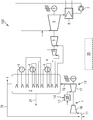
- FIG 1 an abstract schematical drawing of a combined cycle power plant 100 is shown.
- a gas turbine engine 1 and a steam turbine engine 3 is shown.
- the gas turbine engine 1 comprises an inlet 11, a compressor section 16, a combustor 12 and a turbine section 17.
- a fuel supply 14 is indicated by an arrow.
- An exhaust of the gas turbine engine 1 is not particularly shown but indicated via arrow 13.
- a fluid which is exhausted by the exhaust 13 is identified as exhaust fluid 15.
- the exhaust fluid 15 is provided to a heat exchanger 2, particularly a Heat Recovery Steam Generator (HRSG).
- HRSG Heat Recovery Steam Generator
- the steam turbine engine 3 comprises in the example a low, a medium and a high steam turbine section. Each section is driven by a supply from the heat exchanger 2. Condensers 4 are presented in a fluid path of the Rankine (steam) cycle.
- the gas turbine engine 1 is driving a generator 5, the steam turbine engine 3 a further generator 5. Alternatively mechanical components could be driven.
- Pumps or fans may be positioned in the cylces when needed.
- One compressor or fan 7 is depicted in the Rankine cycle past past another heat exchanger 6.
- Ambient air is provided to the gas turbine engine 1 via the position "a" in FIG. 1 .
- Exhaust of the gas turbine engine 1 is provided through the heat exchanger 2 - which identifies the connection between the gas turbine and the steam turbine cycles - and eventually will be passed into the ambient via position "c" of FIG.1 .
- An exhaust fluid recirculation line 10 is present in the gas turbine cycle to allow recirculation of a fraction of the exhaust fluid 15 back to the inlet 11 of the gas turbine engine 1.
- the exhaust fluid recirculation line 10 will preferably controlled by a valve (not shown) and may be provided with a fraction of the exhaust fluid 15 extracted downstream of the heat exchanger 2 (as shown in FIG. 1 ), extracted at a tap 21 of the heat exchanger 2 (only indicated by a dotted line in FIG. 1 ), or extracted directly past the exhaust 13 of the gas turbine engine 1 (not shown in FIG. 1 ).
- a control unit 20 is simply indicated by a dotted rectangle. A single or several control units may be present. The control unit 20 may control all shown components or only a subset.
- the exhaust fluid recirculation line 10 may be closed.
- the exhaust fluid recirculation line 10 may be opened by the control unit 20, such that a fraction of the exhaust fluid 15 - e.g. 40% - is delivered to the inlet 11 of the gas turbine engine 1. At the inlet 11, the recirculated fraction of the exhaust fluid 15 is then mixed with ambient air and provided to the compressor 16 of the gas turbine engine 1.
- the part load performance of a combined cycle power plant 100 is improved by introducing exhaust gas recirculation. Emissions considerations by maximising efficiency can be accomplished as the gas turbine mass-flow can be reduced to maintain a high combustion temperature without punishing component efficiencies too much.
- compressors of gas turbines are volume flow machines and hence, a reduced inlet gas density would reduce the mass-flow of a fixed-speed machine with a maintained volume flow. This means that if the inlet temperature is increased, the mass-flow can be reduced without compromising the compressor efficiency by turning the variable guide vanes.
- the compressor work will increase due to the fact that the amount of work required raising the pressure of a fluid increases, however, the overall effect is that the cycle efficiency increases. Recirculating exhaust fluid with increased temperatures take benefit from this effect.
- the purpose of recirculating exhaust fluid at part load is to reduce the gas turbine mass-flow by raising the inlet temperature.
- a higher gas temperature gives a lower gas density and thereby a reduced mass-flow. This means that the mass-flow can be reduced while the volume flow is maintained, which gives good compressor efficiency for a fixed speed gas turbine engine.
- variable guide vanes of the compressor When going down in loads (and with a closed exhaust fluid recirculation line 10), below the point where variable guide vanes of the compressor are fully closed, the mass flow cannot be reduced and hence the firing temperature will reduce rapidly. This will quite fast result in poor combustion efficiencies and emissions.
- exhaust fluid recirculation as a compliment or alternative to variable guide vanes to reduce mass flow, the mass flow can be reduced further down the load range. This means that the firing temperature and turbine inlet temperature can remain higher at lower loads.
- the first measure to reduce mass-flow would be to use exhaust fluid recirculation.
- the second measure if needed, would be to alter variable guide vane settings in the compressor 16 of the gas turbine engine 1.
- the variable guide vanes may be used to fine tune the flow to give a more accurate control.
- Recirculating exhaust fluid increases the H 2 O and CO 2 content at the inlet 11 of the compressor 16 but reduces the O 2 content of the working fluid.
- a key purpose of exhaust fluid recirculation is to increase the compressor inlet temperature.
- the exhaust mass flow reduces while the exhaust temperature remains high, this results in that the flue gas to steam/water flow ratio reduces with load and the efficiency of the heat exchanger 2 will increase i.e. the stack temperature is reduced.
- the steam cycle will experience a high exhaust temperature from the gas turbine but less mass-flow, which means that the feed-water to exhaust gas mass-flow ratio will increase resulting in an improved heat recovery. Thanks to the maintained high heat exchanger 2 inlet temperature, the reduced energy content mainly affects the low pressure circuit which will diminish with the load range. The overall effect on the steam cycle is that the efficiency remains fairly constant.
- Exhaust fluid reciculation can complement the variable guide vane mechanism as a measurement to reduce the mass-flow at part load and can improve both the efficiency and load range.
Landscapes
- Engineering & Computer Science (AREA)
- Chemical & Material Sciences (AREA)
- Combustion & Propulsion (AREA)
- Mechanical Engineering (AREA)
- General Engineering & Computer Science (AREA)
- Engine Equipment That Uses Special Cycles (AREA)
Priority Applications (1)
| Application Number | Priority Date | Filing Date | Title |
|---|---|---|---|
| EP15195839.4A EP3170995A1 (de) | 2015-11-23 | 2015-11-23 | Kombikraftwerk und zugehöriges verfahren zum betrieb |
Applications Claiming Priority (1)
| Application Number | Priority Date | Filing Date | Title |
|---|---|---|---|
| EP15195839.4A EP3170995A1 (de) | 2015-11-23 | 2015-11-23 | Kombikraftwerk und zugehöriges verfahren zum betrieb |
Publications (1)
| Publication Number | Publication Date |
|---|---|
| EP3170995A1 true EP3170995A1 (de) | 2017-05-24 |
Family
ID=54697484
Family Applications (1)
| Application Number | Title | Priority Date | Filing Date |
|---|---|---|---|
| EP15195839.4A Withdrawn EP3170995A1 (de) | 2015-11-23 | 2015-11-23 | Kombikraftwerk und zugehöriges verfahren zum betrieb |
Country Status (1)
| Country | Link |
|---|---|
| EP (1) | EP3170995A1 (de) |
Cited By (1)
| Publication number | Priority date | Publication date | Assignee | Title |
|---|---|---|---|---|
| CN113669158A (zh) * | 2021-08-09 | 2021-11-19 | 中国舰船研究设计中心 | 基于布雷顿-朗肯联合余热循环的螺杆动力推进系统 |
Citations (4)
| Publication number | Priority date | Publication date | Assignee | Title |
|---|---|---|---|---|
| US4271664A (en) * | 1977-07-21 | 1981-06-09 | Hydragon Corporation | Turbine engine with exhaust gas recirculation |
| US5794431A (en) * | 1993-07-14 | 1998-08-18 | Hitachi, Ltd. | Exhaust recirculation type combined plant |
| EP0887530A2 (de) * | 1997-06-27 | 1998-12-30 | Hitachi, Ltd. | Gasturbine mit Abgasrückführung |
| WO2010072710A2 (en) * | 2008-12-24 | 2010-07-01 | Alstom Technology Ltd | Power plant with co2 capture |
-
2015
- 2015-11-23 EP EP15195839.4A patent/EP3170995A1/de not_active Withdrawn
Patent Citations (4)
| Publication number | Priority date | Publication date | Assignee | Title |
|---|---|---|---|---|
| US4271664A (en) * | 1977-07-21 | 1981-06-09 | Hydragon Corporation | Turbine engine with exhaust gas recirculation |
| US5794431A (en) * | 1993-07-14 | 1998-08-18 | Hitachi, Ltd. | Exhaust recirculation type combined plant |
| EP0887530A2 (de) * | 1997-06-27 | 1998-12-30 | Hitachi, Ltd. | Gasturbine mit Abgasrückführung |
| WO2010072710A2 (en) * | 2008-12-24 | 2010-07-01 | Alstom Technology Ltd | Power plant with co2 capture |
Cited By (1)
| Publication number | Priority date | Publication date | Assignee | Title |
|---|---|---|---|---|
| CN113669158A (zh) * | 2021-08-09 | 2021-11-19 | 中国舰船研究设计中心 | 基于布雷顿-朗肯联合余热循环的螺杆动力推进系统 |
Similar Documents
| Publication | Publication Date | Title |
|---|---|---|
| US10830123B2 (en) | Systems and method for a waste heat-driven turbocharger system | |
| US6226974B1 (en) | Method of operation of industrial gas turbine for optimal performance | |
| JP5639568B2 (ja) | 2軸式ガスタービン | |
| US8479523B2 (en) | Method for gas turbine operation during under-frequency operation through use of air extraction | |
| EP2105598A2 (de) | System zur Erweiterung des Bereichs der Mindestfördermenge einer Turbomaschine | |
| EP2075438A1 (de) | Gasturbine | |
| JP3526433B2 (ja) | 蒸気注入型ガスタービン装置 | |
| US20140331686A1 (en) | Gas turbine combined cycle system | |
| US20150322861A1 (en) | Enhanced Turbine Cooling System Using a Blend of Compressor Bleed Air and Ambient Air | |
| JP2017044209A (ja) | ガスタービンをターンダウン状態で作動させる間にエミッションコンプライアンスを維持するためのシステム及び方法 | |
| JP2015214978A (ja) | 圧縮機吐出空気とタービン区画空気との混合物を用いる強化されたタービン冷却システム | |
| JP6356813B2 (ja) | 高圧力比ツインスプール産業用ガスタービンエンジン | |
| EP2623751B1 (de) | Verfahren und Vorrichtung zur Steuerung des Teillastverhaltens einer Turbine | |
| US12338827B2 (en) | Compressor for CO2 cycle with at least two cascade compression stages for assuring supercritical conditions | |
| JP2018520289A (ja) | 機械駆動用途における超低NOx排出ガスタービンエンジン | |
| US20160061060A1 (en) | Combined cycle power plant thermal energy conservation | |
| EP3170995A1 (de) | Kombikraftwerk und zugehöriges verfahren zum betrieb | |
| US20160010566A1 (en) | Method for operating a gas turbine below its rated power | |
| US20170058771A1 (en) | System and method for generating steam during gas turbine low-load conditions | |
| EP3735520B1 (de) | Verfahren zum hochfahren einer gasturbine eines kombikraftwerks | |
| US11859548B2 (en) | Gas turbine and control method thereof, and combined cycle plant | |
| JPH09125984A (ja) | 蒸気注入ガスタービンとその制御方法 | |
| WO2020095955A1 (ja) | ガスタービンシステム | |
| RU2820930C1 (ru) | Компрессор для цикла co2 с по меньшей мере двумя каскадными ступенями сжатия для обеспечения сверхкритических условий | |
| US20250283472A1 (en) | Compressor for co2 cycle with at least two cascade compression stages for assuring supercritical conditions |
Legal Events
| Date | Code | Title | Description |
|---|---|---|---|
| PUAI | Public reference made under article 153(3) epc to a published international application that has entered the european phase |
Free format text: ORIGINAL CODE: 0009012 |
|
| AK | Designated contracting states |
Kind code of ref document: A1 Designated state(s): AL AT BE BG CH CY CZ DE DK EE ES FI FR GB GR HR HU IE IS IT LI LT LU LV MC MK MT NL NO PL PT RO RS SE SI SK SM TR |
|
| AX | Request for extension of the european patent |
Extension state: BA ME |
|
| RAP1 | Party data changed (applicant data changed or rights of an application transferred) |
Owner name: SIEMENS AKTIENGESELLSCHAFT |
|
| STAA | Information on the status of an ep patent application or granted ep patent |
Free format text: STATUS: THE APPLICATION IS DEEMED TO BE WITHDRAWN |
|
| 18D | Application deemed to be withdrawn |
Effective date: 20171125 |