EP3173790A1 - Plate-forme de criblage d'allergie - Google Patents
Plate-forme de criblage d'allergie Download PDFInfo
- Publication number
- EP3173790A1 EP3173790A1 EP15003344.7A EP15003344A EP3173790A1 EP 3173790 A1 EP3173790 A1 EP 3173790A1 EP 15003344 A EP15003344 A EP 15003344A EP 3173790 A1 EP3173790 A1 EP 3173790A1
- Authority
- EP
- European Patent Office
- Prior art keywords
- allergens
- wells
- antibody
- antibodies
- basophils
- Prior art date
- Legal status (The legal status is an assumption and is not a legal conclusion. Google has not performed a legal analysis and makes no representation as to the accuracy of the status listed.)
- Withdrawn
Links
- 206010020751 Hypersensitivity Diseases 0.000 title claims description 34
- 230000007815 allergy Effects 0.000 title description 26
- 208000026935 allergic disease Diseases 0.000 title description 20
- 238000012216 screening Methods 0.000 title description 8
- 210000003651 basophil Anatomy 0.000 claims abstract description 96
- 239000013566 allergen Substances 0.000 claims abstract description 83
- NTYJJOPFIAHURM-UHFFFAOYSA-N Histamine Chemical compound NCCC1=CN=CN1 NTYJJOPFIAHURM-UHFFFAOYSA-N 0.000 claims abstract description 50
- 238000000034 method Methods 0.000 claims abstract description 50
- 108090000978 Interleukin-4 Proteins 0.000 claims abstract description 49
- 230000000172 allergic effect Effects 0.000 claims abstract description 46
- 208000010668 atopic eczema Diseases 0.000 claims abstract description 46
- 229960001340 histamine Drugs 0.000 claims abstract description 25
- 230000028327 secretion Effects 0.000 claims abstract description 7
- 102000004388 Interleukin-4 Human genes 0.000 claims description 48
- 210000003819 peripheral blood mononuclear cell Anatomy 0.000 claims description 37
- 238000001514 detection method Methods 0.000 claims description 27
- 108010021625 Immunoglobulin Fragments Proteins 0.000 claims description 25
- 102000008394 Immunoglobulin Fragments Human genes 0.000 claims description 25
- 108010002386 Interleukin-3 Proteins 0.000 claims description 16
- 239000013642 negative control Substances 0.000 claims description 12
- 210000001744 T-lymphocyte Anatomy 0.000 claims description 10
- 239000003795 chemical substances by application Substances 0.000 claims description 10
- 239000013641 positive control Substances 0.000 claims description 9
- 208000030961 allergic reaction Diseases 0.000 claims description 6
- YBJHBAHKTGYVGT-ZKWXMUAHSA-N (+)-Biotin Chemical compound N1C(=O)N[C@@H]2[C@H](CCCCC(=O)O)SC[C@@H]21 YBJHBAHKTGYVGT-ZKWXMUAHSA-N 0.000 claims description 4
- 102000002260 Alkaline Phosphatase Human genes 0.000 claims description 4
- 108020004774 Alkaline Phosphatase Proteins 0.000 claims description 4
- 108010001336 Horseradish Peroxidase Proteins 0.000 claims description 4
- -1 and (ii) antibodies Proteins 0.000 claims description 4
- 230000000779 depleting effect Effects 0.000 claims description 4
- 230000007613 environmental effect Effects 0.000 claims description 4
- 238000011534 incubation Methods 0.000 claims description 4
- 241001465754 Metazoa Species 0.000 claims description 3
- 229940079593 drug Drugs 0.000 claims description 3
- 239000003814 drug Substances 0.000 claims description 3
- 239000013568 food allergen Substances 0.000 claims description 3
- 108010090804 Streptavidin Proteins 0.000 claims description 2
- 229960002685 biotin Drugs 0.000 claims description 2
- 235000020958 biotin Nutrition 0.000 claims description 2
- 239000011616 biotin Substances 0.000 claims description 2
- 238000007747 plating Methods 0.000 claims description 2
- 239000013573 pollen allergen Substances 0.000 claims description 2
- 230000004044 response Effects 0.000 abstract description 18
- 230000000638 stimulation Effects 0.000 abstract description 2
- 229960004784 allergens Drugs 0.000 description 42
- 210000004027 cell Anatomy 0.000 description 20
- 241000282326 Felis catus Species 0.000 description 19
- 102000000646 Interleukin-3 Human genes 0.000 description 15
- 238000012360 testing method Methods 0.000 description 15
- 230000004913 activation Effects 0.000 description 13
- 210000004369 blood Anatomy 0.000 description 12
- 239000008280 blood Substances 0.000 description 12
- 235000017060 Arachis glabrata Nutrition 0.000 description 9
- 244000105624 Arachis hypogaea Species 0.000 description 9
- 235000010777 Arachis hypogaea Nutrition 0.000 description 9
- 235000018262 Arachis monticola Nutrition 0.000 description 9
- 102100025222 CD63 antigen Human genes 0.000 description 9
- 101000934368 Homo sapiens CD63 antigen Proteins 0.000 description 9
- 230000015572 biosynthetic process Effects 0.000 description 9
- 235000020232 peanut Nutrition 0.000 description 9
- 239000000243 solution Substances 0.000 description 9
- 239000000523 sample Substances 0.000 description 7
- 239000000427 antigen Substances 0.000 description 6
- 108091007433 antigens Proteins 0.000 description 6
- 102000036639 antigens Human genes 0.000 description 6
- 239000002609 medium Substances 0.000 description 6
- 210000002966 serum Anatomy 0.000 description 6
- 238000003556 assay Methods 0.000 description 5
- 239000011248 coating agent Substances 0.000 description 5
- 238000000576 coating method Methods 0.000 description 5
- 108010008211 N-Formylmethionine Leucyl-Phenylalanine Proteins 0.000 description 4
- 150000001875 compounds Chemical class 0.000 description 4
- 210000003743 erythrocyte Anatomy 0.000 description 4
- 238000002474 experimental method Methods 0.000 description 4
- 210000003630 histaminocyte Anatomy 0.000 description 4
- 238000009169 immunotherapy Methods 0.000 description 4
- 229920000136 polysorbate Polymers 0.000 description 4
- 230000004083 survival effect Effects 0.000 description 4
- 102000009438 IgE Receptors Human genes 0.000 description 3
- 108010073816 IgE Receptors Proteins 0.000 description 3
- 229940074608 allergen extract Drugs 0.000 description 3
- 238000005119 centrifugation Methods 0.000 description 3
- PRQROPMIIGLWRP-BZSNNMDCSA-N chemotactic peptide Chemical compound CSCC[C@H](NC=O)C(=O)N[C@@H](CC(C)C)C(=O)N[C@H](C(O)=O)CC1=CC=CC=C1 PRQROPMIIGLWRP-BZSNNMDCSA-N 0.000 description 3
- 239000012634 fragment Substances 0.000 description 3
- 230000036541 health Effects 0.000 description 3
- 230000028993 immune response Effects 0.000 description 3
- 230000017307 interleukin-4 production Effects 0.000 description 3
- 238000005259 measurement Methods 0.000 description 3
- 239000012528 membrane Substances 0.000 description 3
- 230000035945 sensitivity Effects 0.000 description 3
- 238000010181 skin prick test Methods 0.000 description 3
- 102000004127 Cytokines Human genes 0.000 description 2
- 108090000695 Cytokines Proteins 0.000 description 2
- LFQSCWFLJHTTHZ-UHFFFAOYSA-N Ethanol Chemical compound CCO LFQSCWFLJHTTHZ-UHFFFAOYSA-N 0.000 description 2
- 101001033279 Homo sapiens Interleukin-3 Proteins 0.000 description 2
- 206010070834 Sensitisation Diseases 0.000 description 2
- 239000012190 activator Substances 0.000 description 2
- 230000002009 allergenic effect Effects 0.000 description 2
- 238000002820 assay format Methods 0.000 description 2
- 238000000586 desensitisation Methods 0.000 description 2
- 238000003745 diagnosis Methods 0.000 description 2
- 239000007850 fluorescent dye Substances 0.000 description 2
- 102000055276 human IL3 Human genes 0.000 description 2
- 239000002919 insect venom Substances 0.000 description 2
- 239000000203 mixture Substances 0.000 description 2
- 230000008313 sensitization Effects 0.000 description 2
- 210000003491 skin Anatomy 0.000 description 2
- 230000003827 upregulation Effects 0.000 description 2
- 231100000611 venom Toxicity 0.000 description 2
- XLYOFNOQVPJJNP-UHFFFAOYSA-N water Chemical compound O XLYOFNOQVPJJNP-UHFFFAOYSA-N 0.000 description 2
- 241000251468 Actinopterygii Species 0.000 description 1
- 206010003645 Atopy Diseases 0.000 description 1
- 108700022150 Designed Ankyrin Repeat Proteins Proteins 0.000 description 1
- KCXVZYZYPLLWCC-UHFFFAOYSA-N EDTA Chemical compound OC(=O)CN(CC(O)=O)CCN(CC(O)=O)CC(O)=O KCXVZYZYPLLWCC-UHFFFAOYSA-N 0.000 description 1
- 229920001917 Ficoll Polymers 0.000 description 1
- 208000004262 Food Hypersensitivity Diseases 0.000 description 1
- 235000010469 Glycine max Nutrition 0.000 description 1
- 108010054477 Immunoglobulin Fab Fragments Proteins 0.000 description 1
- 102000001706 Immunoglobulin Fab Fragments Human genes 0.000 description 1
- ZDXPYRJPNDTMRX-VKHMYHEASA-N L-glutamine Chemical compound OC(=O)[C@@H](N)CCC(N)=O ZDXPYRJPNDTMRX-VKHMYHEASA-N 0.000 description 1
- 229930182816 L-glutamine Natural products 0.000 description 1
- 108010079855 Peptide Aptamers Proteins 0.000 description 1
- 108010003723 Single-Domain Antibodies Proteins 0.000 description 1
- GUGOEEXESWIERI-UHFFFAOYSA-N Terfenadine Chemical compound C1=CC(C(C)(C)C)=CC=C1C(O)CCCN1CCC(C(O)(C=2C=CC=CC=2)C=2C=CC=CC=2)CC1 GUGOEEXESWIERI-UHFFFAOYSA-N 0.000 description 1
- 238000004458 analytical method Methods 0.000 description 1
- 231100000659 animal toxin Toxicity 0.000 description 1
- 230000001387 anti-histamine Effects 0.000 description 1
- 239000000739 antihistaminic agent Substances 0.000 description 1
- 238000013459 approach Methods 0.000 description 1
- 210000003719 b-lymphocyte Anatomy 0.000 description 1
- 238000005842 biochemical reaction Methods 0.000 description 1
- 238000000423 cell based assay Methods 0.000 description 1
- 239000002458 cell surface marker Substances 0.000 description 1
- 230000036755 cellular response Effects 0.000 description 1
- 230000002596 correlated effect Effects 0.000 description 1
- 238000004132 cross linking Methods 0.000 description 1
- 230000009260 cross reactivity Effects 0.000 description 1
- 238000000432 density-gradient centrifugation Methods 0.000 description 1
- 230000001419 dependent effect Effects 0.000 description 1
- 238000010790 dilution Methods 0.000 description 1
- 239000012895 dilution Substances 0.000 description 1
- 230000003292 diminished effect Effects 0.000 description 1
- 239000012153 distilled water Substances 0.000 description 1
- 239000000428 dust Substances 0.000 description 1
- 230000000694 effects Effects 0.000 description 1
- 210000000981 epithelium Anatomy 0.000 description 1
- 235000019688 fish Nutrition 0.000 description 1
- 235000013305 food Nutrition 0.000 description 1
- 235000020932 food allergy Nutrition 0.000 description 1
- 239000003102 growth factor Substances 0.000 description 1
- 239000001963 growth medium Substances 0.000 description 1
- 210000002865 immune cell Anatomy 0.000 description 1
- 238000004519 manufacturing process Methods 0.000 description 1
- 239000003550 marker Substances 0.000 description 1
- 235000013372 meat Nutrition 0.000 description 1
- 230000001404 mediated effect Effects 0.000 description 1
- 235000013336 milk Nutrition 0.000 description 1
- 239000008267 milk Substances 0.000 description 1
- 210000004080 milk Anatomy 0.000 description 1
- 239000003607 modifier Substances 0.000 description 1
- 235000014571 nuts Nutrition 0.000 description 1
- 239000013610 patient sample Substances 0.000 description 1
- 108020003175 receptors Proteins 0.000 description 1
- 102000005962 receptors Human genes 0.000 description 1
- 235000015170 shellfish Nutrition 0.000 description 1
- 238000010186 staining Methods 0.000 description 1
- 238000010561 standard procedure Methods 0.000 description 1
- 230000004936 stimulating effect Effects 0.000 description 1
- 239000000126 substance Substances 0.000 description 1
- 231100000617 superantigen Toxicity 0.000 description 1
Images




Classifications
-
- G—PHYSICS
- G01—MEASURING; TESTING
- G01N—INVESTIGATING OR ANALYSING MATERIALS BY DETERMINING THEIR CHEMICAL OR PHYSICAL PROPERTIES
- G01N33/00—Investigating or analysing materials by specific methods not covered by groups G01N1/00 - G01N31/00
- G01N33/48—Biological material, e.g. blood, urine; Haemocytometers
- G01N33/50—Chemical analysis of biological material, e.g. blood, urine; Testing involving biospecific ligand binding methods; Immunological testing
- G01N33/68—Chemical analysis of biological material, e.g. blood, urine; Testing involving biospecific ligand binding methods; Immunological testing involving proteins, peptides or amino acids
- G01N33/6863—Cytokines, i.e. immune system proteins modifying a biological response such as cell growth proliferation or differentiation, e.g. TNF, CNF, GM-CSF, lymphotoxin, MIF or their receptors
- G01N33/6869—Interleukin
-
- G—PHYSICS
- G01—MEASURING; TESTING
- G01N—INVESTIGATING OR ANALYSING MATERIALS BY DETERMINING THEIR CHEMICAL OR PHYSICAL PROPERTIES
- G01N2333/00—Assays involving biological materials from specific organisms or of a specific nature
- G01N2333/435—Assays involving biological materials from specific organisms or of a specific nature from animals; from humans
- G01N2333/52—Assays involving cytokines
- G01N2333/54—Interleukins [IL]
- G01N2333/5406—IL-4
-
- G—PHYSICS
- G01—MEASURING; TESTING
- G01N—INVESTIGATING OR ANALYSING MATERIALS BY DETERMINING THEIR CHEMICAL OR PHYSICAL PROPERTIES
- G01N2800/00—Detection or diagnosis of diseases
- G01N2800/24—Immunology or allergic disorders
Definitions
- the present invention relates to methods for the qualitative and quantitative determination of the allergic status of a subject in relation to one or more allergens of interest, comprising steps of determining IL-4 and/or histamine secretion of basophils in response to stimulation with said allergens.
- the present invention further relates to kits for performing said methods.
- Basophils are a small subset of immune cells within the peripheral blood mononuclear cell (PBMC) population of the blood. They bind specific IgE antibodies on their cell surface via the receptor Fc ⁇ RI and get activated by specific antigens/allergens. They release histamine and cytokines such as IL-4 after activation. Accordingly, basophils are among the main mediators of symptomatically and clinically manifest allergy.
- PBMC peripheral blood mononuclear cell
- the technical problem underlying the present invention is the provision of means for the reliable, specific, easy, and safe diagnosis of symptomatically and clinically manifest allergy.
- the present invention relates to a method for the qualitative and quantitative determination of the allergic status of a subject in relation to one or more allergens of interest, said method comprising the steps of:
- the term “qualitative and quantitative determination of the allergic status of a subject” as used herein relates to the fact that with the methods of the present invention, not only the presence or absence of an allergy against a given allergen, but also the severity of the allergic reaction can be determined. Further, the term “allergic status of a subject” as used herein relates to both of these qualitative and quantitative parameters, i.e., said term encompasses information concerning the presence of an allergy against a given allergen, as well as the severity of the respective allergic reaction.
- Allergens of interest that can be used and assessed in the methods of the present invention are not particularly limited and include any compounds, compositions or substances that are known to or suspected of causing allergic reactions.
- Allergens can be native isolated allergens such as allergen extracts, or recombinant allergens. Allergens can be selected from the group consisting of pollen allergens, drug allergens, environmental allergens, animal allergens, and food allergens.
- Exemplary environmental allergens include mold or dust mite allergens.
- Exemplary animal allergens include cat and dog allergens.
- Exemplary food allergens include allergens derived from peanut (e.g. ara h 1, 2, 3, 4, 5, 6), milk, soy, shell fish, fish, meat, and tree nuts.
- Exemplary animal toxins include insect venoms.
- peripheral blood mononuclear cells are provided from the subject.
- This step expressly excludes the step of obtaining a respective sample, e.g. a whole blood sample, from the patient.
- PBMCs can be isolated from whole blood or other sample material by methods known in the art, e.g. by density gradient centrifugation.
- the surface having one or more discrete wells provided in step (b) of the methods of the present invention can be any well plate known and/or used in the art.
- said plate is a multi-well plate, e.g. a 96-well plate.
- any other multi-well format can equally be used.
- the wells of said surface are coated with at least one of (i) antibodies, antibody fragments, or antibody mimetics directed against IL-4, and (ii) antibodies, antibody fragments, or antibody mimetics directed against histamine.
- antibody fragments as used herein relates to Fab fragments, F(ab') 2 fragments and Fab' fragments.
- antibody mimetic as used herein relates to proteinaceous compounds that, like antibodies, are capable of binding to a given target structure in a specific manner.
- antibody mimetics are selected from the group consisting of single-chain variable fragments (scFv), single-domain antibodies, affibodies, affilins, affimers, affitins, anticalins, DARPins, monobodies, and peptide aptamers.
- scFv single-chain variable fragments
- Methods for the coating of a surface e.g. the wells of a multi-well plate, with antibodies, antibody fragments, or antibody mimetics are not particularly limited and are known in the art. They include for example the incubation of said surface with a respective antibody, antibody fragment, or antibody mimetic solution, e.g. at 4°C for at least 12 hours.
- the term "directed against IL-4" indicates the antigen that is specifically recognized by the respective antibody, antibody fragment, or antibody mimetic.
- antibody directed against IL-4" is expressly used synonymously to the term “anti-IL-4 antibody”.
- the methods of the present invention when used in a multi-well format, allow for each well the specific selection of antibody coating, type of coating antibody, addition of cells, amount of cells added, addition of IL-3, amount of IL-3 added, addition of allergens, type of allergens, amount of allergens added, and addition of negative or positive control solutions, as suited for the respective assay to be conducted.
- the terms "said wells are coated", “adding rigid to said wells", and the like are expressly intended to relate to the fact that only selected wells as suitable for the assay to be conducted are meant.
- a multi-well plate used in a method of the present invention may include wells that are not coated, that do not receive any cells, that do not receive any IL-3, that do not receive any allergens, that receive positive or negative control solutions, and/or that do not receive any detection agents.
- PBMCs are plated in the one or more wells.
- the number of cells per well is suitably selected and may be between 10 3 and 10 6 cells, preferably about 250000 cells.
- IL-3 preferably recombinant human IL-3 (hrIL-3) is added to the wells, preferably in a concentration of 10 to 100 ng/ml, more preferably 10 to 50 ng/ml, e.g. about 30 ng/ml.
- IL-3 serves as a growth factor for basophils, allowing the growth of said cells.
- the one or more allergens of interest are added to the one or more wells.
- one allergen is added per well, although combinations of allergens can also be used in one well.
- the amount of allergen can be between 0.01 and 50 ⁇ g/ml, preferably between 0.01 and 30 ⁇ g/ml. Further, it can be reasonable to use dilution series of allergen in different wells, e.g. 0.15, 1.5, and 15 ⁇ g/ml.
- steps (c), (d), and (e) can be performed simultaneously, e.g. the PBMCs, IL-3 and allergens can be combined prior to addition to the wells.
- Step (e) of the methods of the present invention can further comprise the step of adding negative and/or positive controls to selected wells.
- negative control medium can be used, e.g. the medium in which also the allergens are solved.
- positive control for basophils anti-Fc ⁇ antibodies can be used in combination with the peptide fMLP ( N -Formylmethionine-leucyl-phenylalanine).
- Step (f) of the methods of the present invention encompasses incubation of the surface for a time and at conditions that allow for the secretion of IL-4, and histamine by basophils. Suitable conditions and durations are known in the art.
- the surface can be incubated at 37°C for at least 12 hours.
- step (g) of the methods of the present invention spots in said one or more wells where IL-4 and/or histamine secreted by basophils has been captured by the respective antibodies, antibody fragments, or antibody mimetics are detected.
- Respective methods for detecting said spots are not particularly limited and are known in the art.
- step (g) of the methods of the present invention comprises the steps of:
- the respective detection antibodies, antibody fragments, or antibody mimetics are preferably directed against a different epitope of the respective antigen as the antibodies, antibody fragments, or antibody mimetics used for coating.
- the binding moiety can be any structure or compound that can be specifically recognized by a binding partner, i.e ., by the secondary detection agent. Suitable binding pairs are not particularly limited and are known in the art.
- the signal-generating moiety can be any structure or compound that can directly or indirectly generate a detectable signal.
- said binding moiety is biotin
- said secondary detection agent is streptavidin
- said signal-generating moiety is alkaline phosphatase (AP) or horseradish peroxidase (HRP)
- AP alkaline phosphatase
- HRP horseradish peroxidase
- the methods of the present invention further comprise, after step (g2) and prior to step (g3), a step of adding a suitable detection solution to said one or more wells.
- Suitable detection solutions for use in combination with AP or HRP are not particularly limited and are known in the art.
- the signal-generating moiety is a fluorescent moiety, such as e.g. a fluorescent dye as known in the art.
- the amount of spots correlates with the severity of the subject's allergic reaction, i.e ., the more spots are detected, the more severe the subject's allergic reaction to the respective allergen is.
- the methods of the present invention further comprise, after step (a) and prior to step (c), a step of depleting T cells from said PBMCs.
- Respective methods for depleting T cells from PBMCs are not particularly limited and are known in the art. In this context, depletion of T cells can be employed to ensure that a basophil response is detected. However, even in the presence of T cells, spots detected in the methods of the present invention are to a vast majority derived from basophils. Therefore, T cell depletion is not a necessity.
- the subject in the methods of the present invention is human.
- the present invention relates to a kit, comprising the surface, antibodies, antibody fragments, or antibody mimetics, detection antibodies, antibody fragments, or antibody mimetics, secondary detection agents, and optionally detection solutions as defined.
- the term "about” is intended to be a modifier of ⁇ 10% of the specified value.
- the term “about 250000” is intended to encompass the range of 225000 to 275000.
- the allergy screening panel based on allergen-specific Basophil responses is a novel platform of a cell-based assay to screen for allergies in whole blood samples of patients. It is based on the principle that basophils respond with Histamine and IL-4 release after encountering specific allergenic epitopes.
- the allergy screening panel is designed in a multi-well format. When incubated with recombinant allergen epitopes, only basophils from allergic patients will respond and release Histamine and IL-4 and the released molecules can be visualized as spots on a membrane where one spot represents one cell that responded.
- This novel basophil assay will simplify screening for specific allergen epitopes and will aid to tailor a patient specific desensitization treatment. Furthermore, the amount of spots correlates with the severity of an allergy and, therefore, helps to predict how strong a patient will respond after being exposed to allergens.
- the conjunction of allergen specific basophil responses in 96-well format to screen for allergen specific immune responses provides a novel platform to assess the allergic state of a patient.
- This test provides enhanced sensitivity over Serum IgE or skin prick testing.
- the principle of this invention is measuring IL-4 release as a measure of cellular response to cognate allergen binding specific IgE antibodies and crosslinking Fc ⁇ RI on basophils.
- the activation of basophils is depending on the amount of surface bound allergen and specific IgE. Measuring the T cell frequency and specific amounts of serum level IgE alone is not reflective of the allergic status of a patients as sensitized persons that are non-responders display allergen specific T-cells and might have certain levels of specific serum IgE present.
- the multiwell plate format of the present invention provides a novel approach for health care providers to screen for specific allergic epitopes and asses to which epitopes the patients are responding in a convenient and simple format. The data gained by this test can be used to tailor a patient specific treatment plan for immunotherapy. Furthermore, it gives health care providers an assessment tool at hand to monitor the allergic responses throughout immunotherapy without using current state of the art methods such as oral food challenge that might harm the patient.
- IL-3 as a growth and survival factor for basophils is enabling the measurement of specific IgE responses and sensitization status of the patient. Although IL-3 can induce IL-4 production in basophils at the levels used for this test, this phenomenon can be easily controlled for.
- the allergy analysis platform is intended as a novel tool to screen for allergy in general, screen for specific allergenic epitopes, to assess the allergic status of a patient and to monitor allergic responses during immunotherapy.
- Basophil antigen/allergen specific responses provide a novel screening format for allergies.
- Patient derived basophils can be tested with multiple panels of allergens in a 96-well format. This can be utilized with allergen extracts or specific recombinant allergens to identify specific epitopes a patient is responding to. It is suitable for all allergens, such as environmental allergens, pollen, insect venom, medication allergies and food allergies, as true allergies are all IgE mast cell/basophil dependent immune responses.
- the methods of the present invention will be a helpful tool for a health care provider to understand and diagnose the allergic status of a patient. Especially during desensitization treatment it provides with a simple blood draw a superior and less dangerous way to measure treatment efficacy compared to allergen challenge of the patient.
- IL-4 positive spots can be measured if a sample is treated with either Fc ⁇ R-I, a basophil specific activator, or if PBMCs of an allergic donor are incubated with the relevant epitope. Furthermore, these spots are not present if the basophil population was depleted from the patient samples, indicating that basophils are the major producers of IL-4 under the suggested experimental conditions.
- PBMCs of allergic and healthy donors where treated with anti Fc ⁇ R-I and fMLP as positive control for basophils.
- PBMCs of donors where incubated with relevant or non-relevant allergic epitopes to explore the possibility of false positivity or cross reactivity.
- Non relevant epitopes result in some back ground spots but relevant epitopes display a significant higher spot formation.
- PBMC's from allergic patients respond to exposure of a relevant recombinant allergen with production of IL-4.
- Allergic immune responses are characterized by a TH2 response.
- T cells that are sensitized for specific allergens produce upon re-stimulation with the cognate antigen TH2 cytokines. They provide T cell help and induce in B-cells a class switch to IgE antibodies. These antibodies are bound to the high affinity receptor FC- ⁇ R-I on the surface of mast cells within epithelial tissues or in the surface of basophils within the blood. Mast cells and basophils respond upon antigen recognition with release of Histamine that induces the allergic response. Basophils produce IL-4 and IL-13 after the release of histamine.
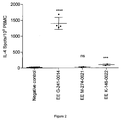
- PBMCs of cat allergic donors respond with IL-4 production after exposure to recombinant Feld 1 ( Figure.1 ).
- IL-4 spots are depending on basophils.
- IL-3 is a crucial survival factor for basophils. IL-3 was added to the medium to enhance basophil survival and enable to measure basophil specific responses to recombinant allergens. Comparison of IL-4 spot formation from cat allergic donors with and without IL-3 showed a significant increase in spot counts ( Figure 3 )
- basophils were depleted from the PBMC subsets of healthy and allergic donors. Basophil depletion with an antibody against IgE that crosslinks basophils to red blood cells during the density centrifugation step was used. Whole blood of cat allergic and non-allergic donors was spitted in halve and one part was not treated and the other was incubated with an antibody against IgE that crosslinks basophils to red blood cells. During density centrifugation the red blood cells and the linked basophils get depleted from the sample, leaving a PBMC population behind that lacks basophils.
- Basophil IL-4 spot formation correlates with basophil activation.
- the basophil activation test is a highly specific test that utilizes extracellular staining for CD63. This membrane bound molecule is present in histamine vesicles and gets shuttled to the cell surfaces of basophils during activation after allergen exposure. The surface expression of CD63 correlates with the severity of an allergic donor.
- the method comparison showed that the IL-4 spot formation correlated well with the CD63 surface expression on basophils. Donors that displayed low levels of surface CD63 expression displayed low spot formation. And donors that displayed high basophil activation displayed high spot formation ( Figure 5 ). These results indicate that the IL-4 spot formation correlates with the severity of an allergy present in a donor.
- Basophil IL-4 spot formation is allergen specific response.
- the suggested assay format is suitable for all types of IgE mediated allergies.
- Cat and Peanut allergic donors have been tested with specific recombinant allergens and displayed significant spot count compared to negative controls ( Figure 6 ). These responses are specific as basophils from cat allergic donors responded with IL-4 production to exposure of Fel d 1 but did not produce IL-4 positive spots in response to peanut allergens such as Ara h 2.
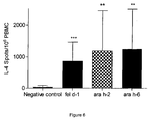
- PBMCs obtained from peanut allergic donors responded well to Ara h 2 and Ara h 6 exposure but did not produce IL-4 in response to soy allergens Gly m 4 and Gly m 5 ( Figure 7 ).
- PBMCs obtained from peanut allergic donors responded well to Ara h 2 and Ara h 6 exposure but did not produce IL-4 in response to soy allergens Gly m 4 and Gly m 5 ( Figure 7 ).
Landscapes
- Life Sciences & Earth Sciences (AREA)
- Health & Medical Sciences (AREA)
- Engineering & Computer Science (AREA)
- Immunology (AREA)
- Molecular Biology (AREA)
- Chemical & Material Sciences (AREA)
- Urology & Nephrology (AREA)
- Biomedical Technology (AREA)
- Cell Biology (AREA)
- Hematology (AREA)
- Medicinal Chemistry (AREA)
- Biochemistry (AREA)
- Biotechnology (AREA)
- Food Science & Technology (AREA)
- Proteomics, Peptides & Aminoacids (AREA)
- Physics & Mathematics (AREA)
- Analytical Chemistry (AREA)
- Microbiology (AREA)
- General Health & Medical Sciences (AREA)
- General Physics & Mathematics (AREA)
- Pathology (AREA)
- Measuring Or Testing Involving Enzymes Or Micro-Organisms (AREA)
- Micro-Organisms Or Cultivation Processes Thereof (AREA)
- Investigating Or Analysing Biological Materials (AREA)
Priority Applications (1)
| Application Number | Priority Date | Filing Date | Title |
|---|---|---|---|
| EP15003344.7A EP3173790A1 (fr) | 2015-11-24 | 2015-11-24 | Plate-forme de criblage d'allergie |
Applications Claiming Priority (1)
| Application Number | Priority Date | Filing Date | Title |
|---|---|---|---|
| EP15003344.7A EP3173790A1 (fr) | 2015-11-24 | 2015-11-24 | Plate-forme de criblage d'allergie |
Publications (1)
| Publication Number | Publication Date |
|---|---|
| EP3173790A1 true EP3173790A1 (fr) | 2017-05-31 |
Family
ID=54770761
Family Applications (1)
| Application Number | Title | Priority Date | Filing Date |
|---|---|---|---|
| EP15003344.7A Withdrawn EP3173790A1 (fr) | 2015-11-24 | 2015-11-24 | Plate-forme de criblage d'allergie |
Country Status (1)
| Country | Link |
|---|---|
| EP (1) | EP3173790A1 (fr) |
Citations (2)
| Publication number | Priority date | Publication date | Assignee | Title |
|---|---|---|---|---|
| EP1241476A1 (fr) * | 2001-03-12 | 2002-09-18 | Mabtech AB | Diagnostic d'une allergie à un métal au moyen de la libération de cytokines par des cellules T in vitro |
| WO2014115102A1 (fr) * | 2013-01-23 | 2014-07-31 | Institut National De La Sante Et De La Recherche Medicale | Nombre de lymphocytes t sécrétant de l'il4 et/ou de l'il3 utilisé en tant que biomarqueur pour maladies allergiques |
-
2015
- 2015-11-24 EP EP15003344.7A patent/EP3173790A1/fr not_active Withdrawn
Patent Citations (2)
| Publication number | Priority date | Publication date | Assignee | Title |
|---|---|---|---|---|
| EP1241476A1 (fr) * | 2001-03-12 | 2002-09-18 | Mabtech AB | Diagnostic d'une allergie à un métal au moyen de la libération de cytokines par des cellules T in vitro |
| WO2014115102A1 (fr) * | 2013-01-23 | 2014-07-31 | Institut National De La Sante Et De La Recherche Medicale | Nombre de lymphocytes t sécrétant de l'il4 et/ou de l'il3 utilisé en tant que biomarqueur pour maladies allergiques |
Non-Patent Citations (4)
| Title |
|---|
| KLEINE BUDDE I ET AL: "The stripped basophil histamine release bioassay as a tool for the detection of allergen-specific IgE in serum.", INTERNATIONAL ARCHIVES OF ALLERGY AND IMMUNOLOGY DEC 2001, vol. 126, no. 4, December 2001 (2001-12-01), pages 277 - 285, XP009189112, ISSN: 1018-2438 * |
| M T KASAIAN ET AL: "IL-4 production by allergen-stimulated primary cultures: identification of basophils as the major IL-4-producing cell type", INTERNATIONAL IMMUNOLOGY, 1 August 1996 (1996-08-01), ENGLAND, pages 1287 - 1297, XP055258486, Retrieved from the Internet <URL:http://intimm.oxfordjournals.org/content/8/8/1287.full.pdf> [retrieved on 20160315], DOI: 10.1093/intimm/8.8.1287 * |
| MINANG JACOB T ET AL: "ELIspot displays a better detection over ELISA of T helper (Th) 2-type cytokine-production by ex vivo-stimulated antigen-specific T cells from human peripheral blood", IMMUNOLOGICAL INVESTIGATIONS, vol. 37, no. 4, 2008, pages 279 - 291, XP009189111, ISSN: 0882-0139 * |
| SAINTE-LAUDY J ET AL: "Enhanced human basophil activation and histamine release by IL3 priming: application to sulfite allergy diagnosis.", INFLAMMATION RESEARCH : OFFICIAL JOURNAL OF THE EUROPEAN HISTAMINE RESEARCH SOCIETY ... [ET AL.] APR 1995, vol. 44 Suppl 1, April 1995 (1995-04-01), pages S3 - S4, XP009189125, ISSN: 1023-3830 * |
Similar Documents
| Publication | Publication Date | Title |
|---|---|---|
| KR101248491B1 (ko) | Ip-10에 기초한 면역학적 모니터링 | |
| JP6170071B2 (ja) | Cns損傷についてのバイオマーカーとしての自然免疫タンパク質 | |
| Gopinath et al. | A novel approach to study markers of dopamine signaling in peripheral immune cells | |
| JP4272431B2 (ja) | 診断試験法 | |
| EP2005182B1 (fr) | Correlats cliniques | |
| US20230349890A1 (en) | Method for determination of basophil activation and kits therefore | |
| Araujo et al. | Respiratory allergy to moth: the importance of sensitization to Bombyx mori in children with asthma and rhinitis | |
| Hall et al. | Simultaneous detection and quantification of six equine cytokines in plasma using a fluorescent microsphere immunoassay (FMIA) | |
| US20200011865A1 (en) | Methods and kits for detecting basophil activation | |
| Arif-Lusson et al. | Streamlining basophil activation testing to enable assay miniaturization and automation of sample preparation | |
| WO2015095136A1 (fr) | Diagnostic sur la base d'immunosignatures et caractérisation de lymphome canin | |
| WO2024174810A1 (fr) | Kit de criblage d'allergènes basé sur le typage de réponses inflammatoires et utilisation associée | |
| EP2948770B1 (fr) | Nombre de lymphocytes t sécrétant il4 et/ou il13 comme biomarqueur d'allergies | |
| KR102547565B1 (ko) | 호염기구 활성화 검사 방법 | |
| EP3173790A1 (fr) | Plate-forme de criblage d'allergie | |
| RU2426130C2 (ru) | Экспресс-тест для диагностирования болезни альцгеймера | |
| Ciepiela et al. | Basophil activation test based on the expression of CD203c in the diagnostics of cow milk allergy in children | |
| US20120040864A1 (en) | Method for Determining the Cbl-b Expression | |
| WO2023046111A1 (fr) | Procédé de détection d'activation de basophiles et application associée | |
| Szymczak-Pajor et al. | Comparison of an automated microfluidic immunoassay technology (BioIC, lab-on-chips) and ImmunoCAP assay. Lab-on-chips as a tool for specific IgE (sIgE) detection | |
| AU2011215826B2 (en) | Compositions and methods for predicting cardiovascular events | |
| EP4484951A1 (fr) | Procédé basé sur une batte pour déterminer la prévalence et/ou la gravité d'une allergie chez un individu et kits associés | |
| JP5625155B2 (ja) | ホスファチジルセリン特異的ホスホリパーゼa1測定による全身性エリテマトーデスの検査方法および検査薬 | |
| CN119901916A (zh) | 瓜氨酸化自身抗原特异性细胞免疫功能检测试剂盒、检测方法及应用 | |
| JP2025518588A (ja) | アレルゲン免疫療法のためのバイオマーカー |
Legal Events
| Date | Code | Title | Description |
|---|---|---|---|
| PUAI | Public reference made under article 153(3) epc to a published international application that has entered the european phase |
Free format text: ORIGINAL CODE: 0009012 |
|
| AK | Designated contracting states |
Kind code of ref document: A1 Designated state(s): AL AT BE BG CH CY CZ DE DK EE ES FI FR GB GR HR HU IE IS IT LI LT LU LV MC MK MT NL NO PL PT RO RS SE SI SK SM TR |
|
| AX | Request for extension of the european patent |
Extension state: BA ME |
|
| STAA | Information on the status of an ep patent application or granted ep patent |
Free format text: STATUS: THE APPLICATION IS DEEMED TO BE WITHDRAWN |
|
| 18D | Application deemed to be withdrawn |
Effective date: 20171201 |