EP3175672B1 - Listen-before-talk-basierter medienzugriff - Google Patents
Listen-before-talk-basierter medienzugriff Download PDFInfo
- Publication number
- EP3175672B1 EP3175672B1 EP14750816.2A EP14750816A EP3175672B1 EP 3175672 B1 EP3175672 B1 EP 3175672B1 EP 14750816 A EP14750816 A EP 14750816A EP 3175672 B1 EP3175672 B1 EP 3175672B1
- Authority
- EP
- European Patent Office
- Prior art keywords
- communication station
- sensing
- lbt
- based medium
- medium access
- Prior art date
- Legal status (The legal status is an assumption and is not a legal conclusion. Google has not performed a legal analysis and makes no representation as to the accuracy of the status listed.)
- Active
Links
Images




Classifications
-
- H—ELECTRICITY
- H04—ELECTRIC COMMUNICATION TECHNIQUE
- H04W—WIRELESS COMMUNICATION NETWORKS
- H04W74/00—Wireless channel access
- H04W74/08—Non-scheduled access, e.g. ALOHA
- H04W74/0808—Non-scheduled access, e.g. ALOHA using carrier sensing, e.g. carrier sense multiple access [CSMA]
Definitions
- the proposed technology generally relates to a method, performed by a communication station, for Listen-Before-Talk, LBT, based medium access, a communication station configured for LBT based medium access, and a corresponding computer program and computer program carrier.
- medium access is of outmost importance for the operation and performance of communication networks.
- LBT Listen-Before-Talk
- Yet another object is to provide a corresponding computer program and computer program carrier.
- a method performed by a communication station, for Listen-Before-Talk, LBT, based medium access.
- the method comprises the step of performing an LBT-based medium access procedure including:
- the method further comprises the step of waiting, when the communication station has transmitted, for a waiting duration that is based on a time duration between consecutive sensing occasions for at least one other communication station, also operating according to an LBT-based medium access procedure on the shared radio spectrum, before performing the LBT-based medium access procedure again.
- the other communication station(s) are also allowed/ensured access to the radio-based medium on the shared radio spectrum, or at least the chances to access the medium are greatly improved, when performing a corresponding LBT-based medium access procedure.
- this enables a more balanced and/or fair medium or channel sharing between different communication stations, belonging to the same or different networks.
- a communication station configured for Listen-Before-Talk, LBT, based medium access.
- the communication station is configured to perform an LBT-based medium access procedure including:
- the communication station is also configured to wait, when the communication station has transmitted, for a waiting duration that is based on a time duration between consecutive sensing occasions for at least one other communication station, also operating according to an LBT-based medium access procedure on the shared radio spectrum, before performing the LBT-based medium access procedure again.
- a computer program comprising instructions, which when executed by at least one processor, cause the at least one processor to:
- a carrier comprising the computer program according to the third aspect.
- a communication station for performing Listen-Before-Talk, LBT, based medium access.
- the communication station comprises:
- the communication system includes a number of communication stations, including radio base stations and/or mobile stations.
- the communication system includes a number of communication stations, including radio base stations and/or mobile stations.
- radio base station may refer to different types of base stations including standardized base stations such as Node Bs, or evolved Node Bs, eNBs, and also macro/micro/pico radio base stations, home base stations, also known as femto base stations, relay nodes, repeaters, radio access points, base transceiver stations, BTSs, and even radio control nodes controlling one or more Remote Radio Units, RRUs, or the like.
- base stations such as Node Bs, or evolved Node Bs, eNBs, and also macro/micro/pico radio base stations, home base stations, also known as femto base stations, relay nodes, repeaters, radio access points, base transceiver stations, BTSs, and even radio control nodes controlling one or more Remote Radio Units, RRUs, or the like.
- the non-limiting terms "mobile station”, “User Equipment” or “wireless device” may refer to a mobile phone, a cellular phone, a Personal Digital Assistant, PDA, equipped with radio communication capabilities, a smart phone, a laptop or Personal Computer, PC, equipped with an internal or external mobile broadband modem, a tablet PC with radio communication capabilities, a target device, a device to device UE, a machine type UE or UE capable of machine to machine communication, iPAD, customer premises equipment, CPE, laptop embedded equipment, LEE, laptop mounted equipment, LME, USB dongle, a portable electronic radio communication device, a sensor device equipped with radio communication capabilities or the like.
- mobile station should be interpreted as a non-limiting term comprising any type of wireless device communicating with a radio network node in a cellular or mobile communication system or any device equipped with radio circuitry for wireless communication according to any relevant standard for communication within a cellular or mobile communication system.
- FIG. 2 is a schematic flow diagram illustrating an example of a method for LBT based medium access according to an embodiment. The method is performed by a communication station.
- the method comprises the step S1 of performing an LBT-based medium access procedure including:
- the method further comprises the step S2 of waiting, when the communication station has transmitted, for a waiting duration that is based on a time duration between consecutive sensing occasions for at least one other communication station, also operating according to an LBT-based medium access procedure on the shared radio spectrum, before performing the LBT-based medium access procedure again.
- the other communication station(s) are also allowed/ensured access to the radio-based medium on the shared radio spectrum, or at least the chances to access the medium are greatly improved, when performing a corresponding LBT-based medium access procedure.
- this enables a more balanced and/or fair medium or channel sharing between different communication stations, belonging to the same or different networks.
- the waiting step can be expressed as: repeating, when the communication station has transmitted, the LBT-based medium access procedure after expiry of a waiting duration that is based on a time duration between consecutive sensing occasions for at least one other communication station, also operating according to an LBT-based medium access procedure on the shared radio spectrum.
- the LBT-based medium access procedure is repeated or performed again only after the waiting duration has expired.
- the proposed LBT-based medium access can be seen as an adaptive LBT-based medium access protocol since the waiting duration is dependent on a time duration between consecutive sensing occasions for at least one other communication station.
- the Listen-Before-Talk, LBT, procedure is referred to as Sense-Before-Transmit.
- the channel sensing may be performed by estimating a received signal level, and the determination of whether or not there is an on-going transmission can be done, e.g. by comparing the received signal level to a threshold level. If the received signal level is below the threshold level, the medium is considered to be free and accessible. If the received signal level exceeds the threshold level, the medium is considered to be occupied by an on-going transmission.
- the threshold level can for example be a so-called Clear Channel Assessment, CCA, threshold.
- the waiting duration may for example be determined as a function f of the time duration between consecutive sensing occasions for one or more other stations.
- the sensing duration used by the other station(s) may be provided as additional input to the function f when determining the waiting duration.
- the time duration between consecutive sensing occasions corresponds to a sensing periodicity of the at least one other communication station
- the waiting duration is based on the sensing periodicity and sensing duration of the at least one other communication station.
- the waiting duration denoted T W
- the waiting duration may be equal to or greater than the sum of the sensing periodicity, denoted P S , and sensing duration, denoted T S , of the at least one other communication station: T W ⁇ P S + T S .
- the sensing periodicity may correspond to a sensing cycle period.
- the communication station and the at least one other communication station operate according to a frame-based transmission protocol in which each frame is divided into sub-frames and sensing is allowed in each sub-frame before transmission takes place, and the communication station waits, when the communication station has transmitted, for at least one sub-frame before repeating the LBT-based medium access procedure.
- the communication station waits, when the communication station has transmitted, and performs the sensing at the end of a following sub-frame.
- the method does not necessarily have to be performed each time the communication has had a transmit opportunity.
- the waiting step may be performed after the communication station has had the transmit opportunity N times, where N is an integer equal to or greater than 1.
- the proposed technology enables a more balanced and/or fair medium or channel sharing between different communication stations, belonging to the same or different networks.
- the communication station and the at least one other communication station may belong to the same radio network.
- the communication station and the at least one other communication station belong to respective unsynchronized radio networks operating in the shared radio spectrum.
- the shared radio spectrum may be an unlicensed spectrum.
- the shared radio spectrum may be a radio spectrum for Long Term Evolution, LTE.
- the proposed technology may enable so-called co-existence of different networks, e.g. in an unlicensed spectrum.
- This could for example be co-existence between different Long Term Evolution in Unlicensed spectrum, LTE-U, networks, and/or co-existence between LTE-U and WLAN such as WiFi.
- the waiting step enables the at least one other communication station to access the radio-based medium on the shared radio spectrum.
- the communication station is a radio base station.
- the communication station and the at least one other communication station are radio base stations.
- the communication station is a mobile station.
- the communication station and the at least one other communication station are mobile stations.
- the proposed technology is applicable in a downlink scenario and/or an uplink scenario.
- LTE Long Term Evolution
- LTE-U Medium Access Control
- Reference [1] relates to deployment of LTE on a license-exempt band as part of the so-called pico-cell underlay. Coexistence mechanisms and other modifications to LTE are discussed. A performance analysis shows that LTE can deliver significant capacity even while sharing the spectrum with WiFi systems.
- LBT Listen-Before-Talk
- a station listens for a carrier for a fixed listening duration and defers if it detects an on-going transmission and transmits immediately if nothing is detected.
- LTE-U adopts the frame structure of LTE; hence, LBT can only be done at specific times for LTE-U. Since every sub-frame is 1ms, LBT can be done at most every 1ms interval.
- a frame-based LBT solution is presented in reference [2].
- This solution operates based on a Fixed Frame Period.
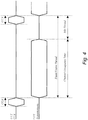
- a frame is generally divided into two main parts, the Channel Occupancy Time and the Idle Period. Transmissions are performed during the Channel Occupancy Time. Between transmissions, the station is silent for an Idle Period. At the end of the Idle Period, the station does a so-called Clear Channel Assessment, CCA, i.e. sensing the medium, before transmitting again, as illustrated in FIG. 4 .
- CCA Clear Channel Assessment
- Another MAC protocol known in WiFi is LBT with random back-off.
- stations will contend by listening for a randomly picked listening duration.
- multiple independent stations will pick different listening durations and hence will not start transmitting at the same time.
- LTE-U turns off transmission periodically for a fixed duration, which can be few sub-frames or frames long.
- the idea is to turn-off a fixed pattern of sub-frames within a radio frame. These so-called blank patterns can enable WiFi to get access to the channel and enable coexistence.
- LBT with random back-off For coexistence of multiple, independent LTE-U networks, a MAC protocol that can possibly be used is LBT with random back-off. This protocol is suitable for non-frame based systems like WiFi. However, it has the following problems when used for LTE-U: LBT and LBT with random back-off are not tolerant to synchronization offset. Though LBT with random back-off gives good coexistence throughput when LTE-U networks are synchronized, performance decreases drastically when there is a synchronization offset. For example, if the synchronization offset is greater than the maximum listening duration, only one of the LTE-U networks gets the channel and the other network(s) has no chance.
- LBT with random back-off is not suitable for practical implementation in LTE-U due to the frame based transmission of LTE.
- LTE nodes expect data transmission to begin only at sub-frame start times, which is typically every 1 ms interval.
- LBT with random back-off requires nodes to start transmission immediately after their back-off timer is elapsed. There is also a probability of collision when the two networks draw the same random listening duration.
- the conventional MAC protocols cannot enable coexistence of multiple LTE-U networks and/or are not suitable for practical implementation due to the frame structure of LTE.
- the proposed MAC protocol may use an adaptive LBT method, in which an LTE-U network listens periodically; but, it skips the listening slot just after getting access to the channel. By skipping this listening slot, an LTE-U network, or the concerned communication station, implicitly skips one sub-frame before trying to transmit again. By doing so, it gives opportunity for another network, or the corresponding communication station thereof, with a synchronization offset to get in and grab the channel. In such a way, two or more independent LTE-U networks using the adaptive LBT protocol alternate in getting access to the channel. Besides, the proposed protocol gives enough space for a WLAN such as WiFi to access the channel; as a result, it can also allow coexistence of LTE-U and WiFi.
- a WLAN such as WiFi
- Tolerance to a synchronization offset between LTE-U networks is also enabled: In unlicensed spectrum, there is no time synchronization between LTE-U networks of different operators; it is a best effort service where everyone tries to access the channel using MAC protocols. At least one embodiment of the proposed technology enables co-existence for any synchronization offset. In fact, the method takes advantage of the presence of the synchronization offset between LTE-U networks to enable coexistence. If the networks are synchronized, a small systematic offset can be introduced to make them asynchronous.
- the proposed technology is also suitable for practical implementation: As compared to the LBT with random back-off protocol, the proposed method is suitable for practical implementation.
- the proposed MAC protocol enables coexistence of uncoordinated (asynchronous) frame-based networks in unlicensed spectrum.
- the procedure involves an adaptive CSMA or LBT medium access protocol, in which a node or communication station skips one sub-frame following channel occupancy before doing LBT and occupying the channel again.
- FIGs. 5-8 For a more in-depth understanding of the differences between the conventional MAC protocols and example embodiments of the proposed technology, reference will now be made to FIGs. 5-8 .
- FIG. 5 is a schematic timing diagram illustrating a first example of the behavior of an LBT protocol for communication stations belonging to two different unsynchronized networks according to the prior art.
- each LTE-U network does carrier sensing every sub-frame interval, which is 1 ms in LTE. Once an LTE-U network does carrier sensing and detects nothing, it will normally occupy the channel for several sub-frames. At the end of the channel occupancy period, carrier sensing is done again to decide whether to transmit in the next sub-frames or not. If two unsynchronized LTE-U networks do the conventional LBT procedure, what happens is shown in FIG. 5 .
- the sub-frame start times are indicated using periodic, long vertical lines. Since there is a synchronization offset between the networks, it is assumed without loss of generality that the sub-frame start time of the first network is earlier than the second network.
- the dark boxes labelled "CCA" show the listening durations and the longer hatched boxes denote the channel occupancy or transmit durations.
- the first network will finish its LBT sensing period (CCA) first and gets the first transmit opportunity. As soon as it finishes transmission (before the next sub-frame starts), the first network will start listening again. As a result, the first network will get the channel again since the listening duration of the second network is yet to come. With the listening durations occurring at most at an interval of 1 sub-frame, the second network will never get the channel using this protocol.
- LBT with random back-off protocol it may theoretically be possible to enable some form of fair channel sharing by using LBT with random back-off protocol. If the synchronization offset is small, there will be overlap between the LBT durations of network 1 and network 2, in FIG. 5 . If the LBT sensing durations are random in addition, then there is a possibility for the LBT timer of network 2 to expire before that of network 1. This means that network 2 can get access to the channel. However, this works only if there is overlap between the LBT durations of the two networks which happens only if the synchronization offset is less than the maximum listening duration in the random back-off window. Therefore, LBT with random back-off enables fair sharing only if the synchronization offset is very small.
- CSMA/CA is used herein as an illustrative example of a listen-before-talk method
- the various embodiments described herein may be equally applicable to any wireless communication with application of a listen-before-talk or, equivalently, sense-before-transmit principle.
- an example embodiment of the proposed technology suggests an adaptive LBT protocol.
- FIG. 7 is a schematic timing diagram illustrating an example of the behavior of an adaptive LBT medium access, when applied to communication stations of two unsynchronized networks, according to an embodiment.
- Adaptive LBT is an LBT protocol with the following modification: Once a network does LBT and gets access to the channel, it should skip one sub-frame of transmission before listening and transmitting again. Hence, it is not necessary to listen immediately after transmission. LBT will be performed at the end of a first sub-frame following transmission, in order to evaluate the possibility of transmitting in the second sub-frame following transmission.
- the result of applying this protocol to two unsynchronized LTE-U networks is shown in FIG. 7 .
- the first network gets the first transmit opportunity, but it is not allowed to transmit in the next sub-frame, i.e. should skip the next sub-frame. This gives opportunity for the second network to do LBT and get the channel next as shown by the hatched box for network 2. Again after network 2 finishes transmission, it is required to skip the next sub-frame and this gives the transmission opportunity back to network 1, and then again back to network 2 and the sequence continues.
- adaptive LBT can be compared to a time division multiplexing system; but it can work with no or limited coordination between the networks.
- FIG. 8 is a schematic timing diagram illustrating an example of the behavior of an adaptive LBT medium access, when applied to communication stations of three unsynchronized networks, according to an embodiment.
- adaptive LBT enables channel sharing between any number of networks.
- FIG. 8 shows the application of adaptive LBT among three LTE-U networks. As illustrated, the protocol gives equal transmit opportunity to all three networks.
- the adaptive LBT method skips a sub-frame every time a LTE-U network gets transmit opportunity. Instead of doing the sub-frame skipping every time a network gets one transmit opportunity, it can be done after a network gets transmit opportunity N times, where N ⁇ 1. Then, the value of N can be adapted based on whether a carrier is detected in the previous LBT or not. For example, if there is only one LTE-U network, it will be feasible to use N much higher than 1 in order to reduce the loss of time resources due to the sub-frame skipping.
- LTE-U is currently expected primarily for the downlink access, but may be designed for both downlink and uplink.
- UEs may for example receive their uplink grants for the unlicensed carrier via the licensed carrier, through carrier aggregation. Before transmitting in a granted sub-frame, the UE first senses the medium. If there is already an on-going transmission, the UE ignores the uplink grant and does not transmit. If there is no on-going transmission, the UE may have the opportunity to transmit.
- the UE when the UE has transmitted, it waits for a waiting duration that is based on a time duration between consecutive sensing occasions for at least one other UE, also operating according to an LBT-based medium access procedure on the shared radio spectrum, before performing the LBT-based medium access procedure again.
- embodiments may be implemented in hardware, or in software for execution by suitable processing circuitry, or a combination thereof.
- Particular examples include one or more suitably configured digital signal processors and other known electronic circuits, e.g. discrete logic gates interconnected to perform a specialized function, or Application Specific Integrated Circuits (ASICs).
- digital signal processors and other known electronic circuits, e.g. discrete logic gates interconnected to perform a specialized function, or Application Specific Integrated Circuits (ASICs).
- ASICs Application Specific Integrated Circuits
- At least some of the steps, functions, procedures, modules and/or blocks described herein may be implemented in software such as a computer program for execution by suitable processing circuitry such as one or more processors or processing units.
- processing circuitry includes, but is not limited to, one or more microprocessors, one or more Digital Signal Processors (DSPs), one or more Central Processing Units (CPUs), video acceleration hardware, and/or any suitable programmable logic circuitry such as one or more Field Programmable Gate Arrays (FPGAs), or one or more Programmable Logic Controllers (PLCs).
- DSPs Digital Signal Processors
- CPUs Central Processing Units
- FPGAs Field Programmable Gate Arrays
- PLCs Programmable Logic Controllers
- a communication station configured for Listen-Before-Talk, LBT, based medium access.
- the communication station is configured to perform an LBT-based medium access procedure including:
- the communication station is further configured to wait, when the communication station has transmitted, for a waiting duration that is based on a time duration between consecutive sensing occasions for at least one other communication station, also operating according to an LBT-based medium access procedure on the shared radio spectrum, before performing the LBT-based medium access procedure again.
- the communication station when the communication station has had a transmit opportunity and transmitted data on the radio-based medium, the communication station is configured to repeat the LBT-based medium access procedure only after the waiting duration has expired.
- the communication station is configured to wait for a waiting duration that is based on the sensing periodicity and sensing duration of said at least one other communication station, wherein the time duration between consecutive sensing occasions corresponds to the sensing periodicity of said at least one other communication station.
- the communication station is configured to wait for a waiting duration, denoted T W , that is equal to or greater than the sum of the sensing periodicity, denoted P S , and sensing duration, denoted T S , of the at least one other communication station: T W ⁇ P S + T S .
- the communication station is configured to operate according to a frame-based transmission protocol in which each frame is divided into sub-frames and sensing is allowed in each sub-frame before transmission takes place, and the communication station is configured to wait, when the communication station has transmitted, for at least one sub-frame before repeating the LBT-based medium access procedure.
- the communication station is configured to wait, when the communication station has transmitted, to perform the sensing at the end of a following sub-frame.
- the communication station may be configured to wait, when the communication station has had the transmit opportunity N times, for the waiting duration before performing the LBT-based medium access procedure, where N is an integer equal to or greater than 1.
- the communication station belongs to the same radio network as the at least one other communication station.
- the communication station belongs to a different and unsynchronized network relative to the network(s) of the at least one other communication station.
- the shared radio spectrum may be an unlicensed spectrum.
- the shared radio spectrum may be a radio spectrum for Long Term Evolution, LTE.
- the proposed technology may enable so-called co-existence of different networks, e.g. in an unlicensed spectrum.
- This could for example be co-existence between different Long Term Evolution in Unlicensed spectrum, LTE-U, networks, and/or co-existence between LTE-U and WLAN such as WiFi.
- the controlled waiting enables the at least one other communication station to access the radio-based medium on the shared radio spectrum.
- the communication station is a radio base station.
- the communication station is a mobile station.
- FIG. 9 is a schematic diagram illustrating an example of a communication station according to an embodiment.
- the communication station 100 comprises a processor 110 and a memory 120.
- the memory 120 comprises instructions executable by the processor 110, whereby the processor 110 is operative to assist in performing the LBT-based medium access procedure and to enable the communication station to wait, when the communication station has transmitted, for the waiting duration before performing the LBT-based medium access procedure again.
- the communication station 100 comprises a communication circuit 130 configured to sense the radio-based medium during a sensing duration and to transmit on the radio-based medium if no on-going transmission is detected during sensing.
- the communication circuit 130 may be interconnected to the processor 110 and/or memory 120.
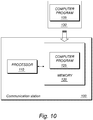
- FIG. 10 is a schematic diagram illustrating an example of a communication station according to another embodiment.
- a computer program 125 135, which is loaded into the memory 120 for execution by processing circuitry including one or more processors 110.
- the processor(s) 110 and memory 120 are interconnected to each other to enable normal software execution.
- An optional input/output device may also be interconnected to the processor(s) and/or the memory to enable input and/or output of relevant data such as input parameter(s) and/or resulting output parameter(s).
- processor' should be interpreted in a general sense as any system or device capable of executing program code or computer program instructions to perform a particular processing, determining or computing task.
- the processing circuitry including one or more processors is thus configured to perform, when executing the computer program, well-defined processing tasks such as those described herein.
- the processing circuitry does not have to be dedicated to only execute the above-described steps, functions, procedure and/or blocks, but may also execute other tasks.
- a computer program 125; 135 comprising instructions, which when executed by at least one processor 110, cause the at least one processor 110 to:
- the proposed technology also provides a carrier 120; 130 comprising the computer program 125; 135, wherein the carrier is one of an electronic signal, an optical signal, an electromagnetic signal, a magnetic signal, an electric signal, a radio signal, a microwave signal, or a computer-readable storage medium.
- the software or computer program 125; 135 may be realized as a computer program product, which is normally carried or stored on a computer-readable medium 120; 130, in particular a non-volatile medium.
- the computer-readable medium may include one or more removable or non-removable memory devices including, but not limited to a Read-Only Memory (ROM), a Random Access Memory (RAM), a Compact Disc (CD), a Digital Versatile Disc (DVD), a Blu-ray disc, a Universal Serial Bus (USB) memory, a Hard Disk Drive (HDD) storage device, a flash memory, a magnetic tape, or any other conventional memory device.
- the computer program may thus be loaded into the operating memory of a computer or equivalent processing device for execution by the processing circuitry thereof.
- a corresponding communication station may therefore be defined as a group of function modules, where each step performed by the processor corresponds to a function module.
- the function modules are implemented as a computer program running on the processor.
- the communication station may alternatively be defined as a group of function modules, where the function modules are implemented as a computer program running on at least one processor.
- the computer program residing in memory may thus be organized as appropriate function modules configured to perform, when executed by the processor, at least part of the steps and/or tasks described herein.
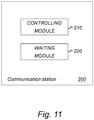
- Figure 11 is a schematic block diagram illustrating an example of a communication station comprising a group of function modules.
- a communication station 200 for performing Listen-Before-Talk, LBT, based medium access.
- the communication station 200 comprises a controlling module 210 and a waiting module 220.
- the controlling module 210 is adapted for controlling an LBT-based medium access procedure in which a radio-based medium is sensed on a shared radio spectrum during a sensing duration and a transmit opportunity on the radio-based medium is given to a communication station if no on-going transmission is detected during the sensing.
- the waiting module 220 which is also referred to as an enabling module, si adapted for enabling the communication station to wait, when the communication station has transmitted in the given transmit opportunity, for a waiting duration that is based on a time duration between consecutive sensing occasions for at least one other communication station, also operating according to an LBT-based medium access procedure on the shared radio spectrum, before performing the LBT-based medium access procedure again.
Landscapes
- Engineering & Computer Science (AREA)
- Computer Networks & Wireless Communication (AREA)
- Signal Processing (AREA)
- Mobile Radio Communication Systems (AREA)
Claims (15)
- Durch eine Kommunikationsstation durchgeführtes Verfahren für einen LBT-basierten Medienzugriff (LBT = Listen Before Talk), wobei das Verfahren die Schritte umfasst:
Durchführen (S1) eines LBT-basierten Medienzugriffsablaufs, der beinhaltet:- Erfassen eines funkbasierten Mediums in einem gemeinsam genutzten Funkspektrum während einer Erfassungsdauer;- Verzögern einer Übertragung, wenn während der Erfassung eine laufende Übertragung erkannt wird; und- Übertragen auf dem funkbasierten Medium, wenn während der Erfassung keine laufende Übertragung erkannt wird; und gekennzeichnet durch:
Warten (S2), wenn die Kommunikationsstation übertragen hat, während einer Wartedauer, die auf einer Zeitdauer zwischen aufeinanderfolgenden Erfassungsereignissen für mindestens eine andere Kommunikationsstation beruht, die ebenfalls gemäß einem LBT-basierten Medienzugriffsablauf in dem gemeinsam genutzten Funkspektrum arbeitet, bevor der LBT-basierte Medienzugriffsablauf erneut durchgeführt wird. - Verfahren nach Anspruch 1, wobei die Zeitdauer zwischen zwei aufeinanderfolgenden Erfassungsereignissen einer Erfassungsperiodizität der mindestens einen anderen Kommunikationsstationen entspricht und die Wartedauer auf der Erfassungsperiodizität und der Erfassungsdauer der mindestens einen anderen Kommunikationsstation beruht.
- Verfahren nach Anspruch 2, wobei die mit Tw bezeichnete Wartedauer gleich oder größer als die Summe aus der mit Ps bezeichneten Erfassungsperiodizität und der mit Ts bezeichneten Erfassungsdauer der mindestens einen anderen Kommunikationsstation ist: Tw ≥ Ps + Ts.
- Verfahren nach einem der vorhergehenden Ansprüche, wobei die Kommunikationsstation und die mindestens eine andere Kommunikationsstation gemäß einem Frame-basierten Übertragungsprotokoll arbeiten, bei dem jeder Frame in Sub-Frames unterteilt ist und das Erfassen in jedem Sub-Frame zulässig ist, bevor die Übertragung stattfindet, und die Kommunikationsstation, wenn die Kommunikationsstation übertragen hat, während mindestens eines Sub-Frame wartet, bevor der LBT-basierte Medienzugriffsablauf wiederholt wird.
- Kommunikationsstation (10; 20; 100; 200), die zum Listen-Before-Talk-basierten (LBT-basierten) Medienzugriff konfiguriert ist, wobei die Kommunikationsstation (10; 20; 100; 200) konfiguriert ist, um einen LBT-basierten Medienzugriffsablauf durchzuführen, der beinhaltet:- Erfassen eines funkbasierten Mediums in einem gemeinsam genutzten Funkspektrum während einer Erfassungsdauer;- Verzögern einer Übertragung, wenn während der Erfassung eine laufende Übertragung erkannt wird; und- Übertragen auf dem funkbasierten Medium, wenn während der Erfassung keine laufende Übertragung erkannt wird; und
wobei die Kommunikationsstation (10; 20; 100; 200) dadurch gekennzeichnet ist, dass sie konfiguriert ist, um, wenn die Kommunikationsstation übertragen hat, während einer Wartedauer zu warten, die auf einer Zeitdauer zwischen aufeinanderfolgenden Erfassungsereignissen für mindestens eine andere Kommunikationsstation beruht, die ebenfalls gemäß einem LBT-basierten Medienzugriffsablauf in dem gemeinsam genutzten Funkspektrum arbeitet, bevor der LBT-basierte Medienzugriffsablauf erneut durchgeführt wird. - Kommunikationsstation nach Anspruch 5, wobei die Kommunikationsstation (10; 20; 100; 200) konfiguriert ist, um während einer Wartedauer zu warten, die auf der Erfassungsperiodizität und der Erfassungsdauer der mindestens einen anderen Kommunikationsstation beruht, wobei die Zeitdauer zwischen aufeinanderfolgenden Erfassungsereignissen der Erfassungsperiodizität der mindestens einen anderen Kommunikationsstation entspricht.
- Kommunikationsstation nach Anspruch 6, wobei die Kommunikationsstation (10; 20; 100; 200) konfiguriert ist, um während einer mit Tw bezeichneten Wartedauer zu warten, die gleich oder größer als die Summe aus der mit Ps bezeichneten Erfassungsperiodizität und der mit Ts bezeichneten Erfassungsdauer der mindestens einen anderen Kommunikationsstation ist: Tw ≥ Ps + Ts.
- Kommunikationsstation nach einem der Ansprüche 5 bis 7, wobei die Kommunikationsstation (10; 20; 100; 200) konfiguriert ist, um gemäß einem Frame-basierten Übertragungsprotokoll zu arbeiten, bei dem jeder Frame in Sub-Frames unterteilt ist und das Erfassen in jedem Sub-Frame zulässig ist, bevor die Übertragung stattfindet, und die Kommunikationsstation konfiguriert ist, um, wenn die Kommunikationsstation übertragen hat, während mindestens eines Sub-Frame zu warten, bevor der LBT-basierte Medienzugriffsablauf wiederholt wird.
- Kommunikationsstation nach einem der Ansprüche 5 bis 8, wobei die Kommunikationsstation (10; 20; 100; 200) eine Funkbasisstation (10) ist.
- Kommunikationsstation nach einem der Ansprüche 5 bis 8, wobei die Kommunikationsstation (10; 20; 100; 200) eine mobile Station (20) ist.
- Kommunikationsstation nach einem der Ansprüche 5 bis 10, wobei die Kommunikationsstation (10; 20; 100; 200) einen Prozessor (110) und einen Speicher (120) umfasst, wobei der Speicher durch den Prozessor (110) ausführbare Anweisungen umfasst, wodurch der Prozessor (110) konfiguriert wird, um das Durchführen des LBT-basierten Medienzugriffsablaufs zu unterstützen und die Kommunikationsstation zu aktivieren, um, wenn die Kommunikationsstation übertragen hat, während der Wartedauer zu warten, bevor der LBT-basierte Medienzugriffsablauf erneut durchgeführt wird.
- Kommunikationsstation nach einem der Ansprüche 5 bis 11, wobei die Kommunikationsstation (10; 20; 100; 200) eine Kommunikationsschaltung (130) umfasst, die konfiguriert ist, um das funkbasierte Medium während einer Erfassungsdauer zu erfassen und auf dem funkbasierten Medium zu übertragen, wenn während einer Erfassungsdauer keine laufende Übertragung erkannt wird.
- Computerprogramm (125; 135), umfassend Anweisungen, die bei Ausführung durch mindestens einen Prozessor (110) bewirken, dass der mindestens eine Prozessor (110):- einen Listen-Before-Talk-basierten (LBT-basierten) Medienzugriffsablauf steuert, bei dem während einer Erfassungsdauer ein funkbasiertes Medium in einem gemeinsam genutzten Funkspektrum erfasst und einer Kommunikationsstation eine Übertragungsgelegenheit auf dem funkbasierten Medium gegeben wird, wenn während der Erfassung keine laufende Übertragung erkannt wird; und dadurch gekennzeichnet, dass bewirkt wird, dass der mindestens eine Prozessor (110):- die Kommunikationsstation aktiviert, um, wenn die Kommunikationsstation innerhalb der gegebenen Übertragungsgelegenheit übertragen hat, während einer Wartedauer zu warten, die auf einer Zeitdauer zwischen aufeinanderfolgenden Erfassungsereignissen für mindestens eine andere Kommunikationsstation beruht, die ebenfalls gemäß einem LBT-basierten Medienzugriffsablauf in dem gemeinsam genutzten Funkspektrum arbeitet, bevor der LBT-basierte Medienzugriffsablauf erneut durchgeführt wird.
- Träger (120; 130), umfassend das Computerprogramm nach Anspruch 13, wobei der Träger eines ist aus einem elektronischen Signal, einem optischen Signal, einem elektromagnetischen Signal, einem magnetischen Signal, einem elektrischen Signal, einem Funksignal, einem Mikrowellensignal oder einem computerlesbaren Speichermedium.
- Kommunikationsstation (200), die zur Durchführung des Listen-Before-Talk-basierten (LBT-basierten) Medienzugriffs konfiguriert ist, wobei die Kommunikationsstation (200) umfasst:- ein Steuermodul (210), das konfiguriert ist, um einen Listen-Before-Talk-basierten (LBT-basierten) Medienzugriffsablauf zu steuern, bei dem während einer Erfassungsdauer ein funkbasiertes Medium in einem gemeinsam genutzten Funkspektrum erfasst und einer Kommunikationsstation eine Übertragungsgelegenheit auf dem funkbasierten Medium gegeben wird, wenn während der Erfassung keine laufende Übertragung erkannt wird; und gekennzeichnet durch- ein Wartemodul (220), das konfiguriert ist, um, wenn die Kommunikationsstation innerhalb der gegebenen Übertragungsgelegenheit übertragen hat, während einer Wartedauer zu warten, die auf einer Zeitdauer zwischen aufeinanderfolgenden Erfassungsereignissen für mindestens eine andere Kommunikationsstation beruht, die ebenfalls gemäß einem LBT-basierten Medienzugriffsablauf in dem gemeinsam genutzten Funkspektrum arbeitet, bevor der LBT-basierte Medienzugriffsablauf erneut durchgeführt wird.
Applications Claiming Priority (1)
| Application Number | Priority Date | Filing Date | Title |
|---|---|---|---|
| PCT/SE2014/050910 WO2016018182A1 (en) | 2014-07-29 | 2014-07-29 | Listen-before-talk based medium access |
Publications (2)
| Publication Number | Publication Date |
|---|---|
| EP3175672A1 EP3175672A1 (de) | 2017-06-07 |
| EP3175672B1 true EP3175672B1 (de) | 2019-05-01 |
Family
ID=51352741
Family Applications (1)
| Application Number | Title | Priority Date | Filing Date |
|---|---|---|---|
| EP14750816.2A Active EP3175672B1 (de) | 2014-07-29 | 2014-07-29 | Listen-before-talk-basierter medienzugriff |
Country Status (4)
| Country | Link |
|---|---|
| US (1) | US10264605B2 (de) |
| EP (1) | EP3175672B1 (de) |
| CN (1) | CN106538028B (de) |
| WO (1) | WO2016018182A1 (de) |
Families Citing this family (17)
| Publication number | Priority date | Publication date | Assignee | Title |
|---|---|---|---|---|
| EP3183933B1 (de) * | 2014-08-19 | 2020-01-01 | Telefonaktiebolaget LM Ericsson (publ) | Kollisionsvermeidung mit synchronisierter übertragung |
| US10637619B2 (en) * | 2014-11-03 | 2020-04-28 | Samsung Electronics Co., Ltd. | Method and apparatus for channel access for LTE on unlicensed spectrum |
| US10568116B2 (en) * | 2015-03-06 | 2020-02-18 | Lg Electronics Inc. | Method for transmitting signal in wireless communication system, and apparatus therefor |
| CN107534896B (zh) * | 2015-05-14 | 2021-09-14 | 有线电视实验室公司 | 对话前监听系统中的混合自动重传请求(harq) |
| US10542541B2 (en) | 2015-08-19 | 2020-01-21 | Qualcomm, Incorporated | Re-contention-based co-existence on a shared communication medium |
| US10356816B2 (en) | 2015-08-19 | 2019-07-16 | Qualcomm Incorporated | Re-contention-based co-existence on a shared communication medium |
| US10091789B2 (en) * | 2015-08-19 | 2018-10-02 | Qualcomm, Incorporated | Re-contention-based co-existence on a shared communication medium |
| US10681663B2 (en) | 2016-03-31 | 2020-06-09 | Telefonaktiebolaget Lm Ericsson (Publ) | Methods for adjusting uplink transmission timing |
| WO2017171604A1 (en) * | 2016-03-31 | 2017-10-05 | Telefonaktiebolaget Lm Ericsson (Publ) | Method and device for timing correction in a channel access using a listen-before-talk protocol |
| US10334631B2 (en) * | 2016-05-27 | 2019-06-25 | Huawei Technologies Canada Co., Ltd. | System and method for a configurable frame structure |
| US10517021B2 (en) | 2016-06-30 | 2019-12-24 | Evolve Cellular Inc. | Long term evolution-primary WiFi (LTE-PW) |
| US10764024B2 (en) | 2018-01-11 | 2020-09-01 | At&T Intellectual Property I, L.P. | Multi-beam listen before talk |
| US10973053B2 (en) | 2018-04-05 | 2021-04-06 | Apple Inc. | Listen-before-talk procedure with priority and interference addition awareness |
| CN113632579B (zh) * | 2019-02-12 | 2024-04-09 | 谷歌有限责任公司 | 用于减小共享载波上基于定时器的传输的延迟的系统和方法 |
| US10887890B2 (en) | 2019-02-15 | 2021-01-05 | At&T Intellectual Property I, L.P. | Fast multi-beam listen before talk |
| CN109905919B (zh) | 2019-02-26 | 2021-02-09 | 展讯通信(上海)有限公司 | 多无线射频系统的数据传输方法及装置、存储介质、终端 |
| DE102022111574A1 (de) * | 2022-05-10 | 2023-11-16 | Bayerische Motoren Werke Aktiengesellschaft | Kommunikationsvorrichtung, Kommunikationsverfahren und Computerprogramm |
Family Cites Families (10)
| Publication number | Priority date | Publication date | Assignee | Title |
|---|---|---|---|---|
| US7990944B2 (en) | 2007-09-06 | 2011-08-02 | Wi-Lan, Inc. | Contention-based communication |
| CN101431509B (zh) * | 2007-11-05 | 2012-11-21 | 华为技术有限公司 | 一种保护设备收发机状态的设置方法和装置 |
| CN101431398B (zh) * | 2007-11-05 | 2012-04-25 | 华为技术有限公司 | 控制保护设备保持激活状态的方法及设备 |
| US8107391B2 (en) * | 2008-11-19 | 2012-01-31 | Wi-Lan, Inc. | Systems and etiquette for home gateways using white space |
| US8948102B2 (en) * | 2009-02-18 | 2015-02-03 | Lg Electronics Inc. | Channel access method for very high throughput (VHT) wireless local access network system |
| US8774209B2 (en) | 2009-12-02 | 2014-07-08 | Qualcomm Incorporated | Apparatus and method for spectrum sharing using listen-before-talk with quiet periods |
| EP2757850B1 (de) | 2013-01-16 | 2018-08-08 | Telefonaktiebolaget LM Ericsson (publ) | Funkkommunikation in nichtlizenziertem band |
| US9763225B2 (en) * | 2013-10-07 | 2017-09-12 | Qualcomm Incorporated | LTE-U clear channel assessment operations |
| US9220115B2 (en) * | 2013-10-23 | 2015-12-22 | Qualcomm Incorporated | Techniques for channel access in asynchronous unlicensed radio frequency spectrum band deployments |
| US10129908B2 (en) * | 2014-04-28 | 2018-11-13 | Intel IP Corporation | Listen before talk protocol selection |
-
2014
- 2014-07-29 EP EP14750816.2A patent/EP3175672B1/de active Active
- 2014-07-29 WO PCT/SE2014/050910 patent/WO2016018182A1/en not_active Ceased
- 2014-07-29 US US15/329,108 patent/US10264605B2/en not_active Expired - Fee Related
- 2014-07-29 CN CN201480080965.4A patent/CN106538028B/zh not_active Expired - Fee Related
Non-Patent Citations (1)
| Title |
|---|
| None * |
Also Published As
| Publication number | Publication date |
|---|---|
| CN106538028A (zh) | 2017-03-22 |
| CN106538028B (zh) | 2020-07-28 |
| US10264605B2 (en) | 2019-04-16 |
| WO2016018182A1 (en) | 2016-02-04 |
| US20170231003A1 (en) | 2017-08-10 |
| EP3175672A1 (de) | 2017-06-07 |
Similar Documents
| Publication | Publication Date | Title |
|---|---|---|
| EP3175672B1 (de) | Listen-before-talk-basierter medienzugriff | |
| EP3527033B1 (de) | Träger für missionskritische und autonome uplink-übertragungen | |
| JP6400756B2 (ja) | 共有スペクトルにおける異なる事業者の優先度付け | |
| KR102545340B1 (ko) | 조정된 리소스 파티셔닝 | |
| EP3266143B1 (de) | Vorrichtungsinterne koexistenz mit anderen technologien in einem betrieb mit lte-lizenzunterstütztem zugang | |
| EP2757850B1 (de) | Funkkommunikation in nichtlizenziertem band | |
| CN109804680B (zh) | 协调式资源发现 | |
| EP3198766B1 (de) | Drahtlose kommunikation unter verwendung von aggregierten trägern in unlizenzierten frequenzbändern | |
| US20130051383A1 (en) | Apparatus and Method for Communication | |
| Loginov et al. | CR-LBT: Listen-before-talk with collision resolution for 5G NR-U networks | |
| JP2021532623A (ja) | 通信装置、通信方法および集積回路 | |
| EP3253146B1 (de) | Datenübertragungsverfahren und datenübertragungsanlage | |
| CN105659685A (zh) | 用于在异步未许可射频谱带部署中进行信道接入的技术 | |
| CN106664726A (zh) | 用于增强使用无执照射频谱带进行的传输的帧结构和先听后讲规程(lbt)的技术 | |
| JP2012517146A (ja) | スペクトル共有のための分散型の優先順位による競合 | |
| CN107852753A (zh) | 用于将冲突避免信令用于与无执照网络的共存的技术 | |
| WO2016155563A1 (zh) | 一种非授权载波上传输资源的抢占方法及设备 | |
| US10015761B2 (en) | Apparatus and method for channel access for long term evolution nodes in unlicensed band | |
| EP2871901A1 (de) | Verfahren und Vorrichtung für drahtlose Vernetzung | |
| CN106455108B (zh) | 一种先听在说方法及装置 | |
| WO2016119142A1 (zh) | 基于移动通信系统实现lbt的基站、用户设备及方法 | |
| US11229051B2 (en) | Method and apparatus for carrier sensing | |
| CN106162925A (zh) | 一种信道接入方法和装置 | |
| WO2013030732A1 (en) | Apparatus and method for communication | |
| GB2493986A (en) | Apparatus and method for communication |
Legal Events
| Date | Code | Title | Description |
|---|---|---|---|
| STAA | Information on the status of an ep patent application or granted ep patent |
Free format text: STATUS: THE INTERNATIONAL PUBLICATION HAS BEEN MADE |
|
| 17P | Request for examination filed |
Effective date: 20170118 |
|
| AK | Designated contracting states |
Kind code of ref document: A1 Designated state(s): AL AT BE BG CH CY CZ DE DK EE ES FI FR GB GR HR HU IE IS IT LI LT LU LV MC MK MT NL NO PL PT RO RS SE SI SK SM TR |
|
| AX | Request for extension of the european patent |
Extension state: BA ME |
|
| PUAI | Public reference made under article 153(3) epc to a published international application that has entered the european phase |
Free format text: ORIGINAL CODE: 0009012 |
|
| STAA | Information on the status of an ep patent application or granted ep patent |
Free format text: STATUS: REQUEST FOR EXAMINATION WAS MADE |
|
| RIN1 | Information on inventor provided before grant (corrected) |
Inventor name: FALCONETTI, LAETITIA Inventor name: GODANA, BRUHTESFA Inventor name: KOUTSIMANIS, CHRYSOSTOMOS Inventor name: FURUSKAER, ANDERS |
|
| DAX | Request for extension of the european patent (deleted) | ||
| GRAP | Despatch of communication of intention to grant a patent |
Free format text: ORIGINAL CODE: EPIDOSNIGR1 |
|
| STAA | Information on the status of an ep patent application or granted ep patent |
Free format text: STATUS: GRANT OF PATENT IS INTENDED |
|
| INTG | Intention to grant announced |
Effective date: 20190109 |
|
| GRAS | Grant fee paid |
Free format text: ORIGINAL CODE: EPIDOSNIGR3 |
|
| GRAA | (expected) grant |
Free format text: ORIGINAL CODE: 0009210 |
|
| STAA | Information on the status of an ep patent application or granted ep patent |
Free format text: STATUS: THE PATENT HAS BEEN GRANTED |
|
| AK | Designated contracting states |
Kind code of ref document: B1 Designated state(s): AL AT BE BG CH CY CZ DE DK EE ES FI FR GB GR HR HU IE IS IT LI LT LU LV MC MK MT NL NO PL PT RO RS SE SI SK SM TR |
|
| REG | Reference to a national code |
Ref country code: GB Ref legal event code: FG4D |
|
| REG | Reference to a national code |
Ref country code: CH Ref legal event code: EP Ref country code: AT Ref legal event code: REF Ref document number: 1128650 Country of ref document: AT Kind code of ref document: T Effective date: 20190515 |
|
| REG | Reference to a national code |
Ref country code: DE Ref legal event code: R096 Ref document number: 602014045780 Country of ref document: DE |
|
| REG | Reference to a national code |
Ref country code: IE Ref legal event code: FG4D |
|
| REG | Reference to a national code |
Ref country code: NL Ref legal event code: MP Effective date: 20190501 |
|
| REG | Reference to a national code |
Ref country code: LT Ref legal event code: MG4D |
|
| PG25 | Lapsed in a contracting state [announced via postgrant information from national office to epo] |
Ref country code: LT Free format text: LAPSE BECAUSE OF FAILURE TO SUBMIT A TRANSLATION OF THE DESCRIPTION OR TO PAY THE FEE WITHIN THE PRESCRIBED TIME-LIMIT Effective date: 20190501 Ref country code: FI Free format text: LAPSE BECAUSE OF FAILURE TO SUBMIT A TRANSLATION OF THE DESCRIPTION OR TO PAY THE FEE WITHIN THE PRESCRIBED TIME-LIMIT Effective date: 20190501 Ref country code: NO Free format text: LAPSE BECAUSE OF FAILURE TO SUBMIT A TRANSLATION OF THE DESCRIPTION OR TO PAY THE FEE WITHIN THE PRESCRIBED TIME-LIMIT Effective date: 20190801 Ref country code: SE Free format text: LAPSE BECAUSE OF FAILURE TO SUBMIT A TRANSLATION OF THE DESCRIPTION OR TO PAY THE FEE WITHIN THE PRESCRIBED TIME-LIMIT Effective date: 20190501 Ref country code: NL Free format text: LAPSE BECAUSE OF FAILURE TO SUBMIT A TRANSLATION OF THE DESCRIPTION OR TO PAY THE FEE WITHIN THE PRESCRIBED TIME-LIMIT Effective date: 20190501 Ref country code: HR Free format text: LAPSE BECAUSE OF FAILURE TO SUBMIT A TRANSLATION OF THE DESCRIPTION OR TO PAY THE FEE WITHIN THE PRESCRIBED TIME-LIMIT Effective date: 20190501 Ref country code: ES Free format text: LAPSE BECAUSE OF FAILURE TO SUBMIT A TRANSLATION OF THE DESCRIPTION OR TO PAY THE FEE WITHIN THE PRESCRIBED TIME-LIMIT Effective date: 20190501 Ref country code: PT Free format text: LAPSE BECAUSE OF FAILURE TO SUBMIT A TRANSLATION OF THE DESCRIPTION OR TO PAY THE FEE WITHIN THE PRESCRIBED TIME-LIMIT Effective date: 20190901 Ref country code: AL Free format text: LAPSE BECAUSE OF FAILURE TO SUBMIT A TRANSLATION OF THE DESCRIPTION OR TO PAY THE FEE WITHIN THE PRESCRIBED TIME-LIMIT Effective date: 20190501 |
|
| PG25 | Lapsed in a contracting state [announced via postgrant information from national office to epo] |
Ref country code: BG Free format text: LAPSE BECAUSE OF FAILURE TO SUBMIT A TRANSLATION OF THE DESCRIPTION OR TO PAY THE FEE WITHIN THE PRESCRIBED TIME-LIMIT Effective date: 20190801 Ref country code: GR Free format text: LAPSE BECAUSE OF FAILURE TO SUBMIT A TRANSLATION OF THE DESCRIPTION OR TO PAY THE FEE WITHIN THE PRESCRIBED TIME-LIMIT Effective date: 20190802 Ref country code: RS Free format text: LAPSE BECAUSE OF FAILURE TO SUBMIT A TRANSLATION OF THE DESCRIPTION OR TO PAY THE FEE WITHIN THE PRESCRIBED TIME-LIMIT Effective date: 20190501 Ref country code: LV Free format text: LAPSE BECAUSE OF FAILURE TO SUBMIT A TRANSLATION OF THE DESCRIPTION OR TO PAY THE FEE WITHIN THE PRESCRIBED TIME-LIMIT Effective date: 20190501 |
|
| REG | Reference to a national code |
Ref country code: AT Ref legal event code: MK05 Ref document number: 1128650 Country of ref document: AT Kind code of ref document: T Effective date: 20190501 |
|
| PG25 | Lapsed in a contracting state [announced via postgrant information from national office to epo] |
Ref country code: IS Free format text: LAPSE BECAUSE OF FAILURE TO SUBMIT A TRANSLATION OF THE DESCRIPTION OR TO PAY THE FEE WITHIN THE PRESCRIBED TIME-LIMIT Effective date: 20190901 |
|
| PG25 | Lapsed in a contracting state [announced via postgrant information from national office to epo] |
Ref country code: SK Free format text: LAPSE BECAUSE OF FAILURE TO SUBMIT A TRANSLATION OF THE DESCRIPTION OR TO PAY THE FEE WITHIN THE PRESCRIBED TIME-LIMIT Effective date: 20190501 Ref country code: DK Free format text: LAPSE BECAUSE OF FAILURE TO SUBMIT A TRANSLATION OF THE DESCRIPTION OR TO PAY THE FEE WITHIN THE PRESCRIBED TIME-LIMIT Effective date: 20190501 Ref country code: AT Free format text: LAPSE BECAUSE OF FAILURE TO SUBMIT A TRANSLATION OF THE DESCRIPTION OR TO PAY THE FEE WITHIN THE PRESCRIBED TIME-LIMIT Effective date: 20190501 Ref country code: EE Free format text: LAPSE BECAUSE OF FAILURE TO SUBMIT A TRANSLATION OF THE DESCRIPTION OR TO PAY THE FEE WITHIN THE PRESCRIBED TIME-LIMIT Effective date: 20190501 Ref country code: CZ Free format text: LAPSE BECAUSE OF FAILURE TO SUBMIT A TRANSLATION OF THE DESCRIPTION OR TO PAY THE FEE WITHIN THE PRESCRIBED TIME-LIMIT Effective date: 20190501 Ref country code: RO Free format text: LAPSE BECAUSE OF FAILURE TO SUBMIT A TRANSLATION OF THE DESCRIPTION OR TO PAY THE FEE WITHIN THE PRESCRIBED TIME-LIMIT Effective date: 20190501 |
|
| REG | Reference to a national code |
Ref country code: DE Ref legal event code: R097 Ref document number: 602014045780 Country of ref document: DE |
|
| PG25 | Lapsed in a contracting state [announced via postgrant information from national office to epo] |
Ref country code: MC Free format text: LAPSE BECAUSE OF FAILURE TO SUBMIT A TRANSLATION OF THE DESCRIPTION OR TO PAY THE FEE WITHIN THE PRESCRIBED TIME-LIMIT Effective date: 20190501 Ref country code: SM Free format text: LAPSE BECAUSE OF FAILURE TO SUBMIT A TRANSLATION OF THE DESCRIPTION OR TO PAY THE FEE WITHIN THE PRESCRIBED TIME-LIMIT Effective date: 20190501 Ref country code: IT Free format text: LAPSE BECAUSE OF FAILURE TO SUBMIT A TRANSLATION OF THE DESCRIPTION OR TO PAY THE FEE WITHIN THE PRESCRIBED TIME-LIMIT Effective date: 20190501 |
|
| REG | Reference to a national code |
Ref country code: CH Ref legal event code: PL |
|
| PLBE | No opposition filed within time limit |
Free format text: ORIGINAL CODE: 0009261 |
|
| STAA | Information on the status of an ep patent application or granted ep patent |
Free format text: STATUS: NO OPPOSITION FILED WITHIN TIME LIMIT |
|
| PG25 | Lapsed in a contracting state [announced via postgrant information from national office to epo] |
Ref country code: TR Free format text: LAPSE BECAUSE OF FAILURE TO SUBMIT A TRANSLATION OF THE DESCRIPTION OR TO PAY THE FEE WITHIN THE PRESCRIBED TIME-LIMIT Effective date: 20190501 |
|
| 26N | No opposition filed |
Effective date: 20200204 |
|
| REG | Reference to a national code |
Ref country code: BE Ref legal event code: MM Effective date: 20190731 |
|
| PG25 | Lapsed in a contracting state [announced via postgrant information from national office to epo] |
Ref country code: PL Free format text: LAPSE BECAUSE OF FAILURE TO SUBMIT A TRANSLATION OF THE DESCRIPTION OR TO PAY THE FEE WITHIN THE PRESCRIBED TIME-LIMIT Effective date: 20190501 |
|
| PG25 | Lapsed in a contracting state [announced via postgrant information from national office to epo] |
Ref country code: LI Free format text: LAPSE BECAUSE OF NON-PAYMENT OF DUE FEES Effective date: 20190731 Ref country code: CH Free format text: LAPSE BECAUSE OF NON-PAYMENT OF DUE FEES Effective date: 20190731 Ref country code: BE Free format text: LAPSE BECAUSE OF NON-PAYMENT OF DUE FEES Effective date: 20190731 Ref country code: SI Free format text: LAPSE BECAUSE OF FAILURE TO SUBMIT A TRANSLATION OF THE DESCRIPTION OR TO PAY THE FEE WITHIN THE PRESCRIBED TIME-LIMIT Effective date: 20190501 Ref country code: LU Free format text: LAPSE BECAUSE OF NON-PAYMENT OF DUE FEES Effective date: 20190729 |
|
| PG25 | Lapsed in a contracting state [announced via postgrant information from national office to epo] |
Ref country code: FR Free format text: LAPSE BECAUSE OF NON-PAYMENT OF DUE FEES Effective date: 20190731 |
|
| PG25 | Lapsed in a contracting state [announced via postgrant information from national office to epo] |
Ref country code: IE Free format text: LAPSE BECAUSE OF NON-PAYMENT OF DUE FEES Effective date: 20190729 |
|
| PG25 | Lapsed in a contracting state [announced via postgrant information from national office to epo] |
Ref country code: CY Free format text: LAPSE BECAUSE OF FAILURE TO SUBMIT A TRANSLATION OF THE DESCRIPTION OR TO PAY THE FEE WITHIN THE PRESCRIBED TIME-LIMIT Effective date: 20190501 |
|
| PG25 | Lapsed in a contracting state [announced via postgrant information from national office to epo] |
Ref country code: MT Free format text: LAPSE BECAUSE OF FAILURE TO SUBMIT A TRANSLATION OF THE DESCRIPTION OR TO PAY THE FEE WITHIN THE PRESCRIBED TIME-LIMIT Effective date: 20190501 Ref country code: HU Free format text: LAPSE BECAUSE OF FAILURE TO SUBMIT A TRANSLATION OF THE DESCRIPTION OR TO PAY THE FEE WITHIN THE PRESCRIBED TIME-LIMIT; INVALID AB INITIO Effective date: 20140729 |
|
| PG25 | Lapsed in a contracting state [announced via postgrant information from national office to epo] |
Ref country code: MK Free format text: LAPSE BECAUSE OF FAILURE TO SUBMIT A TRANSLATION OF THE DESCRIPTION OR TO PAY THE FEE WITHIN THE PRESCRIBED TIME-LIMIT Effective date: 20190501 |
|
| PGFP | Annual fee paid to national office [announced via postgrant information from national office to epo] |
Ref country code: DE Payment date: 20250729 Year of fee payment: 12 |
|
| PGFP | Annual fee paid to national office [announced via postgrant information from national office to epo] |
Ref country code: GB Payment date: 20250728 Year of fee payment: 12 |