EP3176191A1 - Résine de pétrole durcissable et son procédé de préparation - Google Patents
Résine de pétrole durcissable et son procédé de préparation Download PDFInfo
- Publication number
- EP3176191A1 EP3176191A1 EP15827903.4A EP15827903A EP3176191A1 EP 3176191 A1 EP3176191 A1 EP 3176191A1 EP 15827903 A EP15827903 A EP 15827903A EP 3176191 A1 EP3176191 A1 EP 3176191A1
- Authority
- EP
- European Patent Office
- Prior art keywords
- silanes
- petroleum resin
- group
- curable petroleum
- monomers
- Prior art date
- Legal status (The legal status is an assumption and is not a legal conclusion. Google has not performed a legal analysis and makes no representation as to the accuracy of the status listed.)
- Granted
Links
Images


Classifications
-
- C—CHEMISTRY; METALLURGY
- C08—ORGANIC MACROMOLECULAR COMPOUNDS; THEIR PREPARATION OR CHEMICAL WORKING-UP; COMPOSITIONS BASED THEREON
- C08F—MACROMOLECULAR COMPOUNDS OBTAINED BY REACTIONS ONLY INVOLVING CARBON-TO-CARBON UNSATURATED BONDS
- C08F232/00—Copolymers of cyclic compounds containing no unsaturated aliphatic radicals in a side chain, and having one or more carbon-to-carbon double bonds in a carbocyclic ring system
- C08F232/08—Copolymers of cyclic compounds containing no unsaturated aliphatic radicals in a side chain, and having one or more carbon-to-carbon double bonds in a carbocyclic ring system having condensed rings
-
- C—CHEMISTRY; METALLURGY
- C08—ORGANIC MACROMOLECULAR COMPOUNDS; THEIR PREPARATION OR CHEMICAL WORKING-UP; COMPOSITIONS BASED THEREON
- C08F—MACROMOLECULAR COMPOUNDS OBTAINED BY REACTIONS ONLY INVOLVING CARBON-TO-CARBON UNSATURATED BONDS
- C08F2/00—Processes of polymerisation
- C08F2/04—Polymerisation in solution
- C08F2/06—Organic solvent
-
- C—CHEMISTRY; METALLURGY
- C08—ORGANIC MACROMOLECULAR COMPOUNDS; THEIR PREPARATION OR CHEMICAL WORKING-UP; COMPOSITIONS BASED THEREON
- C08F—MACROMOLECULAR COMPOUNDS OBTAINED BY REACTIONS ONLY INVOLVING CARBON-TO-CARBON UNSATURATED BONDS
- C08F220/00—Copolymers of compounds having one or more unsaturated aliphatic radicals, each having only one carbon-to-carbon double bond, and only one being terminated by only one carboxyl radical or a salt, anhydride ester, amide, imide or nitrile thereof
- C08F220/02—Monocarboxylic acids having less than ten carbon atoms; Derivatives thereof
- C08F220/04—Acids; Metal salts or ammonium salts thereof
-
- C—CHEMISTRY; METALLURGY
- C08—ORGANIC MACROMOLECULAR COMPOUNDS; THEIR PREPARATION OR CHEMICAL WORKING-UP; COMPOSITIONS BASED THEREON
- C08F—MACROMOLECULAR COMPOUNDS OBTAINED BY REACTIONS ONLY INVOLVING CARBON-TO-CARBON UNSATURATED BONDS
- C08F240/00—Copolymers of hydrocarbons and mineral oils, e.g. petroleum resins
-
- C—CHEMISTRY; METALLURGY
- C08—ORGANIC MACROMOLECULAR COMPOUNDS; THEIR PREPARATION OR CHEMICAL WORKING-UP; COMPOSITIONS BASED THEREON
- C08F—MACROMOLECULAR COMPOUNDS OBTAINED BY REACTIONS ONLY INVOLVING CARBON-TO-CARBON UNSATURATED BONDS
- C08F289/00—Macromolecular compounds obtained by polymerising monomers on to macromolecular compounds not provided for in groups C08F251/00 - C08F287/00
-
- C—CHEMISTRY; METALLURGY
- C08—ORGANIC MACROMOLECULAR COMPOUNDS; THEIR PREPARATION OR CHEMICAL WORKING-UP; COMPOSITIONS BASED THEREON
- C08F—MACROMOLECULAR COMPOUNDS OBTAINED BY REACTIONS ONLY INVOLVING CARBON-TO-CARBON UNSATURATED BONDS
- C08F4/00—Polymerisation catalysts
- C08F4/28—Oxygen or compounds releasing free oxygen
- C08F4/32—Organic compounds
- C08F4/34—Per-compounds with one peroxy-radical
-
- C—CHEMISTRY; METALLURGY
- C08—ORGANIC MACROMOLECULAR COMPOUNDS; THEIR PREPARATION OR CHEMICAL WORKING-UP; COMPOSITIONS BASED THEREON
- C08G—MACROMOLECULAR COMPOUNDS OBTAINED OTHERWISE THAN BY REACTIONS ONLY INVOLVING UNSATURATED CARBON-TO-CARBON BONDS
- C08G77/00—Macromolecular compounds obtained by reactions forming a linkage containing silicon with or without sulfur, nitrogen, oxygen or carbon in the main chain of the macromolecule
- C08G77/42—Block-or graft-polymers containing polysiloxane sequences
-
- C—CHEMISTRY; METALLURGY
- C09—DYES; PAINTS; POLISHES; NATURAL RESINS; ADHESIVES; COMPOSITIONS NOT OTHERWISE PROVIDED FOR; APPLICATIONS OF MATERIALS NOT OTHERWISE PROVIDED FOR
- C09J—ADHESIVES; NON-MECHANICAL ASPECTS OF ADHESIVE PROCESSES IN GENERAL; ADHESIVE PROCESSES NOT PROVIDED FOR ELSEWHERE; USE OF MATERIALS AS ADHESIVES
- C09J145/00—Adhesives based on homopolymers or copolymers of compounds having no unsaturated aliphatic radicals in a side chain, and having one or more carbon-to-carbon double bonds in a carbocyclic or in a heterocyclic system; Adhesives based on derivatives of such polymers
Definitions
- the present invention relates to a curable petroleum resin and a method of manufacturing the same.
- the body is the heaviest component of the vehicle, accounting for about 40% of the vehicle's total weight.
- Automotive adhesives may be classified into structural adhesives, semi-structural adhesives, non-structural adhesives, double-sided tapes (adhesives), and sealants depending on their strength properties.
- Examples of the main components of the adhesives/sealants may include PVC, acrylic emulsion, epoxy, urethane, acryl/urethane, and synthetic rubber.
- urethane-based adhesives are frequently used for automobile interior materials.
- Reactive hot melts based on urethane chemistry are expensive and poor in terms of safety due to isocyanate included therein. Accordingly, there has been a continuing need for eco-friendly adhesive compositions that can be used in place of urethane-based adhesives.
- polyolefin-based compounds and reactive adhesive compositions including the polyolefin-based compounds may be considered.
- U.S. Patent No. 2005/0043455 discloses a crystalline polyolefin homopolymer or copolymer wax which is modified with a silane compound using a free radical reaction and which has a viscosity of 10 to 50,000 mPa•s when measured at 170°C and a heat of fusion of more than 10 J/g.
- the silane compound used for the modification includes one or more olefinic double bonds and one or more alkoxy radicals directly attached to the silicon.
- the polyolefin wax used for the modification is manufactured using a metallocene catalyst.
- This reference document discloses that a free radical initiator is used in a large amount of 0.1 to 10 wt% based on the polyolefin wax, relative to a silane amount of 0.1 to 40 wt% based on the polyolefin wax.
- EP 0944670B1 discloses a crosslinkable elastomer composition that includes a silane-grafted ethylene alpha-olefin interpolymer elastomer having a hardness (Shore A) of 85 or less, and optionally a crystalline olefin polymer. Exposure to water makes it possible to convert the crosslinkable composition into a non-porous, grafted, and crosslinked elastomeric composition having a hardness (Shore A) of 85 or less, and also abrasion resistance greater than that of the crosslinkable composition.
- silane is preferably used in an amount of 0.1 to 3.5 wt% and that the ratio of silane to the initiator that is used is relatively high, namely 10:1 to 30:1.
- International Publication WO 2005/100501 discloses an article, including 1) a functionalized component, 2) a tackifier, and 3) an olefin polymer, which includes one or more C3 to C40 olefins and optionally one or more diolefins and at most 5 moles of ethylene, and which has a dot T-peel of 1 N or more, a branching index (g') of 0.95 or less when measured at Mz of a polymer, and a Mw of 100,000 or less.
- the functional performance is selected from the group consisting of functionalized polymers, functionalized oligomers, and beta nucleation agents.
- Experimental examples of this reference document relate mainly to a polypropylene-based polymer that is grafted with maleic anhydride.
- U.S. Patent No. 5,824,718 discloses a substantially linear curable ethylene polymer which is useful for wires, cable coatings, weather stripping, and fibers and which is grafted with silane.
- the silane-grafted polymer may or may not be filled, and cures rapidly compared to many commercial coatings.
- This patent discloses an ethylene/ ⁇ -olefin base polymer having a preferable melt index (12) of 0.5 to 200 g/10 min. See also related patents U.S. Patent Nos. 5,741,858 and 6,048,935 .
- 4,806,594 discloses a water-curable composition that includes (a) one or more polymers selected from the group consisting of silane-grafted homopolymers of ethylene, propylene, or 1-butene.
- polyethylene having a relatively high molecular weight, is silanized.
- U.S. Patent No. 5,995,474 discloses an adhesive composition including substantially amorphous silane-grafted poly- ⁇ -olefin.
- the adhesive composition is manufactured by grafting a silane compound, having a moiety containing one to three alkoxy groups and one or more olefinic double bonds directly attached to silicon on substantially amorphous poly- ⁇ -olefin, and subsequently performing crosslinking using water.
- This patent relates mainly to a propylene-based polymer.
- an object of the present invention is to provide a method of manufacturing a petroleum resin of a curable form in manufacturing petroleum resin from monomers derived from a C5 fraction, a C9 fraction, and dicyclopentadiene of naphtha cracking.
- the present invention provides a method of manufacturing a petroleum resin as copolymerizing silanes so that a silane content is high, in other words, so that the resin can be cured in manufacturing petroleum resin from monomers derived from a C5 fraction, a C9 fraction, and dicyclopentadiene and so on.
- Another object of the present invention is to provide a curable petroleum resin having a high silane content.
- the present invention provides a method of manufacturing a curable petroleum resin, the method including a process of thermally polymerizing a composition for polymerization which includes (a) monomers including cyclic olefins having at least one ethylenically unsaturated group selected from among C5 fractions of naphtha cracking, C9 fractions of naphtha cracking and dicyclopentadiene of naphtha cracking, and (b) one or more silanes represented by the following Chemical Formula 1.
- Chemical Formula 1 CH 2 CR- (COO) x (C n H 2n ) y SiR' 3
- R is a hydrogen atom or a methyl group
- x and y are 0 or 1, provided that y is 1 when x is 1
- n is an integer of 1 to 12
- R's are each independently an alkoxy group having 1 to 12 carbon atoms, an aryloxy group, an araloxy group, an aliphatic acyloxy group having 1 to 12 carbon atoms, an amino or substituted amino group, or a lower alkyl group having 1 to 6 carbon atoms, provided that two or less of the three R' groups are alkyl groups.
- the silanes may be selected from the group consisting of vinyltrimethoxysilane, vinyltriethoxysilane, and 3-(trimethoxysilyl)propyl methacrylate.
- the thermally polymerizing the composition may be performed at a reaction temperature of 150 to 300°C for 1 to 3 hours under a predetermined pressure.
- the monomers may include dicyclopentadiene.
- the composition for polymerization may include a non-polymerizable solvent having no ethylenically unsaturated double bond.
- the composition for polymerization may include 5 to 50 wt% of the silanes based on the total weight of the silanes and the monomers.
- the composition for polymerization may include the non-polymerizable solvent in an amount set so that the total concentration of the monomers and the silanes is 30 to 70 wt%.
- the method of the present invention may include degassing and concentration processes after the thermally polymerizing the composition.
- the present invention also provides a curable petroleum resin including a repeating unit derived from monomers including cyclic olefins having at least one ethylenically unsaturated group selected from among C5 fractions, C9 fractions, and dicyclopentadiene of naphtha cracking.
- Silanes are copolymerized, and the proton content of the silanes, determined using 1 H-NMR, is at least 1.7%, preferably 3% or more, and more preferably 7% or more.
- the proton content of the silanes is measured using 1 H-NMR, and is defined as a value obtained by calculating a ratio (%) of the area of the peak, corresponding to R' (alkoxy group) derived from the silanes, with respect to the integral value of all peaks in an NMR analysis graph.
- a Si weight ratio which is the weight ratio of a silicon (Si) element to all elements, analyzed using an X-ray fluorescence spectrometer, may be at least 0.3 wt%, preferably 0.8 wt% or more, and more preferably 2 wt% or more.
- the curable petroleum resin according to the preferable embodiment may be obtained by copolymerizing one or more silanes represented by Chemical Formula 1.
- the silanes according to the preferable embodiment may be selected from the group consisting of vinyltrimethoxysilane, vinyltriethoxysilane, and 3-(trimethoxysilyl)propyl methacrylate.
- the monomers may include dicyclopentadiene.
- the curable petroleum resin may have a weight average molecular weight (Mw) of 500 to 2000.
- the curable petroleum resin may have a softening point of 70 to 150°C.
- the present invention provides a method of manufacturing a petroleum resin from monomers, which are derived from a C5 fraction, a C9 fraction, and dicyclopentadiene of naphtha cracking, by copolymerizing silanes so that the silane content is high and so that the resin can be cured.
- a curable petroleum resin having a high silane content is provided, thus contributing to the development of a petroleum resin useful as a reactive adhesive.
- a general petroleum resin is thermoplastic, and is easily softened when heated and hardened when cooled.
- the reason is as follows.
- the petroleum resin is manufactured using polymerization of olefins and/or diolefins, such as a C5 fraction, a C9 fraction, and dicyclopentadiene, in raw materials, and accordingly, double bonds remain in the resin but there are no reaction sites for crosslinking and curing.
- a conventional petroleum resin is a tackifier, and has been used for the purpose of realizing compatibility with polymers and the adhesion performance. Accordingly, the conventional petroleum resin has not been considered for use as a reactive type.
- the major use of the petroleum resin may include applications to adhesives, road markings, tapes, paints, and tires.
- the present invention is based on the fact that silanes are copolymerized in order to enable the petroleum resin to be curable.
- conventional techniques known as methods of grafting silane to polyolefins include a manufacturing method for causing cross-linking between internal or different polymers using a silane-coupling agent.
- an initiator for example, a peroxide
- the silane may be typically grafted to the polymer using any conventional method or ionizing radiation in the presence of a free radical initiator, for example, peroxide and azo compounds.
- a free radical initiator for example, peroxide and azo compounds.
- Any organic initiator for example, a peroxide initiator, may be useful.
- the initiator may include dicumyl peroxide, di-tert-butyl peroxide, t-butyl perbenzoate, benzoyl peroxide, cumene hydroperoxide, t-butyl peroctoate, methyl ethyl ketone peroxide, 2,5-dimethyl-2,5-di(tert-butylperoxy)hexane, lauryl peroxide and tert-butyl peracetate, t-butyl ⁇ -cumyl peroxide, di-t-butyl peroxide, di-t-amyl peroxide, t-amyl peroxybenzoate, 1,1-bis(t-butylperoxy)-3,3,5-trimethylcyclohexane, ⁇ , ⁇ '-bis(t-butylperoxy)-1,3-diisopropylbenzene, ⁇ , ⁇ ,'-bis(t-butylperoxy)-1,4-di
- the degree of grafting of the grafted polymer and the degree of crosslinking of the cured polymer may vary depending on the amount of initiator and silane that are used.
- a resin to which the silane is grafted in a content of only about 1% may be obtained. Accordingly, it is difficult to use this resin as a reactive adhesive.
- a method of manufacturing the curable petroleum resin according to the present invention does not include a process of reacting the silane-coupling agent in the presence of the initiator using the petroleum resin as a starting material, but includes a polymerization process, particularly a thermal polymerization process, in which the silane-coupling agent is added together with monomers to manufacture the petroleum resin.
- an embodiment of the present invention is a method of manufacturing a curable petroleum resin, the method including a process of thermally polymerizing a composition for polymerization which includes (a) monomers, including cyclic olefins having at least one ethylenically unsaturated group selected from among C5 fractions, C9 fractions, and dicyclopentadiene of naphtha cracking, and (b) one or more silanes represented by the following Chemical Formula 1.
- Chemical Formula 1 CH 2 CR-(COO) x (C n H 2n ) y SiR' 3
- R is a hydrogen atom or a methyl group; x and y are 0 or 1, provided that y is 1 when x is 1; n is an integer of 1 to 12 and preferably 1 to 4; and R's are each independently an organic group including an alkoxy group having 1 to 12 carbon atoms (for example, methoxy, ethoxy, or butoxy), an aryloxy group (for example, phenoxy), an araloxy group (for example, benzyloxy), an aliphatic acyloxy group having 1 to 12 carbon atoms (for example, formyloxy, acetyloxy, or propanoyloxy), an amino or substituted amino group (alkylamino or arylamino), or a lower alkyl group having 1 to 6 carbon atoms (without limitation thereto), provided that one or less of the three R' groups is alkyl. In another embodiment, two or less of three the R' groups are alkyl.
- Suitable silanes include unsaturated silanes including an ethylenically unsaturated hydrocarbyl group, for example, a vinyl, allyl, isopropenyl, butenyl, cyclohexenyl, or ⁇ -(meth)acryloxy allyl group, and a hydrolysable group, for example, a hydrocarbyloxy, hydrocarbonyloxy, or hydrocarbylamino group.
- the hydrolysable group include methoxy, ethoxy, formyloxy, acetoxy, propionyloxy, alkyl, and arylamino groups.
- the preferable silane is an unsaturated alkoxy silane that can be grafted to the polymer.
- the preferable silane includes vinyltrimethoxysilane, vinyltriethoxysilane, 3-(trimethoxysilyl)propyl methacrylate ( ⁇ -(meth)acryloxypropyl trimethoxysilane), and a mixture thereof.
- the reaction may be performed under a predetermined pressure, for example, in an autoclave.
- the internal pressure of the reactor may be about 20 to 25 bar.
- thermal polymerization may be performed at a reaction temperature of 150 to 300°C for 1 to 3 hours under a predetermined pressure, thus obtaining the petroleum resin including the silanes which are copolymerized at a high ratio.
- C5 fractions, C9 fractions, and dicyclopentadiene included in the monomers are obtained as products of naphtha cracking.
- products having four or fewer carbon atoms are separated and purified to be usefully applied to the petrochemical industry.
- most of the C5 fraction, having five carbon atoms is combusted to be used as fuel, and a portion thereof is separated and purified to be industrially applied in various businesses.
- the C5 fractions consist mostly of cyclopentadiene, and most cyclopentadiene is dimerized, thus being present in a dicyclopentadiene form.
- the petroleum hydrocarbon resin of the present invention may include the monomers including the C5 fractions, the C9 fractions, and dicyclopentadiene, which are obtained as the products of naphtha cracking, as main components, and particularly cyclic monomers having an ethylenically unsaturated double bond.
- the monomers according to the preferable embodiment of the present invention include dicyclopentadiene as a main component.
- An ionic polymerization method using a Friedel-Craft catalyst may be considered to polymerize the fractions such as dicyclopentadiene.
- copolymerization with the silanes is not achieved using the above-described method, and the silane-copolymerized petroleum resin may be manufactured only when thermal polymerization is performed at a high temperature of about 150 to 300°C, as in the present invention.
- An additional initiator is not required during the thermal polymerization. That is, an addition reaction readily occurs even when the initiator is not used.
- the polymerization time may be appropriately set to about 1 to 3 hours.
- the monomers and the silanes are polymerized in the presence of a solvent using the thermal polymerization.
- a solvent a non-polymerizable solvent is preferably used in terms of the high silane content.
- a solvent having an ethylenically unsaturated double bond in the molecular structure thereof may participate in the polymerization reaction during the thermal polymerization, thus serving as a factor preventing the silanes from participating in the copolymerization reaction.
- non-polymerizable solvent examples include xylene, toluene, or cyclohexane.
- the composition for polymerization may include the silanes in an amount of 5 to 50 wt% based on the total weight of the silanes and the monomers (that is, the total monomer weight).
- the amount of the silanes that are used is increased, the silane content is increased, but a yield or a softening point and the degree of polymerization may be reduced. Accordingly, in consideration of various factors, the amount of the silanes used may be about 5 to 50 wt%, preferably 10 to 25 wt%, and more preferably 10 to 20 wt% based on the total weight of the silanes and the monomers.
- the monomers and the silanes may be used at the above-described weight ratio, and the non-polymerizable solvent may be added in an amount set so that the total concentration of the monomers and the silanes is 30 to 70 wt%, for the purpose of dilution, thereby obtaining the composition for polymerization.
- the reactants are thermally polymerized under the above-described condition and then cooled to room temperature, and the pressure is relieved, thereby obtaining a polymer.
- An unreacted material or a solvent is included in the polymer.
- Materials other than the silane-copolymerized petroleum resin may be removed using degassing and concentration processes.
- the petroleum resin obtained using a series of the above-described processes includes a repeating unit derived from monomers, including cyclic olefins having at least one ethylenically unsaturated group selected from among C5-olefins, C9-olefins, and dicyclopentadiene of naphtha cracking.
- silanes are copolymerized, and the proton content of the silanes, determined using 1 H-NMR, is at least 2%, thereby ensuring curability.
- the copolymerization of the silanes with the petroleum resin may be confirmed using various measurement and analysis methods, and examples of the methods may include XRF (X-ray fluorescence spectrometer), FT-IR, and 1 H-NMR analyses.
- the relative content of the silanes in the total resin may be obtained using the XRF
- the Si-O peak intensity of the silanes may be obtained using FT-IR
- the proton content of the silanes may be quantitatively obtained using 1 H-NMR.
- the content of the silanes is defined to be determined using 1 H-NMR, which is the quantitatively reliable optimum method.
- the silanes may be copolymerized so that the proton content of the silanes is at least 1.7%, preferably 3%, and more preferably 7% or more.
- the curable petroleum resin in which the silanes are copolymerized at a high content, has a remarkably high silane content, compared to the case where the petroleum resin is reacted with the silane-coupling agent in the presence of the initiator to be modified at an end thereof.
- the curable petroleum resin according to the present invention is advantageous in terms of curability when the proton content of the silanes is increased.
- the practical benefit thereof may be small when the proton content of the silanes is 20% or more.
- the proton content of the silanes may be within 10%.
- an Si weight ratio which is the weight ratio of a silicon (Si) element to all elements analyzed using the X-ray fluorescence spectrometer, may be at least 0.3 wt%, preferably 0.8 wt% or more, and more preferably 2 wt% or more.
- the curable petroleum resin according to the present invention is advantageous in terms of curability when the Si weight ratio is increased.
- the practical benefit thereof may be small when the Si weight ratio is 5% or more.
- the proton content of the silanes may be within 3%.
- the curable petroleum resin in which the silanes are copolymerized according to the present invention has a remarkably high Si weight ratio, compared to the case where the petroleum resin is reacted with the silane-coupling agent in the presence of the initiator to be modified at an end thereof.
- the high silane content and Si weight ratio are attributable to the resin molecular structure in which Si is not located only at the end of the resin but is also distributed in the polymer chain, and this structural characteristic may be confirmed using 29 Si NMR analysis.
- the curable petroleum resin of the present invention may preferably have a weight average molecular weight (Mw) of 500 to 2000 in consideration of the occurrence of self-curing due to heat during the manufacturing process of the product.
- Mw weight average molecular weight
- the curable petroleum resin of the present invention may preferably have a softening point of 70 to 150°C in consideration of application thereof as an adhesive resin.
- One exemplary aspect of the present invention provides a reactive adhesive composition including the curable petroleum resin manufactured using the manufacturing method according to the embodiments.
- the reactive adhesive composition may be understood to be an adhesive composition including main components that can be crosslinked during a curing reaction.
- the reactive adhesive composition may include a curing agent if necessary.
- dicyclopentadiene is used as an example of a monomer used to manufacture a petroleum resin.
- a C5 fraction or a C9 fraction having an ethylenically unsaturated group may serve to ensure the same silane content as dicyclopentadiene.
- cyclic olefins when a diolefin is used as a co-monomer, a known method of manufacturing a petroleum resin is applicable thereto. Accordingly, the use of various co-monomers may be naturally included in the scope of the present invention.
- the temperature of the reactor was increased to 275°C.
- the reaction time started to be measured at a reaction temperature, and the reaction was performed for 1 hour (among reaction conditions, the internal pressure of the reactor was 20 to 25 bar).
- the target temperature was set to room temperature so as to perform cooling. After cooling to 30°C or less was finished, the internal pressure was relieved, and the reactor was then opened to obtain a polymer.
- the polymer an unreacted material and a solvent were included in addition to a polymerized material, and they were removed. Specifically, all of the polymer was placed in a 1L four-neck glass kettle, and a vacuum was created at room temperature. The vacuum strength was maintained at 10 torr. After the vacuum was created, agitation was performed and the temperature was increased to 260°C. The concentration time started to be measured at 260°C, and the temperature was maintained for 10 min. In the state in which the concentration was finished, the vacuum state was released and the molten resin was obtained. After the resin was hardened, the physical properties thereof were measured.
- Reference Example 1 Manufacture of silane-modified petroleum resin using grafting after polymerization of DCPD resin
- TMVS corresponding to an amount of 20 wt% based on the total weight of TMVS and the DCPD reactant
- 1.5 g of an initiator was added to a polymer.
- Reaction devices were assembled after the addition of raw materials. In order to prevent undesired reactions such as a reaction with oxygen at high temperatures, substitution was performed using nitrogen and a predetermined pressure was applied.
- the temperature of the reactor was increased to 220°C.
- the reaction time started to be measured at the reaction temperature, and the reaction was performed for 2 hours (among the reaction conditions, the internal pressure of the reactor was 20 to 25 bar).
- the target temperature was set to room temperature so as to perform cooling. After cooling to 30°C or less was finished, the internal pressure was relieved, and the reactor was then opened to obtain a final polymer.
- an unreacted material and a solvent were included, in addition to a polymerized material, and were then removed.
- all of the polymer was placed in a 1L four-neck glass kettle, and a vacuum was created at room temperature. The vacuum strength was maintained at 10 torr. After the vacuum was created, agitation was performed and the temperature was increased to 260°C. The concentration time started to be measured at 260°C, and the temperature was maintained for 10 min. In the state in which the concentration was finished, the vacuum state was released and the molten resin was obtained. After the resin was hardened, the physical properties thereof were measured.
- Reference Example 2 Manufacture of silane-modified petroleum resin using grafting of complete petroleum resin products
- the temperature of the reactor was increased to 220°C.
- the reaction time started to be measured at the reaction temperature, and the reaction was performed for 2 hours (among the reaction conditions, the internal pressure of the reactor was 20 to 25 bar).
- the target temperature was set to room temperature so as to perform cooling. After cooling to 30°C or less was finished, the internal pressure was relieved, and the reactor was then opened to obtain a polymer.
- the polymer an unreacted material and a solvent were included in addition to a polymerized material, and they were removed. Specifically, all of the polymer was placed in a 1L four-neck glass kettle, and a vacuum was created at room temperature. The vacuum strength was maintained at 10 torr. After the vacuum was created, agitation was performed and the temperature was increased to 260°C. The concentration time started to be measured at 260°C, and the temperature was maintained for 10 min. In the state in which the concentration was finished, the vacuum state was released and the molten resin was obtained. After the resin was hardened, the physical properties thereof were measured.
- the Si weight ratio was defined as the weight ratio of the silicon (Si) element to all elements analyzed using the XRF under the above-described conditions.
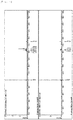
- FIG. 1 Control - upper graph and Reference Example 2 - lower graph
- FIG. 2 Example 1
- the results of confirmation of the proton peak of Si-OCH 3 which is the intrinsic peak derived from TMVS, and the size of the peak using 1 H-NMR are shown in FIG. 3 (Referential Example 2) and FIG. 4 (Example 1).
- the Si weight ratio obtained using the result of the XRF analysis was 2.21%, indicating a high Si weight ratio.
- the present invention is different from a conventional resin, the end of which is modified with the silanes, in view of the position of Si bonds in the chain of the resin.
- the difference can be confirmed through comparison with the graph obtained using 29 Si NMR ( FIG. 5 ).
- the upper graph in FIG. 5 is the graph of Example 1, and the lower graph is the graph of Reference Example 1.
- Si bond peaks were analyzed and classified into approximately three groups between -41 and -45 ppm.
- a weak peak was observed at about -43 ppm.
- the curable petroleum resin was manufactured using the same method as in Example 1, except that the content of TMVS was changed to the values in the following Table 2.
- Example 2 Example 1 Example 3 Example 4 Example 5 Content of TMVS (wt% based on total weight of DCPD and TMVS) 25 20 16 10 5 Yield (%) 25.8 27.8 28.8 30.3 33.0 Softening point (°C) 92.5 97.5 107.0 115.5 122.0 H-NMR silane proton content (%) 9.9 7.6 6.0 3.5 1.7 Si weight ratio (wt%) - 2.21 - 0.82 - Si-O peak intensity (FT-IR) 0.2137 0.1731 0.1444 0.0895 0.0461 Molecular weight Mn 374 364 365 352 354 Mw 801 806 799 822 821 Mz 7509 7858 7345 7846 7428 PDI 2.13 2.21 2.19 2.33 2.32
- the curable petroleum resin was manufactured using the same method as in Example 1, except that the reaction time of thermal polymerization was changed to the values in the following Table 3.
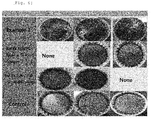
- Example 10 g of each of the petroleum resins obtained in Example 1, among the Examples, and Reference Examples 1 and 2 was weighed on an aluminum dish to be prepared.
- the prepared petroleum resins were heated at 200°C to observe the change in surface state over time.
- a curing catalyst was not added during the above-described procedure.
- the results are shown in FIG. 6 .
- the curing behavior of the surface of the general thermoplastic petroleum resin (Control: HIKOREZ A-1100) is not shown, but the curable petroleum resin started to be cured on the surface thereof.
- the curing rate was increased as the silane content was increased. That is, in Example 1, the resin was cured within a short period of time.
- the resin in which the silanes were grafted in a small amount at the end of the resin as in Reference Examples 1 and 2, slight curing occurred over time but the reactivity was not sufficient.
Landscapes
- Chemical & Material Sciences (AREA)
- Organic Chemistry (AREA)
- Polymers & Plastics (AREA)
- Health & Medical Sciences (AREA)
- Chemical Kinetics & Catalysis (AREA)
- Medicinal Chemistry (AREA)
- Engineering & Computer Science (AREA)
- Materials Engineering (AREA)
- General Chemical & Material Sciences (AREA)
- Oil, Petroleum & Natural Gas (AREA)
- Addition Polymer Or Copolymer, Post-Treatments, Or Chemical Modifications (AREA)
- Adhesives Or Adhesive Processes (AREA)
- Compositions Of Macromolecular Compounds (AREA)
Applications Claiming Priority (3)
| Application Number | Priority Date | Filing Date | Title |
|---|---|---|---|
| KR20140098848 | 2014-08-01 | ||
| KR1020150108441A KR101758060B1 (ko) | 2014-08-01 | 2015-07-31 | 경화 가능한 석유수지 및 이의 제조방법 |
| PCT/KR2015/008086 WO2016018131A1 (fr) | 2014-08-01 | 2015-08-03 | Résine de pétrole durcissable et son procédé de préparation |
Publications (3)
| Publication Number | Publication Date |
|---|---|
| EP3176191A1 true EP3176191A1 (fr) | 2017-06-07 |
| EP3176191A4 EP3176191A4 (fr) | 2018-02-28 |
| EP3176191B1 EP3176191B1 (fr) | 2020-07-01 |
Family
ID=55357278
Family Applications (1)
| Application Number | Title | Priority Date | Filing Date |
|---|---|---|---|
| EP15827903.4A Active EP3176191B1 (fr) | 2014-08-01 | 2015-08-03 | Résine de pétrole durcissable et son procédé de préparation |
Country Status (6)
| Country | Link |
|---|---|
| US (1) | US10280266B2 (fr) |
| EP (1) | EP3176191B1 (fr) |
| JP (2) | JP6470396B2 (fr) |
| KR (1) | KR101758060B1 (fr) |
| CN (1) | CN106574024B (fr) |
| TW (1) | TWI542655B (fr) |
Cited By (2)
| Publication number | Priority date | Publication date | Assignee | Title |
|---|---|---|---|---|
| EP4023729A1 (fr) | 2020-12-30 | 2022-07-06 | Bostik SA | Composition adhésive silylée présentant une adhérence améliorée sur des substrats métalliques |
| EP4198100A1 (fr) | 2021-12-20 | 2023-06-21 | Bostik SA | Composition adhesive reticulable par chauffage formant un joint adhesif stable en temperature |
Families Citing this family (16)
| Publication number | Priority date | Publication date | Assignee | Title |
|---|---|---|---|---|
| KR101995924B1 (ko) * | 2016-03-31 | 2019-07-04 | 코오롱인더스트리 주식회사 | 타이어 트레드용 고무 조성물 |
| KR102003451B1 (ko) | 2016-06-30 | 2019-07-24 | 코오롱인더스트리 주식회사 | 경화 가능한 석유수지, 이의 제조방법 및 이의 용도 |
| WO2018004287A2 (fr) * | 2016-06-30 | 2018-01-04 | 코오롱인더스트리 주식회사 | Résine de pétrole durcissable, son procédé de préparation et son utilisation |
| KR102393363B1 (ko) * | 2016-09-26 | 2022-05-02 | 코오롱인더스트리 주식회사 | 석유수지 및 이의 제조방법 |
| KR102291384B1 (ko) | 2016-09-27 | 2021-08-20 | 코오롱인더스트리 주식회사 | 경화 가능한 변성 석유수지, 이의 제조방법 및 이의 용도 |
| KR102343367B1 (ko) | 2016-12-15 | 2021-12-24 | 코오롱인더스트리 주식회사 | 경화 가능한 석유수지, 이의 제조방법 및 이의 용도 |
| CN115008946B (zh) | 2017-02-08 | 2024-10-11 | 横滨橡胶株式会社 | 充气轮胎 |
| KR102343368B1 (ko) | 2017-06-30 | 2021-12-24 | 코오롱인더스트리 주식회사 | 경화 가능한 석유수지, 이의 제조방법 및 이의 용도 |
| CN115023452A (zh) | 2020-02-10 | 2022-09-06 | 出光兴产株式会社 | 含硅烷的化合物和改性氢化石油树脂 |
| CN111454407B (zh) * | 2020-05-21 | 2022-12-13 | 宁波职业技术学院 | 一种具显著光稳定性的改性石油树脂的制备方法 |
| KR102820537B1 (ko) * | 2022-05-25 | 2025-06-13 | 코오롱인더스트리 주식회사 | 경화성 석유 수지, 이의 제조 방법 |
| KR102921357B1 (ko) * | 2022-07-28 | 2026-01-30 | 코오롱인더스트리 주식회사 | 경화성 석유 수지 |
| CN116178735A (zh) * | 2023-02-07 | 2023-05-30 | 深圳市科拉达精细化工有限公司 | 碳氢石油树脂改性硅树脂的合成 |
| CN116178640B (zh) * | 2023-02-07 | 2025-09-12 | 深圳市科拉达精细化工有限公司 | 石油树脂引入Si-O键化合物改善加工流变性的方法及应用 |
| DE112024001045T5 (de) * | 2023-02-28 | 2025-12-11 | Idemitsu Kosan Co., Ltd. | Asphaltzusammensetzung und asphaltmischung |
| CN117304381B (zh) * | 2023-11-28 | 2024-02-02 | 江苏麒祥高新材料有限公司 | 一种抗撕裂双环戊二烯类树脂的制备方法及其应用 |
Family Cites Families (15)
| Publication number | Priority date | Publication date | Assignee | Title |
|---|---|---|---|---|
| JPS5652925B2 (fr) * | 1973-05-07 | 1981-12-15 | ||
| US4408017A (en) * | 1982-05-26 | 1983-10-04 | Shell Oil Company | Coupling process |
| JP2755642B2 (ja) * | 1989-01-11 | 1998-05-20 | 帝人株式会社 | 無機材料充填重合体成型物およびその製造方法 |
| JP2716515B2 (ja) | 1989-03-31 | 1998-02-18 | 帝人株式会社 | 新規シラン化合物 |
| JPH02270888A (ja) * | 1989-04-12 | 1990-11-05 | Teijin Ltd | 新規シラン化合物 |
| EP0889107A3 (fr) | 1997-07-03 | 1999-03-24 | Ciba SC Holding AG | Adhésif à base de cyclooléfine |
| JP2001261685A (ja) * | 2000-03-17 | 2001-09-26 | Yokohama Rubber Co Ltd:The | シランカップリング剤及びそのゴム組成物 |
| JP2002284879A (ja) * | 2001-03-26 | 2002-10-03 | Arakawa Chem Ind Co Ltd | アルコキシ基含有シラン変性石油樹脂、当該樹脂組成物および石油樹脂−シリカハイブリッド体 |
| JP2002322185A (ja) | 2001-04-27 | 2002-11-08 | Nippon Petrochemicals Co Ltd | トリアルコキシシリル基含有ノルボルネン組成物 |
| EP1535941B1 (fr) | 2002-06-28 | 2007-09-12 | Zeon Corporation | Procedes de production de resines thermoplastiques, de resines reticulees et de materiaux composites de resines reticulees |
| US8101697B2 (en) * | 2005-02-01 | 2012-01-24 | Bridgestone Corporation | Multi-functionalized high-trans elastomeric polymers |
| DE102009046362A1 (de) | 2009-11-03 | 2011-05-05 | Tesa Se | Haftklebestoff aus einem vernetzbaren Polyolefin und einem Klebharz |
| EP3312204A1 (fr) * | 2010-10-13 | 2018-04-25 | ExxonMobil Chemical Patents Inc. | Modificateurs polymères hydrocarbonés fonctionnalisés par silane pour compositions élastomères |
| ES2805289T3 (es) | 2011-06-17 | 2021-02-11 | Materia Inc | Promotores de la adherencia y modificadores de la gelificación para composiciones de metátesis de olefinas |
| JP2016027094A (ja) * | 2014-07-01 | 2016-02-18 | 東ソー株式会社 | シリル化石油樹脂及びその製造方法 |
-
2015
- 2015-07-31 KR KR1020150108441A patent/KR101758060B1/ko active Active
- 2015-07-31 TW TW104125005A patent/TWI542655B/zh active
- 2015-08-03 EP EP15827903.4A patent/EP3176191B1/fr active Active
- 2015-08-03 US US15/500,580 patent/US10280266B2/en active Active
- 2015-08-03 JP JP2017504356A patent/JP6470396B2/ja active Active
- 2015-08-03 CN CN201580040806.6A patent/CN106574024B/zh active Active
-
2018
- 2018-11-28 JP JP2018222627A patent/JP6751429B2/ja active Active
Cited By (4)
| Publication number | Priority date | Publication date | Assignee | Title |
|---|---|---|---|---|
| EP4023729A1 (fr) | 2020-12-30 | 2022-07-06 | Bostik SA | Composition adhésive silylée présentant une adhérence améliorée sur des substrats métalliques |
| WO2022144169A1 (fr) | 2020-12-30 | 2022-07-07 | Bostik Sa | Composition adhésive silylée ayant une adhérence améliorée sur des substrats métalliques |
| EP4198100A1 (fr) | 2021-12-20 | 2023-06-21 | Bostik SA | Composition adhesive reticulable par chauffage formant un joint adhesif stable en temperature |
| FR3130822A1 (fr) | 2021-12-20 | 2023-06-23 | Bostik Sa | Composition adhesive reticulable par chauffage formant un joint adhesif stable en temperature |
Also Published As
| Publication number | Publication date |
|---|---|
| EP3176191A4 (fr) | 2018-02-28 |
| JP6751429B2 (ja) | 2020-09-02 |
| TWI542655B (zh) | 2016-07-21 |
| JP6470396B2 (ja) | 2019-02-13 |
| US10280266B2 (en) | 2019-05-07 |
| TW201606020A (zh) | 2016-02-16 |
| KR101758060B1 (ko) | 2017-07-14 |
| KR20160016677A (ko) | 2016-02-15 |
| US20170218131A1 (en) | 2017-08-03 |
| JP2017523288A (ja) | 2017-08-17 |
| CN106574024B (zh) | 2020-08-07 |
| EP3176191B1 (fr) | 2020-07-01 |
| JP2019031693A (ja) | 2019-02-28 |
| CN106574024A (zh) | 2017-04-19 |
Similar Documents
| Publication | Publication Date | Title |
|---|---|---|
| EP3176191B1 (fr) | Résine de pétrole durcissable et son procédé de préparation | |
| US10954420B2 (en) | Curable modified petroleum resin, and preparation method and use thereof | |
| MX2008008602A (es) | Interpolimeros de etileno de bajo peso molecular, metodos para su elaboracion, y usos de los mismos. | |
| JP7108642B2 (ja) | 硬化可能な石油樹脂、その製造方法及びその用途 | |
| WO2016018131A1 (fr) | Résine de pétrole durcissable et son procédé de préparation | |
| KR20180002699A (ko) | 작용화된 할로겐화 올레핀계 접착제, 이를 함유하는 물품, 및 이의 사용 방법 | |
| KR102003451B1 (ko) | 경화 가능한 석유수지, 이의 제조방법 및 이의 용도 | |
| KR102343367B1 (ko) | 경화 가능한 석유수지, 이의 제조방법 및 이의 용도 | |
| KR20230170491A (ko) | 경화성 석유 수지 및 이를 포함하는 접착제 조성물 |
Legal Events
| Date | Code | Title | Description |
|---|---|---|---|
| STAA | Information on the status of an ep patent application or granted ep patent |
Free format text: STATUS: THE INTERNATIONAL PUBLICATION HAS BEEN MADE |
|
| 17P | Request for examination filed |
Effective date: 20170119 |
|
| AK | Designated contracting states |
Kind code of ref document: A1 Designated state(s): AL AT BE BG CH CY CZ DE DK EE ES FI FR GB GR HR HU IE IS IT LI LT LU LV MC MK MT NL NO PL PT RO RS SE SI SK SM TR |
|
| AX | Request for extension of the european patent |
Extension state: BA ME |
|
| PUAI | Public reference made under article 153(3) epc to a published international application that has entered the european phase |
Free format text: ORIGINAL CODE: 0009012 |
|
| STAA | Information on the status of an ep patent application or granted ep patent |
Free format text: STATUS: REQUEST FOR EXAMINATION WAS MADE |
|
| DAV | Request for validation of the european patent (deleted) | ||
| DAX | Request for extension of the european patent (deleted) | ||
| A4 | Supplementary search report drawn up and despatched |
Effective date: 20180131 |
|
| RIC1 | Information provided on ipc code assigned before grant |
Ipc: C08G 77/42 20060101ALI20180125BHEP Ipc: C08F 289/00 20060101ALI20180125BHEP Ipc: C08F 220/04 20060101ALI20180125BHEP Ipc: C08F 240/00 20060101AFI20180125BHEP Ipc: C08F 2/06 20060101ALI20180125BHEP Ipc: C08F 4/34 20060101ALI20180125BHEP Ipc: C08F 232/08 20060101ALI20180125BHEP Ipc: C09J 145/00 20060101ALI20180125BHEP |
|
| STAA | Information on the status of an ep patent application or granted ep patent |
Free format text: STATUS: EXAMINATION IS IN PROGRESS |
|
| 17Q | First examination report despatched |
Effective date: 20190322 |
|
| RAP1 | Party data changed (applicant data changed or rights of an application transferred) |
Owner name: KOLON INDUSTRIES, INC. |
|
| GRAP | Despatch of communication of intention to grant a patent |
Free format text: ORIGINAL CODE: EPIDOSNIGR1 |
|
| STAA | Information on the status of an ep patent application or granted ep patent |
Free format text: STATUS: GRANT OF PATENT IS INTENDED |
|
| INTG | Intention to grant announced |
Effective date: 20200207 |
|
| GRAS | Grant fee paid |
Free format text: ORIGINAL CODE: EPIDOSNIGR3 |
|
| GRAA | (expected) grant |
Free format text: ORIGINAL CODE: 0009210 |
|
| STAA | Information on the status of an ep patent application or granted ep patent |
Free format text: STATUS: THE PATENT HAS BEEN GRANTED |
|
| AK | Designated contracting states |
Kind code of ref document: B1 Designated state(s): AL AT BE BG CH CY CZ DE DK EE ES FI FR GB GR HR HU IE IS IT LI LT LU LV MC MK MT NL NO PL PT RO RS SE SI SK SM TR |
|
| REG | Reference to a national code |
Ref country code: CH Ref legal event code: EP Ref country code: AT Ref legal event code: REF Ref document number: 1286132 Country of ref document: AT Kind code of ref document: T Effective date: 20200715 |
|
| REG | Reference to a national code |
Ref country code: IE Ref legal event code: FG4D |
|
| REG | Reference to a national code |
Ref country code: DE Ref legal event code: R096 Ref document number: 602015055184 Country of ref document: DE |
|
| REG | Reference to a national code |
Ref country code: NL Ref legal event code: FP |
|
| REG | Reference to a national code |
Ref country code: LT Ref legal event code: MG4D |
|
| PG25 | Lapsed in a contracting state [announced via postgrant information from national office to epo] |
Ref country code: BG Free format text: LAPSE BECAUSE OF FAILURE TO SUBMIT A TRANSLATION OF THE DESCRIPTION OR TO PAY THE FEE WITHIN THE PRESCRIBED TIME-LIMIT Effective date: 20201001 |
|
| REG | Reference to a national code |
Ref country code: AT Ref legal event code: MK05 Ref document number: 1286132 Country of ref document: AT Kind code of ref document: T Effective date: 20200701 |
|
| PG25 | Lapsed in a contracting state [announced via postgrant information from national office to epo] |
Ref country code: FI Free format text: LAPSE BECAUSE OF FAILURE TO SUBMIT A TRANSLATION OF THE DESCRIPTION OR TO PAY THE FEE WITHIN THE PRESCRIBED TIME-LIMIT Effective date: 20200701 Ref country code: AT Free format text: LAPSE BECAUSE OF FAILURE TO SUBMIT A TRANSLATION OF THE DESCRIPTION OR TO PAY THE FEE WITHIN THE PRESCRIBED TIME-LIMIT Effective date: 20200701 Ref country code: NO Free format text: LAPSE BECAUSE OF FAILURE TO SUBMIT A TRANSLATION OF THE DESCRIPTION OR TO PAY THE FEE WITHIN THE PRESCRIBED TIME-LIMIT Effective date: 20201001 Ref country code: GR Free format text: LAPSE BECAUSE OF FAILURE TO SUBMIT A TRANSLATION OF THE DESCRIPTION OR TO PAY THE FEE WITHIN THE PRESCRIBED TIME-LIMIT Effective date: 20201002 Ref country code: ES Free format text: LAPSE BECAUSE OF FAILURE TO SUBMIT A TRANSLATION OF THE DESCRIPTION OR TO PAY THE FEE WITHIN THE PRESCRIBED TIME-LIMIT Effective date: 20200701 Ref country code: SE Free format text: LAPSE BECAUSE OF FAILURE TO SUBMIT A TRANSLATION OF THE DESCRIPTION OR TO PAY THE FEE WITHIN THE PRESCRIBED TIME-LIMIT Effective date: 20200701 Ref country code: CZ Free format text: LAPSE BECAUSE OF FAILURE TO SUBMIT A TRANSLATION OF THE DESCRIPTION OR TO PAY THE FEE WITHIN THE PRESCRIBED TIME-LIMIT Effective date: 20200701 Ref country code: PT Free format text: LAPSE BECAUSE OF FAILURE TO SUBMIT A TRANSLATION OF THE DESCRIPTION OR TO PAY THE FEE WITHIN THE PRESCRIBED TIME-LIMIT Effective date: 20201102 Ref country code: HR Free format text: LAPSE BECAUSE OF FAILURE TO SUBMIT A TRANSLATION OF THE DESCRIPTION OR TO PAY THE FEE WITHIN THE PRESCRIBED TIME-LIMIT Effective date: 20200701 Ref country code: LT Free format text: LAPSE BECAUSE OF FAILURE TO SUBMIT A TRANSLATION OF THE DESCRIPTION OR TO PAY THE FEE WITHIN THE PRESCRIBED TIME-LIMIT Effective date: 20200701 |
|
| PG25 | Lapsed in a contracting state [announced via postgrant information from national office to epo] |
Ref country code: RS Free format text: LAPSE BECAUSE OF FAILURE TO SUBMIT A TRANSLATION OF THE DESCRIPTION OR TO PAY THE FEE WITHIN THE PRESCRIBED TIME-LIMIT Effective date: 20200701 Ref country code: LV Free format text: LAPSE BECAUSE OF FAILURE TO SUBMIT A TRANSLATION OF THE DESCRIPTION OR TO PAY THE FEE WITHIN THE PRESCRIBED TIME-LIMIT Effective date: 20200701 Ref country code: PL Free format text: LAPSE BECAUSE OF FAILURE TO SUBMIT A TRANSLATION OF THE DESCRIPTION OR TO PAY THE FEE WITHIN THE PRESCRIBED TIME-LIMIT Effective date: 20200701 Ref country code: IS Free format text: LAPSE BECAUSE OF FAILURE TO SUBMIT A TRANSLATION OF THE DESCRIPTION OR TO PAY THE FEE WITHIN THE PRESCRIBED TIME-LIMIT Effective date: 20201101 |
|
| PG25 | Lapsed in a contracting state [announced via postgrant information from national office to epo] |
Ref country code: MC Free format text: LAPSE BECAUSE OF FAILURE TO SUBMIT A TRANSLATION OF THE DESCRIPTION OR TO PAY THE FEE WITHIN THE PRESCRIBED TIME-LIMIT Effective date: 20200701 |
|
| REG | Reference to a national code |
Ref country code: CH Ref legal event code: PL |
|
| REG | Reference to a national code |
Ref country code: DE Ref legal event code: R097 Ref document number: 602015055184 Country of ref document: DE |
|
| PG25 | Lapsed in a contracting state [announced via postgrant information from national office to epo] |
Ref country code: EE Free format text: LAPSE BECAUSE OF FAILURE TO SUBMIT A TRANSLATION OF THE DESCRIPTION OR TO PAY THE FEE WITHIN THE PRESCRIBED TIME-LIMIT Effective date: 20200701 Ref country code: SM Free format text: LAPSE BECAUSE OF FAILURE TO SUBMIT A TRANSLATION OF THE DESCRIPTION OR TO PAY THE FEE WITHIN THE PRESCRIBED TIME-LIMIT Effective date: 20200701 Ref country code: RO Free format text: LAPSE BECAUSE OF FAILURE TO SUBMIT A TRANSLATION OF THE DESCRIPTION OR TO PAY THE FEE WITHIN THE PRESCRIBED TIME-LIMIT Effective date: 20200701 Ref country code: LI Free format text: LAPSE BECAUSE OF NON-PAYMENT OF DUE FEES Effective date: 20200831 Ref country code: LU Free format text: LAPSE BECAUSE OF NON-PAYMENT OF DUE FEES Effective date: 20200803 Ref country code: IT Free format text: LAPSE BECAUSE OF FAILURE TO SUBMIT A TRANSLATION OF THE DESCRIPTION OR TO PAY THE FEE WITHIN THE PRESCRIBED TIME-LIMIT Effective date: 20200701 Ref country code: DK Free format text: LAPSE BECAUSE OF FAILURE TO SUBMIT A TRANSLATION OF THE DESCRIPTION OR TO PAY THE FEE WITHIN THE PRESCRIBED TIME-LIMIT Effective date: 20200701 Ref country code: CH Free format text: LAPSE BECAUSE OF NON-PAYMENT OF DUE FEES Effective date: 20200831 |
|
| PLBE | No opposition filed within time limit |
Free format text: ORIGINAL CODE: 0009261 |
|
| STAA | Information on the status of an ep patent application or granted ep patent |
Free format text: STATUS: NO OPPOSITION FILED WITHIN TIME LIMIT |
|
| REG | Reference to a national code |
Ref country code: BE Ref legal event code: MM Effective date: 20200831 |
|
| PG25 | Lapsed in a contracting state [announced via postgrant information from national office to epo] |
Ref country code: AL Free format text: LAPSE BECAUSE OF FAILURE TO SUBMIT A TRANSLATION OF THE DESCRIPTION OR TO PAY THE FEE WITHIN THE PRESCRIBED TIME-LIMIT Effective date: 20200701 |
|
| 26N | No opposition filed |
Effective date: 20210406 |
|
| PG25 | Lapsed in a contracting state [announced via postgrant information from national office to epo] |
Ref country code: SK Free format text: LAPSE BECAUSE OF FAILURE TO SUBMIT A TRANSLATION OF THE DESCRIPTION OR TO PAY THE FEE WITHIN THE PRESCRIBED TIME-LIMIT Effective date: 20200701 |
|
| PG25 | Lapsed in a contracting state [announced via postgrant information from national office to epo] |
Ref country code: BE Free format text: LAPSE BECAUSE OF NON-PAYMENT OF DUE FEES Effective date: 20200831 Ref country code: SI Free format text: LAPSE BECAUSE OF FAILURE TO SUBMIT A TRANSLATION OF THE DESCRIPTION OR TO PAY THE FEE WITHIN THE PRESCRIBED TIME-LIMIT Effective date: 20200701 Ref country code: IE Free format text: LAPSE BECAUSE OF NON-PAYMENT OF DUE FEES Effective date: 20200803 |
|
| PG25 | Lapsed in a contracting state [announced via postgrant information from national office to epo] |
Ref country code: TR Free format text: LAPSE BECAUSE OF FAILURE TO SUBMIT A TRANSLATION OF THE DESCRIPTION OR TO PAY THE FEE WITHIN THE PRESCRIBED TIME-LIMIT Effective date: 20200701 Ref country code: MT Free format text: LAPSE BECAUSE OF FAILURE TO SUBMIT A TRANSLATION OF THE DESCRIPTION OR TO PAY THE FEE WITHIN THE PRESCRIBED TIME-LIMIT Effective date: 20200701 Ref country code: CY Free format text: LAPSE BECAUSE OF FAILURE TO SUBMIT A TRANSLATION OF THE DESCRIPTION OR TO PAY THE FEE WITHIN THE PRESCRIBED TIME-LIMIT Effective date: 20200701 |
|
| PG25 | Lapsed in a contracting state [announced via postgrant information from national office to epo] |
Ref country code: MK Free format text: LAPSE BECAUSE OF FAILURE TO SUBMIT A TRANSLATION OF THE DESCRIPTION OR TO PAY THE FEE WITHIN THE PRESCRIBED TIME-LIMIT Effective date: 20200701 |
|
| REG | Reference to a national code |
Ref country code: DE Ref legal event code: R082 Ref document number: 602015055184 Country of ref document: DE Representative=s name: TER MEER STEINMEISTER & PARTNER PATENTANWAELTE, DE |
|
| PGFP | Annual fee paid to national office [announced via postgrant information from national office to epo] |
Ref country code: NL Payment date: 20250708 Year of fee payment: 11 |
|
| PGFP | Annual fee paid to national office [announced via postgrant information from national office to epo] |
Ref country code: DE Payment date: 20250707 Year of fee payment: 11 |
|
| PGFP | Annual fee paid to national office [announced via postgrant information from national office to epo] |
Ref country code: GB Payment date: 20250707 Year of fee payment: 11 |
|
| PGFP | Annual fee paid to national office [announced via postgrant information from national office to epo] |
Ref country code: FR Payment date: 20250715 Year of fee payment: 11 |