EP3176240B2 - Procédé de préparation de sulfate d'alcool-éther - Google Patents
Procédé de préparation de sulfate d'alcool-éther Download PDFInfo
- Publication number
- EP3176240B2 EP3176240B2 EP16197328.4A EP16197328A EP3176240B2 EP 3176240 B2 EP3176240 B2 EP 3176240B2 EP 16197328 A EP16197328 A EP 16197328A EP 3176240 B2 EP3176240 B2 EP 3176240B2
- Authority
- EP
- European Patent Office
- Prior art keywords
- glycol
- solvent
- alcohol
- ether
- range
- Prior art date
- Legal status (The legal status is an assumption and is not a legal conclusion. Google has not performed a legal analysis and makes no representation as to the accuracy of the status listed.)
- Active
Links
Images

Classifications
-
- C—CHEMISTRY; METALLURGY
- C08—ORGANIC MACROMOLECULAR COMPOUNDS; THEIR PREPARATION OR CHEMICAL WORKING-UP; COMPOSITIONS BASED THEREON
- C08G—MACROMOLECULAR COMPOUNDS OBTAINED OTHERWISE THAN BY REACTIONS ONLY INVOLVING UNSATURATED CARBON-TO-CARBON BONDS
- C08G65/00—Macromolecular compounds obtained by reactions forming an ether link in the main chain of the macromolecule
- C08G65/02—Macromolecular compounds obtained by reactions forming an ether link in the main chain of the macromolecule from cyclic ethers by opening of the heterocyclic ring
- C08G65/32—Polymers modified by chemical after-treatment
- C08G65/321—Polymers modified by chemical after-treatment with inorganic compounds
- C08G65/326—Polymers modified by chemical after-treatment with inorganic compounds containing sulfur
-
- C—CHEMISTRY; METALLURGY
- C07—ORGANIC CHEMISTRY
- C07C—ACYCLIC OR CARBOCYCLIC COMPOUNDS
- C07C303/00—Preparation of esters or amides of sulfuric acids; Preparation of sulfonic acids or of their esters, halides, anhydrides or amides
- C07C303/24—Preparation of esters or amides of sulfuric acids; Preparation of sulfonic acids or of their esters, halides, anhydrides or amides of esters of sulfuric acids
-
- C—CHEMISTRY; METALLURGY
- C09—DYES; PAINTS; POLISHES; NATURAL RESINS; ADHESIVES; COMPOSITIONS NOT OTHERWISE PROVIDED FOR; APPLICATIONS OF MATERIALS NOT OTHERWISE PROVIDED FOR
- C09K—MATERIALS FOR MISCELLANEOUS APPLICATIONS, NOT PROVIDED FOR ELSEWHERE
- C09K8/00—Compositions for drilling of boreholes or wells; Compositions for treating boreholes or wells, e.g. for completion or for remedial operations
- C09K8/58—Compositions for enhanced recovery methods for obtaining hydrocarbons, i.e. for improving the mobility of the oil, e.g. displacing fluids
- C09K8/584—Compositions for enhanced recovery methods for obtaining hydrocarbons, i.e. for improving the mobility of the oil, e.g. displacing fluids characterised by the use of specific surfactants
-
- C—CHEMISTRY; METALLURGY
- C11—ANIMAL OR VEGETABLE OILS, FATS, FATTY SUBSTANCES OR WAXES; FATTY ACIDS THEREFROM; DETERGENTS; CANDLES
- C11D—DETERGENT COMPOSITIONS; USE OF SINGLE SUBSTANCES AS DETERGENTS; SOAP OR SOAP-MAKING; RESIN SOAPS; RECOVERY OF GLYCEROL
- C11D1/00—Detergent compositions based essentially on surface-active compounds; Use of these compounds as a detergent
- C11D1/02—Anionic compounds
- C11D1/12—Sulfonic acids or sulfuric acid esters; Salts thereof
- C11D1/29—Sulfates of polyoxyalkylene ethers
-
- C—CHEMISTRY; METALLURGY
- C08—ORGANIC MACROMOLECULAR COMPOUNDS; THEIR PREPARATION OR CHEMICAL WORKING-UP; COMPOSITIONS BASED THEREON
- C08G—MACROMOLECULAR COMPOUNDS OBTAINED OTHERWISE THAN BY REACTIONS ONLY INVOLVING UNSATURATED CARBON-TO-CARBON BONDS
- C08G2650/00—Macromolecular compounds obtained by reactions forming an ether link in the main chain of the macromolecule
- C08G2650/02—Macromolecular compounds obtained by reactions forming an ether link in the main chain of the macromolecule characterized by the type of post-polymerisation functionalisation
- C08G2650/04—End-capping
-
- C—CHEMISTRY; METALLURGY
- C08—ORGANIC MACROMOLECULAR COMPOUNDS; THEIR PREPARATION OR CHEMICAL WORKING-UP; COMPOSITIONS BASED THEREON
- C08G—MACROMOLECULAR COMPOUNDS OBTAINED OTHERWISE THAN BY REACTIONS ONLY INVOLVING UNSATURATED CARBON-TO-CARBON BONDS
- C08G2650/00—Macromolecular compounds obtained by reactions forming an ether link in the main chain of the macromolecule
- C08G2650/28—Macromolecular compounds obtained by reactions forming an ether link in the main chain of the macromolecule characterised by the polymer type
- C08G2650/38—Macromolecular compounds obtained by reactions forming an ether link in the main chain of the macromolecule characterised by the polymer type containing oxygen in addition to the ether group
-
- C—CHEMISTRY; METALLURGY
- C08—ORGANIC MACROMOLECULAR COMPOUNDS; THEIR PREPARATION OR CHEMICAL WORKING-UP; COMPOSITIONS BASED THEREON
- C08G—MACROMOLECULAR COMPOUNDS OBTAINED OTHERWISE THAN BY REACTIONS ONLY INVOLVING UNSATURATED CARBON-TO-CARBON BONDS
- C08G2650/00—Macromolecular compounds obtained by reactions forming an ether link in the main chain of the macromolecule
- C08G2650/28—Macromolecular compounds obtained by reactions forming an ether link in the main chain of the macromolecule characterised by the polymer type
- C08G2650/58—Ethylene oxide or propylene oxide copolymers, e.g. pluronics
Definitions
- This disclosure relates generally to a process for preparing stabilized alcohol ether sulfates suitable for use in enhanced oil recovery.
- Crude oil production from oil in subterranean reservoirs may involve use of various flooding methods as the natural forces that are used in the "primary recovery” process become depleted. A large portion of the crude oil may have to be driven out of the formation in “secondary” or “tertiary” recovery processes. In addition, some reservoirs may not have sufficient natural forces for oil production even by primary recovery processes. The production of crude oil using such flooding methods is one example of an enhanced oil recovery process.
- the least expensive and easiest method of flooding a subterranean reservoir for the production of crude oil is by injecting a liquid or a gas into the well to force the oil to the surface.
- Water flooding is the most widely used fluid. However, water does not readily displace oil because of the immiscibility of water and oil and/or the high interfacial tension between the two liquids.
- Surfactants are one class of chemical compounds that have been used in aqueous media for enhanced oil recovery. Surfactants have been found to effectively lower the interfacial tension between oil and water and enabling the oil droplets to flow more easily through the channels of the reservoir.
- Alcohol ether sulfates are a class of anionic surfactants used in enhanced oil recovery. Alcohol ether sulfates are made by reacting alkoxylated alcohols with a sulfating agent to convert the alcohol functionality into a sulfuric acid semi-ester (-C-O-SO 3 H group). The sulfuric acid semi-esters are normally neutralized quickly after formation because they are generally not stable (see D.W. Roberts, Org. Process Res. Dev. 1998, 2, 194-202 ). As a result, alcohol ether sulfates tend to be difficult to manufacture.
- a process for preparing an alcohol ether sulfate comprising: (a) sulfating an alkoxylated alcohol; (b) neutralizing the sulfated product of step (a) in the presence of a base and a co-solvent having a flash point of at least 60°C, wherein the co-solvent is selected from the group consisting of polyhydric alcohols, alkylene glycol monoethers, polyalkylene glycols, polyalkylene glycol monoethers; wherein the alcohol ether sulfate has a number average molecular weight of at least 2000.
- alcohol ether sulfate refers to compound having the following general structure: RO-(AO) z -SO 3 M where R is a C 12 -C 36 aliphatic hydrocarbon group; AO represents one or more C 2 -C 4 alkylene oxide units (e.g., ethylene oxide, propylene oxide); z ⁇ 1; and M is an alkali metal cation, an alkaline earth metal cation, an ammonium cation or a substituted ammonium cation.
- the alkylene oxide units may be incorporated randomly or in blocks.
- sulfuric acid semi-ester and “acid ester” refer to a compound having a C-O-SO 3 H group.
- co-solvent refers to alcohols, ethers and/or a range of nonionic materials.
- aliphatic denotes a hydrocarbon moiety that may be straight-chain (i.e., unbranched), branched, or cyclic and may be completely saturated or may contain one or more units of unsaturation, but which is not aromatic.
- Suitable aliphatic groups include, but are not limited to, linear or branched, alkyl and alkenyl groups.
- flash point refers to the lowest temperature at which a volatile liquid can vaporize to form an ignitable mixture in air.
- the flash point can be measured, e.g., by the ASTM D3828 or ASTM D93 closed-cup methods and is an indication of the flammability of the liquid.
- the "number average molecular weight” is abbreviated as M n and refers to the ordinary arithmetic mean of the molecular weight of individual molecules in a sample. It is defined as the total weight of all molecules in a sample divided by the total number of molecules in the sample.
- M n the number-average molecular weight
- the number-average molecular weight can be measured by a variety of well-known methods including gel permeation chromatography, spectroscopic end group analysis, and osmometry. If unspecified, molecular weights of polymers given herein are number average molecular weights.
- Ethylene glycol n -butyl ether (also 2-butoxyethanol) is abbreviated as EGBE.
- Polylene oxide (also -C 3 H 6 O-) is abbreviated as PO.
- Ethylene oxide (also -CH 2 CH 2 O-) is abbreviated as EO.
- Alkoxylated alcohols can be prepared in a manner in principle known to those of skill in the art. Normally, at least one aliphatic alcohol is reacted with alkylene oxide (e.g., ethylene oxide, propylene oxide) in the presence an alkoxylation catalyst. Alkoxylations are usually catalyzed by a base (e.g., KOH), but other catalysts such as double metal cyanide complexes can also be used (see, e.g., U.S. Patent No. 5,482,908 ).
- alkylene oxide e.g., ethylene oxide, propylene oxide
- Alkoxylations are usually catalyzed by a base (e.g., KOH), but other catalysts such as double metal cyanide complexes can also be used (see, e.g., U.S. Patent No. 5,482,908 ).
- the alkoxylated alcohol useful in the process described herein can be represented by the following structure (1): RO-(AO) z -H (1) where R is a C 12 -C 40 (e.g., a C 18 -C 36 or a C 24 -C 32 ) aliphatic hydrocarbon group; AO represents one or more C 2 -C 4 alkylene oxide units (e.g., ethylene oxide, propylene oxide) and z ⁇ 1 (e.g., 100 ⁇ z ⁇ 1).
- the alkylene oxide units may be incorporated randomly or in blocks.
- the aliphatic hydrocarbon group (R) originates from an aliphatic alcohol (R-OH) and may represent a mixture of chain lengths, may be saturated or unsaturated, may be linear or branched, or any combination of the foregoing.
- the aliphatic hydrocarbon group (R) is an alkyl group, more preferably a branched alkyl group.
- the aliphatic alcohol (R-OH) from which the aliphatic hydrocarbon group (R) originates may be a primary or a secondary alcohol, preferably a primary alcohol.
- the aliphatic alcohol is a C 12 -C 40 (e.g., a C 18 -C 36 , a C 24 -C 32 ) Guerbet alcohol.
- a "Guerbet alcohol” refers to a monofunctional, primary alcohol comprising at least one branching at the carbon atom adjacent to the carbon atom carrying the hydroxyl group. Chemically, Guerbet alcohols are described as 2-alkyl-1-alkanols.
- the alkoxylated alcohol useful in the process described herein is a block co-polymer represented by the following structure (2): RO-(C 3 H 6 O) x -(C 2 H 4 O) y -H (2) wherein R is a C 12 -C 40 (e.g., a C 18 -C 36 or a C 24 -C 32 ) aliphatic hydrocarbon group; x >1; y >1; and x + y ⁇ 100.
- a "block co-polymer” refers to a polymer composed of two or more different polymers arranged in segments or "blocks" of each constituent polymer.
- x may be in a range from 5 to 50 (e.g., from 5 to 45, from 10 to 45, from 5 to 40, from 10 to 50, from 10 to 45, from 10 to 40, from 15 to 50, from 15 to 45, from 15 to 40, from 20 to 50, from 20 to 45, from 20 to 40, from 25 to 50, from 25 to 45, or from 25 to 40).
- y may be in a range from 5 to 50 (e.g., from 5 to 45, from 5 to 40, from 5 to 35, from 5 to 30, from 5 to 25, from 5 to 20, from 5 to 15, from 10 to 50, from 10 to 45, 10 to 40, from 10 to 35, from 15 to 50, from 15 to 45, from 15 to 40, from 15 to 35, from 20 to 50, from 20 to 45, from 20 to 40, from 20 to 35, from 25 to 50, from 25 to 45, from 25 to 40, or from 25 to 35).
- 5 to 50 e.g., from 5 to 45, from 5 to 40, from 5 to 35, from 5 to 30, from 5 to 25, from 5 to 20, from 5 to 15, from 10 to 50, from 10 to 45, 10 to 40, from 10 to 35, from 15 to 50, from 15 to 45, from 15 to 40, from 15 to 35, from 20 to 50, from 20 to 45, from 20 to 40, from 20 to 35, from 25 to 50, from 25 to 45, from 25 to 40, or from 25 to 35).
- x may be in a range from 20 to 50 and y may be in a range from 5 to 15. In one embodiment, x may be in a range from 20 to 50 and y may be in a range from 20 to 50.
- the alkoxylated alcohol generally comprises more propylene oxide units ( x ) than ethylene oxide units ( y ), wherein the ratio of ethylene oxide units to propylene oxide units ( y / x ) is in the range from 0.01 to 1 (e.g., from 0.1 to 1, from 0.1 to 0.5, from 0.25 to 1, or from 0.5 to 1).
- Sulfation of the alkoxylated alcohol may be performed by any method known to those of skill in the art.
- the sulfation is typically carried out in a continuous falling film tubular reactor maintained at a temperature from 30°C to 75°C using sulfur trioxide (SO 3 ) as the sulfating agent.
- SO 3 sulfur trioxide
- the mole ratio of SO 3 to alkoxylated alcohol is typically maintained at a range of from 0.8 to 1.2:1.
- the alkoxylated alcohol is sulfated with sulfur trioxide diluted with air (e.g., 3-5% SO 3 mole fraction in process air).
- the resulting sulfated products are sulfuric acid semi-esters ("acid esters") which are generally not stable and must therefore immediately be transferred into a neutralization cycle in which it is converted, since otherwise elimination of sulfur trioxide will occur. Elimination of SO 3 may lead to alkoxylate chain degradation with concomitant formation of undesirable by-products such as 1,4-dioxane and/or dimethyl 1,4-dioxane.
- Neutralization of the acid ester may be carried out in a continuous or batch process by any method known to one skilled in the art.
- the neutralization step is carried out in an in-line mixing reactor in which the acid ester, an organic or inorganic base, and a water-miscible co-solvent are mixed and the temperature is maintained between 20°C and 80°C.
- a "water-miscible co-solvent” refers to an organic co-solvent that can form a monophasic solution with water at the temperature at which the reaction is carried out.
- the acid ester may be neutralized using an aqueous alkali metal hydroxide (e.g., sodium hydroxide or potassium hydroxide), an aqueous alkaline earth metal hydroxide (e.g., magnesium hydroxide or calcium hydroxide), or bases such as ammonium hydroxide, substituted ammonium hydroxide, sodium carbonate or potassium hydrogen carbonate.
- an aqueous alkali metal hydroxide e.g., sodium hydroxide or potassium hydroxide
- an aqueous alkaline earth metal hydroxide e.g., magnesium hydroxide or calcium hydroxide
- bases such as ammonium hydroxide, substituted ammonium hydroxide, sodium carbonate or potassium hydrogen carbonate.
- the acid ester is neutralized using an aqueous alkali metal hydroxide.
- a co-solvent is employed to aid dissolution of the acid ester in water.
- the co-solvent can be any water-miscible fluid having a flash point of at least 60°C.
- the co-solvent is selected from the group consisting of polyhydric alcohols, alkylene glycol monoethers, polyalkylene glycols, polyalkylene glycol monoethers.
- suitable polyhydric alcohols include C 2 -C 6 alkylene glycols, particularly C 2 -C 4 alkylene glycols such as ethylene glycol, propylene glycol, and butylene glycol.
- alkylene glycol monoethers examples include alkylene glycol mono(C 1 -C 6 alkyl)ethers, particularly alkylene glycol mono(C 1 -C 4 alkyl)ethers such as ethylene glycol n -butyl ether and propylene glycol n -butyl ether.
- polyalkylene glycols examples include poly(C 2 -C 4 alkylene)glycols having 2-10 C 2 -C 4 alkylene glycol units such as diethylene glycol, triethylene glycol, tetraethylene glycol, polyethylene glycol 300, polyethylene glycol 400, dipropylene glycol, tripropylene glycol, and the like.
- polyalkylene glycol monoethers examples include poly(C 2 -C 4 alkylene)glycol mono(C 1 -C 6 alkyl) ethers having 2-50 alkylene glycol units per molecule such as diethylene glycol methyl ether, diethylene glycol ethyl ether, diethylene glycol n-butyl ether, triethylene glycol methyl ether, triethylene glycol ethyl ether, triethylene glycol n -butyl ether, dipropylene glycol methyl ether, tripropylene glycol methyl ether, and polyethoxylated C 2 -C 4 alcohols having from 5 to 25 ethylene oxide units per molecule.
- the co-solvent is selected from the group consisting of ethylene glycol, propylene glycol, ethylene glycol n -butyl ether, diethylene glycol, triethylene glycol, tetraethylene glycol, dipropylene glycol, tripropylene glycol, diethylene glycol methyl ether, diethylene glycol ethyl ether, diethylene glycol n-butyl ether, triethylene glycol methyl ether, triethylene glycol ethyl ether, triethylene glycol n-butyl ether, polyethoxylated C 2 -C 4 alcohols having from 5 to 25 ethylene oxide units per molecule, and combinations thereof.
- the co-solvent may have a flash point of at least 65°C, at least 70°C, or at least 75°C.
- the co-solvent may have a flash point of 400°C or less, 350°C or less, 300°C or less, 250°C or less, or even 200°C or less.
- the co-solvent may have a flash point of from 60°C to 400°C (e.g., from 60°C to 350°C, from 60°C to 300°C, from 60°C to 250°C, from 60°C to 225°C, from 60°C to 200°C, from 65°C to 400°C, from 65°C to 350°C, from 65°C to 300°C, from 65°C to 250°C, from 65°C to 225°C, from 65°C to 200°C, from 70°C to 400°C, from 70°C to 350°C, from 70°C to 300°C, from 70°C to 250°C, from 70°C to 225°C, from 70°C to 200°C, from 75°C to 400°C, from 75°C to 350°C, from 75°C to 300°C, from 75°C to 250°C, from 75°C to 225°C, or from 75°C to 200°C).
- 60°C to 400°C e.g., from
- the weight ratio of the co-solvent to the acid ester is suitably from 0.01:1 to 10:1, (e.g., from 0.1:1 to 5:1, from 0.25:1 to 3:1, or from 0.5:1 to 1.5:1).
- the process described herein is a continuous process.
- continuous it is meant a system that operates without interruption or cessation.
- a continuous process to produce an alcohol ether sulfate would be one where the reactants are continually introduced into one or more reactors and alcohol ether sulfate product is continually withdrawn.
- the resulting product is an alcohol ether sulfate represented by the following structure (3): RO-(C3H 6 O) x -(C 2 H 4 O)y-SO 3 M (3) wherein R, x , and y are as described herein above and M is an alkali metal cation, an alkaline earth metal cation, an ammonium cation or a substituted ammonium cation.
- the resulting alcohol ether sulfate has a number average molecular weight (M n ) of at least 2000 (e.g., at least 2500, at least 3000, at least 3500, from 2000 to 6000, from 2000 to 5500, from 2000 to 5000 g/mol, from 2000 to 4500, from 2000 to 4000, from 2500 to 6000, from 2500 to 5500, from 2500 to 5000, from 2500 to 4500, or from 2500 to 4000).
- M n number average molecular weight
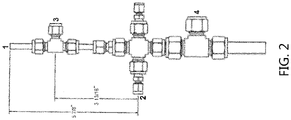
- Pilot plant sulfation of the feedstock was accomplished using a tubular thin film reactor as illustrated in FIG.1 .
- the feedstock was a 2900 MW block propoxylate/ethoxylate co-polymer alcohol (ISOFOL ® 28-(PO) 35 (EO) 10 -H).
- ISOFOL ® 28 (Sasol Performance Chemicals) is 2-dodecyl-hexadecanol. Dilute SO 3 gas is contacted with the organic feedstock.
- the reactor consists of a nominal 0.6 inch inside diameter water-jacketed stainless steel tube, 5 feet long, mounted vertically. The feedstock is metered through a mass flow meter and temperature controlled jacketed tubing before entering the film reactor.
- the feedstock enters a weir at the top of the reactor and is distributed uniformly around the circumference of the reactor tube.
- the dilute SO 3 gas stream enters from above the reactor tube. As the gas and liquid moved down the reactor, the SO 3 is absorbed by the feedstock and reacts with the feedstock. Exiting the reactor, the gas and liquid enter a cyclone where the two phases are separated. The liquid exiting from the bottom of the cyclone is pumped through a cooling heat exchanger. A portion of the cooled liquid is returned just below the bottom of the reactor tube where it is mixed with the hotter gas and liquid exiting the reactor. The recycle of liquid serves to both quench cool the fresh reaction products and scavenge unabsorbed SO 3 .
- vent gas exiting the top of the cyclone is directed to SO 2 absorber and then a mist pad.
- the portion of the cooled liquid that is not recycled back to the reactor is transferred to the neutralizer.
- the crude acid was then quenched with 50 wt. % aqueous NaOH and then diluted approximately 30 % by weight with ethylene glycol n-butyl ether to afford the final product.
- Table 2 summarizes the analytical properties of the product obtained by the sulfation of the 2900 MW alcohol polyether alcohol feedstock.
- the process parameters were used:
- the acids produced were neutralized in batch as follows: to 30.0 grams of acid in a 250 mL PYREX ® glass beaker was added varying aqueous amounts of NaOH (50 wt. % in water) followed by addition of a co-solvent followed by mixing at room temperature for 45 minutes. Two types of mixing were used: standard (Stnd) and high sheer (HS). Standard mixing consisted of an overhead mechanical stirrer (with a flat blade vertical turbine; 5 cm in diameter and 8 blades of 1 cm ⁇ 1 cm dimension) at approximately 500 rpm. For high sheer mixing, a Silverson Model L4RT-A high shear mixer was used. The analytical data for the resulting neutralized products are summarized in Table 4.
- Entry A shows that using only water dilution of the acid and normal mechanical mixing with caustic results in incomplete neutralization.
- Entry B shows that using only water dilution of the acid and high sheer mixing at 2500 rpm with caustic results in neutralization, but the resulting product has low activity.
- Entry C shows that the using water only as the co-solvent and high sheer mixing at 500 rpm with caustic results in incomplete neutralization of the acid.
- Entry D shows that using only EGBE as the co-solvent during neutralization of the acid with caustic and standard mixing results in good neutralization and the pH of the product is stable.
- Entry E shows that using only EGBE as the co-solvent during neutralization of the acid with caustic and high shear mixing (2500 rpm) results in good neutralization but low activity.
- a comparison of Entries D and F shows that using a mixture of EGBE and water during neutralization of the acid with caustic and standard mixing is not as good as using only EGBE.
- Entries H-L show that neutralization of the acid with a variety of nonionic co-solvents, with or without water, and standard mixing provides better neutralization and product stability compared to water alone as the co-solvent.
- the resulting acid (30 g, 34.3% activity) was neutralized with 1.5 g of 50 wt. % aqueous NaOH and 50 g of EGBE using standard mixing conditions at room temperature for 45 minutes and monitored over time for activity and pH as shown in Table 5.
- Table 5 pH 1 % Actives 2 Time (days) 10.1 22.3 0 10.1 20.7 2 10.2 20.3 5 9.9 20.2 20 1 pH measurements were made on a 1 wt. % aqueous solution of the neutralized product using a calibrated pH electrode. 2 Determined via HYAMINE ® titration using 3864 for the sodium salt molecular weight.
Landscapes
- Chemical & Material Sciences (AREA)
- Organic Chemistry (AREA)
- Oil, Petroleum & Natural Gas (AREA)
- Engineering & Computer Science (AREA)
- Life Sciences & Earth Sciences (AREA)
- Chemical Kinetics & Catalysis (AREA)
- General Life Sciences & Earth Sciences (AREA)
- Materials Engineering (AREA)
- Wood Science & Technology (AREA)
- Polymers & Plastics (AREA)
- Medicinal Chemistry (AREA)
- Health & Medical Sciences (AREA)
- General Chemical & Material Sciences (AREA)
- Inorganic Chemistry (AREA)
- Organic Low-Molecular-Weight Compounds And Preparation Thereof (AREA)
- Polyethers (AREA)
Claims (12)
- Procédé pour la préparation d'un sulfate d'alcool-éther, le procédé comprenant :(a) sulfater un alcool alcoxylé ;(b) neutraliser le produit sulfaté de l'étape (a) en la présence d'une base et d'un co-solvant ayant un point d'éclair d'au moins 60°C, où le co-solvant est sélectionné parmi le groupe constitué par alcools polyhydriques, monoéthers d'alcylèneglycol, polyalcylèneglycols, monoéthers de polyalcylèneglycols, dans lequel le sulfate d'alcool-éther a un poids moléculaire moyen par nombre d'au moins 2000.
- Procédé selon la revendication 1, dans lequel le sulfate d'alcool-éther est représenté par la structure suivante :
RO-(C3H6O)x-(C2H4O)y-SO3M
où :R est un groupe hydrocarbure aliphatique C12 à C40 ;x > 1;y > 1;x + y ≤ 100 ; etM est un cation de métal alcalin, un cation de métal alcalino-terreux, un cation ammonium ou un cation ammonium substitué. - Procédé selon la revendication 2, dans lequel R est un groupe alkyle branché C24 à C32.
- Procédé selon la revendication 2, dans lequel x est dans l'intervalle de 20 à 50 et y est dans l'intervalle de 5 à 15.
- Procédé selon la revendication 2, dans lequel x est dans l'intervalle de 20 à 50 et y est dans l'intervalle de 20 à 50.
- Procédé selon la revendication 1, dans lequel l'étape de sulfater (a) comprend réagir l'alcool alcoxylé avec du trioxyde de soufre, qui a été dilué avec de l'air.
- Procédé selon la revendication 1, dans lequel le co-solvant a un point d'éclair de 60°C à 300°C.
- Procédé selon la revendication 1, dans lequel le co-solvant a un point d'éclair de 65°C à 250°C.
- Procédé selon la revendication 1, dans lequel le co-solvant est sélectionné parmi le groupe constitué en l'éthylèneglycol, le propylèneglycol, l'éthylèneglycol n-butyléther, le diéthylèneglycol, le triéthylèneglycol, le tétraéthylèneglycol, le dipropylèneglycol, le tripropylèneglycol, le diéthylèneglycol méthyléther, le diéthylèneglycol éthyléther, le diéthylèneglycol n-butyléther, le triéthylèneglycol méthyléther, le triéthylèneglycol éthyléther, le triéthylèneglycol n-butyléther, des alcools C2 à C4 polyéthoxylés ayant de 5 à 25 unités d'oxyde d'éthylène par molécule, et leurs combinaisons.
- Procédé selon la revendication 1, dans lequel le rapport en poids entre le co-solvant et le produit sulfaté de l'étape (a) est de 0,01:1 à 10:1.
- Procédé selon la revendication 1, dans lequel la base est un hydroxyde de métal alcalin.
- Procédé selon la revendication 1, dans lequel le procédé est un procédé continu.
Applications Claiming Priority (1)
| Application Number | Priority Date | Filing Date | Title |
|---|---|---|---|
| US14/958,972 US9745259B2 (en) | 2015-12-04 | 2015-12-04 | Process for preparing alcohol ether sulfates |
Publications (3)
| Publication Number | Publication Date |
|---|---|
| EP3176240A1 EP3176240A1 (fr) | 2017-06-07 |
| EP3176240B1 EP3176240B1 (fr) | 2019-05-22 |
| EP3176240B2 true EP3176240B2 (fr) | 2022-09-07 |
Family
ID=57226896
Family Applications (1)
| Application Number | Title | Priority Date | Filing Date |
|---|---|---|---|
| EP16197328.4A Active EP3176240B2 (fr) | 2015-12-04 | 2016-11-04 | Procédé de préparation de sulfate d'alcool-éther |
Country Status (5)
| Country | Link |
|---|---|
| US (1) | US9745259B2 (fr) |
| EP (1) | EP3176240B2 (fr) |
| CN (1) | CN106832252B (fr) |
| ES (1) | ES2742832T5 (fr) |
| SG (1) | SG10201610060WA (fr) |
Families Citing this family (6)
| Publication number | Priority date | Publication date | Assignee | Title |
|---|---|---|---|---|
| WO2021084330A1 (fr) | 2019-10-31 | 2021-05-06 | Chevron Oronite Company Llc | Oligomères oléfiniques fonctionnalisés |
| EP4249578A1 (fr) | 2022-03-07 | 2023-09-27 | The Procter & Gamble Company | Procédés de fabrication de mélanges de tensioactifs concentrés |
| WO2023172859A1 (fr) | 2022-03-07 | 2023-09-14 | The Procter & Gamble Company | Procédés de fabrication de mélanges de tensioactifs concentrés |
| CN116925783B (zh) * | 2023-07-17 | 2025-12-09 | 山东勤正表活技术研究有限公司 | 一种醇醚硫酸盐分散剂、其制备工艺及应用 |
| WO2025054162A1 (fr) | 2023-09-06 | 2025-03-13 | The Procter & Gamble Company | Procédés de fabrication de mélanges de tensioactifs concentrés |
| EP4520809A1 (fr) | 2023-09-06 | 2025-03-12 | The Procter & Gamble Company | Procédé de fabrication de mélanges concentrés de tensioactifs |
Citations (7)
| Publication number | Priority date | Publication date | Assignee | Title |
|---|---|---|---|---|
| US3919125A (en) † | 1972-05-23 | 1975-11-11 | Nippon Unitol Co Ltd | Method of preparing a highly concentrated solution of a higher secondary alcohol ethoxysulfate and such a concentrated solution |
| GB1453005A (en) † | 1973-06-19 | 1976-10-20 | Ici Australia Ltd | Sulphated polyoxyalkylated alcohols |
| US4311650A (en) † | 1979-06-15 | 1982-01-19 | Ballestia Chimica, S.p.A. | Multi-stage neutralization of sulfated compounds |
| WO2010121975A1 (fr) † | 2009-04-22 | 2010-10-28 | Akzo Nobel Chemicals International B.V. | Procédé pour la préparation de tensioactifs non gélifiants faiblement moussants et compositions de ceux-ci |
| US20140083707A1 (en) † | 2011-03-24 | 2014-03-27 | Britta Jakobs-Sauter | Highly-Concentrated Flowable Salts of Alkyl Polyalkoxy Sulphates |
| WO2014136091A1 (fr) † | 2013-03-08 | 2014-09-12 | Zschimmer & Schwarz Italiana S.P.A. | Procédé de préparation de compositions anhydres d'alkyl(éthoxy)sulfate |
| US20150252247A1 (en) † | 2014-03-10 | 2015-09-10 | Board Of Regents, The University Of Texas System | High active flowable surfactant blends for enhanced oil recovery |
Family Cites Families (6)
| Publication number | Priority date | Publication date | Assignee | Title |
|---|---|---|---|---|
| US4592875A (en) * | 1984-06-25 | 1986-06-03 | Atlantic Richfield Company | Alkoxylated ether sulfate anionic surfactants from plasticizer alcohol mixtures |
| KR910004791A (ko) * | 1989-08-31 | 1991-03-29 | 오노 알버어스 | 액체 계면 활성 조성물 및 그의 제조방법 |
| US5482908A (en) | 1994-09-08 | 1996-01-09 | Arco Chemical Technology, L.P. | Highly active double metal cyanide catalysts |
| WO1997039089A1 (fr) * | 1996-04-16 | 1997-10-23 | The Procter & Gamble Company | Compositions liquides nettoyantes contenant des tensioactifs ramifies en milieu de chaine selectionnes |
| US8853136B2 (en) * | 2009-10-14 | 2014-10-07 | Basf Se | Process for tertiary mineral oil production using surfactant mixtures |
| CA2893117A1 (fr) * | 2012-12-07 | 2014-06-12 | Shell Internationale Research Maatschappij B.V. | Procede de preparation d'alcools alcoxyles |
-
2015
- 2015-12-04 US US14/958,972 patent/US9745259B2/en active Active
-
2016
- 2016-11-04 ES ES16197328T patent/ES2742832T5/es active Active
- 2016-11-04 EP EP16197328.4A patent/EP3176240B2/fr active Active
- 2016-11-30 SG SG10201610060WA patent/SG10201610060WA/en unknown
- 2016-12-01 CN CN201611092863.1A patent/CN106832252B/zh active Active
Patent Citations (7)
| Publication number | Priority date | Publication date | Assignee | Title |
|---|---|---|---|---|
| US3919125A (en) † | 1972-05-23 | 1975-11-11 | Nippon Unitol Co Ltd | Method of preparing a highly concentrated solution of a higher secondary alcohol ethoxysulfate and such a concentrated solution |
| GB1453005A (en) † | 1973-06-19 | 1976-10-20 | Ici Australia Ltd | Sulphated polyoxyalkylated alcohols |
| US4311650A (en) † | 1979-06-15 | 1982-01-19 | Ballestia Chimica, S.p.A. | Multi-stage neutralization of sulfated compounds |
| WO2010121975A1 (fr) † | 2009-04-22 | 2010-10-28 | Akzo Nobel Chemicals International B.V. | Procédé pour la préparation de tensioactifs non gélifiants faiblement moussants et compositions de ceux-ci |
| US20140083707A1 (en) † | 2011-03-24 | 2014-03-27 | Britta Jakobs-Sauter | Highly-Concentrated Flowable Salts of Alkyl Polyalkoxy Sulphates |
| WO2014136091A1 (fr) † | 2013-03-08 | 2014-09-12 | Zschimmer & Schwarz Italiana S.P.A. | Procédé de préparation de compositions anhydres d'alkyl(éthoxy)sulfate |
| US20150252247A1 (en) † | 2014-03-10 | 2015-09-10 | Board Of Regents, The University Of Texas System | High active flowable surfactant blends for enhanced oil recovery |
Also Published As
| Publication number | Publication date |
|---|---|
| SG10201610060WA (en) | 2017-07-28 |
| US9745259B2 (en) | 2017-08-29 |
| EP3176240B1 (fr) | 2019-05-22 |
| CN106832252A (zh) | 2017-06-13 |
| CN106832252B (zh) | 2021-02-19 |
| US20170158625A1 (en) | 2017-06-08 |
| EP3176240A1 (fr) | 2017-06-07 |
| ES2742832T3 (es) | 2020-02-17 |
| ES2742832T5 (es) | 2023-01-16 |
Similar Documents
| Publication | Publication Date | Title |
|---|---|---|
| EP3176240B2 (fr) | Procédé de préparation de sulfate d'alcool-éther | |
| US4528106A (en) | Glucoside surfactants | |
| EP2791205B1 (fr) | Procédé de préparation de polyols de carbonate de polyéther ester | |
| US9701893B2 (en) | Process for producing mineral oil using surfactants based on a mixture of C32 guerbet-, C34 guerbet-, C36 guerbet-containing alkyl alkoxylates | |
| US9688621B2 (en) | Process for preparing an internal olefin sulfonate | |
| EP3331963B1 (fr) | Dimères mixtes provenant d'acide alpha-oléfine sulfonique | |
| US20190112475A1 (en) | Polyurethane Polyol, and Preparation Method and Application Thereof | |
| CN110746955B (zh) | 一种驱油用双子表面活性剂、二元复合体系及其制备方法与应用 | |
| US10155900B2 (en) | Process for producing mineral oil using surfactants based on a mixture of C24 guerbet, C26 guerbet, C28 guerbet-containing hydrocarbyl alkoxylates | |
| JP2011506458A (ja) | 高純度フェノール系グリコールエーテルの連続製造方法 | |
| CN101052608A (zh) | 制备烷氧基化醇或酚的方法 | |
| US9475979B2 (en) | Process for producing mineral oil using surfactants based on a mixture of C20 Guerbet-, C22 Guerbet-, C24 Guerbet-containing hydrocarbyl alkoxylates | |
| US9428432B2 (en) | Derivatives of tris(2-hydroxyphenyl)methanes, preparation thereof and use thereof for mineral oil production | |
| CN108276979A (zh) | 一种耐温抗盐型聚醚磺酸盐驱油剂及其制备方法 | |
| JP5172627B2 (ja) | ポリオキシアルキレン付加物の製造方法 | |
| US9758718B2 (en) | Highly concentrated, water-free amine salts of hydrocarbon alkoxysulfates and use and method using aqueous dilutions of the same | |
| DE10341953B4 (de) | Verfahren zur Herstellung von organischen Carbonaten | |
| US9475977B2 (en) | Process for producing mineral oil using surfactants based on a mixture of C28 Guerbet, C30 Guerbet, C32 Guerbet-containing hydrocarbyl alkoxylates | |
| KR20240089622A (ko) | 알콕시화된 에테르 아민의 제조 방법 및 이의 용도 | |
| MX2014004523A (es) | Uso de derivados de tris - (2 - hidroxifenil) metano para produccion terciaria de petroleo. | |
| EP2782666B1 (fr) | Dérivés de tris(2-hydroxyphényl)méthanes, leur production et leur utilisation pour l'extraction de pétrole | |
| US20220403225A1 (en) | Surfactant and Preparation Method Therefor | |
| CN101235137A (zh) | 高生产率烷氧基化方法 | |
| JP2014534994A (ja) | C28ゲルベとc30ゲルベとc32ゲルベを含有するハイドロカルビルアルコキシレート混合物系の界面活性剤を用いる鉱油の製造方法 | |
| Zhao et al. | Physicochemical Properties and Applications of Cardanol‐Based Sulfonate Surfactant for Enhanced Oil Recovery |
Legal Events
| Date | Code | Title | Description |
|---|---|---|---|
| AK | Designated contracting states |
Kind code of ref document: A1 Designated state(s): AL AT BE BG CH CY CZ DE DK EE ES FI FR GB GR HR HU IE IS IT LI LT LU LV MC MK MT NL NO PL PT RO RS SE SI SK SM TR |
|
| AX | Request for extension of the european patent |
Extension state: BA ME |
|
| PUAI | Public reference made under article 153(3) epc to a published international application that has entered the european phase |
Free format text: ORIGINAL CODE: 0009012 |
|
| STAA | Information on the status of an ep patent application or granted ep patent |
Free format text: STATUS: THE APPLICATION HAS BEEN PUBLISHED |
|
| STAA | Information on the status of an ep patent application or granted ep patent |
Free format text: STATUS: REQUEST FOR EXAMINATION WAS MADE |
|
| 17P | Request for examination filed |
Effective date: 20171127 |
|
| RBV | Designated contracting states (corrected) |
Designated state(s): AL AT BE BG CH CY CZ DE DK EE ES FI FR GB GR HR HU IE IS IT LI LT LU LV MC MK MT NL NO PL PT RO RS SE SI SK SM TR |
|
| STAA | Information on the status of an ep patent application or granted ep patent |
Free format text: STATUS: EXAMINATION IS IN PROGRESS |
|
| 17Q | First examination report despatched |
Effective date: 20180329 |
|
| GRAP | Despatch of communication of intention to grant a patent |
Free format text: ORIGINAL CODE: EPIDOSNIGR1 |
|
| STAA | Information on the status of an ep patent application or granted ep patent |
Free format text: STATUS: GRANT OF PATENT IS INTENDED |
|
| INTG | Intention to grant announced |
Effective date: 20181116 |
|
| GRAS | Grant fee paid |
Free format text: ORIGINAL CODE: EPIDOSNIGR3 |
|
| GRAJ | Information related to disapproval of communication of intention to grant by the applicant or resumption of examination proceedings by the epo deleted |
Free format text: ORIGINAL CODE: EPIDOSDIGR1 |
|
| GRAL | Information related to payment of fee for publishing/printing deleted |
Free format text: ORIGINAL CODE: EPIDOSDIGR3 |
|
| STAA | Information on the status of an ep patent application or granted ep patent |
Free format text: STATUS: EXAMINATION IS IN PROGRESS |
|
| GRAR | Information related to intention to grant a patent recorded |
Free format text: ORIGINAL CODE: EPIDOSNIGR71 |
|
| STAA | Information on the status of an ep patent application or granted ep patent |
Free format text: STATUS: GRANT OF PATENT IS INTENDED |
|
| GRAA | (expected) grant |
Free format text: ORIGINAL CODE: 0009210 |
|
| STAA | Information on the status of an ep patent application or granted ep patent |
Free format text: STATUS: THE PATENT HAS BEEN GRANTED |
|
| INTC | Intention to grant announced (deleted) | ||
| INTG | Intention to grant announced |
Effective date: 20190410 |
|
| AK | Designated contracting states |
Kind code of ref document: B1 Designated state(s): AL AT BE BG CH CY CZ DE DK EE ES FI FR GB GR HR HU IE IS IT LI LT LU LV MC MK MT NL NO PL PT RO RS SE SI SK SM TR |
|
| REG | Reference to a national code |
Ref country code: GB Ref legal event code: FG4D |
|
| REG | Reference to a national code |
Ref country code: CH Ref legal event code: EP |
|
| REG | Reference to a national code |
Ref country code: IE Ref legal event code: FG4D |
|
| REG | Reference to a national code |
Ref country code: DE Ref legal event code: R096 Ref document number: 602016014231 Country of ref document: DE |
|
| REG | Reference to a national code |
Ref country code: AT Ref legal event code: REF Ref document number: 1136066 Country of ref document: AT Kind code of ref document: T Effective date: 20190615 |
|
| REG | Reference to a national code |
Ref country code: NL Ref legal event code: MP Effective date: 20190522 |
|
| REG | Reference to a national code |
Ref country code: LT Ref legal event code: MG4D |
|
| PG25 | Lapsed in a contracting state [announced via postgrant information from national office to epo] |
Ref country code: NO Free format text: LAPSE BECAUSE OF FAILURE TO SUBMIT A TRANSLATION OF THE DESCRIPTION OR TO PAY THE FEE WITHIN THE PRESCRIBED TIME-LIMIT Effective date: 20190822 Ref country code: FI Free format text: LAPSE BECAUSE OF FAILURE TO SUBMIT A TRANSLATION OF THE DESCRIPTION OR TO PAY THE FEE WITHIN THE PRESCRIBED TIME-LIMIT Effective date: 20190522 Ref country code: LT Free format text: LAPSE BECAUSE OF FAILURE TO SUBMIT A TRANSLATION OF THE DESCRIPTION OR TO PAY THE FEE WITHIN THE PRESCRIBED TIME-LIMIT Effective date: 20190522 Ref country code: HR Free format text: LAPSE BECAUSE OF FAILURE TO SUBMIT A TRANSLATION OF THE DESCRIPTION OR TO PAY THE FEE WITHIN THE PRESCRIBED TIME-LIMIT Effective date: 20190522 Ref country code: PT Free format text: LAPSE BECAUSE OF FAILURE TO SUBMIT A TRANSLATION OF THE DESCRIPTION OR TO PAY THE FEE WITHIN THE PRESCRIBED TIME-LIMIT Effective date: 20190922 Ref country code: SE Free format text: LAPSE BECAUSE OF FAILURE TO SUBMIT A TRANSLATION OF THE DESCRIPTION OR TO PAY THE FEE WITHIN THE PRESCRIBED TIME-LIMIT Effective date: 20190522 Ref country code: NL Free format text: LAPSE BECAUSE OF FAILURE TO SUBMIT A TRANSLATION OF THE DESCRIPTION OR TO PAY THE FEE WITHIN THE PRESCRIBED TIME-LIMIT Effective date: 20190522 Ref country code: AL Free format text: LAPSE BECAUSE OF FAILURE TO SUBMIT A TRANSLATION OF THE DESCRIPTION OR TO PAY THE FEE WITHIN THE PRESCRIBED TIME-LIMIT Effective date: 20190522 |
|
| PG25 | Lapsed in a contracting state [announced via postgrant information from national office to epo] |
Ref country code: LV Free format text: LAPSE BECAUSE OF FAILURE TO SUBMIT A TRANSLATION OF THE DESCRIPTION OR TO PAY THE FEE WITHIN THE PRESCRIBED TIME-LIMIT Effective date: 20190522 Ref country code: BG Free format text: LAPSE BECAUSE OF FAILURE TO SUBMIT A TRANSLATION OF THE DESCRIPTION OR TO PAY THE FEE WITHIN THE PRESCRIBED TIME-LIMIT Effective date: 20190822 Ref country code: RS Free format text: LAPSE BECAUSE OF FAILURE TO SUBMIT A TRANSLATION OF THE DESCRIPTION OR TO PAY THE FEE WITHIN THE PRESCRIBED TIME-LIMIT Effective date: 20190522 Ref country code: GR Free format text: LAPSE BECAUSE OF FAILURE TO SUBMIT A TRANSLATION OF THE DESCRIPTION OR TO PAY THE FEE WITHIN THE PRESCRIBED TIME-LIMIT Effective date: 20190823 |
|
| REG | Reference to a national code |
Ref country code: AT Ref legal event code: MK05 Ref document number: 1136066 Country of ref document: AT Kind code of ref document: T Effective date: 20190522 |
|
| PG25 | Lapsed in a contracting state [announced via postgrant information from national office to epo] |
Ref country code: SK Free format text: LAPSE BECAUSE OF FAILURE TO SUBMIT A TRANSLATION OF THE DESCRIPTION OR TO PAY THE FEE WITHIN THE PRESCRIBED TIME-LIMIT Effective date: 20190522 Ref country code: AT Free format text: LAPSE BECAUSE OF FAILURE TO SUBMIT A TRANSLATION OF THE DESCRIPTION OR TO PAY THE FEE WITHIN THE PRESCRIBED TIME-LIMIT Effective date: 20190522 Ref country code: DK Free format text: LAPSE BECAUSE OF FAILURE TO SUBMIT A TRANSLATION OF THE DESCRIPTION OR TO PAY THE FEE WITHIN THE PRESCRIBED TIME-LIMIT Effective date: 20190522 Ref country code: EE Free format text: LAPSE BECAUSE OF FAILURE TO SUBMIT A TRANSLATION OF THE DESCRIPTION OR TO PAY THE FEE WITHIN THE PRESCRIBED TIME-LIMIT Effective date: 20190522 Ref country code: CZ Free format text: LAPSE BECAUSE OF FAILURE TO SUBMIT A TRANSLATION OF THE DESCRIPTION OR TO PAY THE FEE WITHIN THE PRESCRIBED TIME-LIMIT Effective date: 20190522 Ref country code: RO Free format text: LAPSE BECAUSE OF FAILURE TO SUBMIT A TRANSLATION OF THE DESCRIPTION OR TO PAY THE FEE WITHIN THE PRESCRIBED TIME-LIMIT Effective date: 20190522 |
|
| REG | Reference to a national code |
Ref country code: ES Ref legal event code: FG2A Ref document number: 2742832 Country of ref document: ES Kind code of ref document: T3 Effective date: 20200217 |
|
| REG | Reference to a national code |
Ref country code: DE Ref legal event code: R026 Ref document number: 602016014231 Country of ref document: DE |
|
| PG25 | Lapsed in a contracting state [announced via postgrant information from national office to epo] |
Ref country code: SM Free format text: LAPSE BECAUSE OF FAILURE TO SUBMIT A TRANSLATION OF THE DESCRIPTION OR TO PAY THE FEE WITHIN THE PRESCRIBED TIME-LIMIT Effective date: 20190522 |
|
| PLBI | Opposition filed |
Free format text: ORIGINAL CODE: 0009260 |
|
| PLAX | Notice of opposition and request to file observation + time limit sent |
Free format text: ORIGINAL CODE: EPIDOSNOBS2 |
|
| PG25 | Lapsed in a contracting state [announced via postgrant information from national office to epo] |
Ref country code: TR Free format text: LAPSE BECAUSE OF FAILURE TO SUBMIT A TRANSLATION OF THE DESCRIPTION OR TO PAY THE FEE WITHIN THE PRESCRIBED TIME-LIMIT Effective date: 20190522 |
|
| 26 | Opposition filed |
Opponent name: SASOL PERFORMANCE CHEMICALS GMBH Effective date: 20200220 |
|
| PG25 | Lapsed in a contracting state [announced via postgrant information from national office to epo] |
Ref country code: PL Free format text: LAPSE BECAUSE OF FAILURE TO SUBMIT A TRANSLATION OF THE DESCRIPTION OR TO PAY THE FEE WITHIN THE PRESCRIBED TIME-LIMIT Effective date: 20190522 |
|
| PG25 | Lapsed in a contracting state [announced via postgrant information from national office to epo] |
Ref country code: SI Free format text: LAPSE BECAUSE OF FAILURE TO SUBMIT A TRANSLATION OF THE DESCRIPTION OR TO PAY THE FEE WITHIN THE PRESCRIBED TIME-LIMIT Effective date: 20190522 |
|
| REG | Reference to a national code |
Ref country code: CH Ref legal event code: PL |
|
| PLBB | Reply of patent proprietor to notice(s) of opposition received |
Free format text: ORIGINAL CODE: EPIDOSNOBS3 |
|
| PG25 | Lapsed in a contracting state [announced via postgrant information from national office to epo] |
Ref country code: MC Free format text: LAPSE BECAUSE OF FAILURE TO SUBMIT A TRANSLATION OF THE DESCRIPTION OR TO PAY THE FEE WITHIN THE PRESCRIBED TIME-LIMIT Effective date: 20190522 Ref country code: LU Free format text: LAPSE BECAUSE OF NON-PAYMENT OF DUE FEES Effective date: 20191104 Ref country code: LI Free format text: LAPSE BECAUSE OF NON-PAYMENT OF DUE FEES Effective date: 20191130 Ref country code: CH Free format text: LAPSE BECAUSE OF NON-PAYMENT OF DUE FEES Effective date: 20191130 |
|
| REG | Reference to a national code |
Ref country code: BE Ref legal event code: MM Effective date: 20191130 |
|
| PG25 | Lapsed in a contracting state [announced via postgrant information from national office to epo] |
Ref country code: IE Free format text: LAPSE BECAUSE OF NON-PAYMENT OF DUE FEES Effective date: 20191104 |
|
| PG25 | Lapsed in a contracting state [announced via postgrant information from national office to epo] |
Ref country code: BE Free format text: LAPSE BECAUSE OF NON-PAYMENT OF DUE FEES Effective date: 20191130 |
|
| REG | Reference to a national code |
Ref country code: DE Ref legal event code: R082 Ref document number: 602016014231 Country of ref document: DE Representative=s name: HL KEMPNER PATENTANWAELTE, SOLICITORS (ENGLAND, DE Ref country code: DE Ref legal event code: R082 Ref document number: 602016014231 Country of ref document: DE Representative=s name: HL KEMPNER PATENTANWALT, RECHTSANWALT, SOLICIT, DE Ref country code: DE Ref legal event code: R082 Ref document number: 602016014231 Country of ref document: DE Representative=s name: HL KEMPNER PARTG MBB, DE |
|
| PG25 | Lapsed in a contracting state [announced via postgrant information from national office to epo] |
Ref country code: CY Free format text: LAPSE BECAUSE OF FAILURE TO SUBMIT A TRANSLATION OF THE DESCRIPTION OR TO PAY THE FEE WITHIN THE PRESCRIBED TIME-LIMIT Effective date: 20190522 |
|
| PG25 | Lapsed in a contracting state [announced via postgrant information from national office to epo] |
Ref country code: IS Free format text: LAPSE BECAUSE OF FAILURE TO SUBMIT A TRANSLATION OF THE DESCRIPTION OR TO PAY THE FEE WITHIN THE PRESCRIBED TIME-LIMIT Effective date: 20190922 |
|
| PG25 | Lapsed in a contracting state [announced via postgrant information from national office to epo] |
Ref country code: HU Free format text: LAPSE BECAUSE OF FAILURE TO SUBMIT A TRANSLATION OF THE DESCRIPTION OR TO PAY THE FEE WITHIN THE PRESCRIBED TIME-LIMIT; INVALID AB INITIO Effective date: 20161104 Ref country code: MT Free format text: LAPSE BECAUSE OF FAILURE TO SUBMIT A TRANSLATION OF THE DESCRIPTION OR TO PAY THE FEE WITHIN THE PRESCRIBED TIME-LIMIT Effective date: 20190522 |
|
| PG25 | Lapsed in a contracting state [announced via postgrant information from national office to epo] |
Ref country code: MK Free format text: LAPSE BECAUSE OF FAILURE TO SUBMIT A TRANSLATION OF THE DESCRIPTION OR TO PAY THE FEE WITHIN THE PRESCRIBED TIME-LIMIT Effective date: 20190522 |
|
| PUAH | Patent maintained in amended form |
Free format text: ORIGINAL CODE: 0009272 |
|
| STAA | Information on the status of an ep patent application or granted ep patent |
Free format text: STATUS: PATENT MAINTAINED AS AMENDED |
|
| 27A | Patent maintained in amended form |
Effective date: 20220907 |
|
| AK | Designated contracting states |
Kind code of ref document: B2 Designated state(s): AL AT BE BG CH CY CZ DE DK EE ES FI FR GB GR HR HU IE IS IT LI LT LU LV MC MK MT NL NO PL PT RO RS SE SI SK SM TR |
|
| REG | Reference to a national code |
Ref country code: DE Ref legal event code: R102 Ref document number: 602016014231 Country of ref document: DE |
|
| REG | Reference to a national code |
Ref country code: ES Ref legal event code: DC2A Ref document number: 2742832 Country of ref document: ES Kind code of ref document: T5 Effective date: 20230116 |
|
| P01 | Opt-out of the competence of the unified patent court (upc) registered |
Effective date: 20230522 |
|
| PGFP | Annual fee paid to national office [announced via postgrant information from national office to epo] |
Ref country code: FR Payment date: 20250930 Year of fee payment: 10 |
|
| PGFP | Annual fee paid to national office [announced via postgrant information from national office to epo] |
Ref country code: DE Payment date: 20250930 Year of fee payment: 10 |
|
| PGFP | Annual fee paid to national office [announced via postgrant information from national office to epo] |
Ref country code: GB Payment date: 20251001 Year of fee payment: 10 |
|
| PGFP | Annual fee paid to national office [announced via postgrant information from national office to epo] |
Ref country code: IT Payment date: 20251022 Year of fee payment: 10 |
|
| PGFP | Annual fee paid to national office [announced via postgrant information from national office to epo] |
Ref country code: ES Payment date: 20251211 Year of fee payment: 10 |