EP3180367B1 - Multireaktoraufschlämmungspolymerisationsverfahren mit hochreinem ethylen - Google Patents
Multireaktoraufschlämmungspolymerisationsverfahren mit hochreinem ethylen Download PDFInfo
- Publication number
- EP3180367B1 EP3180367B1 EP15756378.4A EP15756378A EP3180367B1 EP 3180367 B1 EP3180367 B1 EP 3180367B1 EP 15756378 A EP15756378 A EP 15756378A EP 3180367 B1 EP3180367 B1 EP 3180367B1
- Authority
- EP
- European Patent Office
- Prior art keywords
- reactor
- ethylene
- polymerization
- polyethylene
- fed
- Prior art date
- Legal status (The legal status is an assumption and is not a legal conclusion. Google has not performed a legal analysis and makes no representation as to the accuracy of the status listed.)
- Active
Links
Images
Classifications
-
- C—CHEMISTRY; METALLURGY
- C08—ORGANIC MACROMOLECULAR COMPOUNDS; THEIR PREPARATION OR CHEMICAL WORKING-UP; COMPOSITIONS BASED THEREON
- C08F—MACROMOLECULAR COMPOUNDS OBTAINED BY REACTIONS ONLY INVOLVING CARBON-TO-CARBON UNSATURATED BONDS
- C08F110/00—Homopolymers of unsaturated aliphatic hydrocarbons having only one carbon-to-carbon double bond
- C08F110/02—Ethene
-
- C—CHEMISTRY; METALLURGY
- C08—ORGANIC MACROMOLECULAR COMPOUNDS; THEIR PREPARATION OR CHEMICAL WORKING-UP; COMPOSITIONS BASED THEREON
- C08F—MACROMOLECULAR COMPOUNDS OBTAINED BY REACTIONS ONLY INVOLVING CARBON-TO-CARBON UNSATURATED BONDS
- C08F10/00—Homopolymers and copolymers of unsaturated aliphatic hydrocarbons having only one carbon-to-carbon double bond
- C08F10/02—Ethene
-
- C—CHEMISTRY; METALLURGY
- C08—ORGANIC MACROMOLECULAR COMPOUNDS; THEIR PREPARATION OR CHEMICAL WORKING-UP; COMPOSITIONS BASED THEREON
- C08F—MACROMOLECULAR COMPOUNDS OBTAINED BY REACTIONS ONLY INVOLVING CARBON-TO-CARBON UNSATURATED BONDS
- C08F2/00—Processes of polymerisation
- C08F2/001—Multistage polymerisation processes characterised by a change in reactor conditions without deactivating the intermediate polymer
-
- C—CHEMISTRY; METALLURGY
- C08—ORGANIC MACROMOLECULAR COMPOUNDS; THEIR PREPARATION OR CHEMICAL WORKING-UP; COMPOSITIONS BASED THEREON
- C08F—MACROMOLECULAR COMPOUNDS OBTAINED BY REACTIONS ONLY INVOLVING CARBON-TO-CARBON UNSATURATED BONDS
- C08F2/00—Processes of polymerisation
- C08F2/12—Polymerisation in non-solvents
- C08F2/16—Aqueous medium
- C08F2/18—Suspension polymerisation
-
- C—CHEMISTRY; METALLURGY
- C08—ORGANIC MACROMOLECULAR COMPOUNDS; THEIR PREPARATION OR CHEMICAL WORKING-UP; COMPOSITIONS BASED THEREON
- C08F—MACROMOLECULAR COMPOUNDS OBTAINED BY REACTIONS ONLY INVOLVING CARBON-TO-CARBON UNSATURATED BONDS
- C08F2/00—Processes of polymerisation
- C08F2/38—Polymerisation using regulators, e.g. chain terminating agents, e.g. telomerisation
-
- C—CHEMISTRY; METALLURGY
- C08—ORGANIC MACROMOLECULAR COMPOUNDS; THEIR PREPARATION OR CHEMICAL WORKING-UP; COMPOSITIONS BASED THEREON
- C08F—MACROMOLECULAR COMPOUNDS OBTAINED BY REACTIONS ONLY INVOLVING CARBON-TO-CARBON UNSATURATED BONDS
- C08F2500/00—Characteristics or properties of obtained polyolefins; Use thereof
- C08F2500/05—Bimodal or multimodal molecular weight distribution
-
- C—CHEMISTRY; METALLURGY
- C08—ORGANIC MACROMOLECULAR COMPOUNDS; THEIR PREPARATION OR CHEMICAL WORKING-UP; COMPOSITIONS BASED THEREON
- C08F—MACROMOLECULAR COMPOUNDS OBTAINED BY REACTIONS ONLY INVOLVING CARBON-TO-CARBON UNSATURATED BONDS
- C08F2500/00—Characteristics or properties of obtained polyolefins; Use thereof
- C08F2500/18—Bulk density
Definitions
- the present disclosure relates to a process for ethylene polymerization. More particularly, the present disclosure relates to a multi-reactor slurry polymerization process using high purity ethylene to produce multimodal polyethylene.
- polyethylene-containing products The use of polyethylene-containing products is known.
- Various processes can be used to produce polyethylene.
- diluents such as hexane are used to dissolve the ethylene monomer, comonomers and hydrogen, and the monomer(s) are polymerized with a catalyst.
- the polymer product formed is present as a slurry suspended in the liquid medium.
- monomer(s), hydrogen, catalyst and diluent are fed into the first of three reactors where a slurry forms from the polymer particles contained within the diluent and unreacted monomer.
- the reactors can be operated in parallel or in series, and the types/amounts of monomer and conditions can be varied in each reactor to produce a variety of polyethylene materials, including unimodal (molecular weight distribution) or multimodal polyethylene material.
- Such multimodal compositions are used in a variety of applications; e.g., WO 2012/069400 A1 discloses trimodal polyethylene compositions for blow moldings.
- Ziegler type catalysts have been used in ethylene polymerization processes. They use aluminum alkyl compounds as co-catalyst activators to activate titanium or vanadium sites on the catalyst.
- the amount of co-catalyst present in the reactor thus plays an important part in determining the yields and selectivities of the ethylene slurry polymerization process, particularly in multi-reactor systems where different polymers can be produced in each reactor, but the same co-catalyst flows to each reactor in turn.
- aluminum alkyls such as triethylaluminum, trimethylaluminum, tri-isobutylaluminum and tri-n-hexylaluminum as scavengers of poisons in polymerization solutions, as described in WO 2004/085488 A2 .
- these aluminum alkyl materials are also co-catalysts for the catalyzed polymerization, as described above, so that the process of scavenging catalyst poisons changes the availability of the aluminum alkyl co-catalyst for ethylene polymerization. This results in altered reactor yields and product properties.
- the present disclosure provides multi-reactor slurry polymerization processes for the preparation of polyethylene in a reactor cascade of two or more polymerization reactors.
- the present disclosure provides a slurry polymerization process for the preparation of polyethylene in a reactor cascade of two or more polymerization reactors comprising the steps of:
- the process further comprising the steps of:
- the process further comprising the steps of:
- the ethylene fed to the polymerization reactors has a carbon monoxide concentration of at most 0.09 ppm by volume.
- the ethylene fed to the polymerization reactors has a carbon dioxide concentration of at most 0.9 ppm by volume.
- the ethylene fed to the polymerization reactors has an oxygen concentration of at most 0.9 ppm by volume.
- the ethylene fed to the polymerization reactors has an acetylene concentration of at most 2.7 ppm by volume.
- the ethylene fed to the polymerization reactors has a water concentration of at most 1.8 ppm by volume.
- the ethylene purification comprises a first process step comprising contacting the ethylene with a catalyst reducing the concentration of oxygen in the ethylene, a second process step comprising contacting the ethylene with a catalyst reducing the concentration of carbon monoxide in the ethylene, a third process step comprising contacting the ethylene with a molecular sieves and a fourth process step comprising contacting the ethylene with an activated alumina.
- one or more C 3 to C 10 alpha-olefins are fed to at least one of the polymerization rectors and the C 3 to C 10 alpha-olefins are first passed through an olefin purification unit, which reduces at least the concentration of carbon monoxide, carbon dioxide, oxygen, acetylene and water contained in the olefins, before being fed to the two or more polymerization reactors of the reactor cascade.
- the aluminum alkyl is trimethylaluminum, triethylaluminum, tri-isobutylaluminum, isoprenylaluminum, or tri-n-hexylaluminum.
- the diluent fed to the first reactor of the reactor cascade is fresh diluent.
- the prepared polyethylene has a density in the range of from 0.935 g/cm 3 to 0.970 g/cm 3 .
- the prepared polyethylene is a bimodal or multimodal polyethylene.
- the present disclosure provides process for preparing films, pipes or small blow molding or large blow molding polyethylene articles, in which a polyethylene is prepared by the process of the present disclosure and the polyethylene is then converted to a film, pipe or small blow molding or large blow molding polyethylene article.
- the process of the present disclosure relates to a slurry polymerization process for the preparation of polyethylene in a reactor cascade of one first polymerization reactor and one or more subsequent polymerization reactors comprising feeding to the first polymerization reactor amounts of ethylene, of a Ziegler catalyst, of aluminum alkyl and of a diluent, and optionally amounts of hydrogen and optionally amounts of C 3 to C 10 alpha-olefins as comonomers and feeding to the one or more subsequent polymerization reactors amounts of ethylene, and a of diluent, and optionally amounts of hydrogen and optionally amounts of C 3 to C 10 alpha-olefins as comonomers.
- the catalyst fed to the first polymerization reactor of the cascaded multi-reactor system flows from the first polymerization reactor to the second polymerization reactor, and then to subsequent polymerization reactors within the respective reactor slurry products.
- the ethylene fed to the polymerization reactors is first passed through an ethylene purification unit, which reduces at least the concentration of carbon monoxide, carbon dioxide, oxygen, acetylene and water contained in in the ethylene, before it is fed to the two or more polymerization reactors of the reactor cascade.
- the polyethylene slurry production process is carried out in a reactor cascade system, i.e. in reactors which are operated in series.
- a reactor cascade system can have two, three or more polymerization reactors.
- the process is carried out in a three-reactor cascade process operated in series.
- the subject matter of the present disclosure relates to a slurry polymerization process for the preparation of polyethylene comprising:
- the polyethylene slurry production process further comprises:
- the slurry product withdrawn from the second polymerization reactor, withdrawn from the third polymerization reactor, or, if a reactor cascade of more than three polymerization reactors is employed, withdrawn from the last polymerization reactor of the reactor cascade is further fed to a post reactor.
- the process then further comprises the steps of:
- the slurry product withdrawn from the last polymerization reactor of the reactor cascade is usually fed to a separator, which separates the particulate polyethylene from the suspension medium. At least a part of the suspension medium separated from the slurry product in the separator may be recycled as diluent to one or more polymerization reactors of the reactor cascade.
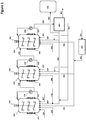
- FIG. 1 illustrates a preferred embodiment of the process of the present disclosure, as a three-reactor system running in series, i.e. as cascade.
- the polymerization is carried out in 3 polymerization reactors 100, 200 and 300.
- Each of the reactors has a cooling jacket 101, 201 or 301 and is equipped with a mixing unit 102, 202 or 302 comprising a motor, a rotating shaft and impellers.
- Catalyst is fed to rector 100 via line 104. Further, ethylene is dosed via line 105 and optionally 1-butene is dosed as comonomer via line 106 and/or hydrogen is dosed via line 107. Reactor slurry is withdrawn form reactors 100 through line 103 and routed for external cooling through cooler 104 and then back to polymerization reactor 100. Reactor slurry withdrawn form reactor 100 via line 103 is further partly transferred through line 108, which may further comprise a flash vessel (not shown), to reactor 200.
- line 108 which may further comprise a flash vessel (not shown), to reactor 200.
- the polyethylene particles contained in the slurry transferred to reactor 200 comprise still active catalyst which continues to polymerize ethylene and, if present, comonomer in reactor 200. Accordingly, ethylene is dosed via line 205 and optionally 1-butene is dosed as comonomer via line 206 and/or hydrogen is dosed via line 207.
- Reactor slurry is withdrawn form reactors 200 through line 203 and routed for external cooling through cooler 204 and then back to polymerization reactor 200. Reactor slurry withdrawn form reactor 200 via line 203 is further partly transferred through line 208, which may further comprise a flash vessel (not shown), to reactor 300.
- the polyethylene particles contained in the slurry transferred to reactor 300 comprise still active catalyst which continues to polymerize ethylene and, if present, comonomer in reactor 300. Accordingly, ethylene is dosed via line 305 and optionally 1-butene is dosed as comonomer via line 306 and/or hydrogen is dosed via line 307.
- Reactor slurry is withdrawn form reactors 300 through line 303 and routed for external cooling through cooler 304 and then back to polymerization reactor 300.
- Reactor slurry withdrawn form reactor 300 via line 303 is further partly transferred through line 308, which may further comprise a flash vessel, cooling devices and/or other vessels (not shown), to separation device 400.
- the suspension medium is separated from the solid particulate polyethylene.
- the polyethylene is directed to a finishing section via line 401 for further processing, including without limitation hydrocarbons removal and compounding.
- Recycled suspension medium is directly routed back to the ethylene slurry polymerization reactors 100, 200 and/or 300 through lines 402 and 109, 209 and/or 309, with excess suspension medium being routed to holding tank 500 via line 403.
- Fresh diluent may also be added to the suspension medium recycle lines 109, 209 and/or 309 through line 501.
- the fresh diluent preferably selected from hexane or isobutane, may either be new, unprocessed diluent or purified diluent obtained from holding tank 500 that has been processed to remove impurities.
- Fresh aluminum alkyl is delivered to suspension medium recycle line 109 through line 110 to polymerization reactor 100.
- the ethylene is first fed via line 601 into an ethylene purification unit 600, passed through purification unit 600, and then routed via line 602 to ethylene feeding lines 105, 205 and 305.
- the diluent fed to the polymerization reactors of the reactor cascade can either be fresh diluent or that which has been separated from the particulate polyethylene in the reactor slurry and then directly recycled, i.e., the recycled suspension medium, or combinations thereof.
- the fresh diluent can either be new, unprocessed material or diluent previously separated from the reactor slurry that has been processed to remove impurities; for example, low boiling components or waxes.
- any combination of recycled suspension medium and fresh diluent can be fed to the polymerization reactors in the reactor cascasde.
- the suspension medium separated from the particulate polyethylene in the separator and consequently also the recycled suspension medium contains diluent, aluminum alkyl, and comonomers such as 1-butene, and waxes.
- the 1-butene is usually present at levels of 0% to 5%.
- the waxes are usually present in an amount from 0% to 5%.
- the diluent fed to the first polymerization reactor of the reactor cascade system is fresh diluent and recycled suspension medium, optionally in combination with fresh diluent, is fed to the subsequent polymerization reactors. It is especially preferred that the diluent fed to the first polymerization reactor of the reactor cascade system is fresh diluent and the diluent fed to the subsequent polymerization reactors is recycled suspension medium.
- the process of the present disclosure to produce polyethylene uses ethylene in a slurry polymerization in the presence of a catalyst, a diluent, preferably hexane or isobutane, and optionally, hydrogen and one or more comonomers.
- the polymerization proceeds in a suspended slurry formed from polymer particles in the diluent, unreacted monomer and catalyst.
- the obtained polyethylene polymers can be ethylene homopolymers or copolymers of ethylene containing up to 40 wt.% of C 3 to C 10 alpha-olefins.
- the comonomers are chosen from 1-butene, 1-pentene, 1-hexene, 1-octene or mixtures thereof.
- the slurry polymerization process is at reactor temperatures from 60°C to 95°C, preferably from 65°C to 90°C, and more preferably from 70°C to 85°C, and at reactor pressures from 0.15 MPa to 3 MPa, preferably from 0.2 MPa to 2 MPa, more preferably from 0.25 MPa to 1.5 MPa.
- the polyethylene polymers obtained in process of the present disclosure are preferably multimodal.
- multimodal means that the polymer compositions produced in the subject multi-reactor cascade system contain multiple polymer components, each component being produced in a separate reactor and differing from the other component(s) in terms of either the type and/or amount of comonomer, or molecular weight distribution.
- multimodal shall include also "bimodal".
- the polyethylene polymers are bimodal or trimodal.
- the production of multimodal polyethylene in the multi-reactor system includes polymers formed in different reactors that are mixed in the process to produce a final polymer.
- Catalyst and polymer flow from reactor to reactor in series.
- catalyst is fed to the first reactor in a series of slurry reactors, along with ethylene, diluent, an aluminum alkyl co-catalyst, and optionally hydrogen and monomers.
- the polymer exiting the first reactor results from the catalyst activity and selectivity in that reactor, which in turn is linked to the effective amount of aluminum alkyl present, the reactor temperature, pressure, and feed concentrations.
- the catalyst activity and selectivity of the catalyst in the first reactor is affected by the interaction of the catalyst, aluminum alkyl co-catalyst and poisons that may be present. If poisons enter the reactors, e.g. with the ethylene feed, they chemically react with the aluminum alkyl, so that the effective amount of the aluminum alkyl present changes. This in turn may change the activity and selectivity of the catalyst system.
- the same interaction occurs between impurities entering with the ethylene, active catalyst in the polymer, and aluminum alkyl co-catalyst, except that fresh aluminum alkyl is not added. Instead, the reactors receive the co-catalyst from the preceding reactor. Therefore, in multi-reactor cascade systems, while polymerization of ethylene occurs in each of the dedicated reactors to make polymers, each having its own molecular weight, the activity of the catalyst and concentration of the aluminum alkyl co-catalyst changes within each reactor, and from reactor-to-reactor. The complexity of such systems obviously increases as the number of reactors increase.
- the polymerization product of the subject multi-reactor process is the result of at least two polymerizations that target individual polymers in each reactor to achieve a desired final product property set for the final polymer.
- the polymerization product of the subject multi-reactor process is the result of at least two polymerizations that target individual polymers in each reactor to achieve a desired final product property set for the final polymer.
- small differences in the structure and composition of the polyethylene fractions produced in the individual polymerization reactors may result in significant differences in the product properties of the final polyethylene compositions.
- the polyethylene polymers produced by the polymerization process are high density polyethylene (HDPE) resins preferably having a density within the range of from 0.935 g/cm 3 to 0.970 g/cm 3 . More preferably, the density is within the range of from 0.94 g/cm 3 to 0.970 g/cm 3 . Most preferably, the density is within the range of 0.945 g/cm 3 to 0.965 g/cm 3 .
- HDPE high density polyethylene
- Density is measured according to DIN EN ISO 1183-1:2004, Method A (Immersion) with compression molded plaques of 2 mm thickness which were prepared with a defined thermal history: Pressed at 180°C, 20 MPa for 8 min with subsequent crystallization in boiling water for 30 min.
- the HDPE resin has a melt index (MI 21.6 ) from 1 g/10 min to 100 g/10 min, more preferably from 1.5 g/10 min to 50 g/10 min, and most preferably from 2 g/10 min to 35 g/10 min.
- MI 21.6 is measured according to DIN EN ISO 1133:2005, condition G at a temperature of 190°C under a load of 21.6 kg.
- the HDPE resin is an ethylene homopolymer or copolymer that comprises from 90 wt.% to 99.8 wt.% of recurring units of ethylene and from 0.2 wt.% to 10 wt.% of recurring units of a C 3 to C 10 alpha-olefin.
- the C 3 to C 10 ⁇ -olefins preferably include propylene, 1-butene, 1-pentene, 1-hexene, 4-methyl-1-pentene, and 1-octene, and mixtures thereof.
- the polyethylene polymers produced by the polymerization process are especially suitable for preparing films, pipes or small blow molding or large blow molding polyethylene articles. Accordingly, the present disclosure also provides processes for preparing films, pipes or small blow molding or large blow molding polyethylene articles, in which a polyethylene is prepared by a process according to the process of the present disclosure and the polyethylene is then converted to a film, pipe or small blow molding or large blow molding polyethylene article.
- the polymerization is preferably carried out using Ziegler catalysts, i.e. catalysts of the Ziegler type which are at times also designated as Ziegler-Natta catalysts, comprising a compound of titanium or vanadium, a compound of magnesium and optionally a particulate inorganic oxide as support.
- Ziegler catalysts i.e. catalysts of the Ziegler type which are at times also designated as Ziegler-Natta catalysts, comprising a compound of titanium or vanadium, a compound of magnesium and optionally a particulate inorganic oxide as support.
- the titanium compounds are preferably selected from the halides or alkoxides of trivalent or tetravalent titanium, with titanium alkoxy halogen compounds or mixtures of various titanium compounds.
- suitable titanium compounds are TiBr 3 , TiBr 4 , TiCl 3 , TiCl 4 , Ti(OCH 3 )Cl 3 , Ti(OC 2 H 5 )Cl 3 , Ti(O-i-C 3 H 7 )Cl 3 , Ti(O-n-C 4 H 9 )Cl 3 , Ti(OC 2 H 5 )Br 3 , Ti(O-n-C 4 H 9 )Br 3 , Ti(OCH 3 ) 2 Cl 2 , Ti(OC 2 H 5 ) 2 Cl 2 , Ti(O-n-C 4 H 9 ) 2 Cl 2 , Ti(OC 2 H 5 ) 2 Br 2 , Ti(OCH 3 ) 3 Cl, Ti(OC 2 H 5 ) 3 Cl, Ti(O-n-C 4 H 9 ) 3
- titanium halides which comprise only halogen in addition to titanium, and among these especially titanium chlorides and in particular, titanium tetrachloride.
- the vanadium compounds preferable are the vanadium halides, the vanadium oxyhalides, the vanadium alkoxides and the vanadium acetylacetonates. Preference is given to vanadium compounds in the oxidation states 3 to 5.
- Suitable compounds of this type are halogen-comprising magnesium compounds such as magnesium halides, and in particular the chlorides or bromides; and magnesium compounds from which the magnesium halides can be obtained in a customary way, e.g. by reaction with halogenating agents.
- the halogens are chlorine, bromine, iodine or fluorine or mixtures of two or more of the halogens. More preferably, the halogens are chlorine or bromine. Most preferably, the halogens are chlorine.
- Possible halogen-containing magnesium compounds are magnesium chlorides or magnesium bromides.
- Magnesium compounds from which the halides can be obtained are, for example, magnesium alkyls, magnesium aryls, magnesium alkoxy compounds or magnesium aryloxy compounds or Grignard compounds.
- Suitable halogenating agents are, for example, halogens, hydrogen halides, SiCl 4 or CCl 4
- chlorine or hydrogen chloride is the halogenating agent.
- Suitable, halogen-free compounds of magnesium are diethylmagnesium, di-n-propylmagnesium, diisopropylmagnesium, di-n-butylmagnesium, di-sec-butylmagnesium, di-tert-butylmagnesium, diamylmagnesium, n-butylethylmagnesium, n-butyl-sec-butylmagnesium, n-butyloctylmagnesium, diphenylmagnesium, diethoxymagnesium, di-n-propyloxymagnesium, diisopropyloxymagnesium, di-n-butyloxymagnesium, di-sec-butyloxymagnesium, di-tert-butyloxymagnesium, diamyloxymagnesium, n-butyloxyethoxymagnesium, n-butyloxy-sec-butyloxymagnesium, n-butyloxyoctyloxy
- Grignard compounds are methylmagnesium chloride, ethylmagnesium chloride, ethylmagnesium bromide, ethylmagnesium iodide, n-propylmagnesium chloride, n-propylmagnesium bromide, n-butylmagnesium chloride, n-butylmagnesium bromide, sec-butylmagnesium chloride, sec-butylmagnesium bromide, tert-butylmagnesium chloride, tert-butylmagnesium bromide, hexylmagnesium chloride, octylmagnesium chloride, amylmagnesium chloride, isoamylmagnesium chloride, phenylmagnesium chloride and phenylmagnesium bromide.
- the Ziegler catalyst comprises a transition metal selected from titanium, zirconium, vanadium, and chromium.
- the Ziegler catalyst is preferably added to the slurry reactor by first mixing the catalyst with the diluent used, such as hexane, in a mixing tank to form a slurry suitable for pumping.
- the concentration of catalyst in the catalyst slurry pumped to the slurry polymerization reactor is from 10 mmol/l to 150 mmol/l, with respect to the titanium content of the catalysts compound.
- a positive displacement pump such as a membrane pump is used to transfer the catalyst slurry to the slurry polymerization reactor.
- Catalysts of the Ziegler type are polymerized in the presence of aluminum alkyl co-catalyst activators.
- the aluminum alkyls are preferably selected from trialkylaluminum compounds. More preferably, the aluminum alkyls are trimethylaluminum (TMA), triethylaluminum (TEAL), tri-isobutylaluminum (TIBAL), isoprenylaluminum (IPRA), or tri-n-hexylaluminum (TNHAL). Most preferably, the aluminum alkyl is TEAL.
- Fresh aluminum alkyl can be added to the slurry reactor as such.
- the aluminum alkyl is added by first mixing the aluminum alkyl with the diluent used, such as hexane, in a mixing tank.
- the concentration of aluminum alkyl in the solution pumped to the slurry polymerization reactor is from 50 mmol/l to 600 mmol/l.
- a positive displacement pump such as a membrane pump is used to transfer the aluminum alkyl to the slurry polymerization reactor.
- the aluminum alkyls fed to the polymerization reactor are partially consumed in the ethylene polymerization reactions, where as discussed above the aluminum alkyl co-catalyst activates the Ti or V sites on the catalyst, or which can be partially deactivated by reaction with the oxygen-containing polar compounds that enter the slurry polymerization reactor with the ethylene or other feed streams like hexane, 1-butene and hydrogen.
- the oxygen in these impurities chemically combines with the aluminum alkyl, thereby interfering with the ethylene polymerization reactivity of the co-catalyst in the slurry polymerization reactor.
- the concentration of aluminum alkyl in the recycled suspension medium is lower than what would be expected from fresh aluminum alkyls of the same type and concentration, with the difference being a result of the consumption of aluminum alkyl due to reactions with the catalyst, and the deactivation caused by reaction with impurities of feed streams.
- the ethylene for use in the ethylene slurry polymerization process is first passed through an ethylene purification unit before being fed to the two or more polymerization reactors of the reactor cascade.
- the ethylene employed for polymerization reactions contains impurities.
- the ethylene stream usually contains a number of impurities.
- the quality of the ethylene feed stream supplied to the polymerization process prior to purification can vary in amount and composition of the impurities. Further, the quality can also vary with time; this can occur for example by a change of the ethylene source or by fluctuations in the ethylene production process.
- Typical ethylene impurities are oxygen-containing polar molecules or acetylene.
- oxygen-containing polar molecules include water, alcohols, glycols, phenols, ethers, carbonyl compounds such as ketones, aldehydes, carboxylic acids, esters, fatty acids, and sulfur dioxides and trioxides, and carbonyl sulfide.
- Common impurities in polymerization grade ethylene are carbon monoxide, typically in a range of 0.1 to 2 ppm or more; carbon dioxide, typically in a range of 0.5 to 3 ppm or more; oxygen, typically in a range of 0.2 to 2 ppm or more; acetylene, typically in a range of 0.5 to 5 ppm or more; and water, typically in a range of 0.5 to 5 ppm or more, based on the ethylene stream and expresses as ppm by volume.
- the ethylene stream may also contain secondary impurities selected from COS, H 2 S, CS 2 ; polar organic compounds such as oxygenated hydrocarbons including alcohols, aldehydes, ketones, ethers, peroxides, and glycols; mercaptans; and nitrogen-based molecules such as ammonia, amines or nitrites; or mixtures thereof.
- the secondary impurities can be present in an amount from 0.01 to 10 ppm by volume, based on the ethylene stream.
- the ethylene feed stream is purified in sequential purification steps. More preferably the ethylene purification unit comprises four process steps through which the ethylene flows sequentially prior to entering the reactors.
- the first process step is preferably the reaction of impurities in the ethylene stream with an oxygen-reduction catalyst.
- the oxygen-reduction catalyst may be selected from CuO, or alumina-based catalysts of nickel, palladium or platinum.
- the oxygen-reduction catalyst is CuO.
- oxygen reacts with the oxygen-reduction catalyst so that the oxygen is captured by the catalyst.
- Hydrogen is preferably also used in the first process step to hydrogenate acetylene to ethylene or ethane in the presence of the oxygen-reducing catalyst.
- the hydrogen flow also maintains the CuO catalyst in a reduced state.
- the first process step preferably takes place in a column which is usually a closed vessel constructed of materials consistent with the temperature and pressure of the ethylene stream and is arranged to house the oxygen-reduction catalyst and distribute flow of the ethylene stream so as to achieve good contact with the oxygen-reduction catalyst.
- the ethylene stream becomes depleted in oxygen and acetylene concentration as it progresses through the first column. It then exits the first column as the first process step product stream and enters the second process step.
- the second process step is preferably the reaction of impurities in the ethylene stream with a carbon monoxide-reduction catalyst which oxidizes CO to CO 2 .
- the carbon monoxide-reduction catalyst may be selected from CuO 2 , copper chromite, Au/CeO 2 or oxides of Pt, Pd, Ag, V, Cr, Mn, Fe, Co, or Ni, optionally supported on alumina.
- the carbon monoxide-reduction catalyst is CuO 2 .
- the second process step takes preferably place in a second column which is usually a closed vessel constructed of materials consistent with the temperature and pressure of the first process step product stream, and is arranged to house the carbon monoxide-reduction catalyst and distribute flow of the first process step product stream so as to achieve good contact with the carbon monoxide-reduction catalyst.
- the first process step product stream becomes depleted in carbon monoxide concentration as it progresses through the second column. It then exits the second process step as the second process step product stream and enters the third process step.
- the carbon monoxide-reduction catalyst is CuO 2
- the oxidation reactions catalyzed by CuO 2 will progressively convert the CuO 2 catalyst to CuO.
- the CuO 2 catalyst in the second column must be regenerated with oxygen.
- the third process step preferably reduces water and CO 2 , including the CO 2 produced in the second process step by contacting the ethylene stream with a water-reduction catalyst that is preferably selected from molecular sieves.
- a water-reduction catalyst that is preferably selected from molecular sieves.
- Molecular sieves are synthetically-produced zeolites, a crystalline form of alkali metal aluminosilicates, and have high structural consistency. They can be activated to obtain adsorbent properties by eliminating their hydration water. The resulting material is highly porous with a strong affinity for water, specific gases and liquids.
- Molecular sieves are generally classified as desiccant types 3A, 4A, 5A or 13X, which differentiate the molecular sieves according to their particular zeolite (potassium-, sodium- or calcium-based) and pore diameter. The different classifications also correspond to molecular sieves suitable for the adsorption of particular compounds, and having particular performance characteristics.
- zeolite potassium-, sodium- or calcium-based
- pore diameter pore diameter
- the different classifications also correspond to molecular sieves suitable for the adsorption of particular compounds, and having particular performance characteristics.
- both water and CO 2 react with the molecular sieve, where the water and CO 2 are adsorbed by the molecular sieve.
- the third process step preferably takes place in a third column which is usually a closed vessel constructed of materials consistent with the temperature and pressure of the third process step product stream, and is arranged to house the water-reduction catalyst and distribute flow of the third process step product stream so as to achieve good contact with the water-reduction catalyst.
- the second process product stream becomes depleted in water concentration and carbon dioxide concentration as it progresses through the third column. It then exits the third process step as the third process step product stream and enters the fourth process step.
- the ethylene stream is preferably contacted with at least one activated alumina catalyst.
- Activated aluminas are synthetically produced amorphous oxides from aluminum trihydrate, having high absorption capabilities.
- Activated alumina's are preferably used to reduce the concentrations of secondary impurities such as COS, H 2 S, CS 2 ; polar organic compounds such as oxygenated hydrocarbons including alcohols, aldehydes, ketones, ethers, peroxides, glycols; mercaptans; and nitrogen-based molecules such as ammonia, amines, nitrites or mixtures thereof.
- the secondary impurities are a preferably dsorbed onto the active alumina.
- the fourth process step preferably takes place in a fourth column which is usually a closed vessel constructed of materials consistent with the temperature and pressure of the third process step product stream, and is arranged to house the activated alumina catalyst and distribute flow of the third process step product stream so as to achieve good contact with the activated alumina catalyst.
- the third process step product stream becomes depleted in secondary impurities as it progresses through the fourth column. It exits the fourth process step as the fourth step product stream, and enters a reactor.
- Activated aluminas suitable for use in the fourth process step include Selexsorb® CD, Selexsorb® AS and Selexsorb® COS, commercially available from BASF.
- the ethylene stream exiting the fourth process step and entering the reactor has preferably a carbon monoxide concentration of at most 0.09 ppm by volume, preferably at most 0.06 ppm by volume, more preferably at most 0.03 ppm by volume; a carbon dioxide concentration of at most 0.9 ppm by volume, preferably at most 0.5 ppm by volume, more preferably at most 0.1 ppm by volume; an oxygen concentration of at most 0.9 ppm by volume, preferably at most 0.5 ppm by volume, more preferably at most 0.1 ppm by volume; an acetylene concentration of at most 2.7 ppm by volume, preferably at most 1.8 ppm by volume, and more preferably at most 1.0 ppm by volume; and a water concentration of at most 1.8 ppm by volume, preferably at most 1.0 ppm by volume, more preferably at most 0.1 ppm by volume.
- the ethylene feed stream to the cascade of polymerization reactors is passed through an ethylene purification unit but also the C 3 to C 10 alpha-olefins, which are fed as comonomer to at least one of the polymerization rectors are first passed through an olefin purification unit, which reduces at least the concentration of carbon monoxide, carbon dioxide, oxygen, acetylene and water contained in the olefins, before being fed to the two or more polymerization reactors of the reactor cascade.
- Passing the ethylene stream fed to the multi-reactor process through a purification unit not only reduces the amount of impurities but also ensures that the quality of the ethylene stream is stable and does not vary over time.
- the structure and composition of the polyethylene exiting the first polymerization is a result of the catalyst activity and selectivity in that reactor, which in turn is linked to the effective amount of aluminum alkyl present, the reactor temperature, the reactor pressure, and the feed concentrations.
- the catalyst activity and selectivity of the catalyst in the first reactor is affected by the interaction of the catalyst, aluminum alkyl co-catalyst and poisons that may be present. Poisons can enter the reactors with the ethylene feed and chemically react with the aluminum alkyl, so that the effective amount of the aluminum alkyl present also changes. This in turn changes the activity and selectivity of the catalyst system.
Landscapes
- Chemical & Material Sciences (AREA)
- Health & Medical Sciences (AREA)
- Chemical Kinetics & Catalysis (AREA)
- Medicinal Chemistry (AREA)
- Polymers & Plastics (AREA)
- Organic Chemistry (AREA)
- Addition Polymer Or Copolymer, Post-Treatments, Or Chemical Modifications (AREA)
- Polymerisation Methods In General (AREA)
- Transition And Organic Metals Composition Catalysts For Addition Polymerization (AREA)
- Polyethers (AREA)
Claims (15)
- Suspensionspolymerisationsverfahren zur Herstellung von Polyethylen in einer Reaktorkaskade aus zwei oder mehr Polymerisationsreaktoren, umfassend die Schritte:a) Einspeisen von Mengen an Ethylen, einem Ziegler-Katalysator, frischem Aluminiumalkyl und einem Verdünnungsmittel und gegebenenfalls Mengen an Wasserstoff und gegebenenfalls Mengen an einem oder mehreren C3- bis C10-alpha-Olefinen in einen Polymerisationsreaktor;b) Kontaktieren der Mengen von dem Ethylen, dem Ziegler-Katalysator, dem frischen Aluminiumalkyl, dem Verdünnungsmittel und gegebenenfalls dem Wasserstoff und den C3- bis C10-alpha-Olefinen in dem Polymerisationsreaktor bei einer Reaktortemperatur von 60 °C bis 95 °C und einem Reaktordruck von 0,15 MPa bis 3 MPa, wodurch ein Suspensionsprodukt gebildet wird, welches teilchenförmiges Polyethylen und ein Suspensionsmedium umfasst;c) Abziehen des Suspensionsprodukts von dem Polymerisationsreaktor;d) Einspeisen des Suspensionsprodukts in einen zweiten Polymerisationsreaktor der Reaktorkaskade,e) Einspeisen von zusätzlichen Mengen an Ethylen, Verdünnungsmittel und gegebenenfalls zusätzlichen Mengen an Wasserstoff und C3- bis C10-alpha-Olefinen in den zweiten Polymerisationsreaktor;f) Kontaktieren des in den zweiten Polymerisationsreaktor eingespeisten Suspensionsprodukts und der zusätzlichen Mengen an Ethylen, Verdünnungsmittel und gegebenenfalls Wasserstoff und C3- bis C10-alpha-Olefinen in dem zweiten Polymerisationsreaktor bei einer Reaktortemperatur von 60 °C bis 95 °C und einem Reaktordruck von 0,15 MPa bis 3 MPa, wodurch eine zusätzliche Menge an Polyethylen in dem Suspensionsprodukt gebildet wird;g) und Abziehen des Suspensionsprodukts aus dem zweiten Polymerisationsreaktor, wobei das Ethylen zuerst durch eine Ethylenreinigungseinheit geführt wird, die mindestens die Konzentration an Kohlenmonoxid, Kohlendioxid, Sauerstoff, Acetylen und Wasser reduziert, die in dem Ethylen enthalten waren, bevor es in die zwei oder mehr Polymerisationsreaktoren der Reaktorkaskade eingespeist wird.
- Verfahren nach Anspruch 1, ferner umfassend die folgenden Schritte:h) Einspeisen des aus dem zweiten Polymerisationsreaktor abgezogenen Suspensionsprodukts in einen dritten Polymerisationsreaktor der Reaktorkaskade,i) Einspeisen von zusätzlichen Mengen an Ethylen, Verdünnungsmittel und gegebenenfalls zusätzlichen Mengen an Wasserstoff und C3- bis C10-alpha-Olefinen in den dritten Polymerisationsreaktor;j) Kontaktieren des in den dritten Polymerisationsreaktor eingespeisten Suspensionsprodukts und der zusätzlichen Mengen an Ethylen, Verdünnungsmittel und gegebenenfalls Wasserstoff und C3- bis C10-alpha-Olefinen in dem dritten Polymerisationsreaktor bei einer Reaktortemperatur von 60 °C bis 95 °C und einem Reaktordruck von 0,15 MPa bis 3 MPa, wodurch eine zusätzliche Menge an Polyethylen in dem Suspensionsprodukt gebildet wird;k) und Abziehen des Suspensionsprodukts aus dem dritten Polymerisationsreaktor.
- Verfahren nach Anspruch 1 oder 2, ferner umfassend die folgenden Schritte:1) Einspeisen des in Schritt g) oder k) abgezogenen Suspensionsprodukts in einen Nachreaktor,m) Halten des Suspensionsprodukts in dem Nachreaktor auf einer Reaktortemperatur von 60 °C bis 95 °C und einem Reaktordruck von 0,15 MPa bis 3 MPa, wodurch eine zusätzliche Menge an Polyethylen in dem Suspensionsprodukt gebildet wird;n) und Abziehen des Suspensionsprodukts aus dem Nachreaktor.
- Verfahren nach einem der Ansprüche 1 bis 3, wobei das in die Polymerisationsreaktoren eingespeiste Ethylen eine Kohlenmonoxidkonzentration von höchstens 0,09 Volumen-ppm aufweist.
- Verfahren nach einem der Ansprüche 1 bis 4, wobei das in die Polymerisationsreaktoren eingespeiste Ethylen eine Kohlendioxidkonzentration von höchstens 0,9 Volumen-ppm aufweist.
- Verfahren nach einem der Ansprüche 1 bis 5, wobei das in die Polymerisationsreaktoren eingespeiste Ethylen eine Sauerstoffkonzentration von höchstens 0,9 Volumen-ppm aufweist.
- Verfahren nach einem der Ansprüche 1 bis 6, wobei das in die Polymerisationsreaktoren eingespeiste Ethylen eine Acetylenkonzentration von höchstens 2,7 Volumen-ppm aufweist.
- Verfahren nach einem der Ansprüche 1 bis 7, wobei das in die Polymerisationsreaktoren eingespeiste Ethylen eine Wasserkonzentration von höchstens 1,8 Volumen-ppm aufweist.
- Verfahren nach einem der Ansprüche 1 bis 8, wobei die Ethylenreinigung einen ersten Verfahrensschritt, der Kontaktieren des Ethylens mit einem Katalysator umfasst, wodurch die Konzentration an Sauerstoff in dem Ethylen reduziert wird, einen zweiten Verfahrensschritt, der Kontaktieren des Ethylens mit einem Katalysator umfasst, wodurch die Konzentration an Kohlenmonoxid in dem Ethylen reduziert wird, einen dritten Verfahrensschritt, der Kontaktieren des Ethylens mit Molekularsieben umfasst, und einen vierten Verfahrensschritt umfasst, der Kontaktieren des Ethylens mit aktiviertem Aluminiumoxid umfasst.
- Verfahren nach einem der Ansprüche 1 bis 9, wobei ein oder mehrere C3- bis C10-alpha-Olefine in mindestens einen der Polymerisationsreaktoren eingespeist werden und die C3- bis C10-alpha-Olefine zuerst durch eine Olefinreinigungseinheit geleitet werden, die mindestens die Konzentration an Kohlenmonoxid, Kohlendioxid, Sauerstoff, Acetylen und Wasser reduziert, die in den Olefinen enthalten sind, bevor sie in die zwei oder mehr Polymerisationsreaktoren der Reaktorkaskade eingespeist werden.
- Verfahren nach einem der Ansprüche 1 bis 10, wobei das Aluminiumalkyl Trimethylaluminium, Triethylaluminium, Triisobutylaluminium, Isoprenylaluminium oder Tri-n-hexylaluminium ist.
- Verfahren nach einem der Ansprüche 1 bis 11, wobei das in den ersten Reaktor der Reaktorkaskade eingespeiste Verdünnungsmittel frisches Verdünnungsmittel ist.
- Verfahren nach einem der Ansprüche 1 bis 12, wobei das hergestellte Polyethylen eine Dichte im Bereich von 0,935 g/cm3 bis 0,970 g/cm3 hat.
- Verfahren nach einem der Ansprüche 1 bis 13, wobei das hergestellte Polyethylen ein bimodales oder multimodales Polyethylen ist.
- Verfahren zur Herstellung von Folien, Rohren oder Polyethylen-Kleinhohlkörpern oder Großhohlkörpern, wobei ein Polyethylen nach dem Verfahren gemäß einem der Ansprüche 1 bis 14 hergestellt wird und das Polyethylen dann in eine Folie, ein Rohr oder einen Polyethylen-Kleinhohlkörper oder Großhohlkörper umgewandelt wird.
Applications Claiming Priority (2)
| Application Number | Priority Date | Filing Date | Title |
|---|---|---|---|
| EP14180976 | 2014-08-14 | ||
| PCT/EP2015/068633 WO2016023973A1 (en) | 2014-08-14 | 2015-08-13 | Multi-reactor slurry polymerization processes with high ethylene purity |
Publications (2)
| Publication Number | Publication Date |
|---|---|
| EP3180367A1 EP3180367A1 (de) | 2017-06-21 |
| EP3180367B1 true EP3180367B1 (de) | 2018-04-18 |
Family
ID=51302676
Family Applications (1)
| Application Number | Title | Priority Date | Filing Date |
|---|---|---|---|
| EP15756378.4A Active EP3180367B1 (de) | 2014-08-14 | 2015-08-13 | Multireaktoraufschlämmungspolymerisationsverfahren mit hochreinem ethylen |
Country Status (9)
| Country | Link |
|---|---|
| US (1) | US10047176B2 (de) |
| EP (1) | EP3180367B1 (de) |
| JP (1) | JP6419939B2 (de) |
| KR (1) | KR101884578B1 (de) |
| CN (1) | CN106574004B (de) |
| BR (1) | BR112017001515B1 (de) |
| RU (1) | RU2672469C2 (de) |
| SA (1) | SA517380896B1 (de) |
| WO (1) | WO2016023973A1 (de) |
Families Citing this family (16)
| Publication number | Priority date | Publication date | Assignee | Title |
|---|---|---|---|---|
| BR112019012652B1 (pt) | 2017-01-03 | 2023-02-07 | Basell Polyolefine Gmbh | Processo de polimerização de pasta fluida para a preparação de polietileno em uma cascata de reatores de dois ou mais reatores de polimerização e uso do mesmo |
| FR3083235B1 (fr) * | 2018-06-29 | 2021-12-03 | Ifp Energies Now | Procede d'oligomerisation en cascade de reacteurs gaz liquide agites avec injection etagee d'ethylene |
| FI128378B (en) | 2019-04-03 | 2020-04-15 | Neste Oyj | Process and input material for the production of hydrocarbons |
| JP7150200B2 (ja) * | 2019-05-29 | 2022-10-07 | バーゼル・ポリオレフィン・ゲーエムベーハー | 懸濁媒質のワークアップ含むエチレンポリマーの製造のための懸濁方法 |
| US12221500B2 (en) | 2019-05-29 | 2025-02-11 | Basell Polyolefine Gmbh | Suspension process for preparing ethylene polymers comprising drying of the polymer particles |
| KR102203007B1 (ko) * | 2019-06-05 | 2021-01-14 | 대림산업 주식회사 | 다단계 연속 중합 방법을 이용한 멀티모달 폴리올레핀 제조방법 |
| US11596918B2 (en) | 2019-09-13 | 2023-03-07 | Exxonmobil Chemical Patents Inc. | Vent gas purge optimizer for slurry loop polyethylene reactors |
| FI128819B (en) | 2019-12-06 | 2020-12-31 | Neste Oyj | Process for processing a bio-based material and processed material |
| CA3161290A1 (en) * | 2019-12-20 | 2021-06-24 | Nova Chemicals Corporation | Processes for producing polyethylene containing recycled polymeric material |
| CN116234837A (zh) | 2020-07-22 | 2023-06-06 | 埃克森美孚化学专利公司 | 聚烯烃组合物及其制品 |
| BE1028738B1 (fr) | 2020-10-27 | 2022-05-24 | Neste Oyj | Procede et charge pour la production d'hydrocarbures |
| EP4259669A1 (de) | 2020-12-08 | 2023-10-18 | ExxonMobil Chemical Patents Inc. | Hochdichte polyethylenzusammensetzungen mit langkettiger verzweigung |
| CN115837254A (zh) * | 2021-09-18 | 2023-03-24 | 中国石油化工股份有限公司 | 一种淤浆法聚乙烯的反应设备及制备淤浆法聚乙烯的方法 |
| KR102809892B1 (ko) * | 2021-12-22 | 2025-05-19 | 바젤 폴리올레핀 게엠베하 | 슬러리 중합에서의 에틸렌 중합체의 제조 방법 |
| FI20216353A1 (en) | 2021-12-27 | 2023-06-28 | Neste Oyj | RENEWABLE STABILIZED NAFTA AREA HYDROCARBON FEED, THERMAL CRACKING METHOD AND ITS PRODUCTS |
| CN115505057B (zh) * | 2022-09-26 | 2023-07-14 | 朴烯晶新能源材料(上海)有限公司 | 一种低灰分聚乙烯粉料生产系统及生产方法 |
Family Cites Families (16)
| Publication number | Priority date | Publication date | Assignee | Title |
|---|---|---|---|---|
| FR1409762A (fr) * | 1964-06-05 | 1965-09-03 | Raffinage Cie Francaise | Catalyseur et procédé d'hydrogénation sélective des hydrocarbures acétyléniquesou dioléfiniques |
| JP3752759B2 (ja) | 1997-01-07 | 2006-03-08 | 東ソー株式会社 | エチレン系重合体及びその製造方法 |
| DE19742507A1 (de) * | 1997-09-26 | 1999-04-01 | Hostalen Polyethylen Gmbh | Polyolefin-Suspensionspolymerisation |
| DE10124962A1 (de) | 2001-05-21 | 2002-12-05 | Basf Ag | Katalysatoren für die Reinigung von Ethylen |
| CA2510063A1 (en) | 2002-12-19 | 2004-07-08 | Basell Polyolefine Gmbh | Polyethylene blow molding composition for producing small containers |
| US7491776B2 (en) | 2004-06-21 | 2009-02-17 | Exxonmobil Chemical Patents Inc. | Polymerization process |
| BRPI0512760A (pt) * | 2004-07-07 | 2008-04-08 | Dow Global Technologies Inc | processo para produzir uma composição de polìmero de etileno em múltiplos estágios, composição de polìmero de etileno, artigo de manufatura e composição |
| DE102005040390A1 (de) * | 2005-08-25 | 2007-03-01 | Basell Polyolefine Gmbh | Multimodale Polyethylen Formmasse zur Herstellung von Rohren mit verbesserten mechanischen Eigenschaften |
| KR20130008644A (ko) * | 2006-03-30 | 2013-01-22 | 토탈 리서치 앤드 테크놀로지 펠루이 | 소량의 소거제 존재하의 에틸렌 슬러리 중합 방법 |
| ES2361972T3 (es) * | 2006-05-22 | 2011-06-24 | Borealis Technology Oy | Procedimiento para producir poliolefinas con un contenido en impurezas extrabajo. |
| EP2030993A1 (de) * | 2007-09-03 | 2009-03-04 | INEOS Manufacturing Belgium NV | Polymerisationsprozess in der Schlammphase |
| EP2030994A1 (de) * | 2007-09-03 | 2009-03-04 | INEOS Manufacturing Belgium NV | Polymerisationsprozess in der Schlammphase |
| EP2679656B1 (de) * | 2008-04-17 | 2016-12-14 | Univation Technologies, LLC | Verfahren zur Entfernung von Unreinheiten aus einer Zufuhrflüssigkeit |
| EP2401308B1 (de) | 2009-02-27 | 2020-03-25 | Basell Polyolefine GmbH | Mehrstufiges verfahren zur polymerisierung von ethylen |
| JP5694133B2 (ja) | 2011-12-12 | 2015-04-01 | 日本ポリプロ株式会社 | 精製したオレフィンによるオレフィンの重合方法 |
| WO2013154907A2 (en) * | 2012-04-13 | 2013-10-17 | Chevron Phillips Chemical Company Lp | Component separations in polymerization |
-
2015
- 2015-08-13 EP EP15756378.4A patent/EP3180367B1/de active Active
- 2015-08-13 RU RU2017106038A patent/RU2672469C2/ru active
- 2015-08-13 US US15/503,299 patent/US10047176B2/en active Active
- 2015-08-13 BR BR112017001515-3A patent/BR112017001515B1/pt active IP Right Grant
- 2015-08-13 WO PCT/EP2015/068633 patent/WO2016023973A1/en not_active Ceased
- 2015-08-13 JP JP2017505843A patent/JP6419939B2/ja active Active
- 2015-08-13 CN CN201580043249.3A patent/CN106574004B/zh active Active
- 2015-08-13 KR KR1020177005304A patent/KR101884578B1/ko active Active
-
2017
- 2017-02-13 SA SA517380896A patent/SA517380896B1/ar unknown
Non-Patent Citations (1)
| Title |
|---|
| None * |
Also Published As
| Publication number | Publication date |
|---|---|
| KR101884578B1 (ko) | 2018-08-01 |
| EP3180367A1 (de) | 2017-06-21 |
| CN106574004B (zh) | 2020-04-28 |
| JP2017524052A (ja) | 2017-08-24 |
| RU2017106038A (ru) | 2018-09-17 |
| RU2672469C2 (ru) | 2018-11-15 |
| CN106574004A (zh) | 2017-04-19 |
| KR20170039229A (ko) | 2017-04-10 |
| JP6419939B2 (ja) | 2018-11-07 |
| WO2016023973A1 (en) | 2016-02-18 |
| SA517380896B1 (ar) | 2020-04-18 |
| US10047176B2 (en) | 2018-08-14 |
| US20180022842A1 (en) | 2018-01-25 |
| BR112017001515B1 (pt) | 2021-09-14 |
| RU2017106038A3 (de) | 2018-09-28 |
| BR112017001515A2 (pt) | 2017-11-21 |
Similar Documents
| Publication | Publication Date | Title |
|---|---|---|
| US10047176B2 (en) | Multi-reactor slurry polymerization processes with high ethylene purity | |
| US9896520B2 (en) | Methods for controlling aluminum alkyl feed to a slurry polymerization process | |
| JP6050436B2 (ja) | エチレンを重合するための多段階方法 | |
| EP3161016B1 (de) | Ethylenpolymerisationsverfahren mit verbesserter wärmetauscherleistung | |
| EP3145632B1 (de) | Verfahren zur ethylenpolymerisierung mit verbesserter pumpenleistung | |
| US8557932B2 (en) | Process for the preparation of a multimodal polyolefin polymer with improved hydrogen removal | |
| US9790303B2 (en) | Process for controlling an ethylene polymerization process | |
| RU2770427C1 (ru) | Газофазный способ получения полимеров этилена | |
| JP6703949B2 (ja) | ポリエチレン組成物及びそれから作製されるフィルム | |
| EP2611838B1 (de) | Verfahren zur herstellung eines polyolefinpolymers mit verbesserter wachsabscheidung | |
| JP5202955B2 (ja) | スラリー相重合方法 | |
| EP3532507A1 (de) | Multireaktoraufschlämmungspolymerisierungsverfahren | |
| US8450435B2 (en) | Increased run length in gas phase reactors | |
| EP1859858A1 (de) | Schleifenreaktor zur Polymerisation |
Legal Events
| Date | Code | Title | Description |
|---|---|---|---|
| PUAI | Public reference made under article 153(3) epc to a published international application that has entered the european phase |
Free format text: ORIGINAL CODE: 0009012 |
|
| 17P | Request for examination filed |
Effective date: 20170209 |
|
| AK | Designated contracting states |
Kind code of ref document: A1 Designated state(s): AL AT BE BG CH CY CZ DE DK EE ES FI FR GB GR HR HU IE IS IT LI LT LU LV MC MK MT NL NO PL PT RO RS SE SI SK SM TR |
|
| AX | Request for extension of the european patent |
Extension state: BA ME |
|
| DAV | Request for validation of the european patent (deleted) | ||
| DAX | Request for extension of the european patent (deleted) | ||
| GRAP | Despatch of communication of intention to grant a patent |
Free format text: ORIGINAL CODE: EPIDOSNIGR1 |
|
| GRAS | Grant fee paid |
Free format text: ORIGINAL CODE: EPIDOSNIGR3 |
|
| INTG | Intention to grant announced |
Effective date: 20180216 |
|
| GRAA | (expected) grant |
Free format text: ORIGINAL CODE: 0009210 |
|
| AK | Designated contracting states |
Kind code of ref document: B1 Designated state(s): AL AT BE BG CH CY CZ DE DK EE ES FI FR GB GR HR HU IE IS IT LI LT LU LV MC MK MT NL NO PL PT RO RS SE SI SK SM TR |
|
| REG | Reference to a national code |
Ref country code: GB Ref legal event code: FG4D |
|
| REG | Reference to a national code |
Ref country code: CH Ref legal event code: EP |
|
| REG | Reference to a national code |
Ref country code: AT Ref legal event code: REF Ref document number: 990373 Country of ref document: AT Kind code of ref document: T Effective date: 20180515 |
|
| REG | Reference to a national code |
Ref country code: IE Ref legal event code: FG4D |
|
| REG | Reference to a national code |
Ref country code: DE Ref legal event code: R096 Ref document number: 602015010216 Country of ref document: DE |
|
| REG | Reference to a national code |
Ref country code: FR Ref legal event code: PLFP Year of fee payment: 4 |
|
| REG | Reference to a national code |
Ref country code: NL Ref legal event code: MP Effective date: 20180418 |
|
| REG | Reference to a national code |
Ref country code: LT Ref legal event code: MG4D |
|
| PG25 | Lapsed in a contracting state [announced via postgrant information from national office to epo] |
Ref country code: NL Free format text: LAPSE BECAUSE OF FAILURE TO SUBMIT A TRANSLATION OF THE DESCRIPTION OR TO PAY THE FEE WITHIN THE PRESCRIBED TIME-LIMIT Effective date: 20180418 |
|
| PG25 | Lapsed in a contracting state [announced via postgrant information from national office to epo] |
Ref country code: LT Free format text: LAPSE BECAUSE OF FAILURE TO SUBMIT A TRANSLATION OF THE DESCRIPTION OR TO PAY THE FEE WITHIN THE PRESCRIBED TIME-LIMIT Effective date: 20180418 Ref country code: NO Free format text: LAPSE BECAUSE OF FAILURE TO SUBMIT A TRANSLATION OF THE DESCRIPTION OR TO PAY THE FEE WITHIN THE PRESCRIBED TIME-LIMIT Effective date: 20180718 Ref country code: SE Free format text: LAPSE BECAUSE OF FAILURE TO SUBMIT A TRANSLATION OF THE DESCRIPTION OR TO PAY THE FEE WITHIN THE PRESCRIBED TIME-LIMIT Effective date: 20180418 Ref country code: AL Free format text: LAPSE BECAUSE OF FAILURE TO SUBMIT A TRANSLATION OF THE DESCRIPTION OR TO PAY THE FEE WITHIN THE PRESCRIBED TIME-LIMIT Effective date: 20180418 Ref country code: BG Free format text: LAPSE BECAUSE OF FAILURE TO SUBMIT A TRANSLATION OF THE DESCRIPTION OR TO PAY THE FEE WITHIN THE PRESCRIBED TIME-LIMIT Effective date: 20180718 Ref country code: ES Free format text: LAPSE BECAUSE OF FAILURE TO SUBMIT A TRANSLATION OF THE DESCRIPTION OR TO PAY THE FEE WITHIN THE PRESCRIBED TIME-LIMIT Effective date: 20180418 Ref country code: PL Free format text: LAPSE BECAUSE OF FAILURE TO SUBMIT A TRANSLATION OF THE DESCRIPTION OR TO PAY THE FEE WITHIN THE PRESCRIBED TIME-LIMIT Effective date: 20180418 Ref country code: FI Free format text: LAPSE BECAUSE OF FAILURE TO SUBMIT A TRANSLATION OF THE DESCRIPTION OR TO PAY THE FEE WITHIN THE PRESCRIBED TIME-LIMIT Effective date: 20180418 |
|
| PG25 | Lapsed in a contracting state [announced via postgrant information from national office to epo] |
Ref country code: RS Free format text: LAPSE BECAUSE OF FAILURE TO SUBMIT A TRANSLATION OF THE DESCRIPTION OR TO PAY THE FEE WITHIN THE PRESCRIBED TIME-LIMIT Effective date: 20180418 Ref country code: GR Free format text: LAPSE BECAUSE OF FAILURE TO SUBMIT A TRANSLATION OF THE DESCRIPTION OR TO PAY THE FEE WITHIN THE PRESCRIBED TIME-LIMIT Effective date: 20180719 Ref country code: LV Free format text: LAPSE BECAUSE OF FAILURE TO SUBMIT A TRANSLATION OF THE DESCRIPTION OR TO PAY THE FEE WITHIN THE PRESCRIBED TIME-LIMIT Effective date: 20180418 Ref country code: HR Free format text: LAPSE BECAUSE OF FAILURE TO SUBMIT A TRANSLATION OF THE DESCRIPTION OR TO PAY THE FEE WITHIN THE PRESCRIBED TIME-LIMIT Effective date: 20180418 |
|
| REG | Reference to a national code |
Ref country code: AT Ref legal event code: MK05 Ref document number: 990373 Country of ref document: AT Kind code of ref document: T Effective date: 20180418 |
|
| REG | Reference to a national code |
Ref country code: DE Ref legal event code: R097 Ref document number: 602015010216 Country of ref document: DE |
|
| PG25 | Lapsed in a contracting state [announced via postgrant information from national office to epo] |
Ref country code: DK Free format text: LAPSE BECAUSE OF FAILURE TO SUBMIT A TRANSLATION OF THE DESCRIPTION OR TO PAY THE FEE WITHIN THE PRESCRIBED TIME-LIMIT Effective date: 20180418 Ref country code: EE Free format text: LAPSE BECAUSE OF FAILURE TO SUBMIT A TRANSLATION OF THE DESCRIPTION OR TO PAY THE FEE WITHIN THE PRESCRIBED TIME-LIMIT Effective date: 20180418 Ref country code: AT Free format text: LAPSE BECAUSE OF FAILURE TO SUBMIT A TRANSLATION OF THE DESCRIPTION OR TO PAY THE FEE WITHIN THE PRESCRIBED TIME-LIMIT Effective date: 20180418 Ref country code: RO Free format text: LAPSE BECAUSE OF FAILURE TO SUBMIT A TRANSLATION OF THE DESCRIPTION OR TO PAY THE FEE WITHIN THE PRESCRIBED TIME-LIMIT Effective date: 20180418 Ref country code: SK Free format text: LAPSE BECAUSE OF FAILURE TO SUBMIT A TRANSLATION OF THE DESCRIPTION OR TO PAY THE FEE WITHIN THE PRESCRIBED TIME-LIMIT Effective date: 20180418 Ref country code: CZ Free format text: LAPSE BECAUSE OF FAILURE TO SUBMIT A TRANSLATION OF THE DESCRIPTION OR TO PAY THE FEE WITHIN THE PRESCRIBED TIME-LIMIT Effective date: 20180418 |
|
| PLBE | No opposition filed within time limit |
Free format text: ORIGINAL CODE: 0009261 |
|
| STAA | Information on the status of an ep patent application or granted ep patent |
Free format text: STATUS: NO OPPOSITION FILED WITHIN TIME LIMIT |
|
| PG25 | Lapsed in a contracting state [announced via postgrant information from national office to epo] |
Ref country code: IT Free format text: LAPSE BECAUSE OF FAILURE TO SUBMIT A TRANSLATION OF THE DESCRIPTION OR TO PAY THE FEE WITHIN THE PRESCRIBED TIME-LIMIT Effective date: 20180418 Ref country code: SM Free format text: LAPSE BECAUSE OF FAILURE TO SUBMIT A TRANSLATION OF THE DESCRIPTION OR TO PAY THE FEE WITHIN THE PRESCRIBED TIME-LIMIT Effective date: 20180418 |
|
| 26N | No opposition filed |
Effective date: 20190121 |
|
| PG25 | Lapsed in a contracting state [announced via postgrant information from national office to epo] |
Ref country code: MC Free format text: LAPSE BECAUSE OF FAILURE TO SUBMIT A TRANSLATION OF THE DESCRIPTION OR TO PAY THE FEE WITHIN THE PRESCRIBED TIME-LIMIT Effective date: 20180418 |
|
| REG | Reference to a national code |
Ref country code: CH Ref legal event code: PL |
|
| PG25 | Lapsed in a contracting state [announced via postgrant information from national office to epo] |
Ref country code: CH Free format text: LAPSE BECAUSE OF NON-PAYMENT OF DUE FEES Effective date: 20180831 Ref country code: LU Free format text: LAPSE BECAUSE OF NON-PAYMENT OF DUE FEES Effective date: 20180813 Ref country code: LI Free format text: LAPSE BECAUSE OF NON-PAYMENT OF DUE FEES Effective date: 20180831 |
|
| REG | Reference to a national code |
Ref country code: IE Ref legal event code: MM4A |
|
| PG25 | Lapsed in a contracting state [announced via postgrant information from national office to epo] |
Ref country code: SI Free format text: LAPSE BECAUSE OF FAILURE TO SUBMIT A TRANSLATION OF THE DESCRIPTION OR TO PAY THE FEE WITHIN THE PRESCRIBED TIME-LIMIT Effective date: 20180418 |
|
| PG25 | Lapsed in a contracting state [announced via postgrant information from national office to epo] |
Ref country code: IE Free format text: LAPSE BECAUSE OF NON-PAYMENT OF DUE FEES Effective date: 20180813 |
|
| PG25 | Lapsed in a contracting state [announced via postgrant information from national office to epo] |
Ref country code: MT Free format text: LAPSE BECAUSE OF NON-PAYMENT OF DUE FEES Effective date: 20180813 |
|
| PG25 | Lapsed in a contracting state [announced via postgrant information from national office to epo] |
Ref country code: TR Free format text: LAPSE BECAUSE OF FAILURE TO SUBMIT A TRANSLATION OF THE DESCRIPTION OR TO PAY THE FEE WITHIN THE PRESCRIBED TIME-LIMIT Effective date: 20180418 |
|
| GBPC | Gb: european patent ceased through non-payment of renewal fee |
Effective date: 20190813 |
|
| PG25 | Lapsed in a contracting state [announced via postgrant information from national office to epo] |
Ref country code: PT Free format text: LAPSE BECAUSE OF FAILURE TO SUBMIT A TRANSLATION OF THE DESCRIPTION OR TO PAY THE FEE WITHIN THE PRESCRIBED TIME-LIMIT Effective date: 20180418 |
|
| PG25 | Lapsed in a contracting state [announced via postgrant information from national office to epo] |
Ref country code: CY Free format text: LAPSE BECAUSE OF FAILURE TO SUBMIT A TRANSLATION OF THE DESCRIPTION OR TO PAY THE FEE WITHIN THE PRESCRIBED TIME-LIMIT Effective date: 20180418 Ref country code: HU Free format text: LAPSE BECAUSE OF FAILURE TO SUBMIT A TRANSLATION OF THE DESCRIPTION OR TO PAY THE FEE WITHIN THE PRESCRIBED TIME-LIMIT; INVALID AB INITIO Effective date: 20150813 Ref country code: MK Free format text: LAPSE BECAUSE OF NON-PAYMENT OF DUE FEES Effective date: 20180418 |
|
| PG25 | Lapsed in a contracting state [announced via postgrant information from national office to epo] |
Ref country code: IS Free format text: LAPSE BECAUSE OF FAILURE TO SUBMIT A TRANSLATION OF THE DESCRIPTION OR TO PAY THE FEE WITHIN THE PRESCRIBED TIME-LIMIT Effective date: 20180818 |
|
| PG25 | Lapsed in a contracting state [announced via postgrant information from national office to epo] |
Ref country code: GB Free format text: LAPSE BECAUSE OF NON-PAYMENT OF DUE FEES Effective date: 20190813 |
|
| P01 | Opt-out of the competence of the unified patent court (upc) registered |
Effective date: 20230507 |
|
| PGFP | Annual fee paid to national office [announced via postgrant information from national office to epo] |
Ref country code: DE Payment date: 20250709 Year of fee payment: 11 |
|
| PGFP | Annual fee paid to national office [announced via postgrant information from national office to epo] |
Ref country code: BE Payment date: 20250710 Year of fee payment: 11 |
|
| PGFP | Annual fee paid to national office [announced via postgrant information from national office to epo] |
Ref country code: FR Payment date: 20250709 Year of fee payment: 11 |