EP3180465B1 - Banques de polymères non-naturels à base de dihydroisoquinolinone pour le ciblage de médicaments à haut débit par technolgie de balayage de réseau à fibres optiques - Google Patents
Banques de polymères non-naturels à base de dihydroisoquinolinone pour le ciblage de médicaments à haut débit par technolgie de balayage de réseau à fibres optiques Download PDFInfo
- Publication number
- EP3180465B1 EP3180465B1 EP15847665.5A EP15847665A EP3180465B1 EP 3180465 B1 EP3180465 B1 EP 3180465B1 EP 15847665 A EP15847665 A EP 15847665A EP 3180465 B1 EP3180465 B1 EP 3180465B1
- Authority
- EP
- European Patent Office
- Prior art keywords
- monomer
- sample
- polymers
- monomers
- dihydroisoquinolinone
- Prior art date
- Legal status (The legal status is an assumption and is not a legal conclusion. Google has not performed a legal analysis and makes no representation as to the accuracy of the status listed.)
- Active
Links
- 0 *NCCN([C@@]([C@@](C(O)=O)c1ccccc11)c2ccccc2)C1=O Chemical compound *NCCN([C@@]([C@@](C(O)=O)c1ccccc11)c2ccccc2)C1=O 0.000 description 2
Images


Classifications
-
- G—PHYSICS
- G01—MEASURING; TESTING
- G01N—INVESTIGATING OR ANALYSING MATERIALS BY DETERMINING THEIR CHEMICAL OR PHYSICAL PROPERTIES
- G01N33/00—Investigating or analysing materials by specific methods not covered by groups G01N1/00 - G01N31/00
- G01N33/48—Biological material, e.g. blood, urine; Haemocytometers
- G01N33/50—Chemical analysis of biological material, e.g. blood, urine; Testing involving biospecific ligand binding methods; Immunological testing
- G01N33/68—Chemical analysis of biological material, e.g. blood, urine; Testing involving biospecific ligand binding methods; Immunological testing involving proteins, peptides or amino acids
- G01N33/6803—General methods of protein analysis not limited to specific proteins or families of proteins
- G01N33/6848—Methods of protein analysis involving mass spectrometry
-
- C—CHEMISTRY; METALLURGY
- C40—COMBINATORIAL TECHNOLOGY
- C40B—COMBINATORIAL CHEMISTRY; LIBRARIES, e.g. CHEMICAL LIBRARIES
- C40B40/00—Libraries per se, e.g. arrays, mixtures
- C40B40/04—Libraries containing only organic compounds
- C40B40/14—Libraries containing macromolecular compounds and not covered by groups C40B40/06 - C40B40/12
-
- C—CHEMISTRY; METALLURGY
- C08—ORGANIC MACROMOLECULAR COMPOUNDS; THEIR PREPARATION OR CHEMICAL WORKING-UP; COMPOSITIONS BASED THEREON
- C08G—MACROMOLECULAR COMPOUNDS OBTAINED OTHERWISE THAN BY REACTIONS ONLY INVOLVING UNSATURATED CARBON-TO-CARBON BONDS
- C08G69/00—Macromolecular compounds obtained by reactions forming a carboxylic amide link in the main chain of the macromolecule
- C08G69/02—Polyamides derived from amino-carboxylic acids or from polyamines and polycarboxylic acids
- C08G69/36—Polyamides derived from amino-carboxylic acids or from polyamines and polycarboxylic acids derived from amino acids, polyamines and polycarboxylic acids
-
- C—CHEMISTRY; METALLURGY
- C40—COMBINATORIAL TECHNOLOGY
- C40B—COMBINATORIAL CHEMISTRY; LIBRARIES, e.g. CHEMICAL LIBRARIES
- C40B50/00—Methods of creating libraries, e.g. combinatorial synthesis
- C40B50/14—Solid phase synthesis, i.e. wherein one or more library building blocks are bound to a solid support during library creation; Particular methods of cleavage from the solid support
-
- C—CHEMISTRY; METALLURGY
- C40—COMBINATORIAL TECHNOLOGY
- C40B—COMBINATORIAL CHEMISTRY; LIBRARIES, e.g. CHEMICAL LIBRARIES
- C40B60/00—Apparatus specially adapted for use in combinatorial chemistry or with libraries
- C40B60/12—Apparatus specially adapted for use in combinatorial chemistry or with libraries for screening libraries
-
- G—PHYSICS
- G01—MEASURING; TESTING
- G01N—INVESTIGATING OR ANALYSING MATERIALS BY DETERMINING THEIR CHEMICAL OR PHYSICAL PROPERTIES
- G01N21/00—Investigating or analysing materials by the use of optical means, i.e. using sub-millimetre waves, infrared, visible or ultraviolet light
- G01N21/62—Systems in which the material investigated is excited whereby it emits light or causes a change in wavelength of the incident light
- G01N21/63—Systems in which the material investigated is excited whereby it emits light or causes a change in wavelength of the incident light optically excited
- G01N21/64—Fluorescence; Phosphorescence
- G01N21/645—Specially adapted constructive features of fluorimeters
- G01N21/6456—Spatial resolved fluorescence measurements; Imaging
-
- G—PHYSICS
- G01—MEASURING; TESTING
- G01N—INVESTIGATING OR ANALYSING MATERIALS BY DETERMINING THEIR CHEMICAL OR PHYSICAL PROPERTIES
- G01N33/00—Investigating or analysing materials by specific methods not covered by groups G01N1/00 - G01N31/00
- G01N33/48—Biological material, e.g. blood, urine; Haemocytometers
- G01N33/50—Chemical analysis of biological material, e.g. blood, urine; Testing involving biospecific ligand binding methods; Immunological testing
- G01N33/53—Immunoassay; Biospecific binding assay; Materials therefor
- G01N33/543—Immunoassay; Biospecific binding assay; Materials therefor with an insoluble carrier for immobilising immunochemicals
- G01N33/54313—Immunoassay; Biospecific binding assay; Materials therefor with an insoluble carrier for immobilising immunochemicals the carrier being characterised by its particulate form
-
- B—PERFORMING OPERATIONS; TRANSPORTING
- B01—PHYSICAL OR CHEMICAL PROCESSES OR APPARATUS IN GENERAL
- B01J—CHEMICAL OR PHYSICAL PROCESSES, e.g. CATALYSIS OR COLLOID CHEMISTRY; THEIR RELEVANT APPARATUS
- B01J2219/00—Chemical, physical or physico-chemical processes in general; Their relevant apparatus
- B01J2219/00274—Sequential or parallel reactions; Apparatus and devices for combinatorial chemistry or for making arrays; Chemical library technology
- B01J2219/00277—Apparatus
- B01J2219/00351—Means for dispensing and evacuation of reagents
- B01J2219/00436—Maskless processes
- B01J2219/0045—Maskless processes using optical fibres
-
- B—PERFORMING OPERATIONS; TRANSPORTING
- B01—PHYSICAL OR CHEMICAL PROCESSES OR APPARATUS IN GENERAL
- B01J—CHEMICAL OR PHYSICAL PROCESSES, e.g. CATALYSIS OR COLLOID CHEMISTRY; THEIR RELEVANT APPARATUS
- B01J2219/00—Chemical, physical or physico-chemical processes in general; Their relevant apparatus
- B01J2219/00274—Sequential or parallel reactions; Apparatus and devices for combinatorial chemistry or for making arrays; Chemical library technology
- B01J2219/00277—Apparatus
- B01J2219/0054—Means for coding or tagging the apparatus or the reagents
- B01J2219/00572—Chemical means
- B01J2219/00576—Chemical means fluorophore
-
- B—PERFORMING OPERATIONS; TRANSPORTING
- B01—PHYSICAL OR CHEMICAL PROCESSES OR APPARATUS IN GENERAL
- B01J—CHEMICAL OR PHYSICAL PROCESSES, e.g. CATALYSIS OR COLLOID CHEMISTRY; THEIR RELEVANT APPARATUS
- B01J2219/00—Chemical, physical or physico-chemical processes in general; Their relevant apparatus
- B01J2219/00274—Sequential or parallel reactions; Apparatus and devices for combinatorial chemistry or for making arrays; Chemical library technology
- B01J2219/00583—Features relative to the processes being carried out
- B01J2219/00596—Solid-phase processes
-
- B—PERFORMING OPERATIONS; TRANSPORTING
- B01—PHYSICAL OR CHEMICAL PROCESSES OR APPARATUS IN GENERAL
- B01J—CHEMICAL OR PHYSICAL PROCESSES, e.g. CATALYSIS OR COLLOID CHEMISTRY; THEIR RELEVANT APPARATUS
- B01J2219/00—Chemical, physical or physico-chemical processes in general; Their relevant apparatus
- B01J2219/00274—Sequential or parallel reactions; Apparatus and devices for combinatorial chemistry or for making arrays; Chemical library technology
- B01J2219/00583—Features relative to the processes being carried out
- B01J2219/00603—Making arrays on substantially continuous surfaces
- B01J2219/00675—In-situ synthesis on the substrate
-
- B—PERFORMING OPERATIONS; TRANSPORTING
- B01—PHYSICAL OR CHEMICAL PROCESSES OR APPARATUS IN GENERAL
- B01J—CHEMICAL OR PHYSICAL PROCESSES, e.g. CATALYSIS OR COLLOID CHEMISTRY; THEIR RELEVANT APPARATUS
- B01J2219/00—Chemical, physical or physico-chemical processes in general; Their relevant apparatus
- B01J2219/00274—Sequential or parallel reactions; Apparatus and devices for combinatorial chemistry or for making arrays; Chemical library technology
- B01J2219/0068—Means for controlling the apparatus of the process
- B01J2219/00702—Processes involving means for analysing and characterising the products
-
- C—CHEMISTRY; METALLURGY
- C07—ORGANIC CHEMISTRY
- C07B—GENERAL METHODS OF ORGANIC CHEMISTRY; APPARATUS THEREFOR
- C07B2200/00—Indexing scheme relating to specific properties of organic compounds
- C07B2200/11—Compounds covalently bound to a solid support
-
- G—PHYSICS
- G01—MEASURING; TESTING
- G01N—INVESTIGATING OR ANALYSING MATERIALS BY DETERMINING THEIR CHEMICAL OR PHYSICAL PROPERTIES
- G01N2201/00—Features of devices classified in G01N21/00
- G01N2201/08—Optical fibres; light guides
-
- G—PHYSICS
- G01—MEASURING; TESTING
- G01N—INVESTIGATING OR ANALYSING MATERIALS BY DETERMINING THEIR CHEMICAL OR PHYSICAL PROPERTIES
- G01N2201/00—Features of devices classified in G01N21/00
- G01N2201/10—Scanning
- G01N2201/105—Purely optical scan
-
- G—PHYSICS
- G01—MEASURING; TESTING
- G01N—INVESTIGATING OR ANALYSING MATERIALS BY DETERMINING THEIR CHEMICAL OR PHYSICAL PROPERTIES
- G01N2201/00—Features of devices classified in G01N21/00
- G01N2201/12—Circuits of general importance; Signal processing
-
- G—PHYSICS
- G01—MEASURING; TESTING
- G01N—INVESTIGATING OR ANALYSING MATERIALS BY DETERMINING THEIR CHEMICAL OR PHYSICAL PROPERTIES
- G01N2560/00—Chemical aspects of mass spectrometric analysis of biological material
Definitions
- FAST fiber -optic array scanning technology
- CTCs circulating tumor cells
- reagents compounds, screening reagents, plates etc.
- assays can be run by one technician level person.
- the invention is of enormous benefit to pharmaceutical companies providing access to cheaper screening and much greater diversity of compound libraries in lead finding though application to rapid discovery of novel affinity reagents for diagnostics and therapeutics as well as catalysts.
- Kritzer et al (J Am Chem Soc, 2005, 127(42), 14584-14585 ) relates to the synthesis of libraries of decapeptides coupled to Tentagel beads, i.e. one-bead-one- ⁇ -peptide libraries, for rapid library screens.
- Thakkar et al (J Comb Chem, 2009, 11(2), 294-302 ) relates to [oligo(N-substitued glycines)] couples to Tentagel beads for high-through put screening.
- Maillard et al. (Nat Protoc, 2009, 4(2), 132-162 ) discloses combinatorial libraries of peptide dendrimers produced by solid-phase peptide synthesis.
- US 2012/0077688 relates to methods for proteomic screening on random protein-bead arrays by mass spec.
- Photocleavable mass tags are utilized to code a protein library displayed on beads randomly arrayed in an array substrate.
- a library of probes can be mixed with the protein-bead array to query the array.
- US 7,280,261 discloses an optical scanner for imaging surfaces having a planar surface for supporting a sample and a bifurcated light path having two fibre optic bundles arranged to define an input and an output of light and a method of using it.
- WO 01/14879 relates to 4-unsubstituted dihydroisoquinolinone derivatives and combinatorial libraries thereof.
- US 5,877,278 relates to a two-step solid phase method for the synthesis of N-substituted oligomers such as poly(N-substituted glycines) by (a) assembling glycine monomers and (b) introducing dihyro- or tetrahydroisoquinolines into the sidechains of the glycine oligomers.
- N-substituted oligomers such as poly(N-substituted glycines) by (a) assembling glycine monomers and (b) introducing dihyro- or tetrahydroisoquinolines into the sidechains of the glycine oligomers.
- US 5,877,278 does not disclose that isoquinolines may be used as actual oligomer backbones.
- the invention provides large non-natural polymers of bioactive monomers, and beads, and libraries of beads comprising the polymers.
- the invention provides use of fiber-optic array scanning technology (FAST) to screen fluorescent beads, including beads comprising the subject polymers.
- FAST fiber-optic array scanning technology
- These inventions provide powerful platforms for affinity reagent and catalyst discovery and library on a bead high throughput screening (HTS).
- the invention provides a library of beads configured for high-throughput drug screening, each bead comprising affixed non-natural polymers of a distinct bioactive monomer with sequence pre-defined branching and folding in tertiary structures, wherein the monomer is a dihydroisoquinolinone. Any suitable polymer and polymerization may be used that incorporates the requisite bioactive monomer and sequence pre-defined branching and folding in tertiary structures.
- the library further comprises, incorporated in each of the polymers secondary structure constraint (SSC) monomers which impose turns and thereby induce the tertiary structures, preferably wherein the SSC monomers are acid cleavable to facilitate mass-spectroscopy based sequencing of the polymers;
- the polymer is a polyamide, a vinylogous polymer, vinylogous polyamide, or an ester;
- the polymer is polymerized in a coupling reaction selected from Wurtz reaction, Glaser coupling, Ullmann reaction, Gomberg-Bachmann reaction, Cadiot-Chodkiewicz coupling, Pinacol coupling reaction, Castro-Stephens coupling, Gilman reagent coupling, Cassar reaction, Kumada coupling, Heck reaction, Sonogashira coupling, Negishi coupling, Stille cross coupling, Suzuki reaction, Hiyama coupling, Buchwald-Hartwig reaction, Fukuyama coupling, and Liebeskind-Srogl coupling; the polymer or polymer
- the invention describes an array, which may be ordered in 1, 2 and/or 3-dimensions of a subject library.
- the invention describes a fiber optic scanner mounted with a slide comprising an ordered array of a subject library.
- the invention describes a method of making a subject library comprising affixing the polymers to the beads or building the polymers on the beads by sequential monomer coupling.
- the invention describes a method of using a fiber optic scanner mounted with a slide comprising an array of a subject library, comprising:
- a laser e.g. 488 nm
- band pass filters e.g. 488 nm
- a non-target molecule e.g. bovine serum albumin or a protein related to our target
- a different wavelength emitting fluorophore e.g. bovine serum albumin or a protein related to our target.
- the ratio of the on-target vs. off-target wavelength signals is then used to select polymers with activity and specificity.
- the invention describes a method of using a subject library comprising:
- the invention provides a non-natural polymer of a distinct bioactive and sequence pre-defined branching and folding in tertiary structures, wherein the monomer is a dihydroisoquinolinone monomer selected from: In embodiments:
- the invention provides a library of beads configured for high-throughput drug screening, each of the beads comprising affixed non-natural polymers as disclosed herein.
- the invention provides a fiber optic scanner mounted with a slide bearing fluorescent beads, preferably a scanner comprising:
- the invention describes a method for imaging a sample comprising the slide bearing fluorescent beads disclosed herein, the method comprising:
- the invention provides a method of using the fiber optic scanner mounted with a slide bearing fluorescent beads disclosed herein, the method comprising:
- the invention specifically provides all combinations of the recited embodiments, as if each had been laboriously individually set forth.
- the invention provides methods of affinity reagent and catalyst discovery employing a library on a bead HTS platform and fiber-optic array scanning technology.
- the invention provides novel non-natural monomers for the synthesis of new polymers, incorporating secondary structural molecular scaffolds and branched structures to maximize the discovery of affinity reagents and catalysts, and a revolutionary high through screening (HTS) platform that can screen a 10 8 member library in less than 5 minutes.
- HTS high through screening
- the invention provides a strategy for mimicking secondary structure elements using small-molecule templates.
- the distances and angles associated with secondary structure elements are modeled as vectors and used to query an enumerated virtual framework library. Hits are then queried across 3D structure databases and manually inspected to identify synthetic monomer targets ( Fig. 1 ).
- Fig. 1 We have designed and validated templates that mimic the angles and side chain projections in ⁇ -helixes and ⁇ -turns, both of which have been prepared on gram scale [3,4].
- Sequence-defined branched polyamides form structured and folded tertiary structures that have unique bioactive properties due to the reduced degrees of spatial freedom. Another benefit of a branched polyamide over a linear polymer is the exponential increase in sequence diversity from a fixed number of monomeric units. Sequence-defined branched polyamides have the chemical properties of proteins but the extraordinary capacity for diversity of polysaccharides. In an embodiment, our approach for accessing branched polyamides uses standard amide bond coupling methodologies combined with peptidotriazole branch points introduced using chemically orthogonal copper-catalyzed cycloadditions ("click-reactions") ( Fig. 2 ).
- Non-Natural Amino Acid Monomers The invention provides non-natural monomers that promote the folding of polyamides into functional conformations.
- non-natural amino acid monomers with backbone dihedral angles outside of those typically found in Ramachandran plot. These amino acids include ⁇ - and ⁇ -amino acid variants of natural amino acids that form compact structured conformations.
- the invention provides computational chemistry tools, analogous to those for the modeling of peptide and protein structure and function, to model the non-natural building blocks, polymers and library designs. Development criteria include:
- polyamides that range from 20-30 monomeric units are used to determine a minimal length capable of forming well-folded structures.
- Circulating tumor cells are individual cancer cells that are shed by tumors into the blood stream and are thought to contribute to the process of metastasis.
- CTCs phenotypes are representative of the status of the primary tumor and as such they provide, through a simple blood draw, a "liquid biopsy" of the entire tumor status of a cancer patient-potentially a very powerful diagnostic tool to non-invasively monitor and direct cancer treatment.
- the major challenge in identifying CTCs is that they are extremely rare (>1 cell in 5 million); however, an SRI platform called the Fiber-optic Array Scanning Technology (FASTTM) cytometer, which is based on the concept of "Xeroxing" a blood sample with a scanning laser and collecting a high resolution capture image of the sample using a densely packed fiber optic array bundle [9].
- FASTTM Fiber-optic Array Scanning Technology
- FAST high throughput screening (HTS) of large combinatorial libraries an extremely rapid and sensitive screening platform which can screen biopolymer libraries of >100,000,000 compounds (>10 8 ) in just 4 minutes.
- Beads can be the same size as cells: Beads for solid phase screening vary from 5-500 microns in diameter. White blood cells screened on the FAST platform typically range from 8-30 microns.
- Beads can be screened using the FAST platform: A 25,000,000-member on-bead library can be screened using a fluorescence-based assay on a glass slide like that used for CTC screening. Once polymer libraries have been synthesized on solid support they are dispersed on FAST glass slides, treated with fluorescently labeled target agent and screened on the FAST scanner for affinity or enzyme activity. The SRI FAST system can scan and identify hits in a 108-member library in 4 mins (60 sec per slide).
- Beads can be selected for characterization: Using the same cell picking systems developed for FAST CTC picking, we can pick selected beads from glass slides and deliver them to 384- or 1536-well plates for resin cleavage and characterization by LC/MS/MS (see sequencing section below). Individual cell picks take 15-20 sec per cell. For example, assuming 100 hits are detected on a plate, bead picking will take only 33 mins, or ⁇ 2 hr for the entire 108 library.
- FRET fluorescent resonance energy transfer
- Sequencing and characterizing non-natural polymers In an embodiment we use 10-20 micron diameter PEG-grafted polystyrene beads to synthesize large libraries. Typically these types of resins have a loading capacity of 0.2-0.3 mmol of compound per gram of resin. There are approximately 250 million 20-micron beads in a gram of resin, which equates to ⁇ 1 pmol of compound per bead, assuming 100% success for synthesis, cleavage and isolation of product from bead. Even assuming a worst-case scenario of only a 1% yield a 30mer polymer from a single bead with a maximum loading of 1 pmol would produce 10 fmol of product. This amount of product can be readily identified by 1D LC/MS/MS analysis.
- a database containing all possible sequences of the library may be constructed and used for identifying biopolymers from MS and MS/MS data. From a single compound on a bead there are only a small number of [MS, MS/MS] spectral pairs to deconvolute from other matching MS library members through fragmentation pattern data.
- This ensemble can be used to create models for classes of novel secondary structures represented in binding motifs found in the screening, and in next generation library design and to optimize affinity reagents for binding to specific target agents through structure-activity relationship (SAR) mapping.
- SAR structure-activity relationship
- the disclosure incorporates:
- Criteria for developing drug-like monomer scaffolds include: stable, chiral, synthetically-scalable, minimal molecular weight, moderate flexibility, functional group density, coupled with reliable chemistry, and orthogonal side chain protecting groups, etc. These criteria are used to produce monomer sets, such as exemplified by candidate sets 1-3, wherein -OH/Cl and Fmoc positions yield monomer chain links:
- Monomer sets may be designed to sample different backbone torsional angles to potentially explore new types of polymer folding geometries.
- SSCs secondary structure constraints
- SSC's may also be designed to be cleavable to facilitate MS-based sequencing of the NNPs: Gamma turn 120 degrees Beta-turn 180 degrees Helix 270 degree turn Branching monomer
- NNP sublibrary configurations Configurations of ⁇ 30mers with monomers and SSCs are constructed to maximize diversity; Fig. 3 .
- Null spacer monomers e.g. beta Ala
- Num. monomer /position Num. positions SSC #1:Num.
- SSCs Sub library size Configuration Description 4 12 3 3 1.51x10 8 4 monomers per position in 12 positions; 3 SSCs in 2 positions 2 24 3 3 1.51x10 8 2 monomer per position randomly selected from 4 monomers, in 24 positions; 3 SSCs in 2 positions 2 25 3 3 1.01x10 8 2 monomer per position randomly selected from 4 monomers, in 25 positions; 3 SSCs in position #1, branched SSC in #2. Total Library 4.03x10 8
- FAST screening of libraries on beads using a well-fee plate wherein compounds are attached to beads, rather than wells, and the number of assays/plate is determined by bead size (e.g. diameter); for examples, 1x10 5-6 for 50-100um beads; 25x10 6 for 10um beads.
- FAST mega-screening enables screening of millions of compounds per minute.
- an exemplary assay combine fluorescent target with 10 8 bead library in tube, incubate and wash, transfer ⁇ 25M 10um beads/slide, FAST scan ( ⁇ 1 min/plate), rank & determine signal intensity, wherein dual wavelength can reduce false positives, automated bead picking and transfer to 384-well plate, cleave NNPs from beads and sequence.
- Screening Create and demonstrate a generalizable screening strategy and platform.
- Hits are characterized for binding affinity or catalytic activity
- Sequencing approach for NNP MS fragmentation detect sequencing ions: a, b, c, x, y, z; additional backbone fragmentations for complex NNP backbones; Fig. 4 .
- Sequencing may be optimized, e.g. optimize each fragmentation method for each class of NNPs; create more sequencing ions: use multiple fragmentation methods; MSn; library.
- Implementation criteria software analysis of complex data, adapt, compare different search engines using NNP fragmentation data; analyze initial data sets from known NNPs with best-performing proteomics engines in above categories; use combinations of engines; combined fragmentation data, MSn, etc; ; library design e.g. no isobaric monomers.
Landscapes
- Health & Medical Sciences (AREA)
- Chemical & Material Sciences (AREA)
- Life Sciences & Earth Sciences (AREA)
- Organic Chemistry (AREA)
- Molecular Biology (AREA)
- Engineering & Computer Science (AREA)
- Medicinal Chemistry (AREA)
- Biochemistry (AREA)
- Immunology (AREA)
- Chemical Kinetics & Catalysis (AREA)
- General Chemical & Material Sciences (AREA)
- Physics & Mathematics (AREA)
- Biomedical Technology (AREA)
- Urology & Nephrology (AREA)
- Hematology (AREA)
- Pathology (AREA)
- General Health & Medical Sciences (AREA)
- General Physics & Mathematics (AREA)
- Analytical Chemistry (AREA)
- Proteomics, Peptides & Aminoacids (AREA)
- Bioinformatics & Computational Biology (AREA)
- Microbiology (AREA)
- Cell Biology (AREA)
- Biotechnology (AREA)
- Food Science & Technology (AREA)
- Bioinformatics & Cheminformatics (AREA)
- Structural Engineering (AREA)
- Biophysics (AREA)
- Spectroscopy & Molecular Physics (AREA)
- Nuclear Medicine, Radiotherapy & Molecular Imaging (AREA)
- Polymers & Plastics (AREA)
- Investigating Or Analysing Biological Materials (AREA)
- Investigating, Analyzing Materials By Fluorescence Or Luminescence (AREA)
- Other Investigation Or Analysis Of Materials By Electrical Means (AREA)
- Investigating Or Analysing Materials By The Use Of Chemical Reactions (AREA)
- Measuring Or Testing Involving Enzymes Or Micro-Organisms (AREA)
Claims (12)
- Banque de billes configurée pour le criblage de médicaments à haut débit, chaque bille comprenant appliqués des polymères non naturels d'un monomère bioactif distinct avec des séquences prédéfinies se ramifiant et se repliant en structure tertiaire, dans laquelle le monomère est une dihydroisoquinolinone.
- Banque selon la revendication 1, comprenant en outre incorporés dans chacun des polymères des monomères à contrainte de structure secondaire (CSS) qui imposent des tours et ainsi induisent la structure tertiaire, les monomères SSC étant clivables par un acide pour faciliter le séquençage des polymères basé sur la spectroscopie de masse.
- Banque selon la revendication 1, configurée en un ensemble sur une lame.
- Banque selon la revendication 1, dans laquelle le monomère dihydroisoquinolinone est choisi parmi :


- Polymère non naturel d'un monomère bioactif distinct avec des séquences prédéfinies se ramifiant et se repliant en structure tertiaire, dans lequel le monomère est un monomère dihydroisoquinolinone choisi parmi :
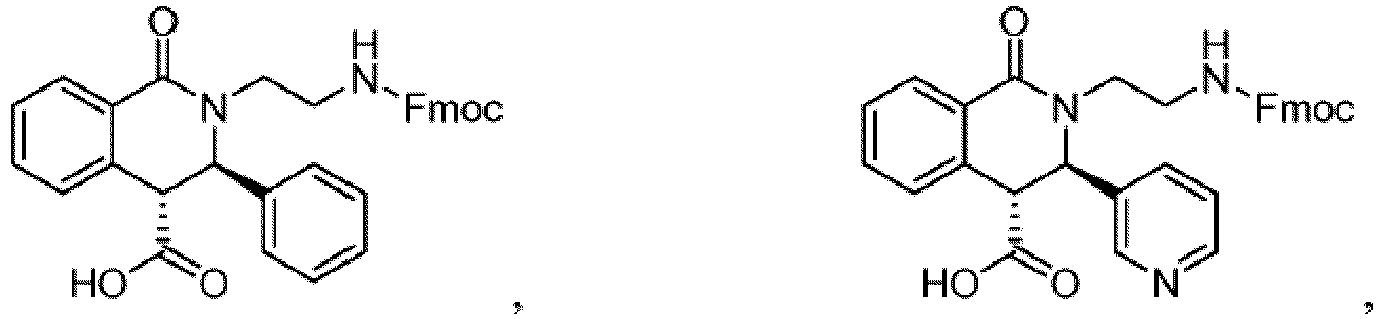


- Polymère selon la revendication 5, comprenant en outre incorporés dans chacun des polymères des monomères à contrainte de structure secondaire (CSS) qui imposent des tours et ainsi induisent la structure tertiaire, de préférence dans lequel les monomères SSC sont clivables par un acide pour faciliter le séquençage des polymères basé sur la spectroscopie de masse.
- Dispositif à balayage à fibres optiques monté avec une lame portant des billes fluorescentes, le dispositif à balayage comprenant ;(a) un étage imageur ayant une surface plane destinée à supporter un échantillon comprenant la lame ;(b) un chemin optique bifurqué comportant deux faisceaux de fibres optiques, chaque faisceau présentant une première extrémité disposée pour définir une ouverture d'entrée pour la vision de l'échantillon sur l'étage imageur, et une extrémité distale du faisceau disposée pour définir une ouverture de sortie placée à distance de l'étage imageur ;(c) une source de balayage disposée pour balayer un faisceau le long d'un chemin qui est perpendiculaire à l'échantillon sur l'étage imageur et étroitement adjacent aux deux faisceaux du chemin optique bifurqué, de sorte qu'un point essentiellement circulaire d'illumination fourni par la source de balayage sur l'échantillon de l'étage imageur fournit un signal lumineux dont au moins une partie est reçue par l'ouverture d'entrée de chaque faisceau et transmise via le chemin optique bifurqué à l'ouverture de sortie ;(d) un photodétecteur disposé pour détecter le signal lumineux à l'extrémité distale ; et(e) un processeur qui traite le signal lumineux détecté par le photodétecteur ;dans lequel chaque bille comprend appliqués des polymères non naturels d'un monomère bioactif distinct avec des séquences prédéfinies se ramifiant et se repliant en structure tertiaire, le monomère étant une dihydroisoquinolinone.
- Dispositif à balayage à fibres optiques selon la revendication 7, dans lequel le monomère dihydroisoquinolinone est choisi parmi :


- Procédé pour l'imagerie d'un échantillon comprenant une lame portant des billes fluorescentes, le procédé comprenant les étapes consistant à :(a) fournir un faisceau essentiellement circulaire de rayonnement perpendiculaire à l'échantillon ;(b) maintenir la direction perpendiculaire du faisceau de rayonnement alors qu'il balaie le long d'un cheminement de balayage sur l'échantillon ;(c) réfléchir au moins une certaine lumière produite par l'interaction du faisceau avec l'échantillon dans une direction s'éloignant de l'échantillon ;(d) capter la lumière produite par l'interaction du faisceau avec l'échantillon dans au moins un élément, se trouvant à proximité, d'un ensemble de premières extrémités de fibres optiques ;(e) détecter la lumière captée au niveau d'une région de sortie choisie ; et(f) coordonner balayage, déplacement et détection pour engendrer un ensemble d'éléments d'images représentatifs d'au moins une partie de l'échantillondans lequel chaque bille comprend appliqués des polymères non naturels d'un monomère bioactif distinct avec des séquences prédéfinies se ramifiant et se repliant en structure tertiaire, le monomère étant une dihydroisoquinolinone.
- Procédé selon la revendication 9, comprenant en outre les étapes consistant à :(a) détecter une bille candidate ;(b) isoler la bille candidate ; et(c) analyser une fonction ou structure de la bille candidate.
- Procédé selon la revendication 9, dans lequel le monomère dihydroisoquinolinone est choisi parmi :


- Procédé selon la revendication 9, dans lequel les polymères comprennent en outre incorporés dans chacun des polymères des monomères à contrainte de structure secondaire (CSS) qui imposent des tours et ainsi induisent la structure tertiaire, les monomères SSC étant clivables par un acide pour faciliter le séquençage des polymères basé sur la spectroscopie de masse.
Applications Claiming Priority (2)
| Application Number | Priority Date | Filing Date | Title |
|---|---|---|---|
| US201462050922P | 2014-09-16 | 2014-09-16 | |
| PCT/US2015/050306 WO2016053621A1 (fr) | 2014-09-16 | 2015-09-16 | Découverte de réactif d'affinité et de catalyseur par technologie de balayage de réseau à fibres optiques |
Publications (3)
| Publication Number | Publication Date |
|---|---|
| EP3180465A1 EP3180465A1 (fr) | 2017-06-21 |
| EP3180465A4 EP3180465A4 (fr) | 2017-08-30 |
| EP3180465B1 true EP3180465B1 (fr) | 2020-04-08 |
Family
ID=55631253
Family Applications (1)
| Application Number | Title | Priority Date | Filing Date |
|---|---|---|---|
| EP15847665.5A Active EP3180465B1 (fr) | 2014-09-16 | 2015-09-16 | Banques de polymères non-naturels à base de dihydroisoquinolinone pour le ciblage de médicaments à haut débit par technolgie de balayage de réseau à fibres optiques |
Country Status (5)
| Country | Link |
|---|---|
| US (2) | US20170184607A1 (fr) |
| EP (1) | EP3180465B1 (fr) |
| JP (1) | JP6925265B2 (fr) |
| CN (1) | CN107109701B (fr) |
| WO (1) | WO2016053621A1 (fr) |
Families Citing this family (2)
| Publication number | Priority date | Publication date | Assignee | Title |
|---|---|---|---|---|
| EP3746772A4 (fr) * | 2018-01-30 | 2021-11-10 | Peter Madrid | Génération informatique de voies et procédés de synthèse chimique |
| WO2025064641A1 (fr) * | 2023-09-19 | 2025-03-27 | Sri International | Composés synthétiques comprenant des monomères de dihydroisoquinolinone |
Family Cites Families (25)
| Publication number | Priority date | Publication date | Assignee | Title |
|---|---|---|---|---|
| US5770358A (en) * | 1991-09-18 | 1998-06-23 | Affymax Technologies N.V. | Tagged synthetic oligomer libraries |
| US5877278A (en) * | 1992-09-24 | 1999-03-02 | Chiron Corporation | Synthesis of N-substituted oligomers |
| US6147205A (en) * | 1995-12-15 | 2000-11-14 | Affymetrix, Inc. | Photocleavable protecting groups and methods for their use |
| US5887278A (en) * | 1997-01-31 | 1999-03-30 | The Procter & Gamble Company | Disposable bib having notched tear resistance |
| AU5855699A (en) * | 1998-08-28 | 2000-03-21 | Jerini Biotools Gmbh | Method for producing polymeric solid phase supporting materials |
| FR2785812B1 (fr) * | 1998-11-16 | 2002-11-29 | Commissariat Energie Atomique | Protheses bioactives, notamment a proprietes immunosuppressives, antistenose et antithrombose, et leur fabrication |
| JP2002536301A (ja) * | 1999-01-27 | 2002-10-29 | ザ スクリプス リサーチ インスティテュート | タンパク質モデリングツール |
| US6452009B1 (en) * | 1999-08-19 | 2002-09-17 | Lion Bioscience Ag | 4-unsubstituted dihydroisoquinolinone derivatives and combinatorial libraries thereof |
| US7280261B2 (en) | 2004-12-20 | 2007-10-09 | Palo Alto Research Center Incorporated | Method of scanning and light collection for a rare cell detector |
| JP5541861B2 (ja) * | 2005-04-29 | 2014-07-09 | エージェンシー フォー サイエンス, テクノロジー アンド リサーチ | 超分岐ポリマーおよびそれらの適用 |
| US20090306310A1 (en) * | 2005-07-18 | 2009-12-10 | The Scripps Research Institute | Method of using click chemistry to functionalize dendrimers |
| US7842465B2 (en) | 2006-01-17 | 2010-11-30 | Palo Alto Research Center Incorporated | Immunocytostaining methods for enhanced dye ratio discrimination in rare event detection |
| ES2420834T3 (es) * | 2006-01-30 | 2013-08-27 | The Scripps Research Institute | Métodos de detección de células tumorales circulantes y métodos de diagnóstico del cáncer en un sujeto mamífero |
| WO2008020180A2 (fr) * | 2006-08-17 | 2008-02-21 | Kudos Pharmaceuticals Limited | Procédés destinés à augmenter la sensibilité des cellules cancéreuses à l'altération de l'adn |
| US20080242560A1 (en) * | 2006-11-21 | 2008-10-02 | Gunderson Kevin L | Methods for generating amplified nucleic acid arrays |
| TWI425945B (zh) * | 2007-05-28 | 2014-02-11 | Seldar Pharma Inc | 四氫異喹啉-1-酮衍生物或其鹽 |
| WO2009049098A2 (fr) * | 2007-10-09 | 2009-04-16 | Indiana University Research & Technology Corporation | Matériaux et procédés pour réguler l'activité des phosphatases |
| CN105675496B (zh) * | 2009-09-21 | 2019-07-05 | 阿科尼生物系统公司 | 一体化料筒 |
| EP2826564B1 (fr) * | 2009-11-23 | 2018-12-26 | 3M Innovative Properties Company | Articles de réseau de micropuits et procédés d'utilisation |
| US9523680B2 (en) * | 2010-06-30 | 2016-12-20 | Ambergen, Inc. | Global Proteomic screening of random bead arrays using mass spectrometry imaging |
| WO2012074840A2 (fr) * | 2010-11-22 | 2012-06-07 | The General Hospital Corporation | Compositions et procédés d'imagerie in vivo |
| US8679858B2 (en) * | 2011-01-11 | 2014-03-25 | The Board Of Trustees Of The Leland Stanford Junior University | Lanthanide mass dots: nanoparticle isotope tags |
| CN102344524B (zh) * | 2011-07-12 | 2013-04-03 | 浙江大学 | 一种水溶性可点击反应的超支化聚合物 |
| DE102011057019A1 (de) * | 2011-12-23 | 2013-06-27 | Forschungszentrum Jülich GmbH | Standard zur Quantifizierung von pathogenen Aggregaten aus körpereigenen Proteinen |
| DE102011057021A1 (de) * | 2011-12-23 | 2013-06-27 | Forschungszentrum Jülich GmbH | Verfahren zur selektiven Quantifizierung von A-Beta-Aggregaten |
-
2015
- 2015-09-16 JP JP2017514916A patent/JP6925265B2/ja active Active
- 2015-09-16 CN CN201580060444.7A patent/CN107109701B/zh active Active
- 2015-09-16 EP EP15847665.5A patent/EP3180465B1/fr active Active
- 2015-09-16 WO PCT/US2015/050306 patent/WO2016053621A1/fr not_active Ceased
-
2017
- 2017-03-16 US US15/461,455 patent/US20170184607A1/en not_active Abandoned
-
2021
- 2021-02-02 US US17/165,293 patent/US20210208157A1/en active Pending
Non-Patent Citations (1)
| Title |
|---|
| None * |
Also Published As
| Publication number | Publication date |
|---|---|
| JP6925265B2 (ja) | 2021-08-25 |
| JP2017535517A (ja) | 2017-11-30 |
| US20210208157A1 (en) | 2021-07-08 |
| WO2016053621A1 (fr) | 2016-04-07 |
| CN107109701A (zh) | 2017-08-29 |
| CN107109701B (zh) | 2020-10-09 |
| EP3180465A4 (fr) | 2017-08-30 |
| EP3180465A1 (fr) | 2017-06-21 |
| US20170184607A1 (en) | 2017-06-29 |
Similar Documents
| Publication | Publication Date | Title |
|---|---|---|
| US11131674B2 (en) | Microarray compositions and methods of their use | |
| AU2020206321B2 (en) | Single-molecule protein and peptide sequencing | |
| US7960119B2 (en) | Combinatorial decoding of random nucleic acid arrays | |
| JP4302780B2 (ja) | マトリックスで結合された化合物の色別コード化とインシトゥ探索 | |
| JP3566653B2 (ja) | 微小球を利用する複合アレイ | |
| Komnatnyy et al. | Bead-based screening in chemical biology and drug discovery | |
| US12474347B2 (en) | Determination of protein information by recoding amino acid polymers into DNA polymers | |
| US20240044909A1 (en) | Determination of protein information by recoding amino acid polymers into dna polymers | |
| US6541203B2 (en) | Detecting structural or synthetic information about chemical compounds | |
| US20210208157A1 (en) | Affinity Reagent and Catalyst Discovery Through Fiber-Optic Array Scanning Technology | |
| EP3384041B1 (fr) | Procédé d'identification de substrat de protéase | |
| Ede et al. | Beyond Rf tagging | |
| HK40110898A (zh) | 处理和监定肽的末端氨基酸的方法、结合剂以及clickp化合物 | |
| HK40105305A (zh) | 单分子蛋白质和肽测序 | |
| CN121954935A (zh) | 基于玻璃珠固载的多肽修饰药物制备体系高通量筛选方法 | |
| Kumble et al. | Microarrays in drug discovery and development | |
| Song et al. | 7 Glycan-Based Arrays for Determining Specificity of Carbohydrate-Binding Proteins | |
| Usui et al. | Designed Peptide Microarrays for Protein Detection and Characterization |
Legal Events
| Date | Code | Title | Description |
|---|---|---|---|
| STAA | Information on the status of an ep patent application or granted ep patent |
Free format text: STATUS: THE INTERNATIONAL PUBLICATION HAS BEEN MADE |
|
| PUAI | Public reference made under article 153(3) epc to a published international application that has entered the european phase |
Free format text: ORIGINAL CODE: 0009012 |
|
| STAA | Information on the status of an ep patent application or granted ep patent |
Free format text: STATUS: REQUEST FOR EXAMINATION WAS MADE |
|
| 17P | Request for examination filed |
Effective date: 20170316 |
|
| AK | Designated contracting states |
Kind code of ref document: A1 Designated state(s): AL AT BE BG CH CY CZ DE DK EE ES FI FR GB GR HR HU IE IS IT LI LT LU LV MC MK MT NL NO PL PT RO RS SE SI SK SM TR |
|
| AX | Request for extension of the european patent |
Extension state: BA ME |
|
| A4 | Supplementary search report drawn up and despatched |
Effective date: 20170801 |
|
| RIC1 | Information provided on ipc code assigned before grant |
Ipc: C40B 60/12 20060101ALI20170726BHEP Ipc: G01N 33/68 20060101ALI20170726BHEP Ipc: G01N 33/543 20060101ALI20170726BHEP Ipc: G01N 21/64 20060101ALI20170726BHEP Ipc: C40B 50/14 20060101ALI20170726BHEP Ipc: C08G 69/36 20060101ALI20170726BHEP Ipc: C40B 40/14 20060101AFI20170726BHEP |
|
| DAV | Request for validation of the european patent (deleted) | ||
| DAX | Request for extension of the european patent (deleted) | ||
| STAA | Information on the status of an ep patent application or granted ep patent |
Free format text: STATUS: EXAMINATION IS IN PROGRESS |
|
| 17Q | First examination report despatched |
Effective date: 20180322 |
|
| GRAP | Despatch of communication of intention to grant a patent |
Free format text: ORIGINAL CODE: EPIDOSNIGR1 |
|
| RIC1 | Information provided on ipc code assigned before grant |
Ipc: C40B 40/14 20060101AFI20190903BHEP Ipc: C40B 50/14 20060101ALI20190903BHEP Ipc: C40B 60/12 20060101ALI20190903BHEP |
|
| STAA | Information on the status of an ep patent application or granted ep patent |
Free format text: STATUS: GRANT OF PATENT IS INTENDED |
|
| INTG | Intention to grant announced |
Effective date: 20191010 |
|
| RAP1 | Party data changed (applicant data changed or rights of an application transferred) |
Owner name: SRI INTERNATIONAL |
|
| GRAS | Grant fee paid |
Free format text: ORIGINAL CODE: EPIDOSNIGR3 |
|
| GRAJ | Information related to disapproval of communication of intention to grant by the applicant or resumption of examination proceedings by the epo deleted |
Free format text: ORIGINAL CODE: EPIDOSDIGR1 |
|
| GRAL | Information related to payment of fee for publishing/printing deleted |
Free format text: ORIGINAL CODE: EPIDOSDIGR3 |
|
| STAA | Information on the status of an ep patent application or granted ep patent |
Free format text: STATUS: EXAMINATION IS IN PROGRESS |
|
| GRAR | Information related to intention to grant a patent recorded |
Free format text: ORIGINAL CODE: EPIDOSNIGR71 |
|
| STAA | Information on the status of an ep patent application or granted ep patent |
Free format text: STATUS: GRANT OF PATENT IS INTENDED |
|
| GRAA | (expected) grant |
Free format text: ORIGINAL CODE: 0009210 |
|
| STAA | Information on the status of an ep patent application or granted ep patent |
Free format text: STATUS: THE PATENT HAS BEEN GRANTED |
|
| INTC | Intention to grant announced (deleted) | ||
| AK | Designated contracting states |
Kind code of ref document: B1 Designated state(s): AL AT BE BG CH CY CZ DE DK EE ES FI FR GB GR HR HU IE IS IT LI LT LU LV MC MK MT NL NO PL PT RO RS SE SI SK SM TR |
|
| INTG | Intention to grant announced |
Effective date: 20200302 |
|
| REG | Reference to a national code |
Ref country code: CH Ref legal event code: EP Ref country code: AT Ref legal event code: REF Ref document number: 1254497 Country of ref document: AT Kind code of ref document: T Effective date: 20200415 |
|
| REG | Reference to a national code |
Ref country code: DE Ref legal event code: R096 Ref document number: 602015050488 Country of ref document: DE |
|
| REG | Reference to a national code |
Ref country code: IE Ref legal event code: FG4D |
|
| REG | Reference to a national code |
Ref country code: NL Ref legal event code: MP Effective date: 20200408 |
|
| REG | Reference to a national code |
Ref country code: LT Ref legal event code: MG4D |
|
| PG25 | Lapsed in a contracting state [announced via postgrant information from national office to epo] |
Ref country code: NL Free format text: LAPSE BECAUSE OF FAILURE TO SUBMIT A TRANSLATION OF THE DESCRIPTION OR TO PAY THE FEE WITHIN THE PRESCRIBED TIME-LIMIT Effective date: 20200408 Ref country code: LT Free format text: LAPSE BECAUSE OF FAILURE TO SUBMIT A TRANSLATION OF THE DESCRIPTION OR TO PAY THE FEE WITHIN THE PRESCRIBED TIME-LIMIT Effective date: 20200408 Ref country code: FI Free format text: LAPSE BECAUSE OF FAILURE TO SUBMIT A TRANSLATION OF THE DESCRIPTION OR TO PAY THE FEE WITHIN THE PRESCRIBED TIME-LIMIT Effective date: 20200408 Ref country code: PT Free format text: LAPSE BECAUSE OF FAILURE TO SUBMIT A TRANSLATION OF THE DESCRIPTION OR TO PAY THE FEE WITHIN THE PRESCRIBED TIME-LIMIT Effective date: 20200817 Ref country code: GR Free format text: LAPSE BECAUSE OF FAILURE TO SUBMIT A TRANSLATION OF THE DESCRIPTION OR TO PAY THE FEE WITHIN THE PRESCRIBED TIME-LIMIT Effective date: 20200709 Ref country code: IS Free format text: LAPSE BECAUSE OF FAILURE TO SUBMIT A TRANSLATION OF THE DESCRIPTION OR TO PAY THE FEE WITHIN THE PRESCRIBED TIME-LIMIT Effective date: 20200808 Ref country code: SE Free format text: LAPSE BECAUSE OF FAILURE TO SUBMIT A TRANSLATION OF THE DESCRIPTION OR TO PAY THE FEE WITHIN THE PRESCRIBED TIME-LIMIT Effective date: 20200408 Ref country code: NO Free format text: LAPSE BECAUSE OF FAILURE TO SUBMIT A TRANSLATION OF THE DESCRIPTION OR TO PAY THE FEE WITHIN THE PRESCRIBED TIME-LIMIT Effective date: 20200708 |
|
| REG | Reference to a national code |
Ref country code: AT Ref legal event code: MK05 Ref document number: 1254497 Country of ref document: AT Kind code of ref document: T Effective date: 20200408 |
|
| PG25 | Lapsed in a contracting state [announced via postgrant information from national office to epo] |
Ref country code: BG Free format text: LAPSE BECAUSE OF FAILURE TO SUBMIT A TRANSLATION OF THE DESCRIPTION OR TO PAY THE FEE WITHIN THE PRESCRIBED TIME-LIMIT Effective date: 20200708 Ref country code: HR Free format text: LAPSE BECAUSE OF FAILURE TO SUBMIT A TRANSLATION OF THE DESCRIPTION OR TO PAY THE FEE WITHIN THE PRESCRIBED TIME-LIMIT Effective date: 20200408 Ref country code: RS Free format text: LAPSE BECAUSE OF FAILURE TO SUBMIT A TRANSLATION OF THE DESCRIPTION OR TO PAY THE FEE WITHIN THE PRESCRIBED TIME-LIMIT Effective date: 20200408 Ref country code: LV Free format text: LAPSE BECAUSE OF FAILURE TO SUBMIT A TRANSLATION OF THE DESCRIPTION OR TO PAY THE FEE WITHIN THE PRESCRIBED TIME-LIMIT Effective date: 20200408 |
|
| PG25 | Lapsed in a contracting state [announced via postgrant information from national office to epo] |
Ref country code: AL Free format text: LAPSE BECAUSE OF FAILURE TO SUBMIT A TRANSLATION OF THE DESCRIPTION OR TO PAY THE FEE WITHIN THE PRESCRIBED TIME-LIMIT Effective date: 20200408 |
|
| REG | Reference to a national code |
Ref country code: DE Ref legal event code: R097 Ref document number: 602015050488 Country of ref document: DE |
|
| PG25 | Lapsed in a contracting state [announced via postgrant information from national office to epo] |
Ref country code: EE Free format text: LAPSE BECAUSE OF FAILURE TO SUBMIT A TRANSLATION OF THE DESCRIPTION OR TO PAY THE FEE WITHIN THE PRESCRIBED TIME-LIMIT Effective date: 20200408 Ref country code: SM Free format text: LAPSE BECAUSE OF FAILURE TO SUBMIT A TRANSLATION OF THE DESCRIPTION OR TO PAY THE FEE WITHIN THE PRESCRIBED TIME-LIMIT Effective date: 20200408 Ref country code: DK Free format text: LAPSE BECAUSE OF FAILURE TO SUBMIT A TRANSLATION OF THE DESCRIPTION OR TO PAY THE FEE WITHIN THE PRESCRIBED TIME-LIMIT Effective date: 20200408 Ref country code: AT Free format text: LAPSE BECAUSE OF FAILURE TO SUBMIT A TRANSLATION OF THE DESCRIPTION OR TO PAY THE FEE WITHIN THE PRESCRIBED TIME-LIMIT Effective date: 20200408 Ref country code: ES Free format text: LAPSE BECAUSE OF FAILURE TO SUBMIT A TRANSLATION OF THE DESCRIPTION OR TO PAY THE FEE WITHIN THE PRESCRIBED TIME-LIMIT Effective date: 20200408 Ref country code: CZ Free format text: LAPSE BECAUSE OF FAILURE TO SUBMIT A TRANSLATION OF THE DESCRIPTION OR TO PAY THE FEE WITHIN THE PRESCRIBED TIME-LIMIT Effective date: 20200408 Ref country code: RO Free format text: LAPSE BECAUSE OF FAILURE TO SUBMIT A TRANSLATION OF THE DESCRIPTION OR TO PAY THE FEE WITHIN THE PRESCRIBED TIME-LIMIT Effective date: 20200408 Ref country code: IT Free format text: LAPSE BECAUSE OF FAILURE TO SUBMIT A TRANSLATION OF THE DESCRIPTION OR TO PAY THE FEE WITHIN THE PRESCRIBED TIME-LIMIT Effective date: 20200408 |
|
| PLBE | No opposition filed within time limit |
Free format text: ORIGINAL CODE: 0009261 |
|
| STAA | Information on the status of an ep patent application or granted ep patent |
Free format text: STATUS: NO OPPOSITION FILED WITHIN TIME LIMIT |
|
| PG25 | Lapsed in a contracting state [announced via postgrant information from national office to epo] |
Ref country code: PL Free format text: LAPSE BECAUSE OF FAILURE TO SUBMIT A TRANSLATION OF THE DESCRIPTION OR TO PAY THE FEE WITHIN THE PRESCRIBED TIME-LIMIT Effective date: 20200408 Ref country code: SK Free format text: LAPSE BECAUSE OF FAILURE TO SUBMIT A TRANSLATION OF THE DESCRIPTION OR TO PAY THE FEE WITHIN THE PRESCRIBED TIME-LIMIT Effective date: 20200408 |
|
| 26N | No opposition filed |
Effective date: 20210112 |
|
| PG25 | Lapsed in a contracting state [announced via postgrant information from national office to epo] |
Ref country code: MC Free format text: LAPSE BECAUSE OF FAILURE TO SUBMIT A TRANSLATION OF THE DESCRIPTION OR TO PAY THE FEE WITHIN THE PRESCRIBED TIME-LIMIT Effective date: 20200408 |
|
| REG | Reference to a national code |
Ref country code: CH Ref legal event code: PL |
|
| PG25 | Lapsed in a contracting state [announced via postgrant information from national office to epo] |
Ref country code: SI Free format text: LAPSE BECAUSE OF FAILURE TO SUBMIT A TRANSLATION OF THE DESCRIPTION OR TO PAY THE FEE WITHIN THE PRESCRIBED TIME-LIMIT Effective date: 20200408 |
|
| REG | Reference to a national code |
Ref country code: BE Ref legal event code: MM Effective date: 20200930 |
|
| PG25 | Lapsed in a contracting state [announced via postgrant information from national office to epo] |
Ref country code: LU Free format text: LAPSE BECAUSE OF NON-PAYMENT OF DUE FEES Effective date: 20200916 |
|
| PG25 | Lapsed in a contracting state [announced via postgrant information from national office to epo] |
Ref country code: CH Free format text: LAPSE BECAUSE OF NON-PAYMENT OF DUE FEES Effective date: 20200930 Ref country code: BE Free format text: LAPSE BECAUSE OF NON-PAYMENT OF DUE FEES Effective date: 20200930 Ref country code: LI Free format text: LAPSE BECAUSE OF NON-PAYMENT OF DUE FEES Effective date: 20200930 Ref country code: IE Free format text: LAPSE BECAUSE OF NON-PAYMENT OF DUE FEES Effective date: 20200916 |
|
| PG25 | Lapsed in a contracting state [announced via postgrant information from national office to epo] |
Ref country code: TR Free format text: LAPSE BECAUSE OF FAILURE TO SUBMIT A TRANSLATION OF THE DESCRIPTION OR TO PAY THE FEE WITHIN THE PRESCRIBED TIME-LIMIT Effective date: 20200408 Ref country code: MT Free format text: LAPSE BECAUSE OF FAILURE TO SUBMIT A TRANSLATION OF THE DESCRIPTION OR TO PAY THE FEE WITHIN THE PRESCRIBED TIME-LIMIT Effective date: 20200408 Ref country code: CY Free format text: LAPSE BECAUSE OF FAILURE TO SUBMIT A TRANSLATION OF THE DESCRIPTION OR TO PAY THE FEE WITHIN THE PRESCRIBED TIME-LIMIT Effective date: 20200408 |
|
| PG25 | Lapsed in a contracting state [announced via postgrant information from national office to epo] |
Ref country code: MK Free format text: LAPSE BECAUSE OF FAILURE TO SUBMIT A TRANSLATION OF THE DESCRIPTION OR TO PAY THE FEE WITHIN THE PRESCRIBED TIME-LIMIT Effective date: 20200408 |
|
| P01 | Opt-out of the competence of the unified patent court (upc) registered |
Effective date: 20230526 |
|
| PGFP | Annual fee paid to national office [announced via postgrant information from national office to epo] |
Ref country code: DE Payment date: 20240702 Year of fee payment: 10 |
|
| PGFP | Annual fee paid to national office [announced via postgrant information from national office to epo] |
Ref country code: GB Payment date: 20240701 Year of fee payment: 10 |
|
| PGFP | Annual fee paid to national office [announced via postgrant information from national office to epo] |
Ref country code: FR Payment date: 20240702 Year of fee payment: 10 |