EP3182780A1 - Vdc-ressourcen-anfrageverfahren, benutzergerät und basisstation - Google Patents
Vdc-ressourcen-anfrageverfahren, benutzergerät und basisstation Download PDFInfo
- Publication number
- EP3182780A1 EP3182780A1 EP15841284.1A EP15841284A EP3182780A1 EP 3182780 A1 EP3182780 A1 EP 3182780A1 EP 15841284 A EP15841284 A EP 15841284A EP 3182780 A1 EP3182780 A1 EP 3182780A1
- Authority
- EP
- European Patent Office
- Prior art keywords
- vdc resource
- user equipment
- base station
- vdc
- information
- Prior art date
- Legal status (The legal status is an assumption and is not a legal conclusion. Google has not performed a legal analysis and makes no representation as to the accuracy of the status listed.)
- Granted
Links
Images




Classifications
-
- H—ELECTRICITY
- H04—ELECTRIC COMMUNICATION TECHNIQUE
- H04W—WIRELESS COMMUNICATION NETWORKS
- H04W72/00—Local resource management
- H04W72/20—Control channels or signalling for resource management
- H04W72/21—Control channels or signalling for resource management in the uplink direction of a wireless link, i.e. towards the network
-
- G—PHYSICS
- G08—SIGNALLING
- G08G—TRAFFIC CONTROL SYSTEMS
- G08G1/00—Traffic control systems for road vehicles
- G08G1/16—Anti-collision systems
- G08G1/161—Decentralised systems, e.g. inter-vehicle communication
- G08G1/163—Decentralised systems, e.g. inter-vehicle communication involving continuous checking
-
- H—ELECTRICITY
- H04—ELECTRIC COMMUNICATION TECHNIQUE
- H04W—WIRELESS COMMUNICATION NETWORKS
- H04W72/00—Local resource management
- H04W72/20—Control channels or signalling for resource management
-
- H—ELECTRICITY
- H04—ELECTRIC COMMUNICATION TECHNIQUE
- H04W—WIRELESS COMMUNICATION NETWORKS
- H04W76/00—Connection management
- H04W76/10—Connection setup
- H04W76/14—Direct-mode setup
-
- H—ELECTRICITY
- H04—ELECTRIC COMMUNICATION TECHNIQUE
- H04W—WIRELESS COMMUNICATION NETWORKS
- H04W72/00—Local resource management
- H04W72/20—Control channels or signalling for resource management
- H04W72/23—Control channels or signalling for resource management in the downlink direction of a wireless link, i.e. towards a terminal
Definitions
- the present invention relates to the communications field, and specifically, to a vehicle direct communication (VDC, Vehicle Direct Communication) resource request method, user equipment, and a base station.
- VDC Vehicle Direct Communication
- a mobile communications module is installed on a vehicle terminal, and communication between vehicles can be implemented by using a mobile communications network.
- a first type of vehicle service information is an information entertainment service, and a user in a vehicle can perform various entertainment activities by using the Internet of Vehicles.
- a second type of vehicle service information is a vehicle efficiency-type information service, and the information is released by a road management department or a road traffic participant and mainly includes road congestion information, road construction information, and information such as speed limitation on a road section, weather on a road section, or whether a road is available for passage.
- a third type of vehicle service information is a vehicle safety message, for example, including emergency brake information of a vehicle, or information prompting a coming vehicle from an opposite side when a vehicle is making a turn, and the vehicle safety message is mainly used to avoid a vehicle collision.
- the first type of vehicle service information and the second type of vehicle service information may be obtained from the cloud in a communication manner such as by using the third generation mobile communications network (that is, 3G) or the fourth generation mobile communications network (that is, 4G). Therefore, a network with a wide coverage area needs to be used.
- the third generation mobile communications network that is, 3G
- the fourth generation mobile communications network that is, 4G
- the third type of vehicle service information because the third type of vehicle service information is travel information of a vehicle, and the vehicle is usually in fast move, transmission of the third type of vehicle service information requires a relatively small transmission delay (the transmission delay is usually required to be less than 100 milliseconds), so as to avoid collision. Coverage of a cellular network is excessively wide, and a link establishment process is relatively complex. Therefore, a transmission time of the cellular network is relatively large. If the third type of vehicle service information is transmitted by using a cellular network such as the 3G or 4G, a transmission delay requirement of the third type of vehicle service information cannot be satisfied. When a transmission delay does not satisfy the transmission delay requirement of the third type of vehicle service information, the third type of vehicle service information may not be sent to a vehicle terminal in time. Consequently, a traffic accident may be caused.
- the present invention provides a VDC resource request method, user equipment, and a base station, to reduce a vehicle service information transmission delay.
- a first aspect of the present invention provides a VDC resource request method, including:
- the VDC resource request message includes the VDC resource status list; and the method further includes:
- the monitoring, by the user equipment, a vehicle direct communication VDC resource use status includes:
- a second aspect of the present invention protects another VDC resource request method, including:
- the VDC resource request message includes the VDC resource status list; and before the receiving a VDC resource request message from user equipment, the method further includes:
- the VDC resource request message includes the travel information of the user equipment, and the travel information includes vehicle speed information of a vehicle on which the user equipment is located; and the allocating a currently available VDC resource to the user equipment according to the VDC resource request message of the user equipment includes: determining a VDC resource range according to a vehicle speed interval of the vehicle speed information of the vehicle on which the user equipment is located, where there is a correspondence between the vehicle speed interval and the VDC resource range; and allocating the currently available VDC resource in the determined VDC resource range to the user equipment.
- the method further includes:
- the method includes:
- the access preamble sequence of the user equipment is further used to indicate a quantity of bytes that are sent at the request of the user equipment; and the allocating an uplink grant value to the user equipment includes: allocating, to the user equipment according to the access preamble sequence of the user equipment, an uplink grant value greater than or equal to the quantity of bytes that are sent at the request of the user equipment.
- a third aspect of the present invention provides user equipment, including:
- the VDC resource request message includes the VDC resource status list; and the user equipment further includes:
- the monitoring unit includes:
- the sending unit is further configured to send a predetermined access preamble sequence to the base station before sending the VDC resource request message to the base station, so that the base station learns, according to the predetermined access preamble sequence, that the user equipment currently needs to apply for a VDC resource, and allocates an uplink grant value to the user equipment;
- the receiving unit is further configured to receive an access acknowledgment message from the base station, and the access acknowledgment message includes the uplink grant value allocated to the user equipment by the base station; and the sending unit is specifically configured to send the VDC resource request message to the base station according to the uplink grant value in the access acknowledgment message.
- a fourth aspect of the present invention provides a base station, including:
- the VDC resource request message includes the VDC resource status list; and the base station further includes:
- the VDC resource request message includes the travel information of the user equipment, and the travel information includes a vehicle speed of a vehicle on which the user equipment is located; and the first allocation unit is specifically configured to: determine a VDC resource range according to a vehicle speed interval of the vehicle speed information of the vehicle on which the user equipment is located, and allocate the currently available VDC resource in the determined VDC resource range to the user equipment, where there is a correspondence between the vehicle speed interval and the VDC resource range.
- the base station further includes a second receiving unit, configured to receive VDC resource occupation indication information from a neighboring base station, where the VDC resource occupation indication information of the neighboring base station is used to indicate an occupied VDC resource within a coverage area of the neighboring base station; and the first allocation unit is specifically configured to allocate the currently available VDC resource to the user equipment according to the VDC resource request message of the user equipment and the VDC resource occupation indication information of the neighboring base station.
- the base station further includes:
- the access preamble sequence of the user equipment is further used to indicate a quantity of bytes that are sent at the request of the user equipment; and the second allocation unit is specifically configured to allocate, to the user equipment according to the access preamble sequence of the user equipment received by the third receiving unit, an uplink grant value greater than or equal to the quantity of bytes that are sent at the request of the user equipment.
- user equipment sends a VDC resource request message to a base station when the user equipment needs to send vehicle service information (for example, when the user equipment needs to send a third type of vehicle service information that requires a small transmission delay), so that the base station allocates an available VDC resource to the user equipment according to the VDC resource request message. Then, the user equipment sends the vehicle service information by using the VDC resource allocated by the base station. In an entire process, no complex link establishment process between the user equipment and the base station is required. Therefore, a vehicle service information transmission delay is effectively reduced. Moreover, experimental research data shows that a transmission delay can be less than 100 milliseconds when vehicle service information is transmitted according to the present invention, that is, a transmission delay requirement of the third type of vehicle service information can be satisfied.
- the VDC resource request method includes the following steps.
- UE sends a VDC resource request message to a base station when the UE needs to request a VDC resource for sending vehicle service information.
- the VDC resource request message includes at least one piece of the following information: a VDC resource status list, or travel information of the UE. An available VDC resource is indicated in the VDC resource status list.
- VDC is a vehicle direct communication technology designed based on a physical layer of a Long Term Evolution (LTE, Long Term Evolution) system, that is, VDC communication is direct communication between UE and UE.
- LTE Long Term Evolution
- a feature of the VDC communication is as follows: A base station configures an independent VDC resource for each cell, and each UE (for example, a vehicle-mounted terminal or a handheld terminal) may obtain VDC resource parameter information by receiving a configuration message that is broadcast by the base station or by establishing a dedicated link to the base station.
- the VDC resource parameter information is, for example, total bandwidth of VDC resources within a coverage area of the base station, a time-frequency resource configuration parameter of a channel corresponding to each VDC resource, or a channel identifier (for example, a channel number) of a channel corresponding to a VDC resource that can be used by each UE.
- the UE needs to use only a VDC resource allocated to the UE by the base station.
- the UE needs to receive as many signals on the VDC resource as possible, so as to receive as many vehicle safety messages sent by other neighboring UE as possible.
- the vehicle safety message includes, for example, emergency brake information of a vehicle, or information prompting a coming vehicle at an opposite side when a vehicle is making a turn.
- the vehicle safety message is mainly used to avoid vehicle collision.
- the UE may locally maintain the VDC resource status list on the UE by monitoring a VDC resource use status, and sends, to the base station when the UE needs to request the VDC resource for sending the vehicle service information, the VDC resource request message that carries the locally maintained VDC resource status list, so that the base station allocates the VDC resource to the UE according to the VDC resource status list.
- the VDC resource request message further includes a radio network temporary identifier (RNTI, Radio Network Tempory Identity) of the UE, and the RNTI is allocated to the UE by the base station when the UE is accessing a cellular network.
- RNTI Radio Network Tempory Identity
- the travel information includes one or more pieces of the following information: vehicle speed information of a vehicle on which the UE is located, or geographical location information and/or a travel direction of a vehicle on which the UE is located.
- the UE requests the VDC resource mainly for sending a third type of vehicle service information.
- the UE may request the VDC resource for sending other vehicle service information.
- the UE is connected to a control management system of the vehicle on which the UE is located.
- the UE may obtain the travel information (for example, the vehicle speed information, brake information, or turning information) of the vehicle from the control management system of the vehicle on which the UE is located.
- the UE may obtain, by using a positioning module (for example, a Global Positioning System (GPS, Global Positioning System) module) configured on the UE, the geographical location information, the travel direction, or the like of the vehicle on which the UE is located.
- GPS Global Positioning System
- the UE generates one or more pieces of third type of vehicle service information according to the obtained geographical location information, travel direction, travel information, or the like of the vehicle.
- the UE Each time the UE generates one piece of third type of vehicle service information, the UE requests a VDC resource from the base station for sending the generated third type of vehicle service information. In this embodiment of the present invention, the UE sends the VDC resource request message to the base station. It should be noted that the third type of vehicle service information in this embodiment of the present invention may be specifically generated with reference to an existing manner for generating a third type of vehicle service information, and details are not described herein.
- the UE receives a VDC resource allocation indication message from the base station.
- the VDC resource allocation indication message indicates a VDC resource allocated to the UE by the base station according to the VDC resource request message.
- the UE sends the vehicle service information by using a VDC resource indicated by the VDC resource allocation indication message.
- the UE in this embodiment of the present invention may be a vehicle-mounted terminal, a handheld terminal, or another terminal that can be connected to a vehicle control management system, and is not limited herein.
- user equipment sends a VDC resource request message to a base station when the user equipment needs to send vehicle service information (for example, when the user equipment needs to send a third type of vehicle service information that requires a small transmission delay), so that the base station allocates an available VDC resource to the user equipment according to the VDC resource request message. Then, the user equipment sends the vehicle service information by using the VDC resource allocated by the base station. In an entire process, no complex link establishment process between the user equipment and the base station is required. Therefore, a vehicle service information transmission delay is effectively reduced. Moreover, experimental research data shows that a transmission delay can be less than 100 milliseconds when vehicle service information is transmitted according to the present invention, that is, a transmission delay requirement of the third type of vehicle service information can be satisfied.
- a VDC resource request message carries a VDC resource status list.
- the VDC resource request method according to this embodiment of the present invention includes the following steps.
- UE monitors a VDC resource use status.
- VDC is a vehicle direct communication technology designed based on a physical layer of an LTE system, that is, VDC communication is direct communication between UE and UE.
- a feature of the VDC communication is as follows: A base station configures an independent VDC resource for each cell, and each UE (for example, a vehicle-mounted terminal or a handheld terminal) may obtain VDC resource parameter information by receiving a configuration message that is broadcast by the base station or by establishing a dedicated link to the base station.
- the VDC resource parameter information is, for example, total bandwidth of VDC resources within a coverage area of the base station, a time-frequency resource configuration parameter of a channel corresponding to each VDC resource, or a channel identifier (for example, a channel number) of a channel corresponding to a VDC resource that can be used by each UE.
- the UE needs to use only a VDC resource allocated to the UE by the base station.
- the UE needs to receive as many signals on the VDC resource as possible, so as to receive as many vehicle safety messages sent by other neighboring UE as possible.
- the vehicle safety message includes, for example, emergency brake information of a vehicle, or information prompting a coming vehicle at an opposite side when a vehicle is making a turn.
- the vehicle safety message is mainly used to avoid vehicle collision.
- the base station manages a VDC resource
- the VDC resource may not be a resource used for cellular communication between the base station and the UE.
- a cellular communication resource between the base station and the UE is a spectrum of 2.6 gigahertz (that is, GHZ), and the VDC resource is a spectrum of 5.9 GHZ; or a cellular communication resource between the base station and the UE is a frequency division duplex (FDD, Frequency Division Duplexing) spectrum of 2.6 gigahertz, and the VDC resource is a time division duplex (TDD, Time Division Duplexing) spectrum of 2.6 GHZ.
- FDD Frequency Division Duplexing
- TDD Time Division Duplexing
- the base station broadcasts the VDC resource parameter information on a broadcast channel (BCH, Broadcast Channel) of a cellular communication resource spectrum.
- the VDC resource parameter information includes VDC resource bandwidth, VDC resource channel division, and a channel parameter.
- the channel parameter includes but is not limited to a channel time-domain resource, a channel frequency-domain resource, a channel retransmission moment, a channel modulation and coding scheme, and the like.
- all UEs in the coverage area of the base station can obtain the VDC resource parameter information that is broadcast by the base station, and starts to monitor a VDC resource use status in the coverage area of the base station according to the obtained VDC resource parameter information, so as to learn a currently occupied VDC resource and a currently idle (that is, available) VDC resource in the coverage area of the base station.
- the base station may not broadcast VDC resource parameter information.
- the UE requests the VDC resource parameter information from the base station, and the base station sends the VDC resource parameter information to the UE after receiving a request of the UE, so that the UE monitors a VDC resource use status.
- the UE may monitor the VDC resource use status in a manner other than the foregoing two manners. This is not limited herein.
- a criterion for determining that a VDC resource is occupied is that the UE detects that energy on the VDC resource is greater than a preset threshold
- a criterion for determining that a VDC resource is idle is that the UE detects that energy on the VDC resource is not greater than the preset threshold. That is, when detecting that energy on a VDC resource is greater than the preset threshold, the UE determines that the VDC resource is currently occupied; when detecting that energy on a VDC resource is not greater than the preset threshold, the UE determines that the VDC resource is currently idle.
- the energy is usually represented by a power value.
- the UE updates a locally stored VDC resource status list when monitoring a change of the VDC resource use status.
- An available VDC resource is indicated in the VDC resource status list.
- VDC resource status list maintained by UE 1 is shown in Table 1.
- Table 1 Channel number Status 5 Idle 6 Occupied 7 Idle 9 Occupied
- a VDC resource corresponding to a channel in an idle state is a VDC resource currently available to the UE 1
- a VDC resource corresponding to a channel in an occupied state is a VDC resource currently unavailable to the UE 1.
- the UE 1 monitors a change of a VDC resource use status, for example, the UE 1 learns, by means of monitoring, that a VDC resource corresponding to a channel whose channel number is 5 is occupied and a VDC resource corresponding to a channel whose channel number is 6 is not occupied, the UE 1 updates the VDC resource status list in Table 1.
- the updated VDC resource status list is shown in Table 2.
- Table 2 Channel number Status 5 Occupied 6 Idle 7 Idle 9 Occupied
- the UE sends a VDC resource request message to a base station when the UE needs to request a VDC resource for sending vehicle service information.
- the VDC resource request message includes the VDC resource status list.
- the VDC resource request message further includes travel information of the UE and/or an RNTI of the UE, and the RNTI is allocated to the UE by the base station when the UE is accessing a cellular network.
- the travel information includes one or more pieces of the following information: vehicle speed information of a vehicle on which the UE is located, or geographical location information and/or a travel direction of a vehicle on which the UE is located.
- the UE requests the VDC resource mainly for sending a third type of vehicle service information. Certainly, the UE may request the VDC resource for sending other vehicle service information.
- the UE is connected to a control management system of the vehicle on which the UE is located.
- the UE may obtain the travel information (for example, the vehicle speed information, brake information, or turning information) of the vehicle from the control management system of the vehicle on which the UE is located.
- the UE may obtain, by using a positioning module (for example, a GPS module) configured on the UE, the geographical location information, the travel direction, or the like of the vehicle on which the UE is located.
- the UE generates one or more pieces of third type of vehicle service information according to the obtained geographical location information, travel direction, travel information, or the like of the vehicle.
- the UE Each time the UE generates one piece of third type of vehicle service information, the UE requests a VDC resource from the base station for sending the generated third type of vehicle service information. In this embodiment of the present invention, the UE sends the VDC resource request message to the base station. It should be noted that the third type of vehicle service information in this embodiment of the present invention may be specifically generated with reference to an existing manner for generating a third type of vehicle service information, and details are not described herein.
- the UE receives a VDC resource allocation indication message from the base station.
- the VDC resource allocation indication message indicates a VDC resource allocated to the UE by the base station according to the VDC resource request message.
- the UE sends the vehicle service information by using a VDC resource indicated by the VDC resource allocation indication message.
- the UE in this embodiment of the present invention may be a vehicle-mounted terminal, a handheld terminal, or another terminal that can be connected to a vehicle control management system, and is not limited herein.
- user equipment pre-monitors a VDC resource use status, updates a locally stored VDC resource status list, and when the user equipment needs to send vehicle service information (for example, when the user equipment needs to send a third type of vehicle service information that requires a small transmission delay), requests an idle resource in the VDC resource status list from a base station, and then sends the vehicle service information by using a VDC resource allocated by the base station.
- vehicle service information for example, when the user equipment needs to send a third type of vehicle service information that requires a small transmission delay
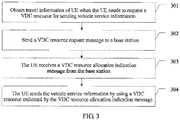
- a VDC resource request message carries travel information of a vehicle on which the UE is located.
- the VDC resource request method according to this embodiment of the present invention includes the following steps.
- the travel information includes one or more pieces of the following information: vehicle speed information of a vehicle on which the UE is located, or geographical location information and/or a travel direction of a vehicle on which the UE is located.
- the UE is connected to a control management system of the vehicle on which the UE is located, and the UE may obtain the vehicle speed information of the vehicle on which the UE is located from the control management system of the vehicle on which the UE is located.
- the UE may obtain, by using a positioning module (for example, a GPS module) configured on the UE, the geographical location information, the travel direction, or the like of the vehicle on which the UE is located.
- a positioning module for example, a GPS module
- the VDC resource request message includes the travel information of the UE obtained in step 301.
- the VDC resource request message may further include a VDC resource status list and/or an RNTI of the UE.
- the RNTI is allocated to the UE by the base station when the UE is accessing a cellular network.
- An available VDC resource is indicated in the VDC resource status list.
- the UE may locally maintain the VDC resource status list on the UE by monitoring a VDC resource use status. Specifically, for a manner for maintaining a local VDC resource status list by the UE, refer to a description in step 202 in the embodiment shown in FIG 2 . Details are not described herein.
- VDC is a vehicle direct communication technology designed based on a physical layer of an LTE system, that is, VDC communication is direct communication between UE and UE.
- a feature of the VDC communication is as follows: A base station configures an independent VDC resource for each cell, and each UE (for example, a vehicle-mounted terminal or a handheld terminal) may obtain VDC resource parameter information by receiving a configuration message that is broadcast by the base station or by establishing a dedicated link to the base station.
- the VDC resource parameter information is, for example, total bandwidth of VDC resources within a coverage area of the base station, a time-frequency resource configuration parameter of a channel corresponding to each VDC resource, or a channel identifier (for example, a channel number) of a channel corresponding to a VDC resource that can be used by each UE.
- the UE needs to use only a VDC resource allocated to the UE by the base station.
- the UE needs to receive as many signals on the VDC resource as possible, so as to receive as many vehicle safety messages sent by other neighboring UE as possible.
- the vehicle safety message includes, for example, emergency brake information of a vehicle, or information prompting a coming vehicle at an opposite side when a vehicle is making a turn.
- the vehicle safety message is mainly used to avoid vehicle collision.
- the UE receives a VDC resource allocation indication message from the base station.
- the VDC resource allocation indication message indicates a VDC resource allocated to the UE by the base station according to the VDC resource request message.
- the UE sends the vehicle service information by using a VDC resource indicated by the VDC resource allocation indication message.
- the UE in this embodiment of the present invention may be a vehicle-mounted terminal, a handheld terminal, or another terminal that can be connected to a vehicle control management system, and is not limited herein.
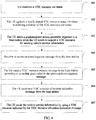
- VDC resource request method performed by UE in an embodiment of the present invention.
- This embodiment of the present invention includes an access request scheme of the UE, and a VDC resource request message carries a VDC resource status list and travel information of a vehicle on which the UE is located.
- the VDC resource request message may carry only one of the following: a VDC resource status list, or travel information of a vehicle on which the UE is located.
- the VDC resource request method according to this embodiment of the present invention includes the following steps.
- UE monitors a VDC resource use status.
- Step 401 is similar to step 201 in the embodiment shown in FIG. 2 .
- step 201 For a specific implementation manner of step 201, refer to a description in step 201. Details are not described herein.
- the UE updates a locally stored VDC resource status list when monitoring a change of the VDC resource use status.
- An available VDC resource is indicated in the VDC resource status list.
- Step 402 is similar to step 202 in the embodiment shown in FIG 2 .
- Step 402 refer to a description in step 202 in the embodiment shown in FIG. 2 . Details are not described herein.
- the UE sends a predetermined access preamble sequence to a base station when the UE needs to request a VDC resource for sending vehicle service information.
- a third type of vehicle service information is characterized by burstiness. Therefore, in this embodiment of the present invention, in access timeslot configuration, each subframe within a coverage area of the base station is configured as accessible to the UE. Therefore, the base station needs to notify, by using a broadcast message or by using a dedicated signaling after the UE performs authentication, the UE that the UE can initiate access to all subframes. In addition, a base station side also needs to ensure that the base station side is always prepared for receiving the access preamble sequence (that is, a preamble) from the UE. The base station provides both a cellular network and a VDC service.
- an independent preamble set is preset for requesting a VDC resource by the UE, so that the base station can rapidly process a VDC resource request from the UE.
- the preamble set includes one or more preambles dedicated for the VDC resource request.
- the UE selects a preamble from the preamble set, and sends the preamble to the base station.
- a Media Access Control (MAC, Media Access Control) layer of the UE selects a preamble from the preamble set, and sends the preamble to a physical layer (that is, a PHY layer) of the UE, and the PHY layer of the UE sends the preamble to the base station in a next nearest subframe.
- MAC Media Access Control
- the UE requests the VDC resource mainly for sending the third type of vehicle service information.
- the UE may request the VDC resource for sending other vehicle service information.
- the UE is connected to a control management system of a vehicle on which the UE is located.
- the UE may obtain travel information (for example, vehicle speed information, brake information, or turning information) of the vehicle from the control management system of the vehicle on which the UE is located.
- the UE may obtain, by using a positioning module (for example, a GPS module) configured on the UE, geographical location information, a travel direction, or the like of the vehicle on which the UE is located.
- the UE generates one or more pieces of third type of vehicle service information according to the obtained geographical location information, travel direction, travel information, or the like of the vehicle.
- the UE Each time the UE generates one piece of third type of vehicle service information, the UE requests a VDC resource from the base station for sending the generated third type of vehicle service information. In this embodiment of the present invention, the UE sends the predetermined preamble to the base station. It should be noted that the third type of vehicle service information in this embodiment of the present invention may be specifically generated with reference to an existing manner for generating a third type of vehicle service information, and details are not described herein.
- the access acknowledgment message includes an uplink grant value allocated to the UE by the base station.
- the base station when the base station receives the preamble sent by the UE in step 403, and finds that the preamble is a preamble dedicated for requesting a VDC resource by the UE, the base station allocates a large enough uplink grant value (that is, UL grant) to the UE.
- a large enough uplink grant value that is, UL grant
- geographical location information includes 10 to 20 bytes, and a VDC resource status list is related to a VDC resource quantity.
- the base station allocates the UL grant to the UE in two manners. A first manner is allocating the UL grant to the UE according to a maximum byte quantity.
- a second manner is as follows: A quantity of bytes that are sent at the request of the UE is indicated by using the preamble, and the base station allocates, to the UE, a nearest UL grant greater than or equal to the quantity of bytes that are sent at the request of the UE.
- the base station classifies preambles into, for example, three types.
- a first type of preamble is corresponding to a quantity, less than or equal to 128, of bytes that are sent at request.
- a second type of preamble is corresponding to a quantity, greater than 128 and less than or equal to 256, of bytes that are sent at request.
- a third type of preamble is corresponding to a quantity, between 256 and 384, of bytes that are sent at request.
- the preambles are not limitedly classified into the foregoing three types, that is, a byte quantity of each type of preamble may be configured according to an actual situation.
- the base station may broadcast preamble classification information (including byte quantities corresponding to various types of preamble) to the UE by using a broadcast message.
- the base station determines a timing advance (TA, Timing Advance) of the UE, and adds the TA of the UE to the access acknowledgment message, so that the UE adjusts a sending time point according to the TA.
- TA Timing Advance
- the base station may not determine a TA of the UE, that is, the access acknowledgment message may not carry the TA of the UE, and the UE adjusts a sending time point according to a downlink TA or an existing TA.
- the UE sends a VDC resource request message to the base station according to an uplink grant value in the access acknowledgment message.
- the VDC resource request message includes the VDC resource status list and the travel information of the UE.
- the travel information includes one or more pieces of the following information: the vehicle speed information of the vehicle on which the UE is located, or the geographical location information and/or the travel direction of the vehicle on which the UE is located.
- the UE is connected to a control management system of the vehicle on which the UE is located, and the UE may obtain the vehicle speed information of the vehicle on which the UE is located from the control management system of the vehicle on which the UE is located.
- the UE may obtain, by using a positioning module (for example, a GPS module) configured on the UE, the geographical location information, the travel direction, or the like of the vehicle on which the UE is located.
- a positioning module for example, a GPS module
- the VDC resource request message further includes an RNTI of the UE, and the RNTI is allocated to the UE by the base station when the UE is accessing a cellular network.
- the UE is connected to the control management system of the vehicle on which the UE is located, and the UE may obtain the vehicle speed information of the vehicle on which the UE is located from the control management system of the vehicle on which the UE is located.
- the UE receives a VDC resource allocation indication message from the base station.
- the VDC resource allocation indication message indicates a VDC resource allocated to the UE by the base station according to the VDC resource request message.
- the UE sends the vehicle service information by using a VDC resource indicated by the VDC resource allocation indication message.
- the UE in this embodiment of the present invention may be a vehicle-mounted terminal, a handheld terminal, or another terminal that can be connected to a vehicle control management system, and is not limited herein.
- user equipment pre-monitors a VDC resource use status, updates a locally stored VDC resource status list, and when the user equipment needs to send vehicle service information (for example, when the user equipment needs to send a third type of vehicle service information that requires a small transmission delay), requests an idle resource in the VDC resource status list from a base station, and then sends the vehicle service information by using a VDC resource allocated by the base station.
- vehicle service information for example, when the user equipment needs to send a third type of vehicle service information that requires a small transmission delay
- the VDC resource request method includes the following steps.
- the VDC resource request message includes at least one piece of the following information: a VDC resource status list, or travel information of the UE. An available VDC resource is indicated in the VDC resource status list.
- the VDC resource request message further includes an RNTI of the UE, and the RNTI is allocated to the UE by the base station when the UE is accessing a cellular network.
- the travel information includes one or more pieces of the following information: vehicle speed information of a vehicle on which the UE is located, or geographical location information and/or a travel direction of a vehicle on which the UE is located.
- VDC is a vehicle direct communication technology designed based on a physical layer of a Long Term Evolution (LTE, Long Term Evolution) system, that is, VDC communication is direct communication between UE and UE.
- LTE Long Term Evolution
- a feature of the VDC communication is as follows: A base station configures an independent VDC resource for each cell, and each UE (for example, a vehicle-mounted terminal or a handheld terminal) may obtain VDC resource parameter information by receiving a configuration message that is broadcast by the base station or by establishing a dedicated link to the base station.
- the VDC resource parameter information is, for example, total bandwidth of VDC resources within a coverage area of the base station, a time-frequency resource configuration parameter of a channel corresponding to each VDC resource, or a channel identifier (for example, a channel number) of a channel corresponding to a VDC resource that can be used by each UE.
- the UE needs to use only a VDC resource allocated to the UE by the base station.
- the UE needs to receive as many signals on the VDC resource as possible, so as to receive as many vehicle safety messages sent by other neighboring UE as possible.
- the vehicle safety message includes, for example, emergency brake information of a vehicle, or information prompting a coming vehicle at an opposite side when a vehicle is making a turn.
- the vehicle safety message is mainly used to avoid vehicle collision.
- the base station broadcasts VDC resource parameter information on a BCH of a cellular communication resource spectrum.
- the VDC resource parameter information includes VDC resource bandwidth, VDC resource channel division, and a channel parameter.
- the channel parameter includes but is not limited to a channel time-domain resource, a channel frequency-domain resource, a channel retransmission moment, a channel modulation and coding scheme, and the like.
- all UEs in the coverage area of the base station can obtain the VDC resource parameter information that is broadcast by the base station, and starts to monitor a VDC resource use status in the coverage area of the base station according to the obtained VDC resource parameter information, so as to update a VDC resource status list locally maintained on each UE.
- the base station may not broadcast VDC resource parameter information.
- the UE requests the VDC resource parameter information from the base station, and the base station sends the VDC resource parameter information to the UE after receiving a request of the UE, so that the UE monitors a VDC resource use status, and updates a VDC resource status list locally maintained on the UE.
- the UE may be connected to a control management system of the vehicle on which the UE is located, and obtain the vehicle speed information of the vehicle on which the UE is located from the control management system of the vehicle on which the UE is located.
- the UE obtains, by using a positioning module (for example, a GPS module) configured on the UE, the geographical location information, the travel direction, or the like of the vehicle on which the UE is located.
- the travel information further includes the geographical location information and the travel direction that are of the vehicle on which the UE is located.
- the UE sends the VDC resource request message to the base station when the UE needs to request a VDC resource for sending vehicle service information.
- the base station selects a VDC resource currently available to the UE from the VDC resource status list according to the VDC resource status list carried in the VDC resource request message, and allocates the VDC resource to the UE.
- the base station allocates a currently available VDC resource to the UE according to the travel information of the UE. Specifically, the base station determines several vehicle speed intervals by means of division, and establishes a correspondence between a vehicle speed interval and a VDC resource.
- the base station may learn the vehicle speed information of the vehicle on which the UE is located, determine a VDC resource range according to a vehicle speed interval of the vehicle speed information of the vehicle on which the UE is located, then select a VDC resource currently available to the UE from the determined VDC resource range for the UE, and allocate the VDC resource to the UE.
- VDC resources are classified into three types: A first type of VDC resource is corresponding to a vehicle speed interval of 90 kilometers/hour, a second type of VDC resource is corresponding to a vehicle speed interval of 60 kilometers/hour (60 kilometers/hour is not included), and a third type of VDC resource is corresponding to a vehicle speed interval of less than 60 kilometers/hour.
- a vehicle speed of the vehicle on which the UE is located is 70 kilometers/hour
- the base station learns, by using the VDC resource request message, that the vehicle speed of the vehicle on which the UE is located is 70 kilometers/hour. Because the 70 kilometers/hour is in the vehicle speed interval of 60 kilometers/hour, the base station determines a second type of VDC resource, and selects a VDC resource currently available to the UE from the second type of VDC resource.
- the VDC resource request message may further carry both the VDC resource status list and the travel information of the UE.
- the base station allocates a currently available VDC resource to the UE with reference to the foregoing two implementation manners.
- the base station further interacts VDC resource occupation indication information with a neighboring base station of the base station.
- the VDC resource occupation indication information is used to indicate occupied VDC resources in respective coverage areas of the base stations.
- the base station allocates the currently available VDC resource to the UE with reference to the VDC resource request message of the UE and VDC resource occupation indication information of the neighboring base station, so as to avoid collision with a VDC resource within a coverage area of the neighboring base station when the VDC resource is allocated to the UE.
- the VDC resource allocation indication message indicates the VDC resource allocated to the UE by the base station, so that the UE sends the vehicle service information by using the VDC resource indicated by the VDC resource allocation indication message.
- a vehicle passes a cell in coverage of a base station in a relatively short time when the vehicle moves at a high speed. If all cells reallocate VDC resources, the VDC resource may be switched for excessively many times in a unit time (for example, one minute). Therefore, the base station expects that a vehicle at a high speed switches a VDC resource for as few times as possible. In addition, a neighboring base station needs to have a same correspondence between a vehicle speed and a VDC resource. Therefore, optionally, in this embodiment of the present invention, the UE adds the travel information of the UE to the VDC resource request message.
- the travel information of the UE further includes the geographical location information and the travel direction that are of the vehicle on which the UE is located.
- the base station After allocating the available VDC resource to the UE in step 502, the base station further determines, according to the geographical location information and the travel direction that are of the vehicle on which the UE is located, a use range for using the VDC resource by the UE, and the use range specifically refers to duration in which the VDC resource can be used, that is, duration in which the VDC resource can be used after a VDC resource allocation instruction is received; or determines a condition for changing the VDC resource, for example, determines that the vehicle on which the UE is located needs to apply for a resource again after the UE arrives at a particular place.
- the base station adds, to the VDC resource allocation indication message sent to the UE, the use range of the VDC resource or the condition for changing the VDC resource, so that the UE initiates a VDC resource request to the base station again when a specified time expires or when the vehicle on which the UE is located satisfies the condition for changing the VDC resource (for example, the vehicle on which the UE is located arrives at a designated place).
- the base station sends the VDC resource allocation indication message to the UE by using a physical downlink shared channel (PDSCH, Physical Downlink Shared Channel).
- PDSCH Physical Downlink Shared Channel
- the UE in this embodiment of the present invention may be a vehicle-mounted terminal, a handheld terminal, or another terminal that can be connected to a vehicle control management system, and is not limited herein.
- a base station after receiving a VDC resource request message of UE, a base station allocates an available VDC resource to the UE according to the resource request message, and indicates the VDC resource to the UE by using a VDC resource allocation indication message, so that the UE sends, according to indication of the VDC resource allocation indication message, vehicle service information by using the VDC resource allocated by the base station.
- a transmission delay can be less than 100 milliseconds when vehicle service information is transmitted according to the present invention, that is, a transmission delay requirement of a third type of vehicle service information can be satisfied.
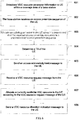
- VDC resource request method performed by a base station in an embodiment of the present invention.
- This embodiment of the present invention includes an access request scheme of UE, and a VDC resource request message carries a VDC resource status list and travel information of a vehicle on which the UE is located.
- the VDC resource request message may carry only one of the following: a VDC resource status list, or travel information of a vehicle on which the UE is located.
- the VDC resource request method according to this embodiment of the present invention includes the following steps.
- the VDC resource parameter information includes VDC resource bandwidth, VDC resource channel division, and a channel parameter.
- the base station broadcasts the VDC resource parameter information to the UE in the coverage area of the base station on a BCH of a cellular communication resource spectrum.
- all UEs in the coverage area of the base station can obtain the VDC resource parameter information that is broadcast by the base station, and starts to monitor a VDC resource use status in the coverage area of the base station according to the obtained VDC resource parameter information, so as to update a VDC resource status list.
- the base station receives an access preamble sequence of the UE.
- a third type of vehicle service information is characterized by burstiness. Therefore, in this embodiment of the present invention, in access timeslot configuration, each subframe in the coverage area of the base station is configured as accessible to the UE. Therefore, the base station needs to notify, by using a broadcast message or by using a dedicated signaling after the UE performs authentication, the UE that the UE can initiate access to all subframes. In addition, a base station side also needs to ensure that the base station side is always prepared for receiving the access preamble sequence (that is, a preamble) from the UE. The base station provides both a cellular network and a VDC service.
- an independent preamble set is preset for requesting a VDC resource by the UE, so that the base station can rapidly process a VDC resource request from the UE.
- the preamble set includes one or more preambles dedicated for the VDC resource request.
- the UE selects a preamble from the preamble set, and sends the preamble to the base station.
- MAC of the UE selects a preamble from the preamble set, and sends the preamble to a physical layer (that is, a PHY layer) of the UE, and the PHY layer of the UE sends the preamble to the base station in a next nearest subframe.
- a physical layer that is, a PHY layer
- the base station when the base station determines that the received preamble is the predetermined preamble, for example, a preamble in the preamble set, the base station allocates the uplink grant value (that is, UL grant) to the UE.
- the uplink grant value that is, UL grant
- the base station allocates a large enough UL grant to the UE when determining that the received preamble is the predetermined preamble.
- geographical location information includes 10 to 20 bytes
- a VDC resource status list is related to a VDC resource quantity.
- the base station allocates the UL grant to the UE in two manners.
- a first manner is allocating the UL grant to the UE according to a maximum byte quantity.
- a second manner is as follows: A quantity of bytes that are sent at the request of the UE is indicated by using the preamble, and the base station allocates, to the UE, a nearest UL grant greater than or equal to the quantity of bytes that are sent at the request of the UE.
- the base station classifies preambles into, for example, three types.
- a first type of preamble is corresponding to a quantity, less than or equal to 128, of bytes that are sent at request.
- a second type of preamble is corresponding to a quantity, greater than 128 and less than or equal to 256, of bytes that are sent at request.
- a third type of preamble is corresponding to a quantity, between 256 and 384, of bytes that are sent at request.
- the preambles are not limitedly classified into the foregoing three types, that is, a byte quantity of each type of preamble may be configured according to an actual situation.
- the base station may broadcast preamble classification information (including byte quantities corresponding to various types of preamble) to the UE by using a broadcast message.
- the access acknowledgment message includes the TA of the UE and the uplink grant value allocated to the UE by the base station. Therefore, after adjusting a sending time point according to the TA in the access acknowledgment message, the UE sends the VDC resource request message to the base station according to the uplink grant value in the access acknowledgment message.
- Step 606 is similar to step 501 in the embodiment shown in FIG. 5 .
- step 606 refers to a description in step 501. Details are not described herein.
- the base station allocates the currently available VDC resource to the UE according to the VDC resource status list and travel information of the UE that are carried in the VDC resource request message of the UE.
- the base station further interacts VDC resource occupation indication information with a neighboring base station of the base station.
- the VDC resource occupation indication information is used to indicate occupied VDC resources in respective coverage areas of the base stations.
- the base station allocates the currently available VDC resource to the UE with reference to the VDC resource request message of the UE and VDC resource occupation indication information of the neighboring base station, so as to avoid collision with a VDC resource within a coverage area of the neighboring base station when the VDC resource is allocated to the UE.
- travel direction information of a corresponding vehicle during use of each VDC resource is further carried, so that a base station that receives the VDC resource occupation information can determine whether the occupied VDC resource can be used within a coverage area of the base station without causing resource collision in a period of time after the VDC resource occupation information is received.
- VDC resource occupation information sent by a base station a to a base station b indicates that a VDC resource 1 is occupied and a travel direction is travel away from the base station b
- the base station b may allocate the VDC resource 1 to UE that is in a direction away from the base station a and just enters the base station b.
- the VDC resource allocation indication message indicates the VDC resource allocated to the UE by the base station, so that the UE sends the vehicle service information by using the VDC resource indicated by the VDC resource allocation indication message.
- a vehicle passes a cell in coverage of a base station in a relatively short time when the vehicle moves at a high speed. If all cells reallocate VDC resources, the VDC resource may be switched for excessively many times in a unit time (for example, one minute). Therefore, the base station expects that a vehicle at a high speed switches a VDC resource for as few times as possible. Therefore, optionally, in this embodiment of the present invention, the UE adds the travel information of the UE to the VDC resource request message. In addition to vehicle speed information of a vehicle on which the UE is located, the travel information of the UE further includes the geographical location information and the travel direction that are of the vehicle on which the UE is located.
- the base station After allocating the available VDC resource to the UE in step 607, the base station further determines, according to the geographical location information and the travel direction that are of the vehicle on which the UE is located, a use range for using the VDC resource by the UE, and the use range specifically refers to duration in which the VDC resource can be used, that is, duration in which the VDC resource can be used after a VDC resource allocation instruction is received; or determines a condition for changing the VDC resource, for example, determines that the vehicle on which the UE is located needs to apply for a resource again after the UE arrives at a particular place.
- the base station adds, to the VDC resource allocation indication message sent to the UE, the use range of the VDC resource or the condition for changing the VDC resource, so that the UE initiates a VDC resource request to the base station again when a specified time expires or when the vehicle on which the UE is located satisfies the condition for changing the VDC resource (for example, the vehicle on which the UE is located arrives at a designated place).
- the base station sends the VDC resource allocation indication message to the UE by using a PDSCH.
- the VDC resource request message carries the VDC resource status list and the travel information of the vehicle on which the UE is located. If the VDC resource request message does not carry the VDC resource status list, step 601 in this embodiment of the present invention may be omitted. In addition, step 604 in this embodiment of the present invention may also be omitted. That is, the base station may not determine a TA of the UE, and the access acknowledgment message sent in step 605 does not carry the TA of the UE. The UE may adjust a sending time point according to a downlink TA or an existing TA.
- the UE in this embodiment of the present invention may be a vehicle-mounted terminal, a handheld terminal, or another terminal that can be connected to a vehicle control management system, and is not limited herein.
- a base station after receiving a VDC resource request message of UE, a base station allocates an available VDC resource to the UE according to the resource request message, and indicates the VDC resource to the UE by using a VDC resource allocation indication message, so that the UE sends, according to indication of the VDC resource allocation indication message, vehicle service information by using the VDC resource allocated by the base station.
- a transmission delay can be less than 100 milliseconds when vehicle service information is transmitted according to the present invention, that is, a transmission delay requirement of a third type of vehicle service information can be satisfied.
- An embodiment of the present invention further provides user equipment.
- user equipment 700 in this embodiment of the present invention includes:
- the sending unit 702 is further configured to send the vehicle service information by using the VDC resource indicated by the VDC resource allocation indication message.
- the VDC resource request message includes the VDC resource status list.
- user equipment 800 further includes: a monitoring unit 703, configured to monitor a VDC resource use status; and an updating unit 704, configured to update a locally stored VDC resource status list when the monitoring unit 703 monitors a change of the VDC resource use status.
- the monitoring unit 703 includes: an obtaining unit, configured to obtain VDC resource parameter information that is broadcast by the base station, where the VDC resource parameter information includes VDC resource bandwidth, VDC resource channel division, and a channel parameter; and a monitoring subunit, configured to monitor the VDC resource use status according to the VDC resource parameter information obtained by the obtaining unit.
- the sending unit 701 is further configured to send a predetermined access preamble sequence to the base station before sending the VDC resource request message to the base station, so that the base station learns, according to the predetermined access preamble sequence, that the user equipment currently needs to apply for a VDC resource, and allocates an uplink grant value to the user equipment.
- the receiving unit 702 is further configured to receive an access acknowledgment message from the base station, and the access acknowledgment message includes the uplink grant value allocated to the user equipment by the base station.
- the sending unit 701 is specifically configured to send the VDC resource request message to the base station according to the uplink grant value in the access acknowledgment message.
- the base station determines a TA of the UE, and adds the TA of the UE to the access acknowledgment message, so that the UE adjusts a sending time point according to the TA.
- VDC is a vehicle direct communication technology designed based on a physical layer of an LTE system, that is, VDC communication is direct communication between UE and UE.
- a feature of the VDC communication is as follows: A base station configures an independent VDC resource for each cell, and each user equipment (for example, a vehicle-mounted terminal or a handheld terminal) may obtain VDC resource parameter information by receiving a configuration message that is broadcast by the base station or by establishing a dedicated link to the base station.
- the VDC resource parameter information is, for example, total bandwidth of VDC resources within a coverage area of the base station, a time-frequency resource configuration parameter of a channel corresponding to each VDC resource, or a channel identifier (for example, a channel number) of a channel corresponding to a VDC resource that can be used by each UE.
- the user equipment needs to use only a VDC resource allocated to the UE by the base station.
- the user equipment needs to receive as many signals on the VDC resource as possible, so as to receive as many vehicle safety messages sent by other neighboring UE as possible.
- the vehicle safety message includes, for example, emergency brake information of a vehicle, or information prompting a coming vehicle at an opposite side when a vehicle is making a turn.
- the vehicle safety message is mainly used to avoid vehicle collision.
- the user equipment in this embodiment of the present invention may be a vehicle-mounted terminal, a handheld terminal, or another terminal that can be connected to a vehicle control management system, and is not limited herein.
- the user equipment in this embodiment of the present invention may be the user equipment in the foregoing method embodiments, and may be configured to implement all technical solutions in the foregoing method embodiments.
- Functions of each function module of the user equipment may be specifically implemented according to the methods described in the foregoing method embodiments. For a specific implementation process, refer to the related descriptions in the foregoing embodiments. Details are not described herein.
- user equipment sends a VDC resource request message to a base station when the user equipment needs to send vehicle service information (for example, when the user equipment needs to send a third type of vehicle service information that requires a small transmission delay), so that the base station allocates an available VDC resource to the user equipment according to the VDC resource request message. Then, the user equipment sends the vehicle service information by using the VDC resource allocated by the base station. In an entire process, no complex link establishment process between the user equipment and the base station is required. Therefore, a vehicle service information transmission delay is effectively reduced. Moreover, experimental research data shows that a transmission delay can be less than 100 milliseconds when vehicle service information is transmitted according to the present invention, that is, a transmission delay requirement of the third type of vehicle service information can be satisfied.
- user equipment 900 in this embodiment of the present invention includes parts such as a memory 901 of one or more computer-readable storage media, an input unit 902, a display unit 903, a processor 904 of one or more processing cores, and a power supply 905.
- parts such as a memory 901 of one or more computer-readable storage media, an input unit 902, a display unit 903, a processor 904 of one or more processing cores, and a power supply 905.
- a user equipment structure shown in FIG. 9 does not limit the user equipment, parts more or less than those shown in the figure may be included, some parts may be combined, or a different part configuration may be included.
- the memory 901 may be configured to store a software program and a module, and the processor 904 executes various functional applications and data processing by running the software program and the module that are stored in the memory 901.
- the memory 901 may mainly include a program storage area and a data storage area.
- the program storage area may store an operating system, an application program required by at least one function (such as a sound play function or an image play function), and the like.
- the data storage area may store data (such as audio data or vehicle travel information) created according to use of the user equipment 900, and the like.
- the memory 901 may include a high-speed random access memory, and may further include a non-volatile memory, for example, at least one magnetic disk storage component, a flash memory component, or another volatile solid-state storage component.
- the memory 901 may further include a memory controller, so as to provide the processor 904 and the input unit 902 with access to the memory 901.
- the input unit 902 may be configured to: receive input digits or character information, and generate keyboard, mouse, joystick, optics, or trackball signal input related to user setting and function control.
- the input unit 902 may be represented by a receiver.
- the input unit 902 includes a touch-sensitive surface 9021 and another input device 9022.
- the touch-sensitive surface 9021 also referred to as a touchscreen or a touch panel, may collect a touch operation (such as an operation performed by a user on the touch-sensitive surface 9021 or near the touch-sensitive surface 9021 by using a finger, a stylus, or any another suitable object or accessory) of a user on or near the touch-sensitive surface, and drives a corresponding connection apparatus according to a preset program.
- the touch-sensitive surface 9021 may include two parts: a touch detection apparatus and a touch controller.
- the touch detection apparatus detects a touch location of a user, detects a signal brought by a touch operation, and sends the signal to the touch controller.
- the touch controller receives touch information from the touch detection apparatus, converts the touch information into touch coordinates, and sends the touch coordinates to the processor 904, and can receive and execute a command sent by the processor 904.
- the touch-sensitive surface 9021 may be implemented in multiple types, such as resistance-type, capacitor-type, infrared ray, and surface acoustic wave.
- the input unit 902 may include another input device 9022.
- the another input device 9022 may include but is not limited to one or more of a physical keyboard, a function key (such as a volume control key or an on/off key), a trackball, a mouse, a joystick, or the like.
- the display unit 903 may be configured to display information input by a user, or information provided for a user, and various graphic user interfaces of the terminal 900.
- the graphic user interfaces may include a graphic, a text, an icon, a video, and any combination thereof.
- the display unit 903 may include a display panel 9031.
- the display panel 9031 may be configured in a form such as a liquid crystal display (LCD, Liquid Crystal Display), or an organic light-emitting diode (OLED, Organic Light-Emitting Diode).
- the touch-sensitive surface 9021 may cover the display panel 9031.
- the touch-sensitive surface 9021 When detecting the touch operation on or near the touch-sensitive surface 9021, the touch-sensitive surface 9021 transmits the touch operation to the processor 904 to determine a type of a touch event, and then the processor 904 provides corresponding visual output on the display panel 9031 according to the type of the touch event.
- the touch-sensitive surface 9021 and the display panel 9031 are used as two independent parts to implement input and input functions. However, in some embodiments, the touch-sensitive surface 9021 and the display panel 9031 may be integrated to implement the input and output functions.
- the processor 904 is a control center of the user equipment 900, connects all parts of the entire mobile phone by using various interfaces and lines, executes, by running or executing the software program and/or the module stored in the memory 901 and by invoking data stored in the memory 901, various functions of the user equipment 900, and processes the data, so as to perform overall monitoring on the user equipment 900.
- the processor 904 may include one or more processing cores.
- an application processor and a modem processor may be integrated into the processor 904.
- the application processor mainly processes an operating system, a user interface, an application program, and the like, and the modem processor mainly processes wireless communications. Certainly, the modem processor may not be integrated into the processor 904.
- the user equipment 900 further includes the power supply 905 (for example, a battery) that supplies power to each part.
- the power supply may be logically connected to the processor 904 by using a power supply management system, so as to manage charging, discharging, and power consumption by using the power supply management system.
- the power supply 905 may include one or more direct current or alternating current power supplies, a rechargeable system, a power failure detection circuit, a power converter or an inverter, a power status indicator, or any another component.
- the user equipment 900 may further include a transmitter (such as a radio frequency (RF, Radio Frequency) circuit), a sensor, an audio frequency circuit, a wireless fidelity (WiFi, wireless fidelity) module, a camera, a Bluetooth module, and the like. Details are not described herein.
- the user equipment 900 further includes one or more programs that are stored in the memory 901 and configured to be executed by one or more processors 904.
- the one or more programs include an instruction used to perform the following operations.
- a VDC resource request message is sent to a base station when the user equipment 900 needs to request a VDC resource for sending vehicle service information.
- the VDC resource request message includes at least one piece of the following information: the VDC resource status list, or travel information of the user equipment 900, and an available VDC resource is indicated in the VDC resource status list.
- the travel information includes at least one piece of the following information: vehicle speed information of a vehicle on which the user equipment 700 is located, or geographical location information and a travel direction of a vehicle on which the user equipment 700 is located.
- a VDC resource allocation indication message from the base station is received.
- the VDC resource allocation indication message indicates a VDC resource allocated to the user equipment 600 by the base station according to the VDC resource request message.
- the vehicle service information is sent by using the VDC resource indicated by the VDC resource allocation indication message.
- the VDC resource request message includes the VDC resource status list
- the processor 904 is further configured to perform the following instructions:
- the monitoring a VDC resource use status includes: VDC resource parameter information that is broadcast by the base station is obtained, where the VDC resource parameter information includes VDC resource bandwidth, VDC resource channel division, and a channel parameter; and the VDC resource use status is monitored according to the obtained VDC resource parameter information.
- the user equipment 900 before sending the VDC resource request message, sends a predetermined access preamble sequence to the base station, so that the base station learns, according to the predetermined access preamble sequence, that the user equipment 900 currently needs to apply for a VDC resource, and allocates an uplink grant value to the user equipment 900; and receives an access acknowledgment message from the base station.
- the access acknowledgment message includes the uplink grant value allocated to the user equipment 900 by the base station.
- the sending a VDC resource request message to a base station is specifically:
- the VDC resource request message is sent to the base station according to the uplink grant value in the access acknowledgment message.
- the user equipment in this embodiment of the present invention may be a vehicle-mounted terminal, a handheld terminal, or another terminal that can be connected to a vehicle control management system, and is not limited herein.
- the user equipment in this embodiment of the present invention may be the user equipment in the foregoing method embodiments, and may be configured to implement all technical solutions in the foregoing method embodiments.
- Functions of each function module of the user equipment may be specifically implemented according to the methods described in the foregoing method embodiments. For a specific implementation process, refer to the related descriptions in the foregoing embodiments. Details are not described herein.
- user equipment sends a VDC resource request message to a base station when the user equipment needs to send vehicle service information (for example, when the user equipment needs to send a third type of vehicle service information that requires a small transmission delay), so that the base station allocates an available VDC resource to the user equipment according to the VDC resource request message. Then, the user equipment sends the vehicle service information by using the VDC resource allocated by the base station. In an entire process, no complex link establishment process between the user equipment and the base station is required. Therefore, a vehicle service information transmission delay is effectively reduced. Moreover, experimental research data shows that a transmission delay can be less than 100 milliseconds when vehicle service information is transmitted according to the present invention, that is, a transmission delay requirement of the third type of vehicle service information can be satisfied.
- a base station 1000 in this embodiment of the present invention includes: a first receiving unit 1001, configured to receive a VDC resource request message from user equipment, where the VDC resource request message includes at least one piece of the following information: a VDC resource status list, or travel information of the user equipment, and an available VDC resource is indicated in the VDC resource status list; and optionally, the travel information includes at least one piece of the following information: vehicle speed information of a vehicle on which the user equipment 700 is located, or geographical location information and a travel direction of a vehicle on which the user equipment 700 is located; a first allocation unit 1002, configured to allocate a currently available VDC resource to the user equipment according to the VDC resource request message of the user equipment received by the first receiving unit 1001; and a first sending unit 1003, configured to send a VDC resource allocation indication message to the user equipment, where the VDC resource allocation indication message indicates the VDC resource allocated to the user equipment by the first allocation unit 1002, so that the user equipment
- the VDC resource request message includes the VDC resource status list.
- the base station in this embodiment of the present invention further includes a broadcasting unit, configured to broadcast VDC resource parameter information to user equipment within a coverage area of the base station.
- the VDC resource parameter information includes VDC resource bandwidth, VDC resource channel division, and a channel parameter.
- the VDC resource request message includes the travel information of the user equipment, and the travel information includes the vehicle speed information of the vehicle on which the user equipment is located.
- the first allocation unit 1002 is specifically configured to: determine a VDC resource range according to a vehicle speed interval of the vehicle speed information of the vehicle on which the user equipment is located, and allocate the currently available VDC resource in the determined VDC resource range to the user equipment. There is a correspondence between the vehicle speed interval and the VDC resource range.
- the base station in this embodiment of the present invention further includes a second receiving unit, configured to receive VDC resource occupation indication information from a neighboring base station, where the VDC resource occupation indication information of the neighboring base station is used to indicate an occupied VDC resource within a coverage area of the neighboring base station.
- the first allocation unit 1002 is specifically configured to allocate the currently available VDC resource to the user equipment according to the VDC resource request message of the user equipment and the VDC resource occupation indication information of the neighboring base station.
- the base station in this embodiment of the present invention further includes: a third receiving unit, configured to receive an access preamble sequence of the user equipment; a second allocation unit, configured to allocate an uplink grant value to the user equipment when it is determined that the access preamble sequence is a predetermined access preamble sequence; a determining unit, configured to determine a time advance of the user equipment; and a second sending unit, configured to send an access acknowledgment message to the user equipment, where the access acknowledgment message includes the time advance of the user equipment and the uplink grant value allocated to the user equipment by the base station.
- a third receiving unit configured to receive an access preamble sequence of the user equipment
- a second allocation unit configured to allocate an uplink grant value to the user equipment when it is determined that the access preamble sequence is a predetermined access preamble sequence
- a determining unit configured to determine a time advance of the user equipment
- a second sending unit configured to send an access acknowledgment message to the user equipment, where the access acknowledgment message includes the time advance of the user equipment and
- the access preamble sequence of the user equipment is further used to indicate a quantity of bytes that are sent at the request of the user equipment.
- the second allocation unit is specifically configured to allocate, to the user equipment according to the access preamble sequence of the user equipment received by the third receiving unit, an uplink grant value greater than or equal to the quantity of bytes that are sent at the request of the user equipment.
- the base station in this embodiment of the present invention may be the base station in the foregoing method embodiments, and may be configured to implement all technical solutions in the foregoing method embodiments.
- Functions of each function module may be specifically implemented according to the methods in the foregoing method embodiments. For a specific implementation process, refer to the related descriptions in the foregoing embodiments. Details are not described herein.
- a base station after receiving a VDC resource request message of user equipment, a base station allocates an available VDC resource to the user equipment according to the resource request message, and indicates the VDC resource to the user equipment by using a VDC resource allocation indication message, so that the user equipment sends, according to indication of the VDC resource allocation indication message, vehicle service information by using the VDC resource allocated by the base station.
- a transmission delay can be less than 100 milliseconds when vehicle service information is transmitted according to the present invention, that is, a transmission delay requirement of a third type of vehicle service information can be satisfied.
- a base station 1100 in this embodiment of the present invention includes:
- the processor 1104 performs the following steps:
- the base station in this embodiment of the present invention may be the base station in the foregoing method embodiments, and may be configured to implement all technical solutions in the foregoing method embodiments.
- Functions of each function module may be specifically implemented according to the methods in the foregoing method embodiments. For a specific implementation process, refer to the related descriptions in the foregoing embodiments. Details are not described herein.
- a base station after receiving a VDC resource request message of user equipment, a base station allocates an available VDC resource to the user equipment according to the resource request message, and indicates the VDC resource to the user equipment by using a VDC resource allocation indication message, so that the user equipment sends, according to indication of the VDC resource allocation indication message, vehicle service information by using the VDC resource allocated by the base station.
- a transmission delay can be less than 100 milliseconds when vehicle service information is transmitted according to the present invention, that is, a transmission delay requirement of a third type of vehicle service information can be satisfied.
- the disclosed apparatus and method may be implemented in other manners.
- the described apparatus embodiment is merely an example.
- the unit division is merely logical function division and may be other division in actual implementation.
- multiple units or components may be combined or integrated into another system, or some features may be ignored or not performed.
- the displayed or discussed mutual couplings or direct couplings or communication connections may be implemented by using some interfaces.
- the indirect couplings or communication connections between the apparatuses or units may be implemented in electronic, mechanical, or another form.
- the units described as separate parts may or may not be physically separate, and parts displayed as units may or may not be physical units, that is, may be located in one position, or may be distributed on multiple network units. Some or all of the units may be selected according to actual needs to achieve the objectives of the solutions of the embodiments.
- functional units in the embodiments of the present invention may be integrated into one processing unit, or each of the units may exist alone physically, or two or more units are integrated into one unit.
- the integrated unit may be implemented in a form of hardware, or may be implemented in a form of a software functional unit.
- the integrated unit When the integrated unit is implemented in the form of a software functional unit and sold or used as an independent product, the integrated unit may be stored in a computer-readable storage medium. Based on such an understanding, the technical solutions of the present invention essentially, or the part contributing to the prior art, or all or some of the technical solutions may be implemented in the form of a software product.
- the software product is stored in a storage medium and includes several instructions for instructing a computer device (which may be a personal computer, a server, a network device, or the like) to perform all or some of the steps of the methods described in the embodiments of the present invention.
- the foregoing storage medium includes: any medium that can store program code, such as a USB flash drive, a removable hard disk, a read-only memory (ROM, Read-Only Memory), a random access memory (RAM, Random Access Memory), a magnetic disk, or an optical disc.
- program code such as a USB flash drive, a removable hard disk, a read-only memory (ROM, Read-Only Memory), a random access memory (RAM, Random Access Memory), a magnetic disk, or an optical disc.
- VDC resource request method user equipment, and a base station that are provided in the present invention are described above, and persons of ordinary skill in the art may make modifications to a specific implementation manner and an application scope according to the idea of the present invention.
- content of this specification should not be understood as a limitation to the present invention.
Landscapes
- Engineering & Computer Science (AREA)
- Computer Networks & Wireless Communication (AREA)
- Signal Processing (AREA)
- Physics & Mathematics (AREA)
- General Physics & Mathematics (AREA)
- Mobile Radio Communication Systems (AREA)
Applications Claiming Priority (2)
| Application Number | Priority Date | Filing Date | Title |
|---|---|---|---|
| CN201410474977.7A CN105491667B (zh) | 2014-09-17 | 2014-09-17 | 一种vdc资源请求方法、用户设备和基站 |
| PCT/CN2015/078409 WO2016041359A1 (zh) | 2014-09-17 | 2015-05-06 | 一种vdc资源请求方法、用户设备和基站 |
Publications (3)
| Publication Number | Publication Date |
|---|---|
| EP3182780A1 true EP3182780A1 (de) | 2017-06-21 |
| EP3182780A4 EP3182780A4 (de) | 2017-09-20 |
| EP3182780B1 EP3182780B1 (de) | 2019-10-09 |
Family
ID=55532520
Family Applications (1)
| Application Number | Title | Priority Date | Filing Date |
|---|---|---|---|
| EP15841284.1A Active EP3182780B1 (de) | 2014-09-17 | 2015-05-06 | Vdc-ressourcen-anfrageverfahren, benutzergerät, basisstation, und computerlesbares speichermedium |
Country Status (4)
| Country | Link |
|---|---|
| US (1) | US20170188355A1 (de) |
| EP (1) | EP3182780B1 (de) |
| CN (1) | CN105491667B (de) |
| WO (1) | WO2016041359A1 (de) |
Cited By (1)
| Publication number | Priority date | Publication date | Assignee | Title |
|---|---|---|---|---|
| EP3454600A4 (de) * | 2016-06-03 | 2019-04-24 | Huawei Technologies Co., Ltd. | V2x-nachrichten-kommunikationsverfahren und -vorrichtung |
Families Citing this family (11)
| Publication number | Priority date | Publication date | Assignee | Title |
|---|---|---|---|---|
| US20190132717A1 (en) * | 2016-05-09 | 2019-05-02 | Nokia Solutions And Networks Oy | Enhancing Communication Services |
| CN107438085B (zh) * | 2016-05-25 | 2021-12-28 | 西安中兴新软件有限责任公司 | 一种基于车载终端的自组网方法及车载终端 |
| CN107734704A (zh) * | 2016-08-12 | 2018-02-23 | 展讯通信(上海)有限公司 | 用于v2x的资源配置和数据传输方法及装置、基站、终端 |
| CN107734480B (zh) * | 2016-08-12 | 2020-01-17 | 普天信息技术有限公司 | 一种切换方法和系统 |
| CN108632779B (zh) * | 2017-03-17 | 2023-03-24 | 中兴通讯股份有限公司 | 资源分配方法及装置、资源预留方法及装置 |
| CN108633001B (zh) | 2017-03-24 | 2019-12-13 | 电信科学技术研究院 | 一种资源分配方法及设备 |
| US11019554B2 (en) * | 2017-04-14 | 2021-05-25 | Hewlett Packard Enterprise Development Lp | Wireless channel access restrictions |
| CN109257766A (zh) * | 2017-07-13 | 2019-01-22 | 中国移动通信有限公司研究院 | 区域资源的上报方法、区域参数的配置方法、终端及基站 |
| EP3462793A1 (de) * | 2017-09-29 | 2019-04-03 | Intel IP Corporation | Verfahren und anordnung zur funkressourcenzuweisung |
| CN109729597B (zh) * | 2017-10-31 | 2022-09-30 | 中国电信股份有限公司 | 上行资源调度方法、系统以及基站和用户终端 |
| US10578720B2 (en) | 2018-04-05 | 2020-03-03 | Luminar Technologies, Inc. | Lidar system with a polygon mirror and a noise-reducing feature |
Family Cites Families (12)
| Publication number | Priority date | Publication date | Assignee | Title |
|---|---|---|---|---|
| US6594557B1 (en) * | 1999-09-27 | 2003-07-15 | Visteon Global Technologies, Inc. | Utilizing intelligent software agents in a mobile vehicle |
| US6366782B1 (en) * | 1999-10-08 | 2002-04-02 | Motorola, Inc. | Method and apparatus for allowing a user of a display-based terminal to communicate with communication units in a communication system |
| US6907023B2 (en) * | 2000-08-14 | 2005-06-14 | Vesuvius, Inc. | Communique system with dynamic bandwidth allocation in cellular communication networks |
| KR101029688B1 (ko) * | 2007-03-20 | 2011-04-15 | 후지쯔 가부시끼가이샤 | 교통 시스템에서의 무선 통신 방법 및 무선 기지국 및 무선 단말기 |
| US8644225B2 (en) * | 2007-11-19 | 2014-02-04 | Telcordia Technologies, Inc. | Method for determining transmission channels for a LPG based vehicle communication network |
| JP4512143B2 (ja) * | 2008-02-21 | 2010-07-28 | 株式会社トヨタIt開発センター | 移動体無線通信システムおよび無線通信方法 |
| CN101990311A (zh) * | 2010-12-10 | 2011-03-23 | 中国海洋大学 | 无线移动宽带系统基于虚拟前导码的随机接入方法 |
| JP5741390B2 (ja) * | 2011-11-11 | 2015-07-01 | トヨタ自動車株式会社 | 周波数選択方法およびコグニティブ無線システム |
| CN104080658B (zh) * | 2012-01-25 | 2016-08-24 | 丰田自动车株式会社 | 车辆远程操作信息提供装置、车载远程操作信息取得装置及具备这些装置的车辆远程操作系统 |
| CN103379581B (zh) * | 2012-04-24 | 2016-08-17 | 华为技术有限公司 | 数据传输方法、用户设备、基站和系统 |
| JP5880302B2 (ja) * | 2012-06-15 | 2016-03-09 | トヨタ自動車株式会社 | 路車間通信システム、管理サーバ、および車両 |
| US9736847B2 (en) * | 2012-07-20 | 2017-08-15 | Avago Technologies General Ip (Singapore) Pte. Ltd. | Fast access in V2V communication services by dynamic resources allocation |
-
2014
- 2014-09-17 CN CN201410474977.7A patent/CN105491667B/zh active Active
-
2015
- 2015-05-06 WO PCT/CN2015/078409 patent/WO2016041359A1/zh not_active Ceased
- 2015-05-06 EP EP15841284.1A patent/EP3182780B1/de active Active
-
2017
- 2017-03-16 US US15/460,484 patent/US20170188355A1/en not_active Abandoned
Cited By (4)
| Publication number | Priority date | Publication date | Assignee | Title |
|---|---|---|---|---|
| EP3454600A4 (de) * | 2016-06-03 | 2019-04-24 | Huawei Technologies Co., Ltd. | V2x-nachrichten-kommunikationsverfahren und -vorrichtung |
| US10716123B2 (en) | 2016-06-03 | 2020-07-14 | Huawei Technologies Co., Ltd. | V2X message communication method and apparatus |
| EP3934320A1 (de) * | 2016-06-03 | 2022-01-05 | Huawei Technologies Co., Ltd. | V2x-nachrichtenkommunikationsverfahren und -vorrichtung |
| US11343833B2 (en) | 2016-06-03 | 2022-05-24 | Huawei Technologies Co., Ltd. | V2X message communication method and apparatus |
Also Published As
| Publication number | Publication date |
|---|---|
| EP3182780B1 (de) | 2019-10-09 |
| EP3182780A4 (de) | 2017-09-20 |
| CN105491667B (zh) | 2019-06-11 |
| US20170188355A1 (en) | 2017-06-29 |
| CN105491667A (zh) | 2016-04-13 |
| WO2016041359A1 (zh) | 2016-03-24 |
Similar Documents
| Publication | Publication Date | Title |
|---|---|---|
| EP3182780B1 (de) | Vdc-ressourcen-anfrageverfahren, benutzergerät, basisstation, und computerlesbares speichermedium | |
| EP3799508B1 (de) | Direktzugriffsverfahren, endgerätevorrichtung und netzwerkvorrichtung | |
| EP3741181B1 (de) | Vorrichtung und verfahren zur durchführung von vehicle-to-everything-kommunikation | |
| US11082895B2 (en) | Subband switching method, device, and system | |
| EP4024966B1 (de) | Verfahren zur übertragung von einem sidelink-signal in einem drahtloskommunikationssystem | |
| CN108605250B (zh) | QoS生成方法、设备以及系统 | |
| CN104869526B (zh) | 一种设备到设备通信及其资源分配方法、设备 | |
| US10070430B2 (en) | Method for configuring resource to data radio bearer DRB, and apparatus | |
| US10736038B2 (en) | Channel monitoring method and device | |
| CN110958692B (zh) | 副链路传输资源的选择方法、配置方法及设备 | |
| EP3952606A1 (de) | Angabeverfahren, endgerätevorrichtung und netzwerkseitige vorrichtung | |
| EP3595377B1 (de) | Verfahren, vorrichtung und system zur konfiguration von übertragungsressourcen | |
| EP3316612B1 (de) | Vorrichtung-zu-vorrichtung (d2d)-dienstübertragungsverfahren, -vorrichtung und -einrichtung | |
| US20230370199A1 (en) | Ue operation method related to psfch and pucch transmission in sidelink in wireless communication system | |
| WO2024069907A1 (ja) | 端末、基地局、及び通信方法 | |
| KR20240132475A (ko) | Ue-간 조정을 위한 명시적 요청 설계 | |
| CN109525378A (zh) | 一种载波聚合管理方法及装置 | |
| CN107690199B (zh) | 一种分配资源和随机接入的方法及设备 | |
| EP3554100B1 (de) | Verfahren und vorrichtung zum erhalt von systemnachrichten, und endgerät | |
| CN108574936A (zh) | 一种系统信息传输方法、装置和设备 | |
| WO2024232106A1 (ja) | 端末及び通信方法 | |
| WO2024069908A1 (ja) | 端末、基地局、及び通信方法 |
Legal Events
| Date | Code | Title | Description |
|---|---|---|---|
| STAA | Information on the status of an ep patent application or granted ep patent |
Free format text: STATUS: THE INTERNATIONAL PUBLICATION HAS BEEN MADE |
|
| PUAI | Public reference made under article 153(3) epc to a published international application that has entered the european phase |
Free format text: ORIGINAL CODE: 0009012 |
|
| STAA | Information on the status of an ep patent application or granted ep patent |
Free format text: STATUS: REQUEST FOR EXAMINATION WAS MADE |
|
| 17P | Request for examination filed |
Effective date: 20170316 |
|
| AK | Designated contracting states |
Kind code of ref document: A1 Designated state(s): AL AT BE BG CH CY CZ DE DK EE ES FI FR GB GR HR HU IE IS IT LI LT LU LV MC MK MT NL NO PL PT RO RS SE SI SK SM TR |
|
| AX | Request for extension of the european patent |
Extension state: BA ME |
|
| A4 | Supplementary search report drawn up and despatched |
Effective date: 20170821 |
|
| RIC1 | Information provided on ipc code assigned before grant |
Ipc: H04W 72/04 20090101AFI20170811BHEP Ipc: H04W 76/02 20090101ALN20170811BHEP Ipc: G08G 1/00 20060101ALN20170811BHEP |
|
| DAV | Request for validation of the european patent (deleted) | ||
| DAX | Request for extension of the european patent (deleted) | ||
| STAA | Information on the status of an ep patent application or granted ep patent |
Free format text: STATUS: EXAMINATION IS IN PROGRESS |
|
| 17Q | First examination report despatched |
Effective date: 20180829 |
|
| GRAP | Despatch of communication of intention to grant a patent |
Free format text: ORIGINAL CODE: EPIDOSNIGR1 |
|
| STAA | Information on the status of an ep patent application or granted ep patent |
Free format text: STATUS: GRANT OF PATENT IS INTENDED |
|
| RIC1 | Information provided on ipc code assigned before grant |
Ipc: G08G 1/00 20060101ALN20190425BHEP Ipc: H04W 72/04 20090101AFI20190425BHEP Ipc: H04W 76/14 20180101ALN20190425BHEP Ipc: H04W 72/14 20090101ALN20190425BHEP |
|
| INTG | Intention to grant announced |
Effective date: 20190522 |
|
| GRAS | Grant fee paid |
Free format text: ORIGINAL CODE: EPIDOSNIGR3 |
|
| GRAA | (expected) grant |
Free format text: ORIGINAL CODE: 0009210 |
|
| STAA | Information on the status of an ep patent application or granted ep patent |
Free format text: STATUS: THE PATENT HAS BEEN GRANTED |
|
| AK | Designated contracting states |
Kind code of ref document: B1 Designated state(s): AL AT BE BG CH CY CZ DE DK EE ES FI FR GB GR HR HU IE IS IT LI LT LU LV MC MK MT NL NO PL PT RO RS SE SI SK SM TR |
|
| REG | Reference to a national code |
Ref country code: GB Ref legal event code: FG4D |
|
| REG | Reference to a national code |
Ref country code: CH Ref legal event code: EP |
|
| REG | Reference to a national code |
Ref country code: IE Ref legal event code: FG4D |
|
| REG | Reference to a national code |
Ref country code: DE Ref legal event code: R096 Ref document number: 602015039673 Country of ref document: DE |
|
| REG | Reference to a national code |
Ref country code: AT Ref legal event code: REF Ref document number: 1190314 Country of ref document: AT Kind code of ref document: T Effective date: 20191115 |
|
| REG | Reference to a national code |
Ref country code: NL Ref legal event code: MP Effective date: 20191009 |
|
| REG | Reference to a national code |
Ref country code: LT Ref legal event code: MG4D |
|
| REG | Reference to a national code |
Ref country code: AT Ref legal event code: MK05 Ref document number: 1190314 Country of ref document: AT Kind code of ref document: T Effective date: 20191009 |
|
| PG25 | Lapsed in a contracting state [announced via postgrant information from national office to epo] |
Ref country code: NO Free format text: LAPSE BECAUSE OF FAILURE TO SUBMIT A TRANSLATION OF THE DESCRIPTION OR TO PAY THE FEE WITHIN THE PRESCRIBED TIME-LIMIT Effective date: 20200109 Ref country code: LT Free format text: LAPSE BECAUSE OF FAILURE TO SUBMIT A TRANSLATION OF THE DESCRIPTION OR TO PAY THE FEE WITHIN THE PRESCRIBED TIME-LIMIT Effective date: 20191009 Ref country code: AT Free format text: LAPSE BECAUSE OF FAILURE TO SUBMIT A TRANSLATION OF THE DESCRIPTION OR TO PAY THE FEE WITHIN THE PRESCRIBED TIME-LIMIT Effective date: 20191009 Ref country code: PL Free format text: LAPSE BECAUSE OF FAILURE TO SUBMIT A TRANSLATION OF THE DESCRIPTION OR TO PAY THE FEE WITHIN THE PRESCRIBED TIME-LIMIT Effective date: 20191009 Ref country code: ES Free format text: LAPSE BECAUSE OF FAILURE TO SUBMIT A TRANSLATION OF THE DESCRIPTION OR TO PAY THE FEE WITHIN THE PRESCRIBED TIME-LIMIT Effective date: 20191009 Ref country code: NL Free format text: LAPSE BECAUSE OF FAILURE TO SUBMIT A TRANSLATION OF THE DESCRIPTION OR TO PAY THE FEE WITHIN THE PRESCRIBED TIME-LIMIT Effective date: 20191009 Ref country code: PT Free format text: LAPSE BECAUSE OF FAILURE TO SUBMIT A TRANSLATION OF THE DESCRIPTION OR TO PAY THE FEE WITHIN THE PRESCRIBED TIME-LIMIT Effective date: 20200210 Ref country code: GR Free format text: LAPSE BECAUSE OF FAILURE TO SUBMIT A TRANSLATION OF THE DESCRIPTION OR TO PAY THE FEE WITHIN THE PRESCRIBED TIME-LIMIT Effective date: 20200110 Ref country code: LV Free format text: LAPSE BECAUSE OF FAILURE TO SUBMIT A TRANSLATION OF THE DESCRIPTION OR TO PAY THE FEE WITHIN THE PRESCRIBED TIME-LIMIT Effective date: 20191009 Ref country code: FI Free format text: LAPSE BECAUSE OF FAILURE TO SUBMIT A TRANSLATION OF THE DESCRIPTION OR TO PAY THE FEE WITHIN THE PRESCRIBED TIME-LIMIT Effective date: 20191009 Ref country code: BG Free format text: LAPSE BECAUSE OF FAILURE TO SUBMIT A TRANSLATION OF THE DESCRIPTION OR TO PAY THE FEE WITHIN THE PRESCRIBED TIME-LIMIT Effective date: 20200109 Ref country code: SE Free format text: LAPSE BECAUSE OF FAILURE TO SUBMIT A TRANSLATION OF THE DESCRIPTION OR TO PAY THE FEE WITHIN THE PRESCRIBED TIME-LIMIT Effective date: 20191009 |
|
| PG25 | Lapsed in a contracting state [announced via postgrant information from national office to epo] |
Ref country code: RS Free format text: LAPSE BECAUSE OF FAILURE TO SUBMIT A TRANSLATION OF THE DESCRIPTION OR TO PAY THE FEE WITHIN THE PRESCRIBED TIME-LIMIT Effective date: 20191009 Ref country code: HR Free format text: LAPSE BECAUSE OF FAILURE TO SUBMIT A TRANSLATION OF THE DESCRIPTION OR TO PAY THE FEE WITHIN THE PRESCRIBED TIME-LIMIT Effective date: 20191009 Ref country code: IS Free format text: LAPSE BECAUSE OF FAILURE TO SUBMIT A TRANSLATION OF THE DESCRIPTION OR TO PAY THE FEE WITHIN THE PRESCRIBED TIME-LIMIT Effective date: 20200224 |
|
| PG25 | Lapsed in a contracting state [announced via postgrant information from national office to epo] |
Ref country code: AL Free format text: LAPSE BECAUSE OF FAILURE TO SUBMIT A TRANSLATION OF THE DESCRIPTION OR TO PAY THE FEE WITHIN THE PRESCRIBED TIME-LIMIT Effective date: 20191009 |
|
| REG | Reference to a national code |
Ref country code: DE Ref legal event code: R097 Ref document number: 602015039673 Country of ref document: DE |
|
| PG2D | Information on lapse in contracting state deleted |
Ref country code: IS |
|
| PG25 | Lapsed in a contracting state [announced via postgrant information from national office to epo] |
Ref country code: DK Free format text: LAPSE BECAUSE OF FAILURE TO SUBMIT A TRANSLATION OF THE DESCRIPTION OR TO PAY THE FEE WITHIN THE PRESCRIBED TIME-LIMIT Effective date: 20191009 Ref country code: CZ Free format text: LAPSE BECAUSE OF FAILURE TO SUBMIT A TRANSLATION OF THE DESCRIPTION OR TO PAY THE FEE WITHIN THE PRESCRIBED TIME-LIMIT Effective date: 20191009 Ref country code: RO Free format text: LAPSE BECAUSE OF FAILURE TO SUBMIT A TRANSLATION OF THE DESCRIPTION OR TO PAY THE FEE WITHIN THE PRESCRIBED TIME-LIMIT Effective date: 20191009 Ref country code: EE Free format text: LAPSE BECAUSE OF FAILURE TO SUBMIT A TRANSLATION OF THE DESCRIPTION OR TO PAY THE FEE WITHIN THE PRESCRIBED TIME-LIMIT Effective date: 20191009 Ref country code: IS Free format text: LAPSE BECAUSE OF FAILURE TO SUBMIT A TRANSLATION OF THE DESCRIPTION OR TO PAY THE FEE WITHIN THE PRESCRIBED TIME-LIMIT Effective date: 20200209 |
|
| PLBE | No opposition filed within time limit |
Free format text: ORIGINAL CODE: 0009261 |
|
| STAA | Information on the status of an ep patent application or granted ep patent |
Free format text: STATUS: NO OPPOSITION FILED WITHIN TIME LIMIT |
|
| PG25 | Lapsed in a contracting state [announced via postgrant information from national office to epo] |
Ref country code: SK Free format text: LAPSE BECAUSE OF FAILURE TO SUBMIT A TRANSLATION OF THE DESCRIPTION OR TO PAY THE FEE WITHIN THE PRESCRIBED TIME-LIMIT Effective date: 20191009 Ref country code: SM Free format text: LAPSE BECAUSE OF FAILURE TO SUBMIT A TRANSLATION OF THE DESCRIPTION OR TO PAY THE FEE WITHIN THE PRESCRIBED TIME-LIMIT Effective date: 20191009 Ref country code: IT Free format text: LAPSE BECAUSE OF FAILURE TO SUBMIT A TRANSLATION OF THE DESCRIPTION OR TO PAY THE FEE WITHIN THE PRESCRIBED TIME-LIMIT Effective date: 20191009 |
|
| 26N | No opposition filed |
Effective date: 20200710 |
|
| PG25 | Lapsed in a contracting state [announced via postgrant information from national office to epo] |
Ref country code: SI Free format text: LAPSE BECAUSE OF FAILURE TO SUBMIT A TRANSLATION OF THE DESCRIPTION OR TO PAY THE FEE WITHIN THE PRESCRIBED TIME-LIMIT Effective date: 20191009 |
|
| REG | Reference to a national code |
Ref country code: DE Ref legal event code: R119 Ref document number: 602015039673 Country of ref document: DE |
|
| PG25 | Lapsed in a contracting state [announced via postgrant information from national office to epo] |
Ref country code: MC Free format text: LAPSE BECAUSE OF FAILURE TO SUBMIT A TRANSLATION OF THE DESCRIPTION OR TO PAY THE FEE WITHIN THE PRESCRIBED TIME-LIMIT Effective date: 20191009 Ref country code: LI Free format text: LAPSE BECAUSE OF NON-PAYMENT OF DUE FEES Effective date: 20200531 Ref country code: CH Free format text: LAPSE BECAUSE OF NON-PAYMENT OF DUE FEES Effective date: 20200531 |
|
| REG | Reference to a national code |
Ref country code: BE Ref legal event code: MM Effective date: 20200531 |
|
| PG25 | Lapsed in a contracting state [announced via postgrant information from national office to epo] |
Ref country code: LU Free format text: LAPSE BECAUSE OF NON-PAYMENT OF DUE FEES Effective date: 20200506 |
|
| PG25 | Lapsed in a contracting state [announced via postgrant information from national office to epo] |
Ref country code: FR Free format text: LAPSE BECAUSE OF NON-PAYMENT OF DUE FEES Effective date: 20200531 Ref country code: IE Free format text: LAPSE BECAUSE OF NON-PAYMENT OF DUE FEES Effective date: 20200506 |
|
| PG25 | Lapsed in a contracting state [announced via postgrant information from national office to epo] |
Ref country code: DE Free format text: LAPSE BECAUSE OF NON-PAYMENT OF DUE FEES Effective date: 20201201 Ref country code: BE Free format text: LAPSE BECAUSE OF NON-PAYMENT OF DUE FEES Effective date: 20200531 |
|
| PG25 | Lapsed in a contracting state [announced via postgrant information from national office to epo] |
Ref country code: TR Free format text: LAPSE BECAUSE OF FAILURE TO SUBMIT A TRANSLATION OF THE DESCRIPTION OR TO PAY THE FEE WITHIN THE PRESCRIBED TIME-LIMIT Effective date: 20191009 Ref country code: MT Free format text: LAPSE BECAUSE OF FAILURE TO SUBMIT A TRANSLATION OF THE DESCRIPTION OR TO PAY THE FEE WITHIN THE PRESCRIBED TIME-LIMIT Effective date: 20191009 Ref country code: CY Free format text: LAPSE BECAUSE OF FAILURE TO SUBMIT A TRANSLATION OF THE DESCRIPTION OR TO PAY THE FEE WITHIN THE PRESCRIBED TIME-LIMIT Effective date: 20191009 |
|
| PG25 | Lapsed in a contracting state [announced via postgrant information from national office to epo] |
Ref country code: MK Free format text: LAPSE BECAUSE OF FAILURE TO SUBMIT A TRANSLATION OF THE DESCRIPTION OR TO PAY THE FEE WITHIN THE PRESCRIBED TIME-LIMIT Effective date: 20191009 |
|
| PGFP | Annual fee paid to national office [announced via postgrant information from national office to epo] |
Ref country code: GB Payment date: 20250401 Year of fee payment: 11 |