EP3185103A1 - Un module de détermination d'un identifiant d'un objet virtuel regardé, un système pour mettre en oeuvre une translucidité du regard dans une scène virtuelle, et la méthode associée - Google Patents
Un module de détermination d'un identifiant d'un objet virtuel regardé, un système pour mettre en oeuvre une translucidité du regard dans une scène virtuelle, et la méthode associée Download PDFInfo
- Publication number
- EP3185103A1 EP3185103A1 EP15307106.3A EP15307106A EP3185103A1 EP 3185103 A1 EP3185103 A1 EP 3185103A1 EP 15307106 A EP15307106 A EP 15307106A EP 3185103 A1 EP3185103 A1 EP 3185103A1
- Authority
- EP
- European Patent Office
- Prior art keywords
- virtual
- gaze
- display
- gazed
- user
- Prior art date
- Legal status (The legal status is an assumption and is not a legal conclusion. Google has not performed a legal analysis and makes no representation as to the accuracy of the status listed.)
- Ceased
Links
Images
Classifications
-
- G—PHYSICS
- G06—COMPUTING OR CALCULATING; COUNTING
- G06F—ELECTRIC DIGITAL DATA PROCESSING
- G06F3/00—Input arrangements for transferring data to be processed into a form capable of being handled by the computer; Output arrangements for transferring data from processing unit to output unit, e.g. interface arrangements
- G06F3/01—Input arrangements or combined input and output arrangements for interaction between user and computer
- G06F3/011—Arrangements for interaction with the human body, e.g. for user immersion in virtual reality
- G06F3/013—Eye tracking input arrangements
-
- G—PHYSICS
- G06—COMPUTING OR CALCULATING; COUNTING
- G06F—ELECTRIC DIGITAL DATA PROCESSING
- G06F3/00—Input arrangements for transferring data to be processed into a form capable of being handled by the computer; Output arrangements for transferring data from processing unit to output unit, e.g. interface arrangements
- G06F3/01—Input arrangements or combined input and output arrangements for interaction between user and computer
- G06F3/048—Interaction techniques based on graphical user interfaces [GUI]
- G06F3/0481—Interaction techniques based on graphical user interfaces [GUI] based on specific properties of the displayed interaction object or a metaphor-based environment, e.g. interaction with desktop elements like windows or icons, or assisted by a cursor's changing behaviour or appearance
- G06F3/04815—Interaction with a metaphor-based environment or interaction object displayed as three-dimensional [3D], e.g. changing the user viewpoint with respect to the environment or object
Definitions
- the present invention relates to the field of gaze translucency systems, and in particular to a system for implementing gaze translucency on a display configured for displaying to a user a virtual scene representation of a virtual scene, said virtual scene representation comprising a number of virtual object representations of virtual objects; a method for the same; a computer program for the same; a gaze distance determination module and a virtual object modification module.
- Eye gaze is a useful element when communicating in group with three or more people.
- the eye gaze information is useful for the person talking, in order to direct his attention to a specific person and to get feedback from him; for the listeners, in order to understand who the speaker is talking to and whom (or what) the other listeners are looking at; and for turn-taking.
- people can see each other, they know that other people can see them, and they know that the other people know that they can see them. This reciprocal characteristic is referred to as gaze translucency.
- gaze translucency is useful to determine whether or not participants are looking at whatever they should be looking. For example, in a classroom setting in which a virtual scene is displayed containing virtual objects, one of which should be paid attention to, the teacher would like to ensure that the students are looking at that virtual object of that virtual scene that is the subject of teaching.
- a current solution provides an approach to identify the gazed at virtual object in the scene through a display or Virtual reality goggles or other alternatives with the need of application of raytracing.
- Such solution essentially applies a means configured to execute raytracing in a gaze translucency architecture for determining the virtual objects that are gazed at.
- raytracing in a gaze translucency architecture for determining the virtual objects that are gazed at.
- An objective of the present invention is to provide with a method, a system and related devices for implementing gaze translucency on a display configured to displaying to a user a virtual scene representation of a virtual scene, but wherein the aforementioned shortcoming or drawbacks of the known solutions are alleviated or overcome.
- a gazed virtual object identification determination module being configured to identify, for a user, an object-identification of a gazed at virtual object of virtual objects, based on captured gaze information, said captured gaze information comprising gaze coordinates representing a position at said display at which said user is looking, said display being configured to display a virtual scene representation of a virtual scene, said virtual scene representation comprising virtual object representations of virtual objects, where such virtual object may be a virtual parent objects or a virtual child object, wherein gazed virtual object identification determination module comprises mapping means configured to map vertices of said virtual scene representation to a respective position at said display and Object identification Retrieving Means, configured to retrieve an object identification associated with a vertex mapped onto a position at said display matching said gaze coordinate.
- embodiments of the invention relate to a system for implementing gaze translucency on a display configured to display to a user a virtual scene representation of a virtual scene on said display, said virtual scene representation comprising virtual object representations of virtual objects, where such virtual object may be a virtual parent object or a virtual child object, wherein said system comprises a gaze capture means, configured to capture gaze information of said user, said gaze information comprising gaze coordinates representing a position at said display at which said user is looking, gazed virtual object identification determination module according to claim 1 and an object determination means configured to determine said object gazed at based on said object-identification associated with a vertex mapped onto a position at said display matching said gaze coordinate.
- Still an embodiment of the present invention relates to a Computing device comprising a gazed virtual object identification determination module according to claim 1.
- Still an embodiment of the present invention relates to a Server comprising a gazed virtual object identification determination module according to claim 1.
- An embodiment of the present invention relates to a method for implementing gaze translucency on a display configured to display to a user a virtual scene representation of a virtual scene on said display, said virtual scene representation comprising virtual object representations of virtual objects, where each such virtual object may be a virtual parent objects or a virtual child object, wherein said method comprises the steps of:
- An embodiment of the present invention relates to a Computer program comprising computer executable instructions configured to perform when executed, the steps of method according to claim 13.
- said gaze information comprises gaze coordinates which represent a position at said display at which said user is looking and subsequently retrieving the object identification that is associated with a vertex mapped onto the position at said display matching said gaze coordinate, which is followed by determining said object gazed at based on the retrieved object-identification associated with the vertex mapped onto the position at said display matching said gaze coordinate from a repository or database comprising a table with the object-identification and optionally with additional object information.
- additional information may comprise the object name, object class, activity information (the object is moving, running, talking, ...), etc., hierarchy information, i.e.
- information on the hierarchy of gazed at object forms part of, such as being into a parent or child relation of further objects in the virtual scene, application-specific information such as whether the looked-at position is a person or an object (where looking at a person might for example trigger an action), activity information (looking at someone who is looking at you might trigger an action), etc.
- Each object-representation included in the virtual scene representation of a virtual scene on said display comprises a plurality of vertices, each vertex being a point of the object representation.
- the plurality of vertices being connected in an orderly fashion so these represent a piecewise-linear estimation to the objects.
- Most used are triangle based meshes (3 vertices connected resulting into one triangle) and quad-based meshes (4 vertices connected resulting into a so-called "quad"). Note that other representations such as point clouds can be used without loss of generality.
- vertices being each being a 3 dimensional point in the 3 Dimensional space of virtual scene are mapped onto a respective position of the display, being in the 2 dimensional space. Due to occlusions not all vertices of objects included in the virtual scene representation are mapped onto the display DP. Not each vertex is mapped to a 2D location (e.g. if occluded) and some 2d locations are not directly mapped to a vertex, but its value, i.e. the corresponding object identification and optionally the additional information, is interpolated from multiple vertices via its connectivity (e.g. triangle meshes).
- Vertices of the plurality of vertices are assigned an object-identification where such object identification identifies the object the vertex forms part of.
- new vertex attributes are defined that are attached to each vertex of the plurality of vertices of a vertical scene representation. ( https://www.opengl.org/sdk/docs/tutorials/ClockworkCoders/attributes.php ). For each vertex of the object in this space additional info is attached such as its object-identification.
- this additional info may consist of the name of the object it belongs to, optionally in combination with additional information such as data on the virtual object hierarchy: e.g. on the belonging parent virtual object or the associated child virtual objects.
- Such, 3-Dimensional virtual object representation may be rendered in a way that is common on nowadays GPU hardware.
- Such additional vertex attributes conveying the object identification of the corresponding virtual object is transformed from the 3-dimensional virtual object representation into the 2-Dimensional domain, i.e. the representation of the virtual scene at the display in a similar manner as the colour information.
- the gaze information of said user is captured, for instance, but not limited to, by means of an eye-tracking means, where said gaze information comprises gaze coordinates representing a position at said display at which said user is looking.
- gaze information may be extracted from information resulting from the analysis of the captured visual activity from the brain.
- the object identification that is associated with the vertex that is mapped onto a position at said display that matches the gaze coordinate is retrieved from a repository, database, and a networked information source.
- the object-identification may be retrieved from the vertex attribute associated with the vertex that is mapped onto a position at said display that matches the gaze coordinate or alternatively retrieved from an alpha channel that conveys the object-identification for each vertex of a virtual scene representation.
- the corresponding object is determined from an repository holding a information on the corresponding object, the parent object of the meant object and optionally further information such as hierarchy information, i.e. information on the hierarchy the gazed at object forms part of, such as being into a parent or child relation of further objects in the virtual scene, application-specific information such as whether the looked-at position is a person or an object (where looking at a person might for example trigger an action), activity information (looking at someone who is looking at you might trigger an action), etc.
- hierarchy information i.e. information on the hierarchy the gazed at object forms part of, such as being into a parent or child relation of further objects in the virtual scene
- application-specific information such as whether the looked-at position is a person or an object (where looking at a person might for example trigger an action), activity information (looking at someone who is looking at you might trigger an action), etc.
- info obtainable from techniques based on point cloud or mesh segmentation in order to dynamically support scene changes.
- 'gaze translucency' is intended to be 'the ability to capture information about what agents are looking at'.
- An 'agent' can be a human being, an animal or an inanimate object, or more generally any entity that is capable of 'gazing', including virtual objects and virtual cameras.
- 'gazing' is well-defined.
- 'gazing' must be interpreted technically according to the specific setting.
- a virtual scene is intended to be an aspect of a virtual world as it is experienced by a user.
- Said virtual world may be purely virtual ( e.g. as in video games) or may be an augmented reality by virtually representing real-world entities ( e.g. as in an enhanced automotive use setting, where real-world road indications or potential dangers are represented on a wind screen, for instance to highlight their importance).
- the virtual world may comprise virtual objects, including any of the following: human beings, animals, or inanimate objects, such as trees, motor parts or road signs.
- Said aspect of a virtual world can be called a virtual scene, typically as viewed by a virtual camera.
- This virtual scene may comprise some (or all) of the virtual objects of said virtual world.
- the virtual scene may be displayed on a display as a virtual scene representation, comprising virtual object representations of those virtual objects of said virtual scene that are in view of the virtual camera ( e.g. inside a view frustum) for its corresponding user.
- a 'display' may refer to any means for visualizing (i.e, provide perception of) a virtual scene, including e.g. a computer monitor, a television screen, a smartphone display, virtual reality goggles, a holographic projection (for holograms), a wall projection, a projection on an eye or retina, a wind screen projection, a helmet visor display, a contact lens display, a bionic eye, a brain-computer interface, etc.
- a further embodiment of the present invention relates to a gazed virtual object identification determination module according to claim 1, wherein said Object identification Retrieving Means, is configured to retrieve said object identification from an alpha channel associated with said position at said display matching said gaze coordinate.
- said object-identification can be retrieved, by means of Object identification Retrieving Means, from an alpha channel that is associated with said a point at said display matching said gaze coordinate.
- An alternative embodiment of the present invention relates to a gazed virtual object identification determination module according to claim 1, wherein said Object identification Retrieving Means is configured to retrieve said object identification from a vertex attribute assigned to a vertex mapped onto a position at said display matching said gaze coordinate.
- said object-identification can be obtained, by means of Object identification Retrieving Means, from a vertex attribute that is assigned to a vertex mapped onto a point at said display matching said gaze coordinate.
- Another embodiment of the present invention relates to a system for implementing gaze translucency according to claim 4, wherein said system further comprises a gaze translucency algorithm module configured to assign a modification command to at least one of said gazed virtual object, based on said identified gazed virtual child object.
- system further comprises a gaze translucency algorithm module configured to assign a modification command to at least one of said virtual child object and said virtual parent object, based on said identified gazed virtual object and optionally based on the additional information assigned to the object-identification.
- this at least one of said identified virtual child object and said associated virtual parent object can be assigned distinct kinds of commands for modification which may imply the differentiating of this at least one of said virtual child object and said virtual parent object over the entire virtual scene in order to enable an improved presentation of at least one of said virtual child object and said virtual parent object the user is gazing at.
- system further comprises a virtual object modification module configured to modify said at least one of an identified virtual child object and/or virtual parent object, based on their assigned modification command.
- Still another embodiment of the present invention relates to a system for implementing gaze translucency according to claim 5, wherein said system further comprises a virtual object modification module configured to modify said at least one of an identified gazed virtual object, based on an assigned modification command.
- said identified gazed virtual child object is possibly modified in accordance with its own modification command which may imply the differentiating of the gazed at, at least one of said virtual child object and said virtual parent object over the entire virtual scene in order to enable an improved factual presentation of this at least one of said virtual child object and said virtual parent object, the user is gazing at.
- any block diagrams herein represent conceptual views of illustrative circuitry embodying the principles of the invention.
- any flow charts, flow diagrams, state transition diagrams, pseudo code, and the like represent various processes which may be substantially represented in computer readable medium and so executed by a computer or processor, whether or not such computer or processor is explicitly shown.
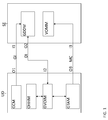
- FIG.1 an implementation of the system for implementing gaze translucency on a display configured to display to a user a virtual scene representation VSR according to an embodiment of the present invention is described.
- all connections between the elements of the system according to the present invention are defined.
- all relevant functional means of the mentioned system as presented in FIG.1 are described followed by a description of all interconnections.
- the functional means of the gazed virtual object identification determination module as presented in Fig.2 is described.
- Essential elements of the system of the present invention are a first entity, e.g. being a user device UD associated with a user, said user device being a computing device being configured to implement gaze translucency on a display DP of said user device UD that is configured to display to a user a virtual scene representation VSR of a virtual scene where, said virtual scene representation comprises virtual object representations P1, P2 of virtual parent objects; each virtual parent object of said virtual parent objects comprising at least one virtual child object.
- Such user device UD being a device configured to conduct a video conference, such user device comprising a display (that may consist of multiple monitors) adapted to visualize representations of a plurality of users, i.e.
- a camera or a set of cameras to record a representation of the user that is associated with the user device and eye gaze tracking means, configured to repeatedly or continuously detect a gazing direction of a user of the user device
- user device UD may be a personal computer like a desktop or laptop computer, a tablet PC a mobile phone like a smart phone or alternatively be a head mounted display for visualization and sensory input, a car, or any form or combination of user device(s) capable of rendering, visualizing a scene combined with possible sensory input to capturing eye gaze information.
- user device UD may be a personal computer like a desktop or laptop computer, a tablet PC a mobile phone like a smart phone or alternatively be a head mounted display for visualization and sensory input, a car, or any form or combination of user device(s) capable of rendering, visualizing a scene combined with possible sensory input to capturing eye gaze information.
- eye gaze tracking means configured to repeatedly or continuously detect a gazing direction of a user of the user device
- eye gaze tracking means configured to repeatedly or continuously detect
- a further essential element of the present invention is a second entity, e.g. being a server SE that is configured to generate this mentioned virtual scene representation VSR of a virtual scene, where the virtual scene representation comprises a virtual object representations P1, P2 of virtual parent objects; each virtual parent object of said virtual parent objects comprising at least one virtual child object.
- the functionality of respectively, the client device UD and server SE may be mixed since any combination of the functionality may exist on the client i.e. the user device UD as well as on the server SE, the user device may additionally contain a means for recording an image of the user and where the user is looking at, and/or means for rendering the VSR.
- Such user device UD may be coupled to Server Device SE over a communications network able to support remote video communication sessions
- communications network may include an xDSL, xPON, WMAN, LAN, 3G link or other fixed or mobile connection such as Wi-Fi, Bluetooth, GSM, UMTS 4G etc or any combination of the previous communication networks.
- the rendering happens at a device from which the different video streams are sent to the client devices we have a client server architecture, this however doesn't scale so well depending on the rendered representation of the VSR (1 st or 3 rd person view).
- every device is capable of rendering its own view with personal viewpoint and hosting some central part(s) of the gaze translucency architecture it will be more robust and scale better, so that e.g. the gazed virtual object modification module VOMM can be part of the client device.
- the user device UD comprises a gaze capture module GCM, a gazed virtual object identification determination module GVOIDM together with an object determination module ODM and a gaze translucency algorithm module GTAM.
- the gaze capture module GCM is configured to capture a user's gaze information GI comprising gaze coordinates, said gaze coordinates may represent a position on a display at which said user is looking or gazing (not shown).
- the captured gaze information comprising gaze coordinates P representing a position at said display at which said user is looking, said display being configured to display a virtual scene representation VSR of a virtual scene, said virtual scene representation comprising virtual object representations P1, P2 of virtual objects; (such virtual objects may represent virtual parent objects comprising at least one virtual child object or alternatively a virtual child object).
- Such gaze capturing means GCM may be included in Diff Displays see http://sachi.cs.st-andrews.ac.uk/research/software/diffdisplays/ wherein the system that is able to track which display you are looking at, using a web camera.
- Another alternative embodiment of such gaze capturing means GCM may be a Tobii eye tracker wherein the gaze direction can be measured with a precision of 1 degree. This makes it possible to drive the eyes of the user's representation also more precisely.
- Miramtrix or other Hardware trackers webcams in combination with software trackers and Do-It-Yourself eye-tracker (DIY setup), and devices capable of eye and/or head tracking , devices capable of capturing brain signals and head-mounted displays with eye- and/or head tracking.
- DIY setup Do-It-Yourself eye-tracker
- the gazed virtual object identification determination module GVOIDM is configured to identify, for a user, an object-identification of a gazed at virtual object (of a virtual parent object) of virtual parent objects, based on captured gaze information where the gazed virtual object identification determination module GVOIDM that comprises a mapping means MM that is configured to map vertices of said 3 dimensional virtual scene representation onto a respective position at said display DP and additionally, by means of the Object identification Retrieving Means OIRM that is configured to retrieve an object identification associated with a vertex mapped onto a position at said display matching said gaze coordinate P.
- the user device UD additionally comprises an object determination means ODM being configured to determine said object gazed at based on said object-identification associated with a vertex mapped onto a position at said display matching said gaze coordinate P.
- ODM object determination means
- the gaze translucency algorithm module GTAM is configured to assign to one or more of said virtual objects a modification command, based on said identified gazed virtual objects.
- the server SE in this embodiment, comprises a virtual object modification module VOMM.
- the virtual object modification module VOMM is configured to modify one or more virtual objects of said number of virtual objects, based on said modification command MC assigned by the gaze translucency algorithm module GTAM.
- the gaze capturing means GCM of the user device UD has an output that is coupled to an input of the gazed virtual object identification determination module GVOIDM that in turn is coupled with an output that is coupled to an input of the object determination means ODM.
- the object determination means ODM further has an output that is coupled to an input of the gaze translucency algorithm module GTAM.
- the gaze translucency algorithm module GTAM has an output that is at the same time an output-terminal O1 of the user device UD.
- the server SE has an input-terminal that is at the same time an input of the virtual object modification module VOMM.
- the gazed virtual object identification determination module GVOIDM as presented in Fig. 2 has an input-terminal I1 that is at the same time an input to the mapping means MM that in turn is coupled with an output to an input of the identification Retrieving Means OIRM.
- the identification Retrieving Means OIRM furthermore possess an output that is at the same time an output-terminal O1 of the gazed virtual object identification determination module GVOIDM.
- these modules may be otherwise implemented, for instance as interface implementations by one or more virtual object (or rather program code instances representing virtual objects).
- a gaze translucency algorithm module GTAM may be comprised by a third entity or further entity, for instance a central server.
- VOMM' may be applied being comprised by a fourth entity or further entity.
- arrows shown to cross from one entity to another may in practice be implemented as communications between the separate (distributed) entities, via a network, using various network modules configured to transmit and receive information to each other.
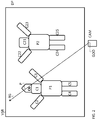
- FIG. 3 illustrates a set-up for a 3-Dimensional virtual scene of a system embodiment according to the present invention.
- the figure shows a virtual camera CAM, a display DP displaying a virtual scene representation VSR, (shown as a perspective continuation from a virtual camera CAM).
- the virtual scene representation VSR is in this case a 2-Dimensional projection of a 3-Dimensional; virtual scene that can be managed by a 3D engine (not shown), but the skilled person will understand that the virtual scene representation VSR can be referred to as a '3D scene', in view of its nature.
- the virtual scene representation VSR comprises a number of virtual object representations P1, P2.
- the underlying virtual scene comprises virtual objects: virtual parent object P1 being the representation of a person, where the parent object is built up of a plurality of virtual child objects being denoted with C1...C6, respectively being the head, the arms, the legs and a helmet. Further virtual parent object being virtual parent objects P2, again being the representation of a person each having a similar structure.
- Each of the virtual objects P1 and P2 and each of the respective corresponding virtual child objects C1..C6, C21..C25, being located in the in the 3 dimensional virtual environment, comprise a plurality of vertices being connected in an orderly fashion so these represent a piecewise-linear estimation to the objects.
- a user gazes at the displayed virtual scene representation VSR which in this embodiment is displayed at a screen of a user device UD, e.g. embodied by a personal computer.
- This user device UD further may comprise a gaze capture module GCM that is configured to capture gaze information of said user where the gaze information comprises gaze coordinates P representing a position at said display at which said user is looking.
- the gaze capture module GCM may be implemented by an eye-tracking means or via a brain interface by interpreting the signals from the human visual system.
- the user's gaze is taken, by the gaze capturing means GCM, to be at a position P on said display DP.
- the gaze capture module GCM is configured to capture gaze information comprising gaze coordinates representing said position P.
- the gaze coordinates (which may for instance be display position coordinates, or any other type of coordinates that can unambiguously represent which position on a display a user is gazing at) are here taken to coincide with the display position P, i.e. the gaze coordinates are also indicated on the figure as reference number P.
- the gazed virtual object identification determination module GVOIDM maps vertices of said 3-dimensional virtual scene representation onto a position at said display. It is now assumed that the helmet C6 is mapped onto the display DP and that point P is located within the shape of the helmet C6 and that also a vertex forming part of the virtual representation of the helmet C6 is mapped onto a display DP at location P of the display DP. Hence based on the capturing gaze information of said user where said gaze information comprises gaze coordinates which represent position P on said display DP at which said user is looking and subsequently retrieving the object identification that is associated with a vertex mapped onto the position of the display that matches the gaze coordinate P.
- This object identification may be associated with the vertex of the plurality of vertices by means of a special attribute that is attached or connected with each vertex of the plurality of the vertices.
- This attribute may be a means of storing such an object identification in a 32bit value attribute associated to a vertex. In future such attribute size may increase enabling the storage of a larger object-identification, which larger object-identification hence enabling the identification of a larger number of possible virtual objects.
- the Object identification Retrieving Means OIRM forming part of the gazed virtual object identification determination module GVOIDM, retrieves an object identification that is associated with the vertex mapped onto a position P of the display DP.
- the Object identification Retrieving Means OIRM retrieves the object-identification from a repository which may comprise a table including each vertex of the plurality of vertices where each vertex is associated with a corresponding object-identification. It is to be noted that vertices corresponding to a single object are assigned the same object-identification. Hence all vertices corresponding to object C6 are assigned the same object-identification. Hence, based on the vertex associated with the position P of the display DP the object identification of the object displayed at display DP at location with gaze coordinates P, being the helmet C6, the object location is retrieved from the mentioned repository.
- a near vertex may be chosen in which case the object-identification of this near vertex is retrieved in the manner as disclosed before.
- the object determination means ODM determines the object gazed at, i.e. the helmet C6, based on the retrieved object-identification associated with the vertex mapped onto the position of said display matching said gaze coordinate P, from a repository including for each object-identification a description of the associated object optionally in combination with additional information such as data on the virtual object hierarchy: e.g. on the belonging parent virtual object or the associated child virtual objects.
- the object corresponding to gaze coordinate P at the display DP is helmet C6 and in addition that helmet C6 is a virtual child object of the virtual parent object P1 and optionally that head C1 is an adjacent virtual child object of the helmet C6.
- this additional info may consist of the name of the object it belongs to optionally or additionally the name or information on the corresponding parent object or may additionally include information about the actions an object is doing, the relation of the object to the scene, etc.
- the object determination module ODM further identifies a virtual parent object of said virtual parent objects corresponding to said virtual object gazed at, based on said virtual object identified, i.e. the virtual child object C6 and an object hierarchy associated to said virtual parent object, based on the object-identification as an entry to the table and the information included in the meant table of the repository.
- Vertices of the plurality of vertices are assigned an object-identification where such object identification identifies the object the vertex forms part of.
- new vertex attribute are defined that are attached to each vertex of the plurality of vertices of a virtual scene representation.(https://www.opengl.org/sdk/docs/tutorials/ClockworkCoders/attribute s.php ). For each vertex of the object in this space additional info is attached such as its object-identification.
- This may be performed by either by means of storing such an object identification in a 32bit value attribute associated to a vertex.
- this may be performed by means of conveying such an object identification by means of the Alpha channel where the meant information, the object-identification is conveyed from the repository coupled to the Object identification Retrieving Means OIRM forming part of the gazed virtual object identification determination module GVOIDM, towards the display DP included in the RGBA information.
- this additional info may also consist of the name of the object it belongs to optionally or additionally the name or information on the corresponding parent object.
- Such, 3-Dimensional virtual object representation may be rendered in a way that is common to nowadays GPU hardware.
- Such additional vertex attributes conveying the object identification of the corresponding virtual object is transformed from the 3-dimensional virtual object representation into the 2-Dimensional domain, i.e. the representation of the virtual object scene at the display DP in a similar manner as the colour information.
- a gazed virtual object identification determination module GVOIDM to identify an object-identification of a gazed at virtual object - in this case, virtual child object represented by the respective virtual object representations C6.
- the system can implement gaze translucency, since information about what virtual objects users are looking at (e.g. the parts of a gazed virtual object; i.e. the virtual child object corresponding to this virtual parent object) can be used to modify for instance one or more display properties of said virtual objects.
- This modification can for instance be performed by a virtual object itself ( e.g. by applying a shader), rather than on its rendering representation on the display (in other words: its pixel representation on said display).
- the gaze information GI, the identified virtual object(s), and the modification command(s) MC may be implemented as a (local) system property, or as events, or as parameters to function calls.
- a network module (not shown) may be used to transmit and/or receive any of the data connections that are shown, thereby facilitating networked and distributed operation.
- the various means of the system can be located in a central way or in a more distributed manner, where these means may be distributed over the client devices and an optional server device.
- Such virtual scene comprises a plurality of users, called objects.
- objects are in the 3d space either represented as point clouds or meshes.
- This object id can for example define the object itself along with its parent object.
- the arm of a person can have an id that encodes that this part of the object is an arm, and that this arm is part of person X.
- Representations in a virtual scene are commonly composed of point clouds or meshes.
- Point clouds consist out of points without any physical volume, as such one need to create such a "volume" when rendering the point cloud. There are a few options in order to do this:
- an AABB axis aligned bounding box
- AABB axis aligned bounding box
- vertices of the simplified shapes get the attributes of the nearest points in the point cloud
- a Z-buffer is used for hiding occluded objects.
- the result is a rendered 2D image with colour information, and a per-pixel object id.
- occlusion is a phenomenon that a part of the three-dimensional position cannot be obtained because a foreground substance hides a background due to the difference in depth, and is one of the occlusion problems.
- the regular 3D rendering pipeline is used which casts all objects to the camera instead of moving from the camera to the scene (as in raytracing).
- a so-called "Z-buffer” that keeps the depth of the nearest object (to the camera) that has been projected onto each pixel.
- the Z-buffer is checked on a per-pixel basis to make sure that an object is only drawn when no other object was drawn before that was closer to the camera.
Landscapes
- Engineering & Computer Science (AREA)
- General Engineering & Computer Science (AREA)
- Theoretical Computer Science (AREA)
- Human Computer Interaction (AREA)
- Physics & Mathematics (AREA)
- General Physics & Mathematics (AREA)
- Processing Or Creating Images (AREA)
Priority Applications (1)
| Application Number | Priority Date | Filing Date | Title |
|---|---|---|---|
| EP15307106.3A EP3185103A1 (fr) | 2015-12-22 | 2015-12-22 | Un module de détermination d'un identifiant d'un objet virtuel regardé, un système pour mettre en oeuvre une translucidité du regard dans une scène virtuelle, et la méthode associée |
Applications Claiming Priority (1)
| Application Number | Priority Date | Filing Date | Title |
|---|---|---|---|
| EP15307106.3A EP3185103A1 (fr) | 2015-12-22 | 2015-12-22 | Un module de détermination d'un identifiant d'un objet virtuel regardé, un système pour mettre en oeuvre une translucidité du regard dans une scène virtuelle, et la méthode associée |
Publications (1)
| Publication Number | Publication Date |
|---|---|
| EP3185103A1 true EP3185103A1 (fr) | 2017-06-28 |
Family
ID=55085507
Family Applications (1)
| Application Number | Title | Priority Date | Filing Date |
|---|---|---|---|
| EP15307106.3A Ceased EP3185103A1 (fr) | 2015-12-22 | 2015-12-22 | Un module de détermination d'un identifiant d'un objet virtuel regardé, un système pour mettre en oeuvre une translucidité du regard dans une scène virtuelle, et la méthode associée |
Country Status (1)
| Country | Link |
|---|---|
| EP (1) | EP3185103A1 (fr) |
Cited By (2)
| Publication number | Priority date | Publication date | Assignee | Title |
|---|---|---|---|---|
| CN111522433A (zh) * | 2019-02-04 | 2020-08-11 | 托比股份公司 | 用于确定当前注视方向的方法和系统 |
| CN112558770A (zh) * | 2020-12-11 | 2021-03-26 | 上海影创信息科技有限公司 | 受注视控制方法和系统、存储介质及其vr设备 |
Citations (3)
| Publication number | Priority date | Publication date | Assignee | Title |
|---|---|---|---|---|
| EP2670146A1 (fr) * | 2012-06-01 | 2013-12-04 | Alcatel Lucent | Procédé et appareil de codage et de décodage d'un flux vidéo multi-vue |
| US20140292754A1 (en) * | 2013-03-26 | 2014-10-02 | Autodesk, Inc. | Easy selection threshold |
| EP2947546A1 (fr) * | 2014-05-20 | 2015-11-25 | Alcatel Lucent | Module pour mettre en oeuvre une translucidité du regard dans une scène virtuelle |
-
2015
- 2015-12-22 EP EP15307106.3A patent/EP3185103A1/fr not_active Ceased
Patent Citations (3)
| Publication number | Priority date | Publication date | Assignee | Title |
|---|---|---|---|---|
| EP2670146A1 (fr) * | 2012-06-01 | 2013-12-04 | Alcatel Lucent | Procédé et appareil de codage et de décodage d'un flux vidéo multi-vue |
| US20140292754A1 (en) * | 2013-03-26 | 2014-10-02 | Autodesk, Inc. | Easy selection threshold |
| EP2947546A1 (fr) * | 2014-05-20 | 2015-11-25 | Alcatel Lucent | Module pour mettre en oeuvre une translucidité du regard dans une scène virtuelle |
Non-Patent Citations (2)
| Title |
|---|
| ANONYMOUS: "Shader - Wikipedia", 6 November 2015 (2015-11-06), XP055576188, Retrieved from the Internet <URL:https://en.wikipedia.org/w/index.php?title=Shader&oldid=689386650> [retrieved on 20190401] * |
| ANONYMOUS: "Vertex (computer graphics) - Wikipedia", 3 July 2015 (2015-07-03), XP055576511, Retrieved from the Internet <URL:https://en.wikipedia.org/w/index.php?title=Vertex_(computer_graphics)&oldid=669831914> [retrieved on 20190402] * |
Cited By (2)
| Publication number | Priority date | Publication date | Assignee | Title |
|---|---|---|---|---|
| CN111522433A (zh) * | 2019-02-04 | 2020-08-11 | 托比股份公司 | 用于确定当前注视方向的方法和系统 |
| CN112558770A (zh) * | 2020-12-11 | 2021-03-26 | 上海影创信息科技有限公司 | 受注视控制方法和系统、存储介质及其vr设备 |
Similar Documents
| Publication | Publication Date | Title |
|---|---|---|
| JP6967043B2 (ja) | 3次元コンテンツ内の場所に基づく仮想要素モダリティ | |
| US11043031B2 (en) | Content display property management | |
| US9654734B1 (en) | Virtual conference room | |
| CN111880644A (zh) | 多用户即时定位与地图构建(slam) | |
| US11238651B2 (en) | Fast hand meshing for dynamic occlusion | |
| CN116778368B (zh) | 使用语义分割的平面检测 | |
| US9785741B2 (en) | Immersive virtual telepresence in a smart environment | |
| CN112987914B (zh) | 用于内容放置的方法和设备 | |
| JP2025028196A (ja) | 仮想現実および拡張現実のためのシステムおよび方法 | |
| AU2016210884A1 (en) | Method and system for providing virtual display of a physical environment | |
| US11676329B1 (en) | Mobile device holographic calling with front and back camera capture | |
| CN106255943A (zh) | 身体锁定增强现实与世界锁定增强现实之间的转换 | |
| US11709370B2 (en) | Presentation of an enriched view of a physical setting | |
| US10955911B2 (en) | Gazed virtual object identification module, a system for implementing gaze translucency, and a related method | |
| CN111602391B (zh) | 用于根据物理环境定制合成现实体验的方法和设备 | |
| US20240112303A1 (en) | Context-Based Selection of Perspective Correction Operations | |
| US12148090B2 (en) | Method and device for visualizing sensory perception | |
| CN113678173B (zh) | 用于虚拟对象的基于图绘的放置的方法和设备 | |
| CN112581628B (zh) | 用于解决焦点冲突的方法和设备 | |
| KR20230116765A (ko) | 다중 카메라 홀 충전을 위한 방법 및 디바이스 | |
| WO2023177773A1 (fr) | Caractéristiques stéréoscopiques en réalité virtuelle | |
| EP3185103A1 (fr) | Un module de détermination d'un identifiant d'un objet virtuel regardé, un système pour mettre en oeuvre une translucidité du regard dans une scène virtuelle, et la méthode associée | |
| WO2025255394A1 (fr) | Procédés d'ajustement d'une résolution simulée d'un objet virtuel dans un environnement tridimensionnel | |
| US12033240B2 (en) | Method and device for resolving focal conflict | |
| US11468611B1 (en) | Method and device for supplementing a virtual environment |
Legal Events
| Date | Code | Title | Description |
|---|---|---|---|
| PUAI | Public reference made under article 153(3) epc to a published international application that has entered the european phase |
Free format text: ORIGINAL CODE: 0009012 |
|
| AK | Designated contracting states |
Kind code of ref document: A1 Designated state(s): AL AT BE BG CH CY CZ DE DK EE ES FI FR GB GR HR HU IE IS IT LI LT LU LV MC MK MT NL NO PL PT RO RS SE SI SK SM TR |
|
| AX | Request for extension of the european patent |
Extension state: BA ME |
|
| 17P | Request for examination filed |
Effective date: 20180102 |
|
| RBV | Designated contracting states (corrected) |
Designated state(s): AL AT BE BG CH CY CZ DE DK EE ES FI FR GB GR HR HU IE IS IT LI LT LU LV MC MK MT NL NO PL PT RO RS SE SI SK SM TR |
|
| RAP1 | Party data changed (applicant data changed or rights of an application transferred) |
Owner name: ALCATEL LUCENT |
|
| 17Q | First examination report despatched |
Effective date: 20180904 |
|
| STAA | Information on the status of an ep patent application or granted ep patent |
Free format text: STATUS: THE APPLICATION HAS BEEN REFUSED |
|
| 18R | Application refused |
Effective date: 20190722 |