EP3185155B1 - Procédé et système permettant d'examiner des données d'étude médicale - Google Patents
Procédé et système permettant d'examiner des données d'étude médicale Download PDFInfo
- Publication number
- EP3185155B1 EP3185155B1 EP15202551.6A EP15202551A EP3185155B1 EP 3185155 B1 EP3185155 B1 EP 3185155B1 EP 15202551 A EP15202551 A EP 15202551A EP 3185155 B1 EP3185155 B1 EP 3185155B1
- Authority
- EP
- European Patent Office
- Prior art keywords
- helper
- viewing application
- user
- drawing commands
- displayed
- Prior art date
- Legal status (The legal status is an assumption and is not a legal conclusion. Google has not performed a legal analysis and makes no representation as to the accuracy of the status listed.)
- Active
Links
Images


Classifications
-
- H—ELECTRICITY
- H04—ELECTRIC COMMUNICATION TECHNIQUE
- H04L—TRANSMISSION OF DIGITAL INFORMATION, e.g. TELEGRAPHIC COMMUNICATION
- H04L67/00—Network arrangements or protocols for supporting network services or applications
- H04L67/01—Protocols
- H04L67/12—Protocols specially adapted for proprietary or special-purpose networking environments, e.g. medical networks, sensor networks, networks in vehicles or remote metering networks
-
- G—PHYSICS
- G16—INFORMATION AND COMMUNICATION TECHNOLOGY [ICT] SPECIALLY ADAPTED FOR SPECIFIC APPLICATION FIELDS
- G16H—HEALTHCARE INFORMATICS, i.e. INFORMATION AND COMMUNICATION TECHNOLOGY [ICT] SPECIALLY ADAPTED FOR THE HANDLING OR PROCESSING OF MEDICAL OR HEALTHCARE DATA
- G16H30/00—ICT specially adapted for the handling or processing of medical images
- G16H30/40—ICT specially adapted for the handling or processing of medical images for processing medical images, e.g. editing
-
- H—ELECTRICITY
- H04—ELECTRIC COMMUNICATION TECHNIQUE
- H04L—TRANSMISSION OF DIGITAL INFORMATION, e.g. TELEGRAPHIC COMMUNICATION
- H04L67/00—Network arrangements or protocols for supporting network services or applications
- H04L67/50—Network services
- H04L67/56—Provisioning of proxy services
- H04L67/565—Conversion or adaptation of application format or content
Definitions
- the present invention relates to a method and system for reviewing medical study data by means of a viewing application running on a user's device.
- Image ArenaTM An example of such software for analysing medical ultrasound images is the product Image ArenaTM by the applicant, which is a multimodality platform for image analysis, review and data management, providing a comprehensive portfolio of clinical and advanced applications for 2D (two-dimensional), 3D (three-dimensional) and 4D (four-dimensional) analysis.
- the resulting scene is rendered by a remote server and transferred over the web socket protocol to the web client.
- the rendering module on the remote server renders the scene into an off-screen buffer.
- the final scene is transferred to the streaming module.
- the streaming module splits the final scene into smaller scene parts and compares the difference between the current scene and the previous one. Only changed scene parts are transferred over the web socket protocol to the web client.
- the web-based client receives a stream of changed scene parts and draws them on a HTML5 canvas element.
- Peter Simoens et al. “Optimized mobile thin clients through a MPEG-4BiFS semantic remote display frame work", Multimed Tools Appl, (2012) 61: 447-470 ) discloses thin client computing applications, where the mobile device runs a viewer application that acts as a remote interface to applications running on distant servers.
- the server side component is enhanced with a scene state manager, orchestrating the transfer of semantic information to the client, using the semantically rich MPEG-4 binary format for scenes (BiFS).
- the contribution of the paper lies in providing the client with additional semantic information on how the user can manipulate each object in the scene.
- the object of the invention to overcome the disadvantages of the prior art by creating a method and system in which the user has a desktop application user experience, but does not require a high bandwidth internet connection or network in order to process and analyse large data files such as three dimensional (3D) or four dimensional (4D) images (wherein the fourth dimension is time). It is another object of the invention to provide a software solution for reviewing medical data in which no client installations such as upgrades, downgrades, configuration and deployment are necessary. It is another object of the invention to provide a software solution for reviewing medical data in which the software, once written, can run anywhere without plugins, and can be accessed everywhere by users. It is a further object of the invention to provide a method for reviewing medical image data which provides diagnostic image quality, both spatial and temporal, even if the images are downloaded from a remote server at a low bandwidth, high-latency network.
- the invention provides a distributed architecture for medical image viewing, with a part that runs in a server environment, which is usually a controlled, secure environment, for example a process on a server machine, a thread in a process running of the server machine, a container (light-weight virtual machine), a virtual machine, cloud instance, etc., and another part that runs on the users' personal device, e.g. inside an internet browser running on a PC, tablet or smartphone (i.e. a web application), or as a desktop application running on the computer's operating system (e.g. Windows, Linux) or using any other runtime environment or interpreter (e.g. Java, Ruby, Python), or as an application for mobile devices ("mobile application” or "app”), which is distributed via channels like Apple's AppStore, GooglePlay or via intranet.
- a server environment which is usually a controlled, secure environment, for example a process on a server machine, a thread in a process running of the server machine, a container (light-weight virtual machine), a virtual machine, cloud
- the part running on the user's personal device is called “viewing application”, whereas the part that runs in a server environment includes a “helper process” or “helper”, and in some embodiments a “coordinator engine”.
- the helper does not render and transfer entire images to be displayed on the user's device but rather encodes and transfers drawing commands to be processed by the client, i.e. the viewing application.
- helper and viewing application know each other's state, for example because they have a 1:1 connection. Accordingly, computations can be distributed between helper and viewing application in an optimized manner, which is not possible in a stateless, multi-client rendering architecture or with a remote-desktop protocol.
- the helper is a stateful component, and the viewing application is able to cache complete drawing commands, or parts thereof, such as related data buffers, or sequences of drawing commands. Since the helper knows what has been sent to the viewing application and has been cached by it, it is able to adapt the further stream of drawing commands such that cached data is not resent. This leads to lower requirements regarding bandwidth of the communication channel, i.e. the network connection between helper and viewing application.
- program parts that are not available on the user's device can be performed by the helper.
- the helper process may be configured not to transfer sensitive/confidential data (e.g. patient data or confidential program code) to the user's device, which may be in an untrusted environment (e.g. when the user's device gets stolen or high-jacked by malicious software).
- the medical study data to be reviewed on the user's device may contain medical image data, e.g. ultrasound, CT, MRI data or image data generated by other modalities, as well as further measurement data such as ECG data etc., in addition to patient parameters such a name, age etc.
- the medical study data is present in the format in which it is supplied by the modality manufacturer, in DICOM standard or any other state of the art format.
- the medical study data may be stored in the same server environment where the helpers are running, but it may also be stored on a different server accessible by a network connection, or possibly even on the user's device.
- the invention is functioning independent of the source of the medical study data.
- the user will first be able to access a list of medical studies and select one (possibly stored on a hospital or other database server). Accordingly, the viewing application will pass on information on the selected medical study e.g. to the coordinator engine before or after or together with the request for a review session, or alternatively directly to the helper process once the communication channel has been set up.
- the helper process is able to communicate with the server where the medical study data is stored and to retrieve the required data.
- the viewing application or at least updates to the viewing application, are loaded onto the user's device, preferably from a web server, preferably without user intervention, and whenever required, e.g. prior to each review session.
- the viewing application is completely loaded onto the user's device before each review session, e.g. if the viewing application is a web application, it is loaded into the user's web browser.
- the viewing application does not have to be regularly updated by the user.
- the viewing application is - or at least can be - deleted from the user's device without any trace after each session.
- the user can initiate a session from all of his client devices (mobile phone, tablet computer, home PC, work PC) without having to install software, or at the most a small app.
- the viewing application can be one or more programs, which act as the client. In useful embodiments, they can be run by the browser's run time environment (e.g. Java script program, web assembly). The loading process of this program can be independent from the other system components (coordinator engine, helper) described here, e.g. served by a dedicated web server or CDN (Content Delivery Network). An example would be a single page application, not a server-based application. However, the invention also covers examples where the viewing application is installed on the user's device (desktop application). In all cases, the functionality required for analysing medical data is distributed between client (viewing application) and server environment (helper).
- client viewing application
- server environment helper
- the viewing application includes program code to create a user interface which includes a drawable region on the user's device.
- the drawable region is the diagnostic area where images and other study data are to be displayed. It is for example a rendering element (e.g. HTML5 Canvas) that can be used for fast, even graphics-card assisted 2D and 3D drawings.
- the user interface may further comprise user interface/input elements such as buttons, sliders, dialogs as well as the general layout which, in the case of a web application, are created by the viewing application directly in the browser.
- This coordinator engine is responsible for allocating at least one helper process in the server environment.
- the helper process may be created new for each review session, or may be chosen from a pool of prepared helpers (warm stand-by).
- the coordinator engine will pass the connection information of the helper process (e.g. URL, token, ...) to the viewing application, which is then able to prepare one or multiple direct connection(s) or communication channel(s) from viewing application to helper.
- a proxy can be used to dispatch network connections from a dedicated server to the helpers.
- the coordinator engine is responsible e.g. for lifecycle (starting, creating, allocating and closing helpers), load balancing in the server environment where the helpers are running, fail-over and initial authentication of the user.
- lifecycle starting, creating, allocating and closing helpers
- load balancing in the server environment where the helpers are running
- fail-over initial authentication of the user.
- the latter can be done by creating a one-time token passed from the viewing application to the server environment (coordinator engine and/or helper process) via a secure connection.
- the communication channel is secure.
- each viewing application then establishes a direct connection to a helper process.
- a proxy can be used to dispatch network connections from a dedicated server to the helper(s).
- HTML5 web sockets are used for low-latency, high bandwidth connections.
- the viewing application may also open multiple connections to its helper. Securing the communication is the responsibility of the communication channel, e.g. using a secure network protocol, like SSL web sockets.
- stream or message based compression may be used (like gzip).
- the helper process is in charge of maintaining the complete scene graph.
- the helper process might use a selected medical study data to perform some measurements or analysis thereon (usually at the request of the user communicated via the above-mentioned user interface on the viewing application), and will create a graphical overlay, e.g. a text annotation or a chart which contains the results of the analysis.
- the helper process will not render (draw) the chart or text annotation itself. It will e.g. only create a scene graph containing these items.
- the scene graph may also include a texture including image data from the medical study data.
- the helper process will (e.g. from such scene graph), generate a stream of drawing commands which it then transfers to the viewing application through the communication channel.
- the helper process will encode the drawing commands relating to a scene graph into a command stream which is then transferred to the client / viewing application.
- the "stream of drawing commands" contains instructions on how to render the image to be displayed in the drawable region.
- individual items in the image e.g. a medical image or part thereof, and overlays such as a text annotation, a chart or other graphical display
- the data related thereto is encoded in associated data buffers (e.g. textures and vertex buffers), which are also transferred and to which the drawing commands refer.
- the stream of drawing commands is separated into individual "command lists" each having a time stamp and relating to one frame, wherein one frame after the other is to be displayed in the drawable region (for an example, see Fig. 4 ).
- the viewing application interprets the drawing commands to generate a time series of frames displayed in the drawable region.
- time series of frames it is not necessarily meant that the medical image data contains a time series of images (although this is the application according to the invention).
- the "time series” may also refer to the changes occurring in the drawable region in the usual course of a review session, e.g. the user selects different images for display, makes annotations etc. which can be done in static or moving images, but which causes changes in the diagnostic region (drawable region).
- the word “frame” is used here to describe whatever is displayed within the drawable region at one time point.
- the viewing application has a, preferably very simple, interpreter that will interpret the stream of drawing commands and generate drawing calls, e.g. for the browser's graphics API (in case of a web application).
- This can e.g. be WebGL or any other graphics library, like e.g. PaperJS or EaslJS.
- a high-performance hardware-accelerated graphics API is used, like WebGL.
- the helper(s) and the viewing application are connected in such a way that they know each other's state. Since the viewing application is able to cache drawing commands, sequences of drawing commands and associated data buffers, e.g.
- the helper will not transfer cached drawing commands again and/or will transfer a drawing command relating to only a difference between one frame and the next. This drastically reduces the amount of data to be transferred, since very often the display in the drawable or diagnostic region will change only gradually. For example, if by user interaction an annotation is changed or a line is drawn in, the underlying image (or texture) will not be resent by the helper, but only the drawing commands relating to the exchanged items such the annotations, lines or other overlays. Thus, when only one item in the drawable region has changed, the helper may transfer an update drawing command, which includes instructions on this changed item, and otherwise tells the viewing application to re-execute the drawing calls for the last frame.
- the helper process will not resend the overlays but only the image content. If a time series of images is to be displayed in a loop, i.e. the same sequence of images again and again, also the images are cached by the viewing application on the user's device. According to the invention, the viewing application will cache also the time stamps relating to each drawing command list, so that it can play the loop of dynamic images without interaction with the helper.
- the viewing application is further able to perform some operations within the drawable region directly, usually in response to user input events at the user interface. These input events are not transferred to the helper.
- these operations relate to display options selected from the group comprising brightness, contrast, tinting, scaling and adding overlays, or to performing measurements on images displayed in the drawable region.
- the medical study data itself is processed by the helper, which transfers the results of such processing to the viewing application in the form of the stream of drawing commands.
- the original medical study data, in the format in which it is stored on the platform, is in most embodiments not transferred to the viewing application.
- the viewing application and the helper will, at the beginning of each session, agree on which functionalities are to be performed by each, based on the bandwidth of the network connection and/or the performance capabilities of the viewing application or the user's device. For example, if the processor on the user's device is slow, whereas the communication channel between viewing application and helper is fast, more data processing functionalities will be performed by the helper, and the results transferred to the viewing application. In an opposite situation, more functionalities might be performed by the viewing application on the user's device.
- useful embodiments of the invention comprise regularly saving the state of the helper, wherein the "state” comprises information e.g. about the active medical study, which measurements were done and the respective results, and which viewport was active, possibly a set of drawing commands necessary to restore the last image rendered in the drawable region.
- the "state” or “state information” is transferred to and stored by the viewing application at regular intervals. Alternatively, it may be stored in the server environment, e.g. by the coordinator engine.
- a review session is unexpectedly terminated because of a crash either of the helper or the viewing application, it can be continued by a fresh helper, e.g. allocated by the coordinator engine. It may also be useful to store the state of the helper at the end of a review session, so that it may be continued at another time.
- a fresh helper e.g. allocated by the coordinator engine. It may also be useful to store the state of the helper at the end of a review session, so that it may be continued at another time.
- the invention is also directed to a system according to claim 11, the system comprising a viewing application running on a user's device configured to create a user interface including a drawable region on the user's device, and to send a request for a review session to a first server; a server environment comprising the first or another server, and including a coordinator engine to receive requests for review sessions from the viewing application, and at least one stateful review helper process, wherein the system is configured to execute the method according to the invention.
- the invention is further directed to a computer program product loadable into the internal memory of a digital computer, comprising software code portions for performing the inventive method when said product is run on the system according to the invention.
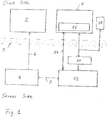
- Fig. 1 shows the client side, i.e. the processes running on the user's device, on top, and the server side in the bottom, with a network 5, such as the internet, as intermediate.
- the server side (“server environment”) may consist of multiple machines.
- the client or viewing application receives a list of medical studies containing e.g. a list of study identifiers from a platform 4, e.g. a remote server like the PACS of a hospital or other medical institution, and displays it at 2 to the user.
- the user may select a study, and information (including e.g. the study identifier) on the selected medical study is passed on to the helper process 12.
- the viewing application 8 will connect to the helper process 12 usually through the intermediation of a coordinator engine 10, which is responsible e.g. for launching, tearing down and migrating helper processes 12.
- the helper 12 can access the platform 4 to retrieve the medical study data after receipt of the study identifier from the viewing application, for example via a HTML connection 9.
- the viewing application 8 will at the start of a review session send information about its capabilities, for example which texture compression algorithms are supported, to the helper 12, and the helper will accordingly adapt its stream of drawing commands to these capabilities, for example by sending textures in a compressed format optimized for the viewing application 8.
- the viewing application 8 includes an interpreter 16 which is able to interpret or decode the stream of drawing commands received from the helper 12 and generate drawing calls which are directly executable and executed on the user' device, for example by its web browser.
- Helper state storage 18 which may be on the user's device or alternatively also within the server environment, or on even another server.
- the stateful helper process 12 is in most applications working per-review session, i.e., it is not re-used but terminated after each review session.
- Fig. 3 illustrates a method for allowing a user to review medical study data on the user's device, in response to a user sending a request 24 for a review session to a server.
- one or several helper processes 12 are allocated in step 22 to this review session.
- a communication channel is established between the client (viewing application) and the helper, and in many embodiments the viewing application will transfer information about its capabilities, e.g. its available processing capacities, available software components such as texture, compression formats and possibly the bandwidth of the communication channel, to the helper.
- Information about the bandwidth of the communication channel may be regularly updated during a review session, since the network performance may change during one review session, and the helper can then adapt its stream of drawing commands accordingly (e.g. use stronger compression in a low-bandwidth network).
- the helper will also receive information about the active medical study and will retrieve medical study data from the data storage or platform 4 in step 26.
- the helper will optionally receive another user input U1, which may prompt the helper to process the medical study data, for example retrieve certain images and produce textures and possibly overlays therefrom.
- the helper 12 encodes a stream of drawing commands D1, which transfers to the viewing application 8 through the communication channel. These drawing commands D1 are interpreted by the viewing application into suitable drawing calls which draw a suitable display into the drawable region 42 of the viewing application. The user may perform some interaction in the drawable region 42, for example draw in a line to perform a measurement.
- This user input U2 is transmitted to the helper process in step 32, and the helper process accordingly generates further drawing commands D2 in step 34 which are transferred to the viewing application.
- drawing commands D2 are optimized by taking into account the state of the viewing application, in particular what has been cached at the viewing application and therefore does not have to be resend.
- the helper process might send information on its state S to a server or to the client side 18 for storage.
- Fig. 2 shows an example of a client, i.e. a viewing application which may be a web application running inside a user's web browser.
- the viewing application creates a user interface 40, which includes a drawable region 42.
- the drawable region 42 may for example be a WebGL canvas. It may be divided into multiple viewports (in this example four) as shown, the viewports being numbered 42a, 42b, 42c and 42d.
- the drawable region 42 is also called diagnostic region. It is the area on the screen where the drawing calls, which are interpreted by the viewing application 8 from the stream of drawing commands D1, D2, are displayed/rendered.
- the user interface includes user input elements such as a tool bar 44 and optionally controls 48.
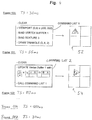
- helper process The interaction between the helper process and the viewing application, in particular the stream of drawing commands and how they are cached by the viewing application, are illustrated by the example shown in Figs. 4 and 5 .
- the viewing application does not have any scene information received, but wishes to render a frame 100 with time stamp 30 ms on a given time line.
- the helper knows about the client's state (i.e. that he does not yet have any scene information) and will initially send the necessary vertex buffers and textures, as depicted in Fig. 5 .
- a texture in this context may contain image data extracted from the medical study data (textures 1 and 3 in Fig. 5 ) or for example an annotation such as texture 2.
- a vertex is e.g. a node in a graph.
- the helper sends command list 1 to the viewing application to enable it to draw frame 100 into the drawable region, to be displayed at time stamp 30 ms.
- the drawing command "viewport (0,0) x (200, 200)" indicates that the upper left window is to be used, which reaches from coordinate 0,0 to 200, 200.
- the viewing application is then instructed to use vertex buffer 1 and texture 3 and to draw a triangle using vertices 3, 6 and 2. These drawing commands are interpreted and executed by the viewing application, and the result is shown at 52.
- useful embodiments of the invention employ data compression or data deduplication algorithms. This can be done very effectively, because the helper can adapt itself to the viewing application: Different user's devices may use different techniques, for example for texture compression, in particular different mobile devices. Therefore, an optional feature of the invention is that the viewing application will at the beginning of the review session send information about the techniques and in particular which texture compression algorithms it supports, and accordingly the helper will adapt the stream of drawing commands to the viewing application's capabilities.
- the helper may send the textures in a format optimized for the client (viewing application).
- the helper may compress textures in JPEG or PNG and the viewing application will decompress them.
- the viewing application can cache the textures and for example load them onto a graphics card (e.g. via web GL).
- WebGL texture compression is useful since this is different to other systems: The helper knows which texture compression the client / viewing application needs and sends the textures ready to be downloaded onto the graphics card. This way the client code can cache the compressed texture and uncompression is "for free" on the graphics card.
- helper and viewing application may adapt to the network bandwidth. For example, in slow communication channels, the resolution of the textures may be reduced, or the compression may be raised. Since the helper transfers only drawing commands (and not rendered images), the overlays (such as text annotations, measurements, ECGs etc.) may still be depicted sharply, and only the textures (the image data) is displayed in reduced quality.
- the amount of data that is transferred from helper to viewing application may be further reduced e.g. with compression on the network protocol and sophisticated delta compression algorithms like z-delta or other deduplication algorithms.
- a further example is the review of animated frames, i.e. a time series of medical images.
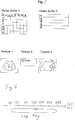
- An example is cardiac imaging, where for example 5-50 images are acquired from the heart during one heart cycle and which have to be displayed in a loop at real-life speed, as illustrated in Fig. 6 .
- Many prior art web-based medical image viewers fail when it comes to animated frames with high frame rates. This is e.g. needed for accurate, diagnostic review of ultrasound examinations. Here both image quality and playback speed must be precise.
- the viewing application Rather than overwriting the texture image, the viewing application now also caches data over time, so it stores the texture images and the delta for the drawing commands to go from Frame 100 to 101, 101 to 102, ..., and 105 to 106. For Frame 106, which is the last frame in the loop, we then need to go to the first frame again. Since the viewing application only stores the difference or "delta” it cannot draw a frame "out of the sequence", so instead we generate the delta to go from timestamp 180ms back to timestamp 30ms, which is our new Frame 107. When this sequence has finished, the viewing application has all information to play the entire loop without any data transferred from the helper. Adding more drawing primitives (like drawing a line or placing a text label) will trigger an update of only a small part of the drawing sequence and we will soon be back to the level where the viewing application can play the loop on its own.
- more drawing primitives like drawing a line or placing a text label
- the cache architecture on the client side may comprise capabilities for caching textures (key and frame, or e.g. MD5 hash), caching drawing commands (e.g. frame draw calls) and/or caching vertices, e.g. in vertex buffers.
- WebGL graphics card texture memory
- the helper state data is stored by the viewing application (e.g. browser) on the user's device: Instead of using a database or cache on the helper side (server environment), the helper may transfer state information to the client (viewing application) and store it there, possibly also optimized with compression and delta encoding. This way the requirements for the helper environment are low (no database etc.) and the client (viewing application) can re-create its helper via the coordinator engine when e.g. one server machine crashes or can no longer be reached. Since the stored helper state data is only relevant for the helper (the viewing application does not work on this data), it can be encoded and stored in a compact/compressed format. For untrusted environments, this stored data can be encrypted (e.g. with AES), where encryption keys (private/public) remain in the server environment (are not sent to the viewing application). Thus, the user cannot decrypt the data, the user's device only stores the helper state data for later use by another helper.
- the viewing application e.g. browser
- the same program code for a viewing application as a web application can be used in a normal desktop application (thick client) by using an embedded browser such as chromium. This reduces the development costs since only one code path has to be maintained.
Landscapes
- Engineering & Computer Science (AREA)
- Health & Medical Sciences (AREA)
- Signal Processing (AREA)
- General Health & Medical Sciences (AREA)
- Medical Informatics (AREA)
- Computer Networks & Wireless Communication (AREA)
- Nuclear Medicine, Radiotherapy & Molecular Imaging (AREA)
- Radiology & Medical Imaging (AREA)
- Epidemiology (AREA)
- Primary Health Care (AREA)
- Public Health (AREA)
- Computing Systems (AREA)
- Medical Treatment And Welfare Office Work (AREA)
Claims (13)
- Procédé de révision des données d'étude médicale au moyen d'une application de visualisation (8) exécutée sur un dispositif d'un utilisateur, ledit procédé comprenant les étapes suivantes :a. l'application de visualisation (8) crée une interface utilisateur (40) comprenant une zone dessinable (42) sur le dispositif de l'utilisateur, et envoie une requête de session de révision à un premier serveur ;b. l'attribution d'au moins une aide à état (12) à l'application de visualisation (8), dans lequel une aide est une application logicielle sur le premier ou un autre serveur, et au moins un canal de communication (14) est établi entre l'application de visualisation et l'aide ;c. la récupération, en réponse aux requêtes de l'application de visualisation (8), par l'aide, des données d'étude médicale provenant d'une mémoire de données (4) et l'utilisation d'au moins une partie desdites données d'étude médicale pour maintenir un graphique de scène hiérarchique contenant des éléments à afficher, lesdits éléments comprenant une texture comprenant des données d'image provenant des données d'étude médicale ainsi qu'une superposition graphique ;
et la génération, à partir d'un tel graphique de scène, par l'aide, d'un flux de requêtes de dessin (D1), lequel est transféré à l'application de visualisation par l'intermédiaire du canal de communication (14), dans lequel l'aide (12) ne rend pas et ne transfère pas d'images entières à afficher sur l'appareil de l'utilisateur ;d. dans lequel le flux de requêtes de dessin (D1) contient des instructions sur la manière de rendre des images à afficher dans la zone dessinable, et l'application de visualisation (8) interprète les requêtes de dessin pour ainsi rendre une série temporelle de trames (52, 54) affichées dans la zone dessinable, dans lequel une trame est tout ce qui est affiché dans la zone dessinable à un moment ;dans lequel au moins une partie des requêtes de dessin (D1) sont mises en cache sur le dispositif de l'utilisateur de telle sorte que l'aide ne transférera pas à nouveau les requêtes de dessin mises en cache et transférera une requête de dessin se rapportant uniquement à une différence entre une trame et la trame suivante,
dans lequel les données d'étude médicale comprennent une série temporelle d'images médicales, lesquelles sont affichées dans la série temporelle de trames dans la zone dessinable en boucle,
et dans lequel l'application de visualisation met en cache des requêtes de dessin comprenant des mémoires tampons de données contenant des données d'image à afficher ainsi que des horodatages relatifs à chaque image médicale dans la série temporelle, et des requêtes de dessin relatives à la différence entre une trame et la trame suivante de telle sorte que l'application de visualisation est capable d'afficher la boucle sans intervention de l'aide. - Procédé selon la revendication 1, dans lequel l'application de visualisation (8) est une application Web exécutée à l'intérieur d'un navigateur Internet, une application de bureau ou une application mobile.
- Procédé selon l'une quelconque des revendications précédentes, dans lequel l'application de visualisation (8) est chargée sur le dispositif de l'utilisateur à partir d'un serveur Web avant chaque session de révision.
- Procédé selon l'une quelconque des revendications précédentes, dans lequel l'application de visualisation (8) comprend un moteur d'interprétation (16), lequel est capable d'interpréter les requêtes de dessin reçues de l'aide (12) et de les traduire en appels de dessin lisibles par logiciels et/ou matériel déjà présents sur l'appareil de l'utilisateur.
- Procédé selon l'une quelconque des revendications précédentes, dans lequel l'application de visualisation (8) est capable d'effectuer certaines opérations dans la zone dessinable sans recevoir de requêtes de dessin de l'aide, dans lequel lesdites opérations se rapportent de préférence soit à des options d'affichage sélectionnées dans le groupe constitué par la luminosité, le contraste, la teinte, l'ajout de superpositions et la mise à l'échelle, soit à la réalisation de mesures sur les images affichées dans la zone dessinable.
- Procédé selon l'une quelconque des revendications précédentes, dans lequel l'aide (12) est attribuée par un moteur de coordination (19) sur le premier serveur, dans lequel ledit moteur de coordination est configuré pour démarrer et/ou allouer des aides, pour équilibrer la charge à l'intérieur de l'environnement du serveur dans lequel les aides s'exécutent et/ou pour assurer l'authentification initiale de l'utilisateur.
- Procédé selon l'une quelconque des revendications précédentes, dans lequel l'aide (12) est configuré pour recevoir des informations d'entrée utilisateur (U1, U2) de l'application de visualisation, pour traiter ladite entrée utilisateur, en particulier par réalisation des mesures sur les données d'étude médicale ou pour éditer les données d'étude médicale, et pour transférer les résultats d'un tel traitement vers l'application de visualisation en tant que partie du flux de requêtes de dessin (D1, D2).
- Procédé selon l'une quelconque des revendications précédentes, dans lequel le flux de requêtes de dessin (D1, D2) code des données médicales telles que des données d'images médicales, ainsi que des superpositions, telles que des annotations de texte et des affichages graphiques, et comprend des mémoires tampons de données associées.
- Procédé selon l'une quelconque des revendications précédentes, dans lequel lorsque seulement une partie des éléments à rendre dans la zone dessinable change d'une trame à la trame suivante, l'aide (12) transfère une requête de mise à jour du dessin pour chaque nouvelle trame, en particulier une requête pour échanger l'au moins un élément modifié et pour réexécuter les appels de dessin de la dernière trame avec les éléments échangés.
- Procédé selon l'une quelconque des revendications précédentes, dans lequel l'état (S) de l'aide (12) est transféré et mémorisé par l'application de visualisation à intervalles réguliers, en particulier à la fin d'une session de révision.
- Un système comprenant :• une application de visualisation (8) fonctionnant sur le dispositif d'un utilisateur configuré pour créer une interface utilisateur comprenant une zone dessinable sur le dispositif de l'utilisateur, et pour envoyer une requête de session de révision à un premier serveur ;• un environnement de serveur comprenant le premier ou un autre serveur, et comprenantdans lequel un processus d'aide est attribué à chaque session de révision par le moteur de coordination, le processus d'aide récupère les données d'étude médicale provenant d'un mémoire de données et utilise au moins une partie desdites données d'étude médicale pour maintenir un graphique de scène hiérarchique contenant des éléments à afficher, lesdits éléments comprenant une texture comprenant des données d'image provenant des données d'étude médicale ainsi qu'une superposition graphique ; et∘ un moteur de coordination (10) pour recevoir les requêtes de sessions de révision de l'application de visualisation, et∘ au moins un processus d'aide à la révision à état (12),
l'aide, à partir dudit graphique de scène, code un flux de requêtes de dessin (D1), lequel est transféré par l'aide à l'application de visualisation, dans lequel l'aide (12) ne rend pas et ne transfère pas d'images entières à afficher sur le dispositif de l'utilisateur ;
dans lequel le flux de requêtes de dessin (D1) contient des instructions sur la manière de rendre les images à afficher dans la zone dessinable, et dans lequel l'application de visualisation (8) interprète les requêtes de dessin pour ainsi rendre une série temporelle de trames (52, 54) affichées dans la zone dessinable, dans lequel une trame est tout ce qui est affiché dans la zone dessinable à un moment ;
dans lequel au moins une partie des requêtes de dessin (D1) sont mises en cache sur le dispositif de l'utilisateur de telle sorte que l'aide ne transférera pas à nouveau les requêtes de dessin mises en cache et transférera une requête de dessin se rapportant uniquement à une différence entre une trame et la trame suivante,
dans lequel les données d'étude médicale comprennent une série temporelle d'images médicales, lesquelles sont affichées dans la série temporelle de trames dans la zone dessinable en boucle, et
dans lequel l'application de visualisation met en cache des requêtes de dessin comprenant des mémoires tampons de données contenant des données d'image à afficher, ainsi que des horodatages relatifs à chaque image médicale dans la série temporelle, et des requêtes de dessin relatives à la différence entre une trame et la trame suivante de telle sorte que l'application de visualisation est capable d'afficher la boucle sans intervention de l'aide. - Système selon la revendication 11, lequel est configuré pour mettre en œuvre un procédé selon l'une quelconque des revendications 1 à 10.
- Produit de programme informatique pouvant être directement chargé dans la mémoire interne d'un ordinateur numérique, comprenant des parties de code logiciel pour mettre en œuvre le procédé selon l'une quelconque des revendications 1 à 10 lorsque ledit produit est exécuté sur un système selon la revendication 11.
Priority Applications (4)
| Application Number | Priority Date | Filing Date | Title |
|---|---|---|---|
| EP15202551.6A EP3185155B1 (fr) | 2015-12-23 | 2015-12-23 | Procédé et système permettant d'examiner des données d'étude médicale |
| JP2016244330A JP7127959B2 (ja) | 2015-12-23 | 2016-12-16 | 医療調査データをレビューするための方法及びシステム |
| CN201611204557.2A CN107066794B (zh) | 2015-12-23 | 2016-12-23 | 用于评估医学研究数据的方法和系统 |
| JP2022091407A JP7407863B2 (ja) | 2015-12-23 | 2022-06-06 | 医療調査データをレビューするための方法及びシステム |
Applications Claiming Priority (1)
| Application Number | Priority Date | Filing Date | Title |
|---|---|---|---|
| EP15202551.6A EP3185155B1 (fr) | 2015-12-23 | 2015-12-23 | Procédé et système permettant d'examiner des données d'étude médicale |
Publications (2)
| Publication Number | Publication Date |
|---|---|
| EP3185155A1 EP3185155A1 (fr) | 2017-06-28 |
| EP3185155B1 true EP3185155B1 (fr) | 2020-05-27 |
Family
ID=55221221
Family Applications (1)
| Application Number | Title | Priority Date | Filing Date |
|---|---|---|---|
| EP15202551.6A Active EP3185155B1 (fr) | 2015-12-23 | 2015-12-23 | Procédé et système permettant d'examiner des données d'étude médicale |
Country Status (1)
| Country | Link |
|---|---|
| EP (1) | EP3185155B1 (fr) |
Citations (1)
| Publication number | Priority date | Publication date | Assignee | Title |
|---|---|---|---|---|
| US20140143298A1 (en) * | 2012-11-21 | 2014-05-22 | General Electric Company | Zero footprint dicom image viewer |
Family Cites Families (3)
| Publication number | Priority date | Publication date | Assignee | Title |
|---|---|---|---|---|
| US6934698B2 (en) | 2000-12-20 | 2005-08-23 | Heart Imaging Technologies Llc | Medical image management system |
| US8166381B2 (en) | 2000-12-20 | 2012-04-24 | Heart Imaging Technologies, Llc | Medical image management system |
| US8799357B2 (en) * | 2010-11-08 | 2014-08-05 | Sony Corporation | Methods and systems for use in providing a remote user interface |
-
2015
- 2015-12-23 EP EP15202551.6A patent/EP3185155B1/fr active Active
Patent Citations (1)
| Publication number | Priority date | Publication date | Assignee | Title |
|---|---|---|---|---|
| US20140143298A1 (en) * | 2012-11-21 | 2014-05-22 | General Electric Company | Zero footprint dicom image viewer |
Non-Patent Citations (1)
| Title |
|---|
| PIETER SIMOENS ET AL: "Optimized mobile thin clients through a MPEG-4 BiFS semantic remote display framework", MULTIMEDIA TOOLS AND APPLICATIONS, KLUWER ACADEMIC PUBLISHERS, BO, vol. 61, no. 2, 9 August 2011 (2011-08-09), pages 447 - 470, XP035093516, ISSN: 1573-7721, DOI: 10.1007/S11042-011-0849-3 * |
Also Published As
| Publication number | Publication date |
|---|---|
| EP3185155A1 (fr) | 2017-06-28 |
Similar Documents
| Publication | Publication Date | Title |
|---|---|---|
| JP7407863B2 (ja) | 医療調査データをレビューするための方法及びシステム | |
| CN102067085B (zh) | 用于向远程客户机虚拟传送软件应用程序的方法和系统 | |
| US20200335199A1 (en) | Methods and Systems for Electronically Receiving, Modifying and Distributing Three-Dimensional Medical Images | |
| US20150074181A1 (en) | Architecture for distributed server-side and client-side image data rendering | |
| US20140074913A1 (en) | Client-side image rendering in a client-server image viewing architecture | |
| US10296713B2 (en) | Method and system for reviewing medical study data | |
| Hachaj | Real time exploration and management of large medical volumetric datasets on small mobile devices—evaluation of remote volume rendering approach | |
| Noguera et al. | Mobile volume rendering: past, present and future | |
| EP2669830A1 (fr) | Préparation et affichage de séries dérivées d'images médicales | |
| US20250308673A1 (en) | Method and device for four-dimensional visualization of medical image | |
| Park et al. | Mobile collaborative medical display system | |
| Li et al. | SP-MIOV: A novel framework of shadow proxy based medical image online visualization in computing and storage resource restrained environments | |
| CN112820385A (zh) | 一种医学图像浏览方法、客户端及系统 | |
| Qiao et al. | An HTML5‐Based Pure Website Solution for Rapidly Viewing and Processing Large‐Scale 3D Medical Volume Reconstruction on Mobile Internet | |
| EP3185155B1 (fr) | Procédé et système permettant d'examiner des données d'étude médicale | |
| Kohlmann et al. | Remote visualization techniques for medical imaging research and image-guided procedures | |
| US11949745B2 (en) | Collaboration design leveraging application server | |
| Gutenko et al. | Remote volume rendering pipeline for mHealth applications | |
| Qiao et al. | A lightweight internet sharing scheme for sectional medical images according to existing hospital network facilities and basic information security rules | |
| CN107491631A (zh) | 用于控制向客户端设备传送双能量ct图像数据的控制对象 | |
| Zhu et al. | An interactive web-based navigation system for learning human anatomy | |
| Cantor-Rivera et al. | Efficient 3D rendering for web-based medical imaging software: a proof of concept | |
| Virag et al. | A survey of web based medical imaging applications | |
| WO2014087297A1 (fr) | Possibilité d'un utilisateur de naviguer dans des données d'image |
Legal Events
| Date | Code | Title | Description |
|---|---|---|---|
| PUAI | Public reference made under article 153(3) epc to a published international application that has entered the european phase |
Free format text: ORIGINAL CODE: 0009012 |
|
| STAA | Information on the status of an ep patent application or granted ep patent |
Free format text: STATUS: THE APPLICATION HAS BEEN PUBLISHED |
|
| AK | Designated contracting states |
Kind code of ref document: A1 Designated state(s): AL AT BE BG CH CY CZ DE DK EE ES FI FR GB GR HR HU IE IS IT LI LT LU LV MC MK MT NL NO PL PT RO RS SE SI SK SM TR |
|
| AX | Request for extension of the european patent |
Extension state: BA ME |
|
| STAA | Information on the status of an ep patent application or granted ep patent |
Free format text: STATUS: REQUEST FOR EXAMINATION WAS MADE |
|
| 17P | Request for examination filed |
Effective date: 20170804 |
|
| RBV | Designated contracting states (corrected) |
Designated state(s): AL AT BE BG CH CY CZ DE DK EE ES FI FR GB GR HR HU IE IS IT LI LT LU LV MC MK MT NL NO PL PT RO RS SE SI SK SM TR |
|
| STAA | Information on the status of an ep patent application or granted ep patent |
Free format text: STATUS: EXAMINATION IS IN PROGRESS |
|
| 17Q | First examination report despatched |
Effective date: 20180219 |
|
| REG | Reference to a national code |
Ref country code: DE Ref legal event code: R079 Ref document number: 602015053288 Country of ref document: DE Free format text: PREVIOUS MAIN CLASS: G06F0019000000 Ipc: G16H0030400000 |
|
| RIC1 | Information provided on ipc code assigned before grant |
Ipc: H04L 29/08 20060101ALI20191031BHEP Ipc: G16H 30/40 20180101AFI20191031BHEP |
|
| GRAP | Despatch of communication of intention to grant a patent |
Free format text: ORIGINAL CODE: EPIDOSNIGR1 |
|
| STAA | Information on the status of an ep patent application or granted ep patent |
Free format text: STATUS: GRANT OF PATENT IS INTENDED |
|
| INTG | Intention to grant announced |
Effective date: 20191216 |
|
| GRAS | Grant fee paid |
Free format text: ORIGINAL CODE: EPIDOSNIGR3 |
|
| GRAA | (expected) grant |
Free format text: ORIGINAL CODE: 0009210 |
|
| STAA | Information on the status of an ep patent application or granted ep patent |
Free format text: STATUS: THE PATENT HAS BEEN GRANTED |
|
| AK | Designated contracting states |
Kind code of ref document: B1 Designated state(s): AL AT BE BG CH CY CZ DE DK EE ES FI FR GB GR HR HU IE IS IT LI LT LU LV MC MK MT NL NO PL PT RO RS SE SI SK SM TR |
|
| REG | Reference to a national code |
Ref country code: GB Ref legal event code: FG4D |
|
| REG | Reference to a national code |
Ref country code: CH Ref legal event code: EP |
|
| REG | Reference to a national code |
Ref country code: AT Ref legal event code: REF Ref document number: 1275397 Country of ref document: AT Kind code of ref document: T Effective date: 20200615 |
|
| REG | Reference to a national code |
Ref country code: DE Ref legal event code: R096 Ref document number: 602015053288 Country of ref document: DE |
|
| REG | Reference to a national code |
Ref country code: LT Ref legal event code: MG4D |
|
| PG25 | Lapsed in a contracting state [announced via postgrant information from national office to epo] |
Ref country code: FI Free format text: LAPSE BECAUSE OF FAILURE TO SUBMIT A TRANSLATION OF THE DESCRIPTION OR TO PAY THE FEE WITHIN THE PRESCRIBED TIME-LIMIT Effective date: 20200527 Ref country code: PT Free format text: LAPSE BECAUSE OF FAILURE TO SUBMIT A TRANSLATION OF THE DESCRIPTION OR TO PAY THE FEE WITHIN THE PRESCRIBED TIME-LIMIT Effective date: 20200928 Ref country code: SE Free format text: LAPSE BECAUSE OF FAILURE TO SUBMIT A TRANSLATION OF THE DESCRIPTION OR TO PAY THE FEE WITHIN THE PRESCRIBED TIME-LIMIT Effective date: 20200527 Ref country code: IS Free format text: LAPSE BECAUSE OF FAILURE TO SUBMIT A TRANSLATION OF THE DESCRIPTION OR TO PAY THE FEE WITHIN THE PRESCRIBED TIME-LIMIT Effective date: 20200927 Ref country code: LT Free format text: LAPSE BECAUSE OF FAILURE TO SUBMIT A TRANSLATION OF THE DESCRIPTION OR TO PAY THE FEE WITHIN THE PRESCRIBED TIME-LIMIT Effective date: 20200527 Ref country code: NO Free format text: LAPSE BECAUSE OF FAILURE TO SUBMIT A TRANSLATION OF THE DESCRIPTION OR TO PAY THE FEE WITHIN THE PRESCRIBED TIME-LIMIT Effective date: 20200827 Ref country code: GR Free format text: LAPSE BECAUSE OF FAILURE TO SUBMIT A TRANSLATION OF THE DESCRIPTION OR TO PAY THE FEE WITHIN THE PRESCRIBED TIME-LIMIT Effective date: 20200828 |
|
| REG | Reference to a national code |
Ref country code: NL Ref legal event code: MP Effective date: 20200527 |
|
| PG25 | Lapsed in a contracting state [announced via postgrant information from national office to epo] |
Ref country code: RS Free format text: LAPSE BECAUSE OF FAILURE TO SUBMIT A TRANSLATION OF THE DESCRIPTION OR TO PAY THE FEE WITHIN THE PRESCRIBED TIME-LIMIT Effective date: 20200527 Ref country code: BG Free format text: LAPSE BECAUSE OF FAILURE TO SUBMIT A TRANSLATION OF THE DESCRIPTION OR TO PAY THE FEE WITHIN THE PRESCRIBED TIME-LIMIT Effective date: 20200827 Ref country code: LV Free format text: LAPSE BECAUSE OF FAILURE TO SUBMIT A TRANSLATION OF THE DESCRIPTION OR TO PAY THE FEE WITHIN THE PRESCRIBED TIME-LIMIT Effective date: 20200527 Ref country code: HR Free format text: LAPSE BECAUSE OF FAILURE TO SUBMIT A TRANSLATION OF THE DESCRIPTION OR TO PAY THE FEE WITHIN THE PRESCRIBED TIME-LIMIT Effective date: 20200527 |
|
| REG | Reference to a national code |
Ref country code: AT Ref legal event code: MK05 Ref document number: 1275397 Country of ref document: AT Kind code of ref document: T Effective date: 20200527 |
|
| PG25 | Lapsed in a contracting state [announced via postgrant information from national office to epo] |
Ref country code: NL Free format text: LAPSE BECAUSE OF FAILURE TO SUBMIT A TRANSLATION OF THE DESCRIPTION OR TO PAY THE FEE WITHIN THE PRESCRIBED TIME-LIMIT Effective date: 20200527 Ref country code: AL Free format text: LAPSE BECAUSE OF FAILURE TO SUBMIT A TRANSLATION OF THE DESCRIPTION OR TO PAY THE FEE WITHIN THE PRESCRIBED TIME-LIMIT Effective date: 20200527 |
|
| PG25 | Lapsed in a contracting state [announced via postgrant information from national office to epo] |
Ref country code: IT Free format text: LAPSE BECAUSE OF FAILURE TO SUBMIT A TRANSLATION OF THE DESCRIPTION OR TO PAY THE FEE WITHIN THE PRESCRIBED TIME-LIMIT Effective date: 20200527 Ref country code: AT Free format text: LAPSE BECAUSE OF FAILURE TO SUBMIT A TRANSLATION OF THE DESCRIPTION OR TO PAY THE FEE WITHIN THE PRESCRIBED TIME-LIMIT Effective date: 20200527 Ref country code: DK Free format text: LAPSE BECAUSE OF FAILURE TO SUBMIT A TRANSLATION OF THE DESCRIPTION OR TO PAY THE FEE WITHIN THE PRESCRIBED TIME-LIMIT Effective date: 20200527 Ref country code: EE Free format text: LAPSE BECAUSE OF FAILURE TO SUBMIT A TRANSLATION OF THE DESCRIPTION OR TO PAY THE FEE WITHIN THE PRESCRIBED TIME-LIMIT Effective date: 20200527 Ref country code: SM Free format text: LAPSE BECAUSE OF FAILURE TO SUBMIT A TRANSLATION OF THE DESCRIPTION OR TO PAY THE FEE WITHIN THE PRESCRIBED TIME-LIMIT Effective date: 20200527 Ref country code: ES Free format text: LAPSE BECAUSE OF FAILURE TO SUBMIT A TRANSLATION OF THE DESCRIPTION OR TO PAY THE FEE WITHIN THE PRESCRIBED TIME-LIMIT Effective date: 20200527 Ref country code: RO Free format text: LAPSE BECAUSE OF FAILURE TO SUBMIT A TRANSLATION OF THE DESCRIPTION OR TO PAY THE FEE WITHIN THE PRESCRIBED TIME-LIMIT Effective date: 20200527 Ref country code: CZ Free format text: LAPSE BECAUSE OF FAILURE TO SUBMIT A TRANSLATION OF THE DESCRIPTION OR TO PAY THE FEE WITHIN THE PRESCRIBED TIME-LIMIT Effective date: 20200527 |
|
| PG25 | Lapsed in a contracting state [announced via postgrant information from national office to epo] |
Ref country code: PL Free format text: LAPSE BECAUSE OF FAILURE TO SUBMIT A TRANSLATION OF THE DESCRIPTION OR TO PAY THE FEE WITHIN THE PRESCRIBED TIME-LIMIT Effective date: 20200527 Ref country code: SK Free format text: LAPSE BECAUSE OF FAILURE TO SUBMIT A TRANSLATION OF THE DESCRIPTION OR TO PAY THE FEE WITHIN THE PRESCRIBED TIME-LIMIT Effective date: 20200527 |
|
| REG | Reference to a national code |
Ref country code: DE Ref legal event code: R097 Ref document number: 602015053288 Country of ref document: DE |
|
| PLBE | No opposition filed within time limit |
Free format text: ORIGINAL CODE: 0009261 |
|
| STAA | Information on the status of an ep patent application or granted ep patent |
Free format text: STATUS: NO OPPOSITION FILED WITHIN TIME LIMIT |
|
| 26N | No opposition filed |
Effective date: 20210302 |
|
| PG25 | Lapsed in a contracting state [announced via postgrant information from national office to epo] |
Ref country code: SI Free format text: LAPSE BECAUSE OF FAILURE TO SUBMIT A TRANSLATION OF THE DESCRIPTION OR TO PAY THE FEE WITHIN THE PRESCRIBED TIME-LIMIT Effective date: 20200527 |
|
| REG | Reference to a national code |
Ref country code: CH Ref legal event code: PL |
|
| GBPC | Gb: european patent ceased through non-payment of renewal fee |
Effective date: 20201223 |
|
| PG25 | Lapsed in a contracting state [announced via postgrant information from national office to epo] |
Ref country code: MC Free format text: LAPSE BECAUSE OF FAILURE TO SUBMIT A TRANSLATION OF THE DESCRIPTION OR TO PAY THE FEE WITHIN THE PRESCRIBED TIME-LIMIT Effective date: 20200527 |
|
| REG | Reference to a national code |
Ref country code: BE Ref legal event code: MM Effective date: 20201231 |
|
| PG25 | Lapsed in a contracting state [announced via postgrant information from national office to epo] |
Ref country code: LU Free format text: LAPSE BECAUSE OF NON-PAYMENT OF DUE FEES Effective date: 20201223 Ref country code: FR Free format text: LAPSE BECAUSE OF NON-PAYMENT OF DUE FEES Effective date: 20201231 Ref country code: IE Free format text: LAPSE BECAUSE OF NON-PAYMENT OF DUE FEES Effective date: 20201223 |
|
| PG25 | Lapsed in a contracting state [announced via postgrant information from national office to epo] |
Ref country code: GB Free format text: LAPSE BECAUSE OF NON-PAYMENT OF DUE FEES Effective date: 20201223 Ref country code: LI Free format text: LAPSE BECAUSE OF NON-PAYMENT OF DUE FEES Effective date: 20201231 Ref country code: CH Free format text: LAPSE BECAUSE OF NON-PAYMENT OF DUE FEES Effective date: 20201231 |
|
| PG25 | Lapsed in a contracting state [announced via postgrant information from national office to epo] |
Ref country code: TR Free format text: LAPSE BECAUSE OF FAILURE TO SUBMIT A TRANSLATION OF THE DESCRIPTION OR TO PAY THE FEE WITHIN THE PRESCRIBED TIME-LIMIT Effective date: 20200527 Ref country code: MT Free format text: LAPSE BECAUSE OF FAILURE TO SUBMIT A TRANSLATION OF THE DESCRIPTION OR TO PAY THE FEE WITHIN THE PRESCRIBED TIME-LIMIT Effective date: 20200527 Ref country code: CY Free format text: LAPSE BECAUSE OF FAILURE TO SUBMIT A TRANSLATION OF THE DESCRIPTION OR TO PAY THE FEE WITHIN THE PRESCRIBED TIME-LIMIT Effective date: 20200527 |
|
| PG25 | Lapsed in a contracting state [announced via postgrant information from national office to epo] |
Ref country code: MK Free format text: LAPSE BECAUSE OF FAILURE TO SUBMIT A TRANSLATION OF THE DESCRIPTION OR TO PAY THE FEE WITHIN THE PRESCRIBED TIME-LIMIT Effective date: 20200527 |
|
| PG25 | Lapsed in a contracting state [announced via postgrant information from national office to epo] |
Ref country code: BE Free format text: LAPSE BECAUSE OF NON-PAYMENT OF DUE FEES Effective date: 20201231 |
|
| REG | Reference to a national code |
Ref country code: DE Ref legal event code: R084 Ref document number: 602015053288 Country of ref document: DE |
|
| PGFP | Annual fee paid to national office [announced via postgrant information from national office to epo] |
Ref country code: DE Payment date: 20251229 Year of fee payment: 11 |