EP3185176A1 - Procédé et dispositif permettant de synthétiser une image d'un visage partiellement occluse - Google Patents
Procédé et dispositif permettant de synthétiser une image d'un visage partiellement occluse Download PDFInfo
- Publication number
- EP3185176A1 EP3185176A1 EP16204815.1A EP16204815A EP3185176A1 EP 3185176 A1 EP3185176 A1 EP 3185176A1 EP 16204815 A EP16204815 A EP 16204815A EP 3185176 A1 EP3185176 A1 EP 3185176A1
- Authority
- EP
- European Patent Office
- Prior art keywords
- face
- image
- parameters
- occluded
- attributes
- Prior art date
- Legal status (The legal status is an assumption and is not a legal conclusion. Google has not performed a legal analysis and makes no representation as to the accuracy of the status listed.)
- Withdrawn
Links
Images



Classifications
-
- G—PHYSICS
- G06—COMPUTING OR CALCULATING; COUNTING
- G06V—IMAGE OR VIDEO RECOGNITION OR UNDERSTANDING
- G06V10/00—Arrangements for image or video recognition or understanding
- G06V10/70—Arrangements for image or video recognition or understanding using pattern recognition or machine learning
- G06V10/77—Processing image or video features in feature spaces; using data integration or data reduction, e.g. principal component analysis [PCA] or independent component analysis [ICA] or self-organising maps [SOM]; Blind source separation
- G06V10/7715—Feature extraction, e.g. by transforming the feature space, e.g. multi-dimensional scaling [MDS]; Mappings, e.g. subspace methods
-
- G—PHYSICS
- G06—COMPUTING OR CALCULATING; COUNTING
- G06F—ELECTRIC DIGITAL DATA PROCESSING
- G06F18/00—Pattern recognition
- G06F18/20—Analysing
- G06F18/21—Design or setup of recognition systems or techniques; Extraction of features in feature space; Blind source separation
- G06F18/213—Feature extraction, e.g. by transforming the feature space; Summarisation; Mappings, e.g. subspace methods
- G06F18/2136—Feature extraction, e.g. by transforming the feature space; Summarisation; Mappings, e.g. subspace methods based on sparsity criteria, e.g. with an overcomplete basis
-
- G—PHYSICS
- G06—COMPUTING OR CALCULATING; COUNTING
- G06T—IMAGE DATA PROCESSING OR GENERATION, IN GENERAL
- G06T5/00—Image enhancement or restoration
- G06T5/50—Image enhancement or restoration using two or more images, e.g. averaging or subtraction
-
- G—PHYSICS
- G06—COMPUTING OR CALCULATING; COUNTING
- G06T—IMAGE DATA PROCESSING OR GENERATION, IN GENERAL
- G06T7/00—Image analysis
- G06T7/10—Segmentation; Edge detection
- G06T7/11—Region-based segmentation
-
- G—PHYSICS
- G06—COMPUTING OR CALCULATING; COUNTING
- G06T—IMAGE DATA PROCESSING OR GENERATION, IN GENERAL
- G06T7/00—Image analysis
- G06T7/10—Segmentation; Edge detection
- G06T7/149—Segmentation; Edge detection involving deformable models, e.g. active contour models
-
- G—PHYSICS
- G06—COMPUTING OR CALCULATING; COUNTING
- G06V—IMAGE OR VIDEO RECOGNITION OR UNDERSTANDING
- G06V40/00—Recognition of biometric, human-related or animal-related patterns in image or video data
- G06V40/10—Human or animal bodies, e.g. vehicle occupants or pedestrians; Body parts, e.g. hands
- G06V40/16—Human faces, e.g. facial parts, sketches or expressions
- G06V40/161—Detection; Localisation; Normalisation
- G06V40/167—Detection; Localisation; Normalisation using comparisons between temporally consecutive images
-
- G—PHYSICS
- G06—COMPUTING OR CALCULATING; COUNTING
- G06V—IMAGE OR VIDEO RECOGNITION OR UNDERSTANDING
- G06V40/00—Recognition of biometric, human-related or animal-related patterns in image or video data
- G06V40/10—Human or animal bodies, e.g. vehicle occupants or pedestrians; Body parts, e.g. hands
- G06V40/16—Human faces, e.g. facial parts, sketches or expressions
- G06V40/168—Feature extraction; Face representation
- G06V40/171—Local features and components; Facial parts ; Occluding parts, e.g. glasses; Geometrical relationships
-
- G—PHYSICS
- G06—COMPUTING OR CALCULATING; COUNTING
- G06T—IMAGE DATA PROCESSING OR GENERATION, IN GENERAL
- G06T2207/00—Indexing scheme for image analysis or image enhancement
- G06T2207/20—Special algorithmic details
- G06T2207/20112—Image segmentation details
- G06T2207/20121—Active appearance model [AAM]
-
- G—PHYSICS
- G06—COMPUTING OR CALCULATING; COUNTING
- G06T—IMAGE DATA PROCESSING OR GENERATION, IN GENERAL
- G06T2207/00—Indexing scheme for image analysis or image enhancement
- G06T2207/20—Special algorithmic details
- G06T2207/20212—Image combination
- G06T2207/20216—Image averaging
-
- G—PHYSICS
- G06—COMPUTING OR CALCULATING; COUNTING
- G06T—IMAGE DATA PROCESSING OR GENERATION, IN GENERAL
- G06T2207/00—Indexing scheme for image analysis or image enhancement
- G06T2207/30—Subject of image; Context of image processing
- G06T2207/30196—Human being; Person
- G06T2207/30201—Face
Definitions
- the present disclosure relates to the domain of image processing, especially to the synthesis of an image representative of a face.
- the present disclosure also relates to the reconstruction of an image of a face, for example the reconstruction of the image of a face at least partially occluded by an occluding object, e.g. a head-mounted display, for example when used for immersive experiences in gaming, virtual reality, movie watching or video conferences.
- an occluding object e.g. a head-mounted display
- Head-mounted displays have undergone major design improvements in the last years. They are now lighter and cheaper and have higher screen resolution and lower latency, which makes them much more comfortable to use. As a result, HMD are now at a point where they will slowly start to affect the way we consume digital content in our everyday lives. The possibility of adapting the content being watched to the user's head movements provides a perfect framework for immersive experiences in gaming, virtual reality, movie watching or video conferences.
- One of the issues of wearing an HMD to this day is that they are very invasive, and hide the wearer's face. In some cases, this is not an issue since the wearer of the HMD is isolated in a purely individualistic experience. However, the recent success of HMD's suggests that they will soon play a part in social interactions.
- One example can be collaborative 3D immersive games where two individuals play together and can still talk and see each other's faces.
- Another example is video-conferencing, where switching from traditional screens to HMD can bring the possibility of viewing the other person (and his surroundings) in 3D as if he was really there. In both cases, not seeing the other person's face damages the quality of the social interaction as it hides part of the non-verbal communication channels, and reduces the quality of the user experience.
- references in the specification to "one embodiment”, “an embodiment”, “an example embodiment”, “a particular embodiment” indicate that the embodiment described may include a particular feature, structure, or characteristic, but every embodiment may not necessarily include the particular feature, structure, or characteristic. Moreover, such phrases are not necessarily referring to the same embodiment. Further, when a particular feature, structure, or characteristic is described in connection with an embodiment, it is submitted that it is within the knowledge of one skilled in the art to affect such feature, structure, or characteristic in connection with other embodiments whether or not explicitly described.
- the present disclosure relates to a method of generating a first face in a first image, a first occluded part of the first face being occluded by an occluding object in the first image, the method comprising:
- each second face is represented non-occluded in one corresponding second image of said second images, a set of determined landmarks being associated with each second face in the corresponding second image, said appearance model and said second parameters representative of the appearance model being obtained by a statistical analysis of landmark location information associated with said determined landmarks and of texture information associated with an area delimited by a convex hull of said determined landmarks in the second images.
- the method further comprises obtaining said regressor, by:
- the appearance model is an Active Appearance Model.
- the occluding object is a Head-Mounted Display.
- the generating comprises retrieving a third image of the first face having third parameters closest to the first parameters, the first face comprising no occluded part in the third image.
- the present disclosure also relates to a device for generating a first face in a first image, the device comprising at least one processor configured to implement the steps of the abovementioned method of synthesizing a first face in a first image.
- the present disclosure also relates to a computer program product comprising instructions of program code for executing, by at least one processor, the abovementioned method of synthesizing a first face in a first image, when the program is executed on a computer.
- the present disclosure also relates to a (non-transitory) processor readable medium having stored therein instructions for causing a processor to perform at least the abovementioned method of synthesizing a first face in a first image.
- HMD Head-Mounted Display
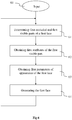
- One or more first visible part(s) of the first face is (are) determined by using an information representative of the first occluded part.
- First attributes representative of the first visible part are calculated.
- First parameters representative of an appearance of the first face are obtained by applying a regressor to the first attributes, the regressor modelling a correlation between second attributes representative of second visible parts of a plurality of second faces in second images and second parameters representative of an appearance model of the plurality of second faces.
- the first face is then synthesized without occluded part by using the first parameters.
- Using a regressor to retrieve the first parameters representative of the appearance (e.g. shape and/or texture) of the first face enables to reconstruct the image of the face of a person in a way that is robust to (severe) occlusion(s) as well as to changes in head pose, facial expression and/or lighting conditions.
- Figure 1 shows a device 10 configured to implement a method of synthesizing a first face 111 represented in a first image 11, according to a particular and non-limiting embodiment of the present principles. An example embodiment of the method of synthesis will be described with more details hereinbelow, with regard to figure 6 .
- the first face 111 is partially occluded by an occluding object 112 in the first image 11.
- the occluding object 112 is for example a HMD (Head-Mounted Display), a pair of glasses, a mask or any object that may be worn by a user.
- the device 10 processes the first image (or input image) 11 to generate an output image 12 representing the first face 111 but without any occlusion.
- the first face 111 is synthesized by the device by replacing the part of the first face occluded by the occluding object 112 with a synthesized part of the first face that enables to obtain a whole visible first face.
- a reconstruction enables to better recognize the first face, which may enhance the user experience during video-conference via HMD for example or enhance the possibility to recognize a person on a video (for example for security reason in video surveillance application).
- the reconstruction of the full face better conveys its expressions and emotions, which are known to be important non-verbal communication cues.
- the first image 11 is for example a still image acquired with a digital still camera or an image from a sequence of images, i.e. a video, acquired with a camera.
- the first image may be stored on a storage device in connection with the device 10.
- the storage device may include one or more memories stored locally and/or remotely (e.g., cloud).
- the storage device may be connected to the device via wired connection (e.g., Ethernet, USB) or via wireless connection (e.g., Wi-Fi, Bluetooth).
- the device 10 comprises the following elements that are linked together by a data and address bus (that may also transports a clock signal):
- the device 10 may also comprise one or more display devices to display images generated and calculated in the device, for example.
- a display device is external to the device 10 and is connected to the device 10 by a cable or wirelessly for transmitting the display signals.
- the microprocessor(s) 101 loads and executes the instructions of the program contained in the memory 102.
- the algorithms implementing the steps of the method(s) specific to the present principles and described hereinbefore are stored in the memory 102 associated with the device 10 implementing these steps.
- the device 10 corresponds for example to a computer, a tablet, a Smartphone, a games console, a laptop, a decoder or a set-top box.
- the device 10 is further configured and adapted to implement a method of learning an appearance model of the first face by using second images representing second faces. According to another aspect of the present principles, the device 10 is further configured and adapted to implement a method of learning a regression between attributes associated with visible part(s) of the second faces and parameters of the appearance model. An example embodiment of the method of learning the appearance model and the regression will be described with more details hereinbelow, with regard to figure 5 .
- the appearance model and associated parameters and the regression are obtained by the device 10 from a remote server and/or storage device, for example via a network such as the Internet, a list of different appearance models and/or regressions being for example stored on said server and/or storage device.
- Figure 5 shows a training method for learning an appearance model from a set of second images of second faces and for learning a regressor establishing a correlation between second attributes representative of second visible parts of the second faces and second parameters representative of said appearance model, according to a particular and non-limiting embodiment of the present principles.
- the training method is for example implemented in the device 10.
- the different parameters of the device 10 are updated.
- the parameters of the appearance model and the parameters of the regressor are initialised in some way.
- second parameters representative of the appearance model are obtained from a training data set comprising a plurality of second images, each representing a second face.
- the number of second images may be comprised between a dozen and several thousand.
- the second images each represent the second of a same person or, according to a variant, different second faces (e.g., of different persons) are represented in the second images, i.e. each different second face is represented in a different subset of the plurality of the second images.
- An example of a second image 2 is illustrated on figure 2.
- Figure 2 shows a second face 20 of a person, each part of the second face being visible, i.e. not occluded by an object.
- Facial landmarks 201 associated with the second face 20 are illustrated with white spots on the second face 20.
- the facial landmarks 201 are for example computed automatically using a landmark detection algorithm, such as the one described in " Robust face landmark estimation under occlusion", by X. Burgos-Artizzu, P. Perona and P. Dollar in IEEE International Conference on Computer Vision, Sydney, 2013 .
- the facial landmarks 201 may be set up manually by an operator according to another example.
- the number and the location of the facial landmarks 201 are determined according to the type of object they are associated with.
- Figure 4 shows for example an image 40 comprising 68 landmarks of the second face represented in the second image.
- An image 40 is advantageously associated with each second image of the set of second images.
- Each image 40 may be normalized to a common reference scale and orientation.
- the landmarks 401, 402 to 468 correspond to key points or interesting spots of a face, such as eye corners, nose tips, mouth corners and face contour.
- Each landmark is advantageously identified with an ID, for example an integer.
- the IDs in the example of figure 4 are 1, 2, 3 ... 68.
- the IDs are advantageously the same in each image 40 and refer to the same landmark location. For example the landmarks associated with the mouth have always the IDs 49 to 68, the landmarks associated with the left-hand eye have always the IDs 37 to 42, etc.
- Coordinates (x,y) are advantageously associated with each landmark corresponding to the position of the landmark in the normalized image 40, which has the size of the second image that it is associated with.
- the coordinates of the landmark are (x,y,z).
- the interesting spots are highly dependent on the type of object represented in the second images and are different from an object to another.
- the number of landmarks is not limited to 68 but extends to any number L, L being an integer, for example 50, 138 or 150.
- the appearance model (also called generative model) of the second face is obtained from the training data set comprising the plurality of non-occluded second face images 2.
- the appearance model is for example an AAM (or Active Appearance Model), such as disclosed by T. Cootes, G. Edwards, and C. Taylor in “Active appearance models", Transactions in Pattern Analysis and Machine Intelligence, 23(6):681-685, 2001 ).
- AAM Active Appearance Model
- the generation of the appearance model outputs two main components:
- the shape and appearance basis vectors Si and A i are learnt from a training set of annotated face images, i.e. the set of second images with associated facial landmarks. All faces in the training set may be first aligned to a common normalized pose (scale and orientation) using a process known as Generalized Procrustes Analysis, as disclosed at https: // en.wikipedia.org / wiki / Procrustes_analysis. Typically, the mean of the aligned face regions provides the reference base mesh So and texture (appearance) A 0 .
- the principal modes of variation of the training samples around S 0 and A 0 are for example computed using Principal Component Analysis (PCA).
- PCA Principal Component Analysis
- PCA is in essence a dimensionality reduction technique, where one tries to capture as much of the variability of the input data as possible in a lower-dimensional linear subspace of the input space.
- the PCA subspace is computed so as to maximize the variance of the projections of the input samples onto the subspace, for a given subspace dimension target.
- PCA is applied independently to the shape (mesh vertices coordinates) and texture (or appearance, e.g. pixel colors or grey levels, or alternative representations of texture) components of the appearance model (e.g. AAM).
- a third PCA is applied to the concatenated set of shape and texture PCA output vectors to further reduce the dimension of the model.
- the subspaces dimensions at the output of the PCAs may be optionally adjusted so that a fixed percentage (usually 95%) of the variance of the original data is retained after the reduction of dimensionality. Typically, these dimensions are of the order of 25 for both shape and appearance, to be compared with the initial dimensions of around 100 for shape space and 10000 for appearance space.
- a second occluded part of the second face is determined for each second image 2, as illustrated of figure 3.
- Figure 3 shows an image 3 of the second face 20 illustrated on figure 2 , a part 30 (called second occluded part) of the second face 20 being occluded by an object.
- the second occluded part 30 is determined from the shape of the object and from a location information of the object with regard to the second face 20.
- the location information corresponds for example to the landmarks that are occluded by the object, depending on the type of the object.
- the shape of the object used to determine the second occluded part 30 is the shape of the object 112 occluding the first face, i.e. a HMD.
- reference landmarks may be used that are the same in each second image, which is possible as the landmarks share the same semantics on each second image, as explained with regard to figure 4 .
- a 2D representation basis defined by the locations of 3 non-aligned landmarks may be used as a reference in each second image (i.e. with the 3 same landmarks, i.e. landmarks with same IDs) for locating the second occluded part 30.
- This second occluded part may for example be defined as a polygon whose vertex coordinates are expressed in said 2D representation basis.
- the second visible part of the second face 20 in each second image may then be determined from the second occluded part 30.
- the second visible part may for example correspond to the part of the second face 20 complementary to the second occluded part 30, said second visible part being for example defined from the location information of the landmarks that are determined visible in each second image.
- the second visible part corresponds to a rectangle whose center, width and height are determined as a function of geometrical properties of the occluded part 30.
- second attributes associated with each second visible in each second image are calculated.
- the second visible part in each second image is subdivided into a determined set of possibly overlapping rectangles (or triangles), and a set of second attributes is computed for each rectangle (or respectively triangle).
- the second attributes may correspond to any descriptor of the texture within each rectangle (or respectively triangle), e.g. mean color information for each color channel or a histogram of gradient orientations as disclosed by N. Dalal and B. Triggs in "Histograms of Oriented Gradients for Human Detection", in IEEE International Conference on Computer Vision and Pattern Recognition, 2005 .
- the second attributes may be calculated for areas of each second image (for example rectangle) of determined size around a selection of or all the visible landmarks.
- a regressor i.e. a regression function
- the regression function of the regressor is learnt from the multiple set of second attributes f i and the multiple second parameters p i and ⁇ i , a set of second attributes and a set of second parameters p i and ⁇ i being associated with each second image of the training set of second images.
- a regression function between multidimensional input data i.e. a set of second attributes associated with one second image forming one dimension of the input data
- multidimensional output data i.e.
- a set of second parameters associated with one second image forming one dimension of the output data may be learnt by means of a hashing scheme that partitions the input data samples into "bins" such that the variance of the input data fi in each bin is small.
- the regressor output for each bin is computed from the distribution of input samples that fall into the bin, for instance as the mean values of the output second parameters of these samples.
- the regression output for a given input is then computed by first finding out which bin the input sample falls into, then looking up the output regression value for the bin, as computed above.
- the hashing scheme may be made to depend on random data partitioning criteria, and repeated for a large number of realizations from these random criteria.
- the output regression value for a given input is then averaged over all the output values computed for each random realization of the hashing scheme.
- Classification techniques well known from the machine learning literature such as random ferns (as disclosed by Oezuysal et al, "Fast Keypoint Recognition using Random Ferns, IEEE Transactions on Pattern Analysis and Machine Intelligence, Vol. 32 n°3, pp.448-461, 2010 ) or random forests, may be used to obtain the desired hashing.
- Figure 6 shows a method of generating, e.g. synthesizing, a first face in a first image (also called test image), according to a particular and non-limiting embodiment of the present principles.
- the synthesizing method is for example implemented in the device 10.
- a first occluded and a first visible part of the first face are determined in an input image 60, i.e. the first image.
- the first occluded part corresponds to the part of the first face in the first image that is occluded by an occluding object, for example a HMD, sunglasses, see-through glasses, a blindfold.
- the first occluded part may be detected by using a visual model of the occluding object, when the type of the occluding object is known (e.g. during a video-conference via HMD), the detection consisting in retrieving an object corresponding to the visual model.
- the visual model may be for example selected in a list of different visual objects with corresponding description that may be stored in the memory of the device 10 or that may be stored remotely and downloaded via a network such as the Internet.
- a first visible part of the first face may then be obtained as the part of the first face that is complementary to the first *occluded part.
- the first visible part of the first face is a geometry (for example a rectangle or a triangle) whose characteristics (e.g. center, length of the edges) are computed from the geometrical properties of the first occluded part.
- the detection of the first occluded part is based on a facial landmark detection algorithm that is applied to the occluded image.
- Facial landmark detection algorithms that are robust to occlusion are known from the state of art, one such algorithm is described in the paper " Robust face landmark estimation under occlusion", by X. Burgos-Artizzu, P. Perona and P. Dollar in IEEE International Conference on Computer Vision, Sydney, 2013 .
- the location of the first visible part in the first image is computed or calculated as a function of the detected landmarks on the first image.
- first attributes representative of the first visible part are obtained, i.e. either calculated or received from a memory.
- the first visible part is for example subdivided into a determined set of possibly overlapping rectangles (or triangles), following the same subdivision process as the one used in step 53, and the set of first attributes defined in step 53 is computed for each rectangle (or respectively triangle).
- a vector formed by stacking the components of each attribute in set of first attributes is then obtained.
- first parameters ⁇ p i ⁇ and ⁇ i ⁇ representative of the first face of the first image are obtained by applying the regressor learnt at step 54 to the vector of first attributes, the output of the regressor being a vector of first parameters ⁇ p i ⁇ and ⁇ i ⁇ describing the first face of the first image 11.
- the regressor used to obtain the first parameters is retrieved from a library of regressors, which is for example stored locally in the memory of the device 10 or downloaded from a remote storage device such as a server.
- the first face is generated based on the first parameters obtained at step 63. Synthesizing the first face corresponds to reconstructing the first face in its entirety, i.e. retrieving the missing texture information that is occluded by the occluding object.
- the instance of the appearance model defined by the first parameters is computed. As explained with regard to step 51 of figure 5 , this instance provides the texture of the reconstructed face in the reference "shape-free" geometry as well as the locations of the landmarks defining the geometry of the face.
- the synthesized face appearance is obtained by warping the shape-free texture of the model instance to its geometry.
- the synthesis comprises retrieving a third image of the first face, which is not occluded, by comparing the obtained first parameters with third parameters representative of one or more third images
- the third parameters are obtained for each third image by fitting the appearance model computed in step 51 to this image.
- the appearance model is an Active Appearance Model
- the fitting process yielding the model parameters for an input un-annotated input image is known from the state-of-art and described, for example, in the above-mentioned paper "Active Appearance Models Revisited”.
- the third image may for example be retrieved from a sample video in which the face to be reconstructed is captured without occlusion.
- the third image that is retrieved corresponds to the third image having the associated third parameters closest according to some distance metric, for instance the Euclidean distance, to the first parameters.
- the texture information of the third image may then be used to synthesize the first face, i.e. the texture information of the face in the third image replaces the whole texture information of the first face.
- Steps 61 to 64 may be reiterated for several first images, with same or different occluding objects. If the occluding object is different, a new regressor adapted to the current occluding object and used in step 63 may be retrieved.
- Figure 7 diagrammatically shows a hardware embodiment of a communication terminal 7 comprising the device 10, for example a smartphone or a tablet or a HMD
- the communication terminal comprises the following elements, connected to each other by an address bus 75 of addresses that transports data that also transports a clock signal:
- the device 7 also comprises one or more display devices 73 of display screen type directly connected to the graphics card 72 to display images calculated live in the graphics card, for example.
- the terminal 7 does not comprise any Graphic board 82, every computation being performed in the CPU 71 using the RAM 77.
- the terminal 7 comprises only one storage device as a memory.
- the present disclosure is not limited to a method of synthesizing the image of a face but also extends to a method of (and device configured for) reconstructing the image of a face that is at least partially occluded.
- the present disclosure is not limited to the synthesizing of image(s) of a face but also extends to the synthesizing of image(s) of any object or animal having at least a part that is occluded by another object.
- the implementations described herein may be implemented in, for example, a method or a process, an apparatus, a software program, a data stream, or a signal. Even if only discussed in the context of a single form of implementation (for example, discussed only as a method or a device), the implementation of features discussed may also be implemented in other forms (for example a program).
- An apparatus may be implemented in, for example, appropriate hardware, software, and firmware.
- the methods may be implemented in, for example, an apparatus such as, for example, a processor, which refers to processing devices in general, including, for example, a computer, a microprocessor, an integrated circuit, or a programmable logic device. Processors also include communication devices, such as, for example, Smartphones, tablets, computers, mobile phones, portable/personal digital assistants ("PDAs”), and other devices that facilitate communication of information between end-users.
- PDAs portable/personal digital assistants
- Implementations of the various processes and features described herein may be embodied in a variety of different equipment or applications, particularly, for example, equipment or applications associated with data encoding, data decoding, view generation, texture processing, and other processing of images and related texture information and/or depth information.
- equipment include an encoder, a decoder, a post-processor processing output from a decoder, a pre-processor providing input to an encoder, a video coder, a video decoder, a video codec, a web server, a set-top box, a laptop, a personal computer, a cell phone, a PDA, and other communication devices.
- the equipment may be mobile and even installed in a mobile vehicle.
- the methods may be implemented by instructions being performed by a processor, and such instructions (and/or data values produced by an implementation) may be stored on a processor-readable medium such as, for example, an integrated circuit, a software carrier or other storage device such as, for example, a hard disk, a compact diskette (“CD"), an optical disc (such as, for example, a DVD, often referred to as a digital versatile disc or a digital video disc), a random access memory (“RAM”), or a read-only memory (“ROM”).
- the instructions may form an application program tangibly embodied on a processor-readable medium. Instructions may be, for example, in hardware, firmware, software, or a combination.
- a processor may be characterized, therefore, as, for example, both a device configured to carry out a process and a device that includes a processor-readable medium (such as a storage device) having instructions for carrying out a process. Further, a processor-readable medium may store, in addition to or in lieu of instructions, data values produced by an implementation.
- implementations may produce a variety of signals formatted to carry information that may be, for example, stored or transmitted.
- the information may include, for example, instructions for performing a method, or data produced by one of the described implementations.
- a signal may be formatted to carry as data the rules for writing or reading the syntax of a described embodiment, or to carry as data the actual syntax-values written by a described embodiment.
- Such a signal may be formatted, for example, as an electromagnetic wave (for example, using a radio frequency portion of spectrum) or as a baseband signal.
- the formatting may include, for example, encoding a data stream and modulating a carrier with the encoded data stream.
- the information that the signal carries may be, for example, analog or digital information.
- the signal may be transmitted over a variety of different wired or wireless links, as is known.
- the signal may be stored on a processor-readable medium.
Landscapes
- Engineering & Computer Science (AREA)
- Theoretical Computer Science (AREA)
- Computer Vision & Pattern Recognition (AREA)
- General Physics & Mathematics (AREA)
- Physics & Mathematics (AREA)
- Health & Medical Sciences (AREA)
- General Health & Medical Sciences (AREA)
- Oral & Maxillofacial Surgery (AREA)
- Multimedia (AREA)
- Software Systems (AREA)
- Artificial Intelligence (AREA)
- Evolutionary Computation (AREA)
- Human Computer Interaction (AREA)
- Databases & Information Systems (AREA)
- Data Mining & Analysis (AREA)
- Medical Informatics (AREA)
- Computing Systems (AREA)
- Life Sciences & Earth Sciences (AREA)
- Bioinformatics & Cheminformatics (AREA)
- Bioinformatics & Computational Biology (AREA)
- Evolutionary Biology (AREA)
- General Engineering & Computer Science (AREA)
- Processing Or Creating Images (AREA)
Applications Claiming Priority (1)
| Application Number | Priority Date | Filing Date | Title |
|---|---|---|---|
| EP15307080 | 2015-12-21 |
Publications (1)
| Publication Number | Publication Date |
|---|---|
| EP3185176A1 true EP3185176A1 (fr) | 2017-06-28 |
Family
ID=55085503
Family Applications (1)
| Application Number | Title | Priority Date | Filing Date |
|---|---|---|---|
| EP16204815.1A Withdrawn EP3185176A1 (fr) | 2015-12-21 | 2016-12-16 | Procédé et dispositif permettant de synthétiser une image d'un visage partiellement occluse |
Country Status (2)
| Country | Link |
|---|---|
| US (1) | US20170178306A1 (fr) |
| EP (1) | EP3185176A1 (fr) |
Families Citing this family (22)
| Publication number | Priority date | Publication date | Assignee | Title |
|---|---|---|---|---|
| US9910275B2 (en) * | 2015-05-18 | 2018-03-06 | Samsung Electronics Co., Ltd. | Image processing for head mounted display devices |
| EP3405830B1 (fr) * | 2016-01-19 | 2024-10-16 | Magic Leap, Inc. | Systèmes et procédés de réalité augmentée utilisant des réflexions |
| CA3014189A1 (fr) | 2016-02-11 | 2017-08-17 | Magic Leap, Inc. | Systeme d'affichage a plans de profondeurs multiples avec commutation reduite entre plans de profondeur |
| US10565790B2 (en) | 2016-11-11 | 2020-02-18 | Magic Leap, Inc. | Periocular and audio synthesis of a full face image |
| CN107330408B (zh) * | 2017-06-30 | 2021-04-20 | 北京乐蜜科技有限责任公司 | 视频处理方法、装置、电子设备及存储介质 |
| US11145124B2 (en) | 2017-08-30 | 2021-10-12 | Ronald H. Winston | System and method for rendering virtual reality interactions |
| CN109872379B (zh) * | 2017-12-05 | 2022-12-02 | 富士通株式会社 | 数据处理装置和方法 |
| CN111936910A (zh) * | 2018-03-13 | 2020-11-13 | 罗纳德·温斯顿 | 虚拟现实系统和方法 |
| CN112106066A (zh) * | 2018-03-16 | 2020-12-18 | 奇跃公司 | 根据眼睛跟踪相机的面部表情 |
| KR102655949B1 (ko) | 2018-05-30 | 2024-04-09 | 삼성전자주식회사 | 3d 영상 기반의 얼굴 인증 방법 및 장치 |
| US11394888B2 (en) * | 2019-01-18 | 2022-07-19 | Snap Inc. | Personalized videos |
| CN110070017B (zh) * | 2019-04-12 | 2021-08-24 | 北京迈格威科技有限公司 | 一种人脸假眼图像生成方法及装置 |
| CN112422817B (zh) * | 2020-10-28 | 2022-04-12 | 维沃移动通信有限公司 | 图像处理方法及装置 |
| US12561885B2 (en) | 2020-12-01 | 2026-02-24 | Matsuko S.R.O. | Method, system, and medium for artificial intelligence-based completion of a 3D image during electronic communication |
| US11783531B2 (en) * | 2020-12-01 | 2023-10-10 | Matsuko S.R.O. | Method, system, and medium for 3D or 2.5D electronic communication |
| US11710265B2 (en) * | 2021-06-08 | 2023-07-25 | Realfacevalue B.V. | Method for producing an image of expected results of medical cosmetic treatments on a human anatomical feature from an image of the anatomical feature prior to these medical cosmetic treatments |
| DE102022208822A1 (de) * | 2021-08-30 | 2023-03-02 | Apple Inc. | Anzeigen von bilddaten basierend auf umgebungslicht |
| US20240370081A1 (en) * | 2021-09-27 | 2024-11-07 | Hewlett-Packard Development Company, L.P. | Visibility of Frames |
| US20250124650A1 (en) * | 2021-09-30 | 2025-04-17 | Canon U.S.A., Inc. | Removal of head mounted display for real-time 3d face reconstruction |
| US12190424B1 (en) | 2022-03-22 | 2025-01-07 | Zoom Video Communications, Inc. | Speech driven talking face |
| US20240070955A1 (en) * | 2022-08-23 | 2024-02-29 | Samsung Electronics Co., Ltd. | Refinement of facial keypoint metadata generation for video conferencing or other applications |
| WO2025014594A1 (fr) * | 2023-07-10 | 2025-01-16 | Qualcomm Incorporated | Gestion de dispositifs pour téléprésence virtuelle |
Family Cites Families (2)
| Publication number | Priority date | Publication date | Assignee | Title |
|---|---|---|---|---|
| WO2016026135A1 (fr) * | 2014-08-22 | 2016-02-25 | Microsoft Technology Licensing, Llc | Alignement de visage comportant une régression de forme |
| US9910275B2 (en) * | 2015-05-18 | 2018-03-06 | Samsung Electronics Co., Ltd. | Image processing for head mounted display devices |
-
2016
- 2016-12-16 EP EP16204815.1A patent/EP3185176A1/fr not_active Withdrawn
- 2016-12-19 US US15/384,215 patent/US20170178306A1/en not_active Abandoned
Non-Patent Citations (7)
| Title |
|---|
| BURGOS-ARTIZZU XAVIER P ET AL: "Pose and Expression-Coherent Face Recovery in the Wild", 2015 IEEE INTERNATIONAL CONFERENCE ON COMPUTER VISION WORKSHOP (ICCVW), IEEE, 7 December 2015 (2015-12-07), pages 877 - 885, XP032865047, DOI: 10.1109/ICCVW.2015.117 * |
| I. MATTHEWS; S. BAKER: "Active Appearance Models Revisited", THE INTERNATIONAL JOURNAL OF COMPUTER VISION, vol. 60, no. 2, 2004, pages 135 - 164, XP019216428, DOI: doi:10.1023/B:VISI.0000029666.37597.d3 |
| N. DALAI; B. TRIGGS: "Histograms of Oriented Gradients for Human Detection", IEEE INTERNATIONAL CONFERENCE ON COMPUTER VISION AND PATTERN RECOGNITION, 2005 |
| OEZUYSAL ET AL.: "Fast Keypoint Recognition using Random Ferns", IEEE TRANSACTIONS ON PATTERN ANALYSIS AND MACHINE INTELLIGENCE, vol. 32, no. 3, 2010, pages 448 - 461 |
| T. COOTES; G. EDWARDS; C. TAYLOR: "Active appearance models", TRANSACTIONS IN PATTERN ANALYSIS AND MACHINE INTELLIGENCE, vol. 23, no. 6, 2001, pages 681 - 685, XP055249235, DOI: doi:10.1109/34.927467 |
| X. BURGOS-ARTIZZU; P. PERONA; P. DOLLAR: "Robust face landmark estimation under occlusion", IEEE INTERNATIONAL CONFERENCE ON COMPUTER VISION, 2013 |
| XAVIER P BURGOS-ARTIZZU ET AL: "Real-time expression-sensitive HMD face reconstruction", 20151102; 20151102 - 20151106, 2 November 2015 (2015-11-02), pages 1 - 4, XP058077404, ISBN: 978-1-4503-3930-8, DOI: 10.1145/2820903.2820910 * |
Also Published As
| Publication number | Publication date |
|---|---|
| US20170178306A1 (en) | 2017-06-22 |
Similar Documents
| Publication | Publication Date | Title |
|---|---|---|
| US20170178306A1 (en) | Method and device for synthesizing an image of a face partially occluded | |
| CN115699114B (zh) | 用于分析的图像增广的方法和装置 | |
| US20180144212A1 (en) | Method and device for generating an image representative of a cluster of images | |
| KR102628905B1 (ko) | 전자 장치가 동영상의 얼굴의 인상을 변형하는 방법 및 그 전자 장치 | |
| US20230169349A1 (en) | Electronic device and controlling method thereof | |
| US11176355B2 (en) | Facial image processing method and apparatus, electronic device and computer readable storage medium | |
| CN102405638B (zh) | 图像处理装置及图像处理方法 | |
| US9396409B2 (en) | Object based image processing | |
| CN111445410A (zh) | 基于纹理图像的纹理增强方法、装置、设备和存储介质 | |
| US10430694B2 (en) | Fast and accurate skin detection using online discriminative modeling | |
| CN113850168A (zh) | 人脸图片的融合方法、装置、设备及存储介质 | |
| CN113220251B (zh) | 物体显示方法、装置、电子设备及存储介质 | |
| CN108701355B (zh) | Gpu优化和在线基于单高斯的皮肤似然估计 | |
| Parde et al. | Face and image representation in deep CNN features | |
| KR20200112647A (ko) | 전자 장치 및 전자 장치의 제어 방법 | |
| US12051168B2 (en) | Avatar generation based on driving views | |
| JP2025023207A (ja) | 顔変化出力方法 | |
| CN117795559A (zh) | 使用媒体数据的对象重建 | |
| Chen et al. | Hierarchical cross-modal talking face generationwith dynamic pixel-wise loss | |
| CN117635439A (zh) | 唇部图像修复方法、虚拟直播方法、装置、设备以及介质 | |
| WO2018123202A1 (fr) | Dispositif de traitement d'images animés, dispositif d'affichage, procédé de traitement d'images animés et programme de commande | |
| CN109934107B (zh) | 图像处理方法及装置、电子设备及存储介质 | |
| Dhiyab | A Comprehensive Review of Real-Time Deepfake Detection Using Light Distribution and Illumination Consistency Analysis | |
| Matei Mancas et al. | Attention, Multimodality, and Datasets | |
| Saha et al. | HoloQA: Full reference video quality assessor of rendered human avatars in virtual reality |
Legal Events
| Date | Code | Title | Description |
|---|---|---|---|
| PUAI | Public reference made under article 153(3) epc to a published international application that has entered the european phase |
Free format text: ORIGINAL CODE: 0009012 |
|
| AK | Designated contracting states |
Kind code of ref document: A1 Designated state(s): AL AT BE BG CH CY CZ DE DK EE ES FI FR GB GR HR HU IE IS IT LI LT LU LV MC MK MT NL NO PL PT RO RS SE SI SK SM TR |
|
| AX | Request for extension of the european patent |
Extension state: BA ME |
|
| 17P | Request for examination filed |
Effective date: 20171221 |
|
| RBV | Designated contracting states (corrected) |
Designated state(s): AL AT BE BG CH CY CZ DE DK EE ES FI FR GB GR HR HU IE IS IT LI LT LU LV MC MK MT NL NO PL PT RO RS SE SI SK SM TR |
|
| 17Q | First examination report despatched |
Effective date: 20180709 |
|
| STAA | Information on the status of an ep patent application or granted ep patent |
Free format text: STATUS: THE APPLICATION IS DEEMED TO BE WITHDRAWN |
|
| 18D | Application deemed to be withdrawn |
Effective date: 20190122 |