EP3185455A1 - Procédé et appareil de détection de perte de paquets dans une diffusion échelonnée - Google Patents
Procédé et appareil de détection de perte de paquets dans une diffusion échelonnée Download PDFInfo
- Publication number
- EP3185455A1 EP3185455A1 EP15307072.7A EP15307072A EP3185455A1 EP 3185455 A1 EP3185455 A1 EP 3185455A1 EP 15307072 A EP15307072 A EP 15307072A EP 3185455 A1 EP3185455 A1 EP 3185455A1
- Authority
- EP
- European Patent Office
- Prior art keywords
- stream
- packet
- stagger
- time
- main stream
- Prior art date
- Legal status (The legal status is an assumption and is not a legal conclusion. Google has not performed a legal analysis and makes no representation as to the accuracy of the status listed.)
- Withdrawn
Links
- 238000000034 method Methods 0.000 title claims description 13
- 230000005540 biological transmission Effects 0.000 claims description 10
- 238000012935 Averaging Methods 0.000 claims description 3
- 238000001514 detection method Methods 0.000 abstract description 7
- 238000012937 correction Methods 0.000 description 5
- 230000003111 delayed effect Effects 0.000 description 3
- 230000006870 function Effects 0.000 description 3
- 230000001413 cellular effect Effects 0.000 description 2
- 238000012545 processing Methods 0.000 description 2
- 238000011084 recovery Methods 0.000 description 2
- 238000013459 approach Methods 0.000 description 1
- 238000004590 computer program Methods 0.000 description 1
- 230000000694 effects Effects 0.000 description 1
- 238000012986 modification Methods 0.000 description 1
- 230000004048 modification Effects 0.000 description 1
Images



Classifications
-
- H—ELECTRICITY
- H04—ELECTRIC COMMUNICATION TECHNIQUE
- H04L—TRANSMISSION OF DIGITAL INFORMATION, e.g. TELEGRAPHIC COMMUNICATION
- H04L1/00—Arrangements for detecting or preventing errors in the information received
-
- H—ELECTRICITY
- H04—ELECTRIC COMMUNICATION TECHNIQUE
- H04L—TRANSMISSION OF DIGITAL INFORMATION, e.g. TELEGRAPHIC COMMUNICATION
- H04L65/00—Network arrangements, protocols or services for supporting real-time applications in data packet communication
- H04L65/40—Support for services or applications
- H04L65/401—Support for services or applications wherein the services involve a main real-time session and one or more additional parallel real-time or time sensitive sessions, e.g. white board sharing or spawning of a subconference
- H04L65/4015—Support for services or applications wherein the services involve a main real-time session and one or more additional parallel real-time or time sensitive sessions, e.g. white board sharing or spawning of a subconference where at least one of the additional parallel sessions is real time or time sensitive, e.g. white board sharing, collaboration or spawning of a subconference
-
- H—ELECTRICITY
- H04—ELECTRIC COMMUNICATION TECHNIQUE
- H04N—PICTORIAL COMMUNICATION, e.g. TELEVISION
- H04N21/00—Selective content distribution, e.g. interactive television or video on demand [VOD]
- H04N21/20—Servers specifically adapted for the distribution of content, e.g. VOD servers; Operations thereof
- H04N21/23—Processing of content or additional data; Elementary server operations; Server middleware
- H04N21/236—Assembling of a multiplex stream, e.g. transport stream, by combining a video stream with other content or additional data, e.g. inserting a URL [Uniform Resource Locator] into a video stream, multiplexing software data into a video stream; Remultiplexing of multiplex streams; Insertion of stuffing bits into the multiplex stream, e.g. to obtain a constant bit-rate; Assembling of a packetised elementary stream
-
- H—ELECTRICITY
- H04—ELECTRIC COMMUNICATION TECHNIQUE
- H04L—TRANSMISSION OF DIGITAL INFORMATION, e.g. TELEGRAPHIC COMMUNICATION
- H04L1/00—Arrangements for detecting or preventing errors in the information received
- H04L1/004—Arrangements for detecting or preventing errors in the information received by using forward error control
- H04L1/0045—Arrangements at the receiver end
-
- H—ELECTRICITY
- H04—ELECTRIC COMMUNICATION TECHNIQUE
- H04L—TRANSMISSION OF DIGITAL INFORMATION, e.g. TELEGRAPHIC COMMUNICATION
- H04L1/00—Arrangements for detecting or preventing errors in the information received
- H04L1/0078—Avoidance of errors by organising the transmitted data in a format specifically designed to deal with errors, e.g. location
-
- H—ELECTRICITY
- H04—ELECTRIC COMMUNICATION TECHNIQUE
- H04L—TRANSMISSION OF DIGITAL INFORMATION, e.g. TELEGRAPHIC COMMUNICATION
- H04L1/00—Arrangements for detecting or preventing errors in the information received
- H04L1/02—Arrangements for detecting or preventing errors in the information received by diversity reception
-
- H—ELECTRICITY
- H04—ELECTRIC COMMUNICATION TECHNIQUE
- H04L—TRANSMISSION OF DIGITAL INFORMATION, e.g. TELEGRAPHIC COMMUNICATION
- H04L1/00—Arrangements for detecting or preventing errors in the information received
- H04L1/20—Arrangements for detecting or preventing errors in the information received using signal quality detector
-
- H—ELECTRICITY
- H04—ELECTRIC COMMUNICATION TECHNIQUE
- H04L—TRANSMISSION OF DIGITAL INFORMATION, e.g. TELEGRAPHIC COMMUNICATION
- H04L25/00—Baseband systems
- H04L25/02—Details ; arrangements for supplying electrical power along data transmission lines
- H04L25/0202—Channel estimation
-
- H—ELECTRICITY
- H04—ELECTRIC COMMUNICATION TECHNIQUE
- H04L—TRANSMISSION OF DIGITAL INFORMATION, e.g. TELEGRAPHIC COMMUNICATION
- H04L43/00—Arrangements for monitoring or testing data switching networks
- H04L43/08—Monitoring or testing based on specific metrics, e.g. QoS, energy consumption or environmental parameters
- H04L43/0823—Errors, e.g. transmission errors
- H04L43/0829—Packet loss
-
- H—ELECTRICITY
- H04—ELECTRIC COMMUNICATION TECHNIQUE
- H04L—TRANSMISSION OF DIGITAL INFORMATION, e.g. TELEGRAPHIC COMMUNICATION
- H04L65/00—Network arrangements, protocols or services for supporting real-time applications in data packet communication
- H04L65/60—Network streaming of media packets
- H04L65/61—Network streaming of media packets for supporting one-way streaming services, e.g. Internet radio
- H04L65/611—Network streaming of media packets for supporting one-way streaming services, e.g. Internet radio for multicast or broadcast
-
- H—ELECTRICITY
- H04—ELECTRIC COMMUNICATION TECHNIQUE
- H04L—TRANSMISSION OF DIGITAL INFORMATION, e.g. TELEGRAPHIC COMMUNICATION
- H04L65/00—Network arrangements, protocols or services for supporting real-time applications in data packet communication
- H04L65/80—Responding to QoS
-
- H—ELECTRICITY
- H04—ELECTRIC COMMUNICATION TECHNIQUE
- H04W—WIRELESS COMMUNICATION NETWORKS
- H04W24/00—Supervisory, monitoring or testing arrangements
- H04W24/08—Testing, supervising or monitoring using real traffic
-
- H—ELECTRICITY
- H04—ELECTRIC COMMUNICATION TECHNIQUE
- H04L—TRANSMISSION OF DIGITAL INFORMATION, e.g. TELEGRAPHIC COMMUNICATION
- H04L47/00—Traffic control in data switching networks
- H04L47/10—Flow control; Congestion control
- H04L47/28—Flow control; Congestion control in relation to timing considerations
- H04L47/283—Flow control; Congestion control in relation to timing considerations in response to processing delays, e.g. caused by jitter or round trip time [RTT]
-
- H—ELECTRICITY
- H04—ELECTRIC COMMUNICATION TECHNIQUE
- H04L—TRANSMISSION OF DIGITAL INFORMATION, e.g. TELEGRAPHIC COMMUNICATION
- H04L65/00—Network arrangements, protocols or services for supporting real-time applications in data packet communication
- H04L65/60—Network streaming of media packets
- H04L65/65—Network streaming protocols, e.g. real-time transport protocol [RTP] or real-time control protocol [RTCP]
Definitions
- the present invention generally relates to communications systems and, more particularly, to wireless and wired systems, e.g., terrestrial broadcast, cellular, Wireless-Fidelity (Wi-Fi), satellite, cable, etc.
- wireless and wired systems e.g., terrestrial broadcast, cellular, Wireless-Fidelity (Wi-Fi), satellite, cable, etc.
- a stream e.g., of packets
- the stagger stream is sent in advance compared to the main stream, i.e., the main stream is delayed (the stagger delay).
- An illustrative staggercasting transmitter is shown in FIG. 1 .
- the elements shown in the figure are well-known and will not be described in detail.
- a staggercast transmitter illustratively comprises encoders 105 and 110, stagger delay 115 and multiplexer (mux) 120.
- a signal 104 is applied to encoders 105 and 110, which encode the signal to provide encoded signals 106 and 111, respectively.
- Encoded signal 111 is also stagger stream 111. For illustration purposes, these encoders perform the same type of encoding, although this is not required. Encoded signal 106 is then delayed in time by stagger delay 115 to provide main stream 116. This delay can be adjustable or fixed. As a result of being delayed, the stagger stream is now "in advance" of the main stream. Mux 120 multiplexes the main stream and the stagger stream to provide output stream 121 for transmission (broadcast), i.e., the transmitted stream.
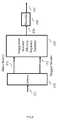
- the staggercast receiver comprises demultiplexer (demux) 150, staggercast selector 155 and decoder 160.
- the transmitted stream (the transmission medium, e.g., broadcast, internet, etc., is not shown in FIG. 2 ) is received by demux 150, which demultiplexes the received transmitted stream 121 and provides main stream 151 and stagger stream 152. Therefore, in case of loss due to physical disruptions, a correction can be made on the receiver side by staggercast selector 155 by inserting data from stagger stream 152 in the main stream 151.
- staggercast selector 155 detects "holes" in main stream 151 when a discontinuity is found in the sequence number of received transport packets in main stream 152. Since packets from stagger stream 152 were received earlier, staggercast selector 155 inserts the correct packet from stagger stream 152 for the missing packet in main stream 151 and provides output signal 156 to decoder 160. In this way, missing packets from main stream 151 can be replaced by using the corresponding packets received earlier from stagger stream 152. Thus, the quality of service (QoS) to the user is maintained and decoder 160 provides a decoded stream 161 (e.g., for additional processing (not shown)) for viewing by a user.
- QoS quality of service
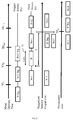
- Stagger stream 152 comprises a stream of packets as represented by packets "N Stg", “N+1 Stg” and “N+2 Stg", where "N", “N+1” and “N+2" represent packet sequence numbers, and "N” is an integer value, e.g., 10.
- main stream 151 comprises a stream of packets as represented by packets "N-1", “N", “N+1” and "N+2".
- the time of delivery (TD) for each packet in main stream 151 is also illustrated in FIG. 3 .
- the time of delivery for packet "N-1" is shown as TD N-1 in FIG. 3 , etc.
- Staggercast selector 155 detects that a packet is missing from main stream 151 at TD N+1 since the next packet received has a sequence number "N+1". As such, staggercast selector 155 pushes both the earlier received packet "N Stg” from stagger stream 152 and packet "N+1" from main stream 151 (shown below the axis "Staggercast Selector Output time") to decoder 160, of FIG. 2 .
- the time between delivery of a packet and presentation to a user is illustrated as ⁇ in FIG. 3 .
- the time of presentation (TP) to the user is shown on the bottom axis of FIG. 3 .
- QoS to the user is maintained, i.e., there is no break in the decoded audio/video content since packet "N Stg" is provided in time for presentation to the user at TP N .
- packet "N+2 Stg” was lost in stagger stream 152, since corresponding packet "N+2" was correctly received in main stream 151, this missing packet had no effect on the decoded audio/video.
- the QoS to the user degrades. The aim is to adjust correctly the stagger delay so that packets in the stagger stream are available to replace missing packets in the main stream.
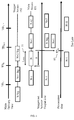
- FIG. 4 This is similar to FIG. 3 except that the time of presentation for packet "N" is now shorter. In other words, the time of presentation for a packet is closer to the time of delivery of the packet.
- TP N 15
- staggercast selector 155 has not yet detected that packet "N" is missing from main stream 151.
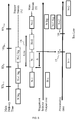
- FIG. 5 The latter is similar to FIG. 4 , except that loss 18 is longer and there is also a packet "N+1" missing from main stream 151.
- staggercast selector 155 does not detect the gap in sequence numbers until receiving packet "N+2" in main stream 151.
- staggercast selector 155 pushes packets "N Stg” and "N+1 Stg” from stagger stream 152 and packet "N+2" from main stream 151.
- the packets from stagger stream 152 are provided too late, i.e., after the time of presentation for packets "N" and "N+1", and will be discarded by the decoder at presentation time.
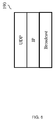
- the currently proposed ATSC 3.0 broadcast system may support staggercasting and has chosen to send content using UDP over IP packets as shown in FIG. 6 .
- the latter shows an illustrative transport stack 190 where content is sent using UDP over IP packets over the broadcast (physical) layer.
- a receiver has to detect by its own means when a corruption occurs (using IP checksum or manage by the physical layer) or when a loss occurs (using discontinuity in transport packets sequence number for instance (as described above)).
- a receiver estimates a delivery time of a packet from a main stream and, if the packet from the main stream is not received at the estimated delivery time, the receiver substitutes a corresponding packet from the stagger stream.
- a loss can be detected quicker since the receiver does not have to wait until detection of a missing sequence number and, therefore, the receiver can accommodate the time of presentation across different systems (as well as different types of transport stacks) such that the user does not suffer a loss in QoS.
- an Advanced Television Systems Committee Digital Television (ATSC DTV) device comprises a receiver for receiving a staggercast transmission representing content comprising at least two packet streams, wherein one packet stream is a main stream and another packet stream is a stagger stream; and a processor configured to estimate a delivery time of a packet from the main stream; and if the packet from the main stream is not received at the estimated delivery time, to substitute a corresponding packet from the received stagger stream for use in presentation of the content.
- ATSC DTV Advanced Television Systems Committee Digital Television
- an Advanced Television Systems Committee Digital Television (ATSC DTV) device performs a method comprising receiving a staggercast transmission representing content comprising at least two packet streams, wherein one packet stream is a main stream and another packet stream is a stagger stream; and estimating a delivery time of a packet from the main stream; and if the packet from the main stream is not received at the estimated delivery time, substituting a corresponding packet from the received stagger stream for use in presenting the content.
- ATSC DTV Advanced Television Systems Committee Digital Television
- a receiver estimates a delivery time of a packet from a main stream and, if the packet from the main stream is not received at the estimated delivery time, the receiver substitutes a corresponding packet from the stagger stream.
- a loss can be detected quicker since the receiver does not have to wait until detection of a missing sequence number and, therefore, the receiver can accommodate the time of presentation across different systems (as well as different types of transport stacks) such that the user does not suffer a loss in QoS.
- Device 200 is representative of any processor-based platform, whether hand-held, mobile or stationary.
- a PC a server, a set-top box, a personal digital assistant (PDA), a cellular telephone, a mobile digital television (DTV), a DTV, etc.
- PDA personal digital assistant
- device 200 includes one, or more, processors with associated memory (not shown).
- Device 200 includes a receiver 205 and a display 290.
- Receiver 205 receives a transmitted signal 121 (the transmission medium, e.g., broadcast, internet, etc., is not shown In FIG.
- receiver 205 detects possible missing packets based on missed delivery times.
- Receiver 205 is a processor-based system and includes one, or more, processors and associated memory as represented by processor 390 and memory 395 shown in the form of dashed boxes in FIG. 8 .
- processors and associated memory are stored in memory 395 for execution by processor 390 and, e.g., implement staggercast selector 255.
- Processor 390 is representative of one, or more, stored-program control processors and these do not have to be dedicated to the receiver function, e.g., processor 390 may also control other functions of receiver 205.
- Memory 395 is representative of any storage device, e.g., random-access memory (RAM), read-only memory (ROM), etc.; may be internal and/or external to receiver 205; and is volatile and/or nonvolatile as necessary.
- Receiver 205 comprises demultiplexer (demux) 150, staggercast selector 255 and decoder 160. Only those portions relevant to the inventive concept are shown.
- the transmitted stream (the transmission medium, e.g., broadcast, internet, etc., is not shown in FIG. 8 ) is received by demux 150, which demultiplexes the received transmitted stream 121 and provides main stream 151 and stagger stream 152. Therefore, in case of loss due to physical disruptions, a correction can be made on the receiver side by staggercast selector 255 by inserting data from stagger stream 152 in the main stream 151.
- staggercast selector 255 estimates a delivery time of a packet from a main stream and, if the packet from the main stream is not received at the estimated delivery time, the receiver substitutes a corresponding packet from the stagger stream (described further below). Since packets from stagger stream 152 were received earlier, staggercast selector 255 inserts the correct packet from stagger stream 152 for the missing packet in main stream 151 and provides output signal 256 to decoder 160. The latter provides a decoded stream 161, which is processed by other circuitry (not shown) of receiver 205 as represented by ellipses 325 to recover therefrom, e.g., a video signal 206 for presentation to a user via display 290 of FIG.
- the receiver can accommodate the time of presentation across different systems (as well as different types of transport stacks) such that the user does not suffer a loss in QoS.
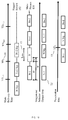
- staggercast selector 255 estimates the delivery time of a packet as a function of the actual delivery time of two contiguous packets. Either the stagger stream 252 or the main stream 151 can be used. For example, with reference to FIG. 10 , packets "N Stg" and “N+1 Stg" in stagger stream 152 can be used to estimate a delivery time for the next packet since both these packets were received.
- staggercast selector 255 uses the time of delivery, D, to check for loss in step 410. It should be noted that step 405 can be performed continuously, periodically, etc. The point of step 405 is that an estimate of time of delivery, D, is determined for use in checking for loss as represented by step 410.
- equation (1) represents a simple subtraction
- other methods e.g., using statistics, such as averaging over a number of received packets can be used.
- staggercast selector 255 cannot determine a time of delivery, D, for a particular execution of step 405, then either a previously determined value can continue to be used, or a default value for D can be used.
- other methods for determining a time of delivery, D can be used such as, but not limited to, simply using the stagger delay D.
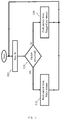
- FIG. 11 an illustrative flow chart for using the estimate of time of delivery, D, to check for loss is shown.
- staggercast selector 255 waits a wait time "W” in step 505 from the time of delivery of the latest packet to determine if there is a loss in the packet stream.
- the wait time, W is illustratively shown in FIG.
- staggercast selector 255 checks at time "TD N-1 + W" if the packet, in this example, "N", was received in step 510. If the packet "N", from the main stream 151, was received, the staggercast selector 255 pushes the packet "N” from main stream 151 in step 515. However, if the packet "N", from the main stream 151, was not received, the staggercast selector 255 pushes the packet "N STG" from stagger stream 152 in step 520. This is illustrated in FIG.
- staggercast selector 255 can use the same approach for the following packet "N+1".
- T DN is simply provided by (T DN-1 + D) and staggercast selector 255 will wait for the wait time, W, to expire to determine if there is a loss at time (T DN + W) for packet "N+1" in the same fashion as described with respect to packet "N” for FIG. 11 .
- any or all of the elements may be implemented in a stored-program-controlled processor, e.g., a digital signal processor, which executes associated software, e.g., corresponding to one or more of the steps shown in, e.g., FIGs. 9 and 11 , etc.
- a stored-program-controlled processor e.g., a digital signal processor
- associated software e.g., corresponding to one or more of the steps shown in, e.g., FIGs. 9 and 11 , etc.
- the inventive concept is not so limited, e.g., the elements of device 200 of FIG. 7 may be distributed in different units in any combination thereof.
- receiver 205 of FIG. 7 may be a part of a device, or box, such as a set-top box that is physically separate from the device, or box, incorporating display 290, etc. It is therefore to be understood that numerous modifications may be made to the illustrative embodiments and that other arrangements may be devised without departing from the scope of
Landscapes
- Engineering & Computer Science (AREA)
- Signal Processing (AREA)
- Computer Networks & Wireless Communication (AREA)
- Multimedia (AREA)
- Environmental & Geological Engineering (AREA)
- Quality & Reliability (AREA)
- Power Engineering (AREA)
- Data Exchanges In Wide-Area Networks (AREA)
- Two-Way Televisions, Distribution Of Moving Picture Or The Like (AREA)
- Compression Or Coding Systems Of Tv Signals (AREA)
Priority Applications (7)
| Application Number | Priority Date | Filing Date | Title |
|---|---|---|---|
| EP15307072.7A EP3185455A1 (fr) | 2015-12-21 | 2015-12-21 | Procédé et appareil de détection de perte de paquets dans une diffusion échelonnée |
| JP2016240685A JP7064284B2 (ja) | 2015-12-21 | 2016-12-12 | スタガーキャストでのパケット損失を検出する方法及び装置 |
| EP16204139.6A EP3185456B1 (fr) | 2015-12-21 | 2016-12-14 | Procédé et appareil de détection de perte de paquets dans une diffusion échelonnée |
| KR1020160172750A KR102750139B1 (ko) | 2015-12-21 | 2016-12-16 | 스태거캐스팅에서 패킷 손실을 검출하기 위한 방법 및 장치 |
| BR102016030098-3A BR102016030098B1 (pt) | 2015-12-21 | 2016-12-21 | Método para uso em um receptor de difusão por escalonador e aparelho para detectar perda de pacote em difusão por escalonador |
| US15/387,611 US11075965B2 (en) | 2015-12-21 | 2016-12-21 | Method and apparatus for detecting packet loss in staggercasting |
| CN201611190997.7A CN107017964B (zh) | 2015-12-21 | 2016-12-21 | 用于检测交错播送中的分组丢失的方法和装置 |
Applications Claiming Priority (1)
| Application Number | Priority Date | Filing Date | Title |
|---|---|---|---|
| EP15307072.7A EP3185455A1 (fr) | 2015-12-21 | 2015-12-21 | Procédé et appareil de détection de perte de paquets dans une diffusion échelonnée |
Publications (1)
| Publication Number | Publication Date |
|---|---|
| EP3185455A1 true EP3185455A1 (fr) | 2017-06-28 |
Family
ID=55072494
Family Applications (2)
| Application Number | Title | Priority Date | Filing Date |
|---|---|---|---|
| EP15307072.7A Withdrawn EP3185455A1 (fr) | 2015-12-21 | 2015-12-21 | Procédé et appareil de détection de perte de paquets dans une diffusion échelonnée |
| EP16204139.6A Active EP3185456B1 (fr) | 2015-12-21 | 2016-12-14 | Procédé et appareil de détection de perte de paquets dans une diffusion échelonnée |
Family Applications After (1)
| Application Number | Title | Priority Date | Filing Date |
|---|---|---|---|
| EP16204139.6A Active EP3185456B1 (fr) | 2015-12-21 | 2016-12-14 | Procédé et appareil de détection de perte de paquets dans une diffusion échelonnée |
Country Status (6)
| Country | Link |
|---|---|
| US (1) | US11075965B2 (fr) |
| EP (2) | EP3185455A1 (fr) |
| JP (1) | JP7064284B2 (fr) |
| KR (1) | KR102750139B1 (fr) |
| CN (1) | CN107017964B (fr) |
| BR (1) | BR102016030098B1 (fr) |
Families Citing this family (2)
| Publication number | Priority date | Publication date | Assignee | Title |
|---|---|---|---|---|
| EP3185455A1 (fr) * | 2015-12-21 | 2017-06-28 | Thomson Licensing | Procédé et appareil de détection de perte de paquets dans une diffusion échelonnée |
| EP4771825A1 (fr) * | 2023-08-28 | 2026-07-08 | Rocoto Ltd | Transmission vidéo fiable et adaptative utilisant une synchronisation améliorée, retransmission sélective de paquets manquants et rapport de crête sur valeur moyenne réduit de débit binaire de trame |
Citations (4)
| Publication number | Priority date | Publication date | Assignee | Title |
|---|---|---|---|---|
| US20080008096A1 (en) * | 2005-08-22 | 2008-01-10 | Infosys Technologies, Ltd. | System and method for managing playout time in packet communication network |
| US20080232243A1 (en) * | 2007-03-20 | 2008-09-25 | Amit Oren | Method and system for implementing redundancy for streaming data in audio video bridging networks |
| WO2009032106A1 (fr) * | 2007-08-28 | 2009-03-12 | Thomson Licensing | Diffusion sur fréquences décalées sans retard de changement de canal |
| WO2009126253A1 (fr) * | 2008-04-11 | 2009-10-15 | Thomson Licensing | Diffusion sur des fréquences décalées avec extensibilité temporelle |
Family Cites Families (31)
| Publication number | Priority date | Publication date | Assignee | Title |
|---|---|---|---|---|
| US5790543A (en) * | 1995-09-25 | 1998-08-04 | Bell Atlantic Network Services, Inc. | Apparatus and method for correcting jitter in data packets |
| US6781983B1 (en) * | 1999-05-03 | 2004-08-24 | Cisco Technology, Inc. | Packet-switched telephony with circuit-switched backup |
| KR20010035779A (ko) | 1999-10-02 | 2001-05-07 | 윤종용 | 사용자 데이터그램 통신 규약 상에서 패킷 로스를 보상하는 방법 |
| US20080030623A1 (en) * | 2001-07-19 | 2008-02-07 | Kumar Ramaswamy | Robust reception of digital broadcast transmission |
| EP1415463A4 (fr) * | 2001-07-19 | 2005-10-12 | Thomson Licensing | Reception fiable de signaux de diffusion numeriques |
| US7079486B2 (en) * | 2002-02-13 | 2006-07-18 | Agere Systems Inc. | Adaptive threshold based jitter buffer management for packetized data |
| MXPA05008094A (es) | 2003-01-28 | 2006-02-08 | Thomson Licensing | Formacion escalonada de modo robusto. |
| US7810124B2 (en) * | 2003-01-28 | 2010-10-05 | Thomson Licensing | Robust mode staggercasting fast channel change |
| US7389357B2 (en) * | 2004-01-20 | 2008-06-17 | Cisco Technology, Inc. | Arrangement in an IP node for preserving security-based sequences by ordering IP packets according to quality of service requirements prior to encryption |
| JP2005328131A (ja) * | 2004-05-12 | 2005-11-24 | Toshiba Corp | リアルタイムデータ受信装置 |
| DE102004039186B4 (de) * | 2004-08-12 | 2010-07-01 | Infineon Technologies Ag | Verfahren und Vorrichtung zur Kompensation von Laufzeitschwankungen von Datenpaketen |
| US7742454B2 (en) * | 2004-12-16 | 2010-06-22 | International Business Machines Corporation | Network performance by dynamically setting a reassembly timer based on network interface |
| US7701851B2 (en) * | 2005-07-20 | 2010-04-20 | Vidyo, Inc. | System and method for the control of the transmission rate in packet-based digital communications |
| US8234547B2 (en) * | 2006-04-29 | 2012-07-31 | Thomson Licensing | Seamless handover of multicast sessions in internet protocol based wireless networks using staggercasting |
| US9178535B2 (en) * | 2006-06-09 | 2015-11-03 | Digital Fountain, Inc. | Dynamic stream interleaving and sub-stream based delivery |
| US7869354B2 (en) * | 2006-08-31 | 2011-01-11 | International Business Machines Corporation | Analyzing and generating network traffic using an improved Markov Modulated Poisson Process model with one bursty state and a plurality of idle states |
| JP4943513B2 (ja) | 2006-12-20 | 2012-05-30 | トムソン リサーチ ファンディング コーポレイション | Iptvの低ビットレートのストリームを使用したビデオデータ損失回復システム |
| JP5191826B2 (ja) * | 2008-07-04 | 2013-05-08 | パナソニック株式会社 | ストリーム通信装置、ストリーム通信方法及びストリーム通信システム |
| WO2010014239A2 (fr) | 2008-07-28 | 2010-02-04 | Thomson Licensing | Diffusion échelonnée d’informations de codage hiérarchique |
| US8483701B2 (en) * | 2009-04-28 | 2013-07-09 | Pine Valley Investments, Inc. | System and method for controlling congestion in cells within a cellular communication system |
| GB2480308A (en) | 2010-05-13 | 2011-11-16 | Skype Ltd | Data recovery for encrypted packet streams at relay nodes using correction data |
| CN103636169A (zh) | 2011-07-04 | 2014-03-12 | 日本电气株式会社 | 传输系统、传输设备、分组丢失比率测量方法和分组丢失比率测量程序 |
| US20130070581A1 (en) * | 2011-09-20 | 2013-03-21 | Cambridge Silicon Radio Limited | Controlling Data Transmission |
| US9497135B2 (en) * | 2011-10-04 | 2016-11-15 | Pismo Labs Technology Limited | Method and system for reduction of time variance of packets received from bonded communication links |
| US8977769B2 (en) | 2012-01-17 | 2015-03-10 | Harman International Industries, Incorporated | System for managing lossless failover in an audio-bridging (AVB) network |
| CN103458268A (zh) | 2012-05-28 | 2013-12-18 | 中兴通讯股份有限公司 | 媒体数据的发送方法及装置 |
| JP6102383B2 (ja) * | 2013-03-18 | 2017-03-29 | 富士通株式会社 | 情報処理システム、情報処理装置、データ転送装置及び情報処理システムの制御方法 |
| CN104065994B (zh) | 2013-03-20 | 2018-06-08 | 晨星半导体股份有限公司 | 资料存取控制方法以及资料存取控制装置 |
| KR102105656B1 (ko) * | 2014-01-09 | 2020-04-28 | 한국전자통신연구원 | Mmt 서비스의 패킷 재전송 방법 및 장치, 재전송 요청 방법 및 장치 |
| EP3185455A1 (fr) * | 2015-12-21 | 2017-06-28 | Thomson Licensing | Procédé et appareil de détection de perte de paquets dans une diffusion échelonnée |
| US10044626B2 (en) * | 2015-12-24 | 2018-08-07 | Intel Corporation | Reliable out-of order end-to-end protocol with robust window state overflow management and a multi-node system using same |
-
2015
- 2015-12-21 EP EP15307072.7A patent/EP3185455A1/fr not_active Withdrawn
-
2016
- 2016-12-12 JP JP2016240685A patent/JP7064284B2/ja active Active
- 2016-12-14 EP EP16204139.6A patent/EP3185456B1/fr active Active
- 2016-12-16 KR KR1020160172750A patent/KR102750139B1/ko active Active
- 2016-12-21 US US15/387,611 patent/US11075965B2/en active Active
- 2016-12-21 CN CN201611190997.7A patent/CN107017964B/zh active Active
- 2016-12-21 BR BR102016030098-3A patent/BR102016030098B1/pt active IP Right Grant
Patent Citations (4)
| Publication number | Priority date | Publication date | Assignee | Title |
|---|---|---|---|---|
| US20080008096A1 (en) * | 2005-08-22 | 2008-01-10 | Infosys Technologies, Ltd. | System and method for managing playout time in packet communication network |
| US20080232243A1 (en) * | 2007-03-20 | 2008-09-25 | Amit Oren | Method and system for implementing redundancy for streaming data in audio video bridging networks |
| WO2009032106A1 (fr) * | 2007-08-28 | 2009-03-12 | Thomson Licensing | Diffusion sur fréquences décalées sans retard de changement de canal |
| WO2009126253A1 (fr) * | 2008-04-11 | 2009-10-15 | Thomson Licensing | Diffusion sur des fréquences décalées avec extensibilité temporelle |
Also Published As
| Publication number | Publication date |
|---|---|
| CN107017964B (zh) | 2021-07-06 |
| JP2017143509A (ja) | 2017-08-17 |
| US11075965B2 (en) | 2021-07-27 |
| BR102016030098A2 (pt) | 2017-07-11 |
| KR20170074779A (ko) | 2017-06-30 |
| EP3185456A1 (fr) | 2017-06-28 |
| EP3185456B1 (fr) | 2019-02-06 |
| KR102750139B1 (ko) | 2025-01-08 |
| CN107017964A (zh) | 2017-08-04 |
| JP7064284B2 (ja) | 2022-05-10 |
| BR102016030098B1 (pt) | 2023-12-12 |
| US20170180437A1 (en) | 2017-06-22 |
Similar Documents
| Publication | Publication Date | Title |
|---|---|---|
| US8254464B2 (en) | Image quality estimation apparatus and image quality estimation method | |
| CN102118242B (zh) | 接收设备和方法、程序和接收系统 | |
| EP2362653A1 (fr) | Compression d'en-tête de paquets de flux de transport | |
| US10491944B2 (en) | Decoding device, reception device, transmission device, transmission/reception system, decoding method, and storage medium having decoding program stored therein | |
| US11128911B2 (en) | Decoding device, reception device, transmission device, transmission/reception system, decoding method, and storage medium having decoding program stored therein | |
| US9807391B2 (en) | Multiple stream video compression in multiple bitrate video encoding | |
| JP5654116B2 (ja) | マルチメディアコンテンツのブロードキャスト方法 | |
| EP3185456B1 (fr) | Procédé et appareil de détection de perte de paquets dans une diffusion échelonnée | |
| US8726318B2 (en) | Multimedia information receiving apparatus | |
| EP3185576A1 (fr) | Mode de réparation à la demande pour un flux staggercast | |
| US10455263B2 (en) | Method and apparatus for bandwidth optimization using staggercast | |
| JP4674918B2 (ja) | デジタル画像データ処理装置及び処理方法 | |
| KR20060064282A (ko) | Pcr 및 데이터 레이트의 보정 장치 및 보정 방법 | |
| Roll et al. | Robust demultiplexing for erroneous MPEG-2 Transport Streams | |
| Bartolin et al. | Reliable real-time video delivery over IP networks | |
| KR20190069976A (ko) | Hybrid Broadcast/Broadband 환경에서 QoS 보장 방법 및 시스템 |
Legal Events
| Date | Code | Title | Description |
|---|---|---|---|
| PUAI | Public reference made under article 153(3) epc to a published international application that has entered the european phase |
Free format text: ORIGINAL CODE: 0009012 |
|
| AK | Designated contracting states |
Kind code of ref document: A1 Designated state(s): AL AT BE BG CH CY CZ DE DK EE ES FI FR GB GR HR HU IE IS IT LI LT LU LV MC MK MT NL NO PL PT RO RS SE SI SK SM TR |
|
| AX | Request for extension of the european patent |
Extension state: BA ME |
|
| STAA | Information on the status of an ep patent application or granted ep patent |
Free format text: STATUS: THE APPLICATION IS DEEMED TO BE WITHDRAWN |
|
| 18D | Application deemed to be withdrawn |
Effective date: 20180103 |