EP3186018B1 - Système digesteur de déchets organiques - Google Patents
Système digesteur de déchets organiques Download PDFInfo
- Publication number
- EP3186018B1 EP3186018B1 EP15830090.5A EP15830090A EP3186018B1 EP 3186018 B1 EP3186018 B1 EP 3186018B1 EP 15830090 A EP15830090 A EP 15830090A EP 3186018 B1 EP3186018 B1 EP 3186018B1
- Authority
- EP
- European Patent Office
- Prior art keywords
- microwave
- organic waste
- disposed
- drying unit
- hopper
- Prior art date
- Legal status (The legal status is an assumption and is not a legal conclusion. Google has not performed a legal analysis and makes no representation as to the accuracy of the status listed.)
- Not-in-force
Links
Images







Classifications
-
- C—CHEMISTRY; METALLURGY
- C12—BIOCHEMISTRY; BEER; SPIRITS; WINE; VINEGAR; MICROBIOLOGY; ENZYMOLOGY; MUTATION OR GENETIC ENGINEERING
- C12M—APPARATUS FOR ENZYMOLOGY OR MICROBIOLOGY; APPARATUS FOR CULTURING MICROORGANISMS FOR PRODUCING BIOMASS, FOR GROWING CELLS OR FOR OBTAINING FERMENTATION OR METABOLIC PRODUCTS, i.e. BIOREACTORS OR FERMENTERS
- C12M45/00—Means for pre-treatment of biological substances
- C12M45/20—Heating; Cooling
-
- C—CHEMISTRY; METALLURGY
- C05—FERTILISERS; MANUFACTURE THEREOF
- C05F—ORGANIC FERTILISERS NOT COVERED BY SUBCLASSES C05B, C05C, e.g. FERTILISERS FROM WASTE OR REFUSE
- C05F9/00—Fertilisers from household or town refuse
- C05F9/02—Apparatus for the manufacture
-
- A—HUMAN NECESSITIES
- A23—FOODS OR FOODSTUFFS; TREATMENT THEREOF, NOT COVERED BY OTHER CLASSES
- A23K—FODDER
- A23K20/00—Accessory food factors for animal feeding-stuffs
- A23K20/10—Organic substances
-
- B—PERFORMING OPERATIONS; TRANSPORTING
- B02—CRUSHING, PULVERISING, OR DISINTEGRATING; PREPARATORY TREATMENT OF GRAIN FOR MILLING
- B02C—CRUSHING, PULVERISING, OR DISINTEGRATING IN GENERAL; MILLING GRAIN
- B02C18/00—Disintegrating by knives or other cutting or tearing members which chop material into fragments
- B02C18/0084—Disintegrating by knives or other cutting or tearing members which chop material into fragments specially adapted for disintegrating garbage, waste or sewage
-
- B—PERFORMING OPERATIONS; TRANSPORTING
- B02—CRUSHING, PULVERISING, OR DISINTEGRATING; PREPARATORY TREATMENT OF GRAIN FOR MILLING
- B02C—CRUSHING, PULVERISING, OR DISINTEGRATING IN GENERAL; MILLING GRAIN
- B02C23/00—Auxiliary methods or auxiliary devices or accessories specially adapted for crushing or disintegrating not provided for in preceding groups or not specially adapted to apparatus covered by a single preceding group
- B02C23/02—Feeding devices
-
- B—PERFORMING OPERATIONS; TRANSPORTING
- B09—DISPOSAL OF SOLID WASTE; RECLAMATION OF CONTAMINATED SOIL
- B09B—DISPOSAL OF SOLID WASTE NOT OTHERWISE PROVIDED FOR
- B09B3/00—Destroying solid waste or transforming solid waste into something useful or harmless
- B09B3/50—Destroying solid waste or transforming solid waste into something useful or harmless involving radiation, e.g. electro-magnetic waves
-
- C—CHEMISTRY; METALLURGY
- C05—FERTILISERS; MANUFACTURE THEREOF
- C05F—ORGANIC FERTILISERS NOT COVERED BY SUBCLASSES C05B, C05C, e.g. FERTILISERS FROM WASTE OR REFUSE
- C05F11/00—Other organic fertilisers
- C05F11/08—Organic fertilisers containing added bacterial cultures, mycelia or the like
-
- C—CHEMISTRY; METALLURGY
- C05—FERTILISERS; MANUFACTURE THEREOF
- C05F—ORGANIC FERTILISERS NOT COVERED BY SUBCLASSES C05B, C05C, e.g. FERTILISERS FROM WASTE OR REFUSE
- C05F17/00—Preparation of fertilisers characterised by biological or biochemical treatment steps, e.g. composting or fermentation
- C05F17/60—Heating or cooling during the treatment
-
- C—CHEMISTRY; METALLURGY
- C05—FERTILISERS; MANUFACTURE THEREOF
- C05F—ORGANIC FERTILISERS NOT COVERED BY SUBCLASSES C05B, C05C, e.g. FERTILISERS FROM WASTE OR REFUSE
- C05F17/00—Preparation of fertilisers characterised by biological or biochemical treatment steps, e.g. composting or fermentation
- C05F17/90—Apparatus therefor
-
- C—CHEMISTRY; METALLURGY
- C10—PETROLEUM, GAS OR COKE INDUSTRIES; TECHNICAL GASES CONTAINING CARBON MONOXIDE; FUELS; LUBRICANTS; PEAT
- C10L—FUELS NOT OTHERWISE PROVIDED FOR; NATURAL GAS; SYNTHETIC NATURAL GAS OBTAINED BY PROCESSES NOT COVERED BY SUBCLASSES C10G OR C10K; LIQUIFIED PETROLEUM GAS; USE OF ADDITIVES TO FUELS OR FIRES; FIRE-LIGHTERS
- C10L5/00—Solid fuels
- C10L5/40—Solid fuels essentially based on materials of non-mineral origin
- C10L5/44—Solid fuels essentially based on materials of non-mineral origin on vegetable substances
- C10L5/445—Agricultural waste, e.g. corn crops, grass clippings, nut shells or oil pressing residues
-
- C—CHEMISTRY; METALLURGY
- C12—BIOCHEMISTRY; BEER; SPIRITS; WINE; VINEGAR; MICROBIOLOGY; ENZYMOLOGY; MUTATION OR GENETIC ENGINEERING
- C12M—APPARATUS FOR ENZYMOLOGY OR MICROBIOLOGY; APPARATUS FOR CULTURING MICROORGANISMS FOR PRODUCING BIOMASS, FOR GROWING CELLS OR FOR OBTAINING FERMENTATION OR METABOLIC PRODUCTS, i.e. BIOREACTORS OR FERMENTERS
- C12M45/00—Means for pre-treatment of biological substances
- C12M45/02—Means for pre-treatment of biological substances by mechanical forces; Stirring; Trituration; Comminuting
-
- C—CHEMISTRY; METALLURGY
- C12—BIOCHEMISTRY; BEER; SPIRITS; WINE; VINEGAR; MICROBIOLOGY; ENZYMOLOGY; MUTATION OR GENETIC ENGINEERING
- C12M—APPARATUS FOR ENZYMOLOGY OR MICROBIOLOGY; APPARATUS FOR CULTURING MICROORGANISMS FOR PRODUCING BIOMASS, FOR GROWING CELLS OR FOR OBTAINING FERMENTATION OR METABOLIC PRODUCTS, i.e. BIOREACTORS OR FERMENTERS
- C12M45/00—Means for pre-treatment of biological substances
- C12M45/03—Means for pre-treatment of biological substances by control of the humidity or content of liquids; Drying
-
- C—CHEMISTRY; METALLURGY
- C10—PETROLEUM, GAS OR COKE INDUSTRIES; TECHNICAL GASES CONTAINING CARBON MONOXIDE; FUELS; LUBRICANTS; PEAT
- C10L—FUELS NOT OTHERWISE PROVIDED FOR; NATURAL GAS; SYNTHETIC NATURAL GAS OBTAINED BY PROCESSES NOT COVERED BY SUBCLASSES C10G OR C10K; LIQUIFIED PETROLEUM GAS; USE OF ADDITIVES TO FUELS OR FIRES; FIRE-LIGHTERS
- C10L2290/00—Fuel preparation or upgrading, processes or apparatus therefore, comprising specific process steps or apparatus units
- C10L2290/08—Drying or removing water
-
- C—CHEMISTRY; METALLURGY
- C10—PETROLEUM, GAS OR COKE INDUSTRIES; TECHNICAL GASES CONTAINING CARBON MONOXIDE; FUELS; LUBRICANTS; PEAT
- C10L—FUELS NOT OTHERWISE PROVIDED FOR; NATURAL GAS; SYNTHETIC NATURAL GAS OBTAINED BY PROCESSES NOT COVERED BY SUBCLASSES C10G OR C10K; LIQUIFIED PETROLEUM GAS; USE OF ADDITIVES TO FUELS OR FIRES; FIRE-LIGHTERS
- C10L2290/00—Fuel preparation or upgrading, processes or apparatus therefore, comprising specific process steps or apparatus units
- C10L2290/24—Mixing, stirring of fuel components
-
- C—CHEMISTRY; METALLURGY
- C10—PETROLEUM, GAS OR COKE INDUSTRIES; TECHNICAL GASES CONTAINING CARBON MONOXIDE; FUELS; LUBRICANTS; PEAT
- C10L—FUELS NOT OTHERWISE PROVIDED FOR; NATURAL GAS; SYNTHETIC NATURAL GAS OBTAINED BY PROCESSES NOT COVERED BY SUBCLASSES C10G OR C10K; LIQUIFIED PETROLEUM GAS; USE OF ADDITIVES TO FUELS OR FIRES; FIRE-LIGHTERS
- C10L2290/00—Fuel preparation or upgrading, processes or apparatus therefore, comprising specific process steps or apparatus units
- C10L2290/26—Composting, fermenting or anaerobic digestion fuel components or materials from which fuels are prepared
-
- C—CHEMISTRY; METALLURGY
- C10—PETROLEUM, GAS OR COKE INDUSTRIES; TECHNICAL GASES CONTAINING CARBON MONOXIDE; FUELS; LUBRICANTS; PEAT
- C10L—FUELS NOT OTHERWISE PROVIDED FOR; NATURAL GAS; SYNTHETIC NATURAL GAS OBTAINED BY PROCESSES NOT COVERED BY SUBCLASSES C10G OR C10K; LIQUIFIED PETROLEUM GAS; USE OF ADDITIVES TO FUELS OR FIRES; FIRE-LIGHTERS
- C10L2290/00—Fuel preparation or upgrading, processes or apparatus therefore, comprising specific process steps or apparatus units
- C10L2290/36—Applying radiation such as microwave, IR, UV
-
- Y—GENERAL TAGGING OF NEW TECHNOLOGICAL DEVELOPMENTS; GENERAL TAGGING OF CROSS-SECTIONAL TECHNOLOGIES SPANNING OVER SEVERAL SECTIONS OF THE IPC; TECHNICAL SUBJECTS COVERED BY FORMER USPC CROSS-REFERENCE ART COLLECTIONS [XRACs] AND DIGESTS
- Y02—TECHNOLOGIES OR APPLICATIONS FOR MITIGATION OR ADAPTATION AGAINST CLIMATE CHANGE
- Y02A—TECHNOLOGIES FOR ADAPTATION TO CLIMATE CHANGE
- Y02A40/00—Adaptation technologies in agriculture, forestry, livestock or agroalimentary production
- Y02A40/10—Adaptation technologies in agriculture, forestry, livestock or agroalimentary production in agriculture
- Y02A40/20—Fertilizers of biological origin, e.g. guano or fertilizers made from animal corpses
-
- Y—GENERAL TAGGING OF NEW TECHNOLOGICAL DEVELOPMENTS; GENERAL TAGGING OF CROSS-SECTIONAL TECHNOLOGIES SPANNING OVER SEVERAL SECTIONS OF THE IPC; TECHNICAL SUBJECTS COVERED BY FORMER USPC CROSS-REFERENCE ART COLLECTIONS [XRACs] AND DIGESTS
- Y02—TECHNOLOGIES OR APPLICATIONS FOR MITIGATION OR ADAPTATION AGAINST CLIMATE CHANGE
- Y02E—REDUCTION OF GREENHOUSE GAS [GHG] EMISSIONS, RELATED TO ENERGY GENERATION, TRANSMISSION OR DISTRIBUTION
- Y02E50/00—Technologies for the production of fuel of non-fossil origin
- Y02E50/10—Biofuels, e.g. bio-diesel
-
- Y—GENERAL TAGGING OF NEW TECHNOLOGICAL DEVELOPMENTS; GENERAL TAGGING OF CROSS-SECTIONAL TECHNOLOGIES SPANNING OVER SEVERAL SECTIONS OF THE IPC; TECHNICAL SUBJECTS COVERED BY FORMER USPC CROSS-REFERENCE ART COLLECTIONS [XRACs] AND DIGESTS
- Y02—TECHNOLOGIES OR APPLICATIONS FOR MITIGATION OR ADAPTATION AGAINST CLIMATE CHANGE
- Y02E—REDUCTION OF GREENHOUSE GAS [GHG] EMISSIONS, RELATED TO ENERGY GENERATION, TRANSMISSION OR DISTRIBUTION
- Y02E50/00—Technologies for the production of fuel of non-fossil origin
- Y02E50/30—Fuel from waste, e.g. synthetic alcohol or diesel
-
- Y—GENERAL TAGGING OF NEW TECHNOLOGICAL DEVELOPMENTS; GENERAL TAGGING OF CROSS-SECTIONAL TECHNOLOGIES SPANNING OVER SEVERAL SECTIONS OF THE IPC; TECHNICAL SUBJECTS COVERED BY FORMER USPC CROSS-REFERENCE ART COLLECTIONS [XRACs] AND DIGESTS
- Y02—TECHNOLOGIES OR APPLICATIONS FOR MITIGATION OR ADAPTATION AGAINST CLIMATE CHANGE
- Y02P—CLIMATE CHANGE MITIGATION TECHNOLOGIES IN THE PRODUCTION OR PROCESSING OF GOODS
- Y02P20/00—Technologies relating to chemical industry
- Y02P20/141—Feedstock
- Y02P20/145—Feedstock the feedstock being materials of biological origin
-
- Y—GENERAL TAGGING OF NEW TECHNOLOGICAL DEVELOPMENTS; GENERAL TAGGING OF CROSS-SECTIONAL TECHNOLOGIES SPANNING OVER SEVERAL SECTIONS OF THE IPC; TECHNICAL SUBJECTS COVERED BY FORMER USPC CROSS-REFERENCE ART COLLECTIONS [XRACs] AND DIGESTS
- Y02—TECHNOLOGIES OR APPLICATIONS FOR MITIGATION OR ADAPTATION AGAINST CLIMATE CHANGE
- Y02W—CLIMATE CHANGE MITIGATION TECHNOLOGIES RELATED TO WASTEWATER TREATMENT OR WASTE MANAGEMENT
- Y02W30/00—Technologies for solid waste management
- Y02W30/40—Bio-organic fraction processing; Production of fertilisers from the organic fraction of waste or refuse
Definitions
- Organic waste is a large component of all waste generated by households, businesses and institutions.
- An organic waste digester system reduces the volume of organic waste by 80-90%.
- the discharge product can be composted more rapidly than organic waste that has not been first digested. It also has application as an animal feed amendment as well as a fuel source. Also, if not subsequently utilized, the discharge product takes up much less volume in a landfill.
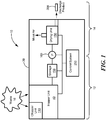
- the organic waste digester system includes a housing and a control system.
- a hopper unit is located within the housing, having an opening to receive organic waste.
- An agitation mechanism mixes the organic waste, and a heater heats the organic waste in the hopper unit.
- a microbe mixture is added to aid in the breakdown of the organic waste.
- the liquefied organic waste is discharged through an outlet to a drying unit downstream of the hopper unit.
- the drying unit comprises a microwave drying unit including a microwave chamber and one or more magnetrons disposed to introduce microwave energy via one or more waveguides into the microwave chamber.
- An organic waste digester system can recycle organic waste including raw and cooked fish, meat and poultry, small bones, eggs and egg shells, fruits, vegetables, dairy products, and grain products.
- organic waste including raw and cooked fish, meat and poultry, small bones, eggs and egg shells, fruits, vegetables, dairy products, and grain products.
- the organic waste is degraded and liquefied by heating and mixing. This process is accelerated by the addition of microbes.
- the liquefied waste is dried and dehydrated.
- the discharge product is 80-90% dry and reduced in mass by 80-90%. It is stable and can be stored for several months.
- This discharge product is a compostable material and can be sent to a compositing facility or to a landfill.
- the discharge product also has uses as an animal feed amendment or a fuel source.
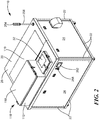
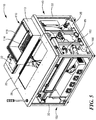
- the system 10 includes a housing 20 for housing the system formed of various structural framing elements 22 connected to form a frame and covered by side panels 24, lower panel 25, and upper panel 26.
- An opening 28, covered with a lid 32, in the upper panel of the housing provides access to the hopper unit 40.
- Organic waste can be deposited directly into the hopper unit 40 through this opening.
- the system also includes a chopper or grinder unit 110, described further below.
- the hopper unit 40 includes a main hopper 42 comprising a hopper bin 44, for example of panels of stainless steel welded or otherwise joined and formed into an appropriate bin shape to receive the waste.
- the hopper bin includes two side panels 46, two end panels 48, and a bottom panel 52.
- the bin is supported within the housing 20 by suitable framing elements 54.
- the main hopper also includes an entrance trough 56 having an open bottom 58 through which the waste is delivered. Waste is deposited into the chopper unit 110, from where it passes through opening 27 into the trough 56 and then into the hopper bin 44.
- a microbe mixture that accelerates the breaking down of the food waste is added directly into the main hopper 42, for example, through the opening 28, covered by a lid 32.
- the microbe mixture typically can be restocked periodically, such as weekly, monthly, quarterly, or annually.
- Mixing of the organic waste with the microbe mixture begins breaking down and liquefying the organic waste.
- Suitable microbe mixtures for the liquefaction of organic waste are known and can be used.
- the microbes can self-regulate their population based on the food supply. In times of high usage and volume, the microbes reproduce and in times of low volume they slow reproduction and go into a dormant state. Users can also view the level of material in the hopper unit through the opening 28 to ensure that the hopper unit is not overfilled.
- the bottom panel 52 is formed with a large opening 68 crossed by with slats 72 spaced apart to form the apertures 64.
- the apertures can be formed in another other manner, such as by providing slits, slots, or holes in the bottom panel or by placing a screen over a large opening in the bottom panel.
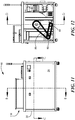
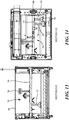
- the hopper unit also includes an agitation mechanism 70 to mix the organic waste to help it break down in the presence of the microbe mixture. See also Figs. 11-15 .
- the agitation mechanism includes a number of auger paddles 72 disposed along an agitator drive shaft 74 in a staggered orientation within the bin 44 of the main hopper 42.
- each auger paddle 72 includes a shaft 76 extending orthogonally from the drive shaft to assist the mixing of the food waste.
- a paddle 78 is disposed at the end of the shaft.
- the paddle can have any suitable configuration, such as flat or chevron-shaped.
- Blades 82 can be disposed along sides of the shaft to help the paddles cut through the organic waste. Eight to ten auger paddles are generally sufficient, although any suitable number can be used, depending on the size of the hopper unit.
- the main hopper 42 can be heated in any suitable manner.
- a mat heater can be attached directly to the outer surfaces of the panels of the hopper.
- the hopper is heated to a temperature range of 27 to 49°C (80 to 120°F).
- the hopper bin can include a layer of an insulating material to retain heat.
- the chopper unit 110 initially chops all the organic material, including meat and small bones, that is deposited into the hopper unit, thereby increasing the surface area of the organic waste, which speeds up decomposition.
- the chopper unit includes a hopper 112 mounted above the opening 27 in the surface 26 of the housing 20, and a chopping blade mechanism 114 that fits within the trough 56.
- An opening 116 covered with a lid 118 provides access to the hopper 112.
- the chopping blade mechanism 114 includes a pair of meshing rotary cutters.
- the chopping blade mechanism can include a rotary chopper knife formed of a number of individual, stacked rotary blade elements aligned and radially spaced equally about a shaft.
- a chopper motor 122 spins the blades on the shaft, thereby chopping any organic waste in the chopper hopper into smaller pieces.
- the chopper motor 122 is also in communication with the control system 250. The organic waste passing through the chopper unit is discharged through the trough directly into the main hopper.
- the chopper unit can be eliminated, if desired, and organic waste can be deposited directly into the hopper bin without an initial chopping.
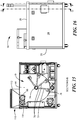
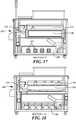
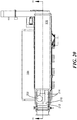
- the sludge is pumped by a pump 160 through suitable hosing or conduits (not shown for clarity) to an inlet 162 of the drying unit 150 of the second stage to effect drying and dehydrating. See Figs. 16-23 .
- suitable fittings to which conduits are attached can be provided at the outlet 65 of the hopper unit and the inlet 162 of the drying unit.
- a level sensor in the hopper unit can be used to determine when an appropriate amount of sludge is available and to send a signal to the control system, which then engages the pump 160.
- the control system 250 then turns on the drying unit to affect the drying and dehydration.
- the drying unit 150 can be located within the housing 20, as shown, or can be external to the housing, for example, adjacent to the housing or on top of the housing.
- a storage vessel 159 can be provided to store the sludge (the liquefied waste) as it is removed from the hopper before transfer to the drying unit.
- the drying unit 150 heats the liquefied sludge to a temperature within a range of 102 to 149°C (215 to 300°F), which is sufficient to effectively kill pathogens, bacteria, and seeds.
- a drying unit 150 uses microwave energy to effect the drying of the sludge.
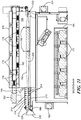
- the drying unit includes a microwave generation chamber 170 for supporting and housing one or more microwave units 172, in communication with the control system 250, a microwave application chamber 190 through which the sludge is transported, for example, on a conveyor belt 192, while being heated by application of the microwave energy, and a microwave suppression chamber 210 at the outlet of the application chamber.
- Each microwave unit 172 includes a high voltage transformer 174 and associated magnetron tube 176 and waveguide 178.
- the waveguides are disposed to direct microwave energy through a wall 182, such as a floor in the embodiment shown, into the microwave application chamber 190.
- the microwave generation chamber 170 housing the magnetron tubes and waveguides is disposed above the microwave application chamber 190, while the associated transformers are housed in a separate power plant enclosure 184 below the application chamber for better control of the high heat generated.
- other configurations can be used if desired, such as placing the microwave application enclosure alongside or above the microwave generation chamber, and/or placing the transformers within the same chamber as the magnetron tubes and waveguides.
- the microwave suppression chamber 210 at the outlet of the microwave application chamber prevents microwave radiation from leaking out of the application chamber.
- the suppression chamber includes an upper wall 212 and lower wall 213 supporting an appropriate number of suppression pins 214 extending into the chamber.
- the pins are of any suitable number, size, and spacing depending on the frequency of the microwaves generated to suppress the microwave radiation. Other suppression configurations can be used.
- the conveyor belt extends through the suppression chamber to transport the dried sludge so that it can be discharged out of the drying unit. The conveyor belt returns below the lower wall 213 and through an opening between the suppression chamber and the application chamber.
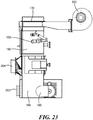
- One or more cooling fans or blowers 202 are disposed to draw cool air into the drying unit to cool the microwave generation enclosure, the power plant enclosure, and the microwave suppression chamber.
- the fans can be disposed in any suitable wall or walls, such as a side wall or ceiling.
- the ambient air within the microwave generation chamber is heated as a byproduct of cooling the magnetrons.
- the heated air can be introduced into the microwave application chamber, for example, through the microwave waveguides.
- the waveguides can include a grate or another suitable opening for the heated ambient air to pass through.
- An exhaust fan 204 is also provided to exhaust air from the drying unit. Any suitable number of cooling fans and exhaust fans can be used.
- the microwave drying unit 150 operates at 2400 MHz frequency, 220 V, 3 phase AC current at 9.6 kilowatts total power. Any suitable number of microwave units can be used, depending on, for example, the application and the amount of material to be digested. In one embodiment, nine microwave units are used. Similarly, any suitable convective and/or forced cooling arrangement of the magnetrons can be used.
- the sludge to be dried passes through the microwave application chamber 190 and suppression chamber 210 in any suitable manner.
- a conveyor belt 192 can be provided that travels the length of the application chamber.
- the sludge enters the application chamber through an inlet 162 and is deposited onto the conveyor belt.
- the inlet can include, for example, a tube fitting connected to a conduit from the pump 160.
- the sludge passes along, for example, beneath, the row of waveguides 178 of the microwave units, which directs microwave energy and heated air onto the sludge.
- the sludge is thereby heated by radiative heating and convective heating to effect the drying.
- a temperature sensor 194 (see Fig. 21 ) is disposed in the application chamber near the output end.
- an infrared temperature sensor is used to monitor the temperature of the sludge as it exits the conveyor belt.
- the temperature of the sludge is roughly analogous to the final moisture content of the sludge.
- the particular correlation depends on the type of organic waste that is introduced into the system, and can be readily determined by testing. For example, in one example, a temperature of at least 171°C (340°F) indicates a moisture content of no more than 10%.
- the type of organic waste is generally consistent at a particular location, and thus once a correlation between temperature and moisture content has been determined for that location, the temperature can serve as a suitable determination of the moisture content.
- the moisture content of the sludge as it is discharged from the application chamber is in the range of 10 to 13%. It will be appreciated that the moisture content can vary, for example, from a low of 1%, 2%, 3%, 4%, 5%, 6%, 7%, 8%, 9%, or 10% to a high of 13%, 14%, 15%, 20% or 25%.
- the temperature sensor is in communication with the control system, which can control each of the microwave units individually to provide a desired amount of heating. For example, the control system can operate the microwave units closest to the inlet end of the application chamber at a higher power to provide a greater amount of heating to the sludge. The microwave units nearer the outlet end can be operated as needed, depending on the moisture content of the sludge.
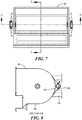
- the conveyor belt 192 is formed of a soft material that is able to be formed with a cupped shape in transverse cross section at and near the inlet end of the application chamber.
- the cupped shaped is formed by side guards 196 (shown schematically in Fig. 21 ).
- the entering sludge still has a high moisture content, and the cupped shape of the conveyor belt retains the water within the longitudinal edges of the belt while the sludge is heated and the water evaporates.
- the belt is also solid, so that liquids and solid particulates cannot fall through. As the sludge dries and is transported toward the outlet end of the application chamber, the conveyor belt takes on a flat configuration, such that it is substantially flat at the discharge end.
- the flat configuration of the belt at the discharge end allows the sludge to be more readily removed from the conveyor belt, for example, with a blade, knife, or scraper 198 at the discharge end the belt.
- a cutting blade or knife 198 operable by a motor 199 in communication with the control system 250, is provided at the discharge end of the belt to cut the sludge into blocks or segments.
- the conveyor belt includes any suitable driving mechanism, such as a drive roller 222, motor 224, a return roller 226, and tensioning mechanism.
- An idler roller 228 can be provided to flatten the belt.
- a suitable material for the belt is a silicone material, which can be repeatedly deformed into a cupped configuration at the entrance and then flattened at the discharge end as the belt cycles through the application chamber.
- the conveyor belt deposits the sludge into an outlet duct 230.
- the dried sludge 300 can be collected and transported to a collection device.
- the outlet duct can be in communication with a vacuum source to assist in pulling the dried sludge off the conveyor belt and into and through the outlet duct.
- Process air in the application chamber is also vented through the exhaust duct.
- exhaust products from the application chamber can be conveyed via a vacuum system into a collection canister.
- the process air can be filtered to remove any suspended particles and exhausted to ambient through a vacuum blower.
- the process air can be transmitted to an air dryer or dehumidifier that removes moisture before discharging the dehumidified air to ambient.
- the control system 250 can be located in a panel 260 that also houses the electrical wiring, fuses, circuit breakers, and the like.
- the control system 250 is a programmable logic controller.
- the control system includes a display 252 with an operator input device such as a keypad and a display screen for outputting messages.
- the control system can be programmed to indicate any stoppages, failures, errors, or maintenance needs.
- a cut-off switch can be provided so that, when the main hopper lid 32, the chopper lid 118, or an access panel 119 is opened during operation, the unit shuts off.
- a visual indicator light or lights 254 can be provided to illuminate when the main hopper lid and/or the chopper lid are open. In one embodiment, lights are provided on a pole 256 elevated above the housing so that they are readily visible.
- An emergency stop button 258 can be located in a relatively accessible location on the outside of the unit.
- the present organic waste digester system is able to maintain optimum levels of aeration, moisture and temperature during the digesting process.
- the system is selfcontained and organic waste can be continually added.
- the cycle time from initial input of organic waste to the discharge of a compostable material can be as little as 3.5 hours.
- the system does not require the addition of water and does not need to be plumbed into an existing water supply.
- the organic waste digester system does not discharge gray water. No liquid waste is produced during the evaporation process.
Landscapes
- Chemical & Material Sciences (AREA)
- Engineering & Computer Science (AREA)
- Life Sciences & Earth Sciences (AREA)
- Health & Medical Sciences (AREA)
- Organic Chemistry (AREA)
- Biochemistry (AREA)
- Zoology (AREA)
- Molecular Biology (AREA)
- Microbiology (AREA)
- Biotechnology (AREA)
- Bioinformatics & Cheminformatics (AREA)
- Wood Science & Technology (AREA)
- General Health & Medical Sciences (AREA)
- General Chemical & Material Sciences (AREA)
- Chemical Kinetics & Catalysis (AREA)
- Food Science & Technology (AREA)
- Biomedical Technology (AREA)
- Sustainable Development (AREA)
- General Engineering & Computer Science (AREA)
- Genetics & Genomics (AREA)
- Environmental & Geological Engineering (AREA)
- Polymers & Plastics (AREA)
- Manufacturing & Machinery (AREA)
- Toxicology (AREA)
- Animal Husbandry (AREA)
- Agronomy & Crop Science (AREA)
- Oil, Petroleum & Natural Gas (AREA)
- Mechanical Engineering (AREA)
- Treatment Of Sludge (AREA)
- Processing Of Solid Wastes (AREA)
Claims (13)
- Système digesteur de déchets organiques comprenant :une unité à trémie (40), l'unité à trémie comprenant une cuve (44) destinée à recevoir des déchets organiques, un mécanisme d'agitation (70) permettant de mélanger les déchets organiques, un chauffage destiné à chauffer les déchets organiques au sein de la cuve, et une sortie (65) par laquelle les déchets organiques liquéfiés sont déchargés ;une unité de séchage (150) en aval de l'unité à trémie et destinée à recevoir et à sécher les déchets organiques liquéfiés provenant de l'unité à trémie, l'unité de séchage comprenant :une unité de séchage à micro-ondes, où l'unité de séchage à micro-ondes comprend une chambre de génération de micro-ondes (170) et une chambre d'application de micro-ondes (190), où la chambre de génération de micro-ondes comprend une pluralité d'unités à micro-ondes (172), chaque unité à micro-ondes comprenant un guide d'ondes (178) disposé pour diriger le rayonnement micro-ondes direct dans la chambre d'application des micro-ondes, etun transporteur (192) agencé pour parcourir la chambre d'application de micro-ondes, le transporteur étant configuré pour recevoir les déchets organiques liquéfiés provenant de l'unité à trémie.
- Système de la revendication 1, comprenant en outre un ou plusieurs ventilateurs de refroidissement (202) dans la chambre de génération de micro-ondes pour refroidir les unités à micro-ondes.
- Système de la revendication 1, comprenant en outre une ou plusieurs ouvertures entre la chambre de génération de micro-ondes et la chambre d'application de micro-ondes pour diriger de l'air chauffé dans la chambre d'application de micro-ondes.
- Système de la revendication 3, dans lequel une ou plusieurs ouvertures sont disposées via un guide d'ondes associé (178).
- Système de la revendication 1, comprenant en outre une chambre de suppression de micro-ondes (210) disposée au niveau d'une sortie de la chambre d'application de micro-ondes, où le transporteur est agencé pour se déplacer à travers la chambre de suppression de micro-ondes.
- Système de la revendication 1, dans lequel le transporteur comprend une courroie transporteuse présentant une forme de coupe en coupe transversale au niveau d'une extrémité d'entrée de l'unité de séchage à micro-ondes et une configuration plane au niveau d'une extrémité de sortie de l'unité de séchage à micro-ondes.
- Système de la revendication 6, comprenant en outre un conduit de sortie disposé au niveau d'une extrémité de sortie de l'unité de séchage à micro-ondes pour recevoir les déchets organiques, et une lame (198) disposée pour retirer par raclage les déchets organiques du transporteur dans le conduit de sortie.
- Système de la revendication 7, comprenant en outre une source de vide disposée pour exercer une pression négative au niveau du conduit de sortie.
- Système de la revendication 1, comprenant en outre un conduit d'évacuation disposé au niveau d'une extrémité de sortie de l'unité de séchage à micro-ondes, configurée pour retirer les produits d'évacuation de l'unité de séchage à micro-ondes, et un filtre sur le conduit d'évacuation pour éliminer les particules en suspension.
- Système de la revendication 9, comprenant en outre un récipient de collecte sur le conduit d'évacuation pour recevoir les particules sèches.
- Système de la revendication 9, comprenant en outre un déshumidificateur sur le conduit d'évacuation pour éliminer l'humidité de l'air du processus.
- Système de la revendication 1, comprenant en outre un système de commande (250) en communication avec l'unité à trémie et l'unité de séchage, et une trémie-broyeuse (112) et un mécanisme de broyeuse (114) disposé au niveau d'une entrée vers la cuve de l'unité à trémie.
- Système de la revendication 1, dans lequel le chauffage fonctionne pour chauffer la cuve à une plage de température de 27 à 49 °C (80 à 120 °F), et comprenant en outre un mélange de microbes permettant d'accélérer la décomposition des déchets organiques au sein de la cuve.
Applications Claiming Priority (2)
| Application Number | Priority Date | Filing Date | Title |
|---|---|---|---|
| US201462033437P | 2014-08-05 | 2014-08-05 | |
| PCT/US2015/033212 WO2016022198A1 (fr) | 2014-08-05 | 2015-05-29 | Système digesteur de déchets organiques |
Publications (3)
| Publication Number | Publication Date |
|---|---|
| EP3186018A1 EP3186018A1 (fr) | 2017-07-05 |
| EP3186018A4 EP3186018A4 (fr) | 2018-03-21 |
| EP3186018B1 true EP3186018B1 (fr) | 2021-09-01 |
Family
ID=55264297
Family Applications (1)
| Application Number | Title | Priority Date | Filing Date |
|---|---|---|---|
| EP15830090.5A Not-in-force EP3186018B1 (fr) | 2014-08-05 | 2015-05-29 | Système digesteur de déchets organiques |
Country Status (4)
| Country | Link |
|---|---|
| US (1) | US10563165B2 (fr) |
| EP (1) | EP3186018B1 (fr) |
| CA (1) | CA2994390C (fr) |
| WO (1) | WO2016022198A1 (fr) |
Families Citing this family (16)
| Publication number | Priority date | Publication date | Assignee | Title |
|---|---|---|---|---|
| CN104230400B (zh) * | 2014-09-16 | 2016-09-14 | 中国环境科学研究院 | 一种餐厨废弃物快速资源化处理设备 |
| DE102016114043B3 (de) * | 2016-07-29 | 2017-08-10 | Technische Universität Dresden | Vorrichtung zur Isolierung von Stammzellen aus fötalen Geweben |
| CN108393327B (zh) * | 2018-02-08 | 2020-12-29 | 衢州学院 | 垃圾处理机 |
| IT201800000548A1 (it) * | 2018-03-02 | 2019-09-02 | Emanuele Montalbano | Impianto mobile per la biostabilizzazione ed il compostaggio della frazione organica derivante da scarti industriali, raccolta differenziata (forsu) e dal trattamento meccanico di rifiuti indifferenziati |
| US12251705B2 (en) | 2019-05-07 | 2025-03-18 | Food Cycle Science Corporation | System and method for providing a food recycler having a bucket and grinder for processing food |
| US11389804B2 (en) * | 2019-05-07 | 2022-07-19 | Food Cycle Science Corporation | System and method for providing volumetric efficiency in a food recycling unit |
| GB2591123B (en) * | 2020-01-16 | 2023-01-18 | Rdc Tech Ltd | An apparatus to effect at least partial breakdown of a material or product item or a combination of materials or product items |
| CN111530899B (zh) * | 2020-05-29 | 2024-06-21 | 桂林益克垃环保科技有限公司 | 集成式生活垃圾多功能处理设备 |
| CN112226261B (zh) * | 2020-10-12 | 2021-06-04 | 新宁新欣热能科技有限公司 | 一种生物颗粒燃料生产方法 |
| US11780749B2 (en) * | 2020-12-10 | 2023-10-10 | John Otis Farneman | Electromagnetic energy system for the breakdown and destruction of organic waste |
| JP7505131B2 (ja) | 2021-05-27 | 2024-06-24 | バイオグリーン 360 インク. | 有機性廃棄物管理システム |
| US12472507B2 (en) | 2021-09-01 | 2025-11-18 | Chewie Labs Llc | Integrating intelligent sensing and safety assurance into organic matter processing apparatus |
| US12530662B2 (en) | 2021-09-01 | 2026-01-20 | Chewie Labs Llc | Network-connected apparatus promoting environmentally responsible processing and disposition of organic matter data |
| US12448208B2 (en) | 2021-09-01 | 2025-10-21 | Chewie Labs Llc | Apparatus for processing organic matter having lid and air treatment system promoting pleasant user experience |
| US12427556B2 (en) | 2021-09-01 | 2025-09-30 | Chewie Labs Llc | User-removable, electrically heated, and mechanically actuated bucket unit for organic matter processing apparatus |
| WO2023034172A1 (fr) | 2021-09-01 | 2023-03-09 | Mill Industries, LLC | Appareil de traitement de matière organique pour favoriser la réduction nette de méthane et d'autres émissions de gaz à effet de serre |
Family Cites Families (29)
| Publication number | Priority date | Publication date | Assignee | Title |
|---|---|---|---|---|
| US3233976A (en) | 1959-11-24 | 1966-02-08 | Waste Processes Inc | Apparatus for converting waste material into fertilizer |
| US3872603A (en) | 1968-01-30 | 1975-03-25 | Varian Associates | Apparatus for drying materials employing spaced microwave heating and transverse-flow moisture flushing stations |
| US3556286A (en) * | 1968-05-18 | 1971-01-19 | Kuraray Co | Endless belt conveyor |
| US3590202A (en) * | 1970-02-24 | 1971-06-29 | Bechtel Corp | Construction for tuning microwave heating applicator |
| US4035598A (en) * | 1974-10-22 | 1977-07-12 | Johannes Menschner Maschinenfabrik Gmbh & Co. Kg. | Apparatus for thermally treating polymeric workpieces with microwave energy |
| US5028010A (en) * | 1989-12-18 | 1991-07-02 | Itex Enterprises, Inc. | Apparatus for mixing solid or semi-solid wastes with additives |
| KR960015463B1 (ko) | 1992-06-01 | 1996-11-14 | 마쯔시다덴기산교 가부시기가이샤 | 고주파가열장치 |
| DE4241754C1 (de) * | 1992-12-11 | 1994-04-07 | Ikotek Informatik Kommunikat | Verfahren zur Aufbereitung von Sekundärrohstoffen aus Abfällen und Anlage zur Durchführung des Verfahrens |
| JP3303892B2 (ja) | 1993-07-12 | 2002-07-22 | 中部ドラム罐工業株式会社 | 生ゴミの高速発酵処理装置 |
| JPH07157386A (ja) * | 1993-12-01 | 1995-06-20 | Toyo Dynam Kk | 有機性廃棄物の処理方法および処理装置 |
| US5980823A (en) * | 1996-05-27 | 1999-11-09 | Jidosha Buhin Kogyo Co., Ltd. | Garbage processing apparatus having deodorizing unit |
| US6139744A (en) * | 1997-07-05 | 2000-10-31 | Microseptec, Inc. | Waste treatment device and method employing the same |
| US6224646B1 (en) * | 1997-10-17 | 2001-05-01 | Manitoba Ltd. | Waste treatment system |
| CZ20004714A3 (cs) | 1998-07-01 | 2001-09-12 | The Procter & Gamble Company | Způsob odstraňování vody z vláknitého rouna za použití oscilačního reverzního proudu dopadajícího plynu |
| US20020030012A1 (en) | 2000-04-19 | 2002-03-14 | Sullivan John Michael | Comprehensive waste treatment system and related methods for animal feeding operations to effectively recover waste solids for beneficial re-use and for treatment of wastewater for nutrient removal and recycle, re-use or discharge |
| US8981250B2 (en) | 2001-07-16 | 2015-03-17 | Foret Plasma Labs, Llc | Apparatus for treating a substance with wave energy from plasma and an electrical Arc |
| US6675958B2 (en) * | 2001-08-15 | 2004-01-13 | Kaeb Sales Inc. | Tube conveyor |
| JP2006510487A (ja) | 2002-11-25 | 2006-03-30 | シーツ,リチャード,ジー | 動物性廃棄液の処理 |
| US7002122B2 (en) * | 2003-10-24 | 2006-02-21 | The Ferrite Company, Inc. | Choke assembly for continuous conveyor microwave oven |
| KR100541159B1 (ko) * | 2004-03-02 | 2006-01-10 | (주)대우건설 | 마이크로파와 가열을 이용한 하수슬러지 처리장치 및 방법 |
| US20060049185A1 (en) * | 2004-08-23 | 2006-03-09 | Masson Randall S | Conveyor belt configurations for microwave oven |
| SE529368C2 (sv) * | 2005-10-07 | 2007-07-17 | Metso Minerals Wear Prot Ab | Skrapblad och förfarande för tillverkning av sådant |
| WO2008126114A1 (fr) * | 2007-04-13 | 2008-10-23 | Tecnoimpianti Srl | Installation et procédé pour la transformation de matière organique |
| GB2462651B (en) | 2008-08-15 | 2010-10-06 | Advasol Man Ltd | Method and apparatus for in-vessel composting and digestion of biodegradable waste |
| US20110179841A1 (en) * | 2010-01-27 | 2011-07-28 | James Cheng-Shyong Lu | High-rate composting process and equipment |
| CA2801429C (fr) * | 2010-04-23 | 2018-06-12 | Organic Fuel Technology A/S | Procede pour la production de biocarburant |
| US20130089918A1 (en) * | 2010-07-08 | 2013-04-11 | Bio-Cosmo Technologies Limited | Food Waste Digestion System |
| MX2011009257A (es) | 2010-07-13 | 2012-10-02 | Ecologico Logic Inc | Sistema de digestion de desperdicios de solidos. |
| US9603203B2 (en) * | 2013-11-26 | 2017-03-21 | Industrial Microwave Systems, L.L.C. | Tubular waveguide applicator |
-
2015
- 2015-05-29 CA CA2994390A patent/CA2994390C/fr active Active
- 2015-05-29 WO PCT/US2015/033212 patent/WO2016022198A1/fr not_active Ceased
- 2015-05-29 EP EP15830090.5A patent/EP3186018B1/fr not_active Not-in-force
- 2015-05-29 US US15/501,595 patent/US10563165B2/en not_active Expired - Fee Related
Also Published As
| Publication number | Publication date |
|---|---|
| US10563165B2 (en) | 2020-02-18 |
| EP3186018A4 (fr) | 2018-03-21 |
| CA2994390C (fr) | 2022-08-16 |
| US20170226466A1 (en) | 2017-08-10 |
| CA2994390A1 (fr) | 2016-02-11 |
| EP3186018A1 (fr) | 2017-07-05 |
| WO2016022198A1 (fr) | 2016-02-11 |
Similar Documents
| Publication | Publication Date | Title |
|---|---|---|
| EP3186018B1 (fr) | Système digesteur de déchets organiques | |
| KR200490770Y1 (ko) | 음식물 쓰레기 처리장치용 이송스크류 | |
| JP2004222589A (ja) | 食用植物料理品等の脱液乾燥装置及びその方法 | |
| WO2016043656A1 (fr) | Appareil de traitement de déchets alimentaires | |
| KR20240035952A (ko) | 마이크로파 폐기물 가열 시스템 및 관련 특징부 | |
| JP3659397B2 (ja) | 乾燥装置及びその乾燥方法 | |
| WO2022250663A1 (fr) | Système de chauffage de déchets par micro-ondes | |
| KR20120111162A (ko) | 폐사 어류를 이용한 유기질 비료 생산장치 | |
| KR20150129596A (ko) | 고형 연료 제조 장치 및 고형 연료 제조 방법 | |
| CN202427704U (zh) | 用于食品废弃物的处理系统 | |
| JP2004503262A (ja) | 成長媒体を殺菌および/または滅菌するための方法および装置 | |
| CN218202578U (zh) | 一种生物质垃圾资源转化设备 | |
| KR101730971B1 (ko) | 신속 저염김치 제조시스템 | |
| CN203159493U (zh) | 一种有机废弃物自然好氧堆肥设备 | |
| KR20000010468A (ko) | 경사진 스크루 컨베어를 이용하여 남은 음식물을 활용한 자동혼합, 파쇄, 발효, 살균, 건조기능을 가진 사료 배합기 | |
| KR100722788B1 (ko) | 음식물 쓰레기 처리장치 | |
| KR102194977B1 (ko) | 음식물 쓰레기 처리장치 | |
| KR100851956B1 (ko) | 폐기물 처리장치 | |
| KR100757401B1 (ko) | 음식물쓰레기 분쇄 건조장치 | |
| KR20230047283A (ko) | 유기물 처리 장치 | |
| KR20020035682A (ko) | 음식물쓰레기 사료화 시스템 | |
| RU2820685C1 (ru) | Сушилка мясных отходов с СВЧ-энергоподводом в электроприводной цилиндрический ситовый резонатор | |
| CN114349546A (zh) | 一种有机物降解处理方法及装置 | |
| KR101286856B1 (ko) | 음식물처리기의 이송부재 및 이를 이용한 멸균 건조장치 | |
| KR200488875Y1 (ko) | 음식물 쓰레기 처리장치용 가열장치 |
Legal Events
| Date | Code | Title | Description |
|---|---|---|---|
| STAA | Information on the status of an ep patent application or granted ep patent |
Free format text: STATUS: THE INTERNATIONAL PUBLICATION HAS BEEN MADE |
|
| PUAI | Public reference made under article 153(3) epc to a published international application that has entered the european phase |
Free format text: ORIGINAL CODE: 0009012 |
|
| STAA | Information on the status of an ep patent application or granted ep patent |
Free format text: STATUS: REQUEST FOR EXAMINATION WAS MADE |
|
| 17P | Request for examination filed |
Effective date: 20170301 |
|
| AK | Designated contracting states |
Kind code of ref document: A1 Designated state(s): AL AT BE BG CH CY CZ DE DK EE ES FI FR GB GR HR HU IE IS IT LI LT LU LV MC MK MT NL NO PL PT RO RS SE SI SK SM TR |
|
| AX | Request for extension of the european patent |
Extension state: BA ME |
|
| DAV | Request for validation of the european patent (deleted) | ||
| DAX | Request for extension of the european patent (deleted) | ||
| RIN1 | Information on inventor provided before grant (corrected) |
Inventor name: GRILLO, PAUL Inventor name: SECOVICH, BRUCE |
|
| A4 | Supplementary search report drawn up and despatched |
Effective date: 20180220 |
|
| RIC1 | Information provided on ipc code assigned before grant |
Ipc: C05F 17/02 20060101ALI20180214BHEP Ipc: C05F 17/00 20060101ALI20180214BHEP Ipc: C05F 9/02 20060101ALI20180214BHEP Ipc: B09B 3/00 20060101AFI20180214BHEP |
|
| STAA | Information on the status of an ep patent application or granted ep patent |
Free format text: STATUS: EXAMINATION IS IN PROGRESS |
|
| 17Q | First examination report despatched |
Effective date: 20200124 |
|
| GRAP | Despatch of communication of intention to grant a patent |
Free format text: ORIGINAL CODE: EPIDOSNIGR1 |
|
| STAA | Information on the status of an ep patent application or granted ep patent |
Free format text: STATUS: GRANT OF PATENT IS INTENDED |
|
| RIC1 | Information provided on ipc code assigned before grant |
Ipc: C05F 9/02 20060101ALI20210311BHEP Ipc: C05B 11/08 20060101ALI20210311BHEP Ipc: B09B 3/00 20060101AFI20210311BHEP |
|
| INTG | Intention to grant announced |
Effective date: 20210408 |
|
| GRAS | Grant fee paid |
Free format text: ORIGINAL CODE: EPIDOSNIGR3 |
|
| GRAF | Information related to payment of grant fee modified |
Free format text: ORIGINAL CODE: EPIDOSCIGR3 |
|
| GRAA | (expected) grant |
Free format text: ORIGINAL CODE: 0009210 |
|
| STAA | Information on the status of an ep patent application or granted ep patent |
Free format text: STATUS: THE PATENT HAS BEEN GRANTED |
|
| AK | Designated contracting states |
Kind code of ref document: B1 Designated state(s): AL AT BE BG CH CY CZ DE DK EE ES FI FR GB GR HR HU IE IS IT LI LT LU LV MC MK MT NL NO PL PT RO RS SE SI SK SM TR |
|
| REG | Reference to a national code |
Ref country code: GB Ref legal event code: FG4D |
|
| REG | Reference to a national code |
Ref country code: CH Ref legal event code: EP Ref country code: AT Ref legal event code: REF Ref document number: 1425672 Country of ref document: AT Kind code of ref document: T Effective date: 20210915 |
|
| REG | Reference to a national code |
Ref country code: DE Ref legal event code: R096 Ref document number: 602015072950 Country of ref document: DE |
|
| REG | Reference to a national code |
Ref country code: IE Ref legal event code: FG4D |
|
| REG | Reference to a national code |
Ref country code: LT Ref legal event code: MG9D |
|
| REG | Reference to a national code |
Ref country code: NL Ref legal event code: MP Effective date: 20210901 |
|
| PG25 | Lapsed in a contracting state [announced via postgrant information from national office to epo] |
Ref country code: HR Free format text: LAPSE BECAUSE OF FAILURE TO SUBMIT A TRANSLATION OF THE DESCRIPTION OR TO PAY THE FEE WITHIN THE PRESCRIBED TIME-LIMIT Effective date: 20210901 Ref country code: SE Free format text: LAPSE BECAUSE OF FAILURE TO SUBMIT A TRANSLATION OF THE DESCRIPTION OR TO PAY THE FEE WITHIN THE PRESCRIBED TIME-LIMIT Effective date: 20210901 Ref country code: RS Free format text: LAPSE BECAUSE OF FAILURE TO SUBMIT A TRANSLATION OF THE DESCRIPTION OR TO PAY THE FEE WITHIN THE PRESCRIBED TIME-LIMIT Effective date: 20210901 Ref country code: LT Free format text: LAPSE BECAUSE OF FAILURE TO SUBMIT A TRANSLATION OF THE DESCRIPTION OR TO PAY THE FEE WITHIN THE PRESCRIBED TIME-LIMIT Effective date: 20210901 Ref country code: BG Free format text: LAPSE BECAUSE OF FAILURE TO SUBMIT A TRANSLATION OF THE DESCRIPTION OR TO PAY THE FEE WITHIN THE PRESCRIBED TIME-LIMIT Effective date: 20211201 Ref country code: NO Free format text: LAPSE BECAUSE OF FAILURE TO SUBMIT A TRANSLATION OF THE DESCRIPTION OR TO PAY THE FEE WITHIN THE PRESCRIBED TIME-LIMIT Effective date: 20211201 Ref country code: FI Free format text: LAPSE BECAUSE OF FAILURE TO SUBMIT A TRANSLATION OF THE DESCRIPTION OR TO PAY THE FEE WITHIN THE PRESCRIBED TIME-LIMIT Effective date: 20210901 Ref country code: ES Free format text: LAPSE BECAUSE OF FAILURE TO SUBMIT A TRANSLATION OF THE DESCRIPTION OR TO PAY THE FEE WITHIN THE PRESCRIBED TIME-LIMIT Effective date: 20210901 |
|
| REG | Reference to a national code |
Ref country code: AT Ref legal event code: MK05 Ref document number: 1425672 Country of ref document: AT Kind code of ref document: T Effective date: 20210901 |
|
| PG25 | Lapsed in a contracting state [announced via postgrant information from national office to epo] |
Ref country code: PL Free format text: LAPSE BECAUSE OF FAILURE TO SUBMIT A TRANSLATION OF THE DESCRIPTION OR TO PAY THE FEE WITHIN THE PRESCRIBED TIME-LIMIT Effective date: 20210901 Ref country code: LV Free format text: LAPSE BECAUSE OF FAILURE TO SUBMIT A TRANSLATION OF THE DESCRIPTION OR TO PAY THE FEE WITHIN THE PRESCRIBED TIME-LIMIT Effective date: 20210901 Ref country code: GR Free format text: LAPSE BECAUSE OF FAILURE TO SUBMIT A TRANSLATION OF THE DESCRIPTION OR TO PAY THE FEE WITHIN THE PRESCRIBED TIME-LIMIT Effective date: 20211202 |
|
| PG25 | Lapsed in a contracting state [announced via postgrant information from national office to epo] |
Ref country code: AT Free format text: LAPSE BECAUSE OF FAILURE TO SUBMIT A TRANSLATION OF THE DESCRIPTION OR TO PAY THE FEE WITHIN THE PRESCRIBED TIME-LIMIT Effective date: 20210901 |
|
| PG25 | Lapsed in a contracting state [announced via postgrant information from national office to epo] |
Ref country code: IS Free format text: LAPSE BECAUSE OF FAILURE TO SUBMIT A TRANSLATION OF THE DESCRIPTION OR TO PAY THE FEE WITHIN THE PRESCRIBED TIME-LIMIT Effective date: 20220101 Ref country code: SM Free format text: LAPSE BECAUSE OF FAILURE TO SUBMIT A TRANSLATION OF THE DESCRIPTION OR TO PAY THE FEE WITHIN THE PRESCRIBED TIME-LIMIT Effective date: 20210901 Ref country code: SK Free format text: LAPSE BECAUSE OF FAILURE TO SUBMIT A TRANSLATION OF THE DESCRIPTION OR TO PAY THE FEE WITHIN THE PRESCRIBED TIME-LIMIT Effective date: 20210901 Ref country code: RO Free format text: LAPSE BECAUSE OF FAILURE TO SUBMIT A TRANSLATION OF THE DESCRIPTION OR TO PAY THE FEE WITHIN THE PRESCRIBED TIME-LIMIT Effective date: 20210901 Ref country code: PT Free format text: LAPSE BECAUSE OF FAILURE TO SUBMIT A TRANSLATION OF THE DESCRIPTION OR TO PAY THE FEE WITHIN THE PRESCRIBED TIME-LIMIT Effective date: 20220103 Ref country code: NL Free format text: LAPSE BECAUSE OF FAILURE TO SUBMIT A TRANSLATION OF THE DESCRIPTION OR TO PAY THE FEE WITHIN THE PRESCRIBED TIME-LIMIT Effective date: 20210901 Ref country code: EE Free format text: LAPSE BECAUSE OF FAILURE TO SUBMIT A TRANSLATION OF THE DESCRIPTION OR TO PAY THE FEE WITHIN THE PRESCRIBED TIME-LIMIT Effective date: 20210901 Ref country code: CZ Free format text: LAPSE BECAUSE OF FAILURE TO SUBMIT A TRANSLATION OF THE DESCRIPTION OR TO PAY THE FEE WITHIN THE PRESCRIBED TIME-LIMIT Effective date: 20210901 Ref country code: AL Free format text: LAPSE BECAUSE OF FAILURE TO SUBMIT A TRANSLATION OF THE DESCRIPTION OR TO PAY THE FEE WITHIN THE PRESCRIBED TIME-LIMIT Effective date: 20210901 |
|
| REG | Reference to a national code |
Ref country code: DE Ref legal event code: R097 Ref document number: 602015072950 Country of ref document: DE |
|
| PLBE | No opposition filed within time limit |
Free format text: ORIGINAL CODE: 0009261 |
|
| STAA | Information on the status of an ep patent application or granted ep patent |
Free format text: STATUS: NO OPPOSITION FILED WITHIN TIME LIMIT |
|
| PG25 | Lapsed in a contracting state [announced via postgrant information from national office to epo] |
Ref country code: IT Free format text: LAPSE BECAUSE OF FAILURE TO SUBMIT A TRANSLATION OF THE DESCRIPTION OR TO PAY THE FEE WITHIN THE PRESCRIBED TIME-LIMIT Effective date: 20210901 Ref country code: DK Free format text: LAPSE BECAUSE OF FAILURE TO SUBMIT A TRANSLATION OF THE DESCRIPTION OR TO PAY THE FEE WITHIN THE PRESCRIBED TIME-LIMIT Effective date: 20210901 |
|
| PGFP | Annual fee paid to national office [announced via postgrant information from national office to epo] |
Ref country code: GB Payment date: 20220527 Year of fee payment: 8 Ref country code: FR Payment date: 20220525 Year of fee payment: 8 Ref country code: DE Payment date: 20220527 Year of fee payment: 8 |
|
| 26N | No opposition filed |
Effective date: 20220602 |
|
| PG25 | Lapsed in a contracting state [announced via postgrant information from national office to epo] |
Ref country code: SI Free format text: LAPSE BECAUSE OF FAILURE TO SUBMIT A TRANSLATION OF THE DESCRIPTION OR TO PAY THE FEE WITHIN THE PRESCRIBED TIME-LIMIT Effective date: 20210901 |
|
| REG | Reference to a national code |
Ref country code: CH Ref legal event code: PL |
|
| REG | Reference to a national code |
Ref country code: BE Ref legal event code: MM Effective date: 20220531 |
|
| PG25 | Lapsed in a contracting state [announced via postgrant information from national office to epo] |
Ref country code: MC Free format text: LAPSE BECAUSE OF FAILURE TO SUBMIT A TRANSLATION OF THE DESCRIPTION OR TO PAY THE FEE WITHIN THE PRESCRIBED TIME-LIMIT Effective date: 20210901 Ref country code: LU Free format text: LAPSE BECAUSE OF NON-PAYMENT OF DUE FEES Effective date: 20220529 Ref country code: LI Free format text: LAPSE BECAUSE OF NON-PAYMENT OF DUE FEES Effective date: 20220531 Ref country code: CH Free format text: LAPSE BECAUSE OF NON-PAYMENT OF DUE FEES Effective date: 20220531 |
|
| PG25 | Lapsed in a contracting state [announced via postgrant information from national office to epo] |
Ref country code: IE Free format text: LAPSE BECAUSE OF NON-PAYMENT OF DUE FEES Effective date: 20220529 |
|
| PG25 | Lapsed in a contracting state [announced via postgrant information from national office to epo] |
Ref country code: BE Free format text: LAPSE BECAUSE OF NON-PAYMENT OF DUE FEES Effective date: 20220531 |
|
| P01 | Opt-out of the competence of the unified patent court (upc) registered |
Effective date: 20230519 |
|
| REG | Reference to a national code |
Ref country code: DE Ref legal event code: R119 Ref document number: 602015072950 Country of ref document: DE |
|
| GBPC | Gb: european patent ceased through non-payment of renewal fee |
Effective date: 20230529 |
|
| PG25 | Lapsed in a contracting state [announced via postgrant information from national office to epo] |
Ref country code: HU Free format text: LAPSE BECAUSE OF FAILURE TO SUBMIT A TRANSLATION OF THE DESCRIPTION OR TO PAY THE FEE WITHIN THE PRESCRIBED TIME-LIMIT; INVALID AB INITIO Effective date: 20150529 |
|
| PG25 | Lapsed in a contracting state [announced via postgrant information from national office to epo] |
Ref country code: MK Free format text: LAPSE BECAUSE OF FAILURE TO SUBMIT A TRANSLATION OF THE DESCRIPTION OR TO PAY THE FEE WITHIN THE PRESCRIBED TIME-LIMIT Effective date: 20210901 Ref country code: DE Free format text: LAPSE BECAUSE OF NON-PAYMENT OF DUE FEES Effective date: 20231201 Ref country code: CY Free format text: LAPSE BECAUSE OF FAILURE TO SUBMIT A TRANSLATION OF THE DESCRIPTION OR TO PAY THE FEE WITHIN THE PRESCRIBED TIME-LIMIT Effective date: 20210901 Ref country code: GB Free format text: LAPSE BECAUSE OF NON-PAYMENT OF DUE FEES Effective date: 20230529 |
|
| PG25 | Lapsed in a contracting state [announced via postgrant information from national office to epo] |
Ref country code: FR Free format text: LAPSE BECAUSE OF NON-PAYMENT OF DUE FEES Effective date: 20230531 |
|
| PG25 | Lapsed in a contracting state [announced via postgrant information from national office to epo] |
Ref country code: MT Free format text: LAPSE BECAUSE OF FAILURE TO SUBMIT A TRANSLATION OF THE DESCRIPTION OR TO PAY THE FEE WITHIN THE PRESCRIBED TIME-LIMIT Effective date: 20210901 |
|
| PG25 | Lapsed in a contracting state [announced via postgrant information from national office to epo] |
Ref country code: TR Free format text: LAPSE BECAUSE OF FAILURE TO SUBMIT A TRANSLATION OF THE DESCRIPTION OR TO PAY THE FEE WITHIN THE PRESCRIBED TIME-LIMIT Effective date: 20210901 |