EP3187199A1 - Dispositifs médicaux hydrophiles - Google Patents
Dispositifs médicaux hydrophiles Download PDFInfo
- Publication number
- EP3187199A1 EP3187199A1 EP15202776.9A EP15202776A EP3187199A1 EP 3187199 A1 EP3187199 A1 EP 3187199A1 EP 15202776 A EP15202776 A EP 15202776A EP 3187199 A1 EP3187199 A1 EP 3187199A1
- Authority
- EP
- European Patent Office
- Prior art keywords
- medical device
- polymer
- hydrophilic
- layer
- substrate
- Prior art date
- Legal status (The legal status is an assumption and is not a legal conclusion. Google has not performed a legal analysis and makes no representation as to the accuracy of the status listed.)
- Granted
Links
Images

Classifications
-
- A—HUMAN NECESSITIES
- A61—MEDICAL OR VETERINARY SCIENCE; HYGIENE
- A61L—METHODS OR APPARATUS FOR STERILISING MATERIALS OR OBJECTS IN GENERAL; DISINFECTION, STERILISATION OR DEODORISATION OF AIR; CHEMICAL ASPECTS OF BANDAGES, DRESSINGS, ABSORBENT PADS OR SURGICAL ARTICLES; MATERIALS FOR BANDAGES, DRESSINGS, ABSORBENT PADS OR SURGICAL ARTICLES
- A61L29/00—Materials for catheters, medical tubing, cannulae, or endoscopes or for coating catheters
- A61L29/08—Materials for coatings
- A61L29/085—Macromolecular materials
-
- A—HUMAN NECESSITIES
- A61—MEDICAL OR VETERINARY SCIENCE; HYGIENE
- A61L—METHODS OR APPARATUS FOR STERILISING MATERIALS OR OBJECTS IN GENERAL; DISINFECTION, STERILISATION OR DEODORISATION OF AIR; CHEMICAL ASPECTS OF BANDAGES, DRESSINGS, ABSORBENT PADS OR SURGICAL ARTICLES; MATERIALS FOR BANDAGES, DRESSINGS, ABSORBENT PADS OR SURGICAL ARTICLES
- A61L29/00—Materials for catheters, medical tubing, cannulae, or endoscopes or for coating catheters
- A61L29/02—Inorganic materials
-
- A—HUMAN NECESSITIES
- A61—MEDICAL OR VETERINARY SCIENCE; HYGIENE
- A61L—METHODS OR APPARATUS FOR STERILISING MATERIALS OR OBJECTS IN GENERAL; DISINFECTION, STERILISATION OR DEODORISATION OF AIR; CHEMICAL ASPECTS OF BANDAGES, DRESSINGS, ABSORBENT PADS OR SURGICAL ARTICLES; MATERIALS FOR BANDAGES, DRESSINGS, ABSORBENT PADS OR SURGICAL ARTICLES
- A61L29/00—Materials for catheters, medical tubing, cannulae, or endoscopes or for coating catheters
- A61L29/14—Materials characterised by their function or physical properties, e.g. lubricating compositions
-
- A—HUMAN NECESSITIES
- A61—MEDICAL OR VETERINARY SCIENCE; HYGIENE
- A61M—DEVICES FOR INTRODUCING MEDIA INTO, OR ONTO, THE BODY; DEVICES FOR TRANSDUCING BODY MEDIA OR FOR TAKING MEDIA FROM THE BODY; DEVICES FOR PRODUCING OR ENDING SLEEP OR STUPOR
- A61M25/00—Catheters; Hollow probes
- A61M25/0009—Making of catheters or other medical or surgical tubes
-
- A—HUMAN NECESSITIES
- A61—MEDICAL OR VETERINARY SCIENCE; HYGIENE
- A61M—DEVICES FOR INTRODUCING MEDIA INTO, OR ONTO, THE BODY; DEVICES FOR TRANSDUCING BODY MEDIA OR FOR TAKING MEDIA FROM THE BODY; DEVICES FOR PRODUCING OR ENDING SLEEP OR STUPOR
- A61M25/00—Catheters; Hollow probes
- A61M25/0017—Catheters; Hollow probes specially adapted for long-term hygiene care, e.g. urethral or indwelling catheters to prevent infections
-
- A—HUMAN NECESSITIES
- A61—MEDICAL OR VETERINARY SCIENCE; HYGIENE
- A61L—METHODS OR APPARATUS FOR STERILISING MATERIALS OR OBJECTS IN GENERAL; DISINFECTION, STERILISATION OR DEODORISATION OF AIR; CHEMICAL ASPECTS OF BANDAGES, DRESSINGS, ABSORBENT PADS OR SURGICAL ARTICLES; MATERIALS FOR BANDAGES, DRESSINGS, ABSORBENT PADS OR SURGICAL ARTICLES
- A61L2400/00—Materials characterised by their function or physical properties
- A61L2400/10—Materials for lubricating medical devices
-
- A—HUMAN NECESSITIES
- A61—MEDICAL OR VETERINARY SCIENCE; HYGIENE
- A61L—METHODS OR APPARATUS FOR STERILISING MATERIALS OR OBJECTS IN GENERAL; DISINFECTION, STERILISATION OR DEODORISATION OF AIR; CHEMICAL ASPECTS OF BANDAGES, DRESSINGS, ABSORBENT PADS OR SURGICAL ARTICLES; MATERIALS FOR BANDAGES, DRESSINGS, ABSORBENT PADS OR SURGICAL ARTICLES
- A61L2420/00—Materials or methods for coatings medical devices
- A61L2420/02—Methods for coating medical devices
-
- A—HUMAN NECESSITIES
- A61—MEDICAL OR VETERINARY SCIENCE; HYGIENE
- A61L—METHODS OR APPARATUS FOR STERILISING MATERIALS OR OBJECTS IN GENERAL; DISINFECTION, STERILISATION OR DEODORISATION OF AIR; CHEMICAL ASPECTS OF BANDAGES, DRESSINGS, ABSORBENT PADS OR SURGICAL ARTICLES; MATERIALS FOR BANDAGES, DRESSINGS, ABSORBENT PADS OR SURGICAL ARTICLES
- A61L2420/00—Materials or methods for coatings medical devices
- A61L2420/06—Coatings containing a mixture of two or more compounds
-
- A—HUMAN NECESSITIES
- A61—MEDICAL OR VETERINARY SCIENCE; HYGIENE
- A61M—DEVICES FOR INTRODUCING MEDIA INTO, OR ONTO, THE BODY; DEVICES FOR TRANSDUCING BODY MEDIA OR FOR TAKING MEDIA FROM THE BODY; DEVICES FOR PRODUCING OR ENDING SLEEP OR STUPOR
- A61M25/00—Catheters; Hollow probes
- A61M25/0043—Catheters; Hollow probes characterised by structural features
- A61M2025/0062—Catheters; Hollow probes characterised by structural features having features to improve the sliding of one part within another by using lubricants or surfaces with low friction
-
- A—HUMAN NECESSITIES
- A61—MEDICAL OR VETERINARY SCIENCE; HYGIENE
- A61M—DEVICES FOR INTRODUCING MEDIA INTO, OR ONTO, THE BODY; DEVICES FOR TRANSDUCING BODY MEDIA OR FOR TAKING MEDIA FROM THE BODY; DEVICES FOR PRODUCING OR ENDING SLEEP OR STUPOR
- A61M2205/00—General characteristics of the apparatus
- A61M2205/02—General characteristics of the apparatus characterised by a particular materials
- A61M2205/0222—Materials for reducing friction
-
- B—PERFORMING OPERATIONS; TRANSPORTING
- B05—SPRAYING OR ATOMISING IN GENERAL; APPLYING FLUENT MATERIALS TO SURFACES, IN GENERAL
- B05D—PROCESSES FOR APPLYING FLUENT MATERIALS TO SURFACES, IN GENERAL
- B05D5/00—Processes for applying liquids or other fluent materials to surfaces to obtain special surface effects, finishes or structures
- B05D5/08—Processes for applying liquids or other fluent materials to surfaces to obtain special surface effects, finishes or structures to obtain an anti-friction or anti-adhesive surface
Definitions
- the present invention generally relates to a hydrophilic medical device, and in particular a medical device which present a substrate, such as an elongate shaft, having a hydrophilic surface which exhibits low-friction when wetted.
- a catheter for insertion into a passageway in a human or animal body and specifically urinary catheters.
- the invention is also related to a corresponding method of manufacture.
- catheters include those designated for urological, angioplasty and valvuloplasty uses, that is, adapted respectively for insertion into the urethra, the lumen of a blood vessel and heart passageway of a living body, normally a human body.
- the material from which the elongate shaft is manufactured must fulfill such requirements as softness, good kink resistance, good dimensional stability, processability, for example ease to form and glue, and the possibility to be sterilized by radiation, steam, gas (e.g. ethylene oxide) or other means.
- the material to have a low-friction surface. This may be obtained by arranging a hydrophilic coating on the substrate of the medical device.
- hydrophilic coating may be problematic.
- the chemistry of the substrate material is critical since this affects the possibility to coat the substrate.
- the coating process is often cumbersome and costly.
- the coating process also typically involves solvents and the like, thereby making the coating processes environmentally unsatisfying.
- the resulting hydrophilic coating may be inadequate, and e.g. being insufficiently connected to the substrate, etc.
- hydrophilic medical devices there is a general problem for most previously known hydrophilic medical devices, that they are costly and/or harmful to the environment, and/or that there are problems related to the hydrophilic coating, such as too poor water retention properties, especially after leaching, too poor adherence to the substrate and too high friction of the hydrophilic surface when wetted.
- the mechanical properties of the substrates may be inadequate, such as being too stiff or having too high resilience.
- the coating quality may be affected and deteriorated during storage, and many medical devices, such as urinary catheters, should typically have a shelf life of at least 2 years, and preferably 3 years or 3,5 years, and many known hydrophilic coatings have problem in maintaining adequate quality during such long time storage.
- a medical device comprising a substrate, having on its surface, on at least a part thereof, a hydrophilic surface layer providing low-friction surface character of the medical device when wetted by a wetting fluid, wherein at least one base layer of the substrate, said base layer including said hydrophilic surface layer, is made of a polymer blend comprising at least one base polymer and at least one hydrophilic polymer, and wherein the concentration of said at least one hydrophilic polymer is higher in the hydrophilic surface layer than in the rest of the base layer.
- the hydrophilic surface layer is formed as an integral part of the substrate, e.g. by means of the method disclosed in the following.
- the medical device is provided with a hydrophilic surface layer serving the same purpose, and having similar properties, as a conventional hydrophilic surface coating.
- the hydrophilic surface layer of this invention can be formed quicker, easier and more cost-efficiently than previously known hydrophilic coatings, and in particular, the production lends itself excellently for fully automated manufacturing.
- the hydrophilic surface layer is very robust and stable, being e.g. strongly connected to the rest of the substrate.
- the substrate may be formed in its entirety by the base layer, and thus be entirely formed by the specified polymer blend.
- the substrate may also comprise one or more additional support layer(s), preferably being arranged inside or underneath the base layer.
- the base layer may be attached to a support layer (or second base layer) made of a thermoplastic polymer material, such as polyurethane, polyolefin or the like.
- a support layer or second base layer
- a support layer or second base layer
- such an additional support layer is preferably arranged inside the base layer comprising the specified polymer blend, so that the hydrophilic surface layer faces the exterior of the catheter. Attachment of the base layer to a further support layer may be obtained in various ways, such as by co-extrusion and the like.
- this hydrophilic surface layer provides excellent water retention, excellent stability of the surface layer and adherence to the substrate, and excellent low-friction properties of the surface when wetted with a wetting fluid, both immediately after wetting and for an extended period of time.
- the concentration of the hydrophilic polymer may be essentially the same in the entire of the interior of the base layer.
- transition layer there may be a thin transition layer between the hydrophilic surface and the interior of the base layer, the transition layer providing a gradual increase in concentration of the hydrophilic polymer from the interior of the base layer towards the hydrophilic surface.
- the transition layer can be made extremely thin, and in some cases close to non-detectable.
- the hydrophilic surface layer preferably comprises a very high concentration of the hydrophilic polymer(s).
- the material composition of the hydrophilic surface layer preferably comprises at least 70 wt% of the at least one polymer, and preferably at least 80 wt%, and more preferably at least 90 wt%, and even more preferably at least 95 wt%, and most preferably at least 99 wt%.
- concentrations related to the material composition of the substrate and the surface layer are all directed to a dry, non-wetted state, i.e. excluding the content of wetting fluid used for wetting the hydrophilic surface layer for the intended use.
- the interior of the base layer also comprises a significant concentration of the hydrophilic polymer(s), but in a lower concentration than in the hydrophilic surface layer.
- the polymer blend in the interior of the base layer preferably comprises 20-90 wt% of the at least one hydrophilic polymer, and preferably 25-75 wt%, and most preferably 25-50 wt%.
- the polymer blend also comprises a significant concentration of the base polymer(s).
- the polymer blend in the interior of the base layer preferably comprises 20-80 wt% of the at least one base polymer, and preferably 25-75 wt%, and most preferably 50-75 wt%.
- the cross-linked hydrophilic surface layer is preferably relatively thin, and e.g. being only a few micrometers thick when dry.
- the hydrophilic surface layer is preferably a single layer of hydrophilic polymer that extends into the interior of the base layer of the substrate.
- the interior of the base layer may itself have a gradient of increasing hydrophilic polymer towards its surface, making the transition gradual between hydrophilic surface layer and the interior of the base layer.
- the interior of the base layer forms at least 95% of the total thickness of the base layer (or the total thickness of the substrate, in case there are no additional support layers), and preferably at least 99% and most preferably at least 99.9%.
- the hydrophilic surface layer preferably has a thickness which is less than 1% of the total thickness of the base layer (or of the total thickness of the substrate, in case there are no additional support layers), and preferably less than 0.1%.
- These thickness measures relate to a dry state, i.e. where the hydrophilic surface layer is not wetted (even though it may previously have been wetted during production, as will be discussed in more detail below).
- the hydrophilic polymer layer has a thickness of less than 10% of the total thickness of the base layer in a wetted state, and preferably less than 1%, and more preferably less than 0,1 %.
- the gradient zone, i.e. the transition layer, in the base layer may e.g. be from 1% of the total thickness of the base layer and up to the entire interior of the base layer.
- a dry state this refers to a state where the materials are as dry as they get under normal conditions in indoor atmosphere.
- a dry state is completely dry, but some hygroscopic materials contain a small amount of water also in a normal state, and this natural state is also regarded as a dry state in the context of the present application.
- the water content is very limited in a normal state.
- the water content in any material in the dry state is preferably below 5 wt%, and more preferably below 2 wt%, and most preferably below 1 wt%.
- the at least one hydrophilic polymer may comprise at least one material selected from: polyvinyl compounds, polysaccharides, polyurethanes, polyacrylates or copolymers of vinyl compounds and acrylates or anhydrides, poly (alkyl ether), i.e.
- polyethylene oxide or polypropylene oxide such as polyoxyethylene (POE), and in particular polyethylene oxide (PEO), polyvinyl-pyrrolidone, heparin, dextran, xanthan gum, polyvinyl alcohol, hydroxy propyl cellulose, methyl cellulose, copolymer of vinylpyrrolidone and hydroxy ethylmethyl acrylate or copolymer of polymethylvinyl ether and maleinic acid anyhydride, and copolymers of these.
- POE polyoxyethylene
- PEO polyethylene oxide
- polyvinyl-pyrrolidone polyvinyl-pyrrolidone
- heparin dextran
- xanthan gum polyvinyl alcohol
- hydroxy propyl cellulose methyl cellulose
- copolymer of vinylpyrrolidone and hydroxy ethylmethyl acrylate or copolymer of polymethylvinyl ether and maleinic acid anyhydride and copolymers of these.
- polyoxyethylene is here used to include polymer chains of any molecular weight, thereby including both polyethylene glycol (PEG), having a molecular weight below 20,000 g/mol, and polyethylene oxide (PEO), having a molecular weight above 20,000 g/mol.
- PEG polyethylene glycol
- PEO polyethylene oxide
- the hydrophilic polymer is a meltable polymer.
- the hydrophilic polymer is preferably at least one of polyethylene oxide, poly(acrylic acid), polyvinyl-pyrrolidone and polysaccharide, such as carboxy methyl cellulose.
- the hydrophilic polymer(s) comprises polyethylene oxide.
- the hydrophilic polymer(s) preferably has a relatively high molecular weight.
- the hydrophilic polymer(s) has a molecular weight of at least 50 kDa, and preferably at least 100 kDa, and most preferably at least 200 kDa.
- the at least one base polymer is preferably a predominantly hydrophobic polymer.
- the at least one base polymer comprises at least one of polyolefin and polyurethane, such as thermoplastic polyurethane.
- the at least one base polymer comprises at least 20 wt% of polyolefin and/or polyurethane, and preferably at least 25 wt%, and more preferably at least 50 wt%, and more preferably at least 75 wt%, and most preferably at least 90 wt%.
- the polyolefin may comprise at least one polymer selected from the group: polyethylene, polypropylene, and olefinic thermoplastic elastomers i.e. styrene block copolymer (SEBS).
- SEBS styrene block copolymer
- the base polymer(s) may also comprise polyolefin and at least one composition having molecules with active hydrogen(s), the molecules preferably being molecules where the active hydrogen(s) is bound to the molecules via nitrogen.
- the compound having molecules with active hydrogen(s) can be either a polymer or smaller molecules, or various combinations of such polymers/molecules.
- Molecules with active hydrogen(s) are molecules having hydrogen that is proned to react with other substances, and thus to leave its position in the molecule. Examples of such compositions having molecules with active hydrogen groups are alcohols, amides, amines, urethanes and acids, and in particular amides, amines and urethanes are preferred.
- the polyolefin is a material comprising olefin monomers, such as one or several of ethylene, propylene, butadiene, pentene, etc.
- the polyolefin can comprise intermixed medical oil, i.e. oil of medical grade, and/or paraffin.
- Polyolefins can be made cost effective and with good mechanical properties for use e.g. as a catheter, and in particular for urinary catheters, and with good environmental properties.
- polyolefin substrates it is relatively difficult to obtain a good adherence for a hydrophilic surface coating.
- the polyolefin based substrates can relatively easy be provided with hydrophilic surface layers, in the way discussed in more detail in the following, thereby providing a very robust and stable hydrophilic surface layer with excellent properties. Further, the excellent mechanical properties of the polyolefin can be maintained, making the substrate highly useable for many types of medical devices, such as for urinary catheters.
- the base layer may further comprise a filler material, such as calcium carbonate filler.
- a filler material such as calcium carbonate filler.
- the substrate may comprise 1-20 wt% of filler material, and preferably 2-10 wt%.
- the filler material is a low price material which does not significantly alter the properties of the substrate, or its useability as the intended medical device, but makes the overall costs for the medical device lower.
- the interior of the base layer may comprise at least two different sub-layers, wherein an outer sub-layer, being closer to the hydrophilic surface layer, has a higher concentration of the hydrophilic polymer(s) than an inner sub-layer, being farther from said hydrophilic surface layer.
- These two different sub-layers may e.g. be coextruded together.
- Such arrangement of two or more different sub-layers may e.g. be used to obtain the desired mechanical properties of the medical device, to lower the overall material costs, etc.
- the base layer may also be arranged on one or more additional support layers, e.g. by co-extrusion. This may also be used to obtain the desired mechanical properties of the medical device, to lower the overall material costs, etc.
- the medical device is preferably a catheter, and preferably a urinary catheter, wherein the hydrophilic surface layer is provided at least on an insertable part thereof.
- the medical device is a urinary catheter for intermittent catheterization, i.e. for intermittent, short time use.
- the urinary catheter preferably has an internal lumen extending between an outlet opening, preferably arranged in the form of a flared connector, and drainage openings arranged close to the proximal, insertable end of the catheter.
- the insertable tip of the catheter is preferably closed, and is preferably formed in a rounded shape. Preferably, only one, single lumen is provided in the catheter.
- the substrate preferably has a hardness Shore A in the range 75 - 85, and preferably within the range 78-82.
- the substrate has a radiation resistance such that it can endure at least 25 kGy, and preferably at least 50 kGy, essentially without degradation.
- radiation sterilization of the medical device can be used, without affecting the properties of the medical device.
- the forming of the base layer and the substrate from said polymer blend is preferably made by means of extrusion, co-extrusion or molding, such as injection molding, or other melt forming processes.
- a method for producing a medical device and preferably a catheter, such as a urinary catheter, comprising:
- This method is particularly useful to provide the novel and advantageous type of medical devices discussed above.
- the production method is further relatively simple and quick, and can be used for very cost-effective manufacturing.
- the method is also easy to integrate in fully or partly automated manufacturing.
- the radiation is preferably at least one of gamma radiation, beta radiation, E-beam and UV radiation.
- the radiation is ionizing radiation, and most preferably E-beam or gamma radiation.
- the absorbed dose in the irradiated medical device is preferably at least 25 kGy, such as at least 50 kGy.
- the step of arranging the substrate in a wetting liquid preferably comprises arranging the medical device in a container together with the wetting liquid, and closing the container, and wherein the subsequent irradiating step also effects sterilization of the medical device. Since medical devices of this type often need to be sterilized, and since it in some cases may be wanted to have medical devices of this type to be constantly maintained in a wetting fluid, in an activated ready-to-use state, this means that even fewer steps are needed, providing a much more efficient and less costly manufacturing process compared to conventional manufacturing, but at the same time providing a low friction hydrophilic surface layer with excellent properties, and without the need for any coating process.
- the waiting time between the arrangement of the medical device in the wetting liquid and the irradiation may be controlled in order control the properties of the hydrophilic surface layer.
- the waiting time may be controlled to be in the range 1 minute to 24 hours, and preferably in the range 2 minutes to 4 hours, and most preferably in the range 3-180 minutes.
- the degree and speed of migration and/or cross-linking may be controller also by additional pretreatment, such as irradiation with UV prior to wetting, plasma treatment and the like.
- additional pretreatment such as irradiation with UV prior to wetting, plasma treatment and the like.
- Such pretreatment could also, optionally be used to obtain varying properties at different areas of the substrate. For example, it may be used to lower friction at certain parts, e.g. in the insertion tip area, to provide higher friction at certain parts, e.g. at or in the vicinity of the non-insertable end, etc.
- fluid is in the context of the present application meant the conventional meaning of the term, including any media that flows under shear stress, and in particular including both liquids and gases.
- the wetting fluid may e.g. be vapor or steam, or a wetting liquid, which may be water or an aqueous solution, such as isotonic or hypertonic solution, such as isotonic or hypertonic saline solution.
- a medical device assembly comprising a medical device as discussed in the foregoing, and a container and a wetting fluid, wherein said container houses at least a part, and preferably the entire, medical device together with the wetting fluid, so that at least a part, and preferably the entire, hydrophilic surface layer is maintained in a wetted state.
- the whole or part of the medical device may be maintained in direct contact with the wetting fluid, or be pre-wetted, so that the wetting fluid is present essentially only in the medical device and not in the rest of the container.
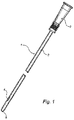
- a catheter 1 as illustrated in Fig. 1 comprises a flared rearward portion 2 and an elongate shaft or tube 3 projecting forwardly from the rearward portion 2.
- An open-ended internal lumen (not shown) extends from the rear end of the rearward portion 2 to a drainage aperture 4 in a rounded tip 5 of the elongate tube 3.
- the catheter preferably has only one, single internal lumen.
- the drainage openings are preferably arranged close to the proximal, insertable end of the catheter.
- the insertable tip of the catheter is preferably closed, and is preferably formed in a rounded shape.
- the rearward portion 2 is preferably formed as a flared end, and may function as a connector of the catheter 1, being connectable to other devices, such as a urine collection bag, a drainage tube or the like.
- At least a part of the elongate tube 3 forms an insertable length to be inserted through a body opening of the user, such as the urethra in case of a urinary catheter.
- insertable length is normally meant that length of the elongate tube 2 which is insertable into the urethra of the patient. Typically, this will be 80-140 mm for a female patient and 200-350 mm for a male patient.
- At least the insertable part of the catheter is preferably provided with a hydrophilic surface layer, to be discussed in more detail in the following.
- the catheter is preferably arranged in a closed container, functioning as a package, and optionally also as a sterile barrier, in a sterilized state.
- the container houses at least the insertable part of the catheter, and preferably also a wetting fluid to maintain the catheter in an activated, wetted state.
- the catheter becomes immediately ready to use upon withdrawal from the package.
- a catheter assembly 20 is schematically illustrated in which the entire catheter 1 is enclosed within the container 21.
- the container is preferably made of a gas-impermeable material, such as a material comprising an aluminum barrier layer.
- the container is preferably arranged with a shape resembling the shape of the catheter, having a narrow elongate part housing the insertable part of the catheter, and a somewhat wider rearward part 22, housing the connector end of the catheter.
- the package encloses the catheter narrowly, thereby limiting the volume between the catheter and the package walls.
- This type of package is per se further disclosed in US 6848574 by the same applicant, said patent hereby being incorporated in its entirety by reference.
- the container may also have many other shapes and dimensions, such as being rectangular etc.
- FIG. 3 an alternative embodiment of a catheter assembly is illustrated. Here, only a part of the catheter, including the insertable part, is enclosed within the package together with the wetting fluid.
- the receptacle 31 could e.g. be connected to the catheter, and in particular to the connector.
- the connection could be provided by means of a welding joint arranged between the catheter and the receptacle, or by means of a shrink fit, an adhesive or the like.
- the catheter lumen may be closable by means of a cap or cover 32 arranged to sealingly close the connector opening.
- a cap or cover 32 arranged to sealingly close the connector opening.
- other ways of providing a closure of the lumen are feasible as well, such as arranging a breakable membrane somewhere in the lumen.
- the wetting fluid 23 is here in contact only with the catheter shaft.
- the entire insertable, hydrophilic part is maintained immersed in the wetting fluid, whereas non-insertable parts are to at least some extent outside the package, and without contact with the wetting fluid.
- the catheter is maintained in a activated, ready-to-use condition.
- the compartment formed by the receptacle and the catheter is preferably gas sealed, and further, the receptacle is preferably gas impermeable.
- Catheter assemblies of this general type are further disclosed in US 2009/0200187 by the same applicant, said document hereby being incorporated in its entirety by reference.
- the receptacle may, in both the embodiments discussed above, simply be opened, and the catheter could immediately be introduced into the patient.
- the receptacle housing the wetting fluid and part of or the whole catheter is preferably a gas impermeable material.
- a gas impermeable material for example one or several of the following gas impermeable materials could be used: aluminium foil laminate, poly(vinylidene chloride) or laminate comprising a metallised film, such as metallised poly(ethylene terepthalate), or silicon oxide coated film, or a laminate comprising aluminum oxide.
- the catheter is immediately ready for use and insertion upon withdrawal from the container.
- the catheter may be stored immersed in a wetting liquid, as discussed in the foregoing.
- the catheter may also be stored in an activated state, where all wetting fluid is present within the hydrophilic surface layer and no or very limited excess wetting fluid is present in the rest of the container.
- the wetting fluid need not be present in liquid form, but may also be present in the form of gas, e.g. by providing a moist, vapor containing atmosphere in the container.
- the catheter may also be stored in a dry state.
- the wetting fluid may be arranged in a separate compartment or pouch of the package, for wetting and activation of the catheter immediately prior to use.
- the wetting fluid When maintained in a dry state, it is also possible to wet the catheter with a wetting fluid provided from an external supply.
- the wetting fluid is preferably a water-based liquid, i.e. using plain water or a solution comprising water as a solvent, such as saline or other.
- the catheter tubing substrate material is produced by preparing a polymer blend comprising at least one base polymer and at least one hydrophilic polymer and forming a substrate or a base layer in the substrate from said polymer blend.
- the preparation of the blend may be made by a compounding step.
- the forming may e.g. be obtained by extrusion.
- the substrate is then arranged in a wetting liquid.
- the at least one hydrophilic polymer migrate(s) towards a surface of the substrate.
- the substrate is irradiated, thereby forming cross-linking between the polymers. This cross-linking prohibits further migration of the hydrophilic polymer(s), whereby a stable hydrophilic surface layer, comprising a higher concentration of the hydrophilic polymer(s) than said polymer blend, is formed on the surface of the substrate.
- the resulting catheter comprises on at least a part thereof, a hydrophilic surface layer providing low-friction surface character of the medical device when in wet state
- the substrate, or at least a base layer of the substrate is made of a polymer blend comprising the at least one base polymer and the at least one hydrophilic polymer, and wherein the concentration of said at least one hydrophilic polymer is higher in the hydrophilic surface layer than in the interior of the base layer or substrate.
- the hydrophilic surface layer is formed not as a coating, but as an integral part of the base layer or substrate.
- the substrate may be formed in its entirety by the base layer, and thus be entirely formed by the specified polymer blend.
- the substrate may also comprise one or more additional support layer(s), preferably being arranged inside or underneath the base layer.
- the base layer may be attached to a support layer (or second base layer) made of a thermoplastic polymer material, such as polyurethane, polyolefin or the like.
- a support layer or second base layer
- a support layer or second base layer
- such an additional support layer is preferably arranged inside the base layer comprising the specified polymer blend, so that the hydrophilic surface layer faces the exterior of the catheter. Attachment of the base layer to a further support layer may be obtained in various ways, such as by co-extrusion and the like.
- the step of arranging the substrate in a wetting liquid preferably comprises arranging the medical device in the container together with the wetting liquid, and closing the container, as illustrated in figs. 2 and 3 .
- the subsequent irradiating step may also effect sterilization of the medical device.
- the concentration of the hydrophilic polymer may be essentially the same in the entire of the interior of the base layer or substrate, i.e. with a homogeneous blend throughout the interior of the base layer/substrate.
- the interior of the base layer may comprise at least two different sub-layers, wherein an outer sub-layer, being closer to the hydrophilic surface layer, has a blend of base polymer(s) and hydrophilic polymer(s) with a higher concentration of the hydrophilic polymer(s) than in the corresponding blend of the inner sub-layer, being farther from said hydrophilic surface layer.
- These two different sub-layers which both comprise blends of base polymer(s) and hydrophilic polymer(s), may e.g. be coextruded together.
- the at least one hydrophilic polymer may comprise at least one material selected from: polyvinyl compounds, polysaccharides, polyurethanes, polyacrylates or copolymers of vinyl compounds and acrylates or anhydrides, poly (alkyl ether), i.e.
- polyethylene oxide or polypropylene oxide such as polyoxyethylene (POE), and in particular polyethylene oxide (PEO), polyvinyl-pyrrolidone (PVP), heparin, dextran, xanthan gum, polyvinyl alcohol, hydroxy propyl cellulose, methyl cellulose, copolymer of vinylpyrrolidone and hydroxy ethylmethyl acrylate or copolymer of polymethylvinyl ether and maleinic acid anyhydride, and copolymers of these.
- the hydrophilic polymer is a meltable polymer.
- the hydrophilic polymer is preferably at least one of polyethyleneoxide (PEO), poly(acrylic acid), polyvinyl-pyrrolidone (PVP) and polysaccharide, such as carboxy methyl cellulose.
- the hydrophilic polymer(s) comprises polyethyleneoxide.
- the hydrophilic polymer(s) preferably has a relatively high molecular weight.
- the hydrophilic polymer(s) has a molecular weight of at least 50 kDa, and preferably at least 100 kDa, and most preferably at least 200 kDa.
- the at least one base polymer is preferably a predominantly hydrophobic polymer.
- the at least one base polymer may comprise at least one of polyolefin and polyurethane, such as thermoplastic polyurethane.
- the polyolefin may comprise at least one polymer selected from the group: polyethylene, polypropylene, and styrene block copolymer (SEBS).
- SEBS styrene block copolymer
- the base polymer(s) may also comprise polyolefin and at least one composition having molecules with active hydrogen(s), the molecules preferably being molecules where the active hydrogen(s) is bound to the molecules via nitrogen.
- the compound having molecules with active hydrogen(s) can be either a polymer or smaller molecules, or various combinations of such polymers/molecules. Examples of such compositions having molecules with active hydrogen groups are alcohols, amides, amines, urethanes and acids, and in particular amides, amines and urethanes are preferred.
- the base layer or substrate may further comprise a filler material, such as calcium carbonate filler.
- the substrate materials is preferably prepared and composed in such a way that it fulfills at least some of the following requirements, and preferably essentially all of them:
- Table 2 Leaching of PEO into water Dimensions when non-wetted Weight when non-wetted Leach time (mts) PEO content in sample Base polymer PEO concentration in the water (mm) (g) (wt%) (g/l) 5x10x1.7 0.097 60 40 T93 0.74 5x10x0.8 0.054 3 75 PU 0 6x10x1 0.061 3 50 T93 0 5x10x1.5 0.11 3 75 PU 0 5x10x1.5 0.11 60 75 PU 2.51 5x10x1.5 0.09 30 75 PU 1.10 5x10x1 0.064 30 50 T93 0.40 5x10x1.2 0.074 3 50 PU 0.10 5x10x1.2 0.077 30 50 PU 0.47 5x10x1.2 0.072 60 50 PU 1.05 5x10x1.2 0.061 60 50 PU 0.82 5x10x1 0.03 3 50 PU 0.04 5x10x1 0.049 30 50 PU 0.38
- the migration of the hydrophilic polymer towards the surface of the substrate, and eventually into the surrounding fluid can be very efficiently controlled inter alia by controlling how long the wetting is allowed to proceed prior to cross-linking.
- the leaching and migration effect only occurs prior to cross-linking, After cross-linking, it has been found that the migration immediately stops, and that essentially no hydrophilic polymer is leached out into the wetting liquid when the catheter is immersed.
- Solid tubes were made by extrusion of these sample materials. Sample tubes were allowed to swell for 2 hours in water, and the swelling and wetting of the tubes were studied. When wetted, an outer layer of wetted, swelled material is formed around a core of non-wetted, un-swelled material. Over time, the outer layer increases in thickness, and the core diminishes gradually, to a point where the entire material is swelled.
- blends with PU swells less than blends with T93 as base polymer, but the percentage of the tube that has been wetted after 2 hours is comparable.
- a higher ratio of PEO provides a faster wetting process and a higher degree of swelling.
- the tubes were then packaged in gas impermeable packages together with different amounts of water, but in a volume that assured complete wetting of the tubes. Tubes packaged with less water were hence packaged in smaller container, with a "tighter" fit. The assemblies were further subject to irradiation at 56 kGy after one hour.
- the friction and durability of the hydrophilic surface layer of the tubes were in all cases subjectively determined to be very good.
- some of the samples were evaluated using a Harland FTS Friction Tester, available from Harland Medical Systems, with a clamp force of 100 g and a pull speed of 1.0 cm/s.
- the friction measurement was also done repeatedly for several times, in order to determine the durability of the hydrophilic surface layer. The results of this are presented in the table below.
- hydrophilic surface layer is in all cases very durable, with limited deterioration when subject to the extensive wear of 5 or 10 measurement cycles. In two of the samples, the hydrophilic surface layer appears to be totally unaffected by this wear.
- the B4 blend was used to extrude catheter tubes, and after cutting one end was formed into a catheter tip through melting and molding, and holes were punched out using a side punch.
- the produced catheter was found to be useable as a urinary catheter, and have comparable properties and characteristics as urinary catheters on the market today. Further, the friction coefficients of the catheter was found to be the same as for the solid tubes discussed above.
Landscapes
- Health & Medical Sciences (AREA)
- Life Sciences & Earth Sciences (AREA)
- Animal Behavior & Ethology (AREA)
- General Health & Medical Sciences (AREA)
- Public Health (AREA)
- Veterinary Medicine (AREA)
- Epidemiology (AREA)
- Engineering & Computer Science (AREA)
- Biophysics (AREA)
- Pulmonology (AREA)
- Anesthesiology (AREA)
- Biomedical Technology (AREA)
- Heart & Thoracic Surgery (AREA)
- Hematology (AREA)
- Inorganic Chemistry (AREA)
- Urology & Nephrology (AREA)
- Chemical & Material Sciences (AREA)
- Materials For Medical Uses (AREA)
Priority Applications (12)
| Application Number | Priority Date | Filing Date | Title |
|---|---|---|---|
| EP15202776.9A EP3187199B1 (fr) | 2015-12-28 | 2015-12-28 | Dispositifs médicaux hydrophiles |
| DK20166707.8T DK3693032T3 (da) | 2015-12-28 | 2015-12-28 | Hydrofil medicinsk indretning |
| HUE15202776A HUE049479T2 (hu) | 2015-12-28 | 2015-12-28 | Hidrofil orvostechnikai eszköz |
| EP20166707.8A EP3693032B1 (fr) | 2015-12-28 | 2015-12-28 | Dispositifs médicaux hydrophiles |
| DK15202776.9T DK3187199T3 (da) | 2015-12-28 | 2015-12-28 | Hydrofil medicinsk anordning |
| BR112018012806-6A BR112018012806B1 (pt) | 2015-12-28 | 2016-12-22 | Dispositivo médico, e, método para produzir um dispositivo médico |
| AU2016382838A AU2016382838A1 (en) | 2015-12-28 | 2016-12-22 | Hydrophilic medical device |
| KR1020187021078A KR102758594B1 (ko) | 2015-12-28 | 2016-12-22 | 친수성 의료 장치 |
| US16/336,061 US11724008B2 (en) | 2015-12-28 | 2016-12-22 | Hydrophilic medical device |
| JP2018533063A JP6938508B2 (ja) | 2015-12-28 | 2016-12-22 | 親水性医療デバイス |
| PCT/EP2016/082410 WO2017114753A1 (fr) | 2015-12-28 | 2016-12-22 | Dispositif médical hydrophile |
| CN201680075227.XA CN108430528B (zh) | 2015-12-28 | 2016-12-22 | 亲水性医疗装置 |
Applications Claiming Priority (1)
| Application Number | Priority Date | Filing Date | Title |
|---|---|---|---|
| EP15202776.9A EP3187199B1 (fr) | 2015-12-28 | 2015-12-28 | Dispositifs médicaux hydrophiles |
Related Child Applications (2)
| Application Number | Title | Priority Date | Filing Date |
|---|---|---|---|
| EP20166707.8A Division EP3693032B1 (fr) | 2015-12-28 | 2015-12-28 | Dispositifs médicaux hydrophiles |
| EP20166707.8A Previously-Filed-Application EP3693032B1 (fr) | 2015-12-28 | 2015-12-28 | Dispositifs médicaux hydrophiles |
Publications (2)
| Publication Number | Publication Date |
|---|---|
| EP3187199A1 true EP3187199A1 (fr) | 2017-07-05 |
| EP3187199B1 EP3187199B1 (fr) | 2020-04-01 |
Family
ID=55066410
Family Applications (2)
| Application Number | Title | Priority Date | Filing Date |
|---|---|---|---|
| EP15202776.9A Not-in-force EP3187199B1 (fr) | 2015-12-28 | 2015-12-28 | Dispositifs médicaux hydrophiles |
| EP20166707.8A Active EP3693032B1 (fr) | 2015-12-28 | 2015-12-28 | Dispositifs médicaux hydrophiles |
Family Applications After (1)
| Application Number | Title | Priority Date | Filing Date |
|---|---|---|---|
| EP20166707.8A Active EP3693032B1 (fr) | 2015-12-28 | 2015-12-28 | Dispositifs médicaux hydrophiles |
Country Status (10)
| Country | Link |
|---|---|
| US (1) | US11724008B2 (fr) |
| EP (2) | EP3187199B1 (fr) |
| JP (1) | JP6938508B2 (fr) |
| KR (1) | KR102758594B1 (fr) |
| CN (1) | CN108430528B (fr) |
| AU (1) | AU2016382838A1 (fr) |
| BR (1) | BR112018012806B1 (fr) |
| DK (2) | DK3693032T3 (fr) |
| HU (1) | HUE049479T2 (fr) |
| WO (1) | WO2017114753A1 (fr) |
Cited By (2)
| Publication number | Priority date | Publication date | Assignee | Title |
|---|---|---|---|---|
| US20210213175A1 (en) * | 2017-12-05 | 2021-07-15 | Hollister Incorporated | Urinary catheters including mechanical properties that are stable over a range of temperatures |
| EP4628107A3 (fr) * | 2019-06-25 | 2025-12-17 | Hollister Incorporated | Produits pour sondes urinaires réutilisables |
Families Citing this family (15)
| Publication number | Priority date | Publication date | Assignee | Title |
|---|---|---|---|---|
| AU2019269674B2 (en) | 2018-05-17 | 2024-04-18 | Hollister Incorporated | Hydrophilic medical products and hydration mediums for hydrating the same |
| WO2020150044A1 (fr) | 2019-01-15 | 2020-07-23 | Polyone Corporation | Composés thermoplastiques lubrifiants et articles thermoplastiques fabriqués à partir de ceux-ci |
| CA3127706A1 (fr) * | 2019-02-08 | 2020-08-13 | Coloplast A/S | Catheter urinaire |
| CN110124185A (zh) * | 2019-06-25 | 2019-08-16 | 华中科技大学同济医学院附属协和医院 | 一种带有可塑性支架的导尿管及用于该支架的消毒装置 |
| CA3160638A1 (fr) | 2019-11-08 | 2021-05-14 | Hollister Incorporated | Produits medicaux hydrophiles et milieux d'hydratation pour leur hydratation |
| GB202006055D0 (en) | 2020-04-24 | 2020-06-10 | Convatec Ltd | A wetting mechanism for a catheter |
| AU2021259368A1 (en) | 2020-04-24 | 2022-09-29 | Convatec Limited | A wetting mechanism for a catheter |
| GB202006059D0 (en) | 2020-04-24 | 2020-06-10 | Convatec Ltd | A wetting mechanism for a catheter |
| CA3175742A1 (fr) | 2020-05-01 | 2021-11-04 | David J. Farrell | Produits de dispositif medical comprenant des elements d'extraction de liquide |
| WO2022098679A1 (fr) * | 2020-11-09 | 2022-05-12 | Carefusion 303, Inc. | Tubulure médicale multicouche à faible capacité d'absorption |
| US20220160970A1 (en) * | 2020-11-24 | 2022-05-26 | Carefusion 303, Inc. | Medical devices for anti-bubble medication delivery |
| GB202105822D0 (en) | 2021-04-23 | 2021-06-09 | Convatec Ltd | Intermittent catheter |
| DK181278B1 (en) * | 2021-05-03 | 2023-06-20 | Jonsman Innovation Aps | Moldable, hydrophilic polymer blend for molding devices which are hydrophilic and lubricious after molding |
| WO2022256114A1 (fr) | 2021-06-04 | 2022-12-08 | Hollister Incorporated | Procédés de fabrication de produits de cathéter hydrophiles gainés |
| CN117651572A (zh) * | 2021-07-27 | 2024-03-05 | 康沃特克有限公司 | 间歇性导管 |
Citations (5)
| Publication number | Priority date | Publication date | Assignee | Title |
|---|---|---|---|---|
| US5041100A (en) * | 1989-04-28 | 1991-08-20 | Cordis Corporation | Catheter and hydrophilic, friction-reducing coating thereon |
| US6848574B1 (en) | 1999-02-12 | 2005-02-01 | Astra Tech Ab | Storage package and a method for packaging |
| US20070184275A1 (en) * | 2006-02-01 | 2007-08-09 | Hollister Incorporated | Methods of applying a hydrophilic coating to a substrate, and substrates having a hydrophilic coating |
| US20090200187A1 (en) | 2002-04-30 | 2009-08-13 | Daniel Nestenborg | Catheter assembly |
| US20100159116A1 (en) * | 2008-12-19 | 2010-06-24 | Rindlav-Westling Aasa | Method for producing a medical device with a cross-linked hydrophilic coating |
Family Cites Families (13)
| Publication number | Priority date | Publication date | Assignee | Title |
|---|---|---|---|---|
| US4642267A (en) * | 1985-05-06 | 1987-02-10 | Hydromer, Inc. | Hydrophilic polymer blend |
| US4781978A (en) * | 1987-03-02 | 1988-11-01 | Minnesota Mining And Manufacturing Company | Articles having a coating formed from a polymeric blend |
| US5061424A (en) * | 1991-01-22 | 1991-10-29 | Becton, Dickinson And Company | Method for applying a lubricious coating to an article |
| US5443907A (en) * | 1991-06-18 | 1995-08-22 | Scimed Life Systems, Inc. | Coating for medical insertion guides |
| US5688855A (en) * | 1995-05-01 | 1997-11-18 | S.K.Y. Polymers, Inc. | Thin film hydrophilic coatings |
| US7628784B2 (en) * | 2003-01-06 | 2009-12-08 | C. R. Bard, Inc. | Balloon catheter with improved resistance to non-deflation |
| US20060240060A1 (en) * | 2005-04-22 | 2006-10-26 | Cardiac Pacemakers, Inc. | Lubricious compound and medical device made of the same |
| ES2392497T3 (es) * | 2005-07-18 | 2012-12-11 | Dentsply Ih Ab | Catéter urinario |
| US20120077049A1 (en) * | 2007-08-06 | 2012-03-29 | Abbott Cardiovascular Systems, Inc. | Medical devices having a lubricious coating with a hydrophilic compound in an interlocking network |
| US20090155519A1 (en) * | 2007-12-12 | 2009-06-18 | Emembrane Inc. | Hydrophilic Coating Of polymeric Substrates |
| DK2301595T3 (da) * | 2009-09-23 | 2014-04-07 | Dentsply Ih Ab | Gennemskylleligt kateter og fremgangsmåde til fremstilling af sådan et kateter |
| JP6383732B2 (ja) * | 2013-01-04 | 2018-08-29 | サーモディクス,インコーポレイティド | ビニルピロリドンポリマーおよび酸性ポリマーを含んでいる層を備えた、粒子が少ない潤滑性コーティング |
| EP3878484A1 (fr) * | 2015-04-16 | 2021-09-15 | Hollister Incorporated | Revêtements hydrophiles et leurs procédés de formation |
-
2015
- 2015-12-28 DK DK20166707.8T patent/DK3693032T3/da active
- 2015-12-28 DK DK15202776.9T patent/DK3187199T3/da active
- 2015-12-28 EP EP15202776.9A patent/EP3187199B1/fr not_active Not-in-force
- 2015-12-28 HU HUE15202776A patent/HUE049479T2/hu unknown
- 2015-12-28 EP EP20166707.8A patent/EP3693032B1/fr active Active
-
2016
- 2016-12-22 US US16/336,061 patent/US11724008B2/en active Active
- 2016-12-22 BR BR112018012806-6A patent/BR112018012806B1/pt not_active IP Right Cessation
- 2016-12-22 JP JP2018533063A patent/JP6938508B2/ja active Active
- 2016-12-22 AU AU2016382838A patent/AU2016382838A1/en not_active Abandoned
- 2016-12-22 KR KR1020187021078A patent/KR102758594B1/ko active Active
- 2016-12-22 CN CN201680075227.XA patent/CN108430528B/zh not_active Expired - Fee Related
- 2016-12-22 WO PCT/EP2016/082410 patent/WO2017114753A1/fr not_active Ceased
Patent Citations (5)
| Publication number | Priority date | Publication date | Assignee | Title |
|---|---|---|---|---|
| US5041100A (en) * | 1989-04-28 | 1991-08-20 | Cordis Corporation | Catheter and hydrophilic, friction-reducing coating thereon |
| US6848574B1 (en) | 1999-02-12 | 2005-02-01 | Astra Tech Ab | Storage package and a method for packaging |
| US20090200187A1 (en) | 2002-04-30 | 2009-08-13 | Daniel Nestenborg | Catheter assembly |
| US20070184275A1 (en) * | 2006-02-01 | 2007-08-09 | Hollister Incorporated | Methods of applying a hydrophilic coating to a substrate, and substrates having a hydrophilic coating |
| US20100159116A1 (en) * | 2008-12-19 | 2010-06-24 | Rindlav-Westling Aasa | Method for producing a medical device with a cross-linked hydrophilic coating |
Cited By (4)
| Publication number | Priority date | Publication date | Assignee | Title |
|---|---|---|---|---|
| US20210213175A1 (en) * | 2017-12-05 | 2021-07-15 | Hollister Incorporated | Urinary catheters including mechanical properties that are stable over a range of temperatures |
| EP3720516B1 (fr) | 2017-12-05 | 2023-06-07 | Hollister Incorporated | Cathéters urinaires comprenant des propriétés mécaniques stables sur une plage de températures |
| AU2018379990B2 (en) * | 2017-12-05 | 2024-09-26 | Hollister Incorporated | Urinary catheters including mechanical properties that are stable over a range of temperatures |
| EP4628107A3 (fr) * | 2019-06-25 | 2025-12-17 | Hollister Incorporated | Produits pour sondes urinaires réutilisables |
Also Published As
| Publication number | Publication date |
|---|---|
| DK3693032T3 (da) | 2022-05-16 |
| US11724008B2 (en) | 2023-08-15 |
| EP3693032B1 (fr) | 2022-02-23 |
| DK3187199T3 (da) | 2020-06-02 |
| KR102758594B1 (ko) | 2025-01-22 |
| US20190224384A1 (en) | 2019-07-25 |
| EP3693032A1 (fr) | 2020-08-12 |
| EP3187199B1 (fr) | 2020-04-01 |
| BR112018012806B1 (pt) | 2021-07-20 |
| WO2017114753A1 (fr) | 2017-07-06 |
| KR20180098325A (ko) | 2018-09-03 |
| JP2019505277A (ja) | 2019-02-28 |
| BR112018012806A2 (pt) | 2018-12-04 |
| AU2016382838A1 (en) | 2018-06-21 |
| HUE049479T2 (hu) | 2020-09-28 |
| JP6938508B2 (ja) | 2021-09-22 |
| CN108430528B (zh) | 2021-06-01 |
| CN108430528A (zh) | 2018-08-21 |
Similar Documents
| Publication | Publication Date | Title |
|---|---|---|
| EP3187199B1 (fr) | Dispositifs médicaux hydrophiles | |
| US12053592B2 (en) | Urinary catheter having a soft tip | |
| AU2006270542B2 (en) | Urinary catheter | |
| CA2719168C (fr) | Dispositif medical ameliore pourvu d'un revetement hydrophile | |
| CN110753565A (zh) | 经蒸汽灭菌的导管组件 | |
| JP2009515604A (ja) | 潤滑化合物及びそれから作られる医療装置 | |
| EP4520358A1 (fr) | Cathéter urinaire hydrophile |
Legal Events
| Date | Code | Title | Description |
|---|---|---|---|
| PUAI | Public reference made under article 153(3) epc to a published international application that has entered the european phase |
Free format text: ORIGINAL CODE: 0009012 |
|
| STAA | Information on the status of an ep patent application or granted ep patent |
Free format text: STATUS: THE APPLICATION HAS BEEN PUBLISHED |
|
| AK | Designated contracting states |
Kind code of ref document: A1 Designated state(s): AL AT BE BG CH CY CZ DE DK EE ES FI FR GB GR HR HU IE IS IT LI LT LU LV MC MK MT NL NO PL PT RO RS SE SI SK SM TR |
|
| AX | Request for extension of the european patent |
Extension state: BA ME |
|
| STAA | Information on the status of an ep patent application or granted ep patent |
Free format text: STATUS: REQUEST FOR EXAMINATION WAS MADE |
|
| 17P | Request for examination filed |
Effective date: 20180104 |
|
| RBV | Designated contracting states (corrected) |
Designated state(s): AL AT BE BG CH CY CZ DE DK EE ES FI FR GB GR HR HU IE IS IT LI LT LU LV MC MK MT NL NO PL PT RO RS SE SI SK SM TR |
|
| STAA | Information on the status of an ep patent application or granted ep patent |
Free format text: STATUS: EXAMINATION IS IN PROGRESS |
|
| 17Q | First examination report despatched |
Effective date: 20190208 |
|
| GRAP | Despatch of communication of intention to grant a patent |
Free format text: ORIGINAL CODE: EPIDOSNIGR1 |
|
| STAA | Information on the status of an ep patent application or granted ep patent |
Free format text: STATUS: GRANT OF PATENT IS INTENDED |
|
| INTG | Intention to grant announced |
Effective date: 20191119 |
|
| RIN1 | Information on inventor provided before grant (corrected) |
Inventor name: LUNDAHL, JOHAN Inventor name: RINDLAV WESTLING, ASA |
|
| GRAS | Grant fee paid |
Free format text: ORIGINAL CODE: EPIDOSNIGR3 |
|
| GRAA | (expected) grant |
Free format text: ORIGINAL CODE: 0009210 |
|
| STAA | Information on the status of an ep patent application or granted ep patent |
Free format text: STATUS: THE PATENT HAS BEEN GRANTED |
|
| AK | Designated contracting states |
Kind code of ref document: B1 Designated state(s): AL AT BE BG CH CY CZ DE DK EE ES FI FR GB GR HR HU IE IS IT LI LT LU LV MC MK MT NL NO PL PT RO RS SE SI SK SM TR |
|
| REG | Reference to a national code |
Ref country code: GB Ref legal event code: FG4D |
|
| REG | Reference to a national code |
Ref country code: AT Ref legal event code: REF Ref document number: 1250528 Country of ref document: AT Kind code of ref document: T Effective date: 20200415 Ref country code: CH Ref legal event code: EP |
|
| REG | Reference to a national code |
Ref country code: DE Ref legal event code: R096 Ref document number: 602015049760 Country of ref document: DE |
|
| REG | Reference to a national code |
Ref country code: IE Ref legal event code: FG4D |
|
| REG | Reference to a national code |
Ref country code: DK Ref legal event code: T3 Effective date: 20200528 |
|
| REG | Reference to a national code |
Ref country code: NL Ref legal event code: FP |
|
| REG | Reference to a national code |
Ref country code: SE Ref legal event code: TRGR |
|
| PG25 | Lapsed in a contracting state [announced via postgrant information from national office to epo] |
Ref country code: BG Free format text: LAPSE BECAUSE OF FAILURE TO SUBMIT A TRANSLATION OF THE DESCRIPTION OR TO PAY THE FEE WITHIN THE PRESCRIBED TIME-LIMIT Effective date: 20200701 |
|
| REG | Reference to a national code |
Ref country code: LT Ref legal event code: MG4D |
|
| REG | Reference to a national code |
Ref country code: HU Ref legal event code: AG4A Ref document number: E049479 Country of ref document: HU |
|
| PG25 | Lapsed in a contracting state [announced via postgrant information from national office to epo] |
Ref country code: FI Free format text: LAPSE BECAUSE OF FAILURE TO SUBMIT A TRANSLATION OF THE DESCRIPTION OR TO PAY THE FEE WITHIN THE PRESCRIBED TIME-LIMIT Effective date: 20200401 Ref country code: LT Free format text: LAPSE BECAUSE OF FAILURE TO SUBMIT A TRANSLATION OF THE DESCRIPTION OR TO PAY THE FEE WITHIN THE PRESCRIBED TIME-LIMIT Effective date: 20200401 Ref country code: CZ Free format text: LAPSE BECAUSE OF FAILURE TO SUBMIT A TRANSLATION OF THE DESCRIPTION OR TO PAY THE FEE WITHIN THE PRESCRIBED TIME-LIMIT Effective date: 20200401 Ref country code: PT Free format text: LAPSE BECAUSE OF FAILURE TO SUBMIT A TRANSLATION OF THE DESCRIPTION OR TO PAY THE FEE WITHIN THE PRESCRIBED TIME-LIMIT Effective date: 20200817 Ref country code: GR Free format text: LAPSE BECAUSE OF FAILURE TO SUBMIT A TRANSLATION OF THE DESCRIPTION OR TO PAY THE FEE WITHIN THE PRESCRIBED TIME-LIMIT Effective date: 20200702 Ref country code: NO Free format text: LAPSE BECAUSE OF FAILURE TO SUBMIT A TRANSLATION OF THE DESCRIPTION OR TO PAY THE FEE WITHIN THE PRESCRIBED TIME-LIMIT Effective date: 20200701 Ref country code: IS Free format text: LAPSE BECAUSE OF FAILURE TO SUBMIT A TRANSLATION OF THE DESCRIPTION OR TO PAY THE FEE WITHIN THE PRESCRIBED TIME-LIMIT Effective date: 20200801 |
|
| REG | Reference to a national code |
Ref country code: AT Ref legal event code: MK05 Ref document number: 1250528 Country of ref document: AT Kind code of ref document: T Effective date: 20200401 |
|
| PG25 | Lapsed in a contracting state [announced via postgrant information from national office to epo] |
Ref country code: RS Free format text: LAPSE BECAUSE OF FAILURE TO SUBMIT A TRANSLATION OF THE DESCRIPTION OR TO PAY THE FEE WITHIN THE PRESCRIBED TIME-LIMIT Effective date: 20200401 Ref country code: LV Free format text: LAPSE BECAUSE OF FAILURE TO SUBMIT A TRANSLATION OF THE DESCRIPTION OR TO PAY THE FEE WITHIN THE PRESCRIBED TIME-LIMIT Effective date: 20200401 Ref country code: HR Free format text: LAPSE BECAUSE OF FAILURE TO SUBMIT A TRANSLATION OF THE DESCRIPTION OR TO PAY THE FEE WITHIN THE PRESCRIBED TIME-LIMIT Effective date: 20200401 |
|
| PG25 | Lapsed in a contracting state [announced via postgrant information from national office to epo] |
Ref country code: AL Free format text: LAPSE BECAUSE OF FAILURE TO SUBMIT A TRANSLATION OF THE DESCRIPTION OR TO PAY THE FEE WITHIN THE PRESCRIBED TIME-LIMIT Effective date: 20200401 |
|
| REG | Reference to a national code |
Ref country code: DE Ref legal event code: R097 Ref document number: 602015049760 Country of ref document: DE |
|
| PG25 | Lapsed in a contracting state [announced via postgrant information from national office to epo] |
Ref country code: EE Free format text: LAPSE BECAUSE OF FAILURE TO SUBMIT A TRANSLATION OF THE DESCRIPTION OR TO PAY THE FEE WITHIN THE PRESCRIBED TIME-LIMIT Effective date: 20200401 Ref country code: SM Free format text: LAPSE BECAUSE OF FAILURE TO SUBMIT A TRANSLATION OF THE DESCRIPTION OR TO PAY THE FEE WITHIN THE PRESCRIBED TIME-LIMIT Effective date: 20200401 Ref country code: RO Free format text: LAPSE BECAUSE OF FAILURE TO SUBMIT A TRANSLATION OF THE DESCRIPTION OR TO PAY THE FEE WITHIN THE PRESCRIBED TIME-LIMIT Effective date: 20200401 Ref country code: ES Free format text: LAPSE BECAUSE OF FAILURE TO SUBMIT A TRANSLATION OF THE DESCRIPTION OR TO PAY THE FEE WITHIN THE PRESCRIBED TIME-LIMIT Effective date: 20200401 Ref country code: AT Free format text: LAPSE BECAUSE OF FAILURE TO SUBMIT A TRANSLATION OF THE DESCRIPTION OR TO PAY THE FEE WITHIN THE PRESCRIBED TIME-LIMIT Effective date: 20200401 |
|
| PLBE | No opposition filed within time limit |
Free format text: ORIGINAL CODE: 0009261 |
|
| STAA | Information on the status of an ep patent application or granted ep patent |
Free format text: STATUS: NO OPPOSITION FILED WITHIN TIME LIMIT |
|
| PG25 | Lapsed in a contracting state [announced via postgrant information from national office to epo] |
Ref country code: PL Free format text: LAPSE BECAUSE OF FAILURE TO SUBMIT A TRANSLATION OF THE DESCRIPTION OR TO PAY THE FEE WITHIN THE PRESCRIBED TIME-LIMIT Effective date: 20200401 Ref country code: SK Free format text: LAPSE BECAUSE OF FAILURE TO SUBMIT A TRANSLATION OF THE DESCRIPTION OR TO PAY THE FEE WITHIN THE PRESCRIBED TIME-LIMIT Effective date: 20200401 |
|
| 26N | No opposition filed |
Effective date: 20210112 |
|
| PG25 | Lapsed in a contracting state [announced via postgrant information from national office to epo] |
Ref country code: SI Free format text: LAPSE BECAUSE OF FAILURE TO SUBMIT A TRANSLATION OF THE DESCRIPTION OR TO PAY THE FEE WITHIN THE PRESCRIBED TIME-LIMIT Effective date: 20200401 |
|
| REG | Reference to a national code |
Ref country code: CH Ref legal event code: PL |
|
| PG25 | Lapsed in a contracting state [announced via postgrant information from national office to epo] |
Ref country code: MC Free format text: LAPSE BECAUSE OF FAILURE TO SUBMIT A TRANSLATION OF THE DESCRIPTION OR TO PAY THE FEE WITHIN THE PRESCRIBED TIME-LIMIT Effective date: 20200401 |
|
| REG | Reference to a national code |
Ref country code: BE Ref legal event code: MM Effective date: 20201231 |
|
| PG25 | Lapsed in a contracting state [announced via postgrant information from national office to epo] |
Ref country code: LU Free format text: LAPSE BECAUSE OF NON-PAYMENT OF DUE FEES Effective date: 20201228 |
|
| PG25 | Lapsed in a contracting state [announced via postgrant information from national office to epo] |
Ref country code: CH Free format text: LAPSE BECAUSE OF NON-PAYMENT OF DUE FEES Effective date: 20201231 Ref country code: LI Free format text: LAPSE BECAUSE OF NON-PAYMENT OF DUE FEES Effective date: 20201231 |
|
| PGFP | Annual fee paid to national office [announced via postgrant information from national office to epo] |
Ref country code: SE Payment date: 20211115 Year of fee payment: 7 Ref country code: FR Payment date: 20211117 Year of fee payment: 7 Ref country code: DK Payment date: 20211118 Year of fee payment: 7 Ref country code: GB Payment date: 20211118 Year of fee payment: 7 Ref country code: IE Payment date: 20211116 Year of fee payment: 7 Ref country code: DE Payment date: 20211116 Year of fee payment: 7 |
|
| PGFP | Annual fee paid to national office [announced via postgrant information from national office to epo] |
Ref country code: IT Payment date: 20211119 Year of fee payment: 7 Ref country code: HU Payment date: 20211122 Year of fee payment: 7 |
|
| PGFP | Annual fee paid to national office [announced via postgrant information from national office to epo] |
Ref country code: NL Payment date: 20211208 Year of fee payment: 7 |
|
| PG25 | Lapsed in a contracting state [announced via postgrant information from national office to epo] |
Ref country code: TR Free format text: LAPSE BECAUSE OF FAILURE TO SUBMIT A TRANSLATION OF THE DESCRIPTION OR TO PAY THE FEE WITHIN THE PRESCRIBED TIME-LIMIT Effective date: 20200401 Ref country code: MT Free format text: LAPSE BECAUSE OF FAILURE TO SUBMIT A TRANSLATION OF THE DESCRIPTION OR TO PAY THE FEE WITHIN THE PRESCRIBED TIME-LIMIT Effective date: 20200401 Ref country code: CY Free format text: LAPSE BECAUSE OF FAILURE TO SUBMIT A TRANSLATION OF THE DESCRIPTION OR TO PAY THE FEE WITHIN THE PRESCRIBED TIME-LIMIT Effective date: 20200401 |
|
| PG25 | Lapsed in a contracting state [announced via postgrant information from national office to epo] |
Ref country code: MK Free format text: LAPSE BECAUSE OF FAILURE TO SUBMIT A TRANSLATION OF THE DESCRIPTION OR TO PAY THE FEE WITHIN THE PRESCRIBED TIME-LIMIT Effective date: 20200401 |
|
| PG25 | Lapsed in a contracting state [announced via postgrant information from national office to epo] |
Ref country code: BE Free format text: LAPSE BECAUSE OF NON-PAYMENT OF DUE FEES Effective date: 20201231 |
|
| REG | Reference to a national code |
Ref country code: DE Ref legal event code: R119 Ref document number: 602015049760 Country of ref document: DE |
|
| REG | Reference to a national code |
Ref country code: DK Ref legal event code: EBP Effective date: 20221231 |
|
| REG | Reference to a national code |
Ref country code: SE Ref legal event code: EUG |
|
| REG | Reference to a national code |
Ref country code: NL Ref legal event code: MM Effective date: 20230101 |
|
| GBPC | Gb: european patent ceased through non-payment of renewal fee |
Effective date: 20221228 |
|
| PG25 | Lapsed in a contracting state [announced via postgrant information from national office to epo] |
Ref country code: NL Free format text: LAPSE BECAUSE OF NON-PAYMENT OF DUE FEES Effective date: 20230101 |
|
| PG25 | Lapsed in a contracting state [announced via postgrant information from national office to epo] |
Ref country code: SE Free format text: LAPSE BECAUSE OF NON-PAYMENT OF DUE FEES Effective date: 20221229 Ref country code: IE Free format text: LAPSE BECAUSE OF NON-PAYMENT OF DUE FEES Effective date: 20221228 Ref country code: GB Free format text: LAPSE BECAUSE OF NON-PAYMENT OF DUE FEES Effective date: 20221228 Ref country code: DE Free format text: LAPSE BECAUSE OF NON-PAYMENT OF DUE FEES Effective date: 20230701 |
|
| PG25 | Lapsed in a contracting state [announced via postgrant information from national office to epo] |
Ref country code: HU Free format text: LAPSE BECAUSE OF NON-PAYMENT OF DUE FEES Effective date: 20221229 Ref country code: FR Free format text: LAPSE BECAUSE OF NON-PAYMENT OF DUE FEES Effective date: 20221231 |
|
| PG25 | Lapsed in a contracting state [announced via postgrant information from national office to epo] |
Ref country code: IT Free format text: LAPSE BECAUSE OF NON-PAYMENT OF DUE FEES Effective date: 20221228 Ref country code: DK Free format text: LAPSE BECAUSE OF NON-PAYMENT OF DUE FEES Effective date: 20221231 |