EP3187251B1 - Polymère et son procédé de préparation - Google Patents
Polymère et son procédé de préparation Download PDFInfo
- Publication number
- EP3187251B1 EP3187251B1 EP16172017.2A EP16172017A EP3187251B1 EP 3187251 B1 EP3187251 B1 EP 3187251B1 EP 16172017 A EP16172017 A EP 16172017A EP 3187251 B1 EP3187251 B1 EP 3187251B1
- Authority
- EP
- European Patent Office
- Prior art keywords
- repeat unit
- polymer
- monomer
- butyl
- compound
- Prior art date
- Legal status (The legal status is an assumption and is not a legal conclusion. Google has not performed a legal analysis and makes no representation as to the accuracy of the status listed.)
- Active
Links
- 0 *CC1C[N+](*)(*)[I-]=CCCCC1 Chemical compound *CC1C[N+](*)(*)[I-]=CCCCC1 0.000 description 17
Classifications
-
- B—PERFORMING OPERATIONS; TRANSPORTING
- B01—PHYSICAL OR CHEMICAL PROCESSES OR APPARATUS IN GENERAL
- B01J—CHEMICAL OR PHYSICAL PROCESSES, e.g. CATALYSIS OR COLLOID CHEMISTRY; THEIR RELEVANT APPARATUS
- B01J41/00—Anion exchange; Use of material as anion exchangers; Treatment of material for improving the anion exchange properties
- B01J41/08—Use of material as anion exchangers; Treatment of material for improving the anion exchange properties
- B01J41/12—Macromolecular compounds
- B01J41/14—Macromolecular compounds obtained by reactions only involving unsaturated carbon-to-carbon bonds
-
- C—CHEMISTRY; METALLURGY
- C08—ORGANIC MACROMOLECULAR COMPOUNDS; THEIR PREPARATION OR CHEMICAL WORKING-UP; COMPOSITIONS BASED THEREON
- C08F—MACROMOLECULAR COMPOUNDS OBTAINED BY REACTIONS ONLY INVOLVING CARBON-TO-CARBON UNSATURATED BONDS
- C08F232/00—Copolymers of cyclic compounds containing no unsaturated aliphatic radicals in a side chain, and having one or more carbon-to-carbon double bonds in a carbocyclic ring system
- C08F232/08—Copolymers of cyclic compounds containing no unsaturated aliphatic radicals in a side chain, and having one or more carbon-to-carbon double bonds in a carbocyclic ring system having condensed rings
-
- B—PERFORMING OPERATIONS; TRANSPORTING
- B01—PHYSICAL OR CHEMICAL PROCESSES OR APPARATUS IN GENERAL
- B01D—SEPARATION
- B01D71/00—Semi-permeable membranes for separation processes or apparatus characterised by the material; Manufacturing processes specially adapted therefor
- B01D71/06—Organic material
- B01D71/44—Polymers obtained by reactions only involving carbon-to-carbon unsaturated bonds, not provided for in a single one of groups B01D71/26-B01D71/42
-
- B—PERFORMING OPERATIONS; TRANSPORTING
- B01—PHYSICAL OR CHEMICAL PROCESSES OR APPARATUS IN GENERAL
- B01D—SEPARATION
- B01D71/00—Semi-permeable membranes for separation processes or apparatus characterised by the material; Manufacturing processes specially adapted therefor
- B01D71/06—Organic material
- B01D71/76—Macromolecular material not specifically provided for in a single one of groups B01D71/08 - B01D71/74
- B01D71/82—Macromolecular material not specifically provided for in a single one of groups B01D71/08 - B01D71/74 characterised by the presence of specified groups, e.g. introduced by chemical after-treatment
-
- C—CHEMISTRY; METALLURGY
- C07—ORGANIC CHEMISTRY
- C07C—ACYCLIC OR CARBOCYCLIC COMPOUNDS
- C07C2/00—Preparation of hydrocarbons from hydrocarbons containing a smaller number of carbon atoms
-
- C—CHEMISTRY; METALLURGY
- C07—ORGANIC CHEMISTRY
- C07D—HETEROCYCLIC COMPOUNDS
- C07D233/00—Heterocyclic compounds containing 1,3-diazole or hydrogenated 1,3-diazole rings, not condensed with other rings
- C07D233/54—Heterocyclic compounds containing 1,3-diazole or hydrogenated 1,3-diazole rings, not condensed with other rings having two double bonds between ring members or between ring members and non-ring members
- C07D233/56—Heterocyclic compounds containing 1,3-diazole or hydrogenated 1,3-diazole rings, not condensed with other rings having two double bonds between ring members or between ring members and non-ring members with only hydrogen atoms or radicals containing only hydrogen and carbon atoms, attached to ring carbon atoms
- C07D233/58—Heterocyclic compounds containing 1,3-diazole or hydrogenated 1,3-diazole rings, not condensed with other rings having two double bonds between ring members or between ring members and non-ring members with only hydrogen atoms or radicals containing only hydrogen and carbon atoms, attached to ring carbon atoms with only hydrogen atoms or radicals containing only hydrogen and carbon atoms, attached to ring nitrogen atoms
-
- C—CHEMISTRY; METALLURGY
- C07—ORGANIC CHEMISTRY
- C07D—HETEROCYCLIC COMPOUNDS
- C07D233/00—Heterocyclic compounds containing 1,3-diazole or hydrogenated 1,3-diazole rings, not condensed with other rings
- C07D233/54—Heterocyclic compounds containing 1,3-diazole or hydrogenated 1,3-diazole rings, not condensed with other rings having two double bonds between ring members or between ring members and non-ring members
- C07D233/64—Heterocyclic compounds containing 1,3-diazole or hydrogenated 1,3-diazole rings, not condensed with other rings having two double bonds between ring members or between ring members and non-ring members with substituted hydrocarbon radicals attached to ring carbon atoms, e.g. histidine
-
- C—CHEMISTRY; METALLURGY
- C08—ORGANIC MACROMOLECULAR COMPOUNDS; THEIR PREPARATION OR CHEMICAL WORKING-UP; COMPOSITIONS BASED THEREON
- C08F—MACROMOLECULAR COMPOUNDS OBTAINED BY REACTIONS ONLY INVOLVING CARBON-TO-CARBON UNSATURATED BONDS
- C08F232/00—Copolymers of cyclic compounds containing no unsaturated aliphatic radicals in a side chain, and having one or more carbon-to-carbon double bonds in a carbocyclic ring system
- C08F232/02—Copolymers of cyclic compounds containing no unsaturated aliphatic radicals in a side chain, and having one or more carbon-to-carbon double bonds in a carbocyclic ring system having no condensed rings
- C08F232/04—Copolymers of cyclic compounds containing no unsaturated aliphatic radicals in a side chain, and having one or more carbon-to-carbon double bonds in a carbocyclic ring system having no condensed rings having one carbon-to-carbon double bond
-
- C—CHEMISTRY; METALLURGY
- C08—ORGANIC MACROMOLECULAR COMPOUNDS; THEIR PREPARATION OR CHEMICAL WORKING-UP; COMPOSITIONS BASED THEREON
- C08G—MACROMOLECULAR COMPOUNDS OBTAINED OTHERWISE THAN BY REACTIONS ONLY INVOLVING UNSATURATED CARBON-TO-CARBON BONDS
- C08G61/00—Macromolecular compounds obtained by reactions forming a carbon-to-carbon link in the main chain of the macromolecule
- C08G61/02—Macromolecular compounds containing only carbon atoms in the main chain of the macromolecule, e.g. polyxylylenes
- C08G61/04—Macromolecular compounds containing only carbon atoms in the main chain of the macromolecule, e.g. polyxylylenes only aliphatic carbon atoms
- C08G61/06—Macromolecular compounds containing only carbon atoms in the main chain of the macromolecule, e.g. polyxylylenes only aliphatic carbon atoms prepared by ring-opening of carbocyclic compounds
- C08G61/08—Macromolecular compounds containing only carbon atoms in the main chain of the macromolecule, e.g. polyxylylenes only aliphatic carbon atoms prepared by ring-opening of carbocyclic compounds of carbocyclic compounds containing one or more carbon-to-carbon double bonds in the ring
-
- C—CHEMISTRY; METALLURGY
- C08—ORGANIC MACROMOLECULAR COMPOUNDS; THEIR PREPARATION OR CHEMICAL WORKING-UP; COMPOSITIONS BASED THEREON
- C08J—WORKING-UP; GENERAL PROCESSES OF COMPOUNDING; AFTER-TREATMENT NOT COVERED BY SUBCLASSES C08B, C08C, C08F, C08G or C08H
- C08J5/00—Manufacture of articles or shaped materials containing macromolecular substances
- C08J5/20—Manufacture of shaped structures of ion-exchange resins
- C08J5/22—Films, membranes or diaphragms
-
- C—CHEMISTRY; METALLURGY
- C08—ORGANIC MACROMOLECULAR COMPOUNDS; THEIR PREPARATION OR CHEMICAL WORKING-UP; COMPOSITIONS BASED THEREON
- C08J—WORKING-UP; GENERAL PROCESSES OF COMPOUNDING; AFTER-TREATMENT NOT COVERED BY SUBCLASSES C08B, C08C, C08F, C08G or C08H
- C08J5/00—Manufacture of articles or shaped materials containing macromolecular substances
- C08J5/20—Manufacture of shaped structures of ion-exchange resins
- C08J5/22—Films, membranes or diaphragms
- C08J5/2206—Films, membranes or diaphragms based on organic and/or inorganic macromolecular compounds
- C08J5/2218—Synthetic macromolecular compounds
- C08J5/2256—Synthetic macromolecular compounds based on macromolecular compounds obtained by reactions other than those involving carbon-to-carbon bonds, e.g. obtained by polycondensation
-
- H—ELECTRICITY
- H01—ELECTRIC ELEMENTS
- H01M—PROCESSES OR MEANS, e.g. BATTERIES, FOR THE DIRECT CONVERSION OF CHEMICAL ENERGY INTO ELECTRICAL ENERGY
- H01M8/00—Fuel cells; Manufacture thereof
- H01M8/08—Fuel cells with aqueous electrolytes
- H01M8/083—Alkaline fuel cells
-
- H—ELECTRICITY
- H01—ELECTRIC ELEMENTS
- H01M—PROCESSES OR MEANS, e.g. BATTERIES, FOR THE DIRECT CONVERSION OF CHEMICAL ENERGY INTO ELECTRICAL ENERGY
- H01M8/00—Fuel cells; Manufacture thereof
- H01M8/10—Fuel cells with solid electrolytes
- H01M8/1016—Fuel cells with solid electrolytes characterised by the electrolyte material
- H01M8/1018—Polymeric electrolyte materials
- H01M8/102—Polymeric electrolyte materials characterised by the chemical structure of the main chain of the ion-conducting polymer
- H01M8/1023—Polymeric electrolyte materials characterised by the chemical structure of the main chain of the ion-conducting polymer having only carbon, e.g. polyarylenes, polystyrenes or polybutadiene-styrenes
-
- B—PERFORMING OPERATIONS; TRANSPORTING
- B01—PHYSICAL OR CHEMICAL PROCESSES OR APPARATUS IN GENERAL
- B01D—SEPARATION
- B01D2325/00—Details relating to properties of membranes
- B01D2325/16—Membrane materials having positively charged functional groups
-
- B—PERFORMING OPERATIONS; TRANSPORTING
- B01—PHYSICAL OR CHEMICAL PROCESSES OR APPARATUS IN GENERAL
- B01D—SEPARATION
- B01D2325/00—Details relating to properties of membranes
- B01D2325/42—Ion-exchange membranes
-
- C—CHEMISTRY; METALLURGY
- C08—ORGANIC MACROMOLECULAR COMPOUNDS; THEIR PREPARATION OR CHEMICAL WORKING-UP; COMPOSITIONS BASED THEREON
- C08G—MACROMOLECULAR COMPOUNDS OBTAINED OTHERWISE THAN BY REACTIONS ONLY INVOLVING UNSATURATED CARBON-TO-CARBON BONDS
- C08G2261/00—Macromolecular compounds obtained by reactions forming a carbon-to-carbon link in the main chain of the macromolecule
- C08G2261/10—Definition of the polymer structure
- C08G2261/12—Copolymers
- C08G2261/122—Copolymers statistical
-
- C—CHEMISTRY; METALLURGY
- C08—ORGANIC MACROMOLECULAR COMPOUNDS; THEIR PREPARATION OR CHEMICAL WORKING-UP; COMPOSITIONS BASED THEREON
- C08G—MACROMOLECULAR COMPOUNDS OBTAINED OTHERWISE THAN BY REACTIONS ONLY INVOLVING UNSATURATED CARBON-TO-CARBON BONDS
- C08G2261/00—Macromolecular compounds obtained by reactions forming a carbon-to-carbon link in the main chain of the macromolecule
- C08G2261/10—Definition of the polymer structure
- C08G2261/13—Morphological aspects
- C08G2261/135—Cross-linked structures
-
- C—CHEMISTRY; METALLURGY
- C08—ORGANIC MACROMOLECULAR COMPOUNDS; THEIR PREPARATION OR CHEMICAL WORKING-UP; COMPOSITIONS BASED THEREON
- C08G—MACROMOLECULAR COMPOUNDS OBTAINED OTHERWISE THAN BY REACTIONS ONLY INVOLVING UNSATURATED CARBON-TO-CARBON BONDS
- C08G2261/00—Macromolecular compounds obtained by reactions forming a carbon-to-carbon link in the main chain of the macromolecule
- C08G2261/10—Definition of the polymer structure
- C08G2261/14—Side-groups
- C08G2261/141—Side-chains having aliphatic units
- C08G2261/1412—Saturated aliphatic units
-
- C—CHEMISTRY; METALLURGY
- C08—ORGANIC MACROMOLECULAR COMPOUNDS; THEIR PREPARATION OR CHEMICAL WORKING-UP; COMPOSITIONS BASED THEREON
- C08G—MACROMOLECULAR COMPOUNDS OBTAINED OTHERWISE THAN BY REACTIONS ONLY INVOLVING UNSATURATED CARBON-TO-CARBON BONDS
- C08G2261/00—Macromolecular compounds obtained by reactions forming a carbon-to-carbon link in the main chain of the macromolecule
- C08G2261/10—Definition of the polymer structure
- C08G2261/14—Side-groups
- C08G2261/149—Side-chains having heteroaromatic units
-
- C—CHEMISTRY; METALLURGY
- C08—ORGANIC MACROMOLECULAR COMPOUNDS; THEIR PREPARATION OR CHEMICAL WORKING-UP; COMPOSITIONS BASED THEREON
- C08G—MACROMOLECULAR COMPOUNDS OBTAINED OTHERWISE THAN BY REACTIONS ONLY INVOLVING UNSATURATED CARBON-TO-CARBON BONDS
- C08G2261/00—Macromolecular compounds obtained by reactions forming a carbon-to-carbon link in the main chain of the macromolecule
- C08G2261/30—Monomer units or repeat units incorporating structural elements in the main chain
- C08G2261/33—Monomer units or repeat units incorporating structural elements in the main chain incorporating non-aromatic structural elements in the main chain
- C08G2261/332—Monomer units or repeat units incorporating structural elements in the main chain incorporating non-aromatic structural elements in the main chain containing only carbon atoms
- C08G2261/3324—Monomer units or repeat units incorporating structural elements in the main chain incorporating non-aromatic structural elements in the main chain containing only carbon atoms derived from norbornene
-
- C—CHEMISTRY; METALLURGY
- C08—ORGANIC MACROMOLECULAR COMPOUNDS; THEIR PREPARATION OR CHEMICAL WORKING-UP; COMPOSITIONS BASED THEREON
- C08G—MACROMOLECULAR COMPOUNDS OBTAINED OTHERWISE THAN BY REACTIONS ONLY INVOLVING UNSATURATED CARBON-TO-CARBON BONDS
- C08G2261/00—Macromolecular compounds obtained by reactions forming a carbon-to-carbon link in the main chain of the macromolecule
- C08G2261/40—Polymerisation processes
- C08G2261/41—Organometallic coupling reactions
- C08G2261/418—Ring opening metathesis polymerisation [ROMP]
-
- C—CHEMISTRY; METALLURGY
- C08—ORGANIC MACROMOLECULAR COMPOUNDS; THEIR PREPARATION OR CHEMICAL WORKING-UP; COMPOSITIONS BASED THEREON
- C08G—MACROMOLECULAR COMPOUNDS OBTAINED OTHERWISE THAN BY REACTIONS ONLY INVOLVING UNSATURATED CARBON-TO-CARBON BONDS
- C08G2261/00—Macromolecular compounds obtained by reactions forming a carbon-to-carbon link in the main chain of the macromolecule
- C08G2261/50—Physical properties
- C08G2261/51—Charge transport
- C08G2261/516—Charge transport ion-conductive
-
- C—CHEMISTRY; METALLURGY
- C08—ORGANIC MACROMOLECULAR COMPOUNDS; THEIR PREPARATION OR CHEMICAL WORKING-UP; COMPOSITIONS BASED THEREON
- C08G—MACROMOLECULAR COMPOUNDS OBTAINED OTHERWISE THAN BY REACTIONS ONLY INVOLVING UNSATURATED CARBON-TO-CARBON BONDS
- C08G2261/00—Macromolecular compounds obtained by reactions forming a carbon-to-carbon link in the main chain of the macromolecule
- C08G2261/70—Post-treatment
- C08G2261/76—Post-treatment crosslinking
-
- C—CHEMISTRY; METALLURGY
- C08—ORGANIC MACROMOLECULAR COMPOUNDS; THEIR PREPARATION OR CHEMICAL WORKING-UP; COMPOSITIONS BASED THEREON
- C08J—WORKING-UP; GENERAL PROCESSES OF COMPOUNDING; AFTER-TREATMENT NOT COVERED BY SUBCLASSES C08B, C08C, C08F, C08G or C08H
- C08J2345/00—Characterised by the use of homopolymers or copolymers of compounds having no unsaturated aliphatic radicals in side chain, and having one or more carbon-to-carbon double bonds in a carbocyclic or in a heterocyclic ring system; Derivatives of such polymers
-
- C—CHEMISTRY; METALLURGY
- C08—ORGANIC MACROMOLECULAR COMPOUNDS; THEIR PREPARATION OR CHEMICAL WORKING-UP; COMPOSITIONS BASED THEREON
- C08J—WORKING-UP; GENERAL PROCESSES OF COMPOUNDING; AFTER-TREATMENT NOT COVERED BY SUBCLASSES C08B, C08C, C08F, C08G or C08H
- C08J2365/00—Characterised by the use of macromolecular compounds obtained by reactions forming a carbon-to-carbon link in the main chain; Derivatives of such polymers
-
- Y—GENERAL TAGGING OF NEW TECHNOLOGICAL DEVELOPMENTS; GENERAL TAGGING OF CROSS-SECTIONAL TECHNOLOGIES SPANNING OVER SEVERAL SECTIONS OF THE IPC; TECHNICAL SUBJECTS COVERED BY FORMER USPC CROSS-REFERENCE ART COLLECTIONS [XRACs] AND DIGESTS
- Y02—TECHNOLOGIES OR APPLICATIONS FOR MITIGATION OR ADAPTATION AGAINST CLIMATE CHANGE
- Y02E—REDUCTION OF GREENHOUSE GAS [GHG] EMISSIONS, RELATED TO ENERGY GENERATION, TRANSMISSION OR DISTRIBUTION
- Y02E60/00—Enabling technologies; Technologies with a potential or indirect contribution to GHG emissions mitigation
- Y02E60/30—Hydrogen technology
- Y02E60/50—Fuel cells
Definitions
- the technical field relates to a polymer and a method for preparing the same.
- Ion exchange membranes are widely used in electrodialysis purification, fuel cells, electroplating, and the food industry.
- An ion exchange membrane includes a polymer material having negatively charged groups or positively charged groups serving as the film body, and migratable cations or anions under electrical or chemical potential.
- a cation exchange membrane has negatively charged groups fixed on the polymer and migratable cations.
- an anion exchange membrane has positively charged groups fixed on the polymer and migratable cations.
- the characteristics of the ion exchange membrane are determined by the number, type, and distribution of the fixed charged group.
- Anion exchange membranes made of conventional polymer material are not suitable for use in an ion exchange membrane fuel cell, due to the poor solubility, mechanical strength, and solvent selectivity of the conventional polymer material.
- AAEMs alkali anion-exchange membranes
- AFCs anion fuel cells
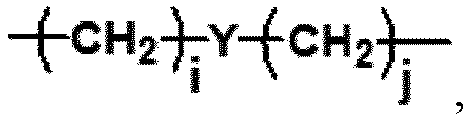
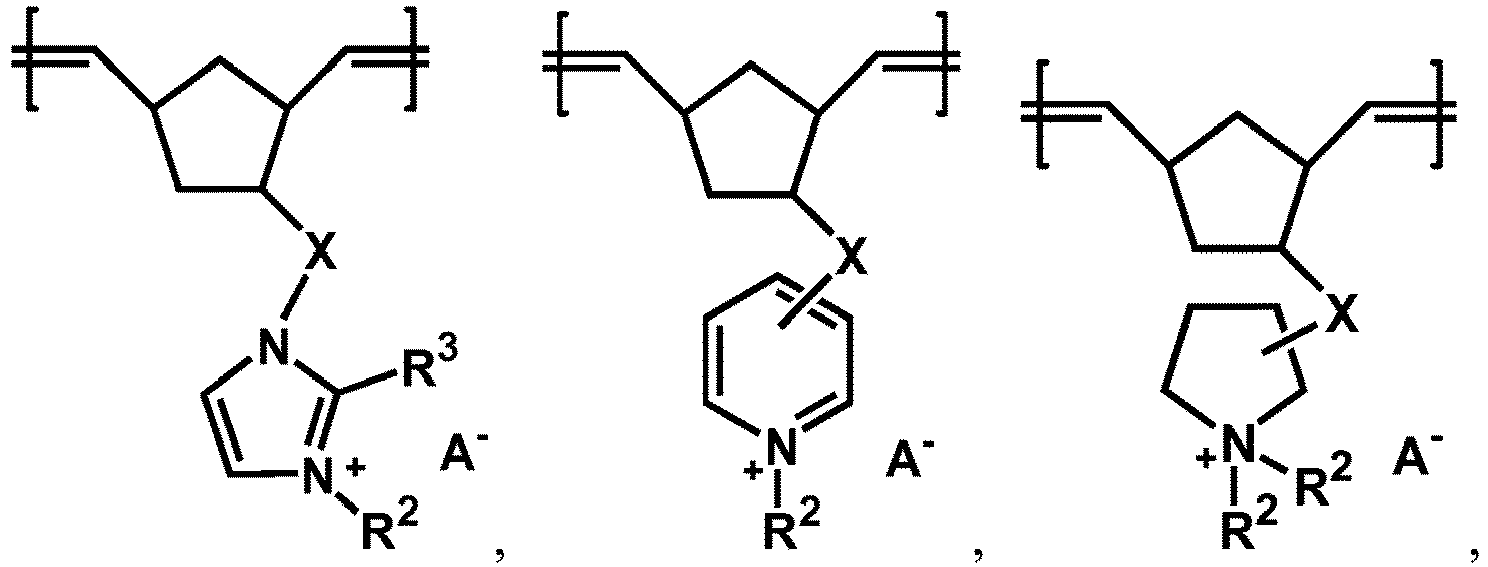
- the disclosure provides a polymer including a first repeat unit and a second repeat unit, wherein the first repeat unit can be the second repeat unit can be wherein R + can be A - can be F - , Cl - , Br - , I - , OH - , HCO 3 - , HSO 4 - , SbF 6 - , BF 4 - , H 2 PO 4 - , H 2 PO 3 - , or H 2 PO 2 - ; X can be i and j can be independently 0, or an integer from 1 to 6, Y can be -O-, -S-, -CH 2 -, or -NH-; R 1 can be independently C 1-8 alkyl group; and, R 2 and R 3 can be independently hydrogen, or C 1-8 alkyl group.
- the ratio between the first repeat unit and the second repeat unit is between about 1:99 and 99:
- the disclosure provides a method for preparing the aforementioned polymer.
- the method includes subjecting a composition to a polymerization.
- the composition includes a first monomer having a structure of Formula (I) and a second monomer having a structure of Formula (II) , wherein R + can be A - can be F - , Cl - , Br - , I - , OH - , HCO 3 - , HSO 4 - , SbF 6 - , BF 4 - , H 2 PO 4 - , H 2 PO 3 - , or H 2 PO 2 - ;
- X can be i and j can be independently 0, or an integer from 1 to 6,
- Y can be -O-, -S-, -CH 2 -, or -NH-;
- R 1 can be independently C 1-8 alkyl group; and, R 2 and R 3 can be independently hydrogen, or C 1-8 alkyl group.
- the disclosure provides a polymer and a method for preparing the same.
- the polymer of the disclosure can be a polymer with a cationic group (such as a highly stable cyclic conjugated cationic group) and non-ionic group (such as long-chain group).
- a cationic group such as a highly stable cyclic conjugated cationic group
- non-ionic group such as long-chain group.
- the polymer of the disclosure in order to enhance the electrical conductivity of the polymer, has a repeat unit with a cationic group.
- the polymer of the disclosure has a repeat unit with a non-ionic group, in order to prevent the solubility of the polymer having cationic groups from decreasing when dissolving in a solvent.
- the polymer of the disclosure besides the high solubility, the polymer of the disclosure exhibits improved mechanical strength and increased solvent selectivity.
- the polymer of the disclosure includes a first repeat unit and a second repeat unit.
- the first repeat unit can be wherein R + can be (such as : (such as );
- a - can be F - , Cl - , Br - , I - , OH - , HCO 3 - , HSO 4 - , SbF 6 - , BF 4 - , H 2 PO 4 - , H 2 PO 3 - , or H 2 PO 2 - ;
- X is i and j can be independently 0, or an integer from 1 to 6,
- Y can be -O-, -S-, -CH 2 -, or -NH-; and,
- R 2 and R 3 can be independently hydrogen, or C 1-8 alkyl group (such as : methyl, ethyl, propyl, isopropyl, n-butyl, sec-butyl, isobutyl, tert-butyl, pen
- the second repeat unit can be wherein R 1 can be independently C 1-8 alkyl group (such as methyl, ethyl, propyl, isopropyl, n-butyl, sec-butyl, isobutyl, tert-butyl, pentyl, hexyl, cyclohexyl, cyclopentyl, heptyl, or octyl).
- R 1 can be independently C 1-8 alkyl group (such as methyl, ethyl, propyl, isopropyl, n-butyl, sec-butyl, isobutyl, tert-butyl, pentyl, hexyl, cyclohexyl, cyclopentyl, heptyl, or octyl).
- the first repeat unit can be wherein R + can be (such as (such as );
- a - can be F - , Cl - , Br - , I - , OH - , HCO 3 - , HSO 4 - , SbF 6 - , BF 4 - , H 2 PO 4 - , H 2 PO 3 - , or H 2 PO 2 - ;
- X is Y can be -O-, -S-,-CH 2 -, or -NH-;
- i and j can be independently 0, or an integer from 1 to 6; and,
- R 2 and R 3 can be independently hydrogen, or C 1-8 alkyl group.
- the polymer of the disclosure has a molecular weight (such as number average molecular weight) between about 100, 000 and 250, 000.
- the ratio between the first repeat unit and the second repeat unit of the polymer can be adjusted to achieve the desired characteristics of the polymer.
- the ratio between the first repeat unit and the second repeat unit can be increased in order to enhance the electrical conductivity and the anion exchange capacity of the polymer.
- the ratio between the first repeat unit and the second repeat unit can be decreased in order to enhance the solubility, the mechanical strength, and the solvent selectivity of the polymer.
- the ratio between the first repeat unit and the second repeat unit is between about 1:99 and 99:1, such as between about 10:90 and 90:10, between about 20:80 and 80:20, or between about 30:70 and 70:30.
- the polymer of the disclosure can further include a third repeat unit, wherein the third repeat unit can be The portion represented by of the first repeat unit, the second repeat unit, or the third repeat unit is bonded to the portion represented by of the other first repeat unit, the other second repeat unit, or the other third repeat unit.
- the first repeat unit, the second repeat unit, and the third repeat unit can be arranged in a random fashion.
- the polymer of the disclosure can have a moiety represented by a moiety represented by or a moiety represented by
- the ratio between the third repeat unit and the sum of the first repeat unit and the second repeat unit can be between about 0.1:100 and 5:100, such as between about 0.5:100 and 4:100, or between about 0.5:100 and 3:100. Due to the introduction of the third repeat unit, the polymer can have improved cross-linking degree and mechanical strength by adopting the third repeat unit. In addition, when the ratio between the third repeat unit and the sum of the first repeat unit and the second repeat unit is too high, the polymer would have too high a cross-linking degree and too high a molecular weight and cannot be redissolved in the subsequent process solvent.
- the disclosure provides a method for preparing the aforementioned polymer.
- the method includes subjecting a composition to a polymerization, such as a ring opening metathesis polymerization (ROMP).
- the composition can include a first monomer having a structure of Formula (I) and a second monomer having a structure of Formula (II) wherein, R + can be A - can be F - , Cl - , Br - , I - , OH - , HCO 3 - , HSO 4 - , SbF 6 - , BF 4 - , H 2 PO 4 - , H 2 PO 3 - , or H 2 PO 2 - ;
- X can be i and j can be independently 0, or an integer from 1 to 6,
- Y can be -O-, -S-, -CH 2 -, or -NH-;
- R 1 can be independently C 1-8 alkyl group; and, R 2 and R 3 can be independently hydrogen
- the first monomer can be wherein, R + can or A - can be F - , Cl - , Br - , I - , OH - , HCO 3 - , HSO 4 - , SbF 6 - , BF 4 - , H 2 PO 4 - , H 2 PO 3 - , or H 2 PO 2 - ;
- X can be i and j can be independently 0, or an integer from 1 to 6,
- Y is -O-, -S-, -CH 2 -, or -NH-; and, R 2 and R 3 are independently hydrogen, or C 1-8 alkyl group (such as : methyl, ethyl, propyl, isopropyl, n-butyl, sec-butyl, isobutyl, tert-butyl, pentyl, hexyl, cyclohexyl, cyclopentyl, heptyl, or
- the molar ratio between the first monomer and the second monomer is between about 1:99 and 99:1, such as between about 10:90 and 90:10, between about 20:80 and 80:20, or between about 30:70 and 70:30.
- the composition can further include a third monomer, wherein the third monomer can be The molar ratio between the third monomer and the sum of the first monomer and the second monomer can be between about 0.1:100 and 5:100, such as between about 0.5:100 and 4:100, or between about 0.5:100 and 3:100.
- the polymer of the disclosure can be used to prepare an ion exchange membrane.
- the method for preparing the ion exchange membrane includes the following steps. First, a composition is provided, wherein the composition includes the aforementioned polymer and a cross-linking agent. In addition, the composition can further include a solvent, and the composition has a solid content between about 5wt% and 50 wt%.
- the cross-linking agent can has a weight percentage between about 1wt% and 30wt% (such as between about 5wt% and 30wt%, or between about 5wt% and 25wt%), based on the weight of the polymer.
- the composition is subjected to a mixing and distributing process.
- the composition is coated on a substrate (such as a glass substrate) to form a coating.
- a substrate such as a glass substrate
- the coating is baked to remove most of the solvent.
- the coating formed on the substrate is baked in a high temperature oven to remove residual solvent.
- the coating is immersed in potassium hydroxide aqueous solution and deionized water for 1-3 hours sequentially. After drying, the ion exchange membrane of the disclosure is obtained.
- the cross-linking agent can be a compound having at least two maleimide groups.
- the cross-linking agent can be a compound having two maleimide groups.
- the compound having two maleimide groups can be wherein Z can be or wherein Y 1 can be single bond, -O-, -S-, -CH 2 -, or -NH-, R 4 can be independently hydrogen, or C 1-4 alkyl group; n ⁇ 1; x can be an integer from 1 to 12, y and z can be independently an integer from 1 to 5.
- the cross-linking agent can be or
- the cross-linking agent can be a polymeric cross-linking agent having at least two maleimide groups.
- the polymeric cross-linking agent can be a reaction product of a compound
- Polymer (1) (having a repeat unit represented by and a repeat unit represented by wherein the ratio of the repeat unit represented by and the repeat unit represented by was about 9:1) was obtained. After measurement, the number average molecular weight (Mn) of Polymer (1) is about 110, 000, and the polydispersity index (PDI) of Polymer (1) is about 1.4.
- Example 2 was performed in the same manner as in Example 1 except that the molar ratio of Compound (2) and Compound (5) was about 8:2, obtaining Polymer (2) (the ratio of the repeat unit represented by and the repeat unit represented by was about 8:2).
- Example 3 was performed in the same manner as in Example 1 except that the molar ratio of Compound (2) and Compound (5) was about 7:3, obtaining Polymer (3) (the ratio of the repeat unit represented by and the repeat unit represented by was about 7:3).
- Example 4 was performed in the same manner as in Example 1 except that the molar ratio of Compound (2) and Compound (5) was about 4:6, obtaining Polymer (4) (the ratio of the repeat unit represented by and the repeat unit represented by was about 4:6).
- Example 5 was performed in the same manner as in Example 1 except that the molar ratio of Compound (2) and Compound (5) was about 2:8, obtaining Polymer (5) (the ratio of the repeat unit represented by and the repeat unit represented by was about 2:8).
- Example 7 was performed in the same manner as in Example 6 except that the molar ratio of Compound (4) and Compound (5) was about 6:4, obtaining Polymer (7) (the ratio of the repeat unit represented by and the repeat unit represented by was about 6:4).
- Example 8 was performed in the same manner as in Example 6 except that the molar ratio of Compound (4) and Compound (5) was about 3:7, obtaining Polymer (8) (the ratio of the repeat unit represented by and the repeat unit represented by was about 3:7).
- polymer (1) prepared from Example 1
- DMAc dimethylacetamide
- polymeric cross-linking agent (1) prepared from Preparation Example 4
- the result was mixed and distributed via a high speed homogenizer, and then defoamed, obtaining a solution.
- the solution was coated on a glass substrate via spin coating, forming a coating.
- the coating was baked at 40-150°C to remove most of the solvent.
- the coating was baked at 120-200°C for 1-6 hours to remove residual solvent.
- Examples 11-14 were performed in the same manner as in Example 10 except that Polymers (2)-(5) were substituted for Polymer (1) respectively, obtaining Anion exchange membranes (2)-(5).
- the ionic conductivity of Anion exchange membranes (2)-(5) were measured, and the results are shown in Table 1.
- the tensile strength and anti-rupture strength of Anion exchange membrane (3) were measured according to ASTM D882-02, and the result is shown in Table 2.
- Table 1 ratio of the repeat unit represented by and the repeat unit represented by ionic conductivity (S/cm) Anion exchange membrane (1) 9:1 0.13 Anion exchange membrane (2) 8:2 -- Anion exchange membrane (3) 7:3 0.06
- Example 15 was performed in the same manner as in Example 12 except that 7 parts by weight of Polymeric cross-linking agent (1) was substituted for 10 parts by weight of Polymeric cross-linking agent (1), obtaining Anion exchange membrane (6).
- the tensile strength and anti-rupture strength of Anion exchange membrane (6) were measured according to ASTM D882-02, and the result is shown in Table 2.
- Example 16 was performed in the same manner as in Example 12 except that 20 parts by weight of Polymeric cross-linking agent (1) was substituted for 10 parts by weight of Polymeric cross-linking agent (1), obtaining Anion exchange membrane (7). Next, the tensile strength and anti-rupture strength of Anion exchange membrane (7) were measured according to ASTM D882-02, and the result is shown in Table 2.
- Example 17 was performed in the same manner as in Example 12 except that 25 parts by weight of Polymeric cross-linking agent (1) was substituted for 10 parts by weight of Polymeric cross-linking agent (1), obtaining Anion exchange membrane (8).
- the tensile strength and anti-rupture strength of Anion exchange membrane (8) were measured according to ASTM D882-02, and the result is shown in Table 2.
- Table 2 polymeric cross-linking agent (parts by weight) tensile strength (MPa) anti-rupture strength (MPa) Anion exchange membrane (3) 10 25.59 36.57 Anion exchange membrane (6) 7 32.51 44.35 Anion exchange membrane (7) 20 30.19 45.77 Anion exchange membrane (8) 25 35.22 47.32
- the anion exchange membrane of the disclosure exhibits superior ionic conductivity and mechanical strength.
- Examples 19-20 were performed in the same manner as in Example 18 except that Polymers (7) and (8) were substituted for Polymer (6) respectively, obtaining Anion exchange membranes (10) and (11).
- the ionic conductivity and dimensional stability of Anion exchange membranes (10) and (11) were measured, and the results are shown in Table 3.
- Table 3 ionic conductivity (S/cm) dimensional shrinkage (%) (measured at 25°C) dimensional shrinkage (%) (measured at 80°C) area thickness area thickness anion exchange membrane (9) 0.09 20 9 24 31 anion exchange membrane (10) 0.02 0 13 0 4 anion exchange membrane (11) 0.004 15 6 4.5 21
- the anion exchange membrane of the disclosure also exhibits high dimensional stability.
- the polymer of the disclosure exhibits high ionic conductivity. Furthermore, due to the introduction of non-ionic group simultaneously, the polymer of the disclosure also exhibits high solubility, mechanical strength, and solvent selectivity.
Landscapes
- Chemical & Material Sciences (AREA)
- Organic Chemistry (AREA)
- Chemical Kinetics & Catalysis (AREA)
- Engineering & Computer Science (AREA)
- Manufacturing & Machinery (AREA)
- Polymers & Plastics (AREA)
- Health & Medical Sciences (AREA)
- Medicinal Chemistry (AREA)
- Sustainable Development (AREA)
- Life Sciences & Earth Sciences (AREA)
- Sustainable Energy (AREA)
- Electrochemistry (AREA)
- General Chemical & Material Sciences (AREA)
- Materials Engineering (AREA)
- Crystallography & Structural Chemistry (AREA)
- Inorganic Chemistry (AREA)
- Addition Polymer Or Copolymer, Post-Treatments, Or Chemical Modifications (AREA)
- Polyoxymethylene Polymers And Polymers With Carbon-To-Carbon Bonds (AREA)
Claims (16)
- Polymère comprenant une première unité de répétition et une deuxième unité de répétition, où la première unité de répétition est




- Polymère selon la revendication 1, dans lequel R1 est un groupe méthyle, éthyle, propyle, isopropyle, n-butyle, butyle secondaire, isobutyle, tert-butyle, pentyle, hexyle, cyclohexyle, cyclopentyle, heptyle ou octyle.
- Polymère selon la revendication 1, dans lequel R2 et R3 sont de manière indépendante un atome d'hydrogène, un groupe méthyle, éthyle, propyle, isopropyle, n-butyle, butyle secondaire, isobutyle, tert-butyle, pentyle, hexyle, cyclohexyle, cyclopentyle, heptyle ou octyle.
- Polymère selon la revendication 1, dans lequel la première unité de répétition est


- Polymère selon la revendication 1, dans lequel la première unité de répétition est



- Polymère selon la revendication 1, dans lequel la deuxième unité de répétition est


- Polymère selon la revendication 1, le polymère comprenant en outre une troisième unité de répétition, la troisième unité de répétition étant

- Polymère selon la revendication 7, dans lequel le rapport entre la troisième unité de répétition et la somme de la première unité de répétition et de la deuxième unité de répétition est entre 0,1 : 100 et 5 : 100.
- Procédé de préparation du polymère selon la revendication 1, comprenant :
la soumission d'une composition à une polymérisation, où la composition comprend un premier monomère ayant une structure selon la formule (I), et un deuxième monomère ayant une structure selon la formule (II)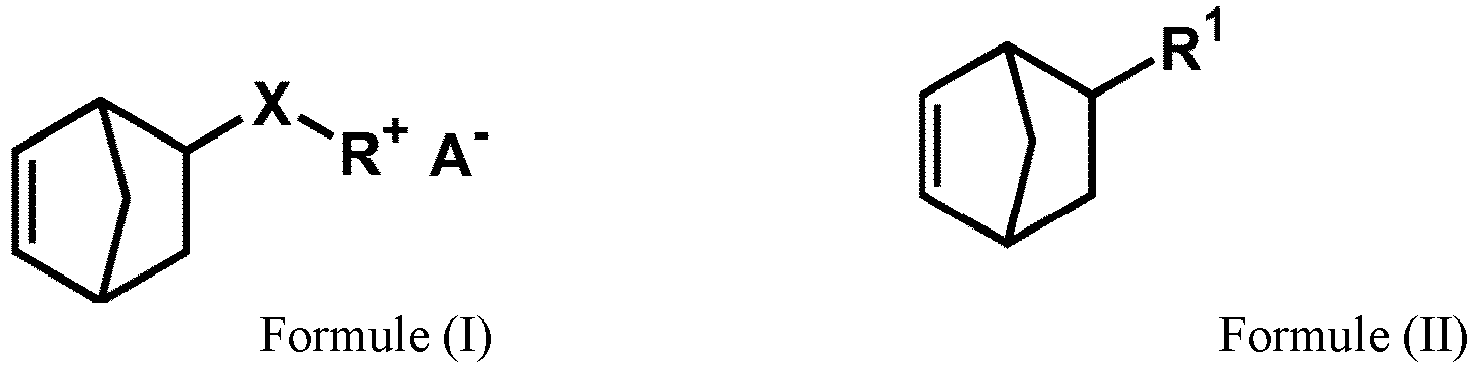


- Procédé selon la revendication 9, dans lequel R1 est un groupe méthyle, éthyle, propyle, isopropyle, n-butyle, butyle secondaire, isobutyle, tert-butyle, pentyle, hexyle, cyclohexyle, cyclopentyle, heptyle ou octyle.
- Procédé selon la revendication 9, dans lequel R2 et R3 sont de manière indépendante un atome d'hydrogène, un groupe méthyle, éthyle, propyle, isopropyle, n-butyle, butyle secondaire, isobutyle, tert-butyle, pentyle, hexyle, cyclohexyle, cyclopentyle, heptyle ou octyle.
- Procédé selon la revendication 9, dans lequel le premier monomère est


- Procédé selon la revendication 9, dans lequel le premier monomère est


- Procédé selon la revendication 9, dans lequel le deuxième monomère est


- Procédé selon la revendication 9, dans lequel la composition comprend en outre un troisième monomère, où le troisième monomère est

- Procédé selon la revendication 15, dans lequel le ratio molaire entre le troisième monomère et la somme du premier monomère et du deuxième monomère est entre 0,1 : 100 et 5 : 100.
Applications Claiming Priority (1)
| Application Number | Priority Date | Filing Date | Title |
|---|---|---|---|
| TW104143989A TWI583708B (zh) | 2015-12-28 | 2015-12-28 | 聚合物及其製備方法 |
Publications (2)
| Publication Number | Publication Date |
|---|---|
| EP3187251A1 EP3187251A1 (fr) | 2017-07-05 |
| EP3187251B1 true EP3187251B1 (fr) | 2020-09-09 |
Family
ID=56119309
Family Applications (1)
| Application Number | Title | Priority Date | Filing Date |
|---|---|---|---|
| EP16172017.2A Active EP3187251B1 (fr) | 2015-12-28 | 2016-05-30 | Polymère et son procédé de préparation |
Country Status (6)
| Country | Link |
|---|---|
| US (1) | US10150113B2 (fr) |
| EP (1) | EP3187251B1 (fr) |
| JP (1) | JP6374459B2 (fr) |
| CN (1) | CN106916251B (fr) |
| DK (1) | DK3187251T3 (fr) |
| TW (1) | TWI583708B (fr) |
Cited By (1)
| Publication number | Priority date | Publication date | Assignee | Title |
|---|---|---|---|---|
| WO2024245731A1 (fr) * | 2023-05-26 | 2024-12-05 | Forschungszentrum Jülich GmbH | Polynorbornènes fonctionnalisés à chaîne latérale utilisés comme ionomères et comme matériaux membranaires pour l'électrolyse alcaline de l'eau, et pile à combustible |
Families Citing this family (2)
| Publication number | Priority date | Publication date | Assignee | Title |
|---|---|---|---|---|
| CN110007558A (zh) * | 2017-12-29 | 2019-07-12 | 财团法人工业技术研究院 | 组合物、包含其的绝缘材料及其制法 |
| CN116284691B (zh) * | 2023-03-27 | 2023-11-17 | 天津大学 | 一种具有抑菌性高透明的离子型环烯烃共聚物及其制备方法 |
Family Cites Families (15)
| Publication number | Priority date | Publication date | Assignee | Title |
|---|---|---|---|---|
| DE10006694A1 (de) | 2000-02-15 | 2001-08-16 | Basf Ag | Norbornenylderivate |
| JP4682358B2 (ja) | 2005-04-05 | 2011-05-11 | 独立行政法人 日本原子力研究開発機構 | 機能性無機/グラフト高分子ハイブリッドイオン交換膜の製造方法および燃料電池用電解質膜 |
| TWI342082B (en) * | 2005-12-30 | 2011-05-11 | Ind Tech Res Inst | Electrode structure |
| JP2009256654A (ja) * | 2008-03-27 | 2009-11-05 | Sumitomo Chemical Co Ltd | 高分子電解質組成物 |
| US8223472B1 (en) | 2008-11-14 | 2012-07-17 | Sandia Corporation | Norbornylene-based polymer systems for dielectric applications |
| EP2510036A2 (fr) * | 2009-12-11 | 2012-10-17 | Promerus LLC | Polymères de type norbornène ayant une fonctionnalité ammonium quaternaire |
| US8765894B2 (en) | 2009-12-11 | 2014-07-01 | Promerus, Llc | Norbornene-type polymers having quaternary ammonium functionality |
| CN102049202B (zh) | 2010-11-03 | 2012-10-31 | 厦门大学 | 一种含氟咪唑鎓盐聚合物阴离子交换膜及其制备方法 |
| WO2012075574A1 (fr) * | 2010-12-09 | 2012-06-14 | Queen's University At Kingston | Dérivés d'ionomères d'azolium de polymères halogénés |
| JP6565680B2 (ja) | 2013-12-20 | 2019-08-28 | 日本ゼオン株式会社 | 樹脂材料及び樹脂フィルム |
| KR101542839B1 (ko) * | 2014-02-12 | 2015-08-10 | 광주과학기술원 | 폴리비닐리덴 플루오라이드 고분자를 포함하는 비수계 레독스 흐름 전지용 유무기 복합 음이온 교환막 및 이의 제조방법 |
| US9328206B2 (en) * | 2014-05-30 | 2016-05-03 | Pall Corporation | Self-assembling polymers—III |
| US9169361B1 (en) * | 2014-05-30 | 2015-10-27 | Pall Corporation | Self-assembling polymers—VI |
| CN104693423B (zh) | 2015-02-02 | 2017-04-19 | 华东师范大学 | 可交联的高介电性降冰片烯类共聚物、降冰片烯交联聚合物及其制备方法 |
| TWI579333B (zh) * | 2015-12-28 | 2017-04-21 | 財團法人工業技術研究院 | 離子交換膜 |
-
2015
- 2015-12-28 TW TW104143989A patent/TWI583708B/zh active
-
2016
- 2016-02-04 CN CN201610078291.5A patent/CN106916251B/zh active Active
- 2016-04-22 US US15/135,851 patent/US10150113B2/en active Active
- 2016-05-30 DK DK16172017.2T patent/DK3187251T3/da active
- 2016-05-30 EP EP16172017.2A patent/EP3187251B1/fr active Active
- 2016-09-09 JP JP2016176356A patent/JP6374459B2/ja active Active
Non-Patent Citations (1)
| Title |
|---|
| None * |
Cited By (1)
| Publication number | Priority date | Publication date | Assignee | Title |
|---|---|---|---|---|
| WO2024245731A1 (fr) * | 2023-05-26 | 2024-12-05 | Forschungszentrum Jülich GmbH | Polynorbornènes fonctionnalisés à chaîne latérale utilisés comme ionomères et comme matériaux membranaires pour l'électrolyse alcaline de l'eau, et pile à combustible |
Also Published As
| Publication number | Publication date |
|---|---|
| JP6374459B2 (ja) | 2018-08-15 |
| DK3187251T3 (da) | 2020-09-21 |
| US10150113B2 (en) | 2018-12-11 |
| TWI583708B (zh) | 2017-05-21 |
| CN106916251B (zh) | 2019-08-02 |
| TW201723009A (zh) | 2017-07-01 |
| US20170182487A1 (en) | 2017-06-29 |
| JP2017119822A (ja) | 2017-07-06 |
| EP3187251A1 (fr) | 2017-07-05 |
| CN106916251A (zh) | 2017-07-04 |
Similar Documents
| Publication | Publication Date | Title |
|---|---|---|
| EP3190146B1 (fr) | Membrane à échange d'ions | |
| EP3187251B1 (fr) | Polymère et son procédé de préparation | |
| US10894861B2 (en) | High molecular weight polymers from waste raw materials | |
| JPH0251449B2 (fr) | ||
| US20100292515A1 (en) | Purification method of high-molecular-weight polyethylene glycol compound | |
| CN108503837B (zh) | 一种固体酸制备含氢硅油的方法 | |
| BR112019015180A2 (pt) | Processo para fabricação de uma polialquilenoimina alcoxilada, e, polialquilenoimina alcoxilada | |
| JPH03504983A (ja) | ヒドロキシ―官能価ポリエーテル化合物中のプロペニルエーテル濃度を減少させる方法 | |
| DE102011116764A1 (de) | Polykationen und Derivate | |
| EP2739656B1 (fr) | Résine d'ester de vinyle contenant un cycle d'oxazolidone et produits obtenus à partir de cette résine | |
| JP3739178B2 (ja) | ポリオキシアルキレンポリオールの製造方法 | |
| JP2009185179A (ja) | 多分岐性高分子及びその製造方法 | |
| EP2750798B1 (fr) | Catalyseurs pour la production de carbonates à partir d'époxydes et de co2 | |
| KR101828825B1 (ko) | 세포막-모방 브러쉬 고분자 및 그 제조방법 | |
| CN116333294B (zh) | 一种制备嵌段聚醚的催化剂、嵌段聚醚的制备方法 | |
| Kumbhar | Synthesis and Characterization of Charged Polyethers for Membrane Materials and to Study Polyelectrolyte Self-Assembly | |
| KR20220057932A (ko) | 사슬 연장된 폴리올 조성물 및 이를 이용한 계면활성제 | |
| KR102914611B1 (ko) | 폴리에테르 폴리올의 정제 공정 | |
| EP4353767B1 (fr) | Procédés de purification de polyéther polyols à l'aide de résines échangeuses d'ions | |
| CN113348191B (zh) | 无雾聚氨酯制剂 | |
| TW202212411A (zh) | 聚甘油之製造方法及聚甘油 | |
| TW202611140A (zh) | 降冰片烯衍生共聚物的製造方法,降冰片烯衍生共聚物及其用途 | |
| JP2023547362A (ja) | ポリウレタン組成物 | |
| WO2013034532A1 (fr) | Procede de préparation de polyamines | |
| JP2006233025A (ja) | 架橋構造体の製造方法 |
Legal Events
| Date | Code | Title | Description |
|---|---|---|---|
| PUAI | Public reference made under article 153(3) epc to a published international application that has entered the european phase |
Free format text: ORIGINAL CODE: 0009012 |
|
| STAA | Information on the status of an ep patent application or granted ep patent |
Free format text: STATUS: REQUEST FOR EXAMINATION WAS MADE |
|
| 17P | Request for examination filed |
Effective date: 20161209 |
|
| AK | Designated contracting states |
Kind code of ref document: A1 Designated state(s): AL AT BE BG CH CY CZ DE DK EE ES FI FR GB GR HR HU IE IS IT LI LT LU LV MC MK MT NL NO PL PT RO RS SE SI SK SM TR |
|
| AX | Request for extension of the european patent |
Extension state: BA ME |
|
| STAA | Information on the status of an ep patent application or granted ep patent |
Free format text: STATUS: EXAMINATION IS IN PROGRESS |
|
| STAA | Information on the status of an ep patent application or granted ep patent |
Free format text: STATUS: REQUEST FOR EXAMINATION WAS MADE |
|
| STAA | Information on the status of an ep patent application or granted ep patent |
Free format text: STATUS: EXAMINATION IS IN PROGRESS |
|
| 17Q | First examination report despatched |
Effective date: 20190722 |
|
| GRAP | Despatch of communication of intention to grant a patent |
Free format text: ORIGINAL CODE: EPIDOSNIGR1 |
|
| STAA | Information on the status of an ep patent application or granted ep patent |
Free format text: STATUS: GRANT OF PATENT IS INTENDED |
|
| INTG | Intention to grant announced |
Effective date: 20200403 |
|
| GRAS | Grant fee paid |
Free format text: ORIGINAL CODE: EPIDOSNIGR3 |
|
| GRAA | (expected) grant |
Free format text: ORIGINAL CODE: 0009210 |
|
| STAA | Information on the status of an ep patent application or granted ep patent |
Free format text: STATUS: THE PATENT HAS BEEN GRANTED |
|
| AK | Designated contracting states |
Kind code of ref document: B1 Designated state(s): AL AT BE BG CH CY CZ DE DK EE ES FI FR GB GR HR HU IE IS IT LI LT LU LV MC MK MT NL NO PL PT RO RS SE SI SK SM TR |
|
| REG | Reference to a national code |
Ref country code: GB Ref legal event code: FG4D |
|
| REG | Reference to a national code |
Ref country code: AT Ref legal event code: REF Ref document number: 1310858 Country of ref document: AT Kind code of ref document: T Effective date: 20200915 Ref country code: CH Ref legal event code: EP |
|
| REG | Reference to a national code |
Ref country code: DK Ref legal event code: T3 Effective date: 20200915 |
|
| REG | Reference to a national code |
Ref country code: DE Ref legal event code: R096 Ref document number: 602016043571 Country of ref document: DE |
|
| REG | Reference to a national code |
Ref country code: IE Ref legal event code: FG4D |
|
| REG | Reference to a national code |
Ref country code: NO Ref legal event code: T2 Effective date: 20200909 |
|
| REG | Reference to a national code |
Ref country code: LT Ref legal event code: MG4D |
|
| PG25 | Lapsed in a contracting state [announced via postgrant information from national office to epo] |
Ref country code: GR Free format text: LAPSE BECAUSE OF FAILURE TO SUBMIT A TRANSLATION OF THE DESCRIPTION OR TO PAY THE FEE WITHIN THE PRESCRIBED TIME-LIMIT Effective date: 20201210 Ref country code: FI Free format text: LAPSE BECAUSE OF FAILURE TO SUBMIT A TRANSLATION OF THE DESCRIPTION OR TO PAY THE FEE WITHIN THE PRESCRIBED TIME-LIMIT Effective date: 20200909 Ref country code: SE Free format text: LAPSE BECAUSE OF FAILURE TO SUBMIT A TRANSLATION OF THE DESCRIPTION OR TO PAY THE FEE WITHIN THE PRESCRIBED TIME-LIMIT Effective date: 20200909 Ref country code: BG Free format text: LAPSE BECAUSE OF FAILURE TO SUBMIT A TRANSLATION OF THE DESCRIPTION OR TO PAY THE FEE WITHIN THE PRESCRIBED TIME-LIMIT Effective date: 20201209 Ref country code: LT Free format text: LAPSE BECAUSE OF FAILURE TO SUBMIT A TRANSLATION OF THE DESCRIPTION OR TO PAY THE FEE WITHIN THE PRESCRIBED TIME-LIMIT Effective date: 20200909 Ref country code: HR Free format text: LAPSE BECAUSE OF FAILURE TO SUBMIT A TRANSLATION OF THE DESCRIPTION OR TO PAY THE FEE WITHIN THE PRESCRIBED TIME-LIMIT Effective date: 20200909 |
|
| REG | Reference to a national code |
Ref country code: AT Ref legal event code: MK05 Ref document number: 1310858 Country of ref document: AT Kind code of ref document: T Effective date: 20200909 |
|
| REG | Reference to a national code |
Ref country code: NL Ref legal event code: MP Effective date: 20200909 |
|
| PG25 | Lapsed in a contracting state [announced via postgrant information from national office to epo] |
Ref country code: PL Free format text: LAPSE BECAUSE OF FAILURE TO SUBMIT A TRANSLATION OF THE DESCRIPTION OR TO PAY THE FEE WITHIN THE PRESCRIBED TIME-LIMIT Effective date: 20200909 Ref country code: RS Free format text: LAPSE BECAUSE OF FAILURE TO SUBMIT A TRANSLATION OF THE DESCRIPTION OR TO PAY THE FEE WITHIN THE PRESCRIBED TIME-LIMIT Effective date: 20200909 Ref country code: LV Free format text: LAPSE BECAUSE OF FAILURE TO SUBMIT A TRANSLATION OF THE DESCRIPTION OR TO PAY THE FEE WITHIN THE PRESCRIBED TIME-LIMIT Effective date: 20200909 |
|
| PG25 | Lapsed in a contracting state [announced via postgrant information from national office to epo] |
Ref country code: EE Free format text: LAPSE BECAUSE OF FAILURE TO SUBMIT A TRANSLATION OF THE DESCRIPTION OR TO PAY THE FEE WITHIN THE PRESCRIBED TIME-LIMIT Effective date: 20200909 Ref country code: CZ Free format text: LAPSE BECAUSE OF FAILURE TO SUBMIT A TRANSLATION OF THE DESCRIPTION OR TO PAY THE FEE WITHIN THE PRESCRIBED TIME-LIMIT Effective date: 20200909 Ref country code: RO Free format text: LAPSE BECAUSE OF FAILURE TO SUBMIT A TRANSLATION OF THE DESCRIPTION OR TO PAY THE FEE WITHIN THE PRESCRIBED TIME-LIMIT Effective date: 20200909 Ref country code: PT Free format text: LAPSE BECAUSE OF FAILURE TO SUBMIT A TRANSLATION OF THE DESCRIPTION OR TO PAY THE FEE WITHIN THE PRESCRIBED TIME-LIMIT Effective date: 20210111 Ref country code: SM Free format text: LAPSE BECAUSE OF FAILURE TO SUBMIT A TRANSLATION OF THE DESCRIPTION OR TO PAY THE FEE WITHIN THE PRESCRIBED TIME-LIMIT Effective date: 20200909 |
|
| PG25 | Lapsed in a contracting state [announced via postgrant information from national office to epo] |
Ref country code: AL Free format text: LAPSE BECAUSE OF FAILURE TO SUBMIT A TRANSLATION OF THE DESCRIPTION OR TO PAY THE FEE WITHIN THE PRESCRIBED TIME-LIMIT Effective date: 20200909 Ref country code: AT Free format text: LAPSE BECAUSE OF FAILURE TO SUBMIT A TRANSLATION OF THE DESCRIPTION OR TO PAY THE FEE WITHIN THE PRESCRIBED TIME-LIMIT Effective date: 20200909 Ref country code: ES Free format text: LAPSE BECAUSE OF FAILURE TO SUBMIT A TRANSLATION OF THE DESCRIPTION OR TO PAY THE FEE WITHIN THE PRESCRIBED TIME-LIMIT Effective date: 20200909 Ref country code: IS Free format text: LAPSE BECAUSE OF FAILURE TO SUBMIT A TRANSLATION OF THE DESCRIPTION OR TO PAY THE FEE WITHIN THE PRESCRIBED TIME-LIMIT Effective date: 20210109 |
|
| REG | Reference to a national code |
Ref country code: DE Ref legal event code: R097 Ref document number: 602016043571 Country of ref document: DE |
|
| PG25 | Lapsed in a contracting state [announced via postgrant information from national office to epo] |
Ref country code: SK Free format text: LAPSE BECAUSE OF FAILURE TO SUBMIT A TRANSLATION OF THE DESCRIPTION OR TO PAY THE FEE WITHIN THE PRESCRIBED TIME-LIMIT Effective date: 20200909 |
|
| PLBE | No opposition filed within time limit |
Free format text: ORIGINAL CODE: 0009261 |
|
| STAA | Information on the status of an ep patent application or granted ep patent |
Free format text: STATUS: NO OPPOSITION FILED WITHIN TIME LIMIT |
|
| 26N | No opposition filed |
Effective date: 20210610 |
|
| PG25 | Lapsed in a contracting state [announced via postgrant information from national office to epo] |
Ref country code: SI Free format text: LAPSE BECAUSE OF FAILURE TO SUBMIT A TRANSLATION OF THE DESCRIPTION OR TO PAY THE FEE WITHIN THE PRESCRIBED TIME-LIMIT Effective date: 20200909 |
|
| PG25 | Lapsed in a contracting state [announced via postgrant information from national office to epo] |
Ref country code: IT Free format text: LAPSE BECAUSE OF FAILURE TO SUBMIT A TRANSLATION OF THE DESCRIPTION OR TO PAY THE FEE WITHIN THE PRESCRIBED TIME-LIMIT Effective date: 20200909 |
|
| REG | Reference to a national code |
Ref country code: CH Ref legal event code: PL |
|
| PG25 | Lapsed in a contracting state [announced via postgrant information from national office to epo] |
Ref country code: LU Free format text: LAPSE BECAUSE OF NON-PAYMENT OF DUE FEES Effective date: 20210530 Ref country code: LI Free format text: LAPSE BECAUSE OF NON-PAYMENT OF DUE FEES Effective date: 20210531 Ref country code: MC Free format text: LAPSE BECAUSE OF FAILURE TO SUBMIT A TRANSLATION OF THE DESCRIPTION OR TO PAY THE FEE WITHIN THE PRESCRIBED TIME-LIMIT Effective date: 20200909 Ref country code: CH Free format text: LAPSE BECAUSE OF NON-PAYMENT OF DUE FEES Effective date: 20210531 |
|
| REG | Reference to a national code |
Ref country code: BE Ref legal event code: MM Effective date: 20210531 |
|
| PG25 | Lapsed in a contracting state [announced via postgrant information from national office to epo] |
Ref country code: IE Free format text: LAPSE BECAUSE OF NON-PAYMENT OF DUE FEES Effective date: 20210530 |
|
| PG25 | Lapsed in a contracting state [announced via postgrant information from national office to epo] |
Ref country code: FR Free format text: LAPSE BECAUSE OF NON-PAYMENT OF DUE FEES Effective date: 20210531 |
|
| PG25 | Lapsed in a contracting state [announced via postgrant information from national office to epo] |
Ref country code: BE Free format text: LAPSE BECAUSE OF NON-PAYMENT OF DUE FEES Effective date: 20210531 |
|
| PG25 | Lapsed in a contracting state [announced via postgrant information from national office to epo] |
Ref country code: HU Free format text: LAPSE BECAUSE OF FAILURE TO SUBMIT A TRANSLATION OF THE DESCRIPTION OR TO PAY THE FEE WITHIN THE PRESCRIBED TIME-LIMIT; INVALID AB INITIO Effective date: 20160530 |
|
| PG25 | Lapsed in a contracting state [announced via postgrant information from national office to epo] |
Ref country code: NL Free format text: LAPSE BECAUSE OF NON-PAYMENT OF DUE FEES Effective date: 20200923 Ref country code: CY Free format text: LAPSE BECAUSE OF FAILURE TO SUBMIT A TRANSLATION OF THE DESCRIPTION OR TO PAY THE FEE WITHIN THE PRESCRIBED TIME-LIMIT Effective date: 20200909 |
|
| PG25 | Lapsed in a contracting state [announced via postgrant information from national office to epo] |
Ref country code: MK Free format text: LAPSE BECAUSE OF FAILURE TO SUBMIT A TRANSLATION OF THE DESCRIPTION OR TO PAY THE FEE WITHIN THE PRESCRIBED TIME-LIMIT Effective date: 20200909 |
|
| PG25 | Lapsed in a contracting state [announced via postgrant information from national office to epo] |
Ref country code: TR Free format text: LAPSE BECAUSE OF FAILURE TO SUBMIT A TRANSLATION OF THE DESCRIPTION OR TO PAY THE FEE WITHIN THE PRESCRIBED TIME-LIMIT Effective date: 20200909 |
|
| PG25 | Lapsed in a contracting state [announced via postgrant information from national office to epo] |
Ref country code: MT Free format text: LAPSE BECAUSE OF FAILURE TO SUBMIT A TRANSLATION OF THE DESCRIPTION OR TO PAY THE FEE WITHIN THE PRESCRIBED TIME-LIMIT Effective date: 20200909 |
|
| PGFP | Annual fee paid to national office [announced via postgrant information from national office to epo] |
Ref country code: DE Payment date: 20250529 Year of fee payment: 10 |
|
| PGFP | Annual fee paid to national office [announced via postgrant information from national office to epo] |
Ref country code: GB Payment date: 20250527 Year of fee payment: 10 Ref country code: DK Payment date: 20250526 Year of fee payment: 10 |
|
| PGFP | Annual fee paid to national office [announced via postgrant information from national office to epo] |
Ref country code: NO Payment date: 20250530 Year of fee payment: 10 |