EP3187614A1 - Hochfestes kaltgewalztes stahlblech und herstellungsverfahren dafür - Google Patents
Hochfestes kaltgewalztes stahlblech und herstellungsverfahren dafür Download PDFInfo
- Publication number
- EP3187614A1 EP3187614A1 EP17000056.6A EP17000056A EP3187614A1 EP 3187614 A1 EP3187614 A1 EP 3187614A1 EP 17000056 A EP17000056 A EP 17000056A EP 3187614 A1 EP3187614 A1 EP 3187614A1
- Authority
- EP
- European Patent Office
- Prior art keywords
- steel sheet
- ferrite
- mass
- temperature
- surface layer
- Prior art date
- Legal status (The legal status is an assumption and is not a legal conclusion. Google has not performed a legal analysis and makes no representation as to the accuracy of the status listed.)
- Withdrawn
Links
Images

Classifications
-
- C—CHEMISTRY; METALLURGY
- C22—METALLURGY; FERROUS OR NON-FERROUS ALLOYS; TREATMENT OF ALLOYS OR NON-FERROUS METALS
- C22C—ALLOYS
- C22C38/00—Ferrous alloys, e.g. steel alloys
- C22C38/18—Ferrous alloys, e.g. steel alloys containing chromium
- C22C38/38—Ferrous alloys, e.g. steel alloys containing chromium with more than 1.5% by weight of manganese
-
- C—CHEMISTRY; METALLURGY
- C21—METALLURGY OF IRON
- C21D—MODIFYING THE PHYSICAL STRUCTURE OF FERROUS METALS; GENERAL DEVICES FOR HEAT TREATMENT OF FERROUS OR NON-FERROUS METALS OR ALLOYS; MAKING METAL MALLEABLE, e.g. BY DECARBURISATION OR TEMPERING
- C21D1/00—General methods or devices for heat treatment, e.g. annealing, hardening, quenching or tempering
- C21D1/18—Hardening; Quenching with or without subsequent tempering
-
- C—CHEMISTRY; METALLURGY
- C21—METALLURGY OF IRON
- C21D—MODIFYING THE PHYSICAL STRUCTURE OF FERROUS METALS; GENERAL DEVICES FOR HEAT TREATMENT OF FERROUS OR NON-FERROUS METALS OR ALLOYS; MAKING METAL MALLEABLE, e.g. BY DECARBURISATION OR TEMPERING
- C21D8/00—Modifying the physical properties of ferrous metals or ferrous alloys by deformation combined with, or followed by, heat treatment
- C21D8/02—Modifying the physical properties of ferrous metals or ferrous alloys by deformation combined with, or followed by, heat treatment during manufacturing of plates or strips
- C21D8/0221—Modifying the physical properties of ferrous metals or ferrous alloys by deformation combined with, or followed by, heat treatment during manufacturing of plates or strips characterised by the working steps
- C21D8/0226—Hot rolling
-
- C—CHEMISTRY; METALLURGY
- C21—METALLURGY OF IRON
- C21D—MODIFYING THE PHYSICAL STRUCTURE OF FERROUS METALS; GENERAL DEVICES FOR HEAT TREATMENT OF FERROUS OR NON-FERROUS METALS OR ALLOYS; MAKING METAL MALLEABLE, e.g. BY DECARBURISATION OR TEMPERING
- C21D8/00—Modifying the physical properties of ferrous metals or ferrous alloys by deformation combined with, or followed by, heat treatment
- C21D8/02—Modifying the physical properties of ferrous metals or ferrous alloys by deformation combined with, or followed by, heat treatment during manufacturing of plates or strips
- C21D8/0221—Modifying the physical properties of ferrous metals or ferrous alloys by deformation combined with, or followed by, heat treatment during manufacturing of plates or strips characterised by the working steps
- C21D8/0236—Cold rolling
-
- C—CHEMISTRY; METALLURGY
- C21—METALLURGY OF IRON
- C21D—MODIFYING THE PHYSICAL STRUCTURE OF FERROUS METALS; GENERAL DEVICES FOR HEAT TREATMENT OF FERROUS OR NON-FERROUS METALS OR ALLOYS; MAKING METAL MALLEABLE, e.g. BY DECARBURISATION OR TEMPERING
- C21D8/00—Modifying the physical properties of ferrous metals or ferrous alloys by deformation combined with, or followed by, heat treatment
- C21D8/02—Modifying the physical properties of ferrous metals or ferrous alloys by deformation combined with, or followed by, heat treatment during manufacturing of plates or strips
- C21D8/0247—Modifying the physical properties of ferrous metals or ferrous alloys by deformation combined with, or followed by, heat treatment during manufacturing of plates or strips characterised by the heat treatment
- C21D8/0263—Modifying the physical properties of ferrous metals or ferrous alloys by deformation combined with, or followed by, heat treatment during manufacturing of plates or strips characterised by the heat treatment following hot rolling
-
- C—CHEMISTRY; METALLURGY
- C21—METALLURGY OF IRON
- C21D—MODIFYING THE PHYSICAL STRUCTURE OF FERROUS METALS; GENERAL DEVICES FOR HEAT TREATMENT OF FERROUS OR NON-FERROUS METALS OR ALLOYS; MAKING METAL MALLEABLE, e.g. BY DECARBURISATION OR TEMPERING
- C21D8/00—Modifying the physical properties of ferrous metals or ferrous alloys by deformation combined with, or followed by, heat treatment
- C21D8/12—Modifying the physical properties of ferrous metals or ferrous alloys by deformation combined with, or followed by, heat treatment during manufacturing of articles with special electromagnetic properties
- C21D8/1244—Modifying the physical properties of ferrous metals or ferrous alloys by deformation combined with, or followed by, heat treatment during manufacturing of articles with special electromagnetic properties characterised by the heat treatment
- C21D8/1272—Final recrystallisation annealing
-
- C—CHEMISTRY; METALLURGY
- C21—METALLURGY OF IRON
- C21D—MODIFYING THE PHYSICAL STRUCTURE OF FERROUS METALS; GENERAL DEVICES FOR HEAT TREATMENT OF FERROUS OR NON-FERROUS METALS OR ALLOYS; MAKING METAL MALLEABLE, e.g. BY DECARBURISATION OR TEMPERING
- C21D9/00—Heat treatment, e.g. annealing, hardening, quenching or tempering, adapted for particular articles; Furnaces therefor
- C21D9/46—Heat treatment, e.g. annealing, hardening, quenching or tempering, adapted for particular articles; Furnaces therefor for sheet metals
-
- C—CHEMISTRY; METALLURGY
- C22—METALLURGY; FERROUS OR NON-FERROUS ALLOYS; TREATMENT OF ALLOYS OR NON-FERROUS METALS
- C22C—ALLOYS
- C22C38/00—Ferrous alloys, e.g. steel alloys
- C22C38/001—Ferrous alloys, e.g. steel alloys containing N
-
- C—CHEMISTRY; METALLURGY
- C22—METALLURGY; FERROUS OR NON-FERROUS ALLOYS; TREATMENT OF ALLOYS OR NON-FERROUS METALS
- C22C—ALLOYS
- C22C38/00—Ferrous alloys, e.g. steel alloys
- C22C38/002—Ferrous alloys, e.g. steel alloys containing In, Mg, or other elements not provided for in one single group C22C38/001 - C22C38/60
-
- C—CHEMISTRY; METALLURGY
- C22—METALLURGY; FERROUS OR NON-FERROUS ALLOYS; TREATMENT OF ALLOYS OR NON-FERROUS METALS
- C22C—ALLOYS
- C22C38/00—Ferrous alloys, e.g. steel alloys
- C22C38/005—Ferrous alloys, e.g. steel alloys containing rare earths, i.e. Sc, Y, Lanthanides
-
- C—CHEMISTRY; METALLURGY
- C22—METALLURGY; FERROUS OR NON-FERROUS ALLOYS; TREATMENT OF ALLOYS OR NON-FERROUS METALS
- C22C—ALLOYS
- C22C38/00—Ferrous alloys, e.g. steel alloys
- C22C38/02—Ferrous alloys, e.g. steel alloys containing silicon
-
- C—CHEMISTRY; METALLURGY
- C22—METALLURGY; FERROUS OR NON-FERROUS ALLOYS; TREATMENT OF ALLOYS OR NON-FERROUS METALS
- C22C—ALLOYS
- C22C38/00—Ferrous alloys, e.g. steel alloys
- C22C38/04—Ferrous alloys, e.g. steel alloys containing manganese
-
- C—CHEMISTRY; METALLURGY
- C22—METALLURGY; FERROUS OR NON-FERROUS ALLOYS; TREATMENT OF ALLOYS OR NON-FERROUS METALS
- C22C—ALLOYS
- C22C38/00—Ferrous alloys, e.g. steel alloys
- C22C38/06—Ferrous alloys, e.g. steel alloys containing aluminium
-
- C—CHEMISTRY; METALLURGY
- C22—METALLURGY; FERROUS OR NON-FERROUS ALLOYS; TREATMENT OF ALLOYS OR NON-FERROUS METALS
- C22C—ALLOYS
- C22C38/00—Ferrous alloys, e.g. steel alloys
- C22C38/08—Ferrous alloys, e.g. steel alloys containing nickel
-
- C—CHEMISTRY; METALLURGY
- C22—METALLURGY; FERROUS OR NON-FERROUS ALLOYS; TREATMENT OF ALLOYS OR NON-FERROUS METALS
- C22C—ALLOYS
- C22C38/00—Ferrous alloys, e.g. steel alloys
- C22C38/12—Ferrous alloys, e.g. steel alloys containing tungsten, tantalum, molybdenum, vanadium, or niobium
-
- C—CHEMISTRY; METALLURGY
- C22—METALLURGY; FERROUS OR NON-FERROUS ALLOYS; TREATMENT OF ALLOYS OR NON-FERROUS METALS
- C22C—ALLOYS
- C22C38/00—Ferrous alloys, e.g. steel alloys
- C22C38/16—Ferrous alloys, e.g. steel alloys containing copper
-
- C—CHEMISTRY; METALLURGY
- C22—METALLURGY; FERROUS OR NON-FERROUS ALLOYS; TREATMENT OF ALLOYS OR NON-FERROUS METALS
- C22C—ALLOYS
- C22C38/00—Ferrous alloys, e.g. steel alloys
- C22C38/18—Ferrous alloys, e.g. steel alloys containing chromium
-
- C—CHEMISTRY; METALLURGY
- C22—METALLURGY; FERROUS OR NON-FERROUS ALLOYS; TREATMENT OF ALLOYS OR NON-FERROUS METALS
- C22C—ALLOYS
- C22C38/00—Ferrous alloys, e.g. steel alloys
- C22C38/18—Ferrous alloys, e.g. steel alloys containing chromium
- C22C38/34—Ferrous alloys, e.g. steel alloys containing chromium with more than 1.5% by weight of silicon
-
- C—CHEMISTRY; METALLURGY
- C21—METALLURGY OF IRON
- C21D—MODIFYING THE PHYSICAL STRUCTURE OF FERROUS METALS; GENERAL DEVICES FOR HEAT TREATMENT OF FERROUS OR NON-FERROUS METALS OR ALLOYS; MAKING METAL MALLEABLE, e.g. BY DECARBURISATION OR TEMPERING
- C21D1/00—General methods or devices for heat treatment, e.g. annealing, hardening, quenching or tempering
- C21D1/18—Hardening; Quenching with or without subsequent tempering
- C21D1/25—Hardening, combined with annealing between 300 degrees Celsius and 600 degrees Celsius, i.e. heat refining ("Vergüten")
-
- C—CHEMISTRY; METALLURGY
- C21—METALLURGY OF IRON
- C21D—MODIFYING THE PHYSICAL STRUCTURE OF FERROUS METALS; GENERAL DEVICES FOR HEAT TREATMENT OF FERROUS OR NON-FERROUS METALS OR ALLOYS; MAKING METAL MALLEABLE, e.g. BY DECARBURISATION OR TEMPERING
- C21D2211/00—Microstructure comprising significant phases
- C21D2211/002—Bainite
-
- C—CHEMISTRY; METALLURGY
- C21—METALLURGY OF IRON
- C21D—MODIFYING THE PHYSICAL STRUCTURE OF FERROUS METALS; GENERAL DEVICES FOR HEAT TREATMENT OF FERROUS OR NON-FERROUS METALS OR ALLOYS; MAKING METAL MALLEABLE, e.g. BY DECARBURISATION OR TEMPERING
- C21D2211/00—Microstructure comprising significant phases
- C21D2211/005—Ferrite
-
- C—CHEMISTRY; METALLURGY
- C21—METALLURGY OF IRON
- C21D—MODIFYING THE PHYSICAL STRUCTURE OF FERROUS METALS; GENERAL DEVICES FOR HEAT TREATMENT OF FERROUS OR NON-FERROUS METALS OR ALLOYS; MAKING METAL MALLEABLE, e.g. BY DECARBURISATION OR TEMPERING
- C21D2211/00—Microstructure comprising significant phases
- C21D2211/008—Martensite
Definitions
- the invention of the present application relates to a high strength cold-rolled steel sheet used for automobile components and the like and a manufacturing method for the same, and relates more specifically to a high strength cold-rolled steel sheet exhibiting little variation in the mechanical property or a high strength cold-rolled steel sheet excellent in bendability.
- recrystallization annealing/tempering treatment is executed by holding at a temperature of Ac1 or above and Ac3 or below for 10 s or more, slow cooling
- Patent Literature 2 a method is disclosed in which the variation in the strength is reduced by that the relation between the tensile strength and the sheet thickness, carbon content, phosphorus content, quenching start temperature, quenching stop temperature, and tempering temperature after quenching of the steel sheet is obtained beforehand, the quenching start temperature is calculated according to the target tensile strength considering the sheet thickness, carbon content, phosphorus content, quenching stop temperature, and tempering temperature after quenching of the steel sheet of the object, and quenching is executed with the quenching start temperature obtained.
- Patent Literature 3 there is disclosed a method for improving the variation in the elongation property in the sheet width direction by soaking at over 800°C and below Ac3 point for 30 s - 5 min, thereafter executing the primary cooling to the temperature range of 450-550°C, then executing secondary cooling to 450-400°C with a lower cooling rate than the primary cooling rate, and holding thereafter at 450-400°C for 1 min or more in the annealing treatment after cold-rolling the hot-rolled steel sheet in manufacturing a steel sheet having the microstructure including 3% or more of the retained austenite.
- Patent Literature 4 there is disclosed a method for improving the drawability of a high strength hot-dip galvanizing-coated steel sheet by achieving the microstructure including a ferrite phase having the average grain size of 10 ⁇ m or less and a martensitic phase having the volumetric fraction of 30-90% in which the ratio of the sheet thickness surface layer hardness with respect to the sheet thickness center hardness is 0.6-1, the maximum depth of the crack and the recess developing from the boundary face between the coating layer and the steel sheet to the inside on the steel sheet side is 0-20 ⁇ m, and the area ratio of the flat section other than the crack and the recess is 60%-100%.
- the prior art 1 described above is characterized to suppress a change in the microstructure fraction caused by the fluctuation in the annealing temperature by increasing the addition amount of Al and raising Ac3 point, thereby expanding the dual-phase temperature range of Ac1 - Ac3, and reducing the temperature dependability within the dual-phase temperature range.
- the invention of the present application is characterized to suppress the fluctuation in the mechanical property caused by the change in the heat treatment condition by equalizing the fraction and the hardness of the hard and soft phases of the steel sheet surface layer section and the inside. Accordingly, the prior art 1 described above does not suggest the technical thought of the invention of the present application. Also, because the prior art 1 described above requires to increase the addition amount of Al, there is also a problem of an increase in the manufacturing cost of the steel sheet.
- the quenching temperature is changed according to the change in the chemical composition, therefore the variation in the strength can be reduced, however the microstructure fraction fluctuates among the coils, and therefore the variation in elongation and stretch flange formability cannot be reduced.
- the average grain size of the ferrite phase is specified to be 10 ⁇ m or less and the hardness ratio of the steel sheet surface layer and the center is specified to be 0.6-1.
- the grain size of the ferrite phase is specified only by the average value, when there is a large variation in the magnitude of the size of each ferrite grain, improvement of the press formability cannot be expected.
- the hardness ratio of the steel sheet surface layer and the center is specified, a large/small relationship of the hardness and the deformability of the hard and soft phases do not agree to each other.
- an ultra-high strength cold-rolled steel sheet which contains C: 0.03-0.2%, Si: 0.05-2% or less, Mn: 0.5-3.0%, P: 0.1% or less, S: 0.01% or less, SolAl: 0.01-0.1%, and N: 0.005% or less, with the remainder consisting of Fe and inevitable impurities, in which a soft phase with the volumetric ratio of ferrite by 90% or more and the thickness of 10-100 ⁇ m is provided in the steel sheet surface layer, and the microstructure in the center section has tempered martensite with the volumetric ratio by 30% or more with the remainder being the ferrite phase.
- Patent Literature 6 a high strength automobile member is disclosed which is characterized that the thickness of the surface layer is 1 nm-300 ⁇ m, the surface layer is a decarburized layer mainly of ferrite, the chemical composition of the inner layer steel contains C: 0.1-0.8% and Mn: 0.5-3% in mass%, and the tensile strength is 980 N/mm 2 or more.
- the prior art 5 described above is to attempt to improve the bendability by that two step cooling is executed after annealing combining cooling of the steel sheet surface layer first by slow cooling and cooling of the entire steel sheet next by rapid cooling, thereby the microstructure is made different between the surface layer and the center section, and a soft layer generally composed of ferrite only is formed in the steel sheet surface layer.
- crystal grains are liable to grow during annealing, and in the surface layer particularly, ferrite grains whose size is non-uniform compared with the microstructure in the center section are liable to be formed.
- the size of the ferrite grains becomes non-uniform, not only the bendability itself deteriorates but also conspicuous unevenness is formed on the surface of a strong working section, and therefore a problem of deterioration of the surface shape also occurs.
- the prior art 6 described above is to attempt to reduce the sensitivity with respect to the delayed fracture by that the thickness of the surface layer is made 1 nm-300 ⁇ m, the surface layer is made a decarburized layer with 50% or more of ferrite in terms of mass%, and thereby the dehydrogenizing rate after hot stamping is significantly increased.
- the inner layer is rapid-cooled after hot stamping and is transformed into a microstructure mainly formed of martensite, therefore, even though deformation may be followed during hot stamping, in cold working, bending work is difficult because the property of the surface layer and the inner layer is extremely different from each other.
- the invention of the present application has been developed in order to solve the problems described above, and one of the objects is to provide a high strength cold-rolled steel sheet exhibiting little variation in the mechanical property and a manufacturing method for the same (may be hereinafter referred to as the object 1). Also, another object of the invention of the present application is to provide a high strength cold-rolled steel sheet excellent in bendability while securing the tensile strength of 780 MPa or more, particularly 980 MPa or more and a manufacturing method for the same (may be hereinafter referred to as the object 2).
- the invention described in claim 1 is a high strength cold-rolled steel sheet containing:
- the invention described in claim 2 is a high strength cold-rolled steel sheet containing:
- the invention described in claim 3 is the high strength cold-rolled steel sheet according to claim 1 or 2 further containing at least one group out of groups of (a)-(c) below.
- the invention described in claim 4 is a manufacturing method for the high strength cold-rolled steel sheet described in claim 1 including the steps of hot rolling, thereafter cold rolling, thereafter annealing, and tempering with respective conditions illustrated in (A1)-(A4) below.
- the invention described in claim 5 is a manufacturing method for the high strength cold-rolled steel sheet described in claim 2 including the steps of hot rolling, thereafter pickling, cold rolling, thereafter annealing, and tempering with respective conditions illustrated in (B1)-(B4) below.
- a high strength steel sheet truly excellent in bendability while securing the tensile strength of 980 MPa or more and a manufacturing method for the same can be provided.
- the inventors of the present application focused on a high strength steel sheet having a dual-phase microstructure formed of ferrite that was the soft first phase and tempered martensite and/or tempered bainite (may be hereinafter collectively referred to as "tempered martensite and the like") that was the hard second phase, and studied the ways and measures for reducing the variation in the mechanical property.
- the invention of the present application that attained the object 1 (to provide a high strength cold-rolled steel sheet exhibiting little variation in the mechanical property and a manufacturing method for the same) will be described.
- the mechanical property may be referred to as “the property” and “the variation in the mechanical property” may be referred to as “the property variation”.
- the soft phase may be simply referred to also as “the soft phase”
- the hard second phase may be simply referred to also as “the hard phase”
- the difference in the property that is the difference in the material along the thickness direction of the steel sheet.
- the inventors of the present application considered that the viewpoint in a macro-state that was to reduce the difference in the material in the steel sheet thickness direction was more effective in suppressing the property variation, and advanced the study with respect to the ways and measures for reducing the difference in the material in the steel sheet thickness direction.
- the following method is possible. That is to say, it is effective to combine coiling at a high temperature in hot rolling, high cold rolling ratio, and annealing on the low temperature side of the dual-phase range.
- the size of the microstructure can be made large and uniform as a whole, and the microstructure formed only of two phases of ferrite+pearlite ( ⁇ +P) is effectively achieved.
- the strain amount introduced to the surface layer section and the inside can be made generally equal to each other.
- the strain of the surface layer section is liable to increase compared to the inside, and the strain amount is liable to be inclined along the steel sheet thickness direction.
- the strain amount is inclined along the steel sheet thickness direction even when the cold rolling ratio is increased, the effect thereof can be suppressed to minimal.
- a high strain amount acts effectively in annealing of the next step. In other words, at the time of annealing, by imparting a high strain to all portions along the steel sheet thickness direction in cold rolling, nucleation of austenite is activated in heating, and a fine austenite microstructure can be obtained. Also, in soaking, ferrite precipitates from the grain boundary triple points of the fine austenite.
- the fractions of the hard and soft phases of the surface layer section and the inside become generally equal to each other, and, because the microstructure size of both of the surface layer section and the inside becomes similar due to the forming process of the microstructure, the hardness also becomes generally the same.
- the formability of the steel sheet having such a microstructure is generally the same under the same strain condition between the surface layer section and the inside, and excellent property stability comes to be exhibited.
- inventive steel sheet is based on the dual-phase microstructure formed of ferrite that is the soft first phase and tempered martensite and the like that is the hard second phase as described above, it is characterized in the point that the difference in the ferrite fraction and the hardness ratio between the steel sheet surface section and the center section is controlled in particular.
- the elongation of the dual-phase microstructure steel such as ferrite-tempered martensite and the like is determined mainly by the area ratio of ferrite.
- the area ratio of ferrite should be 20% or more (preferably 25% or more, and more preferably 30% or more). However, when ferrite becomes excessive, the strength cannot be secured, and therefore the area ratio of ferrite is made 50% or less (preferably 45% or less, and more preferably 40% or less).
- the reason for setting the above condition is that, by equalizing the ferrite fraction of the steel sheet surface layer section and the inside as much as possible, the hardness of the steel sheet surface layer section and the inside described below is equalized, the material is made uniform along the steel sheet thickness direction in a macro-state, and the property variation is suppressed.
- the difference ⁇ V ⁇ of the area ratio of ferrite between the steel sheet surface layer section and the center section should be less than 10% (preferably 8% or less, and more preferably 6% or less).
- the reason the steel sheet surface layer section is limited to the portion from the steel sheet surface to the depth of 100 ⁇ m is that the portion is the region where the microstructure form is particularly liable to change by a general manufacturing method.
- the reason for setting the above condition is that, by equalizing the hardness of the steel sheet surface layer section and the center section as much as possible, the ferrite fraction of the steel sheet surface layer section and the inside described above is equalized, the material is made uniform along the steel sheet thickness direction in a macro-state, and the property variation is suppressed.
- the hardness ratio RHv should be 0.75 or more (preferably 0.77 or more, and more preferably 0.79 or more).
- the hardness ratio RHv exceeds 1.0, if the surface layer section becomes harder than the inside as a case of executing sintering treatment for example, the variation in the property increases adversely.
- each specimen steel sheet was mirror-polished and was corroded by a 3% nital solution to expose the metal microstructure, the scanning electron microscope (SEM) image was thereafter observed under 2,000 magnifications with respect to 5 fields of view of approximately 40 ⁇ m ⁇ 30 ⁇ m region, 100 points were measured per one field of view by the point counting method, the area of each ferrite grain was obtained, and the area of ferrite was obtained by adding them together.
- SEM scanning electron microscope
- the region including cementite was defined as tempered martensite and/or tempered bainite (hard second phase), and the remaining region was defined as retained austenite, martensite, and the mixture microstructure of retained austenite and martensite. Further, from the area percentage of each region, the area ratio of each phase was calculated.
- the area ratio of ferrite in the center section in the range of t/4 - 3t/4 (t is the sheet thickness), the area ratio of ferrite was obtained similarly to [Measuring method for area ratio of each phase over entire thickness of steel sheet] described above.
- the area ratio of ferrite in the steel sheet surface layer section in the range from the steel sheet surface to the depth of 30 ⁇ m, the area ratio of ferrite was obtained similarly to [Measuring method for area ratio of each phase over entire thickness of steel sheet] described above with respect to 5 fields of view of approximately 40 ⁇ mx30 ⁇ m region.
- the hardness of five points along the direction orthogonal to the sheet thickness direction was each measured using a Vickers hardness tester in the condition of the 100 g load, and the hardness was obtained by arithmetically averaging the measured values of these five points.
- C is an important element affecting the area ratio of the hard second phase and the area ratio of ferrite, and affecting the strength, elongation and stretch flange formability.
- C content is less than 0.05%, the strength cannot be secured.
- C content exceeds 0.30%, the weldability deteriorates.
- the range of C content is preferably 0.10-0.25%, and more preferably 0.14-0.20%.
- Si 3.0% or less (exclusive of 0%)
- Si is a useful element having an effect of suppressing coarsening of the cementite grain in tempering, and contributing to fulfilment of both of elongation and stretch flange formability.
- Si content exceeds 3.0%, formation of austenite in heating is impeded, therefore the area ratio of the hard second phase cannot be secured, and stretch flange formability cannot be secured.
- the range of Si content is preferably 0.50-2.5%, and more preferably 1.0-2.2%.
- Mn contributes to fulfilment of both of elongation and stretch flange formability by increasing formability of the hard second phase. Further, there is also an effect of widening the range of the manufacturing condition for obtaining the hard second phase by enhancing quenchability.
- Mn content is less than 0.1%, the effects described above cannot be sufficiently exerted, therefore fulfilment of both of elongation and stretch flange formability cannot be achieved, whereas when Mn content exceeds 5.0%, the reverse transformation temperature becomes excessively low, recrystallization cannot be effected, and therefore the balance of the strength and elongation cannot be secured.
- the range of Mn content is preferably 0.5-2.5%, and more preferably 1.2-2.2%.
- P content is made 0.1% or less, preferably 0.05% or less, and more preferably 0.03% or less.
- S also inevitably exists as an impurity element and deteriorates stretch flange formability by forming MnS inclusions and becoming an origin of a crack in enlarging a hole, and therefore S content is made 0.02% or less, preferably 0.018% or less, and more preferably 0.016% or less.
- Al is added as a deoxidizing element, and has an effect of miniaturizing the inclusions. Also, by joining with N to form AlN and reducing solid solution N that contributes to generation of strain aging, Al prevents deterioration of elongation and stretch flange formability.
- Al content is less than 0.01%, because solid solution N remains in steel, strain aging occurs, and elongation and stretch flange formability cannot be secured.
- Al content exceeds 1.0% because Al impedes formation of austenite in heating, the area ratio of the hard second phase cannot be secured, and stretch flange formability cannot be secured.
- N 0.01% or less (exclusive of 0%)
- N also inevitably exists as an impurity element and deteriorates elongation and stretch flange formability by strain aging, and therefore N content is preferable to be as less as possible, and is made 0.01% or less.
- the steel of the invention of the present application basically contains the composition described above, and the remainder is substantially iron and impurities.
- allowable compositions described below can be added within a range not impairing the action of the invention of the present application.
- Cr is a useful element that can improve stretch flange formability by suppressing growth of cementite.
- Cr is added by less than 0.01%, the action as described above cannot be effectively exerted, whereas when Cr is added exceeding 1.0%, coarse Cr 7 C 3 comes to be formed, and stretch flange formability deteriorates.
- These elements are elements useful in improving the strength without deteriorating formability by solid solution strengthening.
- respective elements are added by less than respective lower limit values described above, the action as described above cannot be effectively exerted, whereas when respective elements are added exceeding 1.0%, the cost increases excessively.
- These elements are elements useful in improving stretch flange formability by miniaturizing inclusions and reducing an origin of fracture.
- respective elements are added by less than 0.0001%, the action as described above cannot be effectively exerted, whereas when respective elements are added exceeding 0.01%, the inclusions are coarsened adversely, and stretch flange formability deteriorates.
- REM means rare earth metals which are 3A group elements in the periodic table.
- steel having the chemical composition as described above is smelted, is made into a slab by blooming or continuous casting, is thereafter hot-rolled, is pickled, and is cold-rolled.
- the finish rolling temperature is set at Ar3 point or above, to execute cooling properly, and to execute coiling thereafter in a range of 600-750°C.
- the size of the microstructure can be made large and uniform as a whole, and the microstructure formed only of two phases of ferrite+pearlite ( ⁇ +P) is achieved.
- the coiling temperature is made excessively high, the microstructure size of the hot-rolled sheet becomes excessively large, and therefore the coiling temperature is made 750°C or below (preferably 730°C or below, and particularly preferably 710°C or below).
- the cold rolling ratio in the range of more than 50% and 80% or less.
- the annealing holding time 3600 s or less at the annealing temperature of Acl or above and below (Ac1+Ac3)/2, to execute slow cooling thereafter with the first cooling rate (slow cooling rate) of 1°C/s or more and less than 50°C/s from the annealing temperature to the first cooling completion temperature (slow cooling completion temperature) of 730°C or below and 500°C or above, and to execute rapid cooling thereafter with the second cooling rate (rapid cooling rate) of 50°C/s or more to the second cooling completion temperature (rapid cooling completion temperature) of Ms point or below.
- the reason for setting the above condition is that, by soaking on the low temperature side of the dual-phase range, a microstructure formed of comparatively large ferrite of a uniform size and fine austenite is to be formed.
- the annealing temperature When the annealing temperature is below Ac1, transformation into austenite is not effected, the predetermined dual-phase microstructure is not obtained, whereas when the annealing temperature becomes (Ac1+Ac3)/2 or above, ferrite in the surface layer section grows excessively, the difference in the ferrite fraction and the hardness between the surface layer section and the inside becomes excessive, and the variation in the property increases.
- the productivity extremely deteriorates which is not preferable.
- Preferable lower limit of the annealing holding time is 60 s.
- the reason for setting the above condition is that, by making the size of ferrite nucleated at the time of the start of cooling a size generally same to that of ferrite formed in the dual-phase range described above and forming the ferrite microstructure having 20-50% in terms of the area ratio combining them, the elongation is made capable of being improved while securing stretch flange formability.
- the reason for setting the above condition is that, ferrite is to be suppressed from being formed from austenite during cooling, and the hard second phase is to be obtained.
- tempering condition it is preferable to execute heating from the temperature after annealing cooling described above to the tempering temperature: 300-500°C, to be held within the temperature range of 300°C - tempering temperature for the tempering holding time: 60-1,200 s, and to execute cooling thereafter.
- the reason for setting the above condition is that, while the solid solution C concentrated into ferrite in annealing described above is made to remain in ferrite as it is even after tempering is effected and the hardness of ferrite is increased, C is to be made to precipitate as cementite further in tempering from the hard second phase where C content has dropped as a reaction of concentration of the solid solution C into ferrite in annealing described above, the fine cementite grains are to be coarsened, and the hardness of the hard second phase is to be lowered.
- the tempering temperature When the tempering temperature is below 300°C or the tempering time is less than 60 s, the heating state of the surface and the inside becomes non-uniform, the hardness difference between the surface and the inside increases, and thereby the property variation increases.
- the tempering temperature exceeds 500°C, the hard second phase is softened excessively and the strength cannot be secured, or cementite is coarsened excessively and stretch flange formability deteriorates.
- the tempering time exceeds 1,200 s, the productivity lowers, which is not preferable.
- Preferable range of the tempering temperature is 320-480°C, and preferable range of the tempering holding time is 120-600 s.
- the point that becomes an origin of fracture in bending work mainly is the boundary face between the soft phase and the hard phase. Therefore, as one of the means for improving the bendability, a method for reducing the difference in the hardness between the soft phase and the hard phase is conceivable.
- the present inventors considered that the bendability was controlled by the balance of the ductility of a phase and restriction of deformation from a phase surrounding the same.
- the soft phase in the vicinity of the surface was increased by decarburization in annealing, however, according to this method, because the microstructure of the surface layer section and the inside extremely differs from each other, excellent bendability cannot be secured.
- the rate of the soft phase was inclined between the surface layer section and the inside by a method described below.
- the hot rolling finishing temperature the higher side (600-750°C)
- grain boundary oxidation is caused in the surface layer section of the hot-rolled sheet.
- the unevenness is formed on the surface.
- more strain is introduced to the vicinity of the surface, and, as a result, strain distribution can be formed from the surface layer section over to the inside.
- the cold rolling ratio is excessively high, the effect by the unevenness described above cannot be secured, the strain is introduced uniformly, and therefore the cold rolling ratio should be within a proper range (20-50%).
- ferrite becomes fine and the ferrite fraction also can be increased compared to the inside.
- the surface layer section is subjected to severer tensile and compressive deformation compared to the inside, however, because of the effect of miniaturization and increase of the soft phase, excellent bendability comes to be exhibited.
- the steel sheet of the invention is based on the dual-phase microstructure formed of ferrite that is the soft first phase and tempered martensite and the like that is the hard second phase as described above, it is characterized in the point that the difference of the ferrite fraction between the steel sheet surface section and the center section and the ferrite grain size of the steel sheet surface section are controlled in particular.
- the elongation of the dual-phase microstructure steel such as ferrite-tempered martensite and the like is determined mainly by the area ratio of ferrite.
- the area ratio of ferrite should be 20% or more (preferably 25% or more, and more preferably 30% or more). However, when ferrite becomes excessive, the strength cannot be secured, and therefore the area ratio of ferrite is made 50% or less (preferably 45% or less, and more preferably 40% or less).
- the reason for setting above condition is that, by making the area ratio of ferrite in the steel sheet surface layer section higher than that of the inside, the tensile and compressive stress applied to the surface layer section in bending work is to be relaxed and the bendability is to be improved.
- the difference ⁇ V ⁇ of the area ratio of ferrite between the steel sheet surface layer section and the center section is less than 10%, the relaxing action of the tensile and compressive stress applied to the surface layer section is not sufficiently exerted, and the improvement effect of the bendability cannot be secured.
- ⁇ V ⁇ exceeds 50%, the ferrite grain size is liable to become non-uniform, and the bendability deteriorates.
- Preferable range of ⁇ V ⁇ is 15-45%, and more preferable range is 20-40%.
- the reason the steel sheet surface layer section is limited to the portion from the steel sheet surface to the depth of 100 ⁇ m is that, when ferrite is increased to the depth exceeding 100 ⁇ m, it becomes hard to secure the strength.
- the reason for setting above condition is that, by miniaturizing ferrite of the steel sheet surface layer section, the size of the ferrite grain is to be made uniform and the bendability is to be improved.
- the average grain size of ferrite of the steel sheet surface layer section exceeds 10 ⁇ m, the bendability deteriorates.
- Preferable range of the average grain size of ferrite described above is 9 ⁇ m or less, and more preferable range is 8 ⁇ m or less.
- each specimen steel sheet was mirror-polished and was corroded by a 3% nital solution to expose the metal microstructure, the scanning electron microscope (SEM) image was thereafter observed under 2,000 magnifications with respect to 5 fields of view of approximately 40 ⁇ m ⁇ 30 ⁇ m region, 100 points were measured per one field of view by the point counting method, the area of each ferrite grain was obtained, and the area of ferrite was obtained by adding them together.
- SEM scanning electron microscope
- the region including cementite was defined as tempered martensite and/or tempered bainite (hard second phase), and the remaining region was defined as retained austenite, martensite, and the mixture microstructure of retained austenite and martensite. Further, from the area percentage of each region, the area ratio of each phase was calculated.
- the area ratio of ferrite in the center section in the range of t/4 - 3t/4 (t is the sheet thickness), the area ratio of ferrite was obtained similarly to [Measuring method for area ratio of each phase over entire thickness of steel sheet] described above.
- the area ratio of ferrite in the steel sheet surface layer section in the range from the steel sheet surface to the depth of 30 ⁇ m, the area ratio of ferrite was obtained similarly to [Measuring method for area ratio of each phase in entire thickness of steel sheet] described above with respect to 5 fields of view of approximately 40 ⁇ m ⁇ 30 ⁇ m region.
- steel having the chemical composition as described above is smelted, is made into a slab by blooming or continuous casting, is thereafter hot-rolled, is pickled, and is cold-rolled.
- the finish rolling temperature is set at Ar 3 point or above, to execute cooling properly, and to execute coiling thereafter in a range of 600-750°C.
- the reason for setting the above condition is that, by making the coiling temperature 600°C or above (preferably 610°C or above) which is on the higher side, grain boundary oxidation is to be caused in the surface layer section of the hot-rolled sheet. After forming the unevenness on the surface by removing this grain boundary oxidation by pickling in a step to follow, cold rolling is executed, thereby more strain is introduced to the vicinity of the surface, and, by further executing annealing, ferrite of the surface layer section can be miniaturized and increased.
- the coiling temperature is made excessively high, the microstructure size of the hot-rolled sheet becomes excessively large, and therefore the coiling temperature is made 750°C or below (preferably 700°C or below).
- the cold rolling ratio in the range of 20-50%.
- the reason for setting the above condition is that, by making the cold rolling ratio 20% or more (preferably 30% or more), more strain is to be introduced to the vicinity of the surface utilizing the unevenness on the steel sheet surface formed by removing grain boundary oxidation by pickling.
- the cold rolling ratio is made excessively high, the strain is introduced uniformly, and therefore the cold rolling ratio is made 50% or less (preferably 45% or less).
- the annealing holding time 3600 s or less at the annealing temperature of (Acl+Ac3)/2 - Ac3, to execute slow cooling thereafter with the first cooling rate (slow cooling rate) of 1°C/s or more and less than 50°C/s from the annealing temperature to the first cooling completion temperature (slow cooling completion temperature) of 730°C or below and 500°C or above, and to execute rapid cooling thereafter with the second cooling rate (rapid cooling rate) of 50°C/s or more to the second cooling completion temperature (rapid cooling completion temperature) of Ms point or below.
- the reason for setting the above condition is that, by holding on the high temperature side of the dual-phase range, austenite is to be easily nucleated, fine ferrite is made to remain, the region of 50% or more in terms of the area ratio is to be transformed into austenite, and thereby the hard second phase of a sufficient amount is to be transformingly formed in cooling thereafter.
- the productivity extremely deteriorates, which is not preferable.
- Preferable lower limit of the annealing holding time is 60 s.
- the reason for setting the above condition is that, by making the size of ferrite nucleated at the time of the start of cooling a size generally the same to that of ferrite formed in the dual-phase range described above and forming the ferrite microstructure having 20-50% in terms of the area ratio combining them, the elongation can be improved in a state stretch flange formability is secured.
- the reason for setting the above condition is that, ferrite is to be suppressed from being formed from austenite during cooling, and the hard second phase is to be obtained.
- the tempering temperature is made 500°C or below. Further, although the strength increases when the tempering temperature is low, because the elongation and the hole expansion ratio (stretch flange formability) deteriorate, the tempering temperature is made 300°C or above. Also, the tempering holding time then is made 60-1,200 s, and cooling can be executed thereafter.
- the chemical composition constituting the steel sheet of the invention of the present application that attained the object 2 described above is similar to that of the high strength cold-rolled steel sheet of the invention of the present application that attained the object 1 described above.
- Tempering condition Coiling temperature Cold rolling ratio Annealing temperature Annealing holding time Slow cooling rate Slow cooling completion temperature Rapid cooling completion temperature Tempering temperature Tempering holding time (°C) (%) (°C) (s) (°C/s) (°C) (°C/s) (°C) (s) 31 650 70 800 120 10 600 75 60 450 300 32 650 70 800 120 10 600 75 60 400 300 33 650 60 800 120 10 600 75 60 425 300 34 650 70 800 120 10 600 75 60 450 300 35 650 70 775 120 10 600 75 60 450 300 36 650 70 775 120 10 600 75 60 450 300 37 650 70 800 120 10 600 75 60 450 300 38 650 70 800 120 10 650 75 60 450 300 39 650 70 800 120 10 600 75 60 450 300 40 700 75 800 120 10 600 75 60 450 300 41 650 70 800 120 10 625 75 60 450 300 42 650 70 775 120 10 600 75 60 450 300 43 650 70 825
- Tempering condition Coiling temperature Cold rolling ratio Annealing temperature Annealing holding time Slow cooling rate Slow cooling completion temperature Rapid cooling completion temperature Tempering temperature Tempering holding time (°C) (%) (°C) (s) (°C/s) (°C) (°C/s) (°C) (s) 61 650 65 800 120 10 600 75 60 450 300 62 650 70 800 180 10 600 75 60 450 300 63 650 70 800 120 20 600 75 60 450 300 64 650 70 800 120 10 625 75 60 450 300 65 650 70 800 120 10 600 120 60 475 300 66 650 70 800 120 10 600 75 45 400 300 67 650 70 800 120 10 600 75 60 450 300 68 650 70 800 120 10 600 75 60 375 250 69 650 70 800 120 10 600 75 60 400 300 70 650 55 800 120 10 600 75 60 450 300 71 650 70 775 120 10 600 75 60 425 300 72 650 70 775 90 10 600 75 60 450 300
- the area ratio of each phase over the entire steel sheet thickness, the area ratio of ferrite in the steel sheet surface layer section and the center section, and the hardness in the steel sheet surface layer section and the center section were measured by the measuring method described in the section of [Description of Embodiments] described above.
- each steel sheet after the heat treatment described above the property of each steel was evaluated by measuring the tensile strength TS, elongation EL and stretch flange formability ⁇ .
- heat treatment was executed changing the manufacturing condition within the maximum fluctuation range of the manufacturing condition of the actual machine, those satisfying all of ⁇ TS ⁇ 200 MPa, ⁇ EL ⁇ 2%, and ⁇ 520% with ⁇ TS, ⁇ EL, and ⁇ being the variation width of TS, EL, and ⁇ respectively were evaluated to have passed (o), and those other than them were evaluated to have failed ( ⁇ ).
- the hole expanding test was executed according to the Japan Iron and Steel Federation Standards JFST 1001 to measure the hole expansion ratio, and the result was made the stretch flange formability.
- steel Nos. 1A-2A, 6A-9A, 32A-35A, 37A-50A, 54A-60A are the inventive steels satisfying all requirements of the invention of the present application. It is known that, in any of the invention examples, a homogeneous cold-rolled steel sheet not only excellent in the absolute value of the mechanical property but also suppressing the variation in the mechanical property was obtained.
- Fig. 1 the difference in the microstructure in the surface layer section and the center section of the inventive steel (steel No. 6A) and the comparative steel (steel No. 10A) will be illustrated as an example in Fig. 1 .
- the drawing is the result of the observation usirig an optical microscope, the whitish region without a pattern is ferrite, and the blackish region is the hard second phase.
- the ferrite fraction of the surface layer section is significantly higher than that of the center section, whereas in the inventive steel, the ferrite fraction of the surface layer section is generally the same degree of that of the center section.
- Example 2 Example in relation with the invention of the present application that attained the object 2 described above
- Tempering condition Coiling temperature Cold rolling ratio Annealing temperature Annealing holding time Slow cooling rate Slow cooling completion temperature Rapid cooling completion temperature Tempering tempterature Tempering holding time (°C) (%) (°C) (s) (°C/s) (°C) (°C/s) (°C) (s) 101 650 50 850 120 10 650 75 60 450 300 102 650 50 850 120 10 650 75 60 400 300 103 500 50 850 120 10 600 75 60 450 300 104 600 50 850 120 10 600 75 60 450 300 105 700 50 850 120 10 600 75 60 450 300 106 800 50 850 120 10 600 75 60 450 300 107 650 70 850 120 10 600 75 60 450 300 108 650 50 775 120 10 600 75 60 450 300 109 650 50 825 120 10 600 75 60 450 300 110 650 50 875 120 10 600 75 60 450 300 111 650 50 925 120 10 600 75 60 450 300 112
- Tempering condition Coiling temperature Cold rolling ratio Annealing temperature Annealing holding time Slow cooling rate Slow cooling completion temperature Rapid cooling completion temperature Tempering temperature Tempering holding time (°C) (%) (°C) (s) (°C/s) (°C) (°C/s) (°C) (s) 133 675 50 830 120 10 625 90 60 400 300 134 650 50 850 150 12 600 75 100 450 300 135 650 50 840 120 12 650 90 60 475 300 136 650 50 850 120 10 675 75 60 450 200 137 625 50 850 120 15 650 75 60 475 300 138 650 50 860 120 10 625 75 60 400 300 139 675 40 860 120 8 625 90 60 425 300 140 650 45 850 150 10 650 105 60 450 300 141 675 50 850 120 12 650 75 60 350 450 142 650 50 840 120 15 650 90 60 375 300 143 650 50 825 120
- the area ratio of each phase over the entire steel sheet thickness, the area ratio of ferrite in the steel sheet surface layer section and the center section, and the average grain size of ferrite in the steel sheet surface layer section were measured by the measuring method described in the section of [Description of Embodiments] described above.
- each steel sheet after the heat treatment described above the property of each steel was evaluated by measuring the tensile strength TS, elongation EL, stretch flange formability ⁇ , and critical bending radius R.
- the hole expanding test was executed according to the Japan Iron and Steel Federation Standards JFST 1001 to measure the hole expansion ratio, and the result was made the stretch flange formability.
- steel Nos. 1B, 2B, 4B, 5B, 9B, 10B, 12B, 13B, 15B, 16B, 18B, 21B, 23B-35B, 37B-42B, 44B-52B, 54B-57B, 59B-62B, 64B are the inventive steels satisfying all requirements of the present invention. It is known that, in any of the inventive steels, a cold-rolled steel sheet not only excellent in the tensile strength, elongation and stretch flange formability but also excellent in the bendability was obtained.
- each of the comparative steels not satisfying any of the requirements of the invention of the present application has such problems as described below.
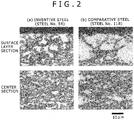
- Fig. 2 the distribution state of the ferrite grains in the surface layer section and the center section of the inventive steel (steel No. 5B) and the comparative steel (steel No. 11B) will be illustrated as an example in Fig. 2 .
- the drawing is the result of the observation using an optical microscope, the whitish region without a pattern is the ferrite grain, and the blackish region is the hard second phase.
- the present invention is useful as a cold-rolled steel sheet for automobile components.
Landscapes
- Chemical & Material Sciences (AREA)
- Engineering & Computer Science (AREA)
- Materials Engineering (AREA)
- Mechanical Engineering (AREA)
- Metallurgy (AREA)
- Organic Chemistry (AREA)
- Physics & Mathematics (AREA)
- Thermal Sciences (AREA)
- Crystallography & Structural Chemistry (AREA)
- Electromagnetism (AREA)
- Manufacturing & Machinery (AREA)
- Heat Treatment Of Sheet Steel (AREA)
Applications Claiming Priority (3)
| Application Number | Priority Date | Filing Date | Title |
|---|---|---|---|
| JP2012124208A JP5878829B2 (ja) | 2012-05-31 | 2012-05-31 | 曲げ性に優れた高強度冷延鋼板およびその製造方法 |
| JP2012124207A JP5860345B2 (ja) | 2012-05-31 | 2012-05-31 | 機械的特性ばらつきの小さい高強度冷延鋼板およびその製造方法 |
| EP13797030.7A EP2857539A4 (de) | 2012-05-31 | 2013-05-29 | Hochfeste kaltgewalzte stahlplatte und herstellungsverfahren dafür |
Related Parent Applications (1)
| Application Number | Title | Priority Date | Filing Date |
|---|---|---|---|
| EP13797030.7A Division EP2857539A4 (de) | 2012-05-31 | 2013-05-29 | Hochfeste kaltgewalzte stahlplatte und herstellungsverfahren dafür |
Publications (1)
| Publication Number | Publication Date |
|---|---|
| EP3187614A1 true EP3187614A1 (de) | 2017-07-05 |
Family
ID=49673368
Family Applications (2)
| Application Number | Title | Priority Date | Filing Date |
|---|---|---|---|
| EP17000056.6A Withdrawn EP3187614A1 (de) | 2012-05-31 | 2013-05-29 | Hochfestes kaltgewalztes stahlblech und herstellungsverfahren dafür |
| EP13797030.7A Withdrawn EP2857539A4 (de) | 2012-05-31 | 2013-05-29 | Hochfeste kaltgewalzte stahlplatte und herstellungsverfahren dafür |
Family Applications After (1)
| Application Number | Title | Priority Date | Filing Date |
|---|---|---|---|
| EP13797030.7A Withdrawn EP2857539A4 (de) | 2012-05-31 | 2013-05-29 | Hochfeste kaltgewalzte stahlplatte und herstellungsverfahren dafür |
Country Status (4)
| Country | Link |
|---|---|
| US (1) | US9708697B2 (de) |
| EP (2) | EP3187614A1 (de) |
| CN (1) | CN104364403A (de) |
| WO (1) | WO2013180180A1 (de) |
Families Citing this family (12)
| Publication number | Priority date | Publication date | Assignee | Title |
|---|---|---|---|---|
| CA2934597C (en) * | 2013-12-27 | 2019-01-15 | Nippon Steel & Sumitomo Metal Corporation | Hot-pressed steel sheet member, method of manufacturing the same, and steel sheet for hot pressing |
| JP6052220B2 (ja) * | 2014-03-31 | 2016-12-27 | Jfeスチール株式会社 | 成形性に優れた高強度冷延薄鋼板およびその製造方法 |
| US10808293B2 (en) * | 2015-07-15 | 2020-10-20 | Ak Steel Properties, Inc. | High formability dual phase steel |
| WO2017109542A1 (en) * | 2015-12-21 | 2017-06-29 | Arcelormittal | Method for producing a high strength steel sheet having improved ductility and formability, and obtained steel sheet |
| CN106637196B (zh) * | 2016-12-25 | 2019-06-18 | 机械科学研究总院青岛分院有限公司 | 一种液压杆的材料表面强化工艺 |
| MX2019009877A (es) * | 2017-02-20 | 2019-10-04 | Nippon Steel Corp | Carroceria estampada en caliente. |
| BR112019016682A2 (pt) * | 2017-02-20 | 2020-04-14 | Nippon Steel Corporation | corpo estampado a quente |
| EP3693485A4 (de) * | 2017-10-02 | 2021-01-20 | Nippon Steel Corporation | Heissprägegeformter artikel, heissgeprägtes stahlblech und verfahren zu seiner herstellung |
| US12031203B2 (en) * | 2018-10-04 | 2024-07-09 | Nippon Steel Corporation | Galvannealed steel sheet |
| KR102200222B1 (ko) | 2018-12-19 | 2021-01-08 | 주식회사 포스코 | 냉간 벤딩성이 우수한 고강도 구조용 강재 및 그 제조방법 |
| CN113355590A (zh) * | 2020-03-06 | 2021-09-07 | 宝山钢铁股份有限公司 | 一种三层复合组织高强钢板及其制造方法 |
| CN114032368B (zh) * | 2021-11-26 | 2023-05-30 | 成都先进金属材料产业技术研究院股份有限公司 | 一种铁素体不锈钢00Cr18Mo2的热处理方法 |
Citations (10)
| Publication number | Priority date | Publication date | Assignee | Title |
|---|---|---|---|---|
| JP2000212684A (ja) | 1999-01-20 | 2000-08-02 | Kobe Steel Ltd | 板幅方向における伸びのバラツキが改善された高強度高延性冷延鋼板、および高強度高延性冷延鋼板の製造方法 |
| JP2003277832A (ja) | 2002-03-22 | 2003-10-02 | Jfe Steel Kk | 高強度冷延鋼板の製造方法 |
| JP2005273002A (ja) | 2004-02-27 | 2005-10-06 | Jfe Steel Kk | 曲げ性および伸びフランジ性に優れた超高強度冷延鋼板およびその製造方法 |
| JP2006104546A (ja) | 2004-10-08 | 2006-04-20 | Nippon Steel Corp | 高強度自動車部材および熱間プレス方法 |
| JP2007138262A (ja) | 2005-11-21 | 2007-06-07 | Jfe Steel Kk | 機械特性ばらつきの小さい高強度冷延鋼板およびその製造方法 |
| JP2008156734A (ja) | 2006-12-26 | 2008-07-10 | Jfe Steel Kk | 高強度溶融亜鉛めっき鋼板およびその製造方法 |
| JP2011042879A (ja) * | 2010-10-26 | 2011-03-03 | Jfe Steel Corp | 高延性で、化成処理性に優れる780MPa以上の引張強度を有する超高強度冷延鋼板 |
| EP2371979A1 (de) * | 2008-11-28 | 2011-10-05 | JFE Steel Corporation | Hochfestes kaltgewalztes stahlblech mit hervorragender bearbeitbarkeit, schmelzflüssiges galvanisiertes hochfestes stahlblech und herstellungsverfahren dafür |
| WO2011148490A1 (ja) * | 2010-05-27 | 2011-12-01 | 住友金属工業株式会社 | 鋼板およびその製造方法 |
| WO2012002520A1 (ja) * | 2010-06-30 | 2012-01-05 | Jfeスチール株式会社 | 延性及び耐遅れ破壊特性に優れる超高強度冷延鋼板およびその製造方法 |
Family Cites Families (8)
| Publication number | Priority date | Publication date | Assignee | Title |
|---|---|---|---|---|
| JP4119676B2 (ja) * | 2002-05-01 | 2008-07-16 | 株式会社神戸製鋼所 | 曲げ加工性に優れた低降伏比型高張力鋼板およびその製造方法 |
| EP2465962B1 (de) | 2006-07-14 | 2013-12-04 | Kabushiki Kaisha Kobe Seiko Sho | Hochfeste Stahlbleche und Verfahren zur deren Herstellung |
| WO2009066734A1 (ja) | 2007-11-22 | 2009-05-28 | Kabushiki Kaisha Kobe Seiko Sho | 高強度冷延鋼板 |
| KR101230803B1 (ko) | 2008-03-07 | 2013-02-06 | 가부시키가이샤 고베 세이코쇼 | 냉간 압연 강판 |
| JP5359168B2 (ja) * | 2008-10-08 | 2013-12-04 | Jfeスチール株式会社 | 延性に優れる超高強度冷延鋼板およびその製造方法 |
| EP2415891A4 (de) | 2009-04-03 | 2014-11-19 | Kobe Steel Ltd | Kaltgewalztes stahlblech und verfahren zu seiner herstellung |
| JP5457840B2 (ja) * | 2010-01-07 | 2014-04-02 | 株式会社神戸製鋼所 | 伸びおよび伸びフランジ性に優れた高強度冷延鋼板 |
| CN103987870B (zh) | 2011-12-15 | 2016-01-06 | 株式会社神户制钢所 | 强度和延展性的偏差小的高强度冷轧钢板及其制造方法 |
-
2013
- 2013-05-29 WO PCT/JP2013/064920 patent/WO2013180180A1/ja not_active Ceased
- 2013-05-29 EP EP17000056.6A patent/EP3187614A1/de not_active Withdrawn
- 2013-05-29 US US14/400,453 patent/US9708697B2/en not_active Expired - Fee Related
- 2013-05-29 CN CN201380027742.7A patent/CN104364403A/zh active Pending
- 2013-05-29 EP EP13797030.7A patent/EP2857539A4/de not_active Withdrawn
Patent Citations (12)
| Publication number | Priority date | Publication date | Assignee | Title |
|---|---|---|---|---|
| JP2000212684A (ja) | 1999-01-20 | 2000-08-02 | Kobe Steel Ltd | 板幅方向における伸びのバラツキが改善された高強度高延性冷延鋼板、および高強度高延性冷延鋼板の製造方法 |
| JP2003277832A (ja) | 2002-03-22 | 2003-10-02 | Jfe Steel Kk | 高強度冷延鋼板の製造方法 |
| JP2005273002A (ja) | 2004-02-27 | 2005-10-06 | Jfe Steel Kk | 曲げ性および伸びフランジ性に優れた超高強度冷延鋼板およびその製造方法 |
| JP2006104546A (ja) | 2004-10-08 | 2006-04-20 | Nippon Steel Corp | 高強度自動車部材および熱間プレス方法 |
| JP2007138262A (ja) | 2005-11-21 | 2007-06-07 | Jfe Steel Kk | 機械特性ばらつきの小さい高強度冷延鋼板およびその製造方法 |
| JP2008156734A (ja) | 2006-12-26 | 2008-07-10 | Jfe Steel Kk | 高強度溶融亜鉛めっき鋼板およびその製造方法 |
| EP2371979A1 (de) * | 2008-11-28 | 2011-10-05 | JFE Steel Corporation | Hochfestes kaltgewalztes stahlblech mit hervorragender bearbeitbarkeit, schmelzflüssiges galvanisiertes hochfestes stahlblech und herstellungsverfahren dafür |
| WO2011148490A1 (ja) * | 2010-05-27 | 2011-12-01 | 住友金属工業株式会社 | 鋼板およびその製造方法 |
| EP2578711A1 (de) * | 2010-05-27 | 2013-04-10 | Nippon Steel & Sumitomo Metal Corporation | Stahlblech und herstellungsverfahren dafür |
| WO2012002520A1 (ja) * | 2010-06-30 | 2012-01-05 | Jfeスチール株式会社 | 延性及び耐遅れ破壊特性に優れる超高強度冷延鋼板およびその製造方法 |
| EP2589674A1 (de) * | 2010-06-30 | 2013-05-08 | JFE Steel Corporation | Ultrahochfestes kaltgewalztes stahlblech mit hervorragender duktilität und verzögerter bruchfestigkeit sowie herstellungsverfahren dafür |
| JP2011042879A (ja) * | 2010-10-26 | 2011-03-03 | Jfe Steel Corp | 高延性で、化成処理性に優れる780MPa以上の引張強度を有する超高強度冷延鋼板 |
Also Published As
| Publication number | Publication date |
|---|---|
| EP2857539A1 (de) | 2015-04-08 |
| WO2013180180A1 (ja) | 2013-12-05 |
| EP2857539A4 (de) | 2016-07-20 |
| CN104364403A (zh) | 2015-02-18 |
| US9708697B2 (en) | 2017-07-18 |
| US20150144231A1 (en) | 2015-05-28 |
Similar Documents
| Publication | Publication Date | Title |
|---|---|---|
| EP3187614A1 (de) | Hochfestes kaltgewalztes stahlblech und herstellungsverfahren dafür | |
| US10612113B2 (en) | Micro-alloyed high-strength multi-phase steel containing silicon and having a minimum tensile strength of 750 MPA and improved properties and method for producing a strip from said steel | |
| EP2246456B9 (de) | Hochfestes stahlblech und herstellungsverfahren dafür | |
| KR101288701B1 (ko) | 초고강도 냉연 강판 및 그 제조 방법 | |
| EP2824210B1 (de) | Hochfestes kaltgewalztes stahlblech und verfahren zur herstellung davon | |
| US10023934B2 (en) | High-strength hot-dip galvannealed steel sheet having excellent bake hardening property and bendability | |
| US10329635B2 (en) | High-strength cold-rolled steel sheet having excellent bendability | |
| EP2641991B1 (de) | Hochfestes stahlblech mit hervorragender formbarkeit, warmarbeitsverfahren und warmbearbeitetes automobilteil | |
| EP4310205A1 (de) | Stahlblech, element, verfahren zur herstellung eines stahlblechs und verfahren zur herstellung eines elements | |
| EP2623622B1 (de) | Hochfestes feuerverzinktes stahlblech mit ausgezeichneter tiefziehbarkeit und dehnbarkeit sowie verfahren zu seiner herstellung | |
| EP2857542A1 (de) | Hochfestes kaltgewalztes stahlblech mit geringer variation der festigkeit und duktilität und herstellungsverfahren dafür | |
| EP3483297A1 (de) | Heissformungselement mit hervorragender rissausbreitungsbeständigkeit und formbarkeit und verfahren zur herstellung davon | |
| EP1731627A1 (de) | Hochsteifes hochfestes dünnes stahlblech und herstellungsverfahren dafür | |
| EP2792762B1 (de) | Hochfestes kaltgewalztes stahlblech mit hohem ertrag und herstellungsverfahren dafür | |
| JP2021504576A (ja) | 衝突特性及び成形性に優れた高強度鋼板及びその製造方法 | |
| EP3293279A1 (de) | Hochfeste stahlplatte und herstellungsverfahren dafür | |
| EP3575425A1 (de) | Stahlblech | |
| CN114761584B (zh) | 经热处理的冷轧钢板及其制造方法 | |
| EP2781615A1 (de) | Dünnes stahlblech und verfahren zu seiner herstellung | |
| EP3395981A1 (de) | Ultrahochfestes stahlblech mit hervorragender lochdehnbarkeit und herstellungsverfahren dafür | |
| EP1731626B1 (de) | Hochsteifes hochfestes dünnes stahlblech und herstellungsverfahren dafür | |
| EP3591087A1 (de) | Hochfestes kaltgewalztes stahlblech und verfahren zur herstellung davon | |
| EP2740813B1 (de) | Feuerverzinktes stahlblech und herstellungsverfahren dafür | |
| EP3305932B1 (de) | Hochfestes stahlblech und verfahren zur herstellung davon | |
| US20240175102A1 (en) | Steel sheet, member, and method for producing steel sheet, and method for producing member |
Legal Events
| Date | Code | Title | Description |
|---|---|---|---|
| PUAI | Public reference made under article 153(3) epc to a published international application that has entered the european phase |
Free format text: ORIGINAL CODE: 0009012 |
|
| AC | Divisional application: reference to earlier application |
Ref document number: 2857539 Country of ref document: EP Kind code of ref document: P |
|
| AK | Designated contracting states |
Kind code of ref document: A1 Designated state(s): AL AT BE BG CH CY CZ DE DK EE ES FI FR GB GR HR HU IE IS IT LI LT LU LV MC MK MT NL NO PL PT RO RS SE SI SK SM TR |
|
| 17P | Request for examination filed |
Effective date: 20180104 |
|
| RBV | Designated contracting states (corrected) |
Designated state(s): AL AT BE BG CH CY CZ DE DK EE ES FI FR GB GR HR HU IE IS IT LI LT LU LV MC MK MT NL NO PL PT RO RS SE SI SK SM TR |
|
| GRAP | Despatch of communication of intention to grant a patent |
Free format text: ORIGINAL CODE: EPIDOSNIGR1 |
|
| INTG | Intention to grant announced |
Effective date: 20180309 |
|
| STAA | Information on the status of an ep patent application or granted ep patent |
Free format text: STATUS: THE APPLICATION IS DEEMED TO BE WITHDRAWN |
|
| 18D | Application deemed to be withdrawn |
Effective date: 20180720 |