EP3189606B1 - System und verfahren zur wiederherstellung der trägerphase in optischer kommunikation - Google Patents
System und verfahren zur wiederherstellung der trägerphase in optischer kommunikation Download PDFInfo
- Publication number
- EP3189606B1 EP3189606B1 EP15767342.7A EP15767342A EP3189606B1 EP 3189606 B1 EP3189606 B1 EP 3189606B1 EP 15767342 A EP15767342 A EP 15767342A EP 3189606 B1 EP3189606 B1 EP 3189606B1
- Authority
- EP
- European Patent Office
- Prior art keywords
- phase
- data
- soft
- decision information
- likelihood
- Prior art date
- Legal status (The legal status is an assumption and is not a legal conclusion. Google has not performed a legal analysis and makes no representation as to the accuracy of the status listed.)
- Active
Links
Images



Classifications
-
- H—ELECTRICITY
- H04—ELECTRIC COMMUNICATION TECHNIQUE
- H04B—TRANSMISSION
- H04B10/00—Transmission systems employing electromagnetic waves other than radio-waves, e.g. infrared, visible or ultraviolet light, or employing corpuscular radiation, e.g. quantum communication
- H04B10/60—Receivers
- H04B10/61—Coherent receivers
- H04B10/616—Details of the electronic signal processing in coherent optical receivers
- H04B10/6165—Estimation of the phase of the received optical signal, phase error estimation or phase error correction
-
- H—ELECTRICITY
- H04—ELECTRIC COMMUNICATION TECHNIQUE
- H04L—TRANSMISSION OF DIGITAL INFORMATION, e.g. TELEGRAPHIC COMMUNICATION
- H04L1/00—Arrangements for detecting or preventing errors in the information received
- H04L1/004—Arrangements for detecting or preventing errors in the information received by using forward error control
- H04L1/0045—Arrangements at the receiver end
- H04L1/0054—Maximum-likelihood or sequential decoding, e.g. Viterbi, Fano, ZJ algorithms
-
- H—ELECTRICITY
- H04—ELECTRIC COMMUNICATION TECHNIQUE
- H04L—TRANSMISSION OF DIGITAL INFORMATION, e.g. TELEGRAPHIC COMMUNICATION
- H04L1/00—Arrangements for detecting or preventing errors in the information received
- H04L1/004—Arrangements for detecting or preventing errors in the information received by using forward error control
- H04L1/0045—Arrangements at the receiver end
- H04L1/0055—MAP-decoding
-
- H—ELECTRICITY
- H04—ELECTRIC COMMUNICATION TECHNIQUE
- H04L—TRANSMISSION OF DIGITAL INFORMATION, e.g. TELEGRAPHIC COMMUNICATION
- H04L1/00—Arrangements for detecting or preventing errors in the information received
- H04L1/004—Arrangements for detecting or preventing errors in the information received by using forward error control
- H04L1/0056—Systems characterized by the type of code used
- H04L1/0057—Block codes
-
- H—ELECTRICITY
- H04—ELECTRIC COMMUNICATION TECHNIQUE
- H04L—TRANSMISSION OF DIGITAL INFORMATION, e.g. TELEGRAPHIC COMMUNICATION
- H04L7/00—Arrangements for synchronising receiver with transmitter
- H04L7/0054—Detection of the synchronisation error by features other than the received signal transition
- H04L7/0062—Detection of the synchronisation error by features other than the received signal transition detection of error based on data decision error, e.g. Mueller type detection
-
- H—ELECTRICITY
- H04—ELECTRIC COMMUNICATION TECHNIQUE
- H04L—TRANSMISSION OF DIGITAL INFORMATION, e.g. TELEGRAPHIC COMMUNICATION
- H04L7/00—Arrangements for synchronising receiver with transmitter
- H04L7/0075—Arrangements for synchronising receiver with transmitter with photonic or optical means
Definitions
- the present invention relates generally to optical communications and more particularly to estimating phases for a soft-decision decoder in a receiver of a coherent optical communications system.
- EP 2 506 516 A1 discloses a method of deriving differentially decoded data values from a received differentially encoded phase modulated optical signal.
- An estimation algorithm is employed to derive a sequence of differentially decoded data values.
- the algorithm stipulates transition probabilities between hypothetical first states, representing differentially encoded data symbols assuming that no phase slip has occurred, and transition probabilities towards hypothetical second states, which represent differentially encoded data symbols assuming that a phase slip has occurred.
- the transition probabilities between the first and second states are weighted on the basis of a predetermined phase slip probability value.
- a BCJR algorithm is used to determine the sequence of probability values.
- WO 2014/115840 A1 discloses an optical receiving device that receives an optical signal that has been modulated by means of phase modulation or quadrature amplitude modulation, converts the received optical signal into an electrical signal using coherent detection, and performs phase compensation on the converted received signal.
- Coherent optical communications technologies have increased data rates by using amplitude, phase, x-polarization, and y-polarization.
- Conventional non-coherent optical communications use only amplitude component of optical fields.
- Coherent modulations like quadrature-amplitude modulation (QAM) or amplitude and phase-shift keying (APSK), require carrier phase estimation (CPE) for demodulating.
- CPE carrier phase estimation
- feedforward CPE based on phase unwrapping has been used.
- an M th power method is used particularly for PSK modulation formats.
- the Viterbi-and-Viterbi (V&V) method uses a certain nonlinear function for amplitude normalization in conjunction with the M th power method to improve estimation accuracy of the carrier phase.
- phase unwrapping method can cause an additional problem known as cycle slips.
- a cycle slip happens with an abrupt change of phase in the CPE when a phase tracking loop in a receiver experiences a temporary loss of lock due to signal distortion, or some other disturbing factors, such as nonlinear phase noise.
- differential encoding or pilot symbol insertion can be used to reduce cycle slips.
- differential encoding has a fundamental problem of the doubling bit-error rate (BER) due to error propagation.
- the pilot symbol insertion also has an inevitable drawback in the reduction of the spectrum efficiency because of the undesired overhead of the pilot symbols.
- FEC forward-error correction
- LDPC low-density parity-check
- turbo equalizations can reduce linear and non-linear distortions.
- Turbo differential decoding has been used to compensate for the degradation of error propagation in differential encoding.
- Cycle slip problems have been dealt with by a turbo CPE, which uses soft-decision feedback from an FEC decoder.
- feeding back the soft-decision information from the decoder to the CPE can increase the overall latency.
- the latency can be reduced by feeding back to a demodulator to compensate for cycle slips.
- the in-phase of reference laser signal is referred to as I
- the quadrature signal that is shifted by 90 degrees is called Q.
- I in-phase of reference laser signal
- Q quadrature signal that is shifted by 90 degrees
- I-Q balanced perfect QAM constellations accurate and stable bias controls for Mach-Zender modulators are highly required.
- bias control is not achieved in practice especially for high-speed transceivers and high-order modulations such as 1024QAM.
- the bias imperfection causes a problem of angular skew, where the constellation points deviate from the ideal square-grid points according to the skew angle between I axis and Q axis.
- phase noise comes from impairment such as fiber nonlinearity and laser linewidth.
- the residual phase noise can degrade performance for dense high-order QAM signals. Accordingly, there is a need in the art for an approach in handling the cycle slip and the angular skew as well as the phase noise for high-order QAM transmissions in high-speed optical communications systems.
- the embodiments of the invention provide a system and method to resolve problems of cycle slips, angular skew, and residual phase noise for high-speed optical communications employing any arbitrary high-order multi-dimensional modulation formats.
- the embodiments use an unwrapping history at a carrier phase estimation (CPE) to provide feedforward soft-decision information of slip probability for more accurate likelihood calculation based on a high-order hidden Markov model (HMM).
- CPE carrier phase estimation
- HMM high-order hidden Markov model
- Decoder feedback information can be used to update the likelihood at a demodulator module, while in an increase in the latency is marginal because the CPE does not need the decoder feedback information.
- the receiver includes a feedforward CPE, a slip process analyzer, an angular skew estimator, a phase noise estimator, a demodulator, and a forward error correction (FEC) decoder.
- the CPE uses multiple-input multiple-output (MIMO) processing, wherein a noise correlation matrix is used to deal with a polarization-dependent phase noise process.
- MIMO processing allows any extension to a multi-dimensional signal space, e.g., for polarization multiplexing, wavelength-division multiplexing, mode-division multiplexing, and space-division multiplexing, as advanced coherent optical communications techniques.
- the slip process analyzer provides reliability information of unwrapping decisions, by using statistics of decision errors according to a history of phase estimates.
- the log-likelihood ratio calculation in the demodulator is based on the soft-decision unwrapping information.
- the unwrapping soft-decision information can compensate for the undesired slips.
- the skew angle and the residual phase noise variance are estimated during the symbol likelihood calculation.
- the FEC decoder corrects potential errors.
- soft-decision information of the FEC decoder can be fed back to the log-likelihood ratio calculator, based on a turbo principle, to improve performance.
- Some embodiments use a time-homogeneous or a time-inhomogeneous hidden Markov model (HMM) for the slip process analyzer.
- the log-likelihood ratio calculation is based on the Markov state transition with an averaged or an instantaneous slip probability.
- the log-likelihood ratio is computed by various different algorithms, including Bahl-Cocke-Jelinek-Raviv (BCJR) maximum a posteriori probability (MAP) algorithm, soft-output Viterbi algorithm, Wiener filter, Kalman filter, kernel filter, neural network filter, particle filter, or smoothing variants.
- BCJR Bahl-Cocke-Jelinek-Raviv
- MAP maximum a posteriori probability
- Wiener filter soft-output Viterbi algorithm
- Wiener filter Wiener filter
- Kalman filter kernel filter
- neural network filter neural network filter
- particle filter or smoothing variants.
- the log-likelihood calculation can be done jointly in dual polarization with joint Markov state transition
- Some embodiments use joint polarization low-pass filtering for a more accurate CPE, in which a moment matching method is used to derive a closed-form stochastic model. Some other embodiments use an optimized amplitude normalization to minimize the mean-square error according to modulation formats, residual additive noise and phase noise variances.
- One embodiment of the invention uses a relatively small number of pilot symbols to improve performance of the CPE and/or the demodulator through the use of decision-directed filter adaptation.
- the present invention can provide a system and a method to resolve problems of cycle slips, angular skew, and residual phase noise for high-speed optical communications employing any arbitrary high-order multi-dimensional modulation formats.
- Fig. 1 is a block diagram of a system and method for decoding data sent from a transmitter to a receiver 100 over an optical communications channel, and in particular to detecting a coherent signal at an optical communications receiver according to embodiments of the invention.
- the system includes a carrier phase estimator (CPE) 110, a slip process analyzer 120, a demodulator 130, and a forward-error-correction (FEC) decoder 140.
- CPE carrier phase estimator
- FEC forward-error-correction
- the embodiments of the invention make it possible to recover cycle slips, I-Q angular skew and residual phase noise, where I and Q represent an in-phase component of the waveform and a quadrature component, respectively.
- the CPE 110 includes an M th power module 111, an amplitude normalizer 112, a low-pass filter 113, and a phase unwrapping and decision modules 114.
- This embodiment is based on a Viterbi-and-Viterbi (V&V) blind CPE procedure.
- the M th power module 111 feeds received data R or symbols 101, which is the result of an I-Q signal waveform having been processed by receiver digital signal processing (DSP) modules to perform functions such as timing recovery, chromatic dispersion compensation, nonlinearity compensation, and polarization recovery. Therefore, the terms received data, received symbols, and received signals are used interchangeably.
- DSP receiver digital signal processing
- the received data R are processed by an exponentiation of M to provide R M .
- M 4 is used for square quadrature-amplitude modulation (QAM) formats.
- QAM quadrature-amplitude modulation
- the amplitude normalizer 112 suppresses modulation-dependent amplitude deviation and scales the amplitude of
- the nonlinear function is a monomial function of F (
- ) 1/
- Setting C M reduces to a conventional M th power CPE, which works only for M -ary phase-shift keying (PSK).
- the amplitude normalizer 112 is dependent on signal-to-noise ratio (SNR), as well as modulation formats.
- SNR signal-to-noise ratio
- the nonlinear function is based on a conditional mean for Q -ary constellations as ⁇ S 1 ,..., S Q ⁇ , where ⁇ 2 is a noise variance.
- the low-pass filter 113 uses a finite-impulse response (FIR) filter taking a weighted sum of the output of the amplitude normalizer 112 to suppress additive noise and phase noise disturbance.
- the low-pass filter can include a rectangular filter, whose filter coefficients are all ones.
- the low-pass filter is based on an exponential weighted filter, whose filter coefficients are given by .exp(-
- ⁇ ) for the k th adjacent symbol over k 0, ⁇ 1, ⁇ 2, ..., ⁇ L , where L is the filter pre/post-cursor length, and ⁇ and ⁇ are any arbitrary real-valued numbers.
- the low-pass filter 113 can be based on a moment-matching method and a linear-transformed Wiener filter according to an auto-covariance of phase.
- the linearized Wiener filter considers that the phase noise is a stochastic Wiener process.
- the index k inside parentheses denotes the symbol index.
- the above auto-covariance is based on a two-sided central cursor.
- the FIR coefficients of the linearized Wiener filter are expressed by using the linear transform of exp( j ⁇ ) ⁇ 1 + j ⁇ as ⁇ K p + ⁇ I ⁇ 1 1 , where I is an identity matrix, 1 is an all-ones vector of size 2 L +1, ⁇ and ⁇ are arbitrary positive real-valued numbers, and a superscript of [.] -1 represents a matrix inversion.
- the phase noise is linearized for a real part and an imaginary part of exp( j ⁇ ( k )) separately.
- a moment-matching method is used instead of using the linear transform.
- Fig. 2 shows a prior art first-order linearized additive noise model, a second-order moment-matched multiplicative noise model according to embodiments of the invention, and mean and covariance over several symbols.
- the sample mean-covariance 201 does not agree with the mean-covariance of the linear-transformed Wiener filter 202, while the sample mean-covariance agrees well with the mean-covariance of the moment-matching method 203.
- this embodiment uses the following modified FIR filter coefficients: R ⁇ T ⁇ + ⁇ I ⁇ 1 R ⁇ ⁇ 1 R ⁇ T ⁇ + ⁇ I ⁇ 1 ⁇ , where R ⁇ is a matrix formed by real and imaginary parts of the output of the amplitude normalizer, ⁇ is a matrix formed by the second moments of the real and imaginary parts, and ⁇ is a vector formed by the first moments of the real and imaginary parts.
- the phase unwrapping and decision modules 114 resolve phase ambiguities and recover the carrier phase of the received data based on the output of the low-pass filter 113.
- the phase unwrapping module 114 is based on at least two consecutive phase estimates to minimize a Mahalanobis norm.
- the phase upwrapping 114 uses a Viterbi algorithm to minimize the Mahalanobis norm over a trellis-state diagram.
- the phase unwrapping of the CPE 110 may make a wrong decision, resulting in a cycle slip, which detrimentally affects the FEC decoder 140.
- the slip process analyzer 120 stores the estimated phase ⁇ ( k ) 119 in a buffer memory for several symbols, e.g., for 100 symbols, and estimates the slip probability based on a hidden Markov model (HMM) 121.
- HMM hidden Markov model
- a Kalman filter is used to adaptively learn the state-transition matrix ⁇ based on a time-homogeneous HMM, in which the slip probability p does not change fast over time.
- the slip process analyzer 120 provides a time-varying state-transition matrix to the demodulator 130 as feedforward soft-decision information, according to the instantaneous phase estimates ⁇ ( k ) based on a time-inhomogeneous HMM using an extended Kalman filter for at least two consecutive phase estimates.
- the demodulator 130 includes a symbol likelihood calculator 131, a skew angle estimator 133, a phase noise estimator 134, and a bit log-likelihood ratio (LLR) calculator 132.
- the demodulator 130 receives the phase-recovered data V(k) 117 to calculate LLR data according to the feedforward soft-decision information 122 for the FEC decoder 140.
- S q ⁇ ⁇ is an angular-skewed constellation of the q th modulation S q .
- the symbol log-likelihood calculation is based on a bilinear transform approximation exp( j ⁇ ) ⁇ (1 + j ⁇ /2)/(1 - j ⁇ /2).
- this embodiment of the invention modifies the symbol log-likelihood Equation (1) by substituting V and S q ⁇ ⁇ with 3 V ⁇ S q ⁇ ⁇ / 2 and V + S q ⁇ ⁇ / 2 , respectively.
- the symbol likelihood calculator 131 uses the estimates of the skew angle ⁇ and the phase noise variance ⁇ ⁇ p 2 , those of which are provided by the skew angle estimator 133 and the phase noise estimator 134, respectively.
- some embodiments of the invention use statistical learning techniques, such as a k-means method.
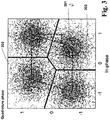
- the skew angle and the phase noise variance are obtained by using an expectation-maximization (EM) algorithm based on a Gaussian mixture model (GMM).
- EM expectation-maximization
- GMM Gaussian mixture model
- the number of mixtures in the GMM is at least a size of the modulation format.
- the skew angle 301 and the cluster variance 302 are jointly estimated. Due to the angular skew, a cluster decision boundary 303 to separate the four different constellation points deviates from a regular square-grid.
- the bit LLR calculator 132 uses the feedforward soft-decision information 122, i.e., the state-transition matrix of the HMM, to provide more reliable bit LLR data to the FEC decoder 140.
- the bit LLR is calculated by using a Bahl-Cocke-Jelinek-Raviv (BCJR) algorithm for a maximum a posteriori probability (MAP) estimation along a trellis-state diagram defined by the state-transition matrix ⁇ .
- BCJR Bahl-Cocke-Jelinek-Raviv
- MAP maximum a posteriori probability
- the BCJR algorithm calculates a forward path metric which accumulates the branch metric in a forward Viterbi procedure, a backward path metric which accumulates the branch metric in a time-reversed direction with a backward Viterbi procedure, and the bit LLR data L b which adds up the branch metric, the forward and backward path metrics.
- the bit LLR calculator 132 uses feedback soft-decision information 135 from the FEC decoder 140 in addition to the feedforward soft-decision information 122, as a turbo principle to improve performance by re-calculating the bit LLR data.
- the bit LLR data L b is subtracted 136 by the feedback soft-decision information ⁇ b as L b - ⁇ b , and sent to the FEC decoder 140.
- the BCJR algorithm is simplified by a max-log-MAP algorithm, in which only the most dominant branch metric is considered at forward and backward Viterbi procedures.
- a soft-output Viterbi algorithm is used to generate an approximated bit LLR data to reduce complexity.
- the FEC decoder 140 corrects potential errors of the LLR data from the demodulator 130.
- the FEC codes include a convolutional code, a turbo code, a repeat-accumulate code, a rate-less code, and a low-density parity-check (LDPC) code.
- the FEC decoder 140 for the LDPC codes includes parallel variable-node decoders (VND) 141, parallel check-node decoders (CND) 142, a syndrome checker 144, and a hard decision module 146 to produce hard decisions for symbols 102 corresponding to the received data.
- VND variable-node decoders
- CND parallel check-node decoders
- a syndrome checker 144 a syndrome checker 144
- a hard decision module 146 to produce hard decisions for symbols 102 corresponding to the received data.
- the LDPC decoder exchanges soft-decision information between VND and CND in an inner loop 143 based on
- the termination condition includes a maximum number of BP iterations or a success of the syndrome check.
- the BP algorithm may use a sum-product algorithm, a min-sum algorithm, or a delta-min algorithm. After the BP iterations, a hard decision 146 for the soft-decision information is taken place to recover the transmitted data.
- the soft-decision information ⁇ b of the VND are subtracted 145 by the original LLR information L b from the demodulator as ⁇ b - L b , and fed back to the demodulator 130 to receive more reliable LLR data in a turbo loop 135.
- the FEC codes use non-binary codes such as non-binary LDPC convolutional codes to improve error correction capability.
- the bit LLR calculator 132 and the BP algorithm are modified according to the size of the Galois field of the non-binary LDPC codes in a straightforward manner.
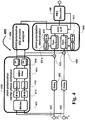
- the module 400 that implements the recovery method includes a joint-polarization CPE 410, a joint-polarization slip process analyzer 420, a joint-polarization demodulator 430, and the FEC decoder 140.
- the joint-polarization CPE 410 includes a whitening filter 411, parallel M th power modules 412, parallel amplitude normalizers 413, a multi-input multi-output (MIMO) low-pass filter 414, and parallel phase unwrapping modules 415.
- MIMO multi-input multi-output
- the whitening filter receives the x-polarization signal R x 401 and y-polarization signal R y 402 to coarsely cancel a cross-correlation between x- and y-polarization signals.
- the cross-correlation may be caused by an imperfect polarization recovery and/or by a correlated phase noise of optical laser linewidth.
- Fig. 5A shows samples of the phase trajectories of x-polarization 501 and y-polarization 502 as a function of angel and symbols received over time.
- Fig. 5B shows that the phase noise deviations of x- and y-polarizations are mutually correlated 503.
- the whitening filter 411 cancels the cross-correlation by multiplying an inverse square root of the covariance matrix, i.e., K pol ⁇ 1 / 2 , with the received dual-polarization signals vector of [ R x , R y ] T .
- the MIMO low-pass filter 414 suppresses additive noise by using the joint-polarization auto-covariance.
- the MIMO low-pass filter uses a multivariate minimum mean-square error (MMSE) FIR filter.
- MMSE multivariate minimum mean-square error
- the MIMO low-pass filter is based on an MIMO least-mean square (LMS) adaptive filter, or an MIMO recursive least-squares (RLS) adaptive filter.
- the MIMO low-pass filter is based on a kernel filter, including a kernel Kalman filter, a kernel support-vector machine, an artificial neural network, and a particle filter, to deal with nonlinear channel statistics.
- the dual-polarization phase estimates are used to recover 433 the carrier phases of the x-polarization signal R x 401 and y-polarization signal R y 402 via delays 405.
- the joint-polarization slip process analyzer 420 feeds the dual-polarization phase estimates and estimates a dual-polarization state-transition matrix based on a multivariate HMM, in which two slip states are considered at once.
- the first-order HMM has a total number of states of at least M 2 , which represent all combinations of the x-polarization state and the y-polarization state.
- the joint-polarization state-transition matrix is estimated by using a Kalman filter, and is sent to the joint-polarization demodulator 430 to compensate for potential cycle slips.
- One embodiment may use an extended Kalman smoother, in which the estimation is taken place with a certain lag.
- the joint-polarization demodulator 430 receives phase-recovered x-polarization signals and y-polarization signals to calculate 435 the corresponding symbol likelihood data, using estimated skew angles 431a and phase noise variances 432 as in the case of a single polarization embodiment.
- a joint-polarization LLR calculator 431 then calculates bit LLR data for both polarizations at once, according to the feedforward soft-decision information, i.e. the joint-polarization state-transition matrix, from the slip process analyzer 420.
- the bit LLR data are obtained by using the BCJR algorithm along an extended trellis-state diagram based on the joint-polarization state-transition matrix.
- the bit LLR data are sent to the FEC decoder 140.
- the joint-polarization demodulator 430 uses feedback soft-decision information from the FEC decoder 140 in a turbo principle to improve performance by re-calculating the bit LLR.
- the method to recover the joint polarization carrier phase is extended to a higher-dimensional signal space.
- the number of signals increases to more than two when the optical communications system uses space-division multiplexing, mode-division multiplexing, wavelength-division multiplexing, or frequency-division multiplexing as well as polarization-division multiplexing.
- the auto-covariance matrix is further extended by jointly considering the convolution of a spatial covariance matrix, a modal covariance matrix, and so on.
- the MIMO filter 414 can be extended to any multi-dimensional signal space in a straightforward manner, by the use of any MIMO adaptive filter such as the RLS algorithm and the Kalman filter.
- One embodiment of the invention uses the pilot symbols at the demodulator 130 or the joint-polarization demodulator 430 to provide more reliable LLR data to the FEC decoder 140.
- the bit LLR calculator 132 or the joint LLR calculator 431 uses the BCJR algorithm in the trellis-state diagram, wherein the branch metric Equation (2) is restricted for the known pilot index q ⁇ at pilot symbols. By restricting the branch metric calculation in the pilot symbols, more reliable LLR data are achieved for the FEC decoder 140 to correct potential errors more efficiently.
- Another embodiment of the invention uses the pilot symbols at the CPE 110 or 410, in addition to the demodulator, to estimate the carrier phase more accurately.
- the accuracy of the phase estimation is improved by using multiple pilot symbols in a linear-transformed MAP estimation after the LS estimation.
- ⁇ ' is an updated phase estimates vector
- A is a diagonal matrix whose k th entry is given by pilot symbols as jS q ⁇ ( k )
- ⁇ is the initial phase estimates vector based on the LS solution
- Y is an error vector, whose k th entry is given as V ( k ) - exp( j ⁇ ( k )) S q ⁇ ( k ).
- the carrier phases during data symbols are interpolated by the phase estimates at pilot symbols.
- an MMSE interpolation based on the phase noise auto-covariance matrix is used to estimate the carrier phases during data symbols.
- a Gaussian process interpolation is used to provide the carrier phase estimates as well as the certainty level of the estimations.
- the Gaussian process interpolation is carried out by using a Kriging interpolation, in which the certainty level is derived from the phase noise auto-covariance matrix K p .
- the certainty level information is used at the demodulator to calculate more accurate likelihood data. For example, the certainty level determines the effective phase noise variance in the symbol likelihood calculation of Equation (1).
- the system and method of the present invention are applicable to optical communications in many kinds of fields.
Landscapes
- Engineering & Computer Science (AREA)
- Computer Networks & Wireless Communication (AREA)
- Signal Processing (AREA)
- Physics & Mathematics (AREA)
- Electromagnetism (AREA)
- Artificial Intelligence (AREA)
- Optics & Photonics (AREA)
- Optical Communication System (AREA)
- Error Detection And Correction (AREA)
- Digital Transmission Methods That Use Modulated Carrier Waves (AREA)
- Detection And Prevention Of Errors In Transmission (AREA)
Claims (12)
- System zum Decodieren empfangener Daten, die über einen optischen Kommunikationskanal von einem Sender an einen Empfänger (100) gesendet werden, umfassend:einen Trägerphasenschätzer (CPE) (110) zur Abschätzung einer Trägerphase empfangener Symbole,einen Verschiebungsprozessanalysator (120), um vorgesteuerte Soft-Decision-Daten in Form einer Verschiebungszustandsübergangsmatrix unter Verwendung eines HMM (Verstecktes Markov Modell) auf der Grundlage der Trägerphase bereitzustellen,einen Demodulator (130), um gemäß den vorgesteuerten Soft-Decision-Daten LLRs (Log-Likelihood Ratios) zu berechnen, undeinen Vorwärtsfehlerkorrektur-Decoder (FEC-Decoder) (140), um Hard-Decision über Symbole, die den Daten entsprechen, zu erzeugen und Fehler zu korrigieren, dadurch gekennzeichnet, dass:
der Trägerphasenschätzer (CPE) einen Amplitudennormalisator (112) umfasst, der zum Unterdrücken der modulationsabhängigen Amplitudenabweichung und zum Skalieren der Amplitude von |R| durch eine nicht lineare Funktion F(|R|) angepasst ist, um F(|R|)RM zu ergeben, wobei die nicht lineare Funktion auf einem bedingten Mittelwert gemäß einer nachfolgenden Gleichung für Q-äre Konstellationen als {SI,..., SQ} basiert, um Fehler bei der Phasenabschätzung zu minimieren, wobei R empfangene Daten ist und σ2 eine Rauschvarianz ist und
- System nach Anspruch 1, wobei der CPE ferner umfasst:ein Leistungsmodul (111), um modulationsabhängige Phasenabweichungen zu unterdrücken,einen Tiefpassfilter (113), um additives Rauschen zu unterdrücken,ein Phase-Unwrapping-Modul (114), um Phasenambiguitäten aufzulösen, undein Phasenentscheidungsmodul (114), um die Trägerphase der empfangenen Daten zurückzugewinnen.
- System nach Anspruch 2, wobei der Tiefpassfilter (113) auf einem Moment-Matching-System und einem linear transformierten Wiener-Filter gemäß einer Autokovarianz des Phasenrauschens basiert.
- System nach Anspruch 2, wobei das Phase-Unwrapping (114) auf mindestens zwei aufeinanderfolgenden Phasenschätzungen basiert, um eine Mahalanobis-Norm zu minimieren.
- System nach Anspruch 1, wobei der Verschiebungsprozessanalysator (120) die Verschiebungszustandsübergangsmatrix in einem zeitlich inhomogenen Verstecktes Markov Modell (HMM) unter Verwendung eines erweiterten Kalman-Filters für mindestens zwei aufeinanderfolgende phasenschätzungen abschätzt.
- System nach Anspruch 1, wobei der Demodulator (130) ferner umfasst:einen Skew-Winkel-Schätzer (133), um einen Skew-Winkel einer Konstellation abzuschätzen,einen Phasenrauschschätzer (134), um eine Restvarianz beim Phasenrauschen abzuschätzen,einen Symbolwahrscheinlichkeitsrechner (131), um einen Log-Likelihood-Wert der Symbolen mit zurückgewonnener Phase gemäß dem Skew-Winkel der Konstellation und der Restvarianz beim Phasenrauschen zu ermitteln, umeinen Bit-LLR-Rechner (132), um LLR-Daten für den FEC-Decoder aus den Log-Likelihood-Daten des Symbols und den vorgesteuerten Soft-Decision-Daten zu errechnen.
- System nach Anspruch 6, wobei der Skew-Winkel (133) der Konstellation und die Restvarianz (134) beim Phasenrauschen mit einem Erwartungsmaximierungs-Algorithmus (EM-Algorithmus) aufgrund eines Gaußschen Mischverteilungsmodells (GMM) abgeschätzt werden, wobei eine Anzahl der Mischungen im GMM mindestens eine Größe eines Modulationsformats beträgt.
- System nach Anspruch 6, wobei der Symbolwahrscheinlichkeitsrechner (131) eine lineare Transformationsannäherung oder eine bilineare Transformationsannäherung benutzt, um die Restvarianz beim Phasenrauschen zu berücksichtigen.
- System nach Anspruch 6, wobei der Bit-LLR-Rechner (132) einen MAP-Algorithmus (Maximum A posteriori Probability) auf BJCR-Basis (Bahl-Cocke-Jelinek-Raviv) entlang eines durch die Zustandsübergangsmatrix des Verschiebungsprozessanalysators definierten Trellis-Diagramms verwendet.
- System nach Anspruch 6, wobei der Bit-LLR-Rechner (132) neben den vorgesteuerten Soft-Decision-Daten aus dem Verschiebungsprozessanalysator vorgesteuerte Soft-Decision-Daten des PEC-Decoders in einer Turbo-Schleife verwendet.
- System nach Anspruch 1, wobei der PEC-Decoder (140) einen Belief-Propagation-Algorithmus verwendet, um einen LDPC-Code (Low-Density Parity Check) einer beliebigen Galois-Feldgröße zu decodieren.
- Verfahren zum Decodieren empfangener Daten, die über einen optischen Kommunikationskanal von einem Sender an einen Empfänger (100) gesendet werden, umfassend die Schritte:Abschätzen (110) einer Trägerphase empfangener Symbole, die den Daten entsprechen,Bereitstellen (120) von vorgesteuerten Soft-Decision-Daten in Form einer Verschiebungszustandsübergangsmatrix unter Verwendung eines HMM (Verstecktes Markov Modell) auf der Grundlage der Trägerphase,Berechnen (130) von LLRs (Log-Likelihood Ratios) gemäß den vorgesteuerten Soft-Decision-Daten undErzeugen (140) einer Hard-Decision über Symbole, die den Daten entsprechen, und um Fehler zu korrigieren, wobei die Schritte in einem Decoder des Empfängers (100) ausgeführt werden,Unterdrücken der modulationsabhängigen Amplitudenabweichung und Skalieren der Amplitude von |R| durch eine nicht lineare Funktion F(|R|) angepasst ist, um F(|R|)RM zu ergeben, wobei die nicht lineare Funktion auf einem bedingten Mittelwert gemäß einer nachfolgenden Gleichung für Q-äre Konstellationen als {SI,..., SQ} basiert, um Fehler bei der Phasenabschätzung zu minimieren, wobei R empfangene Daten ist und σ2 eine Rauschvarianz ist, und

Applications Claiming Priority (2)
| Application Number | Priority Date | Filing Date | Title |
|---|---|---|---|
| US14/475,932 US9473250B2 (en) | 2014-09-03 | 2014-09-03 | System and method for recovering carrier phase in optical communications |
| PCT/JP2015/075276 WO2016035895A1 (en) | 2014-09-03 | 2015-08-31 | System and method for recovering carrier phase in optical communications |
Publications (2)
| Publication Number | Publication Date |
|---|---|
| EP3189606A1 EP3189606A1 (de) | 2017-07-12 |
| EP3189606B1 true EP3189606B1 (de) | 2020-01-01 |
Family
ID=54151367
Family Applications (1)
| Application Number | Title | Priority Date | Filing Date |
|---|---|---|---|
| EP15767342.7A Active EP3189606B1 (de) | 2014-09-03 | 2015-08-31 | System und verfahren zur wiederherstellung der trägerphase in optischer kommunikation |
Country Status (5)
| Country | Link |
|---|---|
| US (1) | US9473250B2 (de) |
| EP (1) | EP3189606B1 (de) |
| JP (1) | JP6271042B2 (de) |
| CN (1) | CN106797256B (de) |
| WO (1) | WO2016035895A1 (de) |
Families Citing this family (51)
| Publication number | Priority date | Publication date | Assignee | Title |
|---|---|---|---|---|
| EP2978146A1 (de) * | 2014-07-25 | 2016-01-27 | Xieon Networks S.à r.l. | Cycle-Slip-resistente, codierte Modulation zur faseroptischen Kommunikation |
| US20170011312A1 (en) * | 2015-07-07 | 2017-01-12 | Tyco Fire & Security Gmbh | Predicting Work Orders For Scheduling Service Tasks On Intrusion And Fire Monitoring |
| US9749089B2 (en) * | 2015-11-04 | 2017-08-29 | Mitsubishi Electric Research Laboratories, Inc. | Fast log-likelihood ratio (LLR) computation for decoding high-order and high-dimensional modulation schemes |
| WO2017221926A1 (ja) * | 2016-06-21 | 2017-12-28 | 日本電信電話株式会社 | 光受信機、光伝送装置及び光受信機のための方法 |
| CN106100751B (zh) * | 2016-07-29 | 2018-08-07 | 上海南明光纤技术有限公司 | 用于高速光脉冲幅度调制的改进的维纳滤波方法及系统 |
| US10312953B2 (en) * | 2016-12-26 | 2019-06-04 | Industrial Technology Research Institute | Orthogonal frequency division multiplexing receiver with low-resolution analog to digital converter and electronic device thereof |
| CN108259402B (zh) * | 2016-12-29 | 2019-08-16 | 大唐移动通信设备有限公司 | 一种信号解调的方法及装置 |
| US10256929B2 (en) * | 2017-01-04 | 2019-04-09 | Samsung Electronics Co., Ltd | Method and apparatus for decision directed common phase error estimation based on soft information |
| CN107294608B (zh) * | 2017-07-18 | 2020-01-17 | 深圳市杰普特光电股份有限公司 | 偏振恢复方法 |
| CN107707310B (zh) * | 2017-09-20 | 2020-05-29 | 哈尔滨工业大学深圳研究生院 | 一种基于自适应卡尔曼的偏振解复用和载波相位恢复方法 |
| WO2019116503A1 (ja) * | 2017-12-14 | 2019-06-20 | 三菱電機株式会社 | 光受信装置および光受信方法 |
| CN108365892B (zh) * | 2018-01-03 | 2020-05-05 | 北京邮电大学 | 一种光纤通信传输系统中的信号补偿方法及装置 |
| US20190222352A1 (en) * | 2018-01-16 | 2019-07-18 | Electronics And Telecommunications Research Instit Ute | Optical receiver and error correction method of the optical receiver |
| US10976444B2 (en) * | 2018-03-28 | 2021-04-13 | Mitsubishi Electric Research Laboratories, Inc. | System and method for GNSS ambiguity resolution |
| CN109115110B (zh) * | 2018-06-07 | 2020-10-20 | 华南师范大学 | 一种基于施密特正交化的干涉图相位迭代恢复方法 |
| JP6969506B2 (ja) * | 2018-06-20 | 2021-11-24 | 日本電信電話株式会社 | 光周波数多重型コヒーレントotdr、試験方法、信号処理装置、及びプログラム |
| CN108924074B (zh) * | 2018-07-02 | 2020-12-11 | 成都国恒空间技术工程有限公司 | 均衡器及信道估计方法 |
| US10804938B2 (en) * | 2018-09-25 | 2020-10-13 | Western Digital Technologies, Inc. | Decoding data using decoders and neural networks |
| US10826731B2 (en) * | 2018-09-28 | 2020-11-03 | Huawei Technologies Co., Ltd. | Efficient implementation of noise whitening post-compensation for narrowband-filtered signals |
| CN111142127B (zh) * | 2018-11-02 | 2023-04-21 | 千寻位置网络有限公司 | 周跳探测方法及其装置 |
| CN109167744B (zh) * | 2018-11-06 | 2021-05-14 | 上海事凡物联网科技有限公司 | 一种相位噪声联合估计方法 |
| US10735231B2 (en) * | 2018-12-19 | 2020-08-04 | International Business Machines Corporation | Demodulating modulated signals with artificial neural networks |
| CN110460551A (zh) * | 2019-02-24 | 2019-11-15 | 苏州工业园区新国大研究院 | 一种基于最小均方误差的信道载波相位恢复方法 |
| CN110098875B (zh) * | 2019-05-07 | 2020-07-03 | 北京邮电大学 | 光纤通信系统中自适应均衡方法、装置、电子设备及介质 |
| CN110336762B (zh) * | 2019-05-09 | 2021-09-17 | 广东工业大学 | 一种mimo系统的相位噪声补偿方法、系统及相关组件 |
| KR102379366B1 (ko) * | 2019-08-28 | 2022-03-25 | 금오공과대학교 산학협력단 | 오토 인코더를 이용한 채널 디코딩 방법 |
| CN110750231B (zh) * | 2019-09-27 | 2021-09-28 | 东南大学 | 一种面向卷积神经网络的双相系数可调模拟乘法计算电路 |
| CN111541636B (zh) * | 2020-03-10 | 2023-07-18 | 西安宇飞电子技术有限公司 | 一种采用维纳滤波进行信号解调的方法及装置 |
| CN111555819B (zh) * | 2020-04-22 | 2021-07-16 | 华南理工大学 | 一种载波相位估计和补偿方法及系统 |
| US20210374534A1 (en) * | 2020-05-29 | 2021-12-02 | Seiko Epson Corporation | Information processing apparatus, arithmetic method, and non-temporary computer-readable medium |
| US12362837B2 (en) * | 2020-08-03 | 2025-07-15 | Nippon Telegraph And Telephone Corporation | Optical signal demodulator, control method and program |
| JP2022045663A (ja) * | 2020-09-09 | 2022-03-22 | 株式会社東芝 | 磁気ディスク装置及びリード処理方法 |
| CN114338313B (zh) * | 2020-09-29 | 2024-04-12 | 大唐移动通信设备有限公司 | 频偏获取方法、装置、电子设备及存储介质 |
| EP3982563B1 (de) | 2020-10-08 | 2025-06-25 | Nokia Solutions and Networks Oy | Leistungsmonitor für ein optisches kommunikationssystem |
| CN112887237B (zh) * | 2021-03-12 | 2022-02-11 | 苏州大学 | 光纤通信系统的复信道均衡器设计方法 |
| CN113300779B (zh) * | 2021-04-26 | 2022-04-08 | 浙江工业大学 | 一种导频辅助的co-fbmc/oqam系统相位噪声补偿方法 |
| CN113315561B (zh) * | 2021-05-25 | 2022-04-08 | 之江实验室 | 一种mimo系统中共参考多通道相位噪声抑制方法 |
| US11881899B1 (en) * | 2021-05-27 | 2024-01-23 | Cable Television Laboratories, Inc. | Systems and methods for carrier phase recovery |
| CN113472712B (zh) * | 2021-06-30 | 2023-05-19 | 中铁二院工程集团有限责任公司 | 一种相位噪声抑制方法 |
| CN114143149B (zh) * | 2021-11-26 | 2023-03-10 | 西北大学 | 一种基于神经网络的LoRa信道估计方法及系统 |
| CN114826348B (zh) * | 2022-04-19 | 2023-03-17 | 电子科技大学 | 一种适用于双极化系统的极化滤波方法 |
| CN114978278B (zh) * | 2022-04-29 | 2023-04-14 | 北京科技大学 | 一种多波束的巨星座卫星频率与功率联合分配方法及装置 |
| CN114759988B (zh) * | 2022-04-29 | 2023-08-29 | 北京邮电大学 | 一种基于残差判决自适应对角卡尔曼滤波方法及其应用 |
| CN115603828B (zh) * | 2022-08-04 | 2026-04-14 | 苏州大学 | 一种相干光通信系统及基于lut的软判决输出序列检测方法 |
| CN115883291A (zh) * | 2022-09-30 | 2023-03-31 | 成都老鹰信息技术有限公司 | 一种基于循环平稳分析的载波频率估计方法 |
| CN115609088B (zh) * | 2022-11-09 | 2025-06-27 | 重庆大学 | 齿轮及其齿面加工反调修正方法 |
| CN116527466A (zh) * | 2022-11-28 | 2023-08-01 | 北京邮电大学 | 一种光纤通信系统载波相位恢复方法及装置 |
| CN118677535B (zh) * | 2023-03-20 | 2025-10-31 | 上海交通大学 | 相干光通信数字多载波系统中联合调制编码方法及系统 |
| CN116735011A (zh) * | 2023-05-29 | 2023-09-12 | 北方工业大学 | 光脉冲相位提取恢复系统 |
| CN119814169B (zh) * | 2025-01-17 | 2025-09-23 | 紫金山实验室 | 一种四维调制信号的恢复方法、装置、设备、介质和产品 |
| CN120263282B (zh) * | 2025-06-03 | 2025-08-15 | 新华三人工智能科技有限公司 | 一种数据预测方法、装置及设备 |
Family Cites Families (22)
| Publication number | Priority date | Publication date | Assignee | Title |
|---|---|---|---|---|
| US7522841B2 (en) * | 2005-10-21 | 2009-04-21 | Nortel Networks Limited | Efficient data transmission and training of data processing functions |
| US20080123210A1 (en) * | 2006-11-06 | 2008-05-29 | Wei Zeng | Handling synchronization errors potentially experienced by a storage device |
| US8311417B1 (en) * | 2008-11-25 | 2012-11-13 | Cisco Technology, Inc. | Decision directed carrier phase estimation with a limiter for coherent dense wavelength division multiplexing systems |
| WO2010135868A1 (en) * | 2009-05-27 | 2010-12-02 | Fujitsu Limited | Filter coefficient control apparatus and method |
| US8718203B2 (en) * | 2010-03-16 | 2014-05-06 | Anchor Hill Communications, Llc | Single carrier communication in dynamic fading channels |
| US8588624B2 (en) | 2010-05-07 | 2013-11-19 | Tyco Electronics Subsea Communications Llc | Pilot symbol aided carrier phase estimation |
| US8477877B2 (en) | 2010-06-23 | 2013-07-02 | At&T Intellectual Property I, L.P. | Feed-forward carrier phase recovery for optical communications |
| CN102971975B (zh) | 2010-07-09 | 2015-07-22 | 华为技术有限公司 | 用于估计和校正相干光学系统中载波相位的方法和设备 |
| US8543882B2 (en) | 2010-10-15 | 2013-09-24 | Tyco Electronics Subsea Communications Llc | Joint carrier phase estimation and forward error correction |
| JP5573627B2 (ja) * | 2010-11-22 | 2014-08-20 | 富士通株式会社 | 光デジタルコヒーレント受信器 |
| US8948612B2 (en) * | 2010-12-03 | 2015-02-03 | Tyco Electronics Subsea Communications Llc | System and method for generating soft decision reliability information from hard decisions in an optical signal receiver |
| EP2506516A1 (de) * | 2011-03-31 | 2012-10-03 | Alcatel Lucent | Verfahren zur Dekodierung optischer Datensignale |
| CN102739317B (zh) | 2011-04-14 | 2015-06-24 | 富士通株式会社 | 一种多级相位估计方法和装置 |
| EP2538596B1 (de) * | 2011-06-21 | 2014-05-14 | Alcatel Lucent | Verfahren zur Decodierung eines unterschiedlich codierten, phasenmodulierten optischen Datensignals |
| US9236973B2 (en) | 2012-04-12 | 2016-01-12 | Futurewei Technologies, Inc. | Linear dispersion polarization-time codes and equalization in polarization multiplexed coherent optical system |
| US9455822B2 (en) * | 2012-08-31 | 2016-09-27 | Mitsubishi Electric Corporation | Receiver, transmitter, and communication method |
| US9036992B2 (en) * | 2012-10-09 | 2015-05-19 | Nec Laboratories America, Inc. | LDPC-coded modulation for ultra-high-speed optical transport in the presence of phase noise |
| US9112615B1 (en) * | 2013-01-23 | 2015-08-18 | Viasat, Inc. | Low cycle slip phase recovery for coherent receiver |
| WO2014115840A1 (ja) | 2013-01-25 | 2014-07-31 | 日本電信電話株式会社 | 光受信装置および位相サイクルスリップ低減方法 |
| EP2806584B1 (de) | 2013-05-24 | 2020-03-04 | Alcatel Lucent | Vorrichtung, Verfahren und Computerprogramm zur Rückgewinnung einer Phase eines empfangenen Signals |
| JP6319309B2 (ja) * | 2013-06-03 | 2018-05-09 | 日本電気株式会社 | 光受信装置、光伝送システム、光受信方法および光伝送方法 |
| US9236952B2 (en) * | 2013-12-26 | 2016-01-12 | Infinera Corporation | Detecting and correcting cycle slips to minimize system penalty |
-
2014
- 2014-09-03 US US14/475,932 patent/US9473250B2/en active Active
-
2015
- 2015-08-31 CN CN201580046500.1A patent/CN106797256B/zh active Active
- 2015-08-31 WO PCT/JP2015/075276 patent/WO2016035895A1/en not_active Ceased
- 2015-08-31 JP JP2016568463A patent/JP6271042B2/ja active Active
- 2015-08-31 EP EP15767342.7A patent/EP3189606B1/de active Active
Non-Patent Citations (1)
| Title |
|---|
| None * |
Also Published As
| Publication number | Publication date |
|---|---|
| JP6271042B2 (ja) | 2018-01-31 |
| CN106797256B (zh) | 2019-06-11 |
| EP3189606A1 (de) | 2017-07-12 |
| CN106797256A (zh) | 2017-05-31 |
| US9473250B2 (en) | 2016-10-18 |
| US20160065315A1 (en) | 2016-03-03 |
| WO2016035895A1 (en) | 2016-03-10 |
| JP2017520974A (ja) | 2017-07-27 |
Similar Documents
| Publication | Publication Date | Title |
|---|---|---|
| US9473250B2 (en) | System and method for recovering carrier phase in optical communications | |
| US8897405B2 (en) | Decision feedback equalizer for highly spectrally efficient communications | |
| EP3272039B1 (de) | Verfahren und empfänger zur decodierung eines optischen signals | |
| US8705664B2 (en) | Soft-input generation for soft-decision FEC decoding | |
| US9130795B2 (en) | Highly-spectrally-efficient receiver | |
| EP2892158B1 (de) | Empfänger und kommunikationsverfahren | |
| EP2806584B1 (de) | Vorrichtung, Verfahren und Computerprogramm zur Rückgewinnung einer Phase eines empfangenen Signals | |
| WO2017059783A1 (en) | Method and apparatus for residual phase noise compensation | |
| JP7200363B2 (ja) | 狭帯域フィルタ済み信号のためのノイズホワイトニング後補償の効率的実施 | |
| US10164715B2 (en) | Adaptive demapper | |
| Castrillon et al. | A new cycle slip compensation technique for ultra high speed coherent optical communications | |
| US11271659B1 (en) | Systems and methods for phase noise mitigation in optical superchannels | |
| Faruk et al. | Blind equalization and carrier-phase recovery in QPSK coherent optical receivers based on modified constant-modulus algorithm | |
| EP3920494A1 (de) | Verfahren und vorrichtung zur reduzierung der auswirkung von dfe-induzierter fehlerfortpflanzung bei der soft-input-decodierung |
Legal Events
| Date | Code | Title | Description |
|---|---|---|---|
| STAA | Information on the status of an ep patent application or granted ep patent |
Free format text: STATUS: THE INTERNATIONAL PUBLICATION HAS BEEN MADE |
|
| PUAI | Public reference made under article 153(3) epc to a published international application that has entered the european phase |
Free format text: ORIGINAL CODE: 0009012 |
|
| STAA | Information on the status of an ep patent application or granted ep patent |
Free format text: STATUS: REQUEST FOR EXAMINATION WAS MADE |
|
| 17P | Request for examination filed |
Effective date: 20170328 |
|
| AK | Designated contracting states |
Kind code of ref document: A1 Designated state(s): AL AT BE BG CH CY CZ DE DK EE ES FI FR GB GR HR HU IE IS IT LI LT LU LV MC MK MT NL NO PL PT RO RS SE SI SK SM TR |
|
| AX | Request for extension of the european patent |
Extension state: BA ME |
|
| DAV | Request for validation of the european patent (deleted) | ||
| DAX | Request for extension of the european patent (deleted) | ||
| STAA | Information on the status of an ep patent application or granted ep patent |
Free format text: STATUS: EXAMINATION IS IN PROGRESS |
|
| 17Q | First examination report despatched |
Effective date: 20180803 |
|
| GRAP | Despatch of communication of intention to grant a patent |
Free format text: ORIGINAL CODE: EPIDOSNIGR1 |
|
| STAA | Information on the status of an ep patent application or granted ep patent |
Free format text: STATUS: GRANT OF PATENT IS INTENDED |
|
| INTG | Intention to grant announced |
Effective date: 20190909 |
|
| GRAS | Grant fee paid |
Free format text: ORIGINAL CODE: EPIDOSNIGR3 |
|
| GRAA | (expected) grant |
Free format text: ORIGINAL CODE: 0009210 |
|
| STAA | Information on the status of an ep patent application or granted ep patent |
Free format text: STATUS: THE PATENT HAS BEEN GRANTED |
|
| AK | Designated contracting states |
Kind code of ref document: B1 Designated state(s): AL AT BE BG CH CY CZ DE DK EE ES FI FR GB GR HR HU IE IS IT LI LT LU LV MC MK MT NL NO PL PT RO RS SE SI SK SM TR |
|
| REG | Reference to a national code |
Ref country code: GB Ref legal event code: FG4D |
|
| REG | Reference to a national code |
Ref country code: CH Ref legal event code: EP Ref country code: AT Ref legal event code: REF Ref document number: 1221123 Country of ref document: AT Kind code of ref document: T Effective date: 20200115 |
|
| REG | Reference to a national code |
Ref country code: DE Ref legal event code: R096 Ref document number: 602015044723 Country of ref document: DE |
|
| REG | Reference to a national code |
Ref country code: IE Ref legal event code: FG4D |
|
| REG | Reference to a national code |
Ref country code: NL Ref legal event code: MP Effective date: 20200101 |
|
| REG | Reference to a national code |
Ref country code: LT Ref legal event code: MG4D |
|
| PG25 | Lapsed in a contracting state [announced via postgrant information from national office to epo] |
Ref country code: RS Free format text: LAPSE BECAUSE OF FAILURE TO SUBMIT A TRANSLATION OF THE DESCRIPTION OR TO PAY THE FEE WITHIN THE PRESCRIBED TIME-LIMIT Effective date: 20200101 Ref country code: FI Free format text: LAPSE BECAUSE OF FAILURE TO SUBMIT A TRANSLATION OF THE DESCRIPTION OR TO PAY THE FEE WITHIN THE PRESCRIBED TIME-LIMIT Effective date: 20200101 Ref country code: NO Free format text: LAPSE BECAUSE OF FAILURE TO SUBMIT A TRANSLATION OF THE DESCRIPTION OR TO PAY THE FEE WITHIN THE PRESCRIBED TIME-LIMIT Effective date: 20200401 Ref country code: CZ Free format text: LAPSE BECAUSE OF FAILURE TO SUBMIT A TRANSLATION OF THE DESCRIPTION OR TO PAY THE FEE WITHIN THE PRESCRIBED TIME-LIMIT Effective date: 20200101 Ref country code: NL Free format text: LAPSE BECAUSE OF FAILURE TO SUBMIT A TRANSLATION OF THE DESCRIPTION OR TO PAY THE FEE WITHIN THE PRESCRIBED TIME-LIMIT Effective date: 20200101 Ref country code: PT Free format text: LAPSE BECAUSE OF FAILURE TO SUBMIT A TRANSLATION OF THE DESCRIPTION OR TO PAY THE FEE WITHIN THE PRESCRIBED TIME-LIMIT Effective date: 20200527 Ref country code: LT Free format text: LAPSE BECAUSE OF FAILURE TO SUBMIT A TRANSLATION OF THE DESCRIPTION OR TO PAY THE FEE WITHIN THE PRESCRIBED TIME-LIMIT Effective date: 20200101 |
|
| PG25 | Lapsed in a contracting state [announced via postgrant information from national office to epo] |
Ref country code: LV Free format text: LAPSE BECAUSE OF FAILURE TO SUBMIT A TRANSLATION OF THE DESCRIPTION OR TO PAY THE FEE WITHIN THE PRESCRIBED TIME-LIMIT Effective date: 20200101 Ref country code: IS Free format text: LAPSE BECAUSE OF FAILURE TO SUBMIT A TRANSLATION OF THE DESCRIPTION OR TO PAY THE FEE WITHIN THE PRESCRIBED TIME-LIMIT Effective date: 20200501 Ref country code: SE Free format text: LAPSE BECAUSE OF FAILURE TO SUBMIT A TRANSLATION OF THE DESCRIPTION OR TO PAY THE FEE WITHIN THE PRESCRIBED TIME-LIMIT Effective date: 20200101 Ref country code: BG Free format text: LAPSE BECAUSE OF FAILURE TO SUBMIT A TRANSLATION OF THE DESCRIPTION OR TO PAY THE FEE WITHIN THE PRESCRIBED TIME-LIMIT Effective date: 20200401 Ref country code: HR Free format text: LAPSE BECAUSE OF FAILURE TO SUBMIT A TRANSLATION OF THE DESCRIPTION OR TO PAY THE FEE WITHIN THE PRESCRIBED TIME-LIMIT Effective date: 20200101 Ref country code: GR Free format text: LAPSE BECAUSE OF FAILURE TO SUBMIT A TRANSLATION OF THE DESCRIPTION OR TO PAY THE FEE WITHIN THE PRESCRIBED TIME-LIMIT Effective date: 20200402 |
|
| REG | Reference to a national code |
Ref country code: DE Ref legal event code: R097 Ref document number: 602015044723 Country of ref document: DE |
|
| PG25 | Lapsed in a contracting state [announced via postgrant information from national office to epo] |
Ref country code: SM Free format text: LAPSE BECAUSE OF FAILURE TO SUBMIT A TRANSLATION OF THE DESCRIPTION OR TO PAY THE FEE WITHIN THE PRESCRIBED TIME-LIMIT Effective date: 20200101 Ref country code: EE Free format text: LAPSE BECAUSE OF FAILURE TO SUBMIT A TRANSLATION OF THE DESCRIPTION OR TO PAY THE FEE WITHIN THE PRESCRIBED TIME-LIMIT Effective date: 20200101 Ref country code: DK Free format text: LAPSE BECAUSE OF FAILURE TO SUBMIT A TRANSLATION OF THE DESCRIPTION OR TO PAY THE FEE WITHIN THE PRESCRIBED TIME-LIMIT Effective date: 20200101 Ref country code: SK Free format text: LAPSE BECAUSE OF FAILURE TO SUBMIT A TRANSLATION OF THE DESCRIPTION OR TO PAY THE FEE WITHIN THE PRESCRIBED TIME-LIMIT Effective date: 20200101 Ref country code: ES Free format text: LAPSE BECAUSE OF FAILURE TO SUBMIT A TRANSLATION OF THE DESCRIPTION OR TO PAY THE FEE WITHIN THE PRESCRIBED TIME-LIMIT Effective date: 20200101 Ref country code: RO Free format text: LAPSE BECAUSE OF FAILURE TO SUBMIT A TRANSLATION OF THE DESCRIPTION OR TO PAY THE FEE WITHIN THE PRESCRIBED TIME-LIMIT Effective date: 20200101 |
|
| PLBE | No opposition filed within time limit |
Free format text: ORIGINAL CODE: 0009261 |
|
| STAA | Information on the status of an ep patent application or granted ep patent |
Free format text: STATUS: NO OPPOSITION FILED WITHIN TIME LIMIT |
|
| REG | Reference to a national code |
Ref country code: AT Ref legal event code: MK05 Ref document number: 1221123 Country of ref document: AT Kind code of ref document: T Effective date: 20200101 |
|
| 26N | No opposition filed |
Effective date: 20201002 |
|
| PG25 | Lapsed in a contracting state [announced via postgrant information from national office to epo] |
Ref country code: IT Free format text: LAPSE BECAUSE OF FAILURE TO SUBMIT A TRANSLATION OF THE DESCRIPTION OR TO PAY THE FEE WITHIN THE PRESCRIBED TIME-LIMIT Effective date: 20200101 Ref country code: AT Free format text: LAPSE BECAUSE OF FAILURE TO SUBMIT A TRANSLATION OF THE DESCRIPTION OR TO PAY THE FEE WITHIN THE PRESCRIBED TIME-LIMIT Effective date: 20200101 |
|
| PG25 | Lapsed in a contracting state [announced via postgrant information from national office to epo] |
Ref country code: SI Free format text: LAPSE BECAUSE OF FAILURE TO SUBMIT A TRANSLATION OF THE DESCRIPTION OR TO PAY THE FEE WITHIN THE PRESCRIBED TIME-LIMIT Effective date: 20200101 Ref country code: PL Free format text: LAPSE BECAUSE OF FAILURE TO SUBMIT A TRANSLATION OF THE DESCRIPTION OR TO PAY THE FEE WITHIN THE PRESCRIBED TIME-LIMIT Effective date: 20200101 |
|
| REG | Reference to a national code |
Ref country code: DE Ref legal event code: R119 Ref document number: 602015044723 Country of ref document: DE |
|
| PG25 | Lapsed in a contracting state [announced via postgrant information from national office to epo] |
Ref country code: MC Free format text: LAPSE BECAUSE OF FAILURE TO SUBMIT A TRANSLATION OF THE DESCRIPTION OR TO PAY THE FEE WITHIN THE PRESCRIBED TIME-LIMIT Effective date: 20200101 |
|
| REG | Reference to a national code |
Ref country code: CH Ref legal event code: PL |
|
| GBPC | Gb: european patent ceased through non-payment of renewal fee |
Effective date: 20200831 |
|
| PG25 | Lapsed in a contracting state [announced via postgrant information from national office to epo] |
Ref country code: CH Free format text: LAPSE BECAUSE OF NON-PAYMENT OF DUE FEES Effective date: 20200831 Ref country code: LI Free format text: LAPSE BECAUSE OF NON-PAYMENT OF DUE FEES Effective date: 20200831 Ref country code: LU Free format text: LAPSE BECAUSE OF NON-PAYMENT OF DUE FEES Effective date: 20200831 |
|
| REG | Reference to a national code |
Ref country code: BE Ref legal event code: MM Effective date: 20200831 |
|
| PG25 | Lapsed in a contracting state [announced via postgrant information from national office to epo] |
Ref country code: DE Free format text: LAPSE BECAUSE OF NON-PAYMENT OF DUE FEES Effective date: 20210302 |
|
| PG25 | Lapsed in a contracting state [announced via postgrant information from national office to epo] |
Ref country code: IE Free format text: LAPSE BECAUSE OF NON-PAYMENT OF DUE FEES Effective date: 20200831 Ref country code: GB Free format text: LAPSE BECAUSE OF NON-PAYMENT OF DUE FEES Effective date: 20200831 Ref country code: BE Free format text: LAPSE BECAUSE OF NON-PAYMENT OF DUE FEES Effective date: 20200831 |
|
| PG25 | Lapsed in a contracting state [announced via postgrant information from national office to epo] |
Ref country code: TR Free format text: LAPSE BECAUSE OF FAILURE TO SUBMIT A TRANSLATION OF THE DESCRIPTION OR TO PAY THE FEE WITHIN THE PRESCRIBED TIME-LIMIT Effective date: 20200101 Ref country code: MT Free format text: LAPSE BECAUSE OF FAILURE TO SUBMIT A TRANSLATION OF THE DESCRIPTION OR TO PAY THE FEE WITHIN THE PRESCRIBED TIME-LIMIT Effective date: 20200101 Ref country code: CY Free format text: LAPSE BECAUSE OF FAILURE TO SUBMIT A TRANSLATION OF THE DESCRIPTION OR TO PAY THE FEE WITHIN THE PRESCRIBED TIME-LIMIT Effective date: 20200101 |
|
| PG25 | Lapsed in a contracting state [announced via postgrant information from national office to epo] |
Ref country code: MK Free format text: LAPSE BECAUSE OF FAILURE TO SUBMIT A TRANSLATION OF THE DESCRIPTION OR TO PAY THE FEE WITHIN THE PRESCRIBED TIME-LIMIT Effective date: 20200101 Ref country code: AL Free format text: LAPSE BECAUSE OF FAILURE TO SUBMIT A TRANSLATION OF THE DESCRIPTION OR TO PAY THE FEE WITHIN THE PRESCRIBED TIME-LIMIT Effective date: 20200101 |
|
| P01 | Opt-out of the competence of the unified patent court (upc) registered |
Effective date: 20230512 |
|
| PGFP | Annual fee paid to national office [announced via postgrant information from national office to epo] |
Ref country code: FR Payment date: 20250703 Year of fee payment: 11 |