EP3192744A2 - Procédé de décoration d'un emballage, dispositif d'exécution du procédé et support d'informations - Google Patents
Procédé de décoration d'un emballage, dispositif d'exécution du procédé et support d'informations Download PDFInfo
- Publication number
- EP3192744A2 EP3192744A2 EP16198626.0A EP16198626A EP3192744A2 EP 3192744 A2 EP3192744 A2 EP 3192744A2 EP 16198626 A EP16198626 A EP 16198626A EP 3192744 A2 EP3192744 A2 EP 3192744A2
- Authority
- EP
- European Patent Office
- Prior art keywords
- information
- goods
- information carrier
- ready
- carrier
- Prior art date
- Legal status (The legal status is an assumption and is not a legal conclusion. Google has not performed a legal analysis and makes no representation as to the accuracy of the status listed.)
- Withdrawn
Links
Images







Classifications
-
- G—PHYSICS
- G06—COMPUTING OR CALCULATING; COUNTING
- G06Q—INFORMATION AND COMMUNICATION TECHNOLOGY [ICT] SPECIALLY ADAPTED FOR ADMINISTRATIVE, COMMERCIAL, FINANCIAL, MANAGERIAL OR SUPERVISORY PURPOSES; SYSTEMS OR METHODS SPECIALLY ADAPTED FOR ADMINISTRATIVE, COMMERCIAL, FINANCIAL, MANAGERIAL OR SUPERVISORY PURPOSES, NOT OTHERWISE PROVIDED FOR
- G06Q10/00—Administration; Management
- G06Q10/08—Logistics, e.g. warehousing, loading or distribution; Inventory or stock management
- G06Q10/087—Inventory or stock management, e.g. order filling, procurement or balancing against orders
-
- B—PERFORMING OPERATIONS; TRANSPORTING
- B65—CONVEYING; PACKING; STORING; HANDLING THIN OR FILAMENTARY MATERIAL
- B65C—LABELLING OR TAGGING MACHINES, APPARATUS, OR PROCESSES
- B65C9/00—Details of labelling machines or apparatus
- B65C9/06—Devices for presenting articles in predetermined attitude or position at labelling station
- B65C9/067—Devices for presenting articles in predetermined attitude or position at labelling station for orienting articles having irregularities, e.g. holes, spots or markings, e.g. labels or imprints, the irregularities or markings being detected
-
- B—PERFORMING OPERATIONS; TRANSPORTING
- B65—CONVEYING; PACKING; STORING; HANDLING THIN OR FILAMENTARY MATERIAL
- B65C—LABELLING OR TAGGING MACHINES, APPARATUS, OR PROCESSES
- B65C9/00—Details of labelling machines or apparatus
- B65C9/40—Controls; Safety devices
-
- H—ELECTRICITY
- H04—ELECTRIC COMMUNICATION TECHNIQUE
- H04W—WIRELESS COMMUNICATION NETWORKS
- H04W4/00—Services specially adapted for wireless communication networks; Facilities therefor
- H04W4/02—Services making use of location information
-
- H—ELECTRICITY
- H04—ELECTRIC COMMUNICATION TECHNIQUE
- H04W—WIRELESS COMMUNICATION NETWORKS
- H04W4/00—Services specially adapted for wireless communication networks; Facilities therefor
- H04W4/80—Services using short range communication, e.g. near-field communication [NFC], radio-frequency identification [RFID] or low energy communication
-
- H—ELECTRICITY
- H04—ELECTRIC COMMUNICATION TECHNIQUE
- H04W—WIRELESS COMMUNICATION NETWORKS
- H04W76/00—Connection management
- H04W76/10—Connection setup
- H04W76/14—Direct-mode setup
-
- B—PERFORMING OPERATIONS; TRANSPORTING
- B65—CONVEYING; PACKING; STORING; HANDLING THIN OR FILAMENTARY MATERIAL
- B65C—LABELLING OR TAGGING MACHINES, APPARATUS, OR PROCESSES
- B65C9/00—Details of labelling machines or apparatus
- B65C9/40—Controls; Safety devices
- B65C2009/408—Controls; Safety devices reading information before printing and applying a label
Definitions
- the present invention relates to the field of manufacturing and distribution of goods. It relates to a method of providing goods with additional information intended for the end user.
- EP1010630 A2 describes a bag laminate comprising an inner layer and an outer layer containing a solid part and a removable adhesive part.
- the solid part with a permanent adhesive is attached to the inner layer.
- the removable adhesive part is provided on its side towards the inner layer with an adhesive, which does not permanently attach the removable adhesive member to the inner layer.
- a pressure-sensitive adhesive is described which remains on the removable adhesive part when the removable adhesive part is removed from the inner layer so that the sticker can be applied to other goods such as children's clothes.
- US8065827 B2 describes among other things a bottle with a label, which serves for advertising purposes.
- the label may provide information about the bottle or information that is not associated with the bottle. It is further described an information carrier and a fastener, with which an advertising product can be attached to a container.
- the fastener may be configured to allow the consumer to replace or reattach the advertising product.
- US8272562 B2 describes a hanging label for advertising purposes with associated product samples combined with interactive scannable codes which refer to contact information or URLs.
- the hanging label may provide advertising patterns or cross-promotional patterns and related information, wherein the hanging label carries a scannable code, such as a QR code, and an integrated product pattern, such as a scent pattern.
- the hanging label can be attached to the goods with a ribbon.
- US2012 / 0031548 US 5,548,860 describes an apparatus for applying a label to a non-ruled area.
- the apparatus includes a label feed element, an array of label conformation pallets, a pressure source, and an array of target object presentation stations.
- the label delivery member includes a release tip disposed adjacent to a carrier sheet travel path, and a label travel path that extends from the release tip in a direction other than the carrier film travel distance.
- the Arrangement of label conformation pallets is forced to orbit a pallet run.
- Each pallet comprises a shell forming a cavity associated with a predetermined shape of non-ruled surface and having an outer edge and an elastic membrane closing the cavity along the outer edge.
- the target object presentation stations are designed to hold individual target objects and are forced to orbit a target object path, with part of the target object path being located adjacent the pallet path.
- DE19832548 A1 describes a method and an apparatus for labeling various goods, wherein at least one sensor device recognizes the, preferably geometric, properties of a product to be identified, depending on the properties of a preferred location on the goods is determined and a marking by a marking device to the preferred location the product is attached.
- the labels In equipping goods with information, various factors regarding the type of goods or the information to be attached play an important role. For example, when equipping a series of goods with labels, it is desirable for the labels to be applied at a predetermined location. For example, for a series of drinks bottles, the labels should each be at the same height. The specific shape of the product or the nature of the surface to which the information is applied places further demands on the label or the way it is applied to the product, which may go beyond equipping smooth, flat surfaces. In addition to the equipment of the goods by the manufacturer itself, it is also occasionally happens that a third party in a cross-marketing project his information in addition to the already on the product in question attach existing information to the goods. In such operations, accurate positioning of the label to the merchandise may be of particular importance. In the context of special actions, which take place accompanying the usual distribution of the commodity, eg competition actions, it may be desirable that the label can be detached from the commodity and used further in a manner to be determined.
- the method according to the invention for equipping the packaging of a product ready for sale with additional information intended for the end user of the product comprises the steps of: (a) providing the goods ready for sale packaged ready for sale; (b) providing an information carrier provided with the additional information; (c) determining a location on or on the packaging at which the information carrier is to be placed; (D) placing the information carrier at the predetermined location on or on the packaging of the goods ready for sale packaged, such that the information carrier remains in this place; and (e) providing the goods provided with the information carrier for further processing.
- the inventive method is advantageously suitable for equipping the packaging of a product with individual information carriers, but it is also an equipment of packaging a product with multiple information carriers conceivable.
- the provision and placement of the information carrier with additional information offers the advantage that already existing information on the packaging of the goods can be supplemented or replaced. This can be e.g. in cross-marketing projects where the additional information is different from the already existing information regarding the appearance, e.g. the labeling of the goods.
- the additional information further offers the advantage that the advertising space of the packaging, which carries the information already available, supplemented and, if desired, can be extended.
- the information carrier after the placement is removable again, which, for example. can be made by a consumer who uses the information carrier for a different purpose, e.g. for a competition action.
- the information carrier can be repositioned in a particularly advantageous embodiment after peeling back to the goods or at another location.
- the information carrier with the additional information for example, at least partially transparent. This may be advantageous if the additional information obscures basic information which by law must remain visible, such as certain food information.
- step (c) basic information for the end user of the goods is already placed on the packaging of the goods ready for sale, and in step (c) the determination of a location on or on the packaging on which the information carrier is to be placed. the determination of the location for the additional information is made according to the placement of the basic information.
- the placement of the additional information can be done in different ways.
- the determination of the location for the additional information in accordance with the placement of the basic information may be particularly important for cross-marketing projects, in which the additional information should advantageously supplement the base information and be adapted to this.
- the basic information can be at least partially obscured.
- Certain advertising information can be placed in this way so that a final customer is involved in conveying the advertising message by detaching the information carrier.
- the additional information with the basic information can form an informative unit.
- the base information may be a first part of an image and the additional information may be a second part of the image, the base information and the additional information being complementary to the whole image.
- the additional information may be completely separated from the basic information.
- step (d) of placing the information carrier at the predetermined location on or on the packaging of the goods ready for sale, such that the information carrier remains at this location the goods ready for sale are packed for this step positioned in their spatial position with regard to this step.
- the type and / or current position of the goods can be detected prior to the positioning of the goods ready for sale and the result of this detection used to control one or more of the subsequent method steps.
- the control of one or more method steps depending on the result of the detection of the type and / or the current position of the product has the advantage that the automation of the method can be increased.
- the control of one or more process steps may be a typological control, the typology usually relating to the type of goods in a series.
- the controller may be an individualized controller, the individual determination being e.g. can refer to an individual product.
- An individual determination and suitable control is also conceivable with respect to the end user, so that a product can be matched to the individual end user by the individualized additional information.
- An individual-determined control can advantageously feed back into one of the method steps according to the invention as a function of the result of detection of the goods, so that an individual control loop is created.
- a local or remote database may be provided, from which for control a control module or a data processing device typological or individual data, e.g. via the end user, and uses these for the individualized control.
- the spatial shape of the goods is detected prior to the positioning of the goods ready for sale, and the result of this detection used to control one or more of the subsequent process steps.
- the result of the detection of the spatial shape of the goods and / or the packaging of the goods for example, the placement of the information carrier can be adjusted if necessary, so that the information carrier can remain at uneven surfaces after placing at the predetermined location.
- the type and / or spatial location of the base information may be detected and the placement of the additional information tuned to that detection. This can e.g. be advantageous if a part of the basic information should not be obscured.
- the goods packaged for sale are produced in a production process, and the step of providing the goods packaged ready for sale follows the production process.
- the product ready for sale is packed in containers, and in the step of providing the product ready for sale, the product ready for sale is separated for further processing.
- the goods can be delivered to a distributor.
- externally supplied control information is used to provide the information carriers provided with the additional information.
- control information can be coupled with results of a detection of the type and / or the shape and / or the current position of the goods, so that a control loop is formed, by means of which the equipment of the goods can be regulated with information.
- control information supplied from the outside is suitable for individualizing the information carriers provided with the additional information.
- the information carrier can be individualized and adapted to the respective product.
- the inventive method has the particular advantage that the equipment of the goods with additional information is not coupled to the production process. and independent of the production process of the goods. Any special features of the product and the location to be determined, at which the information carrier is to be placed, can be detected, the result of the detection for the subsequent process steps can be used, which ensures flexibility in terms of goods and independence from the production process.
- the externally supplied control information for individualizing the provided with the additional information information carrier can be supplied via a network of external databases.
- the inventive device for carrying out the method according to the invention is characterized in that the device comprises a controllable application device and a controller which controls the operation of the controllable application device.
- the controller can be designed for the input of external control information.
- the controller can be connected to external databases via a network.
- controller may be connected to means for detecting the type and / or current position and / or spatial shape of the product.
- controllable application device may be connected to means for detecting the type and / or current position and / or spatial shape of the product.
- means for providing the information carriers may be present, wherein the means for providing the information carriers are connected to the controller and to the controllable application device.
- controllable application device comprises first means for passing the goods to second means for applying the information carrier.
- the information carrier according to the invention for equipping the packaging of a product ready for sale packed with additional, provided for the end user of the goods Information in the method according to the invention is characterized in that the information carrier can be detached from the product without residue.
- the detached information carrier can be repositionable on the packaging of the same product or at another location.
- a repositioning on the same product may be advantageous if the end user wants to attach the information carrier to the article in question for further use, but possibly to a different location after having removed the information carrier e.g. has replaced the basic information of the goods for viewing.
- the repositionability can be achieved, for example, with a suitable adhesive, in particular an adhesive or an adhesive surface.
- the adhesive may optionally be pressure sensitive.
- the adhesive may be applied flat or punctiform on the information carrier.
- the information carrier may contain the additional information in the most diverse training. It may be optically detectable image and / or text elements or codes, or magnetically or electronically readable information.
- the information carrier is provided with electronic means for storing and / or transmitting the information.
- the information carrier may comprise an NFC device.
- the information carrier may include an RFID tag.
- the RFID tag for a near field communication in the NFC standard with a range of max. 10 cm and differs e.g. RFID tags for theft protection.
- the information carrier can be repositionable on an NFC-enabled smart phone in such a way that the NFC device of the information carrier can establish near-field communication with the smart phone.
- the information carrier may be an RFID tag provided with a suitable adhesive or similar adhesive repositionable on the back of a smart phone.
- the smart phone With the repositioned RFID tag, the smart phone can be used, for example, to redeem a specific action specified by the information carrier and optionally visible in the applied information. For example, a particular discount indicated in the posted information may be redeemed in a cashless payment transaction with the smart phone carrying the repositioned RFID tag.
- the information carrier comprises data for determining a number of uses, preferably a serial number, of the information carrier.
- the usage number may be used to measure, for example, a return rate or redemption rate of a particular coupon promotion or competitive promotion. This information may be useful to the distributor and / or the advertiser for determining the success of the coupon promotion or contest action. It is conceivable, for example, that each time a voucher is redeemed, the serial number of the information carrier is read out by an NFC reader and the data read out is sent to a database which provides these data for determining the redemption rate or return rate.
- FIG. 1 shows a side view of a provided with additional information on an information carrier 14 goods (liquid, beverage) 10, which comprises a package 11 in the form of a bottle 11.
- goods liquid, beverage
- the bottle 11 is shown in a lying position so that the bottom of the bottle 11 is laterally.
- the bottle 11 comprises a closure 13 and a base information 12 applied externally to the bottle, which may include, for example, information required by law, such as composition, origin, etc.
- the basic information 12 may be printed, for example, or in the form of a glued label or label.
- the information carrier 14 is configured in the form of a label 14, which is attached to the bottle 11 separately from the base information 12, which is likewise configured as a label, in the lower region of the bottle 11 (towards the bottom).
- the bottle 11 may be made of glass or PET, for example.
- the surface in the lower region of the bottle 11, on which the label 14 is mounted, is usually a curved surface, wherein the surface may have various irregularities, such as circumferential grooves, which in the FIG. 1 not shown.
- the information carrier 14 can be used to mask such unevenness or irregularities of the surface of the package 11.
- the information carrier 14 may e.g. be a label with a print (optical information), a pattern of a product (for example a perfume sample) or a packaging with a pattern, etc. be.
- the information carrier 14 (which is independent of the statutory provisions) offers the advantage that it can be detachable, repositionable and matched to a base information already present on the goods.
- the information carrier 14 may be at least partially transparent in particular embodiments, so that a basic information 12 or part of the basic information 12 may remain visible despite coverage with the information carrier 14.
- the label 14 is attached separately from the base information 12 at a different location on the bottle 11 (see FIG FIG. 8 ). If required, the label 14 can also be applied to the label 12 with the base information 12, so that the base information 12 is at least partially covered by the label 14 (see FIG. 6 ). In a variant, the label 14 can be applied to the label 12 with the base information 12 in such a way that the information on the label 14 forms a unit with the basic information 12 or is an integral part of the basic information 12 (see FIG FIG. 7 ).
- FIG. 2 shows a schematic diagram of the method steps of an application process 15a according to an embodiment of the inventive method. Subsequent to the application process 1 5a, a sales step is shown. The illustrated application process 15a begins with the provision of a product 10, which in the figure as a bottle FIG. 1 will be shown. One step in the process is the provision of
- Information carriers or labels 14 with additional information can be controlled if necessary by an external control information 16.
- the control information 16 may be e.g. change the size, texture or imprint of the labels.
- the labels 14 are applied to the packaging of the goods 10 by means of an application device AV. Prior to the application of the label 14, the location on or on the packaging of the product 10 on which the label 14 is to be placed can be determined.
- the provided with the label 14 goods 10 are supplied to the distribution and get through the distribution to an end user, for whom the additional information is provided.
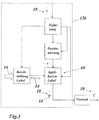
- FIG. 3 shows a schematic diagram of the method steps in an application process 15b another, opposite FIG. 2 extended embodiment of the inventive method.
- the illustrated application process 15b begins with the provision of the ready-to-pack-packed goods 10, which in turn is shown as a bottle in the figure.
- the goods 10 is detected.
- the type of goods 10 to be detected may have different characteristics of the goods 10 or the packaging of the goods 10, e.g. material, surface texture, structure or strength or other parameters.
- the current position of the goods 10 can be detected.
- the spatial shape and shape of the product 10 can be detected.
- the type and / or the position of the basic information relative to the goods 10 can be detected.
- the result of the detection can be used with advantage for the control of the subsequent steps of the method, what in the FIG. 3 is illustrated with angled arrows between the steps “capture”, “positioning", “application label” and “provision label”.
- the result of detecting the current position of the commodity 10 may be used for a step of positioning the commodity 10.
- the item 10 can be positioned in its spatial position due to the detected current position of the item 10 so that the predetermined location at which a label 14 is to be attached, is aligned in a suitable manner for the application of the label 14.
- the result of the detection may be supplied to the step of providing labels 14.
- the provision of the label 14 can in turn be controlled by an external control information 16.
- the control information 16 can be changed depending on the result of the detection. For example, depending on the result of the detection of the type of the goods 10 in the provision of the label 14 different 14 suitable for each product label 14 from a label magazine (not shown in the figure) can be selected or the creation of the label 14 is on the Art individually tailored to the goods.
- the result of the detection can be supplied to the step of application of the label 14.
- the application of the label 14 can be adjusted depending on the result of the detection. For example, depending on the type of goods 10, for example, depending on the material of the packaging, the pressure in the application of the label 14 can be adjusted so that the packaging takes no damage in the application or undesirably deformed. This is important, for example, when the goods are packed in flexible bags.
- a suitable counter-pressure means such as a pressure bearing surface, a mandrel or the supply of compressed air, conceivable, which compensates for the pressure during the application of the label 14.
- the detection of the spatial shape of the product 10 may be advantageous if the product 10 or the predetermined location to which the label 14 is to be attached, has uneven surfaces or deviations from a control surface. Depending on the result of the detection, the application of the label and / or the positioning can be adjusted, so that the label 14 can be attached to the article 10 in a suitable manner.
- the use of the result of the detection for subsequent steps of the method may be advantageous if the additional information of the label 14 is to occupy a spatially predetermined position with respect to a base information already present on the article 10, which is e.g. in cross-marketing projects may be the case. If the application of the label 14 is carried out independently of the manufacturer of the goods 10 at a distribution partner or in the context of logistics, the step of recording can serve to adapt the subsequent steps to the respective product 10, which increases the flexibility of the method.
- the provided with a label 14 product 10 can be supplied to the distribution after the application of the label 14, as in Fig. 3 will be shown.
- a checking step connected, for example, with an optical recognition to check the correct application of the additional information on the goods 10, can take place before the goods 10 are for sale arrives. If the application is incorrect, the product in question may be sorted out if necessary.
- FIG. 4 shows a schematic diagram of an embodiment of the inventive method in which the goods ready for sale packaged goods is produced in a production process.
- the application process 15a, b according to FIG. 2 or 3 connects directly to the production of goods 10.
- a plurality of goods 10 packaged with information carriers are packaged and combined into a container 43.
- the container 43 can finally be supplied to distribution.
- a trade unit and a loading unit for distribution of goods (distribution) are understood here as containers.
- the container stands for the combination of products of the same kind or different kind for the common order in the trade or for joint handling in the logistics.
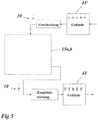
- FIG. 5 shows a schematic diagram of a further embodiment of the inventive method in which the ready-packed goods 10 are present in a container 43 'and are first isolated for further processing.
- the singulation step is followed by the application process 15a, b FIG. 2 or 3 , After the application process 15a, b, a plurality of goods 10 packaged with information carriers are packaged and combined into a container 43.
- the container 43 can finally be supplied to distribution.
- This embodiment of the method can be present, for example, if the equipment of the goods 10 with information carriers is not made by the manufacturer of the goods 10, but by a third-party manufacturer or a distribution partner, which may be the case, for example, in cross-marketing projects.
- the application process 15a, b which provides additional information on various types of provided goods 10 in more flexible Way attach is particularly advantageous for this embodiment of the method.
- FIG. 6 shows a schematic frontal view of an embodiment of an information carrier 14a, which a base information 12a, in the form of a label or the like., Concealed.
- the information carrier 14a is designed to be detachable with advantage, so that an end user can detach the information carrier 14a, for example in the form of a label or labels, from the packaging of the goods and the basic information 1a 2a appears.
- Such an embodiment of the information carrier 14a may be advantageous, for example, in competitive actions or raffle actions in which the base information 12a contains, for example, a competition code that is concealed by the information carrier 14a.
- FIG. 7 shows a schematic frontal view of another embodiment of an information carrier 14b, which forms with base information 12b, in the form of a label, a unit or an integral part and is detachable.
- the detachability is indicated by a dashed part of a detached corner of the information carrier 14b.
- the information carrier 14b for example in the form of a label, can also be configured partially overlapping with the basic information 12b. Alternatively, the information carrier 14b may be disposed adjacent to the basic information 1b.
- FIG. 8 shows a schematic frontal view of another embodiment of an information carrier 14 c, which is completely separated from a base information 12 c attached to a separate location.
- the information carrier 14a, b, c is designed repositionable liable to advantage, so that this after residue-free detachment of the goods in another place the same Goods can be attached.
- the information carrier 14a, b, c can also be designed so repositionable that it can be attached to another product. This may be advantageous, for example, for certain coupon actions, eg when the end user removes the information carrier 14a, b, c from one product and attaches it to another product and the other product with the repositioned information carrier 14a, b, c for a specific action on a Can redeem the point of sale.
- FIG. 9 shows a schematic frontal view of another embodiment of an information carrier 14 d, which includes an NFC device 18 and is repositionable.
- the information carrier 14d comprises an adhesive strip 17, by means of which the information carrier 14d can be attached to a product (not shown). If necessary, however, the information carrier 14d can also be provided with an adhesive on a whole surface, for example the back side of the information carrier 14d.
- the NFC device can be designed, for example, in the form of a (passive) RFID tag.
- Such an embodiment of an information carrier 14d may be advantageous if the additional information is to go beyond visible, eg printed, information. An advantage of this embodiment is that it allows different interaction possibilities by the consumer.
- the information carrier 14d can be provided with further functionalities, which go beyond the mere display of visual information.
- Fig. 10 shows a schematic perspective view of an NFC-enabled smart phone 20, on the back of the information carrier 14d Fig. 9 is repositioned.
- the information carrier 14d may have originally been placed on a beverage bottle and repositioned by the end user onto an NFC-enabled smart phone have been.
- the smart phone can be used, for example, to redeem a specific action specified by the information carrier 14d and optionally contained in the applied information. For example, a particular discount indicated in the posted information may be redeemed in a cashless payment transaction with the smart phone 20 carrying the repositioned RFID tag.
- a credit from the information carrier 14d it is also possible for a credit from the information carrier 14d to be transferable to the smart phone, which can be used in the manner of a prepaid card or directly for a payment transaction with the smart phone 20.
- the information carrier 14d comprises a repositioning information 44 in order to enable precise alignment of the information carrier 14d during repositioning.
- the repositioning information 44 may be a scale, a positioning cross, an arrow symbol 44, or similar, preferably visible, information.
- the repositioning information 44 is preferably arranged on the front surface of the information carrier 14d.
- the repositioning information 44 may also be arranged on the rear surface of the information carrier. For special applications this may be preferred, e.g. when the entire front surface is printed and there is no more space available for attaching the repositioning information.
- the repositioning information 44 for information carrier 14d can be particularly advantageous with an NFC device. With the aid of the repositioning information 44, the information carrier 14d can be aligned with the NFC device exactly on a location for repositioning on an NFC reading device, such as a smartphone 20.
- the repositioning information 44 may also include information 45 about various smartphone models exhibit. This may be advantageous because the NFC readers for different smartphone models are located at different locations on the smartphone 20. Accurate alignment of the information carrier 14d with the NFC device may therefore allow reliable near field communication between the information carrier 14d and the NFC reader.
- Corresponding repositioning information may be provided for other applications in which the information carriers carry analog information, e.g. printed information, exhibited and read by the human eye. This can e.g. be useful for information carriers which are collected by the consumer as collection or collection documents and stored on a collection unit, e.g. a trading card, can be repositioned.
- analog information e.g. printed information
- a collection unit e.g. a trading card
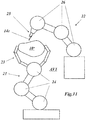
- FIG. 11 shows a schematic side view of an embodiment of a controllable positioning device 21 and an adaptive application device 22, which together form a highly flexible application device AV1, which can be used in a method according to the invention, if increased flexibility is required, for example, in the application of information carriers to constantly changing goods is necessary.
- the controllable positioning device 21 comprises gripper arms 23, which serve to hold an irregularly shaped product 10 '. Furthermore, the controllable positioning device 21 has a plurality of joints 24, which allow any three-dimensional spatial movement of the controllable positioning device 21.
- the controllable positioning device 21 can be controlled with control information. If necessary, the control information can be coupled with the result of a detection of the item 10 '.
- the controllable positioning device 21 can hold and position the goods 10 'such that the goods 10' are aligned in a suitable manner for the application of an information carrier.
- the adaptive application device 22 comprises a holding device 25 and joints 26.
- the holding device 25, which is equipped for example with a suction cup or gripper, can hold an information carrier 14e and release it after application.
- the adaptive application device 22 is spatially movable in three dimensions by means of the joints 26. By a suitable movement of the adaptive application device 22, the holding device 25, for example, from a label magazine (not shown in the figure) grab an information carrier 14e and bring to the goods 10 '.
- the adaptive application device 22 can apply the information carrier 14e to the goods 10 'at a predetermined location.
- the adaptive application device 22 can be controlled by a control information, wherein the control information can be coupled as needed with the result of a detection of the product 10 '.
- the control information can control, for example, the pressure of the application or the time of detachment of the information carrier 14e from the holding device 25.
- the adaptive application device 22 with three hinges 26 and a holding device 25 is shown.
- the adaptive application device 22 more joints and in particular a plurality of independently movable holding devices 25, so that, for example, depending on the application and / or different information carrier can be attached to multiple and / or different goods.
- the controllable positioning device 21 more joints and more than those in the FIG. 11 has shown two gripping arms, so that several goods can be held independently.
- FIG. 12 shows a schematic side view of an application device 27 and AV2, for a quick application with simple and recurrent forms of goods is particularly suitable.
- FIG. 12 Of course, here are also other recurring packaging conceivable.
- a cross-sectionally U-shaped flexible band 28 preferably made of rubber, is provided .
- the band 28 can receive the goods 10 "holding and positioning, wherein a portion of the goods 10", which has a predetermined location for providing the additional information, protrudes from the U-shaped band, as in FIG. 12 (and FIG. 13 ) can be seen.
- the goods 10 "are held and conveyed by support rollers 29 and pressure rollers 30, which are arranged on the outside at the bottom and laterally on the belt 28.
- the support rollers 29 and pressure rollers 30 are each designed to be movable in suitable spatial directions, as illustrated by the double arrows in the figure is.
- the support rollers 29 and pressure rollers 30 Due to the mobility of the support rollers 29 and pressure rollers 30 and the flexible design of the belt 28, an adaptive channel is formed for the goods 10 "in which the goods 10" are held and conveyed.
- the support rollers 29 can also serve to exert a certain counterpressure on the goods 10 ", which may be advantageous in the application of information carriers 14f
- the conveying process can be controlled by means of control information, the control information resulting in a previous detection of the goods 10 "can be coupled.
- the application device 27 further comprises guide bands 31a, b and a flexible application roller 42, preferably made of foam.
- the guide belts 31a, b hold the goods 10 "at a predetermined height and contribute by rolling movement to convey the goods 10" at.
- the guide bands 31 a, b are movable in the vertical direction, as indicated in the figure with double arrows. By the movement in the vertical direction, the guide belt 31a, an information carrier 14f, The application roller 42 is also movable in the vertical direction, which is illustrated by the double arrow in the application roller 42.
- the flexible application roller 42 information carrier 14 f which from an Informationsliczu Foodvoriques 32 be supplied on a carrier tape 33, deduct from the carrier tape 33 and to a predetermined location of the product 10 "create.
- the rolling movement of the flexible application roller 42 is indicated by a curved arrow within the pressure roller 42.
- the flexible design of the flexible application roller 42 makes it possible to equip goods with uneven or deviating surface areas with additional information without “deforming” the goods 10 or damaging the packaging of the goods 10 ".
- the information carriers 14f are fed by the information carrier supply device 32, the information carriers 14f resting on the carrier belt 33 by means of an adhesive layer peelably.
- the carrier tape 33 is continued after the removal of the information carrier 14 f in the Informationsliczu Foodvorraum 32.
- the speeds of the guide belts 31a, b, the application roller 42 and the belt 28 and the feeding speed of the information carriers 14f through the information carrier supply device 32 are coordinated so that a suitable delivery of the goods 10 "and a reliable application of the information carrier 14f on the goods 10" guaranteed at the predetermined location.
- the speeds may be controlled by a control information, which control information may be coupled to a result of a detection of the goods 10 ", eg an optical detection of a base information already present on the goods 10".
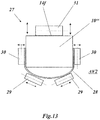
- FIG. 13 shows a schematic sectional view of the application device 27 and AV2 along the section line AA in FIG. 12 ,
- the U-shaped flexible band 28 with the rollers 29 and 30 is visible. Movements of the rollers are illustrated with double arrows, the movements of the rollers need not be limited to the directions shown.
- the lateral pinch rollers 29 press on the side surfaces of the fabric 10 ", which is partially received in the belt 28 and held in the belt 28 by the pinch rollers 29. By a rolling movement of the pinch rollers 29, the Goods 10 "are promoted.
- the upper guide belt 31 a serves both to promote the goods 10 "as well as for pressing the information carrier 14f to the goods 10".
- the information carriers 14 with the additional information for the end user are to be provided in accordance with external information, a connection of the application process 15a, b to external information sources, e.g. Databases, practical.
- external information sources e.g. Databases
- FIG. 14 shows such a scheme in which the product 10 in the course of an application process 1 5b subjected to a detection and positioning, to then be provided in the application step of the application device AV with the information carrier (label) 14.
- This process is controlled by a controller 34, which cooperates with a local memory 35, receives data on the type and shape of the product 10 from the acquisition and controls the provision of the label 14, the positioning of the product 10 and the application of the label 14.
- the controller is connected via a communication network or network 36 with external databases 37, 38, in which data about the ordered goods and about the order itself are stored.
- data can eg name and address of a consumer who ordered the goods online, or information about specific customer groups, to which an appropriate promotion is then assigned.
- a local control unit 39 which cooperates with the local memory 35 and receives the external data from the network 36.
- the local control unit 39 is preceded by a pre-process controller 40, which processes the information from the detection step.
- the local control / regulation unit 39 and the pre-process control / regulation 40 work together with an adaptive control module 41, so that overall a flexible, adaptive application process is available, cf. eg Fig. 11 ,
- the control module 41 may be connected to a control panel in order to install special control steps.
Landscapes
- Engineering & Computer Science (AREA)
- Business, Economics & Management (AREA)
- Computer Networks & Wireless Communication (AREA)
- Signal Processing (AREA)
- Economics (AREA)
- Marketing (AREA)
- Tourism & Hospitality (AREA)
- Finance (AREA)
- Entrepreneurship & Innovation (AREA)
- Human Resources & Organizations (AREA)
- Accounting & Taxation (AREA)
- Operations Research (AREA)
- Quality & Reliability (AREA)
- Strategic Management (AREA)
- Development Economics (AREA)
- Physics & Mathematics (AREA)
- General Business, Economics & Management (AREA)
- General Physics & Mathematics (AREA)
- Theoretical Computer Science (AREA)
- Auxiliary Devices For And Details Of Packaging Control (AREA)
- Details Of Rigid Or Semi-Rigid Containers (AREA)
- Labeling Devices (AREA)
- Cash Registers Or Receiving Machines (AREA)
Applications Claiming Priority (1)
| Application Number | Priority Date | Filing Date | Title |
|---|---|---|---|
| CH01701/15A CH711802A1 (de) | 2015-11-23 | 2015-11-23 | Verfahren zum Ausstatten der Verpackung einer verkaufsfertig verpackten Ware mit zusätzlicher Information, Vorrichtung zur Durchführung des Verfahrens, sowie Informationsträger für ein solches Verfahren. |
Publications (2)
| Publication Number | Publication Date |
|---|---|
| EP3192744A2 true EP3192744A2 (fr) | 2017-07-19 |
| EP3192744A3 EP3192744A3 (fr) | 2017-11-15 |
Family
ID=57345707
Family Applications (1)
| Application Number | Title | Priority Date | Filing Date |
|---|---|---|---|
| EP16198626.0A Withdrawn EP3192744A3 (fr) | 2015-11-23 | 2016-11-14 | Procédé de decoration d'un emballage, dispositif d'exécution du procédé et support d'informations |
Country Status (4)
| Country | Link |
|---|---|
| US (1) | US20170147968A1 (fr) |
| EP (1) | EP3192744A3 (fr) |
| AU (1) | AU2016250483A1 (fr) |
| CH (1) | CH711802A1 (fr) |
Citations (5)
| Publication number | Priority date | Publication date | Assignee | Title |
|---|---|---|---|---|
| DE19832548A1 (de) | 1998-07-21 | 2000-01-27 | Ludwig Meixner | Verfahren und Vorrichtung zur Kennzeichnung von Waren |
| EP1010630A2 (fr) | 1998-12-14 | 2000-06-21 | Sonoco Development, Inc. | Feuille multicouche avec autocollant pour sachet d'emballage |
| US8065827B2 (en) | 2007-10-19 | 2011-11-29 | Regas John P | Systems and methods for an informational attachment on a container |
| US20120031548A1 (en) | 2010-08-06 | 2012-02-09 | Broad Gavin J | Apparatus and Method for Applying a Label to a Non-ruled Surface |
| US8272562B2 (en) | 2010-10-11 | 2012-09-25 | Andrew Ziegler | Promotional hang tag, tag, or label combined with promotional product sample, with interactive quick response (QR code, MS tag) or other scan-able interactive code linked to one or more internet uniform resource locators (URLs) for instantly delivering wide band digital content, promotions and infotainment brand engagement features between consumers and marketers |
Family Cites Families (40)
| Publication number | Priority date | Publication date | Assignee | Title |
|---|---|---|---|---|
| JPS5418195B2 (fr) * | 1972-04-27 | 1979-07-05 | ||
| GB2356841A (en) * | 1999-12-04 | 2001-06-06 | Markem Tech Ltd | Packaging system |
| WO2002098742A2 (fr) * | 2001-06-01 | 2002-12-12 | Interactive Packaging Group, Ltd. | Machine a poser les etiquettes multiples |
| US6616189B2 (en) * | 2001-06-08 | 2003-09-09 | Premier Print & Services Group, Inc. | Sequentially placed shipping and packing label system |
| DE20115480U1 (de) * | 2001-09-19 | 2002-05-16 | Heuft Systemtechnik Gmbh, 56659 Burgbrohl | Vorrichtung zum Anbringen von Etiketten an Behältern |
| US6969134B2 (en) * | 2001-10-01 | 2005-11-29 | Zih Corp. | Printer or other media processor with on-demand selective media converter |
| US7061379B2 (en) * | 2002-11-21 | 2006-06-13 | Kimberly-Clark Worldwide, Inc. | RFID system and method for ensuring safety of hazardous or dangerous substances |
| GB0307225D0 (en) * | 2003-03-28 | 2003-04-30 | Arx Ltd | Automated dispensing system |
| EP1609325B1 (fr) * | 2003-04-03 | 2013-01-02 | Nokia Corporation | Dispositif serveur de reseau, systeme et procedes assurant la mediation de services offerts par un reseau |
| US7443299B2 (en) * | 2003-04-25 | 2008-10-28 | Avery Dennison Corporation | Extended range RFID system |
| US20120322428A1 (en) * | 2004-09-30 | 2012-12-20 | Motedata Inc. | Network of tags |
| US8001550B2 (en) * | 2004-03-22 | 2011-08-16 | The Code Corporation | Object identifier readers that are configured to automatically send and/or store data read from an object identifier |
| JP4458904B2 (ja) * | 2004-04-02 | 2010-04-28 | 東芝テック株式会社 | 発行装置 |
| JP4551122B2 (ja) * | 2004-05-26 | 2010-09-22 | 株式会社岩田レーベル | Rfidラベルの貼付装置 |
| US7218231B2 (en) * | 2004-07-29 | 2007-05-15 | Omnicell, Inc. | Method and apparatus for preparing an item with an RFID tag |
| US7303123B2 (en) * | 2005-02-07 | 2007-12-04 | Cryovac, Inc. | Method of labeling an item for item-level identification |
| WO2007013357A1 (fr) * | 2005-07-29 | 2007-02-01 | Kabushiki Kaisha Sato | Étiquette rfid et dispositif et procédé de fixation d’étiquette rfid |
| US20070052540A1 (en) * | 2005-09-06 | 2007-03-08 | Rockwell Automation Technologies, Inc. | Sensor fusion for RFID accuracy |
| DE112006002484T5 (de) * | 2005-09-14 | 2009-02-26 | Kabushiki Kaisha Sato | Etikettenklebevorrichtung |
| US7602288B2 (en) * | 2005-12-01 | 2009-10-13 | Frito-Lay North America, Inc. | Method for slap-and-ship RFID labeling |
| US20070159298A1 (en) * | 2006-01-03 | 2007-07-12 | Symbol Technologies, Inc. | System and method for interrogating and updating electronic shelf labels |
| US8061601B1 (en) * | 2006-08-07 | 2011-11-22 | Ncr Corporation | Methods and apparatus for establishing and maintaining electronic shelf label information |
| CH705647B1 (de) * | 2006-10-13 | 2013-04-30 | Ferag Ag | RFID-Druckproduktidentifikation. |
| US20090157460A1 (en) * | 2007-12-12 | 2009-06-18 | Karthikeyan Narayanaswamy | System and method for providing product and service data |
| DE102008051791A1 (de) * | 2008-10-17 | 2010-04-22 | Khs Ag | Verfahren sowie Vorrichtung zum Ausstatten von Behältern |
| US20100174599A1 (en) * | 2009-01-05 | 2010-07-08 | Apple Inc. | System and method for providing content associated with a product or service |
| US8738177B2 (en) * | 2010-07-01 | 2014-05-27 | MedAvil, Inc. | Vending machine for storage, labeling and dispensing of a container |
| US9394071B2 (en) * | 2011-01-27 | 2016-07-19 | Teraoka Seiko Co., Ltd. | Label affixing device and method of affixing label |
| EP2742472A2 (fr) * | 2011-08-09 | 2014-06-18 | Bilcare Limited | Système intégré d'authentification d'emballage et procédé associé |
| US8833652B2 (en) * | 2011-08-23 | 2014-09-16 | Tyco Fire & Security Gmbh | Product information system and method using a tag and mobile device |
| US9953354B2 (en) * | 2011-11-29 | 2018-04-24 | Nook Digital, Llc | System and method for providing product information |
| US20130262262A1 (en) * | 2012-03-29 | 2013-10-03 | Ebay, Inc. | Consumer Alerts from a Readable Code |
| US9352872B2 (en) * | 2012-10-04 | 2016-05-31 | Bell And Howell, Llc | Method and system to print and apply labels to products |
| SG2012084067A (en) * | 2012-11-14 | 2014-06-27 | Thinc Loyalty Pte Ltd | Method for processing customer loyalty information |
| US9112543B2 (en) * | 2012-12-27 | 2015-08-18 | Cambridge Silicon Radio Limited | Near field communication devices and methods |
| US8776857B1 (en) * | 2013-02-04 | 2014-07-15 | Computype, Inc. | Label application devices |
| US9324079B2 (en) * | 2013-03-12 | 2016-04-26 | iZipline LLC | System and pouch with QR code, RFID tag, and/or NFC tag |
| US9626464B2 (en) * | 2013-05-10 | 2017-04-18 | The Procter & Gamble Company | Method for evaluating and configuring label application processes |
| CA2907228A1 (fr) * | 2014-10-01 | 2016-04-01 | Pouch Pac Innovations, Llc | Systeme et methode de livraison d'information par communication en champ proche |
| US11049140B2 (en) * | 2015-10-09 | 2021-06-29 | Xerox Corporation | Product package and associated system for improving user-product engagement |
-
2015
- 2015-11-23 CH CH01701/15A patent/CH711802A1/de not_active Application Discontinuation
-
2016
- 2016-10-28 AU AU2016250483A patent/AU2016250483A1/en not_active Abandoned
- 2016-11-08 US US15/346,300 patent/US20170147968A1/en not_active Abandoned
- 2016-11-14 EP EP16198626.0A patent/EP3192744A3/fr not_active Withdrawn
Patent Citations (5)
| Publication number | Priority date | Publication date | Assignee | Title |
|---|---|---|---|---|
| DE19832548A1 (de) | 1998-07-21 | 2000-01-27 | Ludwig Meixner | Verfahren und Vorrichtung zur Kennzeichnung von Waren |
| EP1010630A2 (fr) | 1998-12-14 | 2000-06-21 | Sonoco Development, Inc. | Feuille multicouche avec autocollant pour sachet d'emballage |
| US8065827B2 (en) | 2007-10-19 | 2011-11-29 | Regas John P | Systems and methods for an informational attachment on a container |
| US20120031548A1 (en) | 2010-08-06 | 2012-02-09 | Broad Gavin J | Apparatus and Method for Applying a Label to a Non-ruled Surface |
| US8272562B2 (en) | 2010-10-11 | 2012-09-25 | Andrew Ziegler | Promotional hang tag, tag, or label combined with promotional product sample, with interactive quick response (QR code, MS tag) or other scan-able interactive code linked to one or more internet uniform resource locators (URLs) for instantly delivering wide band digital content, promotions and infotainment brand engagement features between consumers and marketers |
Also Published As
| Publication number | Publication date |
|---|---|
| AU2016250483A1 (en) | 2017-06-08 |
| CH711802A1 (de) | 2017-05-31 |
| EP3192744A3 (fr) | 2017-11-15 |
| US20170147968A1 (en) | 2017-05-25 |
Similar Documents
| Publication | Publication Date | Title |
|---|---|---|
| DE4135106C2 (de) | Vorrichtung zum Aufbringen mehrerer Etiketten | |
| US8727220B2 (en) | Machine readable information interface for a container | |
| US9852316B2 (en) | System and method for bulk RFID tag encoding | |
| DE19526131C2 (de) | Verfahren und Vorrichtung zur halbautomatischen Kommissionierung unterschiedlicher Artikel aus einem geordneten Lager und zur Beschickung desselben | |
| DE102012016339A1 (de) | Gebinde und Herstellverfahren | |
| DE19912529A1 (de) | Vorrichtung zur Dokumentation einer Kühlkettenunterbrechung bei Kühl- bzw. Tiefkühlprodukten | |
| DE3303109A1 (de) | Verfahren und vorrichtung zur automatischen warenerfassung und kennzeichnung | |
| EP2360100A1 (fr) | Procédé de fabrication prêt à l'envoi d'articles cosmétiques individuels et dispositif | |
| DE202007013104U1 (de) | Automatisches Warenlager | |
| WO2007000245A1 (fr) | Integration directe d'elements rfid dans des boites pliantes | |
| CH711802A1 (de) | Verfahren zum Ausstatten der Verpackung einer verkaufsfertig verpackten Ware mit zusätzlicher Information, Vorrichtung zur Durchführung des Verfahrens, sowie Informationsträger für ein solches Verfahren. | |
| DE102005026559A1 (de) | RFID-Etikettenanordnung, etikettierter Gegenstand sowie Verfahren zu dessen Herstellung | |
| DE102018122719A1 (de) | Verfahren und Vorrichtung zum Herstellen und/oder Fertigstellen einer Vielzahl von Schildersätzen | |
| EP2803479B1 (fr) | Caractérisation de la liaison par fusion d'un objet en matière synthétique | |
| DE3620264C2 (fr) | ||
| JP7730743B2 (ja) | ラベル貼付装置及びその方法 | |
| DE10228292A1 (de) | Verfahren zum Aufbringen von Werbeträgern auf Flaschen | |
| DE102004019074A1 (de) | Verfahren und Steuereinheit für einen Etikettendrucker | |
| DE69313653T2 (de) | Verfahren zur Verteilung von Produkten von Lieferanten an Kunden | |
| CN222270535U (zh) | 一种不干胶贴纸生产用的切割结构 | |
| EP2123559B1 (fr) | Dispositif de mélange et d'emballage de parfum | |
| EP0991013A1 (fr) | Dispositif pour attribuer une information à un article de marchandise | |
| DE102010009981A1 (de) | Coffee-to-go Becher, ebenfalls bekannt als Pappbecher für Heißgetränke, Kaffeepappbecher und/oder Kartontrinkbecher versehen mit individueller und informativer Firmenwerbung von verschiedenen Firmen in Form eines Direktdruckes (rundum) oder einer abziehbaren Werbebanderole (auch innenseitig bedruckbar) | |
| DE10244035B4 (de) | Kombinationsetikett zum Einsatz in der Bekleidungsindustrie | |
| DE4202636A1 (de) | Vorrichtung und verfahren zur kennzeichnung von daten des inhalts einer verpackung |
Legal Events
| Date | Code | Title | Description |
|---|---|---|---|
| PUAI | Public reference made under article 153(3) epc to a published international application that has entered the european phase |
Free format text: ORIGINAL CODE: 0009012 |
|
| AK | Designated contracting states |
Kind code of ref document: A2 Designated state(s): AL AT BE BG CH CY CZ DE DK EE ES FI FR GB GR HR HU IE IS IT LI LT LU LV MC MK MT NL NO PL PT RO RS SE SI SK SM TR |
|
| AX | Request for extension of the european patent |
Extension state: BA ME |
|
| PUAL | Search report despatched |
Free format text: ORIGINAL CODE: 0009013 |
|
| RIC1 | Information provided on ipc code assigned before grant |
Ipc: H04W 4/00 20090101ALI20171003BHEP Ipc: B65C 9/40 20060101ALI20171003BHEP Ipc: B65C 9/06 20060101AFI20171003BHEP Ipc: H04W 4/02 20090101ALI20171003BHEP Ipc: G06Q 10/08 20120101ALI20171003BHEP |
|
| AK | Designated contracting states |
Kind code of ref document: A3 Designated state(s): AL AT BE BG CH CY CZ DE DK EE ES FI FR GB GR HR HU IE IS IT LI LT LU LV MC MK MT NL NO PL PT RO RS SE SI SK SM TR |
|
| AX | Request for extension of the european patent |
Extension state: BA ME |
|
| RIC1 | Information provided on ipc code assigned before grant |
Ipc: B65C 9/06 20060101AFI20171011BHEP Ipc: G06Q 10/08 20120101ALI20171011BHEP Ipc: H04W 4/00 20090101ALI20171011BHEP Ipc: H04W 4/02 20090101ALI20171011BHEP Ipc: B65C 9/40 20060101ALI20171011BHEP |
|
| 17P | Request for examination filed |
Effective date: 20180514 |
|
| RBV | Designated contracting states (corrected) |
Designated state(s): AL AT BE BG CH CY CZ DE DK EE ES FI FR GB GR HR HU IE IS IT LI LT LU LV MC MK MT NL NO PL PT RO RS SE SI SK SM TR |
|
| STAA | Information on the status of an ep patent application or granted ep patent |
Free format text: STATUS: THE APPLICATION IS DEEMED TO BE WITHDRAWN |
|
| 18D | Application deemed to be withdrawn |
Effective date: 20200603 |