EP3196249B1 - Matériau de résine (méth)acrylate, renforçateur de dureté de surface, composition de résine de polycarbonate et article moulé - Google Patents
Matériau de résine (méth)acrylate, renforçateur de dureté de surface, composition de résine de polycarbonate et article moulé Download PDFInfo
- Publication number
- EP3196249B1 EP3196249B1 EP15835322.7A EP15835322A EP3196249B1 EP 3196249 B1 EP3196249 B1 EP 3196249B1 EP 15835322 A EP15835322 A EP 15835322A EP 3196249 B1 EP3196249 B1 EP 3196249B1
- Authority
- EP
- European Patent Office
- Prior art keywords
- mass
- constitutional unit
- meth
- resin material
- polycarbonate resin
- Prior art date
- Legal status (The legal status is an assumption and is not a legal conclusion. Google has not performed a legal analysis and makes no representation as to the accuracy of the status listed.)
- Active
Links
Images


Classifications
-
- C—CHEMISTRY; METALLURGY
- C08—ORGANIC MACROMOLECULAR COMPOUNDS; THEIR PREPARATION OR CHEMICAL WORKING-UP; COMPOSITIONS BASED THEREON
- C08L—COMPOSITIONS OF MACROMOLECULAR COMPOUNDS
- C08L69/00—Compositions of polycarbonates; Compositions of derivatives of polycarbonates
-
- C—CHEMISTRY; METALLURGY
- C08—ORGANIC MACROMOLECULAR COMPOUNDS; THEIR PREPARATION OR CHEMICAL WORKING-UP; COMPOSITIONS BASED THEREON
- C08F—MACROMOLECULAR COMPOUNDS OBTAINED BY REACTIONS ONLY INVOLVING CARBON-TO-CARBON UNSATURATED BONDS
- C08F220/00—Copolymers of compounds having one or more unsaturated aliphatic radicals, each having only one carbon-to-carbon double bond, and only one being terminated by only one carboxyl radical or a salt, anhydride ester, amide, imide or nitrile thereof
- C08F220/02—Monocarboxylic acids having less than ten carbon atoms; Derivatives thereof
- C08F220/10—Esters
- C08F220/40—Esters of unsaturated alcohols, e.g. allyl (meth)acrylate
-
- C—CHEMISTRY; METALLURGY
- C08—ORGANIC MACROMOLECULAR COMPOUNDS; THEIR PREPARATION OR CHEMICAL WORKING-UP; COMPOSITIONS BASED THEREON
- C08F—MACROMOLECULAR COMPOUNDS OBTAINED BY REACTIONS ONLY INVOLVING CARBON-TO-CARBON UNSATURATED BONDS
- C08F220/00—Copolymers of compounds having one or more unsaturated aliphatic radicals, each having only one carbon-to-carbon double bond, and only one being terminated by only one carboxyl radical or a salt, anhydride ester, amide, imide or nitrile thereof
- C08F220/02—Monocarboxylic acids having less than ten carbon atoms; Derivatives thereof
- C08F220/10—Esters
- C08F220/12—Esters of monohydric alcohols or phenols
- C08F220/14—Methyl esters, e.g. methyl (meth)acrylate
-
- C—CHEMISTRY; METALLURGY
- C08—ORGANIC MACROMOLECULAR COMPOUNDS; THEIR PREPARATION OR CHEMICAL WORKING-UP; COMPOSITIONS BASED THEREON
- C08F—MACROMOLECULAR COMPOUNDS OBTAINED BY REACTIONS ONLY INVOLVING CARBON-TO-CARBON UNSATURATED BONDS
- C08F220/00—Copolymers of compounds having one or more unsaturated aliphatic radicals, each having only one carbon-to-carbon double bond, and only one being terminated by only one carboxyl radical or a salt, anhydride ester, amide, imide or nitrile thereof
- C08F220/02—Monocarboxylic acids having less than ten carbon atoms; Derivatives thereof
- C08F220/10—Esters
- C08F220/26—Esters containing oxygen in addition to the carboxy oxygen
- C08F220/30—Esters containing oxygen in addition to the carboxy oxygen containing aromatic rings in the alcohol moiety
- C08F220/301—Esters containing oxygen in addition to the carboxy oxygen containing aromatic rings in the alcohol moiety and one oxygen in the alcohol moiety
-
- C—CHEMISTRY; METALLURGY
- C08—ORGANIC MACROMOLECULAR COMPOUNDS; THEIR PREPARATION OR CHEMICAL WORKING-UP; COMPOSITIONS BASED THEREON
- C08K—Use of inorganic or non-macromolecular organic substances as compounding ingredients
- C08K5/00—Use of organic ingredients
- C08K5/04—Oxygen-containing compounds
- C08K5/06—Ethers; Acetals; Ketals; Ortho-esters
-
- C—CHEMISTRY; METALLURGY
- C08—ORGANIC MACROMOLECULAR COMPOUNDS; THEIR PREPARATION OR CHEMICAL WORKING-UP; COMPOSITIONS BASED THEREON
- C08K—Use of inorganic or non-macromolecular organic substances as compounding ingredients
- C08K5/00—Use of organic ingredients
- C08K5/04—Oxygen-containing compounds
- C08K5/09—Carboxylic acids; Metal salts thereof; Anhydrides thereof
-
- C—CHEMISTRY; METALLURGY
- C08—ORGANIC MACROMOLECULAR COMPOUNDS; THEIR PREPARATION OR CHEMICAL WORKING-UP; COMPOSITIONS BASED THEREON
- C08K—Use of inorganic or non-macromolecular organic substances as compounding ingredients
- C08K5/00—Use of organic ingredients
- C08K5/04—Oxygen-containing compounds
- C08K5/13—Phenols; Phenolates
-
- C—CHEMISTRY; METALLURGY
- C08—ORGANIC MACROMOLECULAR COMPOUNDS; THEIR PREPARATION OR CHEMICAL WORKING-UP; COMPOSITIONS BASED THEREON
- C08L—COMPOSITIONS OF MACROMOLECULAR COMPOUNDS
- C08L33/00—Compositions of homopolymers or copolymers of compounds having one or more unsaturated aliphatic radicals, each having only one carbon-to-carbon double bond, and only one being terminated by only one carboxyl radical, or of salts, anhydrides, esters, amides, imides or nitriles thereof; Compositions of derivatives of such polymers
- C08L33/04—Homopolymers or copolymers of esters
- C08L33/06—Homopolymers or copolymers of esters of esters containing only carbon, hydrogen and oxygen, which oxygen atoms are present only as part of the carboxyl radical
- C08L33/10—Homopolymers or copolymers of methacrylic acid esters
-
- C—CHEMISTRY; METALLURGY
- C08—ORGANIC MACROMOLECULAR COMPOUNDS; THEIR PREPARATION OR CHEMICAL WORKING-UP; COMPOSITIONS BASED THEREON
- C08L—COMPOSITIONS OF MACROMOLECULAR COMPOUNDS
- C08L33/00—Compositions of homopolymers or copolymers of compounds having one or more unsaturated aliphatic radicals, each having only one carbon-to-carbon double bond, and only one being terminated by only one carboxyl radical, or of salts, anhydrides, esters, amides, imides or nitriles thereof; Compositions of derivatives of such polymers
- C08L33/04—Homopolymers or copolymers of esters
- C08L33/14—Homopolymers or copolymers of esters of esters containing halogen, nitrogen, sulfur, or oxygen atoms in addition to the carboxy oxygen
-
- C—CHEMISTRY; METALLURGY
- C08—ORGANIC MACROMOLECULAR COMPOUNDS; THEIR PREPARATION OR CHEMICAL WORKING-UP; COMPOSITIONS BASED THEREON
- C08F—MACROMOLECULAR COMPOUNDS OBTAINED BY REACTIONS ONLY INVOLVING CARBON-TO-CARBON UNSATURATED BONDS
- C08F220/00—Copolymers of compounds having one or more unsaturated aliphatic radicals, each having only one carbon-to-carbon double bond, and only one being terminated by only one carboxyl radical or a salt, anhydride ester, amide, imide or nitrile thereof
- C08F220/02—Monocarboxylic acids having less than ten carbon atoms; Derivatives thereof
- C08F220/10—Esters
- C08F220/12—Esters of monohydric alcohols or phenols
- C08F220/16—Esters of monohydric alcohols or phenols of phenols or of alcohols containing two or more carbon atoms
- C08F220/18—Esters of monohydric alcohols or phenols of phenols or of alcohols containing two or more carbon atoms with acrylic or methacrylic acids
- C08F220/1806—C6-(meth)acrylate, e.g. (cyclo)hexyl (meth)acrylate or phenyl (meth)acrylate
-
- C—CHEMISTRY; METALLURGY
- C08—ORGANIC MACROMOLECULAR COMPOUNDS; THEIR PREPARATION OR CHEMICAL WORKING-UP; COMPOSITIONS BASED THEREON
- C08L—COMPOSITIONS OF MACROMOLECULAR COMPOUNDS
- C08L2205/00—Polymer mixtures characterised by other features
- C08L2205/06—Polymer mixtures characterised by other features having improved processability or containing aids for moulding methods
-
- C—CHEMISTRY; METALLURGY
- C08—ORGANIC MACROMOLECULAR COMPOUNDS; THEIR PREPARATION OR CHEMICAL WORKING-UP; COMPOSITIONS BASED THEREON
- C08L—COMPOSITIONS OF MACROMOLECULAR COMPOUNDS
- C08L2205/00—Polymer mixtures characterised by other features
- C08L2205/24—Crystallisation aids
Definitions
- Molded articles of polycarbonate resins are widely used as members (housing and the like) of various kinds of devices (electrical devices, electronic devices, office automation devices, and the like), optical recording media, automobile parts, building members, and the like since they have an excellent mechanical strength and exhibit excellent heat resistance, electrical properties, dimensional stability, flame retardancy, transparency, and the like.
- molded articles of polycarbonate resins have a deficient surface hardness so as not to be used as automobile head lamps, various kinds of sheets, and the like.
- the molded article of the invention is a molded article which contains a polycarbonate resin and has an excellent surface hardness, excellent optical properties, and suppressed molding defects such as whitening.
- (meth)acrylate is a generic name for an acrylate and a methacrylate.
- the (meth)acrylate resin material of the invention is the following (meth)acrylate resin material ( ⁇ ) or (meth)acrylate resin material ( ⁇ ).
- the difference between the (meth)acrylate resin material ( ⁇ ) and the (meth)acrylate resin material ( ⁇ ) is that at least one or more between an acid (B) and a nucleophilic agent (C) is contained as one component of the (meth)acrylate resin material or at least one or more between an acid (B) and a nucleophilic agent (C) is incorporated in the (meth)acrylate polymer as a constitutional unit of the polymer.
- the mass average molecular weight of the polymer (A1) is preferably from 5,000 to 30,000, more preferably from 10,000 to 20,000, and still more preferably from 10,000 to 15,000.
- the molded article has a superior surface hardness when the mass average molecular weight of the polymer (A1) is 5000 or more.
- the molding defects of the molded article are further suppressed when the mass average molecular weight of the polymer (A1) is 30,000 or less.
- the polymer (A2) has the constitutional unit (a1), the constitutional unit (a2), and at least one or more between the constitutional unit (b1) and the constitutional unit (c1).
- the polymer (A2) may have a constitutional unit (a3) derived from another monomer if necessary.
- Examples of the acid (B1) constituting the constitutional unit (b1) may include methacrylic acid, acrylic acid, anhydrous methacrylic acid, anhydrous acrylic acid, maleic acid, anhydrous maleic acid, and itaconic acid.
- the (meth)acrylate polymer has the constitutional unit (a2) derived from methyl methacrylate, and it is thus possible to obtain a molded article having an excellent surface hardness in the case of blending the (meth)acrylate resin material of the invention with a polycarbonate resin.
- nucleophilic agent (C) it is preferable to use a compound having a hydroxyl group from the viewpoint of obtaining a molded article which exhibits excellent optical properties.
- the constitutional unit (c1) is a constitutional unit derived from the nucleophilic agent (C).
- the constitutional unit (c1) improves the compatibility between a polycarbonate resin and the (meth)acrylate resin material and the surface hardness enhancer.
- nucleophilic agent (C) constituting the constitutional unit (c1) a nucleophilic agent (C1) copolymerizable with a monomer having a chemical structure represented by Formula (1), methyl methacrylate, or another monomer is preferable among the nucleophilic agents (C) from the viewpoint of being easily introduced into the polymer (A2) as a constitutional unit.
- Examples of the amine may include dimethylaminoethyl methacrylate, dimethylaminoethyl acrylate, diethylaminoethyl methacrylate, diethylaminoethyl acrylate, tert-butylaminoethyl methacrylate, and tert-butylaminoethyl acrylate.
- organophosphorus compound may include 2-phosphonooxyethyl methacrylate and 2-phosphonooxyethyl acrylate.
- the "PLACCEL FM1", “PLACCEL FM2”, “PLACCEL FM3”, “PLACCEL FM4", and “PLACCEL FM5" are preferable from the viewpoint of excellent heat resistance of the molded article.
- the proportion occupied by a chemical structure represented by the following Formula (5) in the total mass of the (meth)acrylate is preferably from 0.0001 to 30% by mass.
- the (meth)acrylate resin material of the invention described above exhibits favorable compatibility with a polycarbonate resin since it contains the nucleophilic agent (C) or the (meth)acrylate polymer has the constitutional unit (c1) derived from the nucleophilic agent (C). Consequently, it is possible to obtain a molded article having suppressed molding defects by molding a composition in which the (meth)acrylate resin material of the invention is blended with a polycarbonate resin.
- the polymer (A1) or polymer (A2) has the constitutional unit (a2) derived from methyl methacrylate, and it is thus possible to obtain a molded article having an excellent surface hardness by molding a composition in which the (meth)acrylate resin material of the invention is blended with a polycarbonate resin.
- the polymer (A1) or polymer (A2) has the constitutional unit (a1) derived from the following Formula (1), and it is thus possible to obtain a molded article exhibiting excellent optical properties, namely, transparency in the case of blending the (meth)acrylate resin material of the invention with a polycarbonate resin.
- Ar is an aryl group, and the aromatic ring in Ar is directly bonded to the ester terminal in Formula (1).
- the (meth)acrylate resin material of the invention can be suitably used as a surface hardness enhancer of a polycarbonate resin since it exerts the effects described above.
- the polycarbonate resin (D) is not particularly limited as long as it is a polymer compound having a carbonic ester bond (-O-C(O)-O-) in the main chain.
- Examples of the polycarbonate resin (D) may include an aromatic polycarbonate that is usually produced through a reaction between a dihydric phenol and a carbonate precursor. Specific examples thereof may include those produced by reacting a dihydric phenol with a carbonate precursor by a solution method or a melting method, and more specific examples thereof may include those produced by reacting a dihydric phenol with phosgene and those produced by reacting a dihydric phenol with diphenyl carbonate or the like by a transesterification method.
- dihydric phenol examples include 2,2-bis(4-hydroxyphenyl)propane [bisphenol A], 2,2-bis(3-methyl-4-hydroxyphenyl)propane [bisphenol C], bis(hydroxyphenyl)methane, 1,1-bis(4-hydroxyphenyl)ethane, 2,2-bis(4-hydroxy-3,5-dimethylphenyl)propane, 4,4'-dihydroxydiphenyl, bis(4-hydroxyphenyl)cycloalkane, bis(4-hydroxyphenyl) oxide, bis(4-hydroxyphenyl) sulfide, bis(4-hydroxyphenyl) sulfone, bis(4-hydroxyphenyl) sulfoxide, bis(4-hydroxyphenyl) ether, bis(4-hydroxyphenyl) ketone, and any halogen substituted product thereof.
- examples of the dihydric phenol may include hydroquinone, resorcin, and catechol.
- dihydric phenol bis(hydroxyphenyl)alkane-based one is preferable and bisphenol A is particularly preferable from the viewpoint of cost.
- the polycarbonate resin (D) may have a branched structure.
- the branching agent for introducing the branched structure into the polycarbonate resin (D) may include 1,1,1-tris(4-hydroxyphenyl)ethane, ⁇ , ⁇ ', ⁇ "-tris(4-hydroxyphenyl)-1,3,5-triisopropylbenzene, phloroglucin, trimellitic acid, and isatin bis(o-cresol).
- the polycarbonate resin (D) may be a copolymer having a polycarbonate portion and a polyorganosiloxane portion, or it may be a polycarbonate resin containing this copolymer.
- the polyorganosiloxane portion is preferably from 1 to 40% by mass in the total mass of the polycarbonate resin (D) in a case in which the polycarbonate resin (D) contains the polyorganosiloxane portion.
- the viscosity average molecular weight of the polycarbonate resin (D) can be calculated by a viscosity method, and it is preferably from 15,000 to 30,000, more preferably from 16,000 to 27,000, and still more preferably from 17,000 to 25,000.
- the polycarbonate resin composition exhibits excellent moldability and the molded article has an excellent surface hardness when the viscosity average molecular weight is within the above range.
- the polycarbonate resin composition of the invention may contain various kinds of additives such as an antioxidant, an ultraviolet absorber, a light stabilizer, and a flame retardant and various kinds of fillers such as glass, mica, talc, and rubber particles if necessary.
- additives such as an antioxidant, an ultraviolet absorber, a light stabilizer, and a flame retardant
- fillers such as glass, mica, talc, and rubber particles if necessary.
- the polycarbonate resin composition of the invention may contain a resin other than the polycarbonate resin in a range in which the effect of the invention is not impaired.
- the polycarbonate resin composition of the invention contains a compound (also referred to as an exchange compound) produced as some or all of the side chain aryl esters in the constitutional unit (a1) is exchange-reacted with arbitrary one or more between a carbonyl bond and an ester bond in the polycarbonate resin (D).
- An apparatus for gas chromatography-mass spectrometry (GC-MS) equipped with a thermal decomposition apparatus is used for the measurement of the proportion of these exchange compounds.
- the thermal decomposition apparatus may be an apparatus that can directly introduce the gas generated by thermal decomposition to the GC-MS apparatus, for example, a micro vertical type such as the model PY-3030 manufactured by Frontier Laboratories Ltd. or a Curie point type such as the model JHP-5 manufactured by Japan Analytical Industry Co., Ltd..
- the polycarbonate resin composition of the invention can be manufactured by melt-kneading the polycarbonate resin (D), the (meth)acrylate resin material of the invention, and, if necessary, other components.
- the molded article of the invention described above is one that is obtained by molding the polycarbonate resin composition of the invention, and it thus has an excellent surface hardness and suppressed molding defects such as whitening.
- the pencil hardness of the surface of a molded article having a thickness of 2 mm was measured in conformity with JIS K 5600-5-4.
- Examples 8 to 10 an unsaturated fatty acid hydroxyalkyl ester-modified ⁇ -caprolactone (PLACCEL FM5 manufactured by DAICEL CORPORATION) was used as the nucleophilic agent (C) constituting the constitutional unit (c1).
- the nucleophilic agent (C) was added to the aqueous dispersion before the inside of the polymerization apparatus was purged with nitrogen.
- polycarbonate resin compositions of the invention were prepared by using the polycarbonate resin (D) and the (meth)acrylate resin materials ( ⁇ 2) to ( ⁇ 10).
- the molded articles having a sheet shape and a thickness corresponding to the respective evaluations were obtained by conducting the same operation as in Example 1 except that the kind and amount of the (meth)acrylate resin materials blended were changed as presented in Table 2. The evaluation results are presented in Table 2.
- Polymers were obtained by conducting the same operation as in Example 1 except that the respective compositions were changed as described in Table 1.
- the polymers thus obtained were further mixed with the nucleophilic agent (C) to obtain (meth)acrylate resin materials ( ⁇ 1) to ( ⁇ 4) and ( ⁇ 15).
- the proportions and mass average molecular weights of the respective constitutional units of the polymers constituting the (meth)acrylate resin materials ( ⁇ 1) to ( ⁇ 4) and ( ⁇ 15) and the amount of the nucleophilic agent (C) are presented in Table 1.
- the polycarbonate resin compositions of the invention were prepared by using the polycarbonate resin (D) and the (meth)acrylate resin materials ( ⁇ 1) to ( ⁇ 4) and (015).
- the molded articles having a sheet shape and a thickness corresponding to the respective evaluations were obtained by conducting the same operation as in Example 1 except that the kind and amount of the (meth)acrylate resin materials blended were changed as presented in Table 2. The evaluation results are presented in Table 2.
- methacrylic acid manufactured by MITSUBISHI RAYON CO., LTD.
- bisphenol A manufactured by TOKYO CHEMICAL INDUSTRY CO., LTD.
- polycarbonate resin compositions of the invention were prepared by using the polycarbonate resin (D) and the (meth)acrylate resin materials ( ⁇ 1) to (y4).
- the molded articles having a sheet shape and a thickness corresponding to the respective evaluations were obtained by conducting the same operation as in Example 1 except that the kind and amount of the (meth)acrylate resin materials blended were changed as presented in Table 2.
- the evaluation results are presented in Table 2.
Landscapes
- Chemical & Material Sciences (AREA)
- Health & Medical Sciences (AREA)
- Chemical Kinetics & Catalysis (AREA)
- Medicinal Chemistry (AREA)
- Polymers & Plastics (AREA)
- Organic Chemistry (AREA)
- Compositions Of Macromolecular Compounds (AREA)
- Addition Polymer Or Copolymer, Post-Treatments, Or Chemical Modifications (AREA)
- Manufacture Of Macromolecular Shaped Articles (AREA)
Claims (25)
- Matériau en résine (méth)acrylique comportant :un polymère (A1) ayant un motif constitutionnel (a1) dérivé d'un composé représenté par la Formule (1) suivante et un motif constitutionnel (a2) dérivé de méthacrylate de méthyle et d'au moins un ou plusieurs éléments entre un acide (B) et un agent nucléophile (C), qui est un ou plusieurs éléments choisis parmi le groupe constitué d'un composé possédant un groupe hydroxyle, une amine, un composé organophosphoré et un composé ayant une structure chimique qui réagit avec une résine de polycarbonate dans la molécule :
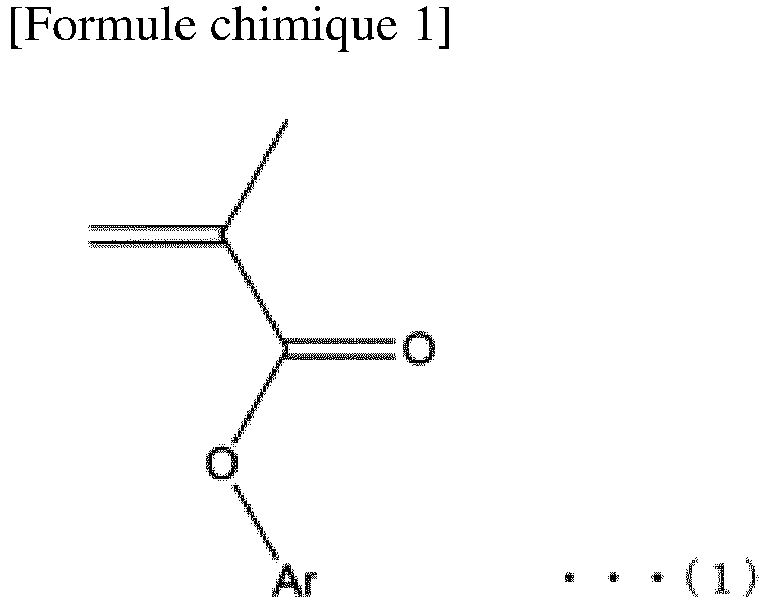 où Ar est un groupe aryle, et un noyau aromatique dans Ar est directement lié à une terminaison ester dans la Formule (1),dans lequel la teneur en acide (B) dans le matériau en résine (méth)acrylique varie de 0,001 à 2 parties en masse par rapport à 100 parties en masse de la somme du motif constitutionnel (a1) et du motif constitutionnel (a2) lorsque le matériau en résine (méth)acrylique comporte l'acide (B).
 - Matériau en résine (méth)acrylique comportant :un polymère (A2) ayant un motif constitutionnel (a1) dérivé d'un composé représenté par la Formule (1) suivante, un motif constitutionnel (a2) dérivé de méthacrylate de méthyle, et d'au moins un ou plusieurs éléments entre un motif constitutionnel (b1) dérivé d'un acide (B) et un motif constitutionnel (c1) dérivé d'un agent nucléophile (C), qui est un ou plusieurs éléments choisis parmi le groupe constitué d'un composé possédant un groupe hydroxyle, une amine, un composé organophosphoré et un composé ayant une structure chimique qui réagit avec une résine de polycarbonate dans la molécule :
 où Ar est un groupe aryle, et un noyau aromatique dans Ar est directement lié à une terminaison ester dans la Formule (1),dans lequel la teneur en motif constitutionnel (b1) dans le matériau en résine (méth)acrylique varie de 0,001 à 2 parties en masse par rapport à 100 parties en masse de la somme du motif constitutionnel (a1) et du motif constitutionnel (a2) lorsque le matériau en résine (méth)acrylique comporte le motif constitutionnel (b1) et ne comporte pas l'acide (B), ou dans lequel la teneur totale en acide (B) et en motif constitutionnel (b1) varie de 0,001 à 2 parties en masse par rapport à 100 parties en masse de la somme du motif constitutionnel (a1) et du motif constitutionnel (a2) lorsque le matériau en résine (méth)acrylique comporte à la fois l'acide (B) et le motif constitutionnel (b 1).
 - Matériau en résine (méth)acrylique selon la revendication 2, comportant en outre au moins un ou plusieurs éléments entre un acide (B) et un agent nucléophile (C), qui est un ou plusieurs éléments choisis parmi le groupe constitué d'un composé possédant un groupe hydroxyle, une amine, un composé organophosphoré et un composé ayant une structure chimique qui réagit avec une résine de polycarbonate dans la molécule.
- Matériau en résine (méth)acrylique selon l'une quelconque des revendications 1 à 3, dans lequel le motif constitutionnel (a1) est au moins un ou plusieurs éléments entre un motif constitutionnel dérivé de méthacrylate de phényle et un motif constitutionnel dérivé de méthacrylate de 2-naphthyle.
- Matériau en résine (méth)acrylique selon l'une quelconque des revendications 1 à 3, dans lequel une proportion du motif constitutionnel (a1) est de 5 à 50 % en masse dans 100 % en masse d'une somme du motif constitutionnel (a1) et du motif constitutionnel (a2).
- Matériau en résine (méth)acrylique selon l'une quelconque des revendications 1 à 3, dans lequel une proportion du motif constitutionnel (a1) est de 5 à 25 % en masse dans 100 % en masse d'une somme du motif constitutionnel (a1) et du motif constitutionnel (a2).
- Matériau en résine (méth)acrylique selon l'une quelconque des revendications 1 à 3, dans lequel une proportion du motif constitutionnel (a2) est de 50 à 95 % en masse dans 100 % en masse d'une somme du motif constitutionnel (a1) et du motif constitutionnel (a2).
- Matériau en résine (méth)acrylique selon l'une quelconque des revendications 1 à 3, dans lequel l'acide (B) est un composé possédant un groupe carboxyle.
- Matériau en résine (méth)acrylique selon l'une quelconque des revendications 1 à 3, dans lequel l'acide (B) est au moins un ou plusieurs éléments entre l'acide méthacrylique et l'acide acrylique.
- Matériau en résine (méth)acrylique selon la revendication 1 dans lequel une teneur en acide (B) est de 0,02 à 2 parties en masse par rapport à 100 parties en masse d'une somme du motif constitutionnel (a1) et du motif constitutionnel (a2).
- Matériau en résine (méth)acrylique selon la revendication 2 ou 3, dans lequel une teneur en motif constitutionnel (b1) ou une teneur totale en acide (B) et en motif constitutionnel (b1) dans un cas où il comporte en outre un acide (B) est de 0,02 à 2 parties en masse par rapport à 100 parties en masse d'une somme du motif constitutionnel (a1) et du motif constitutionnel (a2).
- Matériau en résine (méth)acrylique selon l'une quelconque des revendications 1 à 3, dans lequel l'agent nucléophile (C) est un composé possédant un groupe hydroxyle.
- Matériau en résine (méth)acrylique selon l'une quelconque des revendications 1 à 3, dans lequel l'agent nucléophile (C) est un composé ayant une structure représentée par la Formule (2) suivante dans une molécule :

- Matériau en résine (méth)acrylique selon l'une quelconque des revendications 1 à 3, dans lequel l'agent nucléophile (C) est un composé ayant une structure chimique pour réagir avec une résine de polycarbonate dans une molécule.
- Matériau en résine (méth)acrylique selon la revendication 1 dans lequel une teneur en agent nucléophile (C) est de 0,001 à 10 parties en masse par rapport à 100 parties en masse du polymère (A1).
- Matériau en résine (méth)acrylique selon la revendication 2 ou 3, dans lequel une teneur en motif constitutionnel (c1) ou une teneur totale en agent nucléophile (C) et en motif constitutionnel (c1) dans un cas où il comporte en outre un agent nucléophile (C), qui est un ou plusieurs éléments choisis parmi le groupe constitué d'un composé possédant un groupe hydroxyle, une amine, un composé organophosphoré et un composé ayant une structure chimique qui réagit avec une résine de polycarbonate dans la molécule, est de 0,001 à 10 parties en masse par rapport à 100 parties en masse du polymère (A2).
- Matériau en résine (méth)acrylique selon l'une quelconque des revendications 1 à 3, dans lequel une masse moléculaire moyenne en masse du polymère (A1) ou du polymère (A2) est de 5 000 à 30 000, lorsque déterminée par le procédé décrit dans la description.
- Composition de résine de polycarbonate comportant :une résine de polycarbonate (D) ; etle matériau en résine (méth)acrylique selon l'une quelconque des revendications 1 à 3.
- Article moulé obtenu en moulant la composition de résine de polycarbonate selon la revendication 18.
- Agent de renforcement de dureté superficielle comportant le matériau en résine (méth)acrylique selon l'une quelconque des revendications 1 à 3, dans lequel une dureté au crayon d'un article moulé qui est obtenu en moulant une composition de résine de polycarbonate contenant l'agent de renforcement de dureté superficielle comportant le matériau en résine (méth)acrylique selon l'une quelconque des revendications 1 à 3 à 25 parties en masse par rapport à 100 parties en masse d'une résine de polycarbonate (D) ayant une masse moléculaire moyenne en viscosité de 16 000 ou plus et de 25 000 ou moins et a une épaisseur de 2 mm mesurée conformément à la norme JIS K 5600-5-4 est F ou supérieure.
- Agent de renforcement de dureté superficielle comportant le matériau en résine (méth)acrylique selon l'une quelconque des revendications 1 à 3, dans lequel un trouble d'un article moulé qui est obtenu en moulant une composition de résine de polycarbonate contenant l'agent de renforcement de dureté superficielle comportant le matériau en résine (méth)acrylique selon l'une quelconque des revendications 1 à 3 à 25 parties en masse par rapport à 100 parties en masse d'une résine de polycarbonate (D) ayant une masse moléculaire moyenne en viscosité de 16 000 ou plus et de 25 000 ou moins et a une épaisseur de 2 mm mesurée conformément à la norme JIS K 7136 est de 0,5 % ou moins.
- Agent de renforcement de dureté superficielle comportant le matériau en résine (méth)acrylique selon l'une quelconque des revendications 1 à 3, dans lequel un trouble dans une zone de 16 mm × 12 mm incluant un endroit où un blanchiment d'un article moulé est provoqué dans l'article moulé qui est obtenu en moulant une composition de résine de polycarbonate contenant l'agent de renforcement de dureté superficielle comportant le matériau en résine (méth)acrylique selon l'une quelconque des revendications 1 à 3 à 25 parties en masse par rapport à 100 parties en masse d'une résine de polycarbonate (D) ayant une masse moléculaire moyenne en viscosité de 16 000 ou plus et de 25 000 ou moins et a une forme 1A décrite dans la norme JIS K7162 est de 25 % ou moins.
- Procédé de fabrication d'une composition de résine de polycarbonate, dans lequel une résine de polycarbonate (D) est en outre mélangée de 1 à 400 parties en masse par rapport à 100 parties en masse de la composition de résine de polycarbonate selon la revendication 18.
- Composition de résine de polycarbonate selon la revendication 18, ayant un pic au moins à un ou plusieurs temps de rétention entre 19,3 minutes et 22,1 minutes dans un spectre de masse obtenu lorsque 5 µl d'une solution de méthanol à 20 % d'hydroxyde de tétraméthylammonium (TMAH) sont ajoutés à 200 µg de la composition de résine de polycarbonate , mesuré en utilisant un appareil de chromatographie en phase gazeuse couplée à la spectrométrie de masse (GC-MS) équipé d'un appareil de décomposition thermique, la composition de résine de polycarbonate et le TMAH sont thermiquement décomposés via une réaction par un appareil de décomposition thermique réglé à 400 °C, et un gaz ainsi généré est introduit dans l'appareil GC-MS, séparé en chaque composant par la colonne dans l'appareil de chromatographie en phase gazeuse (GC), et analysé par l'appareil de spectrométrie de masse (MS), telle que déterminée par le procédé décrit dans la description.
- Composition de résine de polycarbonate selon la revendication 24, comportant un polymère ayant un motif constitutionnel dérivé d'au moins un ou plusieurs éléments entre des structures chimiques représentées par la Formule (3) suivante et la Formule (4) suivante.


Applications Claiming Priority (4)
| Application Number | Priority Date | Filing Date | Title |
|---|---|---|---|
| JP2014175471 | 2014-08-29 | ||
| JP2014177274 | 2014-09-01 | ||
| JP2014229713 | 2014-11-12 | ||
| PCT/JP2015/074447 WO2016031967A1 (fr) | 2014-08-29 | 2015-08-28 | Matériau de résine (méth)acrylate, renforçateur de dureté de surface, composition de résine de polycarbonate et article moulé |
Publications (3)
| Publication Number | Publication Date |
|---|---|
| EP3196249A1 EP3196249A1 (fr) | 2017-07-26 |
| EP3196249A4 EP3196249A4 (fr) | 2017-08-30 |
| EP3196249B1 true EP3196249B1 (fr) | 2023-06-28 |
Family
ID=55399850
Family Applications (1)
| Application Number | Title | Priority Date | Filing Date |
|---|---|---|---|
| EP15835322.7A Active EP3196249B1 (fr) | 2014-08-29 | 2015-08-28 | Matériau de résine (méth)acrylate, renforçateur de dureté de surface, composition de résine de polycarbonate et article moulé |
Country Status (7)
| Country | Link |
|---|---|
| US (2) | US10513606B2 (fr) |
| EP (1) | EP3196249B1 (fr) |
| JP (1) | JP6679931B2 (fr) |
| KR (2) | KR101981025B1 (fr) |
| CN (4) | CN107075224B (fr) |
| TW (2) | TWI678377B (fr) |
| WO (1) | WO2016031967A1 (fr) |
Family Cites Families (24)
| Publication number | Priority date | Publication date | Assignee | Title |
|---|---|---|---|---|
| US4158053A (en) * | 1977-08-05 | 1979-06-12 | Eli Lilly And Company | Aqueous emulsion polymer nail coating formulations |
| JPS61145260A (ja) * | 1984-12-18 | 1986-07-02 | Mitsubishi Rayon Co Ltd | アクリル系被覆用材料 |
| DE3719239A1 (de) * | 1987-06-06 | 1988-12-15 | Roehm Gmbh | Vertraegliche polycarbonat-polymethacrylat-mischungen |
| JPH0657157A (ja) * | 1992-03-13 | 1994-03-01 | Mitsubishi Rayon Co Ltd | 重合体粒子及びその製法並びに義歯床用組成物 |
| EP0584376A1 (fr) | 1992-03-13 | 1994-03-02 | Mitsubishi Rayon Co., Ltd. | Particule spherique servant de matiere pour dentier, sa fabrication, et composition de resine pour dentier |
| EP0716344A1 (fr) * | 1994-12-05 | 1996-06-12 | Konica Corporation | Composition photosensible et plaques d'impression lithographiques |
| JP2001066728A (ja) * | 1999-08-27 | 2001-03-16 | Konica Corp | 熱現像感光材料とそれを用いた画像形成方法 |
| JP2002080676A (ja) | 2000-09-05 | 2002-03-19 | Nippon Shokubai Co Ltd | アクリル系樹脂層とポリカーボネート系樹脂層からなる積層体のリサイクル方法 |
| JPWO2003072620A1 (ja) * | 2002-02-28 | 2005-06-23 | 三菱レイヨン株式会社 | 熱可塑性樹脂組成物、及びエンジニアリングプラスチック組成物 |
| US20050202096A1 (en) * | 2004-03-09 | 2005-09-15 | Jun Li | Microcapsules for encapsulation of bioactive substances |
| JP4914027B2 (ja) * | 2005-06-08 | 2012-04-11 | 出光興産株式会社 | 光拡散性ポリカーボネート系樹脂組成物、および同樹脂組成物を用いた光拡散板 |
| US8202943B2 (en) | 2006-12-25 | 2012-06-19 | Mitsubishi Rayon Co., Ltd. | Fluidity-improving agent, aromatic polycarbonate resin composition, and shaped article thereof |
| KR20090039612A (ko) * | 2007-10-18 | 2009-04-22 | 제일모직주식회사 | 메타크릴계 공중합체, 그 제조방법 및 이를 이용한 메타크릴계 수지 조성물 |
| FR2925059B1 (fr) * | 2007-12-13 | 2012-08-17 | Armines | Procede de preparation d'un materiau polymere transparent comprenant un polycarbonate thermoplastique et des nanoparticules minerales modifiees en surface. |
| KR100885819B1 (ko) * | 2007-12-18 | 2009-02-26 | 제일모직주식회사 | 굴절률이 우수한 분지형 아크릴계 공중합체 및 그 제조방법 |
| JPWO2009110091A1 (ja) * | 2008-03-07 | 2011-07-14 | 綜研化学株式会社 | 光拡散性樹脂組成物およびこれを利用した光拡散シート |
| JP5357019B2 (ja) * | 2008-03-11 | 2013-12-04 | 三菱レイヨン株式会社 | 芳香族ポリカーボネート樹脂用流動性向上剤及びその製造方法、芳香族ポリカーボネート樹脂組成物、並びに成形体 |
| JP2010116501A (ja) | 2008-11-13 | 2010-05-27 | Mitsubishi Rayon Co Ltd | 表面硬度向上剤、熱可塑性樹脂組成物及びその成形体 |
| KR101304592B1 (ko) | 2010-06-08 | 2013-09-05 | 주식회사 엘지화학 | 내열성·고강도 아크릴계 공중합체, 및 이를 포함하는 광학필름 |
| CN102311624A (zh) * | 2010-09-30 | 2012-01-11 | 深圳市科聚新材料有限公司 | 一种耐刮擦聚碳酸酯手机料及其制备方法 |
| JP5718701B2 (ja) * | 2011-03-30 | 2015-05-13 | 帝人株式会社 | ウエルド外観および表面硬度に優れた芳香族ポリカーボネート樹脂組成物 |
| CN104769039B (zh) * | 2012-09-05 | 2016-08-24 | 三菱化学株式会社 | 聚碳酸酯树脂组合物及其成型品 |
| JP5589128B2 (ja) * | 2012-09-05 | 2014-09-10 | 三菱化学株式会社 | ポリカーボネート樹脂組成物およびその成形品 |
| JP6000816B2 (ja) * | 2012-11-16 | 2016-10-05 | 住化スタイロンポリカーボネート株式会社 | 表層材用ポリカーボネート樹脂組成物 |
-
2015
- 2015-08-28 KR KR1020187028195A patent/KR101981025B1/ko active Active
- 2015-08-28 US US15/506,403 patent/US10513606B2/en active Active
- 2015-08-28 CN CN201580057698.3A patent/CN107075224B/zh active Active
- 2015-08-28 TW TW104128278A patent/TWI678377B/zh active
- 2015-08-28 WO PCT/JP2015/074447 patent/WO2016031967A1/fr not_active Ceased
- 2015-08-28 CN CN201910054398.XA patent/CN109777071B/zh active Active
- 2015-08-28 EP EP15835322.7A patent/EP3196249B1/fr active Active
- 2015-08-28 KR KR1020177007953A patent/KR101929135B1/ko active Active
- 2015-08-28 JP JP2015545546A patent/JP6679931B2/ja active Active
- 2015-08-28 TW TW108101752A patent/TWI665224B/zh active
- 2015-08-28 CN CN202010311846.2A patent/CN111363079B/zh active Active
- 2015-08-28 CN CN201910054408.XA patent/CN109777072B/zh active Active
-
2019
- 2019-07-09 US US16/506,240 patent/US11098193B2/en active Active
Also Published As
| Publication number | Publication date |
|---|---|
| WO2016031967A1 (fr) | 2016-03-03 |
| TW201609830A (zh) | 2016-03-16 |
| KR101929135B1 (ko) | 2019-03-12 |
| US20200010673A1 (en) | 2020-01-09 |
| US10513606B2 (en) | 2019-12-24 |
| CN109777071B (zh) | 2022-05-31 |
| KR101981025B1 (ko) | 2019-05-21 |
| JP6679931B2 (ja) | 2020-04-15 |
| US20170253736A1 (en) | 2017-09-07 |
| TW201920313A (zh) | 2019-06-01 |
| KR20180110229A (ko) | 2018-10-08 |
| CN111363079B (zh) | 2022-12-02 |
| CN109777072B (zh) | 2021-12-07 |
| US11098193B2 (en) | 2021-08-24 |
| TWI665224B (zh) | 2019-07-11 |
| CN109777071A (zh) | 2019-05-21 |
| KR20170045289A (ko) | 2017-04-26 |
| EP3196249A4 (fr) | 2017-08-30 |
| JPWO2016031967A1 (ja) | 2017-06-08 |
| CN111363079A (zh) | 2020-07-03 |
| TWI678377B (zh) | 2019-12-01 |
| EP3196249A1 (fr) | 2017-07-26 |
| CN109777072A (zh) | 2019-05-21 |
| CN107075224B (zh) | 2020-06-19 |
| CN107075224A (zh) | 2017-08-18 |
Similar Documents
| Publication | Publication Date | Title |
|---|---|---|
| US11021604B2 (en) | Polycarbonate resin composition and molded object of same | |
| CN1171949C (zh) | 改善的流动碳酸酯聚合物混合物 | |
| US10975195B2 (en) | Polycarbonate resin composition and molded body of same | |
| TW201538622A (zh) | 聚碳酸酯樹脂組合物 | |
| JP2016074914A (ja) | (メタ)アクリル系共重合体、樹脂組成物及びその成形体 | |
| TWI546332B (zh) | A polycarbonate resin composition, and a molded product composed of the resin composition | |
| EP2612883A1 (fr) | Composition polymère et produit moulé | |
| EP3196249B1 (fr) | Matériau de résine (méth)acrylate, renforçateur de dureté de surface, composition de résine de polycarbonate et article moulé | |
| JP2018070874A (ja) | 樹脂材料、表面硬度向上剤、ポリカーボネート樹脂組成物、成形体及びポリカーボネート樹脂組成物の製造方法 | |
| JP2019104944A (ja) | 樹脂材料、表面硬度向上剤、ポリカーボネート樹脂組成物、成形体 | |
| CN108291081A (zh) | 聚碳酸酯树脂组合物及其成形品 | |
| TW201538623A (zh) | 聚碳酸酯樹脂組合物 | |
| JP2015206051A (ja) | 成形体の製造方法 | |
| JP2016047937A (ja) | (メタ)アクリレート樹脂材料、ポリカーボネート樹脂組成物および成形体 | |
| JP2016128583A (ja) | (メタ)アクリレート樹脂材料、樹脂組成物および成形体 | |
| JP2018076459A (ja) | ポリカーボネート樹脂組成物および成形体 | |
| JP2016129962A (ja) | 成形体の製造方法 | |
| US20240376310A1 (en) | Hydrolysis-Resistant Polycarbonate Composition | |
| JP2022178794A (ja) | ポリカーボネート樹脂組成物および成形体 | |
| JP2018083911A (ja) | 樹脂組成物及び成形体 |
Legal Events
| Date | Code | Title | Description |
|---|---|---|---|
| STAA | Information on the status of an ep patent application or granted ep patent |
Free format text: STATUS: THE INTERNATIONAL PUBLICATION HAS BEEN MADE |
|
| PUAI | Public reference made under article 153(3) epc to a published international application that has entered the european phase |
Free format text: ORIGINAL CODE: 0009012 |
|
| STAA | Information on the status of an ep patent application or granted ep patent |
Free format text: STATUS: REQUEST FOR EXAMINATION WAS MADE |
|
| 17P | Request for examination filed |
Effective date: 20170224 |
|
| AK | Designated contracting states |
Kind code of ref document: A1 Designated state(s): AL AT BE BG CH CY CZ DE DK EE ES FI FR GB GR HR HU IE IS IT LI LT LU LV MC MK MT NL NO PL PT RO RS SE SI SK SM TR |
|
| AX | Request for extension of the european patent |
Extension state: BA ME |
|
| A4 | Supplementary search report drawn up and despatched |
Effective date: 20170731 |
|
| RIC1 | Information provided on ipc code assigned before grant |
Ipc: C08L 33/10 20060101AFI20170721BHEP Ipc: C08L 69/00 20060101ALI20170721BHEP Ipc: C08F 220/14 20060101ALI20170721BHEP Ipc: C08F 220/10 20060101ALI20170721BHEP |
|
| DAV | Request for validation of the european patent (deleted) | ||
| DAX | Request for extension of the european patent (deleted) | ||
| STAA | Information on the status of an ep patent application or granted ep patent |
Free format text: STATUS: EXAMINATION IS IN PROGRESS |
|
| 17Q | First examination report despatched |
Effective date: 20201013 |
|
| GRAP | Despatch of communication of intention to grant a patent |
Free format text: ORIGINAL CODE: EPIDOSNIGR1 |
|
| STAA | Information on the status of an ep patent application or granted ep patent |
Free format text: STATUS: GRANT OF PATENT IS INTENDED |
|
| INTG | Intention to grant announced |
Effective date: 20230124 |
|
| GRAS | Grant fee paid |
Free format text: ORIGINAL CODE: EPIDOSNIGR3 |
|
| GRAA | (expected) grant |
Free format text: ORIGINAL CODE: 0009210 |
|
| STAA | Information on the status of an ep patent application or granted ep patent |
Free format text: STATUS: THE PATENT HAS BEEN GRANTED |
|
| AK | Designated contracting states |
Kind code of ref document: B1 Designated state(s): AL AT BE BG CH CY CZ DE DK EE ES FI FR GB GR HR HU IE IS IT LI LT LU LV MC MK MT NL NO PL PT RO RS SE SI SK SM TR |
|
| P01 | Opt-out of the competence of the unified patent court (upc) registered |
Effective date: 20230524 |
|
| REG | Reference to a national code |
Ref country code: CH Ref legal event code: EP |
|
| REG | Reference to a national code |
Ref country code: AT Ref legal event code: REF Ref document number: 1582688 Country of ref document: AT Kind code of ref document: T Effective date: 20230715 |
|
| REG | Reference to a national code |
Ref country code: IE Ref legal event code: FG4D |
|
| REG | Reference to a national code |
Ref country code: DE Ref legal event code: R096 Ref document number: 602015084368 Country of ref document: DE |
|
| REG | Reference to a national code |
Ref country code: LT Ref legal event code: MG9D |
|
| PG25 | Lapsed in a contracting state [announced via postgrant information from national office to epo] |
Ref country code: SE Free format text: LAPSE BECAUSE OF FAILURE TO SUBMIT A TRANSLATION OF THE DESCRIPTION OR TO PAY THE FEE WITHIN THE PRESCRIBED TIME-LIMIT Effective date: 20230628 Ref country code: NO Free format text: LAPSE BECAUSE OF FAILURE TO SUBMIT A TRANSLATION OF THE DESCRIPTION OR TO PAY THE FEE WITHIN THE PRESCRIBED TIME-LIMIT Effective date: 20230928 |
|
| REG | Reference to a national code |
Ref country code: NL Ref legal event code: MP Effective date: 20230628 |
|
| REG | Reference to a national code |
Ref country code: AT Ref legal event code: MK05 Ref document number: 1582688 Country of ref document: AT Kind code of ref document: T Effective date: 20230628 |
|
| PG25 | Lapsed in a contracting state [announced via postgrant information from national office to epo] |
Ref country code: RS Free format text: LAPSE BECAUSE OF FAILURE TO SUBMIT A TRANSLATION OF THE DESCRIPTION OR TO PAY THE FEE WITHIN THE PRESCRIBED TIME-LIMIT Effective date: 20230628 Ref country code: NL Free format text: LAPSE BECAUSE OF FAILURE TO SUBMIT A TRANSLATION OF THE DESCRIPTION OR TO PAY THE FEE WITHIN THE PRESCRIBED TIME-LIMIT Effective date: 20230628 Ref country code: LV Free format text: LAPSE BECAUSE OF FAILURE TO SUBMIT A TRANSLATION OF THE DESCRIPTION OR TO PAY THE FEE WITHIN THE PRESCRIBED TIME-LIMIT Effective date: 20230628 Ref country code: LT Free format text: LAPSE BECAUSE OF FAILURE TO SUBMIT A TRANSLATION OF THE DESCRIPTION OR TO PAY THE FEE WITHIN THE PRESCRIBED TIME-LIMIT Effective date: 20230628 Ref country code: HR Free format text: LAPSE BECAUSE OF FAILURE TO SUBMIT A TRANSLATION OF THE DESCRIPTION OR TO PAY THE FEE WITHIN THE PRESCRIBED TIME-LIMIT Effective date: 20230628 Ref country code: GR Free format text: LAPSE BECAUSE OF FAILURE TO SUBMIT A TRANSLATION OF THE DESCRIPTION OR TO PAY THE FEE WITHIN THE PRESCRIBED TIME-LIMIT Effective date: 20230929 |
|
| PG25 | Lapsed in a contracting state [announced via postgrant information from national office to epo] |
Ref country code: FI Free format text: LAPSE BECAUSE OF FAILURE TO SUBMIT A TRANSLATION OF THE DESCRIPTION OR TO PAY THE FEE WITHIN THE PRESCRIBED TIME-LIMIT Effective date: 20230628 |
|
| PG25 | Lapsed in a contracting state [announced via postgrant information from national office to epo] |
Ref country code: SK Free format text: LAPSE BECAUSE OF FAILURE TO SUBMIT A TRANSLATION OF THE DESCRIPTION OR TO PAY THE FEE WITHIN THE PRESCRIBED TIME-LIMIT Effective date: 20230628 |
|
| PG25 | Lapsed in a contracting state [announced via postgrant information from national office to epo] |
Ref country code: ES Free format text: LAPSE BECAUSE OF FAILURE TO SUBMIT A TRANSLATION OF THE DESCRIPTION OR TO PAY THE FEE WITHIN THE PRESCRIBED TIME-LIMIT Effective date: 20230628 |
|
| PG25 | Lapsed in a contracting state [announced via postgrant information from national office to epo] |
Ref country code: IS Free format text: LAPSE BECAUSE OF FAILURE TO SUBMIT A TRANSLATION OF THE DESCRIPTION OR TO PAY THE FEE WITHIN THE PRESCRIBED TIME-LIMIT Effective date: 20231028 |
|
| REG | Reference to a national code |
Ref country code: DE Ref legal event code: R082 Ref document number: 602015084368 Country of ref document: DE Representative=s name: TER MEER STEINMEISTER & PARTNER PATENTANWAELTE, DE |
|
| PG25 | Lapsed in a contracting state [announced via postgrant information from national office to epo] |
Ref country code: SM Free format text: LAPSE BECAUSE OF FAILURE TO SUBMIT A TRANSLATION OF THE DESCRIPTION OR TO PAY THE FEE WITHIN THE PRESCRIBED TIME-LIMIT Effective date: 20230628 Ref country code: SK Free format text: LAPSE BECAUSE OF FAILURE TO SUBMIT A TRANSLATION OF THE DESCRIPTION OR TO PAY THE FEE WITHIN THE PRESCRIBED TIME-LIMIT Effective date: 20230628 Ref country code: RO Free format text: LAPSE BECAUSE OF FAILURE TO SUBMIT A TRANSLATION OF THE DESCRIPTION OR TO PAY THE FEE WITHIN THE PRESCRIBED TIME-LIMIT Effective date: 20230628 Ref country code: PT Free format text: LAPSE BECAUSE OF FAILURE TO SUBMIT A TRANSLATION OF THE DESCRIPTION OR TO PAY THE FEE WITHIN THE PRESCRIBED TIME-LIMIT Effective date: 20231030 Ref country code: IS Free format text: LAPSE BECAUSE OF FAILURE TO SUBMIT A TRANSLATION OF THE DESCRIPTION OR TO PAY THE FEE WITHIN THE PRESCRIBED TIME-LIMIT Effective date: 20231028 Ref country code: ES Free format text: LAPSE BECAUSE OF FAILURE TO SUBMIT A TRANSLATION OF THE DESCRIPTION OR TO PAY THE FEE WITHIN THE PRESCRIBED TIME-LIMIT Effective date: 20230628 Ref country code: EE Free format text: LAPSE BECAUSE OF FAILURE TO SUBMIT A TRANSLATION OF THE DESCRIPTION OR TO PAY THE FEE WITHIN THE PRESCRIBED TIME-LIMIT Effective date: 20230628 Ref country code: CZ Free format text: LAPSE BECAUSE OF FAILURE TO SUBMIT A TRANSLATION OF THE DESCRIPTION OR TO PAY THE FEE WITHIN THE PRESCRIBED TIME-LIMIT Effective date: 20230628 Ref country code: AT Free format text: LAPSE BECAUSE OF FAILURE TO SUBMIT A TRANSLATION OF THE DESCRIPTION OR TO PAY THE FEE WITHIN THE PRESCRIBED TIME-LIMIT Effective date: 20230628 |
|
| PG25 | Lapsed in a contracting state [announced via postgrant information from national office to epo] |
Ref country code: PL Free format text: LAPSE BECAUSE OF FAILURE TO SUBMIT A TRANSLATION OF THE DESCRIPTION OR TO PAY THE FEE WITHIN THE PRESCRIBED TIME-LIMIT Effective date: 20230628 |
|
| PG25 | Lapsed in a contracting state [announced via postgrant information from national office to epo] |
Ref country code: MC Free format text: LAPSE BECAUSE OF FAILURE TO SUBMIT A TRANSLATION OF THE DESCRIPTION OR TO PAY THE FEE WITHIN THE PRESCRIBED TIME-LIMIT Effective date: 20230628 |
|
| REG | Reference to a national code |
Ref country code: CH Ref legal event code: PL |
|
| PG25 | Lapsed in a contracting state [announced via postgrant information from national office to epo] |
Ref country code: MC Free format text: LAPSE BECAUSE OF FAILURE TO SUBMIT A TRANSLATION OF THE DESCRIPTION OR TO PAY THE FEE WITHIN THE PRESCRIBED TIME-LIMIT Effective date: 20230628 |
|
| REG | Reference to a national code |
Ref country code: DE Ref legal event code: R097 Ref document number: 602015084368 Country of ref document: DE |
|
| PG25 | Lapsed in a contracting state [announced via postgrant information from national office to epo] |
Ref country code: LU Free format text: LAPSE BECAUSE OF NON-PAYMENT OF DUE FEES Effective date: 20230828 |
|
| PG25 | Lapsed in a contracting state [announced via postgrant information from national office to epo] |
Ref country code: LU Free format text: LAPSE BECAUSE OF NON-PAYMENT OF DUE FEES Effective date: 20230828 Ref country code: DK Free format text: LAPSE BECAUSE OF FAILURE TO SUBMIT A TRANSLATION OF THE DESCRIPTION OR TO PAY THE FEE WITHIN THE PRESCRIBED TIME-LIMIT Effective date: 20230628 Ref country code: CH Free format text: LAPSE BECAUSE OF NON-PAYMENT OF DUE FEES Effective date: 20230831 |
|
| PLBE | No opposition filed within time limit |
Free format text: ORIGINAL CODE: 0009261 |
|
| STAA | Information on the status of an ep patent application or granted ep patent |
Free format text: STATUS: NO OPPOSITION FILED WITHIN TIME LIMIT |
|
| REG | Reference to a national code |
Ref country code: BE Ref legal event code: MM Effective date: 20230831 |
|
| REG | Reference to a national code |
Ref country code: IE Ref legal event code: MM4A |
|
| GBPC | Gb: european patent ceased through non-payment of renewal fee |
Effective date: 20230928 |
|
| PG25 | Lapsed in a contracting state [announced via postgrant information from national office to epo] |
Ref country code: IT Free format text: LAPSE BECAUSE OF FAILURE TO SUBMIT A TRANSLATION OF THE DESCRIPTION OR TO PAY THE FEE WITHIN THE PRESCRIBED TIME-LIMIT Effective date: 20230628 |
|
| 26N | No opposition filed |
Effective date: 20240402 |
|
| PG25 | Lapsed in a contracting state [announced via postgrant information from national office to epo] |
Ref country code: IE Free format text: LAPSE BECAUSE OF NON-PAYMENT OF DUE FEES Effective date: 20230828 |
|
| PG25 | Lapsed in a contracting state [announced via postgrant information from national office to epo] |
Ref country code: GB Free format text: LAPSE BECAUSE OF NON-PAYMENT OF DUE FEES Effective date: 20230928 |
|
| PG25 | Lapsed in a contracting state [announced via postgrant information from national office to epo] |
Ref country code: IE Free format text: LAPSE BECAUSE OF NON-PAYMENT OF DUE FEES Effective date: 20230828 Ref country code: GB Free format text: LAPSE BECAUSE OF NON-PAYMENT OF DUE FEES Effective date: 20230928 Ref country code: FR Free format text: LAPSE BECAUSE OF NON-PAYMENT OF DUE FEES Effective date: 20230828 Ref country code: SI Free format text: LAPSE BECAUSE OF FAILURE TO SUBMIT A TRANSLATION OF THE DESCRIPTION OR TO PAY THE FEE WITHIN THE PRESCRIBED TIME-LIMIT Effective date: 20230628 |
|
| PG25 | Lapsed in a contracting state [announced via postgrant information from national office to epo] |
Ref country code: BE Free format text: LAPSE BECAUSE OF NON-PAYMENT OF DUE FEES Effective date: 20230831 |
|
| PG25 | Lapsed in a contracting state [announced via postgrant information from national office to epo] |
Ref country code: BG Free format text: LAPSE BECAUSE OF FAILURE TO SUBMIT A TRANSLATION OF THE DESCRIPTION OR TO PAY THE FEE WITHIN THE PRESCRIBED TIME-LIMIT Effective date: 20230628 |
|
| PG25 | Lapsed in a contracting state [announced via postgrant information from national office to epo] |
Ref country code: BG Free format text: LAPSE BECAUSE OF FAILURE TO SUBMIT A TRANSLATION OF THE DESCRIPTION OR TO PAY THE FEE WITHIN THE PRESCRIBED TIME-LIMIT Effective date: 20230628 |
|
| PG25 | Lapsed in a contracting state [announced via postgrant information from national office to epo] |
Ref country code: CY Free format text: LAPSE BECAUSE OF FAILURE TO SUBMIT A TRANSLATION OF THE DESCRIPTION OR TO PAY THE FEE WITHIN THE PRESCRIBED TIME-LIMIT; INVALID AB INITIO Effective date: 20150828 |
|
| PG25 | Lapsed in a contracting state [announced via postgrant information from national office to epo] |
Ref country code: HU Free format text: LAPSE BECAUSE OF FAILURE TO SUBMIT A TRANSLATION OF THE DESCRIPTION OR TO PAY THE FEE WITHIN THE PRESCRIBED TIME-LIMIT; INVALID AB INITIO Effective date: 20150828 |
|
| PGFP | Annual fee paid to national office [announced via postgrant information from national office to epo] |
Ref country code: DE Payment date: 20250702 Year of fee payment: 11 |
|
| PG25 | Lapsed in a contracting state [announced via postgrant information from national office to epo] |
Ref country code: TR Free format text: LAPSE BECAUSE OF FAILURE TO SUBMIT A TRANSLATION OF THE DESCRIPTION OR TO PAY THE FEE WITHIN THE PRESCRIBED TIME-LIMIT Effective date: 20230628 |