EP3196341A1 - Tôle d'acier traitée en surface, procédé de production de cette dernière et tôle d'acier traitée en surface revêtue de résine - Google Patents
Tôle d'acier traitée en surface, procédé de production de cette dernière et tôle d'acier traitée en surface revêtue de résine Download PDFInfo
- Publication number
- EP3196341A1 EP3196341A1 EP15840460.8A EP15840460A EP3196341A1 EP 3196341 A1 EP3196341 A1 EP 3196341A1 EP 15840460 A EP15840460 A EP 15840460A EP 3196341 A1 EP3196341 A1 EP 3196341A1
- Authority
- EP
- European Patent Office
- Prior art keywords
- coating
- steel sheet
- treated steel
- amount
- becomes
- Prior art date
- Legal status (The legal status is an assumption and is not a legal conclusion. Google has not performed a legal analysis and makes no representation as to the accuracy of the status listed.)
- Granted
Links
Images
Classifications
-
- C—CHEMISTRY; METALLURGY
- C25—ELECTROLYTIC OR ELECTROPHORETIC PROCESSES; APPARATUS THEREFOR
- C25D—PROCESSES FOR THE ELECTROLYTIC OR ELECTROPHORETIC PRODUCTION OF COATINGS; ELECTROFORMING; APPARATUS THEREFOR
- C25D9/00—Electrolytic coating other than with metals
- C25D9/04—Electrolytic coating other than with metals with inorganic materials
- C25D9/08—Electrolytic coating other than with metals with inorganic materials by cathodic processes
- C25D9/10—Electrolytic coating other than with metals with inorganic materials by cathodic processes on iron or steel
-
- B—PERFORMING OPERATIONS; TRANSPORTING
- B32—LAYERED PRODUCTS
- B32B—LAYERED PRODUCTS, i.e. PRODUCTS BUILT-UP OF STRATA OF FLAT OR NON-FLAT, e.g. CELLULAR OR HONEYCOMB, FORM
- B32B15/00—Layered products comprising a layer of metal
- B32B15/01—Layered products comprising a layer of metal all layers being exclusively metallic
- B32B15/013—Layered products comprising a layer of metal all layers being exclusively metallic one layer being formed of an iron alloy or steel, another layer being formed of a metal other than iron or aluminium
-
- C—CHEMISTRY; METALLURGY
- C25—ELECTROLYTIC OR ELECTROPHORETIC PROCESSES; APPARATUS THEREFOR
- C25D—PROCESSES FOR THE ELECTROLYTIC OR ELECTROPHORETIC PRODUCTION OF COATINGS; ELECTROFORMING; APPARATUS THEREFOR
- C25D5/00—Electroplating characterised by the process; Pretreatment or after-treatment of workpieces
- C25D5/48—After-treatment of electroplated surfaces
Definitions
- This invention relates to a surface-treated steel sheet, to a process for producing the same and to a resin-coated surface-treated steel sheet. More specifically, the invention relates to a surface-treated steel sheet capable of providing cans that feature excellent adhesiveness, corrosion resistance, resistance against the elution and dent resistance after the retort sterilization, and to a process for producing the same.
- the treatment with the chromate has heretofore been known as a treatment for improving close adhesion between a steel sheet and an organic coating in the field of domestic appliances, building materials, vehicles, aircraft, containers and the like, and has, therefore, been widely employed owing to its excellent corrosion resistance and close adhesion.
- the treatment with the chromate pertains to either the one of the type of containing hexavalent chromium in the coating or the one of the type of containing no hexavalent chromium in the coating.
- Materials used for producing metal containers such as cans and lids are treated with the chromate of the type that does not leave hexavalent chromium in the final products, as a matter of course.
- the materials have, further, been coated with a resin film or the like.
- a tin-plated steel sheet is cathodically electrolyzed in an aqueous solution of sodium bichromate
- a steel sheet is cathodically electrolyzed in an aqueous solution of a fluoride-containing chromium anhydrite
- an aluminum alloy is treated with a chromic phosphate, followed, further, by the coating with a resin.
- Metal containers such as cans and the like are, in many cases, subjected to the retort treatment with hot water in order to sterilize the contents. Therefore, the materials are subjected to a severe environment arousing a problem of decrease in the adhesion between the resin coating and the surface of the metal. To solve the problem, therefore, various studies were so far made.
- the tin-plated sheet and the steel sheet electrolytically treated with chromate that are used as materials for producing cans are washed with warm water or hot water in the step of finally treating the surfaces. Namely, anions such as sulfuric acid ions and fluorine ions in the treated coating are controlled to obtain a metal surface that features excellent adhesion to the resin coating (non-patent document 1, patent document 2).
- Patent Documents
- Non-Patent Document
- Non-patent document 1 " History of Coated Steel Sheets for Cans in Japan", Foundation, Japanese Association of Steels, published October 31, 1998, page 87, last line to page 90 .
- a patent document 2 is disclosing an example of improving the close adhesion by washing the surface of the coating of an oxygen compound of a metal on the metal-plated layer with hot water.
- the washing with hot water that has heretofore been used for the electrolytic chromate-treated steel sheets, is not enough for attaining the surface properties and for suppressing the elution as desired.
- the present applicant has proposed a surface-treated steel sheet obtained by forming a coating of a compound comprising chiefly Zr and containing F and by controlling the amount of F in the coating to be 0. 5 to 10 mg/m 2 by using an ion-containing aqueous solution and a process for producing the same ( JP-A-2013-197714 ).
- the above surface-treated steel sheet and the process for the production thereof are capable of providing cans that feature excellent adhesiveness of the resin coating, corrosion resistance and resistance against the elution. It was, however, learned that when subjected to the retort sterilization treatment, the seamless cans formed by using the above resin-coated surface-treated steel sheet have poor dent resistance. That is, what is called dent resistance is a practical shock resistance that is really required for the canned products. This is such a property that even in case the canned products are fallen or the canned products collided with each other and the canned products are dented, close adhesion of the coating and coverage are still completely maintained.
- an object of the present invention to provide a surface-treated steel sheet that is capable of effectively preventing the resin coating from peeling on the outer surfaces of the cans at dented portions, a process for producing the same and a resin-coated surface-treated steel sheet.
- a surface-treated steel sheet for cans forming a coating of a compound comprising chiefly Zr and containing F, the amount of Zr being 80 to 200 mg/m 2 and the amount of F being not less than 12 mg/m 2 in the coating on the surface that becomes the outer surface side of the can.
- a resin-coated surface-treated steel sheet having a biaxially stretched film containing an inorganic pigment laminated on the coating of the surface-treated steel sheet on the side that becomes the outer surface of the can.
- a process for producing a surface-treated steel sheet for cans by forming, on a steel sheet, a coating of a compound comprising chiefly Zr and containing F, the process including the steps of:
- the present invention is capable of providing a surface-treated steel sheet which, if the amount of Zr and the amount of F are controlled to lie in the above-mentioned ranges in the coating of the compound which chiefly comprises Zr and contains F on the surface that becomes the outer surface side of the can, is capable of providing seamless cans that feature excellent dent resistance after the retort sterilization, effectively preventing the resin coating from peeling on the outer surfaces of the cans at dented portions even after the retort sterilization.
- the resin-coated surface-treated steel sheet of the present invention effectively prevents the resin coating from peeling at dented portions even in case there is used, as the resin coating, a biaxially stretched film containing an inorganic pigment, though it so far tended to be peeled off at dented portions on the outer surface side of the cans, specifically, after the retort sterilization.
- the process for producing the surface-treated steel sheet of the invention further, it is made possible to produce the surface-treated steel sheet in good productivity containing Zr and F in amounts controlled to lie in the above-mentioned ranges on the surface that becomes the inner surface of the cans and on the surface that becomes the outer surface of the cans.
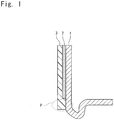
- FIG. 1 is a sectional view illustrating part of a seamless can formed in an Example.
- the surface-treated steel sheet of the present invention is used for producing cans and is forming a coating of a compound that chiefly comprises Zr and contains F, the amount of Zr being 80 to 200 mg/m 2 and the amount of F being not less than 12 mg/m 2 in the coating of the composition on the surface that becomes the outer surface side of the can, which is an important feature from the standpoint of improving the above-mentioned dent resistance.
- the coating of the composition comprising chiefly zirconium and containing fluorine formed on the surface-treated steel sheet of the invention has a non-crystalline structure like ZrO x (OH) y - z F z .
- the coating undergoes the dehydration, dispels F, and turns into an oxidized coating having much crystalline components. As the heating is further continued, it is considered that the coating finally approaches ZrO 2 .
- the heating in excess of thermal hysteresis which the ordinary can materials receive induces cracks in the coating due to a change in the structure and renders the coating to become more like ceramics, inviting not only a decrease in the workability but also a decrease in the adhesiveness to the resin coating, which is not desirable. It is, therefore, desired that the surface-treating layer maintains the structure like ZrO x (OH) y-z F z that contains F and OH.
- the present inventors have studied about the relationships among the coating components such as amount of Zr, amount of F, cross-cut corrosion resistance, adhesiveness to the coating resin, and dent resistance after the retort treatment, specifically, on the surface that becomes the outer surface of the cans.
- amount of Zr is better large from the standpoint of corrosion resistance and close adhesion.
- amount of F a preferred range differs depending on the surface that becomes the outer surface of the can and the surface that becomes the inner surface of the can.
- zirconium if the amount of Zr is small, defective parts are made present much in the surface-treating coating; i.e., the coating permits iron forming the base material to easily elute out. Iron elutes out in the anodic reaction. Due to the cathodic reaction which is the counter-reaction thereof, however, an alkali forms on the interface between the coating resin and the metal coating. The alkali that is formed accelerates the elution of fluorine from the surface-treating coating and becomes a cause of interfacial peeling between the coating resin and the surface-treating layer.
- the adhesiveness decreases to the resin coating and, at the same time, the dent resistance after the retort sterilization decreases on the surface that becomes the outer surface of the can.
- the cross-cut corrosion resistance becomes poorer on the surface that becomes the inner surface of the can than that of if the amount of zirconium is within the above-mentioned range.
- fluorine As for fluorine, further, if the surface-treated steel sheet containing F in very large amounts in the coating is used for producing metal cans, fluorine that is present in an excess amount in the surface-treating layer on the surface that becomes the inner surface of the cans elutes out into the contents during the retort-sterilization of the cans or while the cans are stored at high temperatures, and flavor of the contents are likely to be spoiled. If the amount of F is too small on the surface that becomes the outer surface of the cans, on the other hand, the resin coating might peel off at dented portions after the retort sterilization; i.e., dent resistance decreases.
- a decrease in the adhesiveness of the resin coating at the time of retort sterilization is caused by the formation of an alkali due to the elution of the component of the surface-treating coating and the cathodic reaction.
- formation of the alkali accelerates the elution of fluorine from the surface-treating coating, induces a change in the structure of the surface-treating layer, and causes a decrease in the cohesive force of the coating.
- the decrease in the cohesive force of the coating becomes conspicuous in the dented portions after the retort sterilization. Therefore, the surface-treating coating must contain F in a predetermined amount.
- the surfaces are adjusted by being treated differently depending on the surface that becomes the inner surface of the cans and the surface that becomes the outer surface thereof. Namely, on the surface that becomes the inner surface of the can, the amount of F is decreased so will not to elute out without, however, affecting the corrosion resistance or the close adhesion. On the surface that becomes the outer surface of the can, on the other hand, F is contained in an amount within the above-mentioned range to suppress the resin coating from peeling at the dented portions after the retort sterilization.
- the amount of F must not be less than 12 mg/m 2 . Even if the amount of F is too large, on the other hand, no further improved effect is expected but rather fluorine elutes out causing disadvantage in economy. Desirably, therefore, F is contained in an amount of 12 to 40 mg/m 2 to meet the amount of Zr in a range in which the surface-treating coating is allowed to maintain the above-mentioned structure.
- the amount of F is not more than 25 mg/m 2 from the standpoint of suppressing the elution thereof as described above. If the amount of F is very small, on the other hand, the surface-treating coating undergoes the hydration and its structure changes causing a decrease in the adhesiveness to the resin coating and in the corrosion resistance as a result of a decrease in the cohesive force of the surface-treating coating. Therefore, the amount of F is, desirably, not less than 0.5 mg/m 2 .
- the steel sheet in the step of forming the coating, is cathodically electrolyzed in an electrolytic treating liquid which is an aqueous solution containing Zr ions and F ions so that the coating of a compound chiefly comprising zirconium and containing fluorine is formed on both surfaces of the steel sheet in such a fashion that the amount of Zr is in a range of 80 to 200 mg/m 2 and the amount of F is not less than 12 mg/m 2 and, specifically, in a range of 12 to 40 mg/m 2 .
- an electrolytic treating liquid which is an aqueous solution containing Zr ions and F ions so that the coating of a compound chiefly comprising zirconium and containing fluorine is formed on both surfaces of the steel sheet in such a fashion that the amount of Zr is in a range of 80 to 200 mg/m 2 and the amount of F is not less than 12 mg/m 2 and, specifically, in a range of 12 to 40 mg/m 2 .
- the steel sheet after the coated with the compound thereon is squeezed through the rolls to remove the electrolytic treating solution, washed with water, further, squeezed through the rolls to remove the washing water, and is sent to the next step of adjusting the surfaces. After the electrolytic treating solution has been removed by the rolls, the steel sheet may not be washed with water.
- the concentration of Zr is 1,000 to 10, 000 ppm and the concentration of F is 600 to 13,000 ppm. It is desired that the electrolytic treating solution has a pH of 2 to 5 and, more preferably, 2.5 to 4. The temperature of the electrolytic treating solution is desirably 30 to 60°C.
- the electrolytic treating solution basically contains nitric acid ions and ammonium ions for adjusting the pH as well as Fe ions eluted out from the base material in addition to containing Zr ions and F ions.
- the chemicals used for forming Zr ions that constitute the electrolytic treating solution there is no particular limitation on the chemicals used for forming Zr ions that constitute the electrolytic treating solution, and there can be used, for example, K 2 ZrF 6 , (NH) 2 ZrF 6 , (NH 4 ) 2 ZrO(CO 3 ) 2 , H 2 ZrF 6 , ZrO(NO 3 ) 2 and ZrO(CH 3 COO) 2 .
- the above chemicals may be used alone or in a combination of two or more kinds.
- the coating of a Zr compound is to be formed by the cathodic electrolytic treatment, it is, usually, desired to use a treating solution that contains F ions in addition to the above-mentioned Zr ions as the electrolytic treating solution.
- F ions contained in the electrolytic treating solution work as a complexing agent that enhances solubility of Zr ions in the electrolytic treating solution. Therefore, the Zr compound can be precipitated maintaining a uniform thickness on the base material, and the adhesion can be further improved between the coating and the organic resin layer.
- the electrolytic treating liquid contains F ions in small amounts, then Zr locally precipitates; i.e., the coating includes a mixture of portions where Zr is thickly present and portions where Zr is thinly present. Namely, the coating lacks uniformity in the thickness and, as a result, has poor adhesiveness and corrosion resistance after the working. In the step of forming the coating, therefore, it is important that the molar ratio F/Zr of F atoms to Zr atoms in the coating is so controlled as to be not less than 0.6.
- the chemicals used for forming F ions in the electrolytic treating solution there is no particular limitation on the chemicals used for forming F ions in the electrolytic treating solution, and there can be used ammonium zirconium fluoride, aluminum fluoride, titanium fluoride, sodium fluoride, ammonium fluoride, hydrofluoric acid, calcium fluoride, hexafluorosilicic acid, and sodium hexafluorosilicate. Among them, it is desired to use those chemicals that are highly soluble in water.
- the electrolytic treating solution may be added with electrolytes such as nitric acid ions and ammonium ions in ranges in which they do not impair the formation of the Zr compound coating.
- additives selected from such organic acids as citric acid, lactic acid, tartaric acid and glycolic acid or such high molecular compounds as polyacrylic acid, polyitaconic acid and phenol resin.
- additives such as organic acid and phenol resin
- the electrolytic treating solution may, further, contain phosphoric acid and phosphate.
- the current density is not specifically limited but is, preferably, 1 to 30 A/dm 2 .
- the base material is to be subjected to the cathodic electrolytic treatment, it is desired to employ a discrete electrolytic system which repeats the cycle of flowing the electric current and interrupting the electric current.
- the total time for flowing the electric current to the base material is, preferably, 0.3 to 30 seconds.
- an opposing electrode of any kind may be installed on the base material if it does not dissolve in the electrolytic treating solution while the cathodic electrolytic treatment is being conducted. It is, however, desired to use a titanium plate coated with iridium oxide from such a standpoint that it produces a small oxygen overvoltage and that it sparingly dissolves in the electrolytic treating solution.
- the surfaces are adjusted as described below. That is, the surface-treated steel sheet forming the coating of the compound that chiefly comprises zirconium and contains fluorine obtained through the step of forming the coating, is subjected to the step of adjusting the surfaces by using an alkaline aqueous solution for the coating on the surface that becomes the inner surface of the can and by using warm water for the coating on the surface that becomes the outer surface of the can.
- the compound coating on the surface that becomes the inner surface of the can is adjusted for its surface by using an alkaline aqueous solution. Further, the compound coating on the surface that becomes the outer surface of the can is also adjusted for its surface by bringing warm water into contact therewith to prevent the surface thereof from becoming uneven that would be brought about as the alkaline aqueous solution used for adjusting the inner surface of the can comes in contact with the edge and near the edge of the outer surface of the can locally causing a decrease in the amount of F.
- the surface of the surface-treated steel sheet of the invention that becomes the inner surface of the can is adjusted by bringing the alkaline aqueous solution into contact with the surface that becomes the inner surface of the can so that the amount of F in the compound coating is controlled to be not more than 25 mg/m 2 and, specifically, to lie in a range of 0.5 to 10 mg/m 2 .
- the treatment include spray treatment, dip treatment and cathodic electrolytic treatment. According to the present invention, however, it is desired to employ the spray treatment since it makes it possible to adjust the inner and outer surfaces simultaneously.
- the alkaline aqueous solution is removed by using the rolls, washed with water and, further, the washing water is removed by using the rolls followed by drying using the hot air or the like.
- the alkaline aqueous solution contains at least one or more of sodium, ammonium and potassium, and, specifically, sodium. These ions easily bond to fluorine ions which are anions, and work to efficiently remove fluorine.
- the total amount of sodium ions, potassium ions and ammonium ions contained in the alkaline aqueous solution is not less than 0.001 mols/L, preferably, not less than 0.01 mols/L and, more preferably, not less than 0.02 mols/L.
- alkaline compounds used for preparing the alkaline aqueous solution there is no limitation if they are soluble in water.
- sodium hydroxide, sodium carbonate, sodium hydrogencarbonate, sodium phosphate, sodium hydrogenphosphate, sodium borate, potassium hydroxide, potassium carbonate, ammonia and ammonium zirconium carbonate there can be exemplified sodium hydroxide, sodium carbonate, sodium hydrogencarbonate, sodium phosphate, sodium hydrogenphosphate, sodium borate, potassium hydroxide, potassium carbonate, ammonia and ammonium zirconium carbonate.
- sodium hydroxide and potassium hydroxide are particularly preferred.
- the sodium hydroxide and potassium hydroxide exhibit high pH values despite their concentrations are low, and make it possible to execute the processing at low temperatures in short periods of time offering advantage in productivity. It is also allowable to use two or more kinds of alkaline compounds in combination.
- the aqueous solution for adjusting the surfaces can be added with various kinds of surfactants and chelating agents.
- the alkaline aqueous solution has a pH of not lower than 9 and, specifically, in a range of 11 to 14. If the pH is lower than the above range, fluorine cannot be removed to a sufficient degree unless the treatment is conducted at a high temperature or for an extended period of time causing disadvantage in productivity.
- the temperature of the alkaline aqueous solution is in arrange of 30 to 70°C and, specifically, 40 to 60°C. If the temperature is higher than the above range, fluorine elutes out excessively from the compound coating, and the corrosion resistance may decrease. If the temperature is lower than the above range, on the other hand, the amount of fluorine cannot be decreased to a sufficient degree, and resistance against the elution may decrease.
- the treating time differs depending on the pH of the alkaline aqueous solution, temperature and manner of the treatment, and cannot be definitely specified, but is, preferably, in a range of 0.5 to 5 seconds.
- the treatment for adjusting the surface of the surface-treated steel sheet of the invention that becomes the outer surface of the can is carried out by bringing warm water into contact with the surface that becomes the outer surface of the can to control the amount of F in the compound coating to be not less than 12 mg/m 2 .
- the warm water is squeezed by using the rolls and is, thereafter, dried with the hot air or the like.
- the water used for the treatment for adjusting the surface is heated at a temperature in a range of 30 to 70°C and, specifically, 40 to 60°C. If the temperature is lower than the above range, the alkaline aqueous solution that is used for adjusting the surface that becomes the inner surface of the can and that has flown to the back surface side may not be washed away to a sufficient degree. If the temperature is higher than the above range, on the other hand, fluorine may elute out from the compound coating.
- the treatment with hot water is conducted for a period of time in a range of 0.5 to 5 seconds. If the treating time is longer than the above range, fluorine may elute out. If the treating time is shorter than the above range, on the other hand, the washing may not be effected to a sufficient degree.
- Treatment with the warm water can take a variety of forms depending on the production line for producing the surface-treated steel sheet, such as spray treatment, shower treatment, flow-over treatment or dip treatment so far as the water is allowed to come in contact with the surface of the surface-treated steel sheet that becomes the outer surface of the can, is used for adjusting the surface that becomes the inner surface of the can, and is capable of washing away the alkaline aqueous solution that has flown to the back surface side. It is, however, desired to adjust the surface that becomes the outer surface by the spray treatment since it enables the warm water to come in contact with the surface that becomes the outer surface evenly and simultaneously with the treatment for adjusting the surface that becomes the inner surface.
- the inner and outer surfaces thereof are washed by rinsing after the step of forming the coating and the step of adjusting the surfaces. It is desired that the rinsing is conducted under such a condition that there is no change in the amount of Zr or in the amount of F in the coating of the surface-treated steel sheet after the step of adjusting the surfaces.
- the surfaces may be rinsed with water of normal temperature.
- at least the final rinsing is carried out by using warm water of 40 to 60°C so that the surface-treated steel sheet after rinsed can be easily dried. Namely, the final rinsing is conducted in the form of dip treatment or spray treatment. If the temperature of the warm water is higher than the above range, fluorine that is controlled in the step of adjusting the surfaces starts eluting out, and the amount of F may deviate from the value controlled in the step of adjusting the surfaces. If the temperature is lower than the above range, on the other hand, energy is needed for cooling, which is a disadvantage in economy.
- the rinsing is, particularly preferably, conducted in the form of dip treatment since it makes it possible to wash the inner and outer surfaces of the surface-treated steel sheet simultaneously yet in good rinsing efficiency.
- the dipping time differs depending on the temperature of the warm water that is used but is, desirably, in a range of 0.5 to 5 seconds.
- the steel sheet After the rinsing, the steel sheet is squeezed by the rolls to remove water and is dried with the hot air or the like.
- the surface of the surface-treated sheet that becomes the inner surface thereof and the surface that becomes the outer surface thereof are separately treated through the step of forming the coating, through the step of adjusting the surfaces and through the step of rinsing. From the standpoint of productivity, however, it is, specifically, desired that both surfaces of the steel sheet are treated simultaneously.
- the steel sheet for use as the surface-treated steel sheet of the present invention there can be used, for example, a hot-rolled steel sheet based on a continuously casted aluminum killed steel, a cold-rolled steel sheet obtained by cold-rolling the hot-rolled steel sheet, and a steel sheet obtained by plating metals inclusive of Zn, Sn, Ni, Cu, Al, etc. on the hot-rolled steel sheet or the cold-rolled sheet.
- a steel sheet having, on part or on the whole surface thereof, an alloy layer such as of an Sn-Ni-Fe alloy, an Sn-Fe alloy or an Ni-Fe alloy, as well as a steel sheet having a layer of a metal such as Sn or Ni, further, plated on the above alloy layer.
- a steel sheet is most desirably used as the base material without having a metal-plated layer or having a metal-plated layer but permitting iron to be locally exposed in a dispersed manner from the standpoint of cost.
- the thickness of the base material is not specifically limited and may be suitably selected depending on the use, but is, preferably, 0.07 to 0.4 mm.
- the surface-treated steel sheet obtained by the present invention has a resin coating formed on the compound coating.
- the resin coating excellently adheres to the compound coating. Even in case the surface-treated steel sheet is retort-treated, the resin coating is effectively prevented from peeling at dented portions on the surface that becomes the outer surface of the can.
- the resin coating further, effectively prevents the corrosion from proceeding even in case the resin coating is cracked and the metal surface is exposed in wet environment.
- the resin coating on the surface that becomes the inner surface of the can further, suppresses the metal components constituting the container from eluting out.
- the resin that constitutes the resin coating is not specifically limited and may be suitably selected depending on the use of the surface-treated steel sheet of the invention (depending on the use such as cans and containers for containing specific contents). Namely, there can be exemplified resin films made from various thermoplastic resins and coatings made from thermosetting coating materials or thermoplastic coating materials.
- olefin resin films such as of polyethylene, polypropylene, ethylene-propylene copolymer, ethylene-vinyl acetate copolymer, ethylene-acrylic ester copolymer and ionomer; polyester films such as of polyethylene terephthalate and polybutylene terephthalate; polyamide films such as nylon 6, nylon 6,6, nylon 11, and nylon 12; polyvinyl chloride film and polyvinylidene chloride film, which may not have been stretched or may have been biaxially stretched.
- particularly preferred is an unoriented polyethylene terephthalate obtained by copolymerizing an isophthalic acid.
- the resins for constituting the organic resin layer may be used in a single kind or in a blend of different resins.
- the coating may be of a single resin layer or a multiplicity of resin layers formed by the simultaneous extrusion. Multiplicity of polyester resin layers offer such an advantage that a polyester resin having excellent adhesiveness can be used as the underlying layer, i.e., on the side of the surface-treated steel sheet and that a polyester resin having resistance against the content, i.e., having resistance against being extracted or having property of not adsorbing flavor component can be used as the surface layer.
- examples of the multiplicity of polyester resin layers include polyethylene terephthalate/polyethylene terephthalate ⁇ isophthalate; polyethylene terephthalate/polyethylene ⁇ cyclohexylenedimethylene ⁇ terephthalate; polyethylene terephthalate ⁇ isophthalate having a small isophthalate content ⁇ polyethylene terephthalate ⁇ isophthalate having a large isophthalate content; polyethylene terephthalate ⁇ isophthalate/[blend of polyethylene terephthalate ⁇ isophthalate and polybutylene terephthalate ⁇ adipate] and the like, to which only, however, the invention is in no way limited. It is desired that the thickness ratio of the surface layer:lower layer is in a range of 5:95 to 95:5.
- the above resin coatings can be blended with known blending agents for resins, anti-plocking agent such as anti-blocking agent or amorphous silica, inorganic filler, various antistatic agents, lubricant, antioxidant, and ultraviolet-ray absorber according to a known recipe.
- anti-plocking agent such as anti-blocking agent or amorphous silica
- inorganic filler various antistatic agents, lubricant, antioxidant, and ultraviolet-ray absorber according to a known recipe.
- the resin coating has been effectively suppressed from peeling on the outer surface of the can at the dented portions after the retort sterilization. It, therefore, becomes allowable to favorably use a biaxially stretched film containing inorganic pigments such as titanium dioxide, silicon oxide and zinc oxide, though they, so far, tended to peel off.
- the resin coating applied to the surface-treated steel sheet obtained by the present invention in the case of the thermoplastic resin film, has a thickness in a range of, usually, 3 to 50 ⁇ m and, specifically, 5 to 40 ⁇ m and, in the case of a coating, has a thickness in a range of 1 to 50 ⁇ m and, specifically, 3 to 30 ⁇ m after fired. If the thickness is smaller than the above range, corrosion resistance becomes insufficient. If the thickness exceeds the above range, on the other hand, problems are likely to occur in regard to workability.
- the surface-treated steel sheet obtained by the present invention can be coated with the resin by any means such as, in the case of the thermoplastic resin coating, extrusion-coating method, cast film heat-adhesion method or biaxially stretched film heat-adhesion method.
- the polyester resin in a molten state is extruded onto the surface-treated steel sheet and is thermally adhered thereto.
- the polyester resin is melt-kneaded by an extruder, extruded into the form of a thin film through a T-die, and the molten resin film that is extruded is passed together with the surface-treated steel sheet through a pair of laminating rolls so as to be pressed together into a unitary structure under cold condition followed by quenching.
- an extruder for extruding the surface resin layer and an extruder for extruding the lower resin layer are met together in a multi-layer die.
- the resultant flow of resins may be extruded like in the case of extruding the single resin layer. Further, by passing the surface-treated steel sheet between the pair of laminating rolls in a vertical direction and by feeding the webs of molten resins to both sides thereof, it is made possible to coat both surfaces of the base material with the polyester resins.
- the surface-treated steel sheet as required, is preheated by a heating device, and is fed to a nipping position between the pair of laminating rolls.
- the polyester resin on the other hand, is extruded into the form of a thin film through the die head of the extruder, fed into between the laminating rolls and the surface-treated steel sheet, and is press-adhered onto the surface-treated steel sheet by the laminating rolls.
- the laminating rolls are maintained at a predetermined temperature.
- thermoplastic resin such as polyester
- Thin films of the thermoplastic resin such as polyester are pressed onto the surface-treated steel sheet and are thermally adhered thereto followed by cooling from both sides thereof so as to obtain an organic resin-coated surface-treated steel sheet.
- the organic resin-coated surface-treated steel sheet that is formed is, further, introduced into a water tank for cooling, and is quenched therein to prevent thermal crystallization.
- the polyester resin layer assumes the crystallinity of a low level, i.e., has a density which is different from the amorphous density thereof by not more than 0.05 g/cm 3 due to the resin composition that is selected and due to quenching by the rolls and in the cooling tank. Therefore, the polyester resin layer is sufficiently guaranteed for its workability in the subsequent steps of forming cans and lids.
- the quenching operation is not limited to the above example only but may be to spray the cooling water onto the organic resin-coated surface-treated steel sheet that is formed so as to quench the laminated sheet.
- the polyester resin is thermally adhered to the surface-treated steel sheet by utilizing the quantity of heat possessed by the molten resin layer and the quantity of heat possessed by the surface-treated steel sheet.
- a proper range of the temperature (T1) for heating the surface-treated steel sheet is, usually, 90°C to 290°C and, specifically, 100°C to 280°C while a proper range of the temperature of the laminating rolls is 10°C to 150°C.
- the resin coating can also be formed on the surface-treated steel sheet obtained by the production method of the present invention by thermally adhering, onto the surface-treated steel sheet, a polyester resin film that is formed in advance by a T-die method or an inflation method.
- a polyester resin film that is formed in advance by a T-die method or an inflation method.
- the film there can be used an unstretched film formed by a cast-forming method by quenching the film that is extruded. It is, further, allowable to use a biaxially stretched film obtained by biaxially stretching the film sequentially or simultaneously at a stretching temperature, and thermally setting the film after having been stretched.
- the container is formed by using the organic resin-coated surface-treated steel sheet obtained by coating the surfaces of the surface-treated steel sheet with the resin as described earlier relying on any can-producing method.
- the organic resin-coated surface-treated steel sheet can be used for forming a three-piece can (welded can) having a seam on the side surface thereof and a seamless can (two-piece can). From the standpoint of close adhesion to the organic resin as described above, however, the surface-treated steel sheet containing Zr in large amounts is most desirably used for forming seamless cans.
- the seamless can is produced relying on a conventional means such as draw working, draw ⁇ redraw working, bend-elongation working (stretching) based on the draw ⁇ redrawing, bend-elongation ⁇ ironing working based on the draw ⁇ redrawing, or draw ⁇ ironing working in a manner that the organic coating is on the inner surface side of the cans and/or on the outer surface side of the cans.
- a conventional means such as draw working, draw ⁇ redraw working, bend-elongation working (stretching) based on the draw ⁇ redrawing, bend-elongation ⁇ ironing working based on the draw ⁇ redrawing, or draw ⁇ ironing working in a manner that the organic coating is on the inner surface side of the cans and/or on the outer surface side of the cans.
- the organic coating is a thermoplastic resin coating formed by the extrusion-coating method, a cast-formed unstretched film that is thermally laminated, or a biaxially stretched film that is thermally laminated.
- the organic resin-coated surface-treated steel sheet features excellent close adhesion during the working, and the coating features excellent close adhesion even when it is subjected to severe working. It is, therefore, made possible to provide a seamless can having excellent corrosion resistance.
- the can lid formed by using the surface-treated steel sheet of the invention is, desirably, formed by using the organic resin-coated surface-treated steel sheet like the metal container described above, and is formed by a known lid-forming method.
- the lid may be a flat lid, an easy-open can lid of the stay-on-tub type, or an easy-open can lid of the full-open type.
- the can lids of a variety of types can be formed without limitation by using the organic resin-coated surface-treated steel sheet of the present invention.
- the materials to be coated, dewaxing agents and organic coatings are those arbitrarily selected from those placed in the market, and are not to impose limitation on the process for producing the surface-treated steel sheet of the present invention.
- a low-carbon steel sheet 0.225 mm in thickness and 200 mm in width.
- the steel sheet was dewaxed by the electrolysis with an alkali and was washed with an acid by being dipped in sulfuric acid. Thereafter, the steel sheet was dipped in an electrolytic treating solution and was cathodically and electrolytically treated so that the steel sheet was coated on its both surfaces with a compound that chiefly comprised of Zr and contained F. Next, the steel sheet was squeezed with the rolls to remove the electrolytic treating solution.
- the steel sheet after the step of forming the coating was treated on the surface that becomes the inner surface of the can with the spray of an alkaline aqueous solution for a predetermined period of time and, at the same time, on the surface that becomes the outer surface of the can with the spray of warm water for a predetermined period of time.
- the steel sheet was squeezed with the rolls to remove the alkaline aqueous solution and the warm water.
- the steel sheet was dipped in water for rinsing for 2 seconds to remove the liquids adhered on the inner and outer surfaces.
- the water for rinsing was the water for industrial use heated at 40°C.
- the water was dried with the hot air, and the surface-treated steel sheet was obtained.
- the steel sheet to be tested was washed with water, dried with the hot air, and was measured for its amount of the coating by a method described below.
- the amount of the coating was separately measured on the inner surface side of the can and on the outer surface side of the can.
- the surface-treated steel sheet obtained above was measured for its amount of Zr contained in the metal compound coating.
- Table 1 shows the amount of Zr after the step of forming the coating and the step of adjusting the surfaces.
- the amount of Zr after the rinsing was the same as the amount of Zr after the step of adjusting the surfaces. Therefore, Table 1 does not show the amount of Zr after the rinsing.
- Microanalysis of the amount of F based on the X-ray fluorometry poses limitation in regard to quantitative precision. Specifically, it is difficult to determine the amount of F directly from the surface-treated steel sheet containing F in amounts of less than 1.5 mg/m 2 . After having studied variously, therefore, we have selected the following measuring method. That is, by using a special cell that can be retort-pressurized, the surface-treated steel sheet was retort-treated over a predetermined surface area at 130°C for 30 minutes in a state of being contacted to a predetermined amount of very pure water. Fluorine ions released into very pure water due to the treatment were measured by the ion chromatography (DX-320 manufactured by DIONEX Co.).
- the amount of F present in very pure water was found from the obtained concentration of F and was converted into the amount of F present in the surface-treated steel sheet per a unit area, and was regarded to be the amount of F in the coating.
- Table 1 shows the amount of F after the step of forming the coating and the step of adjusting the surfaces. The amount of F after the rinsing was the same as the amount of F after the step of adjusting the surfaces. Therefore, Table 1 does not show the amount of F after the rinsing.
- the steel sheet was readily cooled with water while paying attention such that the film was oriented to a suitable degree to thereby obtain a resin-coated surface-treated steel sheet.
- the thus obtained resin-coated surface-treated steel sheet was partly used for evaluating cross-cut corrosion resistance, and the rest was used for producing metal cans.
- Paraffin wax was electrostatically applied onto both surfaces of the resin-coated surface-treated steel sheet obtained above.
- the steel sheet was punched into a circle 143 mm in diameter and was draw-formed into a cup 91 mm in diameter and 36 mm in height according in a customary manner.
- the draw-formed cup was at the same time subjected to the draw-ironing working repetitively two times to form a cup having a small diameter and a large height.
- the thus obtained cup possessed properties as described below. Diameter of cup: 52.0 mm Height of cup: 111.7 mm Reduction ratio of sheet thickness in the can wall relative to the initial sheet thickness: 30%
- the cup was heat-treated at 220°C for 60 seconds to remove strain from the resin film, followed by trimming for the open end, printing on the curved surface by applying 30 mg of an indigo ink per a can and 100 mg of a finishing varnish per a can as shown in Fig. 1 and, after fired at 215°C for 80 seconds, necking into a diameter of 50.8 mm and flanging to thereby obtain a seamless can having a capacity of 200 g.
- reference numeral 1 denotes the can body formed by working the resin-coated surface-treated steel sheet
- 2 denotes the printed ink layer
- 3 denotes the finishing varnish layer.
- the obtained seamless can was filled with 183 g of distilled water maintaining a degree of vacuum of 30 KPa in the can, retort-treated at 125°C for 30 minutes and was stored at room temperature for one day with the lid facing upward.
- the can was left to stand still sideways with the rolled direction of the steel sheet forming the bottom of the can in the horizontal direction.
- a spherical weight 52.0 mm in diameter and weighing 1 kg was allowed to fall from a height of 40 mm on the can near the radius portion of body wall at the lower part of the side wall of the can so that the can was deformed.
- a cellophane adhesive tape of a width of 24 mm was stuck to the deformed part of the can as uniformly as possible.
- the tape was then vividly removed to judge the degree of peel of the white film by eye and through an optical microscope (magnifying power of 50 times) on the following basis to evaluate the dent resistance on the outer surface of the can.
- the portion where the peeling was observed was the portion where the finishing varnish only was applied on the white film on the outer surface shown in Fig. 1 (portion where no indigo ink was applied as denoted by P in Fig. 1 ).
- Ten cans were evaluated.
- a mark ⁇ represents the case where even one can was recognized to be peeling as observed with the naked eye
- ⁇ represents the case where not more than 4 cans were recognized to be peeling as observed with the optical microscope though they were not recognized to be peeling by the observation with the naked eye
- ⁇ represents the case where not more than 2 cans were recognized to be peeling as observed with the optical microscope.
- the obtained seamless can was filled with 183 g of very pure water and was retort-treated at 130°C for 30 minutes. Thereafter, fluorine ions released into very pure water was measured by the ion chromatograph (DX-320 manufactured by DIONEX Co.).
- the cans releasing F by more than 0.25 ppm were evaluated to be ⁇
- the cans releasing F by more than 0.20 ppm but not more than 0.25 ppm was evaluated to be ⁇
- the cans releasing F by more than 0.10 ppm but not more than 0.20 ppm were evaluated to be ⁇
- the cans releasing F in an amount not more than a detectable limit (0.10 ppm) were evaluated to be ⁇ .
- Those evaluated to be ⁇ were regarded to be acceptable.
- a portion of the obtained resin-coated surface-treated steel sheet that would become the inner surface side of a can was engraved in a crossing manner in the directions of 45 degrees relative to the rolling direction over a length of 4 cm deep enough to reach the steel sheet to prepare a test piece.
- the test piece was dipped in a model solution (aqueous solution containing sodium chloride and citric acid each at a concentration of 1.5% by weight) maintained at 37°C for one week to evaluate the state of corrosion. Thereafter, the test piece was taken out from the model solution and was observed and evaluated with the eye in regard to if the organic resin layer was peeled or the color has changed due to the formation of the corroded product in and near the cross-cut portion.
- a model solution aqueous solution containing sodium chloride and citric acid each at a concentration of 1.5% by weight
- test piece whose color has changed or whose film has peeled by a maximum width of not less than 2 mm around the cross-cut portion was evaluated to be ⁇
- test piece having a maximum width of peeling of not less than 1 mm but less than 2 mm was evaluated to be ⁇
- test piece having a maximum width of peeling of less than 1 mm was evaluated to be ⁇ .
- Those evaluated to be ⁇ were regarded to be acceptable.
- Table 1 shows the treating methods, amounts of coatings and evaluated results.
- a surface-treated steel sheet was prepared in the same manner as in Example 1 but changing the number of cycles into 11 times in the step of forming the coating on the inner surface side of the can and spraying the warm water of 40°C instead of spraying the alkaline aqueous solution in the step of adjusting the surfaces, and was evaluated in the same manner as in Example 1.
- the amount of F was 28 mg/m 2 on the inner surface side of the can, and the elution of F in the inner surface of the can was evaluated to be ⁇ .
- a surface-treated steel sheet was prepared in the same manner as in Example 1 but spraying an aqueous solution of sodium hydroxide of a pH of 11.0 instead of spraying the warm water in the step of adjusting the surface on the outer surface side of the can, and was evaluated in the same manner as in Example 1.
- the amount of F was 10 mg/m 2 on the outer surface side of the can, and the dent resistance was evaluated to be ⁇ on the outer surface of the can.
- a surface-treated steel sheet was prepared in the same manner as in Example 1 but changing the number of cycles into 5 times in the step of forming the coating on the outer surface side of the can, and was evaluated in the same manner as in Example 1.
- the amount of Zr was 69 mg/m 2 on the outer surface side of the can, and the dent resistance was evaluated to be ⁇ on the outer surface of the can.
Landscapes
- Chemical & Material Sciences (AREA)
- Engineering & Computer Science (AREA)
- Chemical Kinetics & Catalysis (AREA)
- Electrochemistry (AREA)
- Materials Engineering (AREA)
- Metallurgy (AREA)
- Organic Chemistry (AREA)
- Inorganic Chemistry (AREA)
- Laminated Bodies (AREA)
- Chemical Treatment Of Metals (AREA)
- Other Surface Treatments For Metallic Materials (AREA)
Applications Claiming Priority (2)
| Application Number | Priority Date | Filing Date | Title |
|---|---|---|---|
| JP2014185874A JP5886919B1 (ja) | 2014-09-12 | 2014-09-12 | 表面処理鋼板及びその製造方法並びに樹脂被覆表面処理鋼板 |
| PCT/JP2015/057181 WO2016038909A1 (fr) | 2014-09-12 | 2015-03-11 | Tôle d'acier traitée en surface, procédé de production de cette dernière et tôle d'acier traitée en surface revêtue de résine |
Publications (3)
| Publication Number | Publication Date |
|---|---|
| EP3196341A1 true EP3196341A1 (fr) | 2017-07-26 |
| EP3196341A4 EP3196341A4 (fr) | 2018-05-02 |
| EP3196341B1 EP3196341B1 (fr) | 2019-12-18 |
Family
ID=55458674
Family Applications (1)
| Application Number | Title | Priority Date | Filing Date |
|---|---|---|---|
| EP15840460.8A Active EP3196341B1 (fr) | 2014-09-12 | 2015-03-11 | Tôle d'acier traitée en surface, procédé de production de cette dernière et tôle d'acier traitée en surface revêtue de résine |
Country Status (5)
| Country | Link |
|---|---|
| US (1) | US10858751B2 (fr) |
| EP (1) | EP3196341B1 (fr) |
| JP (1) | JP5886919B1 (fr) |
| CN (1) | CN107075710B (fr) |
| WO (1) | WO2016038909A1 (fr) |
Families Citing this family (2)
| Publication number | Priority date | Publication date | Assignee | Title |
|---|---|---|---|---|
| CN118475730A (zh) * | 2021-12-28 | 2024-08-09 | 杰富意钢铁株式会社 | 罐用钢板及其制造方法 |
| WO2025187743A1 (fr) * | 2024-03-05 | 2025-09-12 | 日本製鉄株式会社 | Tôle d'acier traitée en surface pour matériau de récipient, tôle d'acier pré-revêtue pour matériau de récipient, tôle d'acier stratifiée pour matériau de récipient, procédé de production de tôle d'acier traitée en surface pour matériau de récipient, procédé de production de tôle d'acier pré-revêtue pour matériau de récipient, et procédé de production de tôle d'acier stratifiée pour matériau de récipient |
Family Cites Families (13)
| Publication number | Priority date | Publication date | Assignee | Title |
|---|---|---|---|---|
| JP2942105B2 (ja) | 1993-06-24 | 1999-08-30 | 東洋鋼鈑株式会社 | 湿潤下での経時塗料密着性に優れたスズめっき鋼板の製造法 |
| TWI268965B (en) | 2001-06-15 | 2006-12-21 | Nihon Parkerizing | Treating solution for surface treatment of metal and surface treatment method |
| JP4492103B2 (ja) * | 2002-11-25 | 2010-06-30 | 東洋製罐株式会社 | 表面処理金属材料及びその表面処理方法、並びに樹脂被覆金属材料、金属缶、缶蓋 |
| EP1566467B1 (fr) | 2002-11-25 | 2015-03-18 | Toyo Seikan Kaisha, Ltd. | Matériau métallique traité en surface, procédé de traitement de ladite surface, et matériau métallique revêtu de résine, boite de conserve métallique et son couvercle |
| JP4205939B2 (ja) | 2002-12-13 | 2009-01-07 | 日本パーカライジング株式会社 | 金属の表面処理方法 |
| JP4805613B2 (ja) | 2005-06-17 | 2011-11-02 | 東洋製罐株式会社 | 表面処理金属板及びその表面処理方法、並びに樹脂被覆金属板、缶及び缶蓋 |
| JP4996409B2 (ja) * | 2007-09-28 | 2012-08-08 | 新日本製鐵株式会社 | 化成処理被覆鋼板の製造方法 |
| JP2011127141A (ja) * | 2009-12-15 | 2011-06-30 | Nippon Parkerizing Co Ltd | 電着塗装用表面処理金属材料、および化成処理方法 |
| ES2642514T3 (es) * | 2010-03-23 | 2017-11-16 | Nippon Steel & Sumitomo Metal Corporation | Método para producir una lámina de acero para un recipiente |
| EP2569071B1 (fr) | 2010-05-10 | 2015-07-08 | Technische Universität München | Procédé pour l'élution directe de [18f]-fluorure réactif à partir d'une résine échangeuse d'anions dans un milieu organique approprié pour le radiomarquage sans aucune étape d'évaporation à l'aide de cryptates de métaux alcalins et de métaux alcalinoterreux |
| JP5754099B2 (ja) * | 2010-09-15 | 2015-07-22 | Jfeスチール株式会社 | 容器用鋼板の製造方法 |
| JP5873609B2 (ja) * | 2013-09-25 | 2016-03-01 | 東洋鋼鈑株式会社 | 表面処理鋼板、有機樹脂被覆金属容器、並びに表面処理鋼板の製造方法 |
| JP6530885B2 (ja) | 2013-12-18 | 2019-06-12 | 東洋製罐株式会社 | 表面処理鋼板、有機樹脂被覆金属容器、及び表面処理鋼板の製造方法 |
-
2014
- 2014-09-12 JP JP2014185874A patent/JP5886919B1/ja active Active
-
2015
- 2015-03-11 WO PCT/JP2015/057181 patent/WO2016038909A1/fr not_active Ceased
- 2015-03-11 EP EP15840460.8A patent/EP3196341B1/fr active Active
- 2015-03-11 US US15/510,364 patent/US10858751B2/en active Active
- 2015-03-11 CN CN201580048894.4A patent/CN107075710B/zh active Active
Also Published As
| Publication number | Publication date |
|---|---|
| WO2016038909A1 (fr) | 2016-03-17 |
| CN107075710A (zh) | 2017-08-18 |
| CN107075710B (zh) | 2018-09-04 |
| US20170253985A1 (en) | 2017-09-07 |
| EP3196341B1 (fr) | 2019-12-18 |
| JP5886919B1 (ja) | 2016-03-16 |
| JP2016056432A (ja) | 2016-04-21 |
| US10858751B2 (en) | 2020-12-08 |
| EP3196341A4 (fr) | 2018-05-02 |
Similar Documents
| Publication | Publication Date | Title |
|---|---|---|
| EP3085816B1 (fr) | Tôle d'acier traitée en surface, conteneur métallique revêtu de résine organique, et procédé de production de tôle d'acier traitée en surface | |
| JP5978576B2 (ja) | 容器用鋼板およびその製造方法 | |
| TWI418653B (zh) | A method for producing a steel sheet for a container material having a low environmental burden, a method for producing the same, and a method for producing the same, | |
| US10000858B2 (en) | Bath for surface treatment, method of producing surface-treated steel plate by using the bath for surface treatment, and surface treated steel plate produced by the same method | |
| JP5729230B2 (ja) | 容器用鋼板およびその製造方法 | |
| WO2011118846A1 (fr) | Tôle d'acier traitée en surface, procédé de fabrication de cette dernière et tôle d'acier recouverte de résine utilisant cette dernière | |
| EP3196341B1 (fr) | Tôle d'acier traitée en surface, procédé de production de cette dernière et tôle d'acier traitée en surface revêtue de résine | |
| US10934629B2 (en) | Surface-treated steel sheet, organic resin coated metal container, and method for producing surface-treated steel sheet | |
| CA3166939C (fr) | Procede de passivation d'une bande de tole d'etain et appareil de fabrication de ladite bande de tole d'etain passivee | |
| JP6220226B2 (ja) | 表面処理鋼板の製造方法、表面処理鋼板、および有機樹脂被覆金属容器 |
Legal Events
| Date | Code | Title | Description |
|---|---|---|---|
| STAA | Information on the status of an ep patent application or granted ep patent |
Free format text: STATUS: THE INTERNATIONAL PUBLICATION HAS BEEN MADE |
|
| PUAI | Public reference made under article 153(3) epc to a published international application that has entered the european phase |
Free format text: ORIGINAL CODE: 0009012 |
|
| STAA | Information on the status of an ep patent application or granted ep patent |
Free format text: STATUS: REQUEST FOR EXAMINATION WAS MADE |
|
| 17P | Request for examination filed |
Effective date: 20170206 |
|
| AK | Designated contracting states |
Kind code of ref document: A1 Designated state(s): AL AT BE BG CH CY CZ DE DK EE ES FI FR GB GR HR HU IE IS IT LI LT LU LV MC MK MT NL NO PL PT RO RS SE SI SK SM TR |
|
| AX | Request for extension of the european patent |
Extension state: BA ME |
|
| DAV | Request for validation of the european patent (deleted) | ||
| DAX | Request for extension of the european patent (deleted) | ||
| A4 | Supplementary search report drawn up and despatched |
Effective date: 20180404 |
|
| RIC1 | Information provided on ipc code assigned before grant |
Ipc: C25D 9/10 20060101AFI20180323BHEP |
|
| RIC1 | Information provided on ipc code assigned before grant |
Ipc: C25D 9/10 20060101AFI20190521BHEP Ipc: B32B 15/01 20060101ALI20190521BHEP |
|
| GRAP | Despatch of communication of intention to grant a patent |
Free format text: ORIGINAL CODE: EPIDOSNIGR1 |
|
| STAA | Information on the status of an ep patent application or granted ep patent |
Free format text: STATUS: GRANT OF PATENT IS INTENDED |
|
| INTG | Intention to grant announced |
Effective date: 20190708 |
|
| RIN1 | Information on inventor provided before grant (corrected) |
Inventor name: HIROTSU, MUNEMITSU Inventor name: KUROKAWA, WATARU Inventor name: MATSUKAWA, MASAHIKO Inventor name: HARADA, SATOKO Inventor name: YOSHIDA, KEISUKE Inventor name: AIHARA, MITSUHIDE Inventor name: SASAKI, KOUSUKE Inventor name: YOSHIMURA, KUNIHIRO Inventor name: UCHIKAWA, MIWA |
|
| GRAS | Grant fee paid |
Free format text: ORIGINAL CODE: EPIDOSNIGR3 |
|
| GRAA | (expected) grant |
Free format text: ORIGINAL CODE: 0009210 |
|
| STAA | Information on the status of an ep patent application or granted ep patent |
Free format text: STATUS: THE PATENT HAS BEEN GRANTED |
|
| AK | Designated contracting states |
Kind code of ref document: B1 Designated state(s): AL AT BE BG CH CY CZ DE DK EE ES FI FR GB GR HR HU IE IS IT LI LT LU LV MC MK MT NL NO PL PT RO RS SE SI SK SM TR |
|
| REG | Reference to a national code |
Ref country code: CH Ref legal event code: EP |
|
| REG | Reference to a national code |
Ref country code: DE Ref legal event code: R096 Ref document number: 602015044031 Country of ref document: DE |
|
| REG | Reference to a national code |
Ref country code: IE Ref legal event code: FG4D |
|
| REG | Reference to a national code |
Ref country code: AT Ref legal event code: REF Ref document number: 1214691 Country of ref document: AT Kind code of ref document: T Effective date: 20200115 |
|
| REG | Reference to a national code |
Ref country code: NL Ref legal event code: FP |
|
| PG25 | Lapsed in a contracting state [announced via postgrant information from national office to epo] |
Ref country code: LT Free format text: LAPSE BECAUSE OF FAILURE TO SUBMIT A TRANSLATION OF THE DESCRIPTION OR TO PAY THE FEE WITHIN THE PRESCRIBED TIME-LIMIT Effective date: 20191218 Ref country code: GR Free format text: LAPSE BECAUSE OF FAILURE TO SUBMIT A TRANSLATION OF THE DESCRIPTION OR TO PAY THE FEE WITHIN THE PRESCRIBED TIME-LIMIT Effective date: 20200319 Ref country code: NO Free format text: LAPSE BECAUSE OF FAILURE TO SUBMIT A TRANSLATION OF THE DESCRIPTION OR TO PAY THE FEE WITHIN THE PRESCRIBED TIME-LIMIT Effective date: 20200318 Ref country code: FI Free format text: LAPSE BECAUSE OF FAILURE TO SUBMIT A TRANSLATION OF THE DESCRIPTION OR TO PAY THE FEE WITHIN THE PRESCRIBED TIME-LIMIT Effective date: 20191218 Ref country code: BG Free format text: LAPSE BECAUSE OF FAILURE TO SUBMIT A TRANSLATION OF THE DESCRIPTION OR TO PAY THE FEE WITHIN THE PRESCRIBED TIME-LIMIT Effective date: 20200318 Ref country code: SE Free format text: LAPSE BECAUSE OF FAILURE TO SUBMIT A TRANSLATION OF THE DESCRIPTION OR TO PAY THE FEE WITHIN THE PRESCRIBED TIME-LIMIT Effective date: 20191218 Ref country code: LV Free format text: LAPSE BECAUSE OF FAILURE TO SUBMIT A TRANSLATION OF THE DESCRIPTION OR TO PAY THE FEE WITHIN THE PRESCRIBED TIME-LIMIT Effective date: 20191218 |
|
| REG | Reference to a national code |
Ref country code: LT Ref legal event code: MG4D |
|
| PG25 | Lapsed in a contracting state [announced via postgrant information from national office to epo] |
Ref country code: RS Free format text: LAPSE BECAUSE OF FAILURE TO SUBMIT A TRANSLATION OF THE DESCRIPTION OR TO PAY THE FEE WITHIN THE PRESCRIBED TIME-LIMIT Effective date: 20191218 Ref country code: HR Free format text: LAPSE BECAUSE OF FAILURE TO SUBMIT A TRANSLATION OF THE DESCRIPTION OR TO PAY THE FEE WITHIN THE PRESCRIBED TIME-LIMIT Effective date: 20191218 |
|
| PG25 | Lapsed in a contracting state [announced via postgrant information from national office to epo] |
Ref country code: AL Free format text: LAPSE BECAUSE OF FAILURE TO SUBMIT A TRANSLATION OF THE DESCRIPTION OR TO PAY THE FEE WITHIN THE PRESCRIBED TIME-LIMIT Effective date: 20191218 |
|
| PG25 | Lapsed in a contracting state [announced via postgrant information from national office to epo] |
Ref country code: EE Free format text: LAPSE BECAUSE OF FAILURE TO SUBMIT A TRANSLATION OF THE DESCRIPTION OR TO PAY THE FEE WITHIN THE PRESCRIBED TIME-LIMIT Effective date: 20191218 Ref country code: PT Free format text: LAPSE BECAUSE OF FAILURE TO SUBMIT A TRANSLATION OF THE DESCRIPTION OR TO PAY THE FEE WITHIN THE PRESCRIBED TIME-LIMIT Effective date: 20200513 Ref country code: CZ Free format text: LAPSE BECAUSE OF FAILURE TO SUBMIT A TRANSLATION OF THE DESCRIPTION OR TO PAY THE FEE WITHIN THE PRESCRIBED TIME-LIMIT Effective date: 20191218 Ref country code: RO Free format text: LAPSE BECAUSE OF FAILURE TO SUBMIT A TRANSLATION OF THE DESCRIPTION OR TO PAY THE FEE WITHIN THE PRESCRIBED TIME-LIMIT Effective date: 20191218 |
|
| PG25 | Lapsed in a contracting state [announced via postgrant information from national office to epo] |
Ref country code: SM Free format text: LAPSE BECAUSE OF FAILURE TO SUBMIT A TRANSLATION OF THE DESCRIPTION OR TO PAY THE FEE WITHIN THE PRESCRIBED TIME-LIMIT Effective date: 20191218 Ref country code: SK Free format text: LAPSE BECAUSE OF FAILURE TO SUBMIT A TRANSLATION OF THE DESCRIPTION OR TO PAY THE FEE WITHIN THE PRESCRIBED TIME-LIMIT Effective date: 20191218 Ref country code: IS Free format text: LAPSE BECAUSE OF FAILURE TO SUBMIT A TRANSLATION OF THE DESCRIPTION OR TO PAY THE FEE WITHIN THE PRESCRIBED TIME-LIMIT Effective date: 20200418 |
|
| REG | Reference to a national code |
Ref country code: DE Ref legal event code: R097 Ref document number: 602015044031 Country of ref document: DE |
|
| REG | Reference to a national code |
Ref country code: AT Ref legal event code: MK05 Ref document number: 1214691 Country of ref document: AT Kind code of ref document: T Effective date: 20191218 |
|
| PLBE | No opposition filed within time limit |
Free format text: ORIGINAL CODE: 0009261 |
|
| STAA | Information on the status of an ep patent application or granted ep patent |
Free format text: STATUS: NO OPPOSITION FILED WITHIN TIME LIMIT |
|
| PG25 | Lapsed in a contracting state [announced via postgrant information from national office to epo] |
Ref country code: DK Free format text: LAPSE BECAUSE OF FAILURE TO SUBMIT A TRANSLATION OF THE DESCRIPTION OR TO PAY THE FEE WITHIN THE PRESCRIBED TIME-LIMIT Effective date: 20191218 Ref country code: MC Free format text: LAPSE BECAUSE OF FAILURE TO SUBMIT A TRANSLATION OF THE DESCRIPTION OR TO PAY THE FEE WITHIN THE PRESCRIBED TIME-LIMIT Effective date: 20191218 Ref country code: ES Free format text: LAPSE BECAUSE OF FAILURE TO SUBMIT A TRANSLATION OF THE DESCRIPTION OR TO PAY THE FEE WITHIN THE PRESCRIBED TIME-LIMIT Effective date: 20191218 |
|
| REG | Reference to a national code |
Ref country code: CH Ref legal event code: PL |
|
| 26N | No opposition filed |
Effective date: 20200921 |
|
| PG25 | Lapsed in a contracting state [announced via postgrant information from national office to epo] |
Ref country code: AT Free format text: LAPSE BECAUSE OF FAILURE TO SUBMIT A TRANSLATION OF THE DESCRIPTION OR TO PAY THE FEE WITHIN THE PRESCRIBED TIME-LIMIT Effective date: 20191218 Ref country code: SI Free format text: LAPSE BECAUSE OF FAILURE TO SUBMIT A TRANSLATION OF THE DESCRIPTION OR TO PAY THE FEE WITHIN THE PRESCRIBED TIME-LIMIT Effective date: 20191218 |
|
| REG | Reference to a national code |
Ref country code: BE Ref legal event code: MM Effective date: 20200331 |
|
| PG25 | Lapsed in a contracting state [announced via postgrant information from national office to epo] |
Ref country code: LU Free format text: LAPSE BECAUSE OF NON-PAYMENT OF DUE FEES Effective date: 20200311 |
|
| PG25 | Lapsed in a contracting state [announced via postgrant information from national office to epo] |
Ref country code: LI Free format text: LAPSE BECAUSE OF NON-PAYMENT OF DUE FEES Effective date: 20200331 Ref country code: IE Free format text: LAPSE BECAUSE OF NON-PAYMENT OF DUE FEES Effective date: 20200311 Ref country code: IT Free format text: LAPSE BECAUSE OF FAILURE TO SUBMIT A TRANSLATION OF THE DESCRIPTION OR TO PAY THE FEE WITHIN THE PRESCRIBED TIME-LIMIT Effective date: 20191218 Ref country code: CH Free format text: LAPSE BECAUSE OF NON-PAYMENT OF DUE FEES Effective date: 20200331 |
|
| PG25 | Lapsed in a contracting state [announced via postgrant information from national office to epo] |
Ref country code: BE Free format text: LAPSE BECAUSE OF NON-PAYMENT OF DUE FEES Effective date: 20200331 Ref country code: PL Free format text: LAPSE BECAUSE OF FAILURE TO SUBMIT A TRANSLATION OF THE DESCRIPTION OR TO PAY THE FEE WITHIN THE PRESCRIBED TIME-LIMIT Effective date: 20191218 |
|
| PG25 | Lapsed in a contracting state [announced via postgrant information from national office to epo] |
Ref country code: MT Free format text: LAPSE BECAUSE OF FAILURE TO SUBMIT A TRANSLATION OF THE DESCRIPTION OR TO PAY THE FEE WITHIN THE PRESCRIBED TIME-LIMIT Effective date: 20191218 Ref country code: CY Free format text: LAPSE BECAUSE OF FAILURE TO SUBMIT A TRANSLATION OF THE DESCRIPTION OR TO PAY THE FEE WITHIN THE PRESCRIBED TIME-LIMIT Effective date: 20191218 |
|
| PG25 | Lapsed in a contracting state [announced via postgrant information from national office to epo] |
Ref country code: MK Free format text: LAPSE BECAUSE OF FAILURE TO SUBMIT A TRANSLATION OF THE DESCRIPTION OR TO PAY THE FEE WITHIN THE PRESCRIBED TIME-LIMIT Effective date: 20191218 |
|
| P01 | Opt-out of the competence of the unified patent court (upc) registered |
Effective date: 20230509 |
|
| PGFP | Annual fee paid to national office [announced via postgrant information from national office to epo] |
Ref country code: GB Payment date: 20260324 Year of fee payment: 12 |
|
| PGFP | Annual fee paid to national office [announced via postgrant information from national office to epo] |
Ref country code: DE Payment date: 20260319 Year of fee payment: 12 |
|
| PGFP | Annual fee paid to national office [announced via postgrant information from national office to epo] |
Ref country code: NL Payment date: 20260319 Year of fee payment: 12 |
|
| PGFP | Annual fee paid to national office [announced via postgrant information from national office to epo] |
Ref country code: FR Payment date: 20260320 Year of fee payment: 12 |
|
| PGFP | Annual fee paid to national office [announced via postgrant information from national office to epo] |
Ref country code: TR Payment date: 20260304 Year of fee payment: 12 |