EP3196838B1 - Vorrichtung und entsprechende verfahren - Google Patents
Vorrichtung und entsprechende verfahren Download PDFInfo
- Publication number
- EP3196838B1 EP3196838B1 EP16152629.8A EP16152629A EP3196838B1 EP 3196838 B1 EP3196838 B1 EP 3196838B1 EP 16152629 A EP16152629 A EP 16152629A EP 3196838 B1 EP3196838 B1 EP 3196838B1
- Authority
- EP
- European Patent Office
- Prior art keywords
- virtual reality
- reality content
- space
- images
- content
- Prior art date
- Legal status (The legal status is an assumption and is not a legal conclusion. Google has not performed a legal analysis and makes no representation as to the accuracy of the status listed.)
- Active
Links
Images



Classifications
-
- G—PHYSICS
- G06—COMPUTING OR CALCULATING; COUNTING
- G06T—IMAGE DATA PROCESSING OR GENERATION, IN GENERAL
- G06T19/00—Manipulating three-dimensional [3D] models or images for computer graphics
- G06T19/006—Mixed reality
-
- G—PHYSICS
- G06—COMPUTING OR CALCULATING; COUNTING
- G06T—IMAGE DATA PROCESSING OR GENERATION, IN GENERAL
- G06T19/00—Manipulating three-dimensional [3D] models or images for computer graphics
- G06T19/20—Editing of three-dimensional [3D] images, e.g. changing shapes or colours, aligning objects or positioning parts
-
- G—PHYSICS
- G06—COMPUTING OR CALCULATING; COUNTING
- G06T—IMAGE DATA PROCESSING OR GENERATION, IN GENERAL
- G06T3/00—Geometric image transformations in the plane of the image
- G06T3/40—Scaling of whole images or parts thereof, e.g. expanding or contracting
- G06T3/4038—Image mosaicing, e.g. composing plane images from plane sub-images
-
- G—PHYSICS
- G06—COMPUTING OR CALCULATING; COUNTING
- G06T—IMAGE DATA PROCESSING OR GENERATION, IN GENERAL
- G06T5/00—Image enhancement or restoration
- G06T5/50—Image enhancement or restoration using two or more images, e.g. averaging or subtraction
-
- G—PHYSICS
- G06—COMPUTING OR CALCULATING; COUNTING
- G06T—IMAGE DATA PROCESSING OR GENERATION, IN GENERAL
- G06T5/00—Image enhancement or restoration
- G06T5/70—Denoising; Smoothing
-
- G—PHYSICS
- G06—COMPUTING OR CALCULATING; COUNTING
- G06T—IMAGE DATA PROCESSING OR GENERATION, IN GENERAL
- G06T7/00—Image analysis
- G06T7/70—Determining position or orientation of objects or cameras
-
- H—ELECTRICITY
- H04—ELECTRIC COMMUNICATION TECHNIQUE
- H04N—PICTORIAL COMMUNICATION, e.g. TELEVISION
- H04N13/00—Stereoscopic video systems; Multi-view video systems; Details thereof
- H04N13/20—Image signal generators
- H04N13/204—Image signal generators using stereoscopic image cameras
-
- H—ELECTRICITY
- H04—ELECTRIC COMMUNICATION TECHNIQUE
- H04N—PICTORIAL COMMUNICATION, e.g. TELEVISION
- H04N13/00—Stereoscopic video systems; Multi-view video systems; Details thereof
- H04N13/20—Image signal generators
- H04N13/282—Image signal generators for generating image signals corresponding to three or more geometrical viewpoints, e.g. multi-view systems
-
- H—ELECTRICITY
- H04—ELECTRIC COMMUNICATION TECHNIQUE
- H04N—PICTORIAL COMMUNICATION, e.g. TELEVISION
- H04N23/00—Cameras or camera modules comprising electronic image sensors; Control thereof
- H04N23/60—Control of cameras or camera modules
-
- H—ELECTRICITY
- H04—ELECTRIC COMMUNICATION TECHNIQUE
- H04N—PICTORIAL COMMUNICATION, e.g. TELEVISION
- H04N23/00—Cameras or camera modules comprising electronic image sensors; Control thereof
- H04N23/60—Control of cameras or camera modules
- H04N23/698—Control of cameras or camera modules for achieving an enlarged field of view, e.g. panoramic image capture
-
- H—ELECTRICITY
- H04—ELECTRIC COMMUNICATION TECHNIQUE
- H04N—PICTORIAL COMMUNICATION, e.g. TELEVISION
- H04N23/00—Cameras or camera modules comprising electronic image sensors; Control thereof
- H04N23/90—Arrangement of cameras or camera modules, e.g. multiple cameras in TV studios or sports stadiums
-
- G—PHYSICS
- G06—COMPUTING OR CALCULATING; COUNTING
- G06F—ELECTRIC DIGITAL DATA PROCESSING
- G06F2218/00—Aspects of pattern recognition specially adapted for signal processing
- G06F2218/08—Feature extraction
Definitions
- the present disclosure relates to the field of virtual reality and, in particular, to the presentation of content and the control of said content presented by a virtual reality apparatus. Associated methods, computer programs and apparatus is also disclosed. Certain disclosed aspects/examples relate to portable electronic devices, in particular, virtual reality apparatus and virtual reality headsets/glasses.
- Virtual reality may use a headset, such as glasses or goggles, or one or more displays that surround a user to provide the user with an immersive virtual experience.
- a virtual reality apparatus may present multimedia virtual reality content representative of a virtual reality space to a user to simulate the user being present within the virtual reality space.
- the virtual reality space may be provided by a panoramic video, such as a video having a wide or 360° field of view (which may include above and/or below a horizontally oriented field of view).
- the immersive experience provided by virtual reality provides for opportunities to create interactive content using multiple virtual reality content capture devices, as well as different ways for a user to consume and interact with such virtual reality content.
- US 2015/0348580 discloses a camera array comprising a plurality of camera modules having a field of view overlap.
- WO 2015/085406 discloses a system for producing panoramic and stereoscopic videos.
- US 2015/0054913 discloses an image stitching system.
- WEI, Xu et at, "Panoramic video stitching from commodity HDTV cameras", Mulitmedia Systems, Vol 19, no 5, 4 April 2013, pages 407-426 discloses techniques for multi-view image stitching.
- the amalgamated virtual reality space is advantageous as its imagery may be manipulated to provide for an intuitive and effective display of interactive virtual reality content.
- one or more of the images or parts thereof of the first virtual reality content obtained by the first content capture device that contain a view of the second content capture device are excluded from the amalgamated virtual reality space in preference of one or more images or parts thereof of a corresponding portion of the scene along a corresponding viewing direction captured by the second content capture device; and/or one or more of the images or parts thereof of the second virtual reality content obtained by the second content capture device that contain a view of the first content capture device are excluded from the amalgamated virtual reality space in preference of a one or more image or parts thereof of a corresponding portion of the scene along a corresponding viewing direction captured by the first content capture device.
- the VR content capture devices may include a plurality of cameras that capture images in the multiple viewing directions and the apparatus may be configured to select which images or parts thereof are used from each of the VR content sources.
- images or parts thereof having a viewing direction that extends over a substantially hemispherical area are selected from the first VR content capture device and images having a viewing direction that extends over a substantially hemispherical area that faces in an opposite direction are selected from the second VR content capture device, the amalgamated virtual reality space based on the images of the hemispherical areas.
- the amalgamated virtual reality space has a virtual point of view between the point of view of the first virtual reality space formable from the first virtual reality content captured by the first virtual reality content capture device and the point of view of the second virtual reality space formable from the second virtual reality content captured by the second virtual reality content capture device.
- the point of view of the virtual reality space created from the content may appear as being located at the centre of the associated VR content capture device.
- the amalgamated virtual reality space may appear to have a point of view outside the centre of either VR content capture devices, such as between them.
- the image distortion effect is applied at least using the images or parts thereof that lie along a boundary between images from the first virtual reality content and the images from the second virtual reality content that form the amalgamated virtual reality space. In one or more examples, the image distortion effect is provided elsewhere in the amalgamated virtual reality space or may be provided based on where a user is currently looking in the amalgamated virtual reality space.
- the discontinuity may be provided between boundary images from the first virtual reality content and boundary images from the second virtual reality content that form the amalgamated virtual reality space, the boundary images comprising the images that lie along a boundary between images sourced from the first virtual reality content and images sourced from the second virtual reality content that form the amalgamated virtual reality space.
- the discontinuity is provided elsewhere in the amalgamated virtual reality space or may be provided based on where a user is currently looking in the amalgamated virtual reality space.
- the discontinuity comprises a gap.
- the apparatus may provide for an interactive VR experience in which the user can choose from which VR content capture device to view the action.
- on transition between providing for display of the amalgamated virtual reality space and providing for display of the selected virtual reality space provide for display of, in the amalgamated virtual reality space, a fading effect to the images sourced from the first/second virtual reality content associated with the non-selected virtual reality space.
- the fading effect may be advantageous as it may demonstrate that the user selection has been actioned.
- on transition between providing for display of the amalgamated virtual reality space and providing for display of the selected virtual reality space progressively provide for display of more of the selected virtual reality space such that the selected virtual reality space is progressively viewable in all viewing directions in virtual reality.
- on transition between providing for display of the amalgamated virtual reality space and providing for display of the selected virtual reality space provide for display of the selected virtual reality space following progressively increasing the number of images in the amalgamated virtual reality space sourced from the virtual reality content associated with the selected virtual reality space.
- the imagery from either of the first and second VR content capture devices may cover only a portion of the possible viewing directions in the VR view of the user and therefore, progressively showing imagery from the selected VR space in more viewing directions, during the transition, provides effective feedback.
- the user-selection is based on any one of signalling from a user input device, a user gesture, a user voice command, a head direction of the user and a sight command of the user.
- the user may have a handheld device or other input device to make a selection.
- An apparatus may be provide to capture user gestures, such as touchscreen or camera or other sensor to capture free space user gestures.
- Input may be provided by a microphone listening for a voice command.
- a head direction or eye direction such as from sensors in a VR headset may be used as user input.
- the first virtual reality content and the second virtual reality content includes location information indicative of;
- the amalgamation of the images from the first and second virtual reality content to form the amalgamated virtual reality space is based on the location information so that one or more of the images or parts thereof that contains a view of one of the virtual reality content capture devices are excluded when creating the amalgamated virtual reality space.
- the location information may be advantageously used to determine how to combine the VR content, such as providing a parameter on how the imagery may be distorted or warped, such as at a boundary between the imagery, to ensure an aesthetically pleasing amalgamated virtual reality space.
- the selection of images from the first and second virtual reality content to form the amalgamated virtual reality space is based on image feature recognition performed on one or more of the images to identify an image or part thereof that contains a view of one of the virtual reality content capture devices for exclusion when creating the amalgamated virtual reality space.
- image recognition may be used rather than or in addition to the relative location of the VR content capture devices.
- first and second virtual reality content capture devices when the first and second virtual reality content capture devices are located more than the predetermined distance apart when capturing the first and second virtual reality content but one or both of the first and second virtual reality content capture devices are visible in the first and second virtual reality content captured by the other virtual reality content capture device, provide for display of one of the virtual reality spaces formed from the associated virtual reality content including image editing to remove the view of the virtual reality content capture device.
- image editing may be provided to overcome a view of the virtual reality content capture devices being visible.
- Virtual reality may use a headset, such as glasses or goggles, or one or more displays that surround a user to provide a user with an immersive virtual experience.
- a virtual reality apparatus may present multimedia virtual reality content representative of a virtual reality space to a user to simulate the user being present within the virtual reality space.
- the virtual reality space replicates a real world environment to simulate the user being physically present at a real world location or the virtual reality space may be computer generated or a combination of computer generated and real world multimedia content.
- the virtual reality space may be provided by a panoramic video, such as a video having a wide or 360° field of view (which may include above and/or below a horizontally oriented field of view).
- the virtual reality apparatus may provide for user interaction with the virtual reality space displayed.
- the virtual reality content provided to the user comprises live or recorded images of the real world, captured by a virtual reality content capture device such as a panoramic video capture device or telepresence device, for example.
- a virtual reality content capture device such as a panoramic video capture device or telepresence device, for example.
- a virtual reality content capture device is a Nokia OZO camera.
- the virtual reality space may provide a 360° or more field of view and may provide for panning around said field of view based on movement of the VR user's head or eyes.
- the virtual reality view of a virtual reality space may be provided to said user by virtual reality apparatus via displays in the headset.
- the virtual reality space thus appears to the user of the VR apparatus as a three dimensional space created from images of the virtual reality content.
- the VR content may comprise images taken in multiple viewing directions that can be displayed and arranged together to form a (uninterrupted, continuous) "wrap around" field of view.
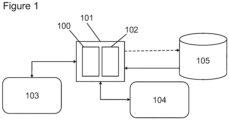
- Figure 1 shows an apparatus 100 configured to provide for display of an amalgamated virtual reality space comprising an amalgamation of images from multiple sources of VR content, as will be described below.
- the apparatus 100 is functionally provided by a computer server 101, which may comprise a memory and a processor.
- the server 101 provides at least part of the functionality of a virtual reality apparatus 102 in combination with a virtual reality headset 103 for use by a user or content producer.
- the apparatus 100 may provide the amalgamated virtual reality space from virtual reality content, obtained by two or more virtual reality content capture devices, where the virtual reality content from the content capture device is stored, transiently, temporarily or more permanently in a virtual reality content store 105.
- the apparatus 100 may be separate from the virtual reality apparatus 102 and have a communication link thereto.
- the apparatus 100 is part of a virtual reality content production device configured to generate the amalgamated virtual reality space from virtual reality content captured from multiple VR content capture devices. Accordingly, the VR content production device may display the amalgamated virtual reality space to the content producer/other user and/or record the created virtual reality content comprising the created amalgamated virtual reality space for subsequent display to a user of a VR apparatus.
- the apparatus is part of or associated with a virtual reality apparatus for "playing" virtual reality content, such as the VR content comprising the amalgamated virtual reality space.
- the apparatus may generate the amalgamated virtual reality space for display to the user from a plurality of VR content in real-time.
- one apparatus provides the functionality of the virtual reality (VR) apparatus 102 and the apparatus 100 for providing for display of the amalgamated virtual reality space.
- VR virtual reality
- these apparatuses 100, 102 may be physically separate and/or grouped together differently.
- the server 101 or each apparatus 100, 102 mentioned above may have only one processor and one memory but it will be appreciated that other embodiments may utilise more than one processor and/or more than one memory (e.g. same or different processor/memory types). Further, the apparatus(es) 100, 102 may be an Application Specific Integrated Circuit (ASIC).
- ASIC Application Specific Integrated Circuit
- the processor may be a general purpose processor dedicated to executing/processing information received from other components, such as content store 105 and user input (such as via VR headset 103 or input device 104) in accordance with instructions stored in the form of computer program code in the memory.
- the output signalling generated by such operations of the processor is provided onwards to further components, such as 102, 103.
- the memory (not necessarily a single memory unit) is a computer readable medium (solid state memory in this example, but may be other types of memory such as a hard drive, ROM, RAM, Flash or the like) that stores computer program code.
- This computer program code stores instructions that are executable by the processor, when the program code is run on the processor.
- the internal connections between the memory and the processor can be understood to, in one or more example embodiments, provide an active coupling between the processor and the memory to allow the processor to access the computer program code stored on the memory.
- the processor and memory are all electrically connected to one another internally to allow for electrical communication between the respective components.
- the components are all located proximate to one another so as to be formed together as an ASIC, in other words, so as to be integrated together as a single chip/circuit that can be installed into an electronic device.
- one or more or all of the components may be located separately from one another.
- the apparatus 100 may receive signalling representative of VR content from the content store 105 and provide signalling to the VR apparatus 102 to display the amalgamated virtual reality space.
- the VR apparatus 102 may then display the amalgamated virtual reality space to the user via the VR headset 103.
- the apparatus 100 may, based on the signalling received from an input device 104, provide for a transition between providing for display of an amalgamated virtual reality space created from VR content of multiple VR content capture devices to a virtual reality space created from a single VR content from a single VR content capture device.
- VR content capture devices are used to capture VR content in a common scene, and it is advantageous, rather than display the VR content from only one of the VR content capture devices, to provide for display of a virtual reality space generated from VR content sourced from the multiple content capture devices.
- each VR content capture device captures images in multiple viewing directions so that a virtual reality space is created for virtual reality display to a user.
- a virtual reality space comprising the amalgamated virtual reality space may be provided for display that uses images from multiple points of view, i.e. VR content sourced from the different VR content capture devices.
- Figure 2 shows two VR content capture devices 201 and 202 at various positions relative to one another as they capture virtual reality content.
- the suffixes a, b and c have been added to the reference numerals 201 and 202 to distinguish between the VR content capture devices when they are at each of positions a, b and c.
- the virtual reality content capture devices 201, 202 comprise Nokia OZO cameras, although other virtual reality content capture devices are available.
- the VR content capture devices are, in this example, configured to capture virtual reality content of the real world.
- the virtual reality content capture devices may comprise a plurality of cameras 203 each orientated in a different viewing direction to capture the surrounding scene.
- a virtual reality space may be formed from the images and the VR content provided by the content capture devices may be pre- or post- processing of the images to form the virtual reality space.
- the virtual reality space may be considered as a patchwork of images extending over a sphere of viewing directions. It will be appreciated that the sphere of viewing directions, in one or more examples, may be incomplete and thus include regions where the patchwork of images is incomplete, such towards a base of the content capture device where its wheels may be located for example.
- the VR content capture devices 201, 202 are mobile and have wheels so that they can move about a scene.
- the VR content capture devices 201, 202 may be remotely controlled.
- the VR content capture devices generate VR content comprising a plurality of images, such as moving images or video, from the plurality of cameras 203 that are processed or "stitched" together to form a virtual reality space.
- the VR content generated by the VR content capture device comprises a virtual reality space formed from a combination or "stitching together" of the plurality of images or comprises the plurality of images for generating the virtual reality space by another apparatus.
- the images of the VR content may be time consecutive frames of the stitched virtual reality space and/or images for stitching together to form the virtual reality space (as well as corresponding time consecutive images), depending on the capability of the virtual reality content capture device.
- the virtual reality space may comprise a space formed from the images that is at least larger than a virtual reality view provided by the VR apparatus of the space and may comprise at least a 180° or 270° or 360° field of view.
- the VR apparatus user may pan around the VR space, such as by movement of their head, to appreciate the whole VR space.
- the VR content capture devices of the present example may be configured to capture a substantially spherical field of view by way of the plurality of cameras.
- each VR content capture devices 201a, 202a are initially located separately, such as more than a predetermined distance apart.
- Each VR content capture devices 201a, 202a may be capturing VR content of separate sections of a movie production, for example, that may be conducted at the same time.
- each VR content capture device 201, 202 may be following a different actor or actress.
- each VR content capture device 201a, 202a is generating/recording VR content that can be used to form a virtual reality space for virtual reality display to a user of a VR apparatus.
- the VR content capture devices 201b, 202b are co-located together, such as within a predetermined distance of one another. In such an arrangement, there may be a clear view of the first content capture device 201b in the VR content captured by the second content capture device 202b and vice versa. Accordingly, the apparatus 100 may be configured to use the VR content from both of VR content capture devices 201a, 201b to form an amalgamated virtual reality space.
- the amalgamated virtual reality space may be created such that it does not include a view or image of one or both the VR content capture devices 201b, 202b.
- the amalgamated virtual reality space may be based on a subset of the plurality of images captured by the plurality of cameras of each of the content capture devices.
- the images captured by the plurality of cameras on one hemispherical side of the first content capture device may be used with images captured by the plurality of cameras on an opposite hemispherical side of the second content capture device.
- the VR content comprises a virtual reality space (essentially a spherical image, for example)
- the amalgamated virtual reality space may be based on a portion of virtual reality space from the first content capture device and a portion of the virtual reality space from the second content capture device.
- the amalgamated virtual reality space may be generated from VR content at different stages of processing i.e. pre or post stitching of the images of the cameras 203, for example.
- the amalgamated virtual reality space may comprise VR content from two or more of the VR content capture devices.
- the choice of which VR content is used may be based on analysis of the content or the relative position of the VR content capture devices.
- the VR content capture devices 201b, 202b may be both capturing VR content in a common scene, such as a section of the movie containing both of the actors/actresses each VR content capture devices 201b, 202b is assigned to.
- the first and second VR content capture devices 201c, 202c are physically moving apart i.e. diverging. Accordingly, while it may be possible to generate an amalgamated virtual reality space when the VR content capture devices 201b, 202b are within a predetermined distance of one another, there becomes a separation when they are too far apart to create a believable or aesthetically acceptable amalgamated virtual reality space. Thus, the point of view of one VR content capture device is too different to (i.e. too far apart from) the point of view of the other VR content capture device. Accordingly, the apparatus 100 may be required to transition from displaying the amalgamated virtual reality space to one of the virtual reality spaces from one of the VR content capture devices.
- the predetermined distance may be dependent on one or more of the sophistication of the software used to generate the amalgamated VR space or the processing available, or the camera lenses or camera settings of the VR content capture devices, or other factors. Typically the predetermined distance comprises up to 100 metres or preferably up to 30 metres.
- the VR content of one of the VR content capture devices includes a view of the other VR content capture device and vice-versa.
- other image editing techniques may be used to digitally edit the VR content or virtual reality space to remove the view of the other content capture device.
- image recognition techniques may be used to identify a VR content capture device and then image editing may be applied (such as surrounding background interpolation or using image information from temporally different points to replace the view of the VR content capture device) to remove the view of the other VR content capture device.
- the apparatus may provide for, on convergence and/or divergence of the VR content capture devices 201, 202, a transition between providing for display of a virtual reality space including a digitally removed view of another content capture device and providing for display of the amalgamated virtual reality space.
- the transition may include one or more of warping, perspective adjustment, light/colour adjustment to the images or parts thereof.
- the creation of VR content in this way may provide for an interactive storyline.
- a user may be viewing the VR "movie" from the point of view (designated by the dot 204) of one of the VR content capture devices, such as the first content capture device 202a.
- the dot 204 thus represents the point of view of the user viewing the VR content.
- the apparatus 100 may then provide for display of the amalgamated virtual reality space to the user when the VR content capture devices are at position "b".
- the dot 205, representing the point of view of the user viewing the amalgamated VR space is shown between the physical positons of the first and second VR content capture devices 201b, 202b.
- the "virtual point of view" for the user appears as if it is between the point of view of the first virtual reality space and the point of view second virtual reality space.
- the apparatus 100 may then require a user-selection of which virtual reality space they wish to follow.
- the user has selected the virtual reality space created from the VR content of the second virtual reality content capture device 202c, designated by the dot 206.
- the dots, 204, 205, 206 show how the point of view of a user of the VR apparatus may move between VR content captured by multiple VR content capture devices.
- FIG 3 shows the virtual reality space and, in particular, the amalgamated virtual reality space 300, of a scene of a beach.
- the VR space 300 although shown as a panoramic image, is intended to represent the VR space that a user may view, which may be a 360° image. It will be appreciated that the VR apparatus user may not see all of the VR space of the scene at any one time as it is too expansive to view and they must move their head to view all of it, corresponding to the viewing directions in which the VR content for the scene was captured.
- the first and second VR content capture devices 201a, 201b are present on the beach both capturing VR content. In this example, the content capture devices are capturing a VR movie in which a cop 301 is pursuing a robber 302.
- the virtual reality content capture devices 201b, 202b are co-located and the apparatus 100 provides for display of the amalgamated virtual reality space, shown diagrammatically at 303.
- a substantially spherical space is shown to represent the amalgamated virtual reality space 303 as a VR viewer at the sphere's centre can view the sphere in all directions, similar to the 360° wrap around imagery provided by virtual reality.
- the amalgamated virtual reality space 300 is shown in exploded form for clarity and to explain its constituent parts. As explained above the amalgamated virtual reality space is formed from VR content from both of the content capture devices 201b, 202b.
- a substantially hemispherical section 304 of the first virtual reality space is combined with a substantially hemispherical section 305 of the second virtual reality space.
- the hemispherical sections designate the part of the VR content that has imagery in viewing directions that extend over the hemispherical surface used to form the amalgamated virtual reality space.
- the VR content comprises unstitched images
- the hemispheres show the viewing directions used to select the patchwork of images from the associated VR content i.e. viewing directions that lie in a direction from a radial origin of the hemisphere to its surface.
- the hemispheres may be chosen so as not to include a view of the other VR content capture device 201b, 202b. It will also be appreciated that although hemispheres are shown, more of one of the first and second virtual reality content or component images thereof may be used than the other in forming the amalgamated virtual reality space.
- the amalgamated virtual reality space includes a boundary region 306, which due to the hemispherically selected parts of the first/second VR content, comprises a substantially circular strip.
- the boundary region may comprise an interpolation of the images of the first and second VR content that lie along the boundary region so that the "join" between the first and second VR content is smooth or aesthetically acceptable.
- the apparatus may be configured to measure the discontinuity between images along a join line between VR content and control the interpolation of the boundary region 306 accordingly.
- the boundary region may not be required and the hemispheres 304, 305 may be abutted together (i.e. the associated imagery in the viewing directions represented by the hemisphere are displayed next to each other) with limited or no image smoothing effects applied to form the amalgamated virtual reality space 303.
- the width of the boundary region 306, where image interpolation is provided may be dependent on physical separation between the VR content capture devices at the time of VR content capture.
- the boundary region 306 is located as a vertical strip at the centre but it is not noticeable due to the interpolation of the parts of the images either side thereof.
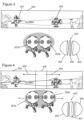
- Figure 4 shows the start of the transition from position "b" to position "c".
- the physical separation between the content capture devices 201b, 202b is increasing but is still below the predetermined distance at which an amalgamated virtual reality space is created.
- the boundary region of the amalgamated virtual reality space, in the scene 300 is shown by a box 400.
- the point of view of each hemisphere i.e. images or parts thereof sourced from each VR content
- the size (or in this example the width) of the boundary region 401 is increased.
- the amalgamated virtual reality space includes in its imagery a larger/wider interpolated image section, shown by box 400.
- the boundary region strip 401 is shown stretched wider.
- the region within box 400 is shown with an image distortion effect, such as a stretching effect or warping effect, demonstrated by arrows 404.
- the stretching effect may be caused by the increased size of the boundary region 401 and therefore the interpolation between the first and second VR content leads to the boundary region appearing stretched.
- the image distortion effect may be applied artificially.
- the apparatus may apply an image distortion effect to show or give the impression of the component parts 304, 305 of the amalgamated virtual reality space 403 moving apart.
- the display of the image distortion effect is advantageous as it provides an intuitive indication to a user viewing the amalgamated virtual reality space 403 that they are required to make a choice about which point of view they want to follow.
- the first VR content capture device 201b is associated with the cop 301 while the second VR content capture device 202b is associated with the robber.
- the apparatus 100 may provide for interactive VR content, which in this example is an interactive movie.
- the user input to make the selection may be provided to the apparatus 100 by any appropriate means, such as a via an input device, such as a touchscreen device or handheld device, a voice command, a sight command or based on where in the amalgamated virtual reality space the user is looking. For example, if the user is looking at the robber during the transition then this may be taken as user selection of the second VR content sourced from the second VR content capture device 202b. Signalling from head position sensors or from the VR apparatus based on what part of the image the user is viewing may be used among other "viewing direction" indicators.
- Figure 5 shows a position close to (within a threshold of) the predetermined distance.
- the amalgamated virtual reality space 500 is provided for display, it contains a discontinuity 501.
- the discontinuity is shown as the gap 502 between the hemispheres 504, 505.
- the discontinuity may be displayed along a boundary between the images of the first VR content and the images second VR content that forms the amalgamated virtual reality space 500.
- the discontinuity 501 may also comprise a gap between these "boundary images" of the amalgamated virtual reality space.
- the discontinuity may be provided for display due to the interpolation of the boundary region 401 reaching an unacceptable threshold.
- the discontinuity may be displayed artificially and thus while a continuous and aesthetically acceptable amalgamated VR space 500 may be created, the apparatus may apply a discontinuity to show or give the impression of the component parts 504, 505 of the amalgamated virtual reality space 403 moving apart.
- the discontinuity may comprise or manifest itself as a localised distortion effect in the imagery, such as due to non-aesthetically pleasing interpolation.
- the display of the discontinuity is advantageous as it further prompts the user to make a user-selection of which of the first and second VR content they wish to follow.
- Figure 6 shows a VR user 601 watching, in the amalgamated virtual reality space 600 the second VR content sourced from the second VR content capture device 202c with a VR headset 602.
- the action of looking in such a direction in the amalgamated virtual reality space 600 may comprise a sight command which determines the user's selection.
- the apparatus 100 is configured to provide for display of a virtual reality space generated from the second VR content by the VR apparatus 102 following display of the amalgamated virtual reality space. Accordingly, the apparatus 100 may provide for display of progressively more imagery from the second VR content and progressively less imagery from the first VR content until only content from the user-selected second VR content is used to display the virtual reality space viewed by the user, i.e. the second virtual reality space. Accordingly, the apparatus 100 may progressively display the portion of the second VR content not displayed in the amalgamated virtual reality space such that it replaces the first VR content.
- Figure 6 shows portion 600a, sourced from the first VR content decreasing and thus being removed from virtual reality display and portion 600b from the second VR content extending the "area" over which it is displayed to the VR user.
- Figure 7 shows the second virtual reality space 700 from the second VR content displayed to the user 601 following display of the amalgamated virtual reality space. Accordingly, this shows the VR content capture devices at position "c" and the VR content used to generate the second virtual reality space 700 is sourced exclusively from the second content capture device 202c. It will be appreciated that the content capture device 201c may be removed from the images of the second content capture device. The movie may now continue with the user watching the action of the robber.
- the shaded areas show the portions of the imagery from each of the first and second VR content that may be sourced for forming an amalgamated VR space.
- a first, larger, portion 803 of the VR content of the second VR space 802 is used along with a second, smaller, portion 804 of the VR content of the first VR space 801.
- the images of the VR content or portions thereof of the portion 804 has a substantially common viewing direction 805, 806 to the images of the VR content or portions thereof of the excluded portion 807.
- a portion of the imagery excluded from one of the first and second VR content in forming the amalgamated VR space is filled by a corresponding portion with a substantially similar viewing direction of the other of the first and second VR content.
- the apparatus may be configured to provide the amalgamated virtual reality space based on live VR content from the content capture devices or pre-recorded VR content.
- the pre-recorded content may include timestamps or other synchronisation information such that playback of the VR content of the content capture devices and the formation of the amalgamated virtual reality space is provided at the appropriate time during playback.
- Figure 9 shows a flow diagram illustrating the steps of in respect of first virtual reality content of a scene captured by a first virtual reality content capture device comprising images of the scene in multiple viewing directions for forming a first virtual reality space and second virtual reality content of the same scene captured by a second virtual reality content capture device comprising images of the scene in multiple viewing directions for forming a second virtual reality space, the first and second virtual reality content capture devices physically arranged within a predetermined distance of one another in the same scene when the first virtual reality content and the second virtual reality content was captured, the first and second virtual reality spaces thereby representative of the scene from different points of view due to the physical separation of the first virtual reality content capture device and the second virtual reality content capture device 900; providing for display 901, in virtual reality, of an amalgamated virtual reality space representative of the scene, the amalgamated virtual reality space comprising an amalgamation of both the images or parts thereof of the first virtual reality content and the images or parts thereof of the second virtual reality content.
- Figure 10 illustrates schematically a computer/processor readable medium 1000 providing a program according to an example.
- the computer/processor readable medium is a disc such as a digital versatile disc (DVD) or a compact disc (CD).
- DVD digital versatile disc
- CD compact disc
- the computer readable medium may be any medium that has been programmed in such a way as to carry out an inventive function.
- the computer program code may be distributed between the multiple memories of the same type, or multiple memories of a different type, such as ROM, RAM, flash, hard disk, solid state, etc.
- User inputs may be gestures which comprise one or more of a tap, a swipe, a slide, a press, a hold, a rotate gesture, a static hover gesture proximal to the user interface of the device, a moving hover gesture proximal to the device, bending at least part of the device, squeezing at least part of the device, a multi-finger gesture, tilting the device, or flipping a control device.
- the gestures may be any free space user gesture using the user's body, such as their arms, or a stylus or other element suitable for performing free space user gestures.
- the apparatus shown in the above examples may be a portable electronic device, a laptop computer, a mobile phone, a Smartphone, a tablet computer, a personal digital assistant, a digital camera, a smartwatch, smart eyewear, a pen based computer, a non-portable electronic device, a desktop computer, a monitor, a household appliance, a smart TV, a server, a wearable apparatus, a virtual reality apparatus, or a module/circuitry for one or more of the same.
- any mentioned apparatus and/or other features of particular mentioned apparatus may be provided by apparatus arranged such that they become configured to carry out the desired operations only when enabled, e.g. switched on, or the like. In such cases, they may not necessarily have the appropriate software loaded into the active memory in the non-enabled (e.g. switched off state) and only load the appropriate software in the enabled (e.g. on state).
- the apparatus may comprise hardware circuitry and/or firmware.
- the apparatus may comprise software loaded onto memory.
- Such software/computer programs may be recorded on the same memory/processor/functional units and/or on one or more memories/processors/ functional units.
- a particular mentioned apparatus may be pre-programmed with the appropriate software to carry out desired operations, and wherein the appropriate software can be enabled for use by a user downloading a "key", for example, to unlock/enable the software and its associated functionality.
- Advantages associated with such examples can include a reduced requirement to download data when further functionality is required for a device, and this can be useful in examples where a device is perceived to have sufficient capacity to store such pre-programmed software for functionality that may not be enabled by a user.
- Any mentioned apparatus/circuitry/elements/processor may have other functions in addition to the mentioned functions, and that these functions may be performed by the same apparatus/circuitry/elements/processor.
- One or more disclosed aspects may encompass the electronic distribution of associated computer programs and computer programs (which may be source/transport encoded) recorded on an appropriate carrier (e.g. memory, signal).
- Any "computer” described herein can comprise a collection of one or more individual processors/processing elements that may or may not be located on the same circuit board, or the same region/position of a circuit board or even the same device. In some examples one or more of any mentioned processors may be distributed over a plurality of devices. The same or different processor/processing elements may perform one or more functions described herein.
- signal may refer to one or more signals transmitted as a series of transmitted and/or received electrical/optical signals.
- the series of signals may comprise one, two, three, four or even more individual signal components or distinct signals to make up said signalling. Some or all of these individual signals may be transmitted/received by wireless or wired communication simultaneously, in sequence, and/or such that they temporally overlap one another.
- processors and memory may comprise a computer processor, Application Specific Integrated Circuit (ASIC), field-programmable gate array (FPGA), and/or other hardware components that have been programmed in such a way to carry out the inventive function.
- ASIC Application Specific Integrated Circuit
- FPGA field-programmable gate array
Landscapes
- Engineering & Computer Science (AREA)
- Multimedia (AREA)
- Signal Processing (AREA)
- Physics & Mathematics (AREA)
- General Physics & Mathematics (AREA)
- Theoretical Computer Science (AREA)
- Computer Graphics (AREA)
- Computer Hardware Design (AREA)
- General Engineering & Computer Science (AREA)
- Software Systems (AREA)
- Computer Vision & Pattern Recognition (AREA)
- Architecture (AREA)
- Processing Or Creating Images (AREA)
- User Interface Of Digital Computer (AREA)
- Studio Devices (AREA)
Claims (15)
- Einrichtung, die Mittel umfasst, die zu Folgendem ausgelegt sind:Erzeugen einer Repräsentation eines verschmolzenen virtuellen Realitätsraums (300, 403, 500, 503, 600) aus einem ersten virtuellen Realitätsinhalt einer Szene der realen Welt, die von einer ersten mobilen Vorrichtung (201) zum Erfassen eines virtuellen Realitätsinhalts erfasst wurde, und einem zweiten virtuellen Realitätsinhalt derselben Szene, die von einer zweiten, anderen mobilen Vorrichtung (202) zum Erfassen eines virtuellen Realitätsinhalts erfasst wurde, wobei sich die erste mobile Vorrichtung (201) zum Erfassen eines virtuellen Realitätsinhalts und die zweite mobile Vorrichtung (202) zum Erfassen eines virtuellen Realitätsinhalts in derselben Szene in einem vorbestimmten Abstand voneinander befanden, als der erste virtuelle Realitätsinhalt und der zweite virtuelle Realitätsinhalt erfasst wurden, wodurch der erste virtuelle Realitätsinhalt und der zweite virtuelle Realitätsinhalt aufgrund der physischen Trennung der ersten mobilen Vorrichtung (201) zum Erfassen eines virtuellen Realitätsinhalts und der zweiten mobilen Vorrichtung (202) zum Erfassen eines virtuellen Realitätsinhalts für die Szene aus verschiedenen Blickpunkten repräsentativ sind, und wobeidie erste mobile Vorrichtung zum Erfassen eines virtuellen Realitätsinhalts eine erste Vielzahl von Kameras umfasst, die Bilder in mehreren Blickrichtungen erfassen, und den ersten virtuellen Realitätsinhalt erzeugt, der eine erste Vielzahl von Bildern von der ersten Vielzahl von Kameras umfasst, die zusammen verarbeitet werden, um einen ersten virtuellen Raum zu bilden;die zweite mobile Vorrichtung zum Erfassen eines virtuellen Realitätsinhalts eine zweite Vielzahl von Kameras umfasst, die Bilder in mehreren Blickrichtungen erfassen, und den zweiten virtuellen Realitätsinhalt erzeugt, der eine zweite Vielzahl von Bildern von der zweiten Vielzahl von Kameras umfasst, die zusammen verarbeitet werden, um einen zweiten virtuellen Raum zu bilden;der verschmolzene virtuelle Realitätsraum auf einem Untersatz der ersten Vielzahl von Bildern und der zweiten Vielzahl von Bildern basiert, die auf Basis einer Bildmerkmalserkennung gewählt werden, die an der ersten und der zweiten Vielzahl von Bildern durchgeführt wird, und/oder auf Basis der relativen Position der entsprechenden mobilen Vorrichtung zum Erfassen einer virtuellen Realität, um ein Bild oder einen Teil davon zu identifizieren, der eine Ansicht von einer der ersten oder der zweiten mobilen Vorrichtung zum Erfassen eines virtuellen Realitätsinhalts beinhaltet, derart, dass eines oder mehrere der Bilder oder Teile davon, die eine Ansicht von einer der Vorrichtungen zum Erfassen eines virtuellen Realitätsinhalts enthalten, ausgeschlossen sind, wenn der verschmolzene virtuelle Realitätsraum erstellt wird, undder verschmolzene virtuelle Realitätsraum eine Umgebung der realen Welt repliziert; undBereitstellen des verschmolzenen virtuellen Realitätsraums (300, 403, 500, 503, 600), der die Szene repräsentiert, zur Anzeige, wobei der verschmolzene virtuelle Realitätsraum von einer virtuellen Realitätseinrichtung angezeigt wird und die Einrichtung eine Signalisierung bereitstellt, die den verschmolzenen virtuellen Realitätsraum der virtuellen Realität für die virtuelle Realitätseinrichtung repräsentiert.
- Einrichtung nach Anspruch 1, wobei der verschmolzene virtuelle Realitätsraum (300, 403, 500, 503, 600) einen virtuellen Blickpunkt zwischen dem Blickpunkt des ersten virtuellen Realitätsraums, der aus dem ersten virtuellen Realitätsinhalt gebildet ist, der von der ersten Vorrichtung zum Erfassen eines virtuellen Realitätsinhalts erfasst wird, und dem Blickpunkt des zweiten virtuellen Realitätsraums, der aus dem zweiten virtuellen Realitätsinhalt gebildet ist, der von der zweiten Vorrichtung zum Erfassen eines virtuellen Realitätsinhalts erfasst wird, aufweist.
- Einrichtung nach einem der vorhergehenden Ansprüche, wobei bei einer Divergenz der Blickpunkte des ersten virtuellen Realitätsinhalts und des zweiten virtuellen Realitätsinhalts aufgrund der Trennung der ersten und der zweiten Vorrichtung (201, 202) zum Erfassen eines virtuellen Realitätsinhalts, als der erste und der zweite virtuelle Realitätsinhalt erfasst wurde, Bereitstellen des verschmolzenen virtuellen Realitätsraums zur Anzeige mit einem Bildverzerrungseffekt mindestens unter Verwendung der Bilder oder Teile davon, die entlang einer Grenze (400) zwischen Bildern vom ersten virtuellen Realitätsinhalt und den Bildern vom zweiten virtuellen Realitätsinhalt, die den verschmolzenen virtuellen Realitätsraum bilden.
- Einrichtung nach einem der vorhergehenden Ansprüche, wobei bei einer Divergenz der Blickpunkte des ersten virtuellen Realitätsinhalts und des zweiten virtuellen Realitätsinhalts aufgrund der Trennung der ersten und der zweiten Vorrichtung (201, 202) zum Erfassen eines virtuellen Realitätsinhalts, als der erste und der zweite virtuelle Realitätsinhalt erfasst wurde, Bereitstellen des verschmolzenen virtuellen Realitätsraums zur Anzeige mit einer Diskontinuität zwischen Grenzbildern vom ersten virtuellen Realitätsinhalt und Grenzbildern vom zweiten virtuellen Realitätsinhalt, die den verschmolzenen virtuellen Realitätsraum bilden, wobei die Grenzbilder die Bilder umfassen, die entlang einer Grenze (400) zwischen Bildern, die aus dem ersten virtuellen Realitätsinhalt stammen, und Bildern liegen, die vom zweiten virtuellen Realitätsinhalt stammen, die den verschmolzenen virtuellen Realitätsraum bilden.
- Einrichtung nach einem der vorhergehenden Ansprüche, wobei bei einer Divergenz der Blickpunkte des ersten virtuellen Realitätsinhalts und des zweiten virtuellen Realitätsinhalts aufgrund der Trennung der ersten und der zweiten Vorrichtung (201, 202) zum Erfassen eines virtuellen Realitätsinhalts, als der erste und der zweite virtuelle Realitätsinhalt erfasst wurde, Bereitstellen eines ausgewählten virtuellen Realitätsraums, der einen des ersten virtuellen Realitätsraums und des zweiten virtuellen Realitätsraums umfasst, auf Basis einer Benutzerauswahl zur Anzeige in einer virtuellen Realität, wodurch es dem Benutzer ermöglicht wird auszuwählen, welcher des ersten und des zweiten virtuellen Realitätsraums angezeigt werden soll, nachdem der verschmolzene virtuelle Realitätsraum angezeigt wurde.
- Einrichtung nach Anspruch 5, wobei bei einem Übergang zwischen dem Bereitstellen des verschmolzenen virtuellen Realitätsraums zur Anzeige und dem Bereitstellen des ausgewählten virtuellen Realitätsraums zur Anzeige Bereitstellen eines Fadingeffekts zu den Bildern, die vom ersten/zweiten virtuellen Realitätsinhalt stammen, der mit dem nicht ausgewählten virtuellen Realitätsraum verknüpft ist, zur Anzeige im verschmolzenen virtuellen Realitätsraum.
- Einrichtung nach Anspruch 5 oder Anspruch 6, wobei bei einem Übergang zwischen dem Bereitstellen des verschmolzenen virtuellen Realitätsraums zur Anzeige und dem Bereitstellen des ausgewählten virtuellen Realitätsraums zur Anzeige progressives Bereitstellen von mehr des ausgewählten virtuellen Realitätsraums zur Anzeige, derart, dass der ausgewählte virtuelle Realitätsraum progressiv in allen Blickrichtungen in der virtuellen Realität angezeigt werden kann.
- Einrichtung nach einem der Ansprüche 5 bis 7, wobei bei einem Übergang zwischen dem Bereitstellen des verschmolzenen virtuellen Realitätsraums zur Anzeige und dem Bereitstellen des ausgewählten virtuellen Realitätsraums zur Anzeige Bereitstellen des ausgewählten virtuellen Realitätsraums zur Anzeige nach einem progressiven Erhöhen der Anzahl von Bildern im verschmolzenen virtuellen Realitätsraum, die vom virtuellen Realitätsinhalt kommen, der mit dem ausgewählten virtuellen Realitätsraum verknüpft ist.
- Einrichtung nach einem der Ansprüche 5 bis 8, wobei die Benutzerauswahl auf einem einer Signalisierung von einer Benutzereingabevorrichtung, einer Benutzergeste, einem Benutzersprachbefehl, einer Kopfrichtung des Benutzers und einem Sichtbefehl des Benutzers basiert.
- Einrichtung nach einem der vorhergehenden Ansprüche, wobei der erste virtuelle Realitätsinhalt und der zweite virtuelle Realitätsinhalt Ortsinformationen beinhalten, die Folgendes anzeigen;i) den geografischen Ort, an dem sich die entsprechende Inhaltserfassungsvorrichtung befand, als der virtuelle Realitätsinhalt erfasst wurde; und/oderii) die relative Position einer anderen Inhaltserfassungsvorrichtung.
- Einrichtung nach einem der vorhergehenden Ansprüche, wobei, wenn sich die erste und die zweite Vorrichtung zum Erfassen eines virtuellen Realitätsinhalts um mehr als einen vorbestimmten Abstand voneinander befinden, als der erste und der zweite virtuelle Realitätsinhalt erfasst werden, aber eine oder beide der ersten und der zweiten Vorrichtung zum Erfassen eines virtuellen Realitätsinhalts im ersten und im zweiten virtuellen Realitätsinhalt sichtbar sind, der von der anderen Vorrichtung zum Erfassen eines virtuellen Realitätsinhalts erfasst wurde, Bereitstellen von einem der virtuellen Realitätsräume zur Anzeige, der aus dem verknüpften virtuellen Realitätsinhalt gebildet ist, einschließlich Bildbearbeitung, um die Ansicht der Vorrichtung zum Erfassen des virtuellen Realitätsinhalts zu entfernen.
- Computerimplementiertes Verfahren, wobei das Verfahren das Erzeugen einer Repräsentation eines verschmolzenen virtuellen Realitätsraums (300, 403, 500, 503, 600) aus einem ersten virtuellen Realitätsinhalt einer Szene der realen Welt, die von einer ersten mobilen Vorrichtung (201) zum Erfassen eines virtuellen Realitätsinhalts erfasst wurde, und einem zweiten virtuellen Realitätsinhalt derselben Szene, die von einer zweiten, anderen mobilen Vorrichtung (202) zum Erfassen eines virtuellen Realitätsinhalts erfasst wurde, umfasst, wobei sich die erste Vorrichtung (201) zum Erfassen eines virtuellen Realitätsinhalts und die zweite Vorrichtung (202) zum Erfassen eines virtuellen Realitätsinhalts in derselben Szene in einem vorbestimmten Abstand voneinander befanden, als der erste virtuelle Realitätsinhalt und der zweite virtuelle Realitätsinhalt erfasst wurden, wodurch der erste virtuelle Realitätsinhalt und der zweite virtuelle Realitätsinhalt aufgrund der physischen Trennung der ersten mobilen Vorrichtung (201) zum Erfassen eines virtuellen Realitätsinhalts und der zweiten mobilen Vorrichtung (202) zum Erfassen eines virtuellen Realitätsinhalts für die Szene aus verschiedenen Blickpunkten repräsentativ sind, und wobeidie erste mobile Vorrichtung zum Erfassen eines virtuellen Realitätsinhalts eine erste Vielzahl von Kameras umfasst, die Bilder in mehreren Blickrichtungen erfassen, und den ersten virtuellen Realitätsinhalt erzeugt, der eine erste Vielzahl von Bildern von der ersten Vielzahl von Kameras umfasst, die zusammen verarbeitet werden, um einen ersten virtuellen Raum zu bilden;die zweite mobile Vorrichtung zum Erfassen eines virtuellen Realitätsinhalts eine zweite Vielzahl von Kameras umfasst, die Bilder in mehreren Blickrichtungen erfassen, und den zweiten virtuellen Realitätsinhalt erzeugt, der eine zweite Vielzahl von Bildern von der zweiten Vielzahl von Kameras umfasst, die zusammen verarbeitet werden, um einen zweiten virtuellen Raum zu bilden;der verschmolzene virtuelle Realitätsraum auf einem Untersatz der ersten Vielzahl von Bildern und der zweiten Vielzahl von Bildern basiert, die auf Basis einer Bildmerkmalserkennung ausgewählt werden, die an der ersten und der zweiten Vielzahl von Bildern durchgeführt wird, und/oder auf Basis der relativen Position der entsprechenden mobilen Vorrichtung zum Erfassen einer virtuellen Realität, um ein Bild oder einen Teil davon zu identifizieren, der eine Ansicht von einer der ersten oder der zweiten mobilen Vorrichtung zum Erfassen eines virtuellen Realitätsinhalts beinhaltet, derart, dass eines oder mehrere der Bilder oder Teile davon, die eine Ansicht von einer der Vorrichtungen zum Erfassen eines virtuellen Realitätsinhalts enthalten, ausgeschlossen sind, wenn der verschmolzene virtuelle Realitätsraum erstellt wird, undder verschmolzene virtuelle Realitätsraum eine Umgebung der realen Welt repliziert; undBereitstellen des verschmolzenen virtuellen Realitätsraums (300, 403, 500, 503, 600), der die Szene repräsentiert, zur Anzeige, wobei der verschmolzene virtuelle Realitätsraum von einer virtuellen Realitätseinrichtung angezeigt wird und die Einrichtung eine Signalisierung bereitstellt, die den verschmolzenen virtuellen Realitätsraum der virtuellen Realität für die virtuelle Realitätseinrichtung repräsentiert.
- Verfahren nach Anspruch 12, wobei der verschmolzene virtuelle Realitätsraum (300, 403, 500, 503, 600) einen virtuellen Blickpunkt zwischen dem Blickpunkt des ersten virtuellen Realitätsraums, der aus dem ersten mobilen virtuellen Realitätsinhalt gebildet ist, der von der ersten Vorrichtung zum Erfassen eines virtuellen Realitätsinhalts erfasst wird, und dem Blickpunkt des zweiten virtuellen Realitätsraums, der aus dem zweiten mobilen virtuellen Realitätsinhalt gebildet ist, der von der zweiten Vorrichtung zum Erfassen eines virtuellen Realitätsinhalts erfasst wird, aufweist.
- Verfahren nach Anspruch 12 oder 13, das bei einer Divergenz der Blickpunkte des ersten mobilen virtuellen Realitätsinhalts und des zweiten mobilen virtuellen Realitätsinhalts aufgrund der Trennung der ersten und der zweiten Vorrichtung (201, 202) zum Erfassen eines virtuellen Realitätsinhalts, als der erste und der zweite mobile virtuelle Realitätsinhalt erfasst wurde, das Bereitstellen des verschmolzenen virtuellen Realitätsraums zur Anzeige mit einem Bildverzerrungseffekt mindestens unter Verwendung der Bilder oder Teile davon, die entlang einer Grenze (400) zwischen Bildern vom ersten mobilen virtuellen Realitätsinhalt und den Bildern vom zweiten mobilen virtuellen Realitätsinhalt liegen, die den verschmolzenen virtuellen Realitätsraum bilden, umfasst.
- Computerlesbares Medium, das einen darauf gespeicherten Computerprogrammcode umfasst, wobei das computerlesbare Medium und der Computerprogrammcode dazu ausgelegt sind, wenn sie auf mindestens einem Prozessor ausgeführt werden, mindestens Folgendes durchzuführen:Erzeugen eines verschmolzenen virtuellen Raums (300, 403, 500, 503, 600) aus einem ersten virtuellen Realitätsinhalt einer Szene der realen Welt, die von einer ersten mobilen Vorrichtung (201) zum Erfassen eines virtuellen Realitätsinhalts erfasst wurde, und einem zweiten virtuellen Realitätsinhalt derselben Szene, die von einer zweiten, anderen mobilen Vorrichtung (202) zum Erfassen eines virtuellen Realitätsinhalts erfasst wurde, wobei sich die erste Vorrichtung (201) zum Erfassen eines virtuellen Realitätsinhalts und die zweite Vorrichtung (202) zum Erfassen eines virtuellen Realitätsinhalts in derselben Szene in einem vorbestimmten Abstand voneinander befanden, als der erste virtuelle Realitätsinhalt und der zweite virtuelle Realitätsinhalt erfasst wurden,wodurch der erste virtuelle Realitätsinhalt und der zweite virtuelle Realitätsinhalt aufgrund der physischen Trennung der ersten Vorrichtung (201) zum Erfassen eines virtuellen Realitätsinhalts und der zweiten Vorrichtung (202) zum Erfassen eines virtuellen Realitätsinhalts für die Szene aus verschiedenen Blickpunkten repräsentativ sind, und wobeidie erste mobile Vorrichtung zum Erfassen eines virtuellen Realitätsinhalts eine erste Vielzahl von Kameras umfasst, die Bilder in mehreren Blickrichtungen erfassen, und den ersten virtuellen Realitätsinhalt erzeugt, der eine erste Vielzahl von Bildern von der ersten Vielzahl von Kameras umfasst, die zusammen verarbeitet werden, um einen ersten virtuellen Raum zu bilden;die zweite mobile Vorrichtung zum Erfassen eines virtuellen Realitätsinhalts eine zweite Vielzahl von Kameras umfasst, die Bilder in mehreren Blickrichtungen erfassen, und den zweiten virtuellen Realitätsinhalt erzeugt, der eine zweite Vielzahl von Bildern von der zweiten Vielzahl von Kameras umfasst, die zusammen verarbeitet werden, um einen zweiten virtuellen Raum zu bilden;der verschmolzene virtuelle Realitätsraum auf einem Untersatz der ersten Vielzahl von Bildern und der zweiten Vielzahl von Bildern basiert, die auf Basis einer Bildmerkmalserkennung ausgewählt werden, die an der ersten und der zweiten Vielzahl von Bildern durchgeführt wird, und/oder auf Basis der relativen Position der entsprechenden mobilen Vorrichtung zum Erfassen einer virtuellen Realität, um ein Bild oder einen Teil davon zu identifizieren, der eine Ansicht von einer der ersten oder der zweiten mobilen Vorrichtung zum Erfassen eines virtuellen Realitätsinhalts beinhaltet, derart, dass eines oder mehrere der Bilder oder Teile davon, die eine Ansicht von einer der Vorrichtungen zum Erfassen eines virtuellen Realitätsinhalts ausgeschlossen sind, wenn der verschmolzene virtuelle Realitätsraum erstellt wird, undder verschmolzene virtuelle Realitätsraum eine Umgebung der realen Welt repliziert, undBereitstellen des verschmolzenen virtuellen Realitätsraums (300, 403, 500, 503, 600), der die Szene repräsentiert, zur Anzeige, wobei der verschmolzene virtuelle Realitätsraum von einer virtuellen Realitätseinrichtung angezeigt wird und die Einrichtung eine Signalisierung bereitstellt, die den verschmolzenen virtuellen Realitätsraum der virtuellen Realität für die virtuelle Realitätseinrichtung repräsentiert.
Priority Applications (4)
| Application Number | Priority Date | Filing Date | Title |
|---|---|---|---|
| EP16152629.8A EP3196838B1 (de) | 2016-01-25 | 2016-01-25 | Vorrichtung und entsprechende verfahren |
| JP2018537636A JP6628343B2 (ja) | 2016-01-25 | 2017-01-18 | 装置および関連する方法 |
| PCT/FI2017/050022 WO2017129857A1 (en) | 2016-01-25 | 2017-01-18 | An apparatus and associated methods |
| US16/070,962 US10665026B2 (en) | 2016-01-25 | 2017-01-18 | Apparatus and associated methods for displaying amalgamated virtual reality content |
Applications Claiming Priority (1)
| Application Number | Priority Date | Filing Date | Title |
|---|---|---|---|
| EP16152629.8A EP3196838B1 (de) | 2016-01-25 | 2016-01-25 | Vorrichtung und entsprechende verfahren |
Publications (2)
| Publication Number | Publication Date |
|---|---|
| EP3196838A1 EP3196838A1 (de) | 2017-07-26 |
| EP3196838B1 true EP3196838B1 (de) | 2025-05-07 |
Family
ID=55357855
Family Applications (1)
| Application Number | Title | Priority Date | Filing Date |
|---|---|---|---|
| EP16152629.8A Active EP3196838B1 (de) | 2016-01-25 | 2016-01-25 | Vorrichtung und entsprechende verfahren |
Country Status (4)
| Country | Link |
|---|---|
| US (1) | US10665026B2 (de) |
| EP (1) | EP3196838B1 (de) |
| JP (1) | JP6628343B2 (de) |
| WO (1) | WO2017129857A1 (de) |
Families Citing this family (5)
| Publication number | Priority date | Publication date | Assignee | Title |
|---|---|---|---|---|
| EP3489882A1 (de) * | 2017-11-27 | 2019-05-29 | Nokia Technologies Oy | Eine vorrichtung und ein zugehöriges verfahren zum kommunizieren zwischen benutzern, die virtuelle realität erfahren |
| JP6745301B2 (ja) * | 2018-07-25 | 2020-08-26 | 株式会社バーチャルキャスト | コンテンツ配信システム、コンテンツ配信方法、コンピュータプログラム |
| CN109407935A (zh) * | 2018-09-14 | 2019-03-01 | 歌尔科技有限公司 | 一种虚拟现实显示控制方法、装置和系统 |
| US11178374B2 (en) * | 2019-05-31 | 2021-11-16 | Adobe Inc. | Dynamically rendering 360-degree videos using view-specific-filter parameters |
| US11430447B2 (en) * | 2019-11-15 | 2022-08-30 | Qualcomm Incorporated | Voice activation based on user recognition |
Family Cites Families (12)
| Publication number | Priority date | Publication date | Assignee | Title |
|---|---|---|---|---|
| US5990941A (en) * | 1991-05-13 | 1999-11-23 | Interactive Pictures Corporation | Method and apparatus for the interactive display of any portion of a spherical image |
| US5850352A (en) * | 1995-03-31 | 1998-12-15 | The Regents Of The University Of California | Immersive video, including video hypermosaicing to generate from multiple video views of a scene a three-dimensional video mosaic from which diverse virtual video scene images are synthesized, including panoramic, scene interactive and stereoscopic images |
| WO2006110584A2 (en) * | 2005-04-07 | 2006-10-19 | Axis Engineering Technologies, Inc. | Stereoscopic wide field of view imaging system |
| US8836771B2 (en) * | 2011-04-26 | 2014-09-16 | Echostar Technologies L.L.C. | Apparatus, systems and methods for shared viewing experience using head mounted displays |
| JP6126820B2 (ja) * | 2012-11-09 | 2017-05-10 | 任天堂株式会社 | 画像生成方法、画像表示方法、画像生成プログラム、画像生成システム、および画像表示装置 |
| US9451162B2 (en) * | 2013-08-21 | 2016-09-20 | Jaunt Inc. | Camera array including camera modules |
| WO2015085406A1 (en) * | 2013-12-13 | 2015-06-18 | 8702209 Canada Inc. | Systems and methods for producing panoramic and stereoscopic videos |
| US10122992B2 (en) * | 2014-05-22 | 2018-11-06 | Disney Enterprises, Inc. | Parallax based monoscopic rendering |
| US9911454B2 (en) * | 2014-05-29 | 2018-03-06 | Jaunt Inc. | Camera array including camera modules |
| JP6365153B2 (ja) * | 2014-09-10 | 2018-08-01 | 株式会社ソシオネクスト | 画像符号化方法および画像符号化装置 |
| PT3326358T (pt) * | 2015-02-27 | 2022-11-25 | Leia Inc | Câmara multiview |
| CN106612426B (zh) * | 2015-10-26 | 2018-03-16 | 华为技术有限公司 | 一种多视点视频传输方法及装置 |
-
2016
- 2016-01-25 EP EP16152629.8A patent/EP3196838B1/de active Active
-
2017
- 2017-01-18 US US16/070,962 patent/US10665026B2/en active Active
- 2017-01-18 JP JP2018537636A patent/JP6628343B2/ja active Active
- 2017-01-18 WO PCT/FI2017/050022 patent/WO2017129857A1/en not_active Ceased
Also Published As
| Publication number | Publication date |
|---|---|
| US10665026B2 (en) | 2020-05-26 |
| JP6628343B2 (ja) | 2020-01-08 |
| JP2019512177A (ja) | 2019-05-09 |
| US20190026951A1 (en) | 2019-01-24 |
| WO2017129857A1 (en) | 2017-08-03 |
| EP3196838A1 (de) | 2017-07-26 |
Similar Documents
| Publication | Publication Date | Title |
|---|---|---|
| US9927948B2 (en) | Image display apparatus and image display method | |
| US11416201B2 (en) | Apparatus and associated methods for communication between users experiencing virtual reality | |
| CN108604175B (zh) | 装置和关联方法 | |
| US10380800B2 (en) | System and method for linking and interacting between augmented reality and virtual reality environments | |
| US20190180509A1 (en) | Apparatus and associated methods for presentation of first and second virtual-or-augmented reality content | |
| EP3327677B1 (de) | Vorrichtung für räumliches audio und zugehöriges verfahren | |
| US11210518B2 (en) | Apparatus and associated methods for display of virtual reality content | |
| US10762722B2 (en) | Apparatus for sharing objects of interest and associated methods | |
| US20170134714A1 (en) | Device and method for creating videoclips from omnidirectional video | |
| EP3196838B1 (de) | Vorrichtung und entsprechende verfahren | |
| US10846535B2 (en) | Virtual reality causal summary content | |
| JP7791226B2 (ja) | 画像処理装置、画像処理方法、およびプログラム | |
| US12470826B2 (en) | Methods and systems to improve image quality and automate panorama shots | |
| JP2024518243A (ja) | 没入型視聴体験 |
Legal Events
| Date | Code | Title | Description |
|---|---|---|---|
| PUAI | Public reference made under article 153(3) epc to a published international application that has entered the european phase |
Free format text: ORIGINAL CODE: 0009012 |
|
| STAA | Information on the status of an ep patent application or granted ep patent |
Free format text: STATUS: THE APPLICATION HAS BEEN PUBLISHED |
|
| AK | Designated contracting states |
Kind code of ref document: A1 Designated state(s): AL AT BE BG CH CY CZ DE DK EE ES FI FR GB GR HR HU IE IS IT LI LT LU LV MC MK MT NL NO PL PT RO RS SE SI SK SM TR |
|
| AX | Request for extension of the european patent |
Extension state: BA ME |
|
| STAA | Information on the status of an ep patent application or granted ep patent |
Free format text: STATUS: REQUEST FOR EXAMINATION WAS MADE |
|
| 17P | Request for examination filed |
Effective date: 20180115 |
|
| RBV | Designated contracting states (corrected) |
Designated state(s): AL AT BE BG CH CY CZ DE DK EE ES FI FR GB GR HR HU IE IS IT LI LT LU LV MC MK MT NL NO PL PT RO RS SE SI SK SM TR |
|
| RAP1 | Party data changed (applicant data changed or rights of an application transferred) |
Owner name: NOKIA TECHNOLOGIES OY |
|
| STAA | Information on the status of an ep patent application or granted ep patent |
Free format text: STATUS: EXAMINATION IS IN PROGRESS |
|
| 17Q | First examination report despatched |
Effective date: 20200219 |
|
| RIC1 | Information provided on ipc code assigned before grant |
Ipc: G06T 3/40 20060101AFI20240412BHEP |
|
| GRAP | Despatch of communication of intention to grant a patent |
Free format text: ORIGINAL CODE: EPIDOSNIGR1 |
|
| STAA | Information on the status of an ep patent application or granted ep patent |
Free format text: STATUS: GRANT OF PATENT IS INTENDED |
|
| INTG | Intention to grant announced |
Effective date: 20240620 |
|
| GRAJ | Information related to disapproval of communication of intention to grant by the applicant or resumption of examination proceedings by the epo deleted |
Free format text: ORIGINAL CODE: EPIDOSDIGR1 |
|
| STAA | Information on the status of an ep patent application or granted ep patent |
Free format text: STATUS: EXAMINATION IS IN PROGRESS |
|
| INTC | Intention to grant announced (deleted) | ||
| GRAP | Despatch of communication of intention to grant a patent |
Free format text: ORIGINAL CODE: EPIDOSNIGR1 |
|
| STAA | Information on the status of an ep patent application or granted ep patent |
Free format text: STATUS: GRANT OF PATENT IS INTENDED |
|
| INTG | Intention to grant announced |
Effective date: 20241205 |
|
| GRAS | Grant fee paid |
Free format text: ORIGINAL CODE: EPIDOSNIGR3 |
|
| GRAA | (expected) grant |
Free format text: ORIGINAL CODE: 0009210 |
|
| STAA | Information on the status of an ep patent application or granted ep patent |
Free format text: STATUS: THE PATENT HAS BEEN GRANTED |
|
| AK | Designated contracting states |
Kind code of ref document: B1 Designated state(s): AL AT BE BG CH CY CZ DE DK EE ES FI FR GB GR HR HU IE IS IT LI LT LU LV MC MK MT NL NO PL PT RO RS SE SI SK SM TR |
|
| REG | Reference to a national code |
Ref country code: GB Ref legal event code: FG4D |
|
| REG | Reference to a national code |
Ref country code: CH Ref legal event code: EP |
|
| REG | Reference to a national code |
Ref country code: DE Ref legal event code: R096 Ref document number: 602016092131 Country of ref document: DE |
|
| REG | Reference to a national code |
Ref country code: IE Ref legal event code: FG4D |
|
| REG | Reference to a national code |
Ref country code: NL Ref legal event code: MP Effective date: 20250507 |
|
| PG25 | Lapsed in a contracting state [announced via postgrant information from national office to epo] |
Ref country code: FI Free format text: LAPSE BECAUSE OF FAILURE TO SUBMIT A TRANSLATION OF THE DESCRIPTION OR TO PAY THE FEE WITHIN THE PRESCRIBED TIME-LIMIT Effective date: 20250507 Ref country code: PT Free format text: LAPSE BECAUSE OF FAILURE TO SUBMIT A TRANSLATION OF THE DESCRIPTION OR TO PAY THE FEE WITHIN THE PRESCRIBED TIME-LIMIT Effective date: 20250908 Ref country code: ES Free format text: LAPSE BECAUSE OF FAILURE TO SUBMIT A TRANSLATION OF THE DESCRIPTION OR TO PAY THE FEE WITHIN THE PRESCRIBED TIME-LIMIT Effective date: 20250507 |
|
| REG | Reference to a national code |
Ref country code: LT Ref legal event code: MG9D |
|
| PG25 | Lapsed in a contracting state [announced via postgrant information from national office to epo] |
Ref country code: NO Free format text: LAPSE BECAUSE OF FAILURE TO SUBMIT A TRANSLATION OF THE DESCRIPTION OR TO PAY THE FEE WITHIN THE PRESCRIBED TIME-LIMIT Effective date: 20250807 Ref country code: GR Free format text: LAPSE BECAUSE OF FAILURE TO SUBMIT A TRANSLATION OF THE DESCRIPTION OR TO PAY THE FEE WITHIN THE PRESCRIBED TIME-LIMIT Effective date: 20250808 |
|
| PG25 | Lapsed in a contracting state [announced via postgrant information from national office to epo] |
Ref country code: PL Free format text: LAPSE BECAUSE OF FAILURE TO SUBMIT A TRANSLATION OF THE DESCRIPTION OR TO PAY THE FEE WITHIN THE PRESCRIBED TIME-LIMIT Effective date: 20250507 Ref country code: NL Free format text: LAPSE BECAUSE OF FAILURE TO SUBMIT A TRANSLATION OF THE DESCRIPTION OR TO PAY THE FEE WITHIN THE PRESCRIBED TIME-LIMIT Effective date: 20250507 |
|
| REG | Reference to a national code |
Ref country code: AT Ref legal event code: MK05 Ref document number: 1793314 Country of ref document: AT Kind code of ref document: T Effective date: 20250507 |
|
| PG25 | Lapsed in a contracting state [announced via postgrant information from national office to epo] |
Ref country code: BG Free format text: LAPSE BECAUSE OF FAILURE TO SUBMIT A TRANSLATION OF THE DESCRIPTION OR TO PAY THE FEE WITHIN THE PRESCRIBED TIME-LIMIT Effective date: 20250507 |
|
| PG25 | Lapsed in a contracting state [announced via postgrant information from national office to epo] |
Ref country code: HR Free format text: LAPSE BECAUSE OF FAILURE TO SUBMIT A TRANSLATION OF THE DESCRIPTION OR TO PAY THE FEE WITHIN THE PRESCRIBED TIME-LIMIT Effective date: 20250507 |
|
| PG25 | Lapsed in a contracting state [announced via postgrant information from national office to epo] |
Ref country code: AT Free format text: LAPSE BECAUSE OF FAILURE TO SUBMIT A TRANSLATION OF THE DESCRIPTION OR TO PAY THE FEE WITHIN THE PRESCRIBED TIME-LIMIT Effective date: 20250507 |
|
| PG25 | Lapsed in a contracting state [announced via postgrant information from national office to epo] |
Ref country code: RS Free format text: LAPSE BECAUSE OF FAILURE TO SUBMIT A TRANSLATION OF THE DESCRIPTION OR TO PAY THE FEE WITHIN THE PRESCRIBED TIME-LIMIT Effective date: 20250807 |
|
| PG25 | Lapsed in a contracting state [announced via postgrant information from national office to epo] |
Ref country code: IS Free format text: LAPSE BECAUSE OF FAILURE TO SUBMIT A TRANSLATION OF THE DESCRIPTION OR TO PAY THE FEE WITHIN THE PRESCRIBED TIME-LIMIT Effective date: 20250907 |
|
| PG25 | Lapsed in a contracting state [announced via postgrant information from national office to epo] |
Ref country code: LV Free format text: LAPSE BECAUSE OF FAILURE TO SUBMIT A TRANSLATION OF THE DESCRIPTION OR TO PAY THE FEE WITHIN THE PRESCRIBED TIME-LIMIT Effective date: 20250507 |
|
| PG25 | Lapsed in a contracting state [announced via postgrant information from national office to epo] |
Ref country code: DK Free format text: LAPSE BECAUSE OF FAILURE TO SUBMIT A TRANSLATION OF THE DESCRIPTION OR TO PAY THE FEE WITHIN THE PRESCRIBED TIME-LIMIT Effective date: 20250507 Ref country code: SM Free format text: LAPSE BECAUSE OF FAILURE TO SUBMIT A TRANSLATION OF THE DESCRIPTION OR TO PAY THE FEE WITHIN THE PRESCRIBED TIME-LIMIT Effective date: 20250507 |
|
| PG25 | Lapsed in a contracting state [announced via postgrant information from national office to epo] |
Ref country code: CZ Free format text: LAPSE BECAUSE OF FAILURE TO SUBMIT A TRANSLATION OF THE DESCRIPTION OR TO PAY THE FEE WITHIN THE PRESCRIBED TIME-LIMIT Effective date: 20250507 |
|
| PG25 | Lapsed in a contracting state [announced via postgrant information from national office to epo] |
Ref country code: EE Free format text: LAPSE BECAUSE OF FAILURE TO SUBMIT A TRANSLATION OF THE DESCRIPTION OR TO PAY THE FEE WITHIN THE PRESCRIBED TIME-LIMIT Effective date: 20250507 |
|
| PG25 | Lapsed in a contracting state [announced via postgrant information from national office to epo] |
Ref country code: SK Free format text: LAPSE BECAUSE OF FAILURE TO SUBMIT A TRANSLATION OF THE DESCRIPTION OR TO PAY THE FEE WITHIN THE PRESCRIBED TIME-LIMIT Effective date: 20250507 Ref country code: RO Free format text: LAPSE BECAUSE OF FAILURE TO SUBMIT A TRANSLATION OF THE DESCRIPTION OR TO PAY THE FEE WITHIN THE PRESCRIBED TIME-LIMIT Effective date: 20250507 |
|
| PG25 | Lapsed in a contracting state [announced via postgrant information from national office to epo] |
Ref country code: IT Free format text: LAPSE BECAUSE OF FAILURE TO SUBMIT A TRANSLATION OF THE DESCRIPTION OR TO PAY THE FEE WITHIN THE PRESCRIBED TIME-LIMIT Effective date: 20250507 |
|
| REG | Reference to a national code |
Ref country code: DE Ref legal event code: R097 Ref document number: 602016092131 Country of ref document: DE |
|
| PLBE | No opposition filed within time limit |
Free format text: ORIGINAL CODE: 0009261 |
|
| STAA | Information on the status of an ep patent application or granted ep patent |
Free format text: STATUS: NO OPPOSITION FILED WITHIN TIME LIMIT |
|
| REG | Reference to a national code |
Ref country code: CH Ref legal event code: L10 Free format text: ST27 STATUS EVENT CODE: U-0-0-L10-L00 (AS PROVIDED BY THE NATIONAL OFFICE) Effective date: 20260318 |
|
| PGFP | Annual fee paid to national office [announced via postgrant information from national office to epo] |
Ref country code: DE Payment date: 20251203 Year of fee payment: 11 |
|
| 26N | No opposition filed |
Effective date: 20260210 |