EP3197169A1 - Procédé de détection audio et dispositif correspondant - Google Patents
Procédé de détection audio et dispositif correspondant Download PDFInfo
- Publication number
- EP3197169A1 EP3197169A1 EP16305061.0A EP16305061A EP3197169A1 EP 3197169 A1 EP3197169 A1 EP 3197169A1 EP 16305061 A EP16305061 A EP 16305061A EP 3197169 A1 EP3197169 A1 EP 3197169A1
- Authority
- EP
- European Patent Office
- Prior art keywords
- audio
- video
- visual indication
- video stream
- digital
- Prior art date
- Legal status (The legal status is an assumption and is not a legal conclusion. Google has not performed a legal analysis and makes no representation as to the accuracy of the status listed.)
- Withdrawn
Links
- 238000000034 method Methods 0.000 title claims abstract description 31
- 238000001514 detection method Methods 0.000 title claims description 9
- 230000000007 visual effect Effects 0.000 claims abstract description 48
- 238000009877 rendering Methods 0.000 claims description 11
- 230000008859 change Effects 0.000 description 27
- 238000012360 testing method Methods 0.000 description 16
- 238000010586 diagram Methods 0.000 description 3
- 230000008569 process Effects 0.000 description 3
- 230000003287 optical effect Effects 0.000 description 2
- 238000004891 communication Methods 0.000 description 1
- 238000004590 computer program Methods 0.000 description 1
- 230000007812 deficiency Effects 0.000 description 1
- 239000000284 extract Substances 0.000 description 1
- 230000006870 function Effects 0.000 description 1
- 230000006872 improvement Effects 0.000 description 1
- 230000007257 malfunction Effects 0.000 description 1
- 230000007246 mechanism Effects 0.000 description 1
- 238000012544 monitoring process Methods 0.000 description 1
- 238000001824 photoionisation detection Methods 0.000 description 1
- 238000012545 processing Methods 0.000 description 1
- 239000004065 semiconductor Substances 0.000 description 1
- 230000001360 synchronised effect Effects 0.000 description 1
- 230000007704 transition Effects 0.000 description 1
Images





Classifications
-
- H—ELECTRICITY
- H04—ELECTRIC COMMUNICATION TECHNIQUE
- H04N—PICTORIAL COMMUNICATION, e.g. TELEVISION
- H04N21/00—Selective content distribution, e.g. interactive television or video on demand [VOD]
- H04N21/40—Client devices specifically adapted for the reception of or interaction with content, e.g. set-top-box [STB]; Operations thereof
- H04N21/43—Processing of content or additional data, e.g. demultiplexing additional data from a digital video stream; Elementary client operations, e.g. monitoring of home network or synchronising decoder's clock; Client middleware
- H04N21/439—Processing of audio elementary streams
- H04N21/4394—Processing of audio elementary streams involving operations for analysing the audio stream, e.g. detecting features or characteristics in audio streams
-
- H—ELECTRICITY
- H04—ELECTRIC COMMUNICATION TECHNIQUE
- H04N—PICTORIAL COMMUNICATION, e.g. TELEVISION
- H04N21/00—Selective content distribution, e.g. interactive television or video on demand [VOD]
- H04N21/40—Client devices specifically adapted for the reception of or interaction with content, e.g. set-top-box [STB]; Operations thereof
- H04N21/43—Processing of content or additional data, e.g. demultiplexing additional data from a digital video stream; Elementary client operations, e.g. monitoring of home network or synchronising decoder's clock; Client middleware
- H04N21/431—Generation of visual interfaces for content selection or interaction; Content or additional data rendering
-
- H—ELECTRICITY
- H04—ELECTRIC COMMUNICATION TECHNIQUE
- H04N—PICTORIAL COMMUNICATION, e.g. TELEVISION
- H04N21/00—Selective content distribution, e.g. interactive television or video on demand [VOD]
- H04N21/40—Client devices specifically adapted for the reception of or interaction with content, e.g. set-top-box [STB]; Operations thereof
- H04N21/43—Processing of content or additional data, e.g. demultiplexing additional data from a digital video stream; Elementary client operations, e.g. monitoring of home network or synchronising decoder's clock; Client middleware
- H04N21/4302—Content synchronisation processes, e.g. decoder synchronisation
-
- H—ELECTRICITY
- H04—ELECTRIC COMMUNICATION TECHNIQUE
- H04N—PICTORIAL COMMUNICATION, e.g. TELEVISION
- H04N21/00—Selective content distribution, e.g. interactive television or video on demand [VOD]
- H04N21/40—Client devices specifically adapted for the reception of or interaction with content, e.g. set-top-box [STB]; Operations thereof
- H04N21/43—Processing of content or additional data, e.g. demultiplexing additional data from a digital video stream; Elementary client operations, e.g. monitoring of home network or synchronising decoder's clock; Client middleware
- H04N21/4302—Content synchronisation processes, e.g. decoder synchronisation
- H04N21/4307—Synchronising the rendering of multiple content streams or additional data on devices, e.g. synchronisation of audio on a mobile phone with the video output on the TV screen
- H04N21/43072—Synchronising the rendering of multiple content streams or additional data on devices, e.g. synchronisation of audio on a mobile phone with the video output on the TV screen of multiple content streams on the same device
-
- H—ELECTRICITY
- H04—ELECTRIC COMMUNICATION TECHNIQUE
- H04N—PICTORIAL COMMUNICATION, e.g. TELEVISION
- H04N21/00—Selective content distribution, e.g. interactive television or video on demand [VOD]
- H04N21/40—Client devices specifically adapted for the reception of or interaction with content, e.g. set-top-box [STB]; Operations thereof
- H04N21/43—Processing of content or additional data, e.g. demultiplexing additional data from a digital video stream; Elementary client operations, e.g. monitoring of home network or synchronising decoder's clock; Client middleware
- H04N21/431—Generation of visual interfaces for content selection or interaction; Content or additional data rendering
- H04N21/4312—Generation of visual interfaces for content selection or interaction; Content or additional data rendering involving specific graphical features, e.g. screen layout, special fonts or colors, blinking icons, highlights or animations
-
- H—ELECTRICITY
- H04—ELECTRIC COMMUNICATION TECHNIQUE
- H04N—PICTORIAL COMMUNICATION, e.g. TELEVISION
- H04N21/00—Selective content distribution, e.g. interactive television or video on demand [VOD]
- H04N21/40—Client devices specifically adapted for the reception of or interaction with content, e.g. set-top-box [STB]; Operations thereof
- H04N21/43—Processing of content or additional data, e.g. demultiplexing additional data from a digital video stream; Elementary client operations, e.g. monitoring of home network or synchronising decoder's clock; Client middleware
- H04N21/439—Processing of audio elementary streams
-
- H—ELECTRICITY
- H04—ELECTRIC COMMUNICATION TECHNIQUE
- H04N—PICTORIAL COMMUNICATION, e.g. TELEVISION
- H04N21/00—Selective content distribution, e.g. interactive television or video on demand [VOD]
- H04N21/40—Client devices specifically adapted for the reception of or interaction with content, e.g. set-top-box [STB]; Operations thereof
- H04N21/43—Processing of content or additional data, e.g. demultiplexing additional data from a digital video stream; Elementary client operations, e.g. monitoring of home network or synchronising decoder's clock; Client middleware
- H04N21/439—Processing of audio elementary streams
- H04N21/4396—Processing of audio elementary streams by muting the audio signal
-
- H—ELECTRICITY
- H04—ELECTRIC COMMUNICATION TECHNIQUE
- H04N—PICTORIAL COMMUNICATION, e.g. TELEVISION
- H04N21/00—Selective content distribution, e.g. interactive television or video on demand [VOD]
- H04N21/40—Client devices specifically adapted for the reception of or interaction with content, e.g. set-top-box [STB]; Operations thereof
- H04N21/45—Management operations performed by the client for facilitating the reception of or the interaction with the content or administrating data related to the end-user or to the client device itself, e.g. learning user preferences for recommending movies, resolving scheduling conflicts
- H04N21/454—Content or additional data filtering, e.g. blocking advertisements
- H04N21/4542—Blocking scenes or portions of the received content, e.g. censoring scenes
Definitions
- the present disclosure generally relates to the field of detection of audio associated with video.
- One of the things to test when test benching the performance of an audio/video receiver is the correct execution of a channel change under varying circumstances and for different channel sources and audio/video configurations.
- An audio switch may help to enable a test operator to switch between identified audio sources for monitoring of channel change and to verify if and when audio is rendered with video, e.g., after a channel change. But manually testing many receivers is long and tedious.
- the test engineer may be induced in error when a channel change or a change of audio/video source is operated during a silence on the new channel or the changed audio/video source. This results in audio being rendered relatively late in the channel change/ audio/video source change process, and the test engineer may erroneously conclude that audio was rendered too late and that the tested audio/video receiver does not function properly. Further, it may be difficult for the test engineer to verify (lip) synchronization between audio and video after a channel change when the audio channel that accompanies the video of the new channel cannot be directly and visibly related to movement in the video.
- the present disclosure aims at alleviating at least some of the deficiencies discussed in the background section.
- the present principles comprise a method for providing a visual indication of a state of audio associated with video rendering of a digital audio/video stream, implemented by an audio/video receiver device, the method comprising determining if audio data is present in the digital audio/video stream. If the audio data is present, and audio is muted and/or audio is below a level, generating a visual indication of the presence of the audio data in the digital audio/video stream.
- the method further comprises determining a delay time between reception of the digital audio/video stream and the presence of audio in the digital audio/video stream and indicating via the visual indication the delay time.
- the method further comprises detecting a synchronization of the audio data with video data in the digital audio/video stream and indicating via the visual indication a detection of the synchronization.
- the synchronization is detected if audio decoding has started, and if a Presentation Time Stamp of a currently decoded audio frame is within a tolerance value around a current value of a System Time Clock of the audio/video receiver device.
- the method further comprises determining a volume level of audio and indicating the determined volume level via the visual indication.
- the method further comprises determining if audio descrambling is authorized by access control and indicating via the visual indication if audio descrambling is not authorized by access control.
- the method further comprises determining if the tolerance value is within determined bounds and indicating via the visual indication that the tolerance is within the determined bounds.
- the present disclosure also relates to an arrangement for providing a visual indication of a state of audio associated with video rendering of a digital audio/video stream, comprising a controller configured to determine if audio data is present in the digital audio/video stream and to determine if audio is muted and/or if audio is below a level, and comprising a visual indication generator configured to generate a visual indication of the presence of the audio data in the digital data stream according to the determining by the controller.
- the controller is further configured to determine a delay time between reception of the digital audio/video stream and the presence of audio in the digital audio/video stream and wherein the visual indication generator is further configured to generate a visual indication for indicating the delay time.
- the controller is further configured to detect a synchronization of the audio data with video data in the digital audio/video stream and wherein the visual indication generator is further configured to generate a visual indication for indicating the detection of the synchronization.
- the controller is further configured to detect the synchronization if audio decoding has started and if a Presentation Time Stamp of a currently decoded audio frame is within a tolerance value around a current value of a System Time Clock.
- the controller is further configured to determine a volume level of audio and wherein the visual indication generator is further configured to generate a visual indication for indicating the determined volume level.
- the controller is further configured to determine if audio descrambling is authorized by access control and wherein the visual indication generator is further configured to generate a visual indication for indicating if the audio descrambling is not authorized by access control.
- the controller is further configured to determine if the tolerance value is within determined bounds and wherein the visual indication generator is further configured to generate a visual indication for indicating if the tolerance value is within determined bounds.
- the arrangement is comprised in a mobile device.
- mobile devices are mobile phones, smartphones, tablets, portable computers, and any portable device capable of audio/video reception.
- the arrangement is comprised in a set top box.
- the arrangement is comprised in a digital television.
- FIG. 1 is a prior art audio/video receiver.
- the audio/video receiver 1 is for example as comprised in an Internet Protocol (IP) Set-Top Box (STB), as comprised in a digital television or in a mobile device such as a smartphone or a tablet.
- IP Internet Protocol
- STB Set-Top Box
- audio/video receiver 1 receives a digital data stream 102 from a source (not shown).
- Digital data stream 102 is demultiplexed in a demultiplexer 103 ("demux"), which extracts packets comprised in the digital data stream and outputs audio related packets 104 and video related packets 105. Audio packets are fed to audio buffer 106 and video packets are fed to video buffer 108.
- video presentation time stamps PTS
- STC System Time Clock
- the STC is a counter that is typically incremented with a frequency that is close to that of the encoder clock used for encoding the digital data stream.
- Program clock reference (PCR) packets comprised in AV streams are used for continuous decoder-encoder synchronization in AV receivers with a front-end, for example a tuner front-end for a satellite- or digital terrestrial television (DTT) reception.
- Audio and video PTS are timing packets that comprise time stamps values that are related to the PCR, and that indicate at which value of PCR audio or video packets that follow PTS in the digital data stream are to be presented (or "rendered").
- PCR packets are used for initial decoder-encoder synchronization but are not used for continuous decoder-encoder synchronization because of technical infeasibility due to transport jitter introduced by the asynchronous character of the IP delivery network.
- the STC is initialized once (e.g. during channel change) with the value of a received PCR 107.
- STC 110 outputs STC counter values 117. From the audio buffer 106, audio packets 112 are input to audio decoder 119. From the video buffer 108, video packets are input to the video decoder 121.
- audio PTS 109 are input to audio sync comparator 113.
- video PTS 111 are input to a video sync comparator 114.
- the values from the STC 110 are input to an audio sync comparator 113 and to a video sync comparator 114.
- the audio sync comparator 113 compares the received audio PTS 109 with the STC values 117. If a received audio PTS 109 is equal to an STC value 117, it outputs a control signal 116 to audio decoder 119, which outputs decoded audio 122. For video, this is the same; the video sync comparator 114 compares the received video PTS 111 with the STC values 117.
- a received video PTS 111 If a received video PTS 111 is equal to an STC value 117, it outputs a control signal 118 to the video decoder 121, which outputs decoded video 123. Finally, an audio/video driver 124 converts, amplifies and adapts audio/video for output on audio/video output 124.
- a controller 127 controls the operation of the device 1. The controller 127 receives input control commands 128, such as channel change commands or audio mute/unmute/volume control commands. If the control command 128 is a channel change command, the controller instructs the network interface 101 to join the multicast IP address of the channel and instructs 126 the demux 103 to filter PIDs corresponding to audio and video streams.
- control command 128 is a mute, unmute or volume adjust command
- the controller instructs 129 the AV driver 120 to mute, unmute or control the audio output volume.
- the receiver 1 comprises an input interface (not shown) for receiving user commands from for example a tactile screen, a mouse, a keyboard, and/or a remote control device.
- one of the things to test when test benching the performance of an audio/video receiver such receiver 1 is the correct execution of a channel change or change of audio/video source under varying circumstances and for different channel sources and audio/video configurations. It may be desirable to verify the presence of audio accompanying a video and the delay of the rendering of audio relative to the rendering of the video and the delay between audio lip synchronization with video rendering after a channel change or change of audio/video source. If many audio/video receivers are tested simultaneously, e.g., in a video-wall like set up for a test bed configuration, it is difficult for a single test engineer to verify audio rendering features during channel change or change of audio/video source for all the tested audio/video receivers individually.
- test engineer may be induced in error when the change is operated during a silence on the new channel or new source. This results in audio being rendered relatively late in the change process. Then the test engineer may erroneously conclude that the audio was rendered too late and that the audio/video receiver under test malfunctions. Further, it may be difficult to verify synchronization between audio and video after a channel/source change when audio accompanying the video of the new channel/source cannot be directly and visibly be related to the video displayed. When changing or selecting a video source with YouTube like applications it is difficult for a user to determine presence of associated audio and correct volume level adjustment as a significant number of video sources do not comprise associated audio and audio levels are not standardized. Embodiments of the present principles described hereafter enable to overcome at least some of the above mentioned disadvantages.
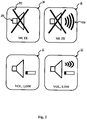
- Figure 2 are example visual indications according to the present principles.
- An icon 20 visually indicates that audio is muted by showing a strike-through loudspeaker 201.
- Icon 21 shows that audio is muted and additionally shows that audio data is present by showing sound waves 202 beside a strike-through loudspeaker.
- Icon 22 visually indicates that audio is not muted but volume is set below a certain level, for example too low to be audible, displaying a volume gauge with low volume indication.
- Icon 23 visually indicates that audio is not muted, that volume is set below the predetermined level, and that presence of audio is detected.
- the volume indication can also be realized without volume gauge and with soundwaves only, for example the display of only one soundwave out of maximum three means low level audio, while the display of two soundwaves indicates mean level audio, and the display of three soundwaves indicates high level audio.
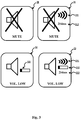
- FIG. 3 is a further example of visual indications according to the present principles.
- Icon 30 indicates that audio is muted and no presence of audio is detected: only a strike-through loudspeaker is shown.
- Icon 31 indicates that audio is muted (strike-through loudspeaker), that presence of audio is detected (audio waves 311), and a delay time 312 between the reception of the digital data stream after a channel/source change and detection of synchronization of audio data with video data.
- Icon 32 indicates that audio is not muted, that no presence of audio is detected (loudspeaker not stroked-through) and that volume is set to a level that is lower than a determined level (volume gauge 321 ), e.g., at an inaudible level.
- Icon 33 indicates that audio is not muted (loudspeaker not stroked-through) but is set to a low level that is under the previously mentioned determined level (volume gauge 332 ), that presence of audio is detected (sound waves 331 ), and further indicates a delay time 333 between the reception of the digital audio/video stream after a channel or source change and detection of synchronization of audio data with video data.
- Figure 4 is a further example visual indication according to the present principles.
- Icon 40 indicates with volume gauge 400 high level that while audio is muted, amplifier volume is set at a very high level. With this icon, the user of a device integrating the present principles is informed that if the audio is unmuted, the sound will be rendered with a very high volume. If this is not desired e.g., for hearing protection, the user can adjust the audio amplifier volume before unmuting the audio.
- FIG. 5 is an embodiment of an audio/video receiver with Picture in Picture (PIP) implementing the present principles.
- Element 52 is an image of a video received from a first source, e.g., from a digital terrestrial receiver comprised in the audio/video receiver.
- Element 50 is an image of a video received from a second source, e.g., from a satellite receiver connected to an external input of the audio/video receiver.
- the audio/video receiver enables to toggle audio focus between either one of the sources; i.e., if focus is set to the first source, audio is rendered that is associated with the first source. If focus is set to the second source, audio is rendered that is associated with the second source. In the example of figure 5 , focus is set to the second source.
- the visual indication 53 of the audio of the first source is grayed out, while the visual indication 51 of the audio associated with the second source is not.
- the visual indication 53 shows that audio is present but muted, even if the visual indication is for example grayed out to indicate that the focus is set to another source.
- the icon 51 shows that audio is present but muted.
- PAP Picture Aside Picture
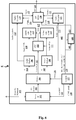
- Figure 6 is an embodiment of an audio/video receiver device implementing the present principles.
- the audio/video receiver device 6 comprises an audio presence supervisor 600.
- Audio presence supervisor 600 receives a first input signal 601 from controller 127. This input signal allows audio presence supervisor 600 to determine if audio is muted, unmuted, and at which level the volume is set, so that it can determine if audio level is set below a predetermined level, e.g. below an audible level.
- Audio presence supervisor 600 receives a second input signal 602 from audio sync comparator 113. This enables the audio presence supervisor to determine if audio data is present and synchronized.
- audio presence supervisor 600 receives further input from controller 127, for informing it of a channel change.
- audio presence supervisor 600 receives further input from a clock unit (not shown) and from network interface 101, which enables the audio presence supervisor 600 to determine delay time between a reception of a digital data stream and presence of associated audio.
- the audio presence supervisor further receives input from STC 110, enabling it to determine if a presentation time stamp of a currently decoded audio frame is within a tolerance value around a current value of the STC, thereby enabling it to detect a synchronization between the audio associated with the video.
- the tolerance value depends on requirements; e.g., for a Dolby ⁇ certification, the tolerance value is set to a maximum range of -10 to 15ms, while for basic lip synchronization, the tolerance value is set to a range of maximum -50 to +50ms.
- the audio presence supervisor 600 receives further input from a Control Access (CA) module for descrambling/decryption of digital streams that are protected through an access control mechanism.
- CA Control Access
- the audio presence supervisor 600 receives further input from a Control Access (CA) module for descrambling/decryption of digital streams that are protected through an access control mechanism. This enables it to detect if the audio descrambling is authorized or not, and to indicate presence of audio associated with video when audio can be descrambled. Alternatively, the presence of audio can be indicated, while, if the descrambling is not authorized by the access control module, an additional indication shows that descrambling is not authorized. The additional indication can take the form of a padlock or any other symbol that suggests locked access.
- FIG. 7 is a variant embodiment of a device 6 for implementing the present principles.
- the device comprises a central processing unit 70 or CPU, a network interface 74, an input interface 75, a clock unit 76, a non-volatile memory 71, a volatile memory 72, and an audio/video driver unit 73. All of these elements are connected to an internal data communication bus 77.
- Input interface 75 receives input commands such as channel change commands.
- Network interface 74 receives digital audio/video streams.
- Central processor 70 is configured to determine if audio data is present in an audio/video stream received, and further to determine if audio is muted and/or below a level, and to generate an appropriate visual indication using audio/video driver 73.
- Computer program instructions implementing the method according to the present principles are for example stored in non-volatile memory 71, while values of temporary variables such as current volume level or mute/unmute setting are stored in volatile memory 72.
- FIG 8 is a flow chart according to a particular embodiment of a method according to the present principles.
- the first step 800 is an initialization step wherein variables and parameters are initialized that are used for the method.
- a step 801 it is determined if audio data is present in a received digital audio/video stream. If audio data is present, it is verified in a step 802 if audio is muted and/or below a level.
- the level is for example a determined level e.g., a low audio level.
- the level is determined according to ambient noise, e.g., an audio level that is considered to be low with regard to the presence of ambient noise. For example, an audio level is considered to be too low to be clearly audible given a level of ambient noise.
- a visual indication of presence of audio data in the audio/video stream is generated in step 803, and the method returns to step 801.
- aspects of the present principles can be embodied as a system, method or computer readable medium. Accordingly, aspects of the present principles can take the form of an entirely hardware embodiment, an entirely software embodiment (including firmware, resident software, micro-code and so forth), or an embodiment combining hardware and software aspects that can all generally be defined to herein as a "circuit", "module” or “system”. Furthermore, aspects of the present principles can take the form of a computer readable storage medium. Any combination of one or more computer readable storage medium(s) can be utilized.
- a computer readable storage medium can take the form of a computer readable program product embodied in one or more computer readable medium(s) and having computer readable program code embodied thereon that is executable by a computer.
- a computer readable storage medium as used herein is considered a non-transitory storage medium given the inherent capability to store the information therein as well as the inherent capability to provide retrieval of the information there from.
- a computer readable storage medium can be, for example, but is not limited to, an electronic, magnetic, optical, electromagnetic, infrared, or semiconductor system, apparatus, or device, or any suitable combination of the foregoing.
Landscapes
- Engineering & Computer Science (AREA)
- Multimedia (AREA)
- Signal Processing (AREA)
- Databases & Information Systems (AREA)
- Two-Way Televisions, Distribution Of Moving Picture Or The Like (AREA)
- User Interface Of Digital Computer (AREA)
- Television Receiver Circuits (AREA)
Priority Applications (8)
| Application Number | Priority Date | Filing Date | Title |
|---|---|---|---|
| EP16305061.0A EP3197169A1 (fr) | 2016-01-25 | 2016-01-25 | Procédé de détection audio et dispositif correspondant |
| TW106101080A TWI735504B (zh) | 2016-01-25 | 2017-01-13 | 與數位聲視串流的視訊顯現關聯之聲頻狀態的視覺指示方法和配置 |
| US16/070,284 US10536745B2 (en) | 2016-01-25 | 2017-01-18 | Method for audio detection and corresponding device |
| PCT/EP2017/050937 WO2017129456A1 (fr) | 2016-01-25 | 2017-01-18 | Procédé de détection audio et dispositif correspondant |
| CN201780008118.0A CN108605156B (zh) | 2016-01-25 | 2017-01-18 | 用于音频检测的方法和对应设备 |
| KR1020187021233A KR102598367B1 (ko) | 2016-01-25 | 2017-01-18 | 오디오 검출을 위한 방법 및 대응하는 디바이스 |
| EP17702306.6A EP3409021A1 (fr) | 2016-01-25 | 2017-01-18 | Procédé de détection audio et dispositif correspondant |
| JP2018538603A JP7166922B2 (ja) | 2016-01-25 | 2017-01-18 | オーディオ検出のための方法および対応するデバイス |
Applications Claiming Priority (1)
| Application Number | Priority Date | Filing Date | Title |
|---|---|---|---|
| EP16305061.0A EP3197169A1 (fr) | 2016-01-25 | 2016-01-25 | Procédé de détection audio et dispositif correspondant |
Publications (1)
| Publication Number | Publication Date |
|---|---|
| EP3197169A1 true EP3197169A1 (fr) | 2017-07-26 |
Family
ID=55359475
Family Applications (2)
| Application Number | Title | Priority Date | Filing Date |
|---|---|---|---|
| EP16305061.0A Withdrawn EP3197169A1 (fr) | 2016-01-25 | 2016-01-25 | Procédé de détection audio et dispositif correspondant |
| EP17702306.6A Ceased EP3409021A1 (fr) | 2016-01-25 | 2017-01-18 | Procédé de détection audio et dispositif correspondant |
Family Applications After (1)
| Application Number | Title | Priority Date | Filing Date |
|---|---|---|---|
| EP17702306.6A Ceased EP3409021A1 (fr) | 2016-01-25 | 2017-01-18 | Procédé de détection audio et dispositif correspondant |
Country Status (7)
| Country | Link |
|---|---|
| US (1) | US10536745B2 (fr) |
| EP (2) | EP3197169A1 (fr) |
| JP (1) | JP7166922B2 (fr) |
| KR (1) | KR102598367B1 (fr) |
| CN (1) | CN108605156B (fr) |
| TW (1) | TWI735504B (fr) |
| WO (1) | WO2017129456A1 (fr) |
Cited By (1)
| Publication number | Priority date | Publication date | Assignee | Title |
|---|---|---|---|---|
| EP4285595A4 (fr) * | 2021-01-29 | 2024-06-26 | Vidaa USA, Inc. | Appareil d'affichage |
Families Citing this family (4)
| Publication number | Priority date | Publication date | Assignee | Title |
|---|---|---|---|---|
| US10011869B2 (en) * | 2015-03-06 | 2018-07-03 | Pillar Biosciences Inc. | Selective amplification of overlapping amplicons |
| US11245958B2 (en) * | 2018-11-16 | 2022-02-08 | Roku, Inc. | Detection of mute and compensation therefor during media replacement event |
| CA3195016A1 (fr) | 2020-10-06 | 2022-04-14 | Arris Enterprises Llc | Systeme et procede de commande audio de programmes video affiches simultanement |
| CN115712368A (zh) * | 2021-08-20 | 2023-02-24 | 华为技术有限公司 | 音量显示方法、电子设备及存储介质 |
Citations (1)
| Publication number | Priority date | Publication date | Assignee | Title |
|---|---|---|---|---|
| EP1071290A2 (fr) * | 1999-07-21 | 2001-01-24 | Thomson Licensing S.A. | Appareil de synchronisation pour un récepteur de son et vidéo comprimés |
Family Cites Families (40)
| Publication number | Priority date | Publication date | Assignee | Title |
|---|---|---|---|---|
| US5317558A (en) * | 1991-10-09 | 1994-05-31 | Pioneer Electronic Corporation | Electronic volume varying apparatus restricted by muting mode |
| JPH11316644A (ja) * | 1992-06-02 | 1999-11-16 | Matsushita Electric Ind Co Ltd | 情報処理装置 |
| JP2002521934A (ja) | 1998-07-24 | 2002-07-16 | リーズ テクノロジーズ リミテッド | ビデオ及びオーディオ同期化 |
| JP4170808B2 (ja) * | 2003-03-31 | 2008-10-22 | 株式会社東芝 | 情報表示装置、情報表示方法及びプログラム |
| CN1567985A (zh) * | 2003-06-30 | 2005-01-19 | 台达电子工业股份有限公司 | 视听装置的音量调低方法 |
| TW200601300A (en) * | 2003-06-30 | 2006-01-01 | Matsushita Electric Industrial Co Ltd | Apparatus and computer-readable program for generating volume image |
| CN1860544A (zh) * | 2003-09-25 | 2006-11-08 | 三星电子株式会社 | 显示音频和视频数据的设备和方法以及在其上记录有用于执行该显示方法的程序的存储介质 |
| KR101041810B1 (ko) * | 2004-08-27 | 2011-06-17 | 엘지전자 주식회사 | 영상기기 및 그의 자동 캡션 수행 방법 |
| CN101112082A (zh) * | 2005-01-31 | 2008-01-23 | 汤姆森许可贸易公司 | 用于在音频静音时显示文字服务的方法和设备 |
| CN100472636C (zh) * | 2005-12-06 | 2009-03-25 | 上海乐金广电电子有限公司 | 音频静音软解除设备及其方法 |
| JP2008053770A (ja) * | 2006-08-22 | 2008-03-06 | Matsushita Electric Ind Co Ltd | リモコンキー認識表示システム |
| CN101431638A (zh) * | 2007-11-07 | 2009-05-13 | 深圳华为通信技术有限公司 | 一种媒体播放的音量调节方法和装置 |
| JP4259602B1 (ja) * | 2008-02-05 | 2009-04-30 | オンキヨー株式会社 | ミュート制御装置、ミュート制御方法及びミュート制御プログラム |
| KR20100027714A (ko) * | 2008-09-03 | 2010-03-11 | 엘지전자 주식회사 | 텔레텍스트 디스플레이 장치 및 방법 |
| US20100074450A1 (en) * | 2008-09-23 | 2010-03-25 | Shiun-Chih Liao | System for adjusting playing volume automatically and method for the same |
| WO2010069375A1 (fr) | 2008-12-17 | 2010-06-24 | Telefonaktiebolaget L M Ericsson (Publ) | Procédé et appareil de mesure de synchronisation audiovisuelle |
| JP2011101097A (ja) * | 2009-11-04 | 2011-05-19 | Fujitsu Ltd | 無線通信装置、イベント発生通知用コンピュータプログラム及びイベント発生通知方法 |
| TWI441527B (zh) * | 2010-06-07 | 2014-06-11 | Hannstar Display Corp | 音訊調整系統及方法 |
| CN102404131B (zh) * | 2010-07-29 | 2015-03-25 | 株式会社理光 | 通讯终端、通讯管理系统、通讯系统、声音输入部登录方法 |
| KR20120019030A (ko) * | 2010-08-24 | 2012-03-06 | 엘지전자 주식회사 | 디스플레이장치 및 그의 볼륨 레벨 조절 방법 |
| US8736700B2 (en) * | 2010-09-30 | 2014-05-27 | Apple Inc. | Techniques for synchronizing audio and video data in an image signal processing system |
| US20120087516A1 (en) * | 2010-10-08 | 2012-04-12 | Umesh Amin | System and methods for dynamically controlling atleast a media content with changes in ambient noise |
| JP5735269B2 (ja) * | 2010-12-24 | 2015-06-17 | 京セラ株式会社 | 受信装置、携帯通信端末、字幕表示制御プログラムおよび字幕表示制御方法 |
| US8441577B2 (en) * | 2011-02-08 | 2013-05-14 | Echostar Technologies L.L.C. | Apparatus, systems and methods for synchronization of a video stream and an audio stream |
| US9179118B2 (en) | 2011-05-12 | 2015-11-03 | Intel Corporation | Techniques for synchronization of audio and video |
| JP5076014B1 (ja) * | 2011-06-10 | 2012-11-21 | 株式会社東芝 | 電子機器、電子機器の制御装置、電子機器の制御方法 |
| KR101883178B1 (ko) * | 2011-10-12 | 2018-07-30 | 엘지전자 주식회사 | 영상표시장치 및 그 동작방법 |
| US9491505B2 (en) * | 2012-02-28 | 2016-11-08 | Qualcomm Incorporated | Frame capture and buffering at source device in wireless display system |
| JP5957760B2 (ja) * | 2012-03-08 | 2016-07-27 | パナソニックIpマネジメント株式会社 | 映像音声処理装置 |
| US8468563B1 (en) * | 2012-04-30 | 2013-06-18 | This Technology, Inc. | Method for ingesting multiple signals of the same meaning |
| US9535653B2 (en) * | 2012-08-31 | 2017-01-03 | Google Inc. | Adjusting audio volume of multimedia when switching between multiple multimedia content |
| KR20140114238A (ko) * | 2013-03-18 | 2014-09-26 | 삼성전자주식회사 | 오디오와 결합된 이미지 표시 방법 |
| KR20140140829A (ko) * | 2013-05-30 | 2014-12-10 | 현대모비스 주식회사 | 소음 측정을 통한 차량 오디오의 자동 볼륨 조절 장치 및 방법 |
| TWI561070B (en) | 2014-01-03 | 2016-12-01 | Mstar Semiconductor Inc | Decoder and decoding method for audio video stream synchronization |
| US10073671B2 (en) * | 2014-01-20 | 2018-09-11 | Lenovo (Singapore) Pte. Ltd. | Detecting noise or object interruption in audio video viewing and altering presentation based thereon |
| CN104105031A (zh) * | 2014-06-27 | 2014-10-15 | 中科创达软件股份有限公司 | 一种音量调节方法及装置 |
| JP6038848B2 (ja) * | 2014-09-01 | 2016-12-07 | ヤフー株式会社 | 再生プログラム、配信装置、再生方法および情報処理装置 |
| US10055887B1 (en) * | 2015-02-19 | 2018-08-21 | Google Llc | Virtual/augmented reality transition system and method |
| US11070864B2 (en) * | 2015-10-14 | 2021-07-20 | Sony Group Corporation | Auto pause when disturbed |
| WO2017174150A1 (fr) * | 2016-04-08 | 2017-10-12 | Arcelik Anonim Sirketi | Dispositif d'affichage d'image ayant une fonction de réglage du niveau de volume adaptatif |
-
2016
- 2016-01-25 EP EP16305061.0A patent/EP3197169A1/fr not_active Withdrawn
-
2017
- 2017-01-13 TW TW106101080A patent/TWI735504B/zh active
- 2017-01-18 CN CN201780008118.0A patent/CN108605156B/zh active Active
- 2017-01-18 EP EP17702306.6A patent/EP3409021A1/fr not_active Ceased
- 2017-01-18 KR KR1020187021233A patent/KR102598367B1/ko active Active
- 2017-01-18 JP JP2018538603A patent/JP7166922B2/ja active Active
- 2017-01-18 US US16/070,284 patent/US10536745B2/en active Active
- 2017-01-18 WO PCT/EP2017/050937 patent/WO2017129456A1/fr not_active Ceased
Patent Citations (1)
| Publication number | Priority date | Publication date | Assignee | Title |
|---|---|---|---|---|
| EP1071290A2 (fr) * | 1999-07-21 | 2001-01-24 | Thomson Licensing S.A. | Appareil de synchronisation pour un récepteur de son et vidéo comprimés |
Non-Patent Citations (2)
| Title |
|---|
| ANONYMOUS: "Codecinfo - Kodi", 29 July 2015 (2015-07-29), XP055279166, Retrieved from the Internet <URL:http://kodi.wiki/view/codecinfo> [retrieved on 20160609] * |
| WALTER FISCHER: "The MPEG Data Stream", 1 January 2004, DIGITAL TELEVISION: A PRACTICAL GUIDE FOR ENGINEERS, SPRINGER, PAGE(S) 26 - 28, ISBN: 978-3-540-01155-2, XP008147516 * |
Cited By (2)
| Publication number | Priority date | Publication date | Assignee | Title |
|---|---|---|---|---|
| EP4285595A4 (fr) * | 2021-01-29 | 2024-06-26 | Vidaa USA, Inc. | Appareil d'affichage |
| US12452480B2 (en) | 2021-01-29 | 2025-10-21 | VIDAA USA, Inc. | Display apparatus |
Also Published As
| Publication number | Publication date |
|---|---|
| EP3409021A1 (fr) | 2018-12-05 |
| KR102598367B1 (ko) | 2023-11-03 |
| TWI735504B (zh) | 2021-08-11 |
| CN108605156B (zh) | 2022-11-15 |
| JP2019507978A (ja) | 2019-03-22 |
| CN108605156A (zh) | 2018-09-28 |
| US20190020918A1 (en) | 2019-01-17 |
| JP7166922B2 (ja) | 2022-11-08 |
| US10536745B2 (en) | 2020-01-14 |
| WO2017129456A1 (fr) | 2017-08-03 |
| TW201737717A (zh) | 2017-10-16 |
| KR20180104627A (ko) | 2018-09-21 |
Similar Documents
| Publication | Publication Date | Title |
|---|---|---|
| US9210360B2 (en) | Volume level-based closed-captioning control | |
| US10178345B2 (en) | Apparatus, systems and methods for synchronization of multiple headsets | |
| US7975285B2 (en) | Broadcast receiver and output control method thereof | |
| US10536745B2 (en) | Method for audio detection and corresponding device | |
| US20110176060A1 (en) | Data feedback for broadcast applications | |
| US8542320B2 (en) | Method and system to control a non-gesture controlled device using gesture interactions with a gesture controlled device | |
| US10250927B2 (en) | Method and apparatus for synchronizing playbacks at two electronic devices | |
| WO2015116164A1 (fr) | Procédé et appareil de synchronisation de lectures au niveau de deux dispositifs électroniques | |
| US20150215564A1 (en) | Methods and apparatus for creation of a reference time index for audio/video programming | |
| US20110216242A1 (en) | Linkage method of video apparatus, video apparatus and video system | |
| JP2019507978A5 (fr) | ||
| WO2014155621A1 (fr) | Dispositif de communication, procédé de communication, et programme | |
| US10728485B2 (en) | Multi-mode input control unit with infrared and laser capability | |
| US20120042249A1 (en) | Audio signal output apparatus and method | |
| KR20110018543A (ko) | 디스플레이장치 및 그의 립싱크 제어 방법 | |
| CN102316291B (zh) | 调制信号处理装置及调制信号处理方法 | |
| KR20110042443A (ko) | 디스플레이장치 및 그의 제어 방법 | |
| JP2019186832A (ja) | 放送受信装置及び放送受信方法 | |
| KR20050107227A (ko) | 방송 수신기의 영상 출력 제어 장치 | |
| KR20100004543A (ko) | 영상표시기기 및 그의 신호 세기 표시 방법 |
Legal Events
| Date | Code | Title | Description |
|---|---|---|---|
| PUAI | Public reference made under article 153(3) epc to a published international application that has entered the european phase |
Free format text: ORIGINAL CODE: 0009012 |
|
| AK | Designated contracting states |
Kind code of ref document: A1 Designated state(s): AL AT BE BG CH CY CZ DE DK EE ES FI FR GB GR HR HU IE IS IT LI LT LU LV MC MK MT NL NO PL PT RO RS SE SI SK SM TR |
|
| AX | Request for extension of the european patent |
Extension state: BA ME |
|
| STAA | Information on the status of an ep patent application or granted ep patent |
Free format text: STATUS: THE APPLICATION IS DEEMED TO BE WITHDRAWN |
|
| 18D | Application deemed to be withdrawn |
Effective date: 20180127 |