EP3198384B1 - Procédé et appareil pour améliorer la précision d'analyse d'événements d'écran tactile par utilisation d'une classification de bord - Google Patents
Procédé et appareil pour améliorer la précision d'analyse d'événements d'écran tactile par utilisation d'une classification de bord Download PDFInfo
- Publication number
- EP3198384B1 EP3198384B1 EP15843989.3A EP15843989A EP3198384B1 EP 3198384 B1 EP3198384 B1 EP 3198384B1 EP 15843989 A EP15843989 A EP 15843989A EP 3198384 B1 EP3198384 B1 EP 3198384B1
- Authority
- EP
- European Patent Office
- Prior art keywords
- touch
- region
- classification
- touch event
- event
- Prior art date
- Legal status (The legal status is an assumption and is not a legal conclusion. Google has not performed a legal analysis and makes no representation as to the accuracy of the status listed.)
- Active
Links
Images

Classifications
-
- G—PHYSICS
- G06—COMPUTING OR CALCULATING; COUNTING
- G06F—ELECTRIC DIGITAL DATA PROCESSING
- G06F3/00—Input arrangements for transferring data to be processed into a form capable of being handled by the computer; Output arrangements for transferring data from processing unit to output unit, e.g. interface arrangements
- G06F3/01—Input arrangements or combined input and output arrangements for interaction between user and computer
- G06F3/03—Arrangements for converting the position or the displacement of a member into a coded form
- G06F3/041—Digitisers, e.g. for touch screens or touch pads, characterised by the transducing means
- G06F3/0416—Control or interface arrangements specially adapted for digitisers
-
- G—PHYSICS
- G06—COMPUTING OR CALCULATING; COUNTING
- G06F—ELECTRIC DIGITAL DATA PROCESSING
- G06F3/00—Input arrangements for transferring data to be processed into a form capable of being handled by the computer; Output arrangements for transferring data from processing unit to output unit, e.g. interface arrangements
- G06F3/01—Input arrangements or combined input and output arrangements for interaction between user and computer
- G06F3/03—Arrangements for converting the position or the displacement of a member into a coded form
- G06F3/041—Digitisers, e.g. for touch screens or touch pads, characterised by the transducing means
- G06F3/0416—Control or interface arrangements specially adapted for digitisers
- G06F3/0418—Control or interface arrangements specially adapted for digitisers for error correction or compensation, e.g. based on parallax, calibration or alignment
- G06F3/04186—Touch location disambiguation
-
- G—PHYSICS
- G06—COMPUTING OR CALCULATING; COUNTING
- G06F—ELECTRIC DIGITAL DATA PROCESSING
- G06F2203/00—Indexing scheme relating to G06F3/00 - G06F3/048
- G06F2203/041—Indexing scheme relating to G06F3/041 - G06F3/045
- G06F2203/04106—Multi-sensing digitiser, i.e. digitiser using at least two different sensing technologies simultaneously or alternatively, e.g. for detecting pen and finger, for saving power or for improving position detection
-
- G—PHYSICS
- G06—COMPUTING OR CALCULATING; COUNTING
- G06F—ELECTRIC DIGITAL DATA PROCESSING
- G06F3/00—Input arrangements for transferring data to be processed into a form capable of being handled by the computer; Output arrangements for transferring data from processing unit to output unit, e.g. interface arrangements
- G06F3/01—Input arrangements or combined input and output arrangements for interaction between user and computer
- G06F3/03—Arrangements for converting the position or the displacement of a member into a coded form
- G06F3/041—Digitisers, e.g. for touch screens or touch pads, characterised by the transducing means
- G06F3/043—Digitisers, e.g. for touch screens or touch pads, characterised by the transducing means using propagating acoustic waves
Definitions
- the present invention relates generally to the field of touch screen technology and more particularly to the addition of an edge touch classifier to increase the accuracy of the analysis of touch screen events.
- US 2009/0174679 A1 discloses systems and methods for selective rejection of touch contacts in an edge region of a touch sensor panel.
- US 2014/071095 A1 discloses systems and methods for processing acoustic signal data to determine where and/or whether an object has been tapped with a stylus, pen, finger nail or the like.
- Various electronic devices today are typically operated by a user interacting with a touch sensitive screen. This feature is particularly a characteristic of the recent generation of smart phones.
- the touch sensitive screens respond to linger contact to activate the display for further processes. Contact may also be made using tools such as a stylus or other parts of the hands.
- the lingers and other contacts made to the touch sensitive screen generally appear as an activated point or blob (i.e., region).
- WO 2009/071919 A1 discloses a controller that has at least one control element for operation by a user, for example by being deformed or displaced by the user's digits.
- the controller has a vibrational sensor for detecting a first vibrational signal caused by deformation or displacement of the control element due to a contact action caused by a user and/or a recovery from such a deformation or displacement of the control element.
- the controller may also have a textured surface for being scratched or stroked by the user to cause corresponding vibrational signals.
- the controller further includes processing means for processing the vibrational signal to enable classification into corresponding characteristic classes of vibrational signal from which a control signal is derivable.
- the controller may be used, for example, to control a music player or a mobile telephone.
- WO 2011/096694 A2 discloses a user interface using an acoustic signal.
- a device with the user interface includes a sensor to acquire a surface acoustic signal generated outside of the device, and at least one processor.
- the processor classifies patterns of the surface acoustic signal by analyzing features of the surface acoustic signal and identifies a user's input signal corresponding to the surface acoustic signal based on the pattern of the surface acoustic signal.
- US 2014/210788 A1 discloses an apparatus classifying touch events.
- the apparatus includes a touch sensitive surface configured to generate a touch event when an object touches the touch sensitive surface.
- the touch event entails a mechanical vibration upon contact with the surface.
- the apparatus includes a touch event detector configured to detect the onset of a touch, and a touch event classifier configured to classify the touch event to identify the object used for the touch event.
- the mechanical vibration is created via any one of finger parts including a tip, a pad, a fingernail, and a knuckle, each of which has a unique feature different from each other.
- US 2004/021681 A1 discloses a dual-touch-screen mobile computer adapted to receive input information by touching a surface of a main screen or a surface of a sub-screen thereof.
- the dual-touch-screen mobile computer comprises a main screen portion having a main screen mounted on the surface thereof and the computer module mounted within the main screen portion.
- the dual-touch-screen mobile computer also comprises a sub-screen portion pivotally coupled to the main screen portion and having a sub-screen mounted on the surface thereof and the embedded system module mounted within the sub-screen portion.
- Both the main screen and the sub-screen are touch-screen type flat panel display screens, thereby allowing a user to input data or commands into the dual-touch-screen mobile computer by physically touching the surface of the main screen or the surface of the sub-screen.
- US 2014/253477 A1 discloses a mobile terminal which includes a terminal body, a display mounted to the terminal body, a window disposed to cover the display and including central and edge regions.
- the central region is formed of a transmissive material and configured to align with the display, and the edge region is formed of an opaque material and configured to surround the central region.
- the mobile terminal further includes a first touch sensor disposed to span at least the central region and configured to detect a touch input to the central region; and a second touch sensor disposed to span at least part of the edge region and configured to detect a touch input to the at least part of the edge region, wherein the second touch sensor is configured to have a higher touch sensitivity than the first in order to detect a touch input to the opaque edge region.
- the touch sensitive screen may be associated with a classification engine which is normally trained on real world touch event data from users.
- classifiers in the classification engine
- receive few edge training instances In response, the classification accuracy of edge touch events tends to be lower. Further, because less of the touch contact is visible, there is less data to work with. This leads to several problems, most notably that classification algorithms may over-fit to the limited data.
- edge contacts appear very different to full-contact, ordinary touches, leading to bi-modal (or even multi-modal) distributions of key characteristics to which some classification algorithms are ill-suited to accommodate. There is therefore a need to mitigate the potential problems associated with edge touch events that could otherwise reduce the accuracy of such classification analysis.
- edge contacts are processed by a classifier that is better suited to process edge contacts (e.g. it has been trained on edge contacts).
- touches that occur in the middle of the screen are processed by another classifier.
- One or more embodiments may be implemented in numerous ways, including as a process, an apparatus, a system, a device, a method, a computer readable medium such as a computer readable storage medium containing computer readable instructions or computer program code, or as a computer program product comprising a computer usable medium having a computer readable program code embodied therein.
- the disclosed embodiments include apparatus for improving accuracy of touch screen event analysis and comprise two separate and distinct classifiers.
- a first classifier is a full touch classifier.
- a second classifier Z is an edge touch classifier.
- the touch screen is provided with two similarly distinct sensing regions.
- One such sensing region is derived from the conventional touch screen and is generally the bulk of the central area of the touch screen, but somewhat reduced in size relative to the entire physical extent of the touch screen. The balance of the touch screen around the periphery, forms the second sensing region which is everywhere proximate to the screen edge.
- this edge touch sensing region is chosen to enable a high probability that any finger touch that might extend beyond the edge of the touch screen would be treated as an edge touch event which will instigate edge touch classifier operation instead of full touch classifier operation during the ensuing analysis of the event.
- the disclosed embodiments include a method for improving accuracy of touch screen event analysis and comprise detecting a touch event on a touch sensitive screen, said surface having at least two touch regions; generating a vibro-acoustic waveform signal using at least one sensor detecting such touch event; converting the waveform signal into at least one other form; extracting distinguishing features from said converted waveform signal; and classifying said features to analyze the features of the converted touch event waveform signal by employing one of at least two different classification processes depending on which of the two distinct touch regions was touched during the touch event,
- the disclosed embodiments include a machine-readable medium carrying one or more sequences of instructions for providing social information, which instructions, when executed by one or more processors, cause the one or more processors to detect a touch event on a touch sensitive screen, said surface having at least two touch regions, generate a vibro-acoustic waveform signal using at least one sensor detecting such touch event, convert the waveform signal into at least one other form, extract distinguishing features from said converted waveform signal, and classify said features to analyze the features of the converted touch event waveform signal by employing one of at least two different classification processes depending on which of the two distinct touch regions was touched during the touch event.
- a user may make contact with a touch sensitive screen of a touch sensitive device or computer system using a stylus or other parts of the hands such as the palm and various parts of the finger, i.e., pad, nail, knuckle, etc.
- a touch sensitive screen of a touch sensitive device or computer system may have his or her own unique touch event characteristics resulting from anatomical differences such as fleshiness, finger size, finger shape, BMI and the like.
- These differences in touch event characteristics may be used advantageously to improve the touch screen technology by reducing ambiguities, distinguishing between users, responding only to intentional touch events and the like.
- Such advantageous uses are derived from sophisticated sensor-based analysis of the touch event coupled with one or more algorithms designed to provide further analytical characteristics otherwise hidden or not readily apparent in the data generated by the touch event.
- the vibro-acoustic signal can be converted into a series of features, for example: Average acoustic power, Standard Deviation, Variance, Skewness, Kurtosis, Absolute sum, Root Mean Square (RMS), Dispersion, Zero-crossings, Spectral centroid, Spectral density, Linear Prediction-based Cepstral Coefficients (LPCC), Perceptual Linear Prediction (PLP), Cepstral Coefficients Cepstrum Coefficients, Mel-Frequency Cepstral Coefficients (MFCC), Frequency phases (e.g., as generated by an FFT).
- LPCC Linear Prediction-based Cepstral Coefficients
- PDP Perceptual Linear Prediction
- Cepstral Coefficients Cepstrum Coefficients Cepstrum Coefficients
- MFCC Mel-Frequency Cepstral Coefficients
- touch screen technologies are able to digitize several aspects of a touch event, such as the shape, size, capacitance, orientation, pressure, etc.
- the latter may be used as distinguishing features, or such features can be derived from them.
- the vibro-acoustic features and touch features contain properties that can be characteristic of different users and different parts of user's hands (e.g., fingertip, knuckle, and nail).
- the disclosed method may include the following operations and may employ the following components:
- a classifier may be configured to use one or more of the following features to perform its operations: location of touch contact (2D, or 3D in the case of curved glass or other non-planar geometry), size of touch contact (some touch technologies provide an ellipse of the touch contact with major and minor axes), rotation of the touch contact, surface area of the touch contact (e.g., in squared mm or pixels), pressure of touch (available on some touch systems), shear of touch ("shear stress", also called “tangential force'- in the literature, arises from a force vector perpendicular to the surface normal of a touch screen.
- the computation phase may also compute the derivative of the above features over a short period of time, for example, touch velocity and pressure velocity.
- classifier may also use include shape of touch (some touch technologies can provide the actual shape of the touch, and not just a circle or ellipse), and image of the hand pose (as imaged by e.g., an optical sensor, diffuse illuminated surface with camera, near-range capacitive sensing).
- the classification engine may use any number of approaches, including but not limited to basic heuristics, decision trees, Support Vector Machine, Random Forest, Naive bayes, elastic matching, dynamic time warping, template matching, k-means clustering, K-nearest neighbors algorithm, neural network. Multilayer perceptron, multinomial logistic regression. Gaussian mixture models and AdaBoost. Additionally, the results from several different classifiers may be combined through, for example, a voting scheme.
- classifiers may be used based on one or more features. For example, two classifiers could be employed, one for processing sensor waveforms with a high Standard Deviation, and another classifier for waveforms with low Standard Deviation.
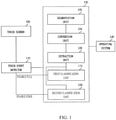
- FIG. 1 is a block diagram of an example computing system for analyzing a touch event based on use of one of two different classifications of resulting signals in accordance with an embodiment of the present invention.
- the computing system of the embodiment may have an operating (OS), and can run various types of services or applications, known as apps.
- the computing system may also be equipped with a telecommunication capability that can allow connections to a communications network.
- Such a computing system may include, but not be limited to, a table top computer (e.g., Surface Computing), laptop computer, desktop computer, mobile computer, mobile internet device, mobile phone, smart-phone.
- PDA Personal Digital Assistant
- game console Portable media player, and the like.
- the computing system includes a touch screen 100, a touch event detector 110, a classifier 120 and an OS 130.
- the touch screen 100 is an electronic visual display and serves also as an input/output device supplementing or substituted tor a keyboard, a mouse, and/or other types of devices.
- the touch screen 100 displays one or more interactive elements such as graphical representation for services or applications designed to perform a specific function on the computing system. Touching the interactive elements with the finger parts of a user, including the conventional tip of the finger, causes the OS 130 to activate the application or service related to the interactive elements appropriate to the identified user. Fingers are diverse appendages, both in their motor capabilities and their anatomical compositions. A single digit contains different parts such as one or more knuckles, a tip, pad and fingernail.
- vibro-acoustic waves When an object strikes a certain material, vibro-acoustic waves propagate outward through the material or along the surface of the material.
- interactive surfaces use rigid materials, such as plastic or glass, which both quickly distribute and faithfully preserve the signal.
- vibro-acoustic responses are produced. The vibro-acoustic characteristics of the respective user fingers and their respective unique anatomical characteristics produce unique responses for each user.
- the touch event detector 110 detects the touch event entailing the vibro-acoustic signal.
- the touch event detector 110 may be arranged at a rear side of the touch screen so that the vibro-acoustic signal caused by the touch event can be captured.
- the touch event detector 110 can be triggered by the onset of the vibro-acoustic signal resulting from the touch event.
- the touch event detector 110 may include one or more impact sensors, vibration sensors, accelerometers, strain gauges, or acoustic sensors such as a condenser microphone a piezoelectric microphone, MEMS microphone and the like.
- the OS 130 runs the computing system so that the function can be activated in line with the classification of the vibro-acoustic signals and the corresponding user.
- the vibro-acoustic classifier 120 includes a segmentation unit 122 to segment the vibro-acoustic signal into a digital representation; a conversion unit 124 to convert the digitized vibro-acoustic signal into an electrical signal; a feature extraction unit 126 to derive a series of features from the electrical signal; and two classification units 128 and 129 to classify each user using the above-described features to analyze the touch event depending upon whether it was a full screen touch event or an edge touch event as will be further described below.
- the segmentation unit 122 samples the vibro-acoustic signal, for example, at a sampling rate of 96 kHz, using a sliding window of 4096 samples of the vibro-acoustic signal.
- the conversion unit 124 then performs, for example, a Fourier Transform on sampled time-dependent vibro-acoustic signal to produce an electrical signal having frequency domain representation. For example, the Fourier Transform of this window may produce 2048 bands of frequency power.
- the vibro-acoustic classifier 120 may further down-sample this data into additional vectors (i.e., buckets often), providing a different aliasing, in addition, additional time-domain features may be calculated from the vibro-acoustic signal, such as the average absolute amplitude, total absolute amplitude, standard deviation of the absolute amplitude, the center of mass for both the segmented input signal and the Fourier Transformed signal, and zero crossings.
- additional vectors i.e., buckets often
- additional time-domain features may be calculated from the vibro-acoustic signal, such as the average absolute amplitude, total absolute amplitude, standard deviation of the absolute amplitude, the center of mass for both the segmented input signal and the Fourier Transformed signal, and zero crossings.
- the feature extraction unit 126 may also calculate a series of features from the frequency domain representation of the vibro-acoustic signals, such as the fundamental frequency of the impact waveform,
- the classification units 128 and 129 classify the vibro-acoustic signal using the features to for example distinguish what user generated the touch event, so that the computing system may selectively activate a function related to the identified user depending on the classified vibro-acoustic signals.
- a device 134 i.e., a smart phone
- a touch screen 136 has a touch screen 136.
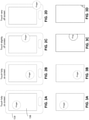
- Figures 2A and 2B illustrate two examples of touch events that are fully on screen 136.
- Figures 2C and 2D illustrate two further examples of touch events that are partially off the edge of screen 136.
- Figures 3A through 3D illustrate what the touch screen "sees" as a result of the touch events of Figures 2A to 2D .
- fully on screen touch events of Figures 2A and 2B result in fully configured touch events which, in the embodiment of Figure 1 , are classified by the first classifier 128.
- touch events which are partially off the edge of the screen 136 as depicted in Figures 2C and 2D are "seen" as partially configured edge touch events which, in the embodiment of Figure 1 , are classified by the second classifier 129.
- FIG. 4 One way of determining whether to enable the first classifier 128 or instead to enable the second classifier 129 for each touch event, is illustrated in Figure 4 .
- a device 134 having a modified touch screen 135 is illustrated. The modification consists of dividing the touch screen into two regions 140 and 150. Region 140 is a full touch classification region and region 150 is an edge touch classification region. In the illustrative embodiment if the touch event is entirely within full touch region 140, only the first classification unit 128 is enabled. However, if any portion of the touch event is within edge touch region 150, only the second classification unit 129 is enabled. Alternatively, the centroid (i.e., weighted center) of the touch contact can be used to decide what classifier is triggered.
- centroid i.e., weighted center
- the full touch first classification unit 128 is “trained” to analyze full touch events.
- the edge touch second classification unit 129 is “trained” to analyze edge touch events. In this manner, classification of touch screen events has a significant probability of being more accurate than in those systems that utilize only one classification unit for all touch events including edge touch events as depicted herein.
- the user can provide supplemental training samples to the vibro-acoustic classifier 120.
- the classification units 128 and 129 may be implemented with a support vector machine (SVM) for feature classification.
- SVM is a supervised learning model with associated learning algorithms that analyze data and recognize patterns, used for classification and regression analysis.
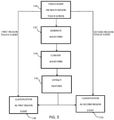
- FIG. 5 illustrates the process steps of an exemplary embodiment of the invention.
- a touch event is detected on a multi-region touch screen. This results in generation of a waveform in step 142.
- the waveform is converted in step 144 and features are extracted in step 146. Then classification of the extracted features occurs in either step 148 or step 150 depending upon whether the touch event occurred in a first or second region.
- At least one sensor may be employed to detect and capture a waveform signal or acoustical or mechanical effect resulting from a touch event.
- the waveform signal is converted, and distinguishing features are extracted for use in two distinct classification units to associate such features with the user.
- a full touch event classifier is trained for such full events, while an edge touch event classifier is trained for analyzing only edge touch events.
- the appropriate classifier is enabled by a touch screen having two distinct regions, full and edge and in response to the location of the touch event relative to these two regions.
- machine-readable media that include program instructions, state information, etc., for performing various operations described herein.
- program instructions include both machine code, such as produced by a compiler, and files containing higher-level code that may be executed by the computer using an interpreter.
- machine-readable media include, but are not limited to, magnetic media such as hard disks, floppy disks, and magnetic tape; optical media such as CD-ROM disks; magneto-optical media; and hardware devices that are specially configured to store and perform program instructions, such as read-only memory (“ROM”) and random access memory (“RAM”).
- any of the above embodiments may be used alone or together with one another in any combination.
- various embodiments may have been motivated by various deficiencies with the prior art, which may be discussed or alluded to in one or more places in the specification, the embodiments do not necessarily address any of these deficiencies.
- different embodiments may address different deficiencies that may be discussed in the specification.
- Some embodiments may only partially address some deficiencies or just one deficiency that may be discussed in the specification, and some embodiments may not address any of these deficiencies.
Landscapes
- Engineering & Computer Science (AREA)
- General Engineering & Computer Science (AREA)
- Theoretical Computer Science (AREA)
- Human Computer Interaction (AREA)
- Physics & Mathematics (AREA)
- General Physics & Mathematics (AREA)
- User Interface Of Digital Computer (AREA)
Claims (13)
- Appareil pour analyser des événements tactiles générés par des utilisateurs sur la base d'une caractérisation de caractéristiques dérivées d'un événement tactile ;
l'appareil comprenant :un écran tactile (100) ayant une surface pour détecter un événement tactile généré par au moins un utilisateur, ladite surface ayant au moins deux régions tactiles distinctes (140, 150) ;au moins un capteur (110) générant un signal de forme d'onde vibro-acoustique à partir d'un tel événement tactile ;un convertisseur (124) pour convertir le signal de forme d'onde vibro-acoustique en le transformant d'une représentation dans le domaine temporel en une représentation dans le domaine fréquentiel pour obtenir un signal de domaine ;un extracteur de caractéristiques (126) pour extraire des caractéristiques distinctives à partir dudit signal de domaine ; et caractérisé par :
une pluralité d'unités de classification (128, 129) qui utilisent les caractéristiques distinctives extraites par ledit extracteur (126) pour analyser les caractéristiques distinctives du signal de domaine, une première des unités de classification (128) associée à une première des régions tactiles et une seconde des unités de classification (129) associée à une seconde des régions tactiles, où la première unité de classification (128) est un classificateur de toucher complet et la seconde unité de classification (129) est un classificateur de toucher de bord, dans lequel la seconde région tactile distincte comprend une région (150) proche du bord dudit écran tactile (100) et la première région tactile comprend une région (140) formant la zone centrale dudit écran tactile (100), et où ladite première unité de classification (128) est utilisée uniquement pour l'événement tactile se trouvant entièrement dans la première région tactile et ladite seconde unité de classification (129) est utilisée pour toute partie de l'événement tactile se trouvant dans la seconde région tactile. - Appareil décrit dans la revendication 1, dans lequel ledit écran tactile (100) comprend une région de bord (150) et une région centrale (140).
- Appareil décrit dans la revendication 1, dans lequel ledit écran tactile (100) active une dite unité de classification (128, 129) en fonction celle desdites au moins deux régions tactiles distinctes (140, 150) qui est touchée pendant un événement tactile.
- Appareil décrit dans la revendication 1 dans lequel ledit au moins un capteur (110) détecte les vibrations mécaniques initiées par ledit événement tactile.
- Appareil décrit dans la revendication 1, dans lequel ledit au moins un capteur comprend un capteur (110) pris dans le groupe de capteurs constitué de capteurs d'impact, de capteurs de vibration, d'accéléromètres, de jauges de contrainte, de dispositifs piézoélectriques et de capteurs acoustiques.
- Appareil décrit dans la revendication 1, dans lequel lesdites caractéristiques distinctives sont extraites sur la base d'au moins un calcul d'une caractéristique prise dans le groupe constitué de la moyenne, de l'écart type, de la variance, de l'asymétrie, de l'aplatissement, de la somme, de la moyenne quadratique, du facteur de crête, de la dispersion, de l'entropie, de la somme de puissance, du centre de masse, du coefficient de variation, de la corrélation croisée, des passages par zéro, de la saisonnalité, de la polarisation continue, du barycentre spectral, de la densité spectrale, des harmoniques sphériques, de l'énergie spectrale, du rapport d'énergie de bande, par des rapports de bande spectrale, des coefficients cepstraux et du contenu de la transformée de Fourier.
- Procédé d'analyse d'événements tactiles générés par des utilisateurs, basé sur la caractérisation de caractéristiques dérivées d'un événement tactile, le procédé comprenant les étapes suivantes :détecter un événement tactile sur une surface d'un écran tactile (100) généré par un utilisateur, ladite surface ayant au moins deux régions tactiles distinctes (140, 150) ;générer un signal de forme d'onde vibro-acoustique en utilisant au moins un capteur (110) détectant un tel événement tactile ;convertir le signal de forme d'onde vibro-acoustique en le transformant d'une représentation dans le domaine temporel en une représentation dans le domaine fréquentiel pour obtenir un signal de domaine ;extraire des caractéristiques distinctives à partir dudit signal de domaine ; et caractérisé par les étapes suivantes :
classer lesdites caractéristiques distinctives pour analyser les caractéristiques distinctives du signal de domaine en employant l'un d'au moins deux processus de classification différents en fonction de celle des deux régions tactiles distinctes (140, 150) qui a été touchée pendant l'événement tactile, où un premier processus de classification est un processus de classification de toucher complet et un second processus de classification est un processus de classification de toucher de bord, où une première desdites deux régions tactiles distinctes comprend une région (140) formant la zone centrale dudit écran tactile (100) et une seconde des deux régions tactiles distinctes comprend une région (150) proche du bord de l'écran tactile, et où l'un desdits premiers processus de classification est employé uniquement pour l'événement tactile se trouvant entièrement dans la première région tactile et ledit second processus de classification est employé pour toute partie de l'événement tactile se trouvant dans la seconde région tactile. - Procédé décrit dans la revendication 7, dans lequel ledit écran tactile (100) comprend une région de bord (150) et une région centrale (140).
- Procédé décrit dans la revendication 7, dans lequel ledit écran tactile (100) active l'un de deux processus de classification différents en fonction de celle desdites au moins deux régions tactiles distinctes (140, 150) qui est touchée pendant un événement tactile.
- Procédé décrit dans la revendication 7, dans lequel ledit au moins un capteur (110) détecte les vibrations mécaniques initiées par ledit événement tactile.
- Procédé décrit dans la revendication 7, dans lequel ledit au moins un capteur (110) comprend un capteur pris dans le groupe de capteurs constitué par de capteurs d'impact, de capteurs de vibration, d'accéléromètres, de jauges de contrainte, de dispositifs piézoélectriques et de capteurs acoustiques.
- Procédé décrit dans la revendication 7, dans lequel lesdites caractéristiques distinctives sont extraites sur la base d'au moins un calcul d'une caractéristique prise dans le groupe constitué de la moyenne, de l'écart type, de la variance, de l'asymétrie, de l'aplatissement, de la somme, de la moyenne quadratique, du facteur de crête, de la dispersion, de l'entropie, de la somme de puissance, du centre de masse, de la variation de coefficient, de la corrélation croisée, des passages par zéro, de la saisonnalité, de la polarisation continue, du barycentre spectral, de la densité spectrale, des harmoniques sphériques, de l'énergie spectrale, du rapport d'énergie de bande, des rapports logarithmiques de bande spectrale, des coefficients cepstraux et du contenu de la transformée de Fourier rapide.
- Support lisible par ordinateur contenant des instructions pour analyser des événements tactiles détectés générés par des utilisateurs où il y a au moins deux régions tactiles distinctes (140, 150),
où l'exécution des instructions de programme par un processeur fait en sorte que le processeur exécute les étapes suivantes :générer un signal de forme d'onde vibro-acoustique à partir d'un événement tactile provenant d'un utilisateur en utilisant au moins un capteur (110) détectant un tel événement tactile ;convertir le signal de forme d'onde vibro-acoustique en le transformant d'une représentation dans le domaine temporel en une représentation dans le domaine fréquentiel pour obtenir un signal de domaine ;extraire des caractéristiques distinctives à partir dudit signal de domaine ; et caractérisé par les étapes suivantes :
classer lesdites caractéristiques distinctives pour analyser les caractéristiques distinctives du signal de domaine en employant l'un d'au moins deux processus de classification différents en fonction de celle des deux régions tactiles distinctes (140, 150) qui a été touchée pendant l'événement tactile, où un premier processus de classification est un processus de classification de toucher complet et un second processus de classification est un processus de classification de toucher de bord, où une première desdites deux régions tactiles distinctes comprend une région (140) formant la zone centrale dudit écran tactile (100) et une seconde desdites deux régions tactiles distinctes comprend une région (150) proche du bord de l'écran tactile, et où l'un desdits premiers processus de classification est employé uniquement pour l'événement tactile se trouvant entièrement dans la première région tactile et ledit second processus de classification est employé pour toute partie de l'événement tactile se trouvant dans la seconde région tactile.
Applications Claiming Priority (2)
| Application Number | Priority Date | Filing Date | Title |
|---|---|---|---|
| US14/492,604 US9864453B2 (en) | 2014-09-22 | 2014-09-22 | Method and apparatus for improving accuracy of touch screen event analysis by use of edge classification |
| PCT/US2015/050570 WO2016048771A1 (fr) | 2014-09-22 | 2015-09-17 | Procédé et appareil pour améliorer la précision d'analyse d'événements d'écran tactile par utilisation d'une classification de bord |
Publications (3)
| Publication Number | Publication Date |
|---|---|
| EP3198384A1 EP3198384A1 (fr) | 2017-08-02 |
| EP3198384A4 EP3198384A4 (fr) | 2018-04-25 |
| EP3198384B1 true EP3198384B1 (fr) | 2022-03-02 |
Family
ID=55525725
Family Applications (1)
| Application Number | Title | Priority Date | Filing Date |
|---|---|---|---|
| EP15843989.3A Active EP3198384B1 (fr) | 2014-09-22 | 2015-09-17 | Procédé et appareil pour améliorer la précision d'analyse d'événements d'écran tactile par utilisation d'une classification de bord |
Country Status (4)
| Country | Link |
|---|---|
| US (2) | US9864453B2 (fr) |
| EP (1) | EP3198384B1 (fr) |
| CN (1) | CN106201240B (fr) |
| WO (1) | WO2016048771A1 (fr) |
Families Citing this family (22)
| Publication number | Priority date | Publication date | Assignee | Title |
|---|---|---|---|---|
| CN109582180A (zh) | 2011-10-18 | 2019-04-05 | 卡内基梅隆大学 | 用于分类触敏表面上的触摸事件的方法和设备 |
| KR20140114766A (ko) | 2013-03-19 | 2014-09-29 | 퀵소 코 | 터치 입력을 감지하기 위한 방법 및 장치 |
| US9013452B2 (en) | 2013-03-25 | 2015-04-21 | Qeexo, Co. | Method and system for activating different interactive functions using different types of finger contacts |
| US9612689B2 (en) | 2015-02-02 | 2017-04-04 | Qeexo, Co. | Method and apparatus for classifying a touch event on a touchscreen as related to one of multiple function generating interaction layers and activating a function in the selected interaction layer |
| WO2015123081A1 (fr) | 2014-02-12 | 2015-08-20 | Qeexo, Co | Détermination de tangage et de lacet d'interactions d'écran tactile |
| US9329715B2 (en) | 2014-09-11 | 2016-05-03 | Qeexo, Co. | Method and apparatus for differentiating touch screen users based on touch event analysis |
| US11619983B2 (en) | 2014-09-15 | 2023-04-04 | Qeexo, Co. | Method and apparatus for resolving touch screen ambiguities |
| US10606417B2 (en) | 2014-09-24 | 2020-03-31 | Qeexo, Co. | Method for improving accuracy of touch screen event analysis by use of spatiotemporal touch patterns |
| US10712858B2 (en) | 2014-09-25 | 2020-07-14 | Qeexo, Co. | Method and apparatus for classifying contacts with a touch sensitive device |
| US10282024B2 (en) | 2014-09-25 | 2019-05-07 | Qeexo, Co. | Classifying contacts or associations with a touch sensitive device |
| WO2017004262A1 (fr) | 2015-07-01 | 2017-01-05 | Qeexo, Co. | Détermination de pas pour interactions sensibles à la proximité |
| US20170052631A1 (en) * | 2015-08-20 | 2017-02-23 | Futurewei Technologies, Inc. | System and Method for Double Knuckle Touch Screen Control |
| US10642404B2 (en) | 2015-08-24 | 2020-05-05 | Qeexo, Co. | Touch sensitive device with multi-sensor stream synchronized data |
| WO2018169381A1 (fr) * | 2017-03-17 | 2018-09-20 | Samsung Electronics Co., Ltd. | Procédé et système de gestion automatique des opérations d'un dispositif électronique |
| US11175767B2 (en) | 2018-02-19 | 2021-11-16 | Beechrock Limited | Unwanted touch management in touch-sensitive devices |
| US11009989B2 (en) | 2018-08-21 | 2021-05-18 | Qeexo, Co. | Recognizing and rejecting unintentional touch events associated with a touch sensitive device |
| CN110058734B (zh) * | 2019-03-25 | 2022-03-22 | 深圳市德明利技术股份有限公司 | 基于类聚算法的触摸屏干扰处理方法、触摸屏及电子设备 |
| US10942603B2 (en) | 2019-05-06 | 2021-03-09 | Qeexo, Co. | Managing activity states of an application processor in relation to touch or hover interactions with a touch sensitive device |
| US11231815B2 (en) | 2019-06-28 | 2022-01-25 | Qeexo, Co. | Detecting object proximity using touch sensitive surface sensing and ultrasonic sensing |
| US11592423B2 (en) | 2020-01-29 | 2023-02-28 | Qeexo, Co. | Adaptive ultrasonic sensing techniques and systems to mitigate interference |
| WO2023274119A1 (fr) * | 2021-06-30 | 2023-01-05 | 华为技术有限公司 | Procédé et appareil de reconnaissance d'opération tactile et dispositif associé |
| CN117389454B (zh) * | 2022-07-01 | 2024-10-18 | 荣耀终端有限公司 | 指关节操作的识别方法及电子设备 |
Family Cites Families (38)
| Publication number | Priority date | Publication date | Assignee | Title |
|---|---|---|---|---|
| JP3988476B2 (ja) | 2001-03-23 | 2007-10-10 | セイコーエプソン株式会社 | 座標入力装置及び表示装置 |
| DE60335424D1 (de) | 2002-02-06 | 2011-01-27 | Soundtouch Ltd | Verfahren für ein Touch pad |
| US20040021681A1 (en) | 2002-07-30 | 2004-02-05 | Liao Chin-Hua Arthur | Dual-touch-screen mobile computer |
| JP4071620B2 (ja) | 2002-12-27 | 2008-04-02 | 株式会社日立製作所 | 情報処理装置 |
| US7982724B2 (en) * | 2004-05-20 | 2011-07-19 | 3M Innovative Properties Company | Multiple region vibration-sensing touch sensor |
| WO2006070044A1 (fr) | 2004-12-29 | 2006-07-06 | Nokia Corporation | Procede et dispositif permettant de localiser une source sonore et d'effectuer une action associee |
| US7693806B2 (en) * | 2007-06-21 | 2010-04-06 | Microsoft Corporation | Classification using a cascade approach |
| GB0724005D0 (en) * | 2007-12-07 | 2008-01-16 | Univ Glasgow | Controller |
| US20090174679A1 (en) * | 2008-01-04 | 2009-07-09 | Wayne Carl Westerman | Selective Rejection of Touch Contacts in an Edge Region of a Touch Surface |
| JP2011028555A (ja) | 2009-07-27 | 2011-02-10 | Sony Corp | 情報処理装置および情報処理方法 |
| KR101678549B1 (ko) | 2010-02-02 | 2016-11-23 | 삼성전자주식회사 | 표면 음향 신호를 이용한 유저 인터페이스 제공 장치 및 방법, 유저 인터페이스를 구비한 디바이스 |
| US20110248948A1 (en) * | 2010-04-08 | 2011-10-13 | Research In Motion Limited | Touch-sensitive device and method of control |
| US9459733B2 (en) * | 2010-08-27 | 2016-10-04 | Inputdynamics Limited | Signal processing systems |
| US8660978B2 (en) * | 2010-12-17 | 2014-02-25 | Microsoft Corporation | Detecting and responding to unintentional contact with a computing device |
| CN109582180A (zh) * | 2011-10-18 | 2019-04-05 | 卡内基梅隆大学 | 用于分类触敏表面上的触摸事件的方法和设备 |
| KR20130102298A (ko) * | 2012-03-07 | 2013-09-17 | 주식회사 팬택 | 휴대용 단말기 및 휴대용 단말기의 디스플레이 제어 방법 |
| US9019244B2 (en) | 2013-02-28 | 2015-04-28 | Qeexo, Co. | Input tools having viobro-acoustically distinct regions and computing device for use with the same |
| KR102118381B1 (ko) | 2013-03-06 | 2020-06-04 | 엘지전자 주식회사 | 이동 단말기 |
| US20140253483A1 (en) | 2013-03-07 | 2014-09-11 | UBE Inc. dba Plum | Wall-Mounted Multi-Touch Electronic Lighting- Control Device with Capability to Control Additional Networked Devices |
| KR20140114766A (ko) | 2013-03-19 | 2014-09-29 | 퀵소 코 | 터치 입력을 감지하기 위한 방법 및 장치 |
| US9612689B2 (en) | 2015-02-02 | 2017-04-04 | Qeexo, Co. | Method and apparatus for classifying a touch event on a touchscreen as related to one of multiple function generating interaction layers and activating a function in the selected interaction layer |
| US9013452B2 (en) | 2013-03-25 | 2015-04-21 | Qeexo, Co. | Method and system for activating different interactive functions using different types of finger contacts |
| JP5983503B2 (ja) * | 2013-04-03 | 2016-08-31 | カシオ計算機株式会社 | 情報処理装置及びプログラム |
| US10599250B2 (en) | 2013-05-06 | 2020-03-24 | Qeexo, Co. | Using finger touch types to interact with electronic devices |
| US9405379B2 (en) * | 2013-06-13 | 2016-08-02 | Microsoft Technology Licensing, Llc | Classification of user input |
| US9411445B2 (en) * | 2013-06-27 | 2016-08-09 | Synaptics Incorporated | Input object classification |
| US20150035759A1 (en) | 2013-08-02 | 2015-02-05 | Qeexo, Co. | Capture of Vibro-Acoustic Data Used to Determine Touch Types |
| US20150242009A1 (en) | 2014-02-26 | 2015-08-27 | Qeexo, Co. | Using Capacitive Images for Touch Type Classification |
| CN104020878A (zh) * | 2014-05-22 | 2014-09-03 | 小米科技有限责任公司 | 触摸输入控制方法及装置 |
| US9558455B2 (en) * | 2014-07-11 | 2017-01-31 | Microsoft Technology Licensing, Llc | Touch classification |
| US9785344B2 (en) * | 2014-08-28 | 2017-10-10 | Winbond Electronics Corp. | Portable electronic apparatus and touch detecting method thereof |
| US9329715B2 (en) | 2014-09-11 | 2016-05-03 | Qeexo, Co. | Method and apparatus for differentiating touch screen users based on touch event analysis |
| US9430085B2 (en) * | 2014-09-12 | 2016-08-30 | Microsoft Technology Licensing, Llc | Classification of touch input as being unintended or intended |
| US11619983B2 (en) | 2014-09-15 | 2023-04-04 | Qeexo, Co. | Method and apparatus for resolving touch screen ambiguities |
| US10606417B2 (en) | 2014-09-24 | 2020-03-31 | Qeexo, Co. | Method for improving accuracy of touch screen event analysis by use of spatiotemporal touch patterns |
| US10095402B2 (en) | 2014-10-01 | 2018-10-09 | Qeexo, Co. | Method and apparatus for addressing touch discontinuities |
| WO2017004262A1 (fr) | 2015-07-01 | 2017-01-05 | Qeexo, Co. | Détermination de pas pour interactions sensibles à la proximité |
| US10642404B2 (en) | 2015-08-24 | 2020-05-05 | Qeexo, Co. | Touch sensitive device with multi-sensor stream synchronized data |
-
2014
- 2014-09-22 US US14/492,604 patent/US9864453B2/en active Active
-
2015
- 2015-05-13 CN CN201510240372.6A patent/CN106201240B/zh active Active
- 2015-09-17 WO PCT/US2015/050570 patent/WO2016048771A1/fr not_active Ceased
- 2015-09-17 EP EP15843989.3A patent/EP3198384B1/fr active Active
-
2017
- 2017-11-16 US US15/815,679 patent/US20180329567A1/en not_active Abandoned
Also Published As
| Publication number | Publication date |
|---|---|
| EP3198384A1 (fr) | 2017-08-02 |
| EP3198384A4 (fr) | 2018-04-25 |
| CN106201240A (zh) | 2016-12-07 |
| WO2016048771A1 (fr) | 2016-03-31 |
| US20160085372A1 (en) | 2016-03-24 |
| US9864453B2 (en) | 2018-01-09 |
| CN106201240B (zh) | 2020-07-24 |
| US20180329567A1 (en) | 2018-11-15 |
Similar Documents
| Publication | Publication Date | Title |
|---|---|---|
| US11029785B2 (en) | Method for improving accuracy of touch screen event analysis by use of spatiotemporal touch patterns | |
| EP3198384B1 (fr) | Procédé et appareil pour améliorer la précision d'analyse d'événements d'écran tactile par utilisation d'une classification de bord | |
| EP3191924B1 (fr) | Procédé et appareil pour différencier des utilisateurs d'écran tactile sur la base d'une analyse d'événement tactile | |
| EP3028125B1 (fr) | Capture de données vibro-acoustiques utilisées pour déterminer des types de gestes tactiles | |
| US10712858B2 (en) | Method and apparatus for classifying contacts with a touch sensitive device | |
| US9329688B2 (en) | Input tools having vibro-acoustically distinct regions and computing device for use with the same | |
| US20200064960A1 (en) | Recognizing and rejecting unintentional touch events associated with a touch sensitive device | |
| EP3966673A1 (fr) | Gestion des états d'activité d'un processeur d'application en rapport avec des interactions tactiles ou de survol à l'aide d'un dispositif tactile | |
| Choe et al. | Online gesture recognition for user interface on accelerometer built-in mobile phones |
Legal Events
| Date | Code | Title | Description |
|---|---|---|---|
| STAA | Information on the status of an ep patent application or granted ep patent |
Free format text: STATUS: THE INTERNATIONAL PUBLICATION HAS BEEN MADE |
|
| PUAI | Public reference made under article 153(3) epc to a published international application that has entered the european phase |
Free format text: ORIGINAL CODE: 0009012 |
|
| STAA | Information on the status of an ep patent application or granted ep patent |
Free format text: STATUS: REQUEST FOR EXAMINATION WAS MADE |
|
| 17P | Request for examination filed |
Effective date: 20160811 |
|
| AK | Designated contracting states |
Kind code of ref document: A1 Designated state(s): AL AT BE BG CH CY CZ DE DK EE ES FI FR GB GR HR HU IE IS IT LI LT LU LV MC MK MT NL NO PL PT RO RS SE SI SK SM TR |
|
| AX | Request for extension of the european patent |
Extension state: BA ME |
|
| DAV | Request for validation of the european patent (deleted) | ||
| DAX | Request for extension of the european patent (deleted) | ||
| A4 | Supplementary search report drawn up and despatched |
Effective date: 20180327 |
|
| RIC1 | Information provided on ipc code assigned before grant |
Ipc: G06F 3/0354 20130101AFI20180321BHEP Ipc: G06F 3/041 20060101ALI20180321BHEP Ipc: G06F 3/043 20060101ALI20180321BHEP |
|
| STAA | Information on the status of an ep patent application or granted ep patent |
Free format text: STATUS: EXAMINATION IS IN PROGRESS |
|
| 17Q | First examination report despatched |
Effective date: 20200511 |
|
| GRAP | Despatch of communication of intention to grant a patent |
Free format text: ORIGINAL CODE: EPIDOSNIGR1 |
|
| STAA | Information on the status of an ep patent application or granted ep patent |
Free format text: STATUS: GRANT OF PATENT IS INTENDED |
|
| INTG | Intention to grant announced |
Effective date: 20210928 |
|
| GRAS | Grant fee paid |
Free format text: ORIGINAL CODE: EPIDOSNIGR3 |
|
| GRAA | (expected) grant |
Free format text: ORIGINAL CODE: 0009210 |
|
| STAA | Information on the status of an ep patent application or granted ep patent |
Free format text: STATUS: THE PATENT HAS BEEN GRANTED |
|
| AK | Designated contracting states |
Kind code of ref document: B1 Designated state(s): AL AT BE BG CH CY CZ DE DK EE ES FI FR GB GR HR HU IE IS IT LI LT LU LV MC MK MT NL NO PL PT RO RS SE SI SK SM TR |
|
| REG | Reference to a national code |
Ref country code: GB Ref legal event code: FG4D |
|
| REG | Reference to a national code |
Ref country code: CH Ref legal event code: EP Ref country code: AT Ref legal event code: REF Ref document number: 1472797 Country of ref document: AT Kind code of ref document: T Effective date: 20220315 |
|
| REG | Reference to a national code |
Ref country code: DE Ref legal event code: R096 Ref document number: 602015077303 Country of ref document: DE |
|
| REG | Reference to a national code |
Ref country code: IE Ref legal event code: FG4D |
|
| REG | Reference to a national code |
Ref country code: LT Ref legal event code: MG9D |
|
| REG | Reference to a national code |
Ref country code: NL Ref legal event code: MP Effective date: 20220302 |
|
| PG25 | Lapsed in a contracting state [announced via postgrant information from national office to epo] |
Ref country code: SE Free format text: LAPSE BECAUSE OF FAILURE TO SUBMIT A TRANSLATION OF THE DESCRIPTION OR TO PAY THE FEE WITHIN THE PRESCRIBED TIME-LIMIT Effective date: 20220302 Ref country code: RS Free format text: LAPSE BECAUSE OF FAILURE TO SUBMIT A TRANSLATION OF THE DESCRIPTION OR TO PAY THE FEE WITHIN THE PRESCRIBED TIME-LIMIT Effective date: 20220302 Ref country code: NO Free format text: LAPSE BECAUSE OF FAILURE TO SUBMIT A TRANSLATION OF THE DESCRIPTION OR TO PAY THE FEE WITHIN THE PRESCRIBED TIME-LIMIT Effective date: 20220602 Ref country code: LT Free format text: LAPSE BECAUSE OF FAILURE TO SUBMIT A TRANSLATION OF THE DESCRIPTION OR TO PAY THE FEE WITHIN THE PRESCRIBED TIME-LIMIT Effective date: 20220302 Ref country code: HR Free format text: LAPSE BECAUSE OF FAILURE TO SUBMIT A TRANSLATION OF THE DESCRIPTION OR TO PAY THE FEE WITHIN THE PRESCRIBED TIME-LIMIT Effective date: 20220302 Ref country code: ES Free format text: LAPSE BECAUSE OF FAILURE TO SUBMIT A TRANSLATION OF THE DESCRIPTION OR TO PAY THE FEE WITHIN THE PRESCRIBED TIME-LIMIT Effective date: 20220302 Ref country code: BG Free format text: LAPSE BECAUSE OF FAILURE TO SUBMIT A TRANSLATION OF THE DESCRIPTION OR TO PAY THE FEE WITHIN THE PRESCRIBED TIME-LIMIT Effective date: 20220602 |
|
| REG | Reference to a national code |
Ref country code: AT Ref legal event code: MK05 Ref document number: 1472797 Country of ref document: AT Kind code of ref document: T Effective date: 20220302 |
|
| PG25 | Lapsed in a contracting state [announced via postgrant information from national office to epo] |
Ref country code: PL Free format text: LAPSE BECAUSE OF FAILURE TO SUBMIT A TRANSLATION OF THE DESCRIPTION OR TO PAY THE FEE WITHIN THE PRESCRIBED TIME-LIMIT Effective date: 20220302 Ref country code: LV Free format text: LAPSE BECAUSE OF FAILURE TO SUBMIT A TRANSLATION OF THE DESCRIPTION OR TO PAY THE FEE WITHIN THE PRESCRIBED TIME-LIMIT Effective date: 20220302 Ref country code: GR Free format text: LAPSE BECAUSE OF FAILURE TO SUBMIT A TRANSLATION OF THE DESCRIPTION OR TO PAY THE FEE WITHIN THE PRESCRIBED TIME-LIMIT Effective date: 20220603 Ref country code: FI Free format text: LAPSE BECAUSE OF FAILURE TO SUBMIT A TRANSLATION OF THE DESCRIPTION OR TO PAY THE FEE WITHIN THE PRESCRIBED TIME-LIMIT Effective date: 20220302 |
|
| PG25 | Lapsed in a contracting state [announced via postgrant information from national office to epo] |
Ref country code: NL Free format text: LAPSE BECAUSE OF FAILURE TO SUBMIT A TRANSLATION OF THE DESCRIPTION OR TO PAY THE FEE WITHIN THE PRESCRIBED TIME-LIMIT Effective date: 20220302 |
|
| PG25 | Lapsed in a contracting state [announced via postgrant information from national office to epo] |
Ref country code: SM Free format text: LAPSE BECAUSE OF FAILURE TO SUBMIT A TRANSLATION OF THE DESCRIPTION OR TO PAY THE FEE WITHIN THE PRESCRIBED TIME-LIMIT Effective date: 20220302 Ref country code: SK Free format text: LAPSE BECAUSE OF FAILURE TO SUBMIT A TRANSLATION OF THE DESCRIPTION OR TO PAY THE FEE WITHIN THE PRESCRIBED TIME-LIMIT Effective date: 20220302 Ref country code: RO Free format text: LAPSE BECAUSE OF FAILURE TO SUBMIT A TRANSLATION OF THE DESCRIPTION OR TO PAY THE FEE WITHIN THE PRESCRIBED TIME-LIMIT Effective date: 20220302 Ref country code: PT Free format text: LAPSE BECAUSE OF FAILURE TO SUBMIT A TRANSLATION OF THE DESCRIPTION OR TO PAY THE FEE WITHIN THE PRESCRIBED TIME-LIMIT Effective date: 20220704 Ref country code: EE Free format text: LAPSE BECAUSE OF FAILURE TO SUBMIT A TRANSLATION OF THE DESCRIPTION OR TO PAY THE FEE WITHIN THE PRESCRIBED TIME-LIMIT Effective date: 20220302 Ref country code: CZ Free format text: LAPSE BECAUSE OF FAILURE TO SUBMIT A TRANSLATION OF THE DESCRIPTION OR TO PAY THE FEE WITHIN THE PRESCRIBED TIME-LIMIT Effective date: 20220302 Ref country code: AT Free format text: LAPSE BECAUSE OF FAILURE TO SUBMIT A TRANSLATION OF THE DESCRIPTION OR TO PAY THE FEE WITHIN THE PRESCRIBED TIME-LIMIT Effective date: 20220302 |
|
| PG25 | Lapsed in a contracting state [announced via postgrant information from national office to epo] |
Ref country code: IS Free format text: LAPSE BECAUSE OF FAILURE TO SUBMIT A TRANSLATION OF THE DESCRIPTION OR TO PAY THE FEE WITHIN THE PRESCRIBED TIME-LIMIT Effective date: 20220702 Ref country code: AL Free format text: LAPSE BECAUSE OF FAILURE TO SUBMIT A TRANSLATION OF THE DESCRIPTION OR TO PAY THE FEE WITHIN THE PRESCRIBED TIME-LIMIT Effective date: 20220302 |
|
| REG | Reference to a national code |
Ref country code: DE Ref legal event code: R097 Ref document number: 602015077303 Country of ref document: DE |
|
| PLBE | No opposition filed within time limit |
Free format text: ORIGINAL CODE: 0009261 |
|
| STAA | Information on the status of an ep patent application or granted ep patent |
Free format text: STATUS: NO OPPOSITION FILED WITHIN TIME LIMIT |
|
| PG25 | Lapsed in a contracting state [announced via postgrant information from national office to epo] |
Ref country code: DK Free format text: LAPSE BECAUSE OF FAILURE TO SUBMIT A TRANSLATION OF THE DESCRIPTION OR TO PAY THE FEE WITHIN THE PRESCRIBED TIME-LIMIT Effective date: 20220302 |
|
| 26N | No opposition filed |
Effective date: 20221205 |
|
| PG25 | Lapsed in a contracting state [announced via postgrant information from national office to epo] |
Ref country code: SI Free format text: LAPSE BECAUSE OF FAILURE TO SUBMIT A TRANSLATION OF THE DESCRIPTION OR TO PAY THE FEE WITHIN THE PRESCRIBED TIME-LIMIT Effective date: 20220302 |
|
| PG25 | Lapsed in a contracting state [announced via postgrant information from national office to epo] |
Ref country code: MC Free format text: LAPSE BECAUSE OF FAILURE TO SUBMIT A TRANSLATION OF THE DESCRIPTION OR TO PAY THE FEE WITHIN THE PRESCRIBED TIME-LIMIT Effective date: 20220302 |
|
| REG | Reference to a national code |
Ref country code: CH Ref legal event code: PL |
|
| REG | Reference to a national code |
Ref country code: BE Ref legal event code: MM Effective date: 20220930 |
|
| PG25 | Lapsed in a contracting state [announced via postgrant information from national office to epo] |
Ref country code: LU Free format text: LAPSE BECAUSE OF NON-PAYMENT OF DUE FEES Effective date: 20220917 |
|
| PG25 | Lapsed in a contracting state [announced via postgrant information from national office to epo] |
Ref country code: LI Free format text: LAPSE BECAUSE OF NON-PAYMENT OF DUE FEES Effective date: 20220930 Ref country code: IT Free format text: LAPSE BECAUSE OF FAILURE TO SUBMIT A TRANSLATION OF THE DESCRIPTION OR TO PAY THE FEE WITHIN THE PRESCRIBED TIME-LIMIT Effective date: 20220302 Ref country code: IE Free format text: LAPSE BECAUSE OF NON-PAYMENT OF DUE FEES Effective date: 20220917 Ref country code: CH Free format text: LAPSE BECAUSE OF NON-PAYMENT OF DUE FEES Effective date: 20220930 |
|
| P01 | Opt-out of the competence of the unified patent court (upc) registered |
Effective date: 20230721 |
|
| PG25 | Lapsed in a contracting state [announced via postgrant information from national office to epo] |
Ref country code: BE Free format text: LAPSE BECAUSE OF NON-PAYMENT OF DUE FEES Effective date: 20220930 |
|
| PG25 | Lapsed in a contracting state [announced via postgrant information from national office to epo] |
Ref country code: HU Free format text: LAPSE BECAUSE OF FAILURE TO SUBMIT A TRANSLATION OF THE DESCRIPTION OR TO PAY THE FEE WITHIN THE PRESCRIBED TIME-LIMIT; INVALID AB INITIO Effective date: 20150917 |
|
| PG25 | Lapsed in a contracting state [announced via postgrant information from national office to epo] |
Ref country code: CY Free format text: LAPSE BECAUSE OF FAILURE TO SUBMIT A TRANSLATION OF THE DESCRIPTION OR TO PAY THE FEE WITHIN THE PRESCRIBED TIME-LIMIT Effective date: 20220302 |
|
| PG25 | Lapsed in a contracting state [announced via postgrant information from national office to epo] |
Ref country code: MK Free format text: LAPSE BECAUSE OF FAILURE TO SUBMIT A TRANSLATION OF THE DESCRIPTION OR TO PAY THE FEE WITHIN THE PRESCRIBED TIME-LIMIT Effective date: 20220302 |
|
| PG25 | Lapsed in a contracting state [announced via postgrant information from national office to epo] |
Ref country code: MT Free format text: LAPSE BECAUSE OF FAILURE TO SUBMIT A TRANSLATION OF THE DESCRIPTION OR TO PAY THE FEE WITHIN THE PRESCRIBED TIME-LIMIT Effective date: 20220302 |
|
| PGFP | Annual fee paid to national office [announced via postgrant information from national office to epo] |
Ref country code: DE Payment date: 20250926 Year of fee payment: 11 |
|
| PGFP | Annual fee paid to national office [announced via postgrant information from national office to epo] |
Ref country code: GB Payment date: 20250923 Year of fee payment: 11 |
|
| PGFP | Annual fee paid to national office [announced via postgrant information from national office to epo] |
Ref country code: FR Payment date: 20250925 Year of fee payment: 11 |
|
| PG25 | Lapsed in a contracting state [announced via postgrant information from national office to epo] |
Ref country code: TR Free format text: LAPSE BECAUSE OF FAILURE TO SUBMIT A TRANSLATION OF THE DESCRIPTION OR TO PAY THE FEE WITHIN THE PRESCRIBED TIME-LIMIT Effective date: 20220302 |