EP3199064A1 - Procédé de fabrication d'un tapis intercalaire en tissu et tapis intercalaire en tissu - Google Patents
Procédé de fabrication d'un tapis intercalaire en tissu et tapis intercalaire en tissu Download PDFInfo
- Publication number
- EP3199064A1 EP3199064A1 EP17152947.2A EP17152947A EP3199064A1 EP 3199064 A1 EP3199064 A1 EP 3199064A1 EP 17152947 A EP17152947 A EP 17152947A EP 3199064 A1 EP3199064 A1 EP 3199064A1
- Authority
- EP
- European Patent Office
- Prior art keywords
- spacer
- spacer fabric
- pressed area
- pressing
- yarns
- Prior art date
- Legal status (The legal status is an assumption and is not a legal conclusion. Google has not performed a legal analysis and makes no representation as to the accuracy of the status listed.)
- Withdrawn
Links
Images

Classifications
-
- A—HUMAN NECESSITIES
- A47—FURNITURE; DOMESTIC ARTICLES OR APPLIANCES; COFFEE MILLS; SPICE MILLS; SUCTION CLEANERS IN GENERAL
- A47C—CHAIRS; SOFAS; BEDS
- A47C27/00—Spring, stuffed or fluid mattresses or cushions specially adapted for chairs, beds or sofas
- A47C27/12—Spring, stuffed or fluid mattresses or cushions specially adapted for chairs, beds or sofas with fibrous inlays, e.g. made of wool, of cotton
-
- A—HUMAN NECESSITIES
- A47—FURNITURE; DOMESTIC ARTICLES OR APPLIANCES; COFFEE MILLS; SPICE MILLS; SUCTION CLEANERS IN GENERAL
- A47C—CHAIRS; SOFAS; BEDS
- A47C31/00—Details or accessories for chairs, beds, or the like, not provided for in other groups of this subclass, e.g. upholstery fasteners, mattress protectors, stretching devices for mattress nets
- A47C31/006—Use of three-dimensional fabrics
-
- B—PERFORMING OPERATIONS; TRANSPORTING
- B68—SADDLERY; UPHOLSTERY
- B68G—METHODS, EQUIPMENT, OR MACHINES FOR USE IN UPHOLSTERING; UPHOLSTERY NOT OTHERWISE PROVIDED FOR
- B68G7/00—Making upholstery
- B68G7/10—Finishing of edges
Definitions
- the present invention relates to processing a spacer fabric mat and a spacer fabric mat, in particular for use as a mattress or a cushion on hard furniture, such as beds, chairs, pool furniture or garden furniture.
- mattresses include foam or interior-sprung mattresses, which are covered by slipcovers.
- mattresses of this type are prone to collect dust and mites. After a few months of use, they may become unsuitable for people suffering from allergies, and after a few years, their use is not advisable even for healthy people. Effective removal of mites from this type of mattresses is hardly possible.
- spacer fabrics having a top layer and a bottom layer having yarns extending in a direction substantially parallel to their main plane, and a spacer layer, which is a knitted fabric joining the top layer and the bottom layer by yarns extending substantially in a direction perpendicular to the top layer and the bottom layer.
- These spacer fabrics may have a thickness between a few millimeters and a few centimeters.
- the spacer fabrics are elastic, and their elasticity depends on the density of the spacer layer and the thickness of its filling yarn.
- These spacer fabrics, in particular highdistance spacer fabrics may be used as an alternative to foam mattresses, in particular for cushions for hard furniture.
- One problem related to elastic mats made of spacer fabrics is the finishing of the side edges. If the mat is cut out from a large spacer fabric sheet with traditional methods, the filling yarn is cut loose and results in prickly needles at each side of the fabric. Such mat is not comfortable to be used as a standalone product, and should be placed into a slipcover to protect a user from the sharp edges. However, the edges of the mat may cause damage to the inside of the slipcover.
- a Polish utility model PL122468 discloses a mattress made of spacer fabric and having a top layer, a bottom layer and a spacer layer, wherein the top layer and the bottom layer extend over the spacer layer and are joined with each other at the edges of the mattress by knitting.
- this type of mattress must be manufactured as a standalone product and may not be cut out from a large sheet or a long roll.
- a method for processing of a spacer fabric mat comprising a top layer, a bottom layer and an elastic spacer layer, characterized by pressing the spacer fabric mat along at least a section of at least one side edge, wherein during the pressing the spacer fabric is compressed in a pressing area to a thickness (h) less than a thickness (H) of the spacer fabric in a non-pressed area adjacent to the pressed area and the yarns of the spacer layer are heated at least to a temperature at which the material of the yarns becomes plastic.
- the method may comprise pressing the spacer fabric by heated clamping heads having a form corresponding to a desired pressing line.
- the method may comprise pressing the spacer fabric with clamping heads, each being displaced by the same distance in opposite directions towards the middle of the spacer fabric.
- the method may comprise pressing the spacer fabric at a distance from the edge of the spacer fabric.
- the method may comprise pressing the spacer at an area adjacent to the edge of the spacer fabric.
- the method may comprise cutting the outer section of the pressed area by a hot cutter having a temperature higher than the flow temperature the yarns of the spacer layer.
- the method may comprise finishing the edge of the pressed area by an overlock type stitch.
- the method may comprise finishing the edge of the pressed area by a bias binding.
- a spacer fabric mat made of a spacer fabric, comprising a top layer, a bottom layer and an elastic spacer layer, characterized in that along at least a section of at least one side edge the spacer fabric mat has a pressed area with a thickness (h) less than a thickness (H) of the knitted fabric in a non-pressed area adjacent to the pressed area, wherein yarns of the spacer layer in the pressed area are permanently deformed with respect to the yarns of the spacer layer in the non-pressed area.
- the length of the yarns of the spacer layer in the pressed area can be the same as in the non-pressed area adjacent to the pressed area.
- the edge of the pressed area can be finished with an overlock type stitch.
- the edge of the pressed area can be finished with a bias binding.
- the mat may comprise more than one spacer layer.
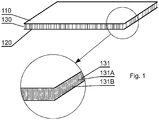
- Fig. 1 presents an overview of a spacer fabric sheet from which the spacer fabric mat can be produced.
- a top layer 110 and a bottom layer 120 are knitted fabrics with yarns extending in a direction substantially parallel to their main plane.
- a spacer layer 130 is arranged between and joins the top layer 110 and the bottom layer 120, wherein its yarns 131 extend substantially in a direction perpendicular to the top layer and the bottom layer. , wherein yarns go substantially in a parallel direction to a main spacer fabric plane.
- a spacer layer 130 which is a knitted fabric, wherein yarns 131 joining flat layers go substantially in a perpendicular direction to the main mat plane, wherein yarns 131 point out a slight distortion in a perpendicular cutting plane parallel to a distortion direction.
- the yarns, including the spacer fabric yarns 131 are typically monofilament plastic yarns. If the large sheet is cut into smaller pieces, such as 50x50cm cushions, some yarns 131A may tend attached only to the top layer 110, and other yarns 131 B may tend attached only to the bottom layer 120, as shown in Fig. 1 . Thus, some filling yarns are cut loose and result in prickly needles at the side of the fabric, so the mat is frayed at the edges.
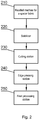
- the method according to the invention can be employed using a process line as shown in Fig. 2 .
- a Raschel machine 210 can be used to manufacture a sheet or a roll of spacer fabric having a desired thickness, for example from 3mm to 100mm. In case multilayer elastic mats are desired, a plurality of Raschel machines 210 can be used.
- the knitted spacer fabric can be finished on a stabilizer 220.
- a finished spacer fabric is then cut to desired dimensions of the spacer fabric mat in a cutting station 230. For example, a 2,5 meter wide sheet or roll of spacer fabric can be made and then cut to a shape of 80cm x 200cm mattresses, or slightly larger (for example about 1cm at each dimension).
- the edges of the cut spacer fabric are pressed in a pressing station 240, as explained in details with respect to Fig. 3 .
- the pressed edges are then finished in a finishing station 250, for example by stitching with an overlock sewing machine by binding.
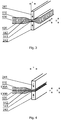
- Fig. 3 presents schematically a pressing process performed in the pressing station 240.
- the pressing station 240 is equipped in a clamping press comprising a clamping top head 241 and a clamping bottom head 242, between which the spacer fabric is arranged.
- the clamping heads 241, 242 have a shape that is to be imprinted on the pressed spacer fabric.
- Fig. 3 shows in a cross-section only a fragment of the pressed knitted fabric and a portion of the clamping heads 241, 242.
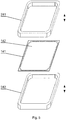
- An example of a full heads shape and the knitted fabric is shown in Fig. 5 .
- the clamping heads have a pressing width x, for example from 2 mm to 20 mm, preferably 1 cm.
- the heads 241, 242 are moved away from each other.
- the spacer fabric is positioned on the bottom head 242.
- the heads 241, 242 are closed to clamp the spacer fabric in an area 141 (a point of contact area with the heads 241, 242) to a distance h being smaller than a spacer fabric thickness H in an area 142 neighboring the heads, such that the spacer fabric at the location between heads 241, 242 is pressed.
- the relationship between the values of h and H is determined individually for a particular spacer fabric mat according to parameters of the spacer fabric, from which it is made, such as the thickness H of the knitted fabric, the density of the yarns 131 of the spacer layer 130, the thickness of the yarns 131, the material from which the yarns 131 are made etc.
- a spacer fabric with a thickness H of 1cm may be pressed between the clamping heads 241, 242 to a thickness of 2 mm.
- the density of the spacer fabric in the clamped area at the width x of the clamping heads 241, 242 is increased.
- a further clamp should be carried out in such a way that both heads 241, 242 move evenly in the compression direction toward the center of the knitted fabric thickness i.e. such as to move each clamping head 241, 242 by the same distance (equal to a half of a difference between the height H of the knitted fabric and the target thickness h after the pressing) towards the middle of the spacer fabric, in opposite directions.
- the pressing area may be positioned away from the edges of the spacer fabric, as shown in Fig. 3 .
- a thin spacer fabric portion between the pressing line and the edge may be considered as a waste product to be cut out at a further processing stages. This may be useful in a high-volume processing processes, to allow an error margin for pressing.
- the presented method may be used in an equivalent manner for multilayer spacer fabrics, i.e. spacer fabrics having more than one spacer layer, for example two spacer layers, as shown in Fig. 4 .
- the pressing may be carried out adjacently to the edge of the knitted fabric, as also shown in Fig. 4 .
- the clamping heads 241, 242 are heated to a temperature, at which the material of the yarns 131 loses its elastic properties and becomes plastic, i.e. devoid of tensions, such that it undergoes non-reversible changes of shape in response to applied forces.
- the heated yarns 131 deform permanently under the influence of the clamping heads and after the pressing force is removed, they remain deformed.
- they may be heated to a temperature of at least the glass transition temperature or a flow temperature.
- the material should not be heated above a temperature wherein the material passes into a liquid state or degrades, for example it should not exceed a melting temperature or a breakdown temperature.
- the clamp of heads 241, 242 causes a bending of the spacer layer yarns 131, which under influence of the transferred heat energy are not deformed elastically to the initial position, but remain in the deformed position.
- yarns 131 of the spacer layer 130 are made of polyester, at the pressing stage they can be heated to a temperature in a range from 150 to 170°C, preferably 150°C.
- the outer section of the knitted fabric may be cut with a hot cutter, i.e. a cutter heated to a temperature above a flow temperature of the plastic of the yarns 131 or even above its breakdown temperature. It allows to remove the spacer fabric excess before its final processing stage, and a high temperature of the cutter may cause that some yarns 131 of the spacer layer that may possibly extend beyond the knitted fabric are fused with the top and the bottom layer or with other spacer layer yarns.
- a hot cutter i.e. a cutter heated to a temperature above a flow temperature of the plastic of the yarns 131 or even above its breakdown temperature. It allows to remove the spacer fabric excess before its final processing stage, and a high temperature of the cutter may cause that some yarns 131 of the spacer layer that may possibly extend beyond the knitted fabric are fused with the top and the bottom layer or with other spacer layer yarns.
- Fig. 5 presents a top view of the pressed knitted fabric after its removal from the press between the heads 241, 242, for example to be used as a cushion for furniture, wherein the area 141 is pressed to the height h and the non-pressed area 142 with the high H nearby the pressed area 141.
- the end product the cushion
- the spacer fabric may be cut to dimensions of a rectangle of 51x51cm, then the spacer fabric may be inserted between the heads 241, 242, which form the pressed area 141 with rounded inner corners between the pressed area 141 and the non-pressed area 142.
- the outer edges of the pressed area 141 may be cut with a hot cutter or at a final finishing stage (it will be easier to precisely cut into a rounded shape than the spacer fabric before the pressing).
- the 1 cm surplus on the perimeter of the spacer fabric may be removed at a further finishing stage as a waste product. It facilitates manufacturing tolerance. If waste product is not desired, the pressing may be also performed precisely to the end product dimension.
- the pressed area 141 extends along all spacer fabric edges, but there are possible other applications, wherein only a section of the spacer fabric edges is finished, for example an edge of only one side.
- An elastic mat may have a variable thickness at its main area, for example it may be quilted (by a pressing and/or stitching in an analogic way as for edges finishing).
- the length of yarns 131 of the spacer layer 130 is substantially the same as in the adjacent non-pressed area 142, and consequently the pressed area is much denser and stiffer.
- the spacer fabric is subject to a pressure, preferably from both sides, along lines parallel to the knitted fabric edges, heating yarns 131 material of the spacer layer 130 to a temperature equal at least a plastifying temperature of this material.
- the knitted fabric pressed in such a way remains permanently in a pressed state after leaving the pressing station 240.
- the knitted fabric in the pressed area is characterized by a much higher density and stiffness than in the non-pressed area. Therefore, it is much easier to be further processed at the finishing station 250.
- the pressed knitted fabric edge can be finished (after earlier cutting off a possible waste material, mentioned in connection with Fig. 3 ).
- For finishing may be used various types of known sartorial methods of edge finishing, such as binding with an overlock type stitch, or applying a bias binding (bias tape).
- Fig. 6 presents an elastic mat top view, for example in a form of a cushion for a hard furniture, with finished edge 141.
- the method according to the invention enables to obtain an elastic mat, wherein the edges are pressed and have permanently thermally deformed spacer layer yarns, thus they may be easily finished by known edge finishing methods.
- the elastic mat has, therefore, appropriately treated and protected edges and as such it may be used as a stand-alone product or may be put into slipcovers with a highly reduced risk of damage to the internal surface of the slipcover at the edges.
Landscapes
- Engineering & Computer Science (AREA)
- Manufacturing & Machinery (AREA)
- Mechanical Engineering (AREA)
- Knitting Of Fabric (AREA)
- Mattresses And Other Support Structures For Chairs And Beds (AREA)
Applications Claiming Priority (1)
| Application Number | Priority Date | Filing Date | Title |
|---|---|---|---|
| PL415921A PL415921A1 (pl) | 2016-01-27 | 2016-01-27 | Sposób obróbki maty sprężystej i mata sprężysta |
Publications (1)
| Publication Number | Publication Date |
|---|---|
| EP3199064A1 true EP3199064A1 (fr) | 2017-08-02 |
Family
ID=57890725
Family Applications (1)
| Application Number | Title | Priority Date | Filing Date |
|---|---|---|---|
| EP17152947.2A Withdrawn EP3199064A1 (fr) | 2016-01-27 | 2017-01-25 | Procédé de fabrication d'un tapis intercalaire en tissu et tapis intercalaire en tissu |
Country Status (2)
| Country | Link |
|---|---|
| EP (1) | EP3199064A1 (fr) |
| PL (1) | PL415921A1 (fr) |
Cited By (1)
| Publication number | Priority date | Publication date | Assignee | Title |
|---|---|---|---|---|
| GB2629905A (en) * | 2023-03-31 | 2024-11-13 | Hs Products Ltd | Resilient unit and method of manufacture |
Citations (4)
| Publication number | Priority date | Publication date | Assignee | Title |
|---|---|---|---|---|
| US20090068910A1 (en) * | 2007-09-07 | 2009-03-12 | Kevin Fredrick | Systems and methods for electronic device heat dissipation and padding |
| GB2468905A (en) * | 2009-03-27 | 2010-09-29 | Brightwake Ltd | Wound packing element |
| PL122468U1 (pl) | 2013-10-21 | 2015-04-27 | Sitarz Wiesława Bowi-Styl Pw | Materac |
| PL405689A1 (pl) | 2013-10-21 | 2015-04-27 | Sitarz Wiesława Bowi-Styl Pw | Sprężysta mata i sposób wytwarzania sprężystej maty |
-
2016
- 2016-01-27 PL PL415921A patent/PL415921A1/pl unknown
-
2017
- 2017-01-25 EP EP17152947.2A patent/EP3199064A1/fr not_active Withdrawn
Patent Citations (4)
| Publication number | Priority date | Publication date | Assignee | Title |
|---|---|---|---|---|
| US20090068910A1 (en) * | 2007-09-07 | 2009-03-12 | Kevin Fredrick | Systems and methods for electronic device heat dissipation and padding |
| GB2468905A (en) * | 2009-03-27 | 2010-09-29 | Brightwake Ltd | Wound packing element |
| PL122468U1 (pl) | 2013-10-21 | 2015-04-27 | Sitarz Wiesława Bowi-Styl Pw | Materac |
| PL405689A1 (pl) | 2013-10-21 | 2015-04-27 | Sitarz Wiesława Bowi-Styl Pw | Sprężysta mata i sposób wytwarzania sprężystej maty |
Cited By (1)
| Publication number | Priority date | Publication date | Assignee | Title |
|---|---|---|---|---|
| GB2629905A (en) * | 2023-03-31 | 2024-11-13 | Hs Products Ltd | Resilient unit and method of manufacture |
Also Published As
| Publication number | Publication date |
|---|---|
| PL415921A1 (pl) | 2017-07-31 |
Similar Documents
| Publication | Publication Date | Title |
|---|---|---|
| CA3046626C (fr) | Ensemble matelas ayant un sur-matelas qui comprend des ressorts helicoidaux en poches et procedes de fabrication correspondants | |
| US9943173B2 (en) | Pocketed spring comfort layer and method of making same | |
| EP1901636B1 (fr) | Procede pour produire des coussins et des rembourrages avec des maillages d'espacement, des tissus d'espacement ou des tricots d'espacement | |
| US10973339B2 (en) | Pocketed spring comfort layer having at least one foam layer and method of making same | |
| US6063461A (en) | Multi-density seating cushion | |
| US10766184B2 (en) | Seat covering material, method for manufacturing the seat covering material, and embossing roll | |
| US11033116B2 (en) | Dual-sided vented pocketed spring comfort layer | |
| US20230092909A1 (en) | Pocketed Spring Assembly | |
| US7125465B2 (en) | Method of making resilient structure including inserting heated coil spring through side surface of fiber batt | |
| CA2761793A1 (fr) | Matelas muni d'un surmatelas a zones matelassees | |
| KR101911784B1 (ko) | 3d 에어매쉬 원단 가공 방법 및 장치 | |
| EP3199064A1 (fr) | Procédé de fabrication d'un tapis intercalaire en tissu et tapis intercalaire en tissu | |
| EP0309019A1 (fr) | Procédé de fabrication de meubles, notamment de fauteuils, canapés ou analogues à partir de feuilles en feutre traité avec une matière durcissante, et meubles ainsi obtenus | |
| KR101898548B1 (ko) | 가죽 패턴 성형장치 및 이를 이용한 패턴 가죽 | |
| CN111333018A (zh) | 一种美健两面连锁弹簧席梦思床垫加工方法 | |
| US2061046A (en) | Method of making metallic pads | |
| US20250000273A1 (en) | Mattress with segmented foam core | |
| US20210148020A1 (en) | Nonwoven havng a corrugated structure, intermediate product, and method for producing a nonwoven having a corrugated structure | |
| JP3021354U (ja) | マット | |
| JP2026029067A (ja) | 嵩上げ材の製造方法、畳セットおよび畳の交換方法 | |
| US20190249266A1 (en) | Ribbing process, particularly for providing leather coverings | |
| JPH034270Y2 (fr) | ||
| CN120537082A (zh) | 一种家纺制品及其缝制方法 |
Legal Events
| Date | Code | Title | Description |
|---|---|---|---|
| PUAI | Public reference made under article 153(3) epc to a published international application that has entered the european phase |
Free format text: ORIGINAL CODE: 0009012 |
|
| STAA | Information on the status of an ep patent application or granted ep patent |
Free format text: STATUS: THE APPLICATION HAS BEEN PUBLISHED |
|
| AK | Designated contracting states |
Kind code of ref document: A1 Designated state(s): AL AT BE BG CH CY CZ DE DK EE ES FI FR GB GR HR HU IE IS IT LI LT LU LV MC MK MT NL NO PL PT RO RS SE SI SK SM TR |
|
| AX | Request for extension of the european patent |
Extension state: BA ME |
|
| STAA | Information on the status of an ep patent application or granted ep patent |
Free format text: STATUS: THE APPLICATION IS DEEMED TO BE WITHDRAWN |
|
| 18D | Application deemed to be withdrawn |
Effective date: 20180203 |