EP3199097A2 - Ametropiebehandlungs-nachverfolgungsverfahren und system - Google Patents
Ametropiebehandlungs-nachverfolgungsverfahren und system Download PDFInfo
- Publication number
- EP3199097A2 EP3199097A2 EP17153507.3A EP17153507A EP3199097A2 EP 3199097 A2 EP3199097 A2 EP 3199097A2 EP 17153507 A EP17153507 A EP 17153507A EP 3199097 A2 EP3199097 A2 EP 3199097A2
- Authority
- EP
- European Patent Office
- Prior art keywords
- spheq
- expected
- trajectory
- estimating
- age
- Prior art date
- Legal status (The legal status is an assumption and is not a legal conclusion. Google has not performed a legal analysis and makes no representation as to the accuracy of the status listed.)
- Granted
Links
Images




Classifications
-
- G—PHYSICS
- G02—OPTICS
- G02C—SPECTACLES; SUNGLASSES OR GOGGLES INSOFAR AS THEY HAVE THE SAME FEATURES AS SPECTACLES; CONTACT LENSES
- G02C7/00—Optical parts
- G02C7/02—Lenses; Lens systems ; Methods of designing lenses
- G02C7/024—Methods of designing ophthalmic lenses
- G02C7/027—Methods of designing ophthalmic lenses considering wearer's parameters
-
- A—HUMAN NECESSITIES
- A61—MEDICAL OR VETERINARY SCIENCE; HYGIENE
- A61B—DIAGNOSIS; SURGERY; IDENTIFICATION
- A61B10/00—Instruments for taking body samples for diagnostic purposes; Other methods or instruments for diagnosis, e.g. for vaccination diagnosis, sex determination or ovulation-period determination; Throat striking implements
-
- G—PHYSICS
- G16—INFORMATION AND COMMUNICATION TECHNOLOGY [ICT] SPECIALLY ADAPTED FOR SPECIFIC APPLICATION FIELDS
- G16H—HEALTHCARE INFORMATICS, i.e. INFORMATION AND COMMUNICATION TECHNOLOGY [ICT] SPECIALLY ADAPTED FOR THE HANDLING OR PROCESSING OF MEDICAL OR HEALTHCARE DATA
- G16H50/00—ICT specially adapted for medical diagnosis, medical simulation or medical data mining; ICT specially adapted for detecting, monitoring or modelling epidemics or pandemics
- G16H50/50—ICT specially adapted for medical diagnosis, medical simulation or medical data mining; ICT specially adapted for detecting, monitoring or modelling epidemics or pandemics for simulation or modelling of medical disorders
-
- A—HUMAN NECESSITIES
- A61—MEDICAL OR VETERINARY SCIENCE; HYGIENE
- A61B—DIAGNOSIS; SURGERY; IDENTIFICATION
- A61B3/00—Apparatus for testing the eyes; Instruments for examining the eyes
- A61B3/0016—Operational features thereof
- A61B3/0025—Operational features thereof characterised by electronic signal processing, e.g. eye models
-
- A—HUMAN NECESSITIES
- A61—MEDICAL OR VETERINARY SCIENCE; HYGIENE
- A61B—DIAGNOSIS; SURGERY; IDENTIFICATION
- A61B3/00—Apparatus for testing the eyes; Instruments for examining the eyes
- A61B3/0016—Operational features thereof
- A61B3/0033—Operational features thereof characterised by user input arrangements
-
- A—HUMAN NECESSITIES
- A61—MEDICAL OR VETERINARY SCIENCE; HYGIENE
- A61B—DIAGNOSIS; SURGERY; IDENTIFICATION
- A61B3/00—Apparatus for testing the eyes; Instruments for examining the eyes
- A61B3/0016—Operational features thereof
- A61B3/0041—Operational features thereof characterised by display arrangements
- A61B3/0058—Operational features thereof characterised by display arrangements for multiple images
-
- A—HUMAN NECESSITIES
- A61—MEDICAL OR VETERINARY SCIENCE; HYGIENE
- A61B—DIAGNOSIS; SURGERY; IDENTIFICATION
- A61B3/00—Apparatus for testing the eyes; Instruments for examining the eyes
- A61B3/10—Objective types, i.e. instruments for examining the eyes independent of the patients' perceptions or reactions
- A61B3/103—Objective types, i.e. instruments for examining the eyes independent of the patients' perceptions or reactions for determining refraction, e.g. refractometers or skiascopes
-
- G—PHYSICS
- G02—OPTICS
- G02C—SPECTACLES; SUNGLASSES OR GOGGLES INSOFAR AS THEY HAVE THE SAME FEATURES AS SPECTACLES; CONTACT LENSES
- G02C7/00—Optical parts
- G02C7/02—Lenses; Lens systems ; Methods of designing lenses
-
- G—PHYSICS
- G02—OPTICS
- G02C—SPECTACLES; SUNGLASSES OR GOGGLES INSOFAR AS THEY HAVE THE SAME FEATURES AS SPECTACLES; CONTACT LENSES
- G02C7/00—Optical parts
- G02C7/02—Lenses; Lens systems ; Methods of designing lenses
- G02C7/024—Methods of designing ophthalmic lenses
-
- G—PHYSICS
- G02—OPTICS
- G02C—SPECTACLES; SUNGLASSES OR GOGGLES INSOFAR AS THEY HAVE THE SAME FEATURES AS SPECTACLES; CONTACT LENSES
- G02C7/00—Optical parts
- G02C7/02—Lenses; Lens systems ; Methods of designing lenses
- G02C7/04—Contact lenses for the eyes
-
- G—PHYSICS
- G02—OPTICS
- G02C—SPECTACLES; SUNGLASSES OR GOGGLES INSOFAR AS THEY HAVE THE SAME FEATURES AS SPECTACLES; CONTACT LENSES
- G02C2202/00—Generic optical aspects applicable to one or more of the subgroups of G02C7/00
- G02C2202/24—Myopia progression prevention
-
- G—PHYSICS
- G16—INFORMATION AND COMMUNICATION TECHNOLOGY [ICT] SPECIALLY ADAPTED FOR SPECIFIC APPLICATION FIELDS
- G16H—HEALTHCARE INFORMATICS, i.e. INFORMATION AND COMMUNICATION TECHNOLOGY [ICT] SPECIALLY ADAPTED FOR THE HANDLING OR PROCESSING OF MEDICAL OR HEALTHCARE DATA
- G16H20/00—ICT specially adapted for therapies or health-improving plans, e.g. for handling prescriptions, for steering therapy or for monitoring patient compliance
-
- G—PHYSICS
- G16—INFORMATION AND COMMUNICATION TECHNOLOGY [ICT] SPECIALLY ADAPTED FOR SPECIFIC APPLICATION FIELDS
- G16H—HEALTHCARE INFORMATICS, i.e. INFORMATION AND COMMUNICATION TECHNOLOGY [ICT] SPECIALLY ADAPTED FOR THE HANDLING OR PROCESSING OF MEDICAL OR HEALTHCARE DATA
- G16H50/00—ICT specially adapted for medical diagnosis, medical simulation or medical data mining; ICT specially adapted for detecting, monitoring or modelling epidemics or pandemics
- G16H50/70—ICT specially adapted for medical diagnosis, medical simulation or medical data mining; ICT specially adapted for detecting, monitoring or modelling epidemics or pandemics for mining of medical data, e.g. analysing previous cases of other patients
Definitions
- the present invention relates to methods and a system for ametropia tracking, and more particularly, for myopia control treatment tracking.
- the tracking methods and system estimate the potential refractive error of an individual over a future predetermined period of time based upon, for example, demographic data and/or myopia control treatment option.
- the tracking methods and system allow Eye Care Providers (ECPs) to demonstrate and track the effectiveness of treatments to slow the progression of myopia and allow individuals to understand the long-term benefit of a myopia control treatment.
- ECPs Eye Care Providers
- myopia and hyperopia for which corrective lenses in the form of spectacles, or rigid or soft contact lenses, are prescribed.
- the conditions are generally described as the imbalance between the length of the eye and the focus of the optical elements of the eye.
- Myopic eyes focus light in front of the retinal plane and hyperopic eyes focus light behind the retinal plane.
- Myopia typically develops because the axial length of the eye grows to be longer than the focal length of the optical components of the eye, that is, the eye grows too long.
- Hyperopia typically develops because the axial length of the eye is too short compared with the focal length of the optical components of the eye, that is, the eye does not grow long enough.
- Myopia has a high prevalence rate in many regions of the world. Of greatest concern with this condition is its possible progression to high myopia, for example, greater than five (5) or six (6) diopters, which dramatically affects one's ability to function without optical aids. High myopia is also associated with an increased risk of retinal disease, cataract, and glaucoma.
- Corrective lenses are used to alter the gross focus of the eye to render a clearer image at the retinal plane, by shifting the focus from in front of the plane to correct myopia, or from behind the plane to correct hyperopia, respectively.
- the corrective approach to the conditions does not address the cause of the condition, but is merely prosthetic or intended to address symptoms.
- myopia and hyperopia are used to include simple myopia and myopic astigmatism and hyperopia and hyperopic, astigmatism respectively.
- Emmetropia describes the state of clear vision where an object at infinity is in relatively sharp focus with the crystalline lens relaxed.
- light from both distant and close objects passing through the central or paraxial region of the aperture or pupil is focused by the crystalline lens inside the eye close to the retinal plane where the inverted image is sensed.
- D Diopters
- the measure D is the dioptric power, defined as the reciprocal of the focal distance of a lens or optical system, in meters.
- the spherical aberration of the normal eye is not constant.
- accommodation the change in optical power of the eye derived primarily through changes to the crystalline lens
- U.S. Patent No. 6,045,578 discloses that the addition of positive spherical aberration on a contact lens will reduce or control the progression of myopia.
- the method includes changing the spherical aberration of an ocular system to alter the growth in eye length.
- emmetropization may be regulated by spherical aberration.
- the cornea of a myopic eye is fitted with a lens having increasing dioptric power away from the lens center. Paraxial light rays entering the central portion of the lens are focused on the retina of the eye, producing a clear image of an object.
- Marginal light rays entering the peripheral portion of the cornea are focused in a plane between the cornea and the retina, and produce positive spherical aberration of the image on the latter.
- This positive spherical aberration produces a physiological effect on the eye which tends to inhibit growth of the eye, thus mitigating the tendency for the myopic eye to grow longer.
- the present invention overcomes the limitations of the prior art by providing methods that allow for estimating myopia progression over a future period of time, while also demonstrating and tracking the effectiveness of treatments to slow the progression of myopia.
- a method for estimating and tracking refractive error progression of an individual is provided.
- a percentile of Spherical Equivalent Refraction (SPHEQ) as a function of at least the individual's age is estimated by comparison to a reference population.
- An expected SPHEQ trajectory over a future predetermined period of time is estimated.
- the expected SPHEQ trajectory is compared with the reference population.
- the expected SPHEQ trajectory is compared with an expected SPHEQ trajectory using an ametropia control treatment, thereby showing a possible treatment benefit over the predetermined period of time.
- a method includes measuring actual SPHEQ refraction history for an individual while using a given ametropia control treatment, comparing to a reference population, and estimating an updated expected SPHEQ trajectory, thereby showing actual treatment benefit over a predetermined period of time.
- the ametropia control treatment may comprise a myopia control ophthalmic lens, for example, a myopia control contact lens.
- a method includes displaying a comparison of an expected SPHEQ trajectory with an expected SPHEQ trajectory using an ametropia control treatment.
- a system for estimating and tracking refractive error progression of an individual estimates an expected SPHEQ trajectory over a future predetermined period of time and an expected SPHEQ trajectory using a myopia control treatment.
- At least one database stores data from the server.
- a smart device in communication with the server via a network has a graphical user interface that displays a comparison of the expected SPHEQ trajectory over a future predetermined period of time with the expected SPHEQ trajectory using a myopia control treatment.
- An object of the present invention is to provide an easy-to-use and reliable way for estimating myopia progression over a given period of time according to the type of ophthalmic lens a child may be using. Probabilities of faster or slower progression around a predicted refractive trajectory may also be presented.
- Another object of the present invention is to help an ECP or parent choose a type of myopia control treatment and/or ophthalmic lens for a child by indicating the anticipated progression of myopia according to a specific type of myopia control treatment option.
- Another object of the present invention is to monitor the effectiveness of a myopia progression control treatment.
- Yet another object of the present invention is to provide methods that track myopia relative to a reference population based on at least one of country, region, gender, ethnicity, parental history, or other demographic or environmental factors relevant to myopia progression.
- the present invention relates to methods and a system for ametropia tracking, and more particularly, for myopia treatment tracking.
- the tracking methods and system estimate a potential refractive error of an individual over a future predetermined period of time relative to reference population, which 1) allow ECPs to predict and track refractive progression as well as demonstrate and track the effectiveness of treatments to slow the progression of myopia and/or 2) allow patients or parents to understand the long-term benefit of a myopia control treatment.
- the discussion below is directed to myopia, the present invention is not so limited and could be applied to other refractive errors, such as hyperopia or astigmatism.
- the discussion below is directed to tracking methods for individuals, in particular children having an approximate age of 6 to 14. However, the tracking methods could also be applied to younger children, older adolescents, or young adults depending on available datasets.
- a method for estimating and tracking a potential refractive error progression of a child comprises:
- a percentile of Spherical Equivalent Refraction is determined as a function of at least a child's age by comparison to a reference population.
- a child is at the pth percentile of SPHEQ population reference percentiles if p% of children have SPHEQ values no more than the SPHEQ of the child.
- a selected dataset is utilized.
- the Collaborative Longitudinal Evaluation of Ethnicity and Refractive Error (CLEERE) dataset or subset thereof may be used to estimate percentiles of SPHEQ as a function of age and ethnicity.
- a selected dataset may include all CLEERE observations for children having an age between 5.5 and 14.5 years and an ethnicity of White, Black, Hispanic, Asian, or Native American.
- reference population percentile curves between 0.1 and 99.9 in increments of 0.1 may be fit using, for example, PROC QUANTREG from SAS®.
- the 0.1-0.4 and 94.6-99.9 percentile curves may be fit with linear models in age; the 0.5-4.5 and 45.6-94.5 percentile curves may be fit with quadratic models in age; and the 4.6-45.5 percentile curves may be fit with cubic models in age.
- These variants in model complexity may result from pruning higher order polynomial terms that may not be statistically significant. It will be appreciated that other models and other increments may be utilized.
- other platforms e.g. the CRAN package GAMLSS (Generalized Additive Models for Location, Scale, and Shape), may be used to fit reference population percentile curves.
- FIG. 1 displays a set of the modeled reference population percentile curves in which the SPHEQ values as a function of age from the selected CLEERE dataset are superimposed.
- the distribution of ethnicity in a selected CLEERE sample may not match that of the United States.
- estimates provided by the data may be biased. Bias can be corrected through weights that are specific to each stratum.
- the general form of the weight is (Nk/N)/(nk/n), where k indexes the strata, N represents the population size, Nk represents the population stratum size, n represents the sample size, and nk represents the sample stratum size.
- This form of weighting may be used to make the distribution of ethnicities in a CLEERE sample more comparable to that of the United States.
- ethnicity proportions (the Nk/N) may come from:
- CLEERE may be selected to provide data needed for other reference populations, for example, keyed to or based on at least one of country, region, gender, ethnicity, or parental history.
- existing dataset(s) that may be used in conjunction with the CLEERE dataset are Singapore Cohort of the Risk factors for Myopia (SCORM); Sydney Myopia Study (SMS) and the Sydney Adolescent Vascular Eye Disease Study (SAVES); Northern Ireland Childhood Errors of Refraction (NICER); or Anyang Childhood Eye Study (Anyang).
- a Spherical Equivalent Refraction may be estimated as a function of input data.
- the input data may be one or more selected from the group consisting of: age; age of first optical refraction; current and/or prior year dry refraction value; current and/or prior year dry retinoscopy; current and/or prior year dry autorefraction; current and/or prior year cycloplegic manifest refraction; current and/or prior year cycloplegic retinoscopy; current and/or prior year cycloplegic autorefraction; gender; race and/or ethnic group; country of residence; urban or rural address; number of myopic parents; number of myopic siblings; level of close work activity (e.g., number of reading hours per day or week or month); level of outdoor activity (e.g., number of hours spent out door per day, or week or month); current and/or prior year axial length; current type of myopia correction and/or myopia progression prevention being used; other demographic or environmental variables considered
- a percentile of Spherical Equivalent Refraction (SPHEQ) for a specific child can be estimated by comparing his or her measured SPHEQ relative to the modeled reference population percentile curves.
- the selected dataset used to estimate the SPHEQ reference population percentiles may also be used to estimate expected SPHEQ trajectories or projections over a future predetermined period of time (e.g., expected future SPHEQ values at year k+1 or k+n, wherein n is an integer).
- the selected dataset may be used to fit a first model of SPHEQ at year k+1 as a function of baseline/current age and baseline SPHEQ at year k (Scenario 1).
- a second model of SPHEQ at year k+1 may be fit using baseline/current age, baseline SPHEQ at year k, and past history of SPHEQ (Scenario 2).
- measured spherical equivalent rate of change between year k and k-1 may be utilized.
- Scenario 1 and/or Scenario 2 may include a random effect to account for the correlation in repeated measures from the same subject.
- the models may be fit by PROC GLIMMIX of SAS® using linear regression with a random effect. It will be appreciated that other models and fitting platforms, such as R, may be utilized.
- error distributions may be obtained by the method disclosed in Jiang et al., Distribution-free Prediction Intervals in Mixed Linear Models, Statistica Sinica, 12(2002), 537-553 .
- FIGS. 2A-4B graphically display the expected SPHEQ/percentile values at year k+1 for a child with baseline age 8 ( FIGS. 2A-2B ); age 9 ( FIGS. 3A-3B ), or age 10 ( FIGS. 4A-4B ) and a baseline SPHEQ of -1.0D.
- Scenario 1 projections are in the first panel ( FIGS. 2A , 3A , and 4A ).
- Scenario 2 projections are in two panels, with a rate of change of 0.5D shown on the left and 1.5D shown on the right ( FIGS. 2B , 3B , and 4B ).
- FIGS. 2A-2B graphically display expected SPHEQ/percentile values for a 9-year-old who, at age 8, had a baseline SPHEQ of -1.0D.
- Scenario 1 FIG. 2A
- Scenario 2 FIG. 2B
- the baseline SPHEQ of -1.0D is the 5.1 percentile of age 8 SPHEQ values.
- the expected SPHEQ at age 9 is -1.6D, which is the 4.9 percentile.
- the solid line connects the baseline and expected SPHEQ value. Prediction error intervals are provided by the endpoints of the dashed lines.
- the column of percentages on the far right of the panel indicates the probability that an expected future outcome lies in the interval to the left of the percent. For example, there is a chance of 50% that the next year's SPHEQ will be between -1.8D and - 1.3D, which at age 9 is the 4.2 and 6.1 percentile, respectively. There is a chance of 90% that the next year's SPHEQ will be between -2.3D and -1.0D which at age 9 is the 7.9 and 2.8 percentile, respectively.
- FIG. 2B two examples are shown for the same subject as in FIG. 2A , but with the rate of change taken into account. On the left, the rate of change is 0.5D and on the right the rate of change is 1.5D. In the case of the 0.5D rate of change, there is a chance of 90% that the next year's SPHEQ will be between -2.3D and - 1.0D which is the 3.0 and 8.0 percentile, respectively. In the case of the 1.5D rate of change, there is a chance of 90% that the next year's SPHEQ will be between -2.4D and -1.2D which is the 2.6 and 7.0 percentile, respectively. [0050] FIGS.
- 3A-3B graphically display expected SPHEQ/percentile values for a 10-year-old who, at age 9, had a SPHEQ of -1.0D.
- Scenario 1 is represented in FIG. 3A and Scenario 2 is represented in FIG. 3B .
- a baseline SPHEQ of -1.0D is the 8.1 percentile of age 9 SPHEQ values.
- the expected SPHEQ is -1.5D, which at age 10 is the 7.7 percentile. There is a chance of 50% that the next year's SPHEQ will be between - 1.8D and -1.3D which at age 10 is the 6.6 and 9.3 percentile, respectively. There is a chance of 90% that the next year's SPHEQ will be between -2.3D and -1.0D, which at age 10 is the 4.6 and 11.7 percentile, respectively.
- FIG. 3B two examples are shown for the same subject as in FIG. 3A , but with the rate of change taken into account.
- the rate of change taken into account.
- the 0.5D rate of change there is a chance of 90% that the next year's SPHEQ will be between -2.2D and - 0.9D which at age 10 is the 4.7 and 11.9 percentile, respectively.
- the 1.5D rate of change there is a chance of 90% that the next year's SPHEQ will be between -2.3D and -1.0D which at age 10 is the 4.4 and 11 percentile, respectively.
- FIGS. 4A-4B graphically display expected SPHEQ/percentile values for an 11-year-old who, at age 10, had a SPHEQ of -1.0D.
- Scenario 1 is represented in FIG. 4A and Scenario 2 is represented in FIG. 4B .
- a baseline SPHEQ of -1.0D is the 11.2 percentile of age 10 SPHEQ values.
- the expected SPHEQ is -1.5D, which at age 10 is the 10.6 percentile. There is a chance of 50% that the next year's SPHEQ will be between - 1.7D and -1.2D. There is a chance of 90% that the next year's SPHEQ will be between -2.2D and -1.0D.
- FIG. 4B two examples are shown for the same subject as in FIG. 4A , but with the rate of change taken into account.
- the rate of change taken into account.
- the 0.5D rate of change there is a chance of 90% that the next year's SPHEQ will be between -2.1 D and - 1.0D.
- the 1.5D rate of change there is a chance of 90% that the next year's SPHEQ will be between -2.2D and -1.0D.
- Table 1 below is a summary of FIGS.
- FIGS. 4A-4B 50% chance of -1.2D to -1.7D 50% chance of -1.2D to -1.7D 50% chance of -1.2D to -1.7D 10 -1.00 11.2% 0.41D 10.6% 90% chance of no progression to -2.2D 90% chance of no progression to -2.1D 90% chance of no progression to -2.2D
- FIGS. 5A-5C graphically display data similar to that shown in FIGS. 2A-4B , but directed to SPHEQ trajectory extended over 5 years period from baseline age (or up to the age of 14).
- the SPHEQ trajectories or projections are shown as a function of SPHEQ and age with 50% and 90% prediction or confidence windows.
- an expected SPHEQ trajectory may be compared to the reference population percentiles for illustration and tracking.
- FIG. 6 shows an expected SPHEQ trajectory for a baseline -1.0D SPHEQ of a 6 year old, who at age 7, is projected to have a SPHEQ of -1.73D with a 90% prediction interval of -1.1 D to -2.4D.
- the expected SPHEQ trajectory is superimposed over a subset of percentiles curves from FIG. 1 ranging from the 0.1 to the 50th percentile.
- the expected trajectory continues to age 14, with an expected SPHEQ of -5.14D.
- FIG. 6 would help ECPs and parents visualize the long-term impact of myopia progression and the likely endpoint relative to a population with the same initial SPHEQ percentile level.
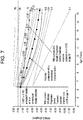
- an expected SPHEQ trajectory with conventional myopia correction may be compared to an expected SPHEQ trajectory using a myopia control treatment, thereby showing a possible treatment benefit over a predetermined period of time.
- an expected SPHEQ trajectory of a child continuing with conventional myopia correction may be compared to an expected SPHEQ trajectory using a myopia control treatment (e.g., FIG. 7 ).
- the myopia control treatment may be myopia control ophthalmic lenses, such as myopia control contact lenses.
- Other myopia control treatments may comprise optical, pharmaceutical, environmental, or other interventions.
- data from myopia control treatments that have been clinically validated to deliver a 50% treatment efficacy may be used. It will be appreciated that values for other myopia control treatments and/or efficacies (e.g., 60% or 80%) may be utilized.
- FIG. 7 shows the 1st percentile SPHEQ of a general population, which at age 6 is -1.0D and falls to -5.7D over the next 8 years. Also shown is the expected SPHEQ trajectory using a conventional myopia correction for a 6-year-old starting at -1.0D and progressing to -5.14D at age 14 years old. Finally shown is an expected SPHEQ trajectory for a child using a myopia control treatment beginning at age 6, with a SPHEQ of -1.0D and a projected SPHEQ of -3.07D at age 14. Thus, there is an expected reduction in the myopia endpoint at age 14 of more than 2D.
- the methods and system of the present invention provide a visual representation of a child's myopia relative to a reference population at any age and provides a myopia progression perspective with conventional and/or myopia control treatment options, plus a potential SPHEQ endpoint based on age and/or other individual factors, such as the input data discussed above.
- the most likely impact and benefit of a myopia control treatment may be estimated.
- the actual SPHEQ refraction history for a child with a particular myopia control treatment may be measured.
- the expected SPHEQ trajectory may then be recalculated and compared to the initial expected SPHEQ trajectory and the reference population percentiles.
- FIG. 8 is an illustration of the same child as in FIG. 7 with actual measured SPHEQ data showing a four year follow-up up to age 10 plotted in a solid line, thereby tracking of the actual SPHEQ history while using a myopia control treatment.
- the child's myopia control treatment performed better than the expected SPHEQ trajectory and resulted in a slowdown of 70% in the myopia rate of progression relative to a conventional myopia correction.
- the dashed line is a representation of an updated expected SPHEQ trajectory based on the child's measured myopia progression rate. The child is projected to have a SPHEQ of -2.24D at age 14 based on the updated projection.
- the present invention helps visualize the continued benefit of a myopia control treatment and helps ECPs manage customer or parent expectations. More importantly, the present invention may provide updates on the success or failure of a myopia control treatment option and a child's myopia progression relative to a reference population and an expected SPHEQ endpoint.
- the present invention helps visualize the treatment benefit of a selected myopia control treatment. Accordingly, the present invention allows the printing or displaying of any of Figures (e.g., FIGS. 6-8 ), input data, output data, or any combination thereof.
- the input data may be as discussed above.
- the output data may be one or more selected from the group consisting of current percentile relative to a reference population; current deviation in diopters away from the 50th percentile refraction of a reference population; most likely SPHEQ percentile trajectory starting at current age and continuing to any given future age; most likely SPHEQ trajectory starting at current age and continuing to any given future age; for each future age, prediction intervals within which future observations are likely to fall with specified levels of confidence; expected SPHEQ percentile trajectory if a myopia control treatment is initiated at the current or a future age; expected SPHEQ refraction trajectory if a myopia control treatment is initiated at the current or a future age; refraction/percentile trajectories with prediction intervals; and projected and actual refraction/percentile trajectories with a myopia control treatment.
- a printout or display may be in any suitable format, such as a table, graph, or pie chart.
- the display may be on a graphical user interface of a computer or of a smart device (e.g., a tablet computer, smart phone, personal digital assistant, wearable digital device, gaming device, TV).
- the display may be synchronized on an Eye Care provider's computer or smart device and on a user computer or smart device.
- the present invention allows for continuous monitoring of a child using a particular myopia control treatment.
- the actual SPHEQ refraction history for a child while using a given myopia control treatment may be measured at periodic intervals (e.g., weekly, monthly, yearly).
- An updated expected SPHEQ trajectory is determined at each interval.
- Data comprising SPHEQ measurements, updated expected SPHEQ trajectory at each interval, and any input and/or output data may be saved to a secure server and/or database.
- the continuous monitoring may be for a plurality of children and for a plurality of myopia control treatments.
- an authorized user may be granted access to view the saved data, for example, via a weblink or software application (e.g., a downloadable app to smart device) that allows access to the secure server and/or database.
- An authorized user may include at least one of an Eye Care Provider, customer, parent, or child.
- the saved data or a subset thereof may be utilized to establish a database comprising clinical data on efficacy of one or more myopia control treatments.
- the saved data or subset thereof may be provided to a third party for ongoing data analysis.
- the data may be anonymous so that the privacy of children will be protected, for example, by using a numeric or alphanumeric identifier.
- data for children that have refused any myopia control treatment may be used to continually update one or more of the selected datasets discussed above, for example, the CLEERE dataset.
- FIG. 9 is a schematic diagram of a system 100 according to an embodiment of the present invention.
- System 100 comprises a server 105 for receiving input data; for performing data analysis such as one or more of the steps discussed above, and for outputting data.
- the input data and output data may be stored or saved in at least one database 110.
- the input and/or output data may be accessed by a software application installed on computer 115 (for example a computer in the office of an ECP); by a downloadable software application (app) on a smart device 120; or by a secure website or weblink 125 accessible by a computer via network 130.
- the input and/or output data may be displayed on a graphical user interface of a computer or smart device.
- a system for estimating and tracking refractive error progression of an individual comprises a server for estimating an expected SPHEQ trajectory over a future predetermined period of time and an expected SPHEQ trajectory using a myopia control treatment; at least one database for storing data from the server; and a smart device in communication with the server via a network and comprising a graphical user interface for displaying a comparison of the expected SPHEQ trajectory over a future predetermined period of time with the expected SPHEQ trajectory using a myopia control treatment.
- aspects of the present invention may be embodied as a system, method, or computer program product. Accordingly, aspects of the present invention may take the form of an entirely hardware embodiment, a processor operating with software embodiment (including firmware, resident software, micro-code, etc.) or an embodiment combining software and hardware aspects that may all generally be referred to herein as a "circuit,” “module” or “system.” Furthermore, aspects of the present invention may take the form of a computer program product embodied in one or more computer readable medium(s) having computer readable program code embodied thereon.
- the computer readable medium may be a computer readable signal medium or a computer readable storage medium.
- a computer readable storage medium may be, for example, but not limited to, an electronic, magnetic, optical, electromagnetic, infrared, or semiconductor system, apparatus, or device, or any suitable combination of the foregoing.
- a computer readable storage medium may be any tangible medium that can contain, or store a program for use by or in connection with an instruction execution system, apparatus, or device.
- Computer program code for carrying out operations for aspects of the present invention may be written in any combination of one or more programming languages, including an object oriented programming language such as Java, Smalltalk,C++, C#, Transact-SQL, XML, PHP or the like and conventional procedural programming languages, such as the "C" programming language or similar programming languages.
- the program code may execute entirely on the user's computer, partly on the user's computer, as a stand-alone software package, partly on the user's computer and partly on a remote computer or entirely on the remote computer or server.
- the remote computer may be connected to the user's computer through any type of network, including a local area network (LAN) or a wide area network (WAN), or the connection may be made to an external computer (for example, through the Internet using an Internet Service Provider).
- LAN local area network
- WAN wide area network
- Internet Service Provider an Internet Service Provider
- Computer program instructions may be provided to a processor of a general purpose computer, special purpose computer, or other programmable data processing apparatus to produce a machine, such that the instructions, which execute with the processor of the computer or other programmable data processing apparatus, create means for implementing the functions/acts specified.
- These computer program instructions may also be stored in a computer readable medium that can direct a computer, other programmable data processing apparatus, or other devices to function in a particular manner, such that the instructions stored in the computer readable medium produce an article of manufacture including instructions which implement the functions/acts specified.
- the computer program instructions may also be loaded onto a computer, other programmable data processing apparatus, or other devices to cause a series of operational steps to be performed on the computer, other programmable apparatus or other devices to produce a computer implemented process such that the instructions which execute on the computer or other programmable apparatus provide processes for implementing the functions/acts specified.
- FIG. 10 a representative hardware environment for practicing at least one embodiment of the invention is depicted.
- the system comprises at least one processor or central processing unit (CPU) 10.
- the CPUs 10 are interconnected with system bus 12 to various devices such as a random access memory (RAM) 14, read-only memory (ROM) 16, and an input/output (I/O) adapter 18.
- RAM random access memory
- ROM read-only memory
- I/O input/output
- the I/O adapter 18 can connect to peripheral devices, such as disk units 11 and tape drives 13, or other program storage devices that are readable by the system.
- the system can read the inventive instructions on the program storage devices and follow these instructions to execute the methodology of at least one embodiment of the invention.
- the system further includes a user interface adapter 19 that connects a keyboard 15, mouse 17, speaker 24, microphone 22, and/or other user interface devices such as a touch screen device (not shown) to the bus 12 to gather user input.
- a communication adapter 20 connects the bus 12 to a data processing network 25, and a display adapter 21 connects the bus 12 to a display device 23 which may be embodied as an output device such as a monitor, printer, or transmitter, for example.
- in communication includes physical and wireless connections that are indirect through one or more additional components (or over a network) or directly between the two components described as being in communication.
Landscapes
- Health & Medical Sciences (AREA)
- Life Sciences & Earth Sciences (AREA)
- Engineering & Computer Science (AREA)
- Physics & Mathematics (AREA)
- Ophthalmology & Optometry (AREA)
- General Health & Medical Sciences (AREA)
- Medical Informatics (AREA)
- Public Health (AREA)
- Biomedical Technology (AREA)
- Veterinary Medicine (AREA)
- Surgery (AREA)
- Animal Behavior & Ethology (AREA)
- Heart & Thoracic Surgery (AREA)
- Molecular Biology (AREA)
- Biophysics (AREA)
- General Physics & Mathematics (AREA)
- Optics & Photonics (AREA)
- Pathology (AREA)
- Data Mining & Analysis (AREA)
- Primary Health Care (AREA)
- Databases & Information Systems (AREA)
- Epidemiology (AREA)
- Signal Processing (AREA)
- Eye Examination Apparatus (AREA)
- Medical Treatment And Welfare Office Work (AREA)
- Eyeglasses (AREA)
- Management, Administration, Business Operations System, And Electronic Commerce (AREA)
- Investigating Or Analysing Materials By Optical Means (AREA)
Applications Claiming Priority (1)
| Application Number | Priority Date | Filing Date | Title |
|---|---|---|---|
| US15/007,660 US10042181B2 (en) | 2016-01-27 | 2016-01-27 | Ametropia treatment tracking methods and system |
Publications (3)
| Publication Number | Publication Date |
|---|---|
| EP3199097A2 true EP3199097A2 (de) | 2017-08-02 |
| EP3199097A3 EP3199097A3 (de) | 2017-08-30 |
| EP3199097B1 EP3199097B1 (de) | 2024-02-21 |
Family
ID=57960257
Family Applications (1)
| Application Number | Title | Priority Date | Filing Date |
|---|---|---|---|
| EP17153507.3A Active EP3199097B1 (de) | 2016-01-27 | 2017-01-27 | Ametropiebehandlungs-nachverfolgungsverfahren und system |
Country Status (6)
| Country | Link |
|---|---|
| US (2) | US10042181B2 (de) |
| EP (1) | EP3199097B1 (de) |
| JP (1) | JP6843629B2 (de) |
| KR (1) | KR102756915B1 (de) |
| CN (1) | CN107028586B (de) |
| RU (1) | RU2664173C2 (de) |
Cited By (4)
| Publication number | Priority date | Publication date | Assignee | Title |
|---|---|---|---|---|
| EP3395233A1 (de) * | 2017-04-25 | 2018-10-31 | Johnson & Johnson Vision Care Inc. | Nachverfolgungsverfahren und -system für ametropiebehandlung |
| US10642067B2 (en) | 2016-01-27 | 2020-05-05 | Johnson & Johnson Vision Care, Inc. | Ametropia treatment tracking methods and system |
| WO2022129253A3 (en) * | 2020-12-18 | 2022-08-11 | Essilor International | System and method for determining an appropriate moment for modifying or changing an initial myopia control solution |
| EP4194933A1 (de) * | 2021-12-10 | 2023-06-14 | Essilor International | System und verfahren zur bestimmung der von einer person verwendeten myopiekontrolllösung |
Families Citing this family (19)
| Publication number | Priority date | Publication date | Assignee | Title |
|---|---|---|---|---|
| JP7057186B2 (ja) * | 2018-03-28 | 2022-04-19 | 株式会社トプコン | 眼科装置、及び眼科情報処理プログラム |
| US12638700B2 (en) * | 2018-03-29 | 2026-05-26 | Reopia Optics, Inc. | Systems and related methods for optimizing spectacle based myopia progression control and management |
| US10909866B2 (en) * | 2018-07-20 | 2021-02-02 | Cybernet Systems Corp. | Autonomous transportation system and methods |
| AU2019407111B2 (en) * | 2018-12-21 | 2025-02-27 | Essilor International | A method and device for predicting evolution over time of a vision-related parameter |
| KR102608915B1 (ko) | 2018-12-21 | 2023-12-01 | 에씰로 앙터나시오날 | 시력-관련 파라미터의 시간 경과에 따른 진화를 예측하기 위한 모델을 구축하는 방법 및 장치 |
| CN109620124A (zh) * | 2019-01-28 | 2019-04-16 | 合肥华科电子技术研究所 | 一种校园视力监测系统 |
| KR102250775B1 (ko) | 2019-10-18 | 2021-05-11 | 주식회사 에스알파테라퓨틱스 | 근시 치료를 위한 디지털 장치 및 애플리케이션 |
| GB201918993D0 (en) | 2019-12-20 | 2020-02-05 | Univ Dublin Technological | A system and method of determining the ocular biometric status of a patient |
| EP3865046B1 (de) * | 2020-02-12 | 2025-09-03 | Essilor International | Detektion und korrektur einer variation eines aktuellen refraktiven fehlers und der aktuellen akkommodationsamplitude einer person |
| JP7574509B2 (ja) * | 2020-10-12 | 2024-10-29 | 株式会社トプコン | 近視進行分析装置、近視進行分析システム、及び近視進行分析プログラム |
| CN112289446A (zh) * | 2020-10-29 | 2021-01-29 | 美视(杭州)人工智能科技有限公司 | 一种预测青少年近视的计算机系统 |
| US20240047037A1 (en) * | 2020-12-18 | 2024-02-08 | Essilor International | System and method for determining a modification or a change of an initial myopia control solution used by a myopic subject |
| US20230081566A1 (en) * | 2021-09-03 | 2023-03-16 | Johnson & Johnson Vision Care, Inc. | Systems and methods for predicting myopia risk |
| KR102870907B1 (ko) * | 2021-11-03 | 2025-10-15 | 주식회사 티아이 | 예측 굴절값을 이용한 근시 치료에 필요한 정보 제공 방법 및 장치 |
| WO2023143711A1 (en) | 2022-01-26 | 2023-08-03 | Kaymak Hakan | Method and system for the treatment of progressing myopia |
| CN114974582B (zh) * | 2022-05-05 | 2025-03-25 | 北京大学 | 近视发生风险预测方法、装置、电子设备及介质 |
| WO2025233803A1 (en) * | 2024-05-10 | 2025-11-13 | Johnson & Johnson Vision Care, Inc. | Myopic control progression modeling, tracking, and/or treatment |
| TW202604422A (zh) * | 2024-06-06 | 2026-02-01 | 英商庫博光學國際有限公司 | 用於估計眼睛生長之方法 |
| JP2026067246A (ja) | 2024-10-08 | 2026-04-20 | 学校法人東邦大学 | ユーザー用アプリケーションプログラム,ユーザー用近視管理装置,ユーザー用眼情報処理方法、近視管理サービス用情報処理システム |
Citations (1)
| Publication number | Priority date | Publication date | Assignee | Title |
|---|---|---|---|---|
| US6045578A (en) | 1995-11-28 | 2000-04-04 | Queensland University Of Technology | Optical treatment method |
Family Cites Families (22)
| Publication number | Priority date | Publication date | Assignee | Title |
|---|---|---|---|---|
| JP2001522679A (ja) * | 1997-11-14 | 2001-11-20 | ブラウン、スチュアート | 自動光反射スクリーニング |
| ATE438880T1 (de) | 1999-02-12 | 2009-08-15 | Hoya Corp | Brille und ihre herstellung |
| US6626538B1 (en) * | 2000-07-12 | 2003-09-30 | Peter N. Arrowsmith | Method for determining the power of an intraocular lens used for the treatment of myopia |
| US6582078B2 (en) | 2001-02-27 | 2003-06-24 | Barton L. Halpern | Method and system for planning corrective refractive surgery |
| KR20120110176A (ko) * | 2003-04-11 | 2012-10-09 | 테크노라스 게엠베하 옵탈몰로지쉐 시스템 | 시력 교정을 위한 치료 계획에 관한 방법, 시스템 및 알고리즘 |
| US7766478B2 (en) * | 2004-07-01 | 2010-08-03 | Auckland Uniservices Limited | Contact lens and method for prevention of myopia progression |
| TWI484249B (zh) | 2007-03-09 | 2015-05-11 | Auckland Uniservices Ltd | 隱形眼鏡 |
| ITFI20080081A1 (it) * | 2008-04-18 | 2009-10-19 | Strumenti Oftalmici C S O S R | Procedimento e sistema per la registrazione di risposte elettrofunzionali erg, perg e vep multifocali in tempo reale |
| FI20090085A7 (fi) * | 2009-03-06 | 2010-09-30 | Kone Corp | Hissijärjestely ja menetelmä |
| BR112013017745B1 (pt) * | 2011-01-14 | 2022-01-18 | University Of Washington Through Its Center For Commercialization | Métodos para o diagnóstico e tratamento de distúrbios relacionados ao comprimento do olho |
| WO2014050879A1 (ja) | 2012-09-25 | 2014-04-03 | 国立大学法人大阪大学 | 近視進行抑制能を有するコンタクトレンズおよび近視進行抑制能を有するコンタクトレンズセット |
| US9201250B2 (en) * | 2012-10-17 | 2015-12-01 | Brien Holden Vision Institute | Lenses, devices, methods and systems for refractive error |
| SG11201506655YA (en) | 2013-03-01 | 2015-09-29 | Essilor Int | Method of evaluating the efficiency of a myopia control product |
| JP6434015B2 (ja) * | 2013-07-25 | 2018-12-05 | オプティメディカ コーポレイション | 物体の屈折率のインサイチュー算定 |
| US9753309B2 (en) * | 2013-11-04 | 2017-09-05 | Myopiaok Limited | Contact lens and method for prevention of myopia progression |
| WO2015070092A1 (en) | 2013-11-07 | 2015-05-14 | Amo Development Llc | Treatment validation systems and methods |
| JP5667730B1 (ja) * | 2013-12-09 | 2015-02-12 | 株式会社ユニバーサルビュー | 近視進行診断装置、近視進行判別方法、プログラム及び記憶媒体 |
| RU2567273C1 (ru) * | 2014-05-06 | 2015-11-10 | Лев Павлович Чередниченко | Способ раннего определения аномального рефрактогенеза у детей |
| KR20160006893A (ko) | 2014-07-09 | 2016-01-20 | 희성전자 주식회사 | 터치패널의 제조방법 |
| US9638936B2 (en) * | 2014-08-20 | 2017-05-02 | Johnson & Johnson Vision Care, Inc. | High plus treatment zone lens design for preventing and/or slowing myopia progression |
| US10010502B2 (en) * | 2015-05-19 | 2018-07-03 | Amorphex Therapeutics Llc | Device that delivers a sustained low-dose of a myopia-suppressing drug, while preserving pupillary function and accommodation |
| US10042181B2 (en) | 2016-01-27 | 2018-08-07 | Johnson & Johnson Vision Care, Inc. | Ametropia treatment tracking methods and system |
-
2016
- 2016-01-27 US US15/007,660 patent/US10042181B2/en active Active
-
2017
- 2017-01-23 RU RU2017101996A patent/RU2664173C2/ru active
- 2017-01-23 KR KR1020170010191A patent/KR102756915B1/ko active Active
- 2017-01-25 CN CN201710060961.5A patent/CN107028586B/zh active Active
- 2017-01-26 JP JP2017012205A patent/JP6843629B2/ja active Active
- 2017-01-27 EP EP17153507.3A patent/EP3199097B1/de active Active
-
2018
- 2018-01-22 US US15/876,308 patent/US10642067B2/en active Active
Patent Citations (1)
| Publication number | Priority date | Publication date | Assignee | Title |
|---|---|---|---|---|
| US6045578A (en) | 1995-11-28 | 2000-04-04 | Queensland University Of Technology | Optical treatment method |
Non-Patent Citations (1)
| Title |
|---|
| JIANG ET AL.: "Distribution-free Prediction Intervals in Mixed Linear Models", STATISTICA SINICA, vol. 12, 2002, pages 537 - 553, XP055391228 |
Cited By (13)
| Publication number | Priority date | Publication date | Assignee | Title |
|---|---|---|---|---|
| US12144544B2 (en) | 2016-01-27 | 2024-11-19 | Johnson & Johnson Vision Care, Inc. | Ametropia treatment tracking methods and system |
| US10642067B2 (en) | 2016-01-27 | 2020-05-05 | Johnson & Johnson Vision Care, Inc. | Ametropia treatment tracking methods and system |
| US10912456B2 (en) | 2016-01-27 | 2021-02-09 | Johnson & Johnson Vision Care, Inc. | Ametropia treatment tracking methods and system |
| EP4049580B1 (de) | 2017-04-25 | 2023-09-06 | Johnson & Johnson Vision Care, Inc. | Nachverfolgungsverfahren und -system für ametropiebehandlung |
| EP4049580A1 (de) * | 2017-04-25 | 2022-08-31 | Johnson & Johnson Vision Care, Inc. | Nachverfolgungsverfahren und -system für ametropiebehandlung |
| EP3395233A1 (de) * | 2017-04-25 | 2018-10-31 | Johnson & Johnson Vision Care Inc. | Nachverfolgungsverfahren und -system für ametropiebehandlung |
| EP3395233B1 (de) | 2017-04-25 | 2022-04-20 | Johnson & Johnson Vision Care, Inc. | Nachverfolgungsverfahren und -system für ametropiebehandlung |
| WO2022129253A3 (en) * | 2020-12-18 | 2022-08-11 | Essilor International | System and method for determining an appropriate moment for modifying or changing an initial myopia control solution |
| CN116507301A (zh) * | 2020-12-18 | 2023-07-28 | 依视路国际公司 | 用于确定修改或改变初始近视控制方案的适当时机的系统和方法 |
| US12437879B2 (en) | 2020-12-18 | 2025-10-07 | Essilor International | System and method for determining an appropriate moment for modifying or changing an initial myopia control solution |
| EP4194933A1 (de) * | 2021-12-10 | 2023-06-14 | Essilor International | System und verfahren zur bestimmung der von einer person verwendeten myopiekontrolllösung |
| WO2023104988A1 (en) * | 2021-12-10 | 2023-06-15 | Essilor International | System and method for determining a myopia control solution |
| US20250053026A1 (en) * | 2021-12-10 | 2025-02-13 | Essilor International | System and method for determining a myopia control solution |
Also Published As
| Publication number | Publication date |
|---|---|
| RU2017101996A (ru) | 2018-07-23 |
| JP6843629B2 (ja) | 2021-03-17 |
| JP2017138977A (ja) | 2017-08-10 |
| US20180140181A1 (en) | 2018-05-24 |
| RU2017101996A3 (de) | 2018-07-23 |
| EP3199097B1 (de) | 2024-02-21 |
| EP3199097A3 (de) | 2017-08-30 |
| RU2664173C2 (ru) | 2018-08-15 |
| US10042181B2 (en) | 2018-08-07 |
| CN107028586B (zh) | 2021-05-28 |
| US20170209036A1 (en) | 2017-07-27 |
| KR20170089771A (ko) | 2017-08-04 |
| CN107028586A (zh) | 2017-08-11 |
| KR102756915B1 (ko) | 2025-01-21 |
| US10642067B2 (en) | 2020-05-05 |
Similar Documents
| Publication | Publication Date | Title |
|---|---|---|
| EP3199097B1 (de) | Ametropiebehandlungs-nachverfolgungsverfahren und system | |
| AU2024202765B2 (en) | Ametropia treatment tracking methods and system | |
| US12144544B2 (en) | Ametropia treatment tracking methods and system | |
| Romashchenko et al. | Peripheral refraction and higher order aberrations | |
| Li et al. | Attitudes of students, parents, and teachers toward glasses use in rural China | |
| Hickenbotham et al. | Meta-analysis of sex differences in presbyopia | |
| WO2023079062A1 (en) | Devices and methods for determining data related to a progression of refractive values of a person | |
| WO2023031800A1 (en) | Systems and methods for predicting myopia risk | |
| Lum | Progressive anisometropia and orthokeratology: a case report | |
| KR20230065127A (ko) | 예측 굴절값을 이용한 근시 치료에 필요한 정보 제공 방법 및 장치 | |
| HK1239497A1 (en) | Ametropia treatment tracking methods and system | |
| HK1239497B (en) | Ametropia treatment tracking methods and system | |
| Safarian Baloujeh et al. | Wavefront changes during a sustained reading task in presbyopic eyes | |
| HK40078657A (en) | Ametropia treatment tracking methods and system | |
| HK40078657B (en) | Ametropia treatment tracking methods and system | |
| Meyer et al. | Clinical Comparison of High‐resolution and Standard Refractions and Prescriptions | |
| Sethi et al. | CPD: Are you being short-sighted about myopia management? | |
| HK1260847A1 (en) | Ametropia treatment tracking methods and system | |
| HK1260847B (en) | Ametropia treatment tracking methods and system | |
| Moore et al. | The Refractive Error and Vision Impairment Estimation With Spectacle data (REVIEWS) study | |
| Benefer | Objectively measured wear time in children prescribed myopia control spectacles: a comparison of adherence between two lens designs | |
| Miller | Know the legal aspects of myopia control | |
| Vincent et al. | Looking and seeing beyond 2020 | |
| Hume | Myopia Management: Implementing an evidence-based Standard of Care | |
| Schwenker et al. | Obamacare: what's in it for kids? |
Legal Events
| Date | Code | Title | Description |
|---|---|---|---|
| PUAI | Public reference made under article 153(3) epc to a published international application that has entered the european phase |
Free format text: ORIGINAL CODE: 0009012 |
|
| STAA | Information on the status of an ep patent application or granted ep patent |
Free format text: STATUS: THE APPLICATION HAS BEEN PUBLISHED |
|
| PUAL | Search report despatched |
Free format text: ORIGINAL CODE: 0009013 |
|
| AK | Designated contracting states |
Kind code of ref document: A2 Designated state(s): AL AT BE BG CH CY CZ DE DK EE ES FI FR GB GR HR HU IE IS IT LI LT LU LV MC MK MT NL NO PL PT RO RS SE SI SK SM TR |
|
| AX | Request for extension of the european patent |
Extension state: BA ME |
|
| AK | Designated contracting states |
Kind code of ref document: A3 Designated state(s): AL AT BE BG CH CY CZ DE DK EE ES FI FR GB GR HR HU IE IS IT LI LT LU LV MC MK MT NL NO PL PT RO RS SE SI SK SM TR |
|
| AX | Request for extension of the european patent |
Extension state: BA ME |
|
| RIC1 | Information provided on ipc code assigned before grant |
Ipc: A61B 3/00 20060101ALI20170724BHEP Ipc: A61B 5/00 20060101ALI20170724BHEP Ipc: A61B 3/103 20060101AFI20170724BHEP Ipc: G06F 19/00 20110101ALI20170724BHEP |
|
| STAA | Information on the status of an ep patent application or granted ep patent |
Free format text: STATUS: REQUEST FOR EXAMINATION WAS MADE |
|
| 17P | Request for examination filed |
Effective date: 20180222 |
|
| RBV | Designated contracting states (corrected) |
Designated state(s): AL AT BE BG CH CY CZ DE DK EE ES FI FR GB GR HR HU IE IS IT LI LT LU LV MC MK MT NL NO PL PT RO RS SE SI SK SM TR |
|
| REG | Reference to a national code |
Ref country code: HK Ref legal event code: DE Ref document number: 1239497 Country of ref document: HK |
|
| STAA | Information on the status of an ep patent application or granted ep patent |
Free format text: STATUS: EXAMINATION IS IN PROGRESS |
|
| 17Q | First examination report despatched |
Effective date: 20210430 |
|
| P01 | Opt-out of the competence of the unified patent court (upc) registered |
Effective date: 20230522 |
|
| GRAP | Despatch of communication of intention to grant a patent |
Free format text: ORIGINAL CODE: EPIDOSNIGR1 |
|
| STAA | Information on the status of an ep patent application or granted ep patent |
Free format text: STATUS: GRANT OF PATENT IS INTENDED |
|
| INTG | Intention to grant announced |
Effective date: 20230908 |
|
| RIC1 | Information provided on ipc code assigned before grant |
Ipc: G16H 50/50 20180101ALI20230825BHEP Ipc: A61B 3/00 20060101ALI20230825BHEP Ipc: A61B 5/00 20060101ALI20230825BHEP Ipc: A61B 3/103 20060101AFI20230825BHEP |
|
| RIN1 | Information on inventor provided before grant (corrected) |
Inventor name: CHENG, XU Inventor name: SINNOTT, LORAINE T. Inventor name: JONES-JORDAN, LISA A. Inventor name: RITCHEY, ERIC A. Inventor name: CHEHAB, KHALED Inventor name: BRENNAN, NOEL A. |
|
| GRAS | Grant fee paid |
Free format text: ORIGINAL CODE: EPIDOSNIGR3 |
|
| GRAA | (expected) grant |
Free format text: ORIGINAL CODE: 0009210 |
|
| STAA | Information on the status of an ep patent application or granted ep patent |
Free format text: STATUS: THE PATENT HAS BEEN GRANTED |
|
| AK | Designated contracting states |
Kind code of ref document: B1 Designated state(s): AL AT BE BG CH CY CZ DE DK EE ES FI FR GB GR HR HU IE IS IT LI LT LU LV MC MK MT NL NO PL PT RO RS SE SI SK SM TR |
|
| REG | Reference to a national code |
Ref country code: GB Ref legal event code: FG4D |
|
| REG | Reference to a national code |
Ref country code: CH Ref legal event code: EP |
|
| REG | Reference to a national code |
Ref country code: IE Ref legal event code: FG4D |
|
| REG | Reference to a national code |
Ref country code: DE Ref legal event code: R096 Ref document number: 602017079288 Country of ref document: DE |
|
| REG | Reference to a national code |
Ref country code: LT Ref legal event code: MG9D |
|
| REG | Reference to a national code |
Ref country code: NL Ref legal event code: MP Effective date: 20240221 |
|
| PG25 | Lapsed in a contracting state [announced via postgrant information from national office to epo] |
Ref country code: IS Free format text: LAPSE BECAUSE OF FAILURE TO SUBMIT A TRANSLATION OF THE DESCRIPTION OR TO PAY THE FEE WITHIN THE PRESCRIBED TIME-LIMIT Effective date: 20240621 |
|
| PG25 | Lapsed in a contracting state [announced via postgrant information from national office to epo] |
Ref country code: LT Free format text: LAPSE BECAUSE OF FAILURE TO SUBMIT A TRANSLATION OF THE DESCRIPTION OR TO PAY THE FEE WITHIN THE PRESCRIBED TIME-LIMIT Effective date: 20240221 |
|
| PG25 | Lapsed in a contracting state [announced via postgrant information from national office to epo] |
Ref country code: GR Free format text: LAPSE BECAUSE OF FAILURE TO SUBMIT A TRANSLATION OF THE DESCRIPTION OR TO PAY THE FEE WITHIN THE PRESCRIBED TIME-LIMIT Effective date: 20240522 |
|
| REG | Reference to a national code |
Ref country code: AT Ref legal event code: MK05 Ref document number: 1658336 Country of ref document: AT Kind code of ref document: T Effective date: 20240221 |
|
| PG25 | Lapsed in a contracting state [announced via postgrant information from national office to epo] |
Ref country code: NL Free format text: LAPSE BECAUSE OF FAILURE TO SUBMIT A TRANSLATION OF THE DESCRIPTION OR TO PAY THE FEE WITHIN THE PRESCRIBED TIME-LIMIT Effective date: 20240221 Ref country code: HR Free format text: LAPSE BECAUSE OF FAILURE TO SUBMIT A TRANSLATION OF THE DESCRIPTION OR TO PAY THE FEE WITHIN THE PRESCRIBED TIME-LIMIT Effective date: 20240221 Ref country code: RS Free format text: LAPSE BECAUSE OF FAILURE TO SUBMIT A TRANSLATION OF THE DESCRIPTION OR TO PAY THE FEE WITHIN THE PRESCRIBED TIME-LIMIT Effective date: 20240521 |
|
| PG25 | Lapsed in a contracting state [announced via postgrant information from national office to epo] |
Ref country code: ES Free format text: LAPSE BECAUSE OF FAILURE TO SUBMIT A TRANSLATION OF THE DESCRIPTION OR TO PAY THE FEE WITHIN THE PRESCRIBED TIME-LIMIT Effective date: 20240221 |
|
| PG25 | Lapsed in a contracting state [announced via postgrant information from national office to epo] |
Ref country code: AT Free format text: LAPSE BECAUSE OF FAILURE TO SUBMIT A TRANSLATION OF THE DESCRIPTION OR TO PAY THE FEE WITHIN THE PRESCRIBED TIME-LIMIT Effective date: 20240221 |
|
| PG25 | Lapsed in a contracting state [announced via postgrant information from national office to epo] |
Ref country code: RS Free format text: LAPSE BECAUSE OF FAILURE TO SUBMIT A TRANSLATION OF THE DESCRIPTION OR TO PAY THE FEE WITHIN THE PRESCRIBED TIME-LIMIT Effective date: 20240521 Ref country code: NO Free format text: LAPSE BECAUSE OF FAILURE TO SUBMIT A TRANSLATION OF THE DESCRIPTION OR TO PAY THE FEE WITHIN THE PRESCRIBED TIME-LIMIT Effective date: 20240521 Ref country code: NL Free format text: LAPSE BECAUSE OF FAILURE TO SUBMIT A TRANSLATION OF THE DESCRIPTION OR TO PAY THE FEE WITHIN THE PRESCRIBED TIME-LIMIT Effective date: 20240221 Ref country code: LT Free format text: LAPSE BECAUSE OF FAILURE TO SUBMIT A TRANSLATION OF THE DESCRIPTION OR TO PAY THE FEE WITHIN THE PRESCRIBED TIME-LIMIT Effective date: 20240221 Ref country code: IS Free format text: LAPSE BECAUSE OF FAILURE TO SUBMIT A TRANSLATION OF THE DESCRIPTION OR TO PAY THE FEE WITHIN THE PRESCRIBED TIME-LIMIT Effective date: 20240621 Ref country code: HR Free format text: LAPSE BECAUSE OF FAILURE TO SUBMIT A TRANSLATION OF THE DESCRIPTION OR TO PAY THE FEE WITHIN THE PRESCRIBED TIME-LIMIT Effective date: 20240221 Ref country code: GR Free format text: LAPSE BECAUSE OF FAILURE TO SUBMIT A TRANSLATION OF THE DESCRIPTION OR TO PAY THE FEE WITHIN THE PRESCRIBED TIME-LIMIT Effective date: 20240522 Ref country code: FI Free format text: LAPSE BECAUSE OF FAILURE TO SUBMIT A TRANSLATION OF THE DESCRIPTION OR TO PAY THE FEE WITHIN THE PRESCRIBED TIME-LIMIT Effective date: 20240221 Ref country code: ES Free format text: LAPSE BECAUSE OF FAILURE TO SUBMIT A TRANSLATION OF THE DESCRIPTION OR TO PAY THE FEE WITHIN THE PRESCRIBED TIME-LIMIT Effective date: 20240221 Ref country code: BG Free format text: LAPSE BECAUSE OF FAILURE TO SUBMIT A TRANSLATION OF THE DESCRIPTION OR TO PAY THE FEE WITHIN THE PRESCRIBED TIME-LIMIT Effective date: 20240221 Ref country code: AT Free format text: LAPSE BECAUSE OF FAILURE TO SUBMIT A TRANSLATION OF THE DESCRIPTION OR TO PAY THE FEE WITHIN THE PRESCRIBED TIME-LIMIT Effective date: 20240221 |
|
| PG25 | Lapsed in a contracting state [announced via postgrant information from national office to epo] |
Ref country code: PT Free format text: LAPSE BECAUSE OF FAILURE TO SUBMIT A TRANSLATION OF THE DESCRIPTION OR TO PAY THE FEE WITHIN THE PRESCRIBED TIME-LIMIT Effective date: 20240621 Ref country code: PL Free format text: LAPSE BECAUSE OF FAILURE TO SUBMIT A TRANSLATION OF THE DESCRIPTION OR TO PAY THE FEE WITHIN THE PRESCRIBED TIME-LIMIT Effective date: 20240221 |
|
| PG25 | Lapsed in a contracting state [announced via postgrant information from national office to epo] |
Ref country code: SE Free format text: LAPSE BECAUSE OF FAILURE TO SUBMIT A TRANSLATION OF THE DESCRIPTION OR TO PAY THE FEE WITHIN THE PRESCRIBED TIME-LIMIT Effective date: 20240221 Ref country code: PT Free format text: LAPSE BECAUSE OF FAILURE TO SUBMIT A TRANSLATION OF THE DESCRIPTION OR TO PAY THE FEE WITHIN THE PRESCRIBED TIME-LIMIT Effective date: 20240621 Ref country code: PL Free format text: LAPSE BECAUSE OF FAILURE TO SUBMIT A TRANSLATION OF THE DESCRIPTION OR TO PAY THE FEE WITHIN THE PRESCRIBED TIME-LIMIT Effective date: 20240221 Ref country code: LV Free format text: LAPSE BECAUSE OF FAILURE TO SUBMIT A TRANSLATION OF THE DESCRIPTION OR TO PAY THE FEE WITHIN THE PRESCRIBED TIME-LIMIT Effective date: 20240221 |
|
| PG25 | Lapsed in a contracting state [announced via postgrant information from national office to epo] |
Ref country code: DK Free format text: LAPSE BECAUSE OF FAILURE TO SUBMIT A TRANSLATION OF THE DESCRIPTION OR TO PAY THE FEE WITHIN THE PRESCRIBED TIME-LIMIT Effective date: 20240221 |
|
| PG25 | Lapsed in a contracting state [announced via postgrant information from national office to epo] |
Ref country code: SM Free format text: LAPSE BECAUSE OF FAILURE TO SUBMIT A TRANSLATION OF THE DESCRIPTION OR TO PAY THE FEE WITHIN THE PRESCRIBED TIME-LIMIT Effective date: 20240221 |
|
| PG25 | Lapsed in a contracting state [announced via postgrant information from national office to epo] |
Ref country code: CZ Free format text: LAPSE BECAUSE OF FAILURE TO SUBMIT A TRANSLATION OF THE DESCRIPTION OR TO PAY THE FEE WITHIN THE PRESCRIBED TIME-LIMIT Effective date: 20240221 Ref country code: EE Free format text: LAPSE BECAUSE OF FAILURE TO SUBMIT A TRANSLATION OF THE DESCRIPTION OR TO PAY THE FEE WITHIN THE PRESCRIBED TIME-LIMIT Effective date: 20240221 |
|
| PG25 | Lapsed in a contracting state [announced via postgrant information from national office to epo] |
Ref country code: SK Free format text: LAPSE BECAUSE OF FAILURE TO SUBMIT A TRANSLATION OF THE DESCRIPTION OR TO PAY THE FEE WITHIN THE PRESCRIBED TIME-LIMIT Effective date: 20240221 |
|
| PG25 | Lapsed in a contracting state [announced via postgrant information from national office to epo] |
Ref country code: SM Free format text: LAPSE BECAUSE OF FAILURE TO SUBMIT A TRANSLATION OF THE DESCRIPTION OR TO PAY THE FEE WITHIN THE PRESCRIBED TIME-LIMIT Effective date: 20240221 Ref country code: SK Free format text: LAPSE BECAUSE OF FAILURE TO SUBMIT A TRANSLATION OF THE DESCRIPTION OR TO PAY THE FEE WITHIN THE PRESCRIBED TIME-LIMIT Effective date: 20240221 Ref country code: RO Free format text: LAPSE BECAUSE OF FAILURE TO SUBMIT A TRANSLATION OF THE DESCRIPTION OR TO PAY THE FEE WITHIN THE PRESCRIBED TIME-LIMIT Effective date: 20240221 Ref country code: EE Free format text: LAPSE BECAUSE OF FAILURE TO SUBMIT A TRANSLATION OF THE DESCRIPTION OR TO PAY THE FEE WITHIN THE PRESCRIBED TIME-LIMIT Effective date: 20240221 Ref country code: DK Free format text: LAPSE BECAUSE OF FAILURE TO SUBMIT A TRANSLATION OF THE DESCRIPTION OR TO PAY THE FEE WITHIN THE PRESCRIBED TIME-LIMIT Effective date: 20240221 Ref country code: CZ Free format text: LAPSE BECAUSE OF FAILURE TO SUBMIT A TRANSLATION OF THE DESCRIPTION OR TO PAY THE FEE WITHIN THE PRESCRIBED TIME-LIMIT Effective date: 20240221 |
|
| REG | Reference to a national code |
Ref country code: DE Ref legal event code: R097 Ref document number: 602017079288 Country of ref document: DE |
|
| PLBE | No opposition filed within time limit |
Free format text: ORIGINAL CODE: 0009261 |
|
| STAA | Information on the status of an ep patent application or granted ep patent |
Free format text: STATUS: NO OPPOSITION FILED WITHIN TIME LIMIT |
|
| 26N | No opposition filed |
Effective date: 20241122 |
|
| PG25 | Lapsed in a contracting state [announced via postgrant information from national office to epo] |
Ref country code: SI Free format text: LAPSE BECAUSE OF FAILURE TO SUBMIT A TRANSLATION OF THE DESCRIPTION OR TO PAY THE FEE WITHIN THE PRESCRIBED TIME-LIMIT Effective date: 20240221 |
|
| REG | Reference to a national code |
Ref country code: CH Ref legal event code: PL |
|
| PG25 | Lapsed in a contracting state [announced via postgrant information from national office to epo] |
Ref country code: MC Free format text: LAPSE BECAUSE OF FAILURE TO SUBMIT A TRANSLATION OF THE DESCRIPTION OR TO PAY THE FEE WITHIN THE PRESCRIBED TIME-LIMIT Effective date: 20240221 Ref country code: LU Free format text: LAPSE BECAUSE OF NON-PAYMENT OF DUE FEES Effective date: 20250127 |
|
| PG25 | Lapsed in a contracting state [announced via postgrant information from national office to epo] |
Ref country code: BE Free format text: LAPSE BECAUSE OF NON-PAYMENT OF DUE FEES Effective date: 20250131 |
|
| PG25 | Lapsed in a contracting state [announced via postgrant information from national office to epo] |
Ref country code: CH Free format text: LAPSE BECAUSE OF NON-PAYMENT OF DUE FEES Effective date: 20250131 |
|
| REG | Reference to a national code |
Ref country code: BE Ref legal event code: MM Effective date: 20250131 |
|
| PGFP | Annual fee paid to national office [announced via postgrant information from national office to epo] |
Ref country code: GB Payment date: 20251204 Year of fee payment: 10 |
|
| PGFP | Annual fee paid to national office [announced via postgrant information from national office to epo] |
Ref country code: FR Payment date: 20251128 Year of fee payment: 10 |
|
| PGFP | Annual fee paid to national office [announced via postgrant information from national office to epo] |
Ref country code: IE Payment date: 20251209 Year of fee payment: 10 |
|
| PGFP | Annual fee paid to national office [announced via postgrant information from national office to epo] |
Ref country code: DE Payment date: 20251203 Year of fee payment: 10 |
|
| PGFP | Annual fee paid to national office [announced via postgrant information from national office to epo] |
Ref country code: IT Payment date: 20251219 Year of fee payment: 10 |
|
| PG25 | Lapsed in a contracting state [announced via postgrant information from national office to epo] |
Ref country code: CY Free format text: LAPSE BECAUSE OF FAILURE TO SUBMIT A TRANSLATION OF THE DESCRIPTION OR TO PAY THE FEE WITHIN THE PRESCRIBED TIME-LIMIT Effective date: 20240221 |
|
| PG25 | Lapsed in a contracting state [announced via postgrant information from national office to epo] |
Ref country code: TR Free format text: LAPSE BECAUSE OF FAILURE TO SUBMIT A TRANSLATION OF THE DESCRIPTION OR TO PAY THE FEE WITHIN THE PRESCRIBED TIME-LIMIT Effective date: 20240221 |