EP3199232A1 - Nanoparticule métallique creuse, catalyseur l'incluant, et procédé de fabrication de nanoparticules métalliques creuses - Google Patents
Nanoparticule métallique creuse, catalyseur l'incluant, et procédé de fabrication de nanoparticules métalliques creuses Download PDFInfo
- Publication number
- EP3199232A1 EP3199232A1 EP15843945.5A EP15843945A EP3199232A1 EP 3199232 A1 EP3199232 A1 EP 3199232A1 EP 15843945 A EP15843945 A EP 15843945A EP 3199232 A1 EP3199232 A1 EP 3199232A1
- Authority
- EP
- European Patent Office
- Prior art keywords
- metal
- hollow
- nanoparticles
- ion
- metal nanoparticles
- Prior art date
- Legal status (The legal status is an assumption and is not a legal conclusion. Google has not performed a legal analysis and makes no representation as to the accuracy of the status listed.)
- Withdrawn
Links
Images




Classifications
-
- B—PERFORMING OPERATIONS; TRANSPORTING
- B01—PHYSICAL OR CHEMICAL PROCESSES OR APPARATUS IN GENERAL
- B01J—CHEMICAL OR PHYSICAL PROCESSES, e.g. CATALYSIS OR COLLOID CHEMISTRY; THEIR RELEVANT APPARATUS
- B01J23/00—Catalysts comprising metals or metal oxides or hydroxides, not provided for in group B01J21/00
- B01J23/70—Catalysts comprising metals or metal oxides or hydroxides, not provided for in group B01J21/00 of the iron group metals or copper
- B01J23/89—Catalysts comprising metals or metal oxides or hydroxides, not provided for in group B01J21/00 of the iron group metals or copper combined with noble metals
- B01J23/892—Nickel and noble metals
-
- B—PERFORMING OPERATIONS; TRANSPORTING
- B01—PHYSICAL OR CHEMICAL PROCESSES OR APPARATUS IN GENERAL
- B01J—CHEMICAL OR PHYSICAL PROCESSES, e.g. CATALYSIS OR COLLOID CHEMISTRY; THEIR RELEVANT APPARATUS
- B01J13/00—Colloid chemistry, e.g. the production of colloidal materials or their solutions, not otherwise provided for; Making microcapsules or microballoons
- B01J13/02—Making microcapsules or microballoons
-
- B—PERFORMING OPERATIONS; TRANSPORTING
- B01—PHYSICAL OR CHEMICAL PROCESSES OR APPARATUS IN GENERAL
- B01J—CHEMICAL OR PHYSICAL PROCESSES, e.g. CATALYSIS OR COLLOID CHEMISTRY; THEIR RELEVANT APPARATUS
- B01J13/00—Colloid chemistry, e.g. the production of colloidal materials or their solutions, not otherwise provided for; Making microcapsules or microballoons
- B01J13/02—Making microcapsules or microballoons
- B01J13/06—Making microcapsules or microballoons by phase separation
- B01J13/08—Simple coacervation, i.e. addition of highly hydrophilic material
-
- B—PERFORMING OPERATIONS; TRANSPORTING
- B01—PHYSICAL OR CHEMICAL PROCESSES OR APPARATUS IN GENERAL
- B01J—CHEMICAL OR PHYSICAL PROCESSES, e.g. CATALYSIS OR COLLOID CHEMISTRY; THEIR RELEVANT APPARATUS
- B01J13/00—Colloid chemistry, e.g. the production of colloidal materials or their solutions, not otherwise provided for; Making microcapsules or microballoons
- B01J13/02—Making microcapsules or microballoons
- B01J13/20—After-treatment of capsule walls, e.g. hardening
- B01J13/22—Coating
-
- B—PERFORMING OPERATIONS; TRANSPORTING
- B01—PHYSICAL OR CHEMICAL PROCESSES OR APPARATUS IN GENERAL
- B01J—CHEMICAL OR PHYSICAL PROCESSES, e.g. CATALYSIS OR COLLOID CHEMISTRY; THEIR RELEVANT APPARATUS
- B01J23/00—Catalysts comprising metals or metal oxides or hydroxides, not provided for in group B01J21/00
-
- B—PERFORMING OPERATIONS; TRANSPORTING
- B01—PHYSICAL OR CHEMICAL PROCESSES OR APPARATUS IN GENERAL
- B01J—CHEMICAL OR PHYSICAL PROCESSES, e.g. CATALYSIS OR COLLOID CHEMISTRY; THEIR RELEVANT APPARATUS
- B01J23/00—Catalysts comprising metals or metal oxides or hydroxides, not provided for in group B01J21/00
- B01J23/007—Mixed salts
-
- B—PERFORMING OPERATIONS; TRANSPORTING
- B01—PHYSICAL OR CHEMICAL PROCESSES OR APPARATUS IN GENERAL
- B01J—CHEMICAL OR PHYSICAL PROCESSES, e.g. CATALYSIS OR COLLOID CHEMISTRY; THEIR RELEVANT APPARATUS
- B01J23/00—Catalysts comprising metals or metal oxides or hydroxides, not provided for in group B01J21/00
- B01J23/38—Catalysts comprising metals or metal oxides or hydroxides, not provided for in group B01J21/00 of noble metals
- B01J23/40—Catalysts comprising metals or metal oxides or hydroxides, not provided for in group B01J21/00 of noble metals of the platinum group metals
- B01J23/42—Platinum
-
- B—PERFORMING OPERATIONS; TRANSPORTING
- B01—PHYSICAL OR CHEMICAL PROCESSES OR APPARATUS IN GENERAL
- B01J—CHEMICAL OR PHYSICAL PROCESSES, e.g. CATALYSIS OR COLLOID CHEMISTRY; THEIR RELEVANT APPARATUS
- B01J23/00—Catalysts comprising metals or metal oxides or hydroxides, not provided for in group B01J21/00
- B01J23/70—Catalysts comprising metals or metal oxides or hydroxides, not provided for in group B01J21/00 of the iron group metals or copper
- B01J23/74—Iron group metals
- B01J23/755—Nickel
-
- B—PERFORMING OPERATIONS; TRANSPORTING
- B01—PHYSICAL OR CHEMICAL PROCESSES OR APPARATUS IN GENERAL
- B01J—CHEMICAL OR PHYSICAL PROCESSES, e.g. CATALYSIS OR COLLOID CHEMISTRY; THEIR RELEVANT APPARATUS
- B01J35/00—Catalysts, in general, characterised by their form or physical properties
- B01J35/40—Catalysts, in general, characterised by their form or physical properties characterised by dimensions, e.g. grain size
- B01J35/45—Nanoparticles
-
- B—PERFORMING OPERATIONS; TRANSPORTING
- B01—PHYSICAL OR CHEMICAL PROCESSES OR APPARATUS IN GENERAL
- B01J—CHEMICAL OR PHYSICAL PROCESSES, e.g. CATALYSIS OR COLLOID CHEMISTRY; THEIR RELEVANT APPARATUS
- B01J35/00—Catalysts, in general, characterised by their form or physical properties
- B01J35/50—Catalysts, in general, characterised by their form or physical properties characterised by their shape or configuration
- B01J35/51—Spheres
- B01J35/52—Hollow spheres
-
- B—PERFORMING OPERATIONS; TRANSPORTING
- B01—PHYSICAL OR CHEMICAL PROCESSES OR APPARATUS IN GENERAL
- B01J—CHEMICAL OR PHYSICAL PROCESSES, e.g. CATALYSIS OR COLLOID CHEMISTRY; THEIR RELEVANT APPARATUS
- B01J37/00—Processes, in general, for preparing catalysts; Processes, in general, for activation of catalysts
- B01J37/0009—Use of binding agents; Moulding; Pressing; Powdering; Granulating; Addition of materials ameliorating the mechanical properties of the product catalyst
- B01J37/0018—Addition of a binding agent or of material, later completely removed among others as result of heat treatment, leaching or washing,(e.g. forming of pores; protective layer, desintegrating by heat)
-
- B—PERFORMING OPERATIONS; TRANSPORTING
- B01—PHYSICAL OR CHEMICAL PROCESSES OR APPARATUS IN GENERAL
- B01J—CHEMICAL OR PHYSICAL PROCESSES, e.g. CATALYSIS OR COLLOID CHEMISTRY; THEIR RELEVANT APPARATUS
- B01J37/00—Processes, in general, for preparing catalysts; Processes, in general, for activation of catalysts
- B01J37/0072—Preparation of particles, e.g. dispersion of droplets in an oil bath
-
- B—PERFORMING OPERATIONS; TRANSPORTING
- B01—PHYSICAL OR CHEMICAL PROCESSES OR APPARATUS IN GENERAL
- B01J—CHEMICAL OR PHYSICAL PROCESSES, e.g. CATALYSIS OR COLLOID CHEMISTRY; THEIR RELEVANT APPARATUS
- B01J37/00—Processes, in general, for preparing catalysts; Processes, in general, for activation of catalysts
- B01J37/04—Mixing
-
- B—PERFORMING OPERATIONS; TRANSPORTING
- B01—PHYSICAL OR CHEMICAL PROCESSES OR APPARATUS IN GENERAL
- B01J—CHEMICAL OR PHYSICAL PROCESSES, e.g. CATALYSIS OR COLLOID CHEMISTRY; THEIR RELEVANT APPARATUS
- B01J37/00—Processes, in general, for preparing catalysts; Processes, in general, for activation of catalysts
- B01J37/16—Reducing
-
- B—PERFORMING OPERATIONS; TRANSPORTING
- B01—PHYSICAL OR CHEMICAL PROCESSES OR APPARATUS IN GENERAL
- B01J—CHEMICAL OR PHYSICAL PROCESSES, e.g. CATALYSIS OR COLLOID CHEMISTRY; THEIR RELEVANT APPARATUS
- B01J2235/00—Indexing scheme associated with group B01J35/00, related to the analysis techniques used to determine the catalysts form or properties
-
- B—PERFORMING OPERATIONS; TRANSPORTING
- B01—PHYSICAL OR CHEMICAL PROCESSES OR APPARATUS IN GENERAL
- B01J—CHEMICAL OR PHYSICAL PROCESSES, e.g. CATALYSIS OR COLLOID CHEMISTRY; THEIR RELEVANT APPARATUS
- B01J2235/00—Indexing scheme associated with group B01J35/00, related to the analysis techniques used to determine the catalysts form or properties
- B01J2235/15—X-ray diffraction
-
- B—PERFORMING OPERATIONS; TRANSPORTING
- B01—PHYSICAL OR CHEMICAL PROCESSES OR APPARATUS IN GENERAL
- B01J—CHEMICAL OR PHYSICAL PROCESSES, e.g. CATALYSIS OR COLLOID CHEMISTRY; THEIR RELEVANT APPARATUS
- B01J2235/00—Indexing scheme associated with group B01J35/00, related to the analysis techniques used to determine the catalysts form or properties
- B01J2235/30—Scanning electron microscopy; Transmission electron microscopy
-
- H—ELECTRICITY
- H01—ELECTRIC ELEMENTS
- H01M—PROCESSES OR MEANS, e.g. BATTERIES, FOR THE DIRECT CONVERSION OF CHEMICAL ENERGY INTO ELECTRICAL ENERGY
- H01M4/00—Electrodes
- H01M4/86—Inert electrodes with catalytic activity, e.g. for fuel cells
- H01M4/90—Selection of catalytic material
- H01M4/92—Metals of platinum group
-
- Y—GENERAL TAGGING OF NEW TECHNOLOGICAL DEVELOPMENTS; GENERAL TAGGING OF CROSS-SECTIONAL TECHNOLOGIES SPANNING OVER SEVERAL SECTIONS OF THE IPC; TECHNICAL SUBJECTS COVERED BY FORMER USPC CROSS-REFERENCE ART COLLECTIONS [XRACs] AND DIGESTS
- Y02—TECHNOLOGIES OR APPLICATIONS FOR MITIGATION OR ADAPTATION AGAINST CLIMATE CHANGE
- Y02E—REDUCTION OF GREENHOUSE GAS [GHG] EMISSIONS, RELATED TO ENERGY GENERATION, TRANSMISSION OR DISTRIBUTION
- Y02E60/00—Enabling technologies; Technologies with a potential or indirect contribution to GHG emissions mitigation
- Y02E60/30—Hydrogen technology
- Y02E60/50—Fuel cells
Definitions
- the present specification relates to hollow metal nanoparticles, a catalyst including the same and a method for manufacturing hollow metal nanoparticles.
- Nano Nanoparticles are particles having nanoscale particle sizes, and show optical, electrical and magnetic properties completely different from materials in a bulk state due to a quantum confinement effect, and a large specific surface area, in which energy required for electron transfer varies depending on the material sizes. Accordingly, due to such properties, much interest has been concentrated on their applicability in a catalytic field, an electromagnetic field, an optical field, a medical field and the like. Nanoparticles may be considered as an intermediate between bulks and molecules, and may be synthesized in terms of two directions of approaches, that is, a "top-down” approach and a “bottom-up” approach.
- Examples of a method for synthesizing metal nanoparticles include a method reducing metal ions in a solution using a reducing agent, a method using gamma rays, an electrochemical method and the like.
- existing methods have problems in that it is difficult to synthesize nanoparticles having uniform size and shape, or the use of organic solvents leads to environmental pollution, high costs, and the like. For these various reasons, it has been difficult to economically mass-produce high-quality nanoparticles. Accordingly, development for mass producing uniform-sized high-quality nanoparticles has been required.
- the present specification is directed to providing hollow metal nanoparticles, a catalyst including the same, and a method for manufacturing hollow metal nanoparticles.
- One embodiment of the present specification provides a method for manufacturing hollow metal nanoparticles including 1) preparing a composition including two or more types of metal salts, one or more types of ionic surfactants, a surface stabilizer and a solvent under air atmosphere; and 2) adding a reducing agent to the composition under air atmosphere.
- Another embodiment of the present specification provides hollow metal nanoparticles manufactured using the manufacturing method.
- hollow metal nanoparticles including a hollow core portion; a shell portion including a first metal and a second metal; and a cavity formed from an outer surface of the shell portion to the hollow core, wherein a ratio of the first metal content and the second metal content in the shell portion is greater than or equal to 1:3 and less than or equal to 1:20.
- Yet another embodiment of the present specification provides a catalyst including hollow metal nanoparticles.
- a hollow core portion can be readily and quickly formed.
- bowl-type metal nanoparticles having a large cavity can be readily and quickly formed among hollow metal nanoparticles.
- Hollow metal nanoparticles of one embodiment of the present specification have an advantage of having a large specific surface area.
- a method for manufacturing hollow metal nanoparticles of one embodiment of the present specification has an advantage in that the method is not limited by metal reduction potential.
- a method for manufacturing hollow metal nanoparticles of one embodiment of the present specification has an advantage of having a simple process.
- the present specification provides a method for manufacturing hollow metal nanoparticles including 1) preparing a composition including two or more types of metal salts, one or more types of ionic surfactants, a surface stabilizer and a solvent under air atmosphere; and 2) adding a reducing agent to the composition under air atmosphere.
- This has an advantage in that metal nanoparticles having bowl and porous forms may be synthesized in high yields in a short time.
- air atmosphere means a state being exposed to colorless transparent mixed gas forming a lower layer of atmosphere surrounding the earth.
- Air includes oxygen, nitrogen and the like, and as for the air to which reactants and products are exposed during the process for manufacturing the hollow metal nanoparticles of the present specification, the content of oxygen may be at least 5vol% or greater in the content of the whole air.
- the step 1) may include preparing a composition by adding two or more types of metal salts, one or more types of ionic surfactants and a surface stabilizer to a solvent; and, through stirring the composition, forming core-shell nanoparticles by the one or more types of ionic surfactants forming a core in the solvent, and metal ions of the metal salts forming a shell on the core surface.
- the core formed by the one or more types of ionic surfactants may be a micelle formed with the surfactants.
- the micelle may have a colloidal property by the ionic surfactant being aggregated by van der Waals' force and the like in a solution and making a thermodynamically stable aggregate, and this aggregate is referred to as a micelle.
- the micelle may have a form of a spherical micelle, a stick-shaped micelle, a plate-shaped micelle, a layer micelle and the like, and the micelle preferably has a shape of a spherical micelle.
- a salt is a product made through a reaction of an anion made by a hydrogen ion leaving from an acid and a cation made by a hydroxyl group leaving from a base.
- a salt is a compound made by an anion of an acid and a cation of a base.
- the metal salt means a salt including a metal ion, and the metal salt may be dissociated into a metal ion including a metal in a solvent.
- the metal ion may be a cation or an anion.
- the core formed by the one or more types of ionic surfactants may be a spherical micelle formed with the surfactants in which polar groups of the ionic surfactants are disposed on the surface, and hydrophobic groups of the ionic surfactant are disposed inside.
- metal ions having affinity for ionic properties of the polar group of the ionic surfactant disposed on the surface of the core may be disposed closer to the core, and metal ions having repulsive force for ionic properties of the polar group of the ionic surfactant disposed on the surface may be disposed away from the core.
- the metal salt may include two or more types of metal salts, and specifically, may include a first metal salt and a second metal salt.
- the metal ion may include a first metal ion or an atomic group ion including a first metal ion dissociated from the first metal salt; and a second metal ion or an atomic group ion including a second metal ion dissociated from the second metal salt.
- the first metal ion or the atomic group ion including the first metal ion, and the second metal ion or the atomic group ion including the second metal ion may have charges opposite to each other.
- the forming of core-shell nanoparticles may include one or more types of ionic surfactants forming a core; the first metal ion or the atomic group ion including the first metal ion having a charge opposite to the charge of polar groups of the one or more types of ionic surfactants forming a first shell on the core surface; and the second metal ion or the atomic group ion including the second metal ion having the same charge as polar groups of the one or more types of ionic surfactants forming a second shell on the first shell.
- the first shell may be a shell in which an amount of the first metal ion or the atomic group ion including the first metal ion having a charge opposite to the charge of polar groups of the ionic surfactants is higher than an amount of the second metal ion or the atomic group ion including the second metal ion.
- the second shell may be a shell in which an amount of the second metal ion or the atomic group ion including the second metal ion having the same charge as polar groups of the ionic surfactants is higher than an amount of the first metal ion or the atomic group ion including the first metal ion.
- the step 2) may include adding a reducing agent to the composition; and forming hollow metal nanoparticles by the reducing agent reducing the metal ions of the shell to metals and the ionic surfactant melting and coming out of core-shell nanoparticles.
- the method for manufacturing hollow metal nanoparticles may include preparing a composition by adding two or more types of metal salts, one or more types of ionic surfactants and a surface stabilizer to a solvent; the one or more types of ionic surfactants forming a core in the solvent by stirring the composition; the first metal ion or the atomic group ion including the first metal ion having a charge opposite to the charge of polar groups of the ionic surfactants forming a first shell on the core surface; the second metal ion or the atomic group ion including the second metal ion having the same charge as polar groups of the ionic surfactants forming a second shell on the first shell; adding a reducing agent to the composition; and forming hollow metal nanoparticles by the reducing agent reducing the first metal ion and the second metal ion to a first metal and a second metal, respectively, and the ionic surfactant and the first metal melting and coming out of core-shell nanoparticles.
- the surfactant melts and comes out to form a hollow
- the first metal comes out therewith, and in the shell portion of the manufactured hollow metal nanoparticles, the amount of the first metal is relatively small. As shown in the following reaction formula, this is due to the fact, under the presence of oxygen, the first metal quickly melts and comes out with the help of the surfactant and the surface stabilizer.
- Surfactants and surface stabilizers largely affect melting and coming out of metals depending on the types and the amounts thereof, and through an oxidative etching process including oxygen, metal nanoparticles having hollow and bowl shapes are quickly formed in a high yield. Ni 0 -2e - ⁇ ->Ni 2+ 1/2 O 2 +H 2 O+2e - ⁇ ->2OH - Ni 2+ +lauryl sulfate (surfactant) ⁇ ->Ni complexes
- the stirring time in the step 2) may be 1 hour or less.
- the stirring time of the composition after adding a reducing agent to the composition may be 1 hour or less. This has an advantage in that large quantities of nanoparticles are capable of being synthesized in a short time in a batch reactor.
- the metal salt is not particularly limited as long as it is capable of being ionized in a solution and providing a metal ion.
- the metal salt may provide a cation including a metal ion or an anion of an atomic group ion including a metal ion by being ionized in a solution state.
- the first metal salt and the second metal salt may each independently include ions of metals selected from the group consisting of metals belonging to the groups 3 to 15 of the periodic table, metalloids, lanthanum group metals and actinium group metals.
- the first metal salt and the second metal salt may each independently include ions of metals selected from the group consisting of platinum (Pt); ruthenium (Ru); rhodium (Rh); molybdenum (Mo); osmium (Os); iridium (Ir); rhenium (Re); palladium (Pd); vanadium (V); tungsten (W); cobalt (Co); iron (Fe); selenium (Se); nickel (Ni); bismuth (Bi); tin (Sn); chromium (Cr); titanium (Ti); gold (Au); cerium (Ce); silver (Ag); and copper (Cu).
- the metal salt may include a first metal salt and a second metal salt, and the first metal salt and the second metal salt may include metal ions that are different from each other.
- the first metal salt may provide a cation including a metal ion
- the second metal salt may provide an anion of an atomic group ion including a metal ion.
- the first metal may be selected from the group consisting of ruthenium (Ru), rhodium (Rh), molybdenum (Mo), osmium (Os), iridium (Ir), rhenium (Re), palladium (Pd), vanadium (V), tungsten (W), cobalt (Co), iron (Fe), selenium (Se), nickel (Ni), bismuth (Bi), tin (Sn), chromium (Cr), titanium (Ti), cerium (Ce), silver (Ag) and copper (Cu), and more specifically, may be nickel (Ni).
- the second metal may be selected from the group consisting of platinum (Pt), silver (Ag), palladium (Pd) and gold (Au), and more specifically, may be platinum (Pt).
- the first metal may be selected from the group consisting of platinum (Pt), silver (Ag), palladium (Pd) and gold (Au), and more specifically, may be platinum (Pt).
- the second metal may be selected from the group consisting of ruthenium (Ru), rhodium (Rh), molybdenum (Mo), osmium (Os), iridium (Ir), rhenium (Re), palladium (Pd), vanadium (V), tungsten (W), cobalt (Co), iron (Fe), selenium (Se), nickel (Ni), bismuth (Bi), tin (Sn), chromium (Cr), titanium (Ti), cerium (Ce), silver (Ag) and copper (Cu), and more specifically, may be nickel (Ni).
- At least one of the first metal salt and the second metal salt may include a nickel ion.
- At least one of the first metal salt and the second metal salt may include a platinum ion.
- the first metal salt may include a nickel ion.
- the second metal salt may include a platinum ion.
- the first metal salt may include a nickel ion
- the second metal salt may include a platinum ion.
- the first metal salt may provide a cation of Ni 2+
- the second metal salt may provide an anion of PtCl 4 2- .
- the one or more types of ionic surfactants are not particularly limited as long as they are ionic in a solvent, and may include at least one of cation surfactants, anion surfactants, amphoteric surfactants and zwitterionic surfactants.
- the zwitterionic surfactant contains both positive and negative charges. When the positive and the negative charges of the surfactant of the present specification are pH dependent, the surfactant may be an amphoteric surfactant, and this may be zwitterionic in a certain pH range.
- the one or more types of ionic surfactants may include at least one of cation surfactants and anion surfactants.
- the anionic surfactant may mean a polar group of the surfactant having a negative charge
- the cationic surfactant may mean a polar group of the surfactant having a positive charge.
- the anionic surfactant is not particularly limited as long as a polar group of the surfactant has a negative charge, and for example, may be selected from the group consisting of ammonium lauryl sulfate, sodium 1-heptanesulfonate, sodium hexanesulfonate, sodium dodecyl sulfate, triethanolammonium dodecyl benzenesulfate, potassium laurate, triethanolamine stearate, lithium dodecyl sulfate, sodium lauryl sulfate, alkyl polyoxyethylene sulfate, sodium alginate, dioctyl sodium sulfosuccinate, phosphatidyl glycerol, phosphatidyl inositol, phosphatidylserine, phosphatidic acid and salts thereof, glyceryl ester, sodium carboxymethylcellulose, bile acid and salts thereof, cholic acid, deoxycholic acid,
- the cationic surfactant is not particularly limited as long as a polar group of the surfactant has a positive charge, and for example, may be selected from the group consisting of quaternary ammonium compounds, benzalkonium chloride, cetyl trimethylammonium bromide, chitosan, lauryl dimethyl benzylammonium chloride, acyl carnitine hydrochloride, alkyl pyridinium halide, cetylpyridinium chloride, cationic lipids, polymethyl methacrylate trimethylammonium bromide, sulfonium compounds, polyvinylpyrrolidone-2-dimethylaminoethyl methacrylate dimethyl sulfate, hexadecyl trimethylammonium bromide, phosphonium compounds, benzyl-di(2-chloroethyl)ethylammonium bromide, coconut trimethylammonium chloride, coconut trimethylam
- the zwitterionic surfactant of the present specification may be selected from the group consisting of N-dodecyl-N,N-dimethyl-3-ammonio-1-propanesulfonate, betaine, alkyl betaine, alkylamido betaine, amido propyl betaine, coco ampho carboxy glycinate, sarcosinate aminopropionate, aminoglycinate, imidazolinium betaine, amphoteric imidazoline, N-alkyl-N,N-dimethylammonio-1-propanesulfonate, 3-cholamido-1-propyldimethylammonio-1-propanesulfonate, dodecylphosphocholine and sulfo-betaine.
- the zwitterionic surfactant is not limited thereto.
- a concentration of the one or more types of ionic surfactants may be greater than or equal to 1 time and less than or equal to 5 times of a critical micelle concentration for a solvent.
- the surfactants When the surfactants are free in the sense of not being present in an aggregated form, they are referred to as a monomer or unimer, and when increasing a unimer concentration, they aggregate to form a small entity of aggregates, that is, a micelle. Such a concentration may be referred to as a critical micelle concentration.
- the critical micelle concentration in the present specification means a lower limit of a concentration at which the surfactant forms a group (micelle) of molecules or ions in a solution.
- sizes of the metal nanoparticles may be adjusted by controlling the one or more types of ionic surfactants forming a micelle and/or controlling the first and the second metal salts surrounding the micelle.
- sizes of the metal nanoparticles may be adjusted by a chain length of the ionic surfactant forming a micelle. Specifically, when a chain length of the ionic surfactant is short, a size of the micelle decreases, and accordingly, sizes of the metal nanoparticles may decrease.
- the number of carbon atoms of the chain of the ionic surfactant may be 15 or less. Specifically, the number of carbon atoms of the chain may be greater than or equal to 8 and less than or equal to 15. Alternatively, the number of carbon atoms of the chain may be greater than or equal to 10 and less than or equal to 12.
- sizes of the metal nanoparticles may be adjusted by controlling the type of a counter ion of the ionic surfactant forming a micelle. Specifically, as a size of the counter ion of the ionic surfactant increases, binding force with a polar group of the ionic surfactant becomes weak causing an increase in the size of the micelle, and consequently, sizes of the metal nanoparticles may increase.
- the ionic surfactant when the ionic surfactant includes an anionic surfactant, the ionic surfactant may include NH 4+ , K + , Na + or Li + as a counter ion. Specifically, sizes of the metal nanoparticles may decrease in the order of the ionic surfactant including NH 4+ as a counter ion, the ionic surfactant including K + as a counter ion, the ionic surfactant including Na + as a counter ion, and the ionic surfactant including Li + as a counter ion.
- the ionic surfactant when the ionic surfactant includes a cationic surfactant, the ionic surfactant may include I - , Br - or Cl - as a counter ion. Specifically, sizes of the metal nanoparticles may decrease in the order of the ionic surfactant including I - as a counter ion, the ionic surfactant including Br - as a counter ion, and the ionic surfactant including Cl - as a counter ion.
- sizes of the metal nanoparticles may be adjusted by adjusting a size of a polar group of the ionic surfactant forming a micelle. Furthermore, when a size of the polar group of the ionic surfactant formed on an outer surface of the micelle increases, repulsive force between the head portions of the ionic surfactant increases causing an increase in the size of the micelle, and consequently, sizes of the metal nanoparticles may increase.
- the reducing agent is not particularly limited as long as it has reducing power capable of reducing dissolved metal ions to have them precipitated as metal particles while being a strong reducing agent having standard reduction of -0.23 V or less, and specifically, greater than or equal to -4 V and less than or equal to -0.23 V.
- a weak reducing agent is used, the reaction rate is low and subsequent heating of the solution is required, which makes a continuous process difficult to obtain causing a problem in mass production.
- the reducing agent may include at least one of sodium borohydride (NaBH 4 ), hydrazine (NH 2 NH 2 ), lithium aluminum hydride (LiAlH 4 ) and lithium triethylborohydride (LiBEt 3 H).
- NaBH 4 sodium borohydride
- NH 2 NH 2 hydrazine
- LiAlH 4 lithium aluminum hydride
- LiBEt 3 H lithium triethylborohydride
- the surface stabilizer may include at least one of disodium phosphate, dipotassium phosphate, disodium citrate, and trisodium citrate.
- the method for manufacturing metal nanoparticles according to one embodiment of the present specification does not use reduction potential differences and thereby has an advantage in that reduction potential between a first metal ion and a second metal ion forming a shell is not considered.
- the manufacturing method of the present specification uses charges among metal ions, and therefore, is simpler than existing methods for preparing metal nanoparticles using reduction potential differences. Accordingly, the method for manufacturing metal nanoparticles of the present specification facilitates mass production, and may prepare metal nanoparticles at low costs.
- the method does not use reduction potential differences, and therefore, has an advantage in that various metal salts may be used since limitations in the metal salts to use are reduced compared to existing methods for manufacturing metal nanoparticle.
- the present specification provides hollow metal nanoparticles manufactured using the above-mentioned manufacturing method.
- the hollow metal nanoparticles may include a hollow core portion; a shell portion including a first metal and a second metal; and a cavity formed from an outer surface of the shell portion to the hollow core.
- the hollow metal nanoparticles of the present specification may include a surfactant in the inner hollow, or may have the surfactant removed from the inner hollow.
- the hollow means the core portion of the metal nanoparticles being empty.
- the hollow may have the same meaning as the hollow core.
- the hollow may include terms such as a hollow, a tunnel, a cavity, a hole, a void and a bowl.
- a volume of the hollow core may be 80vol% or greater based on the total volume of the hollow metal nanoparticles. This has an advantage in increasing catalytic activity since both the outer and the inner surfaces of the metal nanoparticles may be readily used for the reaction, and the reaction area increases therefrom.
- the shell portion includes a first metal and a second metal, and may include a cavity formed from an outer surface of the shell portion to the hollow core.
- the hollow metal nanoparticles may include one cavity described above.
- the cavity may mean empty space continued from one region of an outer side surface of the hollow metal nanoparticles.
- the cavity of the present specification may be formed in one channel form from an outer side surface of the shell portion to the hollow core in one, two or more regions in the shell portion.
- the tunnel form may be a straight line, a continuous form of a curve line or a straight line, and a continuous form mixing a curve line and a straight line.
- the hollow metal nanoparticles is capable of including an empty region connected to the center of the hollow nanoparticles in one or more surfaces on the outer side.
- the bowl-type particles may have a semi-spherical-shaped structure formed by the particle including a cavity and a tunnel being split.
- the cavity of the present specification may serve to utilize an inner surface area of the hollow metal nanoparticles. Specifically, the cavity may perform a role of increasing a surface area that may be brought into contact with reactants when the hollow metal nanoparticles are used as a catalyst and the like. Accordingly, the cavity may perform a role of allowing the hollow metal nanoparticles to exhibit high activity.
- the surface area may increase by 20% to 100% compared to hollow metal nanoparticles without a cavity.
- the shell portion may be a single layer.
- the shell portion of the single layer may include both the first metal and the second metal.
- the first metal and the second metal when the shell portion is a single layer, may be present in a mixed form. Furthermore, when the shell portion is a single layer, the first metal and the second metal may be uniformly or non-uniformly mixed.
- the first metal content may be lower than the second metal content.
- the first metal means a first metal ion or an atomic group ion including the first metal ion having a charge opposite to the charge of polar groups of the ionic surfactant being reduced when preparing the nanoparticles
- the second metal means a second metal ion or an atomic group ion including the second metal ion having the same charge as polar groups of the ionic surfactant being reduced.
- the ratio of the first metal content and the second metal content in the shell portion may be greater than or equal to 1:3 and less than or equal to 1:20.
- the first metal and the second metal may each independently include metals selected from the group consisting of metals belonging to the groups 3 to 15 of the periodic table, metalloids, lanthanum group metals and actinium group metals.
- the first metal and the second metal may each independently include metals selected from the group consisting of platinum (Pt); ruthenium (Ru); rhodium (Rh) ; molybdenum (Mo); osmium (Os); iridium (Ir); rhenium (Re); palladium (Pd); vanadium (V); tungsten (W); cobalt (Co); iron (Fe); selenium (Se); nickel (Ni); bismuth (Bi); tin (Sn); chromium (Cr); titanium (Ti); gold (Au); cerium (Ce); silver (Ag); and copper (Cu).
- the first metal and the second metal are different from each other, and the first metal or the second metal may be nickel.
- the first metal and the second metal are different from each other, and the first metal or the second metal may be platinum.
- the first metal may be nickel, and the second metal may be platinum.
- the shell portion may have a thickness of greater than or equal to 1 nm and less than or equal to 3 nm. This has an advantage of increasing catalyst reactivity with a larger surface area compared to spherical nanoparticles.
- the hollow metal nanoparticles may have an average diameter of greater than or equal to 4 nm and less than or equal to 30 nm. Forming hollow metal nanoparticles having an average particle diameter of less than 2 nm may be difficult, and the hollow metal nanoparticles having particle diameters of 30 nm has many advantages in that the nanoparticles are capable of being used in various fields. Specifically, the hollow metal nanoparticles more preferably have an average particle diameter of greater than or equal to 4 nm and less than or equal to 10 nm.
- Particle diameters of the hollow metal nanoparticles may be in a range of 80% to 120% of an average diameter of the hollow metal nanoparticles.
- An average diameter of the cavity may be greater than or equal to 30% and less than or equal to 90% of an average diameter of the hollow metal nanoparticles.
- the manufactured metal nanoparticles are bowl-type and porous particles
- the bowl-type particles are particles having a semi-spherical shape formed by particles including at least one of a cavity and a tunnel being split
- the porous particles are particles having one or more cavities and one or more tunnels.
- hollow metal nanoparticles including a hollow core portion; a shell portion including a first metal and a second metal; and a cavity formed from an outer surface of the shell portion to the hollow core, wherein a ratio of the first metal content and the second metal content in the shell portion is greater than or equal to 1:3 and less than or equal to 1:20.
- the hollow metal nanoparticles may have a spherical shape.
- the spherical shape of the present specification not only means a perfect spherical shape, but also includes a roughly spherical shape.
- the spherical-shaped outer surface may not be planar in the hollow metal nanoparticles, and in one hollow metal nanoparticle, the radius of curvature may not be constant.
- the hollow metal nanoparticles of the present specification may be used replacing existing nanoparticles in the fields in which nanoparticles are generally used.
- the hollow metal nanoparticles of the present specification have larger specific surface areas compared to existing nanoparticles, and may exhibit more superior activity compared to existing nanoparticles.
- the hollow metal nanoparticles of the present specification may be used in various fields such as catalysts, drug deliveries and gas sensors.
- the catalyst the hollow metal nanoparticles may also be used in cosmetics, pesticides, animal nutrients, or food supplements as an active material substance, and also in electronic products, optical elements, or polymers as a pigment.
- the hollow metal nanoparticles may be used as a catalyst of a fuel cell. In this case, fuel cell efficiency may be significantly enhanced since outer and inner surfaces of the nanoparticles may all be used.
- One embodiment of the present specification provides a catalyst including the hollow metal nanoparticles.
- Example 1 and Comparative Example 1 were measured using a transmission electron microscopy (TEM, HITACHI H-7650) with a 100 KV acceleration voltage.
- TEM transmission electron microscopy
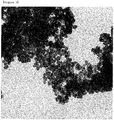
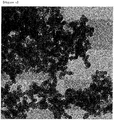
- FIG. 1 and FIG. 2 are TEM pictures (X 40000) measured after reducing the metal nanoparticles under air, and then stirring the result for 1 hour or 4 hours, respectively.
- X 40000 TEM pictures measured after reducing the metal nanoparticles under air, and then stirring the result for 1 hour or 4 hours, respectively.
- FIG. 3 and FIG. 4 are TEM pictures (X 40000) measured after reducing the metal nanoparticles under nitrogen atmosphere, and then stirring the result for 1 hour and 20 minutes, or 4 hours, respectively.
- the particles of FIG. 4 are hollow particles, and it can be seen that the particles of FIG. 4 have smoother surfaces compared to the particles of FIG. 2 .
- the hollow particle is a particle having a hollow core, and may have one cavity in a shell.
- Example 1 and Comparative Example 1 metal nanoparticles are synthesized changing only reaction atmosphere while fixing the amounts of the metal precursor, the reaction temperature, the surfactant, the surface stabilizer and the reducing agent, and TEM pictures thereof were measured. As can be identified from the TEM pictures, it was identified that the nanoparticles of Example 1 synthesized under air formed nanoparticles having a bowl shape and a hollow after one hour, and under nitrogen atmosphere, it was identified that nanoparticles including a hollow were formed after 4 hours.
- Example 1 The crystal structures of the particles manufactured in Example 1 and Comparative Example 1 were analyzed using X-ray diffraction (XRD, Bruker D4 Endeavor Cu-K ⁇ ).
- the 2 ⁇ value of the (111) peak of Pt particles appears at 39.8°, and in the case of an PtNi alloy, the 2 ⁇ value of the (111) peak of the PtNi alloy appears at 41.8°, which is an higher angle compared to the Pt, since Ni that is smaller compared to Pt is included therein leading to smaller lattice spacing. In a Pt 0.7 Ni 0.3 alloy, the 2 ⁇ value of the (111) peak appears between 39.8° and 41.8°.
- the XRD result of FIG. 5 shows changes in the XRD peaks depending on the stirring time of the nanoparticles synthesized in Example 1 after adding the reducing agent.
- peak max the maximum peak near 41° gradually shifted to lower angles as the stirring time after adding the reducing agent increased, and this was due the fact that, in the PtNi alloy, the maximum peak (peak max) shifted to the Pt side with the Ni melting and coming out by oxidative etching.
- the XRD pattern of FIG. 6 shows changes in the XRD peaks depending on the stirring time of the nanoparticles synthesized in Comparative Example 1 after adding the reducing agent. Unlike FIG. 5 , it was identified that the maximum peak (peak max) near 41° did not change much with time, and this was due to the fact that oxidative etching did not occur and the Ni did not melt and come out of the Pt 1-x Ni x alloy, which is different from the result of Example 1 in FIG. 5 .
- Example 1 had a composition of Pt 0.9 Ni 0.1
- the particles of Comparative Example 1 had a composition of Pt 0.7 Ni 0.3 .
Landscapes
- Chemical & Material Sciences (AREA)
- Organic Chemistry (AREA)
- Chemical Kinetics & Catalysis (AREA)
- Engineering & Computer Science (AREA)
- Materials Engineering (AREA)
- Dispersion Chemistry (AREA)
- Oil, Petroleum & Natural Gas (AREA)
- Catalysts (AREA)
- Manufacture Of Metal Powder And Suspensions Thereof (AREA)
Applications Claiming Priority (2)
| Application Number | Priority Date | Filing Date | Title |
|---|---|---|---|
| KR1020140127943A KR20160035941A (ko) | 2014-09-24 | 2014-09-24 | 중공 금속 나노입자, 이를 포함하는 촉매 및 중공 금속 나노입자의 제조방법 |
| PCT/KR2015/007096 WO2016047906A1 (fr) | 2014-09-24 | 2015-07-08 | Nanoparticule métallique creuse, catalyseur l'incluant, et procédé de fabrication de nanoparticules métalliques creuses |
Publications (2)
| Publication Number | Publication Date |
|---|---|
| EP3199232A1 true EP3199232A1 (fr) | 2017-08-02 |
| EP3199232A4 EP3199232A4 (fr) | 2018-05-23 |
Family
ID=55581394
Family Applications (1)
| Application Number | Title | Priority Date | Filing Date |
|---|---|---|---|
| EP15843945.5A Withdrawn EP3199232A4 (fr) | 2014-09-24 | 2015-07-08 | Nanoparticule métallique creuse, catalyseur l'incluant, et procédé de fabrication de nanoparticules métalliques creuses |
Country Status (5)
| Country | Link |
|---|---|
| US (1) | US20170128915A1 (fr) |
| EP (1) | EP3199232A4 (fr) |
| KR (1) | KR20160035941A (fr) |
| CN (1) | CN106488801A (fr) |
| WO (1) | WO2016047906A1 (fr) |
Families Citing this family (16)
| Publication number | Priority date | Publication date | Assignee | Title |
|---|---|---|---|---|
| CN105307799B (zh) * | 2013-06-07 | 2018-02-02 | Lg化学株式会社 | 中空金属纳米粒子 |
| US11581582B2 (en) | 2015-08-04 | 2023-02-14 | Honda Motor Co., Ltd. | Liquid-type room-temperature fluoride ion batteries |
| US11749797B2 (en) | 2016-12-15 | 2023-09-05 | Honda Motor Co., Ltd. | Nanostructural designs for electrode materials of fluoride ion batteries |
| US11177512B2 (en) | 2016-12-15 | 2021-11-16 | Honda Motor Co., Ltd. | Barium-doped composite electrode materials for fluoride-ion electrochemical cells |
| US12136735B2 (en) | 2018-12-05 | 2024-11-05 | Honda Motor Co., Ltd. | Electroactive materials modified with molecular thin film shell |
| EP3555940B1 (fr) | 2016-12-15 | 2023-08-30 | Honda Motor Co., Ltd. | Matériaux d'électrodes composites pour piles électrochimiques aux ions fluorure |
| CN107352514B (zh) * | 2017-08-25 | 2020-02-07 | 楚雄高新区核度富硒生物科技开发有限公司 | 一种高纯纳米硒的制备方法 |
| CN108356279B (zh) * | 2018-03-09 | 2019-05-14 | 华中科技大学 | 一种空心金纳米材料的制备方法 |
| CN114226710B (zh) * | 2018-04-06 | 2024-02-06 | 首尔大学校产学协力团 | 三维手性纳米结构 |
| US11228026B2 (en) | 2018-06-20 | 2022-01-18 | Honda Motor Co., Ltd. | Two phase shell formation on metal nanostructures |
| CN109358195B (zh) * | 2018-11-06 | 2022-04-26 | 枣庄学院 | 一种中空金铂合金纳米笼核-多空二氧化硅壳纳米酶及其制备方法和应用 |
| CN110907428B (zh) * | 2019-12-19 | 2022-12-27 | 哈尔滨工业大学 | 还原诱导法制备可重复利用的多孔sers金属基底的方法及其应用 |
| KR102391743B1 (ko) * | 2021-02-22 | 2022-04-28 | 경희대학교 산학협력단 | 이종금속 나노입자의 합성방법 |
| CN114082938B (zh) * | 2022-01-11 | 2023-08-25 | 苏州艾美特企业管理有限公司 | 一种金属粒子及其制备方法和应用 |
| CN115633499B (zh) * | 2022-08-18 | 2025-12-19 | 陕西科技大学 | 一种中空碳/Co高效电磁波吸收材料及其制备方法和应用 |
| CN116079046B (zh) * | 2023-03-10 | 2025-05-09 | 西安交通大学 | 一种Ru-Ir-M三元合金空心纳米晶体及其合成方法和应用 |
Family Cites Families (6)
| Publication number | Priority date | Publication date | Assignee | Title |
|---|---|---|---|---|
| US6752979B1 (en) * | 2000-11-21 | 2004-06-22 | Very Small Particle Company Pty Ltd | Production of metal oxide particles with nano-sized grains |
| JP4487067B2 (ja) * | 2004-07-30 | 2010-06-23 | 国立大学法人 宮崎大学 | 白金ナノ粒子及びその製造方法 |
| WO2011099957A1 (fr) * | 2010-02-12 | 2011-08-18 | Utc Power Corporation | Monocouche de platine sur des nanoparticules poreuses creuses présentant des surfaces élevées et procédé de fabrication |
| JP2015501387A (ja) * | 2012-05-11 | 2015-01-15 | エルジー・ケム・リミテッド | 中空金属ナノ粒子 |
| CN104884198B (zh) * | 2012-12-27 | 2017-11-17 | Lg化学株式会社 | 制备负载在载体上的中空金属纳米粒子的方法 |
| CN104884194A (zh) * | 2012-12-27 | 2015-09-02 | Lg化学株式会社 | 负载在载体上的中空金属纳米粒子 |
-
2014
- 2014-09-24 KR KR1020140127943A patent/KR20160035941A/ko not_active Ceased
-
2015
- 2015-07-08 US US15/320,934 patent/US20170128915A1/en not_active Abandoned
- 2015-07-08 EP EP15843945.5A patent/EP3199232A4/fr not_active Withdrawn
- 2015-07-08 CN CN201580037673.7A patent/CN106488801A/zh not_active Withdrawn
- 2015-07-08 WO PCT/KR2015/007096 patent/WO2016047906A1/fr not_active Ceased
Also Published As
| Publication number | Publication date |
|---|---|
| KR20160035941A (ko) | 2016-04-01 |
| CN106488801A (zh) | 2017-03-08 |
| US20170128915A1 (en) | 2017-05-11 |
| EP3199232A4 (fr) | 2018-05-23 |
| WO2016047906A1 (fr) | 2016-03-31 |
Similar Documents
| Publication | Publication Date | Title |
|---|---|---|
| EP3199232A1 (fr) | Nanoparticule métallique creuse, catalyseur l'incluant, et procédé de fabrication de nanoparticules métalliques creuses | |
| EP3028989B1 (fr) | Méthode de production d'un composite support de carbone-nanoparticules de métal et composite ainsi obtenu | |
| EP2939764B1 (fr) | Procédé de fabrication d'une nanoparticule métallique creuse supportée par un corps de support | |
| EP2990143B1 (fr) | Procédé de production de nanoparticules métalliques | |
| JP6705110B2 (ja) | 金属ナノ粒子 | |
| US10456838B2 (en) | Method for producing metal nanoparticles | |
| EP3012049B1 (fr) | Particules métalliques creuses, catalyseur d'électrode les comprenant, batterie électrochimique comprenant le catalyseur d'électrode, et procédé de fabrication de particules métalliques creuses | |
| KR101705489B1 (ko) | 금속 나노입자 | |
| EP2990138B1 (fr) | Nanoparticules métalliques creuses |
Legal Events
| Date | Code | Title | Description |
|---|---|---|---|
| PUAI | Public reference made under article 153(3) epc to a published international application that has entered the european phase |
Free format text: ORIGINAL CODE: 0009012 |
|
| 17P | Request for examination filed |
Effective date: 20170103 |
|
| AK | Designated contracting states |
Kind code of ref document: A1 Designated state(s): AL AT BE BG CH CY CZ DE DK EE ES FI FR GB GR HR HU IE IS IT LI LT LU LV MC MK MT NL NO PL PT RO RS SE SI SK SM TR |
|
| AX | Request for extension of the european patent |
Extension state: BA ME |
|
| DAV | Request for validation of the european patent (deleted) | ||
| DAX | Request for extension of the european patent (deleted) | ||
| A4 | Supplementary search report drawn up and despatched |
Effective date: 20180424 |
|
| RIC1 | Information provided on ipc code assigned before grant |
Ipc: B01J 37/16 20060101ALI20180419BHEP Ipc: B01J 13/02 20060101AFI20180419BHEP Ipc: B01J 23/00 20060101ALI20180419BHEP |
|
| STAA | Information on the status of an ep patent application or granted ep patent |
Free format text: STATUS: THE APPLICATION IS DEEMED TO BE WITHDRAWN |
|
| 18D | Application deemed to be withdrawn |
Effective date: 20181127 |